BIOLEACHING
BY SREEREMYA
Introduction
• Future sustainable development requires measures to
reduce the dependence on nonrenewable raw
materials and the demand for
primary resources. New resources for metals must be
developed with the aid of novel technologies. in
addition, improvement of alredy
existing mining techniques can result in metal recovery
from sources that have not been of economical interest
until today. Metal-winning processes based on the
activity of microorganisms offer a possibility to obtain
metals from mineral resources not accessible by
conventional mining
• Bioleaching is a process that employs
microorganisms to dissolve (leach) sulphide
minerals. It finds application in the extraction
of metals from their ores.
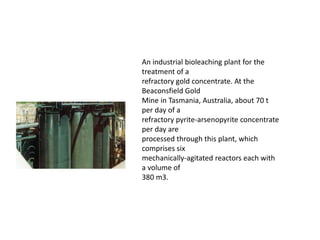
An industrial bioleaching plant for the
treatment of a
refractory gold concentrate. At the
Beaconsfield Gold
Mine in Tasmania, Australia, about 70 t
per day of a
refractory pyrite-arsenopyrite concentrate
per day are
processed through this plant, which
comprises six
mechanically-agitated reactors each with
a volume of
380 m3.
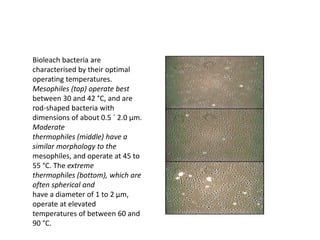
Bioleach bacteria are
characterised by their optimal
operating temperatures.
Mesophiles (top) operate best
between 30 and 42 °C, and are
rod-shaped bacteria with
dimensions of about 0.5 ´ 2.0 μm.
Moderate
thermophiles (middle) have a
similar morphology to the
mesophiles, and operate at 45 to
55 °C. The extreme
thermophiles (bottom), which are
often spherical and
have a diameter of 1 to 2 μm,
operate at elevated
temperatures of between 60 and
90 °C.
Bioleaching ppt
Bioleaching ppt
Bioleaching ppt
Bioleaching ppt
Bioleaching ppt
Bioleaching ppt
Bioleaching ppt
Bioleaching ppt
Bioleaching ppt
Bioleaching ppt
Bioleaching ppt
Bioleaching ppt
Bioleaching ppt

Bioleaching ppt

  • 1.
  • 2.
    Introduction • Future sustainabledevelopment requires measures to reduce the dependence on nonrenewable raw materials and the demand for primary resources. New resources for metals must be developed with the aid of novel technologies. in addition, improvement of alredy existing mining techniques can result in metal recovery from sources that have not been of economical interest until today. Metal-winning processes based on the activity of microorganisms offer a possibility to obtain metals from mineral resources not accessible by conventional mining
  • 3.
    • Bioleaching isa process that employs microorganisms to dissolve (leach) sulphide minerals. It finds application in the extraction of metals from their ores.
  • 4.
    An industrial bioleachingplant for the treatment of a refractory gold concentrate. At the Beaconsfield Gold Mine in Tasmania, Australia, about 70 t per day of a refractory pyrite-arsenopyrite concentrate per day are processed through this plant, which comprises six mechanically-agitated reactors each with a volume of 380 m3.
  • 5.
    Bioleach bacteria are characterisedby their optimal operating temperatures. Mesophiles (top) operate best between 30 and 42 °C, and are rod-shaped bacteria with dimensions of about 0.5 ´ 2.0 μm. Moderate thermophiles (middle) have a similar morphology to the mesophiles, and operate at 45 to 55 °C. The extreme thermophiles (bottom), which are often spherical and have a diameter of 1 to 2 μm, operate at elevated temperatures of between 60 and 90 °C.