Facts on Biodiversity
A Summary of the Millenium Ecosystem Assessment Biodiversity Synthesis


                                                        BIODIVERSITY contributes to many
                                                        aspects of human well-being, for
                                                        instance by providing raw materials and
                                                        contributing to health. Human actions,
                                                        however, often lead to irreversible
                                                        losses in terms of diversity of life on
                                                        Earth and these losses have been more
                                                        rapid in the past 50 years than ever
                                                        before in human history. What factors
                                                        are responsible for this rapid loss of
                                                        biodiversity? What would need to be
                                                        done to significantly slow this trend?
      EUROPEAN COMMISSION
DIRECTORATE GENERAL ENVIRONMENT
Biodiversity: What is it, where is it, and why is it important?
Biodiversity is the measure of the number, variety and variability of living   distribution of all components of biodiversity. Based on present
organisms. It includes diversity within species, between species, and          knowledge of how biodiversity changes over time, rough estimates can be
among ecosystems. The concept also covers how this diversity changes           made of the rates at which species become extinct.
from one location to another and over time. Indicators such as the
number of species in a given area can help in monitoring certain aspects       Ecosystem services are the benefits people obtain from ecosystems.
of biodiversity.                                                               Biodiversity plays an important role in the way ecosystems function and
                                                                               in the many services they provide. Services include nutrient and water
Biodiversity is everywhere, both on land and in water. It includes all         cycling, soil formation and retention, resistance against invasive species,
organisms, from microscopic bacteria to more complex plants and                pollination of plants, regulation of climate, as well as pest and pollution
animals. Current inventories of species, though useful, remain incomplete      control by ecosystems. For ecosystem services it matters which species
and insufficient for providing an accurate picture of the extent and           are abundant as well as how many species are present.


                                                                         Why is biodiversity loss a concern?
Biodiversity provides many key benefits to humans that go beyond the           Over the last century, some people have benefited from the conversion of
mere provision of raw materials.                                               natural ecosystems and an increase in international trade, but other
                                                                               people have suffered from the consequences of biodiversity losses and
Biodiversity loss has negative effects on several aspects of human well-       from restricted access to resources they depend upon. Changes in
being, such as food security, vulnerability to natural disasters, energy       ecosystems are harming many of the world’s poorest people, who are the
security, and access to clean water and raw materials. It also affects         least able to adjust to these changes.
human health, social relations, and freedom of choice.

Society tends to have various competing goals, many of which depend on
biodiversity. When humans modify an ecosystem to improve a service it
provides, this generally also results in changes to other ecosystem
services. For example, actions to increase food production can lead to
reduced water availability for other uses. As a result of such trade-offs,
many services have been degraded, for instance fisheries, water supply,
and protection against natural hazards. In the long term, the value of
services lost may greatly exceed the short-term economic benefits that
are gained from transforming ecosystems.

Unlike goods bought and sold in markets, many ecosystem services are
not traded in markets for readily observable prices. This means that the
importance of biodiversity and natural processes in providing benefits to
humans is ignored by financial markets. New methods are being used to
assign monetary values to benefits such as recreation or clean drinking
water. Degradation of ecosystem services could be significantly slowed
down or reversed if the full economic value of these services were taken
                                                                               Biodiversity loss increases our vulnerability to natural disasters.
into account in decision-making.


        What are the current trends in biodiversity?
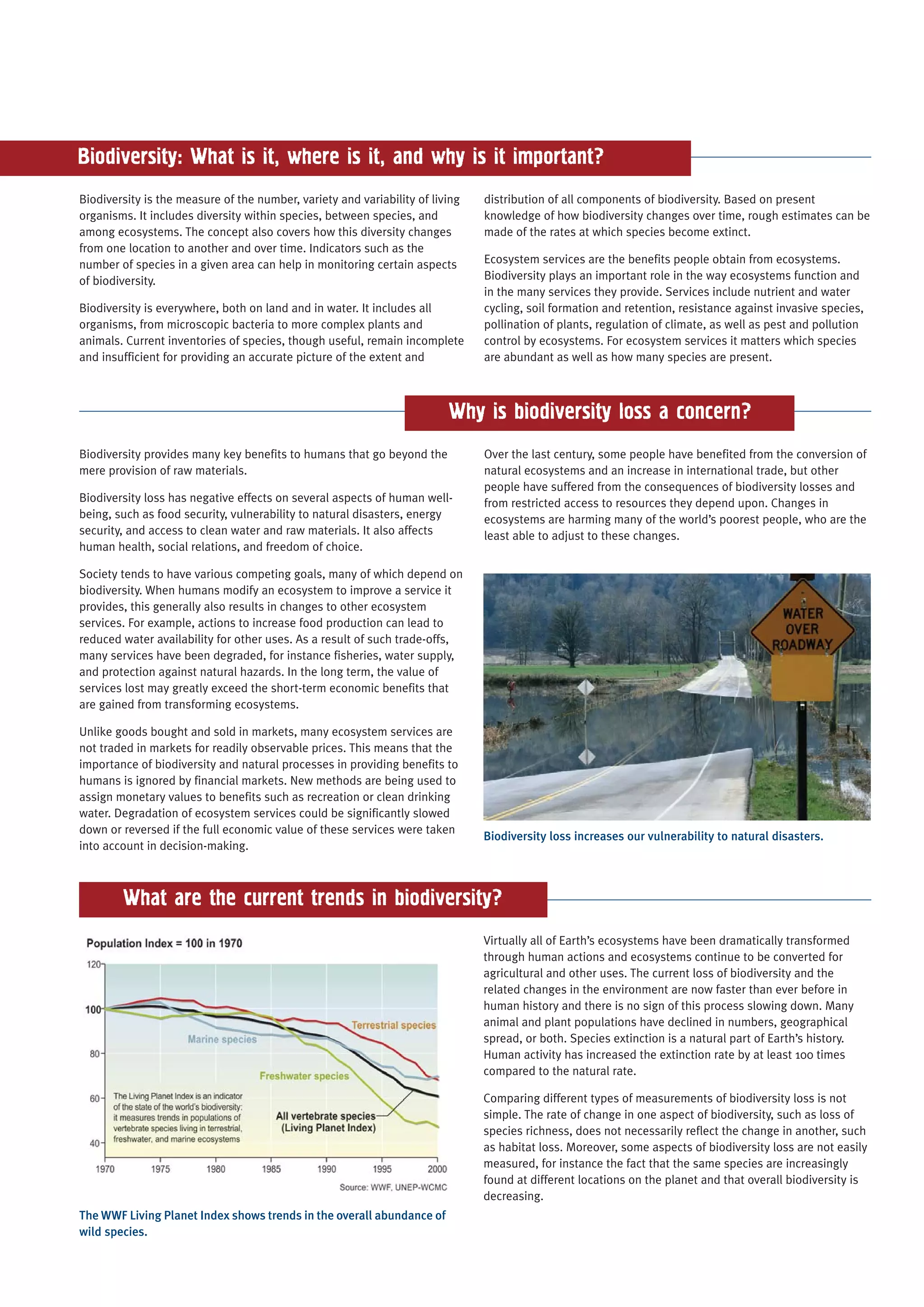
                                                                               Virtually all of Earth’s ecosystems have been dramatically transformed
                                                                               through human actions and ecosystems continue to be converted for
                                                                               agricultural and other uses. The current loss of biodiversity and the
                                                                               related changes in the environment are now faster than ever before in
                                                                               human history and there is no sign of this process slowing down. Many
                                                                               animal and plant populations have declined in numbers, geographical
                                                                               spread, or both. Species extinction is a natural part of Earth’s history.
                                                                               Human activity has increased the extinction rate by at least 100 times
                                                                               compared to the natural rate.

                                                                               Comparing different types of measurements of biodiversity loss is not
                                                                               simple. The rate of change in one aspect of biodiversity, such as loss of
                                                                               species richness, does not necessarily reflect the change in another, such
                                                                               as habitat loss. Moreover, some aspects of biodiversity loss are not easily
                                                                               measured, for instance the fact that the same species are increasingly
                                                                               found at different locations on the planet and that overall biodiversity is
                                                                               decreasing.
The WWF Living Planet Index shows trends in the overall abundance of
wild species.
What factors lead to biodiversity loss?
Biodiversity is declining rapidly due to factors such as land use change,      establish and spread outside their normal distribution; overexploitation
climate change, invasive species, overexploitation, and pollution. Such        of natural resources; and pollution, particularly by excessive fertilizer
natural or human-induced factors – referred to as drivers – tend to            use leading to excessive levels of nutrients in soil and water.
interact and amplify each other.
                                                                               Recent changes in climate have already had significant impacts on
While changes in biodiversity are more clearly linked to direct drivers        biodiversity and ecosystems in certain regions. As climate change will
such as habitat loss, they are also linked to indirect drivers that are at     become more severe, the harmful impacts on ecosystem services are
the root of many changes in ecosystems. The main indirect drivers are          expected to outweigh possible benefits, such as a longer growing season, in
changes in human population, economic activity, and technology, as well        most regions of the world. Climate change is expected to exacerbate risks of
as socio-political and cultural factors.                                       extinctions, floods, droughts, population declines, and disease outbreaks.

Different direct drivers have been critically important in different           Many drivers affecting biodiversity are stronger today than they were in
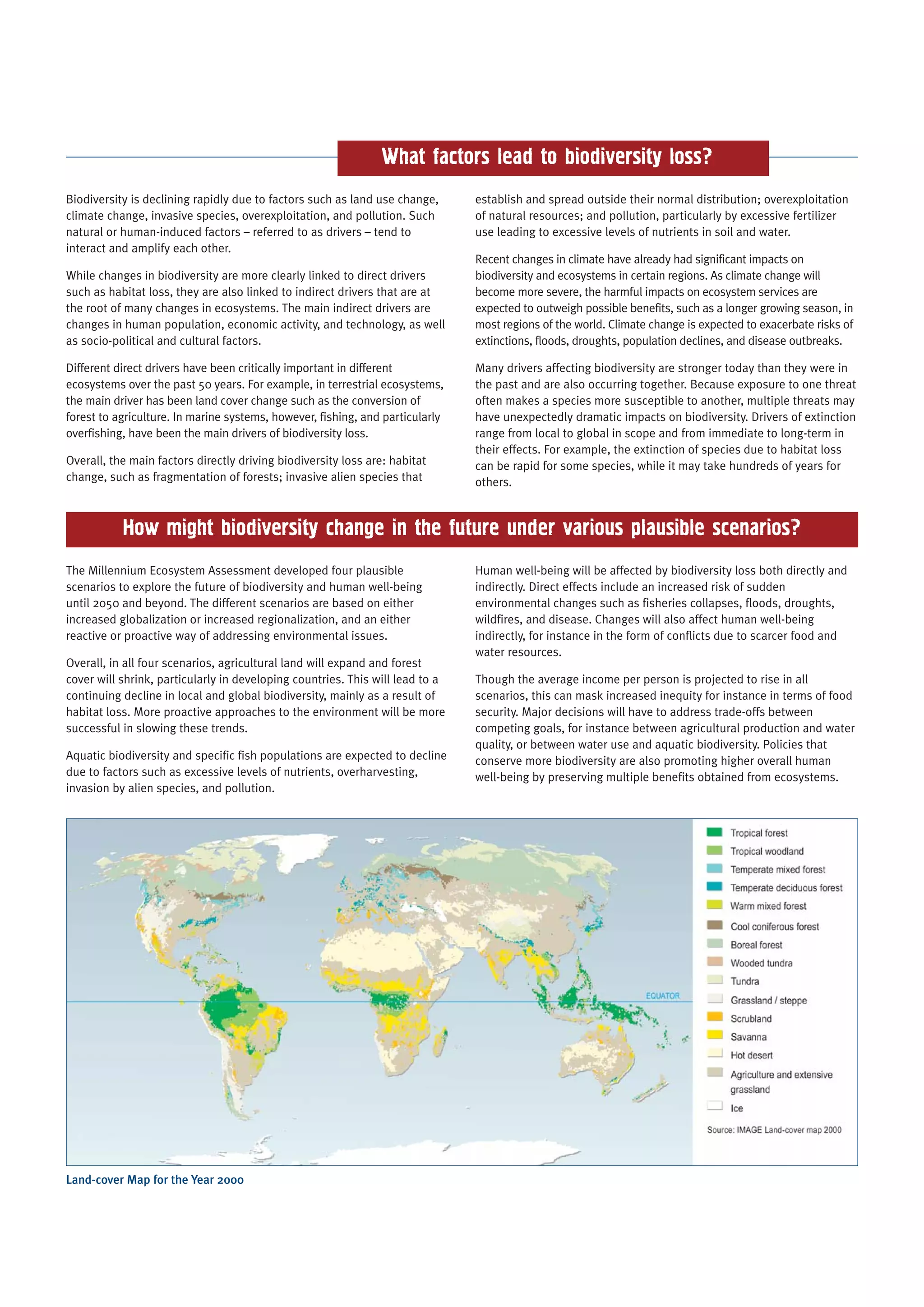
ecosystems over the past 50 years. For example, in terrestrial ecosystems,     the past and are also occurring together. Because exposure to one threat
the main driver has been land cover change such as the conversion of           often makes a species more susceptible to another, multiple threats may
forest to agriculture. In marine systems, however, fishing, and particularly   have unexpectedly dramatic impacts on biodiversity. Drivers of extinction
overfishing, have been the main drivers of biodiversity loss.                  range from local to global in scope and from immediate to long-term in
                                                                               their effects. For example, the extinction of species due to habitat loss
Overall, the main factors directly driving biodiversity loss are: habitat      can be rapid for some species, while it may take hundreds of years for
change, such as fragmentation of forests; invasive alien species that          others.


           How might biodiversity change in the future under various plausible scenarios?
The Millennium Ecosystem Assessment developed four plausible                   Human well-being will be affected by biodiversity loss both directly and
scenarios to explore the future of biodiversity and human well-being           indirectly. Direct effects include an increased risk of sudden
until 2050 and beyond. The different scenarios are based on either             environmental changes such as fisheries collapses, floods, droughts,
increased globalization or increased regionalization, and an either            wildfires, and disease. Changes will also affect human well-being
reactive or proactive way of addressing environmental issues.                  indirectly, for instance in the form of conflicts due to scarcer food and
                                                                               water resources.
Overall, in all four scenarios, agricultural land will expand and forest
cover will shrink, particularly in developing countries. This will lead to a   Though the average income per person is projected to rise in all
continuing decline in local and global biodiversity, mainly as a result of     scenarios, this can mask increased inequity for instance in terms of food
habitat loss. More proactive approaches to the environment will be more        security. Major decisions will have to address trade-offs between
successful in slowing these trends.                                            competing goals, for instance between agricultural production and water
                                                                               quality, or between water use and aquatic biodiversity. Policies that
Aquatic biodiversity and specific fish populations are expected to decline     conserve more biodiversity are also promoting higher overall human
due to factors such as excessive levels of nutrients, overharvesting,          well-being by preserving multiple benefits obtained from ecosystems.
invasion by alien species, and pollution.


Land-cover Map for the Year 2000
What actions can be taken to conserve biodiversity?
Protected areas are an essential part of conservation programs, but they
are not sufficient by themselves to protect the full range of biodiversity
and can be difficult to enforce. To be successful, sites for protected areas
need to be carefully chosen, ensuring that all regional ecosystems are
well represented, and the areas need to be well designed and effectively
managed.

Market tools, such as direct payments for ecosystem services or
transfers of ownership rights to private individuals, can provide
economic incentives to conserve biodiversity and to use ecosystem
services sustainably.

Prevention and early intervention have proven to be the most successful
and cost-effective way of tackling invasive species. Once an invasive
species has become established, its control and particularly its
eradication through the use of chemicals or through the introduction of
other species is not necessarily effective and is extremely difficult and
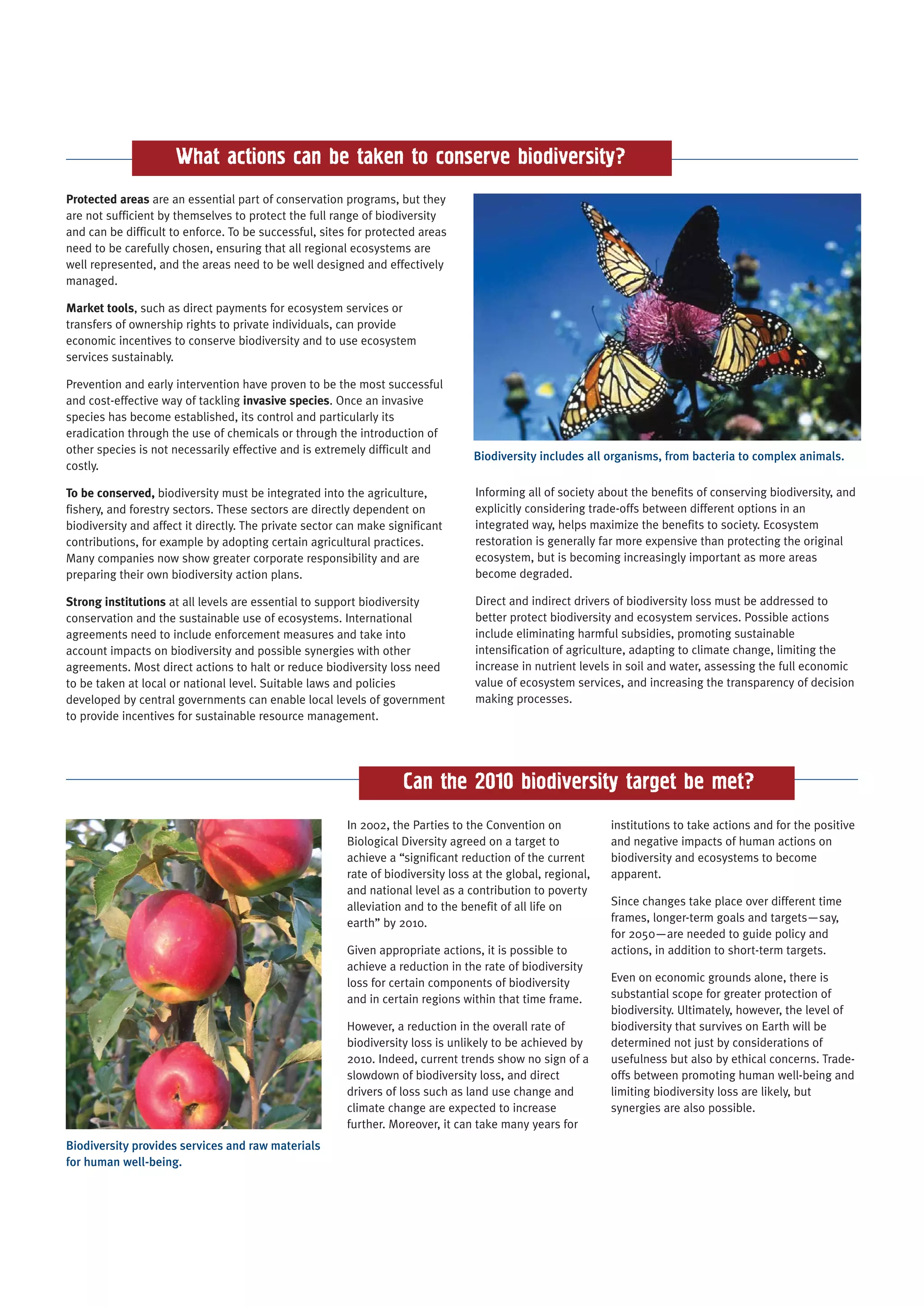
                                                                                  Biodiversity includes all organisms, from bacteria to complex animals.
costly.

To be conserved, biodiversity must be integrated into the agriculture,            Informing all of society about the benefits of conserving biodiversity, and
fishery, and forestry sectors. These sectors are directly dependent on            explicitly considering trade-offs between different options in an
biodiversity and affect it directly. The private sector can make significant      integrated way, helps maximize the benefits to society. Ecosystem
contributions, for example by adopting certain agricultural practices.            restoration is generally far more expensive than protecting the original
Many companies now show greater corporate responsibility and are                  ecosystem, but is becoming increasingly important as more areas
preparing their own biodiversity action plans.                                    become degraded.

Strong institutions at all levels are essential to support biodiversity           Direct and indirect drivers of biodiversity loss must be addressed to
conservation and the sustainable use of ecosystems. International                 better protect biodiversity and ecosystem services. Possible actions
agreements need to include enforcement measures and take into                     include eliminating harmful subsidies, promoting sustainable
account impacts on biodiversity and possible synergies with other                 intensification of agriculture, adapting to climate change, limiting the
agreements. Most direct actions to halt or reduce biodiversity loss need          increase in nutrient levels in soil and water, assessing the full economic
to be taken at local or national level. Suitable laws and policies                value of ecosystem services, and increasing the transparency of decision
developed by central governments can enable local levels of government            making processes.
to provide incentives for sustainable resource management.


                                                                    Can the 2010 biodiversity target be met?
                                                        In 2002, the Parties to the Convention on            institutions to take actions and for the positive
                                                        Biological Diversity agreed on a target to           and negative impacts of human actions on
                                                        achieve a “significant reduction of the current      biodiversity and ecosystems to become
                                                        rate of biodiversity loss at the global, regional,   apparent.
                                                        and national level as a contribution to poverty
                                                        alleviation and to the benefit of all life on        Since changes take place over different time
                                                        earth” by 2010.                                      frames, longer-term goals and targets—say,
                                                                                                             for 2050—are needed to guide policy and
                                                        Given appropriate actions, it is possible to         actions, in addition to short-term targets.
                                                        achieve a reduction in the rate of biodiversity
                                                        loss for certain components of biodiversity          Even on economic grounds alone, there is
                                                        and in certain regions within that time frame.       substantial scope for greater protection of
                                                                                                             biodiversity. Ultimately, however, the level of
                                                        However, a reduction in the overall rate of          biodiversity that survives on Earth will be
                                                        biodiversity loss is unlikely to be achieved by      determined not just by considerations of
                                                        2010. Indeed, current trends show no sign of a       usefulness but also by ethical concerns. Trade-
                                                        slowdown of biodiversity loss, and direct            offs between promoting human well-being and
                                                        drivers of loss such as land use change and          limiting biodiversity loss are likely, but
                                                        climate change are expected to increase              synergies are also possible.
                                                        further. Moreover, it can take many years for
Biodiversity provides services and raw materials
for human well-being.
Conclusion
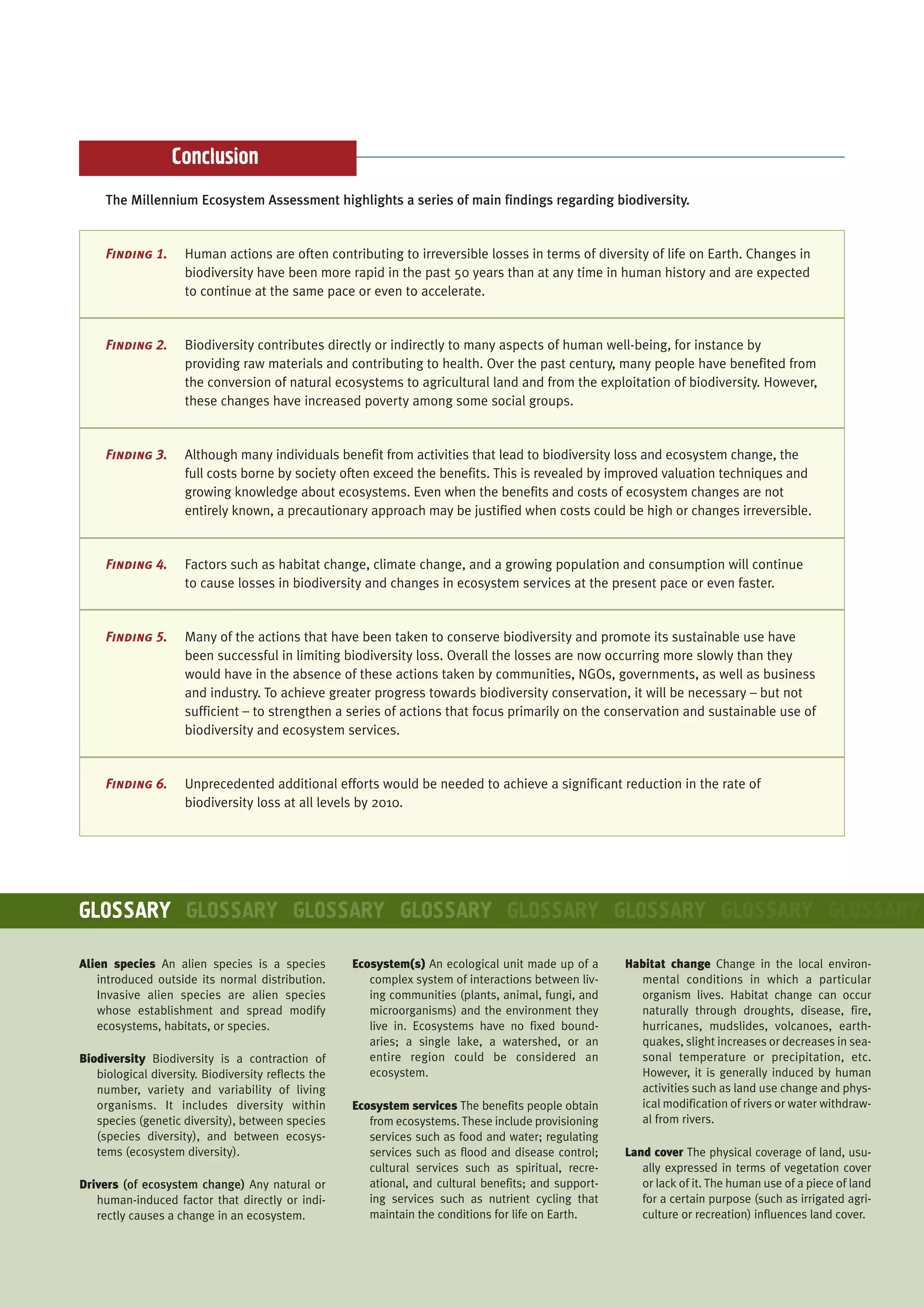
     The Millennium Ecosystem Assessment highlights a series of main findings regarding biodiversity.


     Finding 1.      Human actions are often contributing to irreversible losses in terms of diversity of life on Earth. Changes in
                     biodiversity have been more rapid in the past 50 years than at any time in human history and are expected
                     to continue at the same pace or even to accelerate.


     Finding 2.      Biodiversity contributes directly or indirectly to many aspects of human well-being, for instance by
                     providing raw materials and contributing to health. Over the past century, many people have benefited from
                     the conversion of natural ecosystems to agricultural land and from the exploitation of biodiversity. However,
                     these changes have increased poverty among some social groups.


     Finding 3.      Although many individuals benefit from activities that lead to biodiversity loss and ecosystem change, the
                     full costs borne by society often exceed the benefits. This is revealed by improved valuation techniques and
                     growing knowledge about ecosystems. Even when the benefits and costs of ecosystem changes are not
                     entirely known, a precautionary approach may be justified when costs could be high or changes irreversible.


     Finding 4.      Factors such as habitat change, climate change, and a growing population and consumption will continue
                     to cause losses in biodiversity and changes in ecosystem services at the present pace or even faster.


     Finding 5.      Many of the actions that have been taken to conserve biodiversity and promote its sustainable use have
                     been successful in limiting biodiversity loss. Overall the losses are now occurring more slowly than they
                     would have in the absence of these actions taken by communities, NGOs, governments, as well as business
                     and industry. To achieve greater progress towards biodiversity conservation, it will be necessary – but not
                     sufficient – to strengthen a series of actions that focus primarily on the conservation and sustainable use of
                     biodiversity and ecosystem services.


     Finding 6.      Unprecedented additional efforts would be needed to achieve a significant reduction in the rate of
                     biodiversity loss at all levels by 2010.


GLOSSARY GLOSSARY GLOSSARY GLOSSARY GLOSSARY GLOSSARY GLOSSARY GLOSSARY

Alien species An alien species is a species          Ecosystem(s) An ecological unit made up of a      Habitat change Change in the local environ-
   introduced outside its normal distribution.          complex system of interactions between liv-      mental conditions in which a particular
   Invasive alien species are alien species             ing communities (plants, animal, fungi, and      organism lives. Habitat change can occur
   whose establishment and spread modify                microorganisms) and the environment they         naturally through droughts, disease, fire,
   ecosystems, habitats, or species.                    live in. Ecosystems have no fixed bound-         hurricanes, mudslides, volcanoes, earth-
                                                        aries; a single lake, a watershed, or an         quakes, slight increases or decreases in sea-
Biodiversity Biodiversity is a contraction of           entire region could be considered an             sonal temperature or precipitation, etc.
   biological diversity. Biodiversity reflects the      ecosystem.                                       However, it is generally induced by human
   number, variety and variability of living                                                             activities such as land use change and phys-
   organisms. It includes diversity within           Ecosystem services The benefits people obtain       ical modification of rivers or water withdraw-
   species (genetic diversity), between species         from ecosystems. These include provisioning      al from rivers.
   (species diversity), and between ecosys-             services such as food and water; regulating
   tems (ecosystem diversity).                          services such as flood and disease control;    Land cover The physical coverage of land, usu-
                                                        cultural services such as spiritual, recre-       ally expressed in terms of vegetation cover
Drivers (of ecosystem change) Any natural or            ational, and cultural benefits; and support-      or lack of it. The human use of a piece of land
   human-induced factor that directly or indi-          ing services such as nutrient cycling that        for a certain purpose (such as irrigated agri-
   rectly causes a change in an ecosystem.              maintain the conditions for life on Earth.        culture or recreation) influences land cover.
Facts on Biodiversity
    This foldout presents a faithful summary of one of several leading scientific                      A more detailed summary can be found at
    consensus reports produced in 2005 by the Millennium Ecosystem Assessment                          www.greenfacts.org/biodiversity
    (MA): Ecosystems and Human Well-being: Biodiversity Synthesis.                                     in English, French, Dutch and Spanish

    The Millennium Assessment was launched by UN Secretary-General Kofi Annan in 2001 to provide scientific information
    concerning the consequences of ecosystem change for human well-being and options for responding to those changes. It involved
    over 1300 scientists from 95 countries and a partnership among several international organizations, including the Convention on
    Biological Diversity, UN Convention to Combat Desertification, Ramsar Convention on Wetlands, Convention on Migratory Species,
    five UN agencies, the World Bank, and IUCN.


                                                                                                                                                                    Printed on recycled paper
    The Biodiversity Synthesis Report, one of the main products of this work, responds to requests for information received through
    the Convention on Biological Diversity (CBD) and provides an overview of the links between the state of our ecosystems and the
    biodiversity they contain. The full report is available at: www.millenniumassessment.org


                                                                                                                                                                                  ■
                                                                                                                                                                Concept & layout: beëlzePub
PARTNERS
The following partners teamed up to make this information available to a wider audience:


                                                                                                                                                                                  ■
                                                                                                                                                                Pictures: Grant V Faint, Alex L Fradkin, Messa, Millennium Ecosystem Assessment
Countdown 2010 collaborates          GreenFacts asbl/vzw, an inde-           The UNEP World Conservation                  The World Conservation Union
closely with countries, regions,     pendent non-profit organisation         Monitoring Centre is the biodiver-           (IUCN) brings together some
and civil society to help govern-    based in Brussels, has prepared         sity assessment and policy sup-              10 000 scientists and experts from
ments reduce biodiversity loss by    this summary of the Biodiversity        port arm of the United Nations               181 countries in a unique world-
2010. At the World Summit for        Synthesis Report and published it       Environment Programme, the                   wide partnership to protect biodi-
Sustainable Development and          online. GreenFacts’ mission is to       world's foremost intergovernmen-             versity and work for the sustain-
other occasions, world leaders       make complex scientific consen-         tal environmental organization.              able use of natural resources.
committed to achieve this 2010       sus reports on health and the           For over twenty-five years the               Within this framework, the IUCN
biodiversity target and thus to      environment accessible to non-          Centre has been undertaking sci-             Regional Office for Europe in
meet the challenges outlined in      specialists. Its summaries are          entific research and providing               Brussels has the mission to foster
this report.                         produced under the control of the       practical policy advice to help              and fortify a European network of
                                     GreenFacts Scientific Board com-        decision makers recognise the                excellence in environmental
www.countdown2010.net                posed of independent scientists.        value of biodiversity and apply this         research, policy and best practice.
info@countdown2010.net                                                       knowledge to all that they do.
Tel: +32 (0)2 739 0320               www.greenfacts.org                                                                   www.iucneurope.org
                                     2006@greenfacts.org                     www.unep-wcmc.org                            europe@iucn.org
                                     Tel: +32 (0)2 211 34 88                 Tel: +44 (0)1223 277314                      Tel: +32 (0)2 732 8299


SPONSORS
This foldout has been produced with the kind support of
                                                                                                                                                                                  ■
                                                                                                                                                                Editeur responsable: Jacques de Selliers


                                                                           EUROPEAN COMMISSION
                                                                     DIRECTORATE GENERAL ENVIRONMENT

Scientific Facts on Biodiversity & Human Well-being

  • 1.
    Facts on Biodiversity ASummary of the Millenium Ecosystem Assessment Biodiversity Synthesis BIODIVERSITY contributes to many aspects of human well-being, for instance by providing raw materials and contributing to health. Human actions, however, often lead to irreversible losses in terms of diversity of life on Earth and these losses have been more rapid in the past 50 years than ever before in human history. What factors are responsible for this rapid loss of biodiversity? What would need to be done to significantly slow this trend? EUROPEAN COMMISSION DIRECTORATE GENERAL ENVIRONMENT
  • 2.
    Biodiversity: What isit, where is it, and why is it important? Biodiversity is the measure of the number, variety and variability of living distribution of all components of biodiversity. Based on present organisms. It includes diversity within species, between species, and knowledge of how biodiversity changes over time, rough estimates can be among ecosystems. The concept also covers how this diversity changes made of the rates at which species become extinct. from one location to another and over time. Indicators such as the number of species in a given area can help in monitoring certain aspects Ecosystem services are the benefits people obtain from ecosystems. of biodiversity. Biodiversity plays an important role in the way ecosystems function and in the many services they provide. Services include nutrient and water Biodiversity is everywhere, both on land and in water. It includes all cycling, soil formation and retention, resistance against invasive species, organisms, from microscopic bacteria to more complex plants and pollination of plants, regulation of climate, as well as pest and pollution animals. Current inventories of species, though useful, remain incomplete control by ecosystems. For ecosystem services it matters which species and insufficient for providing an accurate picture of the extent and are abundant as well as how many species are present. Why is biodiversity loss a concern? Biodiversity provides many key benefits to humans that go beyond the Over the last century, some people have benefited from the conversion of mere provision of raw materials. natural ecosystems and an increase in international trade, but other people have suffered from the consequences of biodiversity losses and Biodiversity loss has negative effects on several aspects of human well- from restricted access to resources they depend upon. Changes in being, such as food security, vulnerability to natural disasters, energy ecosystems are harming many of the world’s poorest people, who are the security, and access to clean water and raw materials. It also affects least able to adjust to these changes. human health, social relations, and freedom of choice. Society tends to have various competing goals, many of which depend on biodiversity. When humans modify an ecosystem to improve a service it provides, this generally also results in changes to other ecosystem services. For example, actions to increase food production can lead to reduced water availability for other uses. As a result of such trade-offs, many services have been degraded, for instance fisheries, water supply, and protection against natural hazards. In the long term, the value of services lost may greatly exceed the short-term economic benefits that are gained from transforming ecosystems. Unlike goods bought and sold in markets, many ecosystem services are not traded in markets for readily observable prices. This means that the importance of biodiversity and natural processes in providing benefits to humans is ignored by financial markets. New methods are being used to assign monetary values to benefits such as recreation or clean drinking water. Degradation of ecosystem services could be significantly slowed down or reversed if the full economic value of these services were taken Biodiversity loss increases our vulnerability to natural disasters. into account in decision-making. What are the current trends in biodiversity? Virtually all of Earth’s ecosystems have been dramatically transformed through human actions and ecosystems continue to be converted for agricultural and other uses. The current loss of biodiversity and the related changes in the environment are now faster than ever before in human history and there is no sign of this process slowing down. Many animal and plant populations have declined in numbers, geographical spread, or both. Species extinction is a natural part of Earth’s history. Human activity has increased the extinction rate by at least 100 times compared to the natural rate. Comparing different types of measurements of biodiversity loss is not simple. The rate of change in one aspect of biodiversity, such as loss of species richness, does not necessarily reflect the change in another, such as habitat loss. Moreover, some aspects of biodiversity loss are not easily measured, for instance the fact that the same species are increasingly found at different locations on the planet and that overall biodiversity is decreasing. The WWF Living Planet Index shows trends in the overall abundance of wild species.
  • 3.
    What factors leadto biodiversity loss? Biodiversity is declining rapidly due to factors such as land use change, establish and spread outside their normal distribution; overexploitation climate change, invasive species, overexploitation, and pollution. Such of natural resources; and pollution, particularly by excessive fertilizer natural or human-induced factors – referred to as drivers – tend to use leading to excessive levels of nutrients in soil and water. interact and amplify each other. Recent changes in climate have already had significant impacts on While changes in biodiversity are more clearly linked to direct drivers biodiversity and ecosystems in certain regions. As climate change will such as habitat loss, they are also linked to indirect drivers that are at become more severe, the harmful impacts on ecosystem services are the root of many changes in ecosystems. The main indirect drivers are expected to outweigh possible benefits, such as a longer growing season, in changes in human population, economic activity, and technology, as well most regions of the world. Climate change is expected to exacerbate risks of as socio-political and cultural factors. extinctions, floods, droughts, population declines, and disease outbreaks. Different direct drivers have been critically important in different Many drivers affecting biodiversity are stronger today than they were in ecosystems over the past 50 years. For example, in terrestrial ecosystems, the past and are also occurring together. Because exposure to one threat the main driver has been land cover change such as the conversion of often makes a species more susceptible to another, multiple threats may forest to agriculture. In marine systems, however, fishing, and particularly have unexpectedly dramatic impacts on biodiversity. Drivers of extinction overfishing, have been the main drivers of biodiversity loss. range from local to global in scope and from immediate to long-term in their effects. For example, the extinction of species due to habitat loss Overall, the main factors directly driving biodiversity loss are: habitat can be rapid for some species, while it may take hundreds of years for change, such as fragmentation of forests; invasive alien species that others. How might biodiversity change in the future under various plausible scenarios? The Millennium Ecosystem Assessment developed four plausible Human well-being will be affected by biodiversity loss both directly and scenarios to explore the future of biodiversity and human well-being indirectly. Direct effects include an increased risk of sudden until 2050 and beyond. The different scenarios are based on either environmental changes such as fisheries collapses, floods, droughts, increased globalization or increased regionalization, and an either wildfires, and disease. Changes will also affect human well-being reactive or proactive way of addressing environmental issues. indirectly, for instance in the form of conflicts due to scarcer food and water resources. Overall, in all four scenarios, agricultural land will expand and forest cover will shrink, particularly in developing countries. This will lead to a Though the average income per person is projected to rise in all continuing decline in local and global biodiversity, mainly as a result of scenarios, this can mask increased inequity for instance in terms of food habitat loss. More proactive approaches to the environment will be more security. Major decisions will have to address trade-offs between successful in slowing these trends. competing goals, for instance between agricultural production and water quality, or between water use and aquatic biodiversity. Policies that Aquatic biodiversity and specific fish populations are expected to decline conserve more biodiversity are also promoting higher overall human due to factors such as excessive levels of nutrients, overharvesting, well-being by preserving multiple benefits obtained from ecosystems. invasion by alien species, and pollution. Land-cover Map for the Year 2000
  • 4.
    What actions canbe taken to conserve biodiversity? Protected areas are an essential part of conservation programs, but they are not sufficient by themselves to protect the full range of biodiversity and can be difficult to enforce. To be successful, sites for protected areas need to be carefully chosen, ensuring that all regional ecosystems are well represented, and the areas need to be well designed and effectively managed. Market tools, such as direct payments for ecosystem services or transfers of ownership rights to private individuals, can provide economic incentives to conserve biodiversity and to use ecosystem services sustainably. Prevention and early intervention have proven to be the most successful and cost-effective way of tackling invasive species. Once an invasive species has become established, its control and particularly its eradication through the use of chemicals or through the introduction of other species is not necessarily effective and is extremely difficult and Biodiversity includes all organisms, from bacteria to complex animals. costly. To be conserved, biodiversity must be integrated into the agriculture, Informing all of society about the benefits of conserving biodiversity, and fishery, and forestry sectors. These sectors are directly dependent on explicitly considering trade-offs between different options in an biodiversity and affect it directly. The private sector can make significant integrated way, helps maximize the benefits to society. Ecosystem contributions, for example by adopting certain agricultural practices. restoration is generally far more expensive than protecting the original Many companies now show greater corporate responsibility and are ecosystem, but is becoming increasingly important as more areas preparing their own biodiversity action plans. become degraded. Strong institutions at all levels are essential to support biodiversity Direct and indirect drivers of biodiversity loss must be addressed to conservation and the sustainable use of ecosystems. International better protect biodiversity and ecosystem services. Possible actions agreements need to include enforcement measures and take into include eliminating harmful subsidies, promoting sustainable account impacts on biodiversity and possible synergies with other intensification of agriculture, adapting to climate change, limiting the agreements. Most direct actions to halt or reduce biodiversity loss need increase in nutrient levels in soil and water, assessing the full economic to be taken at local or national level. Suitable laws and policies value of ecosystem services, and increasing the transparency of decision developed by central governments can enable local levels of government making processes. to provide incentives for sustainable resource management. Can the 2010 biodiversity target be met? In 2002, the Parties to the Convention on institutions to take actions and for the positive Biological Diversity agreed on a target to and negative impacts of human actions on achieve a “significant reduction of the current biodiversity and ecosystems to become rate of biodiversity loss at the global, regional, apparent. and national level as a contribution to poverty alleviation and to the benefit of all life on Since changes take place over different time earth” by 2010. frames, longer-term goals and targets—say, for 2050—are needed to guide policy and Given appropriate actions, it is possible to actions, in addition to short-term targets. achieve a reduction in the rate of biodiversity loss for certain components of biodiversity Even on economic grounds alone, there is and in certain regions within that time frame. substantial scope for greater protection of biodiversity. Ultimately, however, the level of However, a reduction in the overall rate of biodiversity that survives on Earth will be biodiversity loss is unlikely to be achieved by determined not just by considerations of 2010. Indeed, current trends show no sign of a usefulness but also by ethical concerns. Trade- slowdown of biodiversity loss, and direct offs between promoting human well-being and drivers of loss such as land use change and limiting biodiversity loss are likely, but climate change are expected to increase synergies are also possible. further. Moreover, it can take many years for Biodiversity provides services and raw materials for human well-being.
  • 5.
    Conclusion The Millennium Ecosystem Assessment highlights a series of main findings regarding biodiversity. Finding 1. Human actions are often contributing to irreversible losses in terms of diversity of life on Earth. Changes in biodiversity have been more rapid in the past 50 years than at any time in human history and are expected to continue at the same pace or even to accelerate. Finding 2. Biodiversity contributes directly or indirectly to many aspects of human well-being, for instance by providing raw materials and contributing to health. Over the past century, many people have benefited from the conversion of natural ecosystems to agricultural land and from the exploitation of biodiversity. However, these changes have increased poverty among some social groups. Finding 3. Although many individuals benefit from activities that lead to biodiversity loss and ecosystem change, the full costs borne by society often exceed the benefits. This is revealed by improved valuation techniques and growing knowledge about ecosystems. Even when the benefits and costs of ecosystem changes are not entirely known, a precautionary approach may be justified when costs could be high or changes irreversible. Finding 4. Factors such as habitat change, climate change, and a growing population and consumption will continue to cause losses in biodiversity and changes in ecosystem services at the present pace or even faster. Finding 5. Many of the actions that have been taken to conserve biodiversity and promote its sustainable use have been successful in limiting biodiversity loss. Overall the losses are now occurring more slowly than they would have in the absence of these actions taken by communities, NGOs, governments, as well as business and industry. To achieve greater progress towards biodiversity conservation, it will be necessary – but not sufficient – to strengthen a series of actions that focus primarily on the conservation and sustainable use of biodiversity and ecosystem services. Finding 6. Unprecedented additional efforts would be needed to achieve a significant reduction in the rate of biodiversity loss at all levels by 2010. GLOSSARY GLOSSARY GLOSSARY GLOSSARY GLOSSARY GLOSSARY GLOSSARY GLOSSARY Alien species An alien species is a species Ecosystem(s) An ecological unit made up of a Habitat change Change in the local environ- introduced outside its normal distribution. complex system of interactions between liv- mental conditions in which a particular Invasive alien species are alien species ing communities (plants, animal, fungi, and organism lives. Habitat change can occur whose establishment and spread modify microorganisms) and the environment they naturally through droughts, disease, fire, ecosystems, habitats, or species. live in. Ecosystems have no fixed bound- hurricanes, mudslides, volcanoes, earth- aries; a single lake, a watershed, or an quakes, slight increases or decreases in sea- Biodiversity Biodiversity is a contraction of entire region could be considered an sonal temperature or precipitation, etc. biological diversity. Biodiversity reflects the ecosystem. However, it is generally induced by human number, variety and variability of living activities such as land use change and phys- organisms. It includes diversity within Ecosystem services The benefits people obtain ical modification of rivers or water withdraw- species (genetic diversity), between species from ecosystems. These include provisioning al from rivers. (species diversity), and between ecosys- services such as food and water; regulating tems (ecosystem diversity). services such as flood and disease control; Land cover The physical coverage of land, usu- cultural services such as spiritual, recre- ally expressed in terms of vegetation cover Drivers (of ecosystem change) Any natural or ational, and cultural benefits; and support- or lack of it. The human use of a piece of land human-induced factor that directly or indi- ing services such as nutrient cycling that for a certain purpose (such as irrigated agri- rectly causes a change in an ecosystem. maintain the conditions for life on Earth. culture or recreation) influences land cover.
  • 6.
    Facts on Biodiversity This foldout presents a faithful summary of one of several leading scientific A more detailed summary can be found at consensus reports produced in 2005 by the Millennium Ecosystem Assessment www.greenfacts.org/biodiversity (MA): Ecosystems and Human Well-being: Biodiversity Synthesis. in English, French, Dutch and Spanish The Millennium Assessment was launched by UN Secretary-General Kofi Annan in 2001 to provide scientific information concerning the consequences of ecosystem change for human well-being and options for responding to those changes. It involved over 1300 scientists from 95 countries and a partnership among several international organizations, including the Convention on Biological Diversity, UN Convention to Combat Desertification, Ramsar Convention on Wetlands, Convention on Migratory Species, five UN agencies, the World Bank, and IUCN. Printed on recycled paper The Biodiversity Synthesis Report, one of the main products of this work, responds to requests for information received through the Convention on Biological Diversity (CBD) and provides an overview of the links between the state of our ecosystems and the biodiversity they contain. The full report is available at: www.millenniumassessment.org ■ Concept & layout: beëlzePub PARTNERS The following partners teamed up to make this information available to a wider audience: ■ Pictures: Grant V Faint, Alex L Fradkin, Messa, Millennium Ecosystem Assessment Countdown 2010 collaborates GreenFacts asbl/vzw, an inde- The UNEP World Conservation The World Conservation Union closely with countries, regions, pendent non-profit organisation Monitoring Centre is the biodiver- (IUCN) brings together some and civil society to help govern- based in Brussels, has prepared sity assessment and policy sup- 10 000 scientists and experts from ments reduce biodiversity loss by this summary of the Biodiversity port arm of the United Nations 181 countries in a unique world- 2010. At the World Summit for Synthesis Report and published it Environment Programme, the wide partnership to protect biodi- Sustainable Development and online. GreenFacts’ mission is to world's foremost intergovernmen- versity and work for the sustain- other occasions, world leaders make complex scientific consen- tal environmental organization. able use of natural resources. committed to achieve this 2010 sus reports on health and the For over twenty-five years the Within this framework, the IUCN biodiversity target and thus to environment accessible to non- Centre has been undertaking sci- Regional Office for Europe in meet the challenges outlined in specialists. Its summaries are entific research and providing Brussels has the mission to foster this report. produced under the control of the practical policy advice to help and fortify a European network of GreenFacts Scientific Board com- decision makers recognise the excellence in environmental www.countdown2010.net posed of independent scientists. value of biodiversity and apply this research, policy and best practice. info@countdown2010.net knowledge to all that they do. Tel: +32 (0)2 739 0320 www.greenfacts.org www.iucneurope.org 2006@greenfacts.org www.unep-wcmc.org europe@iucn.org Tel: +32 (0)2 211 34 88 Tel: +44 (0)1223 277314 Tel: +32 (0)2 732 8299 SPONSORS This foldout has been produced with the kind support of ■ Editeur responsable: Jacques de Selliers EUROPEAN COMMISSION DIRECTORATE GENERAL ENVIRONMENT