BIODIVERSITY AND ITS
CONSERVATION
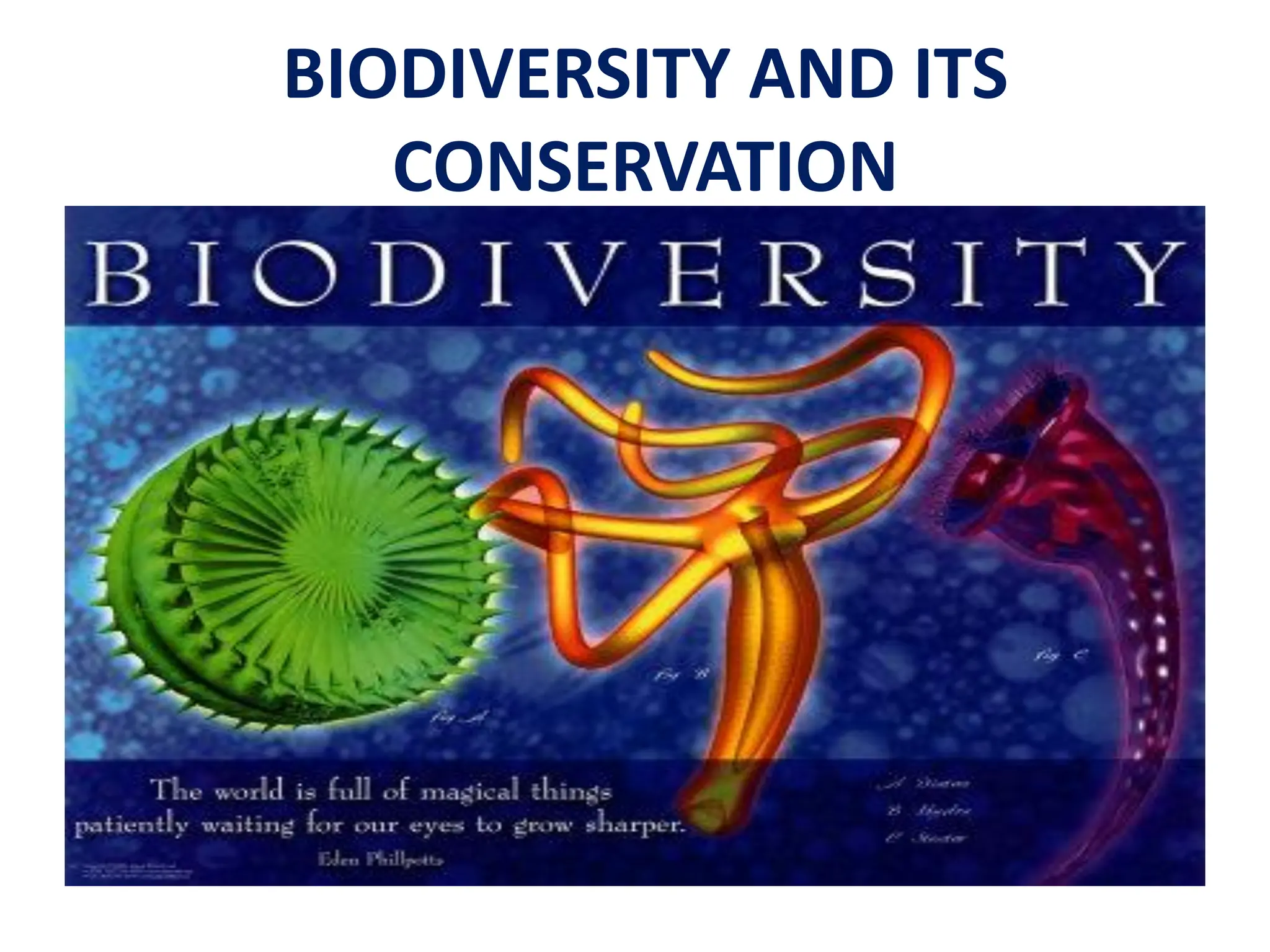
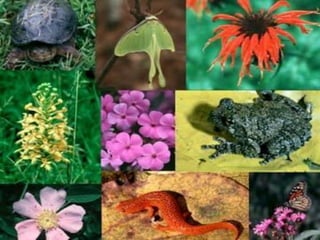
BIODIVERSITY
What does “Diversity” mean?
Diversity = Variety
• Its contraction of biological diversity
• Biological diversity was used around 1980 & used for number
of species in given area.
• Biodiversity is an umbrella term cover wide range of topics
like species, habitat loss, use, value & management of
biological resources; urgent need for conservation action.
• Biodiversity is the variety of life on Earth and the essential
interdependence of all living things
• Scientists have identified more than 2 million species. Tens of
millions -- remain unknown
• The tremendous variety of life on Earth is made possible by
complex interactions among all living things including
microscopic species like algae and mites.
INTRODUCTION
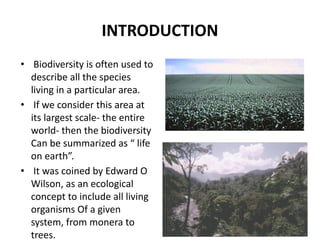
• Biodiversity is often used to
describe all the species
living in a particular area.
• If we consider this area at
its largest scale- the entire
world- then the biodiversity
Can be summarized as “ life
on earth”.
• It was coined by Edward O
Wilson, as an ecological
concept to include all living
organisms Of a given
system, from monera to
trees.
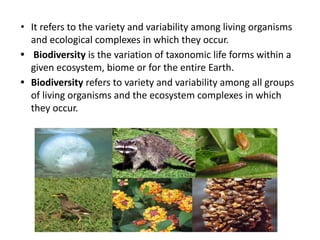
• It refers to the variety and variability among living organisms
and ecological complexes in which they occur.
• Biodiversity is the variation of taxonomic life forms within a
given ecosystem, biome or for the entire Earth.
• Biodiversity refers to variety and variability among all groups
of living organisms and the ecosystem complexes in which
they occur.
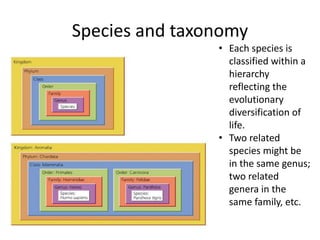
Species and taxonomy
• Each species is
classified within a
hierarchy
reflecting the
evolutionary
diversification of
life.
• Two related
species might be
in the same genus;
two related
genera in the
same family, etc.
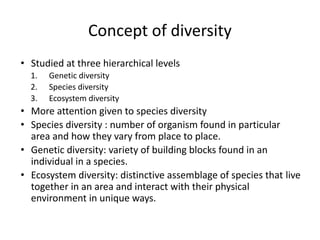
Concept of diversity
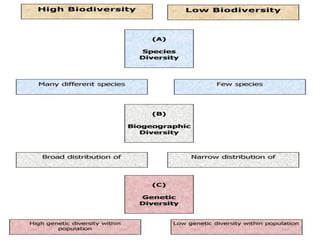
• Studied at three hierarchical levels
1. Genetic diversity
2. Species diversity
3. Ecosystem diversity
• More attention given to species diversity
• Species diversity : number of organism found in particular
area and how they vary from place to place.
• Genetic diversity: variety of building blocks found in an
individual in a species.
• Ecosystem diversity: distinctive assemblage of species that live
together in an area and interact with their physical
environment in unique ways.
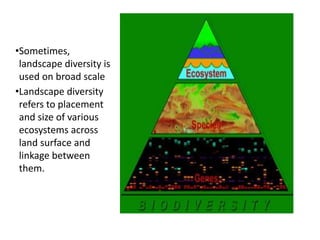
•Sometimes,
landscape diversity is
used on broad scale
•Landscape diversity
refers to placement
and size of various
ecosystems across
land surface and
linkage between
them.
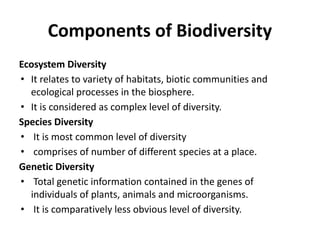
Components of Biodiversity
Ecosystem Diversity
• It relates to variety of habitats, biotic communities and
ecological processes in the biosphere.
• It is considered as complex level of diversity.
Species Diversity
• It is most common level of diversity
• comprises of number of different species at a place.
Genetic Diversity
• Total genetic information contained in the genes of
individuals of plants, animals and microorganisms.
• It is comparatively less obvious level of diversity.
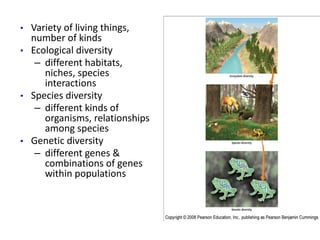
• Variety of living things,
number of kinds
• Ecological diversity
– different habitats,
niches, species
interactions
• Species diversity
– different kinds of
organisms, relationships
among species
• Genetic diversity
– different genes &
combinations of genes
within populations
Measuring biodiversity
• At simplest level, diversity defined as number of species
present in an community, a measure termed as species
richness.
• Mathematical indices of biodiversity have been developed to
represent species biodiversity at different geographical scale.
1. Alpha diversity
2. Beta diversity
3. Gamma diversity
• We are still profoundly ignorant of the number of species that
live on our planet.
• Roughly 1.75 million species have been formally described by
science.
• But many more exist: Estimates range from 3 million to 100
million.
• Why are we still so unsure of the number of species on Earth?
– Some areas remain little explored (hydrothermal vents,
rainforest canopies, tropical soils).
– Many species are tiny and inconspicuous (microbes,
roundworms, protists, fungi…).
– Some species are very similar in appearance (many taxa,
even trees, birds, whales).
Alpha diversity
• Number of species in a single community.
• Used to compare number of species in different ecosystem.
• Refer to species richness
Beta diversity
• Degree to which species composition changes along an
environmental gradient
Gamma diversity
• Species turnover rate with distance between sites of similar
habitat or expanding geographical areas.
• Applicable on larger geographical areas
• Defined as the rate at which additional species are
encountered as geographical replacement are made for a
given habitat type in different localities
Distribution of biodiversity
• Species are not evenly spread among different groups.
– Insects comprise more than half of all species in world.
– Beetles comprise fully 40% of all insects.
– Mammals are outnumbered by spiders and their relatives 16 to
1.
• Size of each organism is scaled to its number of species.
• Mammals are located in front of the insect’s mandibles.
• Some groups that have more species may have gone through an
adaptive radiation.
• This is when an ancestral species give rise to many species that fill
different niches, adapting to them by natural selection.
Darwin’s Galápagos finches, Hawaiian honeycreepers,
Asteraceae—daises and relatives
Distribution of biodiversity
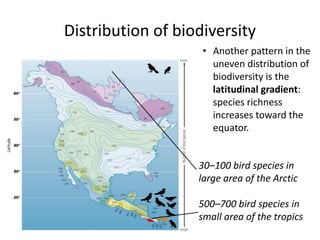
• Another pattern in the
uneven distribution of
biodiversity is the
latitudinal gradient:
species richness
increases toward the
equator.
30–100 bird species in
large area of the Arctic
500–700 bird species in
small area of the tropics
Biogeographical Classification of India
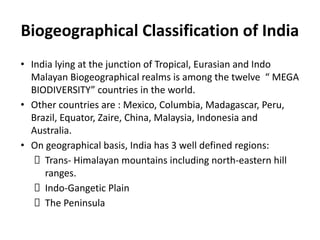
• India lying at the junction of Tropical, Eurasian and Indo
Malayan Biogeographical realms is among the twelve “ MEGA
BIODIVERSITY” countries in the world.
• Other countries are : Mexico, Columbia, Madagascar, Peru,
Brazil, Equator, Zaire, China, Malaysia, Indonesia and
Australia.
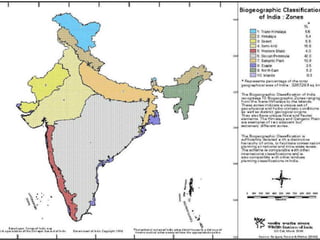
• On geographical basis, India has 3 well defined regions:
Trans- Himalayan mountains including north-eastern hill
ranges.
Indo-Gangetic Plain
The Peninsula
The Value of Biodiversity
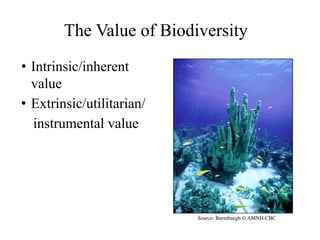
• Intrinsic/inherent
value
• Extrinsic/utilitarian/
instrumental value
Source: Burmbaugh © AMNH-CBC
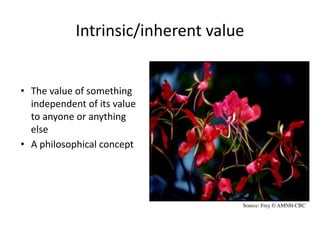
Intrinsic/inherent value
• The value of something
independent of its value
to anyone or anything
else
• A philosophical concept
Source: Frey © AMNH-CBC
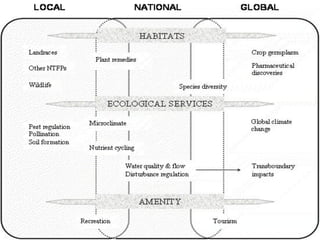
Benefits of biodiversity
Preserving biodiversity preserves ecosystem services, and
directly provides things of pragmatic value to us.
• Food, fuel, and fiber
• Shelter and building materials
• Air and water purification
• Waste decomposition
• Climate stabilization and moderation
• Nutrient cycling
• Soil fertility
• Pollination
• Pest control
• Genetic resources
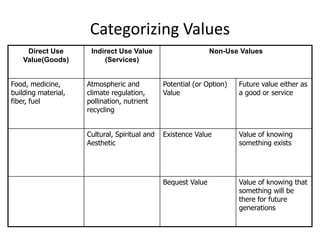
Direct Use
Value(Goods)
Indirect Use Value
(Services)
Non-Use Values
Food, medicine,
building material,
fiber, fuel
Atmospheric and
climate regulation,
pollination, nutrient
recycling
Potential (or Option)
Value
Future value either as
a good or service
Cultural, Spiritual and
Aesthetic
Existence Value Value of knowing
something exists
Bequest Value Value of knowing that
something will be
there for future
generations
Categorizing Values
Categorizing Values
Consumptive and Productive uses:
• FOOD: Grain, vegetables, fruits, nuts, tea, coffe, tobacco,
liquor oil from plants resources.
• meat, egg, milk etc.
• OTHERS: Medicine, fuel, timber, household accessories,
fodder, fibre, fertilizer, wool, leather, paint, wax, rubber, silk
etc.
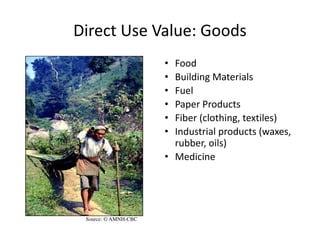
Direct Use Value: Goods
• Food
• Building Materials
• Fuel
• Paper Products
• Fiber (clothing, textiles)
• Industrial products (waxes,
rubber, oils)
• Medicine
Source: © AMNH-CBC
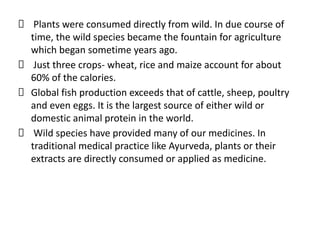
Plants were consumed directly from wild. In due course of
time, the wild species became the fountain for agriculture
which began sometime years ago.
Just three crops- wheat, rice and maize account for about
60% of the calories.
Global fish production exceeds that of cattle, sheep, poultry
and even eggs. It is the largest source of either wild or
domestic animal protein in the world.
Wild species have provided many of our medicines. In
traditional medical practice like Ayurveda, plants or their
extracts are directly consumed or applied as medicine.
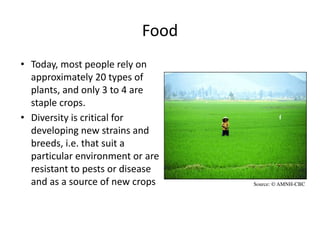
Food
• Today, most people rely on
approximately 20 types of
plants, and only 3 to 4 are
staple crops.
• Diversity is critical for
developing new strains and
breeds, i.e. that suit a
particular environment or are
resistant to pests or disease
and as a source of new crops Source: © AMNH-CBC
Source:
©
AMNH-CBC
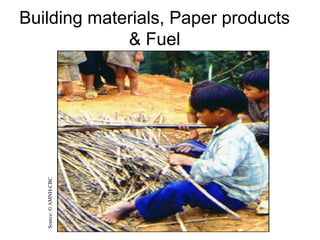
Building materials, Paper products
& Fuel
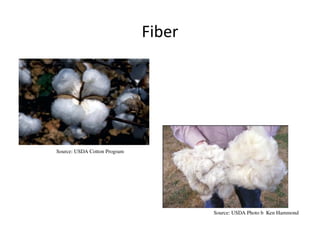
Fiber
Source: USDA Photo b Ken Hammond
Source: USDA Cotton Program
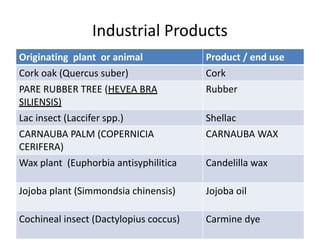
Industrial Products
Originating plant or animal Product / end use
Cork oak (Quercus suber) Cork
PARE RUBBER TREE (HEVEA BRA
SILIENSIS)
Rubber
Lac insect (Laccifer spp.) Shellac
CARNAUBA PALM (COPERNICIA
CERIFERA)
CARNAUBA WAX
Wax plant (Euphorbia antisyphilitica Candelilla wax
Jojoba plant (Simmondsia chinensis) Jojoba oil
Cochineal insect (Dactylopius coccus) Carmine dye
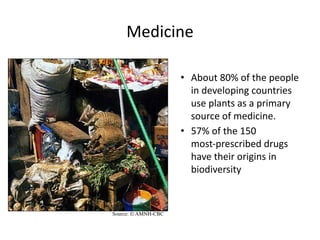
Medicine
• About 80% of the people
in developing countries
use plants as a primary
source of medicine.
• 57% of the 150
most-prescribed drugs
have their origins in
biodiversity
Source: © AMNH-CBC
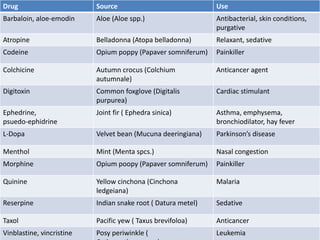
Drug Source Use
Barbaloin, aloe-emodin Aloe (Aloe spp.) Antibacterial, skin conditions,
purgative
Atropine Belladonna (Atopa belladonna) Relaxant, sedative
Codeine Opium poppy (Papaver somniferum) Painkiller
Colchicine Autumn crocus (Colchium
autumnale)
Anticancer agent
Digitoxin Common foxglove (Digitalis
purpurea)
Cardiac stimulant
Ephedrine,
psuedo-ephidrine
Joint fir ( Ephedra sinica) Asthma, emphysema,
bronchiodilator, hay fever
L-Dopa Velvet bean (Mucuna deeringiana) Parkinson’s disease
Menthol Mint (Menta spcs.) Nasal congestion
Morphine Opium poopy (Papaver somniferum) Painkiller
Quinine Yellow cinchona (Cinchona
ledgeiana)
Malaria
Reserpine Indian snake root ( Datura metel) Sedative
Taxol Pacific yew ( Taxus brevifoloa) Anticancer
Vinblastine, vincristine Posy periwinkle ( Leukemia
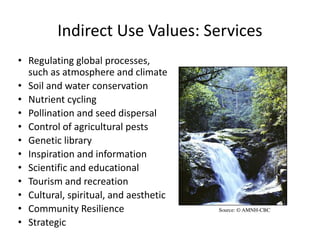
Indirect Use Values: Services
• Regulating global processes,
such as atmosphere and climate
• Soil and water conservation
• Nutrient cycling
• Pollination and seed dispersal
• Control of agricultural pests
• Genetic library
• Inspiration and information
• Scientific and educational
• Tourism and recreation
• Cultural, spiritual, and aesthetic
• Community Resilience
• Strategic
Source: © AMNH-CBC
Non- Consumptive uses
• Carbon-fixing through photosynthesis, which provide support
system for species.
• Pollination, gene flow etc.
• maintaining water cycles, recharging ground water, protecting
watersheds etc.
• Soil formation and protection from erosion.
• Maintaining essential nutrient cycles like carbon, nitrogen and
oxygen.
• Absorbing and decomposing pollutants, decomposing organic
waste, pesticides air & water pollutants.
• Regulating climate at both macro and micro levels.
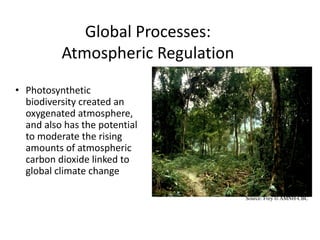
Global Processes:
Atmospheric Regulation
• Photosynthetic
biodiversity created an
oxygenated atmosphere,
and also has the potential
to moderate the rising
amounts of atmospheric
carbon dioxide linked to
global climate change
Source: Frey © AMNH-CBC
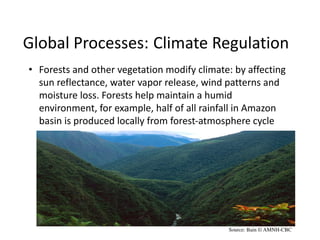
Global Processes: Climate Regulation
• Forests and other vegetation modify climate: by affecting
sun reflectance, water vapor release, wind patterns and
moisture loss. Forests help maintain a humid
environment, for example, half of all rainfall in Amazon
basin is produced locally from forest-atmosphere cycle
Source: Bain © AMNH-CBC
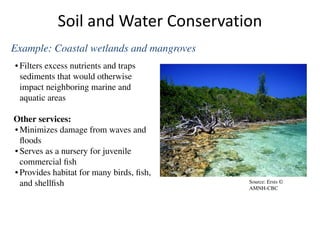
• Filters excess nutrients and traps
sediments that would otherwise
impact neighboring marine and
aquatic areas
Other services:
• Minimizes damage from waves and
floods
• Serves as a nursery for juvenile
commercial fish
• Provides habitat for many birds, fish,
and shellfish Source: Ersts ©
AMNH-CBC
Soil and Water Conservation
Example: Coastal wetlands and mangroves
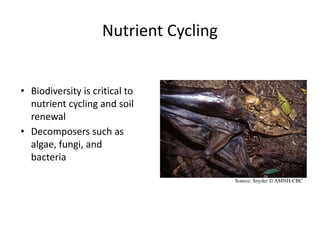
Nutrient Cycling
• Biodiversity is critical to
nutrient cycling and soil
renewal
• Decomposers such as
algae, fungi, and
bacteria
Source: Snyder © AMNH-CBC
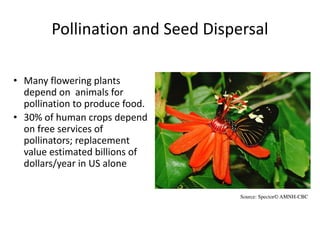
Pollination and Seed Dispersal
• Many flowering plants
depend on animals for
pollination to produce food.
• 30% of human crops depend
on free services of
pollinators; replacement
value estimated billions of
dollars/year in US alone
Source: Spector© AMNH-CBC
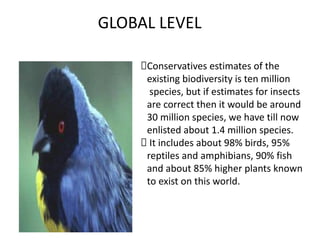
GLOBAL LEVEL
Conservatives estimates of the
existing biodiversity is ten million
species, but if estimates for insects
are correct then it would be around
30 million species, we have till now
enlisted about 1.4 million species.
It includes about 98% birds, 95%
reptiles and amphibians, 90% fish
and about 85% higher plants known
to exist on this world.
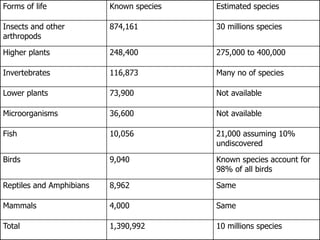
Forms of life Known species Estimated species
Insects and other
arthropods
874,161 30 millions species
Higher plants 248,400 275,000 to 400,000
Invertebrates 116,873 Many no of species
Lower plants 73,900 Not available
Microorganisms 36,600 Not available
Fish 10,056 21,000 assuming 10%
undiscovered
Birds 9,040 Known species account for
98% of all birds
Reptiles and Amphibians 8,962 Same
Mammals 4,000 Same
Total 1,390,992 10 millions species
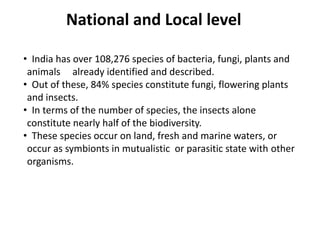
National and Local level
• India has over 108,276 species of bacteria, fungi, plants and
animals already identified and described.
• Out of these, 84% species constitute fungi, flowering plants
and insects.
• In terms of the number of species, the insects alone
constitute nearly half of the biodiversity.
• These species occur on land, fresh and marine waters, or
occur as symbionts in mutualistic or parasitic state with other
organisms.
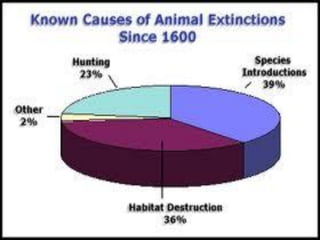
Biodiversity loss and species extinction
• Extinction = last member of a species dies and the species
vanishes forever from Earth
• Extirpation = disappearance of a particular population, but not the
entire species globally
These are natural processes.
• On average one species goes extinct naturally every 500–1,000
years—this is the backgroundrate of extinction.
• 99% of all species that ever lived are now extinct.
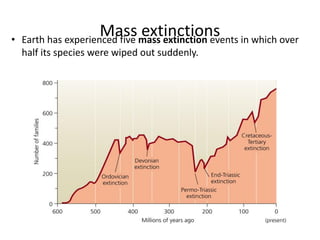
Mass extinctions
• Earth has experienced five mass extinction events in which over
half its species were wiped out suddenly.
Today’s mass extinction
• Currently Earth is undergoing its sixth mass extinction—because of
us.
• Humans have increased the extinction rate by a factor of 1,000.
• 1,100 species are known to have gone extinct in the past 400
years.
• The Red List, from the IUCN, lists species that today are facing high
risks of extinction.
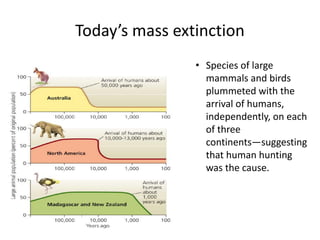
Today’s mass extinction
• Species of large
mammals and birds
plummeted with the
arrival of humans,
independently, on each
of three
continents—suggesting
that human hunting
was the cause.
Causes of species extinction
• Primary causes spell “HIPPO”:
– •Habitat alteration
– •Invasive species
– •Pollution
– •Population growth
– •Overexploitation
“HIPPO”: Habitat alteration
• The greatest cause of extinction today
• Accounts for 85% of population declines of birds and mammals
• Habitat change hurts most organisms because they are adapted to
an existing habitat.
• Alteration due to:
– Forest clearing
– Urban development
– Agriculture
– Global climate change etc….
“HIPPO”: Invasive species
• Accidental or intentional introduction of exotic species to new
areas
• Most do not establish or expand, but some do—likely because
they are “released” from limitations imposed by their native
predators, parasites, and competitors.
• In today’s globalizing world,
– invasive species have become perhaps the second-
worst threat to native biota.
“HIPPO”: Invasive species
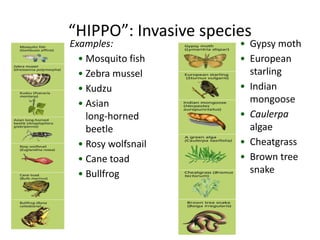
Examples:
• Mosquito fish
• Zebra mussel
• Kudzu
• Asian
long-horned
beetle
• Rosy wolfsnail
• Cane toad
• Bullfrog
• Gypsy moth
• European
starling
• Indian
mongoose
• Caulerpa
algae
• Cheatgrass
• Brown tree
snake
“HIPPO”: Pollution
• Air and water pollution; agricultural runoff, industrial chemicals,
etc.
• Pollution does serious and widespread harm, but is not as
threatening as the other elements of HIPPO.
“HIPPO”: Population growth
• Human population growth exacerbates every other environmental
problem.
• Magnifies effects of the other elements of HIPPO:
• More people means more habitat change, more invasive
species, more pollution, more overexploitation.
• Along with increased resource consumption, it is the ultimate
reason behind proximate threats to biodiversity.
“HIPPO”: Overexploitation
Two meanings:
• Overharvesting of species from the wild
• (too much hunting, fishing…)
• Overconsumption of resources
• (too much timber cutting, fossil fuel use…)
Usually overexploitation is not the sole cause of extinction, but it
often contributes in tandem with other causes.
Causes of species extinction
• In most cases, extinctions occur because of a combination of
factors.
• e.g., current global amphibian declines are thought due to a
complex combination of:
• Chemical contamination
• Disease transmission
• Habitat loss
• Ozone depletion and UV penetrance
• Climate change
• Synergistic interaction of these factors
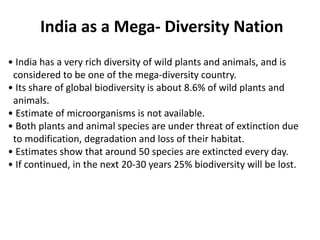
India as a Mega- Diversity Nation
• India has a very rich diversity of wild plants and animals, and is
considered to be one of the mega-diversity country.
• Its share of global biodiversity is about 8.6% of wild plants and
animals.
• Estimate of microorganisms is not available.
• Both plants and animal species are under threat of extinction due
to modification, degradation and loss of their habitat.
• Estimates show that around 50 species are extincted every day.
• If continued, in the next 20-30 years 25% biodiversity will be lost.
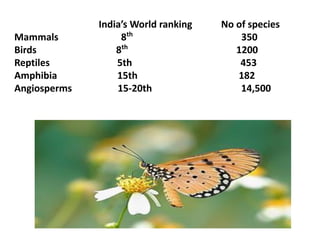
India’s World ranking No of species
Mammals 8th
350
Birds 8th
1200
Reptiles 5th 453
Amphibia 15th 182
Angiosperms 15-20th 14,500
• The earth’s biodiversity is distributed in specific
ecological regions. There are over a thousand major
ecoregions in the world.
• Of these, 200 are said to be the richest, rarest and most
distinctive natural areas.
• It has been estimated that 50,000 endemic plants which
comprise 20% of global plant life, probably occur in only
18 ‘hot spots’ in the world.
• Countries which have a relatively large proportion of
these hot spots of diversity are referred to as
‘megadiversity nations’.
Hot Spots Of Biodiversity
• Cape region, upland western Amazonia, Madagascar,
Philippines, Australia, central Chile, Srilanka,western Ghats,
Malaysia, Colombian Choco.
Hot spots lie India:
Western Ghats, North East India , Himalayas and Andaman
and nicobar islands
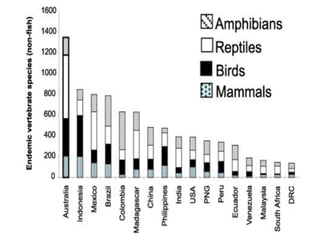
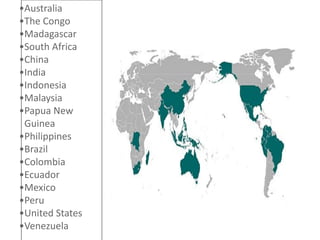
•Australia
•The Congo
•Madagascar
•South Africa
•China
•India
•Indonesia
•Malaysia
•Papua New
Guinea
•Philippines
•Brazil
•Colombia
•Ecuador
•Mexico
•Peru
•United States
•Venezuela
• Australia is home to between 600,000 and 700,000 species,
many of which are endemic, that is they are found nowhere
else in the world. These include, for example, 84% of our plant
species, 83% of mammals, and 45% of birds.
• Australia's biodiversity - the plants, animals, micro-organisms
and their ecosystems - is threatened from the impacts of
human activities. Since European settlement, more than 50
species of Australian animals and over 60 species of Australian
plants are known to have become extinct.
Cause for loss of species
• Modification, degradation and loss of habitat due to
colonization and clearance of forests.
• Over exploitation, mainly for commercial purposes.
• Accidental or deliberate introduction of exotic species which
threat flora and fauna directly.
• Pollution
• Increase in global temperature
ENDANGERED AND ENDEMIC SPECIES
OF INDIA
To appreciate the endemic and endangered species of India it
is important to understand the wide variety of plant and
animal species that are found in the country.
Of the well-known species, there are several which are
endangered by human activity. The endangered species in the
country are categorised as Vulnerable, Rare, Indeterminate and
Threatened.
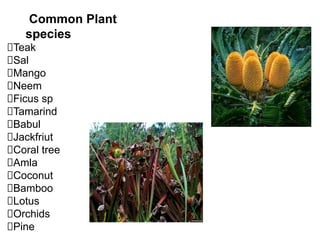
Common Plant
species
Teak
Sal
Mango
Neem
Ficus sp
Tamarind
Babul
Jackfriut
Coral tree
Amla
Coconut
Bamboo
Lotus
Orchids
Pine
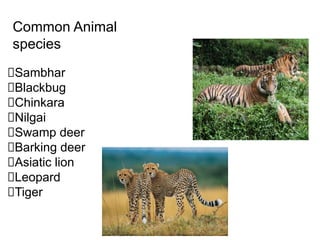
Common Animal
species
Sambhar
Blackbug
Chinkara
Nilgai
Swamp deer
Barking deer
Asiatic lion
Leopard
Tiger
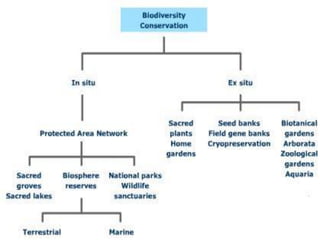
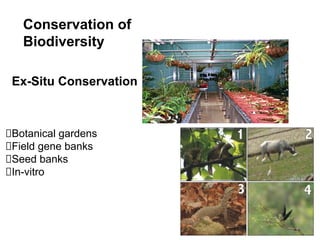
Conservation of
Biodiversity
Ex-Situ Conservation
Botanical gardens
Field gene banks
Seed banks
In-vitro
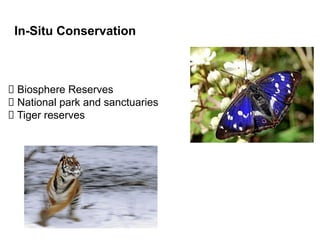
In-Situ Conservation
Biosphere Reserves
National park and sanctuaries
Tiger reserves
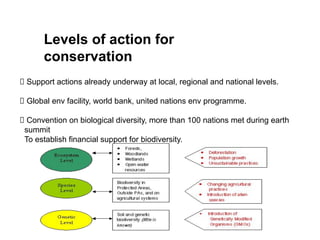
Levels of action for
conservation
Support actions already underway at local, regional and national levels.
Global env facility, world bank, united nations env programme.
Convention on biological diversity, more than 100 nations met during earth
summit
To establish financial support for biodiversity.
Conservation biology
• Scientific discipline devoted to understanding the factors, forces,
and processes that influence the loss, protection, and restoration
of biological diversity within and among ecosystems.
• Applied and goal-oriented: Conservation biologists intend to
prevent extinction.
• This discipline arose in recent decades as biologists grew alarmed
at the degradation of natural systems they had spent their lives
studying.
Equilibrium theory of island
biogeography
• Explains how species diversity patterns arise on islands, as a result
of:
– • Immigration
– • Extinction
– • Island size
– • Distance from the mainland
• The theory originally developed as basic science for oceanic
islands.
• Then it was found to apply to islands of habitat (fragments) within
terrestrial systems, for conservation biology.
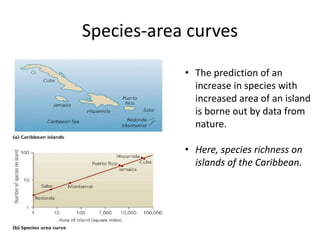
Species-area curves
• The prediction of an
increase in species with
increased area of an island
is borne out by data from
nature.
• Here, species richness on
islands of the Caribbean.
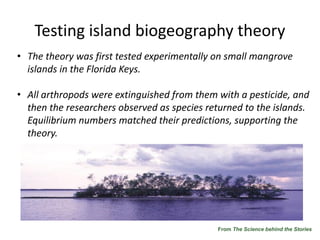
Testing island biogeography theory
• The theory was first tested experimentally on small mangrove
islands in the Florida Keys.
• All arthropods were extinguished from them with a pesticide, and
then the researchers observed as species returned to the islands.
Equilibrium numbers matched their predictions, supporting the
theory.
From The Science behind the Stories
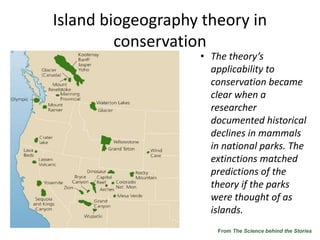
Island biogeography theory in
conservation
• The theory’s
applicability to
conservation became
clear when a
researcher
documented historical
declines in mammals
in national parks. The
extinctions matched
predictions of the
theory if the parks
were thought of as
islands.
From The Science behind the Stories
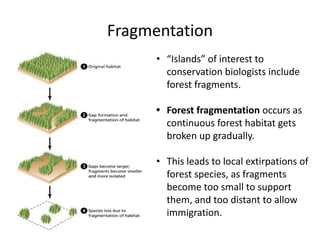
Fragmentation
• “Islands” of interest to
conservation biologists include
forest fragments.
• Forest fragmentation occurs as
continuous forest habitat gets
broken up gradually.
• This leads to local extirpations of
forest species, as fragments
become too small to support
them, and too distant to allow
immigration.
Conservation approaches: Umbrella
species
• When habitat is preserved to meet the needs of an “umbrella
species,” it helps preserve habitat for many other species. (Thus,
primary species serve as an “umbrella” for others.)
– Large species with large home ranges (like tigers and other top
predators) are good umbrella species.
– So are charismatic ones that win public affection, like the
panda.
Conservation approaches: Endangered
species
Trying to preserve single species threatened with extinction is the
goal of endangered species laws, although they often also achieve
umbrella conservation.
U.S. Endangered Species Act, 1973:
– Restricts actions that would destroy endangered species or
their habitats
– Forbids trade in products from species
– Prevents extinction, stabilizes and recovers populations
Conservation approaches:
Endangered species
The ESA has had notable successes:
• Bald eagle
• Peregrine falcon
• 40% of all declining populations held stable
However, there is much popular resentment against the ESA:
• Many citizens believe it will restrict their freedom if
endangered species are found on their land.
• Canada therefore stressed cooperation with landowners
and provincial governments in its recent Species at Risk
Act.
Conservation approaches: Captive
breeding
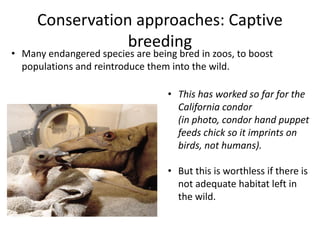
• Many endangered species are being bred in zoos, to boost
populations and reintroduce them into the wild.
• This has worked so far for the
California condor
(in photo, condor hand puppet
feeds chick so it imprints on
birds, not humans).
• But this is worthless if there is
not adequate habitat left in
the wild.
Conservation approaches: Cloning
• A newly suggested approach is to use molecular techniques to
clone endangered or even extinct species, raise them in zoos,
and reintroduce them to the wild.
• Even if this succeeds technically, though, it will be worthless if
there is not adequate habitat and protection left for them in
the wild.
Conservation approaches: International
treaties
• Various treaties have helped conserve biota.
• A major one is CITES, the Convention on International Trade in
Endangered Species of Wild Fauna and Flora, prepared in 1973.
• It bans international trade and transport of body parts of
endangered organisms.
Conservation approaches: International
treaties
• The Convention on Biological Diversity (CBD), from the Rio
Conference in 1992, aims to:
– Conserve biodiversity
– Use it sustainably
– Ensure fair distribution of its benefits
• The CBD has been signed by 188 nations, but not by the United
States.
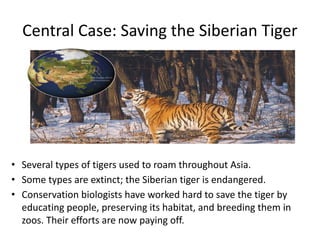
Central Case: Saving the Siberian Tiger
• Several types of tigers used to roam throughout Asia.
• Some types are extinct; the Siberian tiger is endangered.
• Conservation biologists have worked hard to save the tiger by
educating people, preserving its habitat, and breeding them in
zoos. Their efforts are now paying off.
THANK YOU ALL

Powerpoint presentation related to Biodiversity

  • 1.
  • 3.
    BIODIVERSITY What does “Diversity”mean? Diversity = Variety • Its contraction of biological diversity • Biological diversity was used around 1980 & used for number of species in given area. • Biodiversity is an umbrella term cover wide range of topics like species, habitat loss, use, value & management of biological resources; urgent need for conservation action.
  • 4.
    • Biodiversity isthe variety of life on Earth and the essential interdependence of all living things • Scientists have identified more than 2 million species. Tens of millions -- remain unknown • The tremendous variety of life on Earth is made possible by complex interactions among all living things including microscopic species like algae and mites.
  • 5.
    INTRODUCTION • Biodiversity isoften used to describe all the species living in a particular area. • If we consider this area at its largest scale- the entire world- then the biodiversity Can be summarized as “ life on earth”. • It was coined by Edward O Wilson, as an ecological concept to include all living organisms Of a given system, from monera to trees.
  • 6.
    • It refersto the variety and variability among living organisms and ecological complexes in which they occur. • Biodiversity is the variation of taxonomic life forms within a given ecosystem, biome or for the entire Earth. • Biodiversity refers to variety and variability among all groups of living organisms and the ecosystem complexes in which they occur.
  • 7.
    Species and taxonomy •Each species is classified within a hierarchy reflecting the evolutionary diversification of life. • Two related species might be in the same genus; two related genera in the same family, etc.
  • 8.
    Concept of diversity •Studied at three hierarchical levels 1. Genetic diversity 2. Species diversity 3. Ecosystem diversity • More attention given to species diversity • Species diversity : number of organism found in particular area and how they vary from place to place. • Genetic diversity: variety of building blocks found in an individual in a species. • Ecosystem diversity: distinctive assemblage of species that live together in an area and interact with their physical environment in unique ways.
  • 9.
    •Sometimes, landscape diversity is usedon broad scale •Landscape diversity refers to placement and size of various ecosystems across land surface and linkage between them.
  • 11.
    Components of Biodiversity EcosystemDiversity • It relates to variety of habitats, biotic communities and ecological processes in the biosphere. • It is considered as complex level of diversity. Species Diversity • It is most common level of diversity • comprises of number of different species at a place. Genetic Diversity • Total genetic information contained in the genes of individuals of plants, animals and microorganisms. • It is comparatively less obvious level of diversity.
  • 12.
    • Variety ofliving things, number of kinds • Ecological diversity – different habitats, niches, species interactions • Species diversity – different kinds of organisms, relationships among species • Genetic diversity – different genes & combinations of genes within populations
  • 13.
    Measuring biodiversity • Atsimplest level, diversity defined as number of species present in an community, a measure termed as species richness. • Mathematical indices of biodiversity have been developed to represent species biodiversity at different geographical scale. 1. Alpha diversity 2. Beta diversity 3. Gamma diversity
  • 14.
    • We arestill profoundly ignorant of the number of species that live on our planet. • Roughly 1.75 million species have been formally described by science. • But many more exist: Estimates range from 3 million to 100 million. • Why are we still so unsure of the number of species on Earth? – Some areas remain little explored (hydrothermal vents, rainforest canopies, tropical soils). – Many species are tiny and inconspicuous (microbes, roundworms, protists, fungi…). – Some species are very similar in appearance (many taxa, even trees, birds, whales).
  • 15.
    Alpha diversity • Numberof species in a single community. • Used to compare number of species in different ecosystem. • Refer to species richness Beta diversity • Degree to which species composition changes along an environmental gradient Gamma diversity • Species turnover rate with distance between sites of similar habitat or expanding geographical areas. • Applicable on larger geographical areas • Defined as the rate at which additional species are encountered as geographical replacement are made for a given habitat type in different localities
  • 16.
    Distribution of biodiversity •Species are not evenly spread among different groups. – Insects comprise more than half of all species in world. – Beetles comprise fully 40% of all insects. – Mammals are outnumbered by spiders and their relatives 16 to 1. • Size of each organism is scaled to its number of species. • Mammals are located in front of the insect’s mandibles. • Some groups that have more species may have gone through an adaptive radiation. • This is when an ancestral species give rise to many species that fill different niches, adapting to them by natural selection. Darwin’s Galápagos finches, Hawaiian honeycreepers, Asteraceae—daises and relatives
  • 17.
    Distribution of biodiversity •Another pattern in the uneven distribution of biodiversity is the latitudinal gradient: species richness increases toward the equator. 30–100 bird species in large area of the Arctic 500–700 bird species in small area of the tropics
  • 18.
    Biogeographical Classification ofIndia • India lying at the junction of Tropical, Eurasian and Indo Malayan Biogeographical realms is among the twelve “ MEGA BIODIVERSITY” countries in the world. • Other countries are : Mexico, Columbia, Madagascar, Peru, Brazil, Equator, Zaire, China, Malaysia, Indonesia and Australia. • On geographical basis, India has 3 well defined regions: Trans- Himalayan mountains including north-eastern hill ranges. Indo-Gangetic Plain The Peninsula
  • 20.
    The Value ofBiodiversity • Intrinsic/inherent value • Extrinsic/utilitarian/ instrumental value Source: Burmbaugh © AMNH-CBC
  • 21.
    Intrinsic/inherent value • Thevalue of something independent of its value to anyone or anything else • A philosophical concept Source: Frey © AMNH-CBC
  • 22.
    Benefits of biodiversity Preservingbiodiversity preserves ecosystem services, and directly provides things of pragmatic value to us. • Food, fuel, and fiber • Shelter and building materials • Air and water purification • Waste decomposition • Climate stabilization and moderation • Nutrient cycling • Soil fertility • Pollination • Pest control • Genetic resources
  • 23.
    Direct Use Value(Goods) Indirect UseValue (Services) Non-Use Values Food, medicine, building material, fiber, fuel Atmospheric and climate regulation, pollination, nutrient recycling Potential (or Option) Value Future value either as a good or service Cultural, Spiritual and Aesthetic Existence Value Value of knowing something exists Bequest Value Value of knowing that something will be there for future generations Categorizing Values
  • 24.
    Categorizing Values Consumptive andProductive uses: • FOOD: Grain, vegetables, fruits, nuts, tea, coffe, tobacco, liquor oil from plants resources. • meat, egg, milk etc. • OTHERS: Medicine, fuel, timber, household accessories, fodder, fibre, fertilizer, wool, leather, paint, wax, rubber, silk etc.
  • 25.
    Direct Use Value:Goods • Food • Building Materials • Fuel • Paper Products • Fiber (clothing, textiles) • Industrial products (waxes, rubber, oils) • Medicine Source: © AMNH-CBC
  • 26.
    Plants were consumeddirectly from wild. In due course of time, the wild species became the fountain for agriculture which began sometime years ago. Just three crops- wheat, rice and maize account for about 60% of the calories. Global fish production exceeds that of cattle, sheep, poultry and even eggs. It is the largest source of either wild or domestic animal protein in the world. Wild species have provided many of our medicines. In traditional medical practice like Ayurveda, plants or their extracts are directly consumed or applied as medicine.
  • 27.
    Food • Today, mostpeople rely on approximately 20 types of plants, and only 3 to 4 are staple crops. • Diversity is critical for developing new strains and breeds, i.e. that suit a particular environment or are resistant to pests or disease and as a source of new crops Source: © AMNH-CBC
  • 28.
  • 29.
    Fiber Source: USDA Photob Ken Hammond Source: USDA Cotton Program
  • 30.
    Industrial Products Originating plantor animal Product / end use Cork oak (Quercus suber) Cork PARE RUBBER TREE (HEVEA BRA SILIENSIS) Rubber Lac insect (Laccifer spp.) Shellac CARNAUBA PALM (COPERNICIA CERIFERA) CARNAUBA WAX Wax plant (Euphorbia antisyphilitica Candelilla wax Jojoba plant (Simmondsia chinensis) Jojoba oil Cochineal insect (Dactylopius coccus) Carmine dye
  • 31.
    Medicine • About 80%of the people in developing countries use plants as a primary source of medicine. • 57% of the 150 most-prescribed drugs have their origins in biodiversity Source: © AMNH-CBC
  • 32.
    Drug Source Use Barbaloin,aloe-emodin Aloe (Aloe spp.) Antibacterial, skin conditions, purgative Atropine Belladonna (Atopa belladonna) Relaxant, sedative Codeine Opium poppy (Papaver somniferum) Painkiller Colchicine Autumn crocus (Colchium autumnale) Anticancer agent Digitoxin Common foxglove (Digitalis purpurea) Cardiac stimulant Ephedrine, psuedo-ephidrine Joint fir ( Ephedra sinica) Asthma, emphysema, bronchiodilator, hay fever L-Dopa Velvet bean (Mucuna deeringiana) Parkinson’s disease Menthol Mint (Menta spcs.) Nasal congestion Morphine Opium poopy (Papaver somniferum) Painkiller Quinine Yellow cinchona (Cinchona ledgeiana) Malaria Reserpine Indian snake root ( Datura metel) Sedative Taxol Pacific yew ( Taxus brevifoloa) Anticancer Vinblastine, vincristine Posy periwinkle ( Leukemia
  • 33.
    Indirect Use Values:Services • Regulating global processes, such as atmosphere and climate • Soil and water conservation • Nutrient cycling • Pollination and seed dispersal • Control of agricultural pests • Genetic library • Inspiration and information • Scientific and educational • Tourism and recreation • Cultural, spiritual, and aesthetic • Community Resilience • Strategic Source: © AMNH-CBC
  • 34.
    Non- Consumptive uses •Carbon-fixing through photosynthesis, which provide support system for species. • Pollination, gene flow etc. • maintaining water cycles, recharging ground water, protecting watersheds etc. • Soil formation and protection from erosion. • Maintaining essential nutrient cycles like carbon, nitrogen and oxygen. • Absorbing and decomposing pollutants, decomposing organic waste, pesticides air & water pollutants. • Regulating climate at both macro and micro levels.
  • 35.
    Global Processes: Atmospheric Regulation •Photosynthetic biodiversity created an oxygenated atmosphere, and also has the potential to moderate the rising amounts of atmospheric carbon dioxide linked to global climate change Source: Frey © AMNH-CBC
  • 36.
    Global Processes: ClimateRegulation • Forests and other vegetation modify climate: by affecting sun reflectance, water vapor release, wind patterns and moisture loss. Forests help maintain a humid environment, for example, half of all rainfall in Amazon basin is produced locally from forest-atmosphere cycle Source: Bain © AMNH-CBC
  • 37.
    • Filters excessnutrients and traps sediments that would otherwise impact neighboring marine and aquatic areas Other services: • Minimizes damage from waves and floods • Serves as a nursery for juvenile commercial fish • Provides habitat for many birds, fish, and shellfish Source: Ersts © AMNH-CBC Soil and Water Conservation Example: Coastal wetlands and mangroves
  • 38.
    Nutrient Cycling • Biodiversityis critical to nutrient cycling and soil renewal • Decomposers such as algae, fungi, and bacteria Source: Snyder © AMNH-CBC
  • 39.
    Pollination and SeedDispersal • Many flowering plants depend on animals for pollination to produce food. • 30% of human crops depend on free services of pollinators; replacement value estimated billions of dollars/year in US alone Source: Spector© AMNH-CBC
  • 40.
    GLOBAL LEVEL Conservatives estimatesof the existing biodiversity is ten million species, but if estimates for insects are correct then it would be around 30 million species, we have till now enlisted about 1.4 million species. It includes about 98% birds, 95% reptiles and amphibians, 90% fish and about 85% higher plants known to exist on this world.
  • 41.
    Forms of lifeKnown species Estimated species Insects and other arthropods 874,161 30 millions species Higher plants 248,400 275,000 to 400,000 Invertebrates 116,873 Many no of species Lower plants 73,900 Not available Microorganisms 36,600 Not available Fish 10,056 21,000 assuming 10% undiscovered Birds 9,040 Known species account for 98% of all birds Reptiles and Amphibians 8,962 Same Mammals 4,000 Same Total 1,390,992 10 millions species
  • 42.
    National and Locallevel • India has over 108,276 species of bacteria, fungi, plants and animals already identified and described. • Out of these, 84% species constitute fungi, flowering plants and insects. • In terms of the number of species, the insects alone constitute nearly half of the biodiversity. • These species occur on land, fresh and marine waters, or occur as symbionts in mutualistic or parasitic state with other organisms.
  • 44.
    Biodiversity loss andspecies extinction • Extinction = last member of a species dies and the species vanishes forever from Earth • Extirpation = disappearance of a particular population, but not the entire species globally These are natural processes. • On average one species goes extinct naturally every 500–1,000 years—this is the backgroundrate of extinction. • 99% of all species that ever lived are now extinct.
  • 45.
    Mass extinctions • Earthhas experienced five mass extinction events in which over half its species were wiped out suddenly.
  • 46.
    Today’s mass extinction •Currently Earth is undergoing its sixth mass extinction—because of us. • Humans have increased the extinction rate by a factor of 1,000. • 1,100 species are known to have gone extinct in the past 400 years. • The Red List, from the IUCN, lists species that today are facing high risks of extinction.
  • 47.
    Today’s mass extinction •Species of large mammals and birds plummeted with the arrival of humans, independently, on each of three continents—suggesting that human hunting was the cause.
  • 48.
    Causes of speciesextinction • Primary causes spell “HIPPO”: – •Habitat alteration – •Invasive species – •Pollution – •Population growth – •Overexploitation
  • 49.
    “HIPPO”: Habitat alteration •The greatest cause of extinction today • Accounts for 85% of population declines of birds and mammals • Habitat change hurts most organisms because they are adapted to an existing habitat. • Alteration due to: – Forest clearing – Urban development – Agriculture – Global climate change etc….
  • 50.
    “HIPPO”: Invasive species •Accidental or intentional introduction of exotic species to new areas • Most do not establish or expand, but some do—likely because they are “released” from limitations imposed by their native predators, parasites, and competitors. • In today’s globalizing world, – invasive species have become perhaps the second- worst threat to native biota.
  • 51.
    “HIPPO”: Invasive species Examples: •Mosquito fish • Zebra mussel • Kudzu • Asian long-horned beetle • Rosy wolfsnail • Cane toad • Bullfrog • Gypsy moth • European starling • Indian mongoose • Caulerpa algae • Cheatgrass • Brown tree snake
  • 52.
    “HIPPO”: Pollution • Airand water pollution; agricultural runoff, industrial chemicals, etc. • Pollution does serious and widespread harm, but is not as threatening as the other elements of HIPPO.
  • 53.
    “HIPPO”: Population growth •Human population growth exacerbates every other environmental problem. • Magnifies effects of the other elements of HIPPO: • More people means more habitat change, more invasive species, more pollution, more overexploitation. • Along with increased resource consumption, it is the ultimate reason behind proximate threats to biodiversity.
  • 54.
    “HIPPO”: Overexploitation Two meanings: •Overharvesting of species from the wild • (too much hunting, fishing…) • Overconsumption of resources • (too much timber cutting, fossil fuel use…) Usually overexploitation is not the sole cause of extinction, but it often contributes in tandem with other causes.
  • 55.
    Causes of speciesextinction • In most cases, extinctions occur because of a combination of factors. • e.g., current global amphibian declines are thought due to a complex combination of: • Chemical contamination • Disease transmission • Habitat loss • Ozone depletion and UV penetrance • Climate change • Synergistic interaction of these factors
  • 57.
    India as aMega- Diversity Nation • India has a very rich diversity of wild plants and animals, and is considered to be one of the mega-diversity country. • Its share of global biodiversity is about 8.6% of wild plants and animals. • Estimate of microorganisms is not available. • Both plants and animal species are under threat of extinction due to modification, degradation and loss of their habitat. • Estimates show that around 50 species are extincted every day. • If continued, in the next 20-30 years 25% biodiversity will be lost.
  • 58.
    India’s World rankingNo of species Mammals 8th 350 Birds 8th 1200 Reptiles 5th 453 Amphibia 15th 182 Angiosperms 15-20th 14,500
  • 60.
    • The earth’sbiodiversity is distributed in specific ecological regions. There are over a thousand major ecoregions in the world. • Of these, 200 are said to be the richest, rarest and most distinctive natural areas. • It has been estimated that 50,000 endemic plants which comprise 20% of global plant life, probably occur in only 18 ‘hot spots’ in the world. • Countries which have a relatively large proportion of these hot spots of diversity are referred to as ‘megadiversity nations’. Hot Spots Of Biodiversity
  • 61.
    • Cape region,upland western Amazonia, Madagascar, Philippines, Australia, central Chile, Srilanka,western Ghats, Malaysia, Colombian Choco. Hot spots lie India: Western Ghats, North East India , Himalayas and Andaman and nicobar islands
  • 62.
    •Australia •The Congo •Madagascar •South Africa •China •India •Indonesia •Malaysia •PapuaNew Guinea •Philippines •Brazil •Colombia •Ecuador •Mexico •Peru •United States •Venezuela
  • 63.
    • Australia ishome to between 600,000 and 700,000 species, many of which are endemic, that is they are found nowhere else in the world. These include, for example, 84% of our plant species, 83% of mammals, and 45% of birds. • Australia's biodiversity - the plants, animals, micro-organisms and their ecosystems - is threatened from the impacts of human activities. Since European settlement, more than 50 species of Australian animals and over 60 species of Australian plants are known to have become extinct.
  • 64.
    Cause for lossof species • Modification, degradation and loss of habitat due to colonization and clearance of forests. • Over exploitation, mainly for commercial purposes. • Accidental or deliberate introduction of exotic species which threat flora and fauna directly. • Pollution • Increase in global temperature
  • 65.
    ENDANGERED AND ENDEMICSPECIES OF INDIA To appreciate the endemic and endangered species of India it is important to understand the wide variety of plant and animal species that are found in the country. Of the well-known species, there are several which are endangered by human activity. The endangered species in the country are categorised as Vulnerable, Rare, Indeterminate and Threatened.
  • 66.
  • 67.
  • 69.
    Conservation of Biodiversity Ex-Situ Conservation Botanicalgardens Field gene banks Seed banks In-vitro
  • 70.
    In-Situ Conservation Biosphere Reserves Nationalpark and sanctuaries Tiger reserves
  • 71.
    Levels of actionfor conservation Support actions already underway at local, regional and national levels. Global env facility, world bank, united nations env programme. Convention on biological diversity, more than 100 nations met during earth summit To establish financial support for biodiversity.
  • 72.
    Conservation biology • Scientificdiscipline devoted to understanding the factors, forces, and processes that influence the loss, protection, and restoration of biological diversity within and among ecosystems. • Applied and goal-oriented: Conservation biologists intend to prevent extinction. • This discipline arose in recent decades as biologists grew alarmed at the degradation of natural systems they had spent their lives studying.
  • 73.
    Equilibrium theory ofisland biogeography • Explains how species diversity patterns arise on islands, as a result of: – • Immigration – • Extinction – • Island size – • Distance from the mainland • The theory originally developed as basic science for oceanic islands. • Then it was found to apply to islands of habitat (fragments) within terrestrial systems, for conservation biology.
  • 74.
    Species-area curves • Theprediction of an increase in species with increased area of an island is borne out by data from nature. • Here, species richness on islands of the Caribbean.
  • 75.
    Testing island biogeographytheory • The theory was first tested experimentally on small mangrove islands in the Florida Keys. • All arthropods were extinguished from them with a pesticide, and then the researchers observed as species returned to the islands. Equilibrium numbers matched their predictions, supporting the theory. From The Science behind the Stories
  • 76.
    Island biogeography theoryin conservation • The theory’s applicability to conservation became clear when a researcher documented historical declines in mammals in national parks. The extinctions matched predictions of the theory if the parks were thought of as islands. From The Science behind the Stories
  • 77.
    Fragmentation • “Islands” ofinterest to conservation biologists include forest fragments. • Forest fragmentation occurs as continuous forest habitat gets broken up gradually. • This leads to local extirpations of forest species, as fragments become too small to support them, and too distant to allow immigration.
  • 78.
    Conservation approaches: Umbrella species •When habitat is preserved to meet the needs of an “umbrella species,” it helps preserve habitat for many other species. (Thus, primary species serve as an “umbrella” for others.) – Large species with large home ranges (like tigers and other top predators) are good umbrella species. – So are charismatic ones that win public affection, like the panda.
  • 79.
    Conservation approaches: Endangered species Tryingto preserve single species threatened with extinction is the goal of endangered species laws, although they often also achieve umbrella conservation. U.S. Endangered Species Act, 1973: – Restricts actions that would destroy endangered species or their habitats – Forbids trade in products from species – Prevents extinction, stabilizes and recovers populations
  • 80.
    Conservation approaches: Endangered species TheESA has had notable successes: • Bald eagle • Peregrine falcon • 40% of all declining populations held stable However, there is much popular resentment against the ESA: • Many citizens believe it will restrict their freedom if endangered species are found on their land. • Canada therefore stressed cooperation with landowners and provincial governments in its recent Species at Risk Act.
  • 81.
    Conservation approaches: Captive breeding •Many endangered species are being bred in zoos, to boost populations and reintroduce them into the wild. • This has worked so far for the California condor (in photo, condor hand puppet feeds chick so it imprints on birds, not humans). • But this is worthless if there is not adequate habitat left in the wild.
  • 82.
    Conservation approaches: Cloning •A newly suggested approach is to use molecular techniques to clone endangered or even extinct species, raise them in zoos, and reintroduce them to the wild. • Even if this succeeds technically, though, it will be worthless if there is not adequate habitat and protection left for them in the wild.
  • 83.
    Conservation approaches: International treaties •Various treaties have helped conserve biota. • A major one is CITES, the Convention on International Trade in Endangered Species of Wild Fauna and Flora, prepared in 1973. • It bans international trade and transport of body parts of endangered organisms.
  • 84.
    Conservation approaches: International treaties •The Convention on Biological Diversity (CBD), from the Rio Conference in 1992, aims to: – Conserve biodiversity – Use it sustainably – Ensure fair distribution of its benefits • The CBD has been signed by 188 nations, but not by the United States.
  • 85.
    Central Case: Savingthe Siberian Tiger • Several types of tigers used to roam throughout Asia. • Some types are extinct; the Siberian tiger is endangered. • Conservation biologists have worked hard to save the tiger by educating people, preserving its habitat, and breeding them in zoos. Their efforts are now paying off.
  • 86.