Biodegradation & Bioremediation
FST-202
General Microbiology
SubmittedTo:-
Mam Sadia Yasin
Sahiba
7/21/2018 3
Fst-202 General Microbiology
(Session Fall 2017-21)
SubmittedBy:-
Ghulam Qadir
7/21/2018 4
Fst-202 General Microbiology
(Session Fall 2017-21)
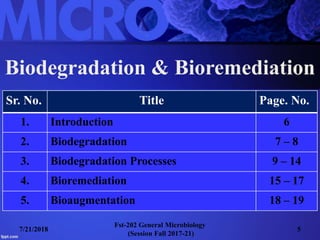
Biodegradation & Bioremediation
Sr. No. Title Page. No.
1. Introduction 6
2. Biodegradation 7 – 8
3. Biodegradation Processes 9 – 14
4. Bioremediation 15 – 17
5. Bioaugmentation 18 – 19
7/21/2018 5
Fst-202 General Microbiology
(Session Fall 2017-21)
Introduction
• The Metabolic activities of microbes can also be
exploit in complex natural environments for
beneficial outcomes. Examples are
1. The use of microbial communities to carry out
biodegradation, bioremediation, and environmental
maintenance processes.
2. The addition of microorganisms to soils or plants for
the improvement of crop production.
7/21/2018 6
Fst-202 General Microbiology
(Session Fall 2017-21)
Biodegradation
• Has at least three outcomes:-
1. A minor change in an organic molecule, leaving the
main structure still intact.
2. Fragmentation of a complex organic molecule in such
a way that the fragments could be yield the original
structure.
3. Complete mineralization, which is the transformation
of organic molecules to inorganic forms.
7/21/2018 7
Fst-202 General Microbiology
(Session Fall 2017-21)
Biodegradation
• Definition :-
• “ ‘Biodegradation’ is the breakdown of organic
matter by microorganisms.”
• The removal of toxic industrial products in soil and
aquatic environments is a daunting and necessary task.
• Compounds Such as perchloroethylene (PCE),
Trichloroethylene (TCE), and Polychlorinated biphenyls
(PCBs) are common contaminants.
7/21/2018 8
Fst-202 General Microbiology
(Session Fall 2017-21)
Biodegradation Processes
• Degradation of complex compounds requires several
discrete stages, usually performed by different
microbes.
• Initially contaminants are converted to less toxic
compounds that are more readily degraded.
• The 1st step for many contaminants, including
organochloride pesticides, alkyl solvent, and aryl
halides, is “reductive dehalogenation”.
7/21/2018 9
Fst-202 General Microbiology
(Session Fall 2017-21)
Biodegradation Processes
• This is the removal of a halogen substituent ( e.g.
chlorine, bromine, fluorine) while at the same time adding
electrons to the molecule.
• This can occur in two ways:-
1. In hydrogenolysis, the halogen substituent is replaced by
a hydrogen atom
2. Alternative, dihaloelimination removes two halogen
substituents from adjacent carbons while interesting an
additional bond between the carbons
7/21/2018 10
Fst-202 General Microbiology
(Session Fall 2017-21)
Biodegradation Processes
• The dehalogenation of PCBs uses electrons derived
from water
• Alternatively hydrogen can be the electron donor for
the dehalogenation of different chlorinated
compounds.
• Major genera with species that carry out this process
include Desulfitobacterium, Dehalospirillum, and
Desulfomonil.
7/21/2018 11
Fst-202 General Microbiology
(Session Fall 2017-21)
Biodegradation Processes
• Another important factor that influences
biodegradation is a compound’s chirality or hardness.
• Microorganisms often degrade one isomer of
substance but not to the other, which will remain in
the environment.
• At least 25% of herbicides are chiral.
• Thus, it is critical to add the herbicides effective and
also degradable.
7/21/2018 12
Fst-202 General Microbiology
(Session Fall 2017-21)
Biodegradation Processes
• Degradation processes that occur in soils also can be
used in large-scale degradation of hydrocarbons or
wastes from agricultural operations.
• The waste material is incorporated into the soil or
allowed to flow across the soil surface, where
degradation occurs.
• While this is often very effective, sometimes such
degradation processes doses not reduce toxicity.
7/21/2018 13
Fst-202 General Microbiology
(Session Fall 2017-21)
Biodegradation Processes
• An important example of this problem is the
degradation of trichloroethylene (TCE), a widely used
solvent.
• When degraded under anoxic conditions, the
dangerous carcinogen vinyl chloride can be formed.
7/21/2018 14
Fst-202 General Microbiology
(Session Fall 2017-21)
Bioremediation
• Definition:-
• “ The use of microbes to transform these
contaminants to non-toxic degradation products is
called ‘Bioremediation ’ ”.
• Bioremediation usually involves stimulating the
degradative activities of microorganisms already
present in contaminated water or soils.
7/21/2018 15
Fst-202 General Microbiology
(Session Fall 2017-21)
Bioremediation
• These existing microbial communities cannot carry
out biodegradation processes at a desired rate due to
limiting physical or nutritional factors.
• For example, biodegradation may be limited by low
levels of oxygen, nitrogen, phosphorus, or other
nutrients.
• In these case, it is very necessary to determine the
limiting factors and supply the needed materials or
modify the environment.
7/21/2018 16
Fst-202 General Microbiology
(Session Fall 2017-21)
Bioremediation
• Often the addition of easily metabolized organic
matter such as glucose increases biodegradation of
recalcitrant compounds that otherwise would not be
use as carbon and energy sources by microorganisms.
• This process is called “Cometabolism”.
7/21/2018 17
Fst-202 General Microbiology
(Session Fall 2017-21)
Bioaugmentation
• Definitions:-
• The acceleration of microbiological processes by the
addition of known active microorganisms to soil, waters,
or other complex systems is called “Bioaugmentation”.
• This is not a new concept; commercial culture
preparations have long been available to facilitate
silage formation and to improve septic tank
performance.
7/21/2018 18
Fst-202 General Microbiology
(Session Fall 2017-21)
Bioaugmentation
• However, the magnitude of contamination coupled
with an increased awareness of some of the dangers
cleanup can introduce has stimulate the growth of the
bioremediation industry.
• For instance, an oil dispersant consisting of several
non-pathogenic Bacillus species, wetting agent, and
nutrients is now commercially available.
7/21/2018 19
Fst-202 General Microbiology
(Session Fall 2017-21)
Biodegradation & Bioremediation

Biodegradation & Bioremediation

  • 2.
  • 3.
    SubmittedTo:- Mam Sadia Yasin Sahiba 7/21/20183 Fst-202 General Microbiology (Session Fall 2017-21)
  • 4.
    SubmittedBy:- Ghulam Qadir 7/21/2018 4 Fst-202General Microbiology (Session Fall 2017-21)
  • 5.
    Biodegradation & Bioremediation Sr.No. Title Page. No. 1. Introduction 6 2. Biodegradation 7 – 8 3. Biodegradation Processes 9 – 14 4. Bioremediation 15 – 17 5. Bioaugmentation 18 – 19 7/21/2018 5 Fst-202 General Microbiology (Session Fall 2017-21)
  • 6.
    Introduction • The Metabolicactivities of microbes can also be exploit in complex natural environments for beneficial outcomes. Examples are 1. The use of microbial communities to carry out biodegradation, bioremediation, and environmental maintenance processes. 2. The addition of microorganisms to soils or plants for the improvement of crop production. 7/21/2018 6 Fst-202 General Microbiology (Session Fall 2017-21)
  • 7.
    Biodegradation • Has atleast three outcomes:- 1. A minor change in an organic molecule, leaving the main structure still intact. 2. Fragmentation of a complex organic molecule in such a way that the fragments could be yield the original structure. 3. Complete mineralization, which is the transformation of organic molecules to inorganic forms. 7/21/2018 7 Fst-202 General Microbiology (Session Fall 2017-21)
  • 8.
    Biodegradation • Definition :- •“ ‘Biodegradation’ is the breakdown of organic matter by microorganisms.” • The removal of toxic industrial products in soil and aquatic environments is a daunting and necessary task. • Compounds Such as perchloroethylene (PCE), Trichloroethylene (TCE), and Polychlorinated biphenyls (PCBs) are common contaminants. 7/21/2018 8 Fst-202 General Microbiology (Session Fall 2017-21)
  • 9.
    Biodegradation Processes • Degradationof complex compounds requires several discrete stages, usually performed by different microbes. • Initially contaminants are converted to less toxic compounds that are more readily degraded. • The 1st step for many contaminants, including organochloride pesticides, alkyl solvent, and aryl halides, is “reductive dehalogenation”. 7/21/2018 9 Fst-202 General Microbiology (Session Fall 2017-21)
  • 10.
    Biodegradation Processes • Thisis the removal of a halogen substituent ( e.g. chlorine, bromine, fluorine) while at the same time adding electrons to the molecule. • This can occur in two ways:- 1. In hydrogenolysis, the halogen substituent is replaced by a hydrogen atom 2. Alternative, dihaloelimination removes two halogen substituents from adjacent carbons while interesting an additional bond between the carbons 7/21/2018 10 Fst-202 General Microbiology (Session Fall 2017-21)
  • 11.
    Biodegradation Processes • Thedehalogenation of PCBs uses electrons derived from water • Alternatively hydrogen can be the electron donor for the dehalogenation of different chlorinated compounds. • Major genera with species that carry out this process include Desulfitobacterium, Dehalospirillum, and Desulfomonil. 7/21/2018 11 Fst-202 General Microbiology (Session Fall 2017-21)
  • 12.
    Biodegradation Processes • Anotherimportant factor that influences biodegradation is a compound’s chirality or hardness. • Microorganisms often degrade one isomer of substance but not to the other, which will remain in the environment. • At least 25% of herbicides are chiral. • Thus, it is critical to add the herbicides effective and also degradable. 7/21/2018 12 Fst-202 General Microbiology (Session Fall 2017-21)
  • 13.
    Biodegradation Processes • Degradationprocesses that occur in soils also can be used in large-scale degradation of hydrocarbons or wastes from agricultural operations. • The waste material is incorporated into the soil or allowed to flow across the soil surface, where degradation occurs. • While this is often very effective, sometimes such degradation processes doses not reduce toxicity. 7/21/2018 13 Fst-202 General Microbiology (Session Fall 2017-21)
  • 14.
    Biodegradation Processes • Animportant example of this problem is the degradation of trichloroethylene (TCE), a widely used solvent. • When degraded under anoxic conditions, the dangerous carcinogen vinyl chloride can be formed. 7/21/2018 14 Fst-202 General Microbiology (Session Fall 2017-21)
  • 15.
    Bioremediation • Definition:- • “The use of microbes to transform these contaminants to non-toxic degradation products is called ‘Bioremediation ’ ”. • Bioremediation usually involves stimulating the degradative activities of microorganisms already present in contaminated water or soils. 7/21/2018 15 Fst-202 General Microbiology (Session Fall 2017-21)
  • 16.
    Bioremediation • These existingmicrobial communities cannot carry out biodegradation processes at a desired rate due to limiting physical or nutritional factors. • For example, biodegradation may be limited by low levels of oxygen, nitrogen, phosphorus, or other nutrients. • In these case, it is very necessary to determine the limiting factors and supply the needed materials or modify the environment. 7/21/2018 16 Fst-202 General Microbiology (Session Fall 2017-21)
  • 17.
    Bioremediation • Often theaddition of easily metabolized organic matter such as glucose increases biodegradation of recalcitrant compounds that otherwise would not be use as carbon and energy sources by microorganisms. • This process is called “Cometabolism”. 7/21/2018 17 Fst-202 General Microbiology (Session Fall 2017-21)
  • 18.
    Bioaugmentation • Definitions:- • Theacceleration of microbiological processes by the addition of known active microorganisms to soil, waters, or other complex systems is called “Bioaugmentation”. • This is not a new concept; commercial culture preparations have long been available to facilitate silage formation and to improve septic tank performance. 7/21/2018 18 Fst-202 General Microbiology (Session Fall 2017-21)
  • 19.
    Bioaugmentation • However, themagnitude of contamination coupled with an increased awareness of some of the dangers cleanup can introduce has stimulate the growth of the bioremediation industry. • For instance, an oil dispersant consisting of several non-pathogenic Bacillus species, wetting agent, and nutrients is now commercially available. 7/21/2018 19 Fst-202 General Microbiology (Session Fall 2017-21)