Google does 1916: an exploration of
the Dublin Rising 1916-2016 virtual
tour and other digital resources
Orna Farrell
Outline
• Remembrance “commemoration tells us more
about the present than the past” (Holohan,
2010)
• Digitising 1916
• Dublin Rising 1916-2016 Virtual Tour
• A selection of Digital resources on 1916
Remembrance and 1916
• In 1924 Cumann na nGaedhael government
hosted the first official military ceremony
commemorating the 1916 Rising, although
relatives of the executed 1916 leaders were
invited, only one, the widow of Michael Mallin,
attended (Ferriter 2007)
• In the aftermath of the Civil War, division
characterised the commemoration of 1916,this
continued throughout the twentieth century as
both the Irish government and Republicans
sought to claim this inheritance
Remembrance and 1916
• Selective memorialisation-using rising to
gain political capital (Martin, 2016)
• The anniversary of the Rising provided the
government with a convenient
opportunity to reiterate that Éire was an
independent state capable of making her
own decisions- especially in 1941
De Valera taking the salute at the 1916
silver jubilee commemorations in 1941
outside the GPO.
Oliver Sheppard’s statue
of Cuchulainn. At its
unveiling in the GPO in
1935
‘IS IT STILL HELD THAT THE GOVERNMENT IS NOT
MAKING IT A PARTY DEMONSTRATION?’—
RICHARD MULCAHY, EASTER 1935
Remembrance and 1916
• In April 1966 the 50th anniversary witnessed an
unprecedented amount of activity as parades, monuments,
television and radio programming commemorated the
Rising (Holohan, 2010)
• In the 1970s, 1980s the absence of the official military
parade down O’Connell Street and past the General Post
Office reflected how the memory of the Rising had been
complicated by the outbreak of violence in Northern
Ireland
• 90th anniversary in 2006 saw the reinstatement of the
parade, an event made possible by the advent of peace in
Northern Ireland, Once again, the 1916 Proclamation of the
Republic was read aloud outside the General Post Office
Remembrance and 1916
• “As the pre-eminent symbol of Irish nationhood rather than the week-
long battle for Dublin, the Rising has lent itself to endless
reinterpretation, with new meanings ascribed in response to events
that occurred long after 1916; the Rising, as Pearse anticipated,
transcended its context, its iconic representation ‘across time and
cultures’ assuming greater weight in public discourse than the original
event.” (McGarry, 2016)
• The current government’s struggle to find an appropriate register to
commemorate the Easter Rising with historical integrity-€46 million
spent http://www.ireland.ie/
• This time 1916 has been framed in the “decade of centuries”
• Pluralism, shifting of collective memory “Remember, reflect,
reimagine”
• broadening the focus from men with guns to labour activists, women
and other previously overlooked groups
Digitising 1916
• The Decade of Centenaries has contributed archival
developments such as the digitisation of the Bureau of
Military History Military Service Pensions Collection,
and the 1901 and 1911 censuses, which have
democratised research and reinvigorated scholarship
http://www.decadeofcentenaries.com/
• In the lead up to the centenary of the 1916 Rising,
drive to survey and digitise relevant archival material
• Huge projects underway by the NLI, Military archives,
national museum, Royal Irish Academy
• These digitisation project share a common ideal- to
make Irelands heritage widely available to everyone
and to enrich the historical narrative
Digitising 1916
• NLI project-making 90,000 images available
online
• Personal papers of 7 of the signatories of the
proclamation
• NLI will also record the commemoration of
1916 in 2016- by capture key websites
• Using social media to learn more about their
photos- inviting comment and involvement
The Dublin Rising 1916-2016
virtual tour
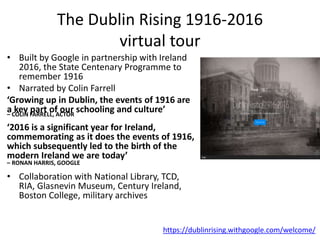
• Built by Google in partnership with Ireland
2016, the State Centenary Programme to
remember 1916
• Narrated by Colin Farrell
‘Growing up in Dublin, the events of 1916 are
a key part of our schooling and culture’– COLIN FARRELL, ACTOR
‘2016 is a significant year for Ireland,
commemorating as it does the events of 1916,
which subsequently led to the birth of the
modern Ireland we are today’
– RONAN HARRIS, GOOGLE
• Collaboration with National Library, TCD,
RIA, Glasnevin Museum, Century Ireland,
Boston College, military archives
https://dublinrising.withgoogle.com/welcome/
The Dublin Rising 1916-2016
virtual tour
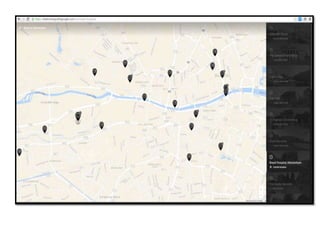
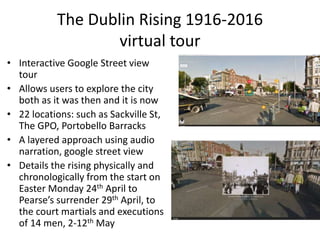
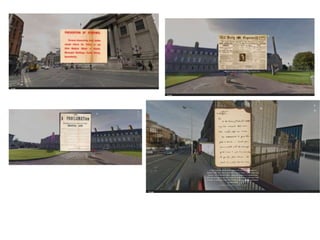
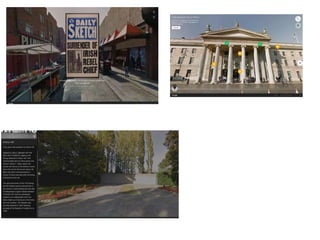
• Interactive Google Street view
tour
• Allows users to explore the city
both as it was then and it is now
• 22 locations: such as Sackville St,
The GPO, Portobello Barracks
• A layered approach using audio
narration, google street view
• Details the rising physically and
chronologically from the start on
Easter Monday 24th April to
Pearse’s surrender 29th April, to
the court martials and executions
of 14 men, 2-12th May
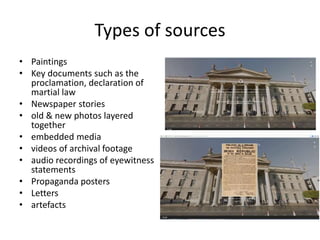
Types of sources
• Paintings
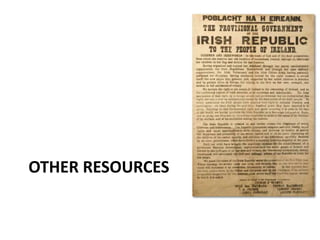
• Key documents such as the
proclamation, declaration of
martial law
• Newspaper stories
• old & new photos layered
together
• embedded media
• videos of archival footage
• audio recordings of eyewitness
statements
• Propaganda posters
• Letters
• artefacts
Google cultural institute
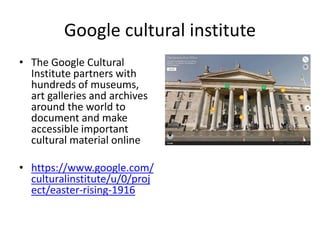
• The Google Cultural
Institute partners with
hundreds of museums,
art galleries and archives
around the world to
document and make
accessible important
cultural material online
• https://www.google.com/
culturalinstitute/u/0/proj
ect/easter-rising-1916
OTHER RESOURCES
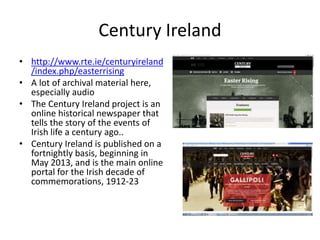
Century Ireland
• http://www.rte.ie/centuryireland
/index.php/easterrising
• A lot of archival material here,
especially audio
• The Century Ireland project is an
online historical newspaper that
tells the story of the events of
Irish life a century ago..
• Century Ireland is published on a
fortnightly basis, beginning in
May 2013, and is the main online
portal for the Irish decade of
commemorations, 1912-23
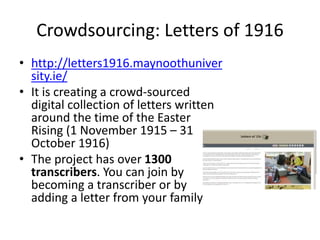
Crowdsourcing: Letters of 1916
• http://letters1916.maynoothuniver
sity.ie/
• It is creating a crowd-sourced
digital collection of letters written
around the time of the Easter
Rising (1 November 1915 – 31
October 1916)
• The project has over 1300
transcribers. You can join by
becoming a transcriber or by
adding a letter from your family
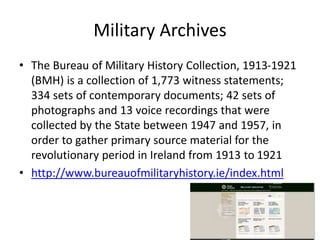
Military Archives
• The Bureau of Military History Collection, 1913-1921
(BMH) is a collection of 1,773 witness statements;
334 sets of contemporary documents; 42 sets of
photographs and 13 voice recordings that were
collected by the State between 1947 and 1957, in
order to gather primary source material for the
revolutionary period in Ireland from 1913 to 1921
• http://www.bureauofmilitaryhistory.ie/index.html
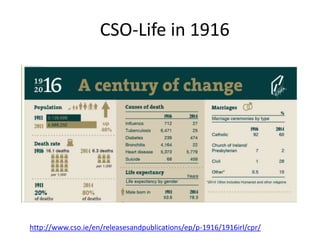
CSO-Life in 1916
http://www.cso.ie/en/releasesandpublications/ep/p-1916/1916irl/cpr/
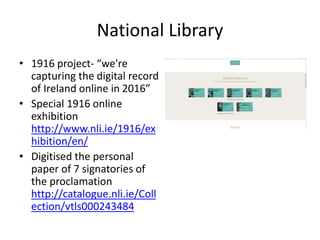
National Library
• 1916 project- “we're
capturing the digital record
of Ireland online in 2016”
• Special 1916 online
exhibition
http://www.nli.ie/1916/ex
hibition/en/
• Digitised the personal
paper of 7 signatories of
the proclamation
http://catalogue.nli.ie/Coll
ection/vtls000243484
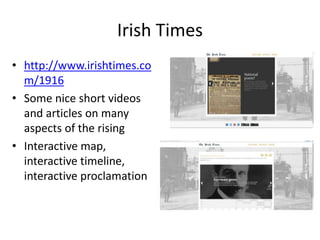
Irish Times
• http://www.irishtimes.co
m/1916
• Some nice short videos
and articles on many
aspects of the rising
• Interactive map,
interactive timeline,
interactive proclamation
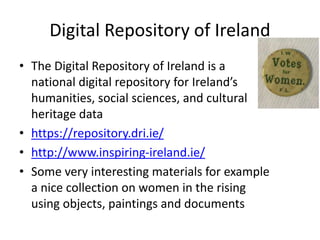
Digital Repository of Ireland
• The Digital Repository of Ireland is a
national digital repository for Ireland’s
humanities, social sciences, and cultural
heritage data
• https://repository.dri.ie/
• http://www.inspiring-ireland.ie/
• Some very interesting materials for example
a nice collection on women in the rising
using objects, paintings and documents
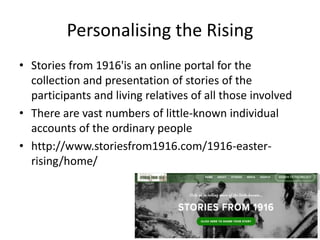
Personalising the Rising
• Stories from 1916'is an online portal for the
collection and presentation of stories of the
participants and living relatives of all those involved
• There are vast numbers of little-known individual
accounts of the ordinary people
• http://www.storiesfrom1916.com/1916-easter-
rising/home/
References
• Ferriter, Diarmaid. “Commemorating the Rising 1922-65: „A Figurative Scramble
for the Bones of the Patriot Dead‟?” 1916 in 1966: Commemorating the Easter
Rising. Ed. Mary E. Daly and Margaret O’Callaghan. Dublin: Royal Irish Academy,
2007. 198- 218
• Holohan, Carole . Towards 2016. In: Research and resources in a digital age : UCD
Irish Virtual Research Library and Archive. UCD Irish Virtual Research Library and
Archive, 2010.
• Martin, Alison . Easter Rising commemorations in the early Irish state. History
Ireland, Vol.24, Issue 2, 2016.
• McGarry, Fergal. ‘Imagining the past to remember the future’?: Easter 1916 in
2016. History Ireland, Vol.24, Issue 2, 2016.
• NLI digitisation project
file:///C:/Users/TEMP/Downloads/NLI%202016%20Programme.pdf

Google does 1916

  • 1.
    Google does 1916:an exploration of the Dublin Rising 1916-2016 virtual tour and other digital resources Orna Farrell
  • 2.
    Outline • Remembrance “commemorationtells us more about the present than the past” (Holohan, 2010) • Digitising 1916 • Dublin Rising 1916-2016 Virtual Tour • A selection of Digital resources on 1916
  • 3.
    Remembrance and 1916 •In 1924 Cumann na nGaedhael government hosted the first official military ceremony commemorating the 1916 Rising, although relatives of the executed 1916 leaders were invited, only one, the widow of Michael Mallin, attended (Ferriter 2007) • In the aftermath of the Civil War, division characterised the commemoration of 1916,this continued throughout the twentieth century as both the Irish government and Republicans sought to claim this inheritance
  • 4.
    Remembrance and 1916 •Selective memorialisation-using rising to gain political capital (Martin, 2016) • The anniversary of the Rising provided the government with a convenient opportunity to reiterate that Éire was an independent state capable of making her own decisions- especially in 1941 De Valera taking the salute at the 1916 silver jubilee commemorations in 1941 outside the GPO. Oliver Sheppard’s statue of Cuchulainn. At its unveiling in the GPO in 1935 ‘IS IT STILL HELD THAT THE GOVERNMENT IS NOT MAKING IT A PARTY DEMONSTRATION?’— RICHARD MULCAHY, EASTER 1935
  • 5.
    Remembrance and 1916 •In April 1966 the 50th anniversary witnessed an unprecedented amount of activity as parades, monuments, television and radio programming commemorated the Rising (Holohan, 2010) • In the 1970s, 1980s the absence of the official military parade down O’Connell Street and past the General Post Office reflected how the memory of the Rising had been complicated by the outbreak of violence in Northern Ireland • 90th anniversary in 2006 saw the reinstatement of the parade, an event made possible by the advent of peace in Northern Ireland, Once again, the 1916 Proclamation of the Republic was read aloud outside the General Post Office
  • 6.
    Remembrance and 1916 •“As the pre-eminent symbol of Irish nationhood rather than the week- long battle for Dublin, the Rising has lent itself to endless reinterpretation, with new meanings ascribed in response to events that occurred long after 1916; the Rising, as Pearse anticipated, transcended its context, its iconic representation ‘across time and cultures’ assuming greater weight in public discourse than the original event.” (McGarry, 2016) • The current government’s struggle to find an appropriate register to commemorate the Easter Rising with historical integrity-€46 million spent http://www.ireland.ie/ • This time 1916 has been framed in the “decade of centuries” • Pluralism, shifting of collective memory “Remember, reflect, reimagine” • broadening the focus from men with guns to labour activists, women and other previously overlooked groups
  • 7.
    Digitising 1916 • TheDecade of Centenaries has contributed archival developments such as the digitisation of the Bureau of Military History Military Service Pensions Collection, and the 1901 and 1911 censuses, which have democratised research and reinvigorated scholarship http://www.decadeofcentenaries.com/ • In the lead up to the centenary of the 1916 Rising, drive to survey and digitise relevant archival material • Huge projects underway by the NLI, Military archives, national museum, Royal Irish Academy • These digitisation project share a common ideal- to make Irelands heritage widely available to everyone and to enrich the historical narrative
  • 8.
    Digitising 1916 • NLIproject-making 90,000 images available online • Personal papers of 7 of the signatories of the proclamation • NLI will also record the commemoration of 1916 in 2016- by capture key websites • Using social media to learn more about their photos- inviting comment and involvement
  • 9.
    The Dublin Rising1916-2016 virtual tour • Built by Google in partnership with Ireland 2016, the State Centenary Programme to remember 1916 • Narrated by Colin Farrell ‘Growing up in Dublin, the events of 1916 are a key part of our schooling and culture’– COLIN FARRELL, ACTOR ‘2016 is a significant year for Ireland, commemorating as it does the events of 1916, which subsequently led to the birth of the modern Ireland we are today’ – RONAN HARRIS, GOOGLE • Collaboration with National Library, TCD, RIA, Glasnevin Museum, Century Ireland, Boston College, military archives https://dublinrising.withgoogle.com/welcome/
  • 11.
    The Dublin Rising1916-2016 virtual tour • Interactive Google Street view tour • Allows users to explore the city both as it was then and it is now • 22 locations: such as Sackville St, The GPO, Portobello Barracks • A layered approach using audio narration, google street view • Details the rising physically and chronologically from the start on Easter Monday 24th April to Pearse’s surrender 29th April, to the court martials and executions of 14 men, 2-12th May
  • 12.
    Types of sources •Paintings • Key documents such as the proclamation, declaration of martial law • Newspaper stories • old & new photos layered together • embedded media • videos of archival footage • audio recordings of eyewitness statements • Propaganda posters • Letters • artefacts
  • 15.
    Google cultural institute •The Google Cultural Institute partners with hundreds of museums, art galleries and archives around the world to document and make accessible important cultural material online • https://www.google.com/ culturalinstitute/u/0/proj ect/easter-rising-1916
  • 16.
  • 17.
    Century Ireland • http://www.rte.ie/centuryireland /index.php/easterrising •A lot of archival material here, especially audio • The Century Ireland project is an online historical newspaper that tells the story of the events of Irish life a century ago.. • Century Ireland is published on a fortnightly basis, beginning in May 2013, and is the main online portal for the Irish decade of commemorations, 1912-23
  • 18.
    Crowdsourcing: Letters of1916 • http://letters1916.maynoothuniver sity.ie/ • It is creating a crowd-sourced digital collection of letters written around the time of the Easter Rising (1 November 1915 – 31 October 1916) • The project has over 1300 transcribers. You can join by becoming a transcriber or by adding a letter from your family
  • 19.
    Military Archives • TheBureau of Military History Collection, 1913-1921 (BMH) is a collection of 1,773 witness statements; 334 sets of contemporary documents; 42 sets of photographs and 13 voice recordings that were collected by the State between 1947 and 1957, in order to gather primary source material for the revolutionary period in Ireland from 1913 to 1921 • http://www.bureauofmilitaryhistory.ie/index.html
  • 20.
  • 21.
    National Library • 1916project- “we're capturing the digital record of Ireland online in 2016” • Special 1916 online exhibition http://www.nli.ie/1916/ex hibition/en/ • Digitised the personal paper of 7 signatories of the proclamation http://catalogue.nli.ie/Coll ection/vtls000243484
  • 22.
    Irish Times • http://www.irishtimes.co m/1916 •Some nice short videos and articles on many aspects of the rising • Interactive map, interactive timeline, interactive proclamation
  • 23.
    Digital Repository ofIreland • The Digital Repository of Ireland is a national digital repository for Ireland’s humanities, social sciences, and cultural heritage data • https://repository.dri.ie/ • http://www.inspiring-ireland.ie/ • Some very interesting materials for example a nice collection on women in the rising using objects, paintings and documents
  • 24.
    Personalising the Rising •Stories from 1916'is an online portal for the collection and presentation of stories of the participants and living relatives of all those involved • There are vast numbers of little-known individual accounts of the ordinary people • http://www.storiesfrom1916.com/1916-easter- rising/home/
  • 25.
    References • Ferriter, Diarmaid.“Commemorating the Rising 1922-65: „A Figurative Scramble for the Bones of the Patriot Dead‟?” 1916 in 1966: Commemorating the Easter Rising. Ed. Mary E. Daly and Margaret O’Callaghan. Dublin: Royal Irish Academy, 2007. 198- 218 • Holohan, Carole . Towards 2016. In: Research and resources in a digital age : UCD Irish Virtual Research Library and Archive. UCD Irish Virtual Research Library and Archive, 2010. • Martin, Alison . Easter Rising commemorations in the early Irish state. History Ireland, Vol.24, Issue 2, 2016. • McGarry, Fergal. ‘Imagining the past to remember the future’?: Easter 1916 in 2016. History Ireland, Vol.24, Issue 2, 2016. • NLI digitisation project file:///C:/Users/TEMP/Downloads/NLI%202016%20Programme.pdf