Biochemistry (Protein Synthesis)
Alexander C D Bowman 12th September 2016- Salisbury 6th Form BTEC Level 2 yr 13- Part 1
3.3 Genes control the activities of cells
https://www.youtube.com/watch?v=URUJD5NEXC8 cell structure
https://www.youtube.com/watch?v=gG7uCskUOrA Protein synthesis
Name:
• 1 Literacy
• Read the text below. Underline each of the spelling / punctuation / grammar mistakes and correct them in the
space.
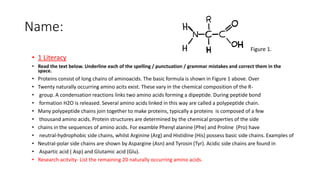
• Proteins consist of long chains of aminoacids. The basic formula is shown in Figure 1 above. Over
• Twenty naturally occurring amino acits exist. These vary in the chemical composition of the R-
• group. A condensation reactions links two amino acids forming a dipeptide. During peptide bond
• formation H2O is released. Several amino acids linked in this way are called a polypeptide chain.
• Many polypeptide chains join together to make proteins, typically a proteins is composed of a few
• thousand amino acids. Protein structures are determined by the chemical properties of the side
• chains in the sequences of amino acids. For examble Phenyl alanine (Phe) and Proline (Pro) have
• neutral-hydrophobic side chains, whilst Arginine (Arg) and Histidine (His) possess basic side chains. Examples of
• Neutral-polar side chains are shown by Aspargine (Asn) and Tyrosin (Tyr). Acidic side chains are found in
• Aspartic acid ( Asp) and Glutamic acid (Glu).
• Research acitvity- List the remaining 20 naturally occurring amino acids.
Figure 1.
2. Some Key words. Draw lines between each key word and the appropriate corresponding text on the right. Two
key words may align with a single piece of text, and one extra piece of information has been included.
Genes determine characteristics. Characteristics are passed on to the next generation, thus we can presume that
genes must contain instructions. Furthermore, the gene must be able to re-produce itself or replicate.
• DNA
• Translation
• RNA
• Transcription
• tRNA
• Nucleic acid
• Oswald Avery (1944)
• Pentose
• Nucleotide
• Organic base
• Beadle and Tatum
• Two types of nucleic acid are found in cells. These are
Deoxyribonucleic acid (DNA) and Ribonucleic acid (RNA).
• Chemical analysis shows that DNA is confined to the nucleus,
whilst RNA is found mainly but not exclusively, in the
cytoplasm.
• A five carbon sugar.
• Hypothesis ‘one gene-one protein’- more accurately one
gene-one polypeptide’.
• It is the building block of a nucleic acid, composed of 3
molecules: a 5 carbon sugar, an organic base and phosphoric
acid.
• Can be any one of 5: Adenine, Guanine, Thymine, Cytosine or
Uracil. In RNA T is replaced by U.
• Famed for evidence showing that nucleic acid was the carrier
of genetic information and NOT protein. The production of
mRNA is called transcription.
• The production of mRNA is called transcription.
• Another sort of RNA, called transfer RNA (tRNA), then places
the amino acids into the correct order to make a specific
protein. This process is called translation.
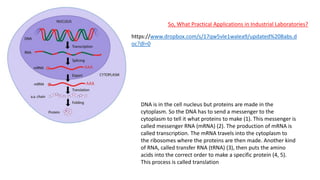
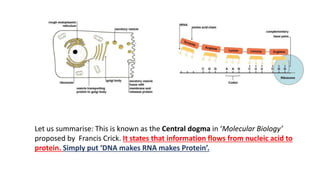
DNA is in the cell nucleus but proteins are made in the
cytoplasm. So the DNA has to send a messenger to the
cytoplasm to tell it what proteins to make (1). This messenger is
called messenger RNA (mRNA) (2). The production of mRNA is
called transcription. The mRNA travels into the cytoplasm to
the ribosomes where the proteins are then made. Another kind
of RNA, called transfer RNA (tRNA) (3), then puts the amino
acids into the correct order to make a specific protein (4, 5).
This process is called translation
So, What Practical Applications in Industrial Laboratories?
https://www.dropbox.com/s/17qw5vle1walea9/updated%20Babs.d
oc?dl=0
Let us summarise: This is known as the Central dogma in ‘Molecular Biology’
proposed by Francis Crick. It states that information flows from nucleic acid to
protein. Simply put ‘DNA makes RNA makes Protein’.
3. Scientific Evidence?
Fill the blank spaces with: Proportions,
Synthesis, Presence and RNA
The -------- of RNA from free
nucleotides in the --- of DNA
has been carried out. The
relative ----------- of the
bases in the newly
synthesized ----- were found
to correspond to those of
the DNA.
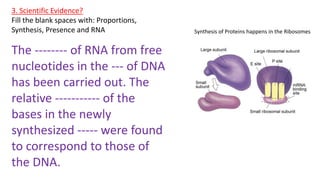
Synthesis of Proteins happens in the Ribosomes
4. Group and Class Discussion Activity. Study the 5 pieces of information, what can you add? Do your
colleagues agree?
Once the protein has been made it folds itself into a shape. The shape allows it to perform a particular function.
This is very important as enzymes (large protein molecules) have a specific active site. The substrate must fit
into the active site of the enzyme to allow it to catalyse the reaction.
What could happen if something went wrong in the production of these proteins. Current issues.
Proteins are Amphoteric- having both positive and negative charges on them. Since opposite charges attract
‘weak electrostatic (hydrogen) bonds’result. This causes the chain to form complex 3-D structures- known as
globular proteins. Can you name some examples?
Sometimes the protein consists of long parallel chains with cross links- fibrous proteins. These are insoluble and
play a role in structural function. Examples: collagen in cartilage and kertain in hooves.
Proteins can be denatured. Heat treatment, strong acid and strong alkali cause hydrogen bonds to break
reverting globular proteins back to a more fibrous nature.
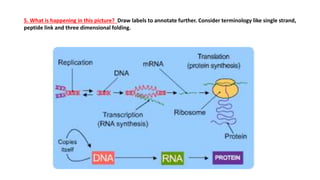
5. What is happening in this picture? Draw labels to annotate further. Consider terminology like single strand,
peptide link and three dimensional folding.
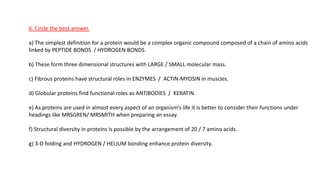
6. Circle the best answer.
a) The simplest definition for a protein would be a complex organic compound composed of a chain of amino acids
linked by PEPTIDE BONDS / HYDROGEN BONDS.
b) These form three dimensional structures with LARGE / SMALL molecular mass.
c) Fibrous proteins have structural roles in ENZYMES / ACTIN-MYOSIN in muscles.
d) Globular proteins find functional roles as ANTIBODIES / KERATIN.
e) As proteins are used in almost every aspect of an organism’s life it is better to consider their functions under
headings like MRSGREN/ MRSMITH when preparing an essay.
f) Structural diversity in proteins is possible by the arrangement of 20 / 7 amino acids.
g) 3-D folding and HYDROGEN / HELIUM bonding enhance protein diversity.
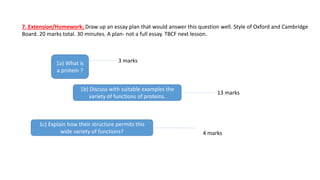
1a) What is
a protein ?
3 marks
1b) Discuss with suitable examples the
variety of functions of proteins.
13 marks
1c) Explain how their structure permits this
wide variety of functions? 4 marks
7. Extension/Homework: Draw up an essay plan that would answer this question well. Style of Oxford and Cambridge
Board. 20 marks total. 30 minutes. A plan- not a full essay. TBCF next lesson.

Biochemistry (protein synthesis)

  • 1.
    Biochemistry (Protein Synthesis) AlexanderC D Bowman 12th September 2016- Salisbury 6th Form BTEC Level 2 yr 13- Part 1 3.3 Genes control the activities of cells https://www.youtube.com/watch?v=URUJD5NEXC8 cell structure https://www.youtube.com/watch?v=gG7uCskUOrA Protein synthesis
  • 2.
    Name: • 1 Literacy •Read the text below. Underline each of the spelling / punctuation / grammar mistakes and correct them in the space. • Proteins consist of long chains of aminoacids. The basic formula is shown in Figure 1 above. Over • Twenty naturally occurring amino acits exist. These vary in the chemical composition of the R- • group. A condensation reactions links two amino acids forming a dipeptide. During peptide bond • formation H2O is released. Several amino acids linked in this way are called a polypeptide chain. • Many polypeptide chains join together to make proteins, typically a proteins is composed of a few • thousand amino acids. Protein structures are determined by the chemical properties of the side • chains in the sequences of amino acids. For examble Phenyl alanine (Phe) and Proline (Pro) have • neutral-hydrophobic side chains, whilst Arginine (Arg) and Histidine (His) possess basic side chains. Examples of • Neutral-polar side chains are shown by Aspargine (Asn) and Tyrosin (Tyr). Acidic side chains are found in • Aspartic acid ( Asp) and Glutamic acid (Glu). • Research acitvity- List the remaining 20 naturally occurring amino acids. Figure 1.
  • 3.
    2. Some Keywords. Draw lines between each key word and the appropriate corresponding text on the right. Two key words may align with a single piece of text, and one extra piece of information has been included. Genes determine characteristics. Characteristics are passed on to the next generation, thus we can presume that genes must contain instructions. Furthermore, the gene must be able to re-produce itself or replicate. • DNA • Translation • RNA • Transcription • tRNA • Nucleic acid • Oswald Avery (1944) • Pentose • Nucleotide • Organic base • Beadle and Tatum • Two types of nucleic acid are found in cells. These are Deoxyribonucleic acid (DNA) and Ribonucleic acid (RNA). • Chemical analysis shows that DNA is confined to the nucleus, whilst RNA is found mainly but not exclusively, in the cytoplasm. • A five carbon sugar. • Hypothesis ‘one gene-one protein’- more accurately one gene-one polypeptide’. • It is the building block of a nucleic acid, composed of 3 molecules: a 5 carbon sugar, an organic base and phosphoric acid. • Can be any one of 5: Adenine, Guanine, Thymine, Cytosine or Uracil. In RNA T is replaced by U. • Famed for evidence showing that nucleic acid was the carrier of genetic information and NOT protein. The production of mRNA is called transcription. • The production of mRNA is called transcription. • Another sort of RNA, called transfer RNA (tRNA), then places the amino acids into the correct order to make a specific protein. This process is called translation.
  • 4.
    DNA is inthe cell nucleus but proteins are made in the cytoplasm. So the DNA has to send a messenger to the cytoplasm to tell it what proteins to make (1). This messenger is called messenger RNA (mRNA) (2). The production of mRNA is called transcription. The mRNA travels into the cytoplasm to the ribosomes where the proteins are then made. Another kind of RNA, called transfer RNA (tRNA) (3), then puts the amino acids into the correct order to make a specific protein (4, 5). This process is called translation So, What Practical Applications in Industrial Laboratories? https://www.dropbox.com/s/17qw5vle1walea9/updated%20Babs.d oc?dl=0
  • 5.
    Let us summarise:This is known as the Central dogma in ‘Molecular Biology’ proposed by Francis Crick. It states that information flows from nucleic acid to protein. Simply put ‘DNA makes RNA makes Protein’.
  • 6.
    3. Scientific Evidence? Fillthe blank spaces with: Proportions, Synthesis, Presence and RNA The -------- of RNA from free nucleotides in the --- of DNA has been carried out. The relative ----------- of the bases in the newly synthesized ----- were found to correspond to those of the DNA. Synthesis of Proteins happens in the Ribosomes
  • 7.
    4. Group andClass Discussion Activity. Study the 5 pieces of information, what can you add? Do your colleagues agree? Once the protein has been made it folds itself into a shape. The shape allows it to perform a particular function. This is very important as enzymes (large protein molecules) have a specific active site. The substrate must fit into the active site of the enzyme to allow it to catalyse the reaction. What could happen if something went wrong in the production of these proteins. Current issues. Proteins are Amphoteric- having both positive and negative charges on them. Since opposite charges attract ‘weak electrostatic (hydrogen) bonds’result. This causes the chain to form complex 3-D structures- known as globular proteins. Can you name some examples? Sometimes the protein consists of long parallel chains with cross links- fibrous proteins. These are insoluble and play a role in structural function. Examples: collagen in cartilage and kertain in hooves. Proteins can be denatured. Heat treatment, strong acid and strong alkali cause hydrogen bonds to break reverting globular proteins back to a more fibrous nature.
  • 8.
    5. What ishappening in this picture? Draw labels to annotate further. Consider terminology like single strand, peptide link and three dimensional folding.
  • 9.
    6. Circle thebest answer. a) The simplest definition for a protein would be a complex organic compound composed of a chain of amino acids linked by PEPTIDE BONDS / HYDROGEN BONDS. b) These form three dimensional structures with LARGE / SMALL molecular mass. c) Fibrous proteins have structural roles in ENZYMES / ACTIN-MYOSIN in muscles. d) Globular proteins find functional roles as ANTIBODIES / KERATIN. e) As proteins are used in almost every aspect of an organism’s life it is better to consider their functions under headings like MRSGREN/ MRSMITH when preparing an essay. f) Structural diversity in proteins is possible by the arrangement of 20 / 7 amino acids. g) 3-D folding and HYDROGEN / HELIUM bonding enhance protein diversity.
  • 10.
    1a) What is aprotein ? 3 marks 1b) Discuss with suitable examples the variety of functions of proteins. 13 marks 1c) Explain how their structure permits this wide variety of functions? 4 marks 7. Extension/Homework: Draw up an essay plan that would answer this question well. Style of Oxford and Cambridge Board. 20 marks total. 30 minutes. A plan- not a full essay. TBCF next lesson.