Adama Science and Technology University
School of Applied Natural Science
Department of Applied Biology postgraduate program
Advanced Biochemistry (Biol5021)
Biochemical and physiological use of
macromolecules
By: Temesgen Assefa
Adama, Ethiopia
January 2, 2018
1
Outline
Introduction
Carbohydrates
Protiens
Nucliec acids
Lipids
Biochemical and physiological importance
January 2, 2018
2
Introduction
January 2, 2018 3
 Biochemistry, sometimes called biological
chemistry, is the study of chemical processes in the
cell.
It deals with the structures, functions and
interactions of biological molecules which provide the
structure of cells and perform many of the functions
associated with life.
Macromolecules are polymers of monomers.
Includes; Carbohydrates, Protiens, Nucliec acids and Lipids
Cont…
Polymers of simple sugars
Carbon compounds that contain large
quantities of hydroxyl groups.
Allows to interact with the aqueous
environment and to participate in hydrogen
bonding, both within and between chains.
Represented by the formula (CH2O) n
January 2, 2018
4
A. Carbohydrates
. C,H &O ratio = 1:2:1
Carbohydrates are classified into three
subtypes based on the basis of the number of
forming units (sugar).
 Monosaccharides
Disaccharides
 polysaccharides
January 2, 2018
5
Cont…
Cont…
January 2, 2018 6
Monosaccharides
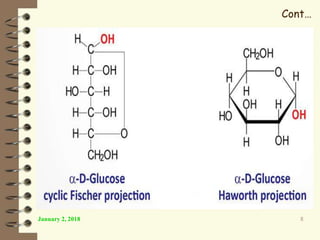
simple sugars
May exist as a linear chain or as ring-
shaped molecules.
In aqueous solutions, they are usually
found in the ring form
January 2, 2018
7
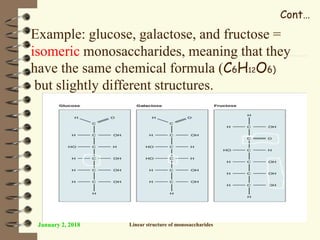
Example: glucose, galactose, and fructose =
isomeric monosaccharides, meaning that they
have the same chemical formula (C6H12O6)
but slightly different structures.
Linear structure of monosaccharides
Cont…
January 2, 2018 8
Cont…
January 2, 2018
9
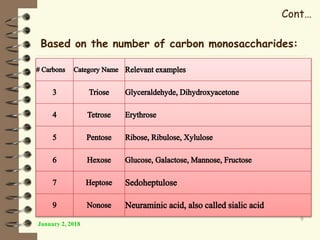
Based on the number of carbon monosaccharides:
Cont…
.
January 2, 2018
10
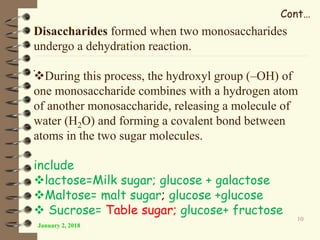
Disaccharides formed when two monosaccharides
undergo a dehydration reaction.
During this process, the hydroxyl group (–OH) of
one monosaccharide combines with a hydrogen atom
of another monosaccharide, releasing a molecule of
water (H2O) and forming a covalent bond between
atoms in the two sugar molecules.
include
lactose=Milk sugar; glucose + galactose
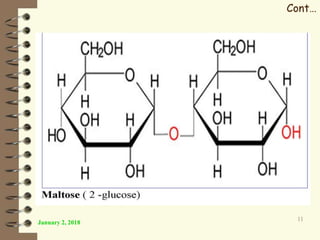
Maltose= malt sugar; glucose +glucose
 Sucrose= Table sugar; glucose+ fructose
Cont…
January 2, 2018
11
Cont…
January 2, 2018
12
Cont…
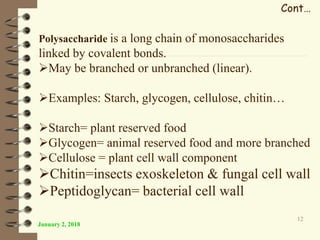
Polysaccharide is a long chain of monosaccharides
linked by covalent bonds.
May be branched or unbranched (linear).
Examples: Starch, glycogen, cellulose, chitin…
Starch= plant reserved food
Glycogen= animal reserved food and more branched
Cellulose = plant cell wall component
Chitin=insects exoskeleton & fungal cell wall
Peptidoglycan= bacterial cell wall
January2,2018
Cont…
Biochemical and physiological Functions of carbohydrates
 Energy storage and production. E.g. Monosaccharides
supply 3.74 kcal/g, disaccharides 3.95 kcal/g, while starch 4.18 kcal/g;
on average 4 kcal/g.
Exert a protein-saving action
Form other bio molecules
Necessary for the normal lipid metabolism
“Fats burn in the fire of carbohydrates“ L. Pasteur
Oxygen transport
Indispensable for the maintenance of the integrity
of nervous tissue (Some CNS areas use glucose to
produce energy)
Two sugars, ribose and deoxyribose, are part of
the bearing structure of RNA and DNA. 13
January 2, 2018 14
For example, at hepatic level glucuronic acid,
synthesized from glucose, combines with endogenous
substances, as hormones, bilirubin etc., and exogenous
substances, as chemical, bacterial toxins or drugs,
making them atoxic, increasing their solubility and
allowing their elimination.
 Act as a reaction intermediates or accessories.
For example vitamin B12 (Riboflavin) has ribose sugar
and it is involved in vital reactions at cellular level.
Detoxifying processes
Cont…
Aid in gut motility
January 2, 2018
15
Cont…
They are also found linked to many
proteins and lipids.
 Structural elements
E.g. cellulose and chitin (homopolysaccharides)
and peptidoglycan (heteropolysaccharide).
January 2, 2018 16
Cont…
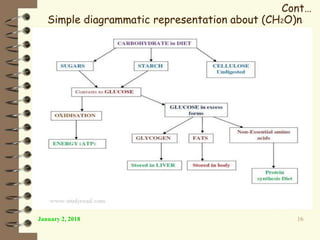
Simple diagrammatic representation about (CH2O)n
January 2, 2018
17
B. Proteins
Cont…
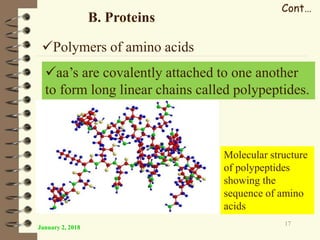
Polymers of amino acids
aa’s are covalently attached to one another
to form long linear chains called polypeptides.
Molecular structure
of polypeptides
showing the
sequence of amino
acids
January 2, 2018
18
Cont…
It may be structural, regulatory, contractile, or
protective; they may serve in transport, storage, or
membranes; or they may be toxins or enzymes.
The functions of proteins is very diverse because
there are 20 different chemically distinct amino acids
that form long chains.
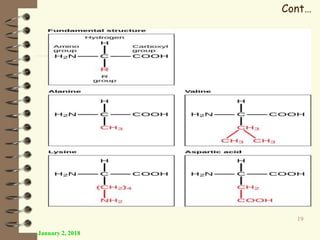
Each amino acid has the same fundamental structure.
NH2 (Amino group)
Carboxyl group (–COOH)
hydrogen atom and
R-group.
January 2, 2018
19
Cont…
January 2, 2018
20
The chemical nature of the R group determines the
chemical nature of the amino acid within its protein
(that is, whether it is acidic, basic, polar, or nonpolar).
The sequence and number of amino acids
ultimately determine a protein’s shape, size,
and function.
Each amino acid is attached to another amino
acid by a covalent bond, known as a peptide
bond, which is formed by a dehydration
reaction.
Cont…
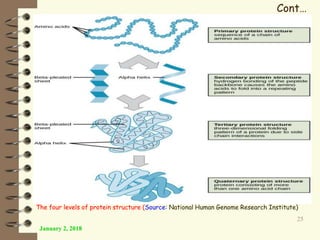
Four levels of protein structure:
 primary
 secondary
Tertiary
quaternary
January 2, 2018
21
Cont…
Protein Structure
The shape of a protein is critical to its function
January 2, 2018
22
Cont…
The unique sequence and number of amino
acids in a polypeptide chain is its primary
structure.
 Folding patterns resulting from interactions
between the non-R group portions of amino
acids yields secondary protein structure.
The most common are the alpha (α)-helix
and beta (β)-pleated sheet structures.
In the alpha helix, the bonds form between
every fourth amino acid and cause a twist in
the amino acid chain.
January 2, 2018
23
Cont…
In the β-pleated sheet, the “pleats” are formed by
hydrogen bonding between atoms on the backbone of
the polypeptide chain
The α-helix and β-pleated sheet structures are found
in many globular and fibrous proteins.
January 2, 2018
24
Cont…
It is caused by chemical interactions between various
amino acids and regions of the polypeptide.
The unique three-dimensional structure of a
polypeptide is known as its tertiary structure
Some proteins are formed from several
polypeptides, also known as subunits, and the
interaction of these subunits forms the quaternary
structure.
January 2, 2018
25
Cont…
The four levels of protein structure (Source: National Human Genome Research Institute)
January 2, 2018
26
Cont…
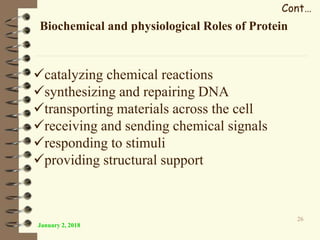
Biochemical and physiological Roles of Protein
catalyzing chemical reactions
synthesizing and repairing DNA
transporting materials across the cell
receiving and sending chemical signals
responding to stimuli
providing structural support
January 2, 2018
27
Cont…
Structure
Structural proteins form the basis of your cells,
which come together to form organs, muscle tissue,
bones, skin, hair and nails.
Movement
Muscle fibers consist of the proteins actin and
myosin, organized in a manner that allows them to
slide back and forth to shorten or lengthen a muscle
Communication
Some proteins function as chemical-signaling
molecules called hormones. And also enzymes.
Immunity
WBC’s synthesize several antibodies and chemokines, to help
protect you against infection and inflammation.
January 2, 2018
28
Cont…Transport and Storage
Hemoglobin is a protein that carries oxygen to the
tissues throughout your body
Myoglobin stores small amounts of oxygen in your
muscles
Respiratory system
Hemoglobin (composed of four protein subunits)
transports oxygen for use in cellular metabolism
Energy
protein can provide energy to your cells
Catalysis
Proteins are enzymes and involved in synthesis and
breakdown reaction (Drive Biochemical Reactions)
January 2, 2018
29
Cont…
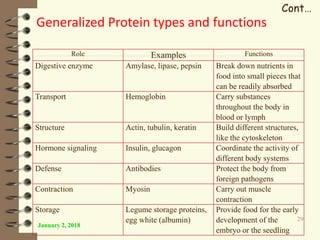
Role Examples Functions
Digestive enzyme Amylase, lipase, pepsin Break down nutrients in
food into small pieces that
can be readily absorbed
Transport Hemoglobin Carry substances
throughout the body in
blood or lymph
Structure Actin, tubulin, keratin Build different structures,
like the cytoskeleton
Hormone signaling Insulin, glucagon Coordinate the activity of
different body systems
Defense Antibodies Protect the body from
foreign pathogens
Contraction Myosin Carry out muscle
contraction
Storage Legume storage proteins,
egg white (albumin)
Provide food for the early
development of the
embryo or the seedling
Generalized Protein types and functions
January 2, 2018
30
Cont…
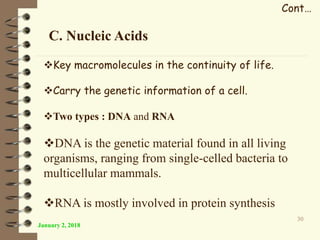
C. Nucleic Acids
Key macromolecules in the continuity of life.
Carry the genetic information of a cell.
Two types : DNA and RNA
DNA is the genetic material found in all living
organisms, ranging from single-celled bacteria to
multicellular mammals.
RNA is mostly involved in protein synthesis
January 2, 2018
31
Cont…
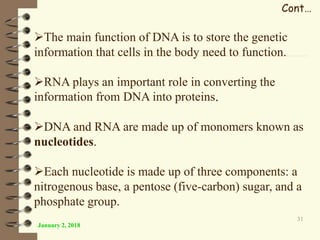
The main function of DNA is to store the genetic
information that cells in the body need to function.
RNA plays an important role in converting the
information from DNA into proteins.
DNA and RNA are made up of monomers known as
nucleotides.
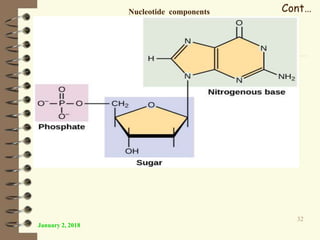
Each nucleotide is made up of three components: a
nitrogenous base, a pentose (five-carbon) sugar, and a
phosphate group.
January 2, 2018
32
Cont…Nucleotide components
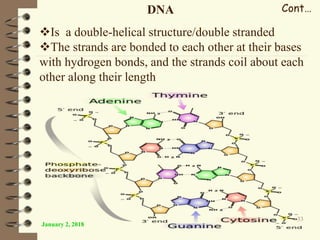
Is a double-helical structure/double stranded
The strands are bonded to each other at their bases
with hydrogen bonds, and the strands coil about each
other along their length
January 2, 2018
33
Cont…DNA
January 2, 2018
34
Cont…
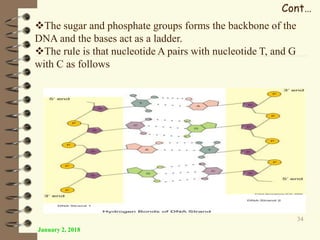
The sugar and phosphate groups forms the backbone of the
DNA and the bases act as a ladder.
The rule is that nucleotide A pairs with nucleotide T, and G
with C as follows
January 2, 2018
35
Cont…
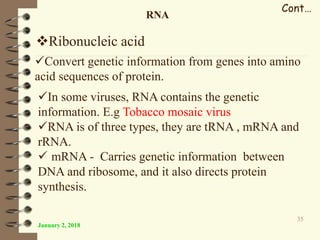
RNA
Ribonucleic acid
Convert genetic information from genes into amino
acid sequences of protein.
In some viruses, RNA contains the genetic
information. E.g Tobacco mosaic virus
RNA is of three types, they are tRNA , mRNA and
rRNA.
 mRNA - Carries genetic information between
DNA and ribosome, and it also directs protein
synthesis.
January 2, 2018
36
Cont…
r-RNA- a major component of the ribosome;
they catalyze the formation of peptide bond.
t-RNA act as a carrier molecule for the amino acids
that are used in protein synthesis. It is also responsible
for decoding the mRNA
January 2, 2018 37
Biochemical and physiological functions of nucleic acids
Cont…
Serve as energy storage
Form a portion of several important
coenzymes such as NAD+, NADP+ and FAD.
Serving as mediators of numerous important cellular
processes such as second messengers in signal
transduction events. E.g. cyclic-AMP
 Controlling enzymatic reactions through allosteric
effects on enzyme activity.
January 2, 2018
38
Serving as neurotransmitter and as signal receptor
ligands. Adenosine can function as an inhibitory
neurotransmitter, while ATP also affects synaptic
neurotransmission throughout the central and
peripheral nervous systems. ADP is an important
activator of platelet functions resulting in control of
blood coagulation.
Serving as activated intermediates in numerous
biosynthetic reactions. E.g. S-adenosylmethionine (S-
Ado Met or SAM= involved in methyl transfer rxn.
It store and transfer genetic information & directs
synthesis of proteins
Cont…
January 2, 2018
39
Cont…
D. Lipids
 Lipids are a class of macromolecules that are
nonpolar and hydrophobic in nature b/c it
include only nonpolar carbon-carbon or carbon-
hydrogen bonds. E.g. fats and oils, waxes,
phospholipids, and steroids.
Fats and oils are a stored form of energy and
can include triglycerides.
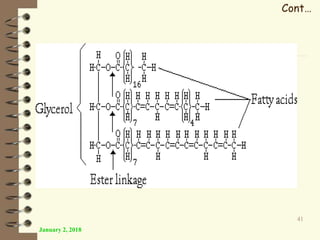
Triglyceride, consists of two main
components glycerol and fatty acids.
January 2, 2018
40
Cont…
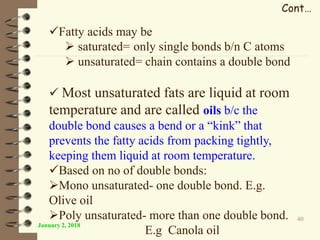
Fatty acids may be
 saturated= only single bonds b/n C atoms
 unsaturated= chain contains a double bond
 Most unsaturated fats are liquid at room
temperature and are called oils b/c the
double bond causes a bend or a “kink” that
prevents the fatty acids from packing tightly,
keeping them liquid at room temperature.
Based on no of double bonds:
Mono unsaturated- one double bond. E.g.
Olive oil
Poly unsaturated- more than one double bond.
E.g Canola oil
January 2, 2018
41
Cont…
January 2, 2018
42
Cont…
January 2, 2018
43
Cont…
Saturated fats tend to get packed tightly and
are solid at room temperature. E.g Animal fats
Mammals store fats in specialized cells called
adipocytes, where globules of fat occupy most of the
cell.
In plants, fat or oil is stored in seeds and is used as a
source of energy during embryonic development
Unsaturated fats help to improve blood cholesterol
levels, whereas saturated fats contribute to plaque
formation in the arteries, which increases the risk of a
heart attack.
January 2, 2018 44
Cont…
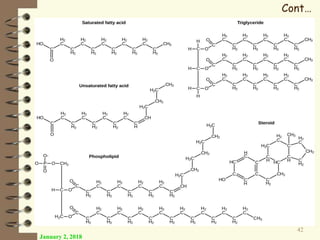
Unlike the phospholipids and fats, steroids
have a ring structure
Phospholipids are modified so that a phosphate
group (PO4
–) is added to one of the fatty acids.
Waxes are made up of a hydrocarbon chain with an
alcohol (-OH) group and a fatty acid.
Steroids are hydrophobic. All steroids have four, linked carbon
rings and several of them, like cholesterol, have a short tail. E.g
Cholesterol synthesized in liver
January 2, 2018
45
Cont…
Biochemical and physiological Function of Lipid
Chemical messengers
Storage and provision of energy
Storage lipids are triacylglycerols = fatty acids and a
glycerol
Lipids are insoluble in aqueous solutions and hence can be
stored readily in the body as a food reserve.
Maintenance of temperature
Layers of subcutaneous fat under the skin also help in
insulation and protection from cold
Membrane lipid layer formation
Membrane lipids are made of polyunsaturated fatty acids
January 2, 2018 46
Cont…
Cholesterol formation
Much of the cholesterol is located in cell
membranes
It maintains the fluidity of membranes by
interacting with their complex lipid components,
specifically the phospholipids such as
phosphatidylcholine and sphingomyelin.
Also it is the precursor of bile acids, vitamin D and
steroidal hormones
January 2, 2018 47
Cont…
Prostaglandin formation and role in inflammation
The essential fatty acids, linoleic and linolenic acids
are precursors of many different types of eicosanoids,
including the hydroxyeicosatetraenes, prostanoids
(prostaglandins, thromboxanes and prostacyclins),
leukotrienes (and lipoxins) and resolvins etc. these play
an important role in pain, fever, inflammation and
blood clotting.
January 2, 2018 48
Cont…
Essential nutrients
Some lipids are essential nutrients like fat-soluble
vitamins A, (necessary for vision) and D (necessary
for calcium metabolism) present in some fats and oils
of animal origin, vitamin E (prevention of
autoxidation of unsaturated lipids), present in
vegetable oils, and vitamin K (normal clotting of
blood) present in green leaves, essential fatty acids,
in particular linoleic and α-linolenic acids, founders
of the family of omega-6 and omega-3 fatty acids
respectively.
January 2, 2018 49
Cont…
Structural component
Lipids are an important constituent of the cell
membrane
Antibiotic agent
Squalamine, a steroid from the blood of sharks, has
been shown to be an antibiotic and antifungal agent
of intense activity and sharks rarely contract
infections and almost never get cancer.
Fatty acid absorption
 Phospholipids play an important role in the
absorption and transportation of fatty acids.
January 2, 2018 50
Cont…Hormone synthesis
The sex hormones, adrenocorticoids, cholic acids
and also vitamin D are all synthesized from
cholesterol, a steroidal lipid.
Vitamin carriers
Lipids act as carriers of natural fat-soluble
vitamins such as vitamin A, D and E.
Blood cholesterol lowering
stearic acid diet lowers blood cholesterol by 14%
of palmitic acid diet and 10% of oleic acid diet.
(Scott Grundy and Andrea Bonanome (1988),
University of Texas )
Thank You!!!
Question
January 2, 2018 51

Advanced biochemistry, ppt: Temesgen Assefa

  • 1.
    Adama Science andTechnology University School of Applied Natural Science Department of Applied Biology postgraduate program Advanced Biochemistry (Biol5021) Biochemical and physiological use of macromolecules By: Temesgen Assefa Adama, Ethiopia January 2, 2018 1
  • 2.
  • 3.
    Introduction January 2, 20183  Biochemistry, sometimes called biological chemistry, is the study of chemical processes in the cell. It deals with the structures, functions and interactions of biological molecules which provide the structure of cells and perform many of the functions associated with life. Macromolecules are polymers of monomers. Includes; Carbohydrates, Protiens, Nucliec acids and Lipids
  • 4.
    Cont… Polymers of simplesugars Carbon compounds that contain large quantities of hydroxyl groups. Allows to interact with the aqueous environment and to participate in hydrogen bonding, both within and between chains. Represented by the formula (CH2O) n January 2, 2018 4 A. Carbohydrates
  • 5.
    . C,H &Oratio = 1:2:1 Carbohydrates are classified into three subtypes based on the basis of the number of forming units (sugar).  Monosaccharides Disaccharides  polysaccharides January 2, 2018 5 Cont…
  • 6.
    Cont… January 2, 20186 Monosaccharides simple sugars May exist as a linear chain or as ring- shaped molecules. In aqueous solutions, they are usually found in the ring form
  • 7.
    January 2, 2018 7 Example:glucose, galactose, and fructose = isomeric monosaccharides, meaning that they have the same chemical formula (C6H12O6) but slightly different structures. Linear structure of monosaccharides Cont…
  • 8.
    January 2, 20188 Cont…
  • 9.
    January 2, 2018 9 Basedon the number of carbon monosaccharides: Cont…
  • 10.
    . January 2, 2018 10 Disaccharidesformed when two monosaccharides undergo a dehydration reaction. During this process, the hydroxyl group (–OH) of one monosaccharide combines with a hydrogen atom of another monosaccharide, releasing a molecule of water (H2O) and forming a covalent bond between atoms in the two sugar molecules. include lactose=Milk sugar; glucose + galactose Maltose= malt sugar; glucose +glucose  Sucrose= Table sugar; glucose+ fructose Cont…
  • 11.
  • 12.
    January 2, 2018 12 Cont… Polysaccharideis a long chain of monosaccharides linked by covalent bonds. May be branched or unbranched (linear). Examples: Starch, glycogen, cellulose, chitin… Starch= plant reserved food Glycogen= animal reserved food and more branched Cellulose = plant cell wall component Chitin=insects exoskeleton & fungal cell wall Peptidoglycan= bacterial cell wall
  • 13.
    January2,2018 Cont… Biochemical and physiologicalFunctions of carbohydrates  Energy storage and production. E.g. Monosaccharides supply 3.74 kcal/g, disaccharides 3.95 kcal/g, while starch 4.18 kcal/g; on average 4 kcal/g. Exert a protein-saving action Form other bio molecules Necessary for the normal lipid metabolism “Fats burn in the fire of carbohydrates“ L. Pasteur Oxygen transport Indispensable for the maintenance of the integrity of nervous tissue (Some CNS areas use glucose to produce energy) Two sugars, ribose and deoxyribose, are part of the bearing structure of RNA and DNA. 13
  • 14.
    January 2, 201814 For example, at hepatic level glucuronic acid, synthesized from glucose, combines with endogenous substances, as hormones, bilirubin etc., and exogenous substances, as chemical, bacterial toxins or drugs, making them atoxic, increasing their solubility and allowing their elimination.  Act as a reaction intermediates or accessories. For example vitamin B12 (Riboflavin) has ribose sugar and it is involved in vital reactions at cellular level. Detoxifying processes Cont…
  • 15.
    Aid in gutmotility January 2, 2018 15 Cont… They are also found linked to many proteins and lipids.  Structural elements E.g. cellulose and chitin (homopolysaccharides) and peptidoglycan (heteropolysaccharide).
  • 16.
    January 2, 201816 Cont… Simple diagrammatic representation about (CH2O)n
  • 17.
    January 2, 2018 17 B.Proteins Cont… Polymers of amino acids aa’s are covalently attached to one another to form long linear chains called polypeptides. Molecular structure of polypeptides showing the sequence of amino acids
  • 18.
    January 2, 2018 18 Cont… Itmay be structural, regulatory, contractile, or protective; they may serve in transport, storage, or membranes; or they may be toxins or enzymes. The functions of proteins is very diverse because there are 20 different chemically distinct amino acids that form long chains. Each amino acid has the same fundamental structure. NH2 (Amino group) Carboxyl group (–COOH) hydrogen atom and R-group.
  • 19.
  • 20.
    January 2, 2018 20 Thechemical nature of the R group determines the chemical nature of the amino acid within its protein (that is, whether it is acidic, basic, polar, or nonpolar). The sequence and number of amino acids ultimately determine a protein’s shape, size, and function. Each amino acid is attached to another amino acid by a covalent bond, known as a peptide bond, which is formed by a dehydration reaction. Cont…
  • 21.
    Four levels ofprotein structure:  primary  secondary Tertiary quaternary January 2, 2018 21 Cont… Protein Structure The shape of a protein is critical to its function
  • 22.
    January 2, 2018 22 Cont… Theunique sequence and number of amino acids in a polypeptide chain is its primary structure.  Folding patterns resulting from interactions between the non-R group portions of amino acids yields secondary protein structure. The most common are the alpha (α)-helix and beta (β)-pleated sheet structures. In the alpha helix, the bonds form between every fourth amino acid and cause a twist in the amino acid chain.
  • 23.
    January 2, 2018 23 Cont… Inthe β-pleated sheet, the “pleats” are formed by hydrogen bonding between atoms on the backbone of the polypeptide chain The α-helix and β-pleated sheet structures are found in many globular and fibrous proteins.
  • 24.
    January 2, 2018 24 Cont… Itis caused by chemical interactions between various amino acids and regions of the polypeptide. The unique three-dimensional structure of a polypeptide is known as its tertiary structure Some proteins are formed from several polypeptides, also known as subunits, and the interaction of these subunits forms the quaternary structure.
  • 25.
    January 2, 2018 25 Cont… Thefour levels of protein structure (Source: National Human Genome Research Institute)
  • 26.
    January 2, 2018 26 Cont… Biochemicaland physiological Roles of Protein catalyzing chemical reactions synthesizing and repairing DNA transporting materials across the cell receiving and sending chemical signals responding to stimuli providing structural support
  • 27.
    January 2, 2018 27 Cont… Structure Structuralproteins form the basis of your cells, which come together to form organs, muscle tissue, bones, skin, hair and nails. Movement Muscle fibers consist of the proteins actin and myosin, organized in a manner that allows them to slide back and forth to shorten or lengthen a muscle Communication Some proteins function as chemical-signaling molecules called hormones. And also enzymes. Immunity WBC’s synthesize several antibodies and chemokines, to help protect you against infection and inflammation.
  • 28.
    January 2, 2018 28 Cont…Transportand Storage Hemoglobin is a protein that carries oxygen to the tissues throughout your body Myoglobin stores small amounts of oxygen in your muscles Respiratory system Hemoglobin (composed of four protein subunits) transports oxygen for use in cellular metabolism Energy protein can provide energy to your cells Catalysis Proteins are enzymes and involved in synthesis and breakdown reaction (Drive Biochemical Reactions)
  • 29.
    January 2, 2018 29 Cont… RoleExamples Functions Digestive enzyme Amylase, lipase, pepsin Break down nutrients in food into small pieces that can be readily absorbed Transport Hemoglobin Carry substances throughout the body in blood or lymph Structure Actin, tubulin, keratin Build different structures, like the cytoskeleton Hormone signaling Insulin, glucagon Coordinate the activity of different body systems Defense Antibodies Protect the body from foreign pathogens Contraction Myosin Carry out muscle contraction Storage Legume storage proteins, egg white (albumin) Provide food for the early development of the embryo or the seedling Generalized Protein types and functions
  • 30.
    January 2, 2018 30 Cont… C.Nucleic Acids Key macromolecules in the continuity of life. Carry the genetic information of a cell. Two types : DNA and RNA DNA is the genetic material found in all living organisms, ranging from single-celled bacteria to multicellular mammals. RNA is mostly involved in protein synthesis
  • 31.
    January 2, 2018 31 Cont… Themain function of DNA is to store the genetic information that cells in the body need to function. RNA plays an important role in converting the information from DNA into proteins. DNA and RNA are made up of monomers known as nucleotides. Each nucleotide is made up of three components: a nitrogenous base, a pentose (five-carbon) sugar, and a phosphate group.
  • 32.
  • 33.
    Is a double-helicalstructure/double stranded The strands are bonded to each other at their bases with hydrogen bonds, and the strands coil about each other along their length January 2, 2018 33 Cont…DNA
  • 34.
    January 2, 2018 34 Cont… Thesugar and phosphate groups forms the backbone of the DNA and the bases act as a ladder. The rule is that nucleotide A pairs with nucleotide T, and G with C as follows
  • 35.
    January 2, 2018 35 Cont… RNA Ribonucleicacid Convert genetic information from genes into amino acid sequences of protein. In some viruses, RNA contains the genetic information. E.g Tobacco mosaic virus RNA is of three types, they are tRNA , mRNA and rRNA.  mRNA - Carries genetic information between DNA and ribosome, and it also directs protein synthesis.
  • 36.
    January 2, 2018 36 Cont… r-RNA-a major component of the ribosome; they catalyze the formation of peptide bond. t-RNA act as a carrier molecule for the amino acids that are used in protein synthesis. It is also responsible for decoding the mRNA
  • 37.
    January 2, 201837 Biochemical and physiological functions of nucleic acids Cont… Serve as energy storage Form a portion of several important coenzymes such as NAD+, NADP+ and FAD. Serving as mediators of numerous important cellular processes such as second messengers in signal transduction events. E.g. cyclic-AMP  Controlling enzymatic reactions through allosteric effects on enzyme activity.
  • 38.
    January 2, 2018 38 Servingas neurotransmitter and as signal receptor ligands. Adenosine can function as an inhibitory neurotransmitter, while ATP also affects synaptic neurotransmission throughout the central and peripheral nervous systems. ADP is an important activator of platelet functions resulting in control of blood coagulation. Serving as activated intermediates in numerous biosynthetic reactions. E.g. S-adenosylmethionine (S- Ado Met or SAM= involved in methyl transfer rxn. It store and transfer genetic information & directs synthesis of proteins Cont…
  • 39.
    January 2, 2018 39 Cont… D.Lipids  Lipids are a class of macromolecules that are nonpolar and hydrophobic in nature b/c it include only nonpolar carbon-carbon or carbon- hydrogen bonds. E.g. fats and oils, waxes, phospholipids, and steroids. Fats and oils are a stored form of energy and can include triglycerides. Triglyceride, consists of two main components glycerol and fatty acids.
  • 40.
    January 2, 2018 40 Cont… Fattyacids may be  saturated= only single bonds b/n C atoms  unsaturated= chain contains a double bond  Most unsaturated fats are liquid at room temperature and are called oils b/c the double bond causes a bend or a “kink” that prevents the fatty acids from packing tightly, keeping them liquid at room temperature. Based on no of double bonds: Mono unsaturated- one double bond. E.g. Olive oil Poly unsaturated- more than one double bond. E.g Canola oil
  • 41.
  • 42.
  • 43.
    January 2, 2018 43 Cont… Saturatedfats tend to get packed tightly and are solid at room temperature. E.g Animal fats Mammals store fats in specialized cells called adipocytes, where globules of fat occupy most of the cell. In plants, fat or oil is stored in seeds and is used as a source of energy during embryonic development Unsaturated fats help to improve blood cholesterol levels, whereas saturated fats contribute to plaque formation in the arteries, which increases the risk of a heart attack.
  • 44.
    January 2, 201844 Cont… Unlike the phospholipids and fats, steroids have a ring structure Phospholipids are modified so that a phosphate group (PO4 –) is added to one of the fatty acids. Waxes are made up of a hydrocarbon chain with an alcohol (-OH) group and a fatty acid. Steroids are hydrophobic. All steroids have four, linked carbon rings and several of them, like cholesterol, have a short tail. E.g Cholesterol synthesized in liver
  • 45.
    January 2, 2018 45 Cont… Biochemicaland physiological Function of Lipid Chemical messengers Storage and provision of energy Storage lipids are triacylglycerols = fatty acids and a glycerol Lipids are insoluble in aqueous solutions and hence can be stored readily in the body as a food reserve. Maintenance of temperature Layers of subcutaneous fat under the skin also help in insulation and protection from cold Membrane lipid layer formation Membrane lipids are made of polyunsaturated fatty acids
  • 46.
    January 2, 201846 Cont… Cholesterol formation Much of the cholesterol is located in cell membranes It maintains the fluidity of membranes by interacting with their complex lipid components, specifically the phospholipids such as phosphatidylcholine and sphingomyelin. Also it is the precursor of bile acids, vitamin D and steroidal hormones
  • 47.
    January 2, 201847 Cont… Prostaglandin formation and role in inflammation The essential fatty acids, linoleic and linolenic acids are precursors of many different types of eicosanoids, including the hydroxyeicosatetraenes, prostanoids (prostaglandins, thromboxanes and prostacyclins), leukotrienes (and lipoxins) and resolvins etc. these play an important role in pain, fever, inflammation and blood clotting.
  • 48.
    January 2, 201848 Cont… Essential nutrients Some lipids are essential nutrients like fat-soluble vitamins A, (necessary for vision) and D (necessary for calcium metabolism) present in some fats and oils of animal origin, vitamin E (prevention of autoxidation of unsaturated lipids), present in vegetable oils, and vitamin K (normal clotting of blood) present in green leaves, essential fatty acids, in particular linoleic and α-linolenic acids, founders of the family of omega-6 and omega-3 fatty acids respectively.
  • 49.
    January 2, 201849 Cont… Structural component Lipids are an important constituent of the cell membrane Antibiotic agent Squalamine, a steroid from the blood of sharks, has been shown to be an antibiotic and antifungal agent of intense activity and sharks rarely contract infections and almost never get cancer. Fatty acid absorption  Phospholipids play an important role in the absorption and transportation of fatty acids.
  • 50.
    January 2, 201850 Cont…Hormone synthesis The sex hormones, adrenocorticoids, cholic acids and also vitamin D are all synthesized from cholesterol, a steroidal lipid. Vitamin carriers Lipids act as carriers of natural fat-soluble vitamins such as vitamin A, D and E. Blood cholesterol lowering stearic acid diet lowers blood cholesterol by 14% of palmitic acid diet and 10% of oleic acid diet. (Scott Grundy and Andrea Bonanome (1988), University of Texas )
  • 51.