© 2012 Pearson Education, Inc. Lecture by Edward J. Zalisko
PowerPoint Lectures for
Campbell Biology: Concepts & Connections, Seventh Edition
Reece, Taylor, Simon, and Dickey
Chapter 2Chapter 2 The Chemical Basis of Life
ELEMENTS, ATOMS,
AND COMPOUNDS
© 2012 Pearson Education, Inc.
 Living organisms are composed of matter, which is
anything that occupies space and has mass
(weight).
 Matter is composed of chemical elements.
– An element is a substance that cannot be broken down
to other substances.
– There are 92 elements in nature—only a few exist in a
pure state.
2.1 Organisms are composed of elements, in
combinations called compounds
© 2012 Pearson Education, Inc.
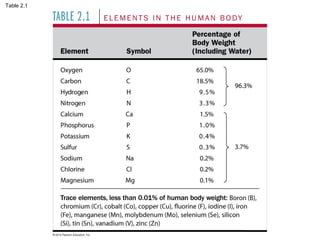
Table 2.1
 A compound is a substance consisting of two or
more different elements in a fixed ratio.
 Compounds are more common than pure
elements.
 Sodium chloride, table salt, is a common
compound of equal parts of sodium (Na) and
chlorine (Cl).
2.1 Organisms are composed of elements, in
combinations called compounds
© 2012 Pearson Education, Inc.
 About 25 elements are essential to life.
 Four elements make up about 96% of the weight of
most living organisms. These are
– oxygen,
– carbon,
– hydrogen, and
– nitrogen.
 Trace elements are essential but are only needed
in minute quantities.
2.1 Organisms are composed of elements, in
combinations called compounds
© 2012 Pearson Education, Inc.
2.2 CONNECTION: Trace elements are
common additives to food and water
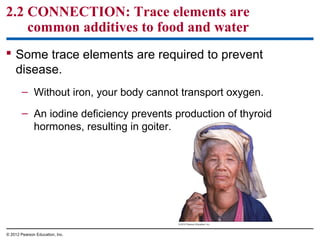
 Some trace elements are required to prevent
disease.
– Without iron, your body cannot transport oxygen.
– An iodine deficiency prevents production of thyroid
hormones, resulting in goiter.
© 2012 Pearson Education, Inc.
2.2 CONNECTION: Trace elements are
common additives to food and water
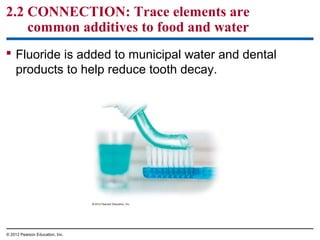
 Fluoride is added to municipal water and dental
products to help reduce tooth decay.
© 2012 Pearson Education, Inc.
2.2 CONNECTION: Trace elements are
common additives to food and water
 Several chemicals are added to food to
– help preserve it,
– make it more nutritious, and/or
– make it look better.
 Check out the “Nutrition Facts” label on foods and
drinks you purchase.
© 2012 Pearson Education, Inc.
2.3 Atoms consist of protons, neutrons, and
electrons
 Each element consists of one kind of atom.
 An atom is the smallest unit of matter that still
retains the properties of an element.
 Three subatomic particles in atoms are relevant to
our discussion of the properties of elements.
– Protons are positively charged.
– Electrons are negatively charged.
– Neutrons are electrically neutral.
© 2012 Pearson Education, Inc.
2.3 Atoms consist of protons, neutrons, and
electrons
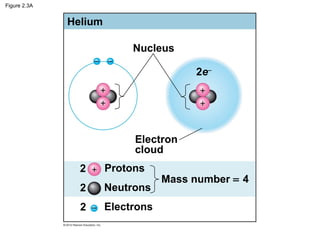
 Neutrons and protons are packed into an atom’s
nucleus.
 Electrons orbit the nucleus.
 The negative charge of electrons and the positive
charge of protons keep electrons near the nucleus.
© 2012 Pearson Education, Inc.
Figure 2.3A
Helium
Nucleus
Electron
cloud
2
2
2
Protons
Neutrons
Electrons
Mass number = 4
2e−
2.3 Atoms consist of protons, neutrons, and
electrons
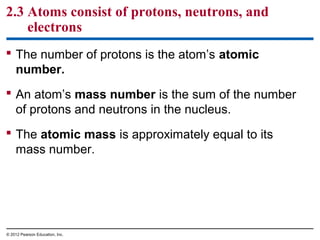
 The number of protons is the atom’s atomic
number.
 An atom’s mass number is the sum of the number
of protons and neutrons in the nucleus.
 The atomic mass is approximately equal to its
mass number.
© 2012 Pearson Education, Inc.
2.3 Atoms consist of protons, neutrons, and
electrons
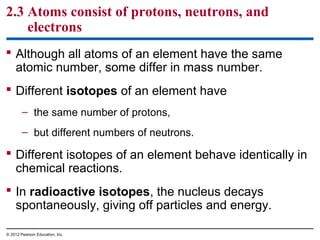
 Although all atoms of an element have the same
atomic number, some differ in mass number.
 Different isotopes of an element have
– the same number of protons,
– but different numbers of neutrons.
 Different isotopes of an element behave identically in
chemical reactions.
 In radioactive isotopes, the nucleus decays
spontaneously, giving off particles and energy.
© 2012 Pearson Education, Inc.
2.4 CONNECTION: Radioactive isotopes can
help or harm us
 Living cells cannot distinguish between isotopes of
the same element.
– Therefore, radioactive compounds in metabolic
processes can act as tracers.
– This radioactivity can be detected by instruments.
– Using these instruments, the fate of radioactive tracers
can be monitored in living organisms.
© 2012 Pearson Education, Inc.
2.4 CONNECTION: Radioactive isotopes can
help or harm us
 Radioactive tracers are frequently used in medical
diagnosis.
 Sophisticated imaging instruments are used to
detect them.
– An imaging instrument that uses positron-emission
tomography (PET) detects the location of injected
radioactive materials.
– PET is useful for diagnosing heart disorders, cancer,
and in brain research.
© 2012 Pearson Education, Inc.
2.4 CONNECTION: Radioactive isotopes can
help or harm us
 In addition to benefits, there are also dangers
associated with using radioactive substances.
– Uncontrolled exposure can cause damage to some
molecules in a living cell, especially DNA.
– Chemical bonds are broken by the emitted energy,
which causes abnormal bonds to form.
© 2012 Pearson Education, Inc.
CHEMICAL BONDS
© 2012 Pearson Education, Inc.
2.5 The distribution of electrons determines an
atom’s chemical properties
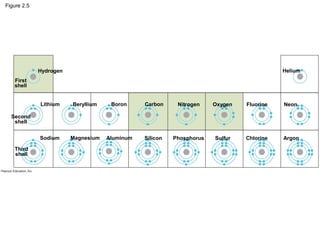
 Of the three subatomic particles—protons,
neutrons, and electrons—only electrons are
directly involved in chemical activity.
 Electrons occur in energy levels called electron
shells.
– Information about the distribution of electrons is found in
the periodic table of the elements.
© 2012 Pearson Education, Inc.
Figure 2.5
Hydrogen
First
shell
Second
shell
Third
shell
Lithium
Sodium
Beryllium
Magnesium
Boron
Aluminum
Carbon
Silicon
Nitrogen
Phosphorus
Oxygen
Sulfur
Fluorine
Chlorine
Helium
Neon
Argon
2.5 The distribution of electrons determines an
atom’s chemical properties
 An atom may have one, two, or three electron
shells surrounding the nucleus.
– The number of electrons in the outermost shell
determines the chemical properties of the atom.
– Atoms whose outer shells are not full tend to interact
with other atoms, participating in chemical reactions.
© 2012 Pearson Education, Inc.
2.5 The distribution of electrons determines an
atom’s chemical properties
 Atoms with incomplete outer shells tend to react so
that both atoms end up with completed outer
shells.
 These atoms may react with each other by sharing,
donating, or receiving electrons.
 These interactions usually result in atoms staying
close together, held by attractions called chemical
bonds.
© 2012 Pearson Education, Inc.
2.6 Covalent bonds join atoms into molecules
through electron sharing
 The strongest kind of chemical bond is a covalent
bond in which two atoms share one or more outer-
shell electrons.
 Two or more atoms held together by covalent
bonds form a molecule.
Animation: Covalent Bonds
© 2012 Pearson Education, Inc.
2.6 Covalent bonds join atoms into molecules
through electron sharing
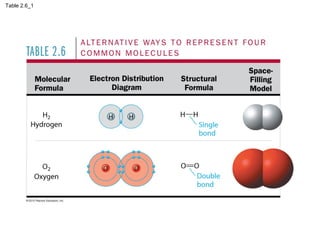
 A covalent bond connects two hydrogen atoms in a
molecule of the gas H2.
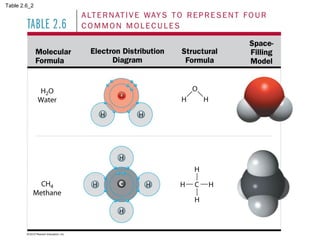
 There are four alternative ways to represent
common molecules.
© 2012 Pearson Education, Inc.
Table 2.6_1
Table 2.6_2
2.6 Covalent bonds join atoms into molecules
through electron sharing
 Atoms in a covalently bonded molecule continually
compete for shared electrons.
– The attraction (pull) for shared electrons is called
electronegativity.
– More electronegative atoms pull harder.
© 2012 Pearson Education, Inc.
2.6 Covalent bonds join atoms into molecules
through electron sharing
 In molecules of only one element, the pull toward
each atom is equal, because each atom has the
same electronegativity.
 The bonds formed are called nonpolar covalent
bonds.
© 2012 Pearson Education, Inc.
2.6 Covalent bonds join atoms into molecules
through electron sharing
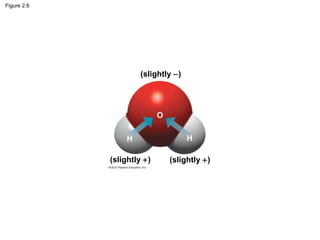
 Water has atoms with different electronegativities.
– Oxygen attracts the shared electrons more strongly than
hydrogen.
– So, the shared electrons spend more time near oxygen.
– The oxygen atom has a slightly negative charge and the
hydrogen atoms have a slightly positive charge.
– The result is a polar covalent bond.
– Because of these polar covalent bonds, water is a polar
molecule.
© 2012 Pearson Education, Inc.
Figure 2.6
(slightly +)
(slightly −)
(slightly +)
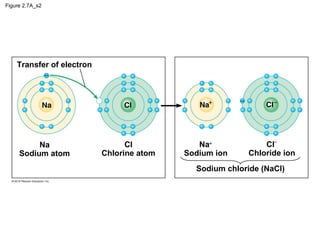
2.7 Ionic bonds are attractions between ions of
opposite charge
 An ion is an atom or molecule with an electrical
charge resulting from gain or loss of electrons.
– When an electron is lost, a positive charge results.
– When an electron is gained, a negative charge results.
 Two ions with opposite charges attract each other.
– When the attraction holds the ions together, it is called
an ionic bond.
– Salt is a synonym for an ionic compound.
Animation: Ionic Bonds
© 2012 Pearson Education, Inc.
Figure 2.7A_s2
Transfer of electron
Na
Sodium atom
Cl
Chlorine atom
Na+
Sodium ion
Cl−
Chloride ion
Sodium chloride (NaCl)
2.8 Hydrogen bonds are weak bonds important
in the chemistry of life
 Most large molecules are held in their three-
dimensional functional shape by weak bonds.
 Hydrogen, as part of a polar covalent bond, has a
partial positive charge.
 The charged regions on molecules are electrically
attracted to oppositely charged regions on
neighboring molecules.
 Because the positively charged region is always a
hydrogen atom, the bond is called a hydrogen bond.
Animation: Water Structure
© 2012 Pearson Education, Inc.
2.9 Chemical reactions make and break
chemical bonds
 Remember that the structure of atoms and
molecules determines the way they behave.
– Remember that atoms combine to form molecules.
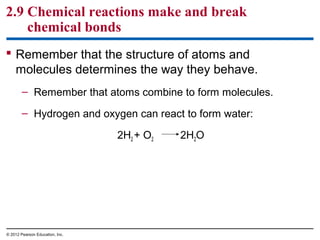
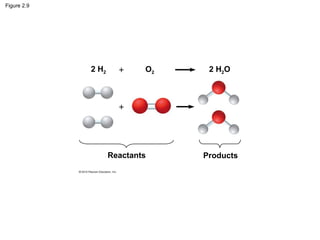
– Hydrogen and oxygen can react to form water:
2H2 + O2 2H2O
© 2012 Pearson Education, Inc.
2.9 Chemical reactions make and break
chemical bonds
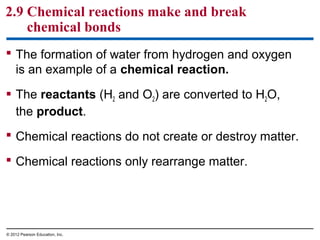
 The formation of water from hydrogen and oxygen
is an example of a chemical reaction.
 The reactants (H2 and O2) are converted to H2O,
the product.
 Chemical reactions do not create or destroy matter.
 Chemical reactions only rearrange matter.
© 2012 Pearson Education, Inc.
Figure 2.9
Reactants Products
2 H2 O2 2 H2O
2.9 Chemical reactions make and break
chemical bonds
 Photosynthesis is a chemical reaction that is
essential to life on Earth.
– Carbon dioxide (from the air) reacts with water.
– Sunlight powers the conversion to produce the products
glucose and oxygen.
© 2012 Pearson Education, Inc.
WATER’S LIFE-SUPPORTING
PROPERTIES
© 2012 Pearson Education, Inc.
2.10 Hydrogen bonds make liquid water
cohesive
 The tendency of molecules of the same kind to stick
together is cohesion.
– Cohesion is much stronger for water than other liquids.
– Most plants depend upon cohesion to help transport
water and nutrients from their roots to their leaves.
 The tendency of two kinds of molecules to stick
together is adhesion.
© 2012 Pearson Education, Inc.
2.10 Hydrogen bonds make liquid water
cohesive
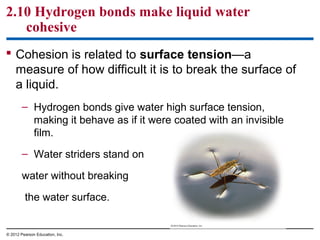
 Cohesion is related to surface tension—a
measure of how difficult it is to break the surface of
a liquid.
– Hydrogen bonds give water high surface tension,
making it behave as if it were coated with an invisible
film.
– Water striders stand on
water without breaking
the water surface.
© 2012 Pearson Education, Inc.
2.11 Water’s hydrogen bonds moderate
temperature
 When a substance evaporates, the surface of the
liquid that remains behind cools down, in the
process of evaporative cooling.
 This cooling occurs because the molecules with
the greatest energy leave the surface.
© 2012 Pearson Education, Inc.
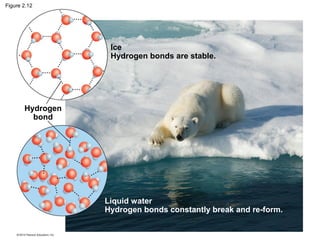
2.12 Ice is less dense than liquid water
 Water can exist as a gas, liquid, or solid.
 Water is less dense as a solid than a liquid because
of hydrogen bonding.
 When water freezes, each molecule forms a stable
hydrogen bond with its neighbors.
– As ice crystals form, the molecules are less densely
packed than in liquid water.
– Because ice is less dense than water, it floats.
© 2012 Pearson Education, Inc.
Figure 2.12
Hydrogen
bond
Ice
Hydrogen bonds are stable.
Liquid water
Hydrogen bonds constantly break and re-form.
2.13 Water is the solvent of life
 A solution is a liquid consisting of a uniform
mixture of two or more substances.
– The dissolving agent is the solvent.
– The substance that is dissolved is the solute.
– An aqueous solution is one in which water is the
solvent.
© 2012 Pearson Education, Inc.
2.13 Water is the solvent of life
 Water’s versatility as a solvent results from the
polarity of its molecules.
 Polar or charged solutes dissolve when water
molecules surround them, forming aqueous
solutions.
 Table salt is an example of a solute that will go into
solution in water.
© 2012 Pearson Education, Inc.
2.14 The chemistry of life is sensitive to acidic and
basic conditions
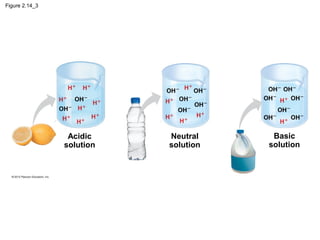
 In aqueous solutions, a small percentage of water
molecules break apart into ions.
– Some are hydrogen ions (H+
).
– Some are hydroxide ions (OH–
).
– Both types are very reactive.
© 2012 Pearson Education, Inc.
2.14 The chemistry of life is sensitive to acidic and
basic conditions
 A compound that releases H+
to a solution is an
acid.
 A compound that accepts H+
is a base.
 The pH scale describes how acidic or basic a
solution is.
– The pH scale ranges from 0 to 14, with zero the most
acidic and 14 the most basic.
– Each pH unit represents a tenfold change in the
concentration of H+
.
© 2012 Pearson Education, Inc.
2.14 The chemistry of life is sensitive to acidic and
basic conditions
 A buffer is a substance that minimizes changes in
pH. Buffers
– accept H+
when it is in excess and
– donate H+
when it is depleted.
© 2012 Pearson Education, Inc.
Figure 2.14_1
IncreasinglyACIDIC
(HigherH+
concentration)
Tomato juice
pH scale
Battery acid
Lemon juice,
gastric juice
Vinegar, cola
NEUTRAL
[H+
]=[OH−
]
Rainwater
Human urine
Saliva
Pure water
Figure 2.14_2
Oven cleaner
IncreasinglyBASIC
(HigherOH−
concentration)
NEUTRAL
[H+
]=[OH−
]
Household bleach
Household ammonia
Milk of magnesia
Pure water
Human blood,
tears
Seawater
pH scale
Figure 2.14_3
Acidic
solution
Neutral
solution
Basic
solution
2.15 CONNECTION: Acid precipitation and
ocean acidification threaten the environment
 When we burn fossil fuels (coal, oil, and gas), air-
polluting compounds and CO2 are released into the
atmosphere.
– Sulfur and nitrous oxides react with water in the air to
form acids.
– These acids fall to Earth as acid precipitation, which is
rain, snow, or fog with a pH lower than 5.2.
– CO2 dissolving in seawater lowers ocean pH in a
process known as ocean acidification.
© 2012 Pearson Education, Inc.
You should now be able to
1. Describe the importance of chemical elements to living
organisms.
2. Explain the formation of compounds.
3. Describe the structure of an atom.
4. Distinguish between ionic, hydrogen, and covalent bonds.
5. Define a chemical reaction and explain how it changes the
composition of matter.
6. List and define the life-supporting properties of water.
7. Explain the pH scale and the formation of acid and base
solutions.
© 2012 Pearson Education, Inc.
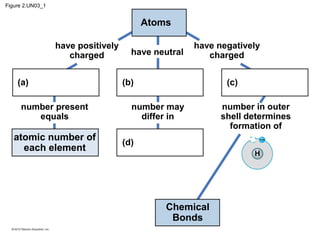
Figure 2.UN03_1
Atoms
atomic number of
each element
Chemical
Bonds
(d)
(a) (b) (c)
number present
equals
number may
differ in
number in outer
shell determines
formation of
have positively
charged
have negatively
chargedhave neutral
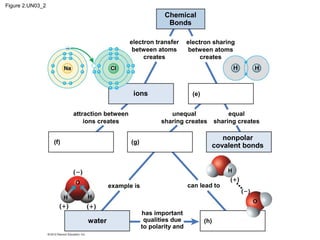
Figure 2.UN03_2
Chemical
Bonds
electron transfer
between atoms
creates
ions
nonpolar
covalent bonds
water
has important
qualities due
to polarity and
(h)
(f) (g)
(e)
example is can lead to
attraction between
ions creates
unequal
sharing creates
equal
sharing creates
electron sharing
between atoms
creates

Bio ch2

  • 1.
    © 2012 PearsonEducation, Inc. Lecture by Edward J. Zalisko PowerPoint Lectures for Campbell Biology: Concepts & Connections, Seventh Edition Reece, Taylor, Simon, and Dickey Chapter 2Chapter 2 The Chemical Basis of Life
  • 2.
    ELEMENTS, ATOMS, AND COMPOUNDS ©2012 Pearson Education, Inc.
  • 3.
     Living organismsare composed of matter, which is anything that occupies space and has mass (weight).  Matter is composed of chemical elements. – An element is a substance that cannot be broken down to other substances. – There are 92 elements in nature—only a few exist in a pure state. 2.1 Organisms are composed of elements, in combinations called compounds © 2012 Pearson Education, Inc.
  • 4.
  • 5.
     A compoundis a substance consisting of two or more different elements in a fixed ratio.  Compounds are more common than pure elements.  Sodium chloride, table salt, is a common compound of equal parts of sodium (Na) and chlorine (Cl). 2.1 Organisms are composed of elements, in combinations called compounds © 2012 Pearson Education, Inc.
  • 6.
     About 25elements are essential to life.  Four elements make up about 96% of the weight of most living organisms. These are – oxygen, – carbon, – hydrogen, and – nitrogen.  Trace elements are essential but are only needed in minute quantities. 2.1 Organisms are composed of elements, in combinations called compounds © 2012 Pearson Education, Inc.
  • 7.
    2.2 CONNECTION: Traceelements are common additives to food and water  Some trace elements are required to prevent disease. – Without iron, your body cannot transport oxygen. – An iodine deficiency prevents production of thyroid hormones, resulting in goiter. © 2012 Pearson Education, Inc.
  • 8.
    2.2 CONNECTION: Traceelements are common additives to food and water  Fluoride is added to municipal water and dental products to help reduce tooth decay. © 2012 Pearson Education, Inc.
  • 9.
    2.2 CONNECTION: Traceelements are common additives to food and water  Several chemicals are added to food to – help preserve it, – make it more nutritious, and/or – make it look better.  Check out the “Nutrition Facts” label on foods and drinks you purchase. © 2012 Pearson Education, Inc.
  • 10.
    2.3 Atoms consistof protons, neutrons, and electrons  Each element consists of one kind of atom.  An atom is the smallest unit of matter that still retains the properties of an element.  Three subatomic particles in atoms are relevant to our discussion of the properties of elements. – Protons are positively charged. – Electrons are negatively charged. – Neutrons are electrically neutral. © 2012 Pearson Education, Inc.
  • 11.
    2.3 Atoms consistof protons, neutrons, and electrons  Neutrons and protons are packed into an atom’s nucleus.  Electrons orbit the nucleus.  The negative charge of electrons and the positive charge of protons keep electrons near the nucleus. © 2012 Pearson Education, Inc.
  • 12.
  • 13.
    2.3 Atoms consistof protons, neutrons, and electrons  The number of protons is the atom’s atomic number.  An atom’s mass number is the sum of the number of protons and neutrons in the nucleus.  The atomic mass is approximately equal to its mass number. © 2012 Pearson Education, Inc.
  • 14.
    2.3 Atoms consistof protons, neutrons, and electrons  Although all atoms of an element have the same atomic number, some differ in mass number.  Different isotopes of an element have – the same number of protons, – but different numbers of neutrons.  Different isotopes of an element behave identically in chemical reactions.  In radioactive isotopes, the nucleus decays spontaneously, giving off particles and energy. © 2012 Pearson Education, Inc.
  • 15.
    2.4 CONNECTION: Radioactiveisotopes can help or harm us  Living cells cannot distinguish between isotopes of the same element. – Therefore, radioactive compounds in metabolic processes can act as tracers. – This radioactivity can be detected by instruments. – Using these instruments, the fate of radioactive tracers can be monitored in living organisms. © 2012 Pearson Education, Inc.
  • 16.
    2.4 CONNECTION: Radioactiveisotopes can help or harm us  Radioactive tracers are frequently used in medical diagnosis.  Sophisticated imaging instruments are used to detect them. – An imaging instrument that uses positron-emission tomography (PET) detects the location of injected radioactive materials. – PET is useful for diagnosing heart disorders, cancer, and in brain research. © 2012 Pearson Education, Inc.
  • 17.
    2.4 CONNECTION: Radioactiveisotopes can help or harm us  In addition to benefits, there are also dangers associated with using radioactive substances. – Uncontrolled exposure can cause damage to some molecules in a living cell, especially DNA. – Chemical bonds are broken by the emitted energy, which causes abnormal bonds to form. © 2012 Pearson Education, Inc.
  • 18.
    CHEMICAL BONDS © 2012Pearson Education, Inc.
  • 19.
    2.5 The distributionof electrons determines an atom’s chemical properties  Of the three subatomic particles—protons, neutrons, and electrons—only electrons are directly involved in chemical activity.  Electrons occur in energy levels called electron shells. – Information about the distribution of electrons is found in the periodic table of the elements. © 2012 Pearson Education, Inc.
  • 20.
  • 21.
    2.5 The distributionof electrons determines an atom’s chemical properties  An atom may have one, two, or three electron shells surrounding the nucleus. – The number of electrons in the outermost shell determines the chemical properties of the atom. – Atoms whose outer shells are not full tend to interact with other atoms, participating in chemical reactions. © 2012 Pearson Education, Inc.
  • 22.
    2.5 The distributionof electrons determines an atom’s chemical properties  Atoms with incomplete outer shells tend to react so that both atoms end up with completed outer shells.  These atoms may react with each other by sharing, donating, or receiving electrons.  These interactions usually result in atoms staying close together, held by attractions called chemical bonds. © 2012 Pearson Education, Inc.
  • 23.
    2.6 Covalent bondsjoin atoms into molecules through electron sharing  The strongest kind of chemical bond is a covalent bond in which two atoms share one or more outer- shell electrons.  Two or more atoms held together by covalent bonds form a molecule. Animation: Covalent Bonds © 2012 Pearson Education, Inc.
  • 24.
    2.6 Covalent bondsjoin atoms into molecules through electron sharing  A covalent bond connects two hydrogen atoms in a molecule of the gas H2.  There are four alternative ways to represent common molecules. © 2012 Pearson Education, Inc.
  • 25.
  • 26.
  • 27.
    2.6 Covalent bondsjoin atoms into molecules through electron sharing  Atoms in a covalently bonded molecule continually compete for shared electrons. – The attraction (pull) for shared electrons is called electronegativity. – More electronegative atoms pull harder. © 2012 Pearson Education, Inc.
  • 28.
    2.6 Covalent bondsjoin atoms into molecules through electron sharing  In molecules of only one element, the pull toward each atom is equal, because each atom has the same electronegativity.  The bonds formed are called nonpolar covalent bonds. © 2012 Pearson Education, Inc.
  • 29.
    2.6 Covalent bondsjoin atoms into molecules through electron sharing  Water has atoms with different electronegativities. – Oxygen attracts the shared electrons more strongly than hydrogen. – So, the shared electrons spend more time near oxygen. – The oxygen atom has a slightly negative charge and the hydrogen atoms have a slightly positive charge. – The result is a polar covalent bond. – Because of these polar covalent bonds, water is a polar molecule. © 2012 Pearson Education, Inc.
  • 30.
  • 31.
    2.7 Ionic bondsare attractions between ions of opposite charge  An ion is an atom or molecule with an electrical charge resulting from gain or loss of electrons. – When an electron is lost, a positive charge results. – When an electron is gained, a negative charge results.  Two ions with opposite charges attract each other. – When the attraction holds the ions together, it is called an ionic bond. – Salt is a synonym for an ionic compound. Animation: Ionic Bonds © 2012 Pearson Education, Inc.
  • 32.
    Figure 2.7A_s2 Transfer ofelectron Na Sodium atom Cl Chlorine atom Na+ Sodium ion Cl− Chloride ion Sodium chloride (NaCl)
  • 33.
    2.8 Hydrogen bondsare weak bonds important in the chemistry of life  Most large molecules are held in their three- dimensional functional shape by weak bonds.  Hydrogen, as part of a polar covalent bond, has a partial positive charge.  The charged regions on molecules are electrically attracted to oppositely charged regions on neighboring molecules.  Because the positively charged region is always a hydrogen atom, the bond is called a hydrogen bond. Animation: Water Structure © 2012 Pearson Education, Inc.
  • 34.
    2.9 Chemical reactionsmake and break chemical bonds  Remember that the structure of atoms and molecules determines the way they behave. – Remember that atoms combine to form molecules. – Hydrogen and oxygen can react to form water: 2H2 + O2 2H2O © 2012 Pearson Education, Inc.
  • 35.
    2.9 Chemical reactionsmake and break chemical bonds  The formation of water from hydrogen and oxygen is an example of a chemical reaction.  The reactants (H2 and O2) are converted to H2O, the product.  Chemical reactions do not create or destroy matter.  Chemical reactions only rearrange matter. © 2012 Pearson Education, Inc.
  • 36.
  • 37.
    2.9 Chemical reactionsmake and break chemical bonds  Photosynthesis is a chemical reaction that is essential to life on Earth. – Carbon dioxide (from the air) reacts with water. – Sunlight powers the conversion to produce the products glucose and oxygen. © 2012 Pearson Education, Inc.
  • 38.
  • 39.
    2.10 Hydrogen bondsmake liquid water cohesive  The tendency of molecules of the same kind to stick together is cohesion. – Cohesion is much stronger for water than other liquids. – Most plants depend upon cohesion to help transport water and nutrients from their roots to their leaves.  The tendency of two kinds of molecules to stick together is adhesion. © 2012 Pearson Education, Inc.
  • 40.
    2.10 Hydrogen bondsmake liquid water cohesive  Cohesion is related to surface tension—a measure of how difficult it is to break the surface of a liquid. – Hydrogen bonds give water high surface tension, making it behave as if it were coated with an invisible film. – Water striders stand on water without breaking the water surface. © 2012 Pearson Education, Inc.
  • 41.
    2.11 Water’s hydrogenbonds moderate temperature  When a substance evaporates, the surface of the liquid that remains behind cools down, in the process of evaporative cooling.  This cooling occurs because the molecules with the greatest energy leave the surface. © 2012 Pearson Education, Inc.
  • 42.
    2.12 Ice isless dense than liquid water  Water can exist as a gas, liquid, or solid.  Water is less dense as a solid than a liquid because of hydrogen bonding.  When water freezes, each molecule forms a stable hydrogen bond with its neighbors. – As ice crystals form, the molecules are less densely packed than in liquid water. – Because ice is less dense than water, it floats. © 2012 Pearson Education, Inc.
  • 43.
    Figure 2.12 Hydrogen bond Ice Hydrogen bondsare stable. Liquid water Hydrogen bonds constantly break and re-form.
  • 44.
    2.13 Water isthe solvent of life  A solution is a liquid consisting of a uniform mixture of two or more substances. – The dissolving agent is the solvent. – The substance that is dissolved is the solute. – An aqueous solution is one in which water is the solvent. © 2012 Pearson Education, Inc.
  • 45.
    2.13 Water isthe solvent of life  Water’s versatility as a solvent results from the polarity of its molecules.  Polar or charged solutes dissolve when water molecules surround them, forming aqueous solutions.  Table salt is an example of a solute that will go into solution in water. © 2012 Pearson Education, Inc.
  • 46.
    2.14 The chemistryof life is sensitive to acidic and basic conditions  In aqueous solutions, a small percentage of water molecules break apart into ions. – Some are hydrogen ions (H+ ). – Some are hydroxide ions (OH– ). – Both types are very reactive. © 2012 Pearson Education, Inc.
  • 47.
    2.14 The chemistryof life is sensitive to acidic and basic conditions  A compound that releases H+ to a solution is an acid.  A compound that accepts H+ is a base.  The pH scale describes how acidic or basic a solution is. – The pH scale ranges from 0 to 14, with zero the most acidic and 14 the most basic. – Each pH unit represents a tenfold change in the concentration of H+ . © 2012 Pearson Education, Inc.
  • 48.
    2.14 The chemistryof life is sensitive to acidic and basic conditions  A buffer is a substance that minimizes changes in pH. Buffers – accept H+ when it is in excess and – donate H+ when it is depleted. © 2012 Pearson Education, Inc.
  • 49.
    Figure 2.14_1 IncreasinglyACIDIC (HigherH+ concentration) Tomato juice pHscale Battery acid Lemon juice, gastric juice Vinegar, cola NEUTRAL [H+ ]=[OH− ] Rainwater Human urine Saliva Pure water
  • 50.
    Figure 2.14_2 Oven cleaner IncreasinglyBASIC (HigherOH− concentration) NEUTRAL [H+ ]=[OH− ] Householdbleach Household ammonia Milk of magnesia Pure water Human blood, tears Seawater pH scale
  • 51.
  • 52.
    2.15 CONNECTION: Acidprecipitation and ocean acidification threaten the environment  When we burn fossil fuels (coal, oil, and gas), air- polluting compounds and CO2 are released into the atmosphere. – Sulfur and nitrous oxides react with water in the air to form acids. – These acids fall to Earth as acid precipitation, which is rain, snow, or fog with a pH lower than 5.2. – CO2 dissolving in seawater lowers ocean pH in a process known as ocean acidification. © 2012 Pearson Education, Inc.
  • 53.
    You should nowbe able to 1. Describe the importance of chemical elements to living organisms. 2. Explain the formation of compounds. 3. Describe the structure of an atom. 4. Distinguish between ionic, hydrogen, and covalent bonds. 5. Define a chemical reaction and explain how it changes the composition of matter. 6. List and define the life-supporting properties of water. 7. Explain the pH scale and the formation of acid and base solutions. © 2012 Pearson Education, Inc.
  • 54.
    Figure 2.UN03_1 Atoms atomic numberof each element Chemical Bonds (d) (a) (b) (c) number present equals number may differ in number in outer shell determines formation of have positively charged have negatively chargedhave neutral
  • 55.
    Figure 2.UN03_2 Chemical Bonds electron transfer betweenatoms creates ions nonpolar covalent bonds water has important qualities due to polarity and (h) (f) (g) (e) example is can lead to attraction between ions creates unequal sharing creates equal sharing creates electron sharing between atoms creates

Editor's Notes

  • #4 Student Misconceptions and Concerns The dangers posed by certain chemicals in our food and broader environment have sometimes misled people to associate chemicals with harm. People might not want chemicals added to their food or in their environment. Students often fail to appreciate the chemical nature of our bodies and our world and the potential harm or benefits of naturally occurring chemistry. They often fail to understand why “natural” does not necessarily mean good. (Consider presenting a long list of naturally occurring toxins to make this point.) Your class may benefit from a class discussion of these misconceptions about our attitudes toward chemicals. Teaching Tips The text notes the unique properties of pure sodium, pure chlorine, and the compound sodium chloride formed when the two bond together. Consider challenging your students to think of other simple examples of new properties that result when a compound is formed (for example, water, formed from hydrogen and oxygen, and rust, formed from iron and oxygen). Students might be interested in the following aside: One of the challenges of raising captive, exotic animals is meeting the unique dietary requirements of a species. A zoo might have trouble keeping a particular animal because zoologists have not identified all of the trace elements required in the animal’s diet.
  • #5 Table 2.1 Elements In the Human Body
  • #6 Student Misconceptions and Concerns The dangers posed by certain chemicals in our food and broader environment have sometimes misled people to associate chemicals with harm. People might not want chemicals added to their food or in their environment. Students often fail to appreciate the chemical nature of our bodies and our world and the potential harm or benefits of naturally occurring chemistry. They often fail to understand why “natural” does not necessarily mean good. (Consider presenting a long list of naturally occurring toxins to make this point.) Your class may benefit from a class discussion of these misconceptions about our attitudes toward chemicals. Teaching Tips 1. The text notes the unique properties of pure sodium, pure chlorine, and the compound sodium chloride formed when the two bond together. Consider challenging your students to think of other simple examples of new properties that result when a compound is formed (for example, water, formed from hydrogen and oxygen, and rust, formed from iron and oxygen). 2. Students might be interested in the following aside: One of the challenges of raising captive, exotic animals is meeting the unique dietary requirements of a species. A zoo might have trouble keeping a particular animal because zoologists have not identified all of the trace elements required in the animal’s diet.
  • #7 Student Misconceptions and Concerns The dangers posed by certain chemicals in our food and broader environment have sometimes misled people to associate chemicals with harm. People might not want chemicals added to their food or in their environment. Students often fail to appreciate the chemical nature of our bodies and our world and the potential harm or benefits of naturally occurring chemistry. They often fail to understand why “natural” does not necessarily mean good. (Consider presenting a long list of naturally occurring toxins to make this point.) Your class may benefit from a class discussion of these misconceptions about our attitudes toward chemicals. Teaching Tips 1. The text notes the unique properties of pure sodium, pure chlorine, and the compound sodium chloride formed when the two bond together. Consider challenging your students to think of other simple examples of new properties that result when a compound is formed (for example, water, formed from hydrogen and oxygen, and rust, formed from iron and oxygen). 2. Students might be interested in the following aside: One of the challenges of raising captive, exotic animals is meeting the unique dietary requirements of a species. A zoo might have trouble keeping a particular animal because zoologists have not identified all of the trace elements required in the animal’s diet.
  • #8 Student Misconceptions and Concerns The dangers posed by certain chemicals in our food and broader environment have sometimes misled people to associate chemicals with harm. People might not want chemicals added to their food or in their environment. Students often fail to appreciate the chemical nature of our bodies and our world and the potential harm or benefits of naturally occurring chemistry. They often fail to understand why “natural” does not necessarily mean good. (Consider presenting a long list of naturally occurring toxins to make this point.) Your class may benefit from a class discussion of these misconceptions about our attitudes toward chemicals. Teaching Tips 1. Students might be interested in the following aside: One of the challenges of raising captive, exotic animals is meeting the unique dietary requirements of a species. A zoo might have trouble keeping a particular animal because zoologists have not identified all of the trace elements required in the animal’s diet. 2. Many breakfast cereals are fortified with iron (see Figure 2.2c). As noted in Module 2.2, you can crush the cereal and extract distinct iron particles with a magnet. An overhead projector or video imaging device should clearly reveal the iron particles stuck to the magnet. This short practical demonstration can help connect an abstract concept to a concrete example.
  • #9 Student Misconceptions and Concerns The dangers posed by certain chemicals in our food and broader environment have sometimes misled people to associate chemicals with harm. People might not want chemicals added to their food or in their environment. Students often fail to appreciate the chemical nature of our bodies and our world and the potential harm or benefits of naturally occurring chemistry. They often fail to understand why “natural” does not necessarily mean good. (Consider presenting a long list of naturally occurring toxins to make this point.) Your class may benefit from a class discussion of these misconceptions about our attitudes toward chemicals. Teaching Tips 1. Students might be interested in the following aside: One of the challenges of raising captive, exotic animals is meeting the unique dietary requirements of a species. A zoo might have trouble keeping a particular animal because zoologists have not identified all of the trace elements required in the animal’s diet. 2. Many breakfast cereals are fortified with iron (see Figure 2.2c). As noted in Module 2.2, you can crush the cereal and extract distinct iron particles with a magnet. An overhead projector or video imaging device should clearly reveal the iron particles stuck to the magnet. This short practical demonstration can help connect an abstract concept to a concrete example.
  • #10 Student Misconceptions and Concerns The dangers posed by certain chemicals in our food and broader environment have sometimes misled people to associate chemicals with harm. People might not want chemicals added to their food or in their environment. Students often fail to appreciate the chemical nature of our bodies and our world and the potential harm or benefits of naturally occurring chemistry. They often fail to understand why “natural” does not necessarily mean good. (Consider presenting a long list of naturally occurring toxins to make this point.) Your class may benefit from a class discussion of these misconceptions about our attitudes toward chemicals. Teaching Tips 1. Students might be interested in the following aside: One of the challenges of raising captive, exotic animals is meeting the unique dietary requirements of a species. A zoo might have trouble keeping a particular animal because zoologists have not identified all of the trace elements required in the animal’s diet. 2. Many breakfast cereals are fortified with iron (see Figure 2.2c). As noted in Module 2.2, you can crush the cereal and extract distinct iron particles with a magnet. An overhead projector or video imaging device should clearly reveal the iron particles stuck to the magnet. This short practical demonstration can help connect an abstract concept to a concrete example.
  • #11 Student Misconceptions and Concerns The dangers posed by certain chemicals in our food and broader environment have sometimes misled people to associate chemicals with harm. People might not want chemicals added to their food or in their environment. Students often fail to appreciate the chemical nature of our bodies and our world and the potential harm or benefits of naturally occurring chemistry. They often fail to understand why “natural” does not necessarily mean good. (Consider presenting a long list of naturally occurring toxins to make this point.) Your class may benefit from a class discussion of these misconceptions about our attitudes toward chemicals. Students with limited backgrounds in chemistry and physics might struggle with basic concepts of mass, weight, compounds, elements, and isotopes. It may also be early in the semester when mature study habits have not yet developed. Consider passing along basic studying advice and tips to help students master these early chemistry concepts. In-class quizzes (graded or not) or a few homework problems will also provide reinforcing practice. Teaching Tips Here is a comparison that helps make the point about the differences in mass of protons and electrons. If a proton were as massive as a bowling ball, an electron would be the mass of a Lifesaver. (This is calculated by considering a 15-pound bowling ball, a Lifesaver with a mass of 0.12 ounces, and the mention in Module 2.3 that an electron is about 1/2,000 the mass of a proton.) The text in Module 2.3 makes an analogy regarding the size of a helium atom. The text notes that if a helium atom were the size of a baseball stadium, the nucleus would be about the size of a fly in center field, and the two electrons would be like tiny gnats buzzing around the stadium. This analogy helps to relate the great distances between parts of an atom. Consider modifying the analogy to any local stadium in your region. Such concrete examples help to relate abstract concepts. After sharing teaching tips 4 and 5 above, consider asking your students to compare the mass of the gnat orbiting a baseball stadium to the mass of the fly in center field. If a proton or neutron is about 2,000 times more massive than an electron, how does the mass of a helium nucleus compare to the mass of one of its electrons? The text notes the use of radioactive isotopes in dating fossils but references Module 15.5 for further discussion. If your course does not include Chapter 15, consider explaining this process at this point in your course.
  • #12 Student Misconceptions and Concerns 
 The dangers posed by certain chemicals in our food and broader environment have sometimes misled people to associate chemicals with harm. People might not want chemicals added to their food or in their environment. Students often fail to appreciate the chemical nature of our bodies and our world and the potential harm or benefits of naturally occurring chemistry. They often fail to understand why “natural” does not necessarily mean good. (Consider presenting a long list of naturally occurring toxins to make this point.) Your class may benefit from a class discussion of these misconceptions about our attitudes toward chemicals. Students with limited backgrounds in chemistry and physics might struggle with basic concepts of mass, weight, compounds, elements, and isotopes. It may also be early in the semester when mature study habits have not yet developed. Consider passing along basic studying advice and tips to help students master these early chemistry concepts. In-class quizzes (graded or not) or a few homework problems will also provide reinforcing practice. Teaching Tips
 Here is a comparison that helps make the point about the differences in mass of protons and electrons. If a proton were as massive as a bowling ball, an electron would be the mass of a Lifesaver. (This is calculated by considering a 15-pound bowling ball, a Lifesaver with a mass of 0.12 ounces, and the mention in Module 2.3 that an electron is about 1/2,000 the mass of a proton.)
 The text in Module 2.3 makes an analogy regarding the size of a helium atom. The text notes that if a helium atom were the size of a baseball stadium, the nucleus would be about the size of a fly in center field, and the two electrons would be like tiny gnats buzzing around the stadium. This analogy helps to relate the great distances between parts of an atom. Consider modifying the analogy to any local stadium in your region. Such concrete examples help to relate abstract concepts.
 Consider asking your students to compare the mass of the gnat orbiting a baseball stadium to the mass of the fly in center field. If a proton or neutron is about 2,000 times more massive than an electron, how does the mass of a helium nucleus compare to the mass of one of its electrons? 
 The text notes the use of radioactive isotopes in dating fossils but references Module 15.5 for further discussion. If your course does not include Chapter 15, consider explaining this process at this point in your course.
  • #13 Figure 2.3A Two models of a helium atom
  • #14 Student Misconceptions and Concerns 
 The dangers posed by certain chemicals in our food and broader environment have sometimes misled people to associate chemicals with harm. People might not want chemicals added to their food or in their environment. Students often fail to appreciate the chemical nature of our bodies and our world and the potential harm or benefits of naturally occurring chemistry. They often fail to understand why “natural” does not necessarily mean good. (Consider presenting a long list of naturally occurring toxins to make this point.) Your class may benefit from a class discussion of these misconceptions about our attitudes toward chemicals. Students with limited backgrounds in chemistry and physics might struggle with basic concepts of mass, weight, compounds, elements, and isotopes. It may also be early in the semester when mature study habits have not yet developed. Consider passing along basic studying advice and tips to help students master these early chemistry concepts. In-class quizzes (graded or not) or a few homework problems will also provide reinforcing practice. Teaching Tips
 Here is a comparison that helps make the point about the differences in mass of protons and electrons. If a proton were as massive as a bowling ball, an electron would be the mass of a Lifesaver. (This is calculated by considering a 15-pound bowling ball, a Lifesaver with a mass of 0.12 ounces, and the mention in Module 2.3 that an electron is about 1/2,000 the mass of a proton.)
 The text in Module 2.3 makes an analogy regarding the size of a helium atom. The text notes that if a helium atom were the size of a baseball stadium, the nucleus would be about the size of a fly in center field, and the two electrons would be like tiny gnats buzzing around the stadium. This analogy helps to relate the great distances between parts of an atom. Consider modifying the analogy to any local stadium in your region. Such concrete examples help to relate abstract concepts.
 Consider asking your students to compare the mass of the gnat orbiting a baseball stadium to the mass of the fly in center field. If a proton or neutron is about 2,000 times more massive than an electron, how does the mass of a helium nucleus compare to the mass of one of its electrons? 
 The text notes the use of radioactive isotopes in dating fossils but references Module 15.5 for further discussion. If your course does not include Chapter 15, consider explaining this process at this point in your course.
  • #15 Student Misconceptions and Concerns The dangers posed by certain chemicals in our food and broader environment have sometimes misled people to associate chemicals with harm. People might not want chemicals added to their food or in their environment. Students often fail to appreciate the chemical nature of our bodies and our world and the potential harm or benefits of naturally occurring chemistry. They often fail to understand why “natural” does not necessarily mean good. (Consider presenting a long list of naturally occurring toxins to make this point.) Your class may benefit from a class discussion of these misconceptions about our attitudes toward chemicals. Students with limited backgrounds in chemistry and physics might struggle with basic concepts of mass, weight, compounds, elements, and isotopes. It may also be early in the semester when mature study habits have not yet developed. Consider passing along basic studying advice and tips to help students master these early chemistry concepts. In-class quizzes (graded or not) or a few homework problems will also provide reinforcing practice. Teaching Tips
 Here is a comparison that helps make the point about the differences in mass of protons and electrons. If a proton were as massive as a bowling ball, an electron would be the mass of a Lifesaver. (This is calculated by considering a 15-pound bowling ball, a Lifesaver with a mass of 0.12 ounces, and the mention in Module 2.3 that an electron is about 1/2,000 the mass of a proton.)
 The text in Module 2.3 makes an analogy regarding the size of a helium atom. The text notes that if a helium atom were the size of a baseball stadium, the nucleus would be about the size of a fly in center field, and the two electrons would be like tiny gnats buzzing around the stadium. This analogy helps to relate the great distances between parts of an atom. Consider modifying the analogy to any local stadium in your region. Such concrete examples help to relate abstract concepts.
 Consider asking your students to compare the mass of the gnat orbiting a baseball stadium to the mass of the fly in center field. If a proton or neutron is about 2,000 times more massive than an electron, how does the mass of a helium nucleus compare to the mass of one of its electrons? 
 The text notes the use of radioactive isotopes in dating fossils but references Module 15.5 for further discussion. If your course does not include Chapter 15, consider explaining this process at this point in your course.
  • #16 Student Misconceptions and Concerns The dangers posed by certain chemicals in our food and broader environment have sometimes misled people to associate chemicals with harm. People might not want chemicals added to their food or in their environment. Students often fail to appreciate the chemical nature of our bodies and our world and the potential harm or benefits of naturally occurring chemistry. They often fail to understand why “natural” does not necessarily mean good. (Consider presenting a long list of naturally occurring toxins to make this point.) Your class may benefit from a class discussion of these misconceptions about our attitudes toward chemicals.
 Teaching Tips
 The half-lives of many radioactive substances, especially those used for dating fossils, might lead some students to expect very long periods of decay for any radioactive substance. This might even be alarming if students are someday asked to consume a radioactive substance for a medical test. However, some medically significant isotopes have relatively short half-lives. Radioactive iodine-131 is often used to diagnose or treat certain thyroid problems. Its half-life of eight days means that it will decay quickly. 
 Depending upon where you are teaching, radon in homes may be a common problem and significant health risk. If you are in a high radon region, consider adding details about home remediation methods and expenses or having students research the topic and report back.
  • #17 Student Misconceptions and Concerns The dangers posed by certain chemicals in our food and broader environment have sometimes misled people to associate chemicals with harm. People might not want chemicals added to their food or in their environment. Students often fail to appreciate the chemical nature of our bodies and our world and the potential harm or benefits of naturally occurring chemistry. They often fail to understand why “natural” does not necessarily mean good. (Consider presenting a long list of naturally occurring toxins to make this point.) Your class may benefit from a class discussion of these misconceptions about our attitudes toward chemicals.
 Teaching Tips
 The half-lives of many radioactive substances, especially those used for dating fossils, might lead some students to expect very long periods of decay for any radioactive substance. This might even be alarming if students are someday asked to consume a radioactive substance for a medical test. However, some medically significant isotopes have relatively short half-lives. Radioactive iodine-131 is often used to diagnose or treat certain thyroid problems. Its half-life of eight days means that it will decay quickly. 
 Depending upon where you are teaching, radon in homes may be a common problem and significant health risk. If you are in a high radon region, consider adding details about home remediation methods and expenses or having students research the topic and report back.
  • #18 Student Misconceptions and Concerns 
 The dangers posed by certain chemicals in our food and broader environment have sometimes misled people to associate chemicals with harm. People might not want chemicals added to their food or in their environment. Students often fail to appreciate the chemical nature of our bodies and our world and the potential harm or benefits of naturally occurring chemistry. They often fail to understand why “natural” does not necessarily mean good. (Consider presenting a long list of naturally occurring toxins to make this point.) Your class may benefit from a class discussion of these misconceptions about our attitudes toward chemicals.
 Teaching Tips
 The half-lives of many radioactive substances, especially those used for dating fossils, might lead some students to expect very long periods of decay for any radioactive substance. This might even be alarming if students are someday asked to consume a radioactive substance for a medical test. However, some medically significant isotopes have relatively short half-lives. Radioactive iodine-131 is often used to diagnose or treat certain thyroid problems. Its half-life of eight days means that it will decay quickly. 
 Depending upon where you are teaching, radon in homes may be a common problem and significant health risk. If you are in a high radon region, consider adding details about home remediation methods and expenses or having students research the topic and report back.
  • #20 Teaching Tips Consider challenging your students to suggest relationships in human lives that are analogous to each of the three types of chemical bonds (covalent, ionic, and hydrogen). Evaluating the accuracy of potential analogies requires careful analysis of the chemical bonding relationships and practices critical thinking skills. Small groups might provide immediate critiques before passing along analogies for the entire class to consider. The following is one example. Ionic and covalent bonds are different types of relationships. Consider this analogy. A woman taking out a loan has a specific relationship to her bank. She owes the bank money, something she got from the bank. A man shares an office with another man. Both look out the same window and answer the same phone. Ionic bonds are like a bank loan, in which something is borrowed. Covalent bonds are like sharing an office, with items (electrons) shared by both members of the relationship. After presenting this analogy, ask your students to modify the office analogy to represent a polar covalent bond. (Perhaps one man in the office sits closer to the window and the phone.)
  • #21 Figure 2.5 The electron distribution diagrams of the first 18 elements in the periodic table
  • #22 Teaching Tips
 Consider challenging your students to suggest relationships in human lives that are analogous to each of the three types of chemical bonds (covalent, ionic, and hydrogen). Evaluating the accuracy of potential analogies requires careful analysis of the chemical bonding relationships and practices critical thinking skills. Small groups might provide immediate critiques before passing along analogies for the entire class to consider. The following is one example. Ionic and covalent bonds are different types of relationships. Consider this analogy. A woman taking out a loan has a specific relationship to her bank. She owes the bank money, something she got from the bank. A man shares an office with another man. Both look out the same window and answer the same phone. Ionic bonds are like a bank loan, in which something is borrowed. Covalent bonds are like sharing an office, with items (electrons) shared by both members of the relationship. After presenting this analogy, ask your students to modify the office analogy to represent a polar covalent bond. (Perhaps one man in the office sits closer to the window and the phone.)
  • #23 Teaching Tips
 Consider challenging your students to suggest relationships in human lives that are analogous to each of the three types of chemical bonds (covalent, ionic, and hydrogen). Evaluating the accuracy of potential analogies requires careful analysis of the chemical bonding relationships and practices critical thinking skills. Small groups might provide immediate critiques before passing along analogies for the entire class to consider. The following is one example. Ionic and covalent bonds are different types of relationships. Consider this analogy. A woman taking out a loan has a specific relationship to her bank. She owes the bank money, something she got from the bank. A man shares an office with another man. Both look out the same window and answer the same phone. Ionic bonds are like a bank loan, in which something is borrowed. Covalent bonds are like sharing an office, with items (electrons) shared by both members of the relationship. After presenting this analogy, ask your students to modify the office analogy to represent a polar covalent bond. (Perhaps one man in the office sits closer to the window and the phone.)
  • #24 Student Misconceptions and Concerns Students with limited backgrounds in chemistry will benefit from a discussion of Table 2.6 and the differences and limitations of representing atomic structure. The contrast in Table 2.6 is a good beginning for such a discussion. In addition to comparing how the positions of electrons are depicted, note the problems with the sense of scale as discussed in Module 2.3. Teaching Tips 1. Consider challenging your students to suggest relationships in human lives that are analogous to each of the three types of chemical bonds (covalent, ionic, and hydrogen). Evaluating the accuracy of potential analogies requires careful analysis of the chemical bonding relationships and practices critical thinking skills. Small groups might provide immediate critiques before passing along analogies for the entire class to consider. The following is one example. Ionic and covalent bonds are different types of relationships. Consider this analogy. A woman taking out a loan has a specific relationship to her bank. She owes the bank money, something she got from the bank. A man shares an office with another man. Both look out the same window and answer the same phone. Ionic bonds are like a bank loan, in which something is borrowed. Covalent bonds are like sharing an office, with items (electrons) shared by both members of the relationship. After presenting this analogy, ask your students to modify the office analogy to represent a polar covalent bond. (Perhaps one man in the office sits closer to the window and the phone.) 2. Have your students try to calculate the number of covalent bonds possible for a variety of atoms. (Carbon, for example, can form up to four covalent bonds.) Then provide the students with a list of elements and the number of outer electrons for each and have them make predictions about the chemical formula for many types of molecules. (For example, carbon could form covalent bonds with four hydrogen atoms.) 3. Modules 2.6 and 2.8 discuss the special bonding in and between water molecules. Many students do not appreciate the importance of weak chemical bonds in water and cellular chemistry. Extra time and attention may be required to address this special aspect of chemistry.
  • #25 Student Misconceptions and Concerns Students with limited backgrounds in chemistry will benefit from a discussion of Table 2.6 and the differences and limitations of representing atomic structure. The contrast in Table 2.6 is a good beginning for such a discussion. In addition to comparing how the positions of electrons are depicted, note the problems with the sense of scale as discussed in Module 2.3. Teaching Tips 1. Consider challenging your students to suggest relationships in human lives that are analogous to each of the three types of chemical bonds (covalent, ionic, and hydrogen). Evaluating the accuracy of potential analogies requires careful analysis of the chemical bonding relationships and practices critical thinking skills. Small groups might provide immediate critiques before passing along analogies for the entire class to consider. The following is one example. Ionic and covalent bonds are different types of relationships. Consider this analogy. A woman taking out a loan has a specific relationship to her bank. She owes the bank money, something she got from the bank. A man shares an office with another man. Both look out the same window and answer the same phone. Ionic bonds are like a bank loan, in which something is borrowed. Covalent bonds are like sharing an office, with items (electrons) shared by both members of the relationship. After presenting this analogy, ask your students to modify the office analogy to represent a polar covalent bond. (Perhaps one man in the office sits closer to the window and the phone.) 2. Have your students try to calculate the number of covalent bonds possible for a variety of atoms. (Carbon, for example, can form up to four covalent bonds.) Then provide the students with a list of elements and the number of outer electrons for each and have them make predictions about the chemical formula for many types of molecules. (For example, carbon could form covalent bonds with four hydrogen atoms.) 3. Modules 2.6 and 2.8 discuss the special bonding in and between water molecules. Many students do not appreciate the importance of weak chemical bonds in water and cellular chemistry. Extra time and attention may be required to address this special aspect of chemistry.
  • #26 Table 2.6_1 Alternative ways to represent four common molecules (part 1)
  • #27 Table 2.6_2 Alternative ways to represent four common molecules (part 2)
  • #28 Student Misconceptions and Concerns Students with limited backgrounds in chemistry will benefit from a discussion of Table 2.6 and the differences and limitations of representing atomic structure. The contrast in Table 2.6 is a good beginning for such a discussion. In addition to comparing how the positions of electrons are depicted, note the problems with the sense of scale as discussed in Module 2.3. 
 Teaching Tips
 Consider challenging your students to suggest relationships in human lives that are analogous to each of the three types of chemical bonds (covalent, ionic, and hydrogen). Evaluating the accuracy of potential analogies requires careful analysis of the chemical bonding relationships and practices critical thinking skills. Small groups might provide immediate critiques before passing along analogies for the entire class to consider. The following is one example.
Ionic and covalent bonds are different types of relationships. Consider this analogy. A woman taking out a loan has a specific relationship to her bank. She owes the bank money, something she got from the bank. A man shares an office with another man. Both look out the same window and answer the same phone. Ionic bonds are like a bank loan, in which something is borrowed. Covalent bonds are like sharing an office, with items (electrons) shared by both members of the relationship. After presenting this analogy, ask your students to modify the office analogy to represent a polar covalent bond. (Perhaps one man in the office sits closer to the window and the phone.)
 Have your students try to calculate the number of covalent bonds possible for a variety of atoms. (Carbon, for example, can form up to four covalent bonds.) Then provide the students with a list of elements and the number of outer electrons for each and have them make predictions about the chemical formula for many types of molecules. (For example, carbon could form covalent bonds with four hydrogen atoms.)
 Modules 2.6 and 2.8 discuss the special bonding in and between water molecules. Many students do not appreciate the importance of weak chemical bonds in water and cellular chemistry. Extra time and attention may be required to address this special aspect of chemistry.
  • #29 Student Misconceptions and Concerns Students with limited backgrounds in chemistry will benefit from a discussion of Table 2.6 and the differences and limitations of representing atomic structure. The contrast in Table 2.6 is a good beginning for such a discussion. In addition to comparing how the positions of electrons are depicted, note the problems with the sense of scale as discussed in Module 2.3. 
 Teaching Tips
 Consider challenging your students to suggest relationships in human lives that are analogous to each of the three types of chemical bonds (covalent, ionic, and hydrogen). Evaluating the accuracy of potential analogies requires careful analysis of the chemical bonding relationships and practices critical thinking skills. Small groups might provide immediate critiques before passing along analogies for the entire class to consider. The following is one example.
Ionic and covalent bonds are different types of relationships. Consider this analogy. A woman taking out a loan has a specific relationship to her bank. She owes the bank money, something she got from the bank. A man shares an office with another man. Both look out the same window and answer the same phone. Ionic bonds are like a bank loan, in which something is borrowed. Covalent bonds are like sharing an office, with items (electrons) shared by both members of the relationship. After presenting this analogy, ask your students to modify the office analogy to represent a polar covalent bond. (Perhaps one man in the office sits closer to the window and the phone.)
 Have your students try to calculate the number of covalent bonds possible for a variety of atoms. (Carbon, for example, can form up to four covalent bonds.) Then provide the students with a list of elements and the number of outer electrons for each and have them make predictions about the chemical formula for many types of molecules. (For example, carbon could form covalent bonds with four hydrogen atoms.)
 Modules 2.6 and 2.8 discuss the special bonding in and between water molecules. Many students do not appreciate the importance of weak chemical bonds in water and cellular chemistry. Extra time and attention may be required to address this special aspect of chemistry.
  • #30 Student Misconceptions and Concerns 
 Students with limited backgrounds in chemistry will benefit from a discussion of Table 2.6 and the differences and limitations of representing atomic structure. The contrast in Table 2.6 is a good beginning for such a discussion. In addition to comparing how the positions of electrons are depicted, note the problems with the sense of scale as discussed in Module 2.3. 
 Teaching Tips
 Consider challenging your students to suggest relationships in human lives that are analogous to each of the three types of chemical bonds (covalent, ionic, and hydrogen). Evaluating the accuracy of potential analogies requires careful analysis of the chemical bonding relationships and practices critical thinking skills. Small groups might provide immediate critiques before passing along analogies for the entire class to consider. The following is one example.
Ionic and covalent bonds are different types of relationships. Consider this analogy. A woman taking out a loan has a specific relationship to her bank. She owes the bank money, something she got from the bank. A man shares an office with another man. Both look out the same window and answer the same phone. Ionic bonds are like a bank loan, in which something is borrowed. Covalent bonds are like sharing an office, with items (electrons) shared by both members of the relationship. After presenting this analogy, ask your students to modify the office analogy to represent a polar covalent bond. (Perhaps one man in the office sits closer to the window and the phone.)
 Have your students try to calculate the number of covalent bonds possible for a variety of atoms. (Carbon, for example, can form up to four covalent bonds.) Then provide the students with a list of elements and the number of outer electrons for each and have them make predictions about the chemical formula for many types of molecules. (For example, carbon could form covalent bonds with four hydrogen atoms.)
 Modules 2.6 and 2.8 discuss the special bonding in and between water molecules. Many students do not appreciate the importance of weak chemical bonds in water and cellular chemistry. Extra time and attention may be required to address this special aspect of chemistry.
  • #31 Figure 2.6 A water molecule, with polar covalent bonds
  • #32 Teaching Tips Consider challenging your students to suggest relationships in human lives that are analogous to each of the three types of chemical bonds (covalent, ionic, and hydrogen). Evaluating the accuracy of potential analogies requires careful analysis of the chemical bonding relationships and practices critical thinking skills. Small groups might provide immediate critiques before passing along analogies for the entire class to consider. The following is one example.Ionic and covalent bonds are different types of relationships. Consider this analogy. A woman taking out a loan has a specific relationship to her bank. She owes the bank money, something she got from the bank. A man shares an office with another man. Both look out the same window and answer the same phone. Ionic bonds are like a bank loan, in which something is borrowed. Covalent bonds are like sharing an office, with items (electrons) shared by both members of the relationship. After presenting this analogy, ask your students to modify the office analogy to represent a polar covalent bond. (Perhaps one man in the office sits closer to the window and the phone.)
  • #33 Figure 2.7A_s2 Formation of an ionic bond, producing sodium chloride (step 2)
  • #34 Teaching Tips 1. Consider challenging your students to suggest relationships in human lives that are analogous to each of the three types of chemical bonds (covalent, ionic, and hydrogen). Evaluating the accuracy of potential analogies requires careful analysis of the chemical bonding relationships and practices critical thinking skills. Small groups might provide immediate critiques before passing along analogies for the entire class to consider. The following is one example. Ionic and covalent bonds are different types of relationships. Consider this analogy. A woman taking out a loan has a specific relationship to her bank. She owes the bank money, something she got from the bank. A man shares an office with another man. Both look out the same window and answer the same phone. Ionic bonds are like a bank loan, in which something is borrowed. Covalent bonds are like sharing an office, with items (electrons) shared by both members of the relationship. After presenting this analogy, ask your students to modify the office analogy to represent a polar covalent bond. (Perhaps one man in the office sits closer to the window and the phone.) 2. Modules 2.6 and 2.8 discuss the special bonding in and between water molecules. Many students do not appreciate the importance of weak chemical bonds in water and cellular chemistry. Extra time and attention may be required to address this special aspect of chemistry.
  • #35 Student Misconceptions and Concerns 1. Students may misunderstand the chemical shorthand equation of photosynthesis presented in Module 2.9. As noted in the text, this overall equation does not include many smaller steps and reactions that occur in photosynthesis. If you discuss greater details of photosynthesis in your course, you might mention that you will address the details at a later time. 2. A common student misconception is that energy is produced by a chemical reaction. When introducing chemical reactions, consider addressing the conservation of energy (the first law of thermodynamics) and the investment and release of energy in the creation and breaking of chemical bonds. Teaching Tips As noted in the text, chemical reactions do not create or destroy matter. Instead, they rearrange the structure and form new relationships. This is much like shuffling and dealing cards. When playing poker, cards are not created nor destroyed. Instead, new combinations are formed as the cards are dealt to the players. 2. The overall reaction of photosynthesis illustrates the investment and release of energy by chemical reactions. Consider discussing the investment of sunlight energy to create chemical bonds and the release of energy in the form of heat when plant materials are burned. (Animals invest some of the energy released by the breakdown of sugars to form new chemical bonds, such as those in ATP.)
  • #36 Student Misconceptions and Concerns Students may misunderstand the chemical shorthand equation of photosynthesis presented in Module 2.9. As noted in the text, this overall equation does not include many smaller steps and reactions that occur in photosynthesis. If you discuss greater details of photosynthesis in your course, you might mention that you will address the details at a later time.
 A common student misconception is that energy is produced by a chemical reaction. When introducing chemical reactions, consider addressing the conservation of energy (the first law of thermodynamics) and the investment and release of energy in the creation and breaking of chemical bonds. Teaching Tips
 As noted in the text, chemical reactions do not create or destroy matter. Instead, they rearrange the structure and form new relationships. This is much like shuffling and dealing cards. When playing poker, cards are not created nor destroyed. Instead, new combinations are formed as the cards are dealt to the players.
 The overall reaction of photosynthesis illustrates the investment and release of energy by chemical reactions. Consider discussing the investment of sunlight energy to create chemical bonds and the release of energy in the form of heat when plant materials are burned. (Animals invest some of the energy released by the breakdown of sugars to form new chemical bonds, such as those in ATP.)
  • #37 Figure 2.9 Breaking and making of bonds in a chemical reaction
  • #38 Student Misconceptions and Concerns Students may misunderstand the chemical shorthand equation of photosynthesis presented in Module 2.9. As noted in the text, this overall equation does not include many smaller steps and reactions that occur in photosynthesis. If you discuss greater details of photosynthesis in your course, you might mention that you will address the details at a later time.
 A common student misconception is that energy is produced by a chemical reaction. When introducing chemical reactions, consider addressing the conservation of energy (the first law of thermodynamics) and the investment and release of energy in the creation and breaking of chemical bonds. Teaching Tips
 As noted in the text, chemical reactions do not create or destroy matter. Instead, they rearrange the structure and form new relationships. This is much like shuffling and dealing cards. When playing poker, cards are not created nor destroyed. Instead, new combinations are formed as the cards are dealt to the players.
 The overall reaction of photosynthesis illustrates the investment and release of energy by chemical reactions. Consider discussing the investment of sunlight energy to create chemical bonds and the release of energy in the form of heat when plant materials are burned. (Animals invest some of the energy released by the breakdown of sugars to form new chemical bonds, such as those in ATP.)
  • #40 Student Misconceptions and Concerns Students are unlikely to have carefully considered the four special properties of water that are apparent in our world. However, these properties are of great biological significance and are often familiar parts of our lives. The connections between these properties and personal experiences can invest great meaning into a discussion of water’s properties. A homework assignment asking for examples of each of these properties in each student’s experiences will require reflection and may produce meaningful illustrations. Similarly, quizzes or exam questions matching examples to a list of the properties may require high-level evaluative analysis. Teaching Tips 1. Here is a way to help your students think about the sticky nature of water in their lives. Ask them to consider the need for a towel after a shower or a bath. Once we get out of the shower or bath, we have left the source of water. So why do we need the towel? A towel helps us dry off water that is still clinging to our bodies because water molecules are polar. The molecules on cell surfaces are also polar, so our skin and the water stick to each other. 2. Some students may be intrigued if you tell them that you too can stand on the surface of water—when it is frozen. Thus, it is necessary to note a liquid water surface when discussing surface tension.
  • #41 Student Misconceptions and Concerns Students are unlikely to have carefully considered the four special properties of water that are apparent in our world. However, these properties are of great biological significance and are often familiar parts of our lives. The connections between these properties and personal experiences can invest great meaning into a discussion of water’s properties. A homework assignment asking for examples of each of these properties in each student’s experiences will require reflection and may produce meaningful illustrations. Similarly, quizzes or exam questions matching examples to a list of the properties may require high-level evaluative analysis. 
 Teaching Tips
 Here is a way to help your students think about the sticky nature of water in their lives. Ask them to consider the need for a towel after a shower or a bath. Once we get out of the shower or bath, we have left the source of water. So why do we need the towel? A towel helps us dry off water that is still clinging to our bodies because water molecules are polar. The molecules on cell surfaces are also polar, so our skin and the water stick to each other.
 Some students may be intrigued if you tell them that you too can stand on the surface of water—when it is frozen. Thus, it is necessary to note a liquid water surface when discussing surface tension.
  • #42 Student Misconceptions and Concerns Students are unlikely to have carefully considered the four special properties of water that are apparent in our world. However, these properties are of great biological significance and are often familiar parts of our lives. The connections between these properties and personal experiences can invest great meaning into a discussion of water’s properties. A homework assignment asking for examples of each of these properties in each student’s experiences will require reflection and may produce meaningful illustrations. Similarly, quizzes or exam questions matching examples to a list of the properties may require high-level evaluative analysis. Teaching Tips 1. Have students compare the seasonal ranges of temperatures of Anchorage and Fairbanks, Alaska. (Many websites, such as www.weather.com, provide weather information about various cities.) These two northern cities have large differences in their annual temperature ranges. Make the point that the coastal location of Anchorage moderates the temperature. 2. The following analogies may help students to understand the relationships between evaporation, heat, and temperature. (a) Ask students how the average on an exam would be affected if the brightest students didn’t take the test. (b) The authors note that the performance of a track team would drop if the fastest runners did not compete. In both analogies, removing the top performers lowers the average, just as the evaporation of the most active water molecules cools the evaporative surface. 3. It’s not the heat, it’s the humidity. The efficiency of evaporative cooling is affected by humidity. As humidity rises, the rate of evaporation decreases, making it more difficult to cool our heat-generating bodies on a warm and humid summer day.
  • #43 Student Misconceptions and Concerns 1. Students are unlikely to have carefully considered the four special properties of water that are apparent in our world. However, these properties are of great biological significance and are often familiar parts of our lives. The connections between these properties and personal experiences can invest great meaning into a discussion of water’s properties. A homework assignment asking for examples of each of these properties in each student’s experiences will require reflection and may produce meaningful illustrations. Similarly, quizzes or exam questions matching examples to a list of the properties may require high-level evaluative analysis. 2. Students at all levels struggle with the distinction between heat and temperature. Students might also expect that all ice is about the same temperature, 0 ºC. Redefining and correcting misunderstandings often takes more class time and energy than introducing previously unknown concepts. Teaching Tips 1. Ask your students if the ocean levels would change if ice did not float. They can try this experiment to find out, or you can begin class with the demonstration and watch the progress throughout the class period. Place several large chunks of ice in a glass and fill the glass up completely with water to the top rim. Thus, the ice cubes should be sticking up above the top of the filled glass. Will the glass overflow when the ice melts? (No.) This phenomenon is important when we consider the potential consequences of global warming. If floating glaciers melt, ocean levels will not be affected. However, if the ice over land melts, we can expect higher ocean levels. 2. Module 2.12 notes the insulating effect of ice forming at the surface of a lake. This phenomenon would not occur if ice were denser than water. Challenge students to think of other consequences from the expansion of water when it forms ice. (These include the ability to widen cracks in rocks, roads, and sidewalks!)
  • #44 Figure 2.12 Hydrogen bonds between water molecules in ice and water
  • #45 Student Misconceptions and Concerns Students are unlikely to have carefully considered the four special properties of water that are apparent in our world. However, these properties are of great biological significance and are often familiar parts of our lives. The connections between these properties and personal experiences can invest great meaning into a discussion of water’s properties. A homework assignment asking for examples of each of these properties in each student’s experiences will require reflection and may produce meaningful illustrations. Similarly, quizzes or exam questions matching examples to a list of the properties may require high-level evaluative analysis. Teaching Tips A simple demonstration of a solute dissolving in a solvent can focus students’ attention on the process when discussing solutions. Using colored water and white sugar or salt may make it easier to see and reference while you are discussing the process. Such simple visual aids add life to a lecture. (You might also add corn oil to the top of the solution to demonstrate the properties of hydrophobic substances, and challenge your class to explain why oil and water do not mix.)
  • #46 Student Misconceptions and Concerns Students are unlikely to have carefully considered the four special properties of water that are apparent in our world. However, these properties are of great biological significance and are often familiar parts of our lives. The connections between these properties and personal experiences can invest great meaning into a discussion of water’s properties. A homework assignment asking for examples of each of these properties in each student’s experiences will require reflection and may produce meaningful illustrations. Similarly, quizzes or exam questions matching examples to a list of the properties may require high-level evaluative analysis. 
 Teaching Tips
 Have students compare the seasonal ranges of temperatures of Anchorage and Fairbanks, Alaska. (Many websites, such as www. weather.com, provide weather information about various cities.) These two northern cities have large differences in their annual temperature ranges. Make the point that the coastal location of Anchorage moderates the temperature.
 The following analogies may help students to understand the relationships between evaporation, heat, and temperature. (a) Ask students how the average on an exam would be affected if the brightest students didn’t take the test. (b) The authors note that the performance of a track team would drop if the fastest runners did not compete. In both analogies, removing the top performers lowers the average, just as the evaporation of the most active water molecules cools the evaporative surface.
 It’s not the heat, it’s the humidity. The efficiency of evaporative cooling is affected by humidity. As humidity rises, the rate of evaporation decreases, making it more difficult to cool our heat-generating bodies on a warm and humid summer day.
  • #47 Teaching Tips Discussions of pH are enhanced by lab activities that permit students to test the pH of everyday items (foods and household solutions). If students do not have opportunities to conduct such tests in lab, consider testing a few items during your class (pH paper or a basic pH meter will, of course, be necessary).
  • #48 Teaching Tips
 Discussions of pH are enhanced by lab activities that permit students to test the pH of everyday items (foods and household solutions). If students do not have opportunities to conduct such tests in lab, consider testing a few items during your class (pH paper or a basic pH meter will, of course, be necessary).
  • #49 Teaching Tips
 Discussions of pH are enhanced by lab activities that permit students to test the pH of everyday items (foods and household solutions). If students do not have opportunities to conduct such tests in lab, consider testing a few items during your class (pH paper or a basic pH meter will, of course, be necessary).
  • #50 Figure 2.14_1 The pH scale reflects the relative concentrations of H and OH (part 1).
  • #51 Figure 2.14_2 The pH scale reflects the relative concentrations of H and OH (part 2).
  • #52 Figure 2.14_3 The pH scale reflects the relative concentrations of H and OH (part 3).
  • #53 Teaching Tips The Environmental Protection Agency (EPA) website, www.epa.gov/acidrain/, includes useful information about acid rain and related science experiments. 2. In Module 2.15, the authors note that threats to water quality are addressed in Chapter 38. If your course does not include Chapter 38, consider covering some of those threats in your discussion of acid precipitation.
  • #55 Figure 2.UN03_1 Connecting the Concepts, question 1 (part 1)
  • #56 Figure 2.UN03_2 Connecting the Concepts, question 1 (part 2)