BIM and the Productivity Challenge
Nick Tune
Digital Director - Transportation
24 May 2018
Contains sensitive information
1
The need for change - PRODUCTIVITY
24 May 2018 2
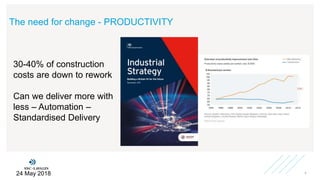
30-40% of construction
costs are down to rework
Can we deliver more with
less – Automation –
Standardised Delivery
How are we going to achieve this?
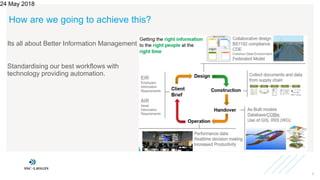
Its all about Better Information Management
Standardising our best workflows with
technology providing automation.
24 May 2018
3
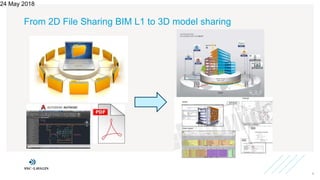
From 2D File Sharing BIM L1 to 3D model sharing
24 May 2018
4
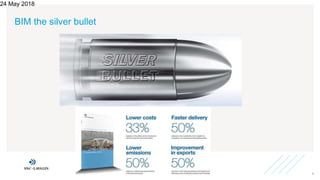
BIM the silver bullet
24 May 2018
5
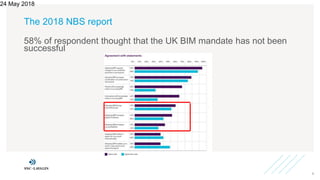
The 2018 NBS report
58% of respondent thought that the UK BIM mandate has not been
successful
24 May 2018
6
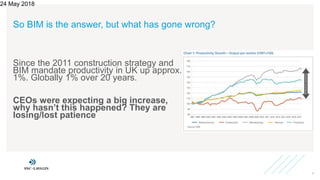
So BIM is the answer, but what has gone wrong?
Since the 2011 construction strategy and
BIM mandate productivity in UK up approx.
1%. Globally 1% over 20 years.
CEOs were expecting a big increase,
why hasn’t this happened? They are
losing/lost patience
24 May 2018
7
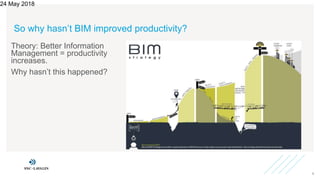
So why hasn’t BIM improved productivity?
Theory: Better Information
Management = productivity
increases.
Why hasn’t this happened?
24 May 2018
8
So why hasn’t BIM improved productivity?
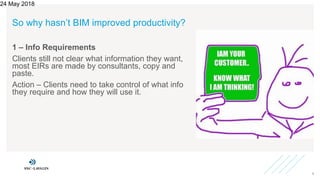
1 – Info Requirements
Clients still not clear what information they want,
most EIRs are made by consultants, copy and
paste.
Action – Clients need to take control of what info
they require and how they will use it.
24 May 2018
9
So why hasn’t BIM improved productivity?
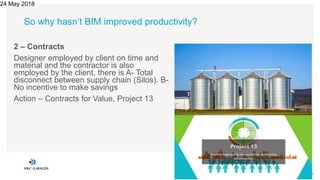
2 – Contracts
Designer employed by client on time and
material and the contractor is also
employed by the client, there is A- Total
disconnect between supply chain (Silos). B-
No incentive to make savings
Action – Contracts for Value, Project 13
24 May 2018
10
So why hasn’t BIM improved productivity?
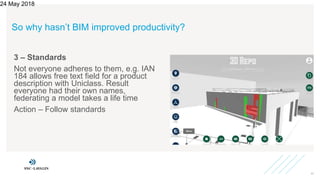
3 – Standards
Not everyone adheres to them, e.g. IAN
184 allows free text field for a product
description with Uniclass. Result
everyone had their own names,
federating a model takes a life time
Action – Follow standards
24 May 2018
11
So why hasn’t BIM improved productivity?
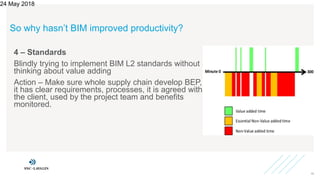
4 – Standards
Blindly trying to implement BIM L2 standards without
thinking about value adding
Action – Make sure whole supply chain develop BEP,
it has clear requirements, processes, it is agreed with
the client, used by the project team and benefits
monitored.
24 May 2018
12
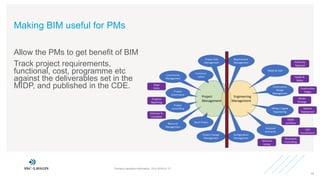
Making BIM useful for PMs
Allow the PMs to get benefit of BIM
Track project requirements,
functional, cost, programme etc
against the deliverables set in the
MIDP, and published in the CDE.
Contains sensitive information. DLA 2018-01-17
13
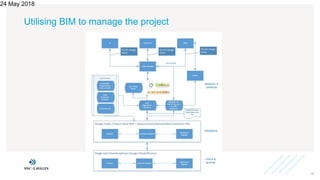
Utilising BIM to manage the project
24 May 2018
14
Make it easy to access information
24 May 2018
15
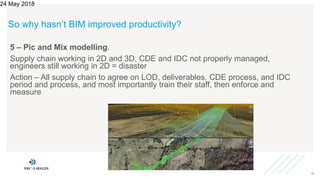
So why hasn’t BIM improved productivity?
5 – Pic and Mix modelling.
Supply chain working in 2D and 3D, CDE and IDC not properly managed,
engineers still working in 2D = disaster
Action – All supply chain to agree on LOD, deliverables, CDE process, and IDC
period and process, and most importantly train their staff, then enforce and
measure
24 May 2018
16
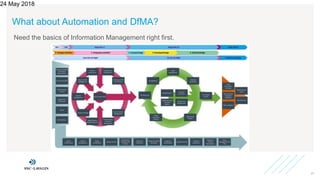
What about Automation and DfMA?
Need the basics of Information Management right first.
24 May 2018
17
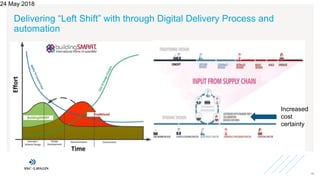
Delivering “Left Shift” with through Digital Delivery Process and
automation
24 May 2018
18
Increased
cost
certainty
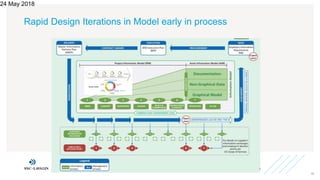
Rapid Design Iterations in Model early in process
24 May 2018
19
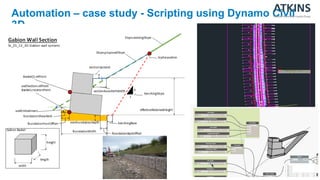
Automation – case study - Scripting using Dynamo Civil
3D
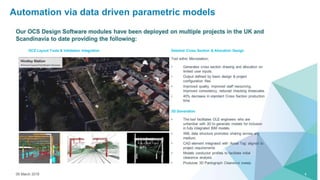
Automation via data driven parametric models
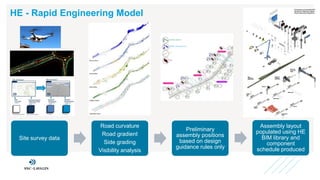
HE - Rapid Engineering Model
Site survey data
Road curvature
Road gradient
Side grading
Visibility analysis
Preliminary
assembly positions
based on design
guidance rules only
Assembly layout
populated using HE
BIM library and
component
schedule produced
24-May-18
24
Software ‘robots’ to
automate manual and
repetitive tasks
Creation of
automated workflows
Enabling Human Robot collaboration
for Business Success
Robotic Process Automation
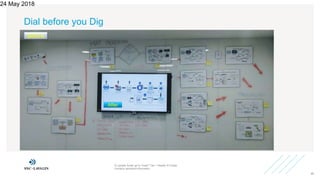
Dial before you Dig
24 May 2018
To update footer go to 'Insert' Tab > Header & Footer
Contains sensitive information
25
Before
After
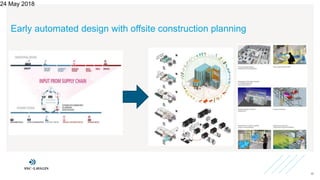
Early automated design with offsite construction planning
24 May 2018
26
24 May 2018
27
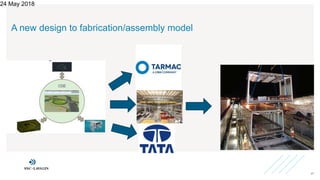
A new design to fabrication/assembly model
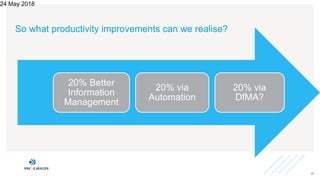
So what productivity improvements can we realise?
20% Better
Information
Management
20% via
Automation
20% via
DfMA?
24 May 2018
28
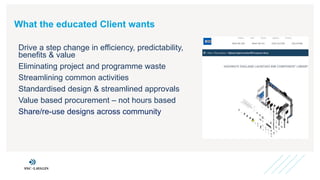
What the educated Client wants
Drive a step change in efficiency, predictability,
benefits & value
Eliminating project and programme waste
Streamlining common activities
Standardised design & streamlined approvals
Value based procurement – not hours based
Share/re-use designs across community
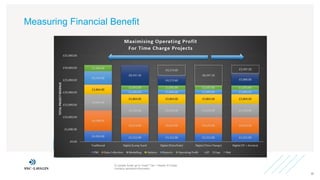
Measuring Financial Benefit
To update footer go to 'Insert' Tab > Header & Footer
Contains sensitive information
30

BIM and the productivity challenge #COMIT2018

  • 1.
    BIM and theProductivity Challenge Nick Tune Digital Director - Transportation 24 May 2018 Contains sensitive information 1
  • 2.
    The need forchange - PRODUCTIVITY 24 May 2018 2 30-40% of construction costs are down to rework Can we deliver more with less – Automation – Standardised Delivery
  • 3.
    How are wegoing to achieve this? Its all about Better Information Management Standardising our best workflows with technology providing automation. 24 May 2018 3
  • 4.
    From 2D FileSharing BIM L1 to 3D model sharing 24 May 2018 4
  • 5.
    BIM the silverbullet 24 May 2018 5
  • 6.
    The 2018 NBSreport 58% of respondent thought that the UK BIM mandate has not been successful 24 May 2018 6
  • 7.
    So BIM isthe answer, but what has gone wrong? Since the 2011 construction strategy and BIM mandate productivity in UK up approx. 1%. Globally 1% over 20 years. CEOs were expecting a big increase, why hasn’t this happened? They are losing/lost patience 24 May 2018 7
  • 8.
    So why hasn’tBIM improved productivity? Theory: Better Information Management = productivity increases. Why hasn’t this happened? 24 May 2018 8
  • 9.
    So why hasn’tBIM improved productivity? 1 – Info Requirements Clients still not clear what information they want, most EIRs are made by consultants, copy and paste. Action – Clients need to take control of what info they require and how they will use it. 24 May 2018 9
  • 10.
    So why hasn’tBIM improved productivity? 2 – Contracts Designer employed by client on time and material and the contractor is also employed by the client, there is A- Total disconnect between supply chain (Silos). B- No incentive to make savings Action – Contracts for Value, Project 13 24 May 2018 10
  • 11.
    So why hasn’tBIM improved productivity? 3 – Standards Not everyone adheres to them, e.g. IAN 184 allows free text field for a product description with Uniclass. Result everyone had their own names, federating a model takes a life time Action – Follow standards 24 May 2018 11
  • 12.
    So why hasn’tBIM improved productivity? 4 – Standards Blindly trying to implement BIM L2 standards without thinking about value adding Action – Make sure whole supply chain develop BEP, it has clear requirements, processes, it is agreed with the client, used by the project team and benefits monitored. 24 May 2018 12
  • 13.
    Making BIM usefulfor PMs Allow the PMs to get benefit of BIM Track project requirements, functional, cost, programme etc against the deliverables set in the MIDP, and published in the CDE. Contains sensitive information. DLA 2018-01-17 13
  • 14.
    Utilising BIM tomanage the project 24 May 2018 14
  • 15.
    Make it easyto access information 24 May 2018 15
  • 16.
    So why hasn’tBIM improved productivity? 5 – Pic and Mix modelling. Supply chain working in 2D and 3D, CDE and IDC not properly managed, engineers still working in 2D = disaster Action – All supply chain to agree on LOD, deliverables, CDE process, and IDC period and process, and most importantly train their staff, then enforce and measure 24 May 2018 16
  • 17.
    What about Automationand DfMA? Need the basics of Information Management right first. 24 May 2018 17
  • 18.
    Delivering “Left Shift”with through Digital Delivery Process and automation 24 May 2018 18 Increased cost certainty
  • 19.
    Rapid Design Iterationsin Model early in process 24 May 2018 19
  • 20.
    Automation – casestudy - Scripting using Dynamo Civil 3D
  • 21.
    Automation via datadriven parametric models
  • 23.
    HE - RapidEngineering Model Site survey data Road curvature Road gradient Side grading Visibility analysis Preliminary assembly positions based on design guidance rules only Assembly layout populated using HE BIM library and component schedule produced
  • 24.
    24-May-18 24 Software ‘robots’ to automatemanual and repetitive tasks Creation of automated workflows Enabling Human Robot collaboration for Business Success Robotic Process Automation
  • 25.
    Dial before youDig 24 May 2018 To update footer go to 'Insert' Tab > Header & Footer Contains sensitive information 25 Before After
  • 26.
    Early automated designwith offsite construction planning 24 May 2018 26
  • 27.
    24 May 2018 27 Anew design to fabrication/assembly model
  • 28.
    So what productivityimprovements can we realise? 20% Better Information Management 20% via Automation 20% via DfMA? 24 May 2018 28
  • 29.
    What the educatedClient wants Drive a step change in efficiency, predictability, benefits & value Eliminating project and programme waste Streamlining common activities Standardised design & streamlined approvals Value based procurement – not hours based Share/re-use designs across community
  • 30.
    Measuring Financial Benefit Toupdate footer go to 'Insert' Tab > Header & Footer Contains sensitive information 30

Editor's Notes

  • #25 Many of us would have seen a lot of manual repetitive rule based processes in various functions across the organization whether it is HR, Finance or engineering functions. If we look at these kind of tasks that are being done, there is no creativity and humans potential is now spending most of their time doing these manual and repetitive tasks. That’s where RPA technology plays big role in finding these kind of opportunities and automating them using software robots. By automating these rule based processes, it enables a perfect collaboration between humans and robots where robots work on the routine tasks and allowing human to focus on more value added tasks or creative tasks. This will be more clear when we discuss further in the coming slides.
  • #26 RTD is utility search service undertaken by the Geospatial and Utility services team in the UK & India. As per HSG47 laid down by UK legislature, it’s a mandate before anyone undertaking excavation work to identify underground services such as gas, water or electricity and plan for safe digging practices. The utility search team provides this service to the customer by surveying the work area for all underground services. As part this service, the team follows three steps: Order processing – Create an order number in the internal database based on the site location information from the client Map processing – survey all utilities for the concerned work area Packing and delivery – Quality check the output and pack and deliver it to the client