2013
The 4Racketeers Design Engineers:
Jake Wang, Daniel Tai,
Augustus Bechtold, Josh Aguilar
6/6/2013
Bike Rack Design Project
COPYRIGHT © 2013 JAKE WANG
Abstract:
The purpose of this project is to present our strength, deflection, buckling, and fatigue
analysis for our bike rack design. Based on our company’s prior experience, we are
implementing constraints on our design with a maximum bicycle weight of 40 pounds, a
maximum dynamic load, of 3G, a design safety factor of 2.0 for strength, a design safety factor
of 3.0 for resistance to buckling, total system deflection less than 1 inch, limit wide of bike and
rack to maximum of 4 feet, limit the maximum overhang of the rack behind the motorcycle to a
maximum of 4.5 feet, lifetime of 10,000 trips with a design safety factor of 5. With these
constraints, we are basically analyzing a total force of 240 pounds (F (total) =2 X 3 X 40=240
lb.).We decided to choose our favorite mechanical design supplier at
www.metalsdepot.com/products, allowing us the flexibility to compare available carbon steel
types and dimensions for our updated design analysis. The preliminary justifications for using
carbon steel are because of its inexpensive price, high yield strength, and broad availability. With
the completion of our design analyses, we can conclude that our initial justifications were correct
and design parameters our purposed bike rack would meet our company’s requirements.
Included is our table of design analysis and comparison, detailed design descriptions, detailed
geometry of structural components with CAD drawings, and mechanical design calculations that
justify our decision for the primary dimensions of our bike rack design.
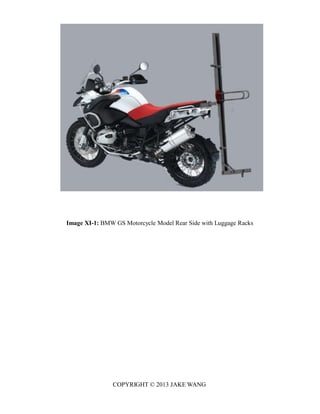
We have picked the BMW GS (see Image A-1) motorcycle model for modeling and
idealization of our bike rack design. We will connect our bike rack to the luggage rack on the
BMW GS. Our bicycle rack system consists of six sections: a vertical beam mainframe, a base
receiver, a horizontal beam support, two link attachments, three strap-on mechanisms, and two
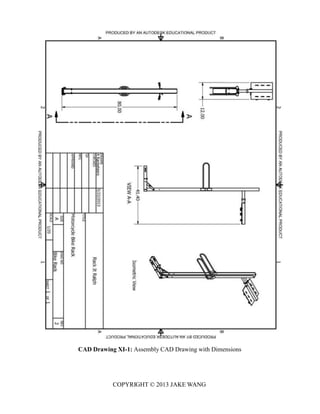
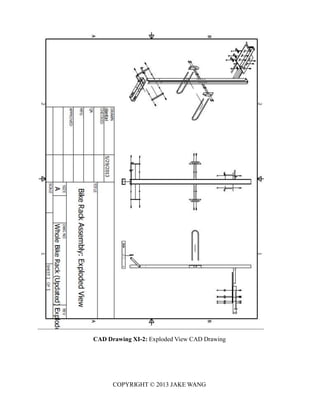
loop-rod bicycle secure attachments, (see CAD Drawing 1 and 2). The finalized overall
geometric size for our bike rack system is the same as our primary chosen dimensions, 80 inches
long and 41.40 inches wide, but it only overhangs behind the motorcycle for about 16 inches.
The estimated total weight of our design is about 86.68 pounds (although the weight for the bike
rake seems heavier than the estimated bike weight, it is sturdy and has a very long lifetime, the
estimated total production cost per unit of this bike rack is $216.50 ($80 cheaper compared to
the only vendor, 2X2 Bicycle Rack (see Image 2A) that is commercializing the product for about
$298 plus shipping and handling), the estimated total deflection is 0.006 inch, the
estimated lifetime over 10 times more than the required 10,000 trips (Table XI-5).
Our design analyses allow us to finalize a new dimension that optimize the strength and
reduce in weight of our bike rack. Our candidate design meets our expectation within the
constraints provided. We met our strength target, with all our Von Mises stress analyses to be
less than the carbon steel’s yield strength. Our selection of material and chosen dimensioned
looks ideal at this phase of the project. However further detailed analysis with fatigue
performance would be required to create an optimal bicycle rack. Not only to satisfy the
customer but to maintain a high quality and safety standard. We look forward to make a
functional, sturdy, and inexpensive prototype for your company.
COPYRIGHT © 2013 JAKE WANG
Design Engineers Background and Contributions:
We are the University of California at Davis, Mechanical Engineers. We are proud to
present our bike rack design to Rack-It Ralph Engineering. Engineer Jake Wang helped organize
the team, put together required paperwork, distributed the weekly work, and maintained a high
quality analysis and material as a group. Jake helped divide the project up equally among the
other three team members and equal work contributions have been present. Jake was in charge of
all the analyses, material gathering, detailed design descriptions of the vertical beam mainframe.
Fellow engineer Daniel Tai was assigned all the analyses, material gathering, and detailed design
descriptions of the loop-rod support system. Fellow engineer Augustus Bechtold was assigned all
the analyses, material gathering, and detailed design descriptions of the horizontal beam. Fellow
engineer Josh Aguilar was assigned all the analyses, material gathering, and detailed design
descriptions of the base receiver. We are all very happy to work together and making great
contribution to our project. GO The4Racketeer!
Below is an abridged version of the actual report. It exemplifies the work from Jake
Wang.
COPYRIGHT © 2013 JAKE WANG
Table of Contents:
I. Overview of Design Description:
II. Visual Presentation:
1)Image XI-1. Motorcycle BWM GX Motorcycle
2) Image XI-2. Motorcyle with Bike Rack
3)CAD Drawing XI-1. Assembly CAD Drawing
4)Figure XI-2. Exploded View CAD Drawing
5) Table XI-5-10. List of Final Dimensions/Weight/Cost
III: General Assumptions:
IV: Overview of the Design:
V: Detail Analysis of the Design:
Vertical Beam Mainframe Detailed Analysis
1) Detailed Description for Design Parts
2) Table A1-2: Material Properties for Design Parts
3) Analyses Formulas
i) Strength Analysis
ii) Deflection Analysis
iii) Buckling Analysis
iv) Fatigue Analysis
4) Detailed Analysis Comparison
i) Table A-: Strength Analysis
ii) Table A-: Deflection Analysis
iii) Table A-Buckling Analysis
iv) Table A-Fatigue Analysis
VI. Recommendations:
VII. Appendices:
1) Whole System Deflection Sketch
2) Whole System Damage Accumulation Sketch
3) Shigley’s Material PropertyTable
4) A500 Steel Mechanical Property Data
5) Bolt Grades Table
6) References
Image XI-1: BMW GS Motorcycle Model Rear Side with Luggage Racks
COPYRIGHT © 2013 JAKE WANG
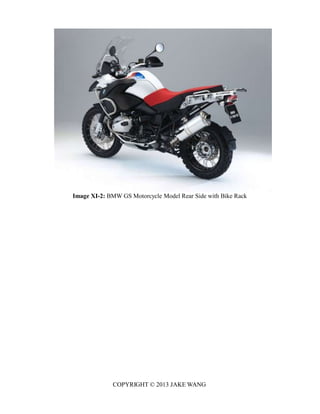
Image XI-2: BMW GS Motorcycle Model Rear Side with Bike Rack
COPYRIGHT © 2013 JAKE WANG
CAD Drawing XI-1: Assembly CAD Drawing with Dimensions
COPYRIGHT © 2013 JAKE WANG
CAD Drawing XI-2: Exploded View CAD Drawing
COPYRIGHT © 2013 JAKE WANG
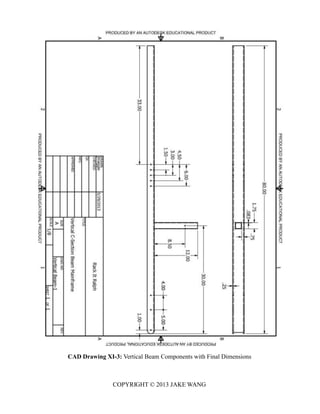
CAD Drawing XI-3: Vertical Beam Components with Final Dimensions
COPYRIGHT © 2013 JAKE WANG
Table XI-1: Vertical Beam Mainframe Final Dimensions/Weight/Cost
Vertical Beam: Design Parameters
Material: A36
Sets H
[inches]
W
[inches]
L
[inches]
t [inches]
3 3 1 1/2 80 1/4
Welded Square Tube: Design Parameters
Material: A513
Sets H
[inches]
W
[inches]
L
[inches]
t [inches]
3 1 1/2 1 1/2 10 3/4
Subtotal Weight [lbs.] 49.25
Subtotal Cost [$] 118.88
Subtotal Deflections
[in]
0.018472
COPYRIGHT © 2013 JAKE WANG
XII: General Assumptions:
There are several assumptions we made to help us analyze our bike rack. For the vertical
beam frame, we assumed the welded square tube connection to the vertical C-Channel to act
like a cantilever at a fix wall. This simplifies our analysis so we do not have to analyze the
additional stress created from the welding.
We used Von Mises Stress Theory to analyze our strength analysis. Because Von Mises
Stress Theory is considered as the more accurate theory compared to the more conservative
Maximum Shear Stress Theory. But, we understand it is not necessarily the case for all the time.
We used this assumption for quicker analysis of our strength of the materials.
We have simplified our moment and shear calculations based just on the weight of the
bike itself. We did not the weight of the bike rack into our calculations. This helps us save time
to work on other analysis.
Primary we chose to use carbon steel as our material choice, because it is fairly
inexpensive and easily to obtained. However, when we start our fatigue analysis, the S-N curve
for A500, A36, and etc., were not available from our vendor. We resort to using the 1045 steel S-
N curve with a home-made scale up and scale down factor. Since the Su and Sy of 1045 steel is
twice of that of our steel material. We will multiple our stress amplitude by 2, and then plug into
the power log formula to obtain the life cycle. At the end we will divide our interpolated life
cycle by 10E11 to get our theoretical life cycle for our steel material.
COPYRIGHT © 2013 JAKE WANG
XIII: Initial Research and Designs:
The two main bicycle rack products for cars are two pillars, with strap-on, and one main
pillar will an L-beam attached (see Image 1A). They generally cost around $55 for the lower end
products and up to $278 for the higher end ones. There are also bicycle racks on the roof top of
the car, but we would not have that luxury with the motorcycle (see Image 1B).
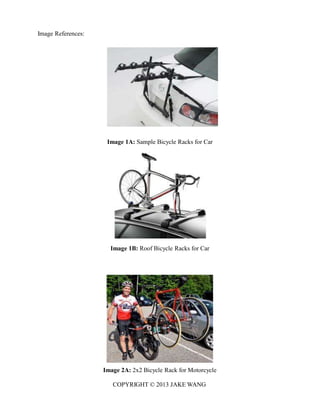
We found only one company called 2X2 Bicycle Rack (see Image 2A) that is
commercializing the product for about $298 plus shipping and handling. 2X2 Bicycle Rack has a
flat steel panel and steel parts for attaching to the backseat of the motorcycle. However, most
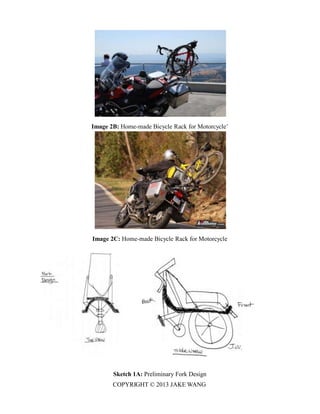
bicycle rack on the internet, are home-made by bicycle enthusiast (see Image 2B) with duck
tapes and wood strapped around the backseat. Some better home-made one have an original
motorcycle backseat metal frame extension, so enthusiast can attach metal rods at the extension
with nuts and bolts and attach the bicycle to the metal rods with nylon bicycle strap (see Image
2C). So far, most of the designs for bicycle rack for motorcycle have the bicycle wheels at least
one or both wheels removed to avoid spinning of the wheels while cruising. The bicycle is
positioned facing forward on the backseat.
Here are some preliminary designs for our client. First, there is the Fork Design, with two
rods forked at one end and one adjoining rod at the other end. It will attach to the motorcycle
frame with a clamp. And it will hold on to the middle rod of the bicycle, with bicycle in a
vertical position, front end facing the sky and bottom end facing the ground (see Sketch 1A).
With this design, the ideal way to have the bicycle attached is to remove both bicycle wheels.
Although there might be issue with the bending moment induced by the weight of the bicycle,
this is the simplest design with minimal material. But we will further modify this design to
reduce bending moment if this is the best design for most motorcycles.
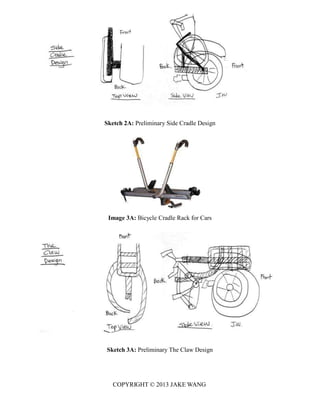
The second design is the Side Cradle Design with a cradle attached to only one side of
the motorcycle (see Sketch 2A). This is an adaptation from a bicycle rack for cars (see Image
3A). This also allows the users to remove only one or none of their bicycle wheels, because the
cradle with its L-shaped tire contraption would fully secured the wheels in place. The bicycle
would be in a vertical position with front facing the sky. There might be stability question we
need to focus on because the cradle is only on one side of the motorcycle. And also we need to
focus on what material to be used and what size for the rod bridging between the bicycle and
the motorcycle. This rod will definitely experience great bending stress and possible axial
stress.
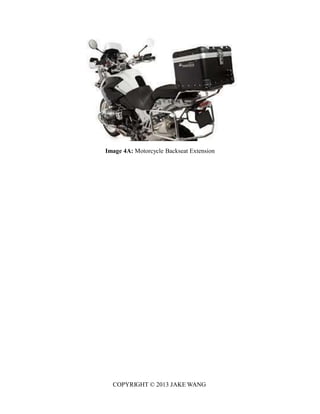
The third design is The Claw Design (see Sketch 3A) inspired by the aluminum box
frame extension for the backseat of a motorcycle (see Image 4A). By adding a center claw to
hold the bicycle fork frame, and one longer and one shorter outer claws to secure the main rod
and the front rod. This design would provide great stability and durability of the bicycle rack.
However, this design would require more material parts and maybe more tooling time. So this
would be a more costly design, unless we find cheaper material with high yielding stress. We
would be using theory for bending of a curved beam for the two outer claws for determining the
maximum stress it can handle.
COPYRIGHT © 2013 JAKE WANG
The bicycle rack idea for motorcycle seems to be interesting with many potential
possibilities. Although we might need some more information regarding the type of motorcycle
we are targeting and the type of bicycle we are handling. And also we may need the budget for
this project and the desired lifetime of the product. We look forward to working on the next
phase of the project.
Image References:
Image 1A: Sample Bicycle Racks for Car
Image 1B: Roof Bicycle Racks for Car
Image 2A: 2x2 Bicycle Rack for Motorcycle
COPYRIGHT © 2013 JAKE WANG
Image 2B: Home-made Bicycle Rack for Motorcycle’
Image 2C: Home-made Bicycle Rack for Motorcycle
Sketch 1A: Preliminary Fork Design
COPYRIGHT © 2013 JAKE WANG
Sketch 2A: Preliminary Side Cradle Design
Image 3A: Bicycle Cradle Rack for Cars
Sketch 3A: Preliminary The Claw Design
COPYRIGHT © 2013 JAKE WANG
Image 4A: Motorcycle Backseat Extension
COPYRIGHT © 2013 JAKE WANG
XIII: Overview of Design:
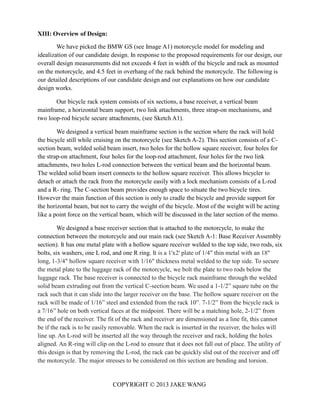
We have picked the BMW GS (see Image A1) motorcycle model for modeling and
idealization of our candidate design. In response to the proposed requirements for our design, our
overall design measurements did not exceeds 4 feet in width of the bicycle and rack as mounted
on the motorcycle, and 4.5 feet in overhang of the rack behind the motorcycle. The following is
our detailed descriptions of our candidate design and our explanations on how our candidate
design works.
Our bicycle rack system consists of six sections, a base receiver, a vertical beam
mainframe, a horizontal beam support, two link attachments, three strap-on mechanisms, and
two loop-rod bicycle secure attachments, (see Sketch A1).
We designed a vertical beam mainframe section is the section where the rack will hold
the bicycle still while cruising on the motorcycle (see Sketch A-2). This section consists of a C-
section beam, welded solid beam insert, two holes for the hollow square receiver, four holes for
the strap-on attachment, four holes for the loop-rod attachment, four holes for the two link
attachments, two holes L-rod connection between the vertical beam and the horizontal beam.
The welded solid beam insert connects to the hollow square receiver. This allows bicycler to
detach or attach the rack from the motorcycle easily with a lock mechanism consists of a L-rod
and a R- ring. The C-section beam provides enough space to situate the two bicycle tires.
However the main function of this section is only to cradle the bicycle and provide support for
the horizontal beam, but not to carry the weight of the bicycle. Most of the weight will be acting
like a point force on the vertical beam, which will be discussed in the later section of the memo.
We designed a base receiver section that is attached to the motorcycle, to make the
connection between the motorcycle and our main rack (see Sketch A-1: Base Receiver Assembly
section). It has one metal plate with a hollow square receiver welded to the top side, two rods, six
bolts, six washers, one L rod, and one R ring. It is a 1'x2' plate of 1/4" thin metal with an 18"
long, 1-3/4" hollow square receiver with 1/16" thickness metal welded to the top side. To secure
the metal plate to the luggage rack of the motorcycle, we bolt the plate to two rods below the
luggage rack. The base receiver is connected to the bicycle rack mainframe through the welded
solid beam extruding out from the vertical C-section beam. We used a 1-1/2” square tube on the
rack such that it can slide into the larger receiver on the base. The hollow square receiver on the
rack will be made of 1/16” steel and extended from the rack 10”. 7-1/2” from the bicycle rack is
a 7/16” hole on both vertical faces at the midpoint. There will be a matching hole, 2-1/2” from
the end of the receiver. The fit of the rack and receiver are dimensioned as a line fit, this cannot
be if the rack is to be easily removable. When the rack is inserted in the receiver, the holes will
line up. An L-rod will be inserted all the way through the receiver and rack, holding the holes
aligned. An R-ring will clip on the L-rod to ensure that it does not fall out of place. The utility of
this design is that by removing the L-rod, the rack can be quickly slid out of the receiver and off
the motorcycle. The major stresses to be considered on this section are bending and torsion.
COPYRIGHT © 2013 JAKE WANG
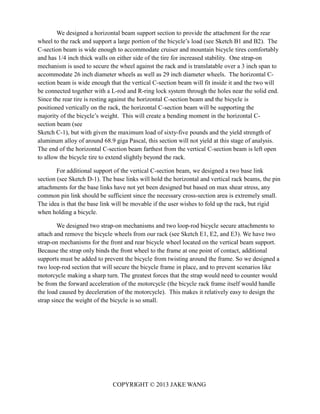
We designed a horizontal beam support section to provide the attachment for the rear
wheel to the rack and support a large portion of the bicycle’s load (see Sketch B1 and B2). The
C-section beam is wide enough to accommodate cruiser and mountain bicycle tires comfortably
and has 1/4 inch thick walls on either side of the tire for increased stability. One strap-on
mechanism is used to secure the wheel against the rack and is translatable over a 3 inch span to
accommodate 26 inch diameter wheels as well as 29 inch diameter wheels. The horizontal C-
section beam is wide enough that the vertical C-section beam will fit inside it and the two will
be connected together with a L-rod and R-ring lock system through the holes near the solid end.
Since the rear tire is resting against the horizontal C-section beam and the bicycle is
positioned vertically on the rack, the horizontal C-section beam will be supporting the
majority of the bicycle’s weight. This will create a bending moment in the horizontal C-
section beam (see
Sketch C-1), but with given the maximum load of sixty-five pounds and the yield strength of
aluminum alloy of around 68.9 giga Pascal, this section will not yield at this stage of analysis.
The end of the horizontal C-section beam farthest from the vertical C-section beam is left open
to allow the bicycle tire to extend slightly beyond the rack.
For additional support of the vertical C-section beam, we designed a two base link
section (see Sketch D-1). The base links will hold the horizontal and vertical rack beams, the pin
attachments for the base links have not yet been designed but based on max shear stress, any
common pin link should be sufficient since the necessary cross-section area is extremely small.
The idea is that the base link will be movable if the user wishes to fold up the rack, but rigid
when holding a bicycle.
We designed two strap-on mechanisms and two loop-rod bicycle secure attachments to
attach and remove the bicycle wheels from our rack (see Sketch E1, E2, and E3). We have two
strap-on mechanisms for the front and rear bicycle wheel located on the vertical beam support.
Because the strap only binds the front wheel to the frame at one point of contact, additional
supports must be added to prevent the bicycle from twisting around the frame. So we designed a
two loop-rod section that will secure the bicycle frame in place, and to prevent scenarios like
motorcycle making a sharp turn. The greatest forces that the strap would need to counter would
be from the forward acceleration of the motorcycle (the bicycle rack frame itself would handle
the load caused by deceleration of the motorcycle). This makes it relatively easy to design the
strap since the weight of the bicycle is so small.
A-3): Detailed Description for Design Parts
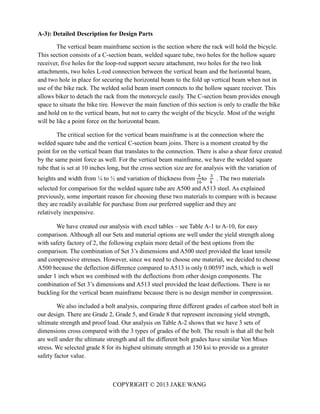
The vertical beam mainframe section is the section where the rack will hold the bicycle.
This section consists of a C-section beam, welded square tube, two holes for the hollow square
receiver, five holes for the loop-rod support secure attachment, two holes for the two link
attachments, two holes L-rod connection between the vertical beam and the horizontal beam,
and two hole in place for securing the horizontal beam to the fold up vertical beam when not in
use of the bike rack. The welded solid beam insert connects to the hollow square receiver. This
allows biker to detach the rack from the motorcycle easily. The C-section beam provides enough
space to situate the bike tire. However the main function of this section is only to cradle the bike
and hold on to the vertical beam, but not to carry the weight of the bicycle. Most of the weight
will be like a point force on the horizontal beam.
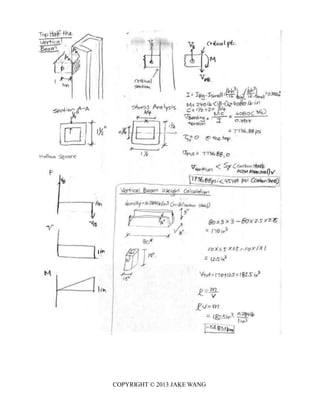
The critical section for the vertical beam mainframe is at the connection where the
welded square tube and the vertical C-section beam joins. There is a moment created by the
point for on the vertical beam that translates to the connection. There is also a shear force created
by the same point force as well. For the vertical beam mainframe, we have the welded square
tube that is set at 10 inches long, but the cross section size are for analysis with the variation of
heights and width from ¼ to ½ and variation of thickness from 3
to 3
. The two materials
COPYRIGHT © 2013 JAKE WANG
16 4
selected for comparison for the welded square tube are A500 and A513 steel. As explained
previously, some important reason for choosing these two materials to compare with is because
they are readily available for purchase from our preferred supplier and they are
relatively inexpensive.
We have created our analysis with excel tables – see Table A-1 to A-10, for easy
comparison. Although all our Sets and material options are well under the yield strength along
with safety factory of 2, the following explain more detail of the best options from the
comparison. The combination of Set 3’s dimensions and A500 steel provided the least tensile
and compressive stresses. However, since we need to choose one material, we decided to choose
A500 because the deflection difference compared to A513 is only 0.00597 inch, which is well
under 1 inch when we combined with the deflections from other design components. The
combination of Set 3’s dimensions and A513 steel provided the least deflections. There is no
buckling for the vertical beam mainframe because there is no design member in compression.
We also included a bolt analysis, comparing three different grades of carbon steel bolt in
our design. There are Grade 2, Grade 5, and Grade 8 that represent increasing yield strength,
ultimate strength and proof load. Our analysis on Table A-2 shows that we have 3 sets of
dimensions cross compared with the 3 types of grades of the bolt. The result is that all the bolt
are well under the ultimate strength and all the different bolt grades have similar Von Mises
stress. We selected grade 8 for its highest ultimate strength at 150 ksi to provide us a greater
safety factor value.
COPYRIGHT © 2013 JAKE WANG
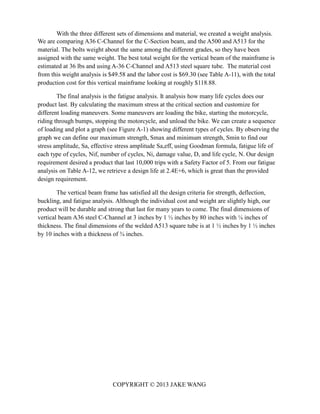
With the three different sets of dimensions and material, we created a weight analysis.
We are comparing A36 C-Channel for the C-Section beam, and the A500 and A513 for the
material. The bolts weight about the same among the different grades, so they have been
assigned with the same weight. The best total weight for the vertical beam of the mainframe is
estimated at 36 lbs and using A-36 C-Channel and A513 steel square tube. The material cost
from this weight analysis is $49.58 and the labor cost is $69.30 (see Table A-11), with the total
production cost for this vertical mainframe looking at roughly $118.88.
The final analysis is the fatigue analysis. It analysis how many life cycles does our
product last. By calculating the maximum stress at the critical section and customize for
different loading maneuvers. Some maneuvers are loading the bike, starting the motorcycle,
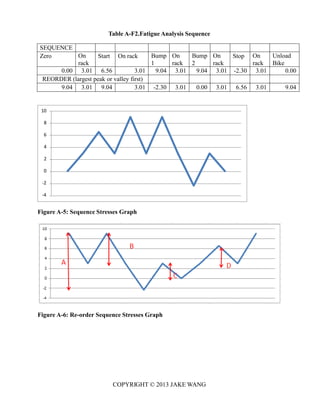
riding through bumps, stopping the motorcycle, and unload the bike. We can create a sequence
of loading and plot a graph (see Figure A-1) showing different types of cycles. By observing the
graph we can define our maximum strength, Smax and minimum strength, Smin to find our
stress amplitude, Sa, effective stress amplitude Sa,eff, using Goodman formula, fatigue life of
each type of cycles, Nif, number of cycles, Ni, damage value, D, and life cycle, N. Our design
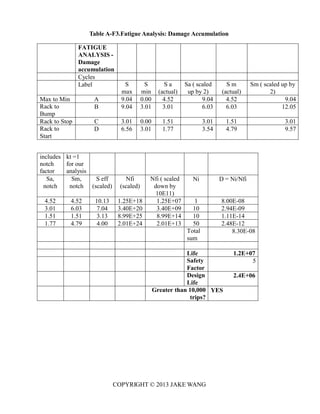
requirement desired a product that last 10,000 trips with a Safety Factor of 5. From our fatigue
analysis on Table A-12, we retrieve a design life at 2.4E+6, which is great than the provided
design requirement.
The vertical beam frame has satisfied all the design criteria for strength, deflection,
buckling, and fatigue analysis. Although the individual cost and weight are slightly high, our
product will be durable and strong that last for many years to come. The final dimensions of
vertical beam A36 steel C-Channel at 3 inches by 1 ½ inches by 80 inches with ¼ inches of
thickness. The final dimensions of the welded A513 square tube is at 1 ½ inches by 1 ½ inches
by 10 inches with a thickness of ¾ inches.
3)Table A1-2: Material Properties for Design Parts
Table A-1: Material Properties for our Steel Square Tubing
Table A-2: Material Properties for our Bolt Options
Table A-3:SAE1045 Steel Fatigue S-N Curve
COPYRIGHT © 2013 JAKE WANG
Major Design Component
Steel Tubing
Material/Grade ASTM A500
Steel*
ASTM A513 Steel*
Density (p) 0.284
[lbf/in^3]
Elastic Modulus
(E)
20300 [kpsi] 30000 [kpsi]*
Poisson's ratio (v) 0.292
Yield Strength
(Sy)
45700 [psi] 72000 [psi]
Ultimate Strength
(Su)
58000 [psi] 87000 [psi]
* Assume 30000. No data
found.
Bolt Component
Material/Grade Low Carbon Bolt
**
Grade 2 5 8
Yield Strength (Sy) 57000 [psi] 92000 [psi] 130000
[psi]
Ultimate Strength
(Su)
74000 [psi] 120000[psi] 150000[psi]
Proof Load 55000 [psi] 85000 [psi] 120000[psi]
(low carbon steel)
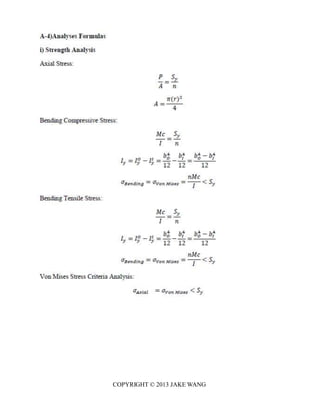
A-4)Analyses Formulas
i) Strength Analysis
Axial Stress:
𝑃𝑃 𝑆𝑆𝑦𝑦
𝐴𝐴 𝑛𝑛
=
𝐴𝐴=
𝜋𝜋(𝑟𝑟)2
4
Bending Compressive Stress:
𝑀𝑀𝑀𝑀 𝑆𝑆𝑦𝑦
𝐼𝐼 𝑛𝑛
=
𝐼𝐼𝑦𝑦= 𝐼𝐼𝑦𝑦− 𝐼𝐼𝑦𝑦=
12
−
12
=𝑂𝑂 𝐼𝐼
𝑏𝑏𝑂𝑂 𝑏𝑏𝐼𝐼
4 4
𝑏𝑏𝑂𝑂− 𝑏𝑏𝐼𝐼
4 4
12
𝜎𝜎𝐵𝐵𝐵𝐵𝐵𝐵𝐵𝐵𝐵𝐵𝐵𝐵𝐵𝐵= 𝜎𝜎𝑉𝑉𝑉𝑉𝐵𝐵 𝑀𝑀𝐵𝐵𝑀𝑀𝐵𝐵𝑀𝑀=
𝑛𝑛𝑀𝑀𝑀𝑀
𝐼𝐼
< 𝑆𝑆𝑦𝑦
Bending Tensile Stress:
𝑀𝑀𝑀𝑀
𝐼𝐼 𝑛𝑛
=
𝑆𝑆𝑦𝑦
𝐼𝐼𝑦𝑦= 𝐼𝐼𝑦𝑦− 𝐼𝐼𝑦𝑦=
12
−
12
=𝑂𝑂 𝐼𝐼
𝑏𝑏𝑂𝑂 𝑏𝑏𝐼𝐼
4 4
𝑏𝑏𝑂𝑂− 𝑏𝑏𝐼𝐼
4 4
12
𝜎𝜎𝐵𝐵𝐵𝐵𝐵𝐵𝐵𝐵𝐵𝐵𝐵𝐵𝐵𝐵= 𝜎𝜎𝑉𝑉𝑉𝑉𝐵𝐵 𝑀𝑀𝐵𝐵𝑀𝑀𝐵𝐵𝑀𝑀=
𝑛𝑛𝑀𝑀𝑀𝑀
𝐼𝐼
< 𝑆𝑆𝑦𝑦
COPYRIGHT © 2013 JAKE WANG
Von Mises Stress Criteria Analysis:
𝜎𝜎𝐴𝐴𝐴𝐴𝐵𝐵𝐴𝐴𝐴𝐴 = 𝜎𝜎𝑉𝑉𝑉𝑉𝐵𝐵 𝑀𝑀𝐵𝐵𝑀𝑀𝐵𝐵𝑀𝑀< 𝑆𝑆𝑦𝑦
COPYRIGHT © 2013 JAKE WANG
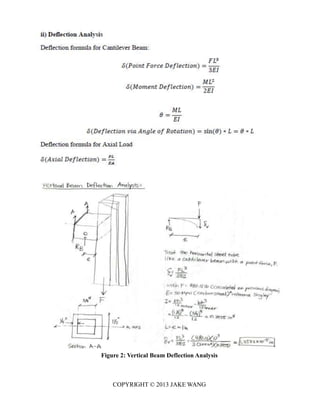
ii) Deflection Analysis
Deflection formula for Cantilever Beam:
𝛿𝛿(𝑃𝑃𝑃𝑃𝑃𝑃𝑛𝑛𝑃𝑃𝐹𝐹𝑃𝑃𝑟𝑟𝑀𝑀𝐹𝐹𝐷𝐷𝐹𝐹𝐷𝐷𝐷𝐷𝐹𝐹𝑀𝑀𝑃𝑃𝑃𝑃𝑃𝑃𝑛𝑛) =
𝐹𝐹𝐿𝐿3
3𝐸𝐸𝐼𝐼
𝛿𝛿(𝑀𝑀𝑃𝑃𝑀𝑀𝐹𝐹𝑛𝑛𝑃𝑃𝐷𝐷𝐹𝐹𝐷𝐷𝐷𝐷𝐹𝐹𝑀𝑀𝑃𝑃𝑃𝑃𝑃𝑃𝑛𝑛) =
𝑀𝑀𝐿𝐿2
2𝐸𝐸𝐼𝐼
𝜃𝜃=
𝑀𝑀𝐿𝐿
𝐸𝐸𝐼𝐼
𝛿𝛿(𝐷𝐷𝐹𝐹𝐷𝐷𝐷𝐷𝐹𝐹𝑀𝑀𝑃𝑃𝑃𝑃𝑃𝑃𝑛𝑛𝑣𝑣𝑃𝑃𝑣𝑣𝐴𝐴𝑛𝑛𝐴𝐴𝐷𝐷𝐹𝐹𝑃𝑃𝐷𝐷𝑅𝑅𝑃𝑃𝑃𝑃𝑣𝑣𝑃𝑃𝑃𝑃𝑃𝑃𝑛𝑛) = sin(𝜃𝜃) ∗ 𝐿𝐿= 𝜃𝜃∗ 𝐿𝐿
Deflection formula for Axial Load
𝛿𝛿(𝐴𝐴𝐴𝐴𝑃𝑃𝑣𝑣𝐷𝐷𝐷𝐷𝐹𝐹𝐷𝐷𝐷𝐷𝐹𝐹𝑀𝑀𝑃𝑃𝑃𝑃𝑃𝑃𝑛𝑛) = 𝑃𝑃𝑃𝑃
𝐸𝐸𝐴𝐴
Figure 2: Vertical Beam Deflection Analysis
COPYRIGHT © 2013 JAKE WANG
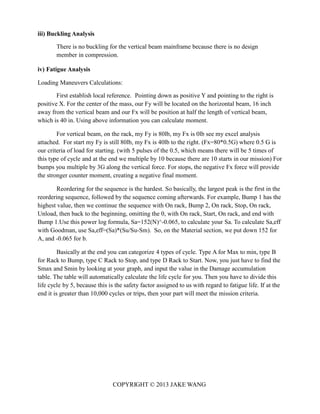
iii) Buckling Analysis
There is no buckling for the vertical beam mainframe because there is no design
member in compression.
iv) Fatigue Analysis
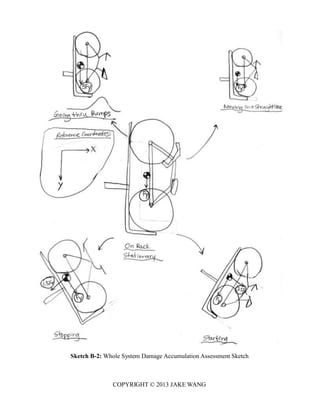
Loading Maneuvers Calculations:
First establish local reference. Pointing down as positive Y and pointing to the right is
positive X. For the center of the mass, our Fy will be located on the horizontal beam, 16 inch
away from the vertical beam and our Fx will be position at half the length of vertical beam,
which is 40 in. Using above information you can calculate moment.
For vertical beam, on the rack, my Fy is 80lb, my Fx is 0lb see my excel analysis
attached. For start my Fy is still 80lb, my Fx is 40lb to the right. (Fx=80*0.5G) where 0.5 G is
our criteria of load for starting. (with 5 pulses of the 0.5, which means there will be 5 times of
this type of cycle and at the end we multiple by 10 because there are 10 starts in our mission) For
bumps you multiple by 3G along the vertical force. For stops, the negative Fx force will provide
the stronger counter moment, creating a negative final moment.
Reordering for the sequence is the hardest. So basically, the largest peak is the first in the
reordering sequence, followed by the sequence coming afterwards. For example, Bump 1 has the
highest value, then we continue the sequence with On rack, Bump 2, On rack, Stop, On rack,
Unload, then back to the beginning, omitting the 0, with On rack, Start, On rack, and end with
Bump 1.Use this power log formula, Sa=152(N)^-0.065, to calculate your Sa. To calculate Sa,eff
with Goodman, use Sa,eff=(Sa)*(Su/Su-Sm). So, on the Material section, we put down 152 for
A, and -0.065 for b.
Basically at the end you can categorize 4 types of cycle. Type A for Max to min, type B
for Rack to Bump, type C Rack to Stop, and type D Rack to Start. Now, you just have to find the
Smax and Smin by looking at your graph, and input the value in the Damage accumulation
table. The table will automatically calculate the life cycle for you. Then you have to divide this
life cycle by 5, because this is the safety factor assigned to us with regard to fatigue life. If at the
end it is greater than 10,000 cycles or trips, then your part will meet the mission criteria.
COPYRIGHT © 2013 JAKE WANG
A.5) Detailed Analysis Comparison
i) Table A-: Strength Analysis
Table A-3: Complete Table of Available Dimensions Welded Square Tube Analysis
Welded Square Tube: Design Parameters
Dimensions
Sets H [inches] W [inches] L [inches] t [inches]
1 1 1/4 1 1/4 10 3/16
2 1 1/2 1 1/2 10 1/4
3 1 1/2 1 1/2 10 3/4
Parts Design Parameters
Area Calculations
Sets A [inches^2]
1 2/3
2 1 1/4
3 2 1/4
Parts Design Parameters
Moment of Inertia Calculations
Sets I [inches^4]
1 1/6
2 1/3
3 3/7
Parts Design Parameters
Distance from the edge to Bolt
(e)
Sets e [inches]
1 1
1 1 1/2
1 2
2 1
2 1 1/2
2 2
3 1
3 1 1/2
3 2
COPYRIGHT © 2013 JAKE WANG
ii) Table A-: Deflection Analysis
Parts Material
Strength Set A500 Von
Mises
<Sy A513 Von
Mises
<Sy Best Set
Ranking
Tensile Stress [psi] 1 16493 14400 Yes 3709 3138 Yes 3
24/25 1/11 6/13
2 9038 7253 Yes 2448 1360 Yes 2
10/13 1/3
3 7253 7253 Yes 1360 1360 Yes 1
1/3 1/3
Compressive Stress 1 -16493 - Yes -3138 -3138 Yes 3
[psi] 24/25 14400 6/13 6/13
(Note: A500: 2 -9038 -7253 Yes -1360 -1360 Yes 2
Sy=45700 [psi]) 10/13 1/3
(Note: A513: 3 -7253 -7253 Yes -1360 -1360 Yes 1
Sy=72000 [psi]) 1/3 1/3
Best Material
Ranking
1 2
Parts Material
Deflections Set A500 A513
Vertical Deflection [in.] 1 19/400 9/280
(Note: E=20300 [kpsi]) 1 21/131 32/295
1 19/50 9/35
2 19/800 9/560
2 21/262 16/295
2 19/100 9/70
3 15/812 1/80
3 25/401 17/403
3 103/697 1/10
Deflections for design part
[in.]
1 19/400 9/280
2 19/800 9/560
3 15/812 1/80 Deflection
Difference
Min Deflections for design
part [in.]
Set
3
15/812 1/80 2/335
COPYRIGHT © 2013 JAKE WANG
iii) Table A-Buckling Analysis
iv) Table A-Fatigue Analysis
Table A-F1.Fatigue Analysis
Parts Material
Buckling Set A500 <Sy [Yes/No] A513 <Sy [Yes/No]
Tensile Stress [psi] 1 0 0 0 0
2 0 0 0 0
3 0 0 0 0
Compressive Stress [psi] 1 0 0 0 0
2 0 0 0 0
3 0 0 0 0
(Comments: Due to no compressive force acting on the vertical beam, the beam would not
buckle.)
Vertical Beam Welded Tube Fatigue Analysis:
GEOMETRY MATERIAL A1045 Steel
D 0.85 inch Sy 105 ksi
Su 84 ksi
I 0.3385 inch^4 A 152 ksi, (for fully
reversed loading)
A N/A inch^2 b -0.065
c 0.7500 inch
Kt, notch 1.0000 (unnotched)
LOADING
Maneuver Fx [lbs] Fy [lbs] P [lbs] V [lbs] M
[lb*in]
Stress @ Welded Tube
(Mc/I) [ksi]
Load Bike 0 0 0 0 0 0.00
On rack 0 80 0 80 1360 3.01
Start 40 80 40 80 2960 6.56
Bump 0 240 0 240 4080 9.04
Stop -60 80 -60 80 -1040 -2.30
On rack 0 80 0 80 1360 3.01
Unload
Bike
0 0 0 0 0 0
Table A-F2.Fatigue Analysis Sequence
10
8
6
4
2
0
-2
-4
Figure A-5: Sequence Stresses Graph
Figure A-6: Re-order Sequence Stresses Graph
COPYRIGHT © 2013 JAKE WANG
SEQUENCE
Zero On
rack
Start On rack Bump
1
On
rack
Bump
2
On
rack
Stop On
rack
Unload
Bike
0.00 3.01 6.56 3.01 9.04 3.01 9.04 3.01 -2.30 3.01 0.00
REORDER (largest peak or valley first)
9.04 3.01 9.04 3.01 -2.30 3.01 0.00 3.01 6.56 3.01 9.04
COPYRIGHT © 2013 JAKE WANG
Table A-F3.Fatigue Analysis: Damage Accumulation
FATIGUE
ANALYSIS -
Damage
accumulation
Cycles
Label S
max
S
min
S a
(actual)
Sa ( scaled
up by 2)
S m
(actual)
Sm ( scaled up by
2)
Max to Min A 9.04 0.00 4.52 9.04 4.52 9.04
Rack to
Bump
B 9.04 3.01 3.01 6.03 6.03 12.05
Rack to Stop C 3.01 0.00 1.51 3.01 1.51 3.01
Rack to
Start
D 6.56 3.01 1.77 3.54 4.79 9.57
includes
notch
factor
kt =1
for our
analysis
Sa,
notch
Sm,
notch
S eff
(scaled)
Nfi
(scaled)
Nfi ( scaled
down by
10E11)
Ni D = Ni/Nfi
4.52 4.52 10.13 1.25E+18 1.25E+07 1 8.00E-08
3.01 6.03 7.04 3.40E+20 3.40E+09 10 2.94E-09
1.51 1.51 3.13 8.99E+25 8.99E+14 10 1.11E-14
1.77 4.79 4.00 2.01E+24 2.01E+13 50 2.48E-12
Total
sum
8.30E-08
Life 1.2E+07
Safety
Factor
5
Design
Life
2.4E+06
Greater than 10,000
trips?
YES
COPYRIGHT © 2013 JAKE WANG
Table A-W1.Vertical Beam and Welded Tube Weight Analysis
Table A-C1.Vertical Beam and Welded Tube Cost Analysis
Components Weight
Sets Vertical Beam [lb] Welded Tube [lb] Bolts
[lb]
Total Weight [lb] Selection
Ranking
1 34 2 1/4 36 18/61 1
2 45 1/2 3 5/9 1/4 49 9/35 2
3 42 3/5 6 2/5 1/4 49 9/35 2
Vertical Beam and Welded Tube Cost
Analysis
Material: C
Channel
A-36
Steel
Welded
Tube
A500
Steel
Components Costs
Sets Vertical
Beam [$]
Welded
Tube [$]
Bolts
[$]
Material
Cost [$]
Labor
Cost
[$]
Total
Cost
[$]
Selection
Ranking
1 40.96 21.66 2 64.62 69.30 133.92 1
2 52.00 13.32 2 67.32 69.53 136.85 2
3 51.84 18.00 2 71.84 69.91 141.75 3
Vertical Beam and Welded Tube Cost
Analysis
Material: C
Channel
A-36
Steel
Welded
Tube
A513
Steel
Components Costs
Sets Vertical
Beam [$]
Welded
Tube [$]
Bolts
[$]
Material
Cost [$]
Labor
Cost
[$]
Total
Cost
[$]
Selection
Ranking
1 40.96 6.62 2 49.58 69.30 118.88 1
2 52.00 6.24 2 60.24 69.53 129.77 2
3 51.84 7.82 2 61.66 69.91 131.57 3
COPYRIGHT © 2013 JAKE WANG
Table A-L: Vertical Beam and Welded Tube Labor Cost Analysis
Vertical Beam and Welded Tube Labor Cost Analysis
Material: C
Channel
A-36
Steel
Welded
Tube
A500 or
513 Steel
Sets 1 2 3
Processes Unit Cost
[$]
# of Units
or Length
[cm]
Subtotal
Cost [$]
Unit
Cost
[$]
# of Units
or Length
[cm]
Subtotal
Cost [$]
Unit
Cost
[$]
# of Units
or Length
[cm]
Subtotal
Cost [$]
Vertical
Tube
Drilled $ 5 $ $ 5 $ $ 5 $
holes <
25.4 mm
dia. 0.35 1.75 0.35 1.75 0.35 1.75
Saw or $ 40.54 $ $ 40.54 $ $ 40.54 $
tubing cuts 0.40 16.22 0.40 16.22 0.40 16.22
Welded
Tube
Tube end $ 1 $ $ 1 $ $ 1 $
preparation
for
welding 0.75 0.75 0.75 0.75 0.75 0.75
Weld $ 1.69 $ $ 3.18 $ $ 5.72 $
0.15 0.25 0.15 0.48 0.15 0.86
Tube cut $ 35.56 $ $ 35.56 $ $ 35.56 $
0.15 5.33 0.15 5.33 0.15 5.33
Assembly
Assemble, $ 12 $ $ 12 $ $ 12 $
>20 kg,
Line-on-
Line 3.75 45.00 3.75 45.00 3.75 45.00
Total $ Total $ Total $
Labor Labor Labor
Cost 69.30 Cost 69.53 Cost 69.91
Ranking (Least to
Highest Price)
1 2 3
COPYRIGHT © 2013 JAKE WANG
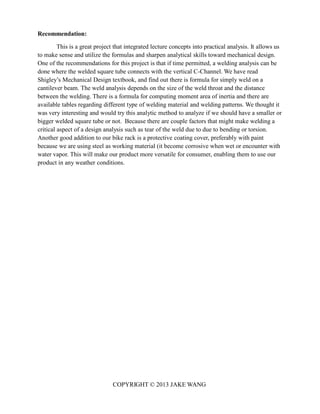
Recommendation:
This is a great project that integrated lecture concepts into practical analysis. It allows us
to make sense and utilize the formulas and sharpen analytical skills toward mechanical design.
One of the recommendations for this project is that if time permitted, a welding analysis can be
done where the welded square tube connects with the vertical C-Channel. We have read
Shigley’s Mechanical Design textbook, and find out there is formula for simply weld on a
cantilever beam. The weld analysis depends on the size of the weld throat and the distance
between the welding. There is a formula for computing moment area of inertia and there are
available tables regarding different type of welding material and welding patterns. We thought it
was very interesting and would try this analytic method to analyze if we should have a smaller or
bigger welded square tube or not. Because there are couple factors that might make welding a
critical aspect of a design analysis such as tear of the weld due to due to bending or torsion.
Another good addition to our bike rack is a protective coating cover, preferably with paint
because we are using steel as working material (it become corrosive when wet or encounter with
water vapor. This will make our product more versatile for consumer, enabling them to use our
product in any weather conditions.
XVI. Appendix:
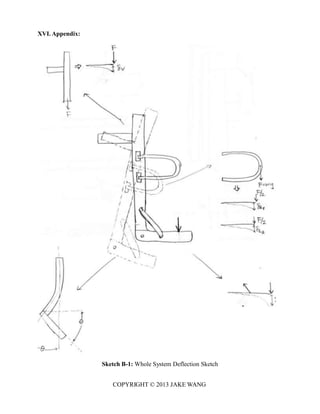
Sketch B-1: Whole System Deflection Sketch
COPYRIGHT © 2013 JAKE WANG
Sketch B-2: Whole System Damage Accumulation Assessment Sketch
COPYRIGHT © 2013 JAKE WANG

Bike Rack Design Project

  • 1.
    2013 The 4Racketeers DesignEngineers: Jake Wang, Daniel Tai, Augustus Bechtold, Josh Aguilar 6/6/2013 Bike Rack Design Project
  • 2.
    COPYRIGHT © 2013JAKE WANG Abstract: The purpose of this project is to present our strength, deflection, buckling, and fatigue analysis for our bike rack design. Based on our company’s prior experience, we are implementing constraints on our design with a maximum bicycle weight of 40 pounds, a maximum dynamic load, of 3G, a design safety factor of 2.0 for strength, a design safety factor of 3.0 for resistance to buckling, total system deflection less than 1 inch, limit wide of bike and rack to maximum of 4 feet, limit the maximum overhang of the rack behind the motorcycle to a maximum of 4.5 feet, lifetime of 10,000 trips with a design safety factor of 5. With these constraints, we are basically analyzing a total force of 240 pounds (F (total) =2 X 3 X 40=240 lb.).We decided to choose our favorite mechanical design supplier at www.metalsdepot.com/products, allowing us the flexibility to compare available carbon steel types and dimensions for our updated design analysis. The preliminary justifications for using carbon steel are because of its inexpensive price, high yield strength, and broad availability. With the completion of our design analyses, we can conclude that our initial justifications were correct and design parameters our purposed bike rack would meet our company’s requirements. Included is our table of design analysis and comparison, detailed design descriptions, detailed geometry of structural components with CAD drawings, and mechanical design calculations that justify our decision for the primary dimensions of our bike rack design. We have picked the BMW GS (see Image A-1) motorcycle model for modeling and idealization of our bike rack design. We will connect our bike rack to the luggage rack on the BMW GS. Our bicycle rack system consists of six sections: a vertical beam mainframe, a base receiver, a horizontal beam support, two link attachments, three strap-on mechanisms, and two loop-rod bicycle secure attachments, (see CAD Drawing 1 and 2). The finalized overall geometric size for our bike rack system is the same as our primary chosen dimensions, 80 inches long and 41.40 inches wide, but it only overhangs behind the motorcycle for about 16 inches. The estimated total weight of our design is about 86.68 pounds (although the weight for the bike rake seems heavier than the estimated bike weight, it is sturdy and has a very long lifetime, the estimated total production cost per unit of this bike rack is $216.50 ($80 cheaper compared to the only vendor, 2X2 Bicycle Rack (see Image 2A) that is commercializing the product for about $298 plus shipping and handling), the estimated total deflection is 0.006 inch, the estimated lifetime over 10 times more than the required 10,000 trips (Table XI-5). Our design analyses allow us to finalize a new dimension that optimize the strength and reduce in weight of our bike rack. Our candidate design meets our expectation within the constraints provided. We met our strength target, with all our Von Mises stress analyses to be less than the carbon steel’s yield strength. Our selection of material and chosen dimensioned looks ideal at this phase of the project. However further detailed analysis with fatigue performance would be required to create an optimal bicycle rack. Not only to satisfy the customer but to maintain a high quality and safety standard. We look forward to make a functional, sturdy, and inexpensive prototype for your company.
  • 3.
    COPYRIGHT © 2013JAKE WANG Design Engineers Background and Contributions: We are the University of California at Davis, Mechanical Engineers. We are proud to present our bike rack design to Rack-It Ralph Engineering. Engineer Jake Wang helped organize the team, put together required paperwork, distributed the weekly work, and maintained a high quality analysis and material as a group. Jake helped divide the project up equally among the other three team members and equal work contributions have been present. Jake was in charge of all the analyses, material gathering, detailed design descriptions of the vertical beam mainframe. Fellow engineer Daniel Tai was assigned all the analyses, material gathering, and detailed design descriptions of the loop-rod support system. Fellow engineer Augustus Bechtold was assigned all the analyses, material gathering, and detailed design descriptions of the horizontal beam. Fellow engineer Josh Aguilar was assigned all the analyses, material gathering, and detailed design descriptions of the base receiver. We are all very happy to work together and making great contribution to our project. GO The4Racketeer! Below is an abridged version of the actual report. It exemplifies the work from Jake Wang.
  • 4.
    COPYRIGHT © 2013JAKE WANG Table of Contents: I. Overview of Design Description: II. Visual Presentation: 1)Image XI-1. Motorcycle BWM GX Motorcycle 2) Image XI-2. Motorcyle with Bike Rack 3)CAD Drawing XI-1. Assembly CAD Drawing 4)Figure XI-2. Exploded View CAD Drawing 5) Table XI-5-10. List of Final Dimensions/Weight/Cost III: General Assumptions: IV: Overview of the Design: V: Detail Analysis of the Design: Vertical Beam Mainframe Detailed Analysis 1) Detailed Description for Design Parts 2) Table A1-2: Material Properties for Design Parts 3) Analyses Formulas i) Strength Analysis ii) Deflection Analysis iii) Buckling Analysis iv) Fatigue Analysis 4) Detailed Analysis Comparison i) Table A-: Strength Analysis ii) Table A-: Deflection Analysis iii) Table A-Buckling Analysis iv) Table A-Fatigue Analysis VI. Recommendations: VII. Appendices: 1) Whole System Deflection Sketch 2) Whole System Damage Accumulation Sketch 3) Shigley’s Material PropertyTable 4) A500 Steel Mechanical Property Data 5) Bolt Grades Table 6) References
  • 5.
    Image XI-1: BMWGS Motorcycle Model Rear Side with Luggage Racks COPYRIGHT © 2013 JAKE WANG
  • 6.
    Image XI-2: BMWGS Motorcycle Model Rear Side with Bike Rack COPYRIGHT © 2013 JAKE WANG
  • 7.
    CAD Drawing XI-1:Assembly CAD Drawing with Dimensions COPYRIGHT © 2013 JAKE WANG
  • 8.
    CAD Drawing XI-2:Exploded View CAD Drawing COPYRIGHT © 2013 JAKE WANG
  • 9.
    CAD Drawing XI-3:Vertical Beam Components with Final Dimensions COPYRIGHT © 2013 JAKE WANG
  • 10.
    COPYRIGHT © 2013JAKE WANG Table XI-1: Vertical Beam Mainframe Final Dimensions/Weight/Cost Vertical Beam: Design Parameters Material: A36 Sets H [inches] W [inches] L [inches] t [inches] 3 3 1 1/2 80 1/4 Welded Square Tube: Design Parameters Material: A513 Sets H [inches] W [inches] L [inches] t [inches] 3 1 1/2 1 1/2 10 3/4 Subtotal Weight [lbs.] 49.25 Subtotal Cost [$] 118.88 Subtotal Deflections [in] 0.018472
  • 11.
    COPYRIGHT © 2013JAKE WANG XII: General Assumptions: There are several assumptions we made to help us analyze our bike rack. For the vertical beam frame, we assumed the welded square tube connection to the vertical C-Channel to act like a cantilever at a fix wall. This simplifies our analysis so we do not have to analyze the additional stress created from the welding. We used Von Mises Stress Theory to analyze our strength analysis. Because Von Mises Stress Theory is considered as the more accurate theory compared to the more conservative Maximum Shear Stress Theory. But, we understand it is not necessarily the case for all the time. We used this assumption for quicker analysis of our strength of the materials. We have simplified our moment and shear calculations based just on the weight of the bike itself. We did not the weight of the bike rack into our calculations. This helps us save time to work on other analysis. Primary we chose to use carbon steel as our material choice, because it is fairly inexpensive and easily to obtained. However, when we start our fatigue analysis, the S-N curve for A500, A36, and etc., were not available from our vendor. We resort to using the 1045 steel S- N curve with a home-made scale up and scale down factor. Since the Su and Sy of 1045 steel is twice of that of our steel material. We will multiple our stress amplitude by 2, and then plug into the power log formula to obtain the life cycle. At the end we will divide our interpolated life cycle by 10E11 to get our theoretical life cycle for our steel material.
  • 12.
    COPYRIGHT © 2013JAKE WANG XIII: Initial Research and Designs: The two main bicycle rack products for cars are two pillars, with strap-on, and one main pillar will an L-beam attached (see Image 1A). They generally cost around $55 for the lower end products and up to $278 for the higher end ones. There are also bicycle racks on the roof top of the car, but we would not have that luxury with the motorcycle (see Image 1B). We found only one company called 2X2 Bicycle Rack (see Image 2A) that is commercializing the product for about $298 plus shipping and handling. 2X2 Bicycle Rack has a flat steel panel and steel parts for attaching to the backseat of the motorcycle. However, most bicycle rack on the internet, are home-made by bicycle enthusiast (see Image 2B) with duck tapes and wood strapped around the backseat. Some better home-made one have an original motorcycle backseat metal frame extension, so enthusiast can attach metal rods at the extension with nuts and bolts and attach the bicycle to the metal rods with nylon bicycle strap (see Image 2C). So far, most of the designs for bicycle rack for motorcycle have the bicycle wheels at least one or both wheels removed to avoid spinning of the wheels while cruising. The bicycle is positioned facing forward on the backseat. Here are some preliminary designs for our client. First, there is the Fork Design, with two rods forked at one end and one adjoining rod at the other end. It will attach to the motorcycle frame with a clamp. And it will hold on to the middle rod of the bicycle, with bicycle in a vertical position, front end facing the sky and bottom end facing the ground (see Sketch 1A). With this design, the ideal way to have the bicycle attached is to remove both bicycle wheels. Although there might be issue with the bending moment induced by the weight of the bicycle, this is the simplest design with minimal material. But we will further modify this design to reduce bending moment if this is the best design for most motorcycles. The second design is the Side Cradle Design with a cradle attached to only one side of the motorcycle (see Sketch 2A). This is an adaptation from a bicycle rack for cars (see Image 3A). This also allows the users to remove only one or none of their bicycle wheels, because the cradle with its L-shaped tire contraption would fully secured the wheels in place. The bicycle would be in a vertical position with front facing the sky. There might be stability question we need to focus on because the cradle is only on one side of the motorcycle. And also we need to focus on what material to be used and what size for the rod bridging between the bicycle and the motorcycle. This rod will definitely experience great bending stress and possible axial stress. The third design is The Claw Design (see Sketch 3A) inspired by the aluminum box frame extension for the backseat of a motorcycle (see Image 4A). By adding a center claw to hold the bicycle fork frame, and one longer and one shorter outer claws to secure the main rod and the front rod. This design would provide great stability and durability of the bicycle rack. However, this design would require more material parts and maybe more tooling time. So this would be a more costly design, unless we find cheaper material with high yielding stress. We would be using theory for bending of a curved beam for the two outer claws for determining the maximum stress it can handle.
  • 13.
    COPYRIGHT © 2013JAKE WANG The bicycle rack idea for motorcycle seems to be interesting with many potential possibilities. Although we might need some more information regarding the type of motorcycle we are targeting and the type of bicycle we are handling. And also we may need the budget for this project and the desired lifetime of the product. We look forward to working on the next phase of the project.
  • 14.
    Image References: Image 1A:Sample Bicycle Racks for Car Image 1B: Roof Bicycle Racks for Car Image 2A: 2x2 Bicycle Rack for Motorcycle COPYRIGHT © 2013 JAKE WANG
  • 15.
    Image 2B: Home-madeBicycle Rack for Motorcycle’ Image 2C: Home-made Bicycle Rack for Motorcycle Sketch 1A: Preliminary Fork Design COPYRIGHT © 2013 JAKE WANG
  • 16.
    Sketch 2A: PreliminarySide Cradle Design Image 3A: Bicycle Cradle Rack for Cars Sketch 3A: Preliminary The Claw Design COPYRIGHT © 2013 JAKE WANG
  • 17.
    Image 4A: MotorcycleBackseat Extension COPYRIGHT © 2013 JAKE WANG
  • 18.
    COPYRIGHT © 2013JAKE WANG XIII: Overview of Design: We have picked the BMW GS (see Image A1) motorcycle model for modeling and idealization of our candidate design. In response to the proposed requirements for our design, our overall design measurements did not exceeds 4 feet in width of the bicycle and rack as mounted on the motorcycle, and 4.5 feet in overhang of the rack behind the motorcycle. The following is our detailed descriptions of our candidate design and our explanations on how our candidate design works. Our bicycle rack system consists of six sections, a base receiver, a vertical beam mainframe, a horizontal beam support, two link attachments, three strap-on mechanisms, and two loop-rod bicycle secure attachments, (see Sketch A1). We designed a vertical beam mainframe section is the section where the rack will hold the bicycle still while cruising on the motorcycle (see Sketch A-2). This section consists of a C- section beam, welded solid beam insert, two holes for the hollow square receiver, four holes for the strap-on attachment, four holes for the loop-rod attachment, four holes for the two link attachments, two holes L-rod connection between the vertical beam and the horizontal beam. The welded solid beam insert connects to the hollow square receiver. This allows bicycler to detach or attach the rack from the motorcycle easily with a lock mechanism consists of a L-rod and a R- ring. The C-section beam provides enough space to situate the two bicycle tires. However the main function of this section is only to cradle the bicycle and provide support for the horizontal beam, but not to carry the weight of the bicycle. Most of the weight will be acting like a point force on the vertical beam, which will be discussed in the later section of the memo. We designed a base receiver section that is attached to the motorcycle, to make the connection between the motorcycle and our main rack (see Sketch A-1: Base Receiver Assembly section). It has one metal plate with a hollow square receiver welded to the top side, two rods, six bolts, six washers, one L rod, and one R ring. It is a 1'x2' plate of 1/4" thin metal with an 18" long, 1-3/4" hollow square receiver with 1/16" thickness metal welded to the top side. To secure the metal plate to the luggage rack of the motorcycle, we bolt the plate to two rods below the luggage rack. The base receiver is connected to the bicycle rack mainframe through the welded solid beam extruding out from the vertical C-section beam. We used a 1-1/2” square tube on the rack such that it can slide into the larger receiver on the base. The hollow square receiver on the rack will be made of 1/16” steel and extended from the rack 10”. 7-1/2” from the bicycle rack is a 7/16” hole on both vertical faces at the midpoint. There will be a matching hole, 2-1/2” from the end of the receiver. The fit of the rack and receiver are dimensioned as a line fit, this cannot be if the rack is to be easily removable. When the rack is inserted in the receiver, the holes will line up. An L-rod will be inserted all the way through the receiver and rack, holding the holes aligned. An R-ring will clip on the L-rod to ensure that it does not fall out of place. The utility of this design is that by removing the L-rod, the rack can be quickly slid out of the receiver and off the motorcycle. The major stresses to be considered on this section are bending and torsion.
  • 19.
    COPYRIGHT © 2013JAKE WANG We designed a horizontal beam support section to provide the attachment for the rear wheel to the rack and support a large portion of the bicycle’s load (see Sketch B1 and B2). The C-section beam is wide enough to accommodate cruiser and mountain bicycle tires comfortably and has 1/4 inch thick walls on either side of the tire for increased stability. One strap-on mechanism is used to secure the wheel against the rack and is translatable over a 3 inch span to accommodate 26 inch diameter wheels as well as 29 inch diameter wheels. The horizontal C- section beam is wide enough that the vertical C-section beam will fit inside it and the two will be connected together with a L-rod and R-ring lock system through the holes near the solid end. Since the rear tire is resting against the horizontal C-section beam and the bicycle is positioned vertically on the rack, the horizontal C-section beam will be supporting the majority of the bicycle’s weight. This will create a bending moment in the horizontal C- section beam (see Sketch C-1), but with given the maximum load of sixty-five pounds and the yield strength of aluminum alloy of around 68.9 giga Pascal, this section will not yield at this stage of analysis. The end of the horizontal C-section beam farthest from the vertical C-section beam is left open to allow the bicycle tire to extend slightly beyond the rack. For additional support of the vertical C-section beam, we designed a two base link section (see Sketch D-1). The base links will hold the horizontal and vertical rack beams, the pin attachments for the base links have not yet been designed but based on max shear stress, any common pin link should be sufficient since the necessary cross-section area is extremely small. The idea is that the base link will be movable if the user wishes to fold up the rack, but rigid when holding a bicycle. We designed two strap-on mechanisms and two loop-rod bicycle secure attachments to attach and remove the bicycle wheels from our rack (see Sketch E1, E2, and E3). We have two strap-on mechanisms for the front and rear bicycle wheel located on the vertical beam support. Because the strap only binds the front wheel to the frame at one point of contact, additional supports must be added to prevent the bicycle from twisting around the frame. So we designed a two loop-rod section that will secure the bicycle frame in place, and to prevent scenarios like motorcycle making a sharp turn. The greatest forces that the strap would need to counter would be from the forward acceleration of the motorcycle (the bicycle rack frame itself would handle the load caused by deceleration of the motorcycle). This makes it relatively easy to design the strap since the weight of the bicycle is so small.
  • 20.
    A-3): Detailed Descriptionfor Design Parts The vertical beam mainframe section is the section where the rack will hold the bicycle. This section consists of a C-section beam, welded square tube, two holes for the hollow square receiver, five holes for the loop-rod support secure attachment, two holes for the two link attachments, two holes L-rod connection between the vertical beam and the horizontal beam, and two hole in place for securing the horizontal beam to the fold up vertical beam when not in use of the bike rack. The welded solid beam insert connects to the hollow square receiver. This allows biker to detach the rack from the motorcycle easily. The C-section beam provides enough space to situate the bike tire. However the main function of this section is only to cradle the bike and hold on to the vertical beam, but not to carry the weight of the bicycle. Most of the weight will be like a point force on the horizontal beam. The critical section for the vertical beam mainframe is at the connection where the welded square tube and the vertical C-section beam joins. There is a moment created by the point for on the vertical beam that translates to the connection. There is also a shear force created by the same point force as well. For the vertical beam mainframe, we have the welded square tube that is set at 10 inches long, but the cross section size are for analysis with the variation of heights and width from ¼ to ½ and variation of thickness from 3 to 3 . The two materials COPYRIGHT © 2013 JAKE WANG 16 4 selected for comparison for the welded square tube are A500 and A513 steel. As explained previously, some important reason for choosing these two materials to compare with is because they are readily available for purchase from our preferred supplier and they are relatively inexpensive. We have created our analysis with excel tables – see Table A-1 to A-10, for easy comparison. Although all our Sets and material options are well under the yield strength along with safety factory of 2, the following explain more detail of the best options from the comparison. The combination of Set 3’s dimensions and A500 steel provided the least tensile and compressive stresses. However, since we need to choose one material, we decided to choose A500 because the deflection difference compared to A513 is only 0.00597 inch, which is well under 1 inch when we combined with the deflections from other design components. The combination of Set 3’s dimensions and A513 steel provided the least deflections. There is no buckling for the vertical beam mainframe because there is no design member in compression. We also included a bolt analysis, comparing three different grades of carbon steel bolt in our design. There are Grade 2, Grade 5, and Grade 8 that represent increasing yield strength, ultimate strength and proof load. Our analysis on Table A-2 shows that we have 3 sets of dimensions cross compared with the 3 types of grades of the bolt. The result is that all the bolt are well under the ultimate strength and all the different bolt grades have similar Von Mises stress. We selected grade 8 for its highest ultimate strength at 150 ksi to provide us a greater safety factor value.
  • 21.
    COPYRIGHT © 2013JAKE WANG With the three different sets of dimensions and material, we created a weight analysis. We are comparing A36 C-Channel for the C-Section beam, and the A500 and A513 for the material. The bolts weight about the same among the different grades, so they have been assigned with the same weight. The best total weight for the vertical beam of the mainframe is estimated at 36 lbs and using A-36 C-Channel and A513 steel square tube. The material cost from this weight analysis is $49.58 and the labor cost is $69.30 (see Table A-11), with the total production cost for this vertical mainframe looking at roughly $118.88. The final analysis is the fatigue analysis. It analysis how many life cycles does our product last. By calculating the maximum stress at the critical section and customize for different loading maneuvers. Some maneuvers are loading the bike, starting the motorcycle, riding through bumps, stopping the motorcycle, and unload the bike. We can create a sequence of loading and plot a graph (see Figure A-1) showing different types of cycles. By observing the graph we can define our maximum strength, Smax and minimum strength, Smin to find our stress amplitude, Sa, effective stress amplitude Sa,eff, using Goodman formula, fatigue life of each type of cycles, Nif, number of cycles, Ni, damage value, D, and life cycle, N. Our design requirement desired a product that last 10,000 trips with a Safety Factor of 5. From our fatigue analysis on Table A-12, we retrieve a design life at 2.4E+6, which is great than the provided design requirement. The vertical beam frame has satisfied all the design criteria for strength, deflection, buckling, and fatigue analysis. Although the individual cost and weight are slightly high, our product will be durable and strong that last for many years to come. The final dimensions of vertical beam A36 steel C-Channel at 3 inches by 1 ½ inches by 80 inches with ¼ inches of thickness. The final dimensions of the welded A513 square tube is at 1 ½ inches by 1 ½ inches by 10 inches with a thickness of ¾ inches.
  • 22.
    3)Table A1-2: MaterialProperties for Design Parts Table A-1: Material Properties for our Steel Square Tubing Table A-2: Material Properties for our Bolt Options Table A-3:SAE1045 Steel Fatigue S-N Curve COPYRIGHT © 2013 JAKE WANG Major Design Component Steel Tubing Material/Grade ASTM A500 Steel* ASTM A513 Steel* Density (p) 0.284 [lbf/in^3] Elastic Modulus (E) 20300 [kpsi] 30000 [kpsi]* Poisson's ratio (v) 0.292 Yield Strength (Sy) 45700 [psi] 72000 [psi] Ultimate Strength (Su) 58000 [psi] 87000 [psi] * Assume 30000. No data found. Bolt Component Material/Grade Low Carbon Bolt ** Grade 2 5 8 Yield Strength (Sy) 57000 [psi] 92000 [psi] 130000 [psi] Ultimate Strength (Su) 74000 [psi] 120000[psi] 150000[psi] Proof Load 55000 [psi] 85000 [psi] 120000[psi] (low carbon steel)
  • 23.
    A-4)Analyses Formulas i) StrengthAnalysis Axial Stress: 𝑃𝑃 𝑆𝑆𝑦𝑦 𝐴𝐴 𝑛𝑛 = 𝐴𝐴= 𝜋𝜋(𝑟𝑟)2 4 Bending Compressive Stress: 𝑀𝑀𝑀𝑀 𝑆𝑆𝑦𝑦 𝐼𝐼 𝑛𝑛 = 𝐼𝐼𝑦𝑦= 𝐼𝐼𝑦𝑦− 𝐼𝐼𝑦𝑦= 12 − 12 =𝑂𝑂 𝐼𝐼 𝑏𝑏𝑂𝑂 𝑏𝑏𝐼𝐼 4 4 𝑏𝑏𝑂𝑂− 𝑏𝑏𝐼𝐼 4 4 12 𝜎𝜎𝐵𝐵𝐵𝐵𝐵𝐵𝐵𝐵𝐵𝐵𝐵𝐵𝐵𝐵= 𝜎𝜎𝑉𝑉𝑉𝑉𝐵𝐵 𝑀𝑀𝐵𝐵𝑀𝑀𝐵𝐵𝑀𝑀= 𝑛𝑛𝑀𝑀𝑀𝑀 𝐼𝐼 < 𝑆𝑆𝑦𝑦 Bending Tensile Stress: 𝑀𝑀𝑀𝑀 𝐼𝐼 𝑛𝑛 = 𝑆𝑆𝑦𝑦 𝐼𝐼𝑦𝑦= 𝐼𝐼𝑦𝑦− 𝐼𝐼𝑦𝑦= 12 − 12 =𝑂𝑂 𝐼𝐼 𝑏𝑏𝑂𝑂 𝑏𝑏𝐼𝐼 4 4 𝑏𝑏𝑂𝑂− 𝑏𝑏𝐼𝐼 4 4 12 𝜎𝜎𝐵𝐵𝐵𝐵𝐵𝐵𝐵𝐵𝐵𝐵𝐵𝐵𝐵𝐵= 𝜎𝜎𝑉𝑉𝑉𝑉𝐵𝐵 𝑀𝑀𝐵𝐵𝑀𝑀𝐵𝐵𝑀𝑀= 𝑛𝑛𝑀𝑀𝑀𝑀 𝐼𝐼 < 𝑆𝑆𝑦𝑦 COPYRIGHT © 2013 JAKE WANG Von Mises Stress Criteria Analysis: 𝜎𝜎𝐴𝐴𝐴𝐴𝐵𝐵𝐴𝐴𝐴𝐴 = 𝜎𝜎𝑉𝑉𝑉𝑉𝐵𝐵 𝑀𝑀𝐵𝐵𝑀𝑀𝐵𝐵𝑀𝑀< 𝑆𝑆𝑦𝑦
  • 24.
  • 25.
    ii) Deflection Analysis Deflectionformula for Cantilever Beam: 𝛿𝛿(𝑃𝑃𝑃𝑃𝑃𝑃𝑛𝑛𝑃𝑃𝐹𝐹𝑃𝑃𝑟𝑟𝑀𝑀𝐹𝐹𝐷𝐷𝐹𝐹𝐷𝐷𝐷𝐷𝐹𝐹𝑀𝑀𝑃𝑃𝑃𝑃𝑃𝑃𝑛𝑛) = 𝐹𝐹𝐿𝐿3 3𝐸𝐸𝐼𝐼 𝛿𝛿(𝑀𝑀𝑃𝑃𝑀𝑀𝐹𝐹𝑛𝑛𝑃𝑃𝐷𝐷𝐹𝐹𝐷𝐷𝐷𝐷𝐹𝐹𝑀𝑀𝑃𝑃𝑃𝑃𝑃𝑃𝑛𝑛) = 𝑀𝑀𝐿𝐿2 2𝐸𝐸𝐼𝐼 𝜃𝜃= 𝑀𝑀𝐿𝐿 𝐸𝐸𝐼𝐼 𝛿𝛿(𝐷𝐷𝐹𝐹𝐷𝐷𝐷𝐷𝐹𝐹𝑀𝑀𝑃𝑃𝑃𝑃𝑃𝑃𝑛𝑛𝑣𝑣𝑃𝑃𝑣𝑣𝐴𝐴𝑛𝑛𝐴𝐴𝐷𝐷𝐹𝐹𝑃𝑃𝐷𝐷𝑅𝑅𝑃𝑃𝑃𝑃𝑣𝑣𝑃𝑃𝑃𝑃𝑃𝑃𝑛𝑛) = sin(𝜃𝜃) ∗ 𝐿𝐿= 𝜃𝜃∗ 𝐿𝐿 Deflection formula for Axial Load 𝛿𝛿(𝐴𝐴𝐴𝐴𝑃𝑃𝑣𝑣𝐷𝐷𝐷𝐷𝐹𝐹𝐷𝐷𝐷𝐷𝐹𝐹𝑀𝑀𝑃𝑃𝑃𝑃𝑃𝑃𝑛𝑛) = 𝑃𝑃𝑃𝑃 𝐸𝐸𝐴𝐴 Figure 2: Vertical Beam Deflection Analysis COPYRIGHT © 2013 JAKE WANG
  • 26.
    COPYRIGHT © 2013JAKE WANG iii) Buckling Analysis There is no buckling for the vertical beam mainframe because there is no design member in compression. iv) Fatigue Analysis Loading Maneuvers Calculations: First establish local reference. Pointing down as positive Y and pointing to the right is positive X. For the center of the mass, our Fy will be located on the horizontal beam, 16 inch away from the vertical beam and our Fx will be position at half the length of vertical beam, which is 40 in. Using above information you can calculate moment. For vertical beam, on the rack, my Fy is 80lb, my Fx is 0lb see my excel analysis attached. For start my Fy is still 80lb, my Fx is 40lb to the right. (Fx=80*0.5G) where 0.5 G is our criteria of load for starting. (with 5 pulses of the 0.5, which means there will be 5 times of this type of cycle and at the end we multiple by 10 because there are 10 starts in our mission) For bumps you multiple by 3G along the vertical force. For stops, the negative Fx force will provide the stronger counter moment, creating a negative final moment. Reordering for the sequence is the hardest. So basically, the largest peak is the first in the reordering sequence, followed by the sequence coming afterwards. For example, Bump 1 has the highest value, then we continue the sequence with On rack, Bump 2, On rack, Stop, On rack, Unload, then back to the beginning, omitting the 0, with On rack, Start, On rack, and end with Bump 1.Use this power log formula, Sa=152(N)^-0.065, to calculate your Sa. To calculate Sa,eff with Goodman, use Sa,eff=(Sa)*(Su/Su-Sm). So, on the Material section, we put down 152 for A, and -0.065 for b. Basically at the end you can categorize 4 types of cycle. Type A for Max to min, type B for Rack to Bump, type C Rack to Stop, and type D Rack to Start. Now, you just have to find the Smax and Smin by looking at your graph, and input the value in the Damage accumulation table. The table will automatically calculate the life cycle for you. Then you have to divide this life cycle by 5, because this is the safety factor assigned to us with regard to fatigue life. If at the end it is greater than 10,000 cycles or trips, then your part will meet the mission criteria.
  • 27.
    COPYRIGHT © 2013JAKE WANG A.5) Detailed Analysis Comparison i) Table A-: Strength Analysis Table A-3: Complete Table of Available Dimensions Welded Square Tube Analysis Welded Square Tube: Design Parameters Dimensions Sets H [inches] W [inches] L [inches] t [inches] 1 1 1/4 1 1/4 10 3/16 2 1 1/2 1 1/2 10 1/4 3 1 1/2 1 1/2 10 3/4 Parts Design Parameters Area Calculations Sets A [inches^2] 1 2/3 2 1 1/4 3 2 1/4 Parts Design Parameters Moment of Inertia Calculations Sets I [inches^4] 1 1/6 2 1/3 3 3/7 Parts Design Parameters Distance from the edge to Bolt (e) Sets e [inches] 1 1 1 1 1/2 1 2 2 1 2 1 1/2 2 2 3 1 3 1 1/2 3 2
  • 28.
    COPYRIGHT © 2013JAKE WANG ii) Table A-: Deflection Analysis Parts Material Strength Set A500 Von Mises <Sy A513 Von Mises <Sy Best Set Ranking Tensile Stress [psi] 1 16493 14400 Yes 3709 3138 Yes 3 24/25 1/11 6/13 2 9038 7253 Yes 2448 1360 Yes 2 10/13 1/3 3 7253 7253 Yes 1360 1360 Yes 1 1/3 1/3 Compressive Stress 1 -16493 - Yes -3138 -3138 Yes 3 [psi] 24/25 14400 6/13 6/13 (Note: A500: 2 -9038 -7253 Yes -1360 -1360 Yes 2 Sy=45700 [psi]) 10/13 1/3 (Note: A513: 3 -7253 -7253 Yes -1360 -1360 Yes 1 Sy=72000 [psi]) 1/3 1/3 Best Material Ranking 1 2 Parts Material Deflections Set A500 A513 Vertical Deflection [in.] 1 19/400 9/280 (Note: E=20300 [kpsi]) 1 21/131 32/295 1 19/50 9/35 2 19/800 9/560 2 21/262 16/295 2 19/100 9/70 3 15/812 1/80 3 25/401 17/403 3 103/697 1/10 Deflections for design part [in.] 1 19/400 9/280 2 19/800 9/560 3 15/812 1/80 Deflection Difference Min Deflections for design part [in.] Set 3 15/812 1/80 2/335
  • 29.
    COPYRIGHT © 2013JAKE WANG iii) Table A-Buckling Analysis iv) Table A-Fatigue Analysis Table A-F1.Fatigue Analysis Parts Material Buckling Set A500 <Sy [Yes/No] A513 <Sy [Yes/No] Tensile Stress [psi] 1 0 0 0 0 2 0 0 0 0 3 0 0 0 0 Compressive Stress [psi] 1 0 0 0 0 2 0 0 0 0 3 0 0 0 0 (Comments: Due to no compressive force acting on the vertical beam, the beam would not buckle.) Vertical Beam Welded Tube Fatigue Analysis: GEOMETRY MATERIAL A1045 Steel D 0.85 inch Sy 105 ksi Su 84 ksi I 0.3385 inch^4 A 152 ksi, (for fully reversed loading) A N/A inch^2 b -0.065 c 0.7500 inch Kt, notch 1.0000 (unnotched) LOADING Maneuver Fx [lbs] Fy [lbs] P [lbs] V [lbs] M [lb*in] Stress @ Welded Tube (Mc/I) [ksi] Load Bike 0 0 0 0 0 0.00 On rack 0 80 0 80 1360 3.01 Start 40 80 40 80 2960 6.56 Bump 0 240 0 240 4080 9.04 Stop -60 80 -60 80 -1040 -2.30 On rack 0 80 0 80 1360 3.01 Unload Bike 0 0 0 0 0 0
  • 30.
    Table A-F2.Fatigue AnalysisSequence 10 8 6 4 2 0 -2 -4 Figure A-5: Sequence Stresses Graph Figure A-6: Re-order Sequence Stresses Graph COPYRIGHT © 2013 JAKE WANG SEQUENCE Zero On rack Start On rack Bump 1 On rack Bump 2 On rack Stop On rack Unload Bike 0.00 3.01 6.56 3.01 9.04 3.01 9.04 3.01 -2.30 3.01 0.00 REORDER (largest peak or valley first) 9.04 3.01 9.04 3.01 -2.30 3.01 0.00 3.01 6.56 3.01 9.04
  • 31.
    COPYRIGHT © 2013JAKE WANG Table A-F3.Fatigue Analysis: Damage Accumulation FATIGUE ANALYSIS - Damage accumulation Cycles Label S max S min S a (actual) Sa ( scaled up by 2) S m (actual) Sm ( scaled up by 2) Max to Min A 9.04 0.00 4.52 9.04 4.52 9.04 Rack to Bump B 9.04 3.01 3.01 6.03 6.03 12.05 Rack to Stop C 3.01 0.00 1.51 3.01 1.51 3.01 Rack to Start D 6.56 3.01 1.77 3.54 4.79 9.57 includes notch factor kt =1 for our analysis Sa, notch Sm, notch S eff (scaled) Nfi (scaled) Nfi ( scaled down by 10E11) Ni D = Ni/Nfi 4.52 4.52 10.13 1.25E+18 1.25E+07 1 8.00E-08 3.01 6.03 7.04 3.40E+20 3.40E+09 10 2.94E-09 1.51 1.51 3.13 8.99E+25 8.99E+14 10 1.11E-14 1.77 4.79 4.00 2.01E+24 2.01E+13 50 2.48E-12 Total sum 8.30E-08 Life 1.2E+07 Safety Factor 5 Design Life 2.4E+06 Greater than 10,000 trips? YES
  • 32.
    COPYRIGHT © 2013JAKE WANG Table A-W1.Vertical Beam and Welded Tube Weight Analysis Table A-C1.Vertical Beam and Welded Tube Cost Analysis Components Weight Sets Vertical Beam [lb] Welded Tube [lb] Bolts [lb] Total Weight [lb] Selection Ranking 1 34 2 1/4 36 18/61 1 2 45 1/2 3 5/9 1/4 49 9/35 2 3 42 3/5 6 2/5 1/4 49 9/35 2 Vertical Beam and Welded Tube Cost Analysis Material: C Channel A-36 Steel Welded Tube A500 Steel Components Costs Sets Vertical Beam [$] Welded Tube [$] Bolts [$] Material Cost [$] Labor Cost [$] Total Cost [$] Selection Ranking 1 40.96 21.66 2 64.62 69.30 133.92 1 2 52.00 13.32 2 67.32 69.53 136.85 2 3 51.84 18.00 2 71.84 69.91 141.75 3 Vertical Beam and Welded Tube Cost Analysis Material: C Channel A-36 Steel Welded Tube A513 Steel Components Costs Sets Vertical Beam [$] Welded Tube [$] Bolts [$] Material Cost [$] Labor Cost [$] Total Cost [$] Selection Ranking 1 40.96 6.62 2 49.58 69.30 118.88 1 2 52.00 6.24 2 60.24 69.53 129.77 2 3 51.84 7.82 2 61.66 69.91 131.57 3
  • 33.
    COPYRIGHT © 2013JAKE WANG Table A-L: Vertical Beam and Welded Tube Labor Cost Analysis Vertical Beam and Welded Tube Labor Cost Analysis Material: C Channel A-36 Steel Welded Tube A500 or 513 Steel Sets 1 2 3 Processes Unit Cost [$] # of Units or Length [cm] Subtotal Cost [$] Unit Cost [$] # of Units or Length [cm] Subtotal Cost [$] Unit Cost [$] # of Units or Length [cm] Subtotal Cost [$] Vertical Tube Drilled $ 5 $ $ 5 $ $ 5 $ holes < 25.4 mm dia. 0.35 1.75 0.35 1.75 0.35 1.75 Saw or $ 40.54 $ $ 40.54 $ $ 40.54 $ tubing cuts 0.40 16.22 0.40 16.22 0.40 16.22 Welded Tube Tube end $ 1 $ $ 1 $ $ 1 $ preparation for welding 0.75 0.75 0.75 0.75 0.75 0.75 Weld $ 1.69 $ $ 3.18 $ $ 5.72 $ 0.15 0.25 0.15 0.48 0.15 0.86 Tube cut $ 35.56 $ $ 35.56 $ $ 35.56 $ 0.15 5.33 0.15 5.33 0.15 5.33 Assembly Assemble, $ 12 $ $ 12 $ $ 12 $ >20 kg, Line-on- Line 3.75 45.00 3.75 45.00 3.75 45.00 Total $ Total $ Total $ Labor Labor Labor Cost 69.30 Cost 69.53 Cost 69.91 Ranking (Least to Highest Price) 1 2 3
  • 34.
    COPYRIGHT © 2013JAKE WANG Recommendation: This is a great project that integrated lecture concepts into practical analysis. It allows us to make sense and utilize the formulas and sharpen analytical skills toward mechanical design. One of the recommendations for this project is that if time permitted, a welding analysis can be done where the welded square tube connects with the vertical C-Channel. We have read Shigley’s Mechanical Design textbook, and find out there is formula for simply weld on a cantilever beam. The weld analysis depends on the size of the weld throat and the distance between the welding. There is a formula for computing moment area of inertia and there are available tables regarding different type of welding material and welding patterns. We thought it was very interesting and would try this analytic method to analyze if we should have a smaller or bigger welded square tube or not. Because there are couple factors that might make welding a critical aspect of a design analysis such as tear of the weld due to due to bending or torsion. Another good addition to our bike rack is a protective coating cover, preferably with paint because we are using steel as working material (it become corrosive when wet or encounter with water vapor. This will make our product more versatile for consumer, enabling them to use our product in any weather conditions.
  • 35.
    XVI. Appendix: Sketch B-1:Whole System Deflection Sketch COPYRIGHT © 2013 JAKE WANG
  • 36.
    Sketch B-2: WholeSystem Damage Accumulation Assessment Sketch COPYRIGHT © 2013 JAKE WANG