Advanced Non-Relational Schemas
For Big Data
by Victor Smirnov
“Data dominates. If you've chosen the right data
structures and organized things well, the
algorithms will almost always be self-evident. Data
structures, not algorithms, are central to
programming. (See Brooks p.102).”- Rob Pike,
Notes on Programming in C, 1989
What If You Need...
Dynamic Vector
Searchable Bitmap
File System
Compact Inverted Index
Suffix Tree/Suffix Array
Version History
Name Your Specific Problem...
Non-Relational Schema
Is just a data structure
That uses some Memory Model
Typically, Key->Value mapping
Where Key is an Integer ID
And Value is an arbitrary array of a limited size or
memory block
It's assumed that operations on memory blocks
are atomic.
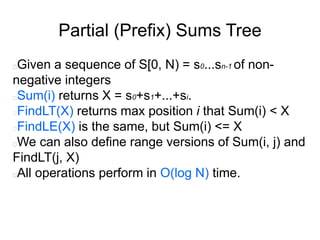
Partial (Prefix) Sums Tree
Given a sequence of S[0, N) = s0...sn-1 of non-
negative integers
Sum(i) returns X = s0+s1+...+si.
FindLT(X) returns max position i that Sum(i) < X
FindLE(X) is the same, but Sum(i) <= X
We can also define range versions of Sum(i, j) and
FindLT(j, X)
All operations perform in O(log N) time.
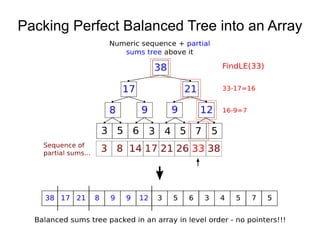
Packing Perfect Balanced Tree into an Array
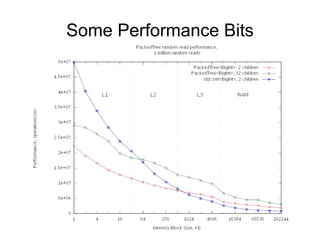
Some Performance Bits
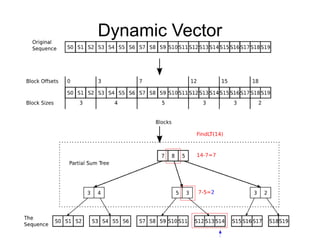
Dynamic Vector
An ordered sequence of elements (bytes,
integers, strings) of size N
Acess(i) is O(log N)
Insert(i, value) is O(log N)
Delete(i) is O(log N)
We can also define batch operations:
Insert(i, value[])
Delete(i, j)
Split(i); Merge(AnotherVector);...
Dynamic Vector
Dynamic Vector Operations
FindLT(i) returns the B where i bounds and offset
j in the block B for i
Acces(i) is O(log N)
Insert(i, value) and Delete(i) are also O(log N)
because the tree is balanced.
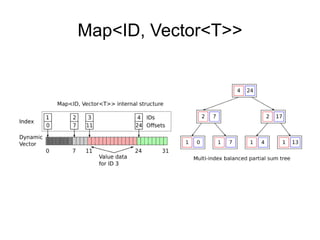
File System: Map<ID, Vector<T>>
Maps ID to Vector<T>
Merge all values into one large Dynamic Vector,
in ID order
Create separate “index” sequence from pairs <ID,
Offset> in ID order
We can represent this “index” sequence as two
partial sums tree, for ID and for Offset
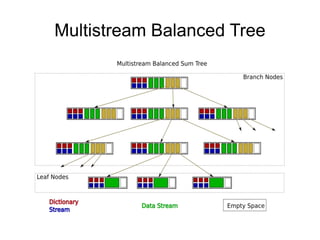
We can merge both these trees to one because
they have exactly the same structure: multi-index
balanced partial sums tree.
Map<ID, Vector<T>>
Sharing Tree Structures
Tree structure sharing saves both space and
time: SPMD principle (single program, multiple
data)
We can align partial sum trees with different
structures using interpolation (padding with
zeroes)
We can merge index and data streams (index
and data) of Map<ID, Vector<T>> in one multi-
stream tree.
Merging the trees, we will try to fit index pairs and
corresponding data into the same leaf node of
multi-stream tree.
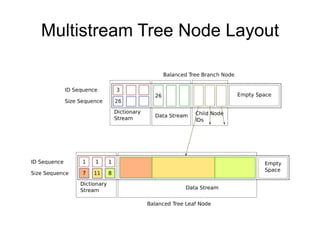
Multistream Tree Node Layout
Multistream Balanced Tree
ACID
Atomic block operations are not enough
Even simple tree update affects several blocks
So, ACID is mandatory for advanced non-
relational schemas
We can get ACID for free with Multi-Version
Concurrency Control (MVCC)
We need Version History over data blocks
Where each each transaction is a version.
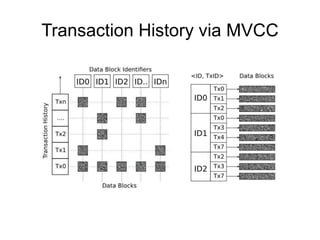
Transaction History via MVCC
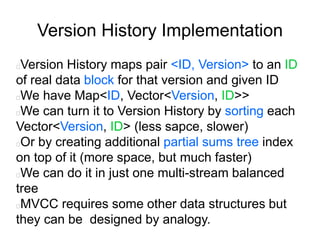
Version History Implementation
Version History maps pair <ID, Version> to an ID
of real data block for that version and given ID
We have Map<ID, Vector<Version, ID>>
We can turn it to Version History by sorting each
Vector<Version, ID> (less sapce, slower)
Or by creating additional partial sums tree index
on top of it (more space, but much faster)
We can do it in just one multi-stream balanced
tree
MVCC requires some other data structures but
they can be designed by analogy.
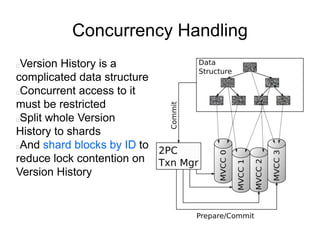
Concurrency Handling
Version History is a
complicated data structure
Concurrent access to it
must be restricted
Split whole Version
History to shards
And shard blocks by ID to
reduce lock contention on
Version History
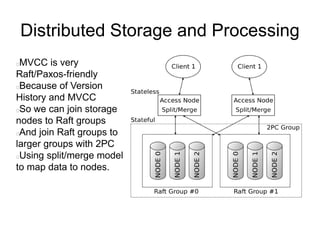
Distributed Storage and Processing
MVCC is very
Raft/Paxos-friendly
Because of Version
History and MVCC
So we can join storage
nodes to Raft groups
And join Raft groups to
larger groups with 2PC
Using split/merge model
to map data to nodes.
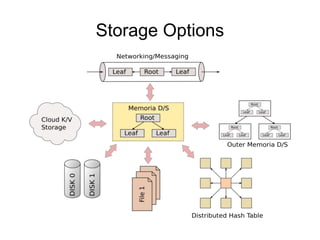
Storage Options
Bonus Slides
Searchable Bitmaps
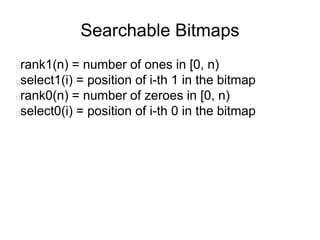
rank1(n) = number of ones in [0, n)
select1(i) = position of i-th 1 in the bitmap
rank0(n) = number of zeroes in [0, n)
select0(i) = position of i-th 0 in the bitmap
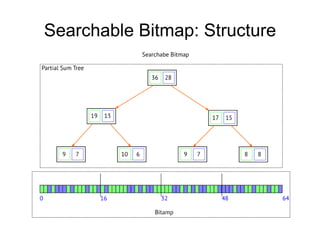
Searchable Bitmap: Structure
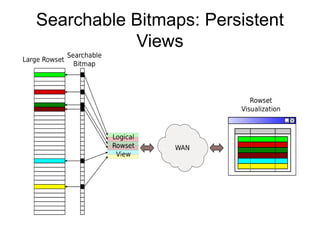
Searchable Bitmaps: Persistent
Views
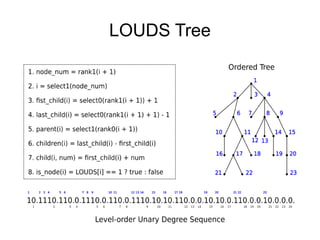
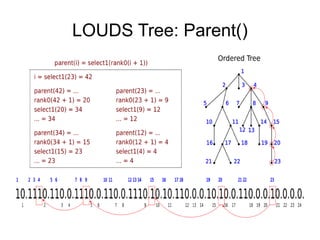
LOUDS Tree
LOUDS Tree: Parent()
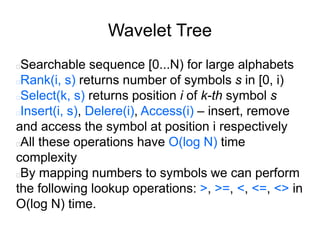
Wavelet Tree
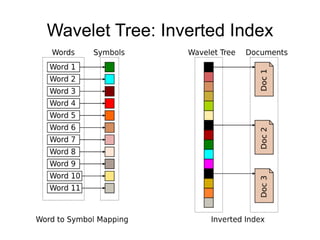
Searchable sequence [0...N) for large alphabets
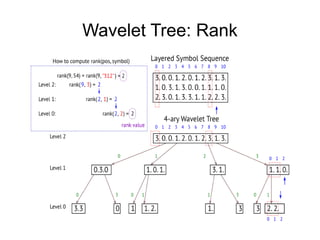
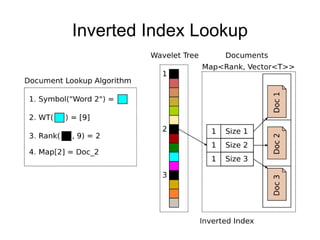
Rank(i, s) returns number of symbols s in [0, i)
Select(k, s) returns position i of k-th symbol s
Insert(i, s), Delere(i), Access(i) – insert, remove
and access the symbol at position i respectively
All these operations have O(log N) time
complexity
By mapping numbers to symbols we can perform
the following lookup operations: >, >=, <, <=, <> in
O(log N) time.
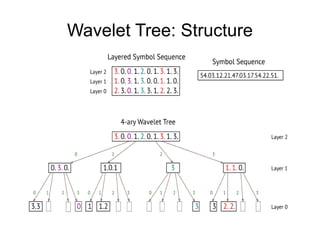
Wavelet Tree: Structure
Wavelet Tree: Rank
Wavelet Tree: Inverted Index
Inverted Index Lookup
Thanks!
More details are at:
http://bit.ly/1D4cj21

«Дизайн продвинутых нереляционных схем для Big Data»

  • 1.
    Advanced Non-Relational Schemas ForBig Data by Victor Smirnov
  • 2.
    “Data dominates. Ifyou've chosen the right data structures and organized things well, the algorithms will almost always be self-evident. Data structures, not algorithms, are central to programming. (See Brooks p.102).”- Rob Pike, Notes on Programming in C, 1989
  • 3.
    What If YouNeed... Dynamic Vector Searchable Bitmap File System Compact Inverted Index Suffix Tree/Suffix Array Version History Name Your Specific Problem...
  • 4.
    Non-Relational Schema Is justa data structure That uses some Memory Model Typically, Key->Value mapping Where Key is an Integer ID And Value is an arbitrary array of a limited size or memory block It's assumed that operations on memory blocks are atomic.
  • 5.
    Partial (Prefix) SumsTree Given a sequence of S[0, N) = s0...sn-1 of non- negative integers Sum(i) returns X = s0+s1+...+si. FindLT(X) returns max position i that Sum(i) < X FindLE(X) is the same, but Sum(i) <= X We can also define range versions of Sum(i, j) and FindLT(j, X) All operations perform in O(log N) time.
  • 6.
    Packing Perfect BalancedTree into an Array
  • 7.
  • 8.
    Dynamic Vector An orderedsequence of elements (bytes, integers, strings) of size N Acess(i) is O(log N) Insert(i, value) is O(log N) Delete(i) is O(log N) We can also define batch operations: Insert(i, value[]) Delete(i, j) Split(i); Merge(AnotherVector);...
  • 9.
  • 10.
    Dynamic Vector Operations FindLT(i)returns the B where i bounds and offset j in the block B for i Acces(i) is O(log N) Insert(i, value) and Delete(i) are also O(log N) because the tree is balanced.
  • 11.
    File System: Map<ID,Vector<T>> Maps ID to Vector<T> Merge all values into one large Dynamic Vector, in ID order Create separate “index” sequence from pairs <ID, Offset> in ID order We can represent this “index” sequence as two partial sums tree, for ID and for Offset We can merge both these trees to one because they have exactly the same structure: multi-index balanced partial sums tree.
  • 12.
  • 13.
    Sharing Tree Structures Treestructure sharing saves both space and time: SPMD principle (single program, multiple data) We can align partial sum trees with different structures using interpolation (padding with zeroes) We can merge index and data streams (index and data) of Map<ID, Vector<T>> in one multi- stream tree. Merging the trees, we will try to fit index pairs and corresponding data into the same leaf node of multi-stream tree.
  • 14.
  • 15.
  • 16.
    ACID Atomic block operationsare not enough Even simple tree update affects several blocks So, ACID is mandatory for advanced non- relational schemas We can get ACID for free with Multi-Version Concurrency Control (MVCC) We need Version History over data blocks Where each each transaction is a version.
  • 17.
  • 18.
    Version History Implementation VersionHistory maps pair <ID, Version> to an ID of real data block for that version and given ID We have Map<ID, Vector<Version, ID>> We can turn it to Version History by sorting each Vector<Version, ID> (less sapce, slower) Or by creating additional partial sums tree index on top of it (more space, but much faster) We can do it in just one multi-stream balanced tree MVCC requires some other data structures but they can be designed by analogy.
  • 19.
    Concurrency Handling Version Historyis a complicated data structure Concurrent access to it must be restricted Split whole Version History to shards And shard blocks by ID to reduce lock contention on Version History
  • 20.
    Distributed Storage andProcessing MVCC is very Raft/Paxos-friendly Because of Version History and MVCC So we can join storage nodes to Raft groups And join Raft groups to larger groups with 2PC Using split/merge model to map data to nodes.
  • 21.
  • 22.
  • 23.
    Searchable Bitmaps rank1(n) =number of ones in [0, n) select1(i) = position of i-th 1 in the bitmap rank0(n) = number of zeroes in [0, n) select0(i) = position of i-th 0 in the bitmap
  • 24.
  • 25.
  • 26.
  • 27.
  • 28.
    Wavelet Tree Searchable sequence[0...N) for large alphabets Rank(i, s) returns number of symbols s in [0, i) Select(k, s) returns position i of k-th symbol s Insert(i, s), Delere(i), Access(i) – insert, remove and access the symbol at position i respectively All these operations have O(log N) time complexity By mapping numbers to symbols we can perform the following lookup operations: >, >=, <, <=, <> in O(log N) time.
  • 29.
  • 30.
  • 31.
  • 32.
  • 33.
    Thanks! More details areat: http://bit.ly/1D4cj21