If you look up at the sky
at night, the heavens
appear to be unchanging.
In 1917 Einstein wrote
down the theory of
General Relativity. His
equations indicated that
the universe was
expanding and decelerating. He believed that the
universe was unchanging so he put in the
cosmological constant to fix his equations.
In 1929 Edwin Hubble found that galaxies are
flying away from us in every direction. The
farther they are, the faster they are receding. This
is evidence for the expansion of the universe.
The Big Bang
Scientists now believe that the universe began in a
tremendous release of energy known as the Big Bang.
The universe has been expanding ever since. Evidence
for this:
•Observation of galaxies flying away from us in
all directions (Hubble’s observations).
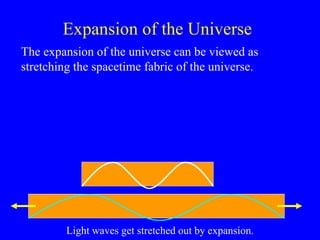
Expansion of the Universe
The expansion of the universe can be viewed as
stretching the spacetime fabric of the universe.
Light waves get stretched out by expansion.
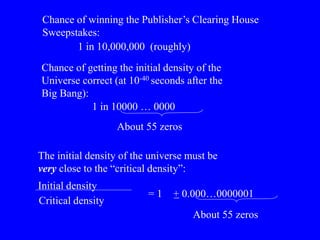
Chance of winning the Publisher’s Clearing House
Sweepstakes:
1 in 10,000,000 (roughly)
Chance of getting the initial density of the
Universe correct (at 10-40 seconds after the
Big Bang):
1 in 10000 … 0000
About 55 zeros
The initial density of the universe must be
very close to the “critical density”:
Initial density
Critical density
= 1 + 0.000…0000001
_
About 55 zeros
Origin of the Universe
Scientists believe that the universe began in a
tremendous release of energy known as the Big Bang.
The universe has been expanding ever since. Evidence
for this:
•Observation of galaxies flying away from us in
all directions.
•Remnant of the Big Bang known as the Cosmic
Microwave Background Radiation.
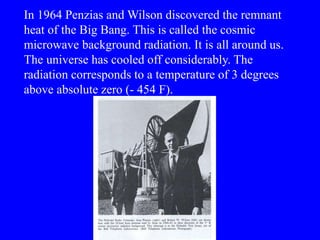
In 1964 Penzias and Wilson discovered the remnant
heat of the Big Bang. This is called the cosmic
microwave background radiation. It is all around us.
The universe has cooled off considerably. The
radiation corresponds to a temperature of 3 degrees
above absolute zero (- 454 F).
Origin of the Universe
Scientists believe that the universe began in a
tremendous release of energy known as the Big Bang.
The universe has been expanding ever since. Evidence
for this:
•Observation of galaxies flying away from us in
all directions.
•Remnant of the Big Bang known as the Cosmic
Microwave Background Radiation.
•Observed abundance of light elements made in
the Big Bang matches predictions.
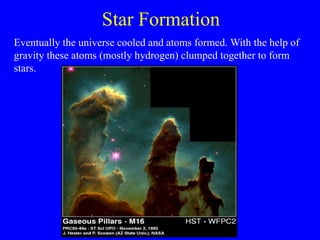
Star Formation
Eventually the universe cooled and atoms formed. With the help of
gravity these atoms (mostly hydrogen) clumped together to form
stars.
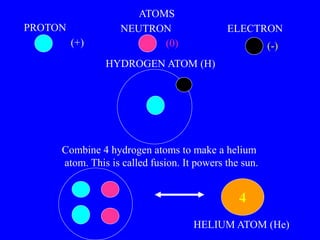
ATOMS
PROTON NEUTRON ELECTRON
HYDROGEN ATOM (H)
Combine 4 hydrogen atoms to make a helium
atom. This is called fusion. It powers the sun.
4
HELIUM ATOM (He)
(+) (-)
(0)
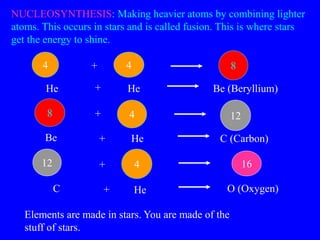
NUCLEOSYNTHESIS: Making heavier atoms by combining lighter
atoms. This occurs in stars and is called fusion. This is where stars
get the energy to shine.
4 + 4 8
He He
+ Be (Beryllium)
8 4
+ 12
12
Be + He C (Carbon)
4
+
+ He
C
16
O (Oxygen)
Elements are made in stars. You are made of the
stuff of stars.
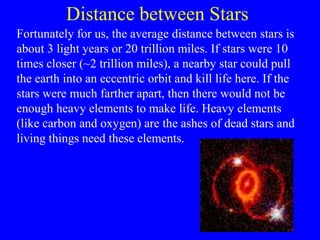
Distance between Stars
Fortunately for us, the average distance between stars is
about 3 light years or 20 trillion miles. If stars were 10
times closer (~2 trillion miles), a nearby star could pull
the earth into an eccentric orbit and kill life here. If the
stars were much farther apart, then there would not be
enough heavy elements to make life. Heavy elements
(like carbon and oxygen) are the ashes of dead stars and
living things need these elements.

Big bang theory

  • 2.
    If you lookup at the sky at night, the heavens appear to be unchanging. In 1917 Einstein wrote down the theory of General Relativity. His equations indicated that the universe was expanding and decelerating. He believed that the universe was unchanging so he put in the cosmological constant to fix his equations.
  • 3.
    In 1929 EdwinHubble found that galaxies are flying away from us in every direction. The farther they are, the faster they are receding. This is evidence for the expansion of the universe.
  • 4.
    The Big Bang Scientistsnow believe that the universe began in a tremendous release of energy known as the Big Bang. The universe has been expanding ever since. Evidence for this: •Observation of galaxies flying away from us in all directions (Hubble’s observations).
  • 5.
    Expansion of theUniverse The expansion of the universe can be viewed as stretching the spacetime fabric of the universe. Light waves get stretched out by expansion.
  • 6.
    Chance of winningthe Publisher’s Clearing House Sweepstakes: 1 in 10,000,000 (roughly) Chance of getting the initial density of the Universe correct (at 10-40 seconds after the Big Bang): 1 in 10000 … 0000 About 55 zeros The initial density of the universe must be very close to the “critical density”: Initial density Critical density = 1 + 0.000…0000001 _ About 55 zeros
  • 7.
    Origin of theUniverse Scientists believe that the universe began in a tremendous release of energy known as the Big Bang. The universe has been expanding ever since. Evidence for this: •Observation of galaxies flying away from us in all directions. •Remnant of the Big Bang known as the Cosmic Microwave Background Radiation.
  • 8.
    In 1964 Penziasand Wilson discovered the remnant heat of the Big Bang. This is called the cosmic microwave background radiation. It is all around us. The universe has cooled off considerably. The radiation corresponds to a temperature of 3 degrees above absolute zero (- 454 F).
  • 9.
    Origin of theUniverse Scientists believe that the universe began in a tremendous release of energy known as the Big Bang. The universe has been expanding ever since. Evidence for this: •Observation of galaxies flying away from us in all directions. •Remnant of the Big Bang known as the Cosmic Microwave Background Radiation. •Observed abundance of light elements made in the Big Bang matches predictions.
  • 10.
    Star Formation Eventually theuniverse cooled and atoms formed. With the help of gravity these atoms (mostly hydrogen) clumped together to form stars.
  • 11.
    ATOMS PROTON NEUTRON ELECTRON HYDROGENATOM (H) Combine 4 hydrogen atoms to make a helium atom. This is called fusion. It powers the sun. 4 HELIUM ATOM (He) (+) (-) (0)
  • 12.
    NUCLEOSYNTHESIS: Making heavieratoms by combining lighter atoms. This occurs in stars and is called fusion. This is where stars get the energy to shine. 4 + 4 8 He He + Be (Beryllium) 8 4 + 12 12 Be + He C (Carbon) 4 + + He C 16 O (Oxygen) Elements are made in stars. You are made of the stuff of stars.
  • 13.
    Distance between Stars Fortunatelyfor us, the average distance between stars is about 3 light years or 20 trillion miles. If stars were 10 times closer (~2 trillion miles), a nearby star could pull the earth into an eccentric orbit and kill life here. If the stars were much farther apart, then there would not be enough heavy elements to make life. Heavy elements (like carbon and oxygen) are the ashes of dead stars and living things need these elements.