Organisational Design

        Presentation by
Stephen, Kaz, Ken, Ron, Leo, Pat
       18th August 2011
Introduction
 Core concept of organisation design:
     Form follows function.
     Design the entity in such a way so as to
      effectively deliver the function (purpose)
 Design elements to consider:
     Strategy, People, Rewards, Processes,
      Systems, Skills, Shared values,
      Structure, Culture, Mission, Core Goals,
      Purpose, Principles, Practices etc.
Organisational Design
                   Approaches
 Five Star: Strategy, Structure, People, Rewards, Processes – Focus on
  Strategy
 McKinsey 7-S: Strategy, Structure, Systems, Skills, Staff, Style,
  Shared Values – Focus on Strategy
 Strategic Management: System aspects (Technical, political, cultural)
  & Aligned Mgt tools (mission/strategy, org structure, HR Mgt) - Focus
  on Alignment of systems and tools.
 Congruence Model: Informal Org, Formal Org, Work, People – Focus on
  fit
 Collaborative Organisational Model: – Core Goals and Values,
  Strategy, Work Processes, Structure, Systems, People, Culture – Focus
  on core future goals at design team level
 Six Box Model: Purpose, Structure, Relationships, Helpful Mechanisms,
  Rewards, Leadership – Focus on Purpose and leadership.
 Chaordic Design: Purpose, Principles, Participants, Org Concept,
  Constitution, Practices – Focus on Purpose and Principles.
Loose Organisational
                    Design
 The suggested academic approach as most effective in using
  commitment instead of control as an organising principle is
  the Chaordic (the intersection of Chaos and Order where
  innovation occurs) with variations such as Org2 Design.
                  Org2 Design Key Concepts
 Commitment as opposed to control as an organising
  principle.
 Iterative process, not necessary linear and not completed in
  a single pass.
 Designers consider each facet of the organisation to gain
  clarity leading to decisions to coherently deliver the purpose
  of the organisation.
 Constantly evolving while remaining aligned and integrated.
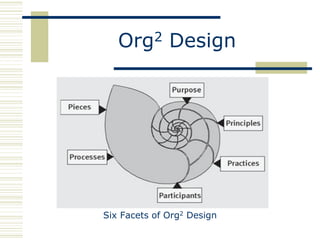
Org2 Design


Six Facets of Org2 Design
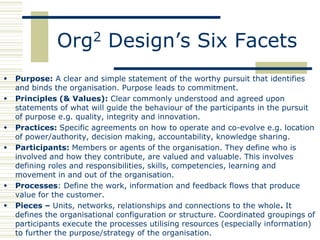
Org2 Design’s Six Facets
   Purpose: A clear and simple statement of the worthy pursuit that identifies
    and binds the organisation. Purpose leads to commitment.
   Principles (& Values): Clear commonly understood and agreed upon
    statements of what will guide the behaviour of the participants in the pursuit
    of purpose e.g. quality, integrity and innovation.
   Practices: Specific agreements on how to operate and co-evolve e.g. location
    of power/authority, decision making, accountability, knowledge sharing.
   Participants: Members or agents of the organisation. They define who is
    involved and how they contribute, are valued and valuable. This involves
    defining roles and responsibilities, skills, competencies, learning and
    movement in and out of the organisation.
   Processes: Define the work, information and feedback flows that produce
    value for the customer.
   Pieces – Units, networks, relationships and connections to the whole. It
    defines the organisational configuration or structure. Coordinated groupings of
    participants execute the processes utilising resources (especially information)
    to further the purpose/strategy of the organisation.
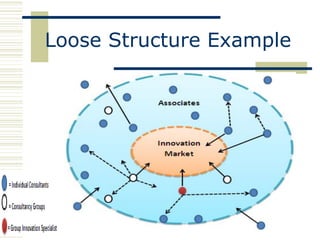
Loose Structure Example
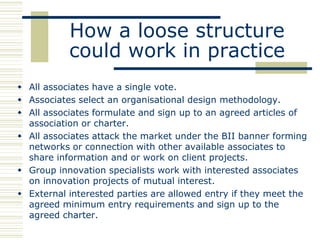
How a loose structure
           could work in practice
 All associates have a single vote.
 Associates select an organisational design methodology.
 All associates formulate and sign up to an agreed articles of
  association or charter.
 All associates attack the market under the BII banner forming
  networks or connection with other available associates to
  share information and or work on client projects.
 Group innovation specialists work with interested associates
  on innovation projects of mutual interest.
 External interested parties are allowed entry if they meet the
  agreed minimum entry requirements and sign up to the
  agreed charter.
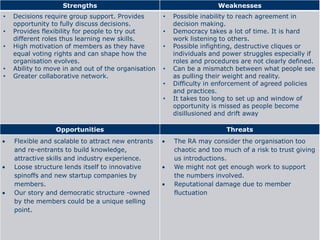
Strengths                                          Weaknesses
•   Decisions require group support. Provides        •   Possible inability to reach agreement in
    opportunity to fully discuss decisions.              decision making.
•   Provides flexibility for people to try out       •   Democracy takes a lot of time. It is hard
    different roles thus learning new skills.            work listening to others.
•                       SWOT of Loose Structure
    High motivation of members as they have
    equal voting rights and can shape how the
                                                     •   Possible infighting, destructive cliques or
                                                         individuals and power struggles especially if
    organisation evolves.                                roles and procedures are not clearly defined.
•   Ability to move in and out of the organisation   •   Can be a mismatch between what people see
•   Greater collaborative network.                       as pulling their weight and reality.
                                                     •   Difficulty in enforcement of agreed policies
                                                         and practices.
                                                     •   It takes too long to set up and window of
                                                         opportunity is missed as people become
                                                         disillusioned and drift away

                 Opportunities                                            Threats
    Flexible and scalable to attract new entrants        The RA may consider the organisation too
    and re-entrants to build knowledge,                  chaotic and too much of a risk to trust giving
    attractive skills and industry experience.           us introductions.
    Loose structure lends itself to innovative           We might not get enough work to support
    spinoffs and new startup companies by                the numbers involved.
    members.                                             Reputational damage due to member
    Our story and democratic structure -owned            fluctuation
    by the members could be a unique selling
    point.
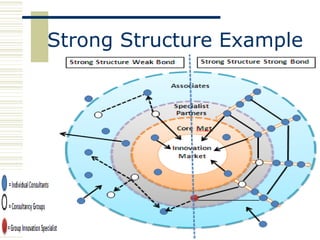
Strong Structure Example
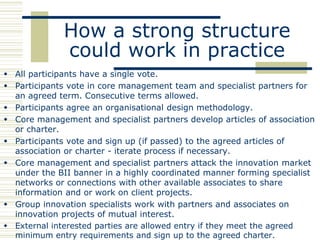
How a strong structure
              could work in practice
 All participants have a single vote.
 Participants vote in core management team and specialist partners for
  an agreed term. Consecutive terms allowed.
 Participants agree an organisational design methodology.
 Core management and specialist partners develop articles of association
  or charter.
 Participants vote and sign up (if passed) to the agreed articles of
  association or charter - iterate process if necessary.
 Core management and specialist partners attack the innovation market
  under the BII banner in a highly coordinated manner forming specialist
  networks or connections with other available associates to share
  information and or work on client projects.
 Group innovation specialists work with partners and associates on
  innovation projects of mutual interest.
 External interested parties are allowed entry if they meet the agreed
  minimum entry requirements and sign up to the agreed charter.
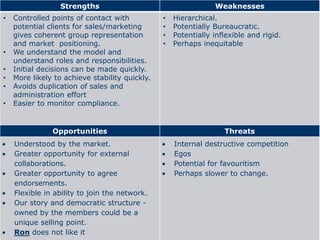
Strengths                                     Weaknesses
•   Controlled points of contact with           •   Hierarchical.
    potential clients for sales/marketing       •   Potentially Bureaucratic.
    gives coherent group representation         •   Potentially inflexible and rigid.

•
                      SWOT of Loose Structure
    and market positioning.
    We understand the model and
                                                •   Perhaps inequitable

    understand roles and responsibilities.
•   Initial decisions can be made quickly.
•   More likely to achieve stability quickly.
•   Avoids duplication of sales and
    administration effort
•   Easier to monitor compliance.


               Opportunities                                       Threats
    Understood by the market.                       Internal destructive competition
    Greater opportunity for external                Egos
    collaborations.                                 Potential for favouritism
    Greater opportunity to agree                    Perhaps slower to change.
    endorsements.
    Flexible in ability to join the network.
    Our story and democratic structure -
    owned by the members could be a
    unique selling point.
    Ron does not like it
Discussion on Structure

Bi ipresentationon organisationalstructure18thaugust2011

  • 1.
    Organisational Design Presentation by Stephen, Kaz, Ken, Ron, Leo, Pat 18th August 2011
  • 2.
    Introduction  Core conceptof organisation design:  Form follows function.  Design the entity in such a way so as to effectively deliver the function (purpose)  Design elements to consider:  Strategy, People, Rewards, Processes, Systems, Skills, Shared values, Structure, Culture, Mission, Core Goals, Purpose, Principles, Practices etc.
  • 3.
    Organisational Design Approaches  Five Star: Strategy, Structure, People, Rewards, Processes – Focus on Strategy  McKinsey 7-S: Strategy, Structure, Systems, Skills, Staff, Style, Shared Values – Focus on Strategy  Strategic Management: System aspects (Technical, political, cultural) & Aligned Mgt tools (mission/strategy, org structure, HR Mgt) - Focus on Alignment of systems and tools.  Congruence Model: Informal Org, Formal Org, Work, People – Focus on fit  Collaborative Organisational Model: – Core Goals and Values, Strategy, Work Processes, Structure, Systems, People, Culture – Focus on core future goals at design team level  Six Box Model: Purpose, Structure, Relationships, Helpful Mechanisms, Rewards, Leadership – Focus on Purpose and leadership.  Chaordic Design: Purpose, Principles, Participants, Org Concept, Constitution, Practices – Focus on Purpose and Principles.
  • 4.
    Loose Organisational Design  The suggested academic approach as most effective in using commitment instead of control as an organising principle is the Chaordic (the intersection of Chaos and Order where innovation occurs) with variations such as Org2 Design. Org2 Design Key Concepts  Commitment as opposed to control as an organising principle.  Iterative process, not necessary linear and not completed in a single pass.  Designers consider each facet of the organisation to gain clarity leading to decisions to coherently deliver the purpose of the organisation.  Constantly evolving while remaining aligned and integrated.
  • 5.
    Org2 Design Six Facetsof Org2 Design
  • 6.
    Org2 Design’s SixFacets  Purpose: A clear and simple statement of the worthy pursuit that identifies and binds the organisation. Purpose leads to commitment.  Principles (& Values): Clear commonly understood and agreed upon statements of what will guide the behaviour of the participants in the pursuit of purpose e.g. quality, integrity and innovation.  Practices: Specific agreements on how to operate and co-evolve e.g. location of power/authority, decision making, accountability, knowledge sharing.  Participants: Members or agents of the organisation. They define who is involved and how they contribute, are valued and valuable. This involves defining roles and responsibilities, skills, competencies, learning and movement in and out of the organisation.  Processes: Define the work, information and feedback flows that produce value for the customer.  Pieces – Units, networks, relationships and connections to the whole. It defines the organisational configuration or structure. Coordinated groupings of participants execute the processes utilising resources (especially information) to further the purpose/strategy of the organisation.
  • 7.
  • 8.
    How a loosestructure could work in practice  All associates have a single vote.  Associates select an organisational design methodology.  All associates formulate and sign up to an agreed articles of association or charter.  All associates attack the market under the BII banner forming networks or connection with other available associates to share information and or work on client projects.  Group innovation specialists work with interested associates on innovation projects of mutual interest.  External interested parties are allowed entry if they meet the agreed minimum entry requirements and sign up to the agreed charter.
  • 9.
    Strengths Weaknesses • Decisions require group support. Provides • Possible inability to reach agreement in opportunity to fully discuss decisions. decision making. • Provides flexibility for people to try out • Democracy takes a lot of time. It is hard different roles thus learning new skills. work listening to others. • SWOT of Loose Structure High motivation of members as they have equal voting rights and can shape how the • Possible infighting, destructive cliques or individuals and power struggles especially if organisation evolves. roles and procedures are not clearly defined. • Ability to move in and out of the organisation • Can be a mismatch between what people see • Greater collaborative network. as pulling their weight and reality. • Difficulty in enforcement of agreed policies and practices. • It takes too long to set up and window of opportunity is missed as people become disillusioned and drift away Opportunities Threats Flexible and scalable to attract new entrants The RA may consider the organisation too and re-entrants to build knowledge, chaotic and too much of a risk to trust giving attractive skills and industry experience. us introductions. Loose structure lends itself to innovative We might not get enough work to support spinoffs and new startup companies by the numbers involved. members. Reputational damage due to member Our story and democratic structure -owned fluctuation by the members could be a unique selling point.
  • 10.
  • 11.
    How a strongstructure could work in practice  All participants have a single vote.  Participants vote in core management team and specialist partners for an agreed term. Consecutive terms allowed.  Participants agree an organisational design methodology.  Core management and specialist partners develop articles of association or charter.  Participants vote and sign up (if passed) to the agreed articles of association or charter - iterate process if necessary.  Core management and specialist partners attack the innovation market under the BII banner in a highly coordinated manner forming specialist networks or connections with other available associates to share information and or work on client projects.  Group innovation specialists work with partners and associates on innovation projects of mutual interest.  External interested parties are allowed entry if they meet the agreed minimum entry requirements and sign up to the agreed charter.
  • 12.
    Strengths Weaknesses • Controlled points of contact with • Hierarchical. potential clients for sales/marketing • Potentially Bureaucratic. gives coherent group representation • Potentially inflexible and rigid. • SWOT of Loose Structure and market positioning. We understand the model and • Perhaps inequitable understand roles and responsibilities. • Initial decisions can be made quickly. • More likely to achieve stability quickly. • Avoids duplication of sales and administration effort • Easier to monitor compliance. Opportunities Threats Understood by the market. Internal destructive competition Greater opportunity for external Egos collaborations. Potential for favouritism Greater opportunity to agree Perhaps slower to change. endorsements. Flexible in ability to join the network. Our story and democratic structure - owned by the members could be a unique selling point. Ron does not like it
  • 13.