Organisational Stress, Structure and Synergy External influences on structure and systems design and their implications for achievement of synergy
Presentation A&O To define the various forms of and trends in the design of organisational structures To consider the relationship between the business environment (ie the titular  ‘stress’ ), company strategy and choice of structure To analyse the respective characteristics of structural forms To consider the limiting effects of communication systems, relationships and organisational design upon the achievement of synergy
Presentation Structure Sources and resources Definitions:  stress; structure; synergy etc Organisational structures:  conceptualisation / representation & basic forms analysed Influences on structure:  scale, geography, complexity, competition, stability, management . Structure as an inhibitor of synergy Latest trends in organisation design
Sources and resources Global trends in organisational design.  Nikoloenko A & Kleiner B. (1996) Work Study Vol 45 No 7 pp23-26 (Management e jnls BU site) The Structuring of Organizations.  Mintzberg H (1979) See Pt 1 pp17-65 Corporate Strategy for Tourism . Tribe J (1997) See pp 174 - 193 Interrelationships and horizontal strategy to achieve synergy and competitive advantage in the diversified firm . Ensign P (1998) Management Decision Vol 36 No 10 pp 657-668 (Management e jnls BU site) Ref: Porter’s 5 Forces and Value Chain models encountered with SR in BIT and elsewhere on BATS eg TILT unit. Competitive Advantage: creating and sustaining superior performance . Porter M (1985)
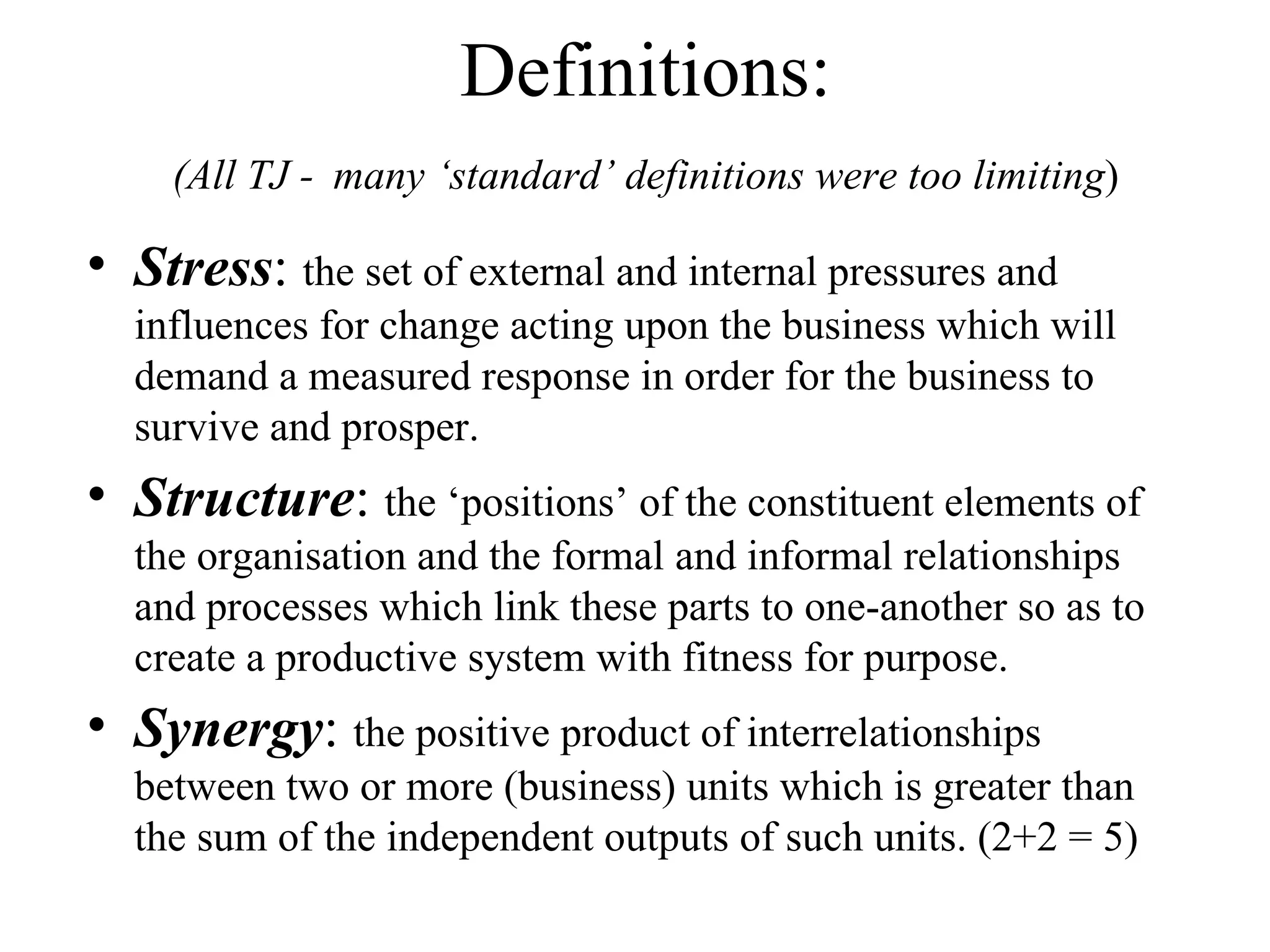
Definitions: (All TJ -   many ‘standard’ definitions were too limiting ) Stress :  the set of external and internal pressures and influences for change acting upon the business which will demand a measured response in order for the business to survive and prosper. Structure :  the ‘positions’ of the constituent elements of the organisation and the formal and informal relationships and processes which link these parts to one-another so as to create a productive system with fitness for purpose. Synergy :  the positive product of interrelationships between two or more (business) units which is greater than the sum of the independent outputs of such units. (2+2 = 5)
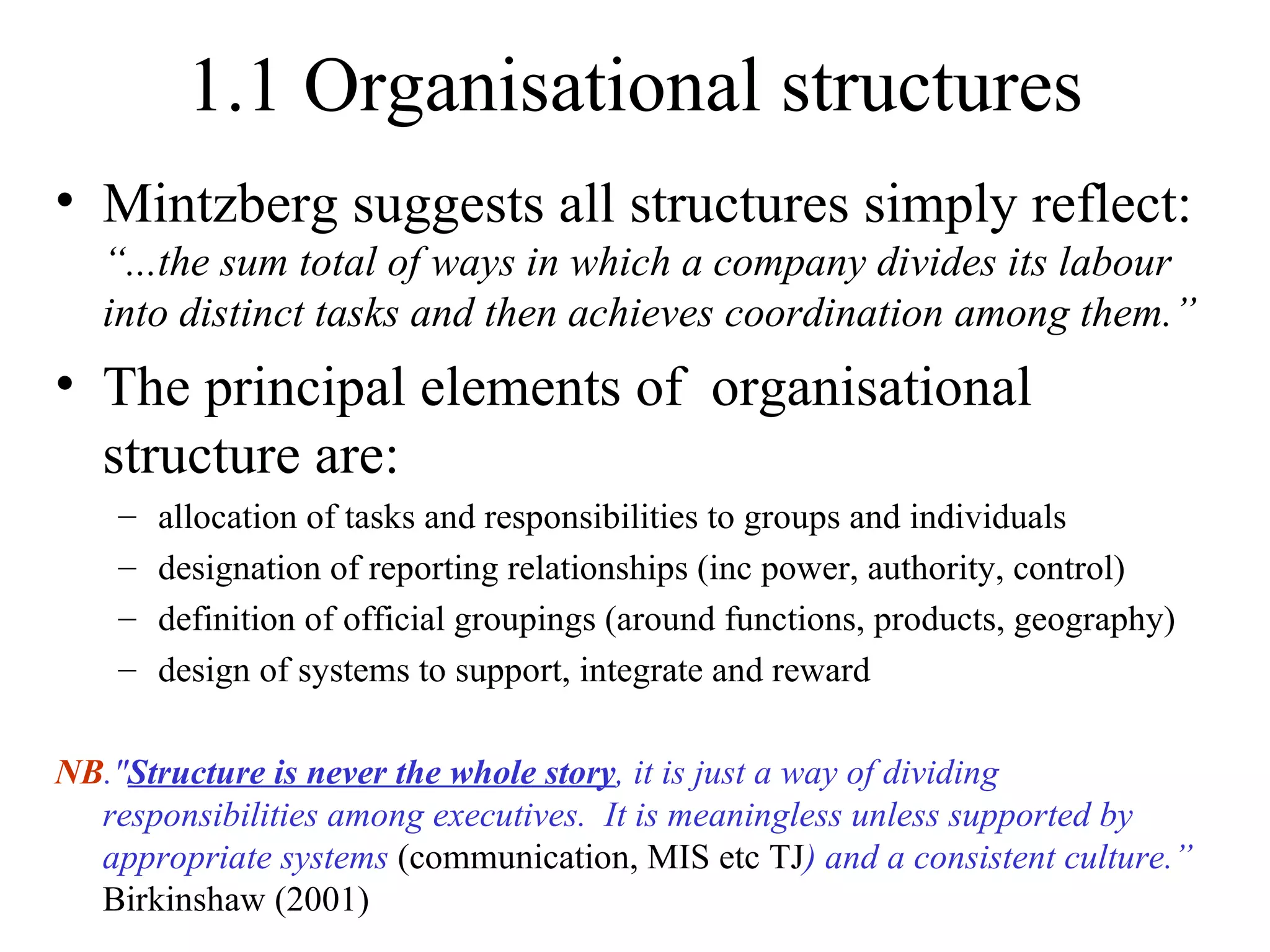
1.1 Organisational structures Mintzberg suggests all structures simply reflect:  “...the sum total of ways in which a company divides its labour into distinct tasks and then achieves coordination among them.” The principal elements of  organisational structure are: allocation of tasks and responsibilities to groups and individuals designation of reporting relationships (inc power, authority, control) definition of official groupings (around functions, products, geography) design of systems to support, integrate and reward NB ." Structure is never the whole story , it is just a way of dividing responsibilities among executives.  It is meaningless unless supported by appropriate systems  (communication, MIS etc TJ ) and a consistent culture.”  Birkinshaw (2001)
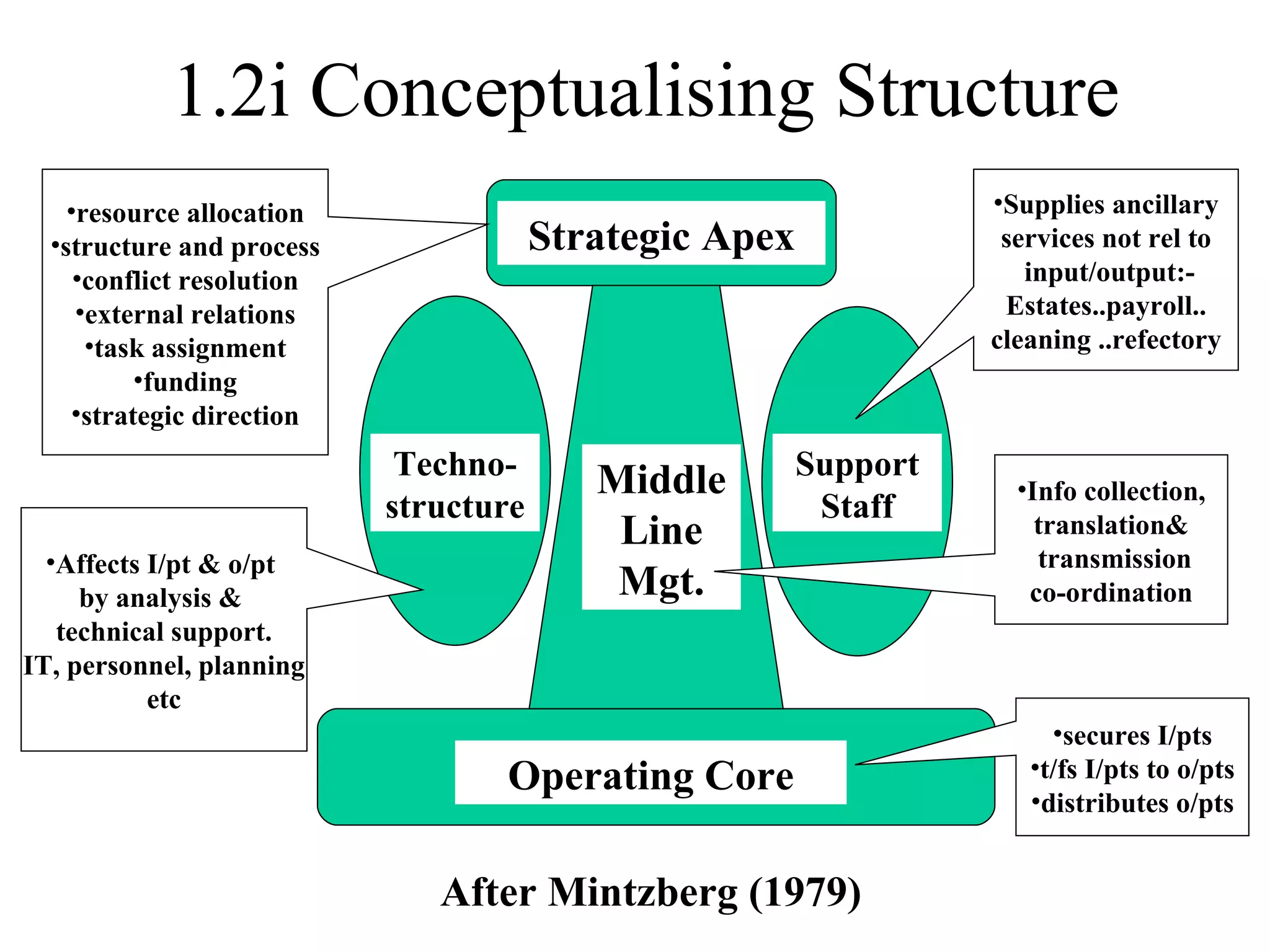
1.2i Conceptualising Structure Strategic Apex Operating Core Middle Line Mgt. Support Staff Techno-structure After Mintzberg (1979) secures I/pts t/fs I/pts to o/pts distributes o/pts Supplies ancillary services not rel to input/output:- Estates..payroll.. cleaning ..refectory Affects I/pt & o/pt  by analysis &  technical support. IT, personnel, planning etc Info collection, translation& transmission co-ordination resource allocation structure and process conflict resolution external relations task assignment funding strategic direction
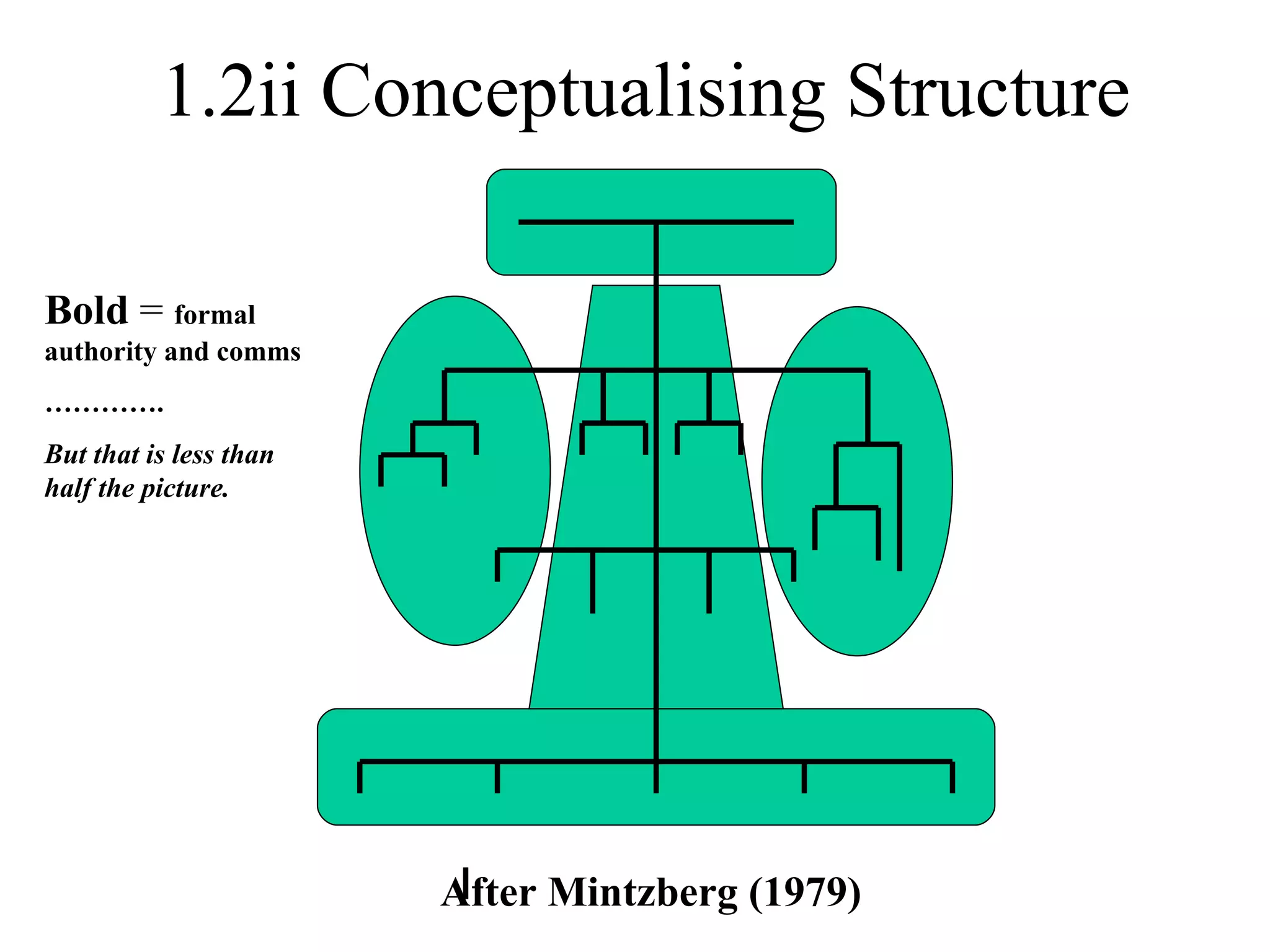
1.2ii Conceptualising Structure After Mintzberg (1979) Bold  =  formal authority and comms ………… . But that is less than half the picture.
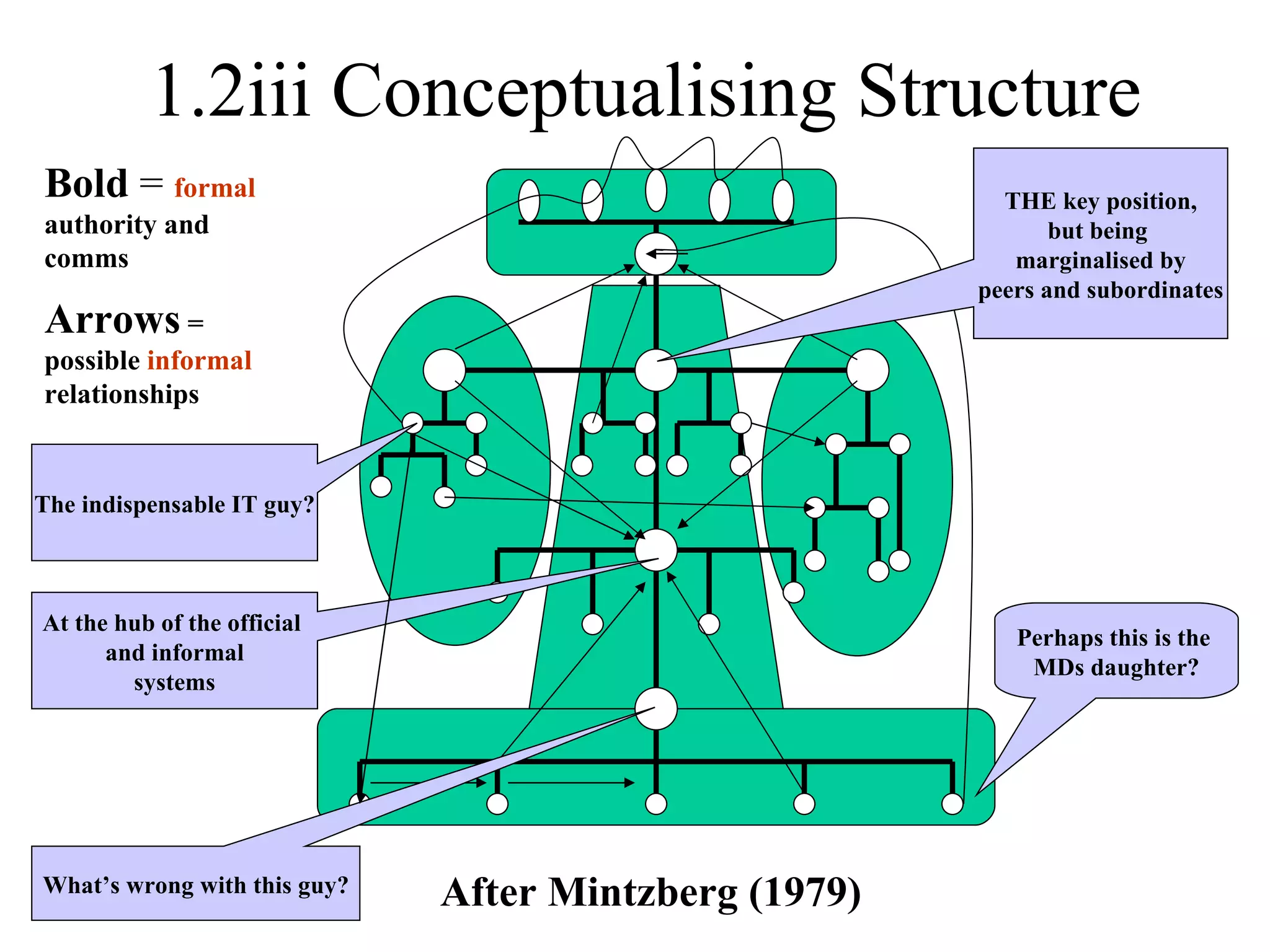
1.2iii Conceptualising Structure After Mintzberg (1979) Bold  =  formal  authority and comms Arrows  = possible  informal  relationships Perhaps this is the  MDs daughter? What’s wrong with this guy? At the hub of the official  and informal systems THE key position, but being  marginalised by peers and subordinates The indispensable IT guy?
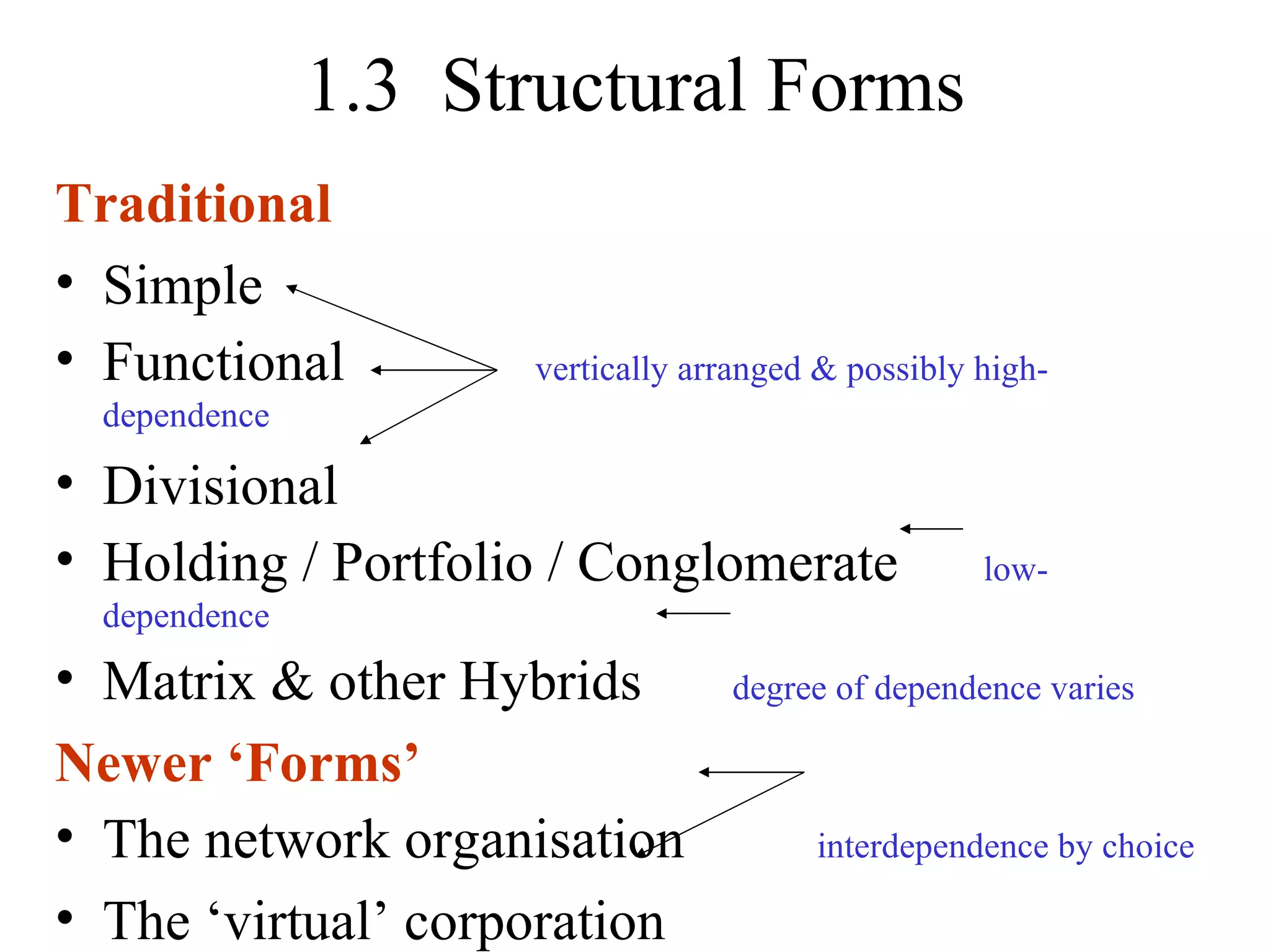
1.3  Structural Forms Traditional Simple Functional   vertically arranged & possibly high-dependence Divisional Holding / Portfolio / Conglomerate  low-dependence Matrix & other Hybrids   degree of dependence varies Newer ‘Forms’ The network organisation  interdependence by choice The ‘virtual’ corporation
1.4 Simple Structure The ‘structure without a structure’ usually for new start ups, small operations where there is: small scale no complexity no multiple functional specialism requirement
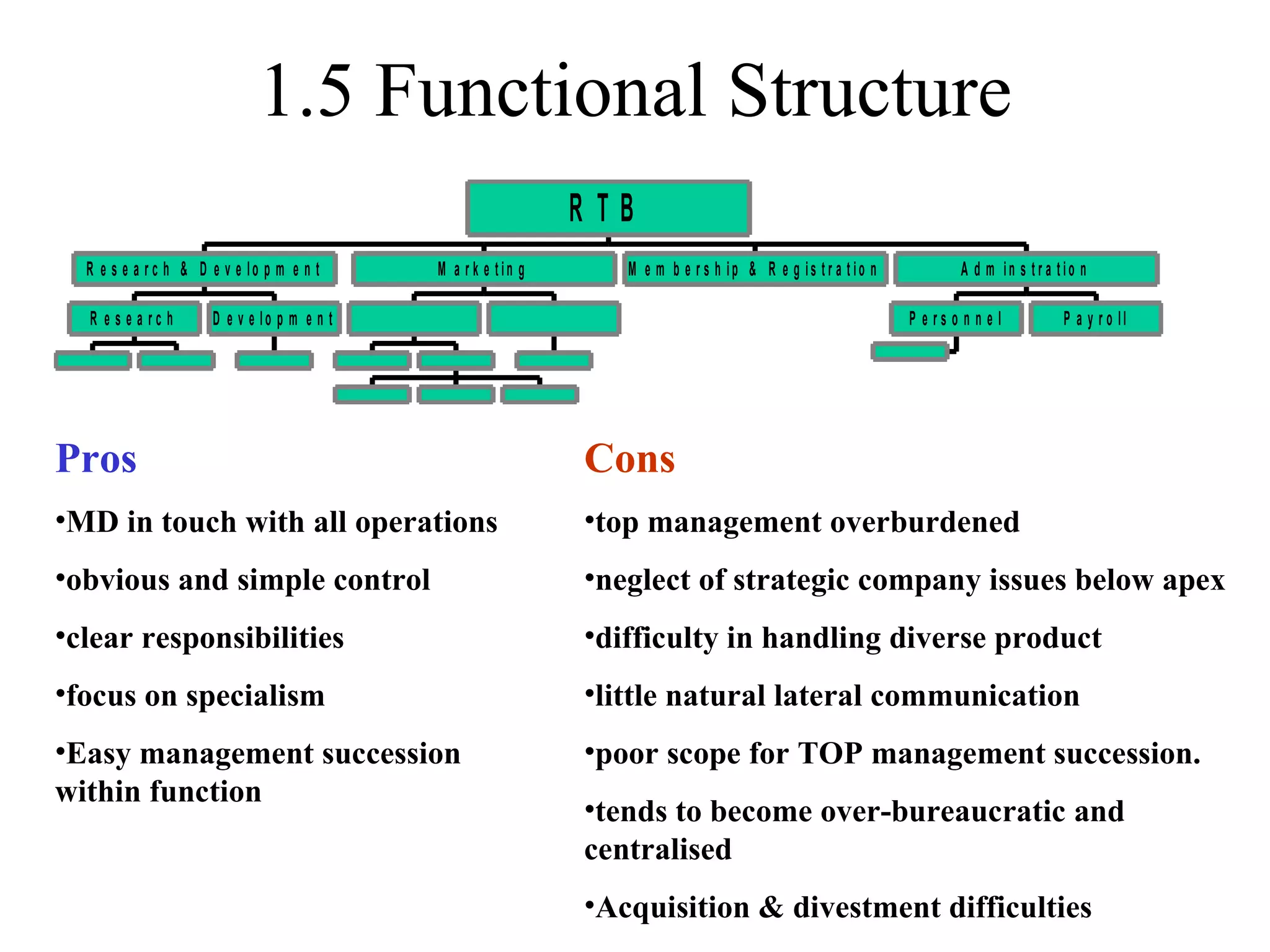
1.5 Functional Structure Pros MD in touch with all operations obvious and simple control clear responsibilities focus on specialism Easy management succession within function Cons top management overburdened neglect of strategic company issues below apex difficulty in handling diverse product  little natural lateral communication poor scope for TOP management succession. tends to become over-bureaucratic and centralised Acquisition & divestment difficulties
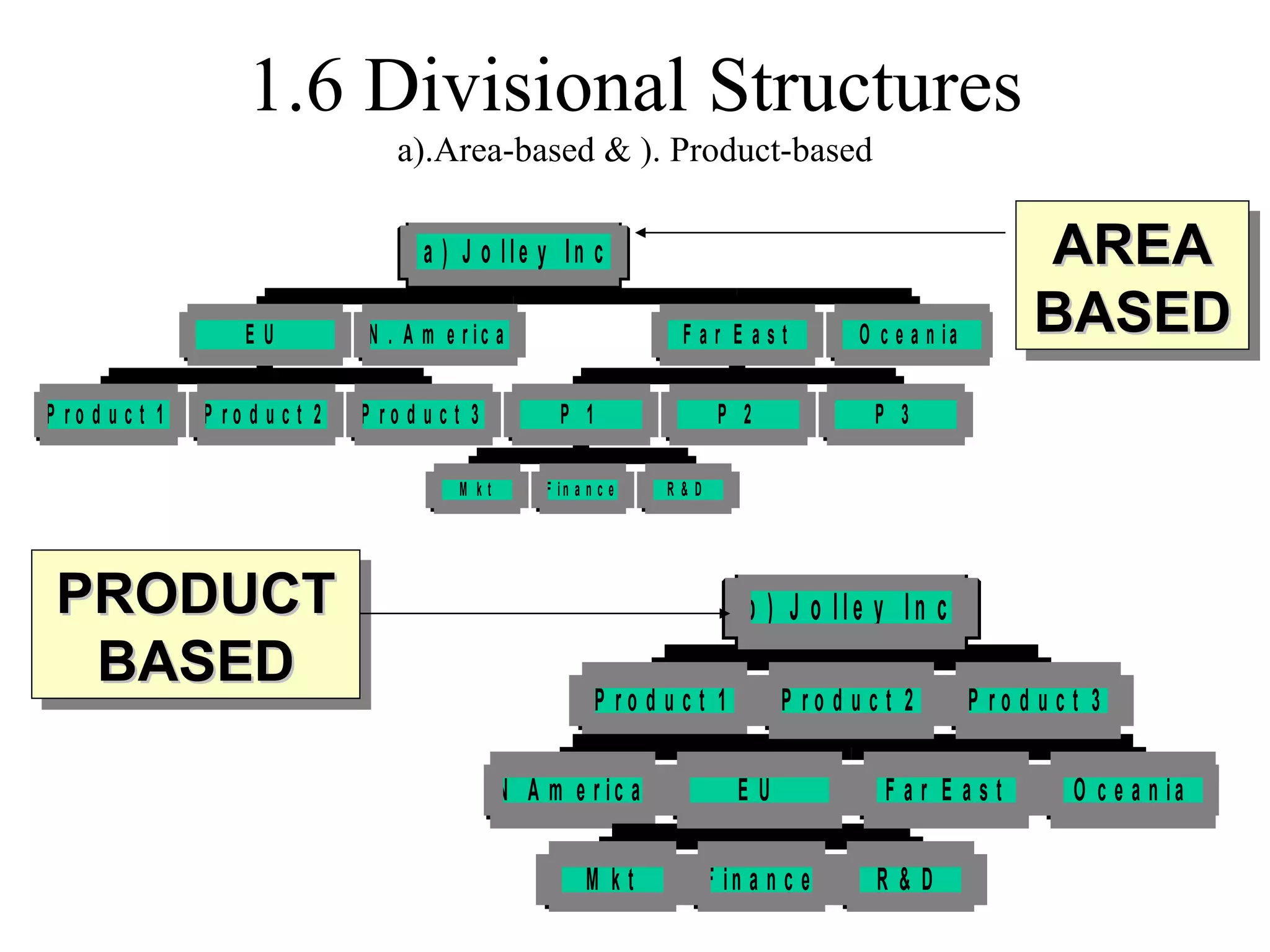
1.6 Divisional Structures a).Area-based & ). Product-based AREA BASED PRODUCT BASED
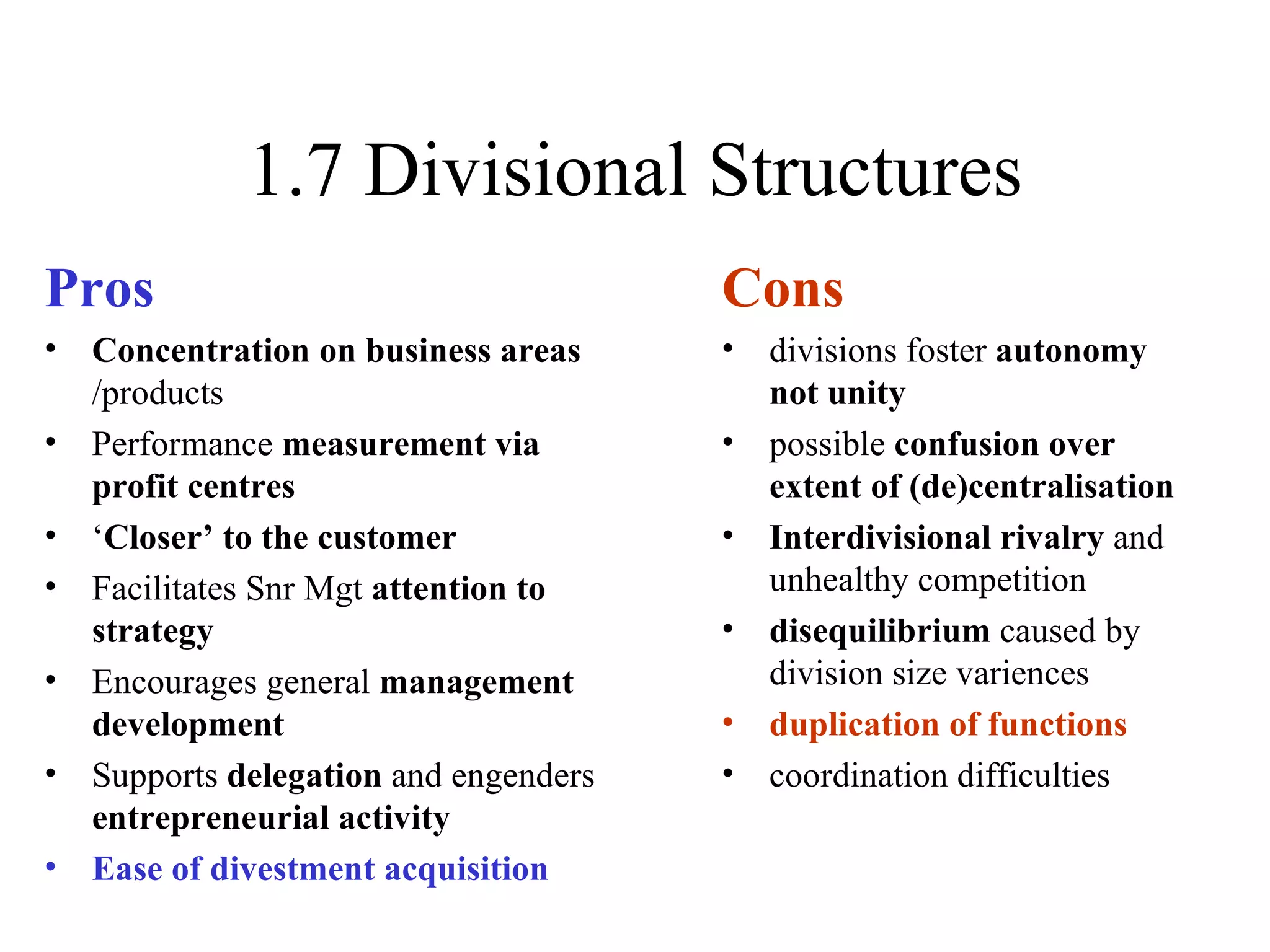
1.7 Divisional Structures Pros Concentration on business areas  /products Performance  measurement via profit centres ‘ Closer’ to the customer Facilitates Snr Mgt  attention to strategy Encourages general  management development Supports  delegation  and engenders  entrepreneurial activity Ease of divestment acquisition Cons divisions foster  autonomy not unity possible  confusion over extent of (de)centralisation Interdivisional rivalry  and unhealthy competition disequilibrium  caused by division size variences duplication of functions coordination difficulties
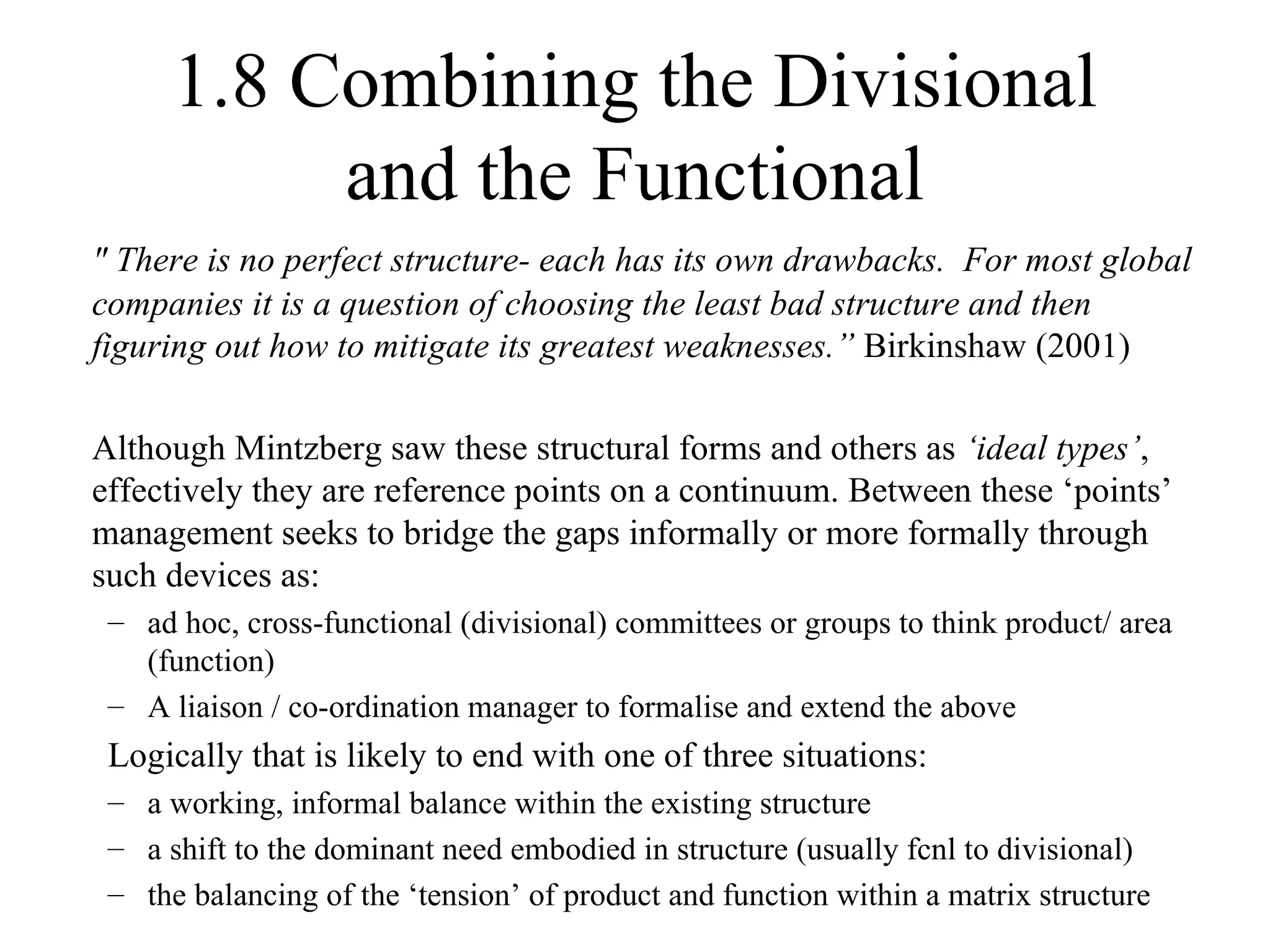
1.8 Combining the Divisional and the Functional " There is no perfect structure- each has its own drawbacks.  For most global companies it is a question of choosing the least bad structure and then figuring out how to mitigate its greatest weaknesses.”  Birkinshaw (2001) Although Mintzberg saw these structural forms and others as  ‘ideal types’ , effectively they are reference points on a continuum. Between these ‘points’ management seeks to bridge the gaps informally or more formally through such devices as: ad hoc, cross-functional (divisional) committees or groups to think product/ area (function) A liaison / co-ordination manager to formalise and extend the above Logically that is likely to end with one of three situations:   a working, informal balance within the existing structure a shift to the dominant need embodied in structure (usually fcnl to divisional) the balancing of the ‘tension’ of product and function within a matrix structure
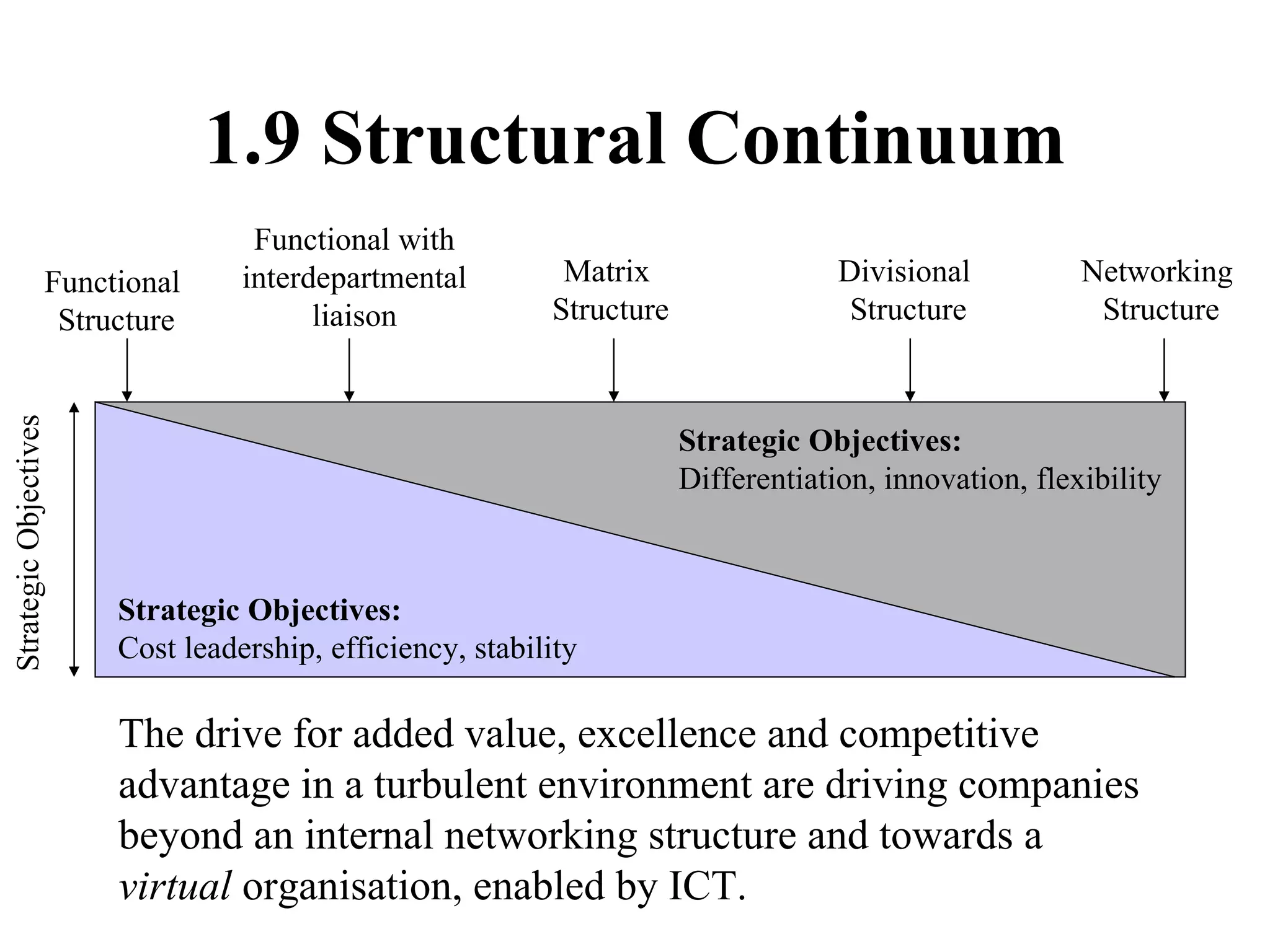
1.9 Structural Continuum Strategic Objectives Functional  Structure Functional with interdepartmental liaison Matrix  Structure Divisional  Structure Networking  Structure Strategic Objectives: Differentiation, innovation, flexibility Strategic Objectives: Cost leadership, efficiency, stability The drive for added value, excellence and competitive advantage in a turbulent environment are driving companies beyond an internal networking structure and towards a  virtual  organisation, enabled by ICT.
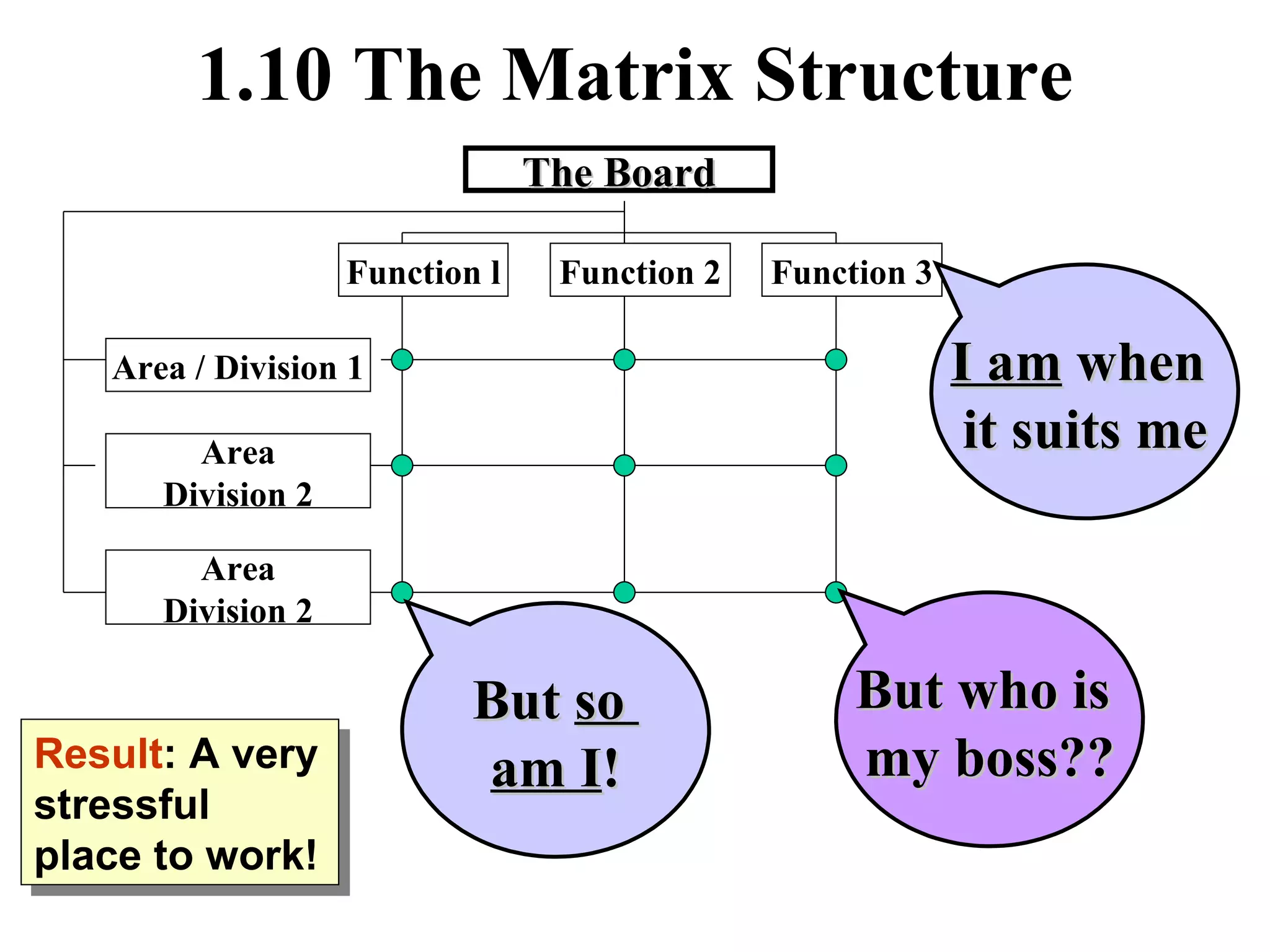
1.10 The Matrix Structure The Board Function 2 Function 3 Area Division 2 Area / Division 1 Function l Area Division 2 But who is  my boss?? I am  when  it suits me But  so  am I ! Result : A very stressful place to work!
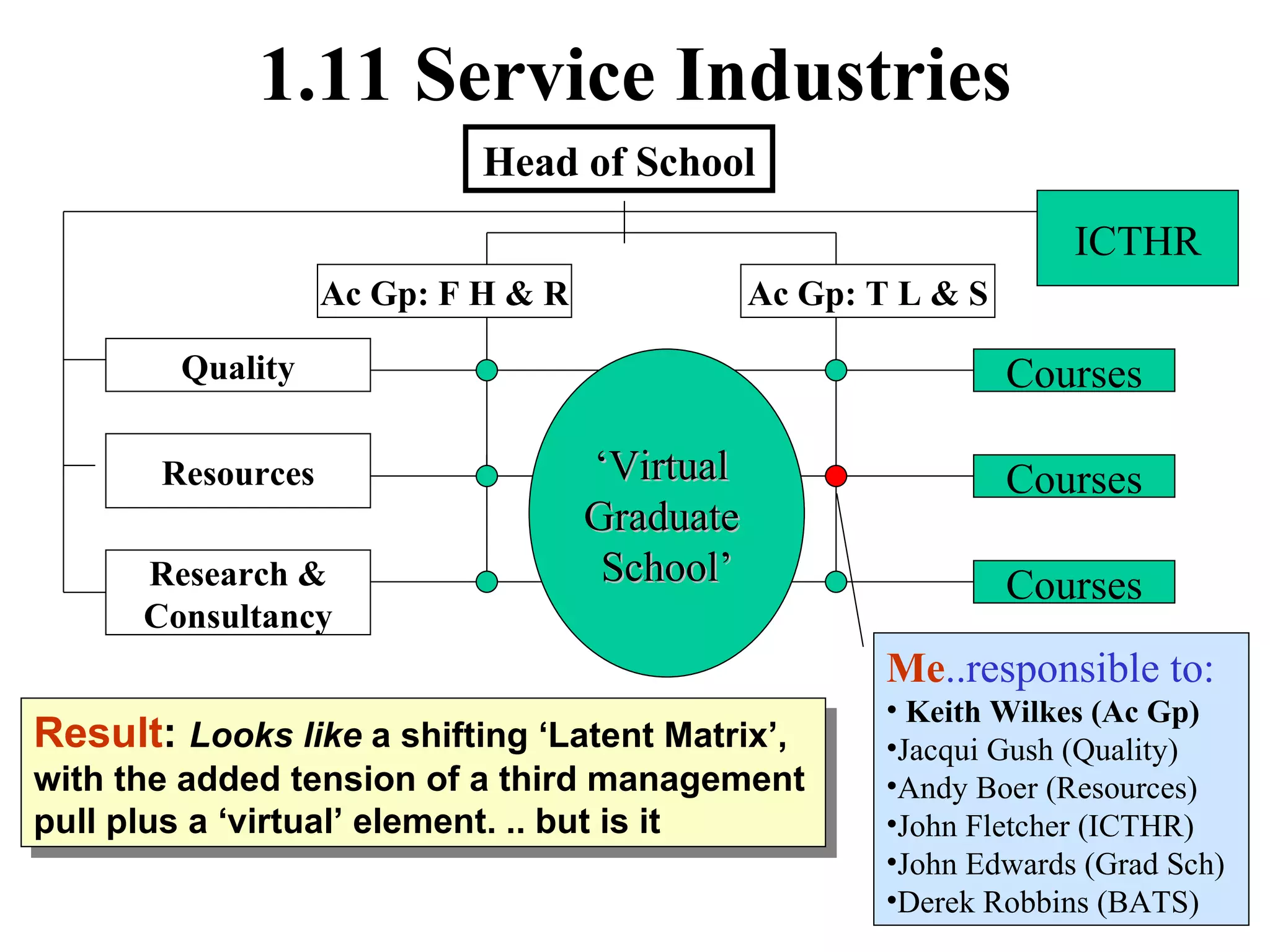
1.11 Service Industries Head of School Ac Gp: T L & S Resources Quality Ac Gp: F H & R Research & Consultancy Result :  Looks like  a shifting ‘Latent Matrix’, with the added tension of a third management pull plus a ‘virtual’ element. .. but is it Courses Courses Courses ‘ Virtual  Graduate  School’ Me ..responsible to: Keith Wilkes (Ac Gp) Jacqui Gush (Quality) Andy Boer (Resources) John Fletcher (ICTHR) John Edwards (Grad Sch) Derek Robbins (BATS) ICTHR
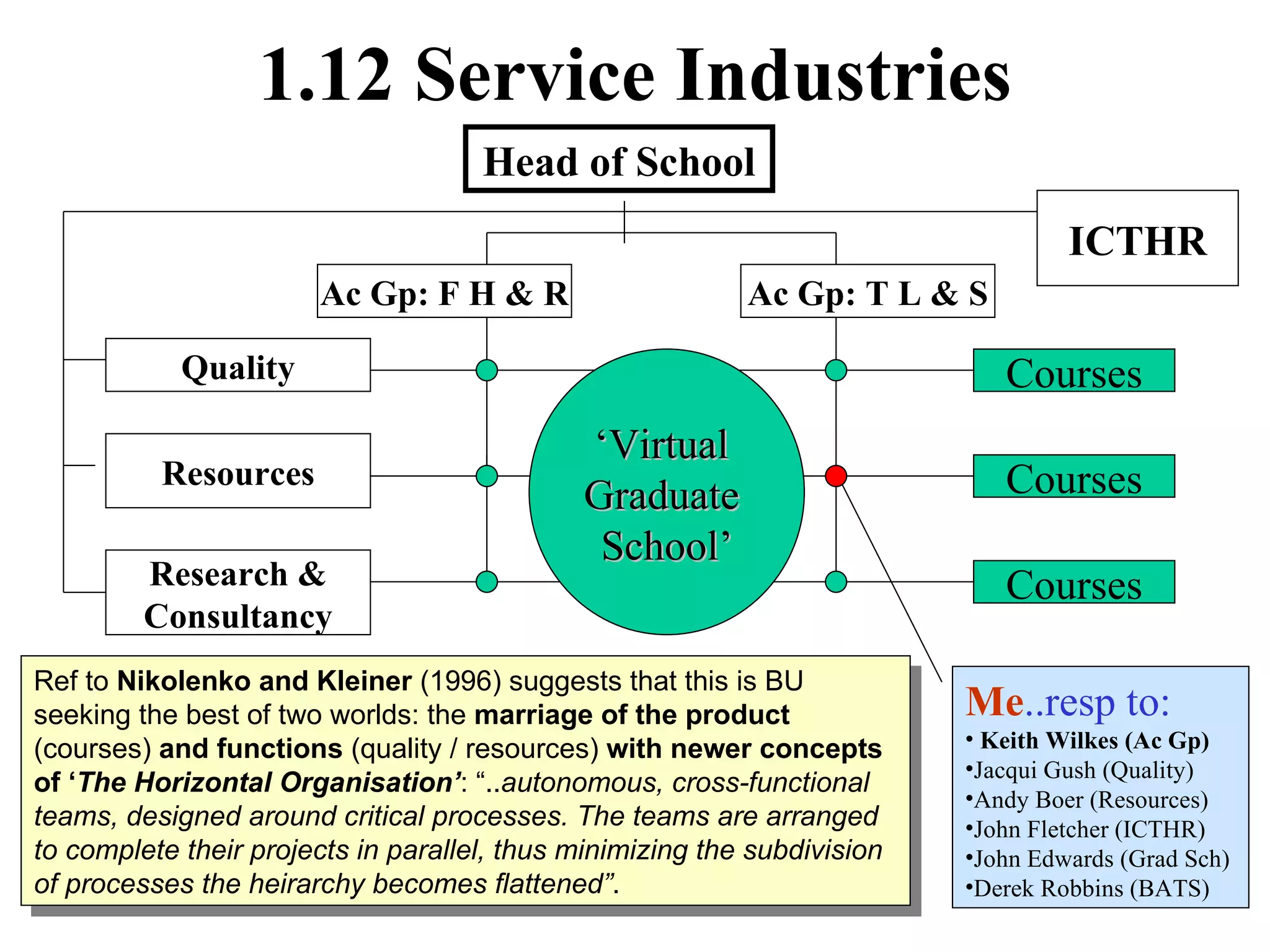
1.12 Service Industries Head of School Ac Gp: T L & S Resources Quality Ac Gp: F H & R Research & Consultancy Ref to  Nikolenko and Kleiner  (1996) suggests that this is BU seeking the best of two worlds: the  marriage of the product  (courses)  and functions  (quality / resources)  with newer concepts of ‘ The Horizontal Organisation’ : “.. autonomous, cross-functional teams, designed around critical processes. The teams are arranged to complete their projects in parallel, thus minimizing the subdivision of processes the heirarchy becomes flattened” . Courses Courses Courses ‘ Virtual  Graduate  School’ Me ..resp to: Keith Wilkes (Ac Gp) Jacqui Gush (Quality) Andy Boer (Resources) John Fletcher (ICTHR) John Edwards (Grad Sch) Derek Robbins (BATS) ICTHR
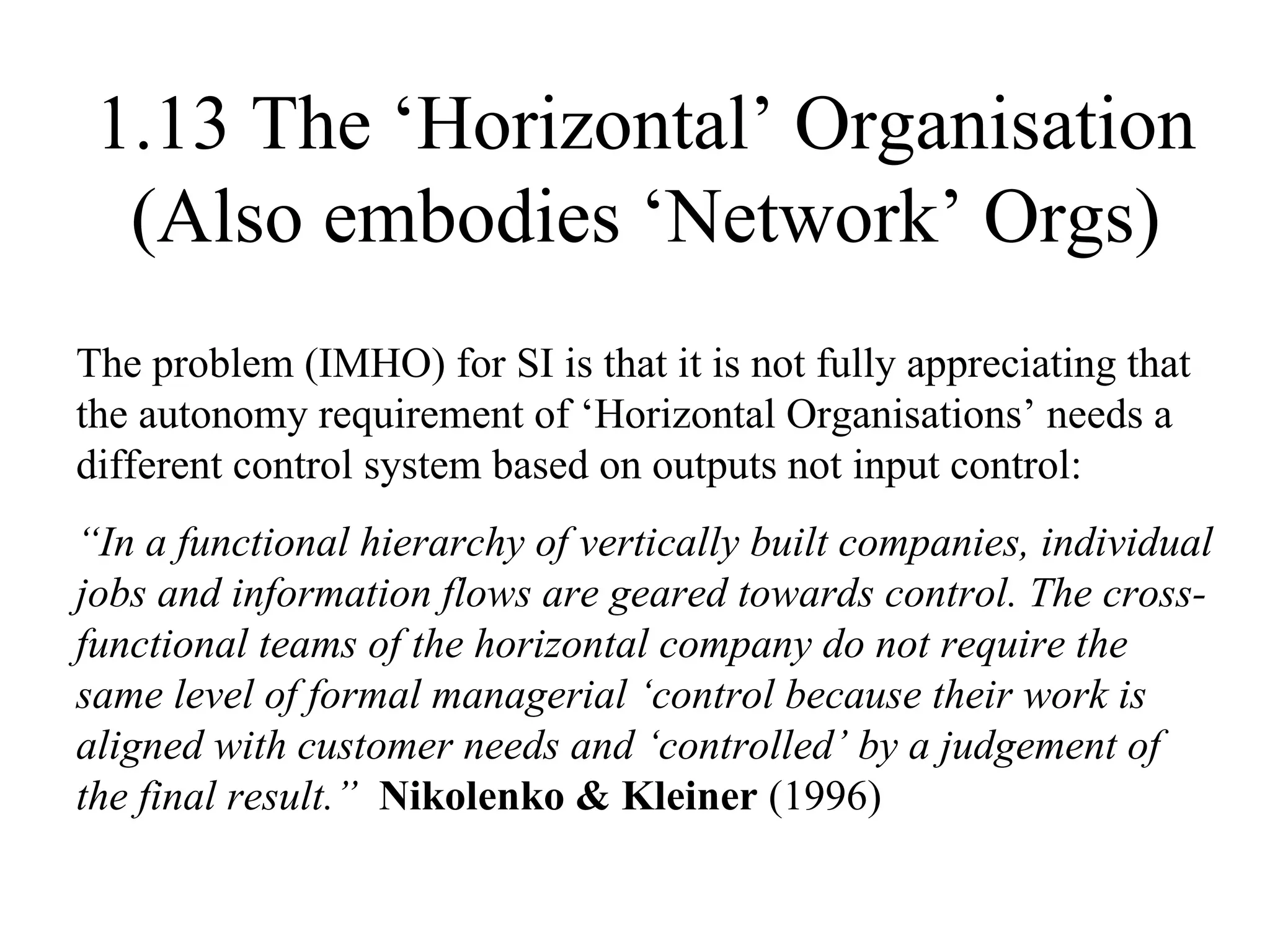
1.13 The ‘Horizontal’ Organisation (Also embodies ‘Network’ Orgs) The problem (IMHO) for SI is that it is not fully appreciating that the autonomy requirement of ‘Horizontal Organisations’ needs a different control system based on outputs not input control: “ In a functional hierarchy of vertically built companies, individual jobs and information flows are geared towards control. The cross-functional teams of the horizontal company do not require the same level of formal managerial ‘control because their work is aligned with customer needs and ‘controlled’ by a judgement of the final result.”   Nikolenko & Kleiner  (1996)
1.14 The Virtual Corporation A transient, ephemeral form.  A coalition of interested parties from various specialities and points on the value chain working together for a particular purpose, project or contract.  The logical end point of outsourcing, whereby a network of suppliers is offering capability at the business unit or function level, such that these capabilities may be combined in a unique way to add value and competitive advantage.  (TJ!) Nikolenko & Kleiner  (1996) suggest that within a VC  “..companies can share costs, skills, and access to global markets with one-another, with each contributing to the common goal what it is best at  ….  The VC appears to be a single firm with vast capacities, when in reality it is a collection of many smaller firms that work together to achieve a specific goal.”
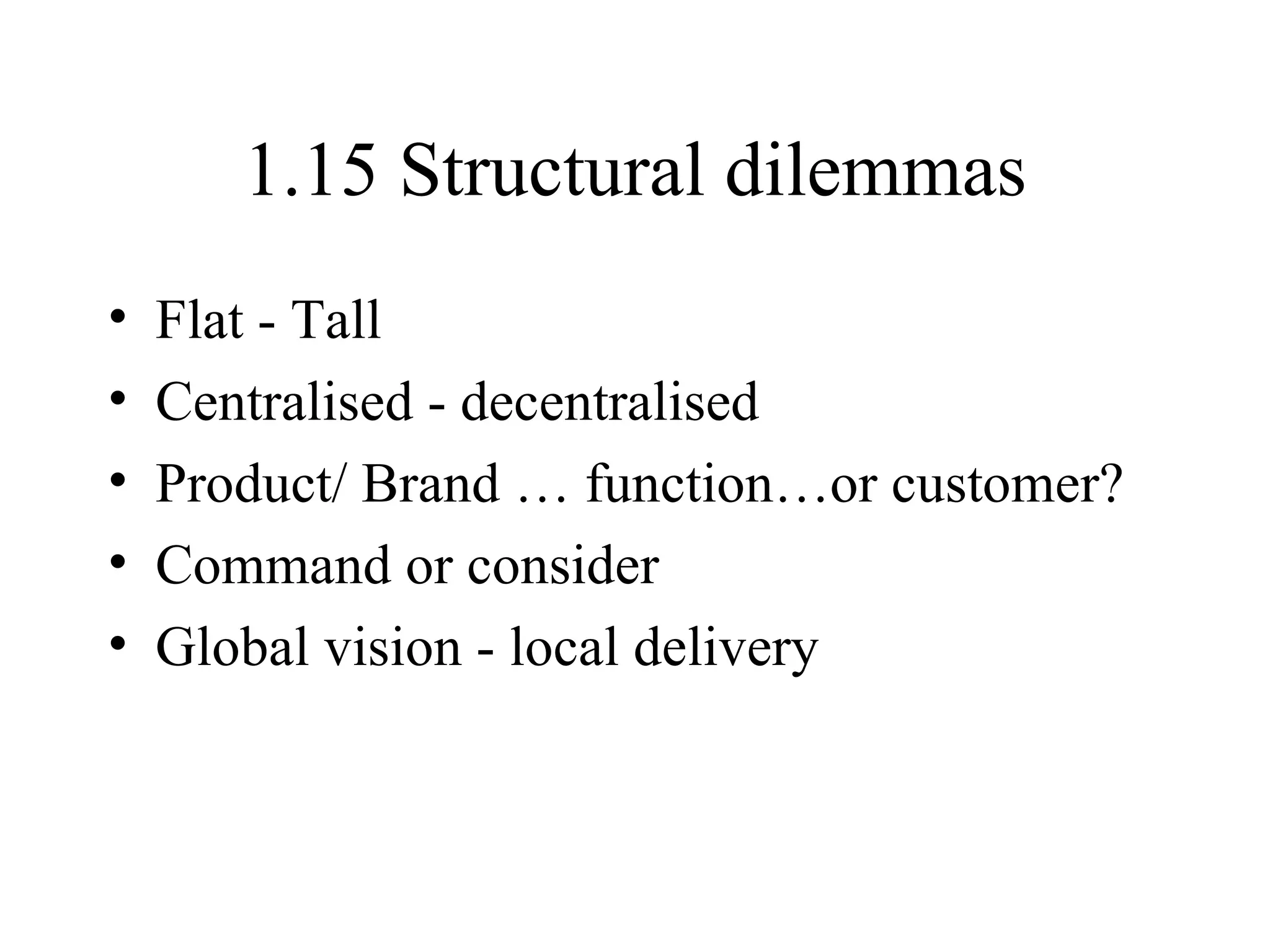
1.15 Structural dilemmas Flat - Tall Centralised - decentralised Product/ Brand … function…or customer? Command or consider Global vision - local delivery
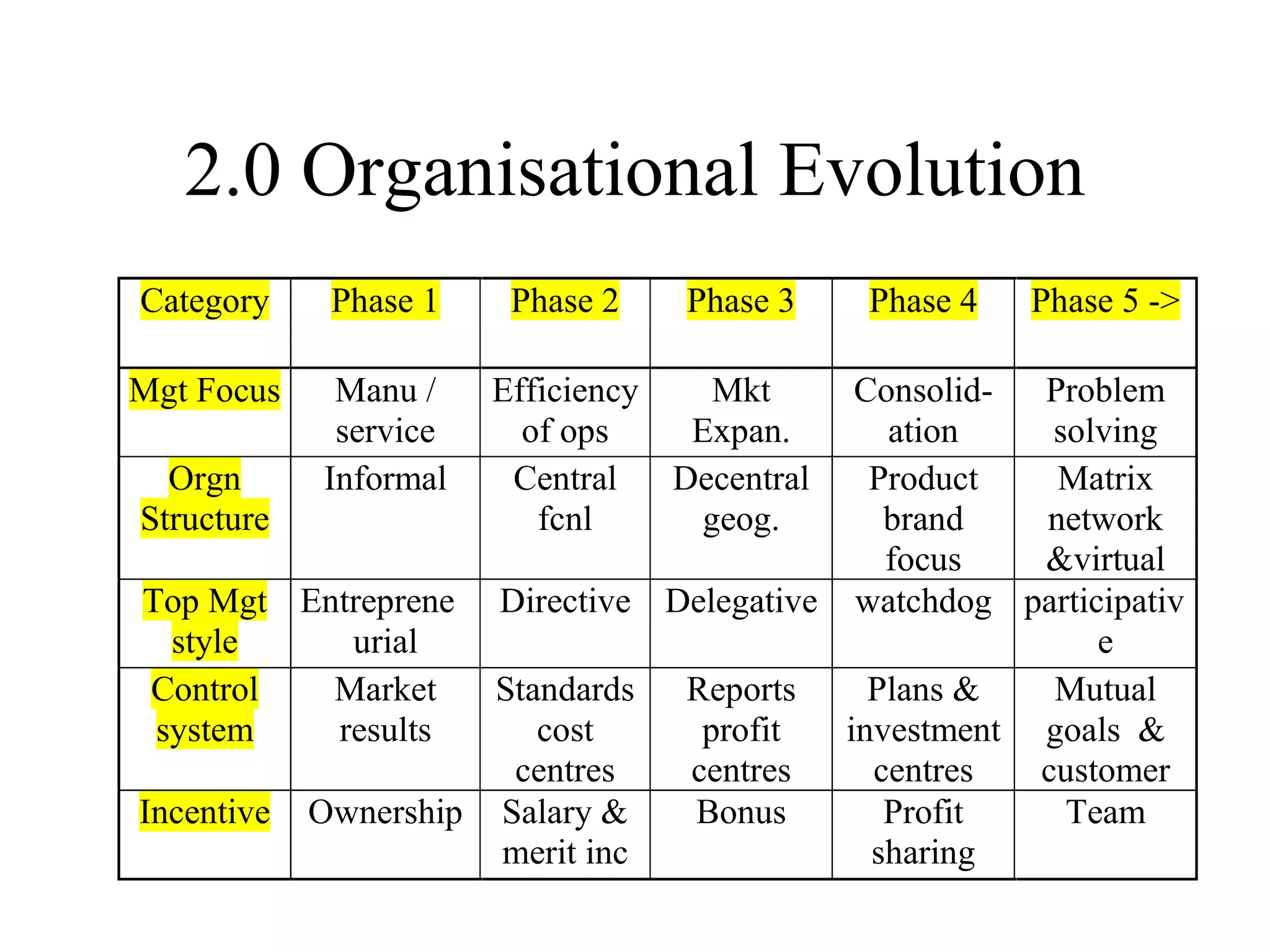
2.0 Organisational Evolution
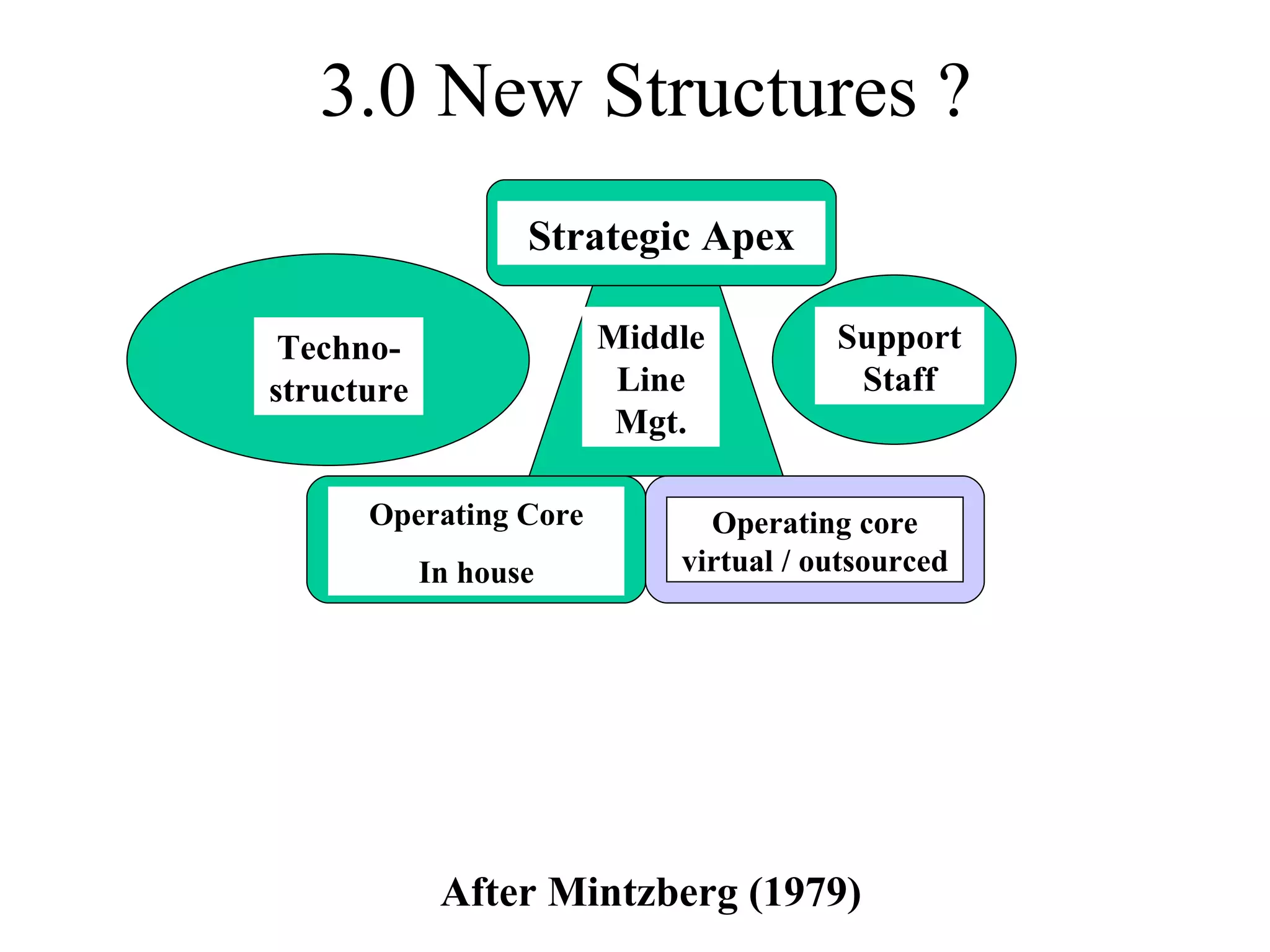
3.0 New Structures ? Strategic Apex Operating Core In house Middle Line Mgt. Support Staff Techno-structure After Mintzberg (1979) Operating core virtual / outsourced
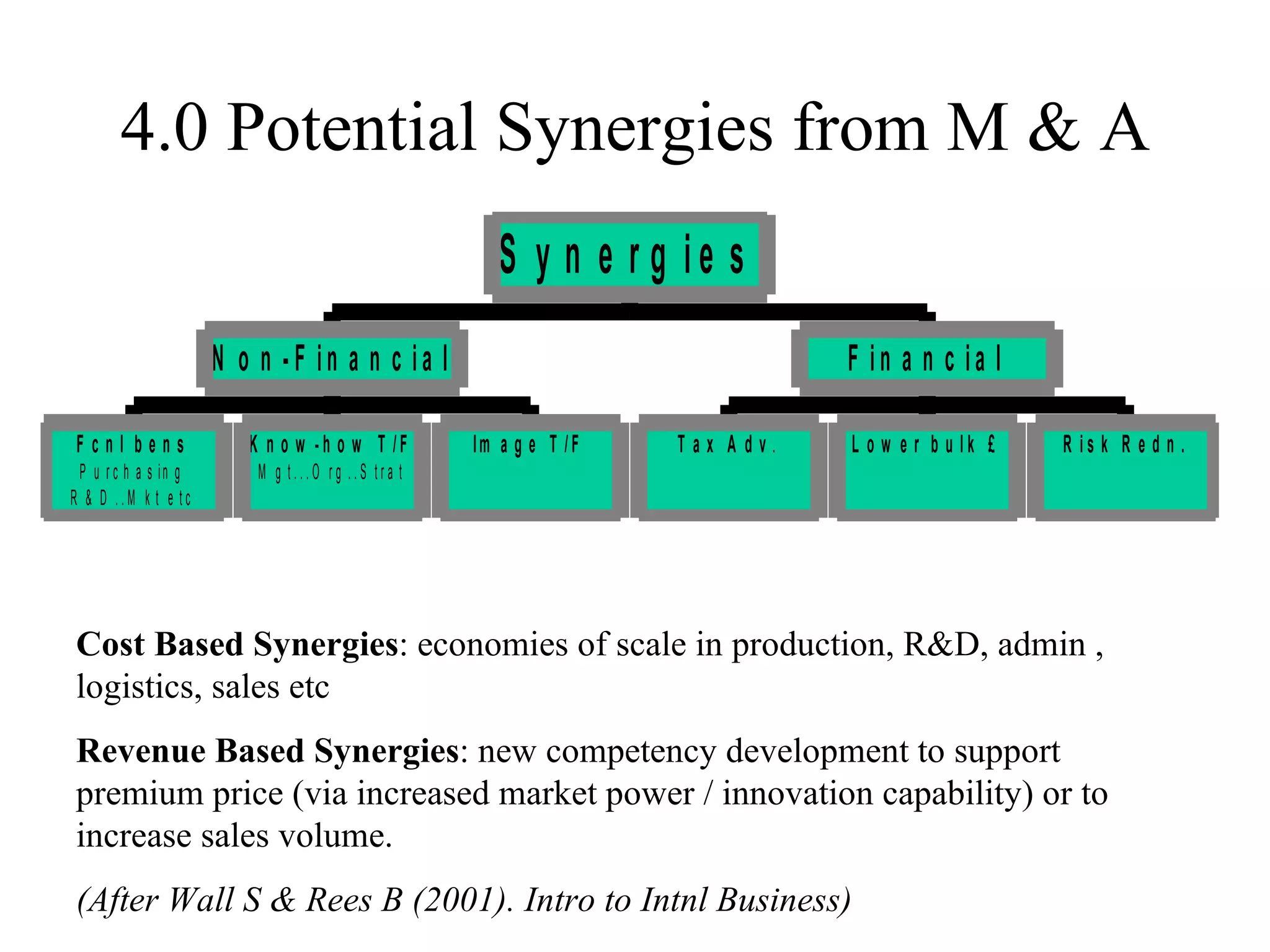
4.0 Potential Synergies from M & A Cost Based Synergies : economies of scale in production, R&D, admin , logistics, sales etc Revenue Based Synergies : new competency development to support premium price (via increased market power / innovation capability) or to increase sales volume. (After Wall S & Rees B (2001). Intro to Intnl Business)
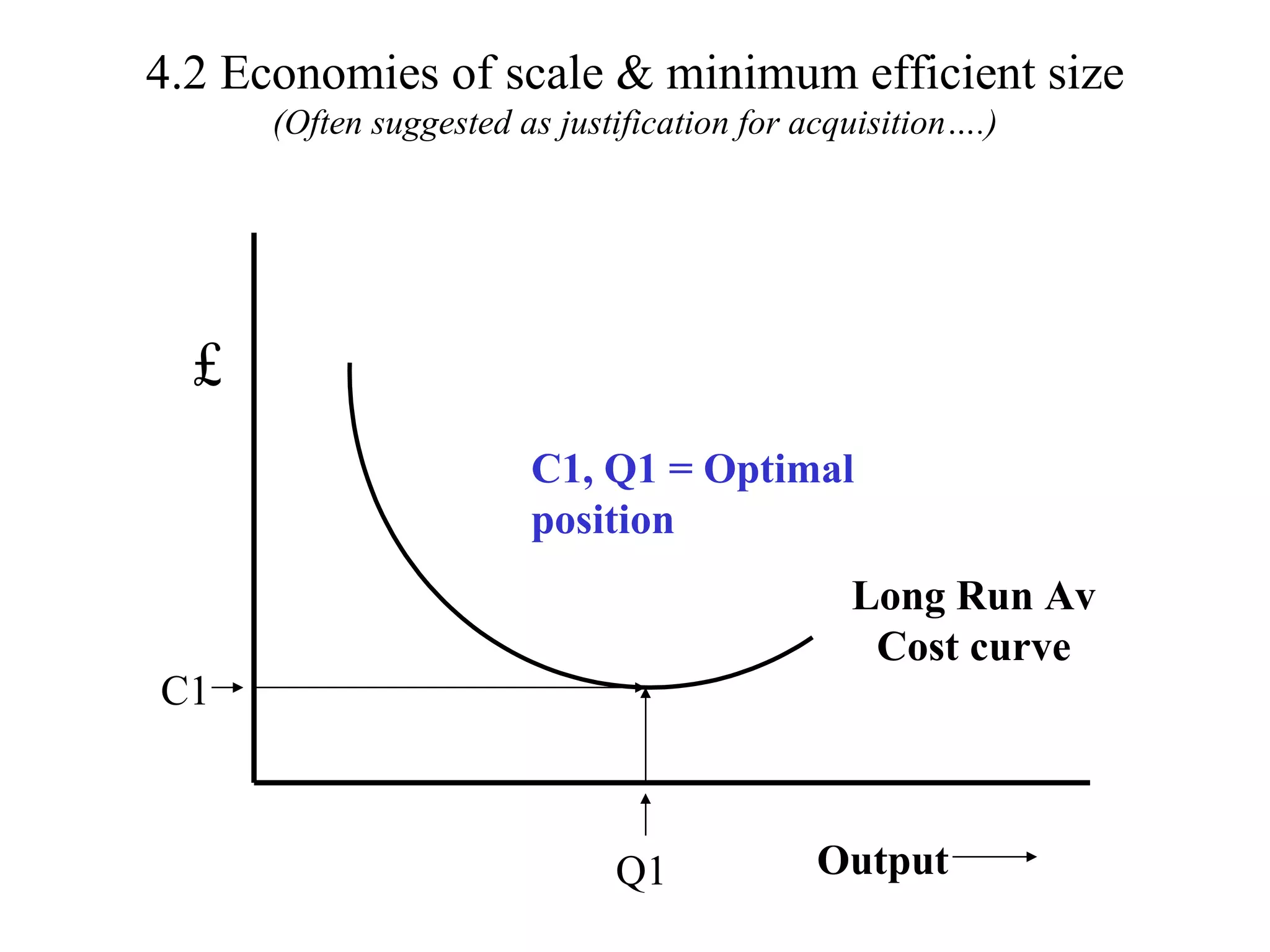
4.2 Economies of scale & minimum efficient size (Often suggested as justification for acquisition….) £ C1 Q1 Long Run Av Cost curve Output C1, Q1 = Optimal position
4.3 Key to Synergy “  It depends upon the selection of activities where interrelationships will occur. Recognising the costs and benefits to specific circumstances is important: knowing when NOT to pursue interdependencies may be as crucial as knowing when to seek them. The realisation of synergy depends upon how effectively linkages between activities are actually managed.”   Ensign 1998)
SOAR - Scenario planning in industry   Overall, then, the level of conservatism to be seen suggests that many managements will be unprepared for the surprises which await them…..the answer to this problem can be quite simple. Even the smallest organisations can now make use of scenario planning techniques as the starting point for producing robust strategies It is even possible to conduct the whole long-range planning process in a single day. Organisational futures: unprepared for the surprises to come. Mercer D (Management Decision 37/5 [1999] 411±416)

Structure

  • 1.
    Organisational Stress, Structureand Synergy External influences on structure and systems design and their implications for achievement of synergy
  • 2.
    Presentation A&O Todefine the various forms of and trends in the design of organisational structures To consider the relationship between the business environment (ie the titular ‘stress’ ), company strategy and choice of structure To analyse the respective characteristics of structural forms To consider the limiting effects of communication systems, relationships and organisational design upon the achievement of synergy
  • 3.
    Presentation Structure Sourcesand resources Definitions: stress; structure; synergy etc Organisational structures: conceptualisation / representation & basic forms analysed Influences on structure: scale, geography, complexity, competition, stability, management . Structure as an inhibitor of synergy Latest trends in organisation design
  • 4.
    Sources and resourcesGlobal trends in organisational design. Nikoloenko A & Kleiner B. (1996) Work Study Vol 45 No 7 pp23-26 (Management e jnls BU site) The Structuring of Organizations. Mintzberg H (1979) See Pt 1 pp17-65 Corporate Strategy for Tourism . Tribe J (1997) See pp 174 - 193 Interrelationships and horizontal strategy to achieve synergy and competitive advantage in the diversified firm . Ensign P (1998) Management Decision Vol 36 No 10 pp 657-668 (Management e jnls BU site) Ref: Porter’s 5 Forces and Value Chain models encountered with SR in BIT and elsewhere on BATS eg TILT unit. Competitive Advantage: creating and sustaining superior performance . Porter M (1985)
  • 5.
    Definitions: (All TJ- many ‘standard’ definitions were too limiting ) Stress : the set of external and internal pressures and influences for change acting upon the business which will demand a measured response in order for the business to survive and prosper. Structure : the ‘positions’ of the constituent elements of the organisation and the formal and informal relationships and processes which link these parts to one-another so as to create a productive system with fitness for purpose. Synergy : the positive product of interrelationships between two or more (business) units which is greater than the sum of the independent outputs of such units. (2+2 = 5)
  • 6.
    1.1 Organisational structuresMintzberg suggests all structures simply reflect: “...the sum total of ways in which a company divides its labour into distinct tasks and then achieves coordination among them.” The principal elements of organisational structure are: allocation of tasks and responsibilities to groups and individuals designation of reporting relationships (inc power, authority, control) definition of official groupings (around functions, products, geography) design of systems to support, integrate and reward NB ." Structure is never the whole story , it is just a way of dividing responsibilities among executives. It is meaningless unless supported by appropriate systems (communication, MIS etc TJ ) and a consistent culture.” Birkinshaw (2001)
  • 7.
    1.2i Conceptualising StructureStrategic Apex Operating Core Middle Line Mgt. Support Staff Techno-structure After Mintzberg (1979) secures I/pts t/fs I/pts to o/pts distributes o/pts Supplies ancillary services not rel to input/output:- Estates..payroll.. cleaning ..refectory Affects I/pt & o/pt by analysis & technical support. IT, personnel, planning etc Info collection, translation& transmission co-ordination resource allocation structure and process conflict resolution external relations task assignment funding strategic direction
  • 8.
    1.2ii Conceptualising StructureAfter Mintzberg (1979) Bold = formal authority and comms ………… . But that is less than half the picture.
  • 9.
    1.2iii Conceptualising StructureAfter Mintzberg (1979) Bold = formal authority and comms Arrows = possible informal relationships Perhaps this is the MDs daughter? What’s wrong with this guy? At the hub of the official and informal systems THE key position, but being marginalised by peers and subordinates The indispensable IT guy?
  • 10.
    1.3 StructuralForms Traditional Simple Functional vertically arranged & possibly high-dependence Divisional Holding / Portfolio / Conglomerate low-dependence Matrix & other Hybrids degree of dependence varies Newer ‘Forms’ The network organisation interdependence by choice The ‘virtual’ corporation
  • 11.
    1.4 Simple StructureThe ‘structure without a structure’ usually for new start ups, small operations where there is: small scale no complexity no multiple functional specialism requirement
  • 12.
    1.5 Functional StructurePros MD in touch with all operations obvious and simple control clear responsibilities focus on specialism Easy management succession within function Cons top management overburdened neglect of strategic company issues below apex difficulty in handling diverse product little natural lateral communication poor scope for TOP management succession. tends to become over-bureaucratic and centralised Acquisition & divestment difficulties
  • 13.
    1.6 Divisional Structuresa).Area-based & ). Product-based AREA BASED PRODUCT BASED
  • 14.
    1.7 Divisional StructuresPros Concentration on business areas /products Performance measurement via profit centres ‘ Closer’ to the customer Facilitates Snr Mgt attention to strategy Encourages general management development Supports delegation and engenders entrepreneurial activity Ease of divestment acquisition Cons divisions foster autonomy not unity possible confusion over extent of (de)centralisation Interdivisional rivalry and unhealthy competition disequilibrium caused by division size variences duplication of functions coordination difficulties
  • 15.
    1.8 Combining theDivisional and the Functional " There is no perfect structure- each has its own drawbacks. For most global companies it is a question of choosing the least bad structure and then figuring out how to mitigate its greatest weaknesses.” Birkinshaw (2001) Although Mintzberg saw these structural forms and others as ‘ideal types’ , effectively they are reference points on a continuum. Between these ‘points’ management seeks to bridge the gaps informally or more formally through such devices as: ad hoc, cross-functional (divisional) committees or groups to think product/ area (function) A liaison / co-ordination manager to formalise and extend the above Logically that is likely to end with one of three situations: a working, informal balance within the existing structure a shift to the dominant need embodied in structure (usually fcnl to divisional) the balancing of the ‘tension’ of product and function within a matrix structure
  • 16.
    1.9 Structural ContinuumStrategic Objectives Functional Structure Functional with interdepartmental liaison Matrix Structure Divisional Structure Networking Structure Strategic Objectives: Differentiation, innovation, flexibility Strategic Objectives: Cost leadership, efficiency, stability The drive for added value, excellence and competitive advantage in a turbulent environment are driving companies beyond an internal networking structure and towards a virtual organisation, enabled by ICT.
  • 17.
    1.10 The MatrixStructure The Board Function 2 Function 3 Area Division 2 Area / Division 1 Function l Area Division 2 But who is my boss?? I am when it suits me But so am I ! Result : A very stressful place to work!
  • 18.
    1.11 Service IndustriesHead of School Ac Gp: T L & S Resources Quality Ac Gp: F H & R Research & Consultancy Result : Looks like a shifting ‘Latent Matrix’, with the added tension of a third management pull plus a ‘virtual’ element. .. but is it Courses Courses Courses ‘ Virtual Graduate School’ Me ..responsible to: Keith Wilkes (Ac Gp) Jacqui Gush (Quality) Andy Boer (Resources) John Fletcher (ICTHR) John Edwards (Grad Sch) Derek Robbins (BATS) ICTHR
  • 19.
    1.12 Service IndustriesHead of School Ac Gp: T L & S Resources Quality Ac Gp: F H & R Research & Consultancy Ref to Nikolenko and Kleiner (1996) suggests that this is BU seeking the best of two worlds: the marriage of the product (courses) and functions (quality / resources) with newer concepts of ‘ The Horizontal Organisation’ : “.. autonomous, cross-functional teams, designed around critical processes. The teams are arranged to complete their projects in parallel, thus minimizing the subdivision of processes the heirarchy becomes flattened” . Courses Courses Courses ‘ Virtual Graduate School’ Me ..resp to: Keith Wilkes (Ac Gp) Jacqui Gush (Quality) Andy Boer (Resources) John Fletcher (ICTHR) John Edwards (Grad Sch) Derek Robbins (BATS) ICTHR
  • 20.
    1.13 The ‘Horizontal’Organisation (Also embodies ‘Network’ Orgs) The problem (IMHO) for SI is that it is not fully appreciating that the autonomy requirement of ‘Horizontal Organisations’ needs a different control system based on outputs not input control: “ In a functional hierarchy of vertically built companies, individual jobs and information flows are geared towards control. The cross-functional teams of the horizontal company do not require the same level of formal managerial ‘control because their work is aligned with customer needs and ‘controlled’ by a judgement of the final result.” Nikolenko & Kleiner (1996)
  • 21.
    1.14 The VirtualCorporation A transient, ephemeral form. A coalition of interested parties from various specialities and points on the value chain working together for a particular purpose, project or contract. The logical end point of outsourcing, whereby a network of suppliers is offering capability at the business unit or function level, such that these capabilities may be combined in a unique way to add value and competitive advantage. (TJ!) Nikolenko & Kleiner (1996) suggest that within a VC “..companies can share costs, skills, and access to global markets with one-another, with each contributing to the common goal what it is best at …. The VC appears to be a single firm with vast capacities, when in reality it is a collection of many smaller firms that work together to achieve a specific goal.”
  • 22.
    1.15 Structural dilemmasFlat - Tall Centralised - decentralised Product/ Brand … function…or customer? Command or consider Global vision - local delivery
  • 23.
  • 24.
    3.0 New Structures? Strategic Apex Operating Core In house Middle Line Mgt. Support Staff Techno-structure After Mintzberg (1979) Operating core virtual / outsourced
  • 25.
    4.0 Potential Synergiesfrom M & A Cost Based Synergies : economies of scale in production, R&D, admin , logistics, sales etc Revenue Based Synergies : new competency development to support premium price (via increased market power / innovation capability) or to increase sales volume. (After Wall S & Rees B (2001). Intro to Intnl Business)
  • 26.
    4.2 Economies ofscale & minimum efficient size (Often suggested as justification for acquisition….) £ C1 Q1 Long Run Av Cost curve Output C1, Q1 = Optimal position
  • 27.
    4.3 Key toSynergy “ It depends upon the selection of activities where interrelationships will occur. Recognising the costs and benefits to specific circumstances is important: knowing when NOT to pursue interdependencies may be as crucial as knowing when to seek them. The realisation of synergy depends upon how effectively linkages between activities are actually managed.” Ensign 1998)
  • 28.
    SOAR - Scenarioplanning in industry Overall, then, the level of conservatism to be seen suggests that many managements will be unprepared for the surprises which await them…..the answer to this problem can be quite simple. Even the smallest organisations can now make use of scenario planning techniques as the starting point for producing robust strategies It is even possible to conduct the whole long-range planning process in a single day. Organisational futures: unprepared for the surprises to come. Mercer D (Management Decision 37/5 [1999] 411±416)