Using Collaboration to Improve Effectiveness   (or Why Your Intranet Should be More Like the  Internet) Nikos Drakos Research Director, Social Software Selected Slides only
The First Step to a Happy Relationship: Speaking the Same Language! I want a wiki;  I want Facebook;  I want to work outside this box! I want $1.38 out of every $1 invested …in 9 months!
Justifying Collaboration Spending Is Hard Productivity is not profitability (or competitiveness). There are no reliable aggregate measures of the benefits.  Process/activity benefits are not enough to justify broad investments. The people who pay don't always get the benefits. Collaboration is about everyone working together on what they are told to do; the rest is a waste of time. The best plans can be ruined by a lack of end-user acceptance. Why are free consumer tools so much better than what we pay for?
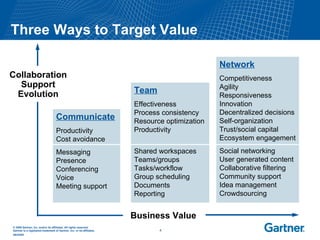
Three Ways to Target Value Business Value Collaboration Support Evolution Communicate Productivity Cost avoidance Messaging  Presence Conferencing Voice Meeting support Network Competitiveness Agility Responsiveness Innovation Decentralized decisions Self-organization Trust/social capital Ecosystem engagement Social networking User generated content Collaborative filtering Community support Idea management Crowdsourcing Team Effectiveness Process consistency Resource optimization Productivity  Shared workspaces Teams/groups Tasks/workflow Group scheduling Documents Reporting
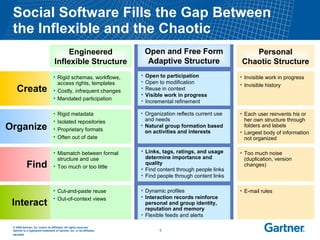
Social Software Fills the Gap Between the Inflexible and the Chaotic Engineered Inflexible Structure Personal Chaotic Structure Organize Create Find Interact Rigid schemas, workflows, access rights, templates Costly, infrequent changes Mandated participation Rigid metadata Isolated repositories Proprietary formats Often out of date Invisible work in progress Invisible history Each user reinvents his or her own structure through folders and labels Largest body of information not organized Cut-and-paste reuse Out-of-context views Mismatch between formal structure and use Too much or too little  Open and Free Form Adaptive Structure Open to participation Open to modification Reuse in context Visible work in progress Incremental refinement Links, tags, ratings, and usage determine importance and quality Find content through people links Find people through content links Dynamic profiles Interaction records reinforce personal and group identity, reputation and memory Flexible feeds and alerts Organization reflects current use and needs Natural group formation based on activities and interests Too much noise (duplication, version changes) E-mail rules
What Can Go Wrong:  Loosening Up is Not Easy Support for social interactions will release and amplify hidden creativity as well as pent up frustration. Transparency across teams and departments  => Loss of control over people and information Guidelines and policies on acceptable use of resources; respect of confidentiality Open systems, easy publishing  =>  Compromised quality , loudest voice wins, negativity, and personal attacks Discourage/disallow anonymity; use 'social accounting' for trust and reputation; intervention more necessary in early stages Messy and unreliable user-controlled classification systems  =>  Redundancy and inconsistencies Accept some 'messiness' in organizing information that would not be organized in any other way Privacy risks  =>  ‘Employee monitoring' fears Education and user control over what information about them is available to others
Recommendations Build successful business cases by linking collaboration support to business performance.  Combine hard numbers with soft anecdotal evidence.  Look for activities that will benefit from communication, coordination, multitasking and networking.  Rethink policies of  "restricted access by  default" — especially for jobs that depend on exploration, innovation, creativity and discovery.  Use good governance to stamp out problems from open information access, less editorial control, misuse. Use disposable, low-priced products as negotiating levers.

Using Collaboration To Improve Effectiveness

  • 1.
    Using Collaboration toImprove Effectiveness (or Why Your Intranet Should be More Like the  Internet) Nikos Drakos Research Director, Social Software Selected Slides only
  • 2.
    The First Stepto a Happy Relationship: Speaking the Same Language! I want a wiki; I want Facebook; I want to work outside this box! I want $1.38 out of every $1 invested …in 9 months!
  • 3.
    Justifying Collaboration SpendingIs Hard Productivity is not profitability (or competitiveness). There are no reliable aggregate measures of the benefits. Process/activity benefits are not enough to justify broad investments. The people who pay don't always get the benefits. Collaboration is about everyone working together on what they are told to do; the rest is a waste of time. The best plans can be ruined by a lack of end-user acceptance. Why are free consumer tools so much better than what we pay for?
  • 4.
    Three Ways toTarget Value Business Value Collaboration Support Evolution Communicate Productivity Cost avoidance Messaging Presence Conferencing Voice Meeting support Network Competitiveness Agility Responsiveness Innovation Decentralized decisions Self-organization Trust/social capital Ecosystem engagement Social networking User generated content Collaborative filtering Community support Idea management Crowdsourcing Team Effectiveness Process consistency Resource optimization Productivity Shared workspaces Teams/groups Tasks/workflow Group scheduling Documents Reporting
  • 5.
    Social Software Fillsthe Gap Between the Inflexible and the Chaotic Engineered Inflexible Structure Personal Chaotic Structure Organize Create Find Interact Rigid schemas, workflows, access rights, templates Costly, infrequent changes Mandated participation Rigid metadata Isolated repositories Proprietary formats Often out of date Invisible work in progress Invisible history Each user reinvents his or her own structure through folders and labels Largest body of information not organized Cut-and-paste reuse Out-of-context views Mismatch between formal structure and use Too much or too little Open and Free Form Adaptive Structure Open to participation Open to modification Reuse in context Visible work in progress Incremental refinement Links, tags, ratings, and usage determine importance and quality Find content through people links Find people through content links Dynamic profiles Interaction records reinforce personal and group identity, reputation and memory Flexible feeds and alerts Organization reflects current use and needs Natural group formation based on activities and interests Too much noise (duplication, version changes) E-mail rules
  • 6.
    What Can GoWrong: Loosening Up is Not Easy Support for social interactions will release and amplify hidden creativity as well as pent up frustration. Transparency across teams and departments => Loss of control over people and information Guidelines and policies on acceptable use of resources; respect of confidentiality Open systems, easy publishing => Compromised quality , loudest voice wins, negativity, and personal attacks Discourage/disallow anonymity; use 'social accounting' for trust and reputation; intervention more necessary in early stages Messy and unreliable user-controlled classification systems => Redundancy and inconsistencies Accept some 'messiness' in organizing information that would not be organized in any other way Privacy risks => ‘Employee monitoring' fears Education and user control over what information about them is available to others
  • 7.
    Recommendations Build successfulbusiness cases by linking collaboration support to business performance. Combine hard numbers with soft anecdotal evidence. Look for activities that will benefit from communication, coordination, multitasking and networking. Rethink policies of "restricted access by default" — especially for jobs that depend on exploration, innovation, creativity and discovery. Use good governance to stamp out problems from open information access, less editorial control, misuse. Use disposable, low-priced products as negotiating levers.

Editor's Notes

  • #2 For more information about our research policies, processes and methodologies, please visit Gartner Research Methodology on gartner.com. These materials can be reproduced only with written approval from Gartner. Such approvals must be requested via e-mail: vendor.relations@gartner.com. Nikos Drakos Collaborative Workspaces  Now and in the Future: Why Your Intranet Should be More Like the  Internet
  • #3 06/24/09 Collaboration support can impact a lot of different kinds of business activities. To succeed, it is critical to understand how and where these solutions offer value, and how they can improve the effectiveness and performance of the organization. But business value is hard to quantify for CFOs accustomed to seeing spreadsheets designed to compute to the minute when an investment will earn its keep. In this presentation, we look both at "hard" numbers and "soft" anecdotal evidence that can help to reconcile end-user demands for tools and technology with the need to ensure maximum return on investments.
  • #4 06/24/09 Key Issue: What is an appropriate framework for justifying collaboration support investments?
  • #5 06/24/09 Key Issue: What are the pain points and the opportunities where collaboration support can deliver measurable value?
  • #6 06/24/09 Tactical Guideline: Augment established collaboration support with easy-to-use, free-form environments that encourage participants to experiment with, communicate about and share their work.
  • #7 06/24/09 Strategic Planning Assumption: Through 2009, due to security, technology maturity, and compliance concerns fewer than 30 percent of Fortune 1000 companies will have formal support for enterprise-wide social software platforms.
  • #8 06/24/09 Recommendations