And its relation to the four dominant scientific
DWH-modeling concepts
Data warehousing in practice
Drs. S.F.J Otten
13-05-2014
Topics
 About me…
 Business Intelligence
 What is a Data warehouse (DWH)
 DWH – Design strategies
 Data-modeling
 Brief history in data modeling
 Star-schematic
 Snowflake-schematic
 Datavault
 Anchormodeling
 Pratical examples
 Summary
About me…
 Education
 Highschool (MAVO)
 College (MBO ICT lvl.4)
 Univeristy of Applied
sciences (Avans
Hogeschool, Business
Informatics; BSc)
 Utrecht University (MBI;
MSc)
 Utrecht University
(Dissertation on
BI,DM,PPM; PhD)
 Carreer till now..
 CSB-System BV/GmbH
(privatly held, 500-1000
employees globally) (2010-
present)
 BI-consultant/architect
(Microsoft BI stack)
 SQL-Programmer
 Expert-role at
programmingdepartment for
BI-development at HQ
 Semantic development
Business Intelligence
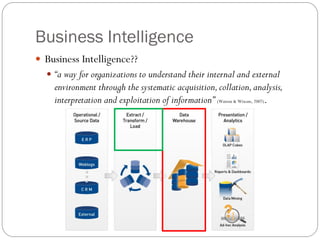
 Business Intelligence??
 “a way for organizations to understand their internal and external
environment through the systematic acquisition,collation,analysis,
interpretation and exploitation of information” (Watson & Wixom, 2007).
What is a Data warehouse (1)
 Data warehouse?? (DWH)
 “a repository where all data relevant to the management of an
organization is stored and from which knowledge emerges.” (March & Hevner,
2007)
 “A data warehouse is a subject-oriented,integrated,time-variant,
nonvolatile collection of data in support of management’s decision-
making process.”(Inmon, 1992)
 Different definitions same goal;
 provide data in such a way that it has meaning and can be used
in all levels of an organization as input for a decision-making-
process
DWH – design strategies (1)
 Enterprise wide DWH-design (Imnon, 2002)
 DWH is designed by using a normalized enterprise data model
From the EDWH data marts for specific business domains are
derived
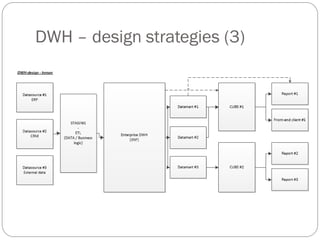
 Data mart design (Kimball, 2002)
 Hybrid strategy (top-down & bottom-up) for DWH-design
 Create datamarts in a bottom-up fasion
 Datamart-design conforms to a top-down
skeleton/framwork-design which is called the “data
warehouse bus”
 The EDW = the union of the conformed datamarts
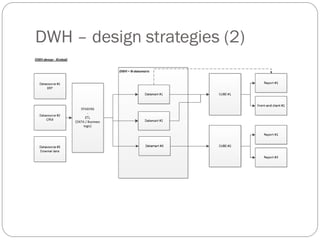
DWH – design strategies (2)
DWH – design strategies (3)
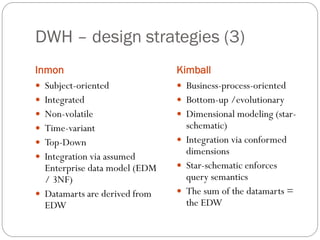
Inmon Kimball
 Subject-oriented
 Integrated
 Non-volatile
 Time-variant
 Top-Down
 Integration via assumed
Enterprise data model (EDM
/ 3NF)
 Datamarts are derived from
EDW
 Business-process-oriented
 Bottom-up /evolutionary
 Dimensional modeling (star-
schematic)
 Integration via conformed
dimensions
 Star-schematic enforces
query semantics
 The sum of the datamarts =
the EDW
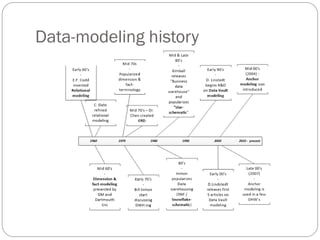
Data-modeling history
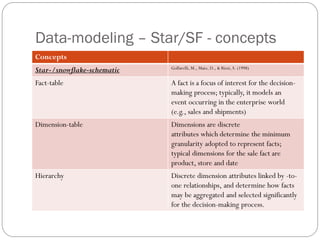
Data-modeling – Star/SF - concepts
Concepts
Star-/snowflake-schematic Golfarelli, M., Maio, D., & Rizzi, S. (1998)
Fact-table A fact is a focus of interest for the decision-
making process; typically, it models an
event occurring in the enterprise world
(e.g., sales and shipments)
Dimension-table Dimensions are discrete
attributes which determine the minimum
granularity adopted to represent facts;
typical dimensions for the sale fact are
product, store and date
Hierarchy Discrete dimension attributes linked by -to-
one relationships, and determine how facts
may be aggregated and selected significantly
for the decision-making process.
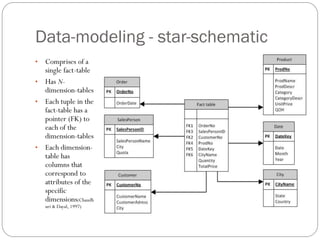
Data-modeling - star-schematic
• Comprises of a
single fact-table
• Has N-
dimension-tables
• Each tuple in the
fact-table has a
pointer (FK) to
each of the
dimension-tables
• Each dimension-
table has
columns that
correspond to
attributes of the
specific
dimensions(Chaudh
uri & Dayal, 1997)
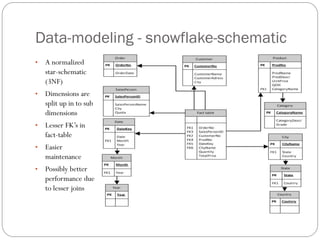
Data-modeling - snowflake-schematic
• A normalized
star-schematic
(3NF)
• Dimensions are
split up in to sub
dimensions
• Lesser FK’s in
fact-table
• Easier
maintenance
• Possibly better
performance due
to lesser joins
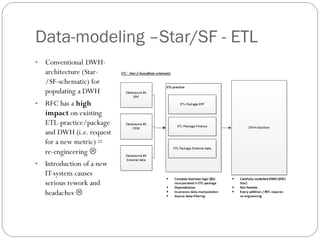
Data-modeling –Star/SF - ETL
• Conventional DWH-
architecture (Star-
/SF-schematic) for
populating a DWH
• RFC has a high
impact on existing
ETL-practice/package
and DWH (i.e. request
for a new metric) =
re-engineering 
• Introduction of a new
IT-system causes
serious rework and
headaches 
Data-modeling – Star/SF – ETL - P.O.A
 Two types of ETL:
 FULL ETL
 Complete transfer of all data in source-systems via ETL-packages
 Incremental ETL
 After FULL ETL , incremental ETL determines the delta and loads it into
the DWH.The loading can be :
 INSERT records that are not present in the DWH
 UPDATE records that have changed values in certain columns
o Requires UPDATE-statements need to take into account the keys
(primary and foreign) that uniquely identify a record in a table and
execute the UPDATE-statement); risky if not entirely clear
what the unique identifier is.
Data-modeling – Star/SF – Case (1)
 DWH = Snowflake-architecture (3NF)
 Dimension-tables (DimItem,DimInvoice)
 Fact-table (FactSalesStatistics)
 ETL comprises a FULL and INCREMENTAL-load
 Client A sends an RFC for an addition in the sales-overview.
 Addition = metric “NetValue” per item per invoice
 Additional req= metric “NetValue” is present for future data
and also for data allready residing in the sales-overview
 How would you guys, as future Business-/Technical-consultants
/ researches approach this case??
Data-modeling – Star/SF – Case (2)
 Solution
 Identify column containing metric “NetValue” in the source-system
(requires in-depth analysis of transactional system)
 Add column to fact table “FactSalesStatistics” ([NetValue] [decimal]
(x,y) NULL)
 Revert to appropriate ETL-package;
 Adjust the source-query / source-columns to include the identified column
(metric)
 Adjust the function that determines the Delta (add identified column)
 Adjust the INSERT-command to write the value from the identified source-
column  metric “NetValue” in fact-table “FactSalesStatistics”
 Adjust the UPDATE-command to update the metric “NetValue” with the
value from the identified source-column for the existing data in table
“FactSalesStatistics”
 VALIDATE…VALIDATE…VALIDATE…the ERP-data and DWH-
data (especially in the beginning)
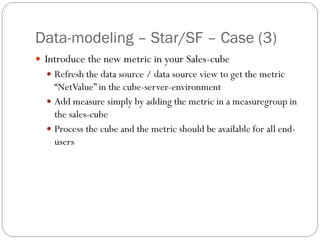
Data-modeling – Star/SF – Case (3)
 Introduce the new metric in your Sales-cube
 Refresh the data source / data source view to get the metric
“NetValue” in the cube-server-environment
 Add measure simply by adding the metric in a measuregroup in
the sales-cube
 Process the cube and the metric should be available for all end-
users
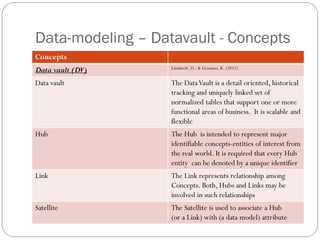
Data-modeling – Datavault - Concepts
Concepts
Data vault (DV) Lindstedt, D., & Graziano, K. (2011)
Data vault The DataVault is a detail oriented, historical
tracking and uniquely linked set of
normalized tables that support one or more
functional areas of business. It is scalable and
flexible
Hub The Hub is intended to represent major
identifiable concepts-entities of interest from
the real world. It is required that every Hub
entity can be denoted by a unique identifier
Link The Link represents relationship among
Concepts. Both, Hubs and Links may be
involved in such relationships
Satellite The Satellite is used to associate a Hub
(or a Link) with (a data model) attribute
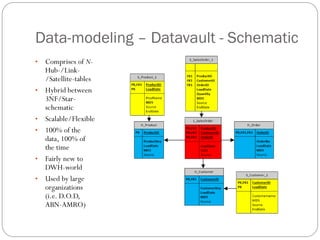
Data-modeling – Datavault - Schematic
• Comprises of N-
Hub-/Link-
/Satellite-tables
• Hybrid between
3NF/Star-
schematic
• Scalable/Flexible
• 100% of the
data, 100% of
the time
• Fairly new to
DWH-world
• Used by large
organizations
(i.e. D.O.D,
ABN-AMRO)
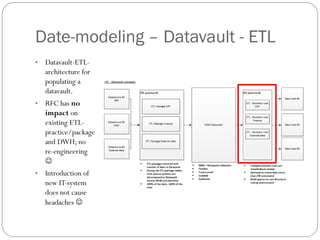
Date-modeling – Datavault - ETL
• Datavault-ETL-
architecture for
populating a
datavault.
• RFC has no
impact on
existing ETL-
practice/package
and DWH; no
re-engineering

• Introduction of
new IT-system
does not cause
headaches 
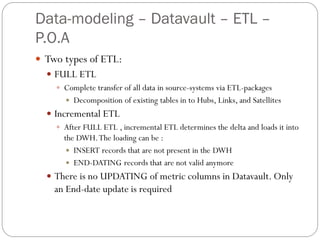
Data-modeling – Datavault – ETL –
P.O.A
 Two types of ETL:
 FULL ETL
 Complete transfer of all data in source-systems via ETL-packages
 Decomposition of existing tables in to Hubs, Links, and Satellites
 Incremental ETL
 After FULL ETL , incremental ETL determines the delta and loads it into
the DWH.The loading can be :
 INSERT records that are not present in the DWH
 END-DATING records that are not valid anymore
 There is no UPDATING of metric columns in Datavault. Only
an End-date update is required
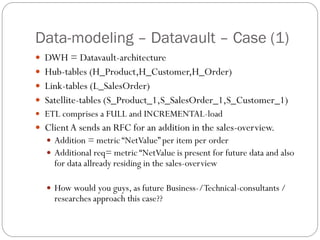
Data-modeling – Datavault – Case (1)
 DWH = Datavault-architecture
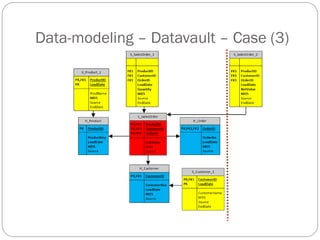
 Hub-tables (H_Product,H_Customer,H_Order)
 Link-tables (L_SalesOrder)
 Satellite-tables (S_Product_1,S_SalesOrder_1,S_Customer_1)
 ETL comprises a FULL and INCREMENTAL-load
 ClientA sends an RFC for an addition in the sales-overview.
 Addition = metric “NetValue” per item per order
 Additional req= metric “NetValue is present for future data and also
for data allready residing in the sales-overview
 How would you guys, as future Business-/Technical-consultants /
researches approach this case??
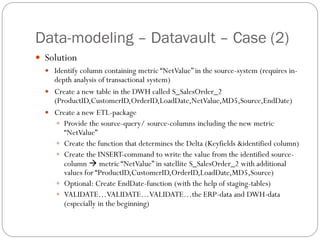
Data-modeling – Datavault – Case (2)
 Solution
 Identify column containing metric “NetValue” in the source-system (requires in-
depth analysis of transactional system)
 Create a new table in the DWH called S_SalesOrder_2
(ProductID,CustomerID,OrderID,LoadDate,NetValue,MD5,Source,EndDate)
 Create a new ETL-package
 Provide the source-query/ source-columns including the new metric
“NetValue”
 Create the function that determines the Delta (Keyfields &identified column)
 Create the INSERT-command to write the value from the identified source-
column  metric “NetValue” in satellite S_SalesOrder_2 with additional
values for “ProductID,CustomerID,OrderID,LoadDate,MD5,Source)
 Optional: Create EndDate-function (with the help of staging-tables)
 VALIDATE…VALIDATE…VALIDATE…the ERP-data and DWH-data
(especially in the beginning)
Data-modeling – Datavault – Case (3)
Data-modeling – Datavault – Case (4)
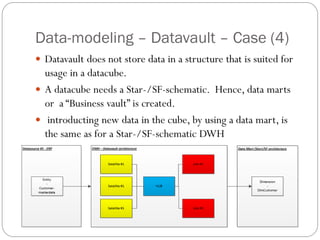
 Datavault does not store data in a structure that is suited for
usage in a datacube.
 A datacube needs a Star-/SF-schematic. Hence, data marts
or a “Business vault” is created.
 introducting new data in the cube, by using a data mart, is
the same as for a Star-/SF-schematic DWH
Data-modeling – Anchormodeling -
concepts
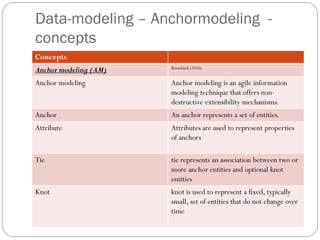
Concepts
Anchor modeling (AM) Rönnbäck (2010)
Anchor modeling Anchor modeling is an agile information
modeling technique that offers non-
destructive extensibility mechanisms.
Anchor An anchor represents a set of entities.
Attribute Attributes are used to represent properties
of anchors
Tie tie represents an association between two or
more anchor entities and optional knot
entities
Knot knot is used to represent a fixed, typically
small, set of entities that do not change over
time
Data-modeling – anchormodeling -
schematic
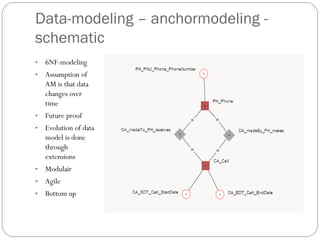
• 6NF-modeling
• Assumption of
AM is that data
changes over
time
• Future proof
• Evolution of data
model is done
through
extensions
• Modulair
• Agile
• Bottom up
Data-modeling – anchormodeling - ETL
 ETL-procedure has many similarities with DV-ETL-ing
 In DV first the HUBS are filled, followed by the LINKS and to
finish it of the SATELLITES are filled.
 With AM at first the ANCHORS are populated, followed by
theTIES and ATTRIBUTES
 In addition a metadata-repository is filled with each ETL-run
 Like DV, there are only INSERT-statements and END-
DATING-procedures.
 NO UPDATE-statement
 DELETE-statement is only performed when errornous data is
loaded for a given batch
Data-modeling – anchormodeling –
ETL – P.O.A
 In an ANCHOR only the surrogate key is stored.While with
DV in a HUB the surrogate key and businesskey are stored
together
 How is this resolved in an ETL-environment?
 Well, when implementing anAM in a database, views are
created for each anchor (comprising the anchor and attributes)
with an insert-trigger
 We can simply populate the anchor and attributes through the view
created by the online modeler.
 Additional attributes can be loaded in parallel like in DV. For
each of those attributes the surrogatekey is resolved by
referencing the businesskey-attribute.
BREAK
Practical examples
 Star /SF-schematic
 ETL
 DWH
 Datavault
 ETL
 DWH
 Anchor Modeling
 ETL
 DWH
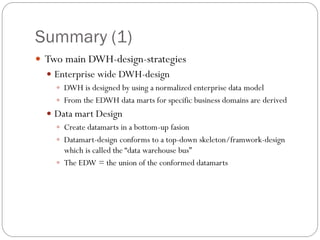
Summary (1)
 Two main DWH-design-strategies
 Enterprise wide DWH-design
 DWH is designed by using a normalized enterprise data model
 From the EDWH data marts for specific business domains are derived
 Data mart Design
 Create datamarts in a bottom-up fasion
 Datamart-design conforms to a top-down skeleton/framwork-design
which is called the “data warehouse bus”
 The EDW = the union of the conformed datamarts
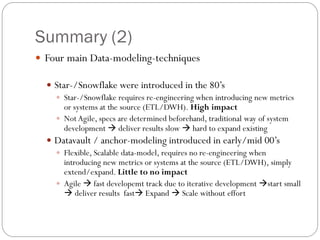
Summary (2)
 Four main Data-modeling-techniques
 Star-/Snowflake were introduced in the 80’s
 Star-/Snowflake requires re-engineering when introducing new metrics
or systems at the source (ETL/DWH). High impact
 Not Agile, specs are determined beforehand, traditional way of system
development  deliver results slow  hard to expand existing
 Datavault / anchor-modeling introduced in early/mid 00’s
 Flexible, Scalable data-model, requires no re-engineering when
introducing new metrics or systems at the source (ETL/DWH), simply
extend/expand. Little to no impact
 Agile  fast developemt track due to iterative development start small
 deliver results fast Expand  Scale without effort
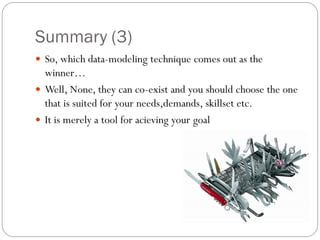
Summary (3)
 So, which data-modeling technique comes out as the
winner…
 Well, None, they can co-exist and you should choose the one
that is suited for your needs,demands, skillset etc.
 It is merely a tool for acieving your goal
Thank you
 @Linkedin : http://nl.linkedin.com/in/sjorsotten
 @mail : Sjors.Otten@csb.com

BI - Data warehousing in practice

  • 1.
    And its relationto the four dominant scientific DWH-modeling concepts Data warehousing in practice Drs. S.F.J Otten 13-05-2014
  • 2.
    Topics  About me… Business Intelligence  What is a Data warehouse (DWH)  DWH – Design strategies  Data-modeling  Brief history in data modeling  Star-schematic  Snowflake-schematic  Datavault  Anchormodeling  Pratical examples  Summary
  • 3.
    About me…  Education Highschool (MAVO)  College (MBO ICT lvl.4)  Univeristy of Applied sciences (Avans Hogeschool, Business Informatics; BSc)  Utrecht University (MBI; MSc)  Utrecht University (Dissertation on BI,DM,PPM; PhD)  Carreer till now..  CSB-System BV/GmbH (privatly held, 500-1000 employees globally) (2010- present)  BI-consultant/architect (Microsoft BI stack)  SQL-Programmer  Expert-role at programmingdepartment for BI-development at HQ  Semantic development
  • 4.
    Business Intelligence  BusinessIntelligence??  “a way for organizations to understand their internal and external environment through the systematic acquisition,collation,analysis, interpretation and exploitation of information” (Watson & Wixom, 2007).
  • 5.
    What is aData warehouse (1)  Data warehouse?? (DWH)  “a repository where all data relevant to the management of an organization is stored and from which knowledge emerges.” (March & Hevner, 2007)  “A data warehouse is a subject-oriented,integrated,time-variant, nonvolatile collection of data in support of management’s decision- making process.”(Inmon, 1992)  Different definitions same goal;  provide data in such a way that it has meaning and can be used in all levels of an organization as input for a decision-making- process
  • 6.
    DWH – designstrategies (1)  Enterprise wide DWH-design (Imnon, 2002)  DWH is designed by using a normalized enterprise data model From the EDWH data marts for specific business domains are derived  Data mart design (Kimball, 2002)  Hybrid strategy (top-down & bottom-up) for DWH-design  Create datamarts in a bottom-up fasion  Datamart-design conforms to a top-down skeleton/framwork-design which is called the “data warehouse bus”  The EDW = the union of the conformed datamarts
  • 7.
    DWH – designstrategies (2)
  • 8.
    DWH – designstrategies (3)
  • 9.
    DWH – designstrategies (3) Inmon Kimball  Subject-oriented  Integrated  Non-volatile  Time-variant  Top-Down  Integration via assumed Enterprise data model (EDM / 3NF)  Datamarts are derived from EDW  Business-process-oriented  Bottom-up /evolutionary  Dimensional modeling (star- schematic)  Integration via conformed dimensions  Star-schematic enforces query semantics  The sum of the datamarts = the EDW
  • 10.
  • 11.
    Data-modeling – Star/SF- concepts Concepts Star-/snowflake-schematic Golfarelli, M., Maio, D., & Rizzi, S. (1998) Fact-table A fact is a focus of interest for the decision- making process; typically, it models an event occurring in the enterprise world (e.g., sales and shipments) Dimension-table Dimensions are discrete attributes which determine the minimum granularity adopted to represent facts; typical dimensions for the sale fact are product, store and date Hierarchy Discrete dimension attributes linked by -to- one relationships, and determine how facts may be aggregated and selected significantly for the decision-making process.
  • 12.
    Data-modeling - star-schematic •Comprises of a single fact-table • Has N- dimension-tables • Each tuple in the fact-table has a pointer (FK) to each of the dimension-tables • Each dimension- table has columns that correspond to attributes of the specific dimensions(Chaudh uri & Dayal, 1997)
  • 13.
    Data-modeling - snowflake-schematic •A normalized star-schematic (3NF) • Dimensions are split up in to sub dimensions • Lesser FK’s in fact-table • Easier maintenance • Possibly better performance due to lesser joins
  • 14.
    Data-modeling –Star/SF -ETL • Conventional DWH- architecture (Star- /SF-schematic) for populating a DWH • RFC has a high impact on existing ETL-practice/package and DWH (i.e. request for a new metric) = re-engineering  • Introduction of a new IT-system causes serious rework and headaches 
  • 15.
    Data-modeling – Star/SF– ETL - P.O.A  Two types of ETL:  FULL ETL  Complete transfer of all data in source-systems via ETL-packages  Incremental ETL  After FULL ETL , incremental ETL determines the delta and loads it into the DWH.The loading can be :  INSERT records that are not present in the DWH  UPDATE records that have changed values in certain columns o Requires UPDATE-statements need to take into account the keys (primary and foreign) that uniquely identify a record in a table and execute the UPDATE-statement); risky if not entirely clear what the unique identifier is.
  • 16.
    Data-modeling – Star/SF– Case (1)  DWH = Snowflake-architecture (3NF)  Dimension-tables (DimItem,DimInvoice)  Fact-table (FactSalesStatistics)  ETL comprises a FULL and INCREMENTAL-load  Client A sends an RFC for an addition in the sales-overview.  Addition = metric “NetValue” per item per invoice  Additional req= metric “NetValue” is present for future data and also for data allready residing in the sales-overview  How would you guys, as future Business-/Technical-consultants / researches approach this case??
  • 17.
    Data-modeling – Star/SF– Case (2)  Solution  Identify column containing metric “NetValue” in the source-system (requires in-depth analysis of transactional system)  Add column to fact table “FactSalesStatistics” ([NetValue] [decimal] (x,y) NULL)  Revert to appropriate ETL-package;  Adjust the source-query / source-columns to include the identified column (metric)  Adjust the function that determines the Delta (add identified column)  Adjust the INSERT-command to write the value from the identified source- column  metric “NetValue” in fact-table “FactSalesStatistics”  Adjust the UPDATE-command to update the metric “NetValue” with the value from the identified source-column for the existing data in table “FactSalesStatistics”  VALIDATE…VALIDATE…VALIDATE…the ERP-data and DWH- data (especially in the beginning)
  • 18.
    Data-modeling – Star/SF– Case (3)  Introduce the new metric in your Sales-cube  Refresh the data source / data source view to get the metric “NetValue” in the cube-server-environment  Add measure simply by adding the metric in a measuregroup in the sales-cube  Process the cube and the metric should be available for all end- users
  • 19.
    Data-modeling – Datavault- Concepts Concepts Data vault (DV) Lindstedt, D., & Graziano, K. (2011) Data vault The DataVault is a detail oriented, historical tracking and uniquely linked set of normalized tables that support one or more functional areas of business. It is scalable and flexible Hub The Hub is intended to represent major identifiable concepts-entities of interest from the real world. It is required that every Hub entity can be denoted by a unique identifier Link The Link represents relationship among Concepts. Both, Hubs and Links may be involved in such relationships Satellite The Satellite is used to associate a Hub (or a Link) with (a data model) attribute
  • 20.
    Data-modeling – Datavault- Schematic • Comprises of N- Hub-/Link- /Satellite-tables • Hybrid between 3NF/Star- schematic • Scalable/Flexible • 100% of the data, 100% of the time • Fairly new to DWH-world • Used by large organizations (i.e. D.O.D, ABN-AMRO)
  • 21.
    Date-modeling – Datavault- ETL • Datavault-ETL- architecture for populating a datavault. • RFC has no impact on existing ETL- practice/package and DWH; no re-engineering  • Introduction of new IT-system does not cause headaches 
  • 22.
    Data-modeling – Datavault– ETL – P.O.A  Two types of ETL:  FULL ETL  Complete transfer of all data in source-systems via ETL-packages  Decomposition of existing tables in to Hubs, Links, and Satellites  Incremental ETL  After FULL ETL , incremental ETL determines the delta and loads it into the DWH.The loading can be :  INSERT records that are not present in the DWH  END-DATING records that are not valid anymore  There is no UPDATING of metric columns in Datavault. Only an End-date update is required
  • 23.
    Data-modeling – Datavault– Case (1)  DWH = Datavault-architecture  Hub-tables (H_Product,H_Customer,H_Order)  Link-tables (L_SalesOrder)  Satellite-tables (S_Product_1,S_SalesOrder_1,S_Customer_1)  ETL comprises a FULL and INCREMENTAL-load  ClientA sends an RFC for an addition in the sales-overview.  Addition = metric “NetValue” per item per order  Additional req= metric “NetValue is present for future data and also for data allready residing in the sales-overview  How would you guys, as future Business-/Technical-consultants / researches approach this case??
  • 24.
    Data-modeling – Datavault– Case (2)  Solution  Identify column containing metric “NetValue” in the source-system (requires in- depth analysis of transactional system)  Create a new table in the DWH called S_SalesOrder_2 (ProductID,CustomerID,OrderID,LoadDate,NetValue,MD5,Source,EndDate)  Create a new ETL-package  Provide the source-query/ source-columns including the new metric “NetValue”  Create the function that determines the Delta (Keyfields &identified column)  Create the INSERT-command to write the value from the identified source- column  metric “NetValue” in satellite S_SalesOrder_2 with additional values for “ProductID,CustomerID,OrderID,LoadDate,MD5,Source)  Optional: Create EndDate-function (with the help of staging-tables)  VALIDATE…VALIDATE…VALIDATE…the ERP-data and DWH-data (especially in the beginning)
  • 25.
  • 26.
    Data-modeling – Datavault– Case (4)  Datavault does not store data in a structure that is suited for usage in a datacube.  A datacube needs a Star-/SF-schematic. Hence, data marts or a “Business vault” is created.  introducting new data in the cube, by using a data mart, is the same as for a Star-/SF-schematic DWH
  • 27.
    Data-modeling – Anchormodeling- concepts Concepts Anchor modeling (AM) Rönnbäck (2010) Anchor modeling Anchor modeling is an agile information modeling technique that offers non- destructive extensibility mechanisms. Anchor An anchor represents a set of entities. Attribute Attributes are used to represent properties of anchors Tie tie represents an association between two or more anchor entities and optional knot entities Knot knot is used to represent a fixed, typically small, set of entities that do not change over time
  • 28.
    Data-modeling – anchormodeling- schematic • 6NF-modeling • Assumption of AM is that data changes over time • Future proof • Evolution of data model is done through extensions • Modulair • Agile • Bottom up
  • 29.
    Data-modeling – anchormodeling- ETL  ETL-procedure has many similarities with DV-ETL-ing  In DV first the HUBS are filled, followed by the LINKS and to finish it of the SATELLITES are filled.  With AM at first the ANCHORS are populated, followed by theTIES and ATTRIBUTES  In addition a metadata-repository is filled with each ETL-run  Like DV, there are only INSERT-statements and END- DATING-procedures.  NO UPDATE-statement  DELETE-statement is only performed when errornous data is loaded for a given batch
  • 30.
    Data-modeling – anchormodeling– ETL – P.O.A  In an ANCHOR only the surrogate key is stored.While with DV in a HUB the surrogate key and businesskey are stored together  How is this resolved in an ETL-environment?  Well, when implementing anAM in a database, views are created for each anchor (comprising the anchor and attributes) with an insert-trigger  We can simply populate the anchor and attributes through the view created by the online modeler.  Additional attributes can be loaded in parallel like in DV. For each of those attributes the surrogatekey is resolved by referencing the businesskey-attribute.
  • 31.
  • 32.
    Practical examples  Star/SF-schematic  ETL  DWH  Datavault  ETL  DWH  Anchor Modeling  ETL  DWH
  • 33.
    Summary (1)  Twomain DWH-design-strategies  Enterprise wide DWH-design  DWH is designed by using a normalized enterprise data model  From the EDWH data marts for specific business domains are derived  Data mart Design  Create datamarts in a bottom-up fasion  Datamart-design conforms to a top-down skeleton/framwork-design which is called the “data warehouse bus”  The EDW = the union of the conformed datamarts
  • 34.
    Summary (2)  Fourmain Data-modeling-techniques  Star-/Snowflake were introduced in the 80’s  Star-/Snowflake requires re-engineering when introducing new metrics or systems at the source (ETL/DWH). High impact  Not Agile, specs are determined beforehand, traditional way of system development  deliver results slow  hard to expand existing  Datavault / anchor-modeling introduced in early/mid 00’s  Flexible, Scalable data-model, requires no re-engineering when introducing new metrics or systems at the source (ETL/DWH), simply extend/expand. Little to no impact  Agile  fast developemt track due to iterative development start small  deliver results fast Expand  Scale without effort
  • 35.
    Summary (3)  So,which data-modeling technique comes out as the winner…  Well, None, they can co-exist and you should choose the one that is suited for your needs,demands, skillset etc.  It is merely a tool for acieving your goal
  • 36.
    Thank you  @Linkedin: http://nl.linkedin.com/in/sjorsotten  @mail : Sjors.Otten@csb.com