NOIDA INTERNATIONAL UNIVERSITY
GREATER NOIDA
DEPARTMENT OF MECHANICALENGINEERING
INDUSTRIAL TRAINING PRESENTATION
ON
Bharat Heavy Electricals
Limited, Haridwar
(Uttarakhand)
Submitted To :
Ms.Nidhi Sindhu (Asst.Prof)
Submitted By :
Md Shahnwaz Anwer
Mohammad Nadeem Khan
Chandra Pratap Shastri
Naveen Baghel
TABLE OF CONTENTS
 INTRODUCTION OF B.H.E.L
 OVERVIEW OF THE ENTERPRISE
 OCCUPATIONAL HEALTH AND SAFETY POLICY
 STEAM TURBINES
 TYPES OF STEAM TURBINE
 MANUFACTURING PROCESS
 BLOCK-3 LAYOUT
 BLADE SHOP
 TYPES OF BLADE
 BLADES MANUFACTURING
 ACHIEVED DURING THE TRAINING
 CONCLUSION
 REFERENCES
INTRODUCTION OF BHEL
 Bharat Heavy Electricals Limited (B.H.E.L.) is the largest engineering and
manufacturing enterprise in India.
 Established in 1960s under the Indo-Soviet Agreements of 1959 and 1960 in
the area of Scientific, Technical and Industrial Cooperation.
 BHEL has its setup spread all over India namely New Delhi, Gurgaon,
Haridwar, Rudrapur, Jhansi, Bhopal, Hyderabad, Jagdishpur , Tiruchirapalli,
Bangalore and many more.
 Over 65% of power generated in India comes from BHEL-supplied
equipment. Overall it has installed power equipment for over 90,000 MW.
 BHEL has already attained ISO 9000 certification for quality management, and
ISO14001 certification for environment management.
 It is one of India's nine largest Public Sector Undertakings or PSUs, known as
the “NAVRATNAS” or “The Nine Jewels”.
OVERVIEW OF BHEL
 BHEL was established in 1964.
 BHEL is one of the only 7 PSUs of India clubbed underthe esteemed
'Maharatna' status. (1st February2013).
 BHEL is engaged in the design, engineering, manufacture, construction,
testing, commissioning and servicing of a wide range of products and
services for the core sectors of the economy, viz. Power, Transmission,
Industry,Transportation (Railway), Oil & Gas and defence.
 BHEL has 15 manufacturing divisions, two repair units, four regional offices,
eight service centers and 15 regionalcenters.
Main Manufacturing Units
1. BHEL Bhopal (Madhya Pradesh )
2. BHEL Ramachandrapuram, Hyderabad (Andhra Pradesh)
3. Transformer Plant, BHEL Jhansi(Uttar Pradesh)
4. High Pressure Boiler Plant and Seamless Steel Tube Plant,
5. Tiruchirapalli(Tamil Nadu)
6. Boiler Auxiliaries Plant, Ranipet (Tamil Nadu)
7. ElectronicsDivision and Electro Porcelain Division,
Bangalore(Karnataka)
8. Jagdishpur (Uttar Pradesh)
9. Rudrapur (Uttrakhand)
10. Industrial ValvesPlant, Goindwal (Punjab)
11. BHEL Ranipur, Haridwar (Uttarakhand)
12. Bharat Heavy Plates and Vessels Limited(Vizag)
Heavy Electrical Equipment Plant(HEEP)
1. BLOCK-1: Electrical Machine Shop
2. BLOCK-2: Heavy Fabrication Shop
3. BLOCK-3: Turbine Manufacturing Shop
4. BLOCK-4: CIM (Coils & Insulation Manuf.)
5. BLOCK-5: Condenser Fabrication & Forge Shop
6. BLOCK-6: Fabrication Shop & Die Shop
7. BLOCK-7: Carpentry & Heat Treatment Shop
8. BLOCK-8: Heat Exchanger Shop
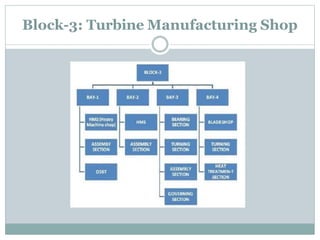
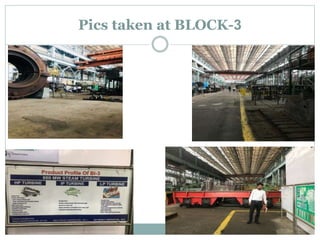
Block-3: Turbine Manufacturing Shop
Pics taken at BLOCK-3
Steam Turbine
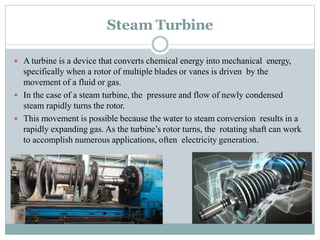
 A turbine is a device that converts chemical energy into mechanical energy,
specifically when a rotor of multiple blades or vanes is driven by the
movement of a fluid or gas.
 In the case of a steam turbine, the pressure and flow of newly condensed
steam rapidly turns the rotor.
 This movement is possible because the water to steam conversion results in a
rapidly expanding gas. As the turbine’s rotor turns, the rotating shaft can work
to accomplish numerous applications, often electricity generation.
TYPES OF STEAM TURBINES
1. IMPULSE TURBINE
2. REACTION TURBINE
 And depending upon pressure:
 Highpressure turbine (H.P. Turbine)
 Intermediate pressure turbine (I.P. Turbine)
 Low pressure turbine (L.P. Turbine)
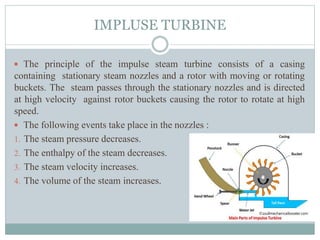
IMPLUSE TURBINE
 The principle of the impulse steam turbine consists of a casing
containing stationary steam nozzles and a rotor with moving or rotating
buckets. The steam passes through the stationary nozzles and is directed
at high velocity against rotor buckets causing the rotor to rotate at high
speed.
 The following events take place in the nozzles :
1. The steam pressure decreases.
2. The enthalpy of the steam decreases.
3. The steam velocity increases.
4. The volume of the steam increases.
REACTION TURBINE
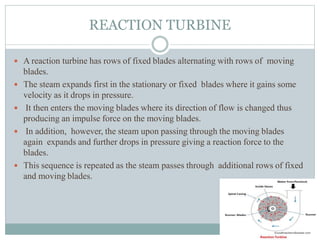
 A reaction turbine has rows of fixed blades alternating with rows of moving
blades.
 The steam expands first in the stationary or fixed blades where it gains some
velocity as it drops in pressure.
 It then enters the moving blades where its direction of flow is changed thus
producing an impulse force on the moving blades.
 In addition, however, the steam upon passing through the moving blades
again expands and further drops in pressure giving a reaction force to the
blades.
 This sequence is repeated as the steam passes through additional rows of fixed
and moving blades.
HIGH PRESSURE TURBINE
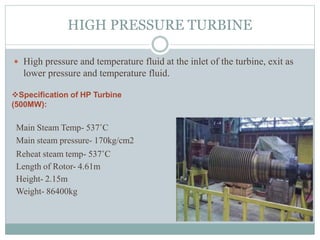
 High pressure and temperature fluid at the inlet of the turbine, exit as
lower pressure and temperature fluid.
Specification of HP Turbine
(500MW):
Main Steam Temp- 537˚C
Main steam pressure- 170kg/cm2
Reheat steam temp- 537˚C
Length of Rotor- 4.61m
Height- 2.15m
Weight- 86400kg
INTERMEDIATE PRESSURE TURBINE
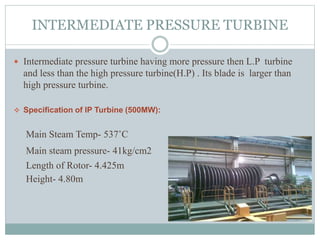
 Intermediate pressure turbine having more pressure then L.P turbine
and less than the high pressure turbine(H.P) . Its blade is larger than
high pressure turbine.
 Specification of IP Turbine (500MW):
Main Steam Temp- 537˚C
Main steam pressure- 41kg/cm2
Length of Rotor- 4.425m
Height- 4.80m
LOW PRESSURE TURBINE
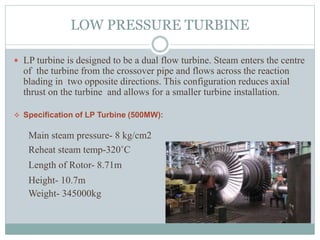
 LP turbine is designed to be a dual flow turbine. Steam enters the centre
of the turbine from the crossover pipe and flows across the reaction
blading in two opposite directions. This configuration reduces axial
thrust on the turbine and allows for a smaller turbine installation.
 Specification of LP Turbine (500MW):
Main steam pressure- 8 kg/cm2
Reheat steam temp-320˚C
Length of Rotor- 8.71m
Height- 10.7m
Weight- 345000kg
BLADE OF TURBINES (HP, IP & LP)
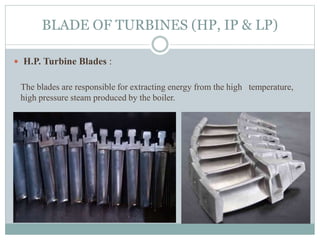
 H.P. Turbine Blades :
The blades are responsible for extracting energy from the high temperature,
high pressure steam produced by the boiler.
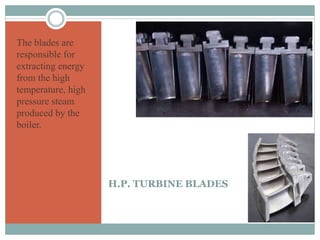
H.P. TURBINE BLADES
The blades are
responsible for
extracting energy
from the high
temperature, high
pressure steam
produced by the
boiler.
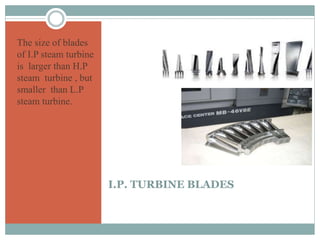
I.P. TURBINE BLADES
The size of blades
of I.P steam turbine
is larger than H.P
steam turbine , but
smaller than L.P
steam turbine.
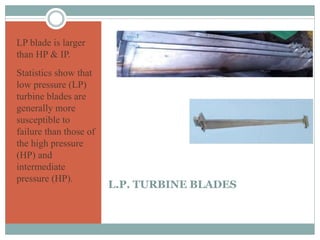
L.P. TURBINE BLADES
LP blade is larger
than HP & IP.
Statistics show that
low pressure (LP)
turbine blades are
generally more
susceptible to
failure than those of
the high pressure
(HP) and
intermediate
pressure (HP).
BLADES MANUFACTURING
 Operations Performed On Blades:
 Inspection
 Cutting
 Milling
 Grinding on both the surface
 Machining Of Blades:
 Horizontal milling machine
 Central lathe machine
 CNC machine
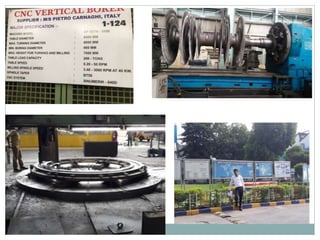
 Vertical boring machine
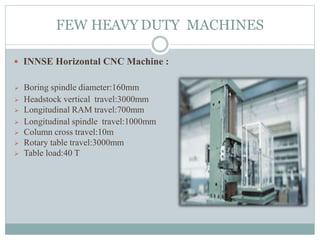
FEW HEAVY DUTY MACHINES
 INNSE Horizontal CNC Machine :
 Boring spindle diameter:160mm
 Headstock vertical travel:3000mm
 Longitudinal RAM travel:700mm
 Longitudinal spindle travel:1000mm
 Column cross travel:10m
 Rotary table travel:3000mm
 Table load:40 T
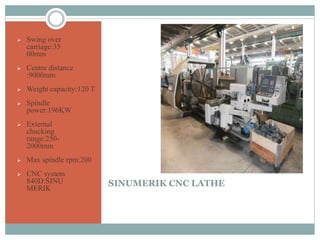
SINUMERIK CNC LATHE
 Swing over
carriage:35
00mm
 Centre distance
:9000mm
 Weight capacity:120 T
 Spindle
power:196KW
 External
chucking
range:250-
2000mm
 Max spindle rpm:200
 CNC system
840D:SINU
MERIK
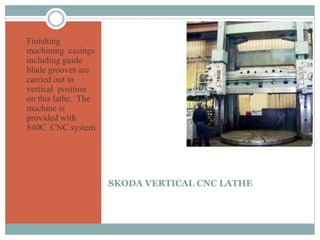
SKODA VERTICAL CNC LATHE
 Finishing
machining casings
including guide
blade grooves are
carried out in
vertical position
on this lathe. The
machine is
provided with
840C CNC system
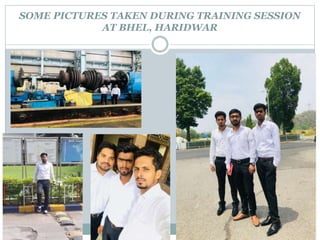
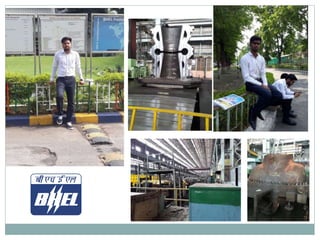
SOME PICTURES TAKEN DURING TRAINING SESSION
AT BHEL, HARIDWAR
ACHIEVED DURING THE TRAINING
 Gone through rigorous 4 Weeks training under the guidance of capable
engineers and workers of BHEL Haridwar in Block-3 “TURBINE
MANUFACTURING” headed by Senior Engineer of department Mr.
Bhagwanad Pandit situated in Ranipur, Haridwar,(Uttarakhand).
 The training was specified under the Turbine Manufacturing
Department. Working under the department I came to know about the
basic grinding, scaling and machining processes which was shown on
heavy to medium machines. Duty lathes were planted in the same line
where the specified work was undertaken.
 The training brought to my knowledge the various machining and
fabrication processes went not only in the manufacturing of blades but
other parts of the turbine.
CONCLUSION
 BHEL is the largest engineering and manufacturing enterprise in
India .
 The company manufactures 235 MW nuclear turbine generator sets
and in future it will 500 MW.
 BHEL is a major contributor of equipment and systems to industries.
 At the all, till now BHEL is best in supply and manufacturing products.
REFERENCES
• Wikipedia
• Figures from manufacturing data web page BHEL.com.
• Google
• Report maintained during training.
THANK YOU
!

BHEL PPT

  • 1.
    NOIDA INTERNATIONAL UNIVERSITY GREATERNOIDA DEPARTMENT OF MECHANICALENGINEERING INDUSTRIAL TRAINING PRESENTATION ON Bharat Heavy Electricals Limited, Haridwar (Uttarakhand) Submitted To : Ms.Nidhi Sindhu (Asst.Prof) Submitted By : Md Shahnwaz Anwer Mohammad Nadeem Khan Chandra Pratap Shastri Naveen Baghel
  • 2.
    TABLE OF CONTENTS INTRODUCTION OF B.H.E.L  OVERVIEW OF THE ENTERPRISE  OCCUPATIONAL HEALTH AND SAFETY POLICY  STEAM TURBINES  TYPES OF STEAM TURBINE  MANUFACTURING PROCESS  BLOCK-3 LAYOUT  BLADE SHOP  TYPES OF BLADE  BLADES MANUFACTURING  ACHIEVED DURING THE TRAINING  CONCLUSION  REFERENCES
  • 3.
    INTRODUCTION OF BHEL Bharat Heavy Electricals Limited (B.H.E.L.) is the largest engineering and manufacturing enterprise in India.  Established in 1960s under the Indo-Soviet Agreements of 1959 and 1960 in the area of Scientific, Technical and Industrial Cooperation.  BHEL has its setup spread all over India namely New Delhi, Gurgaon, Haridwar, Rudrapur, Jhansi, Bhopal, Hyderabad, Jagdishpur , Tiruchirapalli, Bangalore and many more.  Over 65% of power generated in India comes from BHEL-supplied equipment. Overall it has installed power equipment for over 90,000 MW.  BHEL has already attained ISO 9000 certification for quality management, and ISO14001 certification for environment management.  It is one of India's nine largest Public Sector Undertakings or PSUs, known as the “NAVRATNAS” or “The Nine Jewels”.
  • 4.
    OVERVIEW OF BHEL BHEL was established in 1964.  BHEL is one of the only 7 PSUs of India clubbed underthe esteemed 'Maharatna' status. (1st February2013).  BHEL is engaged in the design, engineering, manufacture, construction, testing, commissioning and servicing of a wide range of products and services for the core sectors of the economy, viz. Power, Transmission, Industry,Transportation (Railway), Oil & Gas and defence.  BHEL has 15 manufacturing divisions, two repair units, four regional offices, eight service centers and 15 regionalcenters.
  • 5.
    Main Manufacturing Units 1.BHEL Bhopal (Madhya Pradesh ) 2. BHEL Ramachandrapuram, Hyderabad (Andhra Pradesh) 3. Transformer Plant, BHEL Jhansi(Uttar Pradesh) 4. High Pressure Boiler Plant and Seamless Steel Tube Plant, 5. Tiruchirapalli(Tamil Nadu) 6. Boiler Auxiliaries Plant, Ranipet (Tamil Nadu) 7. ElectronicsDivision and Electro Porcelain Division, Bangalore(Karnataka) 8. Jagdishpur (Uttar Pradesh) 9. Rudrapur (Uttrakhand) 10. Industrial ValvesPlant, Goindwal (Punjab) 11. BHEL Ranipur, Haridwar (Uttarakhand) 12. Bharat Heavy Plates and Vessels Limited(Vizag)
  • 6.
    Heavy Electrical EquipmentPlant(HEEP) 1. BLOCK-1: Electrical Machine Shop 2. BLOCK-2: Heavy Fabrication Shop 3. BLOCK-3: Turbine Manufacturing Shop 4. BLOCK-4: CIM (Coils & Insulation Manuf.) 5. BLOCK-5: Condenser Fabrication & Forge Shop 6. BLOCK-6: Fabrication Shop & Die Shop 7. BLOCK-7: Carpentry & Heat Treatment Shop 8. BLOCK-8: Heat Exchanger Shop
  • 7.
  • 8.
  • 9.
    Steam Turbine  Aturbine is a device that converts chemical energy into mechanical energy, specifically when a rotor of multiple blades or vanes is driven by the movement of a fluid or gas.  In the case of a steam turbine, the pressure and flow of newly condensed steam rapidly turns the rotor.  This movement is possible because the water to steam conversion results in a rapidly expanding gas. As the turbine’s rotor turns, the rotating shaft can work to accomplish numerous applications, often electricity generation.
  • 10.
    TYPES OF STEAMTURBINES 1. IMPULSE TURBINE 2. REACTION TURBINE  And depending upon pressure:  Highpressure turbine (H.P. Turbine)  Intermediate pressure turbine (I.P. Turbine)  Low pressure turbine (L.P. Turbine)
  • 11.
    IMPLUSE TURBINE  Theprinciple of the impulse steam turbine consists of a casing containing stationary steam nozzles and a rotor with moving or rotating buckets. The steam passes through the stationary nozzles and is directed at high velocity against rotor buckets causing the rotor to rotate at high speed.  The following events take place in the nozzles : 1. The steam pressure decreases. 2. The enthalpy of the steam decreases. 3. The steam velocity increases. 4. The volume of the steam increases.
  • 12.
    REACTION TURBINE  Areaction turbine has rows of fixed blades alternating with rows of moving blades.  The steam expands first in the stationary or fixed blades where it gains some velocity as it drops in pressure.  It then enters the moving blades where its direction of flow is changed thus producing an impulse force on the moving blades.  In addition, however, the steam upon passing through the moving blades again expands and further drops in pressure giving a reaction force to the blades.  This sequence is repeated as the steam passes through additional rows of fixed and moving blades.
  • 13.
    HIGH PRESSURE TURBINE High pressure and temperature fluid at the inlet of the turbine, exit as lower pressure and temperature fluid. Specification of HP Turbine (500MW): Main Steam Temp- 537˚C Main steam pressure- 170kg/cm2 Reheat steam temp- 537˚C Length of Rotor- 4.61m Height- 2.15m Weight- 86400kg
  • 14.
    INTERMEDIATE PRESSURE TURBINE Intermediate pressure turbine having more pressure then L.P turbine and less than the high pressure turbine(H.P) . Its blade is larger than high pressure turbine.  Specification of IP Turbine (500MW): Main Steam Temp- 537˚C Main steam pressure- 41kg/cm2 Length of Rotor- 4.425m Height- 4.80m
  • 15.
    LOW PRESSURE TURBINE LP turbine is designed to be a dual flow turbine. Steam enters the centre of the turbine from the crossover pipe and flows across the reaction blading in two opposite directions. This configuration reduces axial thrust on the turbine and allows for a smaller turbine installation.  Specification of LP Turbine (500MW): Main steam pressure- 8 kg/cm2 Reheat steam temp-320˚C Length of Rotor- 8.71m Height- 10.7m Weight- 345000kg
  • 16.
    BLADE OF TURBINES(HP, IP & LP)  H.P. Turbine Blades : The blades are responsible for extracting energy from the high temperature, high pressure steam produced by the boiler.
  • 17.
    H.P. TURBINE BLADES Theblades are responsible for extracting energy from the high temperature, high pressure steam produced by the boiler.
  • 18.
    I.P. TURBINE BLADES Thesize of blades of I.P steam turbine is larger than H.P steam turbine , but smaller than L.P steam turbine.
  • 19.
    L.P. TURBINE BLADES LPblade is larger than HP & IP. Statistics show that low pressure (LP) turbine blades are generally more susceptible to failure than those of the high pressure (HP) and intermediate pressure (HP).
  • 20.
    BLADES MANUFACTURING  OperationsPerformed On Blades:  Inspection  Cutting  Milling  Grinding on both the surface  Machining Of Blades:  Horizontal milling machine  Central lathe machine  CNC machine  Vertical boring machine
  • 21.
    FEW HEAVY DUTYMACHINES  INNSE Horizontal CNC Machine :  Boring spindle diameter:160mm  Headstock vertical travel:3000mm  Longitudinal RAM travel:700mm  Longitudinal spindle travel:1000mm  Column cross travel:10m  Rotary table travel:3000mm  Table load:40 T
  • 22.
    SINUMERIK CNC LATHE Swing over carriage:35 00mm  Centre distance :9000mm  Weight capacity:120 T  Spindle power:196KW  External chucking range:250- 2000mm  Max spindle rpm:200  CNC system 840D:SINU MERIK
  • 23.
    SKODA VERTICAL CNCLATHE  Finishing machining casings including guide blade grooves are carried out in vertical position on this lathe. The machine is provided with 840C CNC system
  • 24.
    SOME PICTURES TAKENDURING TRAINING SESSION AT BHEL, HARIDWAR
  • 27.
    ACHIEVED DURING THETRAINING  Gone through rigorous 4 Weeks training under the guidance of capable engineers and workers of BHEL Haridwar in Block-3 “TURBINE MANUFACTURING” headed by Senior Engineer of department Mr. Bhagwanad Pandit situated in Ranipur, Haridwar,(Uttarakhand).  The training was specified under the Turbine Manufacturing Department. Working under the department I came to know about the basic grinding, scaling and machining processes which was shown on heavy to medium machines. Duty lathes were planted in the same line where the specified work was undertaken.  The training brought to my knowledge the various machining and fabrication processes went not only in the manufacturing of blades but other parts of the turbine.
  • 28.
    CONCLUSION  BHEL isthe largest engineering and manufacturing enterprise in India .  The company manufactures 235 MW nuclear turbine generator sets and in future it will 500 MW.  BHEL is a major contributor of equipment and systems to industries.  At the all, till now BHEL is best in supply and manufacturing products.
  • 29.
    REFERENCES • Wikipedia • Figuresfrom manufacturing data web page BHEL.com. • Google • Report maintained during training.
  • 30.