



THINGBOT
IOT SECURITY
BY :
BELLAJ BADR
IOT : Internet des objets
The Internet of Things is a new term in the tech industry that refers to a concept where every
device in your house gets its own computer chip, software, and connection to the Internet: your
fridge, thermostat, smart water meter, door locks, etc.
The Internet of Things (IoT) is a vision. It is being built
today
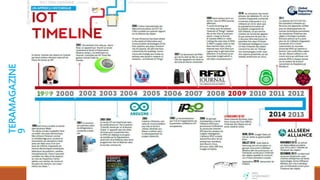
TERAMAGAZINE
9
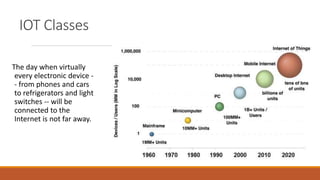
IOT Classes
The day when virtually
every electronic device -
- from phones and cars
to refrigerators and light
switches -- will be
connected to the
Internet is not far away.
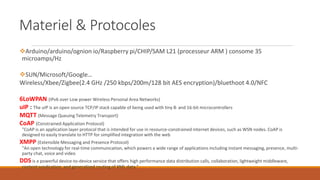
Materiel & Protocoles
Arduino/arduino/ognion io/Raspberry pi/CHIP/SAM L21 (processeur ARM ) consome 35
microamps/Hz
SUN/Microsoft/Google…
Wireless/Xbee/Zigbee(2.4 GHz /250 kbps/200m/128 bit AES encryption)/bluethoot 4.0/NFC
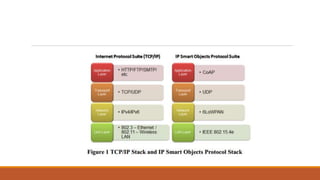
6LoWPAN (IPv6 over Low power Wireless Personal Area Networks)
uIP : The uIP is an open source TCP/IP stack capable of being used with tiny 8- and 16-bit microcontrollers
MQTT (Message Queuing Telemetry Transport)
CoAP (Constrained Application Protocol)
"CoAP is an application layer protocol that is intended for use in resource-constrained internet devices, such as WSN nodes. CoAP is
designed to easily translate to HTTP for simplified integration with the web
XMPP (Extensible Messaging and Presence Protocol)
"An open technology for real-time communication, which powers a wide range of applications including instant messaging, presence, multi-
party chat, voice and video
DDS is a powerful device-to-device service that offers high performance data distribution calls, collaboration, lightweight middleware,
content syndication, and generalized routing of XML data."
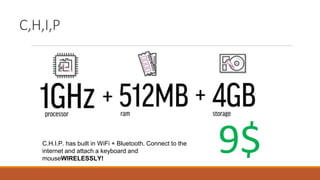
C,H,I,P
9$C.H.I.P. has built in WiFi + Bluetooth. Connect to the
internet and attach a keyboard and
mouseWIRELESSLY!
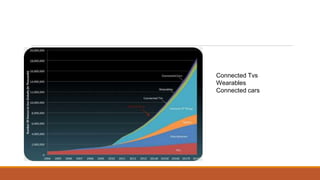
Connected Tvs
Wearables
Connected cars
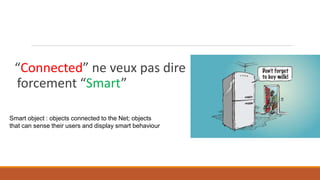
“Connected” ne veux pas dire
forcement “Smart”
Smart object : objects connected to the Net; objects
that can sense their users and display smart behaviour
The number of Internet-connected devices
is growing rapidly and is expected to reach
50 billion by 2020.(Cisco report)
As the number of Internet-connected devices grows, the
potential security challenges of the so-called "Internet of
Things," or IoT, can no longer be ignored. The web of
interconnected devices promises both enormous benefits to
users and serious security threats, due to the sensitive data
those devices will share.
Futur
euh ….
Now the really scary part
Internet-of-things "devices are typically not protected
by the anti-spam and anti-virus infrastructures
available to organizations and individual consumers,
nor are they routinely monitored by dedicated IT
teams or alerting software to receive patches to
address new security issues as they arise.
Why menaced
the paradigm is menaced by a multitude of threat
actors, from cybercriminals to government entities,
even hacktivists. The reason is simple: IoT devices
manage a huge quantity of information, they are
capillary distributed in every industry, and,
unfortunately, their current level of security is still low.
IOT THREATS
As explained by experts at Symantec, the principal cyber threats for the Internet of
Things are:
◦ Denial of service – DDoS attacks could target all the end points of a working scenario, causing
a serious problem with the network of smart devices and paralyzing the service it provides.
◦ Botnets and malware based attacks.
◦ Data breaches : Attackers could spy on the communications between peers in a IoT network
and collect information on the services they implement
◦ Weakening perimeters: If the attacker is able to compromise a device, he could have access
to our domestic network, spy on us, or cause physical damage to our domestic environment.
The problem is equally serious if we consider the use of IoT devices in any industry.
The OWASP Internet of Things (IoT) Top 10
The Open Web Application Security Project (OWASP) has the primary intent to divulge best
practices to improve the security of software. It is natural that the project also analyzed the top
10 security issues related to the popular paradigm.
◦ Insecure Web Interface
◦ Insufficient Authentication/Authorization
◦ Insecure Network Services
◦ Lack of Transport Encryption
◦ Privacy Concerns
◦ Insecure Cloud Interface
◦ Insecure Mobile Interface
◦ Insufficient Security Configurability
◦ Insecure Software/Firmware
◦ Poor Physical Security
Internet of Things devices are generally
not designed with security in mind.
“Many users may not be aware that they are using
vulnerable devices in their homes or offices,”
“Another issue we could face is that even if users notice
vulnerable devices, no updates have been provided to some
products by the vendor, because of outdated technology or
hardware limitations, such as not having enough memory
or a CPU that is too slow to support new versions of the
software.”
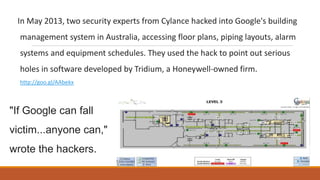
In May 2013, two security experts from Cylance hacked into Google's building
management system in Australia, accessing floor plans, piping layouts, alarm
systems and equipment schedules. They used the hack to point out serious
holes in software developed by Tridium, a Honeywell-owned firm.
http://goo.gl/AAbekx
"If Google can fall
victim...anyone can,"
wrote the hackers.
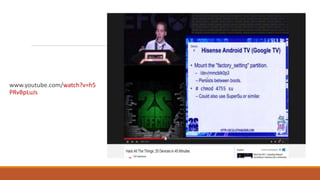
www.youtube.com/watch?v=h5
PRvBpLuJs
Botnets //&
Thingbots
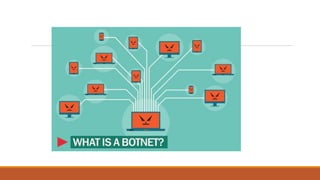
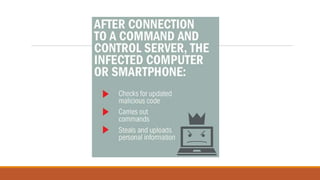
A ‘bot' is a type of malware that an attacker can
use to control an infected computer or mobile
device. A group or network of machines that
have been co-opted this way and are under the
control of the same attacker is known a ‘botnet‘
Your computer could be a part of a botnet
BOT = Robot(zombbie)
Net=Network
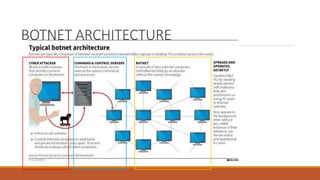
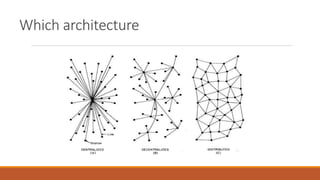
BOTNET ARCHITECTURE
We are looking at a new age of botnets. The first
age was servers, PCs, and laptops. The second
age was mobile devices such as smartphones,
phablets, and tablets. What’s the newest wave?
… Thingbots.
BOTNETS & ThingBots
A malware author specifically designs their codes to
compromise architectures used by IoT devices. A malicious code
could be used to infect computers used to control a network of
smart devices or to compromise the software running on them.
In this second scenario, the attackers can exploit the presence of
a flaw in the firmware running on the devices and run their
arbitrary code, turning IoT components to unplanned use.
BOTNETS & ThingBots
In November 2013, Symantec discovered a
new Linux worm, Linux.Darlloz, infecting Intel
x86-powered Linux devices. The attackers
compromised IoT devices in order to build a
botnet (a thingbot)
Bot-nets are already a major security
concern and the emergence of
thingbots may make the situation
much worse,
BOTNETS & ThingBots
Meanwhile, the attacks continue. Recently, experts at Akamai’s
Prolexic Security Engineering & Response Team (PLXsert)
spotted a new malware kit named Spike, which is used to run
DDoS attacks through desktops and Internet of Things devices.
The Spike thingbot was able to run different types of DDoS
attacks, including SYN, UDP, Domain Name System query, and
GET floods against Linux based machines, Windows, and ARM-
based Linux hosts.
BOTNETS & ThingBots
The thingbot was composed of home routers, smart
dryers, smart thermostats and other intelligent
devices. Akamai noticed a number of devices for the
Spike botnet ranging from 12,000 to 15,000. The
researchers highlighted the ability of attackers to
customize the malware also for ARM architectures
widely adopted by IoT devices.
BOTNETS & ThingBots
Akamai published an interesting report on the Spike botnet that
includes details related to DDoS attacks run by the threat actor.
The experts observed that one of the attacks clocked 215
gigabits per second (Gbps) and 150 million packets per second
(Mpps). The document confirms that, even if the majority of the
DDoS attacks launched from low-powered devices could be
insignificant, IoT devices could anyway represent a powerful
weapon in the hand of the attackers.
BOTNETS & ThingBots
In March 2014, researchers at Team Cymru
published a detailed report on a large scale
SOHO pharming attack that hit more that
300,000 devices worldwide
Hackers are Trying to Turn
Your Connected Fridge Into a
‘Thingbot
Security researchers at Proofpoint have uncovered the very first
wide-scale hack that involved television sets and at least one
refrigerator.
Yes, a fridge.
This is being hailed as the first home appliance "botnet" and the
first cyberattack from the Internet of Things.
The hack happened between December 23, 2013 and
January 6, 2014, and featured waves of malicious email,
typically sent in bursts of 100,000, three times per day,
targeting enterprises and individuals worldwide.
one-quarter, were sent by hacked home appliances.
Hackers didn't have to be amazingly smart when breaking
into home appliances. Many times they gained access
because the home owners didn't set them up correctly, or
used the default password that came with the device.
More Than 750,000 Phishing and SPAM
Emails Launched From "Thingbots"
Including Televisions, Fridge
Think about when we’ll have 22 Billion -_-
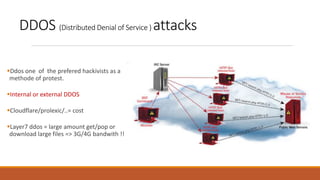
DDOS (Distributed Denial of Service ) attacks
Ddos one of the prefered hackivists as a
methode of protest.
Internal or external DDOS
Cloudflare/prolexic/..= cost
Layer7 ddos = large amount get/pop or
download large files => 3G/4G bandwith !!
Performance
Attackers could use thingbots to mine bitcoins !!
Malicious attackers can crash your devices,
block them from connecting and drain their
Battery
Attack could use them as a private
proxy to mask their identity.
Decrease in performance
Privacy
Each of these devices has some level of capability to allow hackers to
influence and gain knowledge about our lives. Compromised devices can
share what our cameras see, change our environmental controls, and affect
our very lives by changing settings on our medical devices.
Samsung's latest voice-controlled TVs can listen to private conversations.
Our physical security is in danger
What To do
Create your thingbot
1. Compile bot’s code for a desired architecture or use
a bot builder.
2. Spread it
3. Setup your C&C
Which architecture
Watch a documentary
about
Dionaea (a honeypot)
ON
Setup a honeypot
Deploying Dionaea on a Raspberry Pi using MHN
https://github.com/threatstream/mhn/wiki/Deploying-
Dionaea-on-a-Raspberry-Pi
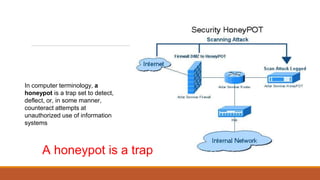
In computer terminology, a
honeypot is a trap set to detect,
deflect, or, in some manner,
counteract attempts at
unauthorized use of information
systems
A honeypot is a trap
Trust Zone
Invest in secure chips to add a
security layer to existent systems.
Secure chips
Bot-nets are already a
major security concern
and the emergence of
thingbots may make
the situation much
worse,

beware of Thing Bot

  • 1.
  • 2.
    IOT : Internetdes objets The Internet of Things is a new term in the tech industry that refers to a concept where every device in your house gets its own computer chip, software, and connection to the Internet: your fridge, thermostat, smart water meter, door locks, etc. The Internet of Things (IoT) is a vision. It is being built today
  • 3.
  • 4.
    IOT Classes The daywhen virtually every electronic device - - from phones and cars to refrigerators and light switches -- will be connected to the Internet is not far away.
  • 5.
    Materiel & Protocoles Arduino/arduino/ognionio/Raspberry pi/CHIP/SAM L21 (processeur ARM ) consome 35 microamps/Hz SUN/Microsoft/Google… Wireless/Xbee/Zigbee(2.4 GHz /250 kbps/200m/128 bit AES encryption)/bluethoot 4.0/NFC 6LoWPAN (IPv6 over Low power Wireless Personal Area Networks) uIP : The uIP is an open source TCP/IP stack capable of being used with tiny 8- and 16-bit microcontrollers MQTT (Message Queuing Telemetry Transport) CoAP (Constrained Application Protocol) "CoAP is an application layer protocol that is intended for use in resource-constrained internet devices, such as WSN nodes. CoAP is designed to easily translate to HTTP for simplified integration with the web XMPP (Extensible Messaging and Presence Protocol) "An open technology for real-time communication, which powers a wide range of applications including instant messaging, presence, multi- party chat, voice and video DDS is a powerful device-to-device service that offers high performance data distribution calls, collaboration, lightweight middleware, content syndication, and generalized routing of XML data."
  • 7.
    C,H,I,P 9$C.H.I.P. has builtin WiFi + Bluetooth. Connect to the internet and attach a keyboard and mouseWIRELESSLY!
  • 8.
  • 9.
    “Connected” ne veuxpas dire forcement “Smart” Smart object : objects connected to the Net; objects that can sense their users and display smart behaviour
  • 10.
    The number ofInternet-connected devices is growing rapidly and is expected to reach 50 billion by 2020.(Cisco report) As the number of Internet-connected devices grows, the potential security challenges of the so-called "Internet of Things," or IoT, can no longer be ignored. The web of interconnected devices promises both enormous benefits to users and serious security threats, due to the sensitive data those devices will share. Futur
  • 13.
  • 14.
    Now the reallyscary part Internet-of-things "devices are typically not protected by the anti-spam and anti-virus infrastructures available to organizations and individual consumers, nor are they routinely monitored by dedicated IT teams or alerting software to receive patches to address new security issues as they arise.
  • 15.
    Why menaced the paradigmis menaced by a multitude of threat actors, from cybercriminals to government entities, even hacktivists. The reason is simple: IoT devices manage a huge quantity of information, they are capillary distributed in every industry, and, unfortunately, their current level of security is still low.
  • 16.
    IOT THREATS As explainedby experts at Symantec, the principal cyber threats for the Internet of Things are: ◦ Denial of service – DDoS attacks could target all the end points of a working scenario, causing a serious problem with the network of smart devices and paralyzing the service it provides. ◦ Botnets and malware based attacks. ◦ Data breaches : Attackers could spy on the communications between peers in a IoT network and collect information on the services they implement ◦ Weakening perimeters: If the attacker is able to compromise a device, he could have access to our domestic network, spy on us, or cause physical damage to our domestic environment. The problem is equally serious if we consider the use of IoT devices in any industry.
  • 17.
    The OWASP Internetof Things (IoT) Top 10 The Open Web Application Security Project (OWASP) has the primary intent to divulge best practices to improve the security of software. It is natural that the project also analyzed the top 10 security issues related to the popular paradigm. ◦ Insecure Web Interface ◦ Insufficient Authentication/Authorization ◦ Insecure Network Services ◦ Lack of Transport Encryption ◦ Privacy Concerns ◦ Insecure Cloud Interface ◦ Insecure Mobile Interface ◦ Insufficient Security Configurability ◦ Insecure Software/Firmware ◦ Poor Physical Security
  • 18.
    Internet of Thingsdevices are generally not designed with security in mind.
  • 19.
    “Many users maynot be aware that they are using vulnerable devices in their homes or offices,” “Another issue we could face is that even if users notice vulnerable devices, no updates have been provided to some products by the vendor, because of outdated technology or hardware limitations, such as not having enough memory or a CPU that is too slow to support new versions of the software.”
  • 20.
    In May 2013,two security experts from Cylance hacked into Google's building management system in Australia, accessing floor plans, piping layouts, alarm systems and equipment schedules. They used the hack to point out serious holes in software developed by Tridium, a Honeywell-owned firm. http://goo.gl/AAbekx "If Google can fall victim...anyone can," wrote the hackers.
  • 21.
  • 22.
  • 24.
    A ‘bot' isa type of malware that an attacker can use to control an infected computer or mobile device. A group or network of machines that have been co-opted this way and are under the control of the same attacker is known a ‘botnet‘ Your computer could be a part of a botnet
  • 25.
  • 26.
  • 28.
    We are lookingat a new age of botnets. The first age was servers, PCs, and laptops. The second age was mobile devices such as smartphones, phablets, and tablets. What’s the newest wave? … Thingbots.
  • 29.
    BOTNETS & ThingBots Amalware author specifically designs their codes to compromise architectures used by IoT devices. A malicious code could be used to infect computers used to control a network of smart devices or to compromise the software running on them. In this second scenario, the attackers can exploit the presence of a flaw in the firmware running on the devices and run their arbitrary code, turning IoT components to unplanned use.
  • 30.
    BOTNETS & ThingBots InNovember 2013, Symantec discovered a new Linux worm, Linux.Darlloz, infecting Intel x86-powered Linux devices. The attackers compromised IoT devices in order to build a botnet (a thingbot)
  • 31.
    Bot-nets are alreadya major security concern and the emergence of thingbots may make the situation much worse,
  • 32.
    BOTNETS & ThingBots Meanwhile,the attacks continue. Recently, experts at Akamai’s Prolexic Security Engineering & Response Team (PLXsert) spotted a new malware kit named Spike, which is used to run DDoS attacks through desktops and Internet of Things devices. The Spike thingbot was able to run different types of DDoS attacks, including SYN, UDP, Domain Name System query, and GET floods against Linux based machines, Windows, and ARM- based Linux hosts.
  • 33.
    BOTNETS & ThingBots Thethingbot was composed of home routers, smart dryers, smart thermostats and other intelligent devices. Akamai noticed a number of devices for the Spike botnet ranging from 12,000 to 15,000. The researchers highlighted the ability of attackers to customize the malware also for ARM architectures widely adopted by IoT devices.
  • 34.
    BOTNETS & ThingBots Akamaipublished an interesting report on the Spike botnet that includes details related to DDoS attacks run by the threat actor. The experts observed that one of the attacks clocked 215 gigabits per second (Gbps) and 150 million packets per second (Mpps). The document confirms that, even if the majority of the DDoS attacks launched from low-powered devices could be insignificant, IoT devices could anyway represent a powerful weapon in the hand of the attackers.
  • 35.
    BOTNETS & ThingBots InMarch 2014, researchers at Team Cymru published a detailed report on a large scale SOHO pharming attack that hit more that 300,000 devices worldwide
  • 36.
    Hackers are Tryingto Turn Your Connected Fridge Into a ‘Thingbot
  • 38.
    Security researchers atProofpoint have uncovered the very first wide-scale hack that involved television sets and at least one refrigerator. Yes, a fridge. This is being hailed as the first home appliance "botnet" and the first cyberattack from the Internet of Things.
  • 39.
    The hack happenedbetween December 23, 2013 and January 6, 2014, and featured waves of malicious email, typically sent in bursts of 100,000, three times per day, targeting enterprises and individuals worldwide. one-quarter, were sent by hacked home appliances. Hackers didn't have to be amazingly smart when breaking into home appliances. Many times they gained access because the home owners didn't set them up correctly, or used the default password that came with the device.
  • 40.
    More Than 750,000Phishing and SPAM Emails Launched From "Thingbots" Including Televisions, Fridge Think about when we’ll have 22 Billion -_-
  • 41.
    DDOS (Distributed Denialof Service ) attacks Ddos one of the prefered hackivists as a methode of protest. Internal or external DDOS Cloudflare/prolexic/..= cost Layer7 ddos = large amount get/pop or download large files => 3G/4G bandwith !!
  • 42.
    Performance Attackers could usethingbots to mine bitcoins !! Malicious attackers can crash your devices, block them from connecting and drain their Battery Attack could use them as a private proxy to mask their identity. Decrease in performance
  • 43.
    Privacy Each of thesedevices has some level of capability to allow hackers to influence and gain knowledge about our lives. Compromised devices can share what our cameras see, change our environmental controls, and affect our very lives by changing settings on our medical devices. Samsung's latest voice-controlled TVs can listen to private conversations. Our physical security is in danger
  • 44.
  • 45.
    Create your thingbot 1.Compile bot’s code for a desired architecture or use a bot builder. 2. Spread it 3. Setup your C&C
  • 46.
  • 47.
  • 48.
    Setup a honeypot DeployingDionaea on a Raspberry Pi using MHN https://github.com/threatstream/mhn/wiki/Deploying- Dionaea-on-a-Raspberry-Pi
  • 49.
    In computer terminology,a honeypot is a trap set to detect, deflect, or, in some manner, counteract attempts at unauthorized use of information systems A honeypot is a trap
  • 50.
    Trust Zone Invest insecure chips to add a security layer to existent systems. Secure chips
  • 51.
    Bot-nets are alreadya major security concern and the emergence of thingbots may make the situation much worse,

Editor's Notes

  • #9 Les tendances issu de l evolution IOT
  • #15 Une evolution rapide du materiel asynchrone avec l ev de lev secu Donc une fois une vulnérabilité est decouverte c est defifficile de se proteger
  • #21 (At that time, Tridium had already created a patch for the security hole, but Google had not yet upgraded its software.)
  • #22 Si on arrive dc a les roter et avoir acces Qu’imaginer vous les hacker vont faire avec ??
  • #29 A thingbot is something with an embedded system and an Internet connection that has been coopted by a hacker to become part of a botnet of networked things.
  • #30 – This is probably one of the most common and dangerous scenarios. Linux.Darlloz, that was exploiting various vulnerabilities in PHP to infect Intel x86-powered Linux devices Thingbt : that was used for illegal activities, including sending spam, generating costly SMS messages, or running a DDoS attack.
  • #33 The thingbot was composed of home routers, smart dryers, smart thermostats and other intelligent devices. Akamai noticed a number of devices for the Spike botnet ranging from 12,000 to 15,000. The researchers highlighted the ability of attackers to customize the malware also for ARM architectures widely adopted by IoT devices.
  • #44 Systems are already being used to steal billions of records and disrupt Internet communications and other commercial services. Now we have whole new waves and classes of devices which have no on-device protection. What happens when we add these IoT devices to the mix is a critical concern for a number of research organizations.
  • #49 dionaea intention is to trap malware exploiting vulnerabilities exposed by services offerd to a network, the ultimate goal is gaining a copy of the malware.
  • #51 ARM Cortex-A57 ARM Cortex-A53 ARM Cortex-A17ARM Cortex-A15     ARM Cortex-A9 ARM Cortex-A8 ARM Cortex-A7 ARM Cortex-A5
  • #52 The Internet of Things is a paradigm that is changing our daily life. According to many experts, the paradigm is the link between human and technology. The Internet of Things needs security by design; for this reason it is a business opportunity for IT companies and security firms. Manufacturers must carefully evaluate the cyber threats and the level of exposure of IoT devices, implementing all the necessary countermeasures and allowing the updates of the firmware to respond the evolution of the menaces.