INTERNET
OF THINGS (IoT)
Contents
• What is IOT
• Where is IOT
• Why IOT
• IOT Market
• Attacking IOT
• Case Study
• Architecture
• Conclusion
What is IOT?
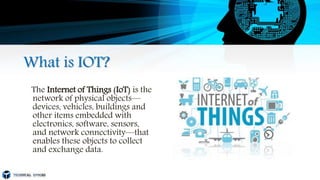
The Internet of Things (IoT) is the
network of physical objects—
devices, vehicles, buildings and
other items embedded with
electronics, software, sensors,
and network connectivity—that
enables these objects to collect
and exchange data.
Various Names
• M2M (Machine to Machine)
• “Internet of Everything” (Cisco Systems)
• “World Size Web” (Bruce Schneier)
• “Skynet” (Terminator movie)
What are the “Things” in the IOT?
• Could be anything
– Physical
– Virtual
Internet of Things (IOT) is an integrated part of Future Internet and
could be defined as a dynamic global network infrastructure with
self configuring capabilities based on standard and interoperable
communication protocols where physical and virtual 'things' have
identities, physical attributes, and virtual ...
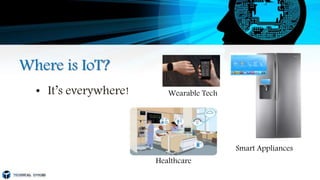
Where is IoT?
• It’s everywhere! Wearable Tech
Healthcare
Smart Appliances
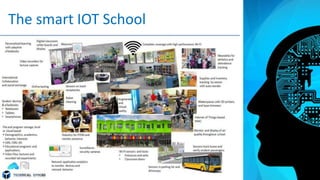
The smart IOT School
Why IOT?
• Generate, collect, process and use acquired
information to make better decisions
• Smart objects: Make things that weren’t meant to
talk to each other interact smartly
• Gartner says the Internet of Things installed base will
grow to 26 Billion units by 2020; I want to be well
aligned and prepared for that
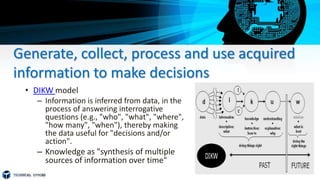
Generate, collect, process and use acquired
information to make decisions
• DIKW model
– Information is inferred from data, in the
process of answering interrogative
questions (e.g., "who", "what", "where",
"how many", "when"), thereby making
the data useful for "decisions and/or
action".
– Knowledge as "synthesis of multiple
sources of information over time"
Smart objects: Make things that
weren’t meant to talk to each other
interact smartly
– Phone  Location detection, presence detection  Thermostat
– Doorbell activation  CCTV takes picture Email + SMS +
Tweet
– Fire Alarm  Email + SMS
– Security System CCTV  Email + SMS
– Climate control  presence @ home & weather forecast
– Hot water tank 1   Hot water tank 2   our presence,
weather forecast
– Dog CCTV + Email
– Weather notifications  email
Why we concerned about IOT?
• It’s just another computer, right?
– All of the same issues we have with access control,
vulnerability management, patching, monitoring, etc.
– Imagine your network with 1,000,000 more devices
– Any compromised device is a foothold on the network
The IOT Market
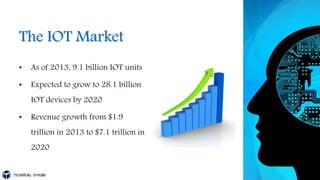
• As of 2013, 9.1 billion IOT units
• Expected to grow to 28.1 billion
IOT devices by 2020
• Revenue growth from $1.9
trillion in 2013 to $7.1 trillion in
2020
Attacking IOT
• Default, weak, and hardcoded credentials
• Difficult to update firmware and OS
• Lack of vendor support for repairing vulnerabilities
• Vulnerable web interfaces (SQL injection, XSS)
• Coding errors (buffer overflow)
• Clear text protocols and unnecessary open ports
• DOS / DDOS
• Physical theft and tampering
Case Study: Trane
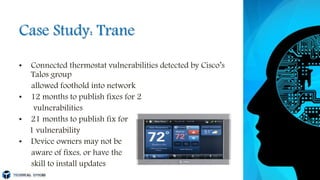
• Connected thermostat vulnerabilities detected by Cisco’s
Talos group
allowed foothold into network
• 12 months to publish fixes for 2
vulnerabilities
• 21 months to publish fix for
1 vulnerability
• Device owners may not be
aware of fixes, or have the
skill to install updates
Case Study: Lessons Learned
• All software can contain vulnerabilities
• Public not informed for months
• Vendors may delay or ignore issues
• Product lifecycles and end-of-support
• Patching IOT devices may not scale in large
environments
Threat vs. Opportunity
• If misunderstood and misconfigured, IOT
poses risk to our data, privacy, and safety
• If understood and secured, IOT will enhance
communications, lifestyle, and delivery of
services
Challenges
• Global cooperation
– Proprietary and incompatible protocols
– Lack of APIs
– Example: Common external power supply
• Technological challenges
– Power usage
– Scalability
– Security
– Communication mechanisms
• Ethics, control society, surveillance, consent and data driven life
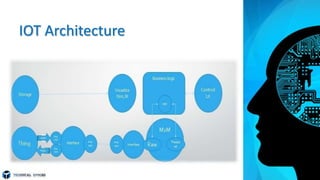
IOT Architecture
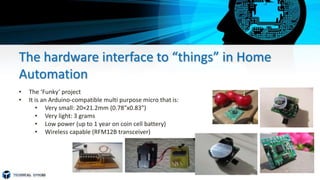
The hardware interface to “things” in Home
Automation
• The ‘Funky’ project
• It is an Arduino-compatible multi purpose micro that is:
• Very small: 20×21.2mm (0.78″x0.83″)
• Very light: 3 grams
• Low power (up to 1 year on coin cell battery)
• Wireless capable (RFM12B transceiver)
Conclusion
• The future of IOT is virtually unlimited due to
advances in technology and consumers' desire
to integrate devices such as smart phones with
household machines.
Any Queries
References
• http://www.utsystem.edu/offices/board-regents/uts165-standards
• https://securityintelligence.com/the-importance-of-ipv6-and-the-internet-of-things/
• http://www.isaca.org/Knowledge-Center/Research/ResearchDeliverables/Pages/internet-of-things-risk-and-value-
considerations.aspx
• https://www.owasp.org/images/7/71/Internet_of_Things_Top_Ten_2014-OWASP.pdf
• https://www.owasp.org/images/3/36/IoTTestingMethodology.pdf
• http://blog.sec-consult.com/2015/11/house-of-keys-industry-wide-https.html
• http://blog.trendmicro.com/trendlabs-security-intelligence/high-profile-mobile-apps-at-risk-due-to-three-year-
old-vulnerability/#
• http://www.rs-online.com/designspark/electronics/knowledge-item/eleven-internet-of-things-iot-protocols-you-
need-to-know-about
• https://thenewstack.io/tutorial-prototyping-a-sensor-node-and-iot-gateway-with-arduino-and-raspberry-pi-part-
1
• http://www.business.att.com/content/article/IoT-worldwide_regional_2014-2020-forecast.pdf
• http://blog.talosintel.com/2016/02/trane-iot.html
• http://krebsonsecurity.com/2016/02/iot-reality-smart-devices-dumb-defaults/
• http://www.gsma.com/connectedliving/gsma-iot-security-guidelines-complete-document-set/
Thank You

IOT.pptx

  • 1.
  • 2.
    Contents • What isIOT • Where is IOT • Why IOT • IOT Market • Attacking IOT • Case Study • Architecture • Conclusion
  • 3.
    What is IOT? TheInternet of Things (IoT) is the network of physical objects— devices, vehicles, buildings and other items embedded with electronics, software, sensors, and network connectivity—that enables these objects to collect and exchange data.
  • 4.
    Various Names • M2M(Machine to Machine) • “Internet of Everything” (Cisco Systems) • “World Size Web” (Bruce Schneier) • “Skynet” (Terminator movie)
  • 5.
    What are the“Things” in the IOT? • Could be anything – Physical – Virtual Internet of Things (IOT) is an integrated part of Future Internet and could be defined as a dynamic global network infrastructure with self configuring capabilities based on standard and interoperable communication protocols where physical and virtual 'things' have identities, physical attributes, and virtual ...
  • 6.
    Where is IoT? •It’s everywhere! Wearable Tech Healthcare Smart Appliances
  • 7.
  • 8.
    Why IOT? • Generate,collect, process and use acquired information to make better decisions • Smart objects: Make things that weren’t meant to talk to each other interact smartly • Gartner says the Internet of Things installed base will grow to 26 Billion units by 2020; I want to be well aligned and prepared for that
  • 9.
    Generate, collect, processand use acquired information to make decisions • DIKW model – Information is inferred from data, in the process of answering interrogative questions (e.g., "who", "what", "where", "how many", "when"), thereby making the data useful for "decisions and/or action". – Knowledge as "synthesis of multiple sources of information over time"
  • 10.
    Smart objects: Makethings that weren’t meant to talk to each other interact smartly – Phone  Location detection, presence detection  Thermostat – Doorbell activation  CCTV takes picture Email + SMS + Tweet – Fire Alarm  Email + SMS – Security System CCTV  Email + SMS – Climate control  presence @ home & weather forecast – Hot water tank 1   Hot water tank 2   our presence, weather forecast – Dog CCTV + Email – Weather notifications  email
  • 11.
    Why we concernedabout IOT? • It’s just another computer, right? – All of the same issues we have with access control, vulnerability management, patching, monitoring, etc. – Imagine your network with 1,000,000 more devices – Any compromised device is a foothold on the network
  • 12.
    The IOT Market •As of 2013, 9.1 billion IOT units • Expected to grow to 28.1 billion IOT devices by 2020 • Revenue growth from $1.9 trillion in 2013 to $7.1 trillion in 2020
  • 13.
    Attacking IOT • Default,weak, and hardcoded credentials • Difficult to update firmware and OS • Lack of vendor support for repairing vulnerabilities • Vulnerable web interfaces (SQL injection, XSS) • Coding errors (buffer overflow) • Clear text protocols and unnecessary open ports • DOS / DDOS • Physical theft and tampering
  • 14.
    Case Study: Trane •Connected thermostat vulnerabilities detected by Cisco’s Talos group allowed foothold into network • 12 months to publish fixes for 2 vulnerabilities • 21 months to publish fix for 1 vulnerability • Device owners may not be aware of fixes, or have the skill to install updates
  • 15.
    Case Study: LessonsLearned • All software can contain vulnerabilities • Public not informed for months • Vendors may delay or ignore issues • Product lifecycles and end-of-support • Patching IOT devices may not scale in large environments
  • 16.
    Threat vs. Opportunity •If misunderstood and misconfigured, IOT poses risk to our data, privacy, and safety • If understood and secured, IOT will enhance communications, lifestyle, and delivery of services
  • 17.
    Challenges • Global cooperation –Proprietary and incompatible protocols – Lack of APIs – Example: Common external power supply • Technological challenges – Power usage – Scalability – Security – Communication mechanisms • Ethics, control society, surveillance, consent and data driven life
  • 18.
  • 19.
    The hardware interfaceto “things” in Home Automation • The ‘Funky’ project • It is an Arduino-compatible multi purpose micro that is: • Very small: 20×21.2mm (0.78″x0.83″) • Very light: 3 grams • Low power (up to 1 year on coin cell battery) • Wireless capable (RFM12B transceiver)
  • 20.
    Conclusion • The futureof IOT is virtually unlimited due to advances in technology and consumers' desire to integrate devices such as smart phones with household machines.
  • 21.
  • 22.
    References • http://www.utsystem.edu/offices/board-regents/uts165-standards • https://securityintelligence.com/the-importance-of-ipv6-and-the-internet-of-things/ •http://www.isaca.org/Knowledge-Center/Research/ResearchDeliverables/Pages/internet-of-things-risk-and-value- considerations.aspx • https://www.owasp.org/images/7/71/Internet_of_Things_Top_Ten_2014-OWASP.pdf • https://www.owasp.org/images/3/36/IoTTestingMethodology.pdf • http://blog.sec-consult.com/2015/11/house-of-keys-industry-wide-https.html • http://blog.trendmicro.com/trendlabs-security-intelligence/high-profile-mobile-apps-at-risk-due-to-three-year- old-vulnerability/# • http://www.rs-online.com/designspark/electronics/knowledge-item/eleven-internet-of-things-iot-protocols-you- need-to-know-about • https://thenewstack.io/tutorial-prototyping-a-sensor-node-and-iot-gateway-with-arduino-and-raspberry-pi-part- 1 • http://www.business.att.com/content/article/IoT-worldwide_regional_2014-2020-forecast.pdf • http://blog.talosintel.com/2016/02/trane-iot.html • http://krebsonsecurity.com/2016/02/iot-reality-smart-devices-dumb-defaults/ • http://www.gsma.com/connectedliving/gsma-iot-security-guidelines-complete-document-set/
  • 23.