The Movement Takes a New
Turn
Chapter 21.5
pp. 722-727
The Movement Takes a New Turn
• NOTES
a. Why did the civil rights movement split by the mid-
1960s? What were the results of this split?
b. How did the tragic events of 1968 affect the
nation?
c. What is the lasting legacy of the civil rights
movement?
• Terms
– Malcolm X, Stokely Carmichael, Black Power, Black
Panthers, de jure segregation vs. de facto
segregation
James Baldwin
Author & Civil Rights Activist
• “The Negro’s past, of…death and humiliation;
fear by day and night; fear as deep as the
marrow of the bone; doubt that he was
worthy of life, since everyone denied it…”
• “The Negro himself no longer believes in the
good faith of white Americans—if, indeed, he
ever could have.”
Malcolm X & Black Nationalism
• Born in Omaha in 1925 as Malcolm Little
• Father was a Baptist minister that supported
“Back-to-Africa” campaign
• Father died when he was young
• Uncle was lynched
• Mother put in mental hospital
• Grew up in ghettoes of Detroit, Boston, NYC
• In jail by age 20, served 7 years
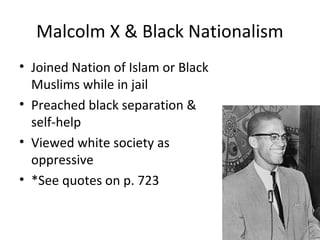
Malcolm X & Black Nationalism
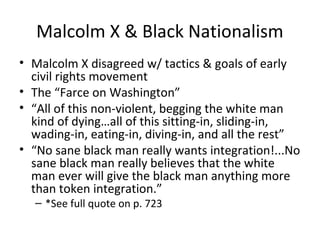
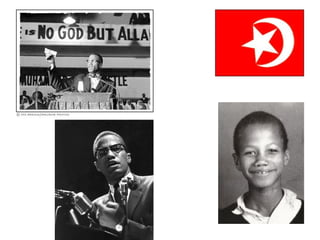
• Joined Nation of Islam or Black
Muslims while in jail
• Preached black separation &
self-help
• Viewed white society as
oppressive
• *See quotes on p. 723
Malcolm X & Black Nationalism
• Elijah Muhammad, leader of the Nation of
Islam, taught that Allah would bring about a
“Black Nation”
• One of the keys to knowledge was knowing
one’s enemy; namely white society
• Black Muslims did not seek change through
political means
• Instead, they tried to live righteous lives &
become economically self-sufficient
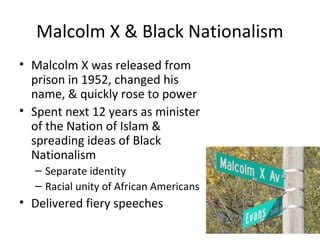
Malcolm X & Black Nationalism
• Malcolm X was released from
prison in 1952, changed his
name, & quickly rose to power
• Spent next 12 years as minister
of the Nation of Islam &
spreading ideas of Black
Nationalism
– Separate identity
– Racial unity of African Americans
• Delivered fiery speeches
Malcolm X & Black Nationalism
• Malcolm X disagreed w/ tactics & goals of early
civil rights movement
• The “Farce on Washington”
• “All of this non-violent, begging the white man
kind of dying…all of this sitting-in, sliding-in,
wading-in, eating-in, diving-in, and all the rest”
• “No sane black man really wants integration!...No
sane black man really believes that the white
man ever will give the black man anything more
than token integration.”
– *See full quote on p. 723
Malcolm X & Black Nationalism
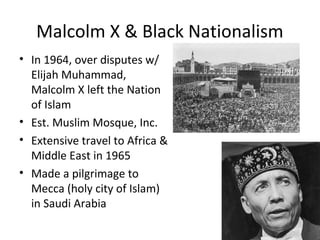
• In 1964, over disputes w/
Elijah Muhammad,
Malcolm X left the Nation
of Islam
• Est. Muslim Mosque, Inc.
• Extensive travel to Africa &
Middle East in 1965
• Made a pilgrimage to
Mecca (holy city of Islam)
in Saudi Arabia
Malcolm X & Black Nationalism
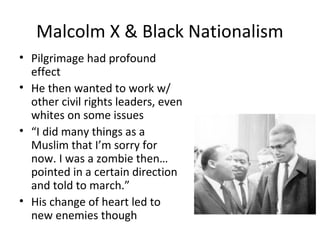
• Pilgrimage had profound
effect
• He then wanted to work w/
other civil rights leaders, even
whites on some issues
• “I did many things as a
Muslim that I’m sorry for
now. I was a zombie then…
pointed in a certain direction
and told to march.”
• His change of heart led to
new enemies though
Malcolm X & Black Nationalism
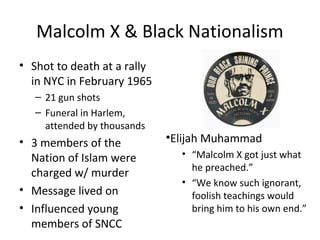
• Shot to death at a rally
in NYC in February 1965
– 21 gun shots
– Funeral in Harlem,
attended by thousands
• 3 members of the
Nation of Islam were
charged w/ murder
• Message lived on
• Influenced young
members of SNCC
•Elijah Muhammad
• “Malcolm X got just what
he preached.”
• “We know such ignorant,
foolish teachings would
bring him to his own end.”
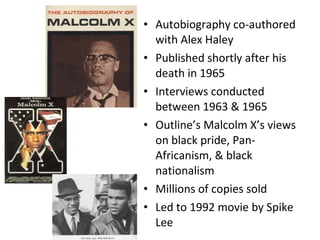
• Autobiography co-authored
with Alex Haley
• Published shortly after his
death in 1965
• Interviews conducted
between 1963 & 1965
• Outline’s Malcolm X’s views
on black pride, Pan-
Africanism, & black
nationalism
• Millions of copies sold
• Led to 1992 movie by Spike
Lee
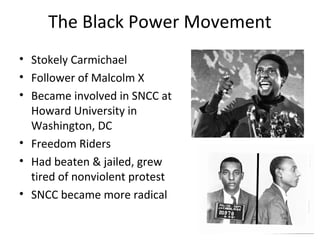
The Black Power Movement
• Stokely Carmichael
• Follower of Malcolm X
• Became involved in SNCC at
Howard University in
Washington, DC
• Freedom Riders
• Had beaten & jailed, grew
tired of nonviolent protest
• SNCC became more radical
Movement Splits
• Greenwood, MS in 1966
• King’s followers sang
“We Shall Overcome”
• Carmichael’s supporters
sang “We Shall
Overrun”
• “This is the 27th
time I
have been arrested, and
I ain’t going to jail no
more!...The only way
we gonna stop them
white men from
whippin’ us is to take
over. We been saying
freedom for six years—
and we ain’t got
nothin’. What we gonna
start saying now is
‘black power!’
Black Power
• New slogan resonated
w/ many African
Americans
• Encouraged immediate
action
• A call to “unite, to
recognize their
heritage, to build a
sense of community…to
begin to define their
own goals, to lead their
own organizations and
support those
organizations.”
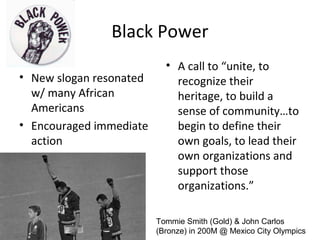
Tommie Smith (Gold) & John Carlos
(Bronze) in 200M @ Mexico City Olympics
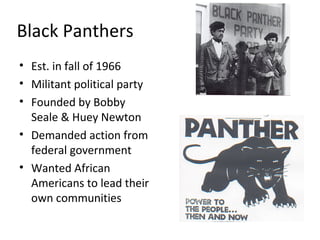
Black Panthers
• Est. in fall of 1966
• Militant political party
• Founded by Bobby
Seale & Huey Newton
• Demanded action from
federal government
• Wanted African
Americans to lead their
own communities
Black Panthers
• Often confrontation w/
white authorities
• Newton repeated
phrase from Communist
leader of China, Mao
Zedong, “power flows
from the barrel of a
gun”
• Violence w/ police
• “Black is beautiful”
became a new slogan
• SNCC & Black Panthers
moved away from
NAACP & SCLC
Riots in the Streets
• De jure segregation=
racial separation
created by law
• De facto segregation=
separation created by
social conditions, like
poverty
• De facto segregation
was a fact of life in most
American cities, North
& South
• Residents of
neighborhoods viewed
police officers as
oppressors, not
upholders of justice
• “like an occupying
soldier in a bitterly
hostile country”
• Riots started to flare up
along east coast (NYC)
in 1964
Riots in the Streets
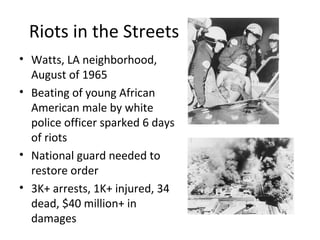
• Watts, LA neighborhood,
August of 1965
• Beating of young African
American male by white
police officer sparked 6 days
of riots
• National guard needed to
restore order
• 3K+ arrests, 1K+ injured, 34
dead, $40 million+ in
damages
Riots in the Streets
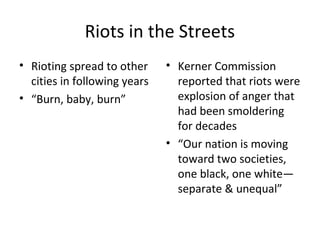
• Rioting spread to other
cities in following years
• “Burn, baby, burn”
• Kerner Commission
reported that riots were
explosion of anger that
had been smoldering
for decades
• “Our nation is moving
toward two societies,
one black, one white—
separate & unequal”
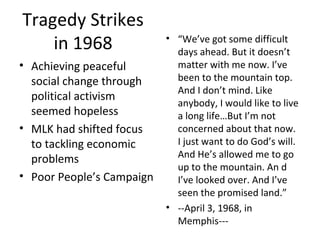
Tragedy Strikes
in 1968
• Achieving peaceful
social change through
political activism
seemed hopeless
• MLK had shifted focus
to tackling economic
problems
• Poor People’s Campaign
• “We’ve got some difficult
days ahead. But it doesn’t
matter with me now. I’ve
been to the mountain top.
And I don’t mind. Like
anybody, I would like to live
a long life…But I’m not
concerned about that now.
I just want to do God’s will.
And He’s allowed me to go
up to the mountain. An d
I’ve looked over. And I’ve
seen the promised land.”
• --April 3, 1968, in
Memphis---
Tragedy Strikes in 1968
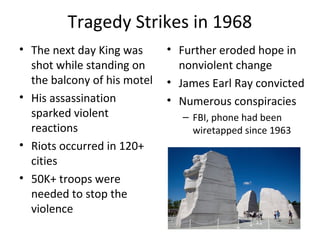
• The next day King was
shot while standing on
the balcony of his motel
• His assassination
sparked violent
reactions
• Riots occurred in 120+
cities
• 50K+ troops were
needed to stop the
violence
• Further eroded hope in
nonviolent change
• James Earl Ray convicted
• Numerous conspiracies
– FBI, phone had been
wiretapped since 1963
Tragedy Strikes in 1968
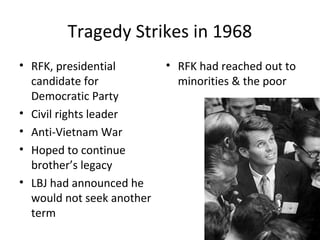
• RFK, presidential
candidate for
Democratic Party
• Civil rights leader
• Anti-Vietnam War
• Hoped to continue
brother’s legacy
• LBJ had announced he
would not seek another
term
• RFK had reached out to
minorities & the poor
Tragedy Strikes in 1968
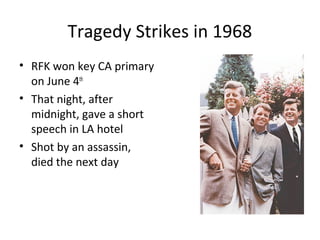
• RFK won key CA primary
on June 4th
• That night, after
midnight, gave a short
speech in LA hotel
• Shot by an assassin,
died the next day
Legacy of the Movement
• LBJ administration
brought about major
changes
• Segregation was illegal
• African Americans
began to vote by the
thousands
• Number of African
Americans elected to
high office rose
dramatically
• *Shirley Chisholm of NY
became first black
woman elected to
Congress
The Movement Takes a New Turn
• NOTES
a. Why did the civil rights movement split by the mid-
1960s? What were the results of this split?
b. How did the tragic events of 1968 affect the
nation?
c. What is the lasting legacy of the civil rights
movement?
• Terms
– Malcolm X, Stokely Carmichael, Black Power, Black
Panthers, de jure segregation vs. de facto
segregation

The Movement Takes a New Turn

  • 1.
    The Movement Takesa New Turn Chapter 21.5 pp. 722-727
  • 2.
    The Movement Takesa New Turn • NOTES a. Why did the civil rights movement split by the mid- 1960s? What were the results of this split? b. How did the tragic events of 1968 affect the nation? c. What is the lasting legacy of the civil rights movement? • Terms – Malcolm X, Stokely Carmichael, Black Power, Black Panthers, de jure segregation vs. de facto segregation
  • 3.
    James Baldwin Author &Civil Rights Activist • “The Negro’s past, of…death and humiliation; fear by day and night; fear as deep as the marrow of the bone; doubt that he was worthy of life, since everyone denied it…” • “The Negro himself no longer believes in the good faith of white Americans—if, indeed, he ever could have.”
  • 4.
    Malcolm X &Black Nationalism • Born in Omaha in 1925 as Malcolm Little • Father was a Baptist minister that supported “Back-to-Africa” campaign • Father died when he was young • Uncle was lynched • Mother put in mental hospital • Grew up in ghettoes of Detroit, Boston, NYC • In jail by age 20, served 7 years
  • 5.
    Malcolm X &Black Nationalism • Joined Nation of Islam or Black Muslims while in jail • Preached black separation & self-help • Viewed white society as oppressive • *See quotes on p. 723
  • 6.
    Malcolm X &Black Nationalism • Elijah Muhammad, leader of the Nation of Islam, taught that Allah would bring about a “Black Nation” • One of the keys to knowledge was knowing one’s enemy; namely white society • Black Muslims did not seek change through political means • Instead, they tried to live righteous lives & become economically self-sufficient
  • 7.
    Malcolm X &Black Nationalism • Malcolm X was released from prison in 1952, changed his name, & quickly rose to power • Spent next 12 years as minister of the Nation of Islam & spreading ideas of Black Nationalism – Separate identity – Racial unity of African Americans • Delivered fiery speeches
  • 8.
    Malcolm X &Black Nationalism • Malcolm X disagreed w/ tactics & goals of early civil rights movement • The “Farce on Washington” • “All of this non-violent, begging the white man kind of dying…all of this sitting-in, sliding-in, wading-in, eating-in, diving-in, and all the rest” • “No sane black man really wants integration!...No sane black man really believes that the white man ever will give the black man anything more than token integration.” – *See full quote on p. 723
  • 10.
    Malcolm X &Black Nationalism • In 1964, over disputes w/ Elijah Muhammad, Malcolm X left the Nation of Islam • Est. Muslim Mosque, Inc. • Extensive travel to Africa & Middle East in 1965 • Made a pilgrimage to Mecca (holy city of Islam) in Saudi Arabia
  • 11.
    Malcolm X &Black Nationalism • Pilgrimage had profound effect • He then wanted to work w/ other civil rights leaders, even whites on some issues • “I did many things as a Muslim that I’m sorry for now. I was a zombie then… pointed in a certain direction and told to march.” • His change of heart led to new enemies though
  • 12.
    Malcolm X &Black Nationalism • Shot to death at a rally in NYC in February 1965 – 21 gun shots – Funeral in Harlem, attended by thousands • 3 members of the Nation of Islam were charged w/ murder • Message lived on • Influenced young members of SNCC •Elijah Muhammad • “Malcolm X got just what he preached.” • “We know such ignorant, foolish teachings would bring him to his own end.”
  • 13.
    • Autobiography co-authored withAlex Haley • Published shortly after his death in 1965 • Interviews conducted between 1963 & 1965 • Outline’s Malcolm X’s views on black pride, Pan- Africanism, & black nationalism • Millions of copies sold • Led to 1992 movie by Spike Lee
  • 14.
    The Black PowerMovement • Stokely Carmichael • Follower of Malcolm X • Became involved in SNCC at Howard University in Washington, DC • Freedom Riders • Had beaten & jailed, grew tired of nonviolent protest • SNCC became more radical
  • 15.
    Movement Splits • Greenwood,MS in 1966 • King’s followers sang “We Shall Overcome” • Carmichael’s supporters sang “We Shall Overrun” • “This is the 27th time I have been arrested, and I ain’t going to jail no more!...The only way we gonna stop them white men from whippin’ us is to take over. We been saying freedom for six years— and we ain’t got nothin’. What we gonna start saying now is ‘black power!’
  • 16.
    Black Power • Newslogan resonated w/ many African Americans • Encouraged immediate action • A call to “unite, to recognize their heritage, to build a sense of community…to begin to define their own goals, to lead their own organizations and support those organizations.” Tommie Smith (Gold) & John Carlos (Bronze) in 200M @ Mexico City Olympics
  • 17.
    Black Panthers • Est.in fall of 1966 • Militant political party • Founded by Bobby Seale & Huey Newton • Demanded action from federal government • Wanted African Americans to lead their own communities
  • 18.
    Black Panthers • Oftenconfrontation w/ white authorities • Newton repeated phrase from Communist leader of China, Mao Zedong, “power flows from the barrel of a gun” • Violence w/ police • “Black is beautiful” became a new slogan • SNCC & Black Panthers moved away from NAACP & SCLC
  • 19.
    Riots in theStreets • De jure segregation= racial separation created by law • De facto segregation= separation created by social conditions, like poverty • De facto segregation was a fact of life in most American cities, North & South • Residents of neighborhoods viewed police officers as oppressors, not upholders of justice • “like an occupying soldier in a bitterly hostile country” • Riots started to flare up along east coast (NYC) in 1964
  • 20.
    Riots in theStreets • Watts, LA neighborhood, August of 1965 • Beating of young African American male by white police officer sparked 6 days of riots • National guard needed to restore order • 3K+ arrests, 1K+ injured, 34 dead, $40 million+ in damages
  • 21.
    Riots in theStreets • Rioting spread to other cities in following years • “Burn, baby, burn” • Kerner Commission reported that riots were explosion of anger that had been smoldering for decades • “Our nation is moving toward two societies, one black, one white— separate & unequal”
  • 22.
    Tragedy Strikes in 1968 •Achieving peaceful social change through political activism seemed hopeless • MLK had shifted focus to tackling economic problems • Poor People’s Campaign • “We’ve got some difficult days ahead. But it doesn’t matter with me now. I’ve been to the mountain top. And I don’t mind. Like anybody, I would like to live a long life…But I’m not concerned about that now. I just want to do God’s will. And He’s allowed me to go up to the mountain. An d I’ve looked over. And I’ve seen the promised land.” • --April 3, 1968, in Memphis---
  • 23.
    Tragedy Strikes in1968 • The next day King was shot while standing on the balcony of his motel • His assassination sparked violent reactions • Riots occurred in 120+ cities • 50K+ troops were needed to stop the violence • Further eroded hope in nonviolent change • James Earl Ray convicted • Numerous conspiracies – FBI, phone had been wiretapped since 1963
  • 24.
    Tragedy Strikes in1968 • RFK, presidential candidate for Democratic Party • Civil rights leader • Anti-Vietnam War • Hoped to continue brother’s legacy • LBJ had announced he would not seek another term • RFK had reached out to minorities & the poor
  • 25.
    Tragedy Strikes in1968 • RFK won key CA primary on June 4th • That night, after midnight, gave a short speech in LA hotel • Shot by an assassin, died the next day
  • 26.
    Legacy of theMovement • LBJ administration brought about major changes • Segregation was illegal • African Americans began to vote by the thousands • Number of African Americans elected to high office rose dramatically • *Shirley Chisholm of NY became first black woman elected to Congress
  • 27.
    The Movement Takesa New Turn • NOTES a. Why did the civil rights movement split by the mid- 1960s? What were the results of this split? b. How did the tragic events of 1968 affect the nation? c. What is the lasting legacy of the civil rights movement? • Terms – Malcolm X, Stokely Carmichael, Black Power, Black Panthers, de jure segregation vs. de facto segregation

Editor's Notes

  • #5 ----- Meeting Notes (3/2/14 20:41) ----- His dad died when he was six. His mom was sent to a mental hospital when he was 13. Grew up in a series of foster homes.
  • #6 Espoused black supremacy