Creativity & Communication

Jim McQuaid
jim@turnipfilms.com
www.turnipfilms.com
Abstract
• My personal journey through high
technology and creative work and how that
enabled me to pursue my path.
• Changes I‟m seeing:
– The “demise” of culture
– Story telling and the future of (technical)
communication

• Thoughts about the problem of creativity in
large organizations
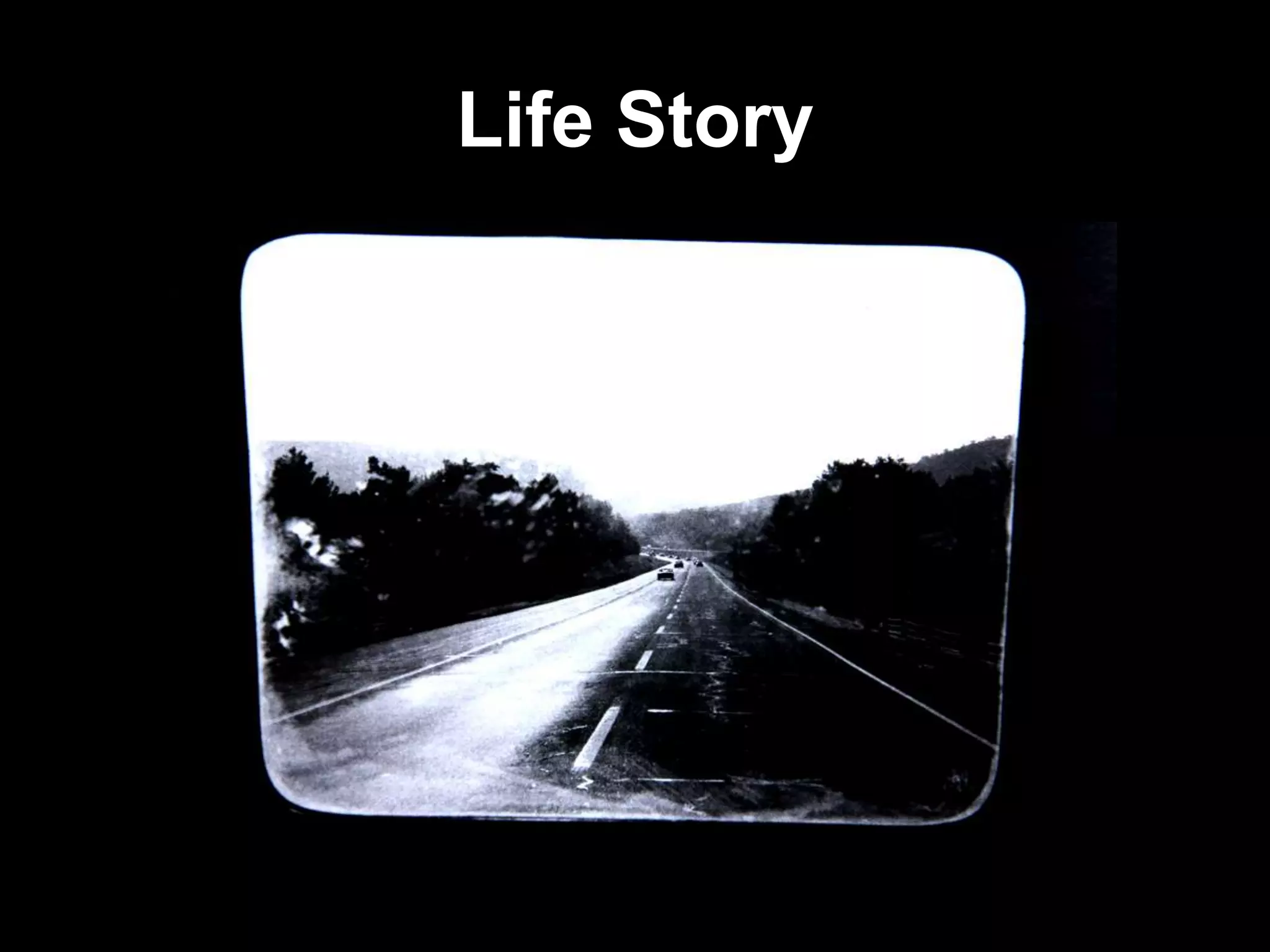
Life Story
Life Story
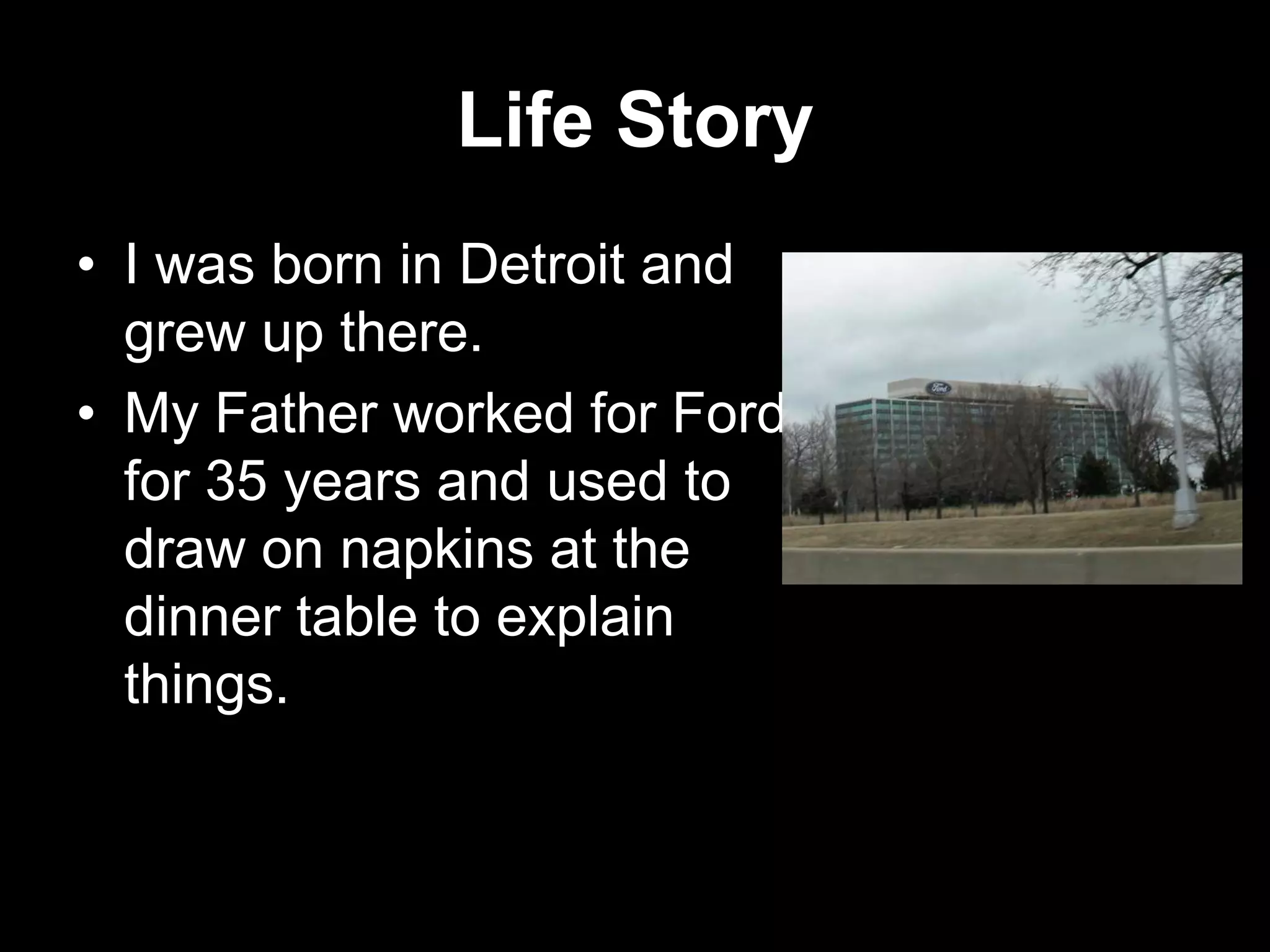
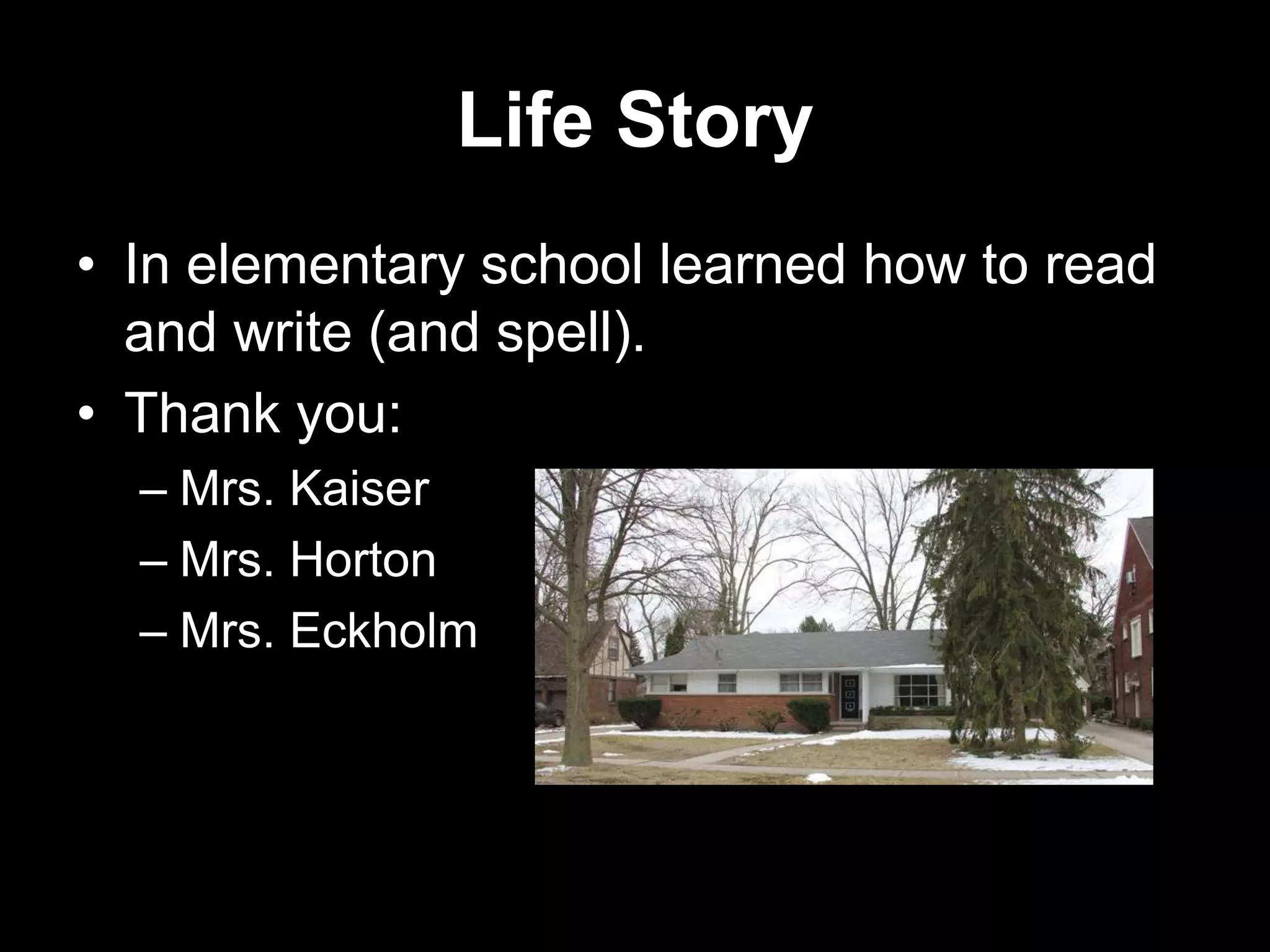
• I was born in Detroit and
grew up there.
• My Father worked for Ford
for 35 years and used to
draw on napkins at the
dinner table to explain
things.
Life Story
• In elementary school learned how to read
and write (and spell).
• Thank you:
– Mrs. Kaiser
– Mrs. Horton
– Mrs. Eckholm
High School
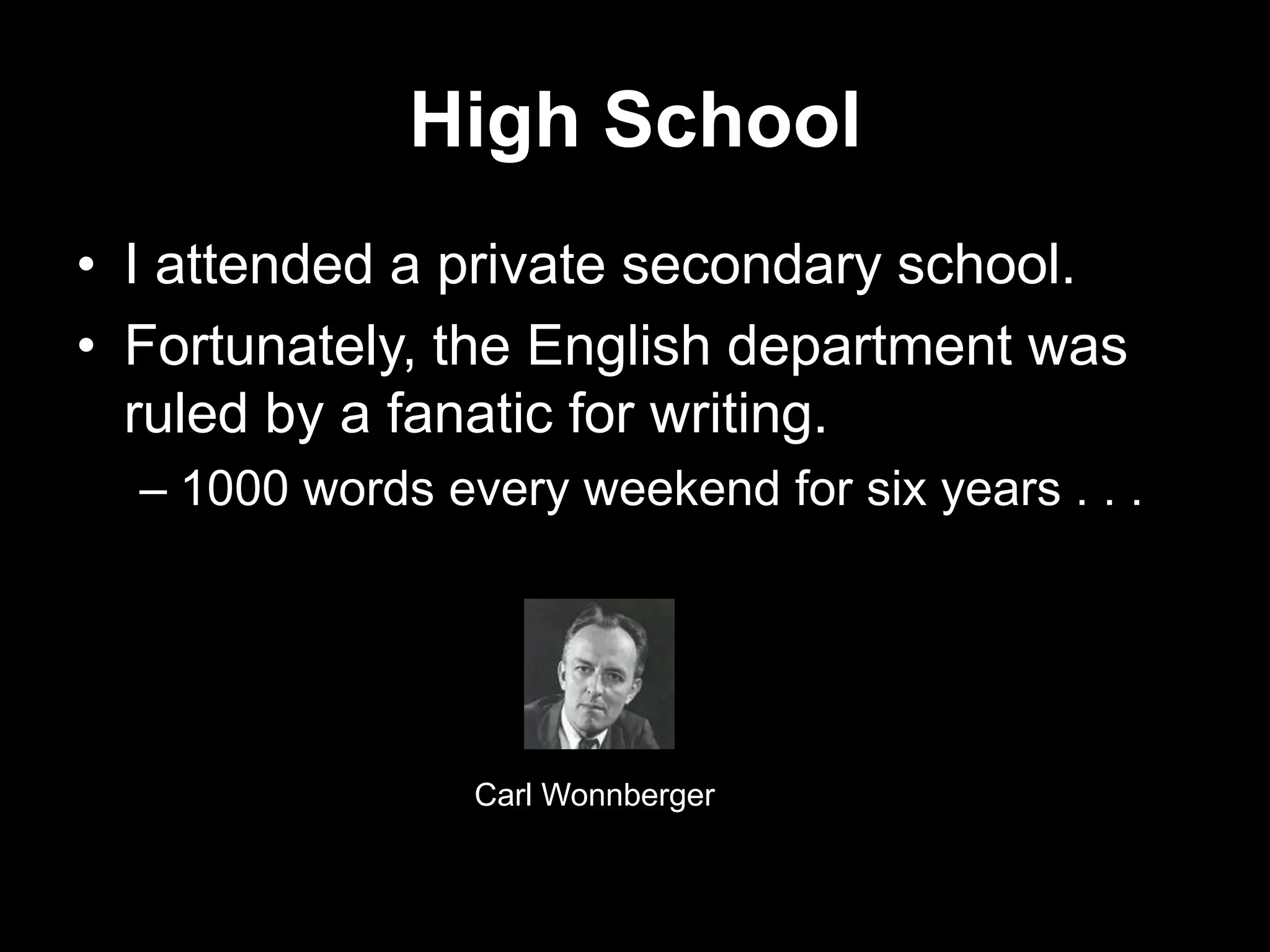
• I attended a private secondary school.
• Fortunately, the English department was
ruled by a fanatic for writing.
– 1000 words every weekend for six years . . .

Carl Wonnberger
High School
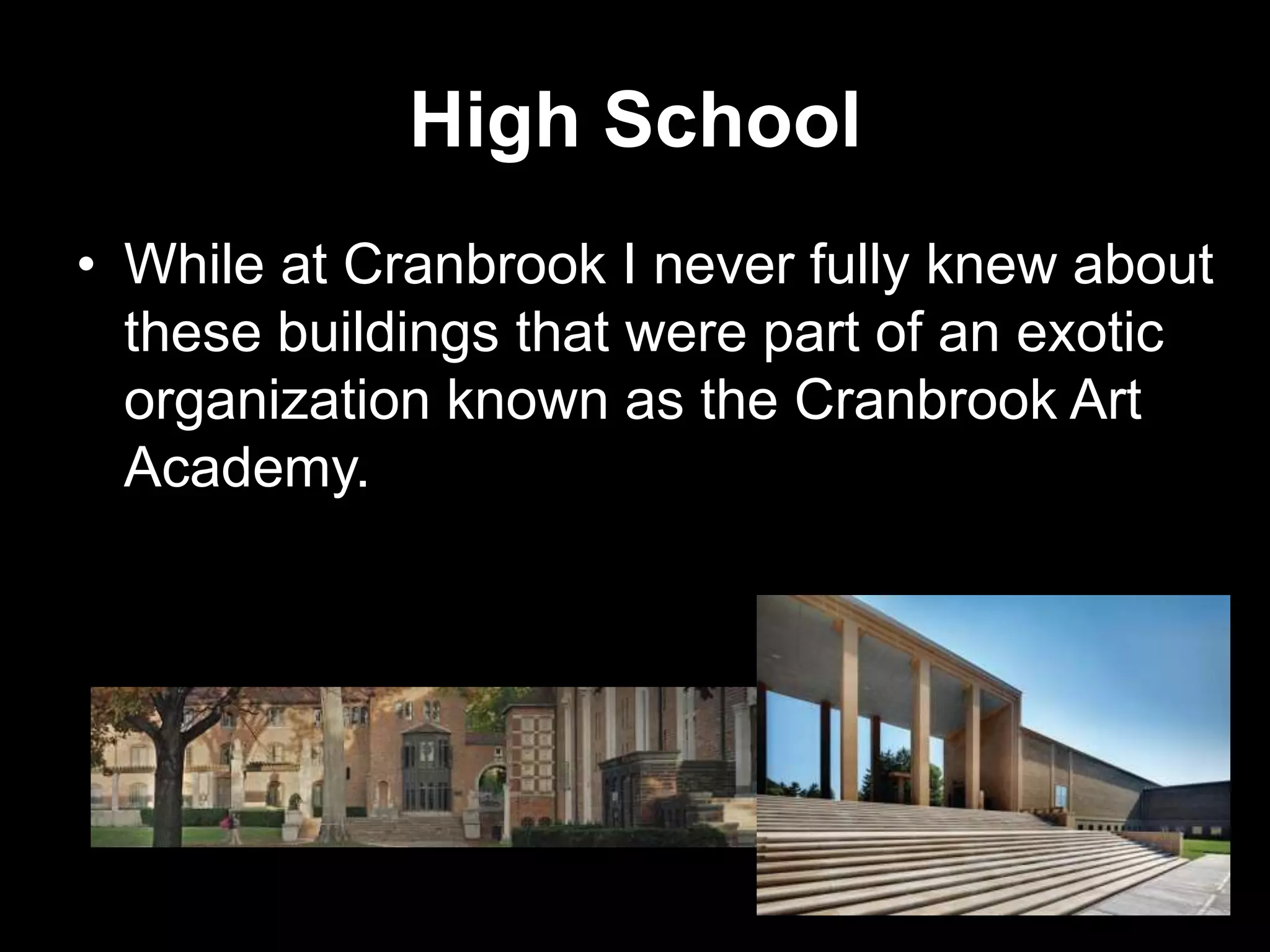
• While at Cranbrook I never fully knew about
these buildings that were part of an exotic
organization known as the Cranbrook Art
Academy.
A Liberal Education
• At the University of Michigan earned a
degree in Political Science
– (Because I got an “A” in the intro course)

• But that was not my real major . . .
A Liberal Education
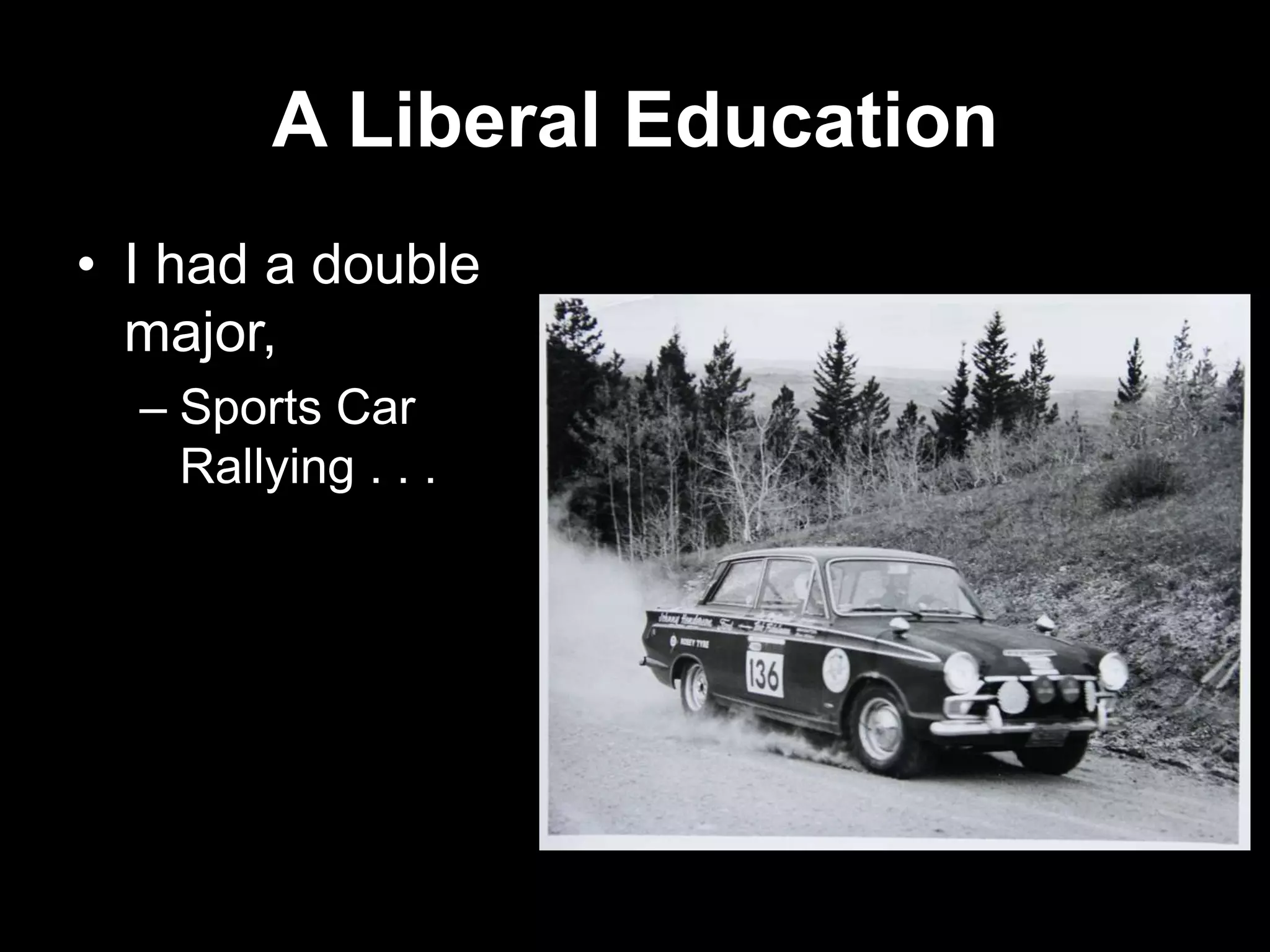
• I had a double
major,
– Sports Car
Rallying . . .
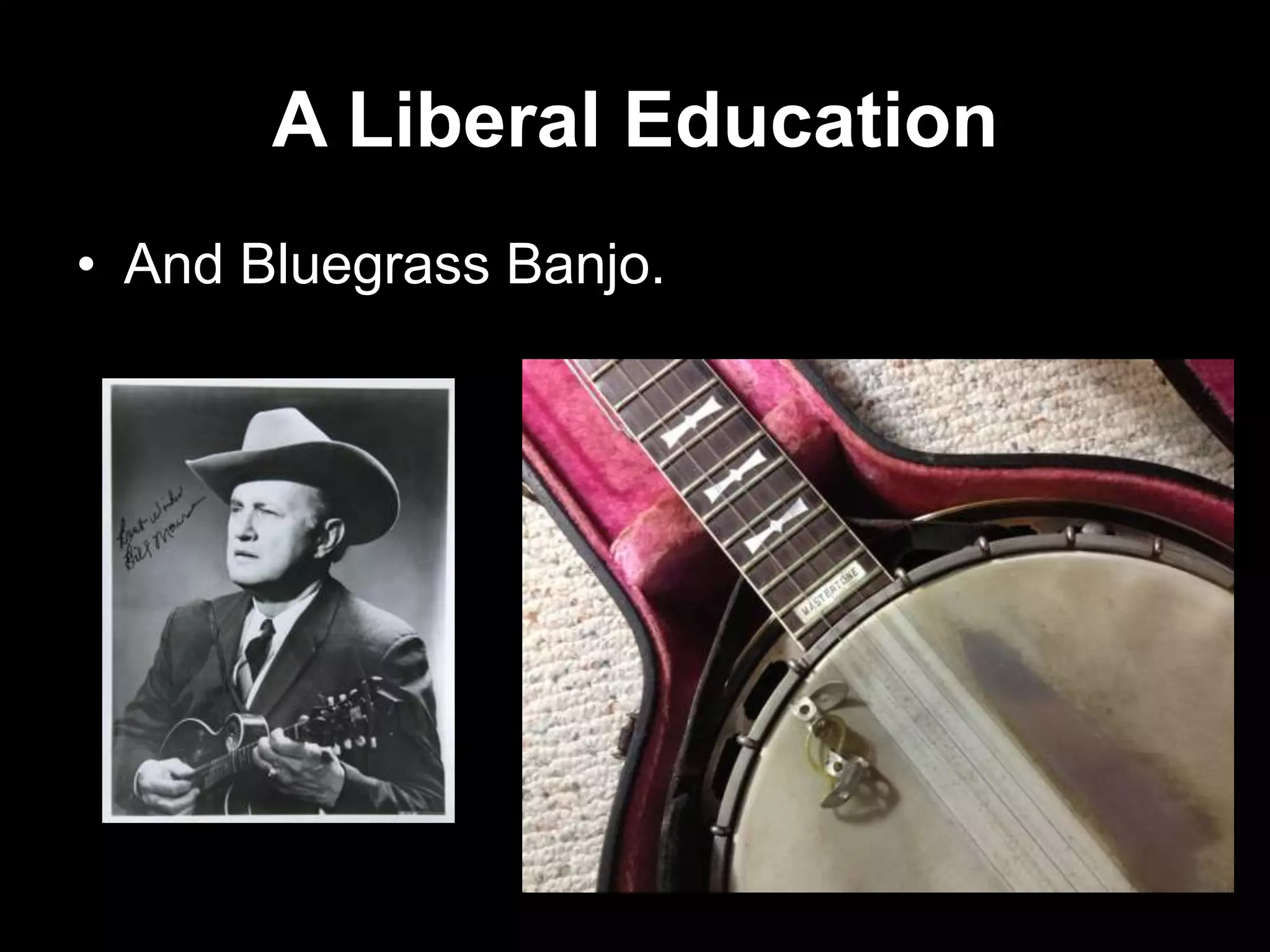
A Liberal Education
• And Bluegrass Banjo.
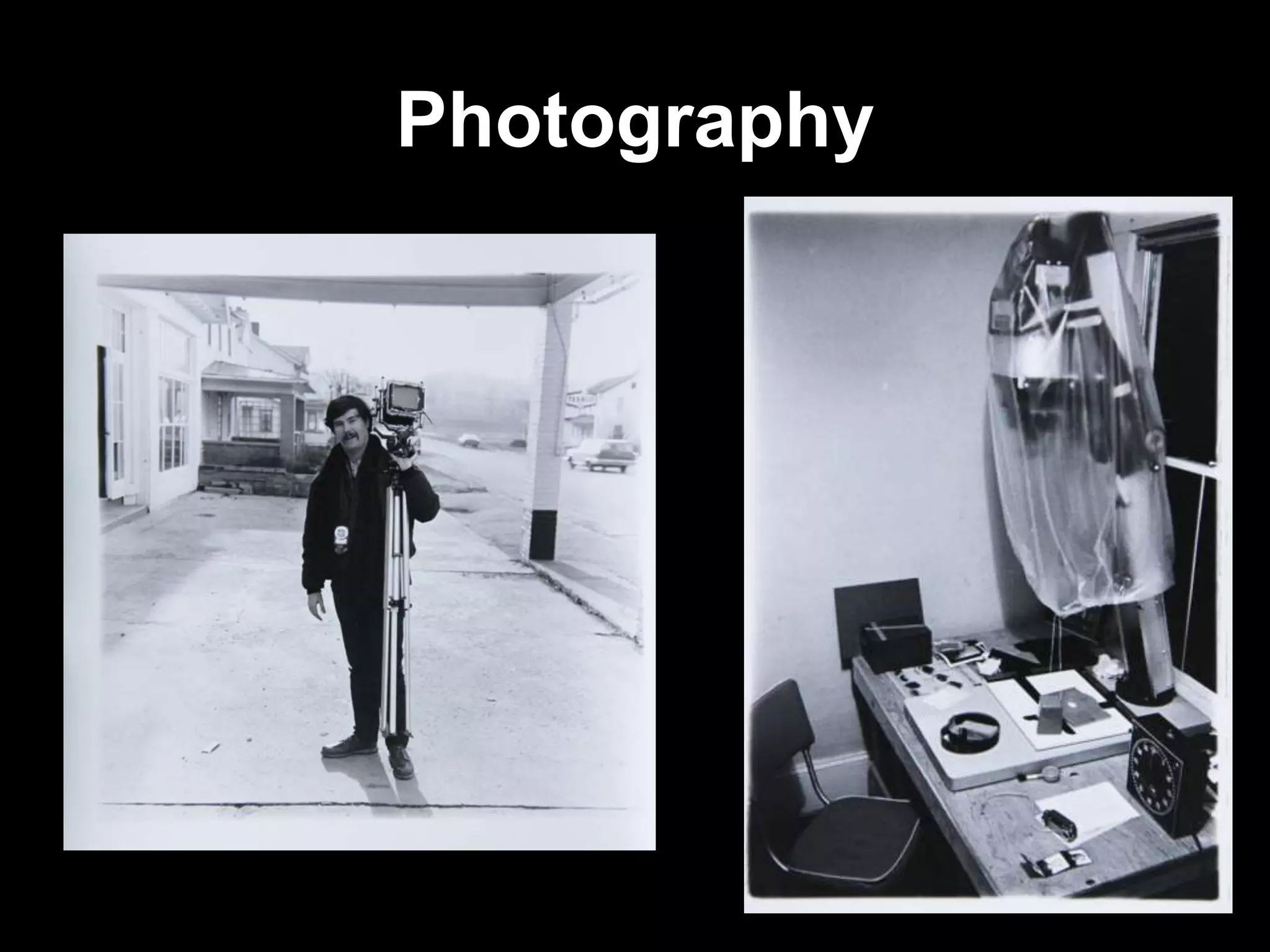
Photography
• Regular
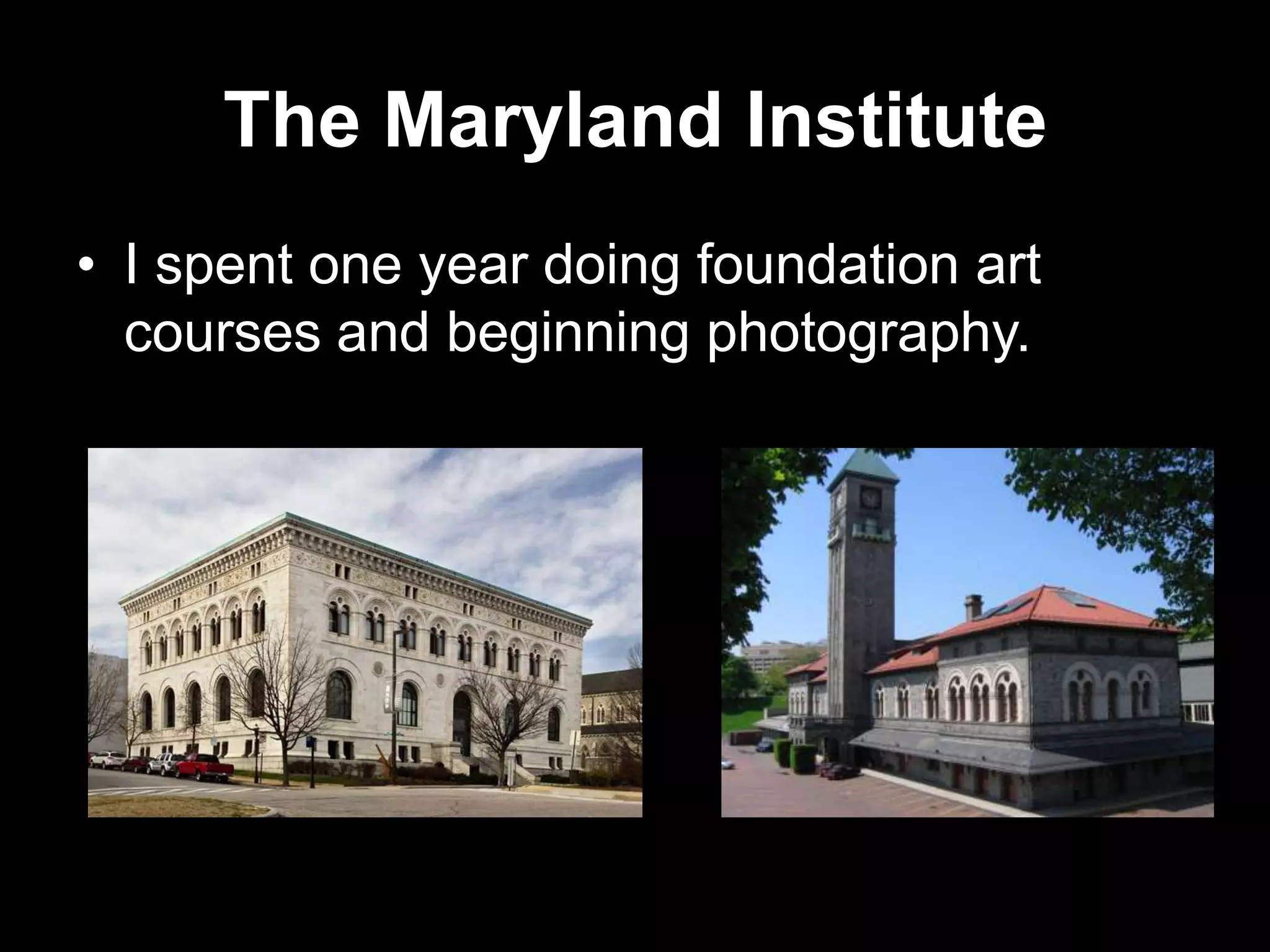
The Maryland Institute
• I spent one year doing foundation art
courses and beginning photography.
Side trip: Ex-convicts
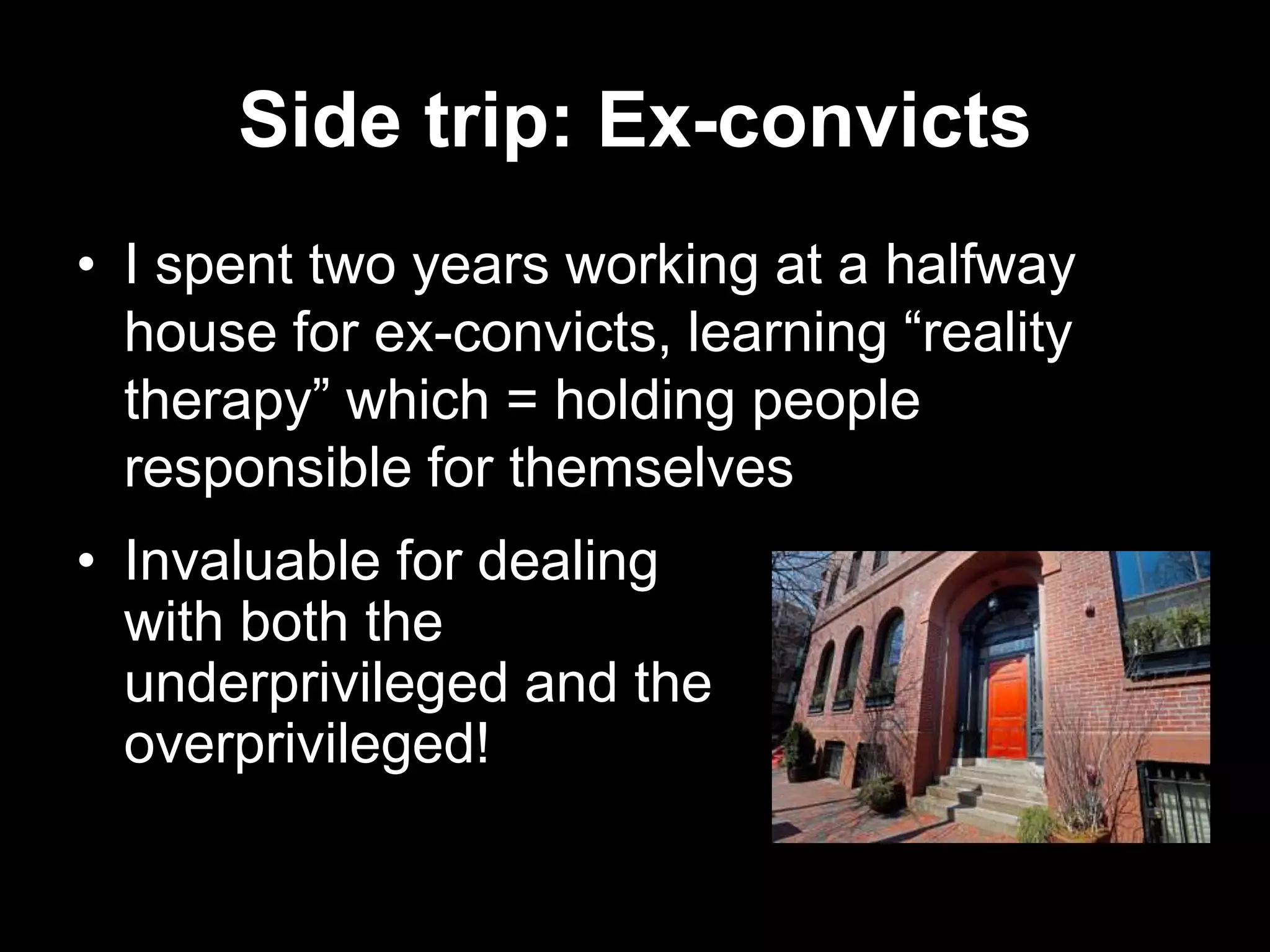
• I spent two years working at a halfway
house for ex-convicts, learning “reality
therapy” which = holding people
responsible for themselves
• Invaluable for dealing
with both the
underprivileged and the
overprivileged!
Graduate School
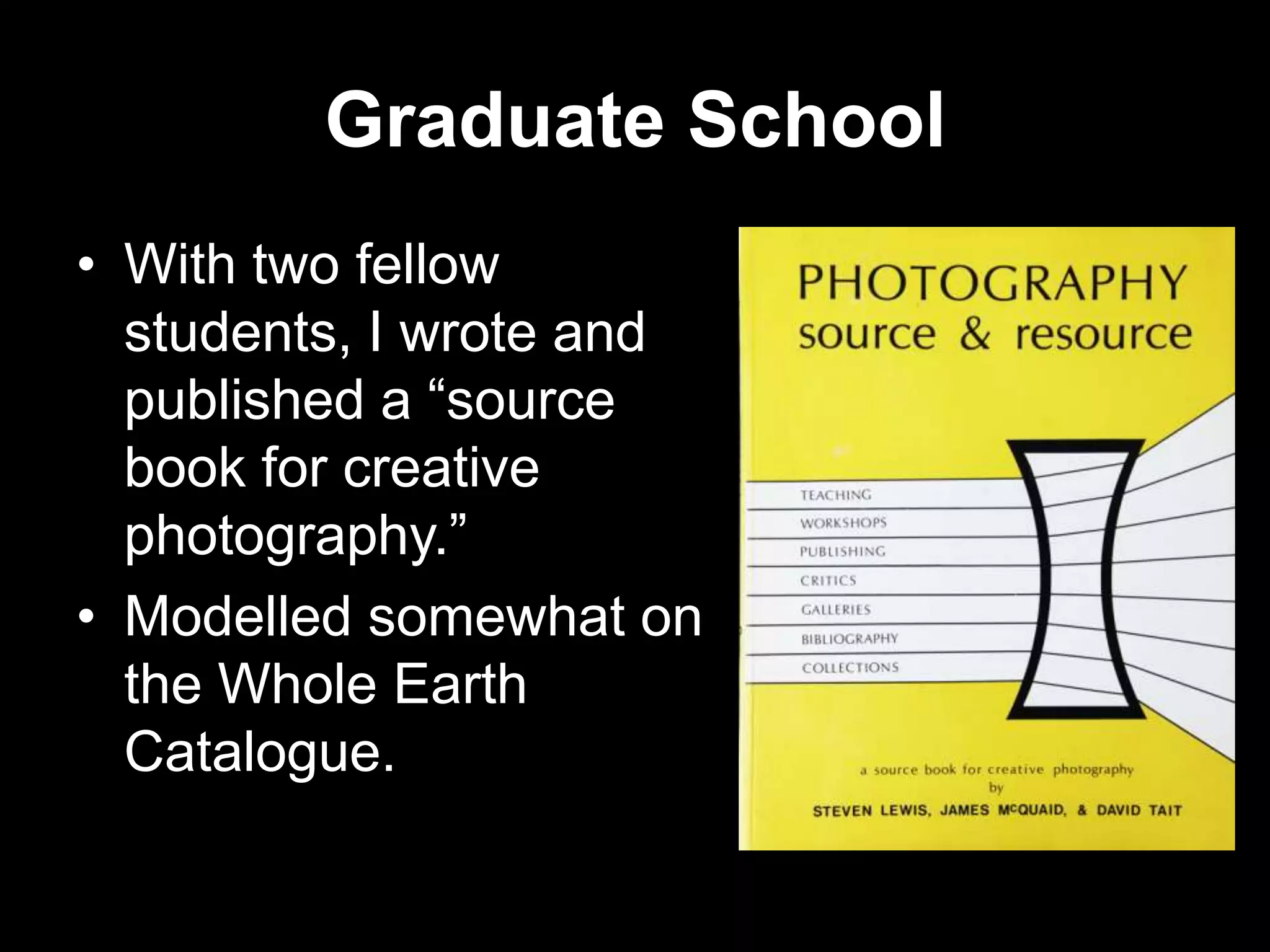
• With two fellow
students, I wrote and
published a “source
book for creative
photography.”
• Modelled somewhat on
the Whole Earth
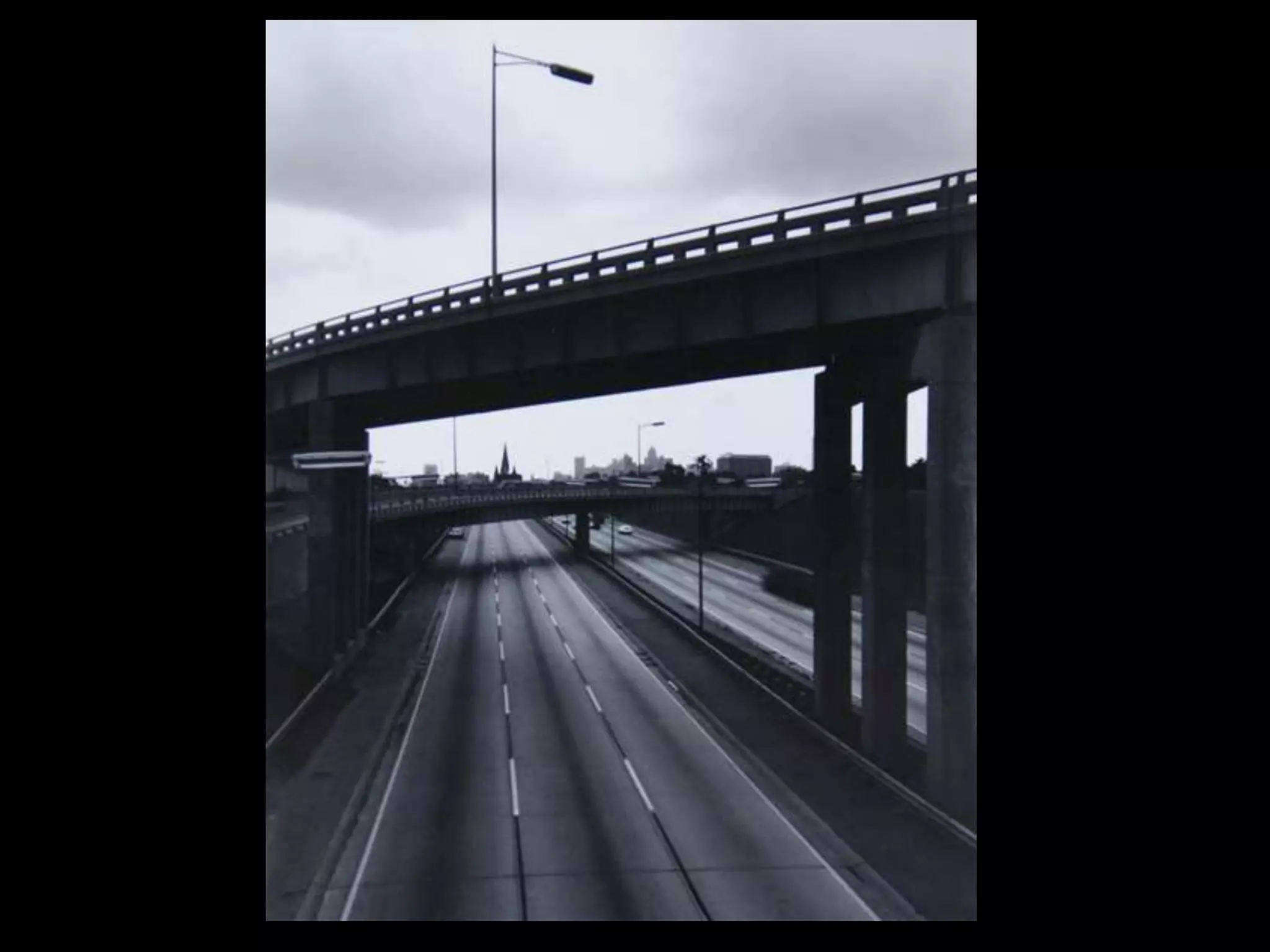
Catalogue.
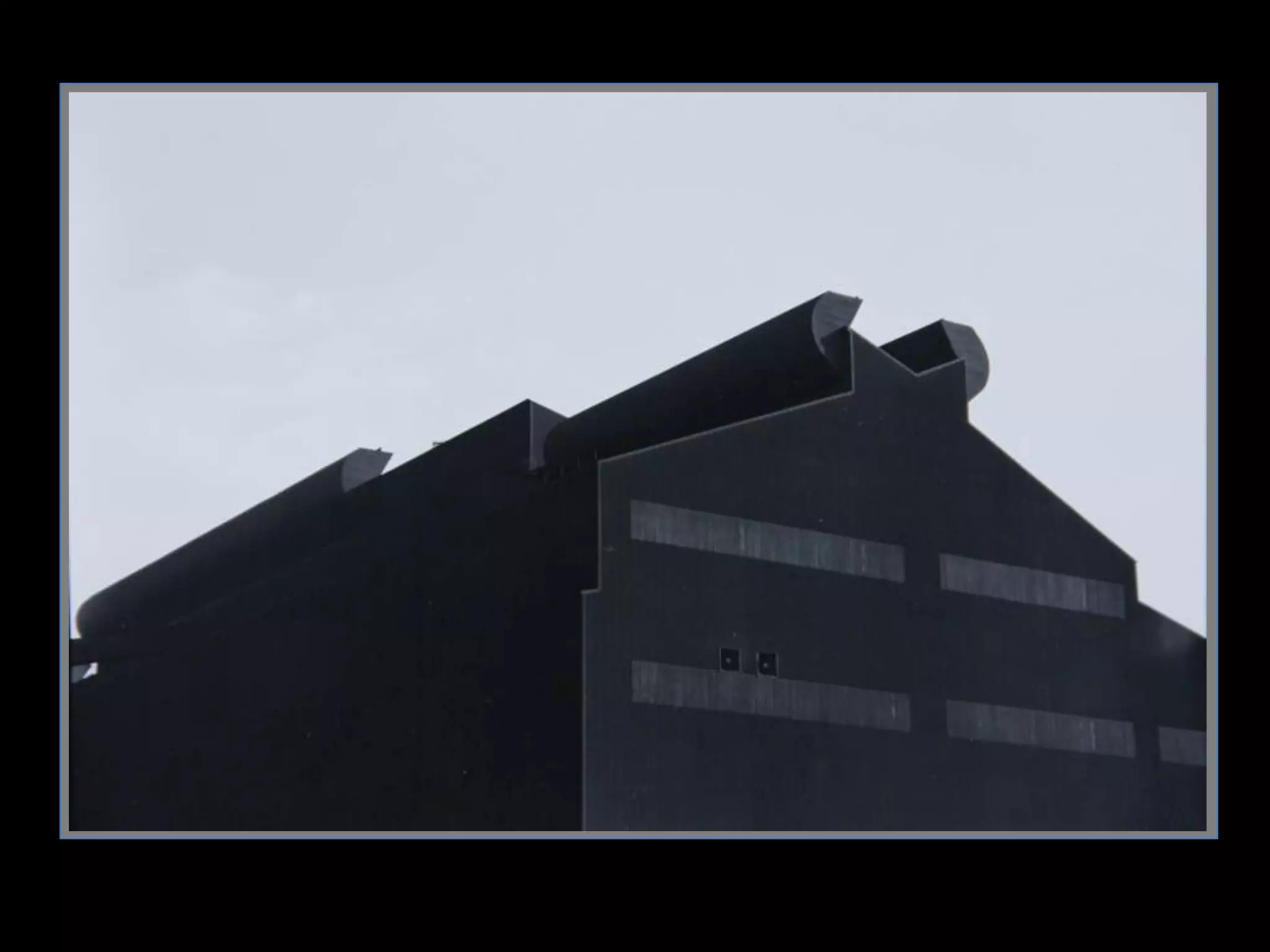
I also made some photographs
Academic Nomad
• I taught photography, the history of
photography and introductory art at:
– Central Michigan University
– Denison College
– The Cooper School of Art
– Western Michigan University
– UMass, Boston
Oral History Project
• Before the last teaching gig, I ran an Oral
History Project at the George Eastman
House (NEH grants)
• We interviewed aging, under-documented
photographers
• I conducted eight memoir-length
interviews during this time
– Frederick Sommer, Paul Vanderbilt, Lisette Model, Henry Holmes Smith, Brett
Weston, Arthur Siegel, Andre Kertesz, Berenice Abbott
And High Tech
• Failing to get a permanent position (the
primary goal of any academic):
– I decided not to move again, (I was in Boston)
– I was able to get a job as a technical writer for
Data Terminal Systems, an electronic cash
register company.

• And I worked my way from there to the roles
that seemed easier and more fun!
Problem with High Tech
• I had one major problem with my work in
high tech:
– Technology is extremely interesting

• This messed up my “artist with a day job”
plan pretty well
– I eventually took programming courses at
Harvard Extension
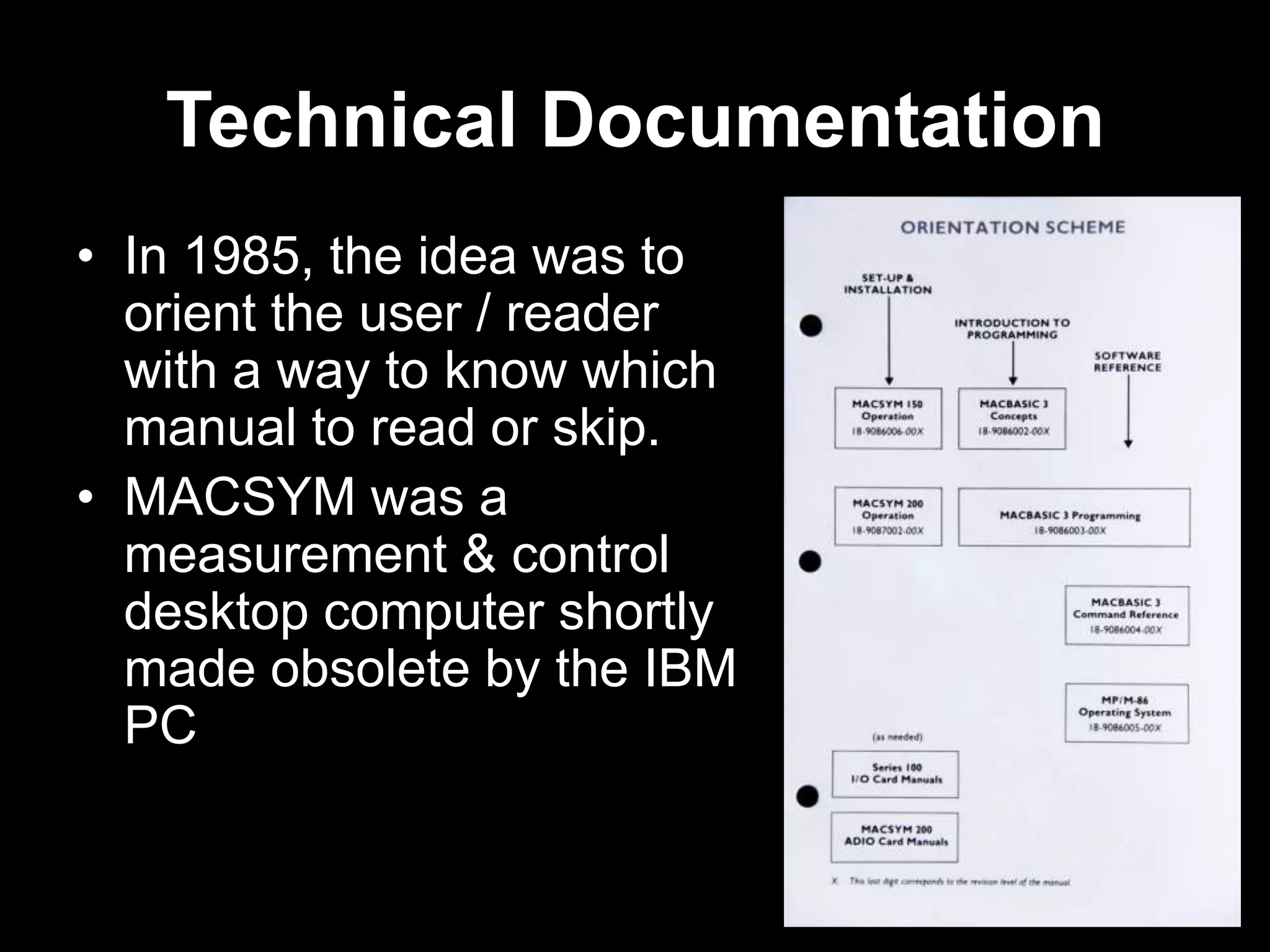
Technical Documentation
• In 1985, the idea was to
orient the user / reader
with a way to know which
manual to read or skip.
• MACSYM was a
measurement & control
desktop computer shortly
made obsolete by the IBM
PC
My Journey in High Tech
• Data Terminal Systems (tech writer)
• Analog Devices (tech writer, marketing
communications)
• Wandel & Goltermann (training, marketing
comunications, product management)
• NetScout (product management &
documentation)
• NetIQ (product management)
• NetQos (product management)
My Journey from High Tech
• Product managers
– Know a little bit about many things
– Tell people what to do, encourage them, harass
them, excite them
– Tell the story of the product

• Filmmakers
– Know a little bit about many things
– Tell people what to
do, encourage, harass, excite, incite
– Tell stories that they think have value
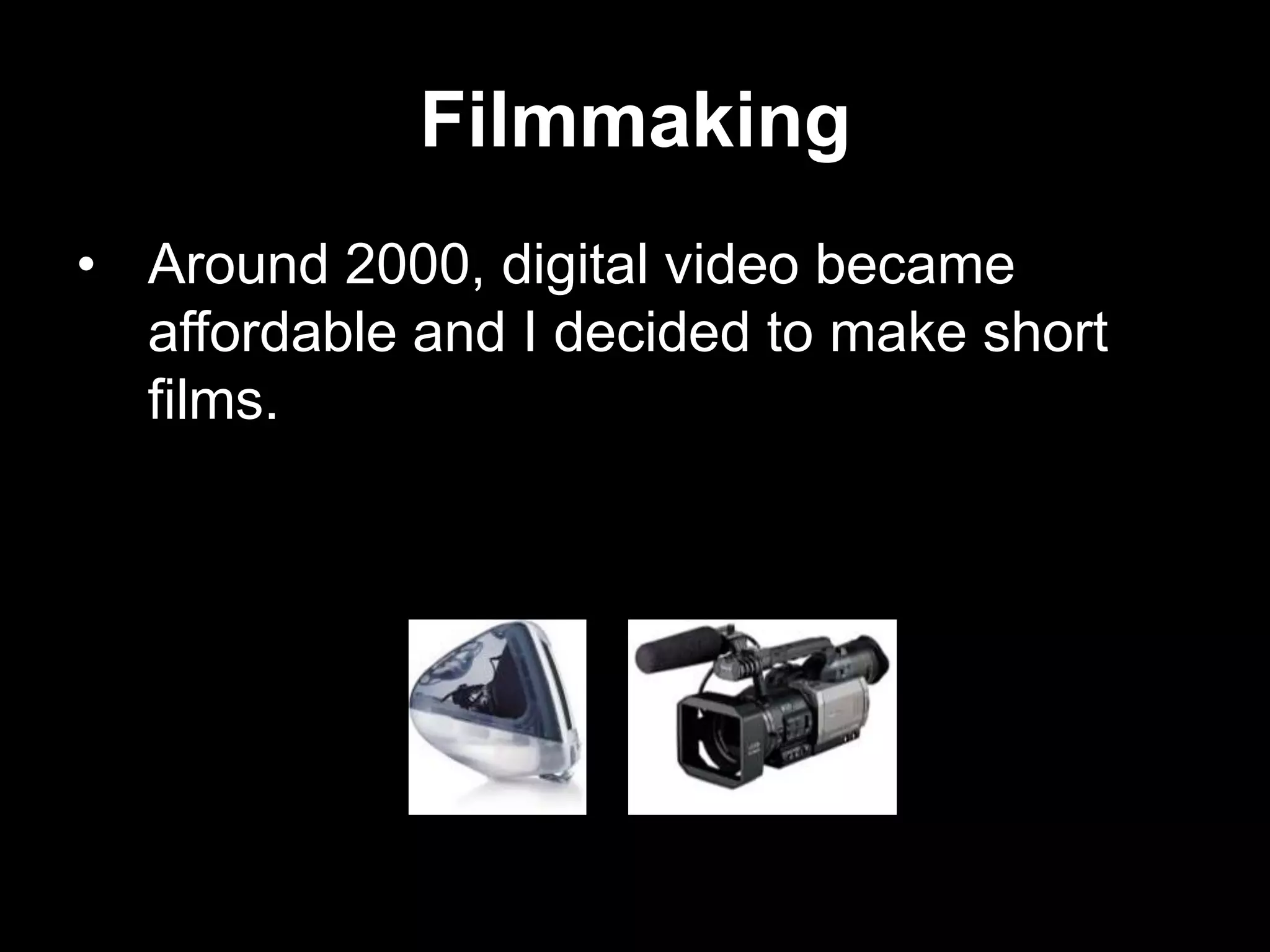
Filmmaking
• Around 2000, digital video became
affordable and I decided to make short
films.
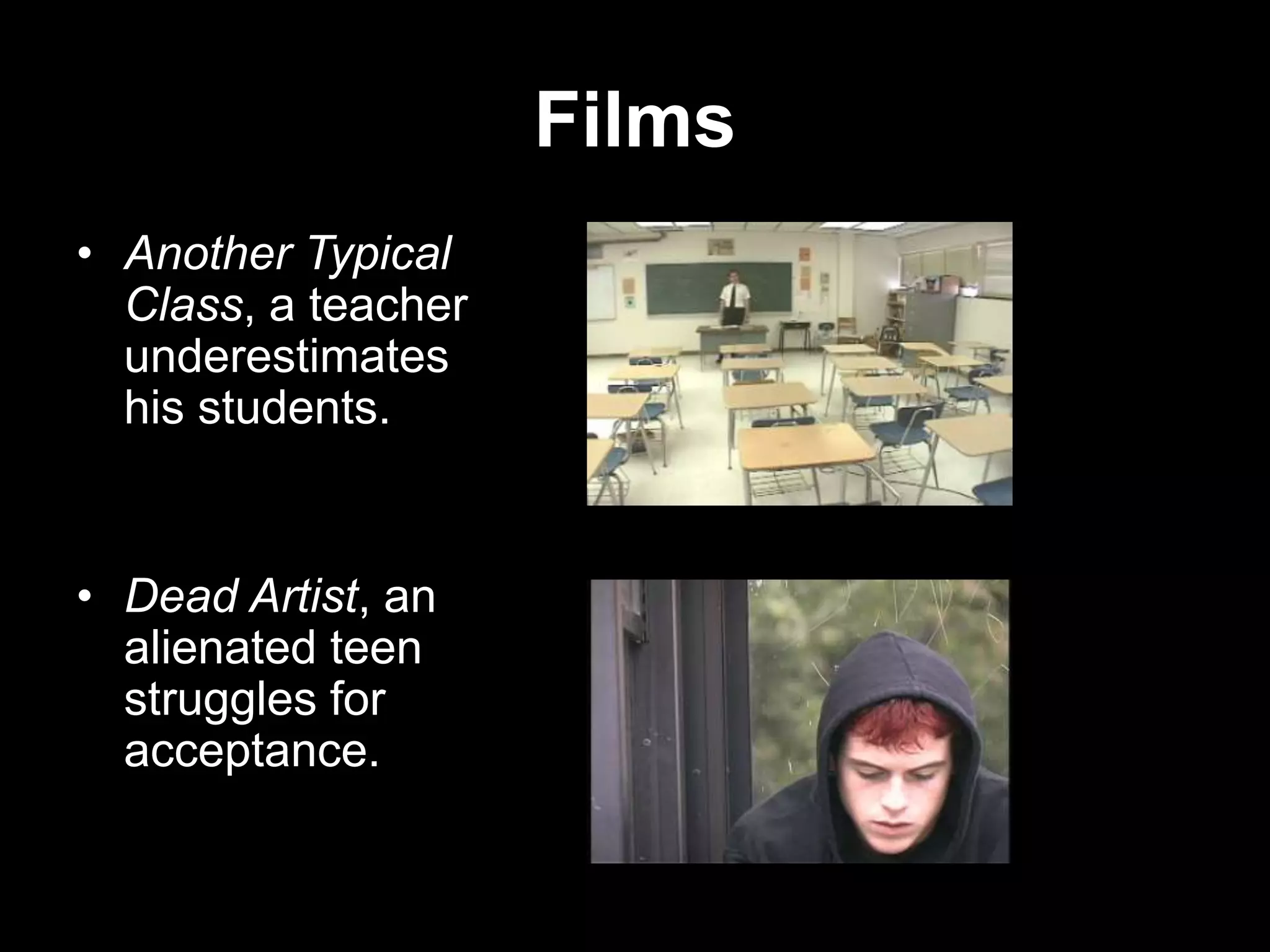
Films
• Another Typical
Class, a teacher
underestimates
his students.

• Dead Artist, an
alienated teen
struggles for
acceptance.
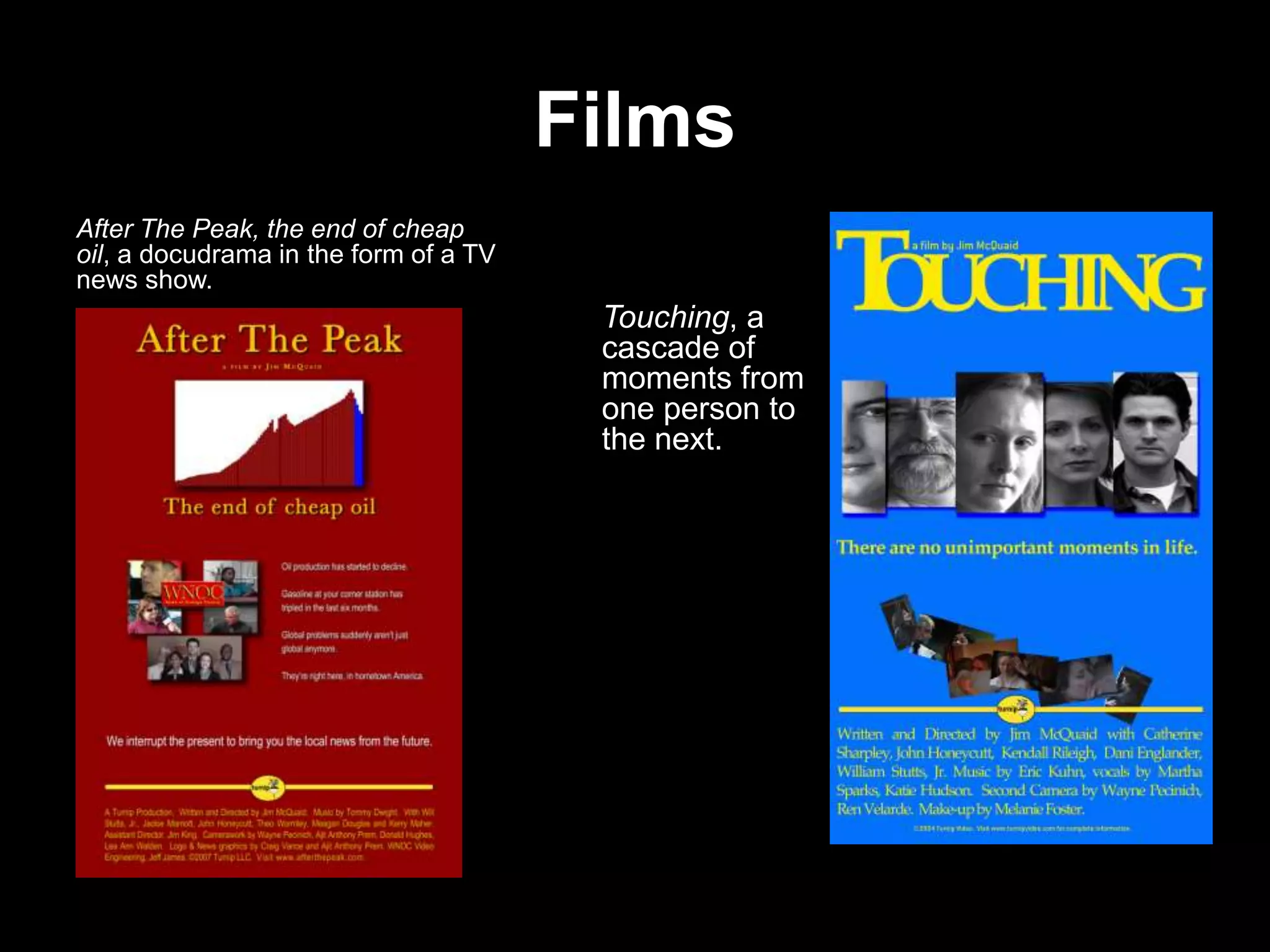
Films
After The Peak, the end of cheap
oil, a docudrama in the form of a TV
news show.

Touching, a
cascade of
moments from
one person to
the next.
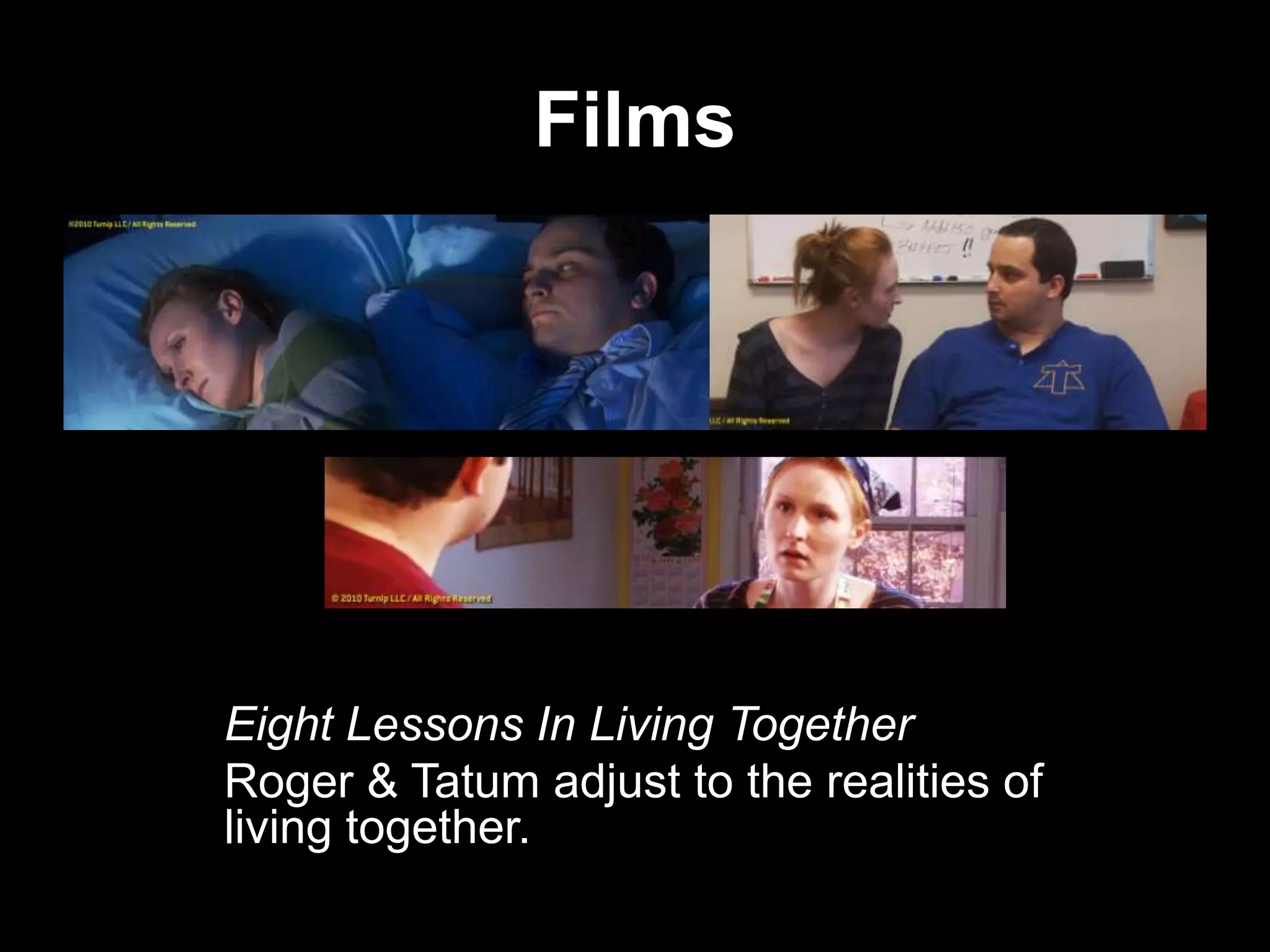
Films

Eight Lessons In Living Together
Roger & Tatum adjust to the realities of
living together.
Films

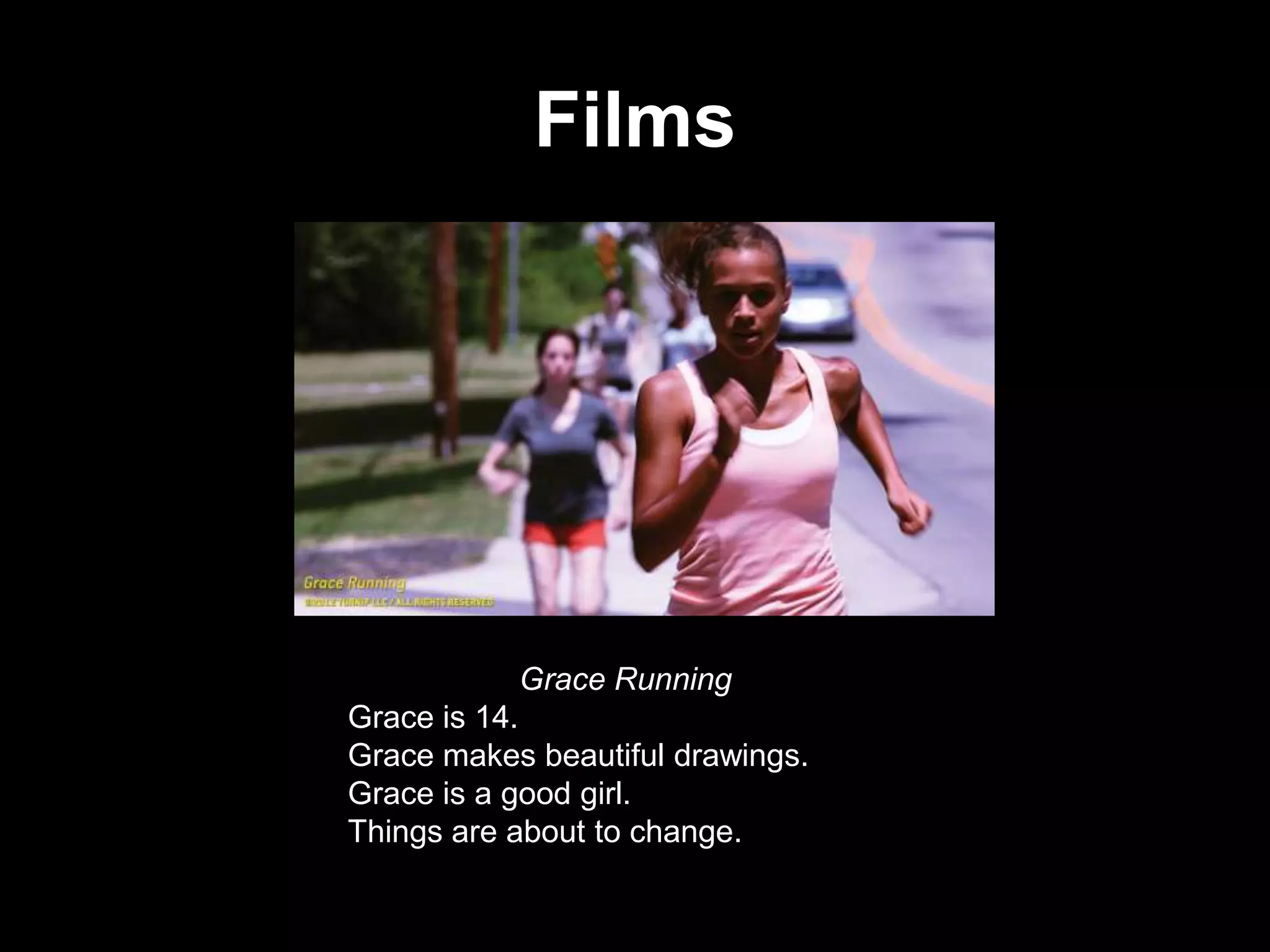
Grace Running
Grace is 14.
Grace makes beautiful drawings.
Grace is a good girl.
Things are about to change.
Films

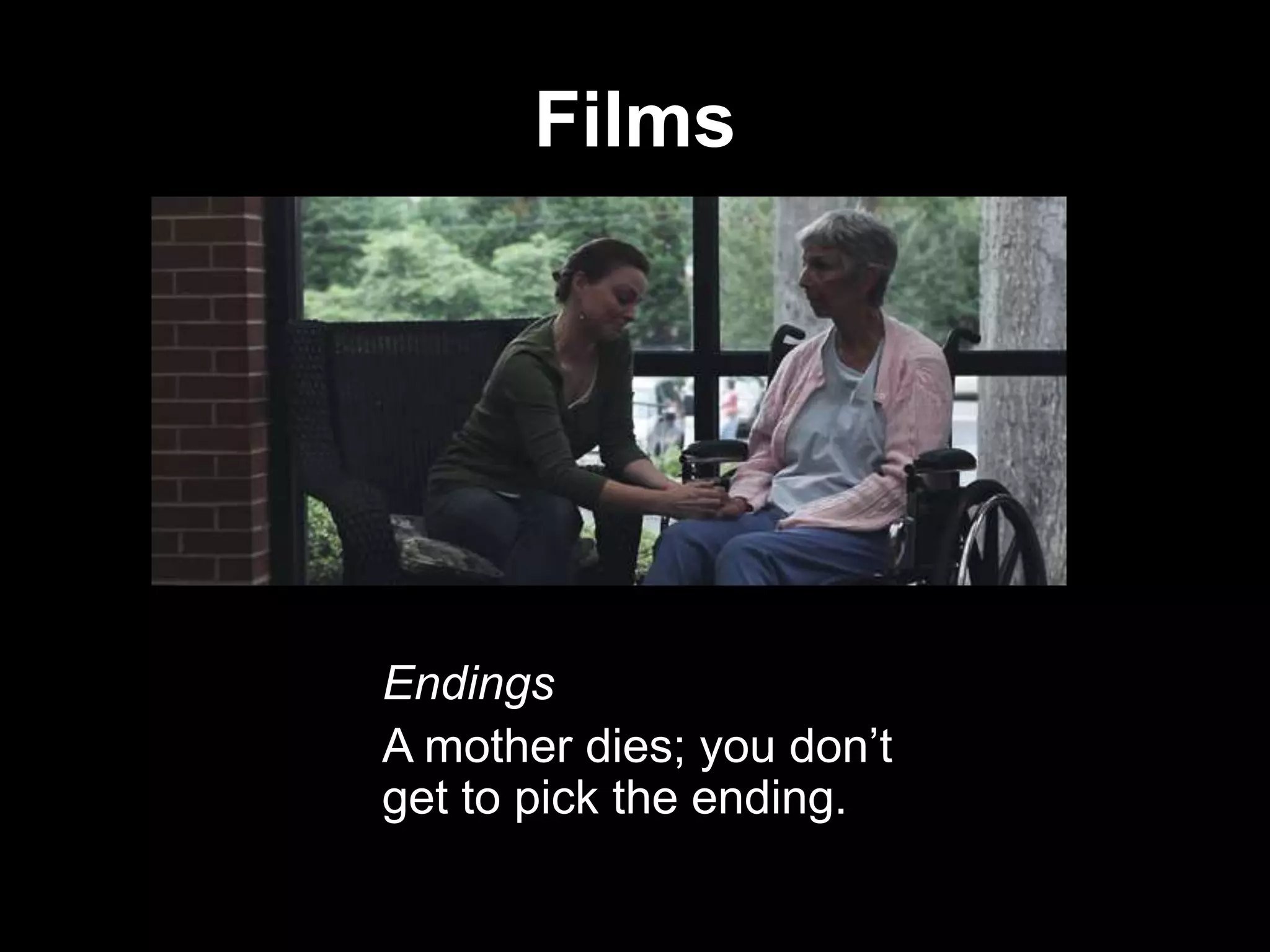
Endings
A mother dies; you don‟t
get to pick the ending.
Change?
The End of Civilization
• Okay, slightly hysterical title but some key
things seem to be in decline:
– Critical thinking and the ability to write clearly,
– Separating fact from fiction or myth,
– Willingness to see shades of gray,
– Books, magazines, newspapers,
– A general understanding of science or
mathematics.
College Students Today:
“They can assemble strings of jargon and
generate clots of ventriloquistic syntax. They
can meta-metastasize any thematic or
ideological notion they happen upon. And they
get good grades for doing just that. But as for
writing clearly, simply, with attention and
openness to their own thoughts and emotions
and the world around them — no.”
– Verlyn Klinkenborg, writer, teacher (Pomona
College, Harvard, Yale, Columbia)
Facts & Fiction
• Clearly, in our political speech, assertion is
more important than fact.
• Facts have the quality of becoming
inconvenient; at odds with modern
life, more or less.
• Myths acquire tremendous power in the
face of ignorance.
• Myths and conspiracies make goodstories.
Print Media
• Generally in decline?
• The Internet appears to jeopardize
newspapers and eventually broadcast
television as well.
• Journalism may be lost in the deal.
• Ebooks appear promising
– But paper is high bandwidth
Science & Math
• “Creationism” is the best example
– Essentially ignores the scientific method in
favor of alternate sources of authority.

• Probabilities remain esoteric
– And Nate Silver predicts the election.

• We lose the context for judgements
– Faced with a 1:1billion chance of a
problem, we react emotionally (depends on
the problem).
Liberal Education?
• The old notion of liberal education has
died, taking a lot of reading, writing and
clear thinking with it.
• In its place we find a short-sighted mix of
vocationally-oriented majors, leading to a
potentially great first job and a lot of
questions about life.
• Would you hire a music major?
Storytelling
Scott Russell Sanders
•
•
•
•
•
•

Stories entertain us.
Stories create community.
Stories show us the consequences of our actions.
Stories educate our desires.
Stories help us to dwell in place, to be rooted.
Stories help us to dwell in time, to understand its
flow
• Stories help us to deal with suffering. Stories teach
us how to be human
• Stories help us acknowledge the wonder and
mystery of creation.
Storytelling
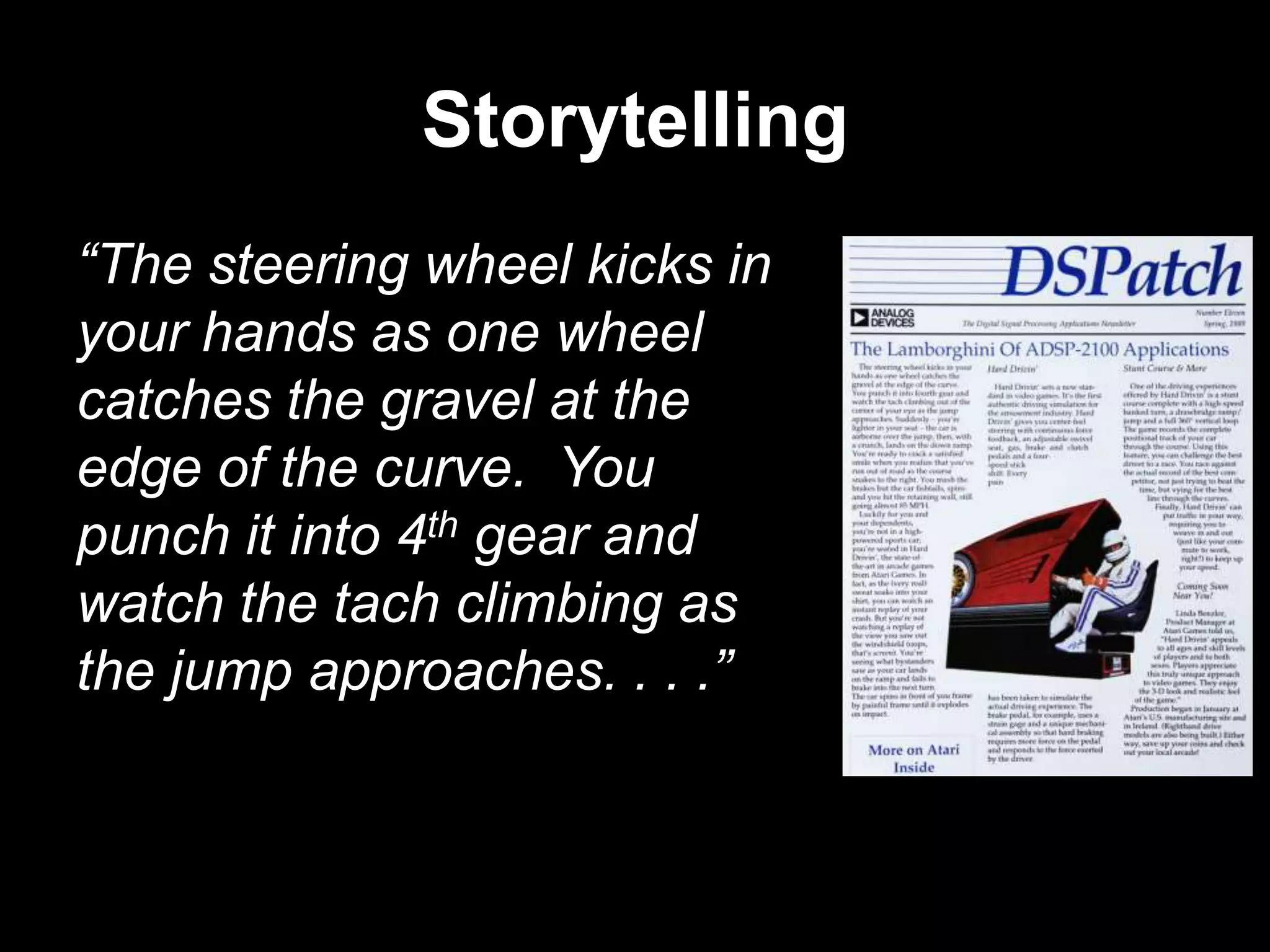
“The steering wheel kicks in
your hands as one wheel
catches the gravel at the
edge of the curve. You
punch it into 4th gear and
watch the tach climbing as
the jump approaches. . . .”
Find a Story, Any Story
• The “news” was that a simple multiplier
chip, second-sourced by Analog Devices was
now being made in a one-micron process.
(funny, hunh?)

• This was the “B” version of the product.
• Big whoop.
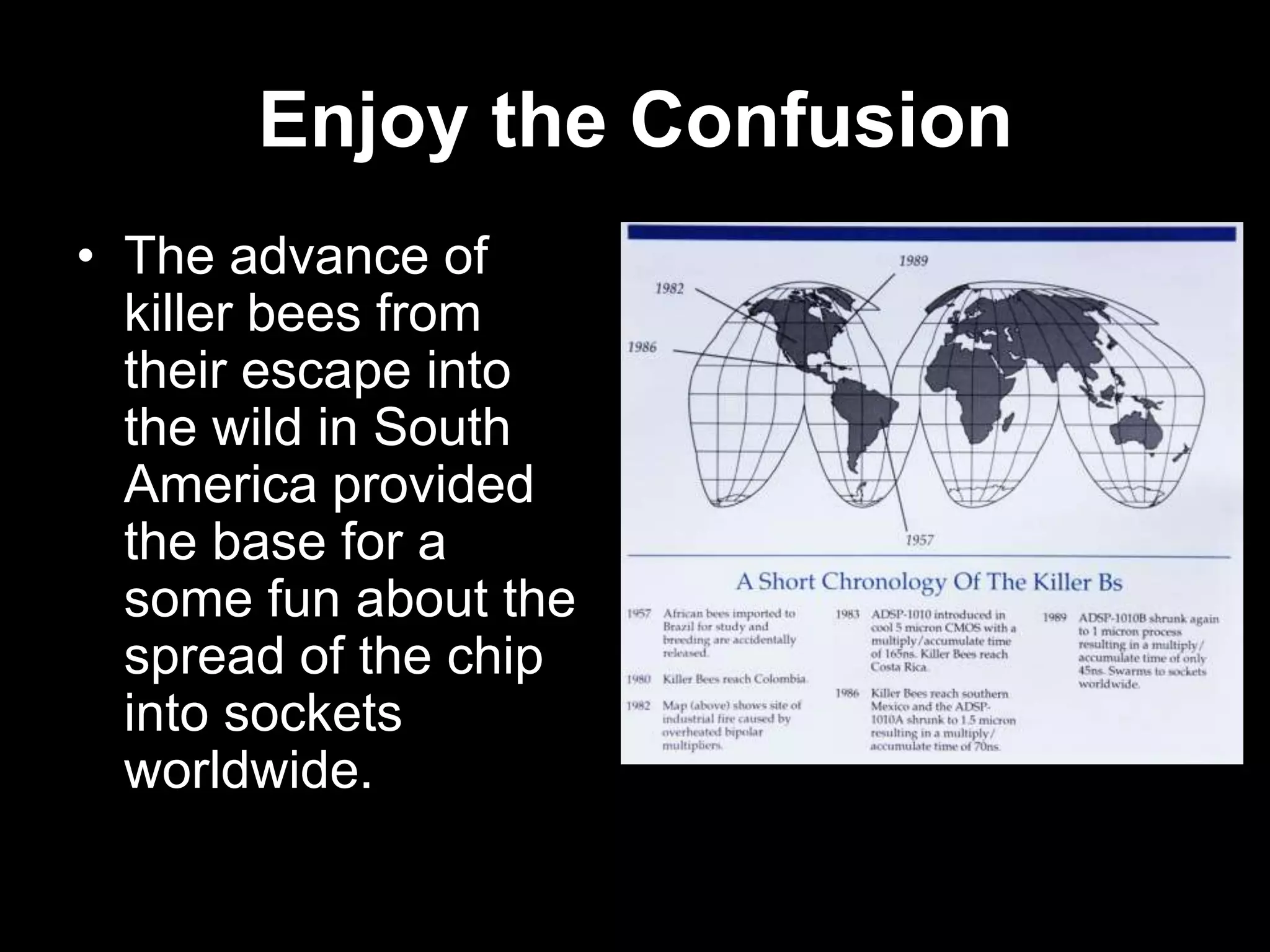
Killer “Bees”
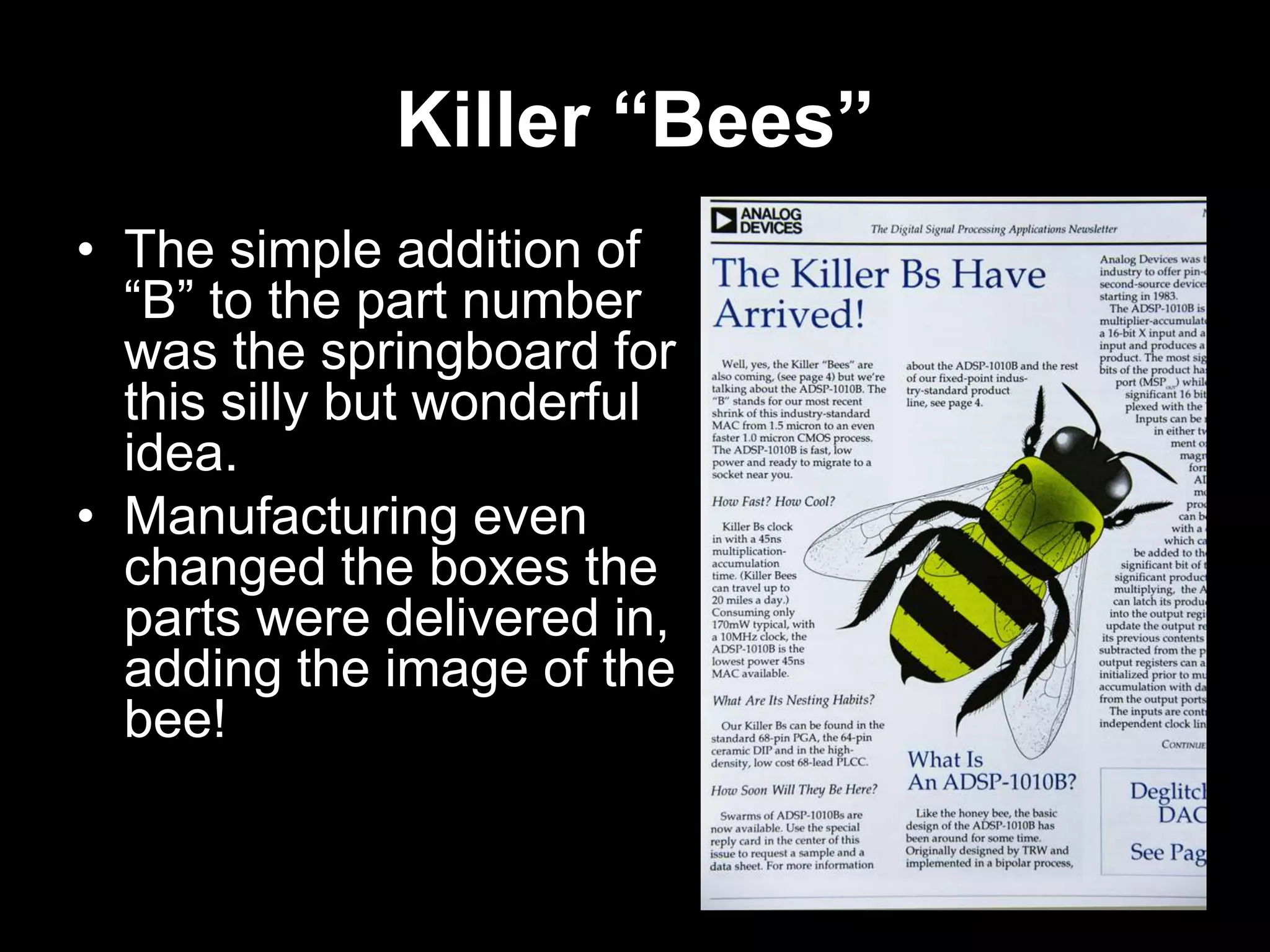
• The simple addition of
“B” to the part number
was the springboard for
this silly but wonderful
idea.
• Manufacturing even
changed the boxes the
parts were delivered in,
adding the image of the
bee!
Enjoy the Confusion
• The advance of
killer bees from
their escape into
the wild in South
America provided
the base for a
some fun about the
spread of the chip
into sockets
worldwide.
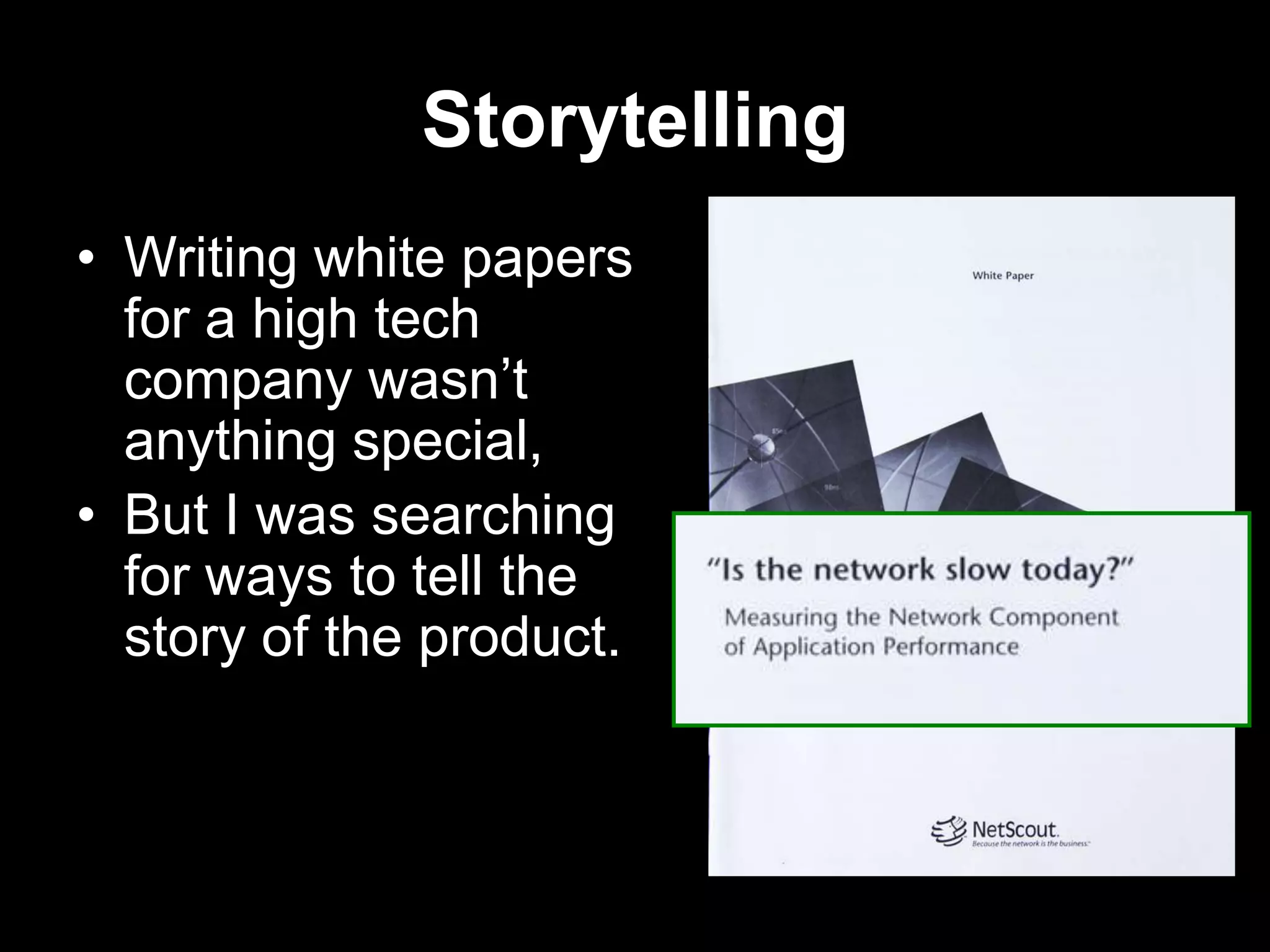
Storytelling
• Writing white papers
for a high tech
company wasn‟t
anything special,
• But I was searching
for ways to tell the
story of the product.
Storytelling
• Even at semiconductor firm, Analog
Devices, one element of success was the
wealth of “application notes” of all kinds.
• An “application note” after all, is a kind of story
about how to actually use some technology to
accomplish a purpose.
• It may not exactly be the „hero‟s quest‟ but it
creates the context for understanding value.
Scenario-Based Training
• The majority of my commercial video
business is collaborating on the creation of
what I call “scenario-based training.”
• There is plenty of literature on this and
related subjects.
Scenarios
• The fundamental challenge is to discover
the stories inherent in the task or
operations or field of knowledge at issue.
• Example:
– Wake County Board of Elections
– -Help Desk scenario; voter moved
BOE video
Standard Training
• Most videos, even those illustrating a
complete operation are relatively simple
narratives of the method at issue.
• With some realms of policy, it is possible –
and therefore important – to have more
fun.
BOE – Voter ID Card
Alternatives
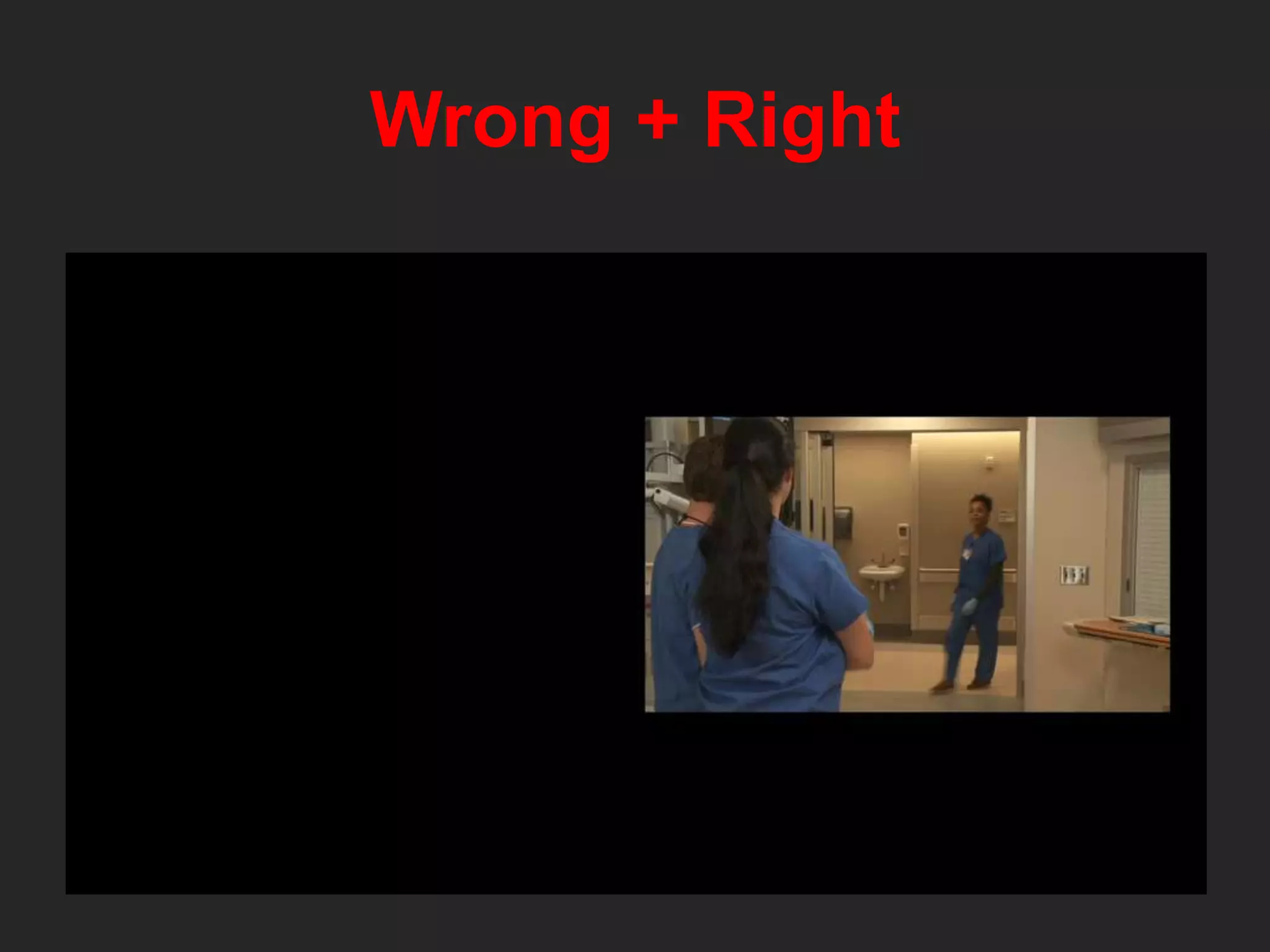
• Another training video approach that can
be extremely useful is showing both the
right and the wrong way to accomplish
some operation.
– This approach can also be used in a testing &
verification setting: can the viewer detect the
errors?
– Which level of OR-to-ICU communication
would you want for your surgery?
Wrong + Right
Changes
• Web video takes over many aspects of
communication post-internet.
–
–
–
–
–
–

VINE: “cool moment”
YOUTUBE: “How do you do that?”
YOUTUBE: “I’m a star too!”
HULU: “What’s on?”
FB: “What are you doing?”
LINKEDIN: “What do you do?”

• And sometimes, “I‟m engaged with a story.”
The Good News
• The overtones of video are subversive.
– Sometimes in a good way
• (I trust this guy)

– Sometimes in a weird way
• (What is he doing with his left hand?)

– Sometimes in a bad way
• (You can tell he‟s lying)
The Aura?
• Walter Benjamin famously wrote that the
“original” had an aura which the
reproduction did not.
• Digital media eliminates the original for
virtually all purposes.
– Instead, there is the original experience and
the record, which can be duplicated and
transmitted endlessly
The Aura
• Live
– Emotionally complete
– Time-consuming, hard to arrange

• Asynchronous
– Email? Voice mail??

• Recorded / played back
– Video emulates “live” better
Creativity
&
Organizations
Leadership

“All problems are leadership problems.”
Creativity
• Everyone has some degree of creativity
• Education generally diminishes
(channels?) this over time
• It‟s like a muscle that has to be used to be
strong
• Some of the best creative work is
collaborative work (not taught in most
classrooms)
Creativity In Organizations
• Alan Kay said it best:
• “It’s easy to get innovation. You take
smart people and money and you rub
them together.”
• But it‟s hard for organizations to recognize
or appreciate.
Who Do You Hire?
• Someone whose resume contains the
keywords that match your HR department‟s
automated search function?
• Someone with a degree in technical
communication?
• Someone with a broad background and basic
skills?
• Who may take a while to get up to speed but
potentially have some new ideas
How Do You Manage?
• My 29-year-old daughter won‟t tolerate
being micro-managed.
– (possibly genetic)

• How often does the mission change?
• Does resource allocation reflect the
realities of creating something?
Creativity is Personal
• People with no time, no power and no
ownership will have a hard time becoming
creative.

• Collaboration can be creative, but this is
not a natural organizational structure – it‟s
not hierarchical.
Scott Russell Sanders
•
•
•
•
•
•

Stories entertain us.
Stories create community.
Stories show us the consequences of our actions.
Stories educate our desires.
Stories help us to dwell in place, to be rooted.
Stories help us to dwell in time, to understand its
flow
• Stories help us to deal with suffering. Stories teach
us how to be human
• Stories help us acknowledge the wonder and
mystery of creation.
Best Practices Conference 2013

Best Practices Conference 2013

  • 1.
    Creativity & Communication JimMcQuaid jim@turnipfilms.com www.turnipfilms.com
  • 2.
    Abstract • My personaljourney through high technology and creative work and how that enabled me to pursue my path. • Changes I‟m seeing: – The “demise” of culture – Story telling and the future of (technical) communication • Thoughts about the problem of creativity in large organizations
  • 3.
  • 4.
    Life Story • Iwas born in Detroit and grew up there. • My Father worked for Ford for 35 years and used to draw on napkins at the dinner table to explain things.
  • 5.
    Life Story • Inelementary school learned how to read and write (and spell). • Thank you: – Mrs. Kaiser – Mrs. Horton – Mrs. Eckholm
  • 6.
    High School • Iattended a private secondary school. • Fortunately, the English department was ruled by a fanatic for writing. – 1000 words every weekend for six years . . . Carl Wonnberger
  • 7.
    High School • Whileat Cranbrook I never fully knew about these buildings that were part of an exotic organization known as the Cranbrook Art Academy.
  • 8.
    A Liberal Education •At the University of Michigan earned a degree in Political Science – (Because I got an “A” in the intro course) • But that was not my real major . . .
  • 9.
    A Liberal Education •I had a double major, – Sports Car Rallying . . .
  • 10.
    A Liberal Education •And Bluegrass Banjo.
  • 11.
  • 12.
    The Maryland Institute •I spent one year doing foundation art courses and beginning photography.
  • 13.
    Side trip: Ex-convicts •I spent two years working at a halfway house for ex-convicts, learning “reality therapy” which = holding people responsible for themselves • Invaluable for dealing with both the underprivileged and the overprivileged!
  • 14.
    Graduate School • Withtwo fellow students, I wrote and published a “source book for creative photography.” • Modelled somewhat on the Whole Earth Catalogue.
  • 15.
    I also madesome photographs
  • 18.
    Academic Nomad • Itaught photography, the history of photography and introductory art at: – Central Michigan University – Denison College – The Cooper School of Art – Western Michigan University – UMass, Boston
  • 19.
    Oral History Project •Before the last teaching gig, I ran an Oral History Project at the George Eastman House (NEH grants) • We interviewed aging, under-documented photographers • I conducted eight memoir-length interviews during this time – Frederick Sommer, Paul Vanderbilt, Lisette Model, Henry Holmes Smith, Brett Weston, Arthur Siegel, Andre Kertesz, Berenice Abbott
  • 20.
    And High Tech •Failing to get a permanent position (the primary goal of any academic): – I decided not to move again, (I was in Boston) – I was able to get a job as a technical writer for Data Terminal Systems, an electronic cash register company. • And I worked my way from there to the roles that seemed easier and more fun!
  • 21.
    Problem with HighTech • I had one major problem with my work in high tech: – Technology is extremely interesting • This messed up my “artist with a day job” plan pretty well – I eventually took programming courses at Harvard Extension
  • 22.
    Technical Documentation • In1985, the idea was to orient the user / reader with a way to know which manual to read or skip. • MACSYM was a measurement & control desktop computer shortly made obsolete by the IBM PC
  • 23.
    My Journey inHigh Tech • Data Terminal Systems (tech writer) • Analog Devices (tech writer, marketing communications) • Wandel & Goltermann (training, marketing comunications, product management) • NetScout (product management & documentation) • NetIQ (product management) • NetQos (product management)
  • 24.
    My Journey fromHigh Tech • Product managers – Know a little bit about many things – Tell people what to do, encourage them, harass them, excite them – Tell the story of the product • Filmmakers – Know a little bit about many things – Tell people what to do, encourage, harass, excite, incite – Tell stories that they think have value
  • 25.
    Filmmaking • Around 2000,digital video became affordable and I decided to make short films.
  • 26.
    Films • Another Typical Class,a teacher underestimates his students. • Dead Artist, an alienated teen struggles for acceptance.
  • 27.
    Films After The Peak,the end of cheap oil, a docudrama in the form of a TV news show. Touching, a cascade of moments from one person to the next.
  • 28.
    Films Eight Lessons InLiving Together Roger & Tatum adjust to the realities of living together.
  • 29.
    Films Grace Running Grace is14. Grace makes beautiful drawings. Grace is a good girl. Things are about to change.
  • 30.
    Films Endings A mother dies;you don‟t get to pick the ending.
  • 31.
  • 32.
    The End ofCivilization • Okay, slightly hysterical title but some key things seem to be in decline: – Critical thinking and the ability to write clearly, – Separating fact from fiction or myth, – Willingness to see shades of gray, – Books, magazines, newspapers, – A general understanding of science or mathematics.
  • 33.
    College Students Today: “Theycan assemble strings of jargon and generate clots of ventriloquistic syntax. They can meta-metastasize any thematic or ideological notion they happen upon. And they get good grades for doing just that. But as for writing clearly, simply, with attention and openness to their own thoughts and emotions and the world around them — no.” – Verlyn Klinkenborg, writer, teacher (Pomona College, Harvard, Yale, Columbia)
  • 34.
    Facts & Fiction •Clearly, in our political speech, assertion is more important than fact. • Facts have the quality of becoming inconvenient; at odds with modern life, more or less. • Myths acquire tremendous power in the face of ignorance. • Myths and conspiracies make goodstories.
  • 35.
    Print Media • Generallyin decline? • The Internet appears to jeopardize newspapers and eventually broadcast television as well. • Journalism may be lost in the deal. • Ebooks appear promising – But paper is high bandwidth
  • 36.
    Science & Math •“Creationism” is the best example – Essentially ignores the scientific method in favor of alternate sources of authority. • Probabilities remain esoteric – And Nate Silver predicts the election. • We lose the context for judgements – Faced with a 1:1billion chance of a problem, we react emotionally (depends on the problem).
  • 37.
    Liberal Education? • Theold notion of liberal education has died, taking a lot of reading, writing and clear thinking with it. • In its place we find a short-sighted mix of vocationally-oriented majors, leading to a potentially great first job and a lot of questions about life. • Would you hire a music major?
  • 38.
  • 39.
    Scott Russell Sanders • • • • • • Storiesentertain us. Stories create community. Stories show us the consequences of our actions. Stories educate our desires. Stories help us to dwell in place, to be rooted. Stories help us to dwell in time, to understand its flow • Stories help us to deal with suffering. Stories teach us how to be human • Stories help us acknowledge the wonder and mystery of creation.
  • 40.
    Storytelling “The steering wheelkicks in your hands as one wheel catches the gravel at the edge of the curve. You punch it into 4th gear and watch the tach climbing as the jump approaches. . . .”
  • 41.
    Find a Story,Any Story • The “news” was that a simple multiplier chip, second-sourced by Analog Devices was now being made in a one-micron process. (funny, hunh?) • This was the “B” version of the product. • Big whoop.
  • 42.
    Killer “Bees” • Thesimple addition of “B” to the part number was the springboard for this silly but wonderful idea. • Manufacturing even changed the boxes the parts were delivered in, adding the image of the bee!
  • 43.
    Enjoy the Confusion •The advance of killer bees from their escape into the wild in South America provided the base for a some fun about the spread of the chip into sockets worldwide.
  • 44.
    Storytelling • Writing whitepapers for a high tech company wasn‟t anything special, • But I was searching for ways to tell the story of the product.
  • 45.
    Storytelling • Even atsemiconductor firm, Analog Devices, one element of success was the wealth of “application notes” of all kinds. • An “application note” after all, is a kind of story about how to actually use some technology to accomplish a purpose. • It may not exactly be the „hero‟s quest‟ but it creates the context for understanding value.
  • 46.
    Scenario-Based Training • Themajority of my commercial video business is collaborating on the creation of what I call “scenario-based training.” • There is plenty of literature on this and related subjects.
  • 47.
    Scenarios • The fundamentalchallenge is to discover the stories inherent in the task or operations or field of knowledge at issue. • Example: – Wake County Board of Elections – -Help Desk scenario; voter moved
  • 48.
  • 49.
    Standard Training • Mostvideos, even those illustrating a complete operation are relatively simple narratives of the method at issue. • With some realms of policy, it is possible – and therefore important – to have more fun.
  • 50.
  • 51.
    Alternatives • Another trainingvideo approach that can be extremely useful is showing both the right and the wrong way to accomplish some operation. – This approach can also be used in a testing & verification setting: can the viewer detect the errors? – Which level of OR-to-ICU communication would you want for your surgery?
  • 52.
  • 53.
    Changes • Web videotakes over many aspects of communication post-internet. – – – – – – VINE: “cool moment” YOUTUBE: “How do you do that?” YOUTUBE: “I’m a star too!” HULU: “What’s on?” FB: “What are you doing?” LINKEDIN: “What do you do?” • And sometimes, “I‟m engaged with a story.”
  • 54.
    The Good News •The overtones of video are subversive. – Sometimes in a good way • (I trust this guy) – Sometimes in a weird way • (What is he doing with his left hand?) – Sometimes in a bad way • (You can tell he‟s lying)
  • 55.
    The Aura? • WalterBenjamin famously wrote that the “original” had an aura which the reproduction did not. • Digital media eliminates the original for virtually all purposes. – Instead, there is the original experience and the record, which can be duplicated and transmitted endlessly
  • 56.
    The Aura • Live –Emotionally complete – Time-consuming, hard to arrange • Asynchronous – Email? Voice mail?? • Recorded / played back – Video emulates “live” better
  • 57.
  • 58.
    Leadership “All problems areleadership problems.”
  • 59.
    Creativity • Everyone hassome degree of creativity • Education generally diminishes (channels?) this over time • It‟s like a muscle that has to be used to be strong • Some of the best creative work is collaborative work (not taught in most classrooms)
  • 60.
    Creativity In Organizations •Alan Kay said it best: • “It’s easy to get innovation. You take smart people and money and you rub them together.” • But it‟s hard for organizations to recognize or appreciate.
  • 61.
    Who Do YouHire? • Someone whose resume contains the keywords that match your HR department‟s automated search function? • Someone with a degree in technical communication? • Someone with a broad background and basic skills? • Who may take a while to get up to speed but potentially have some new ideas
  • 62.
    How Do YouManage? • My 29-year-old daughter won‟t tolerate being micro-managed. – (possibly genetic) • How often does the mission change? • Does resource allocation reflect the realities of creating something?
  • 63.
    Creativity is Personal •People with no time, no power and no ownership will have a hard time becoming creative. • Collaboration can be creative, but this is not a natural organizational structure – it‟s not hierarchical.
  • 64.
    Scott Russell Sanders • • • • • • Storiesentertain us. Stories create community. Stories show us the consequences of our actions. Stories educate our desires. Stories help us to dwell in place, to be rooted. Stories help us to dwell in time, to understand its flow • Stories help us to deal with suffering. Stories teach us how to be human • Stories help us acknowledge the wonder and mystery of creation.

Editor's Notes

  • #34 She notes that at Pomona, there were 16 English majors out of 1560 students total.
  • #53 The training issue is the relationship between the OR teams and the ICU team that must receive the patient. Which relationship would you want if you were coming from brain surgery?