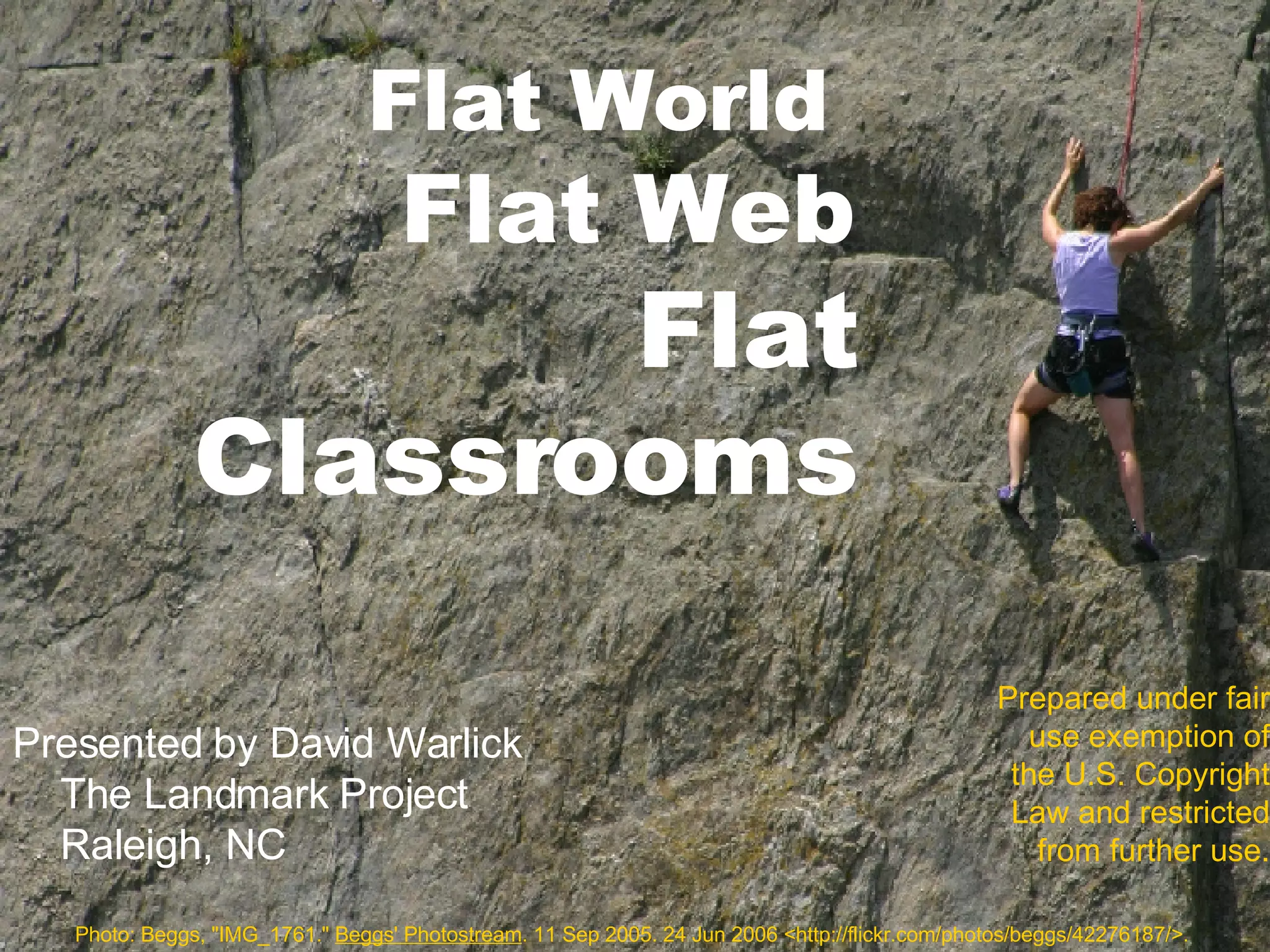
Presented by David Warlick The Landmark Project Raleigh, NC Flat World  Flat Web   Flat Classrooms Photo: Beggs, &quot;IMG_1761.&quot;  Beggs' Photostream . 11 Sep 2005. 24 Jun 2006 <http://flickr.com/photos/beggs/42276187/>. Prepared under fair use exemption of the U.S. Copyright Law and restricted from further use.
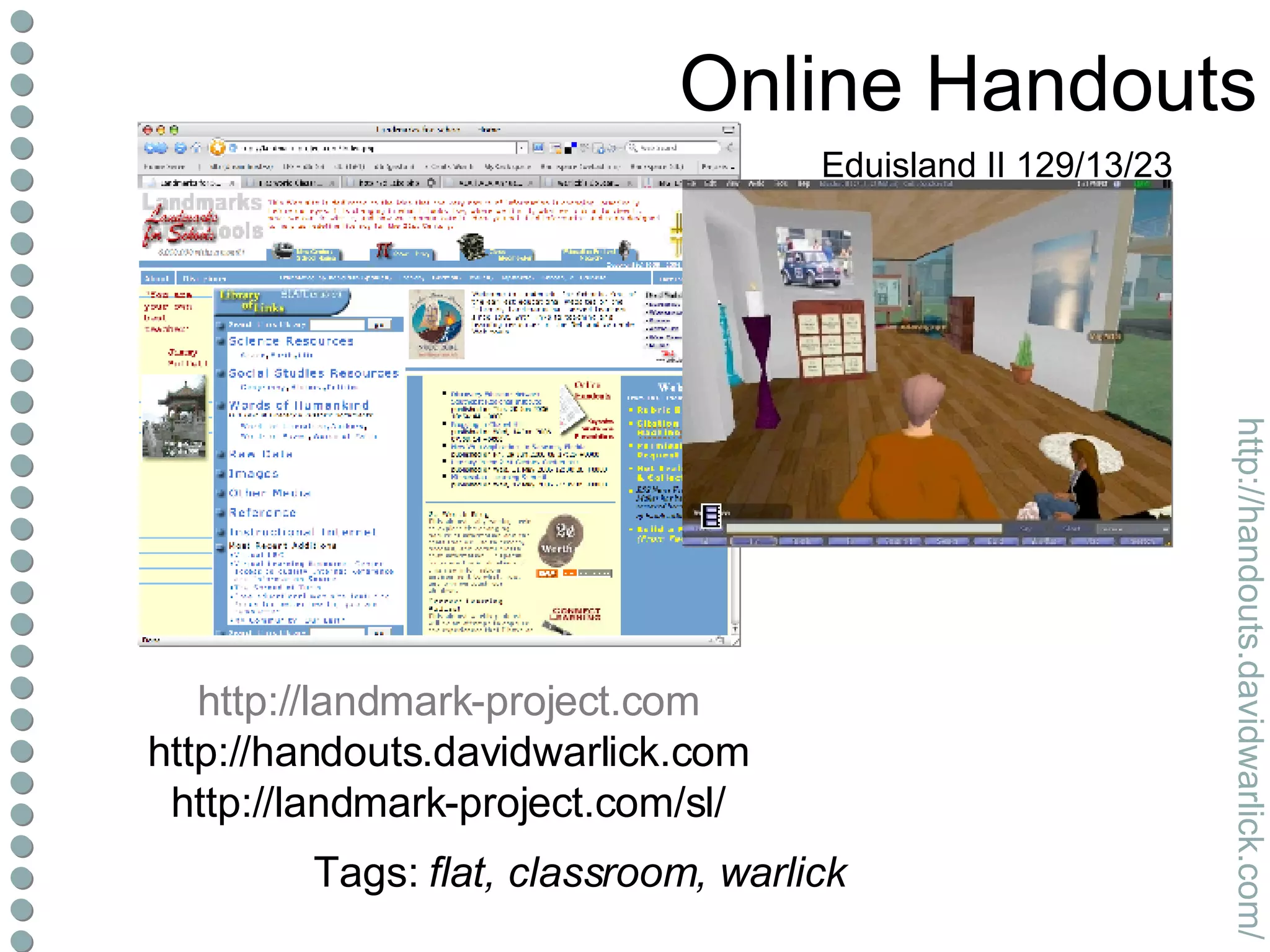
Online Handouts http://landmark-project.com http://handouts.davidwarlick.com http://landmark-project.com/sl/ Eduisland II 129/13/23 Tags:  flat, classroom, warlick
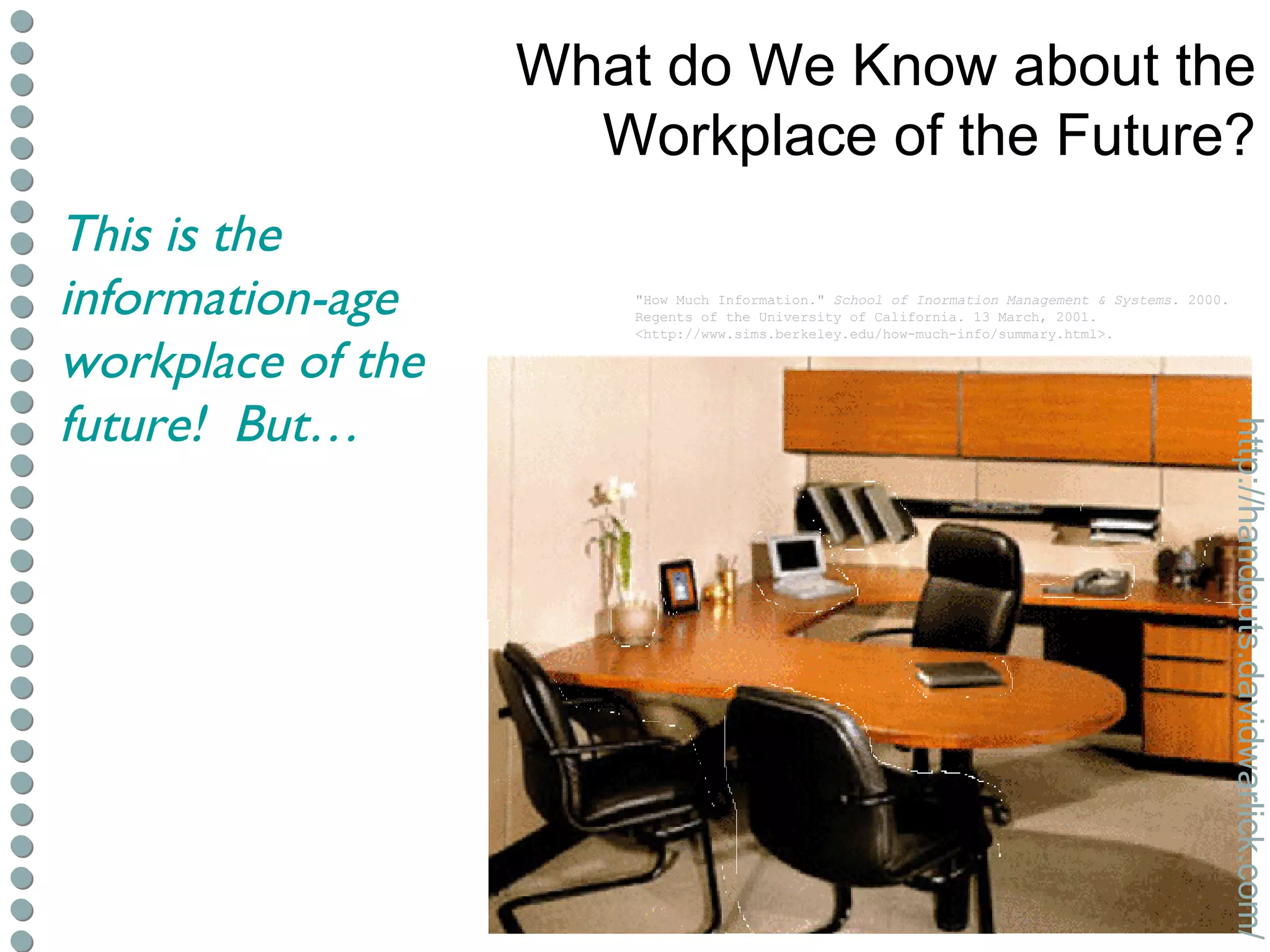
What do We Know about the Workplace of the Future? &quot;How Much Information.&quot;  School of Inormation Management & Systems . 2000. Regents of the University of California. 13 March, 2001. <http://www.sims.berkeley.edu/how-much-info/summary.html>. This is the information-age workplace of the future!  But… http://handouts.davidwarlick.com/
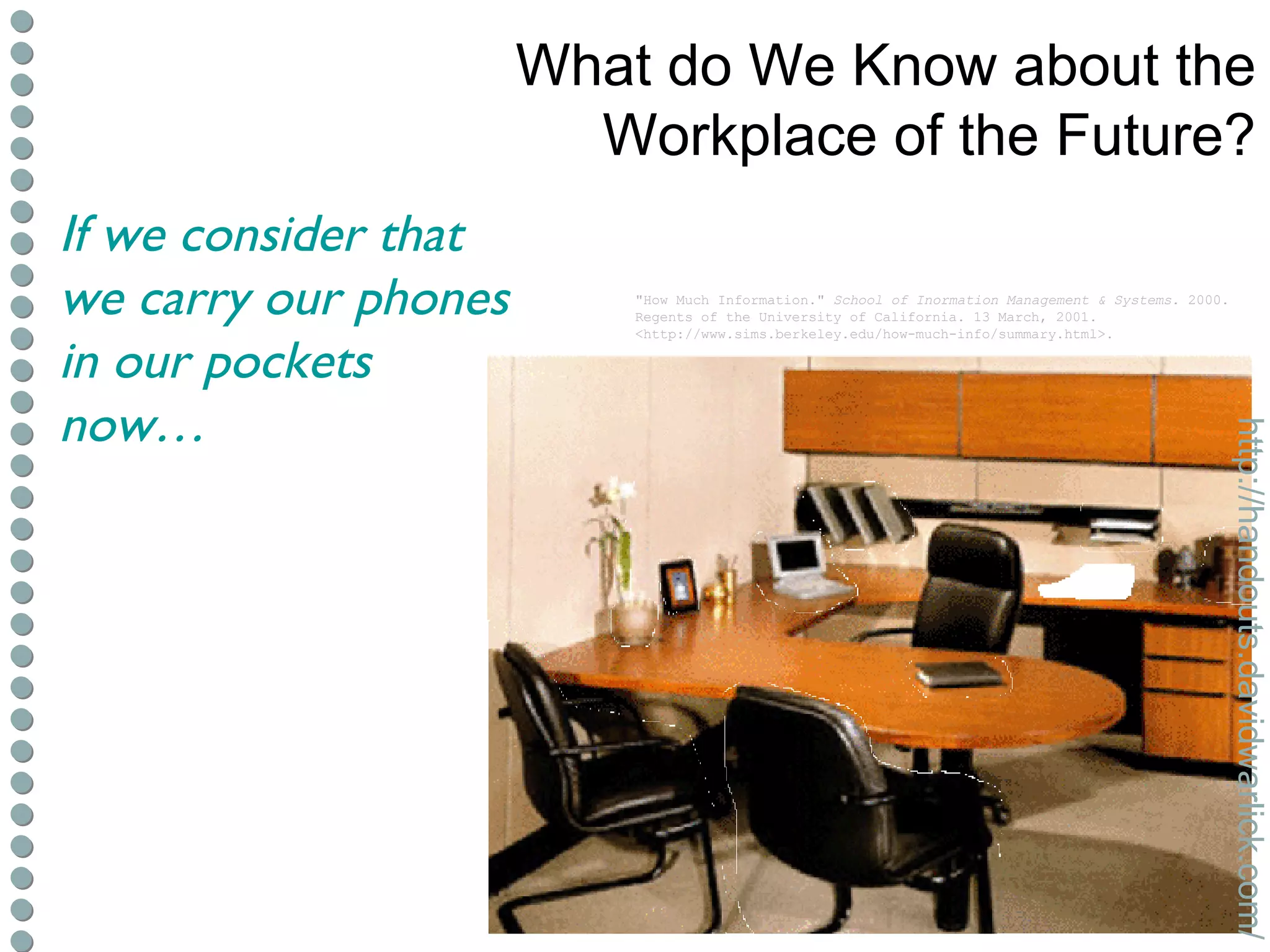
What do We Know about the Workplace of the Future? &quot;How Much Information.&quot;  School of Inormation Management & Systems . 2000. Regents of the University of California. 13 March, 2001. <http://www.sims.berkeley.edu/how-much-info/summary.html>. If we consider that we carry our phones in our pockets now… http://handouts.davidwarlick.com/
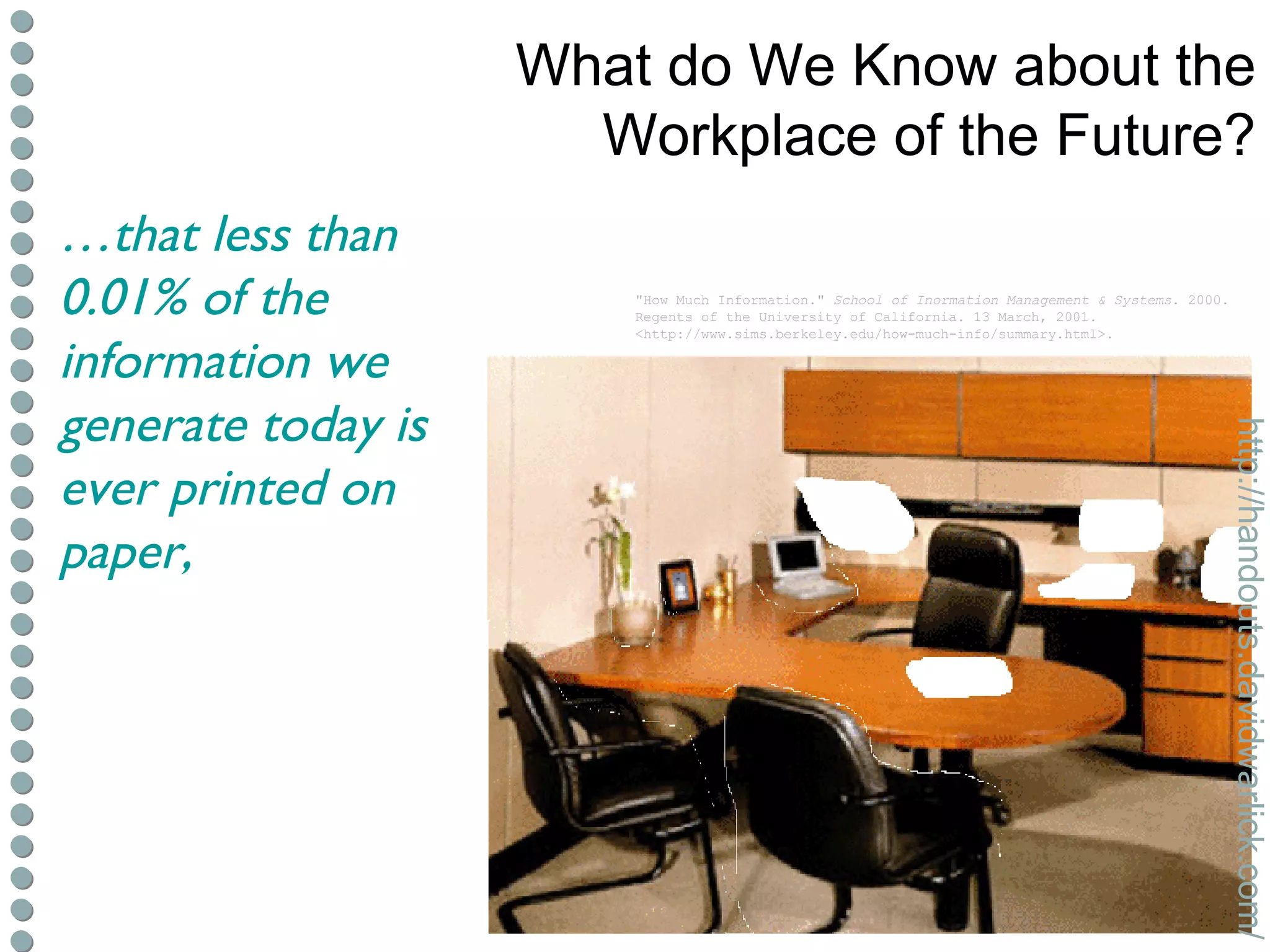
What do We Know about the Workplace of the Future? &quot;How Much Information.&quot;  School of Inormation Management & Systems . 2000. Regents of the University of California. 13 March, 2001. <http://www.sims.berkeley.edu/how-much-info/summary.html>. … that less than 0.01% of the information we generate today is ever printed on paper, http://handouts.davidwarlick.com/
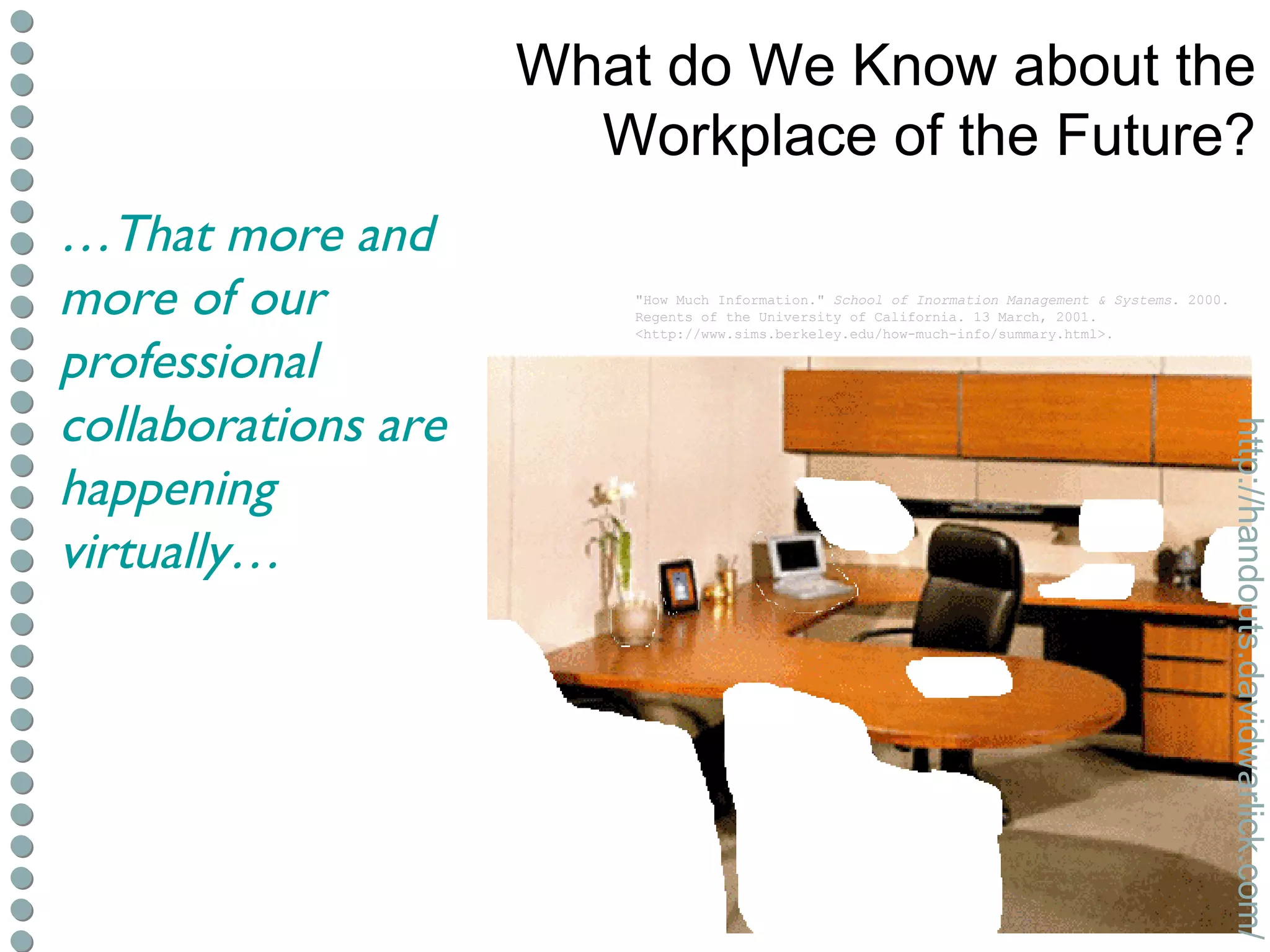
What do We Know about the Workplace of the Future? &quot;How Much Information.&quot;  School of Inormation Management & Systems . 2000. Regents of the University of California. 13 March, 2001. <http://www.sims.berkeley.edu/how-much-info/summary.html>. … That more and more of our professional collaborations are happening virtually… http://handouts.davidwarlick.com/
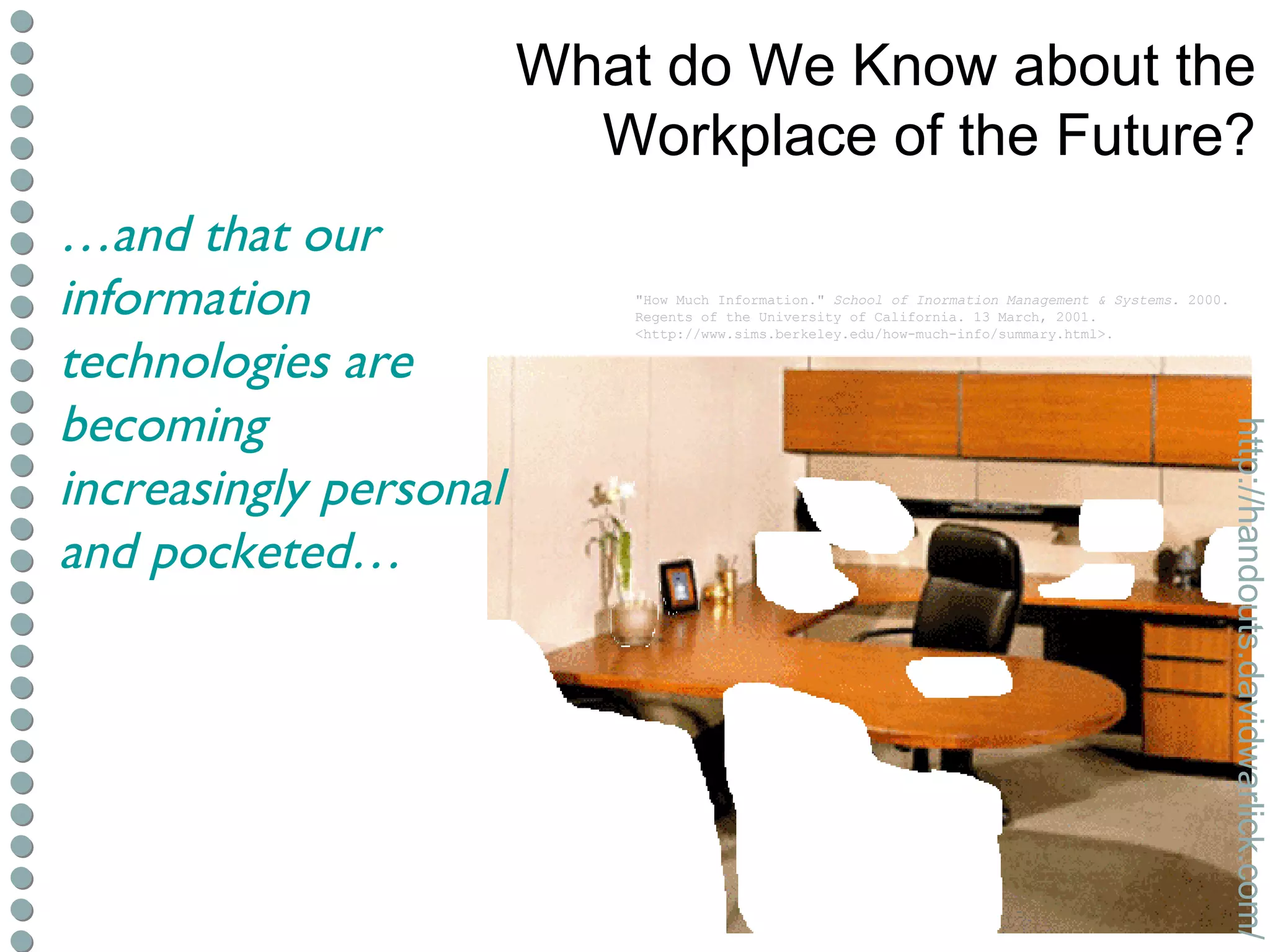
What do We Know about the Workplace of the Future? &quot;How Much Information.&quot;  School of Inormation Management & Systems . 2000. Regents of the University of California. 13 March, 2001. <http://www.sims.berkeley.edu/how-much-info/summary.html>. … and that our information technologies are becoming increasingly personal and pocketed… http://handouts.davidwarlick.com/
What do We Know about the Workplace of the Future? There won’t be much left for the desk -- won’t be much reason to have a desk… So what do we have left? Almost nothing!
What do We Know about the Workplace of the Future? … And this is exactly what we know about the future we’re preparing our children for… Almost  Nothing!
For the first time in history, our job as educators is to prepare our students for a future that we can not clearly describe.
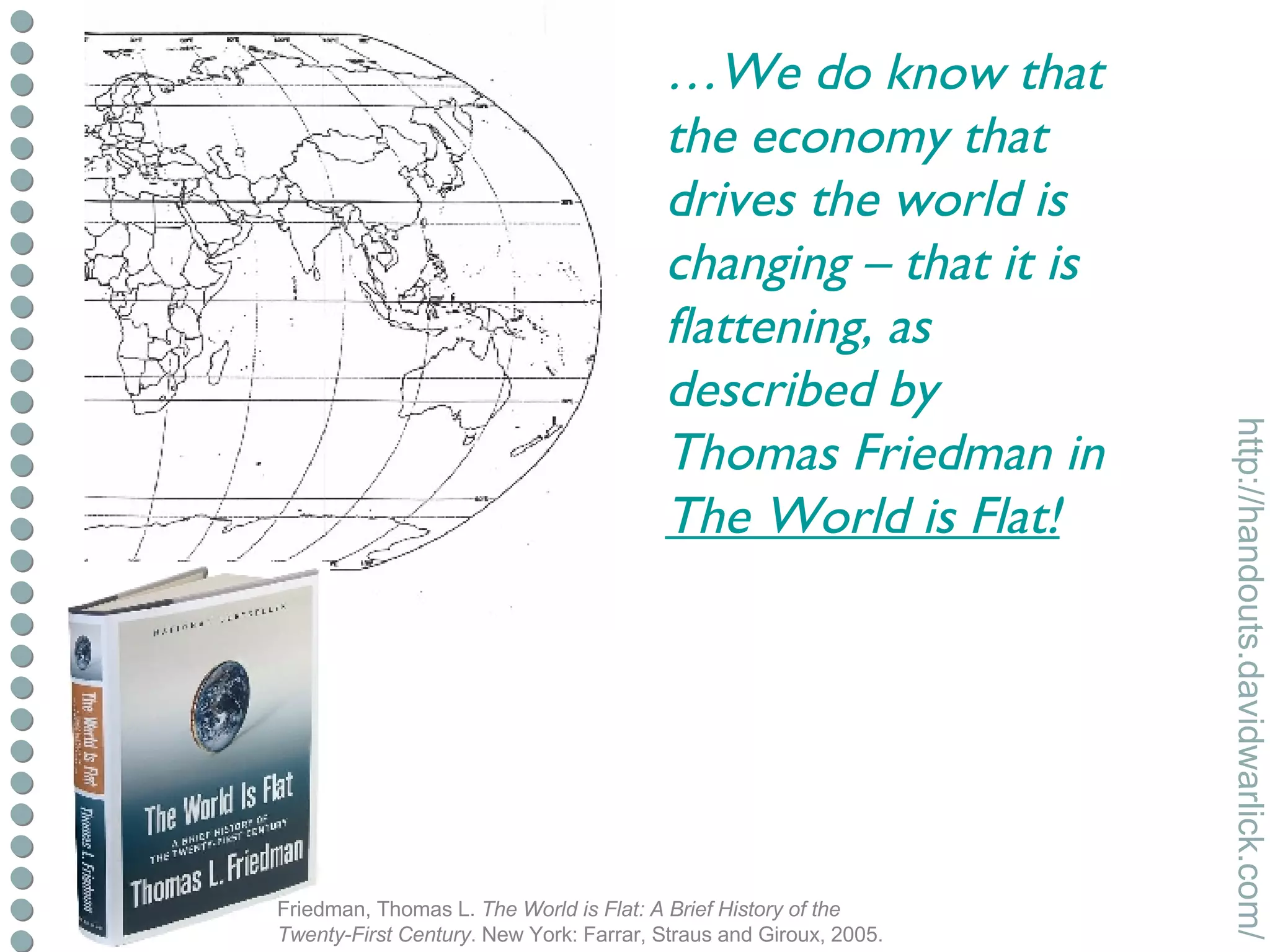
Friedman, Thomas L.  The World is Flat: A Brief History of the Twenty-First Century . New York: Farrar, Straus and Giroux, 2005. … We do know that the economy that drives the world is changing – that it is flattening, as described by Thomas Friedman in  The World is Flat!
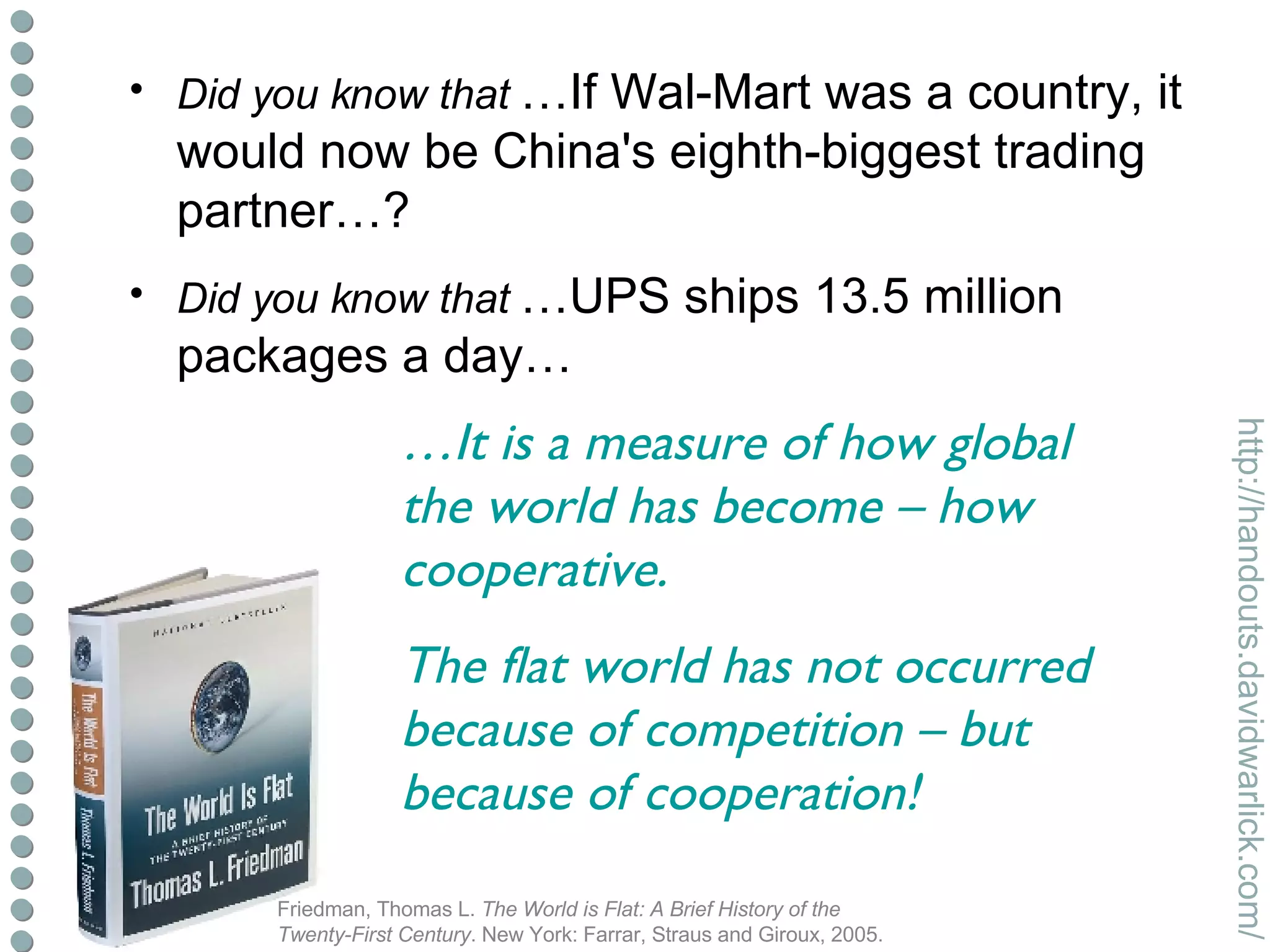
Did you know that   …If Wal-Mart was a country, it would now be China's eighth-biggest trading partner…? Did you know that   …UPS ships 13.5 million packages a day…  which means that at any given moment, 2% of the world's GDP is in the back of a UPS delivery truck? Friedman, Thomas L.  The World is Flat: A Brief History of the Twenty-First Century . New York: Farrar, Straus and Giroux, 2005. … It is a measure of how global the world has become – how cooperative. The flat world has not occurred because of competition – but because of cooperation!
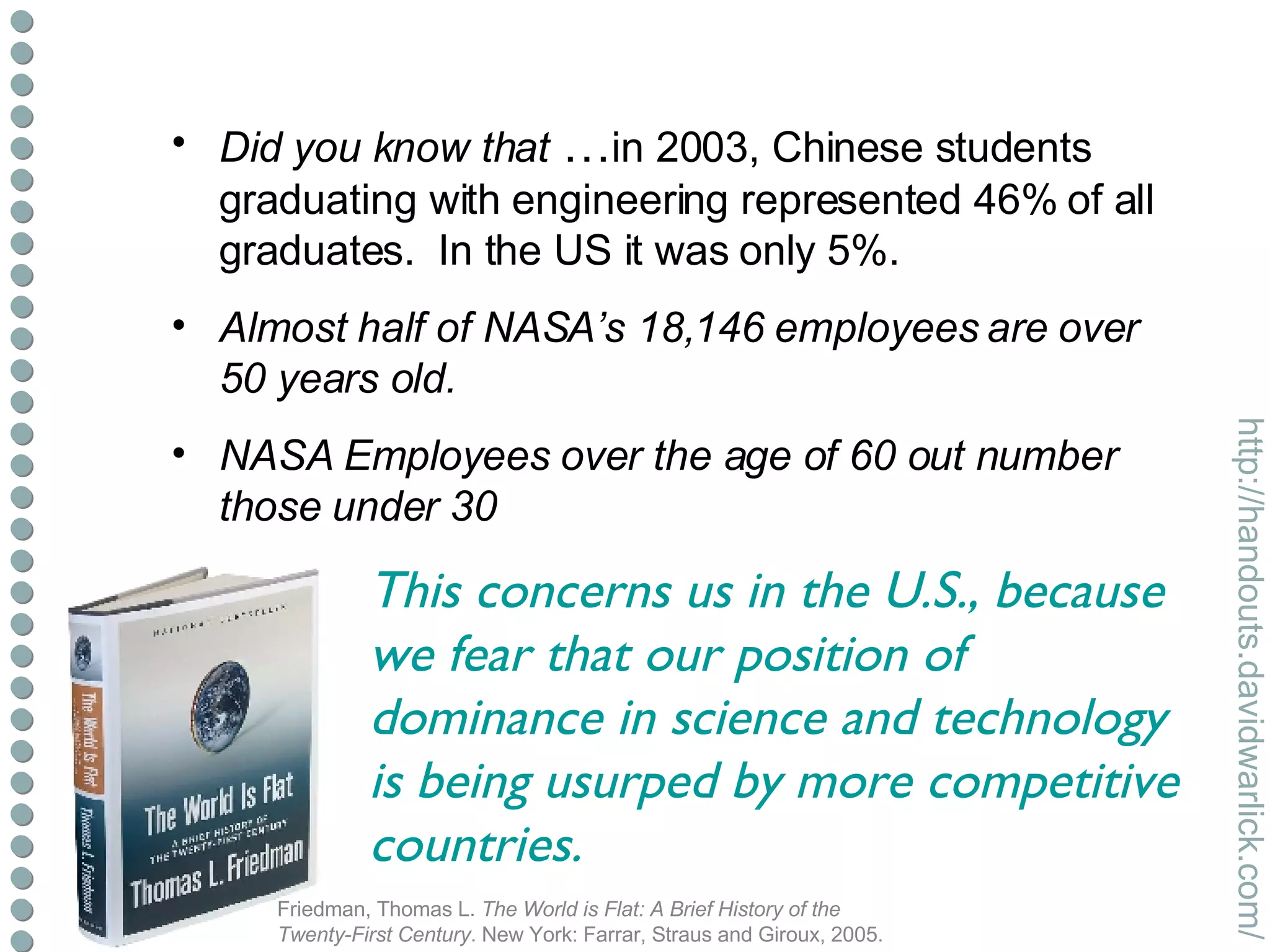
Did you know that   … in 2003, Chinese students graduating with engineering represented 46% of all graduates.  In the US it was only 5%. Almost half of NASA’s 18,146 employees are over 50 years old. NASA Employees over the age of 60 out number those under 30 Friedman, Thomas L.  The World is Flat: A Brief History of the Twenty-First Century . New York: Farrar, Straus and Giroux, 2005. This concerns us in the U.S., because we fear that our position of dominance in science and technology is being usurped by more competitive countries.
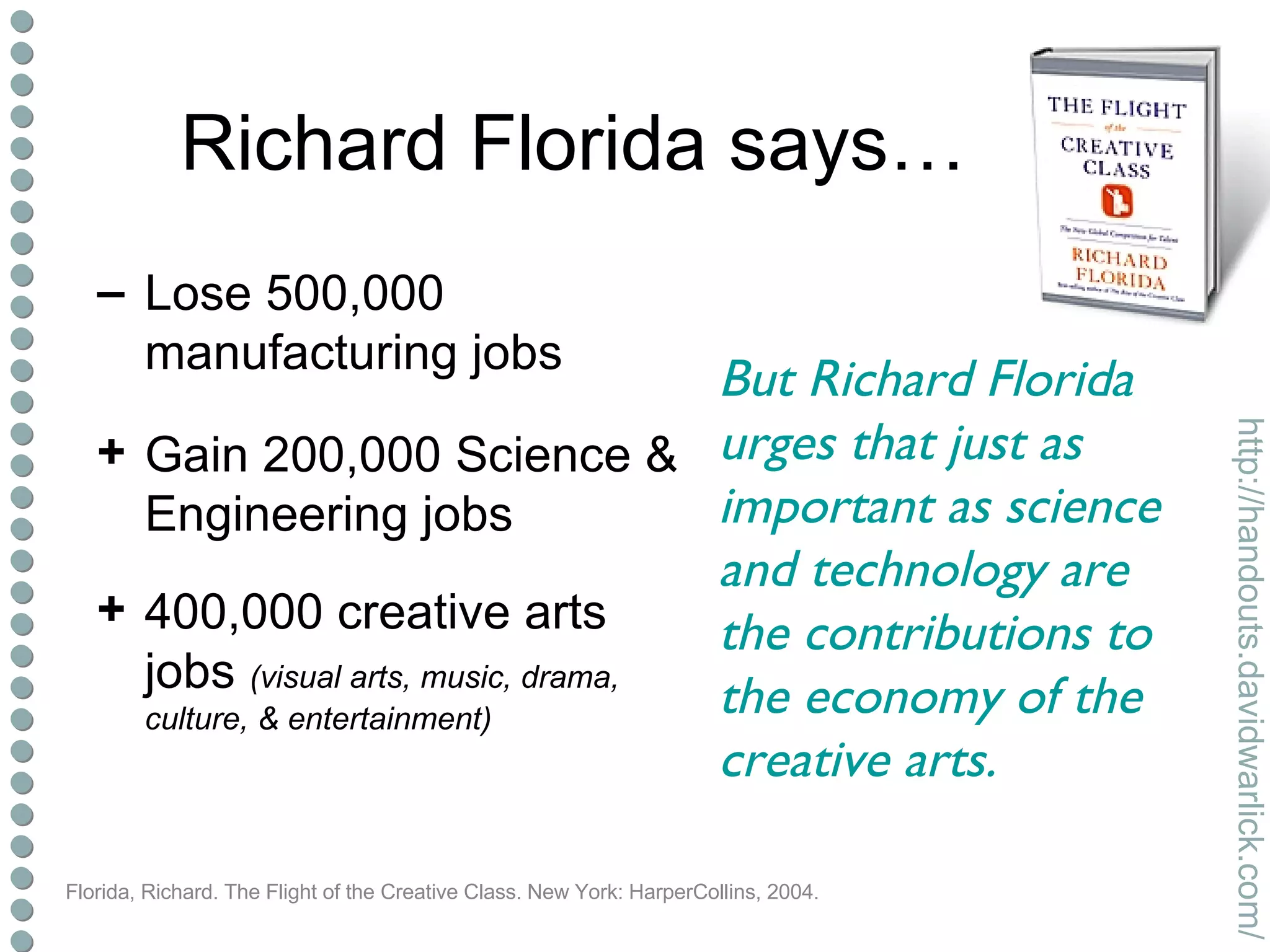
Richard Florida says…  Lose 500,000 manufacturing jobs Gain 200,000 Science & Engineering jobs 400,000 creative arts jobs  (visual arts, music, drama, culture, & entertainment) Florida, Richard. The Flight of the Creative Class. New York: HarperCollins, 2004. But Richard Florida urges that just as important as science and technology are the contributions to the economy of the creative arts.
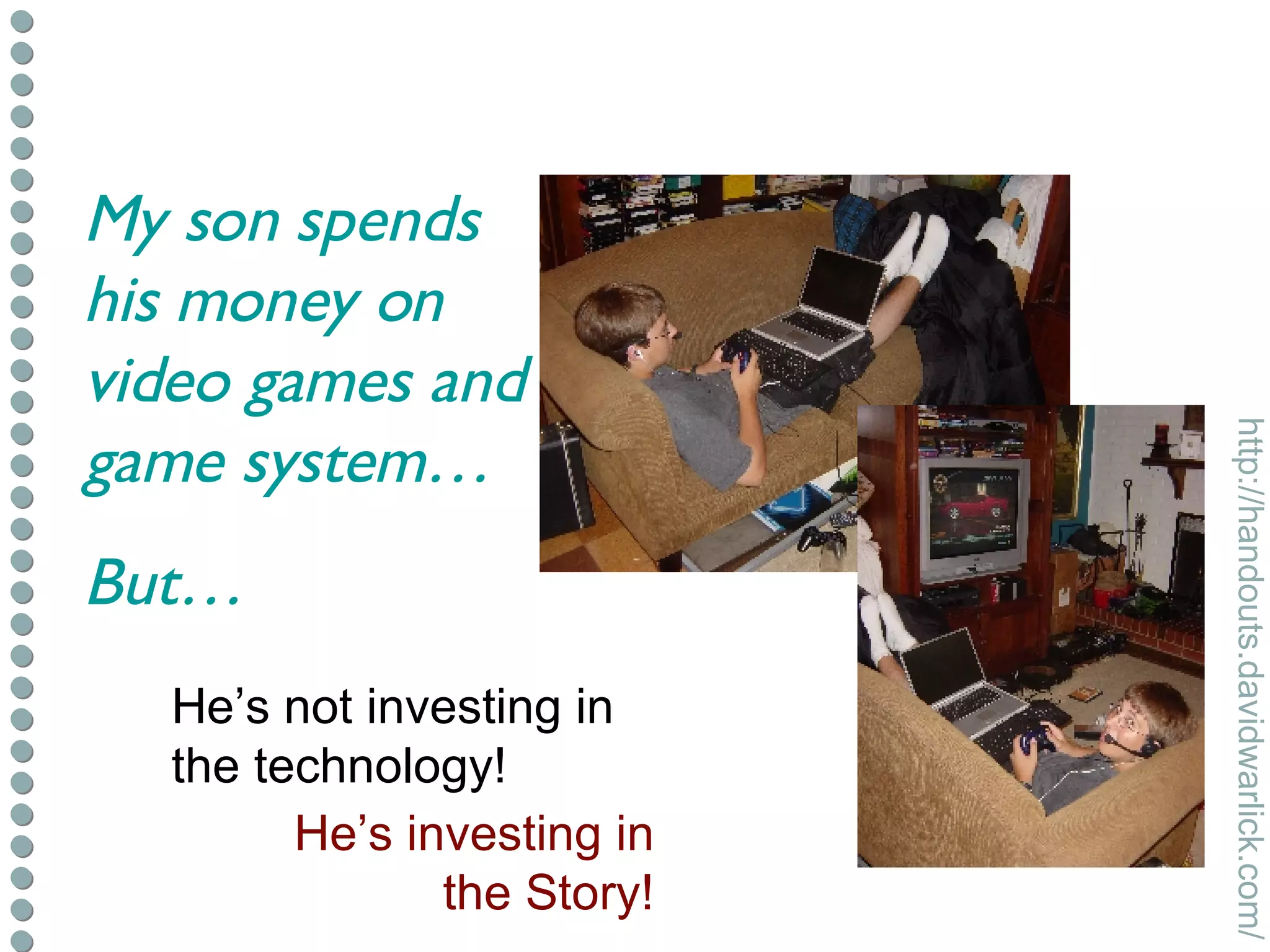
He’s not investing in the technology! He’s investing in the Story! My son spends his money on video games and game system… But…
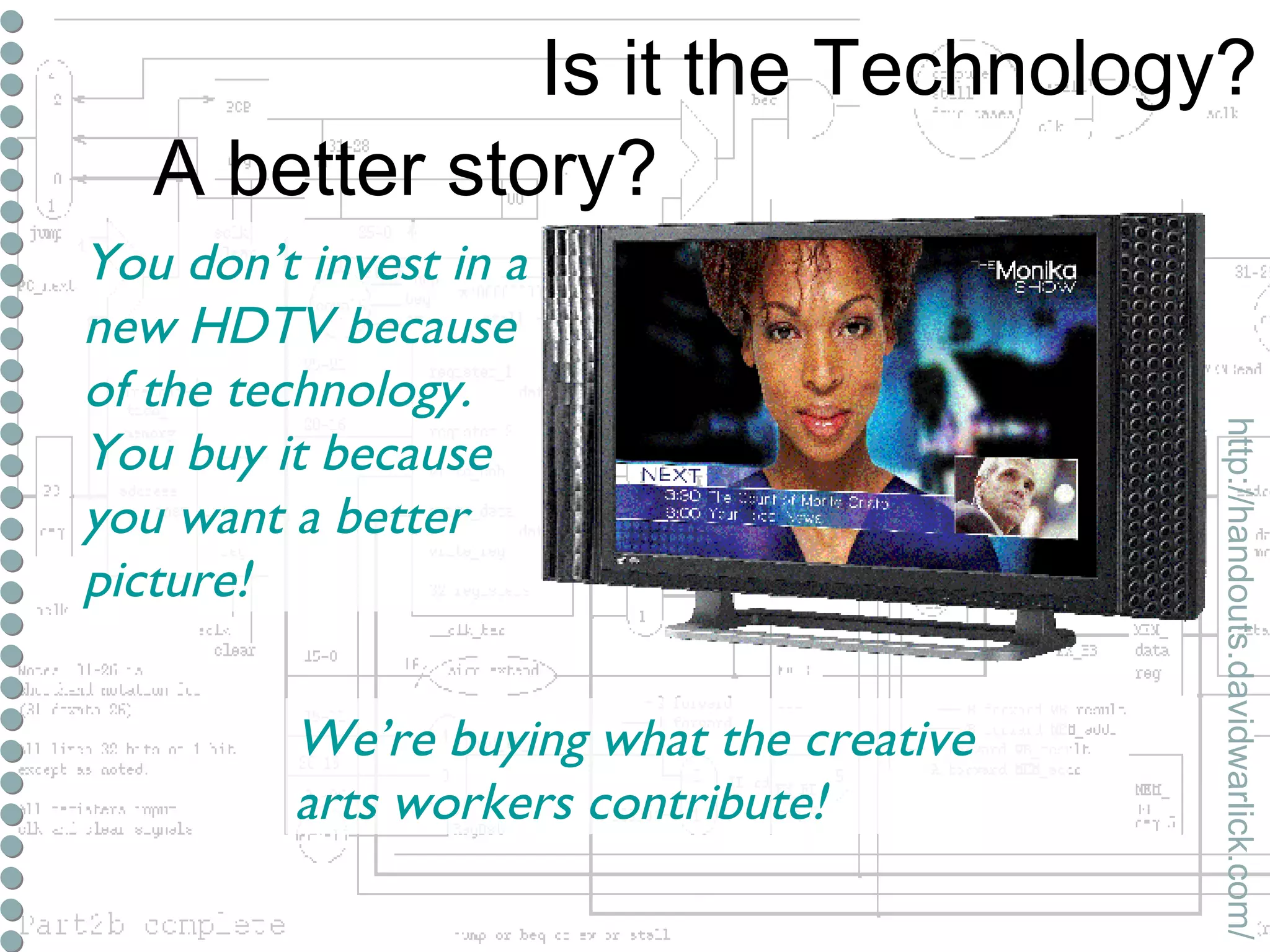
Is it the Technology? http://handouts.davidwarlick.com/ A better story? You don’t invest in a new HDTV because of the technology.  You buy it because you want a better picture! We’re buying what the creative arts workers contribute!
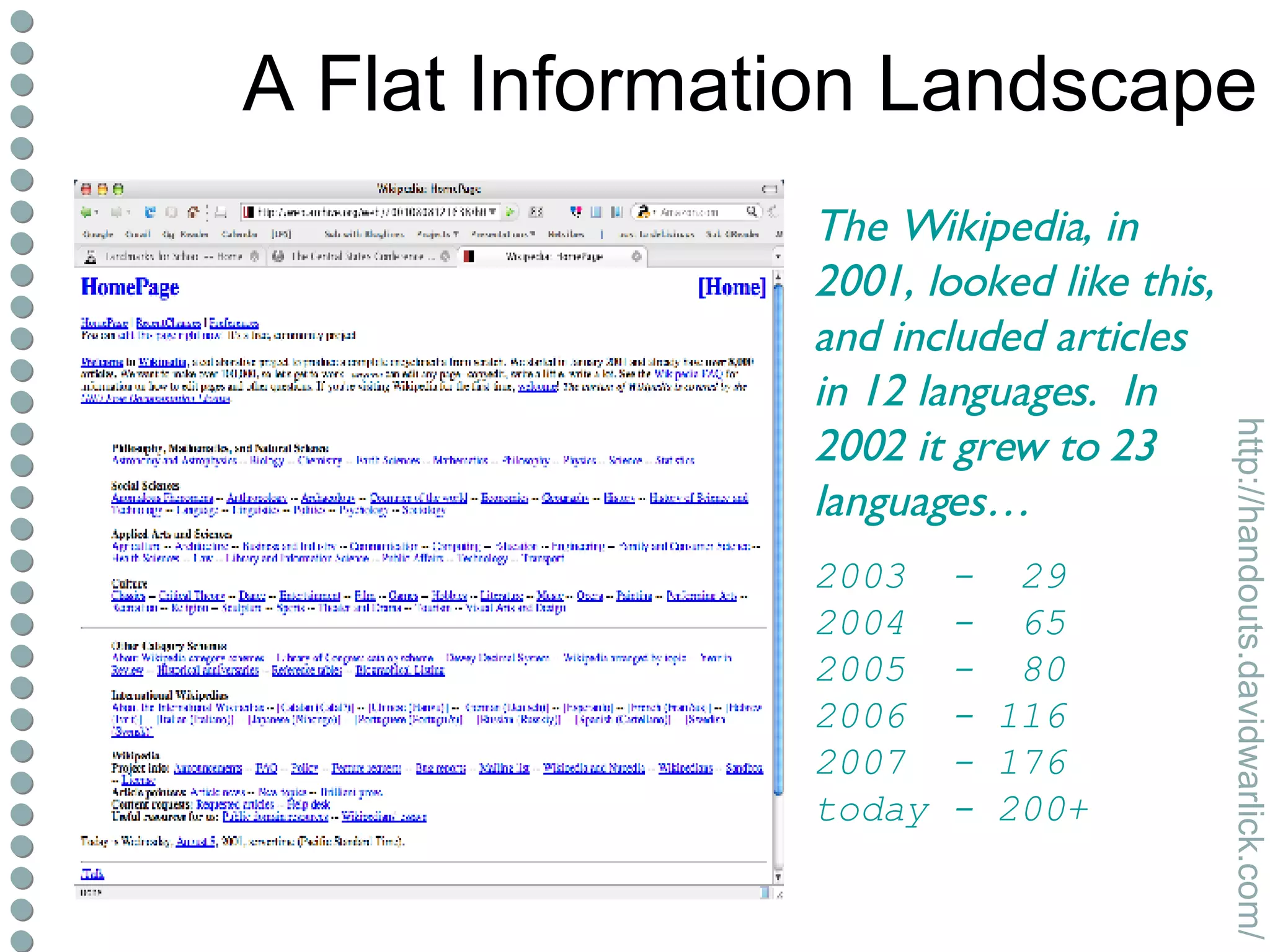
A Flat Information Landscape The Wikipedia, in 2001, looked like this, and included articles in 12 languages.  In 2002 it grew to 23 languages… 2003  -  29 2004  -  65 2005  -  80 2006  - 116 2007  - 176 today - 200+
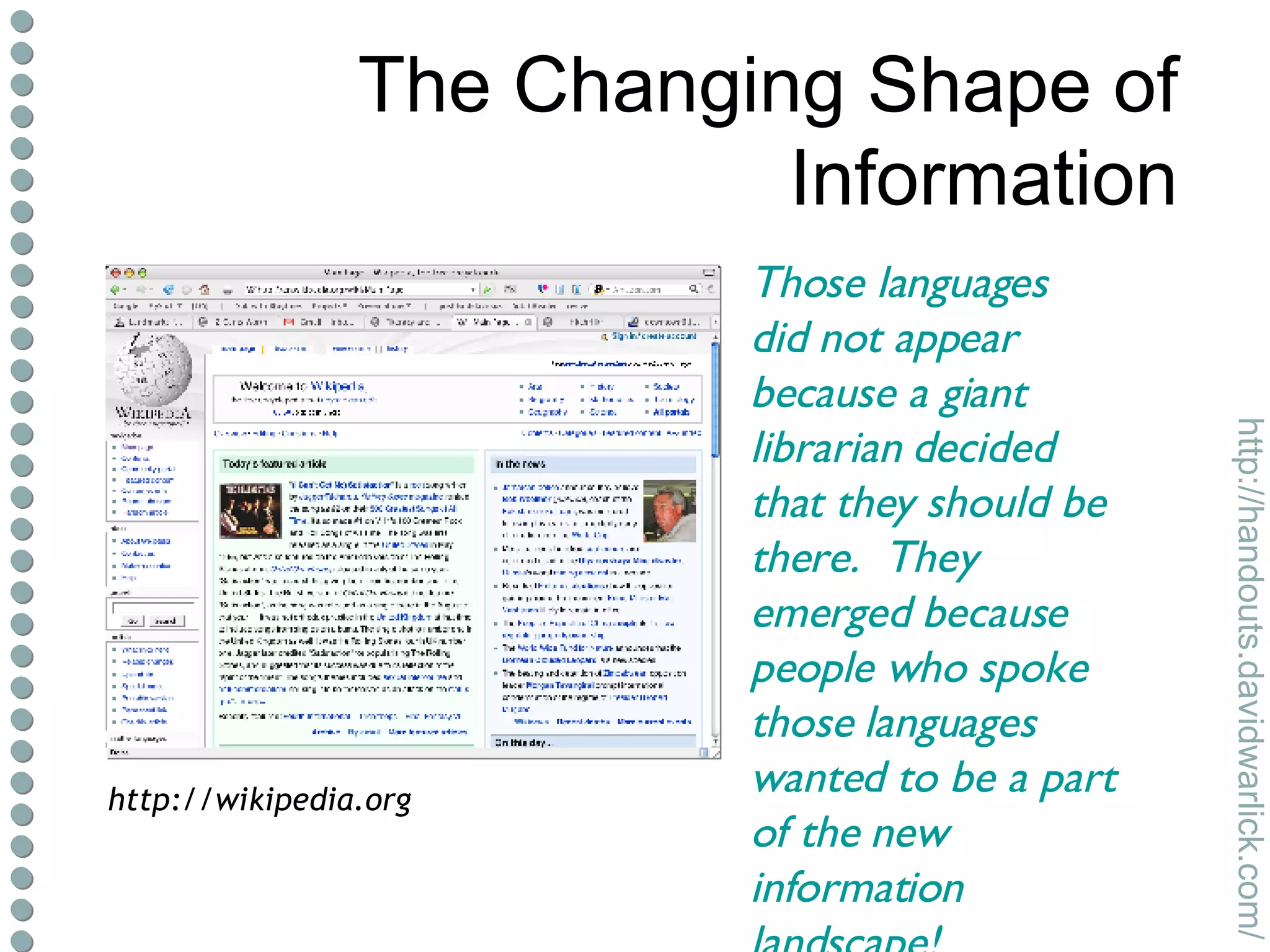
The Changing Shape of Information http://wikipedia.org Those languages did not appear because a giant librarian decided that they should be there.  They emerged because people who spoke those languages wanted to be a part of the new information landscape!
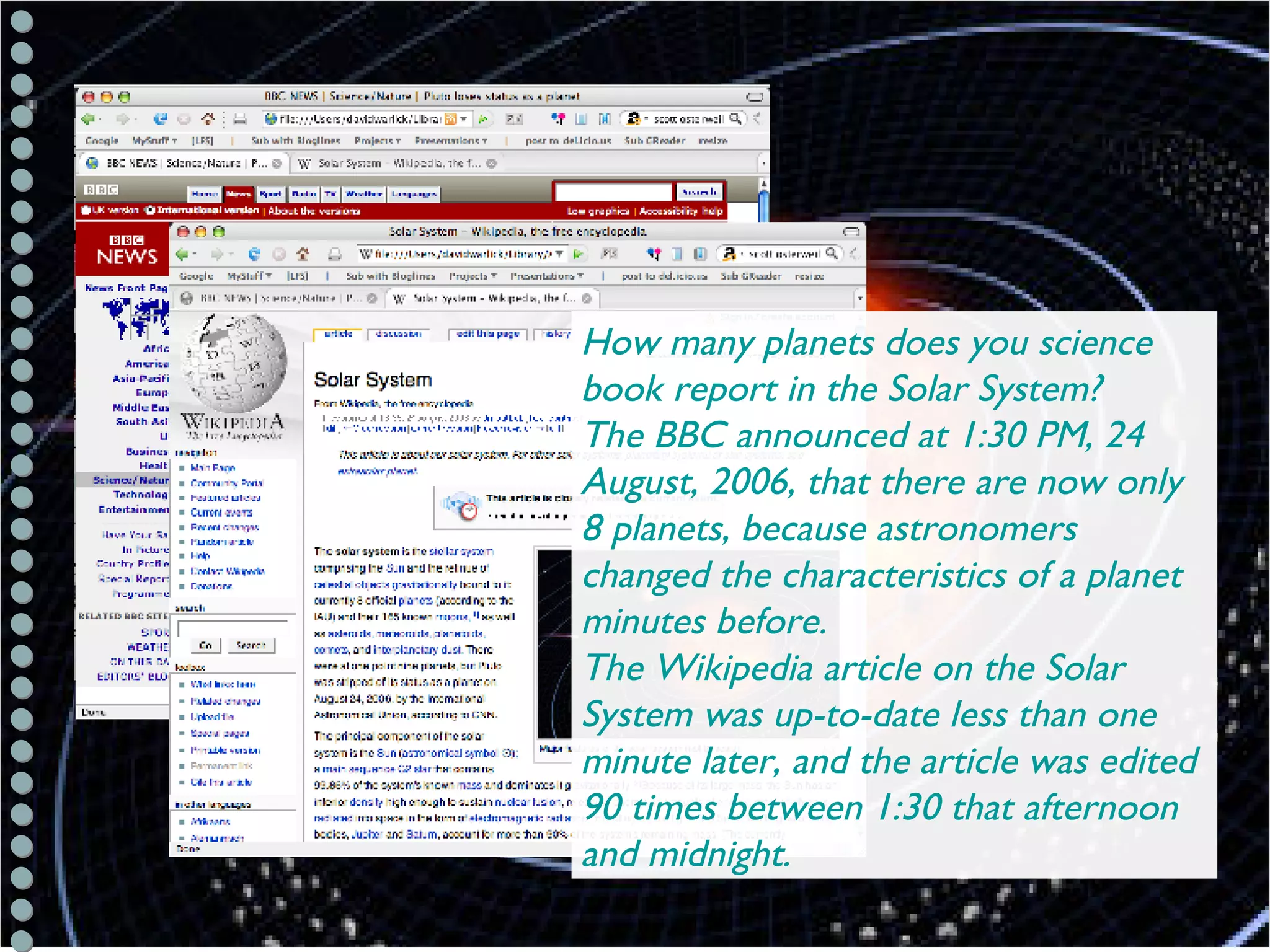
Science/Astronomy How many planets does you science book report in the Solar System?  The BBC announced at 1:30 PM, 24 August, 2006, that there are now only 8 planets, because astronomers changed the characteristics of a planet minutes before.  The Wikipedia article on the Solar System was up-to-date less than one minute later, and the article was edited 90 times between 1:30 that afternoon and midnight.
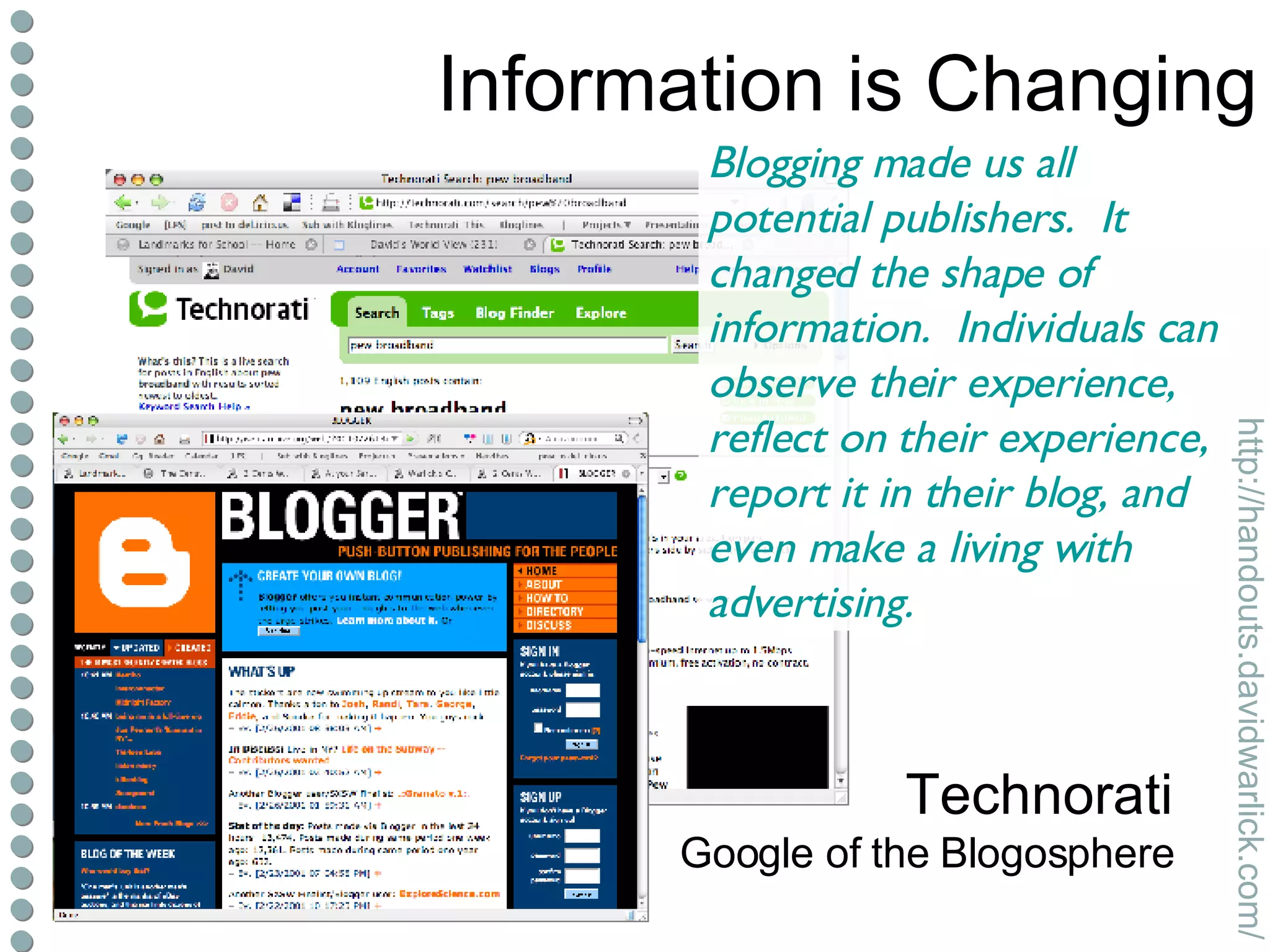
Information is Changing Technorati Google of the Blogosphere Blogging made us all potential publishers.  It changed the shape of information.  Individuals can observe their experience, reflect on their experience, report it in their blog, and even make a living with advertising.
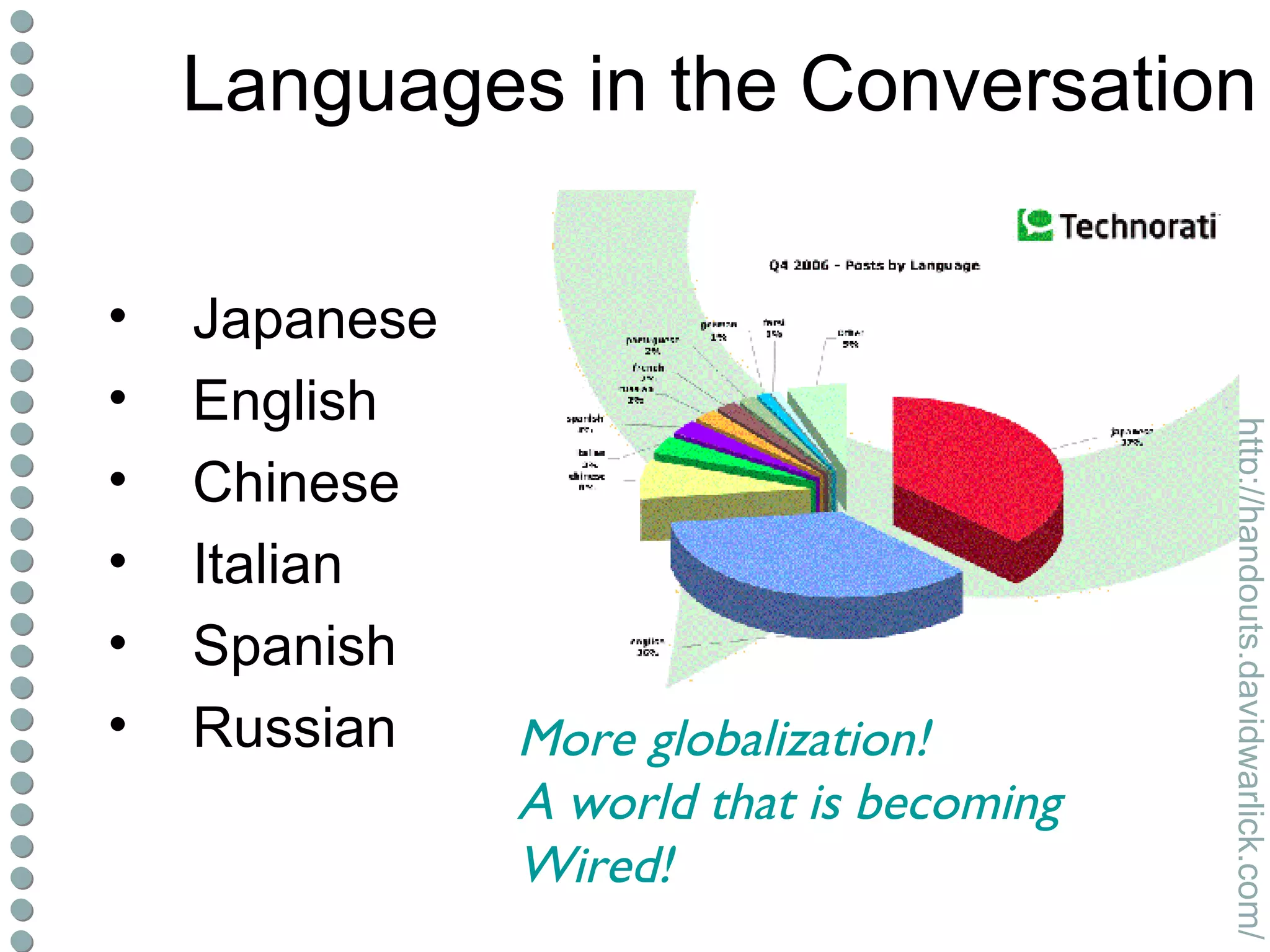
Languages in the Conversation Japanese English Chinese Italian Spanish Russian More globalization! A world that is becoming Wired!
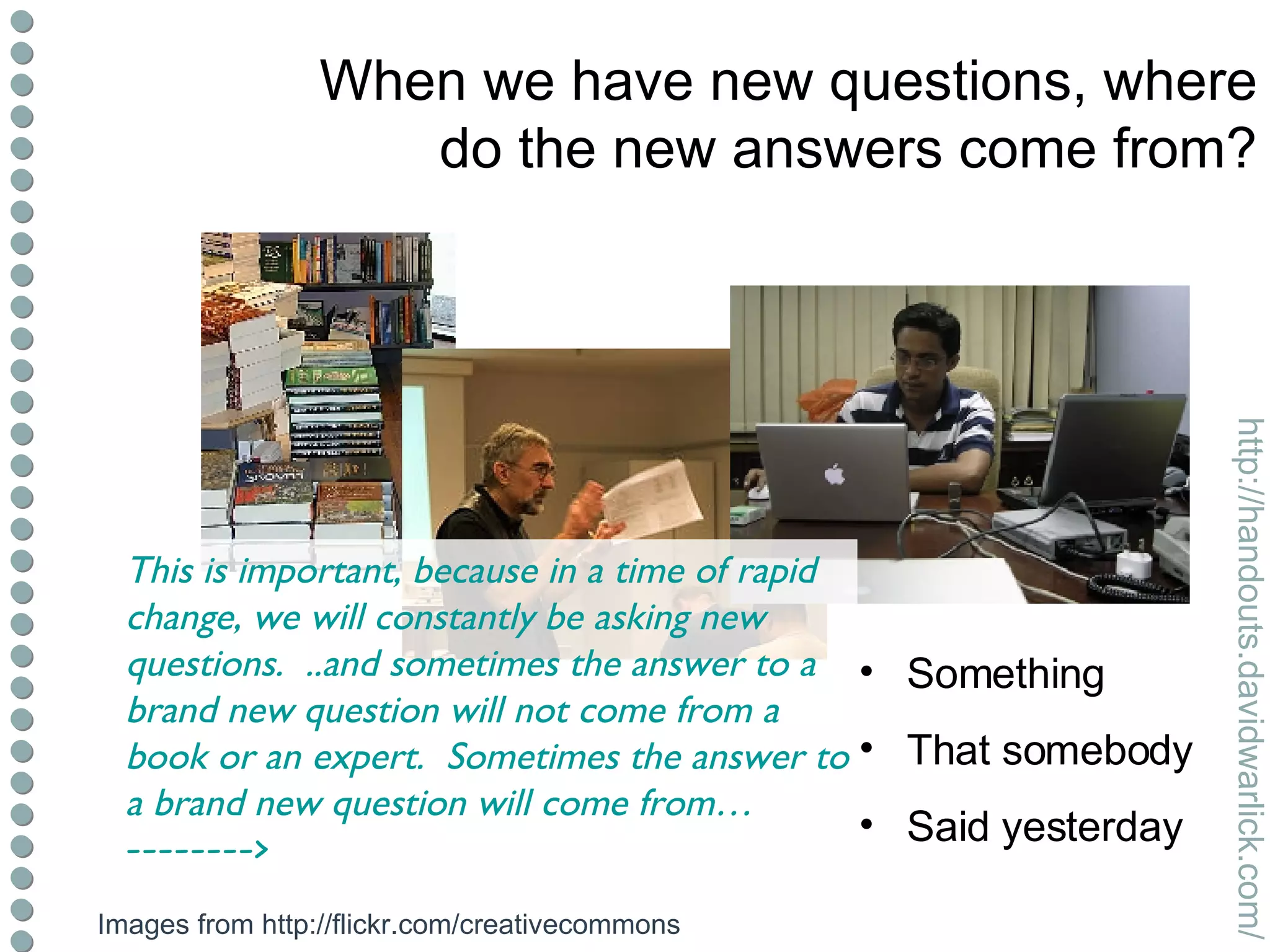
When we have new questions, where do the new answers come from? Something That somebody Said yesterday Images from http://flickr.com/creativecommons This is important, because in a time of rapid change, we will constantly be asking new questions.  ..and sometimes the answer to a brand new question will not come from a book or an expert.  Sometimes the answer to a brand new question will come from…  -------->
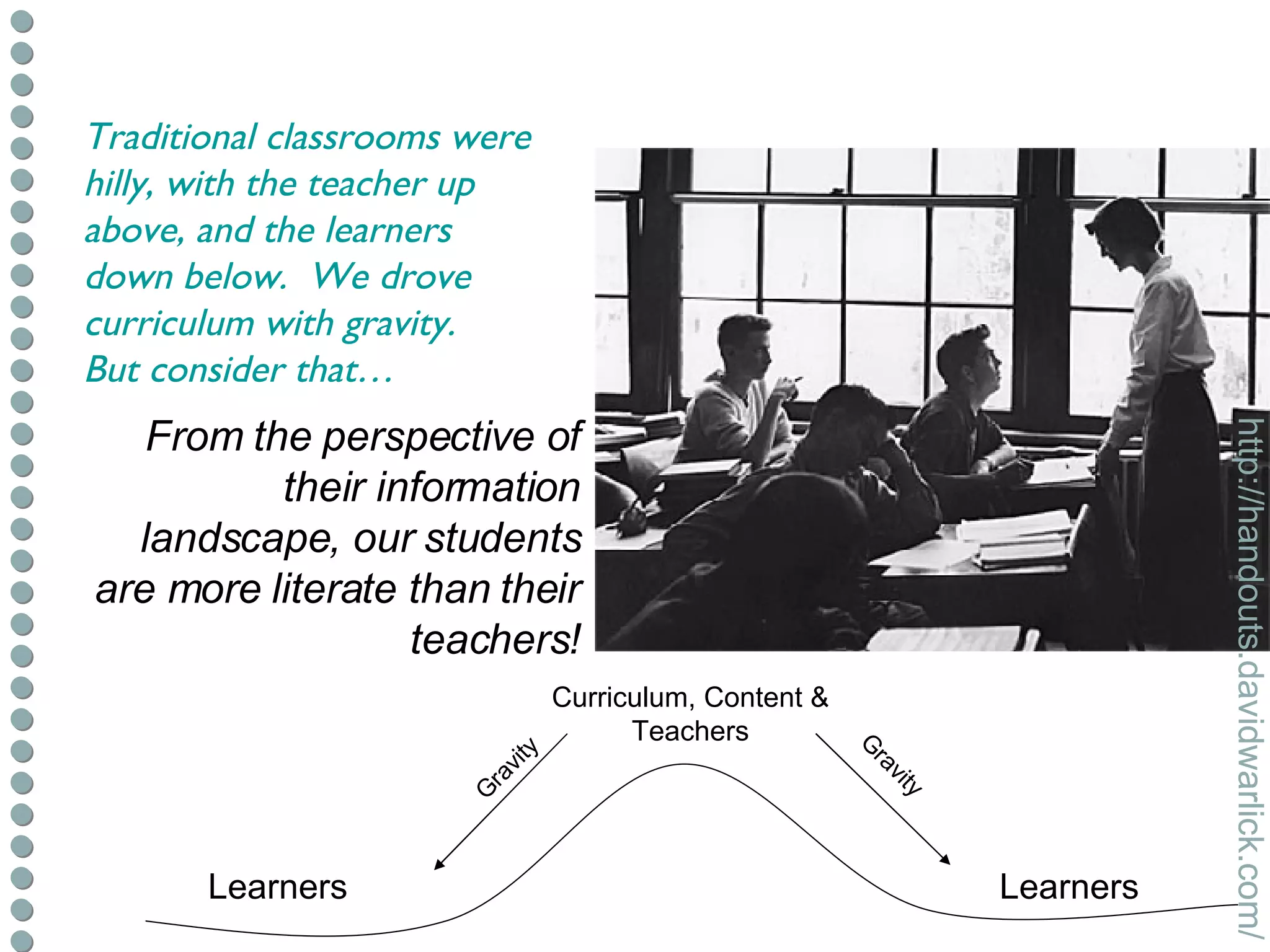
From the perspective of their information landscape, our students are more literate than their teachers! http://handouts.davidwarlick.com/ Traditional classrooms were hilly, with the teacher up above, and the learners down below.  We drove curriculum with gravity. But consider that… Learners Learners Curriculum, Content & Teachers Gravity Gravity
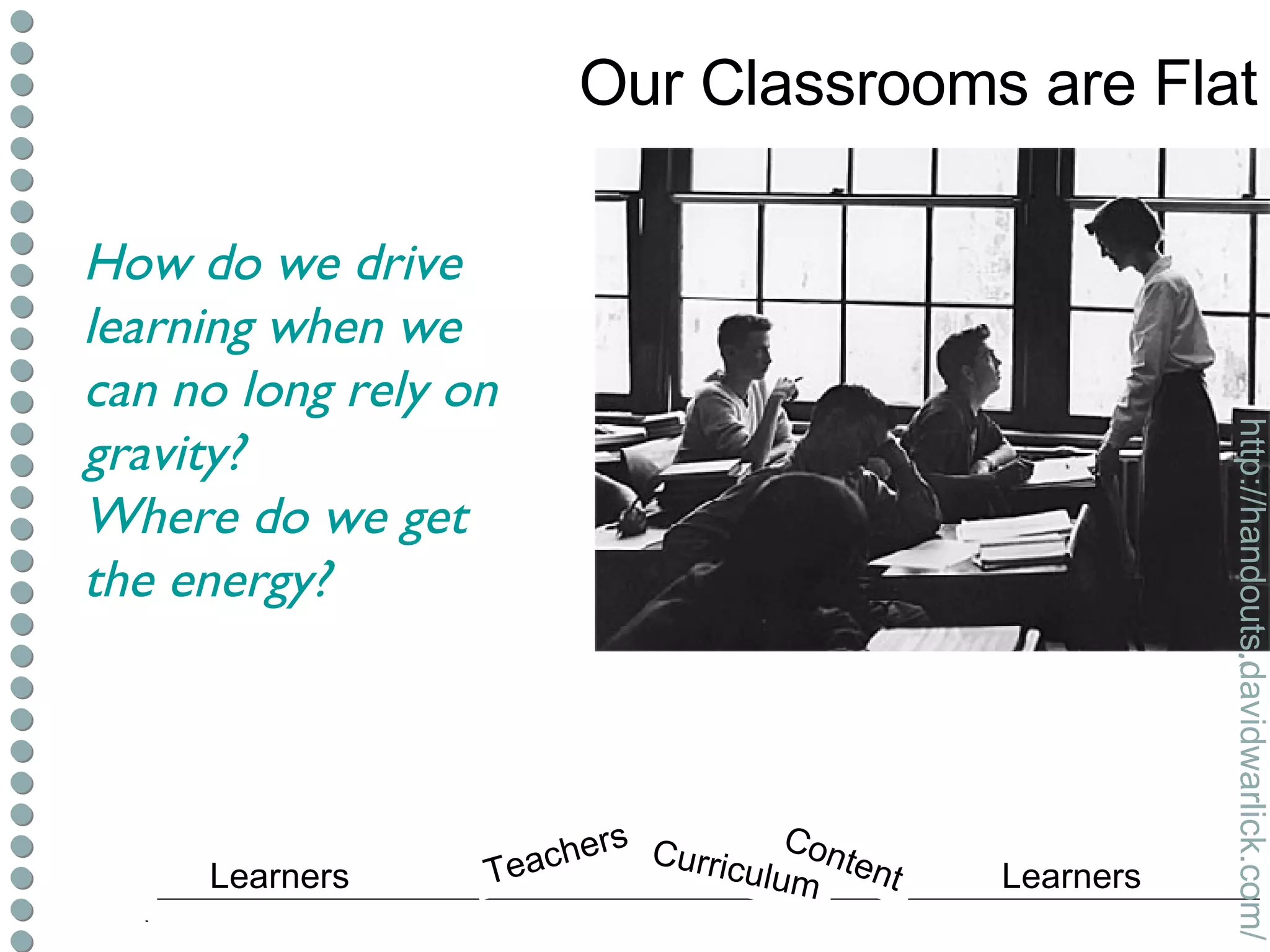
Our Classrooms are Flat http://handouts.davidwarlick.com/ How do we drive learning when we can no long rely on gravity? Where do we get the energy? Learners Learners Curriculum, Content & Teachers Gravity Gravity Learners Learners Curriculum Content Teachers
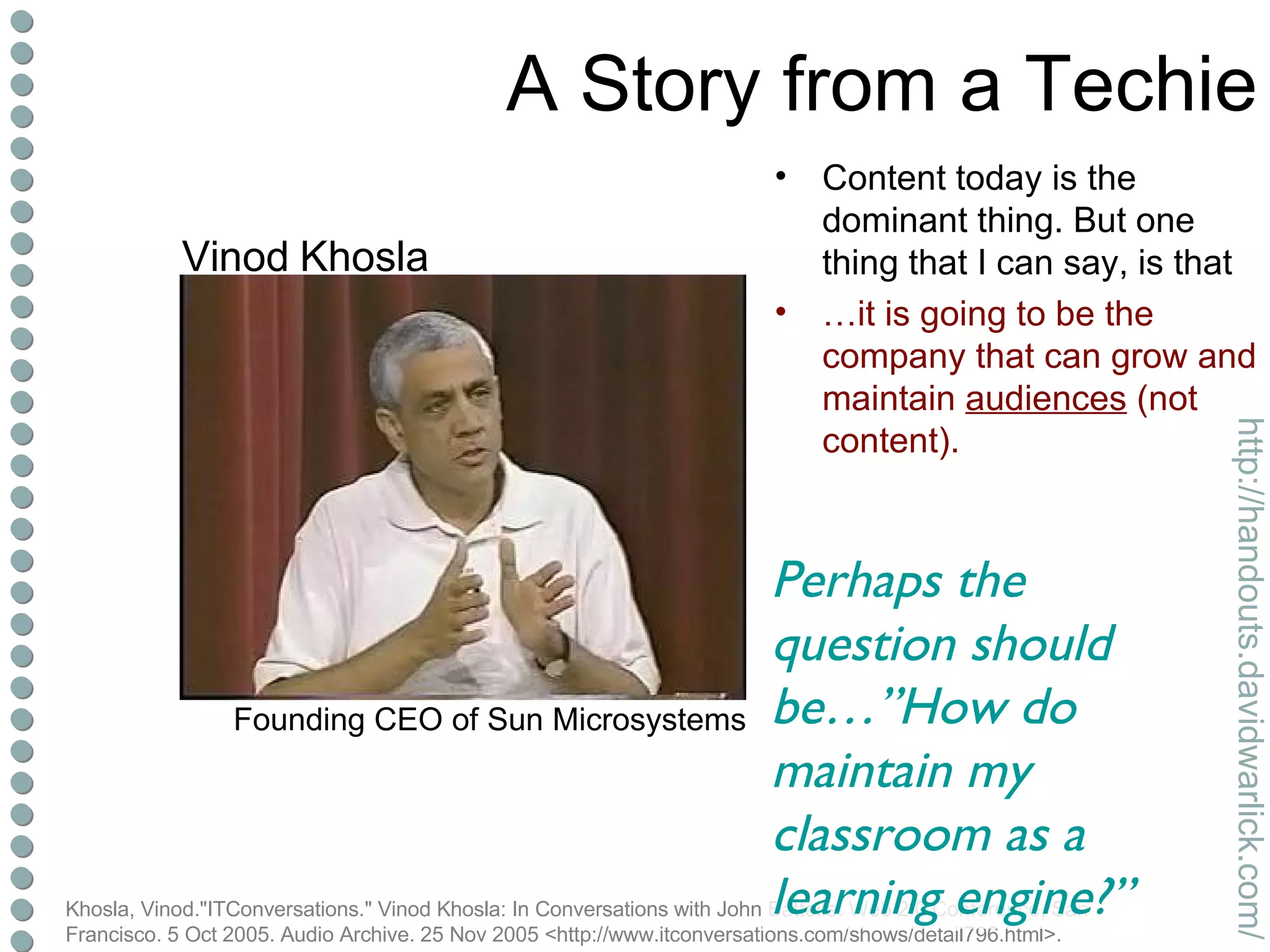
A Story from a Techie Content today is the dominant thing. But one thing that I can say, is that … it is going to be the company that can grow and maintain  audiences  (not content). Khosla, Vinod.&quot;ITConversations.&quot; Vinod Khosla: In Conversations with John Battelle. Web 2.0 Conference, San Francisco. 5 Oct 2005. Audio Archive. 25 Nov 2005 <http://www.itconversations.com/shows/detail796.html>. Perhaps the question should be…”How do maintain my classroom as a learning engine?” Vinod Khosla Founding CEO of Sun Microsystems
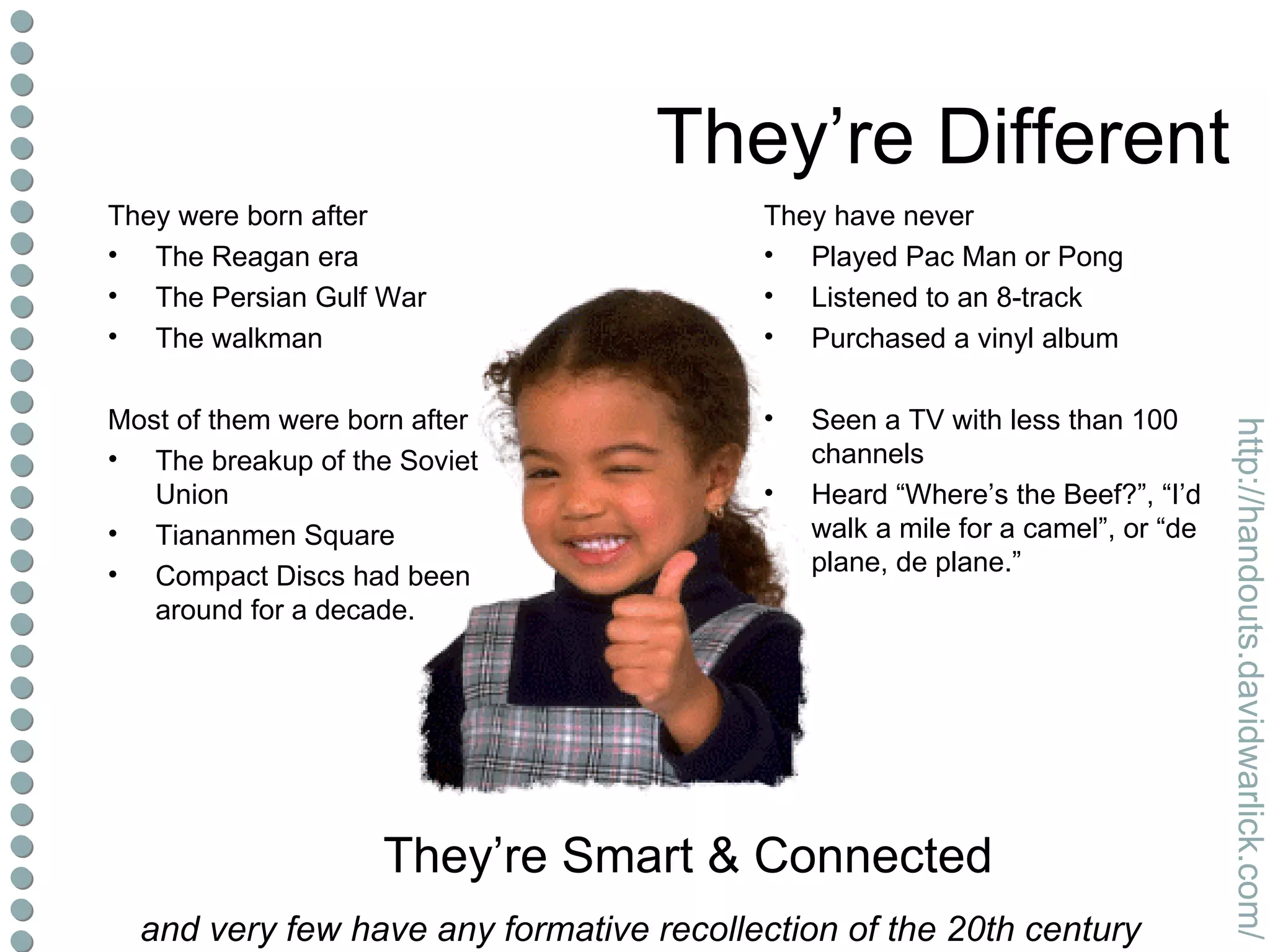
They’re Different They were born after The Reagan era The Persian Gulf War The walkman Most of them were born after The breakup of the Soviet Union Tiananmen Square Compact Discs had been around for a decade. They have never Played Pac Man or Pong Listened to an 8-track Purchased a vinyl album Seen a TV with less than 100 channels Heard “Where’s the Beef?”, “I’d walk a mile for a camel”, or “de plane, de plane.” They’re Smart & Connected and very few have any formative recollection of the 20th century
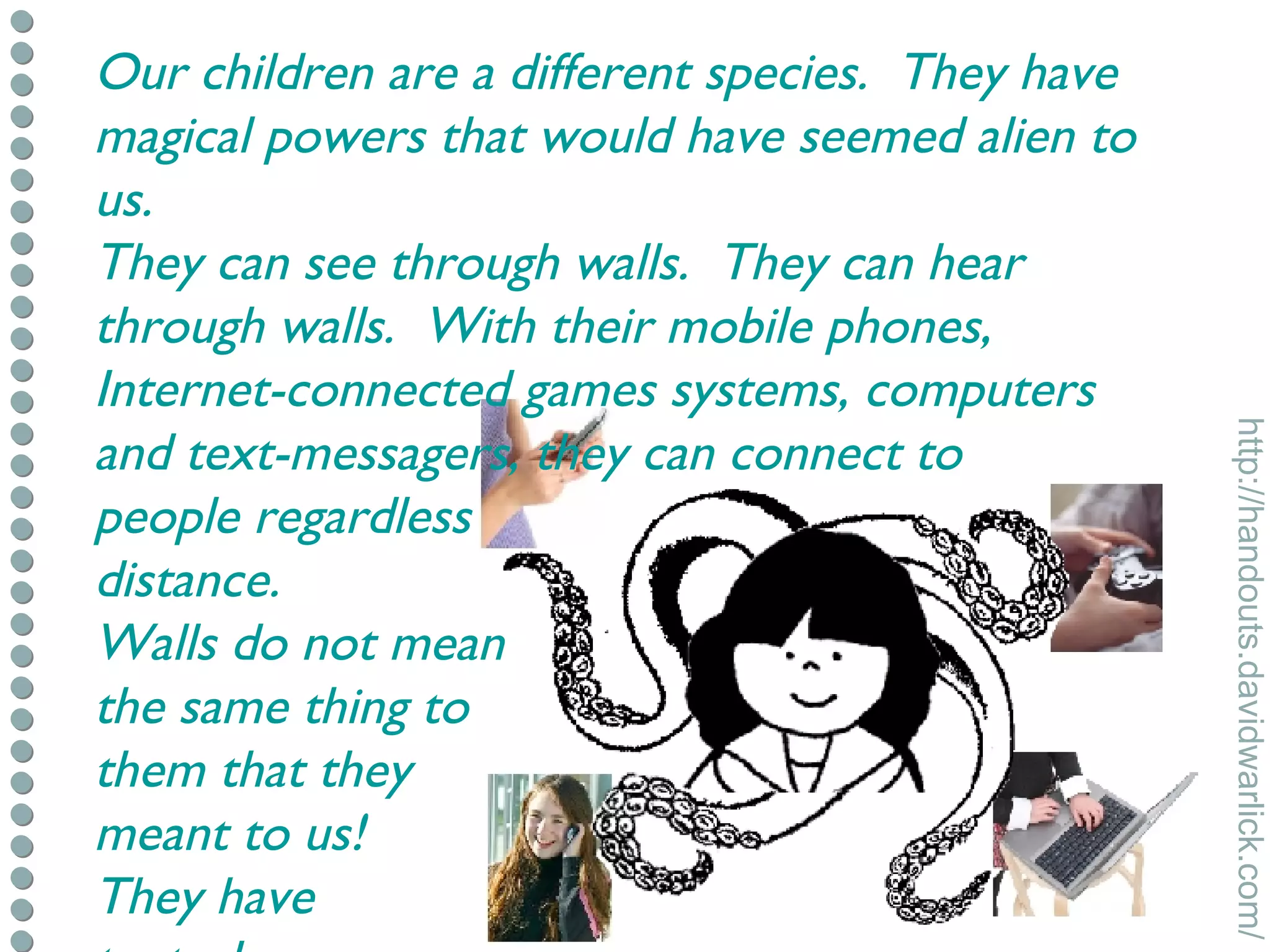
Our children are a different species.  They have magical powers that would have seemed alien to us. They can see through walls.  They can hear through walls.  With their mobile phones, Internet-connected games systems, computers and text-messagers, they can connect to  people regardless distance. Walls do not mean the same thing to them that they meant to us! They have  tentacles.
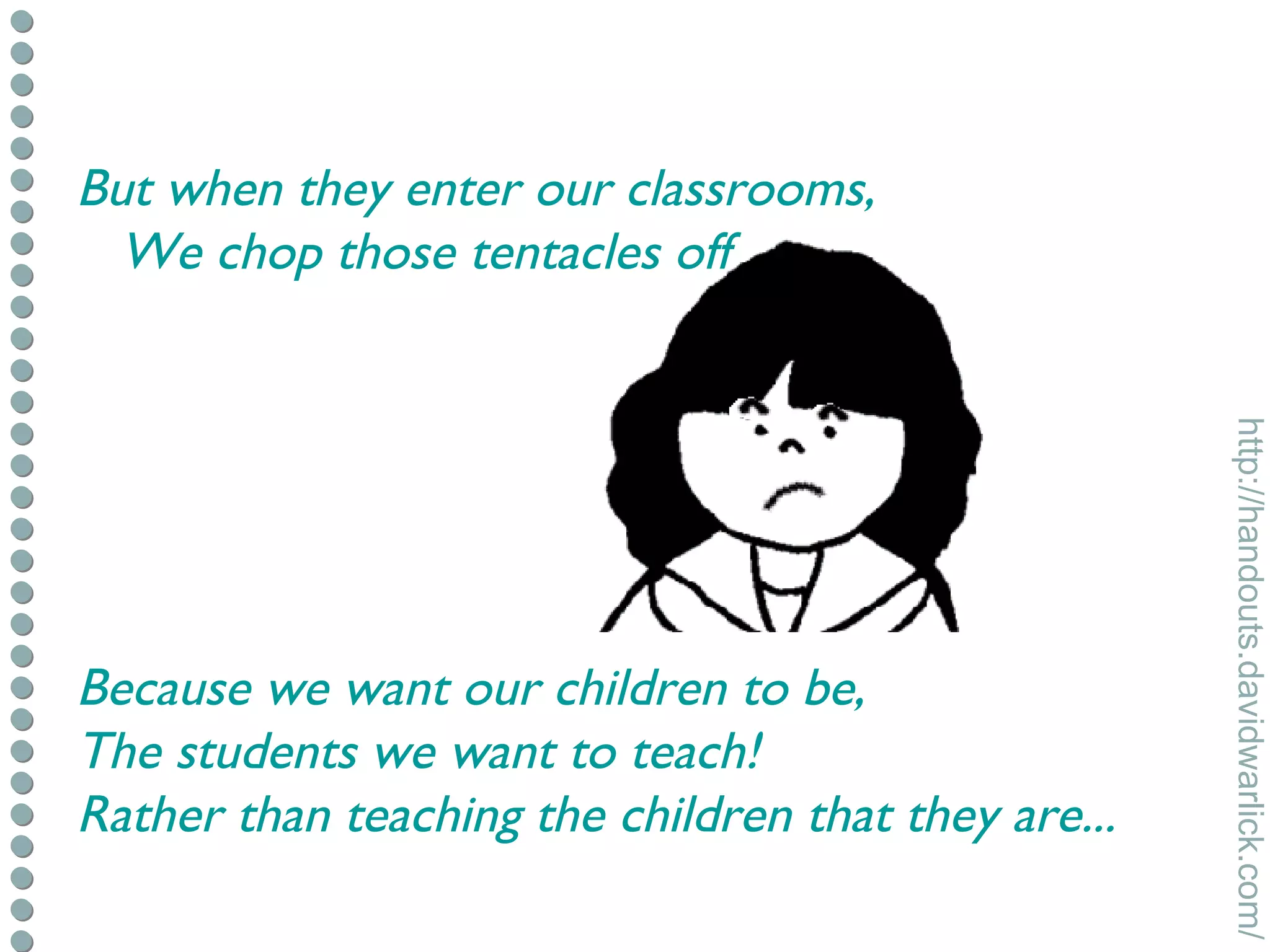
But when they enter our classrooms,  We chop those tentacles off Because we want our children to be, The students we want to teach! Rather than teaching the children that they are...
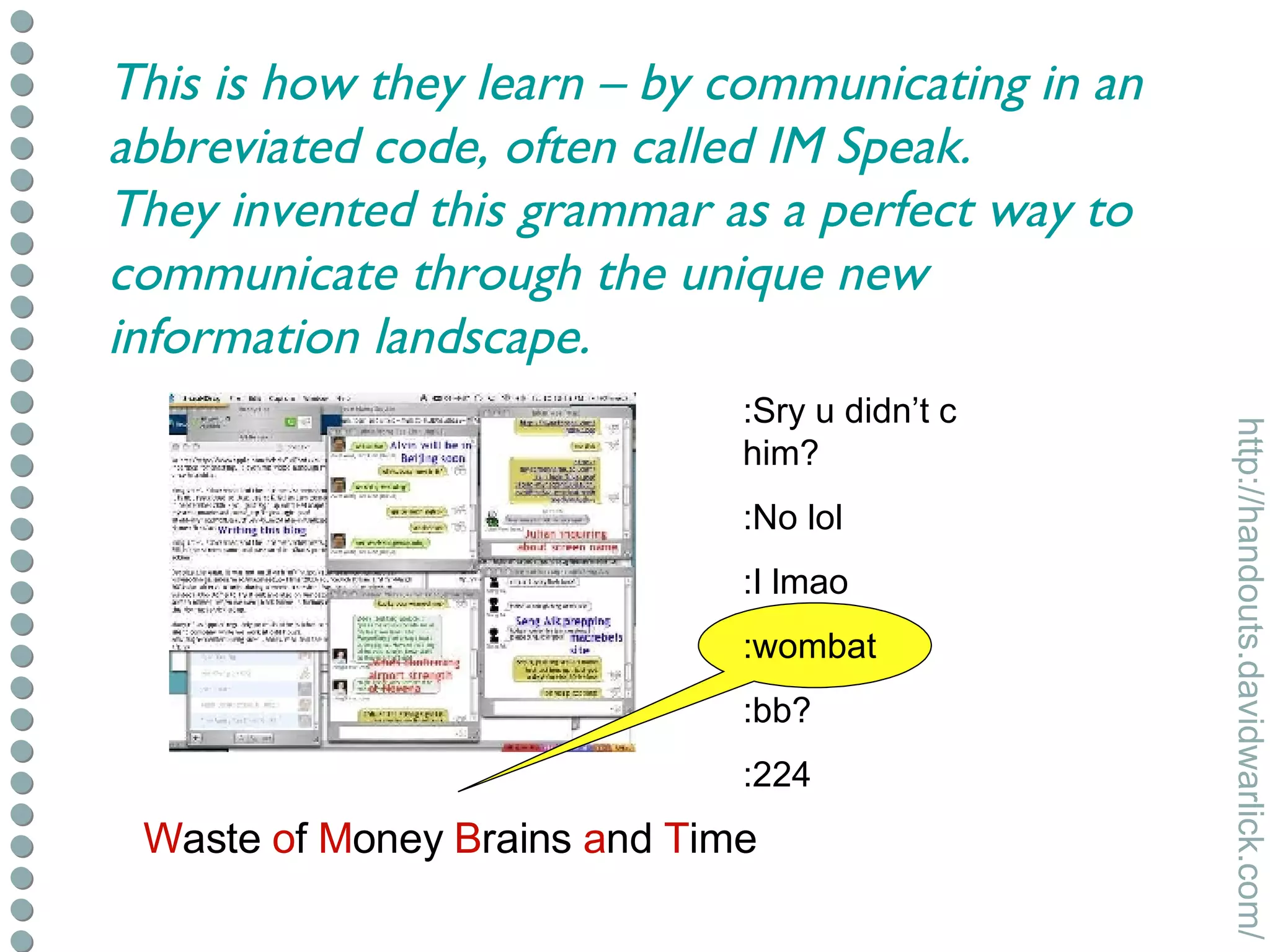
:Sry u didn’t c him? :No lol :I lmao :wombat :bb? :224 W aste  o f  M oney  B rains  a nd  T ime This is how they learn – by communicating in an abbreviated code, often called IM Speak. They invented this grammar as a perfect way to communicate through the unique new information landscape.
How our Students Learn? Got Game   by John Beck & Mitchell Wade The Kids are Alright: How the Gamer Generation is Changing the Workplace   by John Beck & Mitchell Wade What Video Games Have to Teach Us About Learning and Literacy   by James Paul Gee Don't Bother Me Mom--I'm Learning!   By Marc Prensky How Computer Games Help Children Learn   By David Williamson Shaffer They also learn in complex and rich video games. We are now beginning to recognize this activity as a genuine learning experience.
Thank You! David Warlick   •  919-571-3292  •  [email_address] http://2cents.davidwarlick.com http://connectlearning.davidwarlick.com Blog………………………………….………… Podcast……………………….…….. http://handouts.davidwarlick.com/ In a conference bookstore near you  ;-) The most important thing that we can realize, is that although technology is changing, it is the changing nature of information that must be the guiding principal for retooling education for the 21st century!

Flat World, Flat Web, Flat Classrooms

  • 1.
    Presented by DavidWarlick The Landmark Project Raleigh, NC Flat World Flat Web Flat Classrooms Photo: Beggs, &quot;IMG_1761.&quot; Beggs' Photostream . 11 Sep 2005. 24 Jun 2006 <http://flickr.com/photos/beggs/42276187/>. Prepared under fair use exemption of the U.S. Copyright Law and restricted from further use.
  • 2.
    Online Handouts http://landmark-project.comhttp://handouts.davidwarlick.com http://landmark-project.com/sl/ Eduisland II 129/13/23 Tags: flat, classroom, warlick
  • 3.
    What do WeKnow about the Workplace of the Future? &quot;How Much Information.&quot; School of Inormation Management & Systems . 2000. Regents of the University of California. 13 March, 2001. <http://www.sims.berkeley.edu/how-much-info/summary.html>. This is the information-age workplace of the future! But… http://handouts.davidwarlick.com/
  • 4.
    What do WeKnow about the Workplace of the Future? &quot;How Much Information.&quot; School of Inormation Management & Systems . 2000. Regents of the University of California. 13 March, 2001. <http://www.sims.berkeley.edu/how-much-info/summary.html>. If we consider that we carry our phones in our pockets now… http://handouts.davidwarlick.com/
  • 5.
    What do WeKnow about the Workplace of the Future? &quot;How Much Information.&quot; School of Inormation Management & Systems . 2000. Regents of the University of California. 13 March, 2001. <http://www.sims.berkeley.edu/how-much-info/summary.html>. … that less than 0.01% of the information we generate today is ever printed on paper, http://handouts.davidwarlick.com/
  • 6.
    What do WeKnow about the Workplace of the Future? &quot;How Much Information.&quot; School of Inormation Management & Systems . 2000. Regents of the University of California. 13 March, 2001. <http://www.sims.berkeley.edu/how-much-info/summary.html>. … That more and more of our professional collaborations are happening virtually… http://handouts.davidwarlick.com/
  • 7.
    What do WeKnow about the Workplace of the Future? &quot;How Much Information.&quot; School of Inormation Management & Systems . 2000. Regents of the University of California. 13 March, 2001. <http://www.sims.berkeley.edu/how-much-info/summary.html>. … and that our information technologies are becoming increasingly personal and pocketed… http://handouts.davidwarlick.com/
  • 8.
    What do WeKnow about the Workplace of the Future? There won’t be much left for the desk -- won’t be much reason to have a desk… So what do we have left? Almost nothing!
  • 9.
    What do WeKnow about the Workplace of the Future? … And this is exactly what we know about the future we’re preparing our children for… Almost Nothing!
  • 10.
    For the firsttime in history, our job as educators is to prepare our students for a future that we can not clearly describe.
  • 11.
    Friedman, Thomas L. The World is Flat: A Brief History of the Twenty-First Century . New York: Farrar, Straus and Giroux, 2005. … We do know that the economy that drives the world is changing – that it is flattening, as described by Thomas Friedman in The World is Flat!
  • 12.
    Did you knowthat …If Wal-Mart was a country, it would now be China's eighth-biggest trading partner…? Did you know that …UPS ships 13.5 million packages a day… which means that at any given moment, 2% of the world's GDP is in the back of a UPS delivery truck? Friedman, Thomas L. The World is Flat: A Brief History of the Twenty-First Century . New York: Farrar, Straus and Giroux, 2005. … It is a measure of how global the world has become – how cooperative. The flat world has not occurred because of competition – but because of cooperation!
  • 13.
    Did you knowthat … in 2003, Chinese students graduating with engineering represented 46% of all graduates. In the US it was only 5%. Almost half of NASA’s 18,146 employees are over 50 years old. NASA Employees over the age of 60 out number those under 30 Friedman, Thomas L. The World is Flat: A Brief History of the Twenty-First Century . New York: Farrar, Straus and Giroux, 2005. This concerns us in the U.S., because we fear that our position of dominance in science and technology is being usurped by more competitive countries.
  • 14.
    Richard Florida says… Lose 500,000 manufacturing jobs Gain 200,000 Science & Engineering jobs 400,000 creative arts jobs (visual arts, music, drama, culture, & entertainment) Florida, Richard. The Flight of the Creative Class. New York: HarperCollins, 2004. But Richard Florida urges that just as important as science and technology are the contributions to the economy of the creative arts.
  • 15.
    He’s not investingin the technology! He’s investing in the Story! My son spends his money on video games and game system… But…
  • 16.
    Is it theTechnology? http://handouts.davidwarlick.com/ A better story? You don’t invest in a new HDTV because of the technology. You buy it because you want a better picture! We’re buying what the creative arts workers contribute!
  • 17.
    A Flat InformationLandscape The Wikipedia, in 2001, looked like this, and included articles in 12 languages. In 2002 it grew to 23 languages… 2003 - 29 2004 - 65 2005 - 80 2006 - 116 2007 - 176 today - 200+
  • 18.
    The Changing Shapeof Information http://wikipedia.org Those languages did not appear because a giant librarian decided that they should be there. They emerged because people who spoke those languages wanted to be a part of the new information landscape!
  • 19.
    Science/Astronomy How manyplanets does you science book report in the Solar System? The BBC announced at 1:30 PM, 24 August, 2006, that there are now only 8 planets, because astronomers changed the characteristics of a planet minutes before. The Wikipedia article on the Solar System was up-to-date less than one minute later, and the article was edited 90 times between 1:30 that afternoon and midnight.
  • 20.
    Information is ChangingTechnorati Google of the Blogosphere Blogging made us all potential publishers. It changed the shape of information. Individuals can observe their experience, reflect on their experience, report it in their blog, and even make a living with advertising.
  • 21.
    Languages in theConversation Japanese English Chinese Italian Spanish Russian More globalization! A world that is becoming Wired!
  • 22.
    When we havenew questions, where do the new answers come from? Something That somebody Said yesterday Images from http://flickr.com/creativecommons This is important, because in a time of rapid change, we will constantly be asking new questions. ..and sometimes the answer to a brand new question will not come from a book or an expert. Sometimes the answer to a brand new question will come from… -------->
  • 23.
    From the perspectiveof their information landscape, our students are more literate than their teachers! http://handouts.davidwarlick.com/ Traditional classrooms were hilly, with the teacher up above, and the learners down below. We drove curriculum with gravity. But consider that… Learners Learners Curriculum, Content & Teachers Gravity Gravity
  • 24.
    Our Classrooms areFlat http://handouts.davidwarlick.com/ How do we drive learning when we can no long rely on gravity? Where do we get the energy? Learners Learners Curriculum, Content & Teachers Gravity Gravity Learners Learners Curriculum Content Teachers
  • 25.
    A Story froma Techie Content today is the dominant thing. But one thing that I can say, is that … it is going to be the company that can grow and maintain audiences (not content). Khosla, Vinod.&quot;ITConversations.&quot; Vinod Khosla: In Conversations with John Battelle. Web 2.0 Conference, San Francisco. 5 Oct 2005. Audio Archive. 25 Nov 2005 <http://www.itconversations.com/shows/detail796.html>. Perhaps the question should be…”How do maintain my classroom as a learning engine?” Vinod Khosla Founding CEO of Sun Microsystems
  • 26.
    They’re Different Theywere born after The Reagan era The Persian Gulf War The walkman Most of them were born after The breakup of the Soviet Union Tiananmen Square Compact Discs had been around for a decade. They have never Played Pac Man or Pong Listened to an 8-track Purchased a vinyl album Seen a TV with less than 100 channels Heard “Where’s the Beef?”, “I’d walk a mile for a camel”, or “de plane, de plane.” They’re Smart & Connected and very few have any formative recollection of the 20th century
  • 27.
    Our children area different species. They have magical powers that would have seemed alien to us. They can see through walls. They can hear through walls. With their mobile phones, Internet-connected games systems, computers and text-messagers, they can connect to people regardless distance. Walls do not mean the same thing to them that they meant to us! They have tentacles.
  • 28.
    But when theyenter our classrooms, We chop those tentacles off Because we want our children to be, The students we want to teach! Rather than teaching the children that they are...
  • 29.
    :Sry u didn’tc him? :No lol :I lmao :wombat :bb? :224 W aste o f M oney B rains a nd T ime This is how they learn – by communicating in an abbreviated code, often called IM Speak. They invented this grammar as a perfect way to communicate through the unique new information landscape.
  • 30.
    How our StudentsLearn? Got Game by John Beck & Mitchell Wade The Kids are Alright: How the Gamer Generation is Changing the Workplace by John Beck & Mitchell Wade What Video Games Have to Teach Us About Learning and Literacy by James Paul Gee Don't Bother Me Mom--I'm Learning! By Marc Prensky How Computer Games Help Children Learn By David Williamson Shaffer They also learn in complex and rich video games. We are now beginning to recognize this activity as a genuine learning experience.
  • 31.
    Thank You! DavidWarlick • 919-571-3292 • [email_address] http://2cents.davidwarlick.com http://connectlearning.davidwarlick.com Blog………………………………….………… Podcast……………………….…….. http://handouts.davidwarlick.com/ In a conference bookstore near you ;-) The most important thing that we can realize, is that although technology is changing, it is the changing nature of information that must be the guiding principal for retooling education for the 21st century!