The Triumph of TechnologyOr, Journalism in the Age of NowFrom Sputnik (me) to Facebook (you)
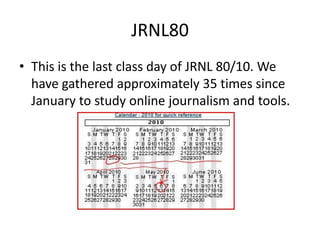
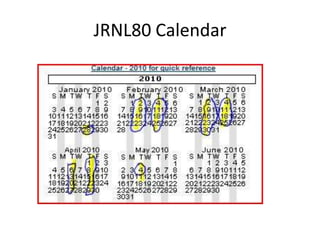
JRNL80This is the last class day of JRNL 80/10. We have gathered approximately 35 times since January to study online journalism and tools.
JRNL80 Calendar
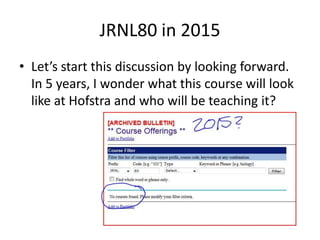
JRNL80 in 2015Let’s start this discussion by looking forward. In 5 years, I wonder what this course will look like at Hofstra and who will be teaching it?
CareersIn five years, most of you here today will be into starting your careers. Life, my students, goes really quickly after that.Why Does Time Fly By As You Get Older?Spoiler alert:	The novelty wears out. Keep the fire lit.
The High School Class of 2015Today’s 13-year-olds are texting and sharing on social networks.They are blogging like Tavi, a 13-Year-OldThey willwill come to schoolusing mobilesmart devices for simply everything as the mobile web eclipses the desktop web(Morgan Stanley study via Mashable, April 13, 2010).
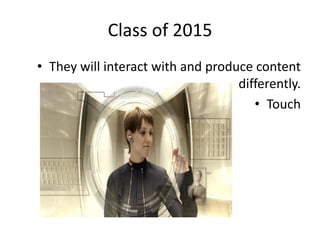
Class of 2015They will interact with and produce content differently.Touch
They Will Use Live Mobile VideoIf you aren’t doing video from your phone, you should be.  Cisco, the Internet technology company, estimates that 64 percent of Internet traffic will come from mobile video by 2013. Think of what it will do for:-- telemedicine, -- mobile virtual presence, -- machine-to-machine applications such as telematics,-- enriched navigation experience, -- interactive gaming, -- remote sensing applications, -- mobile education systems, -- mobile emergency management systems, -- and far richer advertising opportunities for mobile advertising and entertainment.
SharingPeople are sharing video and it will only continue to grow. Most mobile video is of poor quality due to device limitations and networks, but what is compelling is mobile live video.  It will only get better and become more pervasive in everything we do.
Now, back to the class of 2015Colleges will be competing hard for students as the high school class of 2015 will be the smallest since enrollment peaked at 3.12 million in 2009.
Are You Above Average?Today, Facebook says that the average user today has 130 friends, a year ago that was 120.Assume a 2 percent growth rate annually and that’s an average friend count of 140 friends in five years on FB. Even if Facebook’s population remains stable at 400 million people, that means some 56 billion possible ‘friend’ connections. Think about what happens if the average goes above that.
High School Class of 2015Facebook users from age 13-18 grew 88 percent (5.7M to 10.7M) from Jan. 2009-Jan. 2010, iStrategylabs says.
 New Networks, Not New FriendsAt some point, we are going to run out of new people to friend and relationship webs on the social graph will attain even higher value. Already I see getting access to someone’s network will become of even greater value and the way to earn that now is through trust, transparency and credibility. Build and share your network.
Sharing ContentThe Class of 2015 will be used to sharing content.
Facebook CreationistsOn Facebook, the average user creates 70 pieces of content each month. In aggregate, more than 25 billion pieces of content (web links, news stories, blog posts, notes, photo albums, etc.) are shared each month.
Sharing and KnowingYou will share a lot online. Monitor your public persona and know what your name returns. Contribute good stuff and build connections with people. Share your special knowledge, become that go-to person.
Social capitalIn http://globalhumancapital.org/?p=675, the blogger says:
The New Web: Game-ChangerPervasive Web 2.0 also means re-examination or disruption of most areas of life, culture, society, government and business because social networks alter how many and what kind of relationships people have
Let’s take a look at this want ad that appeared yesterday in the Huffington Post. Are you qualified to go after the job of associate social news editor?http://www.huffingtonpost.com/p/jobs-at-huffingtonpostcom.
Hot Sector of JournalismForbes said in December that this sector is one of the hottest in journalism:http://www.forbes.com/2009/12/09/social-media-director-business-media-journalism.html 
Your skills package:Regardless of whether you are a print journalist or a broadcast journalist, today you should be able to do your work in both text and visually. And, it should be findable.
You are Part of Something BiggerYou are empowered by the skills and traditions of the generations that have gone before you in this field. You have an important part to play in a democratic society.
In February, 2010, Robert Hernandez wrote in OJR that the top skills for Web journalists are:solid news judgment, strong ethics, thrive under deadline, accuracy, a mastery of the AP Stylebook.
Other skills areBasic knowledge of HTML (links), experience with CMS, working understanding of SEO, being social in social media and the willingness to try new technologies.
Ability to tell stories in all media:Know how to write for text, photos, audio, video and the combination of any of them. At the very least, know and respect each of these crafts and how they are used on the Web.The most important skill is journalism, not the latest technology.
The Journalism MarketAverage circulation figures for newspapers dropped 8 percent for the six-month period ending in March
The New York Timeslost 8 percent of its circulation in that time while the Wall Street Journal was the only publication to show growth.
Advertising Won’t Pay the BillsSome are predicting online advertising will surpass newspaper advertising by mid-decade. When this happens, we will be trading print dollars for digital dimes. Going to have to generate a lot of page views to make a living.$27,000 PVs a day=$30,000 a year salary.
Writers and Editors Employment OutlookThe market is expected to grow faster than average, but keen competition is expected for writing and editing jobs as many people are attracted to this occupation. At the same time, many employers are downsizing.
Writers and editorsThose who have adapted to the new media and are comfortable writing for and working with a variety of electronic and digital tools will have an advantage in finding new work. Source: Bureau of Labor Statistics
Getting Work PublishedThe declining costs of self-publishing and the growing popularity of electronic books and book readers will allow many freelancers to get their work published. Some job openings will arise as experienced workers retire, transfer to other occupations, or leave the labor force.
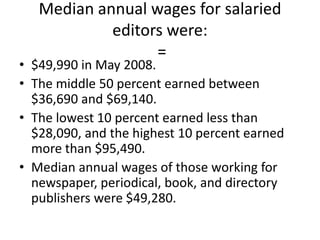
Median annual wages for salaried editors were: =$49,990 in May 2008. The middle 50 percent earned between $36,690 and $69,140. The lowest 10 percent earned less than $28,090, and the highest 10 percent earned more than $95,490. Median annual wages of those working for newspaper, periodical, book, and directory publishers were $49,280.
The broadcast side, Some 400 local television news journalists lost their jobs in 2009, according to research conducted by Bob Papper.
The LocalNewser blog described the outlook for this year as:a year of local news broadcast journalists feeling more confident of holding on to their jobs, though those jobs will probably mean doing a lot more than ever before, and it's still not a great time to be re-negotiating a new contract.
The Futurist Magazine http://www.wfs.org/forecasts.htm
GlobalizationThe United States will see a significant proportion of its population emigrate due to overseas opportunities.
Millennial-generation learners — those born after 1992 — are growing up in a mobile, personalized, on-demand media environment that poses challenges to traditional classroom-bound educators.
Education will be portable, and learning will be ‘on-demand.’Education may follow the entertainment-delivery model, allowing customers (learners) to download what they want and use it when they want it.
 FacultyWill increasingly upload lectures and educational “playlists” to podcasting services for students to attend at their convenience. — Tomorrow in Brief, Sep-Oct 2006, p. 2
Text will be instantly translated into multimedia presentationsNo more waiting for the movie version: Rapid language processing will create multimedia animations of your favorite book (or any text, such as directions to a museum in a foreign city). Storytellers could use the technology to create more-realistic storyboards from eye-witness reports. — Tomorrow in Brief, July-Aug 2006, p. 2
The production of art will increase But the audience for art shrinks.New media such as video, virtual reality, and hyperlinked text will create new methods for artistic expression. But fine art is facing increased competition for viewers’ time and attention among “easier” forms of leisure, such as video games and television.-- RAND Corporation report, “A Portrait of the Visual Arts.” — World Trends & Forecasts, Jan-Feb 2006, p. 10
SuperlongevityWhat would you do if you knew you would be working for 50 years or more?More young people will opt to not only pursue postgraduate education, they may remain in school well into their 20s or early 30s in order to train for the complex jobs required in our advanced society. More people in their 50s will also return to school to start new careers. 	— Michael G. Zey, “The Superlongevity Revolution: How It Will Change Our Lives,” Nov-Dec 2005, p. 16
Workers over the age of 55 areexpected to grow from 14% of the labor force to 19% by 2012. In less than five years, 77 million baby boomers in the United States will begin reaching age 65, the traditional retirement age. As a result, the idea of “retirement” will change significantly.
Who is the Financial Boss?According to McKinsey, “by 2015, boomers will control nearly 60% of US net wealth and account for 40% of US consumption and income.”http://webcache.googleusercontent.com/search?q=cache:TiTRoUCrz3MJ:blogs.praized.com/seb/category/socio-demographics/+social-graph+2015+youth&cd=3&hl=en&ct=clnk&gl=us&client=firefox-a
Humanity or Machine-ity?

The triumph of technology final power point 050310

  • 1.
    The Triumph ofTechnologyOr, Journalism in the Age of NowFrom Sputnik (me) to Facebook (you)
  • 2.
    JRNL80This is thelast class day of JRNL 80/10. We have gathered approximately 35 times since January to study online journalism and tools.
  • 3.
  • 4.
    JRNL80 in 2015Let’sstart this discussion by looking forward. In 5 years, I wonder what this course will look like at Hofstra and who will be teaching it?
  • 5.
    CareersIn five years,most of you here today will be into starting your careers. Life, my students, goes really quickly after that.Why Does Time Fly By As You Get Older?Spoiler alert: The novelty wears out. Keep the fire lit.
  • 6.
    The High SchoolClass of 2015Today’s 13-year-olds are texting and sharing on social networks.They are blogging like Tavi, a 13-Year-OldThey willwill come to schoolusing mobilesmart devices for simply everything as the mobile web eclipses the desktop web(Morgan Stanley study via Mashable, April 13, 2010).
  • 7.
    Class of 2015Theywill interact with and produce content differently.Touch
  • 8.
    They Will UseLive Mobile VideoIf you aren’t doing video from your phone, you should be. Cisco, the Internet technology company, estimates that 64 percent of Internet traffic will come from mobile video by 2013. Think of what it will do for:-- telemedicine, -- mobile virtual presence, -- machine-to-machine applications such as telematics,-- enriched navigation experience, -- interactive gaming, -- remote sensing applications, -- mobile education systems, -- mobile emergency management systems, -- and far richer advertising opportunities for mobile advertising and entertainment.
  • 9.
    SharingPeople are sharingvideo and it will only continue to grow. Most mobile video is of poor quality due to device limitations and networks, but what is compelling is mobile live video. It will only get better and become more pervasive in everything we do.
  • 10.
    Now, back tothe class of 2015Colleges will be competing hard for students as the high school class of 2015 will be the smallest since enrollment peaked at 3.12 million in 2009.
  • 11.
    Are You AboveAverage?Today, Facebook says that the average user today has 130 friends, a year ago that was 120.Assume a 2 percent growth rate annually and that’s an average friend count of 140 friends in five years on FB. Even if Facebook’s population remains stable at 400 million people, that means some 56 billion possible ‘friend’ connections. Think about what happens if the average goes above that.
  • 12.
    High School Classof 2015Facebook users from age 13-18 grew 88 percent (5.7M to 10.7M) from Jan. 2009-Jan. 2010, iStrategylabs says.
  • 13.
    New Networks,Not New FriendsAt some point, we are going to run out of new people to friend and relationship webs on the social graph will attain even higher value. Already I see getting access to someone’s network will become of even greater value and the way to earn that now is through trust, transparency and credibility. Build and share your network.
  • 14.
    Sharing ContentThe Classof 2015 will be used to sharing content.
  • 15.
    Facebook CreationistsOn Facebook,the average user creates 70 pieces of content each month. In aggregate, more than 25 billion pieces of content (web links, news stories, blog posts, notes, photo albums, etc.) are shared each month.
  • 16.
    Sharing and KnowingYouwill share a lot online. Monitor your public persona and know what your name returns. Contribute good stuff and build connections with people. Share your special knowledge, become that go-to person.
  • 17.
  • 18.
    The New Web:Game-ChangerPervasive Web 2.0 also means re-examination or disruption of most areas of life, culture, society, government and business because social networks alter how many and what kind of relationships people have
  • 19.
    Let’s take alook at this want ad that appeared yesterday in the Huffington Post. Are you qualified to go after the job of associate social news editor?http://www.huffingtonpost.com/p/jobs-at-huffingtonpostcom.
  • 20.
    Hot Sector ofJournalismForbes said in December that this sector is one of the hottest in journalism:http://www.forbes.com/2009/12/09/social-media-director-business-media-journalism.html 
  • 21.
    Your skills package:Regardlessof whether you are a print journalist or a broadcast journalist, today you should be able to do your work in both text and visually. And, it should be findable.
  • 22.
    You are Partof Something BiggerYou are empowered by the skills and traditions of the generations that have gone before you in this field. You have an important part to play in a democratic society.
  • 23.
    In February, 2010,Robert Hernandez wrote in OJR that the top skills for Web journalists are:solid news judgment, strong ethics, thrive under deadline, accuracy, a mastery of the AP Stylebook.
  • 24.
    Other skills areBasicknowledge of HTML (links), experience with CMS, working understanding of SEO, being social in social media and the willingness to try new technologies.
  • 25.
    Ability to tellstories in all media:Know how to write for text, photos, audio, video and the combination of any of them. At the very least, know and respect each of these crafts and how they are used on the Web.The most important skill is journalism, not the latest technology.
  • 26.
    The Journalism MarketAveragecirculation figures for newspapers dropped 8 percent for the six-month period ending in March
  • 27.
    The New YorkTimeslost 8 percent of its circulation in that time while the Wall Street Journal was the only publication to show growth.
  • 28.
    Advertising Won’t Paythe BillsSome are predicting online advertising will surpass newspaper advertising by mid-decade. When this happens, we will be trading print dollars for digital dimes. Going to have to generate a lot of page views to make a living.$27,000 PVs a day=$30,000 a year salary.
  • 29.
    Writers and EditorsEmployment OutlookThe market is expected to grow faster than average, but keen competition is expected for writing and editing jobs as many people are attracted to this occupation. At the same time, many employers are downsizing.
  • 30.
    Writers and editorsThosewho have adapted to the new media and are comfortable writing for and working with a variety of electronic and digital tools will have an advantage in finding new work. Source: Bureau of Labor Statistics
  • 31.
    Getting Work PublishedThedeclining costs of self-publishing and the growing popularity of electronic books and book readers will allow many freelancers to get their work published. Some job openings will arise as experienced workers retire, transfer to other occupations, or leave the labor force.
  • 32.
    Median annual wagesfor salaried editors were: =$49,990 in May 2008. The middle 50 percent earned between $36,690 and $69,140. The lowest 10 percent earned less than $28,090, and the highest 10 percent earned more than $95,490. Median annual wages of those working for newspaper, periodical, book, and directory publishers were $49,280.
  • 33.
    The broadcast side,Some 400 local television news journalists lost their jobs in 2009, according to research conducted by Bob Papper.
  • 34.
    The LocalNewser blogdescribed the outlook for this year as:a year of local news broadcast journalists feeling more confident of holding on to their jobs, though those jobs will probably mean doing a lot more than ever before, and it's still not a great time to be re-negotiating a new contract.
  • 35.
  • 36.
    GlobalizationThe United Stateswill see a significant proportion of its population emigrate due to overseas opportunities.
  • 37.
    Millennial-generation learners —those born after 1992 — are growing up in a mobile, personalized, on-demand media environment that poses challenges to traditional classroom-bound educators.
  • 38.
    Education will beportable, and learning will be ‘on-demand.’Education may follow the entertainment-delivery model, allowing customers (learners) to download what they want and use it when they want it.
  • 39.
    FacultyWill increasinglyupload lectures and educational “playlists” to podcasting services for students to attend at their convenience. — Tomorrow in Brief, Sep-Oct 2006, p. 2
  • 40.
    Text will beinstantly translated into multimedia presentationsNo more waiting for the movie version: Rapid language processing will create multimedia animations of your favorite book (or any text, such as directions to a museum in a foreign city). Storytellers could use the technology to create more-realistic storyboards from eye-witness reports. — Tomorrow in Brief, July-Aug 2006, p. 2
  • 41.
    The production ofart will increase But the audience for art shrinks.New media such as video, virtual reality, and hyperlinked text will create new methods for artistic expression. But fine art is facing increased competition for viewers’ time and attention among “easier” forms of leisure, such as video games and television.-- RAND Corporation report, “A Portrait of the Visual Arts.” — World Trends & Forecasts, Jan-Feb 2006, p. 10
  • 42.
    SuperlongevityWhat would youdo if you knew you would be working for 50 years or more?More young people will opt to not only pursue postgraduate education, they may remain in school well into their 20s or early 30s in order to train for the complex jobs required in our advanced society. More people in their 50s will also return to school to start new careers. — Michael G. Zey, “The Superlongevity Revolution: How It Will Change Our Lives,” Nov-Dec 2005, p. 16
  • 43.
    Workers over theage of 55 areexpected to grow from 14% of the labor force to 19% by 2012. In less than five years, 77 million baby boomers in the United States will begin reaching age 65, the traditional retirement age. As a result, the idea of “retirement” will change significantly.
  • 44.
    Who is theFinancial Boss?According to McKinsey, “by 2015, boomers will control nearly 60% of US net wealth and account for 40% of US consumption and income.”http://webcache.googleusercontent.com/search?q=cache:TiTRoUCrz3MJ:blogs.praized.com/seb/category/socio-demographics/+social-graph+2015+youth&cd=3&hl=en&ct=clnk&gl=us&client=firefox-a
  • 61.