What is Karate?
Karate is a Japanese martial art whose
physical aspects seek the development of
defensive and counterattacking body
movements.
The themes of traditional karate
training are fighting and self-defense, though
its mental and moral aspects target the
overall improvement of the individual.
This is facilitated by the discipline and
persistent effort required in training.
If karate had to be described in only one
sentence, then the most suitable one may
arguably be "You never attack first in
karate."
It originated in the southernmost islands of
Japan, the Ryukyu islands that were originally allied
with China; Japan later took control of these islands.
The largest of these islands is Okinawa. This martial
art developed, therefore, with these distinct
influences.
Origin of
Karate
The word karate is a combination of
two kanji (Chinese characters): kara, meaning empty,
and te, meaning hand; thus, karate means "empty
hand."
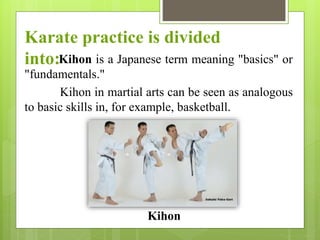
Kihon is a Japanese term meaning "basics" or
"fundamentals."
Kihon in martial arts can be seen as analogous
to basic skills in, for example, basketball.
Karate practice is divided
into:
Kihon
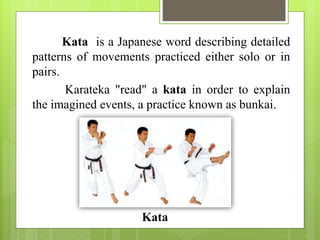
Kata is a Japanese word describing detailed
patterns of movements practiced either solo or in
pairs.
Karateka "read" a kata in order to explain
the imagined events, a practice known as bunkai.
Kata
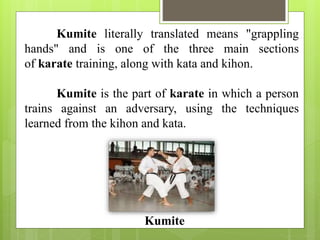
Kumite literally translated means "grappling
hands" and is one of the three main sections
of karate training, along with kata and kihon.
Kumite is the part of karate in which a person
trains against an adversary, using the techniques
learned from the kihon and kata.
Kumite
In our everyday lives we often forget the value
of exercise to both our physical and mental health.
The practice of karate tones the body, develops
coordination, quickens reflexes, and builds stamina.
Also, the serious practice of karate develops
composure, a clearer thought process, deeper insight
into one's mental capabilities, and more self-
confidence.
Benefits of
Karate
In this, karate is not an end, but a means to
an end. It is an activity in which advancing age is
not a hindrance. Rather it encourages proficiency
in the keen coordination of mind and body.
Karate may be practiced for many reasons,
but was originally developed for self defense.
However, proper training is required to make these
techniques usable against a determined aggressor.

self defense in karatejsbdbbdsbdbdbdbbfb

  • 2.
    What is Karate? Karateis a Japanese martial art whose physical aspects seek the development of defensive and counterattacking body movements. The themes of traditional karate training are fighting and self-defense, though its mental and moral aspects target the overall improvement of the individual.
  • 3.
    This is facilitatedby the discipline and persistent effort required in training. If karate had to be described in only one sentence, then the most suitable one may arguably be "You never attack first in karate."
  • 4.
    It originated inthe southernmost islands of Japan, the Ryukyu islands that were originally allied with China; Japan later took control of these islands. The largest of these islands is Okinawa. This martial art developed, therefore, with these distinct influences. Origin of Karate The word karate is a combination of two kanji (Chinese characters): kara, meaning empty, and te, meaning hand; thus, karate means "empty hand."
  • 5.
    Kihon is aJapanese term meaning "basics" or "fundamentals." Kihon in martial arts can be seen as analogous to basic skills in, for example, basketball. Karate practice is divided into: Kihon
  • 6.
    Kata is aJapanese word describing detailed patterns of movements practiced either solo or in pairs. Karateka "read" a kata in order to explain the imagined events, a practice known as bunkai. Kata
  • 7.
    Kumite literally translatedmeans "grappling hands" and is one of the three main sections of karate training, along with kata and kihon. Kumite is the part of karate in which a person trains against an adversary, using the techniques learned from the kihon and kata. Kumite
  • 8.
    In our everydaylives we often forget the value of exercise to both our physical and mental health. The practice of karate tones the body, develops coordination, quickens reflexes, and builds stamina. Also, the serious practice of karate develops composure, a clearer thought process, deeper insight into one's mental capabilities, and more self- confidence. Benefits of Karate
  • 9.
    In this, karateis not an end, but a means to an end. It is an activity in which advancing age is not a hindrance. Rather it encourages proficiency in the keen coordination of mind and body. Karate may be practiced for many reasons, but was originally developed for self defense. However, proper training is required to make these techniques usable against a determined aggressor.