Terms
• Archetype – pattern or model , Beowulf
  possess archetypal classic hero characteristics
• Hierarchical – ranking one thing over another
  political - social system of the Anglo-Saxons
  King the head, nobles, warriors, then peasants
• Anglo-Saxon – Germanic tribes that founded
  early Europe, warlike structure
• Epic poem - long serious poem about a hero
Terms continued…
• Hubris – overly inflated sense of pride, it usually
  leads to a literary hero’s demise
• Classic Literary Hero – the archetype in literature
  that reflects a protagonist that possess heroic
  characteristics
• Heroic Code – Anglo-Saxon political social code,
  Warriors must demonstrate kinship with their
  strong leader and stand by him through the end.
  They must retaliate any attack on a fellow
  warrior – an eye for an eye
Classic Literary Hero
                 Characteristics
•   Special birth
•   Call to adventure
•   Goes on a journey = quest
•   Crosses the threshold
•   Talisman – special weapon
•   Special helper
•   Faces trials
•   Achievement of the goal
•   The return home
•   Reconciliation with the father figure
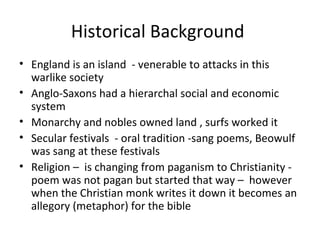
Historical Background
• England is an island - venerable to attacks in this
  warlike society
• Anglo-Saxons had a hierarchal social and economic
  system
• Monarchy and nobles owned land , surfs worked it
• Secular festivals - oral tradition -sang poems, Beowulf
  was sang at these festivals
• Religion – is changing from paganism to Christianity -
  poem was not pagan but started that way – however
  when the Christian monk writes it down it becomes an
  allegory (metaphor) for the bible
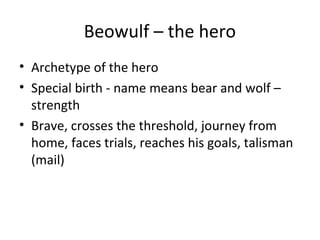
Beowulf – the hero
• Archetype of the hero
• Special birth - name means bear and wolf –
  strength
• Brave, crosses the threshold, journey from
  home, faces trials, reaches his goals, talisman
  (mail)
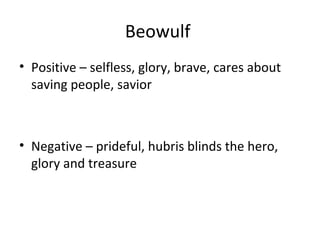
Beowulf
• Positive – selfless, glory, brave, cares about
  saving people, savior


• Negative – prideful, hubris blinds the hero,
  glory and treasure
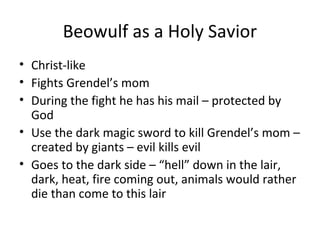
Beowulf as a Holy Savior
• Christ-like
• Fights Grendel’s mom
• During the fight he has his mail – protected by
  God
• Use the dark magic sword to kill Grendel’s mom –
  created by giants – evil kills evil
• Goes to the dark side – “hell” down in the lair,
  dark, heat, fire coming out, animals would rather
  die than come to this lair
Holy Savior
• Chops off Grendel’s head
• Water turns black and red
• The onlookers believe he is dead - like Jesus
• Water turns clear - rebirth
• At the end comes out of the lake with the
  sword – looks like a cross
• This battle is the one that best demonstrates
  the theme of Good vs. Evil
Old Beowulf vs. Young Beowulf
• Young Beowulf
- Selfless, fights for glory, super strength,
   doesn’t think about death, survives dangerous
   battles
• Old Beowulf
- Fights for glory to prove himself, fights for
   treasure, hubris, men betray him, dies
Beowulf – the Poem
• Poem is believed to be written by a Christian
  Monk because they were the only ones who
  could read and write at the time
• A pagan poem becomes a symbol for
  Christianity
• We see elements of both paganism and
  Christianity with in the poem
Examples of the Heroic Code
• Beowulf fights for glory
• Brings the bravest and best men Denmark
• Leaves men behind with the ship when he arrives
  at Denmark
• The battle of Grendel demonstrates Beowulf’s
  men trying to defend him
• After the battle with Grendel’s mother everyone
  thinks Beowulf is dead and they leave but
  Beowulf’s men stay behind and wait for him
Examples of the Heroic Code cont..
• Wiglaf’s speech to Beowulf’s warriors after
  they abandon him
• Beowulf leaves his kingdom to Wiglaf because
  he is the last of “our far flung family”
Paganism vs. Christianity
• Poem is written at time when Paganism is
  dying and Christianity is taking over
• Danish people praying to other Gods before
  Beowulf arrives
• Heroic Code – unwritten laws of warrior –
  kinship – eye for an eye – conflicts with the
  Christian doctrine of love and “turn the other
  cheek” – this tension is demonstrated
  throughout the entire poem
The Importance of Establishing an
              Identity
• Beowulf is royalty – father was king and he will
  become king
• Beowulf’s Boast establishes him as a hero – is
  experienced in fighting monsters, glory, has no
  fear
• Must establish his own path and fight for glory
• Travels to a foreign land to fight their monsters
• Fights Grendel without weapons
• Goes into the monsters’ lair to kill Grendel’s mom

Beowulf study guide

  • 1.
    Terms • Archetype –pattern or model , Beowulf possess archetypal classic hero characteristics • Hierarchical – ranking one thing over another political - social system of the Anglo-Saxons King the head, nobles, warriors, then peasants • Anglo-Saxon – Germanic tribes that founded early Europe, warlike structure • Epic poem - long serious poem about a hero
  • 2.
    Terms continued… • Hubris– overly inflated sense of pride, it usually leads to a literary hero’s demise • Classic Literary Hero – the archetype in literature that reflects a protagonist that possess heroic characteristics • Heroic Code – Anglo-Saxon political social code, Warriors must demonstrate kinship with their strong leader and stand by him through the end. They must retaliate any attack on a fellow warrior – an eye for an eye
  • 3.
    Classic Literary Hero Characteristics • Special birth • Call to adventure • Goes on a journey = quest • Crosses the threshold • Talisman – special weapon • Special helper • Faces trials • Achievement of the goal • The return home • Reconciliation with the father figure
  • 4.
    Historical Background • Englandis an island - venerable to attacks in this warlike society • Anglo-Saxons had a hierarchal social and economic system • Monarchy and nobles owned land , surfs worked it • Secular festivals - oral tradition -sang poems, Beowulf was sang at these festivals • Religion – is changing from paganism to Christianity - poem was not pagan but started that way – however when the Christian monk writes it down it becomes an allegory (metaphor) for the bible
  • 5.
    Beowulf – thehero • Archetype of the hero • Special birth - name means bear and wolf – strength • Brave, crosses the threshold, journey from home, faces trials, reaches his goals, talisman (mail)
  • 6.
    Beowulf • Positive –selfless, glory, brave, cares about saving people, savior • Negative – prideful, hubris blinds the hero, glory and treasure
  • 7.
    Beowulf as aHoly Savior • Christ-like • Fights Grendel’s mom • During the fight he has his mail – protected by God • Use the dark magic sword to kill Grendel’s mom – created by giants – evil kills evil • Goes to the dark side – “hell” down in the lair, dark, heat, fire coming out, animals would rather die than come to this lair
  • 8.
    Holy Savior • Chopsoff Grendel’s head • Water turns black and red • The onlookers believe he is dead - like Jesus • Water turns clear - rebirth • At the end comes out of the lake with the sword – looks like a cross • This battle is the one that best demonstrates the theme of Good vs. Evil
  • 9.
    Old Beowulf vs.Young Beowulf • Young Beowulf - Selfless, fights for glory, super strength, doesn’t think about death, survives dangerous battles • Old Beowulf - Fights for glory to prove himself, fights for treasure, hubris, men betray him, dies
  • 10.
    Beowulf – thePoem • Poem is believed to be written by a Christian Monk because they were the only ones who could read and write at the time • A pagan poem becomes a symbol for Christianity • We see elements of both paganism and Christianity with in the poem
  • 11.
    Examples of theHeroic Code • Beowulf fights for glory • Brings the bravest and best men Denmark • Leaves men behind with the ship when he arrives at Denmark • The battle of Grendel demonstrates Beowulf’s men trying to defend him • After the battle with Grendel’s mother everyone thinks Beowulf is dead and they leave but Beowulf’s men stay behind and wait for him
  • 12.
    Examples of theHeroic Code cont.. • Wiglaf’s speech to Beowulf’s warriors after they abandon him • Beowulf leaves his kingdom to Wiglaf because he is the last of “our far flung family”
  • 13.
    Paganism vs. Christianity •Poem is written at time when Paganism is dying and Christianity is taking over • Danish people praying to other Gods before Beowulf arrives • Heroic Code – unwritten laws of warrior – kinship – eye for an eye – conflicts with the Christian doctrine of love and “turn the other cheek” – this tension is demonstrated throughout the entire poem
  • 14.
    The Importance ofEstablishing an Identity • Beowulf is royalty – father was king and he will become king • Beowulf’s Boast establishes him as a hero – is experienced in fighting monsters, glory, has no fear • Must establish his own path and fight for glory • Travels to a foreign land to fight their monsters • Fights Grendel without weapons • Goes into the monsters’ lair to kill Grendel’s mom