Beowulf
Introduction to Beowulf
• Beowulf is one of the earliest poems
written in any form of English.
• Actually, this writer should be called
an editor because the poem had a
long oral tradition and finally came to
rest as what we know as Beowulf.
• The original poem didn’t have a title,
modern editors gave the poem its
name.
More About the Editor
• The “editor” was obviously well-read
and conscious of his role as a poet.
• This is a Christian writer balancing his
faith with very Pagan themes.
• We know that the editor is Christian
because the only literate people of the
time were those from the church.
Review of Old English
History
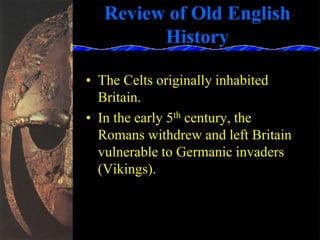
• The Celts originally inhabited
Britain.
• In the early 5th century, the
Romans withdrew and left Britain
vulnerable to Germanic invaders
(Vikings).
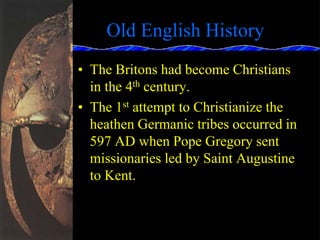
Old English History
• The Britons had become Christians
in the 4th century.
• The 1st attempt to Christianize the
heathen Germanic tribes occurred in
597 AD when Pope Gregory sent
missionaries led by Saint Augustine
to Kent.
Review of Old English
History
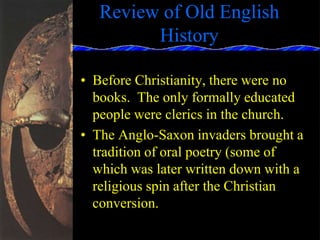
• Before Christianity, there were no
books. The only formally educated
people were clerics in the church.
• The Anglo-Saxon invaders brought a
tradition of oral poetry (some of
which was later written down with a
religious spin after the Christian
conversion.
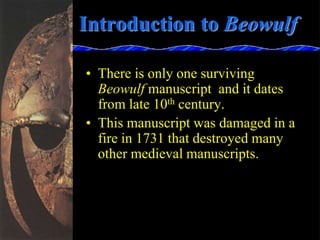
Introduction to Beowulf
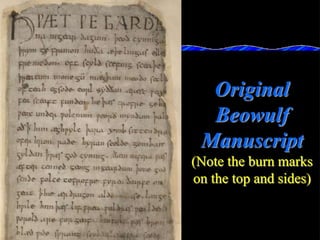
• There is only one surviving
Beowulf manuscript and it dates
from late 10th century.
• This manuscript was damaged in a
fire in 1731 that destroyed many
other medieval manuscripts.
Original
Beowulf
Manuscript
(Note the burn marks
on the top and sides)
Introduction to Beowulf
• Beowulf is recognized as a hallmark
of English literature, yet its heroes
and its setting are not English.
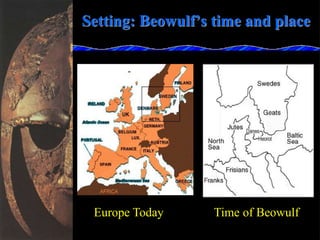
• The poem is set in two places: the
first half on a Danish island and the
second half in Beowulf’s homeland
(an island off the SE coast of
Sweden).
Introduction to Beowulf
• Interesting Fact:
J.R.R. Tolkein (The Lord of the Rings
Trilogy) was a learned Beowulf
scholar. He played a huge part in
getting Beowulf accepted as classic
literature
Introduction to Beowulf
• Beowulf is written in the epic
tradition, meaning it is larger than
life.
• There is also liberal use of the
supernatural.
• The poem champions bravery,
loyalty, and devotion to community.
Introduction to Beowulf
• The poem portrays a strong sense of
fatalism (acceptance of death)
• The warriors of the era accepted their
mortality in a way that seems casual
to modern readers.
• The concept of fate was central to the
world view of Anglo-Saxons.
Beowulf Background
• 30,000 lines of Anglo-Saxon poetry
survive today
• 3, 182 (10%) of the lines are from
Beowulf
• Setting - Denmark and Sweden
• Author - Unknown, probably a monk
• Composed in the 7th or 8th century
• Oldest surviving English poem
An epic…
• Is a long narrative poem form
• Has a hero
• Is the story of the hero’s travels and his
fights with monsters, gods, and bad guys
• An epic is in 3rd person
• Was originally sung
• Jumps right into the plot
• Contains information about the culture that
created them
• Offers clues as to what the author might
have feared, admired, or questioned.
Beowulf The Epic
The Epic Warrior
• Has “Larger than life” qualities,
• Is a natural lead of others
• Is not emotionally connected to his
followers.
• Is appealing to the opposite sex, but
is rarely in a committed relationship
• Defeats monsters and or fights for
Gods
The Epic Warrior
•Has “good” on his or her side
•Is associated with strength and values
•Often stands alone in battle
•Is generally smarter than everyone
else. A problem-solver
•Has a fatal weakness
•Is constantly on the move
•Is a skilled fighter
LITERARY ELEMENT –
Conflict
• The central struggle between two
opposing forces in a story or drama
-External
-Internal
External Conflict
• Exists when a character struggles
against some outside force
-EX: fight between two people
Internal Conflict
• A struggle within the mind of a
character.
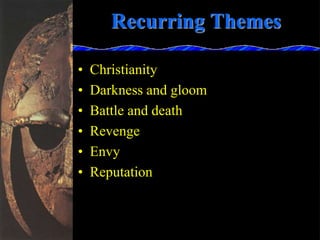
• Christianity
• Darkness and gloom
• Battle and death
• Revenge
• Envy
• Reputation
Recurring Themes
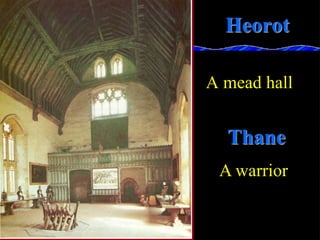
A mead hall
Heorot
Thane
A warrior
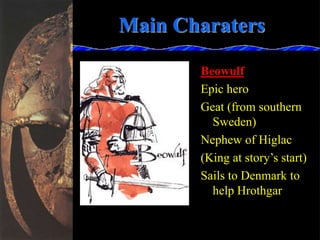
Main Charaters
Beowulf
Epic hero
Geat (from southern
Sweden)
Nephew of Higlac
(King at story’s start)
Sails to Denmark to
help Hrothgar
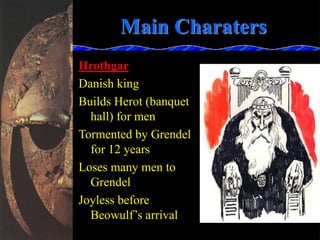
Main Charaters
Hrothgar
Danish king
Builds Herot (banquet
hall) for men
Tormented by Grendel
for 12 years
Loses many men to
Grendel
Joyless before
Beowulf’s arrival
Main Charaters
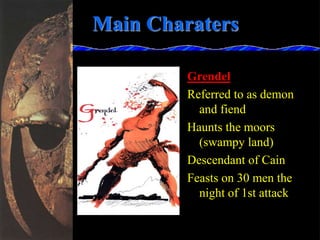
Grendel
Referred to as demon
and fiend
Haunts the moors
(swampy land)
Descendant of Cain
Feasts on 30 men the
night of 1st attack
Main Charaters
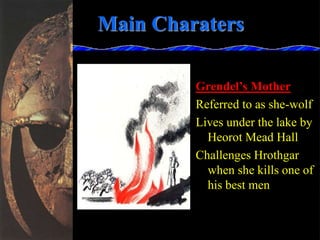
Grendel’s Mother
Referred to as she-wolf
Lives under the lake by
Heorot Mead Hall
Challenges Hrothgar
when she kills one of
his best men
Main Charaters
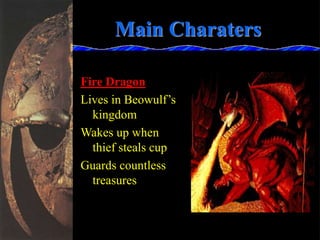
Fire Dragon
Lives in Beowulf’s
kingdom
Wakes up when
thief steals cup
Guards countless
treasures
Setting: Beowulf’s time and place
Europe Today Time of Beowulf
Thank you
for
Listening ☺

Beowulf Intro..pptx

  • 1.
  • 2.
    Introduction to Beowulf •Beowulf is one of the earliest poems written in any form of English. • Actually, this writer should be called an editor because the poem had a long oral tradition and finally came to rest as what we know as Beowulf. • The original poem didn’t have a title, modern editors gave the poem its name.
  • 3.
    More About theEditor • The “editor” was obviously well-read and conscious of his role as a poet. • This is a Christian writer balancing his faith with very Pagan themes. • We know that the editor is Christian because the only literate people of the time were those from the church.
  • 4.
    Review of OldEnglish History • The Celts originally inhabited Britain. • In the early 5th century, the Romans withdrew and left Britain vulnerable to Germanic invaders (Vikings).
  • 5.
    Old English History •The Britons had become Christians in the 4th century. • The 1st attempt to Christianize the heathen Germanic tribes occurred in 597 AD when Pope Gregory sent missionaries led by Saint Augustine to Kent.
  • 6.
    Review of OldEnglish History • Before Christianity, there were no books. The only formally educated people were clerics in the church. • The Anglo-Saxon invaders brought a tradition of oral poetry (some of which was later written down with a religious spin after the Christian conversion.
  • 7.
    Introduction to Beowulf •There is only one surviving Beowulf manuscript and it dates from late 10th century. • This manuscript was damaged in a fire in 1731 that destroyed many other medieval manuscripts.
  • 8.
    Original Beowulf Manuscript (Note the burnmarks on the top and sides)
  • 9.
    Introduction to Beowulf •Beowulf is recognized as a hallmark of English literature, yet its heroes and its setting are not English. • The poem is set in two places: the first half on a Danish island and the second half in Beowulf’s homeland (an island off the SE coast of Sweden).
  • 10.
    Introduction to Beowulf •Interesting Fact: J.R.R. Tolkein (The Lord of the Rings Trilogy) was a learned Beowulf scholar. He played a huge part in getting Beowulf accepted as classic literature
  • 11.
    Introduction to Beowulf •Beowulf is written in the epic tradition, meaning it is larger than life. • There is also liberal use of the supernatural. • The poem champions bravery, loyalty, and devotion to community.
  • 12.
    Introduction to Beowulf •The poem portrays a strong sense of fatalism (acceptance of death) • The warriors of the era accepted their mortality in a way that seems casual to modern readers. • The concept of fate was central to the world view of Anglo-Saxons.
  • 13.
    Beowulf Background • 30,000lines of Anglo-Saxon poetry survive today • 3, 182 (10%) of the lines are from Beowulf • Setting - Denmark and Sweden • Author - Unknown, probably a monk • Composed in the 7th or 8th century • Oldest surviving English poem
  • 14.
    An epic… • Isa long narrative poem form • Has a hero • Is the story of the hero’s travels and his fights with monsters, gods, and bad guys • An epic is in 3rd person • Was originally sung • Jumps right into the plot • Contains information about the culture that created them • Offers clues as to what the author might have feared, admired, or questioned. Beowulf The Epic
  • 15.
    The Epic Warrior •Has “Larger than life” qualities, • Is a natural lead of others • Is not emotionally connected to his followers. • Is appealing to the opposite sex, but is rarely in a committed relationship • Defeats monsters and or fights for Gods
  • 16.
    The Epic Warrior •Has“good” on his or her side •Is associated with strength and values •Often stands alone in battle •Is generally smarter than everyone else. A problem-solver •Has a fatal weakness •Is constantly on the move •Is a skilled fighter
  • 17.
    LITERARY ELEMENT – Conflict •The central struggle between two opposing forces in a story or drama -External -Internal
  • 18.
    External Conflict • Existswhen a character struggles against some outside force -EX: fight between two people
  • 19.
    Internal Conflict • Astruggle within the mind of a character.
  • 20.
    • Christianity • Darknessand gloom • Battle and death • Revenge • Envy • Reputation Recurring Themes
  • 21.
  • 22.
    Main Charaters Beowulf Epic hero Geat(from southern Sweden) Nephew of Higlac (King at story’s start) Sails to Denmark to help Hrothgar
  • 23.
    Main Charaters Hrothgar Danish king BuildsHerot (banquet hall) for men Tormented by Grendel for 12 years Loses many men to Grendel Joyless before Beowulf’s arrival
  • 24.
    Main Charaters Grendel Referred toas demon and fiend Haunts the moors (swampy land) Descendant of Cain Feasts on 30 men the night of 1st attack
  • 25.
    Main Charaters Grendel’s Mother Referredto as she-wolf Lives under the lake by Heorot Mead Hall Challenges Hrothgar when she kills one of his best men
  • 26.
    Main Charaters Fire Dragon Livesin Beowulf’s kingdom Wakes up when thief steals cup Guards countless treasures
  • 27.
    Setting: Beowulf’s timeand place Europe Today Time of Beowulf
  • 28.