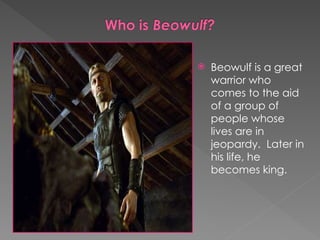
 Beowulf is a great
warrior who
comes to the aid
of a group of
people whose
lives are in
jeopardy. Later in
his life, he
becomes king.
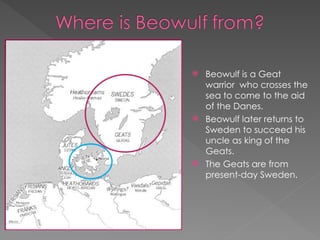
 Beowulf is a Geat
warrior who crosses the
sea to come to the aid
of the Danes.
 Beowulf later returns to
Sweden to succeed his
uncle as king of the
Geats.
 The Geats are from
present-day Sweden.
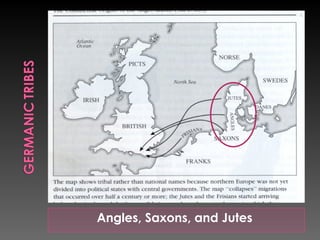
Angles, Saxons, and Jutes
 Beowulf is the first Masterpiece in English literature.
› Its author is unknown.
› Consists of 3182 alliterative long lines
› The original audience and purpose of the work is also
unknown.
 Beowulf is the longest and greatest surviving Anglo-Saxon
poem.
 Beowulf is the oldest surviving epic in English literature.
 An unknown bard composed it around the 7th or 8th
century, and probably recited it to the accompaniment of
harp music.
 The setting of the epic is the sixth century in what is now
known as Denmark and southwestern Sweden.
 By the tenth century, the words were first
written in Old English. This would be a foreign
language to us, although a few words are
familiar: scyld (shield), sweord (sword), Gode
(God) and strong.
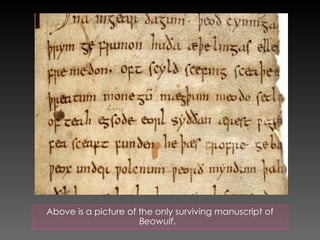
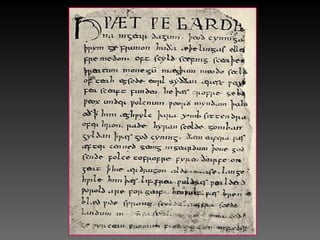
 Beowulf now exists in only one manuscript. This
copy survived a disastrous fire which destroyed
the library of Sir Robert Bruce Cotton (1571-
1631).
 The Beowulf manuscript is now housed in the
British Library, London.
 The world of warriors in Beowulf is based on
loyalty and bravery, and combines pagan
customs of revenge with Christian faith in the
will of God.
Above is a picture of the only surviving manuscript of
Beowulf.
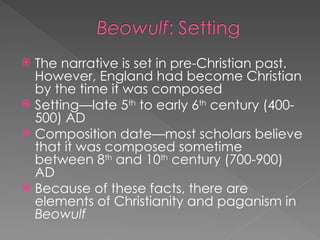
 The narrative is set in pre-Christian past.
However, England had become Christian
by the time it was composed
 Setting—late 5th
to early 6th
century (400-
500) AD
 Composition date—most scholars believe
that it was composed sometime
between 8th
and 10th
century (700-900)
AD
 Because of these facts, there are
elements of Christianity and paganism in
Beowulf
Literary Devices &
Critical Terms
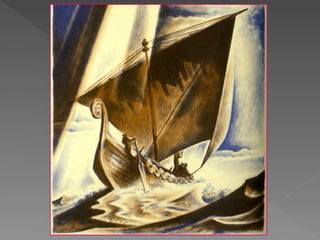
on the waves under the cliffs and the
warriors stood at the prow as the water
wound against the sand.
The warriors bore into the ship's
bosom bright weapons (4&5)
The Battle With Grendel:
"Toward that gold-shining hall. He had
visited Hrothgar's...."
When Wiglaf talks of the
hero: “I know for a truth that
the worth of his deeds is not
so poor” (2656-57).
When King Hrothgar is
describing Grendel’s mere,
he says: “Not a pleasant
place” (1372).
One simile occurs in line 218
when the poet tells us that
the ship went over the sea
"like a bird”
Weohstan is said to have
held the “mail-shirt and sword
till his son was ready to show
as much courage as his
graying father” (2621-22).
Wiglaf showed “strength and
daring, as was his nature”
(2696).
"Over all the world, or between the seas, /
Or under the heaven, no hero was
greater." (671-672).
This dazzles the listener with
Beowulf's bravery. His bravery is again
exaggerated when he jumps in the
swamp wearing heavy armor to fight and
kill Grendel's mother. It's
unlikely even a strong warrior could win a
battle with a she-monster in
an underwater cave with a broken sword.
But it adds to the excitement.
it was not only spoken, it was sung!
 The scops (pronounced “shopes”) were
both composers and storytellers who
traveled from court to court and village
to village. People would gather around
to hear the stories recited and chanted
and sung. Simply put, the scops were
entertainers.
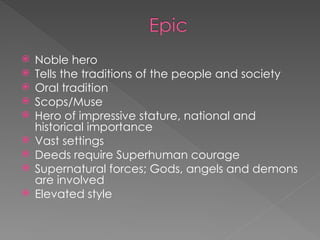
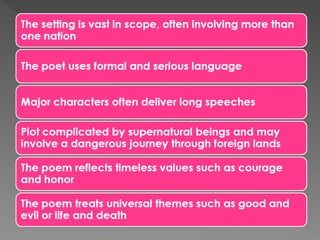
The Epic
 Noble hero
 Tells the traditions of the people and society
 Oral tradition
 Scops/Muse
 Hero of impressive stature, national and
historical importance
 Vast settings
 Deeds require Superhuman courage
 Supernatural forces; Gods, angels and demons
are involved
 Elevated style
Characteristics
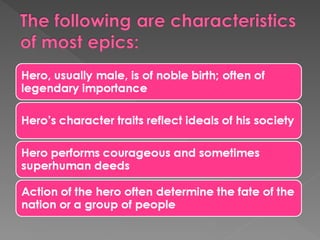
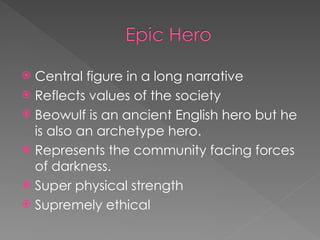
Epic Hero
 Central figure in a long narrative
 Reflects values of the society
 Beowulf is an ancient English hero but he
is also an archetype hero.
 Represents the community facing forces
of darkness.
 Super physical strength
 Supremely ethical
Pagan and Christian
elements
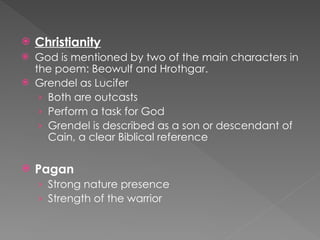
 Christianity
 God is mentioned by two of the main characters in
the poem: Beowulf and Hrothgar.
 Grendel as Lucifer
› Both are outcasts
› Perform a task for God
› Grendel is described as a son or descendant of
Cain, a clear Biblical reference
 Pagan
› Strong nature presence
› Strength of the warrior
 The poetry of Beowulf is densely
packed and full of sounds.
› The subject matter deals with heroic
adventures and some fairy –tale themes
(i.e. fire breathing dragons and big scary
monsters).
› It also deals with the nature of success and
friendship in Anglo Saxon times, as well as
the final value to be found in life and
death.
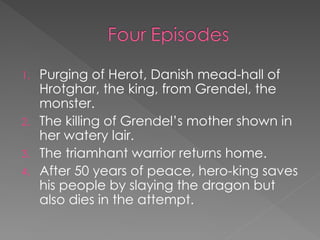
Four Episodes
1. Purging of Herot, Danish mead-hall of
Hrotghar, the king, from Grendel, the
monster.
2. The killing of Grendel’s mother shown in
her watery lair.
3. The triamhant warrior returns home.
4. After 50 years of peace, hero-king saves
his people by slaying the dragon but
also dies in the attempt.
 The poem opens with a brief genealogy of the
Scylding (Dane) royal dynasty, named after a
mythic hero, Scyld Scefing.
 Many years ago he came to them, the Danish
people. They found him on the beach in a
boat no bigger than a shield, a child without
clothing, surrounded by treasure.
 No one knew who had sent him across the sea,
but he lived and grew and gained respect until
they made him their King, and all the tribes
living nearby had to obey him.
 No enemy dared to attack , and he gave gifts
gladly to his followers. He was a good King.
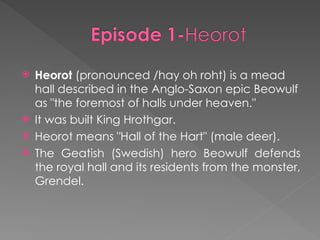
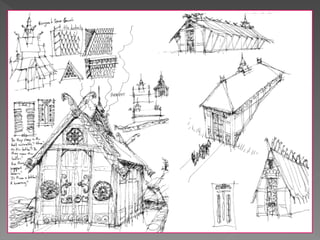
 Heorot (pronounced /hay oh roht) is a mead
hall described in the Anglo-Saxon epic Beowulf
as "the foremost of halls under heaven."
 It was built King Hrothgar.
 Heorot means "Hall of the Hart" (male deer).
 The Geatish (Swedish) hero Beowulf defends
the royal hall and its residents from the monster,
Grendel.
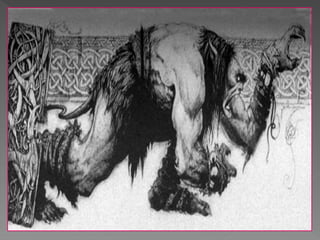
 For 12 years, a huge man-like ogre named
Grendel, a descendant of the biblical
murderer Cain, has menaced the aging
Hrothgar, raiding Heorot and killing the
king’s thanes (warriors).
 Grendel rules the mead-hall nightly.
 He is jealous of the marry making and joys
of the man as he is not a part of the society.
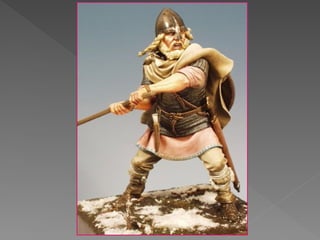
 Beowulf, a young warrior in Geatland
(southwestern Sweden), comes to the
Scyldings’ aid, bringing with him 14 of his
finest men.
 Hrothgar once sheltered Beowulf’s father
during a deadly feud, and the mighty Geat
hopes to return the favor while enhancing
his own reputation.
 At a feast before nightfall of the first day of the
visit, an obnoxious, drunken Scylding named
Unferth insults Beowulf and claims that the
Geat visitor once embarrassingly lost a
swimming contest to a boyhood acquaintance
named Breca and is no match for Grendel.
 Beowulf responds with dignity while putting
Unferth in his place.
 In fact, the two swimmers were separated by
a storm on the fifth night of the contest, and
Beowulf had slain nine sea monsters before
finally returning to shore.
 While the Danes retire to safer sleeping
quarters, Beowulf and the Geats bed down
in Heorot, fully aware that Grendel will visit
them.
 He does. Angered by the joy of the men in
the mead-hall, the ogre furiously bursts in on
the Geats, killing one and then reaching for
Beowulf.
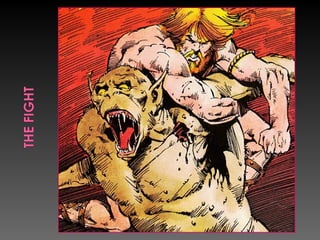
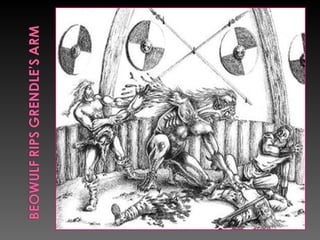
 With the strength of 30 men in his hand-
grip, Beowulf seizes the ogre’s claw and
does not let go.
 The ensuing battle nearly destroys the
great hall, but Beowulf emerges
victorious as he rips Grendel’s claw from
its shoulder socket, sending the mortally
wounded beast fleeing to his mere
(pool).
 The arm
trophy
hangs
high
under the
roof of
Heorot.
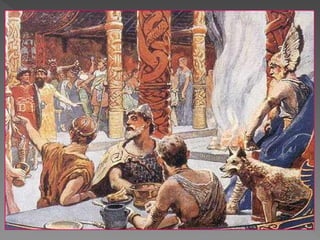
 The Danes celebrate the next day with a
huge feast featuring entertainment by
Hrothgar’s scop (pronounced “shop”), a
professional bard who accompanies
himself on a harp and sings or chants
traditional lays such as an account of
the Danes’ victory at Finnsburh.
 This bard also improvises a song about
Beowulf’s victory.
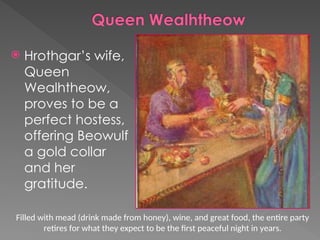
 Hrothgar’s wife,
Queen
Wealhtheow,
proves to be a
perfect hostess,
offering Beowulf
a gold collar
and her
gratitude.
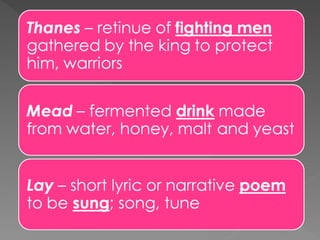
Filled with mead (drink made from honey), wine, and great food, the entire party
retires for what they expect to be the first peaceful night in years.
 But Grendel’s mother—not quite as
powerful as her son but highly motivated—
climbs to Heorot that night, retrieves her
son’s claw, and murderously abducts one
of the Scyldings (Aeschere) while Beowulf
sleeps elsewhere.
 The next morning, Hrothgar, Beowulf, and a
retinue of Scyldings and Geats follow the
mother’s tracks into a dark, forbidding
swamp and to the edge of her mere.
 The slaughtered Aeschere’s head sits on a
cliff by the lake, which hides the ogres’
underground cave.
 Near the bottom of the lake, Grendel’s
mother attacks and hauls the Geat warrior
to her dimly lit cave.
 Beowulf fights back once inside the dry
cavern, but the gift sword, Hrunting, strong
as it is, fails to penetrate the ogre’s hide.
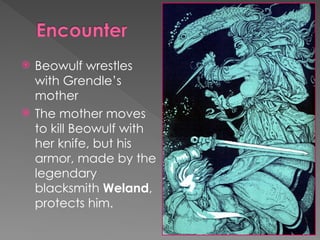
 Beowulf wrestles
with Grendle’s
mother
 The mother moves
to kill Beowulf with
her knife, but his
armor, made by the
legendary
blacksmith Weland,
protects him.
 Suddenly Beowulf spots a magical, giant
sword and uses it to cut through the
mother’s spine at the neck, killing her.
 A blessed light unexplainably illuminates
the cavern, disclosing Grendel’s corpse
and a great deal of treasure. Beowulf
decapitates the corpse.
 The magic sword melts to its hilt. Beowulf
returns to the lake’s surface carrying the
head and hilt but leaving the treasure.
 After more celebration and gifts and a sermon
by Hrothgar warning of the dangers of pride
and the mutability of time, Beowulf and his
men return to Geatland.
 There he serves his king well until Hygelac is
killed in battle and his son dies in a feud.
 Beowulf is then named king and rules
successfully for 50 years.
 Like Hrothgar, however, his peace is shattered
in his declining years. Beowulf must battle one
more demon.
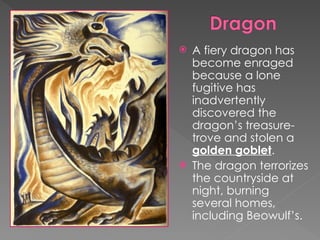
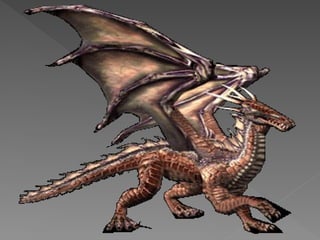
 A fiery dragon has
become enraged
because a lone
fugitive has
inadvertently
discovered the
dragon’s treasure-
trove and stolen a
golden goblet.
 The dragon terrorizes
the countryside at
night, burning
several homes,
including Beowulf’s.
 Led by the fugitive, Beowulf and eleven of
his men seek out the dragon’s barrow.
 Beowulf insists on taking on the dragon
alone, but his own sword, Naegling, is no
match for the monster.
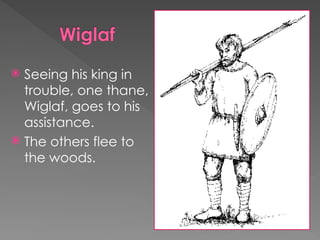
 Seeing his king in
trouble, one thane,
Wiglaf, goes to his
assistance.
 The others flee to
the woods.
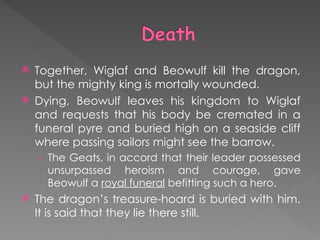
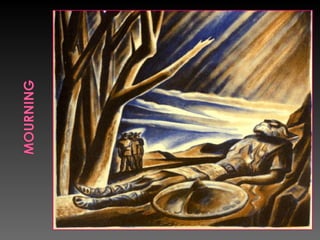
 Together, Wiglaf and Beowulf kill the dragon,
but the mighty king is mortally wounded.
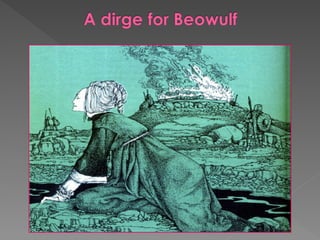
 Dying, Beowulf leaves his kingdom to Wiglaf
and requests that his body be cremated in a
funeral pyre and buried high on a seaside cliff
where passing sailors might see the barrow.
› The Geats, in accord that their leader possessed
unsurpassed heroism and courage, gave
Beowulf a royal funeral befitting such a hero.
 The dragon’s treasure-hoard is buried with him.
It is said that they lie there still.
 Literary Term
› Foreshadowing – The technique of giving hints
or clues of what is to come. This device helps
to create suspense, as readers are eager to
see if the inferences they draw are correct. It
also sets the stage for future events to be told
in the story. It may be specific (ex. “Everyone
knew some tragedy would befall them. . . “);
or may involve only vague hints expressed
through setting or other description (ex. “Silent,
lonely and sublime, the castle seemed to
stand sovereign over the scene and to frown
in defiance on all who dared to invade its
solitary reign…”)
beowulfreport-copy-130925014853-phpapp01.ppt

beowulfreport-copy-130925014853-phpapp01.ppt

  • 2.
     Beowulf isa great warrior who comes to the aid of a group of people whose lives are in jeopardy. Later in his life, he becomes king.
  • 3.
     Beowulf isa Geat warrior who crosses the sea to come to the aid of the Danes.  Beowulf later returns to Sweden to succeed his uncle as king of the Geats.  The Geats are from present-day Sweden.
  • 4.
  • 5.
     Beowulf isthe first Masterpiece in English literature. › Its author is unknown. › Consists of 3182 alliterative long lines › The original audience and purpose of the work is also unknown.  Beowulf is the longest and greatest surviving Anglo-Saxon poem.  Beowulf is the oldest surviving epic in English literature.  An unknown bard composed it around the 7th or 8th century, and probably recited it to the accompaniment of harp music.  The setting of the epic is the sixth century in what is now known as Denmark and southwestern Sweden.
  • 6.
     By thetenth century, the words were first written in Old English. This would be a foreign language to us, although a few words are familiar: scyld (shield), sweord (sword), Gode (God) and strong.  Beowulf now exists in only one manuscript. This copy survived a disastrous fire which destroyed the library of Sir Robert Bruce Cotton (1571- 1631).  The Beowulf manuscript is now housed in the British Library, London.  The world of warriors in Beowulf is based on loyalty and bravery, and combines pagan customs of revenge with Christian faith in the will of God.
  • 7.
    Above is apicture of the only surviving manuscript of Beowulf.
  • 9.
     The narrativeis set in pre-Christian past. However, England had become Christian by the time it was composed  Setting—late 5th to early 6th century (400- 500) AD  Composition date—most scholars believe that it was composed sometime between 8th and 10th century (700-900) AD  Because of these facts, there are elements of Christianity and paganism in Beowulf
  • 10.
  • 11.
    on the wavesunder the cliffs and the warriors stood at the prow as the water wound against the sand. The warriors bore into the ship's bosom bright weapons (4&5) The Battle With Grendel: "Toward that gold-shining hall. He had visited Hrothgar's...."
  • 12.
    When Wiglaf talksof the hero: “I know for a truth that the worth of his deeds is not so poor” (2656-57). When King Hrothgar is describing Grendel’s mere, he says: “Not a pleasant place” (1372). One simile occurs in line 218 when the poet tells us that the ship went over the sea "like a bird” Weohstan is said to have held the “mail-shirt and sword till his son was ready to show as much courage as his graying father” (2621-22). Wiglaf showed “strength and daring, as was his nature” (2696). "Over all the world, or between the seas, / Or under the heaven, no hero was greater." (671-672). This dazzles the listener with Beowulf's bravery. His bravery is again exaggerated when he jumps in the swamp wearing heavy armor to fight and kill Grendel's mother. It's unlikely even a strong warrior could win a battle with a she-monster in an underwater cave with a broken sword. But it adds to the excitement.
  • 16.
    it was notonly spoken, it was sung!
  • 17.
     The scops(pronounced “shopes”) were both composers and storytellers who traveled from court to court and village to village. People would gather around to hear the stories recited and chanted and sung. Simply put, the scops were entertainers.
  • 18.
  • 19.
     Noble hero Tells the traditions of the people and society  Oral tradition  Scops/Muse  Hero of impressive stature, national and historical importance  Vast settings  Deeds require Superhuman courage  Supernatural forces; Gods, angels and demons are involved  Elevated style
  • 20.
  • 23.
  • 24.
     Central figurein a long narrative  Reflects values of the society  Beowulf is an ancient English hero but he is also an archetype hero.  Represents the community facing forces of darkness.  Super physical strength  Supremely ethical
  • 25.
  • 26.
     Christianity  Godis mentioned by two of the main characters in the poem: Beowulf and Hrothgar.  Grendel as Lucifer › Both are outcasts › Perform a task for God › Grendel is described as a son or descendant of Cain, a clear Biblical reference  Pagan › Strong nature presence › Strength of the warrior
  • 27.
     The poetryof Beowulf is densely packed and full of sounds. › The subject matter deals with heroic adventures and some fairy –tale themes (i.e. fire breathing dragons and big scary monsters). › It also deals with the nature of success and friendship in Anglo Saxon times, as well as the final value to be found in life and death.
  • 28.
  • 29.
    1. Purging ofHerot, Danish mead-hall of Hrotghar, the king, from Grendel, the monster. 2. The killing of Grendel’s mother shown in her watery lair. 3. The triamhant warrior returns home. 4. After 50 years of peace, hero-king saves his people by slaying the dragon but also dies in the attempt.
  • 30.
     The poemopens with a brief genealogy of the Scylding (Dane) royal dynasty, named after a mythic hero, Scyld Scefing.  Many years ago he came to them, the Danish people. They found him on the beach in a boat no bigger than a shield, a child without clothing, surrounded by treasure.  No one knew who had sent him across the sea, but he lived and grew and gained respect until they made him their King, and all the tribes living nearby had to obey him.  No enemy dared to attack , and he gave gifts gladly to his followers. He was a good King.
  • 31.
     Heorot (pronounced/hay oh roht) is a mead hall described in the Anglo-Saxon epic Beowulf as "the foremost of halls under heaven."  It was built King Hrothgar.  Heorot means "Hall of the Hart" (male deer).  The Geatish (Swedish) hero Beowulf defends the royal hall and its residents from the monster, Grendel.
  • 34.
     For 12years, a huge man-like ogre named Grendel, a descendant of the biblical murderer Cain, has menaced the aging Hrothgar, raiding Heorot and killing the king’s thanes (warriors).  Grendel rules the mead-hall nightly.  He is jealous of the marry making and joys of the man as he is not a part of the society.
  • 36.
     Beowulf, ayoung warrior in Geatland (southwestern Sweden), comes to the Scyldings’ aid, bringing with him 14 of his finest men.  Hrothgar once sheltered Beowulf’s father during a deadly feud, and the mighty Geat hopes to return the favor while enhancing his own reputation.
  • 38.
     At afeast before nightfall of the first day of the visit, an obnoxious, drunken Scylding named Unferth insults Beowulf and claims that the Geat visitor once embarrassingly lost a swimming contest to a boyhood acquaintance named Breca and is no match for Grendel.  Beowulf responds with dignity while putting Unferth in his place.  In fact, the two swimmers were separated by a storm on the fifth night of the contest, and Beowulf had slain nine sea monsters before finally returning to shore.
  • 40.
     While theDanes retire to safer sleeping quarters, Beowulf and the Geats bed down in Heorot, fully aware that Grendel will visit them.  He does. Angered by the joy of the men in the mead-hall, the ogre furiously bursts in on the Geats, killing one and then reaching for Beowulf.
  • 42.
     With thestrength of 30 men in his hand- grip, Beowulf seizes the ogre’s claw and does not let go.  The ensuing battle nearly destroys the great hall, but Beowulf emerges victorious as he rips Grendel’s claw from its shoulder socket, sending the mortally wounded beast fleeing to his mere (pool).
  • 44.
  • 45.
     The Danescelebrate the next day with a huge feast featuring entertainment by Hrothgar’s scop (pronounced “shop”), a professional bard who accompanies himself on a harp and sings or chants traditional lays such as an account of the Danes’ victory at Finnsburh.  This bard also improvises a song about Beowulf’s victory.
  • 46.
     Hrothgar’s wife, Queen Wealhtheow, provesto be a perfect hostess, offering Beowulf a gold collar and her gratitude. Filled with mead (drink made from honey), wine, and great food, the entire party retires for what they expect to be the first peaceful night in years.
  • 47.
     But Grendel’smother—not quite as powerful as her son but highly motivated— climbs to Heorot that night, retrieves her son’s claw, and murderously abducts one of the Scyldings (Aeschere) while Beowulf sleeps elsewhere.  The next morning, Hrothgar, Beowulf, and a retinue of Scyldings and Geats follow the mother’s tracks into a dark, forbidding swamp and to the edge of her mere.
  • 48.
     The slaughteredAeschere’s head sits on a cliff by the lake, which hides the ogres’ underground cave.  Near the bottom of the lake, Grendel’s mother attacks and hauls the Geat warrior to her dimly lit cave.  Beowulf fights back once inside the dry cavern, but the gift sword, Hrunting, strong as it is, fails to penetrate the ogre’s hide.
  • 49.
     Beowulf wrestles withGrendle’s mother  The mother moves to kill Beowulf with her knife, but his armor, made by the legendary blacksmith Weland, protects him.
  • 50.
     Suddenly Beowulfspots a magical, giant sword and uses it to cut through the mother’s spine at the neck, killing her.  A blessed light unexplainably illuminates the cavern, disclosing Grendel’s corpse and a great deal of treasure. Beowulf decapitates the corpse.  The magic sword melts to its hilt. Beowulf returns to the lake’s surface carrying the head and hilt but leaving the treasure.
  • 51.
     After morecelebration and gifts and a sermon by Hrothgar warning of the dangers of pride and the mutability of time, Beowulf and his men return to Geatland.  There he serves his king well until Hygelac is killed in battle and his son dies in a feud.  Beowulf is then named king and rules successfully for 50 years.  Like Hrothgar, however, his peace is shattered in his declining years. Beowulf must battle one more demon.
  • 52.
     A fierydragon has become enraged because a lone fugitive has inadvertently discovered the dragon’s treasure- trove and stolen a golden goblet.  The dragon terrorizes the countryside at night, burning several homes, including Beowulf’s.
  • 54.
     Led bythe fugitive, Beowulf and eleven of his men seek out the dragon’s barrow.  Beowulf insists on taking on the dragon alone, but his own sword, Naegling, is no match for the monster.
  • 56.
     Seeing hisking in trouble, one thane, Wiglaf, goes to his assistance.  The others flee to the woods.
  • 58.
     Together, Wiglafand Beowulf kill the dragon, but the mighty king is mortally wounded.  Dying, Beowulf leaves his kingdom to Wiglaf and requests that his body be cremated in a funeral pyre and buried high on a seaside cliff where passing sailors might see the barrow. › The Geats, in accord that their leader possessed unsurpassed heroism and courage, gave Beowulf a royal funeral befitting such a hero.  The dragon’s treasure-hoard is buried with him. It is said that they lie there still.
  • 62.
     Literary Term ›Foreshadowing – The technique of giving hints or clues of what is to come. This device helps to create suspense, as readers are eager to see if the inferences they draw are correct. It also sets the stage for future events to be told in the story. It may be specific (ex. “Everyone knew some tragedy would befall them. . . “); or may involve only vague hints expressed through setting or other description (ex. “Silent, lonely and sublime, the castle seemed to stand sovereign over the scene and to frown in defiance on all who dared to invade its solitary reign…”)