“If it's too loud, you're too old!” — Barrythemod
The Major Influences in Music
• Many African American migrated to the north because they
wanted to escape oppression from the south this was known as the
Great Migration. From this migration came the music styles of
Blues.
• The migration led to the rise of the African Americans middle
class.
• This began after world war I when many African American where
coming back from the world looking for jobs.
• Another reason for their migration was because the northern
economy was better than the south. The industrial jobs were
numerous, and factory owners looked for sources of cheap labor.
• Blues is a style of music that evolved from southern African-
American secular songs and is usually distinguished by a strong
4/4 rhythm, flatted thirds and sevenths, a 12-bar structure, and
lyrics in a three-line stanza in which the second line repeats the
first:.
Major Performers & Contributions
• Billie Holiday (Lady Day) (1915-1959) was a social
phenomenon, started her career as a teen and at 18 began to
produce original music. She was one of the first black women
to work with a white orchestra. She pioneered a new way of
manipulating phrasing and tempo.
• Louis Armstrong (1901-1971) was the most famous during the
Harlem Renaissance era, played all around New Orleans. Moved
to Chicago to grow and develop in his band Creole Jazz Band,
two years later moved to New York and played with Fletcher
Henderson Orchestra, played all round the city including
Broadway. He used a pop song and interpreted it through jazz.
Setting the stage for acceptance of jazz music in the future.
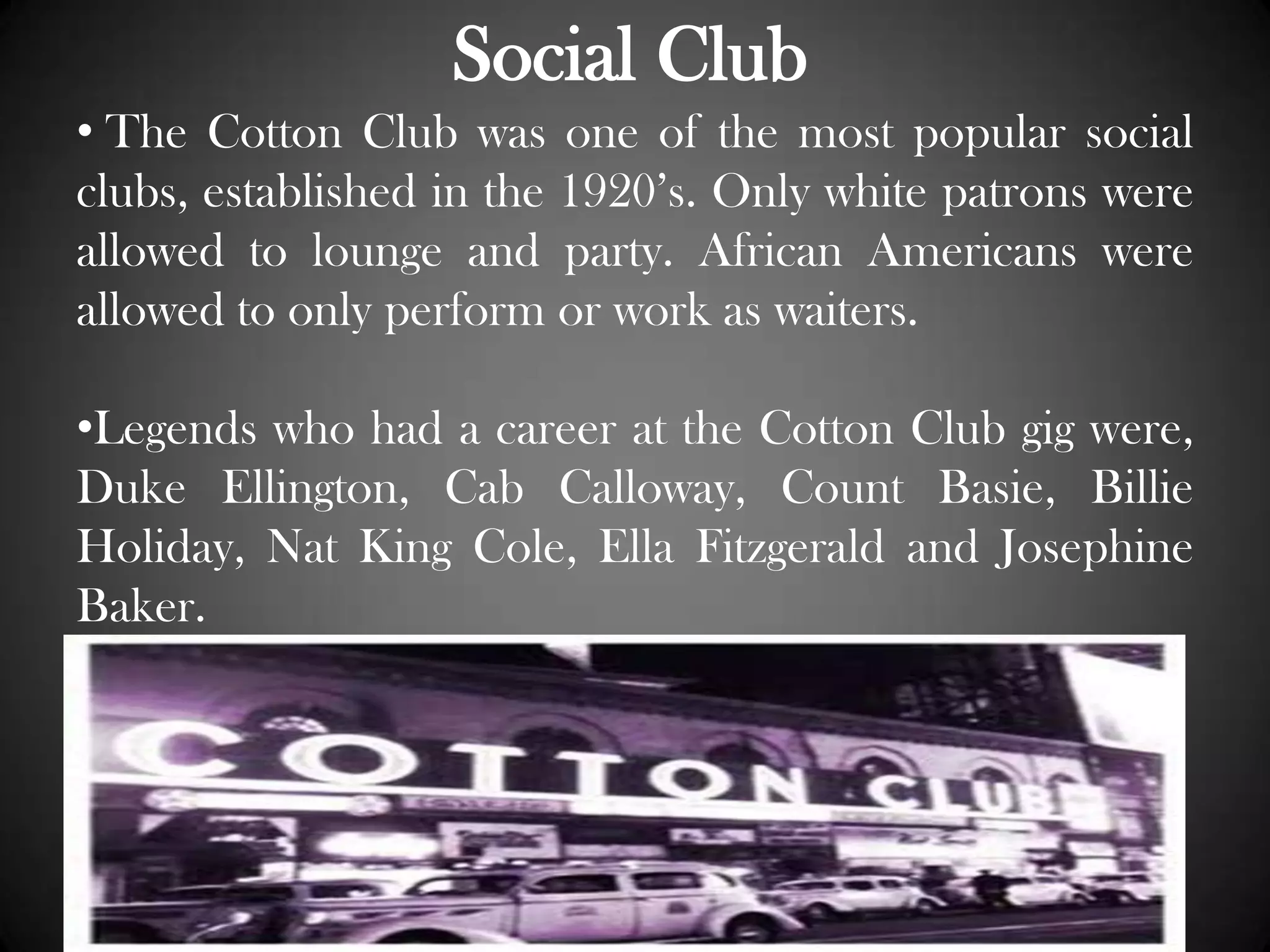
• The Cotton Club was one of the most popular social
clubs, established in the 1920’s. Only white patrons were
allowed to lounge and party. African Americans were
allowed to only perform or work as waiters.
•Legends who had a career at the Cotton Club gig were,
Duke Ellington, Cab Calloway, Count Basie, Billie
Holiday, Nat King Cole, Ella Fitzgerald and Josephine
Baker.
Social Club
Rent Party
• Rent parties were social occasions where tenants
hired a musician or band to play. They then would
pass a hat around the room, to raise money to pay
for their rent, while also having a good time.
• Musicians associated with these rent parties, where
Speckled Red, James P. Johnson, Willie "the Lion"
Smith, and Fats Waller.
• Mainly played music styles of jazz, blues
and folk. Dance was the Charleston.
• Happened after midnight in houses.
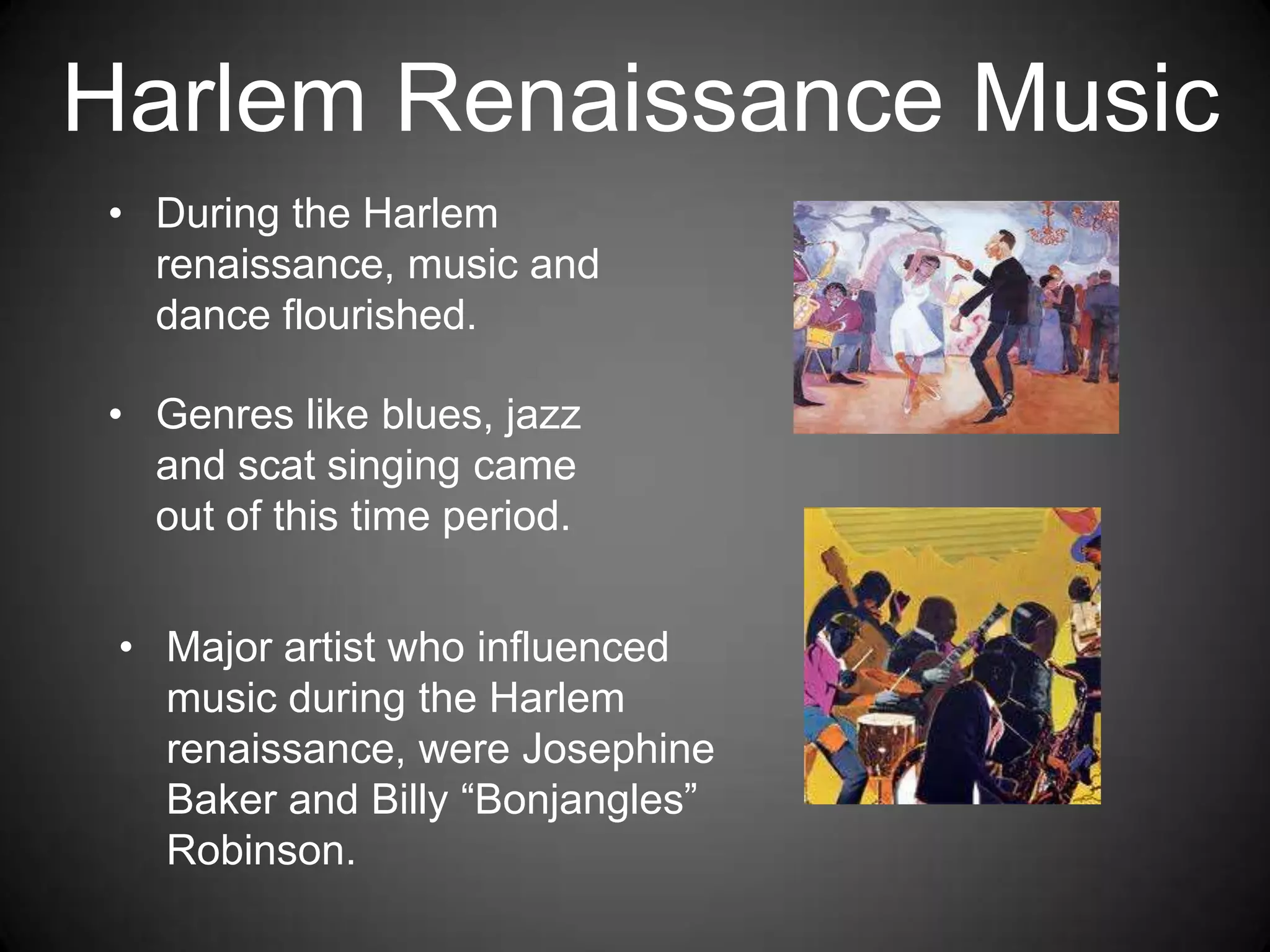
• During the Harlem
renaissance, music and
dance flourished.
• Genres like blues, jazz
and scat singing came
out of this time period.
Harlem Renaissance Music
• Major artist who influenced
music during the Harlem
renaissance, were Josephine
Baker and Billy “Bonjangles”
Robinson.
Harlem Renaissance Music influence in
American society
• The United States was changed by
many different cultural influences.
It was shown by various behavior
changes, the way people thought,
and in how they perceived life.
• Whites thought that African
Americans were incapable of
producing music, but through the
music styles of Louis Armstrong
and other African Americans, their
views changed. This gave the
African Americans more respect
and opportunities during this era.
References
• Ercina Garcia, Erica Messmer, Caryn Monta, and Kristina Odumes “Harlem
Entertainment”. afamstud.intrasun.tcnj.edu n.d. Web. 20nd February 2013
• “The Harlem Renaissance”. ushistory.org n.d. Web. 21st February 2013
• “Importance of Music, Art, and Dance”. Elements of the Movements.
home.wlu.edu n.d. Web. 22th February 2013
• “Harlem Renaissance”. BIO Classroom. n.d. biography.com Web. 20th
February 2013
• “Harlem Art”. Harlem World. harlemworldmag.com est. 2003. Web. 19th
February 2013
• “The Great Migration and North Carolina”. NCPEDIA. ncpedia.org Spring
2006. Web. 22nd February 2013
• Sarah E. Johnson “The Artists' Influences”. Why Literature Changed
During The Harlem Renaissance. education.ed.pacificu.edu 23rd
October 2002. Web. 18th February 2013
• Irving Arts Center “An Introduction to The Harlem Renaissnace”
irvingartscenter.com 2009-2010. Web. 20th February 2013
• Tod Olon “Harlem Renaissasnce: Aftermidnight” scholastics.com/harlem-
renaissance-after-midnight n.d. Web. 21st February 2013
“A real leader faces the music, even if he doesn't
like the tune."— Anon
By: Yaridis Rodriguez, Anggie Luna,
Katherine Luna, Edwin Torres

Harlem Renaissance Music CP

  • 1.
    “If it's tooloud, you're too old!” — Barrythemod
  • 2.
    The Major Influencesin Music • Many African American migrated to the north because they wanted to escape oppression from the south this was known as the Great Migration. From this migration came the music styles of Blues. • The migration led to the rise of the African Americans middle class. • This began after world war I when many African American where coming back from the world looking for jobs. • Another reason for their migration was because the northern economy was better than the south. The industrial jobs were numerous, and factory owners looked for sources of cheap labor. • Blues is a style of music that evolved from southern African- American secular songs and is usually distinguished by a strong 4/4 rhythm, flatted thirds and sevenths, a 12-bar structure, and lyrics in a three-line stanza in which the second line repeats the first:.
  • 3.
    Major Performers &Contributions • Billie Holiday (Lady Day) (1915-1959) was a social phenomenon, started her career as a teen and at 18 began to produce original music. She was one of the first black women to work with a white orchestra. She pioneered a new way of manipulating phrasing and tempo. • Louis Armstrong (1901-1971) was the most famous during the Harlem Renaissance era, played all around New Orleans. Moved to Chicago to grow and develop in his band Creole Jazz Band, two years later moved to New York and played with Fletcher Henderson Orchestra, played all round the city including Broadway. He used a pop song and interpreted it through jazz. Setting the stage for acceptance of jazz music in the future.
  • 4.
    • The CottonClub was one of the most popular social clubs, established in the 1920’s. Only white patrons were allowed to lounge and party. African Americans were allowed to only perform or work as waiters. •Legends who had a career at the Cotton Club gig were, Duke Ellington, Cab Calloway, Count Basie, Billie Holiday, Nat King Cole, Ella Fitzgerald and Josephine Baker. Social Club
  • 5.
    Rent Party • Rentparties were social occasions where tenants hired a musician or band to play. They then would pass a hat around the room, to raise money to pay for their rent, while also having a good time. • Musicians associated with these rent parties, where Speckled Red, James P. Johnson, Willie "the Lion" Smith, and Fats Waller. • Mainly played music styles of jazz, blues and folk. Dance was the Charleston. • Happened after midnight in houses.
  • 6.
    • During theHarlem renaissance, music and dance flourished. • Genres like blues, jazz and scat singing came out of this time period. Harlem Renaissance Music • Major artist who influenced music during the Harlem renaissance, were Josephine Baker and Billy “Bonjangles” Robinson.
  • 7.
    Harlem Renaissance Musicinfluence in American society • The United States was changed by many different cultural influences. It was shown by various behavior changes, the way people thought, and in how they perceived life. • Whites thought that African Americans were incapable of producing music, but through the music styles of Louis Armstrong and other African Americans, their views changed. This gave the African Americans more respect and opportunities during this era.
  • 8.
    References • Ercina Garcia,Erica Messmer, Caryn Monta, and Kristina Odumes “Harlem Entertainment”. afamstud.intrasun.tcnj.edu n.d. Web. 20nd February 2013 • “The Harlem Renaissance”. ushistory.org n.d. Web. 21st February 2013 • “Importance of Music, Art, and Dance”. Elements of the Movements. home.wlu.edu n.d. Web. 22th February 2013 • “Harlem Renaissance”. BIO Classroom. n.d. biography.com Web. 20th February 2013 • “Harlem Art”. Harlem World. harlemworldmag.com est. 2003. Web. 19th February 2013 • “The Great Migration and North Carolina”. NCPEDIA. ncpedia.org Spring 2006. Web. 22nd February 2013 • Sarah E. Johnson “The Artists' Influences”. Why Literature Changed During The Harlem Renaissance. education.ed.pacificu.edu 23rd October 2002. Web. 18th February 2013 • Irving Arts Center “An Introduction to The Harlem Renaissnace” irvingartscenter.com 2009-2010. Web. 20th February 2013 • Tod Olon “Harlem Renaissasnce: Aftermidnight” scholastics.com/harlem- renaissance-after-midnight n.d. Web. 21st February 2013
  • 9.
    “A real leaderfaces the music, even if he doesn't like the tune."— Anon By: Yaridis Rodriguez, Anggie Luna, Katherine Luna, Edwin Torres