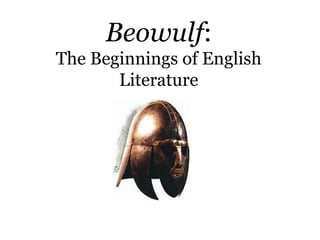
Beowulf:
The Beginnings of English
       Literature
Origins
Unknown author;
possibly one Christian
author in Anglo-
Saxon England
Unknown date of
composition (roughly
8th-11th Century CE)
Literary Devices
 Allusion: Biblical, Germanic oral tradition,
  Norse myth and legend, historical Anglo-
  Saxon kings (eg. King Offa of Mercia)
 Alliteration (eg. Scyld’s strong son)
 Epic poetry: a long narrative poem written
  in elevated style which celebrates the deeds
  of a legendary hero or god.
 Kenning: two-word metaphorical name for
  something (eg. whale-road=sea)
 Scop: Anglo-Saxon composers and
  storytellers (like minstrels or bards)
Warrior Code
 Comitatus: Germanic code of loyalty
 Thane: warrior – swears loyalty to the king
  for whom they fought and whom they
  protected
 Kings: generous, protected thanes
 Reputation: thanes were expected to be
  loyal, brave, courageous; kings were
  expected to be generous and hospitable
 Wergild: “man-payment”; a fee paid to the
  family of a slain man to atone for his
  murder and to prevent the family from
  seeking revenge.
Geats and Danes
 Beowulf was a war
  leader of the Geats,
  a group of people in
  what is now
  southern Sweden
 Hrothgar was king
  of the Danes
Old English

 Beowulf was written in Old English, an early
  form of English
 Old English was spoken in the Middle Ages from
  about 6th century to 11th century CE
 In 1066, William the Conqueror successfully
  invaded England, bringing his Norman French
  language with him; the nobility began to speak
  French, and gradually Old English evolved into
  Middle English (1100-1500): “Whan that Aprill,
  with his shoures soote/The droghte of March
  hath perced to the roote”
 Modern English has been spoken since the
  Renaissance – Shakespeare is NOT Old English;
  he is Early Modern English
Elements of an Epic
1. Epic hero– an character with a trait or
   characteristic that is valued by his society.
   •   (E.g.– Superman’s bravery or valor)
2. Quest– A journey through which the character
   or the reader learns something
3. Valorous Deeds– Doing something bravely.
4. Divine Intervention– The hand of God (or
   gods) help the hero, proving his value.
5. Great events– The hero has a hand in
   something important in the history or
   mythology of a culture.
2 Types of Epics
1. Folk
  –   Told out loud first (usually by scops)
  –   Unknown author
  –   Unknown dates
  –   (E.g.—Beowulf is a folk epic because we don’t know
      who wrote it)
2. Literary
  –   Known author
  –   (E.g.– Paradise Lost, by John Milton is a literary
      epic because we know who wrote it.)
3 Epic Conventions
1. Invoke a muse
    – Muse– inspiration provided by the gods
2. Plot begins in medias res
    – In medias red– “In the middle of” the action
3. Serious tone

•   Not necessary to have all on these, but
    need most at least
Possible OER
• Evaluate a story you’ve read or seen as an epic
  story.
  – O! Brother, Where Art Thou?
     • Epic hero– Ulysses Everett McGill
     • Quest– To seek the treasure
     • Valorous deeds– Singing the song, escaping the sheriff,
       saving Tommy from the KKK, et al.
     • Divine intervention– the flood
     • Great events– Helping elect Pappy O’Daniel as governor of
       Mississippi instead of the KKK head dragon
     • Literary epic– Cohen brothers wrote it in 2001
     • Invokes a muse at the beginning
     • Begins in the middle of the story as they escape jail
     • Serious tone? Notsomuch.
Beowulf’s Name
• Beowulf’s father– Edgetho
   – In most cases, the son is named after the father
       •   Don
       •   Donald (son of Don)
       •   McDonald (son of son of Don)
       •   McDonaldson (son of son of son of Don)
• Proves Beowulf is own individual with own powers and
  abilities (and more important than his father)
• Beo– Bear
   – Bears are known as Great Protectors in Norse mythology
   – Strong
• Wulf– Wolf
   – Wolves are also great protectors, but are also cunning and
     speedy
Characters
• Beowulf
  – The protagonist of the
    epic
  – His boasts and
    encounters reveal him
    to be the strongest,
    ablest warrior of the
    era.
  – In his youth, he
    personifies all of the
    best values of the
    heroic culture. In his
    old age, he proves a
    wise and effective ruler.
Characters
    • King Hrothgar
      – King of the Danes.
        Hrothgar enjoys military
        success and prosperity
        until Grendel terrorizes his
        realm.
      – He is a father figure to
        Beowulf and a model for
        the kind of king that
        Beowulf becomes.
Characters
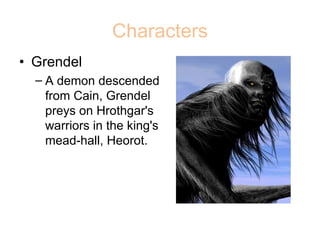
• Grendel
  – A demon descended
    from Cain, Grendel
    preys on Hrothgar's
    warriors in the king's
    mead-hall, Heorot.
Characters
   • Grendel’s Mother
     – An unnamed swamp-
       hag, Grendel's
       mother has fewer
       human qualities than
       Grendel, but her
       terrorization of Heorot
       is because of revenge
       —a human
       motivation.
Characters
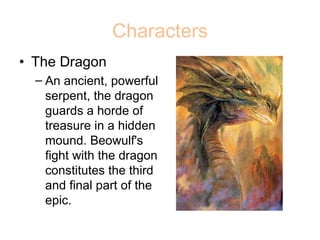
• The Dragon
  – An ancient, powerful
    serpent, the dragon
    guards a horde of
    treasure in a hidden
    mound. Beowulf's
    fight with the dragon
    constitutes the third
    and final part of the
    epic.
Characters
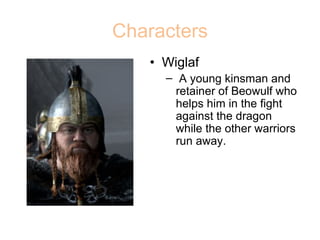
   • Wiglaf
     – A young kinsman and
       retainer of Beowulf who
       helps him in the fight
       against the dragon
       while the other warriors
       run away.
Characters
• Halfdane
  – The father of Hrothgar, Heorogar, Halga, and an
    unnamed daughter who married a king of the
    Swedes, Halfdane succeeded Beow as ruler of the
    Danes
• Wealhtheow
  – Hrothgar's wife, the gracious Queen of the Danes.
• Unferth
  – A Danish warrior who is jealous of Beowulf, Unferth
    is unable or unwilling to fight Grendel, thus proving
    himself inferior to Beowulf.

Beowulf 1

  • 1.
    Beowulf: The Beginnings ofEnglish Literature
  • 2.
    Origins Unknown author; possibly oneChristian author in Anglo- Saxon England Unknown date of composition (roughly 8th-11th Century CE)
  • 3.
    Literary Devices  Allusion:Biblical, Germanic oral tradition, Norse myth and legend, historical Anglo- Saxon kings (eg. King Offa of Mercia)  Alliteration (eg. Scyld’s strong son)  Epic poetry: a long narrative poem written in elevated style which celebrates the deeds of a legendary hero or god.  Kenning: two-word metaphorical name for something (eg. whale-road=sea)  Scop: Anglo-Saxon composers and storytellers (like minstrels or bards)
  • 4.
    Warrior Code  Comitatus:Germanic code of loyalty  Thane: warrior – swears loyalty to the king for whom they fought and whom they protected  Kings: generous, protected thanes  Reputation: thanes were expected to be loyal, brave, courageous; kings were expected to be generous and hospitable  Wergild: “man-payment”; a fee paid to the family of a slain man to atone for his murder and to prevent the family from seeking revenge.
  • 5.
    Geats and Danes Beowulf was a war leader of the Geats, a group of people in what is now southern Sweden  Hrothgar was king of the Danes
  • 6.
    Old English  Beowulfwas written in Old English, an early form of English  Old English was spoken in the Middle Ages from about 6th century to 11th century CE  In 1066, William the Conqueror successfully invaded England, bringing his Norman French language with him; the nobility began to speak French, and gradually Old English evolved into Middle English (1100-1500): “Whan that Aprill, with his shoures soote/The droghte of March hath perced to the roote”  Modern English has been spoken since the Renaissance – Shakespeare is NOT Old English; he is Early Modern English
  • 8.
    Elements of anEpic 1. Epic hero– an character with a trait or characteristic that is valued by his society. • (E.g.– Superman’s bravery or valor) 2. Quest– A journey through which the character or the reader learns something 3. Valorous Deeds– Doing something bravely. 4. Divine Intervention– The hand of God (or gods) help the hero, proving his value. 5. Great events– The hero has a hand in something important in the history or mythology of a culture.
  • 9.
    2 Types ofEpics 1. Folk – Told out loud first (usually by scops) – Unknown author – Unknown dates – (E.g.—Beowulf is a folk epic because we don’t know who wrote it) 2. Literary – Known author – (E.g.– Paradise Lost, by John Milton is a literary epic because we know who wrote it.)
  • 10.
    3 Epic Conventions 1.Invoke a muse – Muse– inspiration provided by the gods 2. Plot begins in medias res – In medias red– “In the middle of” the action 3. Serious tone • Not necessary to have all on these, but need most at least
  • 11.
    Possible OER • Evaluatea story you’ve read or seen as an epic story. – O! Brother, Where Art Thou? • Epic hero– Ulysses Everett McGill • Quest– To seek the treasure • Valorous deeds– Singing the song, escaping the sheriff, saving Tommy from the KKK, et al. • Divine intervention– the flood • Great events– Helping elect Pappy O’Daniel as governor of Mississippi instead of the KKK head dragon • Literary epic– Cohen brothers wrote it in 2001 • Invokes a muse at the beginning • Begins in the middle of the story as they escape jail • Serious tone? Notsomuch.
  • 12.
    Beowulf’s Name • Beowulf’sfather– Edgetho – In most cases, the son is named after the father • Don • Donald (son of Don) • McDonald (son of son of Don) • McDonaldson (son of son of son of Don) • Proves Beowulf is own individual with own powers and abilities (and more important than his father) • Beo– Bear – Bears are known as Great Protectors in Norse mythology – Strong • Wulf– Wolf – Wolves are also great protectors, but are also cunning and speedy
  • 13.
    Characters • Beowulf – The protagonist of the epic – His boasts and encounters reveal him to be the strongest, ablest warrior of the era. – In his youth, he personifies all of the best values of the heroic culture. In his old age, he proves a wise and effective ruler.
  • 14.
    Characters • King Hrothgar – King of the Danes. Hrothgar enjoys military success and prosperity until Grendel terrorizes his realm. – He is a father figure to Beowulf and a model for the kind of king that Beowulf becomes.
  • 15.
    Characters • Grendel – A demon descended from Cain, Grendel preys on Hrothgar's warriors in the king's mead-hall, Heorot.
  • 16.
    Characters • Grendel’s Mother – An unnamed swamp- hag, Grendel's mother has fewer human qualities than Grendel, but her terrorization of Heorot is because of revenge —a human motivation.
  • 17.
    Characters • The Dragon – An ancient, powerful serpent, the dragon guards a horde of treasure in a hidden mound. Beowulf's fight with the dragon constitutes the third and final part of the epic.
  • 18.
    Characters • Wiglaf – A young kinsman and retainer of Beowulf who helps him in the fight against the dragon while the other warriors run away.
  • 19.
    Characters • Halfdane – The father of Hrothgar, Heorogar, Halga, and an unnamed daughter who married a king of the Swedes, Halfdane succeeded Beow as ruler of the Danes • Wealhtheow – Hrothgar's wife, the gracious Queen of the Danes. • Unferth – A Danish warrior who is jealous of Beowulf, Unferth is unable or unwilling to fight Grendel, thus proving himself inferior to Beowulf.