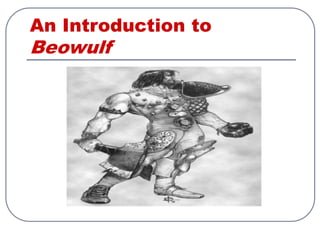
An Introduction to
Beowulf
What is an Epic?
 An epic or “heroic poem” is a lengthy
narrative poem (a long poem that tells a
story)
 Epics are told in a formal and elevated style
 Epics address serious subjects and usually
focus on heroic deeds or events significant to
a nation or culture
 Traditional epics were originally oral poems
that told about a national hero during a
warlike age
Traits of an Epic
1) Character: The hero is a figure of great national or
even cosmic importance (characters are noble or
supernatural)
2) Setting: Setting is ample in scale and may deal with
whole countries or be worldwide
3) Plot:
o Action is not trivial; it involves extraordinary deeds in
battle or a long and dangerous journey in which the fate
of a whole group of people (town, country, sometimes
even a whole human race) depends
o Poem often begins at a critical point in the action known
as “in medias res” or in the middle of things.
4) Theme: Epics begin by directly stating the author’s
argument or theme
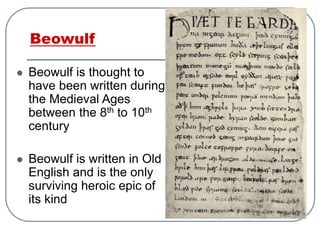
Beowulf
 Beowulf is thought to
have been written during
the Medieval Ages
between the 8th to 10th
century
 Beowulf is written in Old
English and is the only
surviving heroic epic of
its kind
Old English Alphabet
Interesting Facts & Significance
 The original manuscript survives despite being badly
damaged by a fire in 1731 that swept through a
building housing a collection of Medieval
manuscripts.
 Beowulf consists of 3,182 alliterative lines and was
transcribed from an original by two scribes, one of
whom wrote the first 1,939 lines and a second who
wrote the remainder, so the poem up to line 1,939 is
in one handwriting, while the rest of the poem is in
another. Both scribes proofread their work down to
the most minute error. It is said that the second
scribe slaved over the poem for many years.
 Beowulf is commonly cited as one of the most
important works of Anglo-Saxon literature.
What is Anglo-Saxon?
 Anglo-Saxon refers to a group of settlers from
the German regions of Angeln and Saxony,
who made their way over to Britain after the fall
of the Roman Empire around AD 410.
 The Anglo-Saxons did little to keep their
Roman legacy alive. Instead, they established
their own cultural identity and spoke their own
language which gave rise to the English we
speak today!
 The Anglo-Saxon empire lasted for around 600
years (410-1066).
Cultural Values
 Materialism
 Fairness
 Boasting
 Love of Glory
 Loyalty
 Courage/Bravery
 Generosity
Social Expectations
 HEROISM/LEADERSHIP & GENEROSITY: The Anglo-
Saxon social structure consisted of tribal units led by
chieftains ("kings," or "lords") who earned their respect
from their warriors (or "thanes“). Kings were expected to
display the heroic ideal and be known for an extraordinary
and courageous feat or for success in war, all preceded
by some boasting. The king must be a generous "ring-
giver" too -- that is, he must dish out the spoils of war to
his thanes rather than hoard the treasures won in tribal
warfare. The craftsmanship of such items were always
elaborate and there was a story behind each item. It was
vital for one's sense of self-worth to be part of a tribe and
come from a warrior community. The worst fate for these
people was to be exiled or to outlive all one's fellow
warriors.
 GLORY & JUSTICE: Fighting was a way of life, and
not to avenge the death of a family member was a
social disgrace, so endlessly intricate blood-feuds
generated perpetual excuses for going to war. The
two alternatives for ending a blood-feud were 1)
paying "wergild" -- the man price, or 2) arranging a
marriage.
 Women were known as "cup-bearers" (because they
served the mead) and "peace-weavers" (because of
this function whereby feuds could be ended). But
none of this really ever worked. The germanic tribes
hated peace; fighting was more honorable.
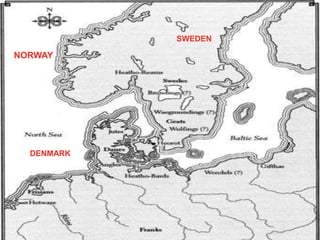
The Setting of Beowulf
Beowulf takes place in
Scandinavia or modern
day Sweden (the Geats)
and Denmark (the
Danes).
NORWAY
SWEDEN
DENMARK
The Story of Beowulf
 In the poem, Beowulf, a hero of the Geats in
Scandinavia (Sweden), comes to the help of
Hrothgar, the king of the Danes (Denmark), whose
mead hall (Heorot) has been under attack by a
monster known as Grendel. After Beowulf slays
him, Grendel’s mother attacks the hall and is then
also defeated. Victorious, Beowulf goes home to
Geatland in Sweden and later becomes king of the
Geats. After a period of fifty years has passed,
Beowulf defeats a dragon that is terrorizing his
people, but is fatally wounded in the battle.
 Beowulf is considered an epic poem in that the
main character is a hero who travels great
distances to prove his strength at impossible odds
against supernatural demons and beasts.
Beowulf’s Structure
 It is debated amongst scholars whether
Beowulf is divided into a two part
structure based on Beowulf’s age and
the changes his character undergoes or
is a three part structure based on the
battles Beowulf wages (Grendel,
Grendel’s Mother & the Dragon).
Poetic Elements in Beowulf
 Alliteration: The repetition of consonant
sounds at the beginning of words.
(Ex. Sally picked seashells down by the
seashore.)
oAlliteration made it easier for scops (poets
who would travel to royal courts to perform) to
memorize their lines
 Kenning: A literary device in which a
poetic phrase substitutes for a noun.
• sky-candle (the sun)
• swan-road (the sea)
• stout-hearted (brave)
• battle sweat (blood)
• Light-of-battle (sword)
• helmet bearers (warriors)
• giver of gold (king)
• earth-hall (burial mound, barrow)
• dwelling place (home)
• storm of swords (battle)
Modern Examples
 gas guzzler – a vehicle that has poor gas mileage ( alliteration, striking
imagery)
 2. headhunter – a person who finds executive positions for job seekers
(consonance with the “h” sound, striking imagery)
 3. muffin top – extra skin at the top of a pair of too-tight jeans (striking
imagery)
 4. rug rat – a mischievous child (alliteration, striking imagery)
 5. land line – a traditional telephone (alliteration)
 6. eye candy – a person or thing with visual appeal but little substance
(striking imagery)
 7. cancer stick – a cigarette (striking imagery)
 8. boob tube – television (rhyme, striking imagery)
 9. couch potato – a person who gets little exercise (assonance and
striking imagery)
 10. tramp stamp – a tattoo on the lower back (rhyme, striking imagery)

Intro_to_Beowulf.ppt

  • 1.
  • 2.
    What is anEpic?  An epic or “heroic poem” is a lengthy narrative poem (a long poem that tells a story)  Epics are told in a formal and elevated style  Epics address serious subjects and usually focus on heroic deeds or events significant to a nation or culture  Traditional epics were originally oral poems that told about a national hero during a warlike age
  • 3.
    Traits of anEpic 1) Character: The hero is a figure of great national or even cosmic importance (characters are noble or supernatural) 2) Setting: Setting is ample in scale and may deal with whole countries or be worldwide 3) Plot: o Action is not trivial; it involves extraordinary deeds in battle or a long and dangerous journey in which the fate of a whole group of people (town, country, sometimes even a whole human race) depends o Poem often begins at a critical point in the action known as “in medias res” or in the middle of things. 4) Theme: Epics begin by directly stating the author’s argument or theme
  • 4.
    Beowulf  Beowulf isthought to have been written during the Medieval Ages between the 8th to 10th century  Beowulf is written in Old English and is the only surviving heroic epic of its kind
  • 5.
  • 6.
    Interesting Facts &Significance  The original manuscript survives despite being badly damaged by a fire in 1731 that swept through a building housing a collection of Medieval manuscripts.  Beowulf consists of 3,182 alliterative lines and was transcribed from an original by two scribes, one of whom wrote the first 1,939 lines and a second who wrote the remainder, so the poem up to line 1,939 is in one handwriting, while the rest of the poem is in another. Both scribes proofread their work down to the most minute error. It is said that the second scribe slaved over the poem for many years.  Beowulf is commonly cited as one of the most important works of Anglo-Saxon literature.
  • 7.
    What is Anglo-Saxon? Anglo-Saxon refers to a group of settlers from the German regions of Angeln and Saxony, who made their way over to Britain after the fall of the Roman Empire around AD 410.  The Anglo-Saxons did little to keep their Roman legacy alive. Instead, they established their own cultural identity and spoke their own language which gave rise to the English we speak today!  The Anglo-Saxon empire lasted for around 600 years (410-1066).
  • 8.
    Cultural Values  Materialism Fairness  Boasting  Love of Glory  Loyalty  Courage/Bravery  Generosity
  • 9.
    Social Expectations  HEROISM/LEADERSHIP& GENEROSITY: The Anglo- Saxon social structure consisted of tribal units led by chieftains ("kings," or "lords") who earned their respect from their warriors (or "thanes“). Kings were expected to display the heroic ideal and be known for an extraordinary and courageous feat or for success in war, all preceded by some boasting. The king must be a generous "ring- giver" too -- that is, he must dish out the spoils of war to his thanes rather than hoard the treasures won in tribal warfare. The craftsmanship of such items were always elaborate and there was a story behind each item. It was vital for one's sense of self-worth to be part of a tribe and come from a warrior community. The worst fate for these people was to be exiled or to outlive all one's fellow warriors.
  • 10.
     GLORY &JUSTICE: Fighting was a way of life, and not to avenge the death of a family member was a social disgrace, so endlessly intricate blood-feuds generated perpetual excuses for going to war. The two alternatives for ending a blood-feud were 1) paying "wergild" -- the man price, or 2) arranging a marriage.  Women were known as "cup-bearers" (because they served the mead) and "peace-weavers" (because of this function whereby feuds could be ended). But none of this really ever worked. The germanic tribes hated peace; fighting was more honorable.
  • 11.
    The Setting ofBeowulf Beowulf takes place in Scandinavia or modern day Sweden (the Geats) and Denmark (the Danes).
  • 12.
  • 13.
    The Story ofBeowulf  In the poem, Beowulf, a hero of the Geats in Scandinavia (Sweden), comes to the help of Hrothgar, the king of the Danes (Denmark), whose mead hall (Heorot) has been under attack by a monster known as Grendel. After Beowulf slays him, Grendel’s mother attacks the hall and is then also defeated. Victorious, Beowulf goes home to Geatland in Sweden and later becomes king of the Geats. After a period of fifty years has passed, Beowulf defeats a dragon that is terrorizing his people, but is fatally wounded in the battle.  Beowulf is considered an epic poem in that the main character is a hero who travels great distances to prove his strength at impossible odds against supernatural demons and beasts.
  • 14.
    Beowulf’s Structure  Itis debated amongst scholars whether Beowulf is divided into a two part structure based on Beowulf’s age and the changes his character undergoes or is a three part structure based on the battles Beowulf wages (Grendel, Grendel’s Mother & the Dragon).
  • 15.
    Poetic Elements inBeowulf  Alliteration: The repetition of consonant sounds at the beginning of words. (Ex. Sally picked seashells down by the seashore.) oAlliteration made it easier for scops (poets who would travel to royal courts to perform) to memorize their lines
  • 16.
     Kenning: Aliterary device in which a poetic phrase substitutes for a noun. • sky-candle (the sun) • swan-road (the sea) • stout-hearted (brave) • battle sweat (blood) • Light-of-battle (sword) • helmet bearers (warriors) • giver of gold (king) • earth-hall (burial mound, barrow) • dwelling place (home) • storm of swords (battle)
  • 17.
    Modern Examples  gasguzzler – a vehicle that has poor gas mileage ( alliteration, striking imagery)  2. headhunter – a person who finds executive positions for job seekers (consonance with the “h” sound, striking imagery)  3. muffin top – extra skin at the top of a pair of too-tight jeans (striking imagery)  4. rug rat – a mischievous child (alliteration, striking imagery)  5. land line – a traditional telephone (alliteration)  6. eye candy – a person or thing with visual appeal but little substance (striking imagery)  7. cancer stick – a cigarette (striking imagery)  8. boob tube – television (rhyme, striking imagery)  9. couch potato – a person who gets little exercise (assonance and striking imagery)  10. tramp stamp – a tattoo on the lower back (rhyme, striking imagery)