Beowulf
Epic Hero
Characters
 Beowulf
 The hero for whom the untitled poem was later named,
Beowulf is the perfect warrior -- brave, strong, and
honorable. While he displays enough bravado to
inspire hope in the Scyldings, he is still courteous. He
uses both his wits and brute strength to defeat his
foes. Beowulf's only flaw manifests in the latter part of
the poem, when he decides to face the dragon alone
instead of delegating the task to a younger man, and in
so doing leaves his kingdom without an experienced
ruler, vulnerable to its enemies.
Characters
 Hrothgar
 The king of the Scyldings is a wise and
venerable leader weighed down with sorrow
and loss. Placed in the unenviable position
of requiring outside help to solve his
deadliest problem, Hrothgar nevertheless
stands proud as he decides to accept
Beowulf's help. Before the hero returns
home, Hrothgar has wisdom to share with
him about kingship, for which he believes
Beowulf is eminently suited.
Characters
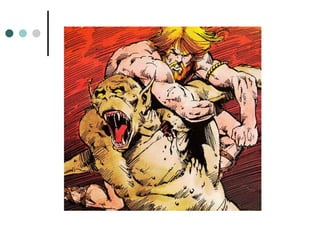
 Grendel
 The first and most memorable foe that Beowulf must
face, Grendel is a hideous creature that is clearly not
human; and yet, he displays human emotions and
motivations. The poem ties him to the biblical Cain and
brands him an outsider, condemned to live beyond the
human community in a horrible place. There is a
suggestion that envy of the splendor Hrothgar's
Scyldings enjoyed and bitterness at being excluded
drove him to attack Heorot.
Characters
 Unferth
 Unferth is one of Hrothgar's Scyldings, and like all the
other Scyldings, he has failed to defeat Grendel, and
will not face the fiend. When Beowulf arrives and is the
focus of his comrade's hopes, Unferth grows jealous,
and, having indulged in too much drink, he taunts the
hero. Unferth's resentment and inferiority serve to
throw Beowulf's greatness into sharper relief. Yet he is
the one character who exhibits any growth, humbled
by Beowulf's defeat of Grendel and lending his prized
sword to the hero when he fights Grendel's mother.
However, he understands -- as does the reader -- that
he will never be a true hero.
Characters
 Wealhtheow
 Hrothgar's wife and queen is Wealhtheow.
Her appearance in Heorot lends a certain
grave splendor to the festivities. It is
Wealhtheow to whom Beowulf makes his
pledge to kill Grendel or die in the attempt,
and it is Wealhtheow's confirmation of
Hrothgar's adoption of Beowulf that seems
to legitimize the act. In a sense,
Wealhtheow symbolizes all that is fine and
good in women, especially women of rank
and sensibility.
Characters
 Grendel's Mother
 A swamp-fiend like her son, Grendel's mother -- who is
never named -- is just as fierce and dangerous as
Grendel. Understandably enraged by the death of her
offspring, the hag attacks swiftly and flees, killing
Hrothgar's advisor Aeschere. But when Beowulf comes
after her, she faces him willingly, dragging him into her
lair and attacking him viciously. Just as much a
monster as Grendel, the mother shares a very human
desire for vengeance. She can be contrasted with
Wealhtheow, symbolizing evil in womanhood.
Characters
 Hygelac
 Hygelac is the King of the Geats. He is fond
of Beowulf, yet surprised that he has
triumphed over such a deadly foe. By
bestowing gifts and honors on the returning
hero, Hygelac reveals how Beowulf's
victories have earned him respect among
the Geats. When Hygelac dies, Beowulf
refuses to take the throne; only when
Hygelac's son is killed does Beowulf take on
the responsibility of ruling Geatland.
Characters
 The Dragon
 An ancient creature, the Dragon has made
his home in an even more ancient barrow,
where the treasure of a long-dead pagan
chieftain was hidden. When its lair is
accidentally discovered, and when only one
item is taken from its hoard, the Dragon
awakens to bring fiery devastation to
Geatland. Beowulf's battle with the Dragon
will be his last.
Characters
 Wiglaf
 A kinsman to Beowulf, Wiglaf is one of the
warriors that the hero brings with him to
seek out the Dragon, and the only one who
joins Beowulf in his hour of need instead of
fleeing. For his loyalty and courage, Wiglaf
is made Beowulf's heir, signifying that the
valued qualities of the warrior live on in the
next generation of Scandinavian manhood.
 http://historymedren.about.com/od/beowulf/t
p/beowulf_characters.htm
The Epic
 A long, narrative poem
 Heroic figure whose actions determine
the fate of the people
 Vast setting, visits other worlds
 Written by literary artists
 Often first in oral tradition
 Uses specific literary terms & formats
 Supernatural forces intervene/appear
The Epic Hero
 Has superhuman courage, especially
in battle
 Usually the ideal man of his culture
 Imposing physical stature – greater
than the common man
 His actions control the fate of his
people
The Epic Hero cont.
 Admired for grand achievements
 Affected by grand events
 Sometimes of divine origins or help
 Wants to or becomes remembered
or immortalized because of his
deeds
 May go on an epic quest
Themes – Main Ideas
 #1 Good vs Evil
 Courageous warrior vs monsters
 Christians vs the Devil and Hell
 Man vs the evil within (wild nature)
 Man vs death
Themes – Main Ideas
 #2 Warriors and Courage
 Warriors go to extremes to use or
display physical strength
 Skill is also desired
 Combine these with courage – true
bravery and no fear of death
 Meet all challenges as his duty
Other Ideas
 Alienation and loneliness
 Wealth – king is ring-giver, rewards for
great deeds
 Identity – making a name for yourself -
reputation
 Supernatural – pagan and Christian
 Envy
 Revenge
Code of Comitatus
 Germanic Code of honor 5th 6th cent.
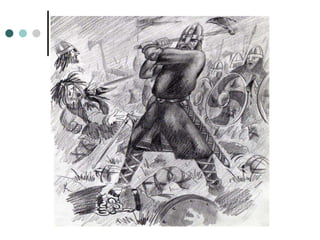
 Warriors (thanes) swore allegiance to
the King or feudal lord
 Fight to the death or avenge his death
 They are rewarded with treasure,
protection, and land
 Everyone/everything is interlaced –
dependent upon one another
Lit Terms
 Kenning
 Caesura
 Alliteration
 Metonymy
 Speaker
 All the Hero Definitions

Beowulf PP (1).ppt

  • 1.
  • 2.
    Characters  Beowulf  Thehero for whom the untitled poem was later named, Beowulf is the perfect warrior -- brave, strong, and honorable. While he displays enough bravado to inspire hope in the Scyldings, he is still courteous. He uses both his wits and brute strength to defeat his foes. Beowulf's only flaw manifests in the latter part of the poem, when he decides to face the dragon alone instead of delegating the task to a younger man, and in so doing leaves his kingdom without an experienced ruler, vulnerable to its enemies.
  • 4.
    Characters  Hrothgar  Theking of the Scyldings is a wise and venerable leader weighed down with sorrow and loss. Placed in the unenviable position of requiring outside help to solve his deadliest problem, Hrothgar nevertheless stands proud as he decides to accept Beowulf's help. Before the hero returns home, Hrothgar has wisdom to share with him about kingship, for which he believes Beowulf is eminently suited.
  • 5.
    Characters  Grendel  Thefirst and most memorable foe that Beowulf must face, Grendel is a hideous creature that is clearly not human; and yet, he displays human emotions and motivations. The poem ties him to the biblical Cain and brands him an outsider, condemned to live beyond the human community in a horrible place. There is a suggestion that envy of the splendor Hrothgar's Scyldings enjoyed and bitterness at being excluded drove him to attack Heorot.
  • 7.
    Characters  Unferth  Unferthis one of Hrothgar's Scyldings, and like all the other Scyldings, he has failed to defeat Grendel, and will not face the fiend. When Beowulf arrives and is the focus of his comrade's hopes, Unferth grows jealous, and, having indulged in too much drink, he taunts the hero. Unferth's resentment and inferiority serve to throw Beowulf's greatness into sharper relief. Yet he is the one character who exhibits any growth, humbled by Beowulf's defeat of Grendel and lending his prized sword to the hero when he fights Grendel's mother. However, he understands -- as does the reader -- that he will never be a true hero.
  • 8.
    Characters  Wealhtheow  Hrothgar'swife and queen is Wealhtheow. Her appearance in Heorot lends a certain grave splendor to the festivities. It is Wealhtheow to whom Beowulf makes his pledge to kill Grendel or die in the attempt, and it is Wealhtheow's confirmation of Hrothgar's adoption of Beowulf that seems to legitimize the act. In a sense, Wealhtheow symbolizes all that is fine and good in women, especially women of rank and sensibility.
  • 9.
    Characters  Grendel's Mother A swamp-fiend like her son, Grendel's mother -- who is never named -- is just as fierce and dangerous as Grendel. Understandably enraged by the death of her offspring, the hag attacks swiftly and flees, killing Hrothgar's advisor Aeschere. But when Beowulf comes after her, she faces him willingly, dragging him into her lair and attacking him viciously. Just as much a monster as Grendel, the mother shares a very human desire for vengeance. She can be contrasted with Wealhtheow, symbolizing evil in womanhood.
  • 10.
    Characters  Hygelac  Hygelacis the King of the Geats. He is fond of Beowulf, yet surprised that he has triumphed over such a deadly foe. By bestowing gifts and honors on the returning hero, Hygelac reveals how Beowulf's victories have earned him respect among the Geats. When Hygelac dies, Beowulf refuses to take the throne; only when Hygelac's son is killed does Beowulf take on the responsibility of ruling Geatland.
  • 11.
    Characters  The Dragon An ancient creature, the Dragon has made his home in an even more ancient barrow, where the treasure of a long-dead pagan chieftain was hidden. When its lair is accidentally discovered, and when only one item is taken from its hoard, the Dragon awakens to bring fiery devastation to Geatland. Beowulf's battle with the Dragon will be his last.
  • 13.
    Characters  Wiglaf  Akinsman to Beowulf, Wiglaf is one of the warriors that the hero brings with him to seek out the Dragon, and the only one who joins Beowulf in his hour of need instead of fleeing. For his loyalty and courage, Wiglaf is made Beowulf's heir, signifying that the valued qualities of the warrior live on in the next generation of Scandinavian manhood.  http://historymedren.about.com/od/beowulf/t p/beowulf_characters.htm
  • 15.
    The Epic  Along, narrative poem  Heroic figure whose actions determine the fate of the people  Vast setting, visits other worlds  Written by literary artists  Often first in oral tradition  Uses specific literary terms & formats  Supernatural forces intervene/appear
  • 16.
    The Epic Hero Has superhuman courage, especially in battle  Usually the ideal man of his culture  Imposing physical stature – greater than the common man  His actions control the fate of his people
  • 17.
    The Epic Herocont.  Admired for grand achievements  Affected by grand events  Sometimes of divine origins or help  Wants to or becomes remembered or immortalized because of his deeds  May go on an epic quest
  • 19.
    Themes – MainIdeas  #1 Good vs Evil  Courageous warrior vs monsters  Christians vs the Devil and Hell  Man vs the evil within (wild nature)  Man vs death
  • 20.
    Themes – MainIdeas  #2 Warriors and Courage  Warriors go to extremes to use or display physical strength  Skill is also desired  Combine these with courage – true bravery and no fear of death  Meet all challenges as his duty
  • 21.
    Other Ideas  Alienationand loneliness  Wealth – king is ring-giver, rewards for great deeds  Identity – making a name for yourself - reputation  Supernatural – pagan and Christian  Envy  Revenge
  • 22.
    Code of Comitatus Germanic Code of honor 5th 6th cent.  Warriors (thanes) swore allegiance to the King or feudal lord  Fight to the death or avenge his death  They are rewarded with treasure, protection, and land  Everyone/everything is interlaced – dependent upon one another
  • 24.
    Lit Terms  Kenning Caesura  Alliteration  Metonymy  Speaker  All the Hero Definitions