Background Notes on Inferno
Canto – Italian word for “song.” Divine Comedy is divided into 3
  cantitas of 33 cantos each (plus one introductory canto = 100
  total).

Stanza – a poetic “paragraph.” The division of lines in poetry.

Virgil – Roman poet – lived during Caesar’s time – the father of
   drama. Virgil guides Dante through hell in the Inferno. Dante
   acknowledges that Virgil is his mentor, or hero.

Terza Rima – a rhyming poetic form that consists of an interlocking
  3-line rhyme scheme: A-B-A, B-C-B, C-D-C, D-E-D.
  Difficult to translate.
The Divine Comedy
Widely considered the central epic poem of
 Italian literature, Dante’s Divine Comedy is
 seen as one of the greatest works of world
 literature.

The Divine Comedy is composed of over 14,000
lines that are divided into three canticas —
Inferno (Hell) Purgatorio (Purgatory), and
Paradiso (Paradise).
                              
The poem is written in the first person, and
 tells of Dante's journey through the three
 realms of the dead, lasting during the Easter
 Triduum in the spring of 1300. The Roman
 poet Virgil guides him through Hell and
 Purgatory; Beatrice, Dante's ideal woman,
 guides him through Heaven.
Themes of Inferno
Dante Alighieri, claims that before achieving
 moral redemption, an individual must take a
 hard look at evil both in the world and in
 himself. Only by confronting inner evil can
 people achieve self-knowledge, which is the
 first step toward redemption.

Dante also says that people should not be
 expected to make their journey alone; they
 need a guide to help them (for him, Virgil
 and Beatrice)
Literary Techniques in Inferno
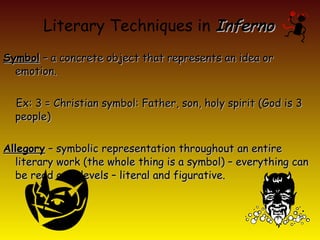
Symbol – a concrete object that represents an idea or
  emotion.


  Ex: 3 = Christian symbol: Father, son, holy spirit (God is 3
  people)


Allegory – symbolic representation throughout an entire
  literary work (the whole thing is a symbol) – everything can
  be read on 2 levels – literal and figurative.
The poem begins in the middle …

 in medias res – Latin literary and artistic
   technique where the narrative starts in the
   middle of the story instead of from its
   beginning.
The characters, setting, and conflict are often
   introduced through a series of flashbacks or
   through characters relating past events to
   each other.
Probably originating from an oral tradition, the
   technique is a convention of epic poetry.
Pre-reading for Dante’s Inferno
1.  Consider the saying, “You reap what you sow.”.
    Does a person get what he/she deserves?
2. If a person repents immediately before death,
    does that make a difference in where they end
    up?
3. 3.       In Hell, what kind of punishments do
    you envision for:
   • A thief
   • A liar
   • A cheater
   • A traitor
   • A murderer
   • A?

Inferno pre reading

  • 1.
    Background Notes onInferno Canto – Italian word for “song.” Divine Comedy is divided into 3 cantitas of 33 cantos each (plus one introductory canto = 100 total). Stanza – a poetic “paragraph.” The division of lines in poetry. Virgil – Roman poet – lived during Caesar’s time – the father of drama. Virgil guides Dante through hell in the Inferno. Dante acknowledges that Virgil is his mentor, or hero. Terza Rima – a rhyming poetic form that consists of an interlocking 3-line rhyme scheme: A-B-A, B-C-B, C-D-C, D-E-D. Difficult to translate.
  • 2.
    The Divine Comedy Widelyconsidered the central epic poem of Italian literature, Dante’s Divine Comedy is seen as one of the greatest works of world literature. The Divine Comedy is composed of over 14,000 lines that are divided into three canticas — Inferno (Hell) Purgatorio (Purgatory), and Paradiso (Paradise).                             
  • 3.
    The poem iswritten in the first person, and tells of Dante's journey through the three realms of the dead, lasting during the Easter Triduum in the spring of 1300. The Roman poet Virgil guides him through Hell and Purgatory; Beatrice, Dante's ideal woman, guides him through Heaven.
  • 4.
    Themes of Inferno DanteAlighieri, claims that before achieving moral redemption, an individual must take a hard look at evil both in the world and in himself. Only by confronting inner evil can people achieve self-knowledge, which is the first step toward redemption. Dante also says that people should not be expected to make their journey alone; they need a guide to help them (for him, Virgil and Beatrice)
  • 5.
    Literary Techniques inInferno Symbol – a concrete object that represents an idea or emotion. Ex: 3 = Christian symbol: Father, son, holy spirit (God is 3 people) Allegory – symbolic representation throughout an entire literary work (the whole thing is a symbol) – everything can be read on 2 levels – literal and figurative.
  • 6.
    The poem beginsin the middle … in medias res – Latin literary and artistic technique where the narrative starts in the middle of the story instead of from its beginning. The characters, setting, and conflict are often introduced through a series of flashbacks or through characters relating past events to each other. Probably originating from an oral tradition, the technique is a convention of epic poetry.
  • 7.
    Pre-reading for Dante’sInferno 1. Consider the saying, “You reap what you sow.”. Does a person get what he/she deserves? 2. If a person repents immediately before death, does that make a difference in where they end up? 3. 3. In Hell, what kind of punishments do you envision for: • A thief • A liar • A cheater • A traitor • A murderer • A?