What is an elegy?
An elegy is a mournful poem or song, a
lament for the dead.


What does lament mean?
Lament means to express sorrow,
remorse or regret. A poem or song in
which a death is lamented.
Objectives
By the end of today’s lesson you will be able to:


Complete a MITSL
 analysis of On My
 First Sonne.
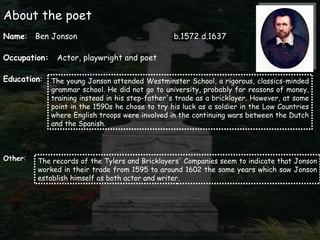
About the poet
Name: Ben Jonson                                  b.1572 d.1637

Occupation:    Actor, playwright and poet

Education:    The young Jonson attended Westminster School, a rigorous, classics-minded
              grammar school. He did not go to university, probably for reasons of money,
              training instead in his step-father's trade as a bricklayer. However, at some
              point in the 1590s he chose to try his luck as a soldier in the Low Countries
              where English troops were involved in the continuing wars between the Dutch
              and the Spanish.


Other:   The records of the Tylers and Bricklayers' Companies seem to indicate that Jonson
         worked in their trade from 1595 to around 1602 the same years which saw Jonson
         establish himself as both actor and writer.
On my first Sonne

Farewell, thou child of my right hand, and joy;
My sinne was too much hope of thee, lov'd boy
Seven yeeres thou wert lent to me, and I thee pay,
Exacted by thy fate, on the just day.
O, could I loose all father, now. For why
Will man lament the state he should envie?
To have so soone scap'd worlds, and fleshes rage,
And, if no other miserie, yet age?
Rest in soft peace, and, ask'd, say here doth lye
Ben. Jonson his best piece of poetrie.
For whose sake, hence-forth, all his vowes be such,
As what he loves may never like too much.

Ben Jonson
1616
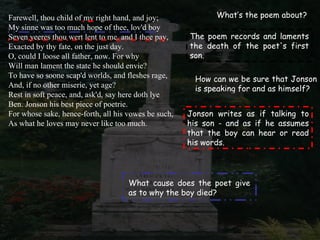
Farewell, thou child of my right hand, and joy;              What’s the poem about?
My sinne was too much hope of thee, lov'd boy
Seven yeeres thou wert lent to me, and I thee pay,    The poem records and laments
Exacted by thy fate, on the just day.                 the death of the poet's first
O, could I loose all father, now. For why             son.
Will man lament the state he should envie?
To have so soone scap'd worlds, and fleshes rage,      How can we be sure that Jonson
And, if no other miserie, yet age?                     is speaking for and as himself?
Rest in soft peace, and, ask'd, say here doth lye
Ben. Jonson his best piece of poetrie.
For whose sake, hence-forth, all his vowes be such,   Jonson writes as if talking to
As what he loves may never like too much.             his son - and as if he assumes
                                                      that the boy can hear or read
                                                      his words.


                                     What cause does the poet give
                                     as to why the boy died?
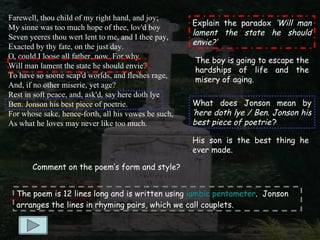
Farewell, thou child of my right hand, and joy;
                                                      Explain the paradox ‘Will man
My sinne was too much hope of thee, lov'd boy
                                                      lament the state he should
Seven yeeres thou wert lent to me, and I thee pay,
                                                      envie?’
Exacted by thy fate, on the just day.
O, could I loose all father, now. For why
                                                      The boy is going to escape the
Will man lament the state he should envie?
                                                      hardships of life and the
To have so soone scap'd worlds, and fleshes rage,
                                                      misery of aging.
And, if no other miserie, yet age?
Rest in soft peace, and, ask'd, say here doth lye
Ben. Jonson his best piece of poetrie.                What does Jonson mean by
For whose sake, hence-forth, all his vowes be such,   ‘here doth lye / Ben. Jonson his
As what he loves may never like too much.             best piece of poetrie’?

                                                      His son is the best thing he
                                                      ever made.

       Comment on the poem’s form and style?


  The poem is 12 lines long and is written using iambic pentameter. Jonson
  arranges the lines in rhyming pairs, which we call couplets.
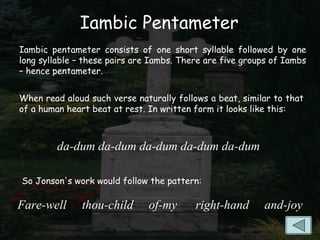
Iambic Pentameter
Iambic pentameter consists of one short syllable followed by one
long syllable – these pairs are Iambs. There are five groups of Iambs
– hence pentameter.


When read aloud such verse naturally follows a beat, similar to that
of a human heart beat at rest. In written form it looks like this:


         da-dum da-dum da-dum da-dum da-dum

So Jonson's work would follow the pattern:

Fare-well      thou-child      of-my      right-hand      and-joy
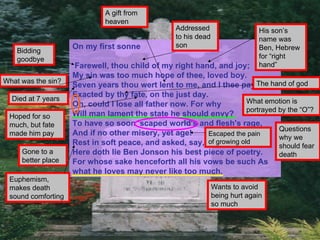
A gift from
                             heaven
                                                 Addressed                    His son’s
                                                 to his dead                  name was
                    On my first sonne            son                          Ben, Hebrew
    Bidding
    goodbye                                                                   for “right
                    Farewell, thou child of my right hand, and joy;           hand”
                    My sin was too much hope of thee, loved boy.
What was the sin?
                    Seven years thou wert lent to me, and I thee pay,The hand of god
                    Exacted by thy fate, on the just day.
  Died at 7 years                                                    What emotion is
                    Oh, could I lose all father now. For why
                                                                     portrayed by the “O”?
 Hoped for so       Will man lament the state he should envy?
 much, but fate     To have so soon 'scaped world's and flesh's rage,
                                                                               Questions
 made him pay       And if no other misery, yet age!     Escaped the pain
                                                                               why we
                    Rest in soft peace, and asked, say, of growing old         should fear
     Gone to a      Here doth lie Ben Jonson his best piece of poetry.         death
     better place   For whose sake henceforth all his vows be such As
                    what he loves may never like too much.
 Euphemism,
 makes death                                                   Wants to avoid
 sound comforting                                              being hurt again
                                                               so much

On my first sonne2

  • 1.
    What is anelegy? An elegy is a mournful poem or song, a lament for the dead. What does lament mean? Lament means to express sorrow, remorse or regret. A poem or song in which a death is lamented.
  • 2.
    Objectives By the endof today’s lesson you will be able to: Complete a MITSL analysis of On My First Sonne.
  • 3.
    About the poet Name:Ben Jonson b.1572 d.1637 Occupation: Actor, playwright and poet Education: The young Jonson attended Westminster School, a rigorous, classics-minded grammar school. He did not go to university, probably for reasons of money, training instead in his step-father's trade as a bricklayer. However, at some point in the 1590s he chose to try his luck as a soldier in the Low Countries where English troops were involved in the continuing wars between the Dutch and the Spanish. Other: The records of the Tylers and Bricklayers' Companies seem to indicate that Jonson worked in their trade from 1595 to around 1602 the same years which saw Jonson establish himself as both actor and writer.
  • 4.
    On my firstSonne Farewell, thou child of my right hand, and joy; My sinne was too much hope of thee, lov'd boy Seven yeeres thou wert lent to me, and I thee pay, Exacted by thy fate, on the just day. O, could I loose all father, now. For why Will man lament the state he should envie? To have so soone scap'd worlds, and fleshes rage, And, if no other miserie, yet age? Rest in soft peace, and, ask'd, say here doth lye Ben. Jonson his best piece of poetrie. For whose sake, hence-forth, all his vowes be such, As what he loves may never like too much. Ben Jonson 1616
  • 5.
    Farewell, thou childof my right hand, and joy; What’s the poem about? My sinne was too much hope of thee, lov'd boy Seven yeeres thou wert lent to me, and I thee pay, The poem records and laments Exacted by thy fate, on the just day. the death of the poet's first O, could I loose all father, now. For why son. Will man lament the state he should envie? To have so soone scap'd worlds, and fleshes rage, How can we be sure that Jonson And, if no other miserie, yet age? is speaking for and as himself? Rest in soft peace, and, ask'd, say here doth lye Ben. Jonson his best piece of poetrie. For whose sake, hence-forth, all his vowes be such, Jonson writes as if talking to As what he loves may never like too much. his son - and as if he assumes that the boy can hear or read his words. What cause does the poet give as to why the boy died?
  • 6.
    Farewell, thou childof my right hand, and joy; Explain the paradox ‘Will man My sinne was too much hope of thee, lov'd boy lament the state he should Seven yeeres thou wert lent to me, and I thee pay, envie?’ Exacted by thy fate, on the just day. O, could I loose all father, now. For why The boy is going to escape the Will man lament the state he should envie? hardships of life and the To have so soone scap'd worlds, and fleshes rage, misery of aging. And, if no other miserie, yet age? Rest in soft peace, and, ask'd, say here doth lye Ben. Jonson his best piece of poetrie. What does Jonson mean by For whose sake, hence-forth, all his vowes be such, ‘here doth lye / Ben. Jonson his As what he loves may never like too much. best piece of poetrie’? His son is the best thing he ever made. Comment on the poem’s form and style? The poem is 12 lines long and is written using iambic pentameter. Jonson arranges the lines in rhyming pairs, which we call couplets.
  • 7.
    Iambic Pentameter Iambic pentameterconsists of one short syllable followed by one long syllable – these pairs are Iambs. There are five groups of Iambs – hence pentameter. When read aloud such verse naturally follows a beat, similar to that of a human heart beat at rest. In written form it looks like this: da-dum da-dum da-dum da-dum da-dum So Jonson's work would follow the pattern: Fare-well thou-child of-my right-hand and-joy
  • 8.
    A gift from heaven Addressed His son’s to his dead name was On my first sonne son Ben, Hebrew Bidding goodbye for “right Farewell, thou child of my right hand, and joy; hand” My sin was too much hope of thee, loved boy. What was the sin? Seven years thou wert lent to me, and I thee pay,The hand of god Exacted by thy fate, on the just day. Died at 7 years What emotion is Oh, could I lose all father now. For why portrayed by the “O”? Hoped for so Will man lament the state he should envy? much, but fate To have so soon 'scaped world's and flesh's rage, Questions made him pay And if no other misery, yet age! Escaped the pain why we Rest in soft peace, and asked, say, of growing old should fear Gone to a Here doth lie Ben Jonson his best piece of poetry. death better place For whose sake henceforth all his vows be such As what he loves may never like too much. Euphemism, makes death Wants to avoid sound comforting being hurt again so much