LASER MICRO JOINING - PROCESSES AND
APPLICATIONS IN RESEARCH AND DEVELOPMENT

A. Gillner, B. Mehlmann, A. Olowinsky, A. Roesner, F. Schmitt
Eindhoven, 06 December 2012


© Fraunhofer ILT
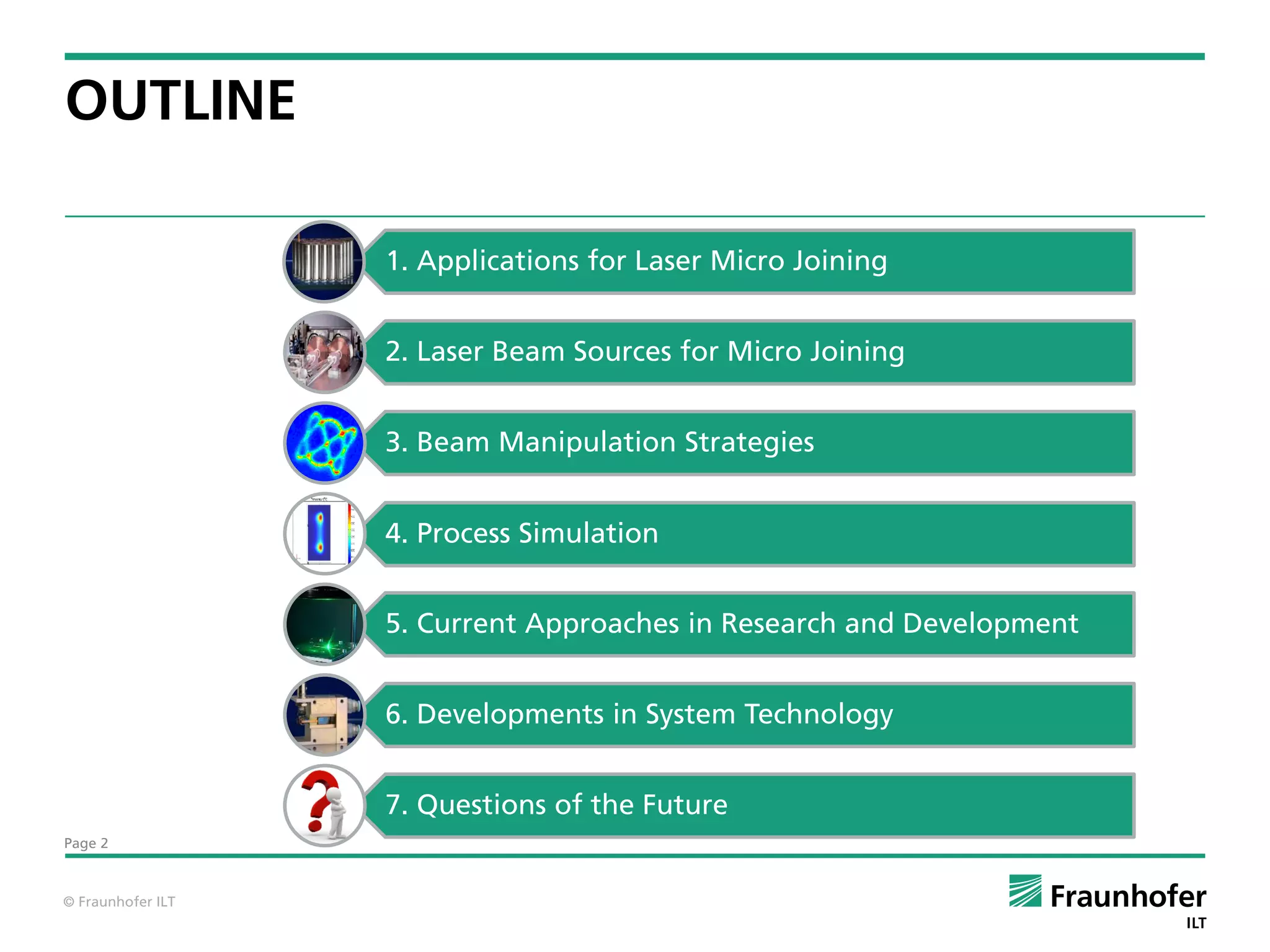
OUTLINE

                   1. Applications for Laser Micro Joining


                   2. Laser Beam Sources for Micro Joining


                   3. Beam Manipulation Strategies


                   4. Process Simulation


                   5. Current Approaches in Research and Development


                   6. Developments in System Technology


                   7. Questions of the Future
Page 2


© Fraunhofer ILT
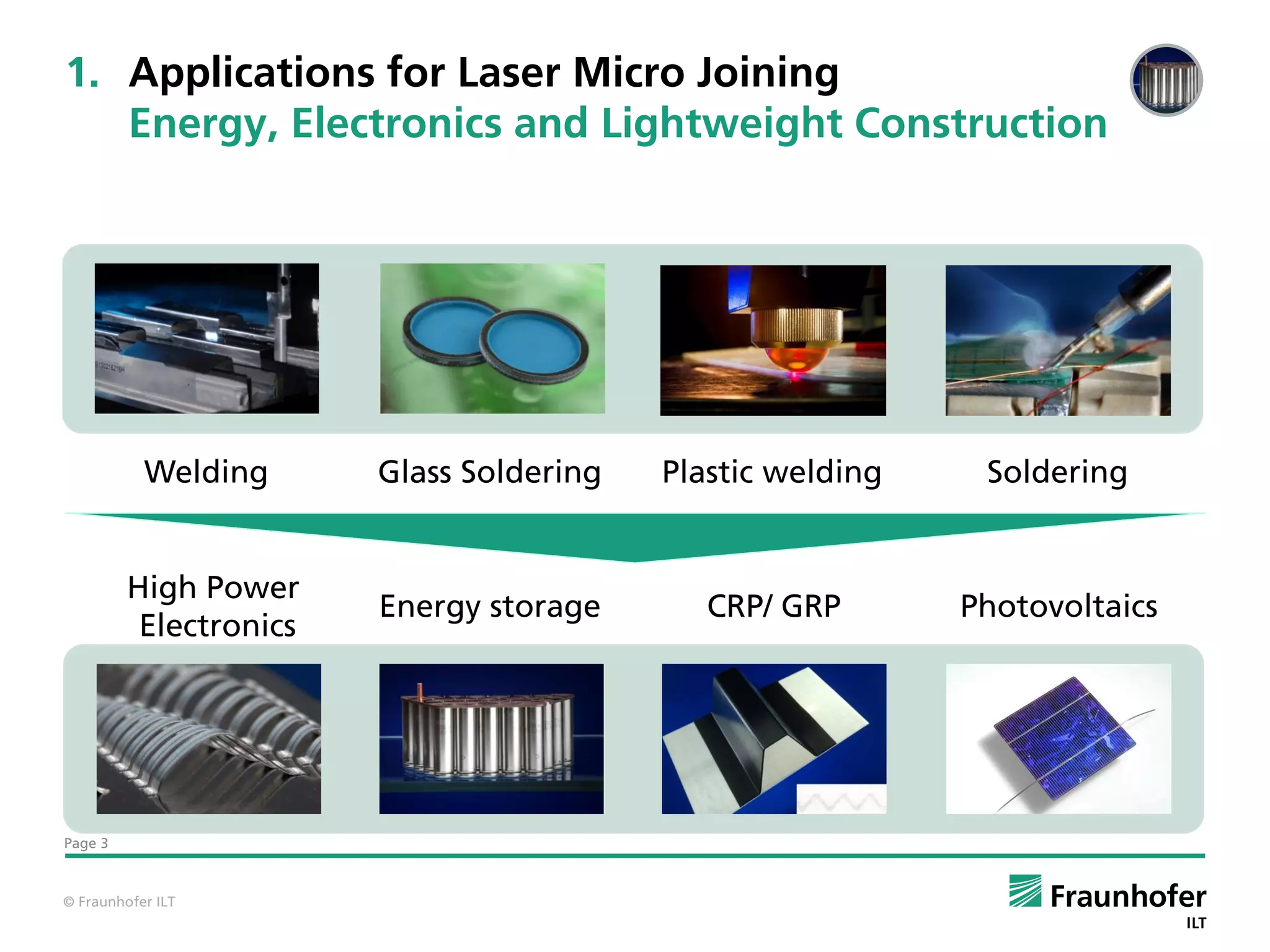
1. Applications for Laser Micro Joining
   Energy, Electronics and Lightweight Construction


           Welding      Glass Soldering   Plastic welding    Soldering


         High Power
                        Energy storage       CRP/ GRP       Photovoltaics
          Electronics


Page 3


© Fraunhofer ILT
1. Applications for Laser Micro Joining
   Energy, Electronics and Lightweight Construction


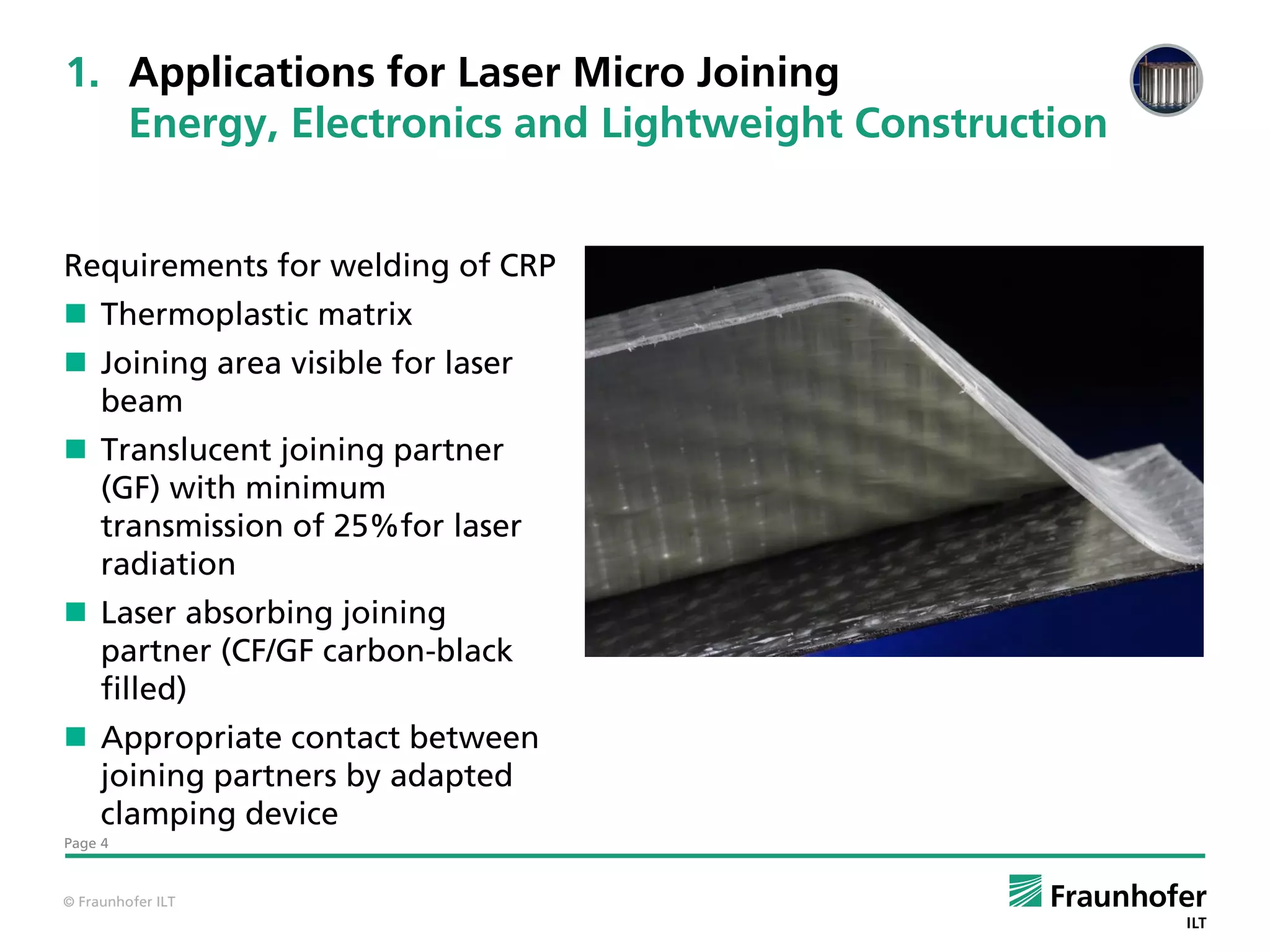
Requirements for welding of CRP
 Thermoplastic matrix
 Joining area visible for laser
  beam
 Translucent joining partner
  (GF) with minimum
  transmission of 25%for laser
  radiation
 Laser absorbing joining
  partner (CF/GF carbon-black
  filled)
 Appropriate contact between
  joining partners by adapted
  clamping device
Page 4


© Fraunhofer ILT
1. Applications for Laser Micro Joining
   Energy, Electronics and Lightweight Construction

                                                         15
                   Laser Beam
                                                                                  Penetration


                                  Line Energy [J/m m ]
                                                                                                   Al 0,5
                   Conductors                            10                                        Cu 0,3


                                                          5
                    Pouch Cell


                   Plate Cooler                                   Not Connected
                                                          0
                                                              0       50       100     150   200
                                                                           Feed [mm/s]


 Welding geometry:
  Overlap, Al conductor
   top                                 Requirements for welding process
  Linear weld seam                                                Stabilized process in small working range
  Parameter:
                                                                   Enlarged cross-section for enhanced conductivity
   df = 80 µm
   P = 500 - 1 000 W                                              Welding of dissimilar materials
  
Page 5 v = 50 - 200 mm/s


© Fraunhofer ILT
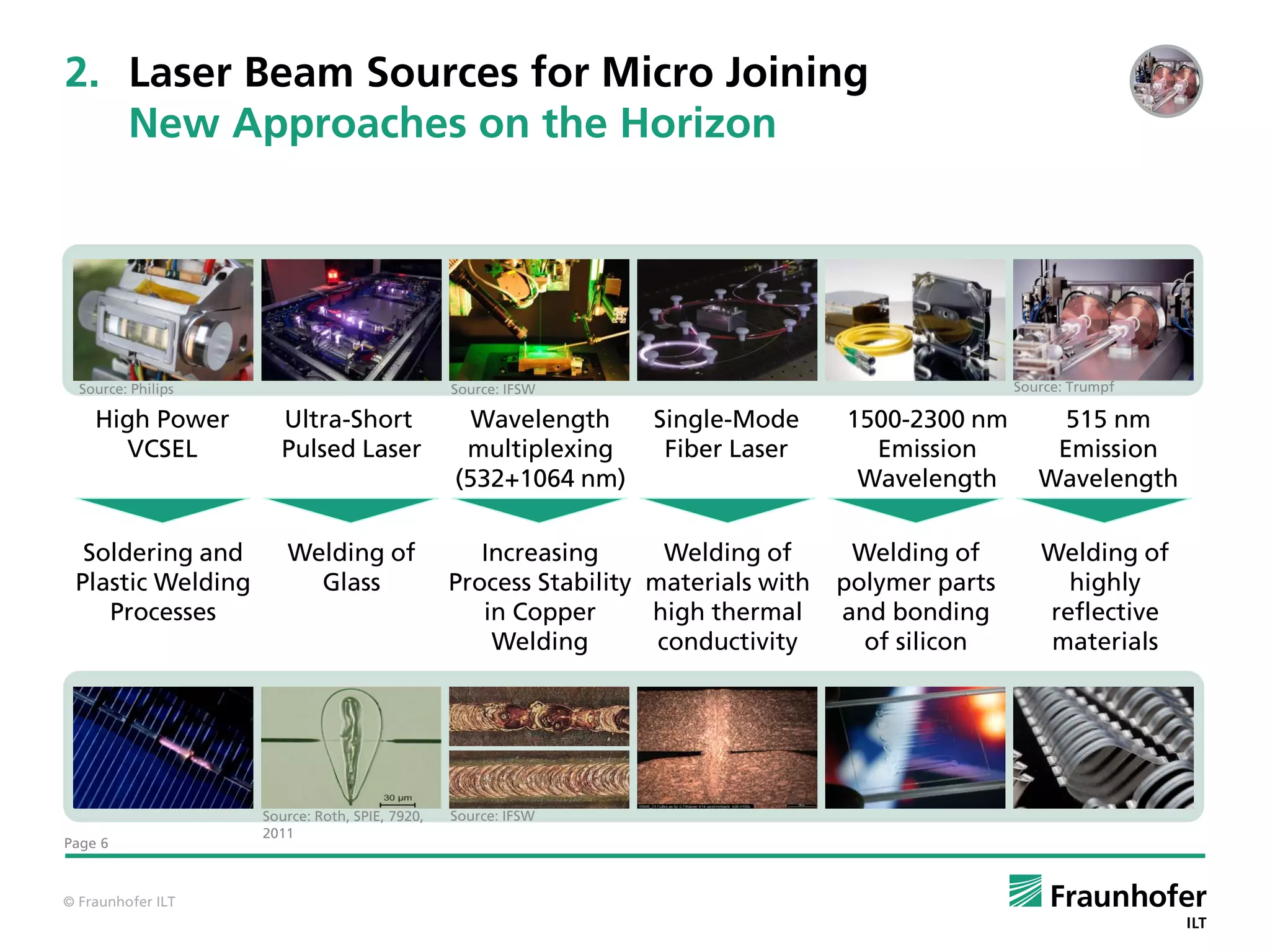
2. Laser Beam Sources for Micro Joining
   New Approaches on the Horizon


  Source: Philips                               Source: IFSW                                       Source: Trumpf

    High Power        Ultra-Short                 Wavelength      Single-Mode      1500-2300 nm         515 nm
      VCSEL           Pulsed Laser               multiplexing      Fiber Laser       Emission          Emission
                                                (532+1064 nm)                       Wavelength        Wavelength

  Soldering and        Welding of                  Increasing       Welding of      Welding of        Welding of
 Plastic Welding         Glass                  Process Stability materials with   polymer parts        highly
    Processes                                      in Copper      high thermal     and bonding        reflective
                                                    Welding        conductivity      of silicon       materials


                    Source: Roth, SPIE, 7920,   Source: IFSW
                    2011
Page 6


© Fraunhofer ILT
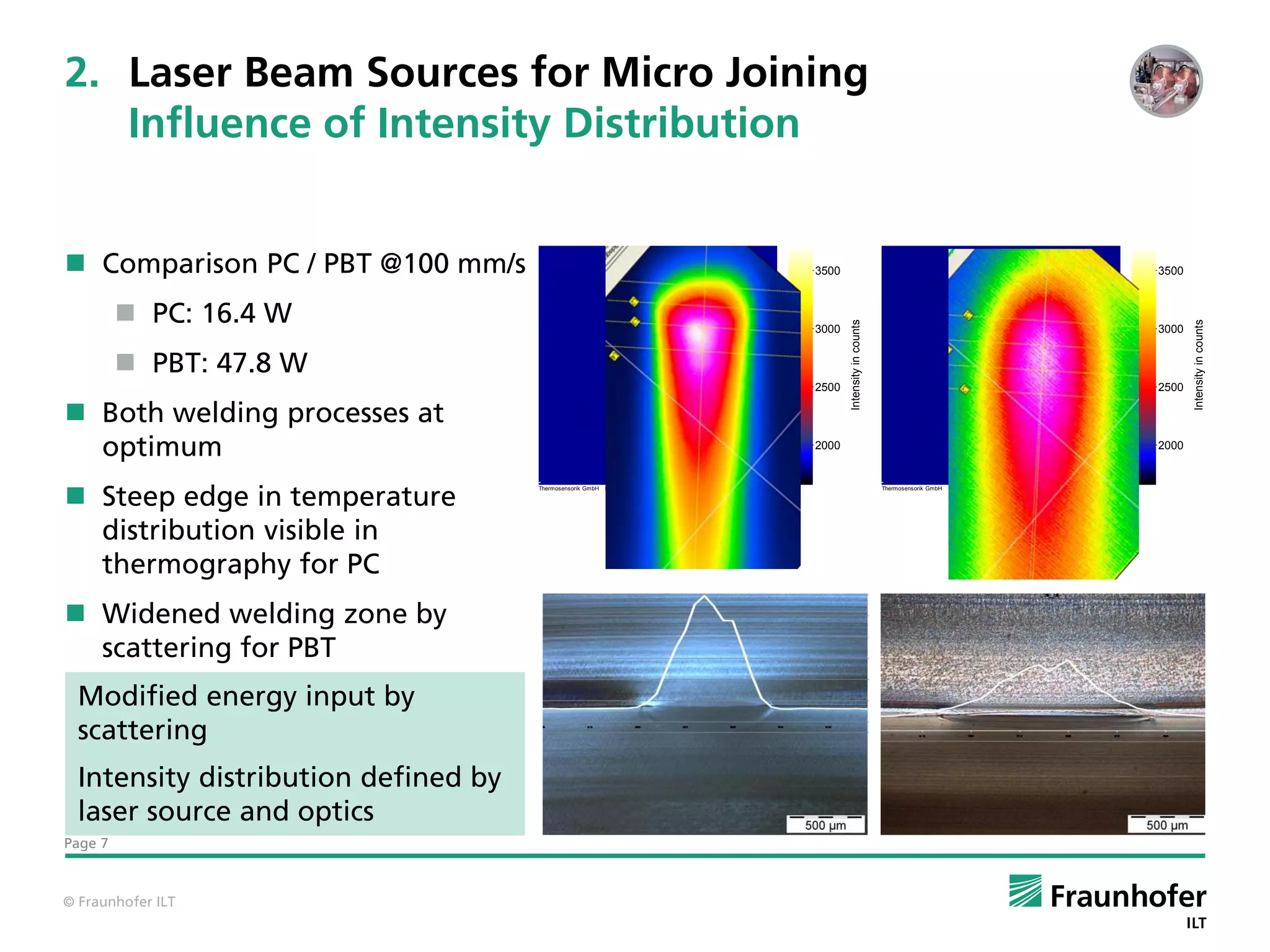
2. Laser Beam Sources for Micro Joining
   Influence of Intensity Distribution


 Comparison PC / PBT @100 mm/s                                          3500                                                            3500


          PC: 16.4 W


                                                                                Intensity in counts


                                                                                                                                                Intensity in counts
                                                                         3000                                                            3000


          PBT: 47.8 W
                                                                         2500                                                            2500

 Both welding processes at
  optimum                                                                2000                                                            2000


 Steep edge in temperature
                                      Thermosensorik GmbH   IR Sy stem                                Thermosensorik GmbH   IR Sy stem


  distribution visible in
  thermography for PC
 Widened welding zone by
  scattering for PBT
  Modified energy input by
  scattering
  Intensity distribution defined by
  laser source and optics
Page 7


© Fraunhofer ILT
3. Beam Manipulation Strategies
   Variable Intensity Profile in Time and Space


                                                                                 Intensität [W/ cm²]                  Intensität [W/ cm²]
                                                                                         0,0E+00                              0,0E+00
                                              0,2                             0,2        2,8E+03                              1,9E+03
                                                                                         5,5E+03                              3,8E+03
                                                                                         8,3E+03                              5,6E+03
                                                                                         1,1E+04                              7,5E+03
                                                                                         1,4E+04                              9,4E+03
                                                                                         1,7E+04                              1,1E+04


                                     y [mm]


                                                                     y [mm]
                                                                                         1,9E+04                              1,3E+04
                                              0,0                              0,0       2,2E+04                              1,5E+04
                                                                                         2,5E+04                              1,7E+04
                                                                                         2,8E+04                              1,9E+04
                                                                                         3,0E+04                              2,1E+04
                                                                                         3,3E+04                              2,3E+04
                                                                                         3,6E+04                              2,4E+04
                                                                                         3,9E+04                              2,6E+04
                                              -0,2                            -0,2       4,1E+04                              2,8E+04
                                                                                         4,4E+04                              3,0E+04
                                                                                         4,7E+04                              3,2E+04
                                                     -0,2    0,0     0,2               -0,2             0,0     0,2
                                                            x [mm]                                     x [mm]


            Beam Shaping                             Spatial Power                                                                              Temporal Power
                                                      Modulation                                                                                  Modulation
         • M-Shape               •              Fast Beam                                                                                   •   Rising Time
         • Circle                               Deflection                                                                                  •   Frequency
         • Diffractive Optical   •              Lissajous-                                                                                  •   Different
           Elements (DOE)                       oscillation                                                                                     modulation shapes
                                                geometries
                                                                                                                                            •   Amplitude
                                 •              Frequency
                                 •              Amplitude
Page 8


© Fraunhofer ILT
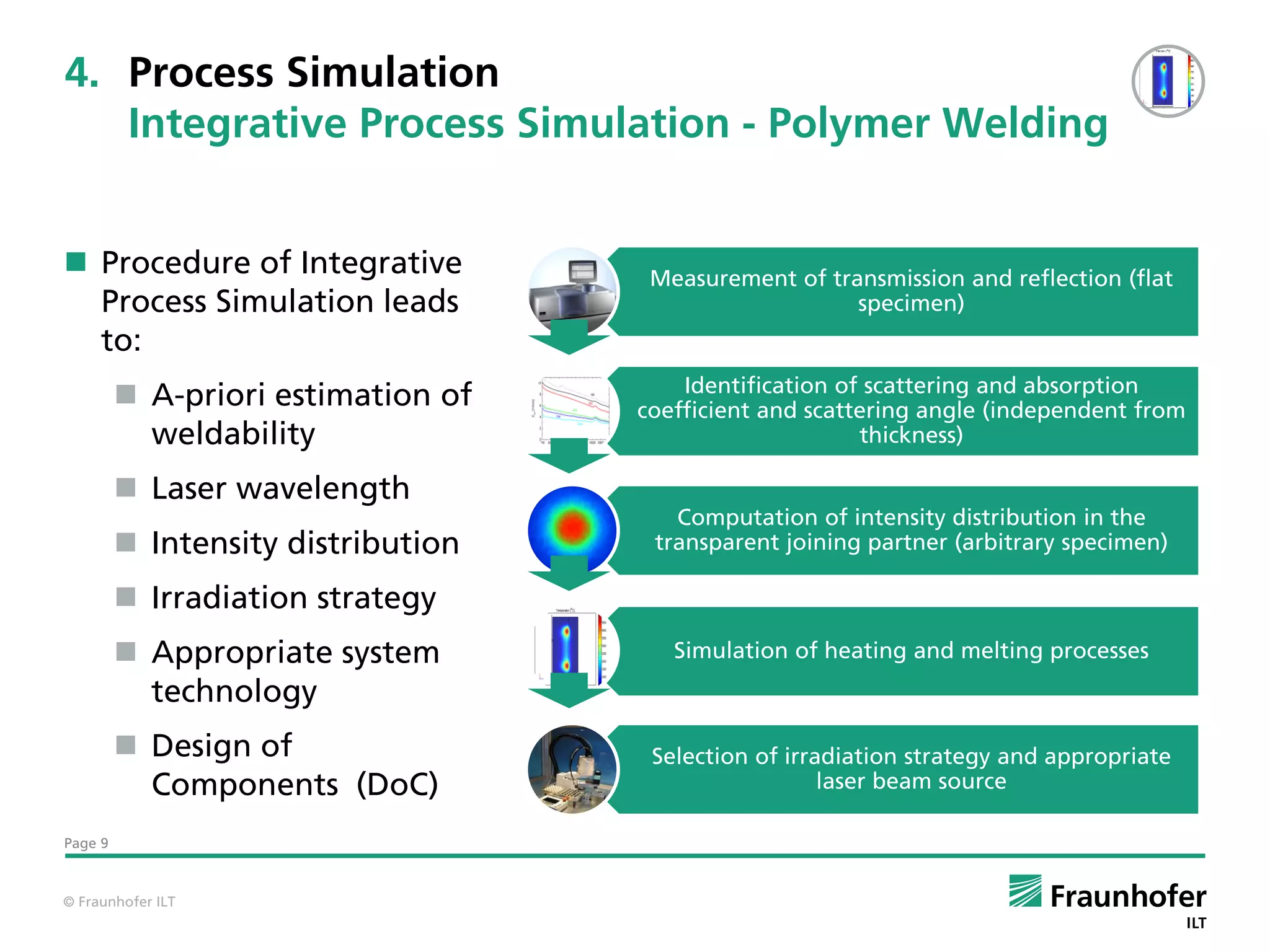
4. Process Simulation
   Integrative Process Simulation - Polymer Welding


 Procedure of Integrative           Measurement of transmission and reflection (flat
  Process Simulation leads                             specimen)
  to:
                                        Identification of scattering and absorption
          A-priori estimation of   coefficient and scattering angle (independent from
           weldability                                   thickness)

          Laser wavelength
                                       Computation of intensity distribution in the
          Intensity distribution    transparent joining partner (arbitrary specimen)

          Irradiation strategy
          Appropriate system          Simulation of heating and melting processes
           technology
          Design of                 Selection of irradiation strategy and appropriate
           Components (DoC)                           laser beam source

Page 9


© Fraunhofer ILT
4. Process Simulation
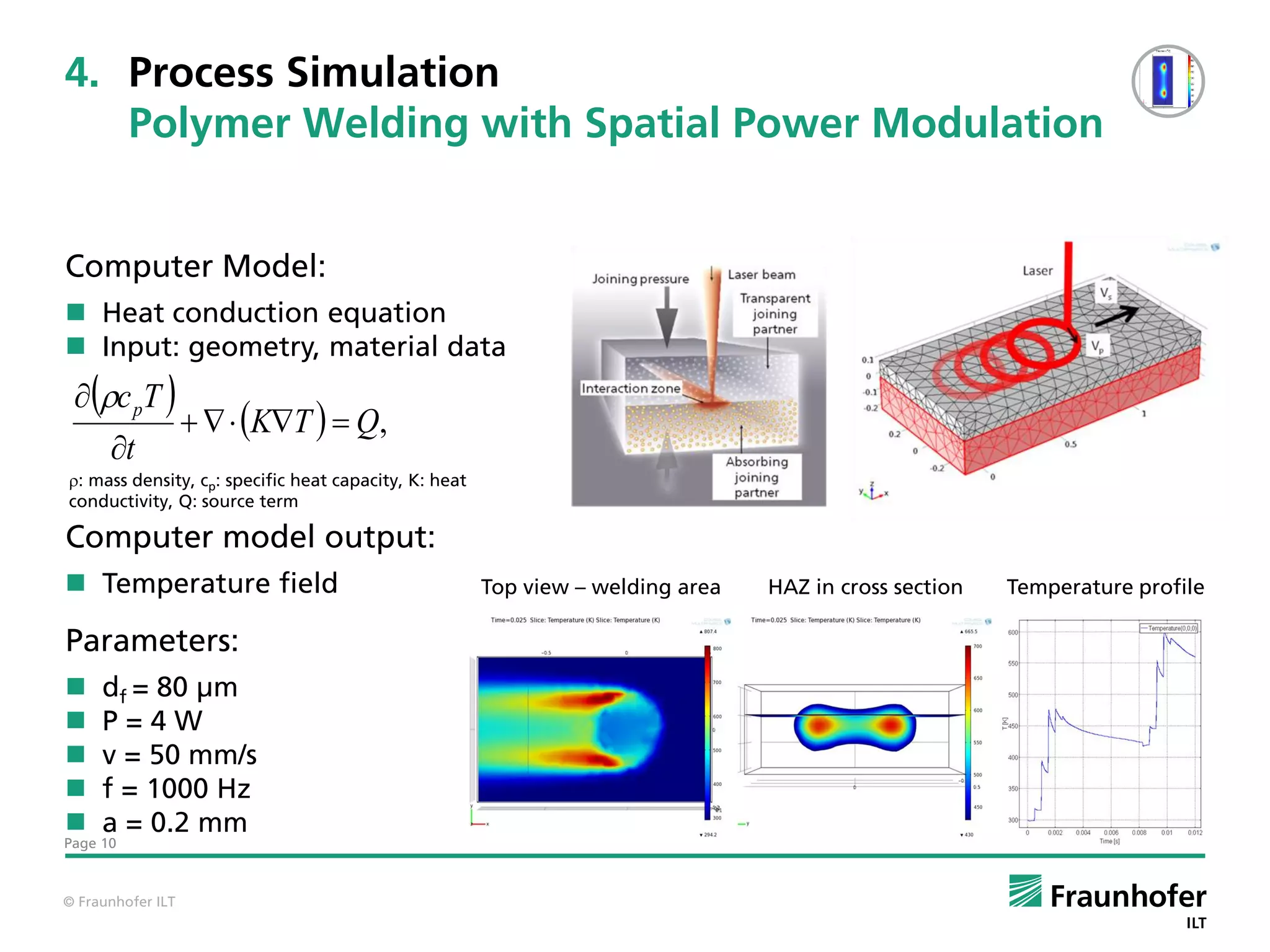
   Polymer Welding with Spatial Power Modulation


Computer Model:
 Heat conduction equation
 Input: geometry, material data
  c pT 
                      KT   Q,
      t
: mass density, cp: specific heat capacity, K: heat
: mass density, c : specific heat capacity, K: heat conductivity, Q: source term.
conductivity, Q: source term
                           p

Computer model output:
 Temperature field                                    Top view – welding area   HAZ in cross section   Temperature profile

Parameters:
    df = 80 µm
    P=4W
    v = 50 mm/s
    f = 1000 Hz
    a = 0.2 mm
Page 10


© Fraunhofer ILT
4. Process Simulation
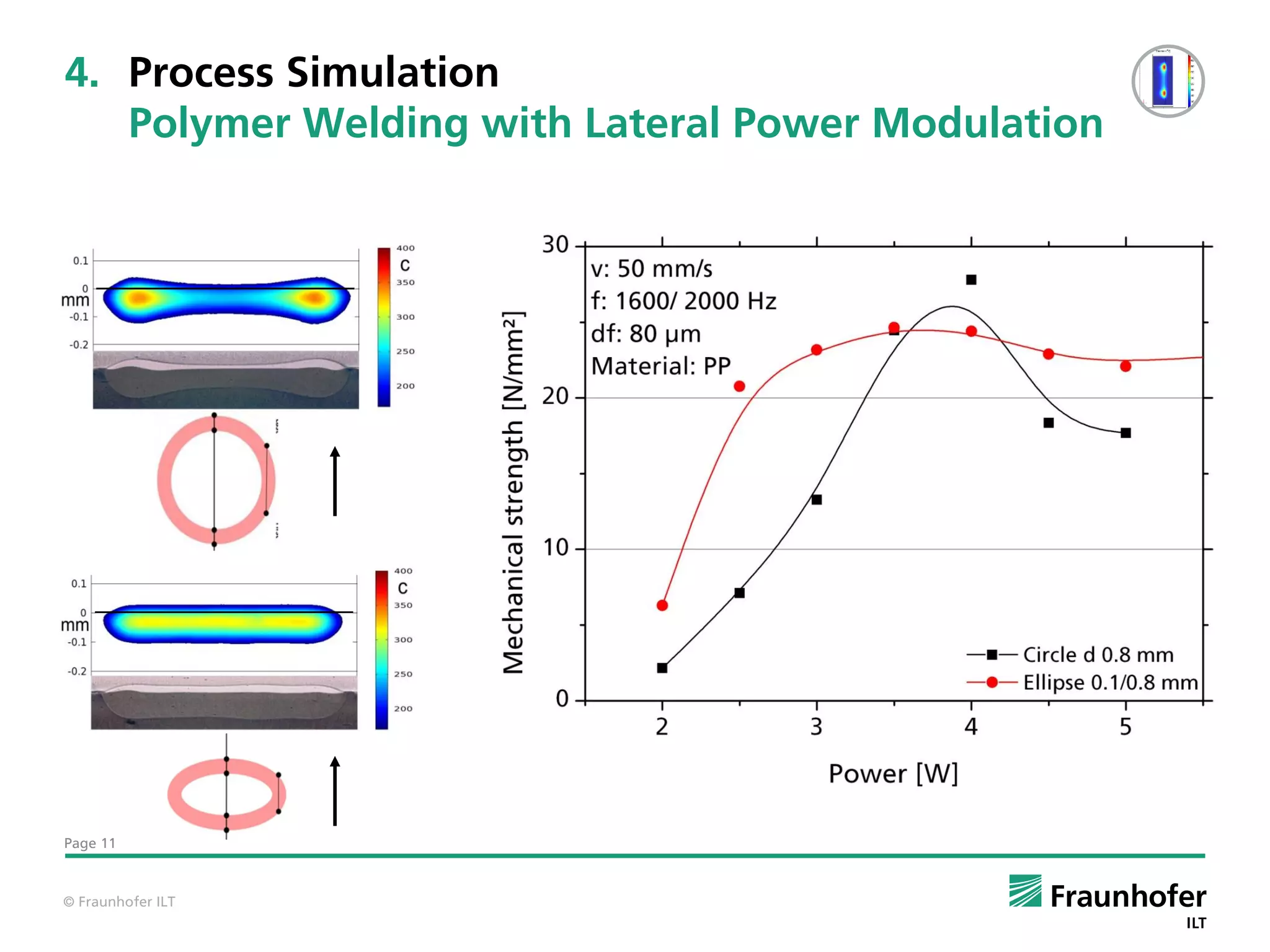
   Polymer Welding with Lateral Power Modulation


Page 11


© Fraunhofer ILT
5. Current Approaches in Research and Development
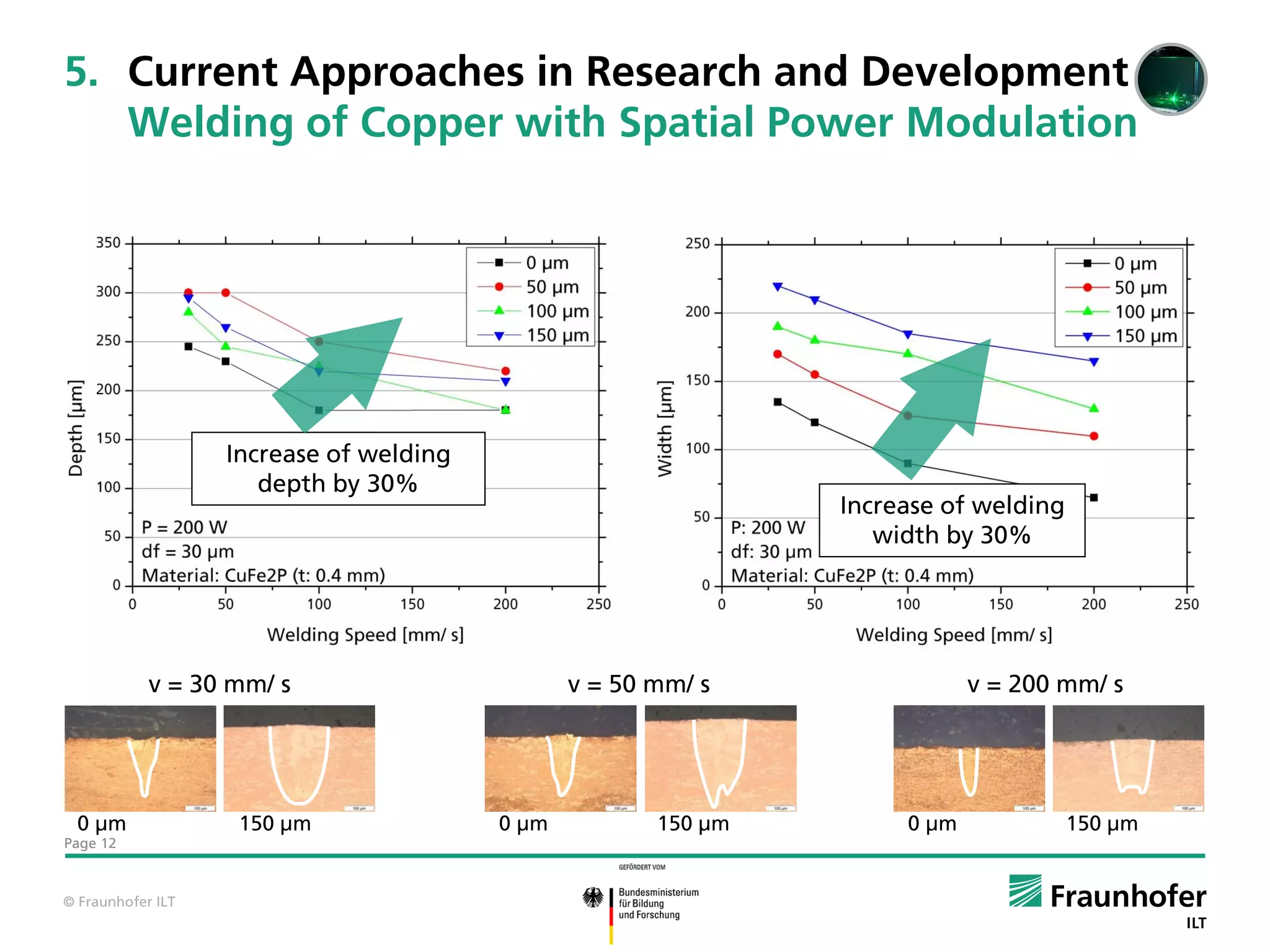
   Welding of Copper with Spatial Power Modulation


                   Increase of welding
                      depth by 30%
                                                                Increase of welding
                                                                   width by 30%


            v = 30 mm/ s                        v = 50 mm/ s                v = 200 mm/ s


 0 µm               150 µm               0 µm          150 µm        0 µm             150 µm
Page 12


© Fraunhofer ILT
5. Current Approaches in Research and Development
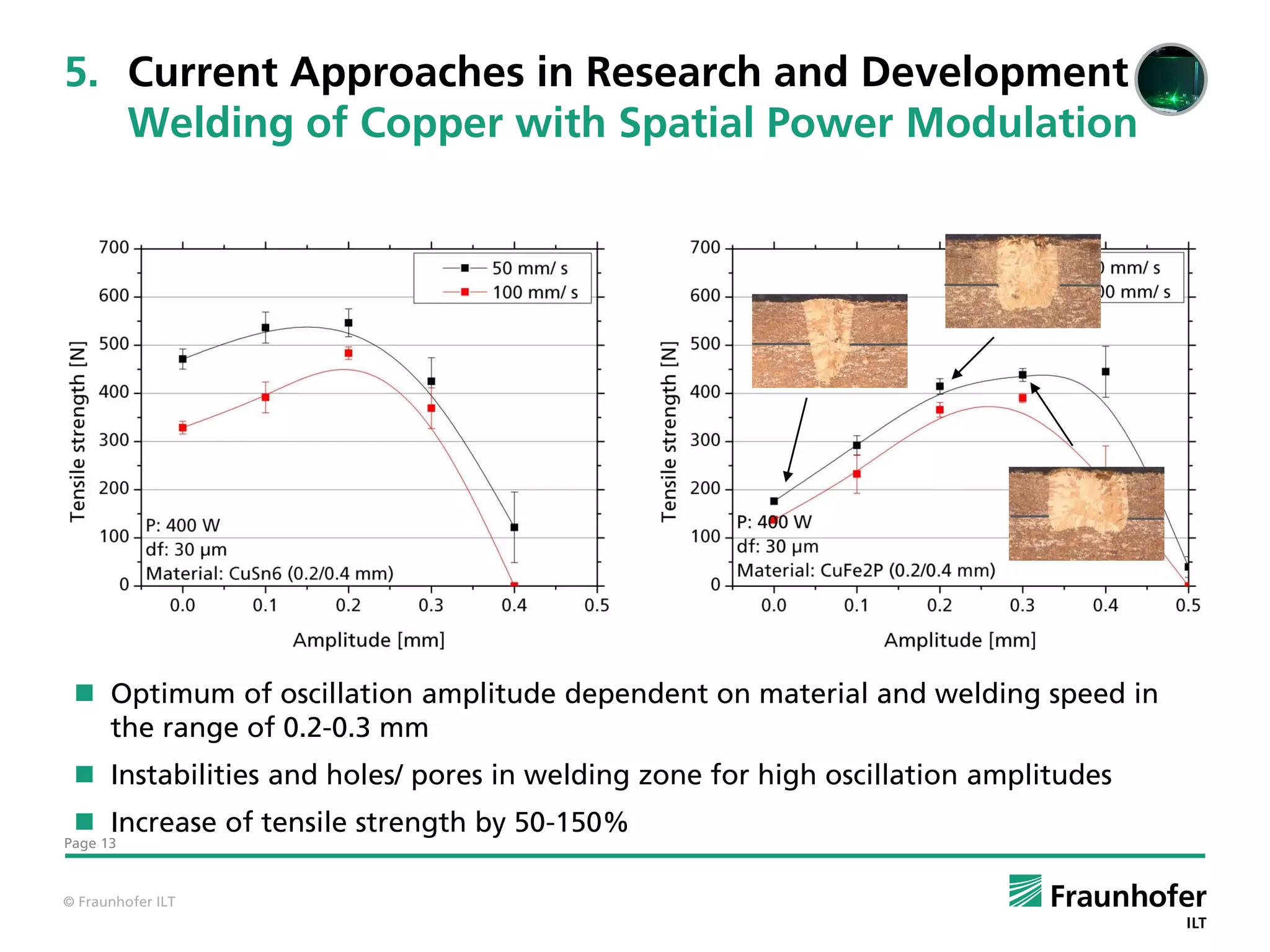
   Welding of Copper with Spatial Power Modulation


  Optimum of oscillation amplitude dependent on material and welding speed in
   the range of 0.2-0.3 mm
  Instabilities and holes/ pores in welding zone for high oscillation amplitudes
  Increase of tensile strength by 50-150%
Page 13


© Fraunhofer ILT
5. Current Approaches in Research and Development
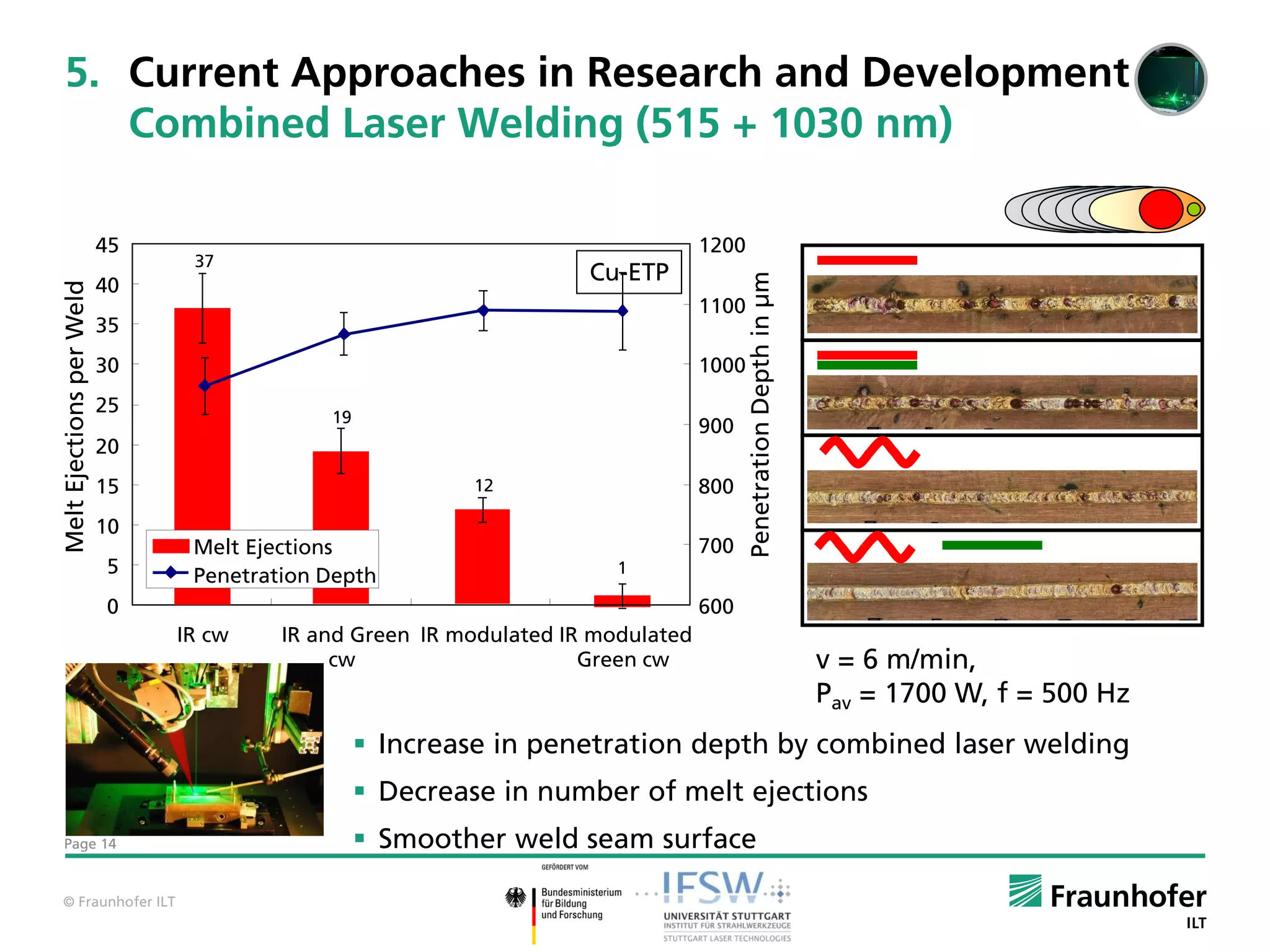
   Combined Laser Welding (515 + 1030 nm)

                          45                                                     1200
                                37
                                                                    Cu-ETP


                                                                                        Penetration Depth in µm
                          40
Melt Ejections per Weld


                                                                                 1100
                          35
                          30                                                     1000
                          25
                                            19
                                                                                 900
                          20
                          15                             12                      800
                          10
                                Melt Ejections                                   700
                          5     Penetration Depth                      1

                          0                                                      600
                               IR cw    IR and Green IR modulated IR modulated
                                             cw                     Green cw                                      v = 6 m/min,
                                                                                                                  Pav = 1700 W, f = 500 Hz
                                                  Increase in penetration depth by combined laser welding
                                                  Decrease in number of melt ejections
Page 14                                           Smoother weld seam surface

© Fraunhofer ILT
5. Current Approaches in Research and Development
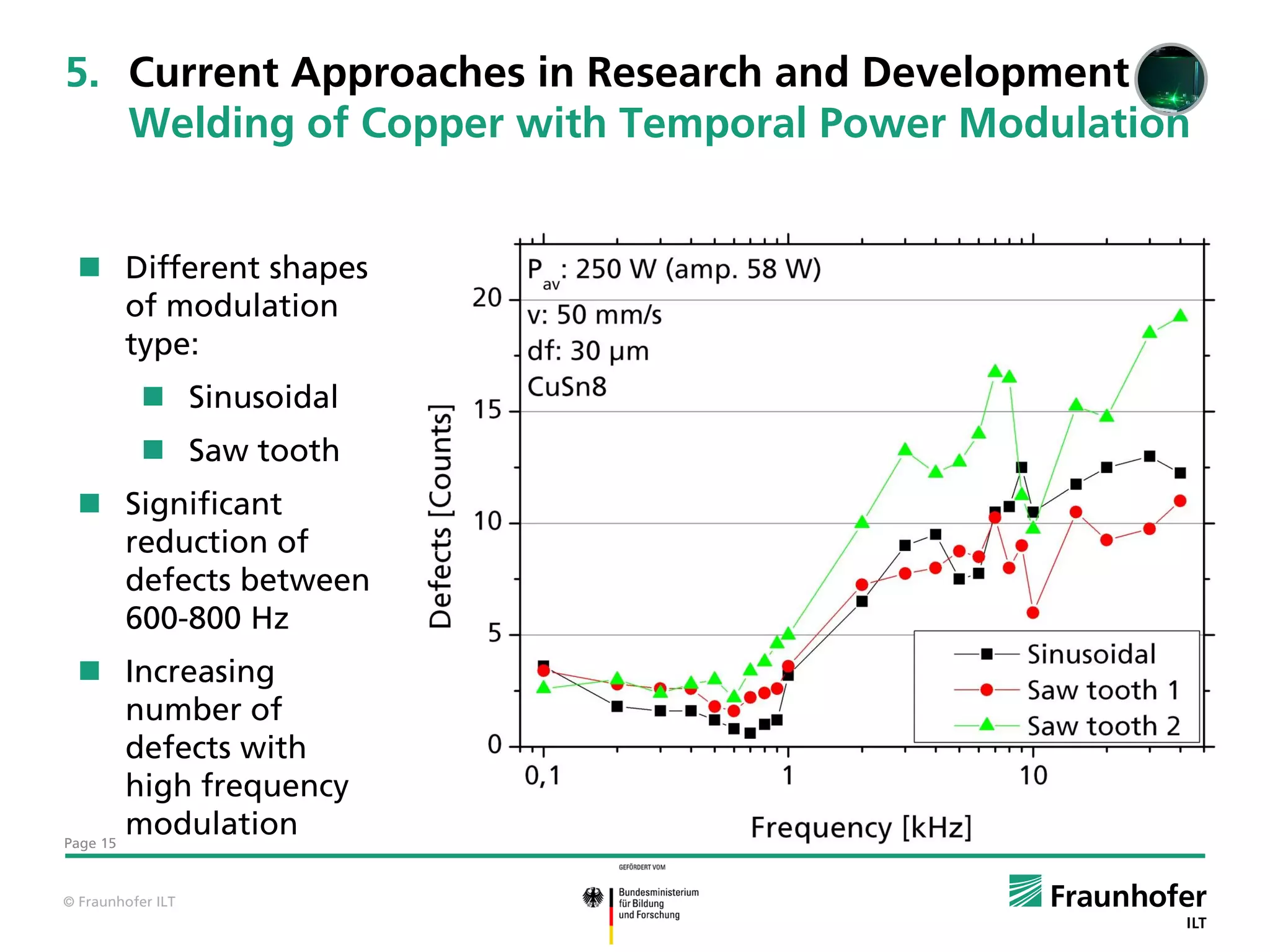
   Welding of Copper with Temporal Power Modulation


   Different shapes
    of modulation
    type:
            Sinusoidal
            Saw tooth
   Significant
    reduction of
    defects between
    600-800 Hz
   Increasing
        number of
        defects with
        high frequency
Page 15
        modulation

© Fraunhofer ILT
5. Current Approaches in Research and Development
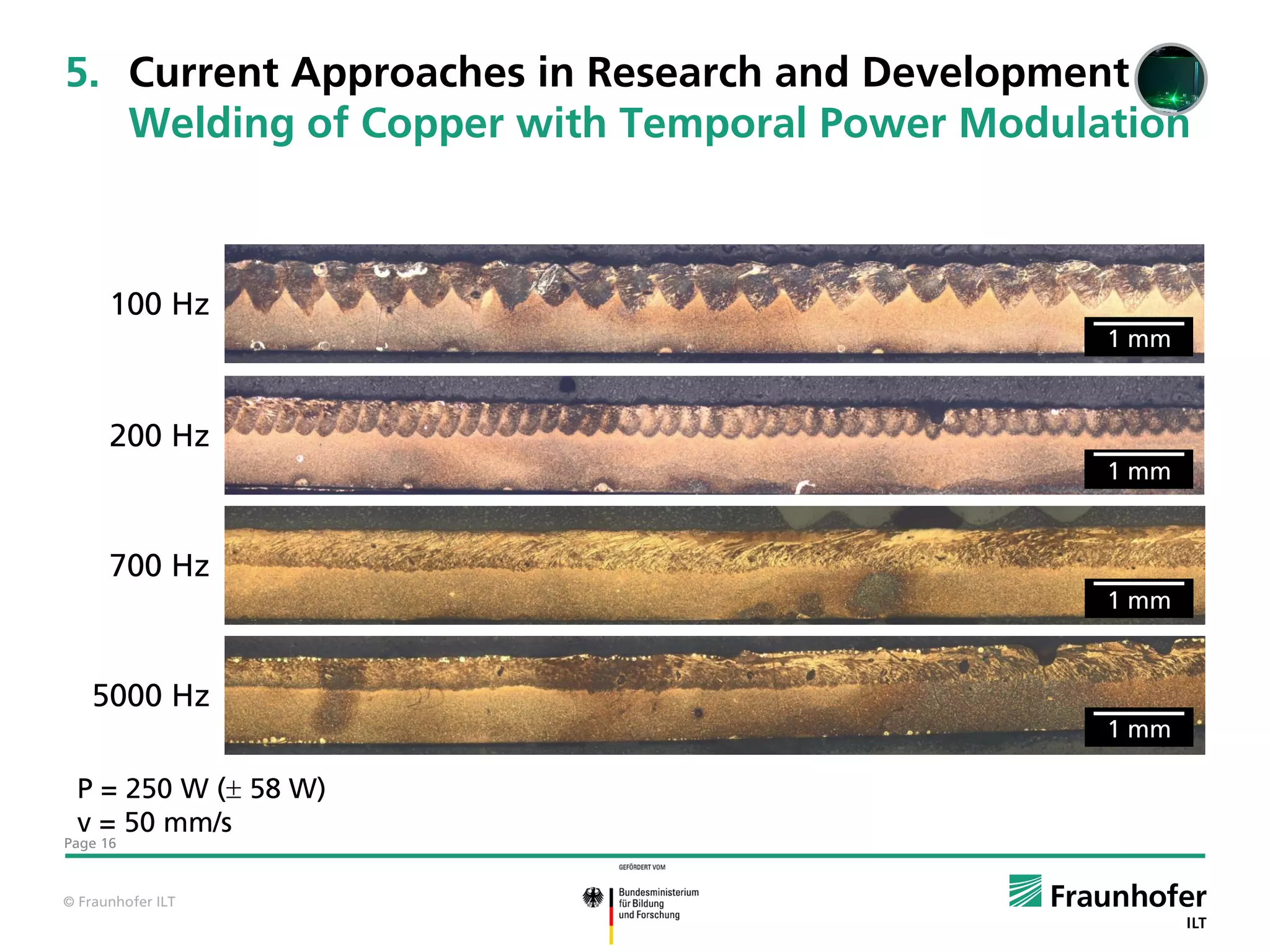
   Welding of Copper with Temporal Power Modulation


      100 Hz
                                               1 mm


      200 Hz
                                               1 mm


      700 Hz
                                               1 mm


    5000 Hz
                                               1 mm

 P = 250 W ( 58 W)
 v = 50 mm/s
Page 16


© Fraunhofer ILT
6. Developments in System Technology
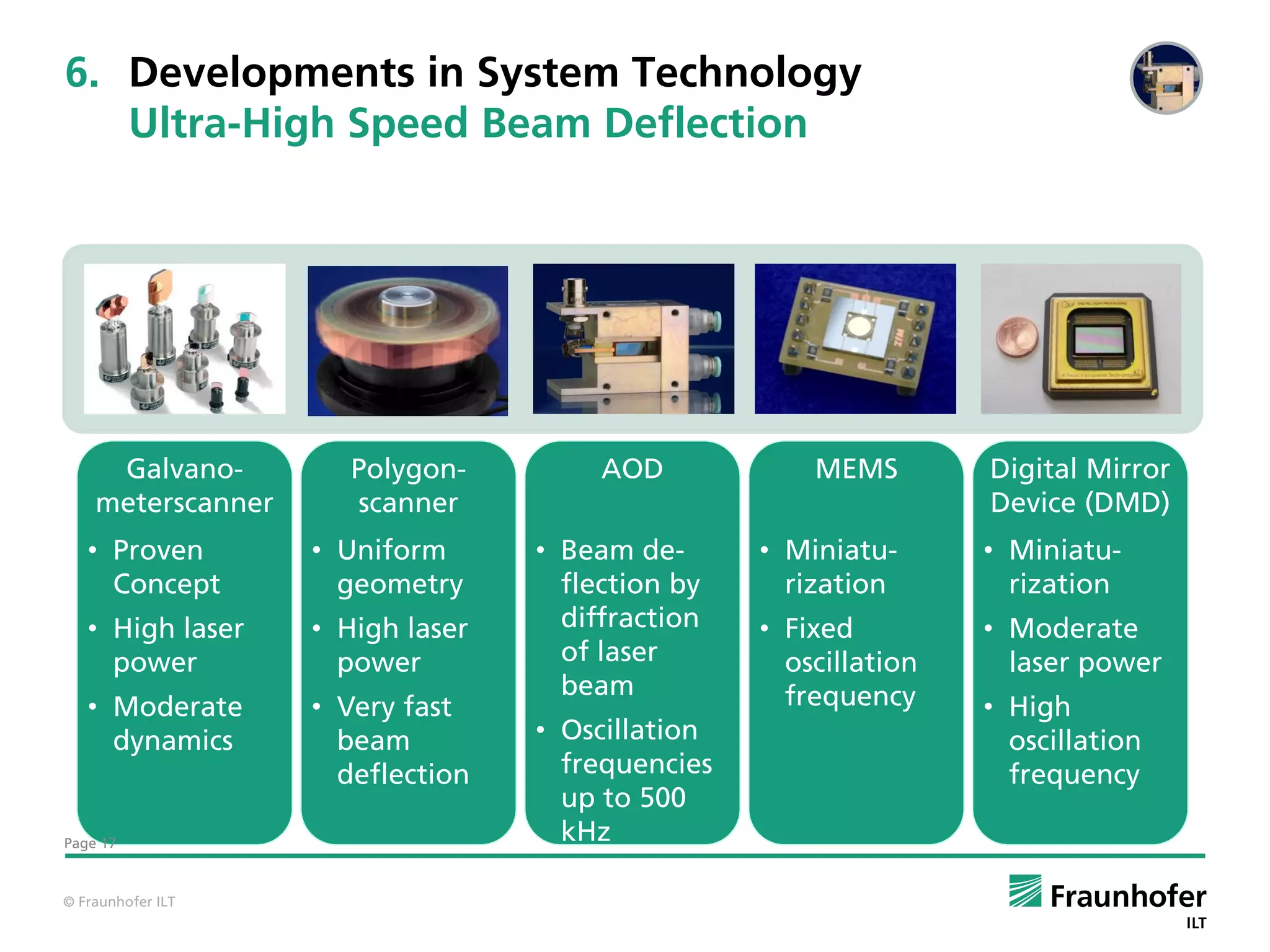
   Ultra-High Speed Beam Deflection


     Galvano-         Polygon-         AOD            MEMS        Digital Mirror
    meterscanner      scanner                                     Device (DMD)
   • Proven        • Uniform      • Beam de-      • Miniatu-      • Miniatu-
     Concept         geometry       flection by     rization        rization
   • High laser    • High laser     diffraction   • Fixed         • Moderate
     power           power          of laser        oscillation     laser power
                                    beam            frequency
   • Moderate      • Very fast                                    • High
     dynamics        beam         • Oscillation                     oscillation
                     deflection     frequencies                     frequency
                                    up to 500
Page 17
                                    kHz

© Fraunhofer ILT
7. Questions of the Future
   Precision Melt Engineering


 Manipulation of the liquid melt by temporal and spatial power
  modulation leading to an increase in welding precision
 Welding of joining partners in the thickness below 10 µm (e.g.
  welding on metallic coatings)
 Best suited intensity distribution depending on characteristics of
  materials or laser beam sources
 Adaptions in modelling and simulation in neglected 3. dimension
 Simultaneous welding like in E-beam welding
 Process control for highly dynamic beam manipulation


Page 18


© Fraunhofer ILT
Thank you very much for your attention!


 Dipl.-Ing. Benjamin Mehlmann

 Fraunhofer-Institut für Lasertechnik
 Tel.:             +49 (0) 241 89 06 -613
 Fax:              +49 (0) 241 89 06 -121
 Email:            benjamin.mehlmann@ilt.fraunhofer.de
 Thanks to:
 Andreas Heider, Axel Hess (IFSW Stuttgart)
 Stephan Gronenborn, Holger Mönch (Philips)


© Fraunhofer ILT

Benjamin Mehlmann - Fraunhofer Institute

  • 1.
    LASER MICRO JOINING- PROCESSES AND APPLICATIONS IN RESEARCH AND DEVELOPMENT A. Gillner, B. Mehlmann, A. Olowinsky, A. Roesner, F. Schmitt Eindhoven, 06 December 2012 © Fraunhofer ILT
  • 2.
    OUTLINE 1. Applications for Laser Micro Joining 2. Laser Beam Sources for Micro Joining 3. Beam Manipulation Strategies 4. Process Simulation 5. Current Approaches in Research and Development 6. Developments in System Technology 7. Questions of the Future Page 2 © Fraunhofer ILT
  • 3.
    1. Applications forLaser Micro Joining Energy, Electronics and Lightweight Construction Welding Glass Soldering Plastic welding Soldering High Power Energy storage CRP/ GRP Photovoltaics Electronics Page 3 © Fraunhofer ILT
  • 4.
    1. Applications forLaser Micro Joining Energy, Electronics and Lightweight Construction Requirements for welding of CRP  Thermoplastic matrix  Joining area visible for laser beam  Translucent joining partner (GF) with minimum transmission of 25%for laser radiation  Laser absorbing joining partner (CF/GF carbon-black filled)  Appropriate contact between joining partners by adapted clamping device Page 4 © Fraunhofer ILT
  • 5.
    1. Applications forLaser Micro Joining Energy, Electronics and Lightweight Construction 15 Laser Beam Penetration Line Energy [J/m m ] Al 0,5 Conductors 10 Cu 0,3 5 Pouch Cell Plate Cooler Not Connected 0 0 50 100 150 200 Feed [mm/s] Welding geometry:  Overlap, Al conductor top Requirements for welding process  Linear weld seam  Stabilized process in small working range Parameter:  Enlarged cross-section for enhanced conductivity  df = 80 µm  P = 500 - 1 000 W  Welding of dissimilar materials  Page 5 v = 50 - 200 mm/s © Fraunhofer ILT
  • 6.
    2. Laser BeamSources for Micro Joining New Approaches on the Horizon Source: Philips Source: IFSW Source: Trumpf High Power Ultra-Short Wavelength Single-Mode 1500-2300 nm 515 nm VCSEL Pulsed Laser multiplexing Fiber Laser Emission Emission (532+1064 nm) Wavelength Wavelength Soldering and Welding of Increasing Welding of Welding of Welding of Plastic Welding Glass Process Stability materials with polymer parts highly Processes in Copper high thermal and bonding reflective Welding conductivity of silicon materials Source: Roth, SPIE, 7920, Source: IFSW 2011 Page 6 © Fraunhofer ILT
  • 7.
    2. Laser BeamSources for Micro Joining Influence of Intensity Distribution  Comparison PC / PBT @100 mm/s 3500 3500  PC: 16.4 W Intensity in counts Intensity in counts 3000 3000  PBT: 47.8 W 2500 2500  Both welding processes at optimum 2000 2000  Steep edge in temperature Thermosensorik GmbH IR Sy stem Thermosensorik GmbH IR Sy stem distribution visible in thermography for PC  Widened welding zone by scattering for PBT Modified energy input by scattering Intensity distribution defined by laser source and optics Page 7 © Fraunhofer ILT
  • 8.
    3. Beam ManipulationStrategies Variable Intensity Profile in Time and Space Intensität [W/ cm²] Intensität [W/ cm²] 0,0E+00 0,0E+00 0,2 0,2 2,8E+03 1,9E+03 5,5E+03 3,8E+03 8,3E+03 5,6E+03 1,1E+04 7,5E+03 1,4E+04 9,4E+03 1,7E+04 1,1E+04 y [mm] y [mm] 1,9E+04 1,3E+04 0,0 0,0 2,2E+04 1,5E+04 2,5E+04 1,7E+04 2,8E+04 1,9E+04 3,0E+04 2,1E+04 3,3E+04 2,3E+04 3,6E+04 2,4E+04 3,9E+04 2,6E+04 -0,2 -0,2 4,1E+04 2,8E+04 4,4E+04 3,0E+04 4,7E+04 3,2E+04 -0,2 0,0 0,2 -0,2 0,0 0,2 x [mm] x [mm] Beam Shaping Spatial Power Temporal Power Modulation Modulation • M-Shape • Fast Beam • Rising Time • Circle Deflection • Frequency • Diffractive Optical • Lissajous- • Different Elements (DOE) oscillation modulation shapes geometries • Amplitude • Frequency • Amplitude Page 8 © Fraunhofer ILT
  • 9.
    4. Process Simulation Integrative Process Simulation - Polymer Welding  Procedure of Integrative Measurement of transmission and reflection (flat Process Simulation leads specimen) to: Identification of scattering and absorption  A-priori estimation of coefficient and scattering angle (independent from weldability thickness)  Laser wavelength Computation of intensity distribution in the  Intensity distribution transparent joining partner (arbitrary specimen)  Irradiation strategy  Appropriate system Simulation of heating and melting processes technology  Design of Selection of irradiation strategy and appropriate Components (DoC) laser beam source Page 9 © Fraunhofer ILT
  • 10.
    4. Process Simulation Polymer Welding with Spatial Power Modulation Computer Model:  Heat conduction equation  Input: geometry, material data  c pT     KT   Q, t : mass density, cp: specific heat capacity, K: heat : mass density, c : specific heat capacity, K: heat conductivity, Q: source term. conductivity, Q: source term p Computer model output:  Temperature field Top view – welding area HAZ in cross section Temperature profile Parameters:  df = 80 µm  P=4W  v = 50 mm/s  f = 1000 Hz  a = 0.2 mm Page 10 © Fraunhofer ILT
  • 11.
    4. Process Simulation Polymer Welding with Lateral Power Modulation Page 11 © Fraunhofer ILT
  • 12.
    5. Current Approachesin Research and Development Welding of Copper with Spatial Power Modulation Increase of welding depth by 30% Increase of welding width by 30% v = 30 mm/ s v = 50 mm/ s v = 200 mm/ s 0 µm 150 µm 0 µm 150 µm 0 µm 150 µm Page 12 © Fraunhofer ILT
  • 13.
    5. Current Approachesin Research and Development Welding of Copper with Spatial Power Modulation  Optimum of oscillation amplitude dependent on material and welding speed in the range of 0.2-0.3 mm  Instabilities and holes/ pores in welding zone for high oscillation amplitudes  Increase of tensile strength by 50-150% Page 13 © Fraunhofer ILT
  • 14.
    5. Current Approachesin Research and Development Combined Laser Welding (515 + 1030 nm) 45 1200 37 Cu-ETP Penetration Depth in µm 40 Melt Ejections per Weld 1100 35 30 1000 25 19 900 20 15 12 800 10 Melt Ejections 700 5 Penetration Depth 1 0 600 IR cw IR and Green IR modulated IR modulated cw Green cw v = 6 m/min, Pav = 1700 W, f = 500 Hz  Increase in penetration depth by combined laser welding  Decrease in number of melt ejections Page 14  Smoother weld seam surface © Fraunhofer ILT
  • 15.
    5. Current Approachesin Research and Development Welding of Copper with Temporal Power Modulation  Different shapes of modulation type:  Sinusoidal  Saw tooth  Significant reduction of defects between 600-800 Hz  Increasing number of defects with high frequency Page 15 modulation © Fraunhofer ILT
  • 16.
    5. Current Approachesin Research and Development Welding of Copper with Temporal Power Modulation 100 Hz 1 mm 200 Hz 1 mm 700 Hz 1 mm 5000 Hz 1 mm P = 250 W ( 58 W) v = 50 mm/s Page 16 © Fraunhofer ILT
  • 17.
    6. Developments inSystem Technology Ultra-High Speed Beam Deflection Galvano- Polygon- AOD MEMS Digital Mirror meterscanner scanner Device (DMD) • Proven • Uniform • Beam de- • Miniatu- • Miniatu- Concept geometry flection by rization rization • High laser • High laser diffraction • Fixed • Moderate power power of laser oscillation laser power beam frequency • Moderate • Very fast • High dynamics beam • Oscillation oscillation deflection frequencies frequency up to 500 Page 17 kHz © Fraunhofer ILT
  • 18.
    7. Questions ofthe Future Precision Melt Engineering  Manipulation of the liquid melt by temporal and spatial power modulation leading to an increase in welding precision  Welding of joining partners in the thickness below 10 µm (e.g. welding on metallic coatings)  Best suited intensity distribution depending on characteristics of materials or laser beam sources  Adaptions in modelling and simulation in neglected 3. dimension  Simultaneous welding like in E-beam welding  Process control for highly dynamic beam manipulation Page 18 © Fraunhofer ILT
  • 19.
    Thank you verymuch for your attention! Dipl.-Ing. Benjamin Mehlmann Fraunhofer-Institut für Lasertechnik Tel.: +49 (0) 241 89 06 -613 Fax: +49 (0) 241 89 06 -121 Email: benjamin.mehlmann@ilt.fraunhofer.de Thanks to: Andreas Heider, Axel Hess (IFSW Stuttgart) Stephan Gronenborn, Holger Mönch (Philips) © Fraunhofer ILT