Research Overview

   Manav Vohra

    Duke University


  March 21, 2013
Reactive particles


                                                             Applications:
                                                                 ultra-high strength
                                                                 materials
                                                                 high performance
                                                                 coatings
                                                                 high performance
                                                                 capacitors and
                                                                 magnetic
                                                                 transducers
                                                                 smart materials for
                                                                 sensors
                                                                 high performance
                                                                 visible optics
                                                                 bio-agent defeat


                        (Fritz et al.)

   Manav Vohra (Duke)                    Research Overview          March 21, 2013   2/6
Bio-agent defeat
Background & Motivation:
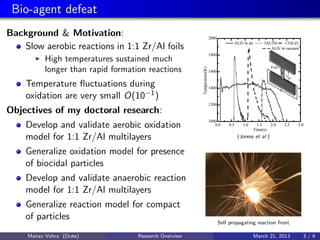
   Slow aerobic reactions in 1:1 Zr/Al foils
           High temperatures sustained much
           longer than rapid formation reactions
    Temperature fluctuations during
    oxidation are very small O(10−1 )
Objectives of my doctoral research:
    Develop and validate aerobic oxidation
    model for 1:1 Zr/Al multilayers                             (Joress et al.)


    Generalize oxidation model for presence
    of biocidal particles
    Develop and validate anaerobic reaction
    model for 1:1 Zr/Al multilayers
    Generalize reaction model for compact
    of particles
                                                        Self propagating reaction front

     Manav Vohra (Duke)             Research Overview                  March 21, 2013     3/6
Oxidation model
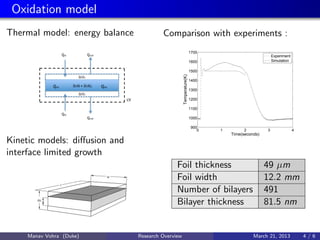
Thermal model: energy balance            Comparison with experiments :
                                                                     1700
                                                                                                    Experiment
                                                                     1600                           Simulation

                                                                     1500


                                                    Temperature(K)
                                                                     1400

                                                                     1300

                                                                     1200

                                                                     1100

                                                                     1000

                                                                     900
                                                                        0   1         2         3                4
                                                                                Time(seconds)
Kinetic models: diffusion and
interface limited growth
                                               Foil thickness                                   49 µm
                                               Foil width                                       12.2 mm
                                               Number of bilayers                               491
                                               Bilayer thickness                                81.5 nm


     Manav Vohra (Duke)         Research Overview                                         March 21, 2013             4/6
Anaerobic reaction model

  Estimate activation energy, Ea for foil
  ignition
        hot plate tests
        explain low estimates
  Predict diffusivity pre-exponent, Do for
  low T by comparing simulations with
  experiments
        Uniform ignition temperature profiles
  Estimate reaction velocities for different
  bilayers
  Estimate and optimize diffusion
  parameters for high T using velocity
  estimates
  Propose a composite diffusivity plot
                                                    Computational domain


  Manav Vohra (Duke)            Research Overview            March 21, 2013   5/6
Front propagation: Zr/Al nanolaminate foil


  Manav Vohra (Duke)   Research Overview     March 21, 2013   6/6

Research Overview

  • 1.
    Research Overview Manav Vohra Duke University March 21, 2013
  • 2.
    Reactive particles Applications: ultra-high strength materials high performance coatings high performance capacitors and magnetic transducers smart materials for sensors high performance visible optics bio-agent defeat (Fritz et al.) Manav Vohra (Duke) Research Overview March 21, 2013 2/6
  • 3.
    Bio-agent defeat Background &Motivation: Slow aerobic reactions in 1:1 Zr/Al foils High temperatures sustained much longer than rapid formation reactions Temperature fluctuations during oxidation are very small O(10−1 ) Objectives of my doctoral research: Develop and validate aerobic oxidation model for 1:1 Zr/Al multilayers (Joress et al.) Generalize oxidation model for presence of biocidal particles Develop and validate anaerobic reaction model for 1:1 Zr/Al multilayers Generalize reaction model for compact of particles Self propagating reaction front Manav Vohra (Duke) Research Overview March 21, 2013 3/6
  • 4.
    Oxidation model Thermal model:energy balance Comparison with experiments : 1700 Experiment 1600 Simulation 1500 Temperature(K) 1400 1300 1200 1100 1000 900 0 1 2 3 4 Time(seconds) Kinetic models: diffusion and interface limited growth Foil thickness 49 µm Foil width 12.2 mm Number of bilayers 491 Bilayer thickness 81.5 nm Manav Vohra (Duke) Research Overview March 21, 2013 4/6
  • 5.
    Anaerobic reaction model Estimate activation energy, Ea for foil ignition hot plate tests explain low estimates Predict diffusivity pre-exponent, Do for low T by comparing simulations with experiments Uniform ignition temperature profiles Estimate reaction velocities for different bilayers Estimate and optimize diffusion parameters for high T using velocity estimates Propose a composite diffusivity plot Computational domain Manav Vohra (Duke) Research Overview March 21, 2013 5/6
  • 6.
    Front propagation: Zr/Alnanolaminate foil Manav Vohra (Duke) Research Overview March 21, 2013 6/6