Fraunhofer Heinrich Hertz Institute 
Fraunhofer Heinrich Hertz Institute, Einsteinufer 37, 10587 Berlin www.hhi.fraunhofer.de 
The H.265/MPEG-HEVC Standard 
IMTC Annual Member Meeting – Redmond, WA, October 16, 2014
Fraunhofer Heinrich Hertz Institute 
© 
20.10.2014 
2 
High Efficiency Video Coding (HEVC) 
HEVC 1.0 – Low Delay Performance 
HEVC 2.0 – The Extensions 
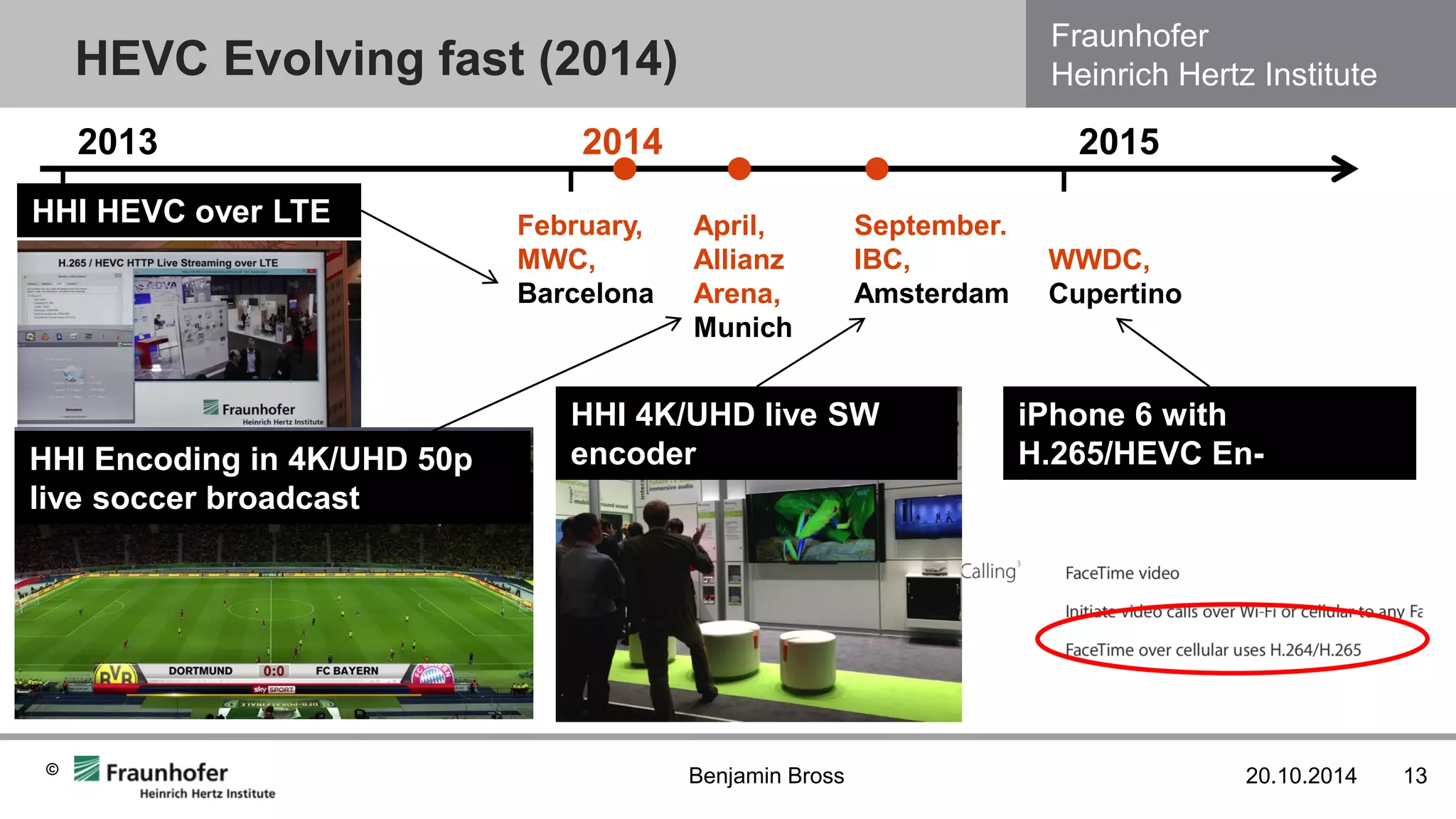
HEVC Evolving fast 
Summary & Outlook 
Outline 
Benjamin Bross
Fraunhofer Heinrich Hertz Institute 
© 
20.10.2014 
3 
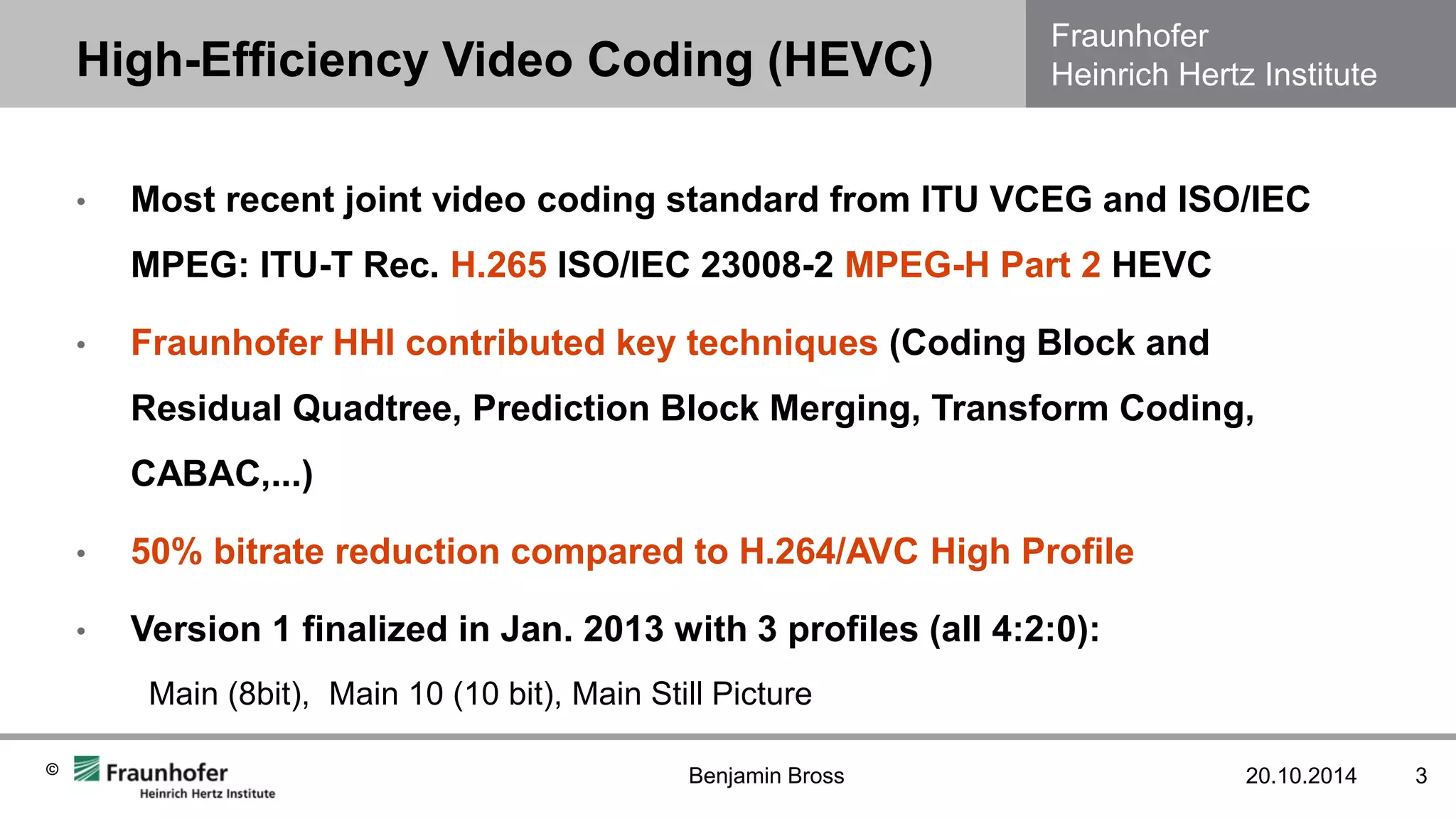
•Most recent joint video coding standard from ITU VCEG and ISO/IEC MPEG: ITU-T Rec. H.265 ISO/IEC 23008-2 MPEG-H Part 2 HEVC 
•Fraunhofer HHI contributed key techniques (Coding Block and Residual Quadtree, Prediction Block Merging, Transform Coding, CABAC,...) 
•50% bitrate reduction compared to H.264/AVC High Profile 
•Version 1 finalized in Jan. 2013 with 3 profiles (all 4:2:0): Main (8bit), Main 10 (10 bit), Main Still Picture 
High-Efficiency Video Coding (HEVC) 
Benjamin Bross
Fraunhofer Heinrich Hertz Institute 
© 
HEVC 1.0 – Performance 
20.10.2014 
4 
Benjamin Bross 
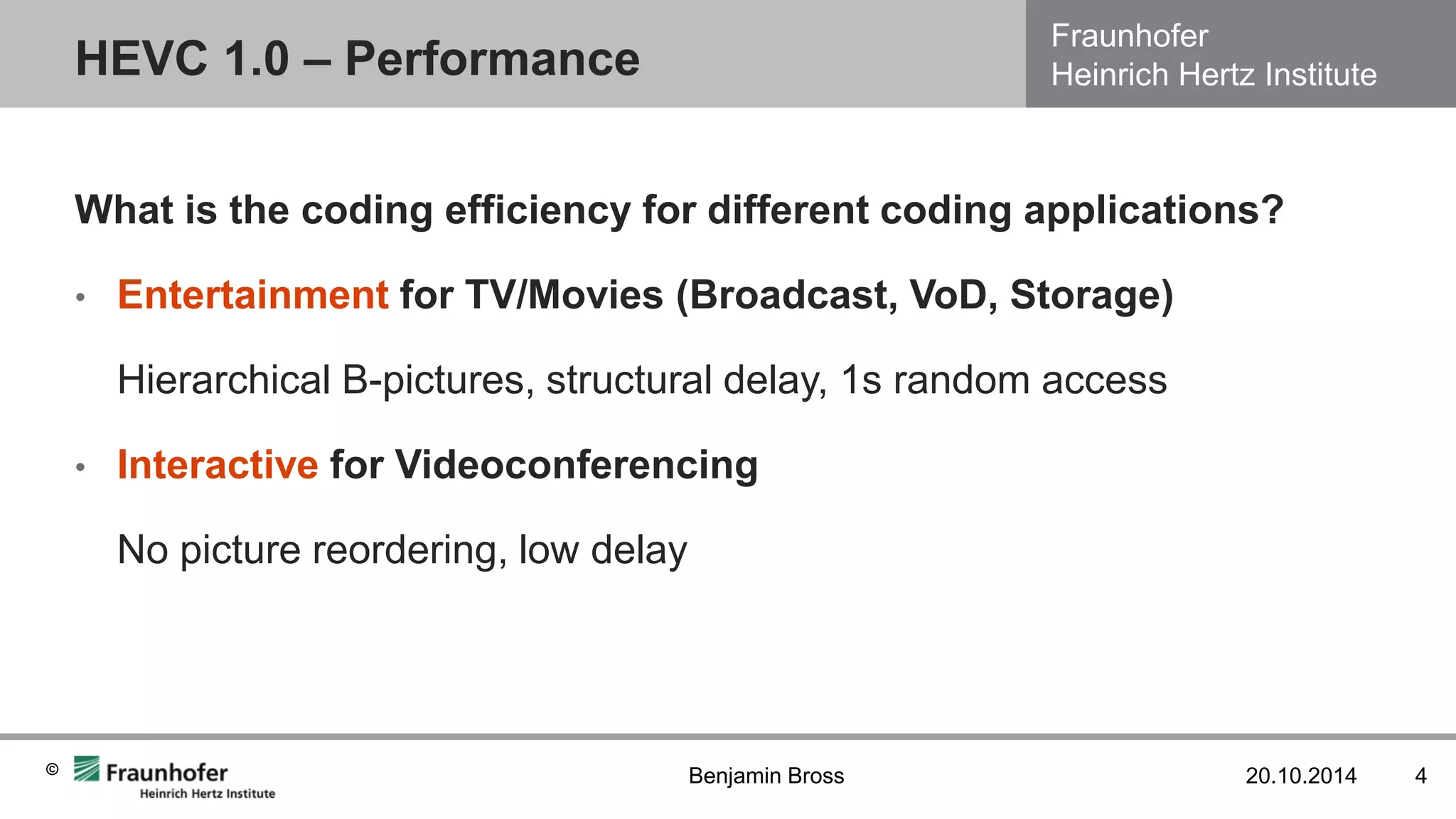
What is the coding efficiency for different coding applications? 
•Entertainment for TV/Movies (Broadcast, VoD, Storage) 
Hierarchical B-pictures, structural delay, 1s random access 
•Interactive for Videoconferencing 
No picture reordering, low delay
Fraunhofer Heinrich Hertz Institute 
© 
Several studies reporting bitrate savings of H.265/HEVC HM Reference Encoder for the same objective/subjective quality: 
HEVC 1.0 – Performance 
20.10.2014 
5 
Benjamin Bross 
AVC HP 
VP9 
AVC HP 
VP9 
Encoder 
Sequences 
Objective [PSNR] 
Subjective [MOS] 
Objective [PSNR] 
Subjective [MOS] 
Objective [PSNR] 
Objective [PSNR] 
AVC 
VP9 
[1] Ohm2012 
35% 
49% 
40% 
JSVM 
JCT-VC 
[2] Grois2013 
39% 
43% 
x264 
WebM 
JCT-VC 
(Class A,B,E, F) 
[3] Rerabek2014 
39% 
53% 
36% 
49% 
JM 
WebM 
4K 
[4] Grois2014 
41% 
33% 
x264 
WebM 
JCT-VC 
(Class E) 
Entertainment (Random Access) 
Interactive (Low Delay)
Fraunhofer Heinrich Hertz Institute 
© 
Several studies reporting bitrate savings of H.265/HEVC HM Reference Encoder for the same objective/subjective quality: 
HEVC 1.0 – Performance 
20.10.2014 
6 
Benjamin Bross 
AVC HP 
VP9 
AVC HP 
VP9 
Encoder 
Sequences 
Objective [PSNR] 
Subjective [MOS] 
Objective [PSNR] 
Subjective [MOS] 
Objective [PSNR] 
Objective [PSNR] 
AVC 
VP9 
[1] Ohm2012 
35% 
49% 
40% 
JSVM 
JCT-VC 
[2] Grois2013 
39% 
43% 
x264 
WebM 
JCT-VC 
(Class A,B,E, F) 
[3] Rerabek2014 
39% 
53% 
36% 
49% 
JM 
WebM 
4K 
[4] Grois2014 
41% 
33% 
x264 
WebM 
JCT-VC 
(Class E) 
Entertainment (Random Access) 
Interactive (Low Delay)
Fraunhofer Heinrich Hertz Institute 
© 
HEVC 1.0 – Low Delay Performance 
20.10.2014 
7 
Benjamin Bross 
Low Delay performance study from Grois et al [4]: 
•Tested publicly available encoders: 
•H.265/HEVC  HM reference encoder 
•H.264/AVC  x264 r2334 
•VP9  WebM v1.2.0-3088-ga81bd12 
•IPPP coding structure (I-picture followed by P-pictures) 
•Three JCT-VC 720p60 class E test sequences
Fraunhofer Heinrich Hertz Institute 
© 
HEVC 1.0 – Low Delay Performance 
20.10.2014 
8 
Benjamin Bross 
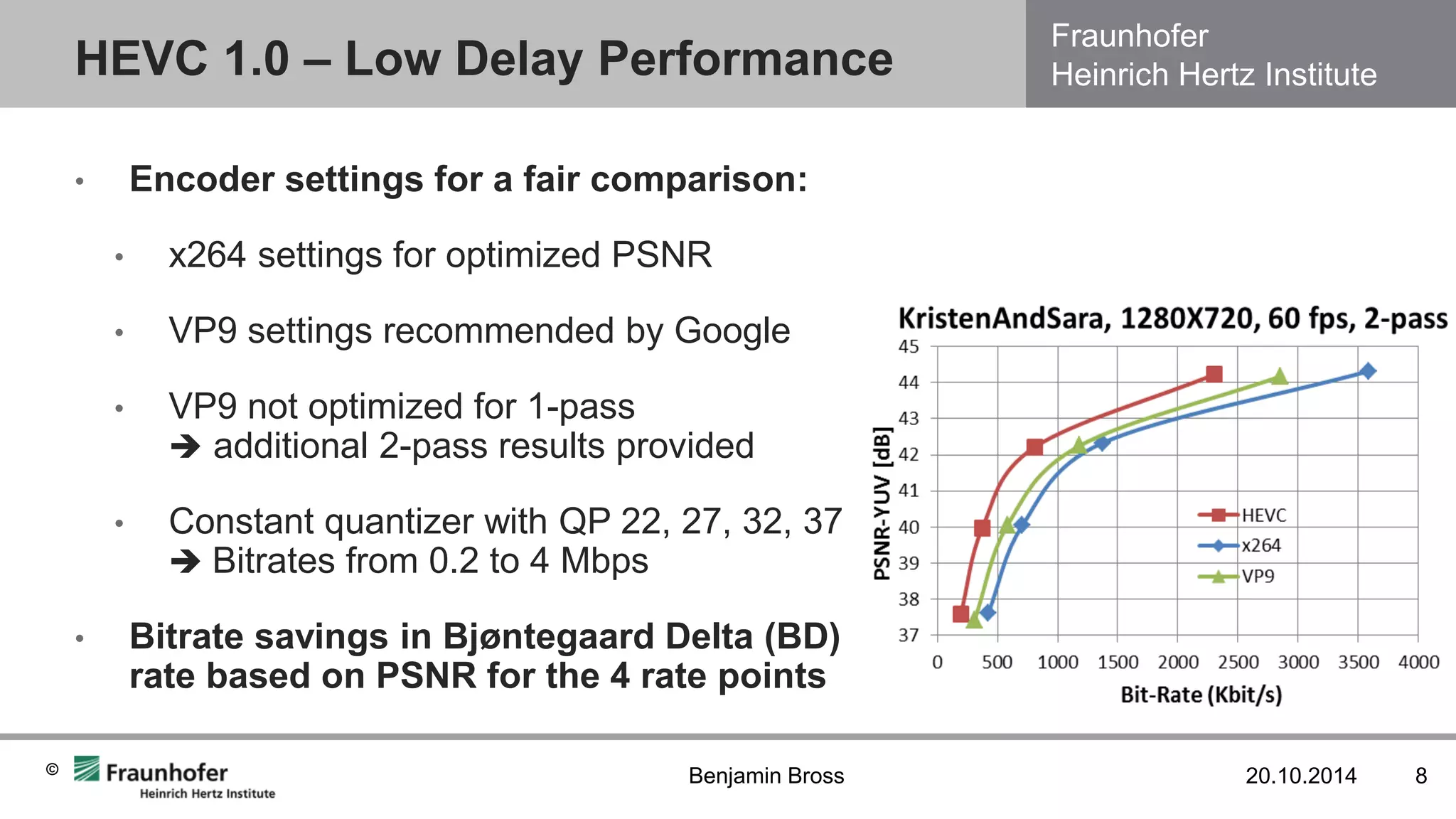
•Encoder settings for a fair comparison: 
•x264 settings for optimized PSNR 
•VP9 settings recommended by Google 
•VP9 not optimized for 1-pass  additional 2-pass results provided 
•Constant quantizer with QP 22, 27, 32, 37  Bitrates from 0.2 to 4 Mbps 
•Bitrate savings in Bjøntegaard Delta (BD) rate based on PSNR for the 4 rate points 
Figure 2. 2-pass Encoding Mode: R-D curves and corresponding are representing different video conferencing scenarios.
Fraunhofer Heinrich Hertz Institute 
© 
HEVC 1.0 – Low Delay Performance 
20.10.2014 
9 
Benjamin Bross 
•For same objective quality (PSNR), VP9 and x264 have significant bitrate overhead: 
•VP9 48% more than HM 
•x264 73% more than HM 
•2nd pass encoding does not gain much for low delay 
•Runtime differences by factor ~103 between x264 and reference encoders (HM and VP9) 
1 
10 
100 
1000 
10000 
0 
20 
40 
60 
80 
Encoding Speedup 
Bitrate overhead to HEVC HM in BD-rate [%] 
VP9 (1-pass) 
VP9 (2-pass) 
x264 (1-pass) 
x264 (2-pass)
Fraunhofer Heinrich Hertz Institute 
© 
HEVC 1.0 – Low Delay Performance 
20.10.2014 
10 
Benjamin Bross 
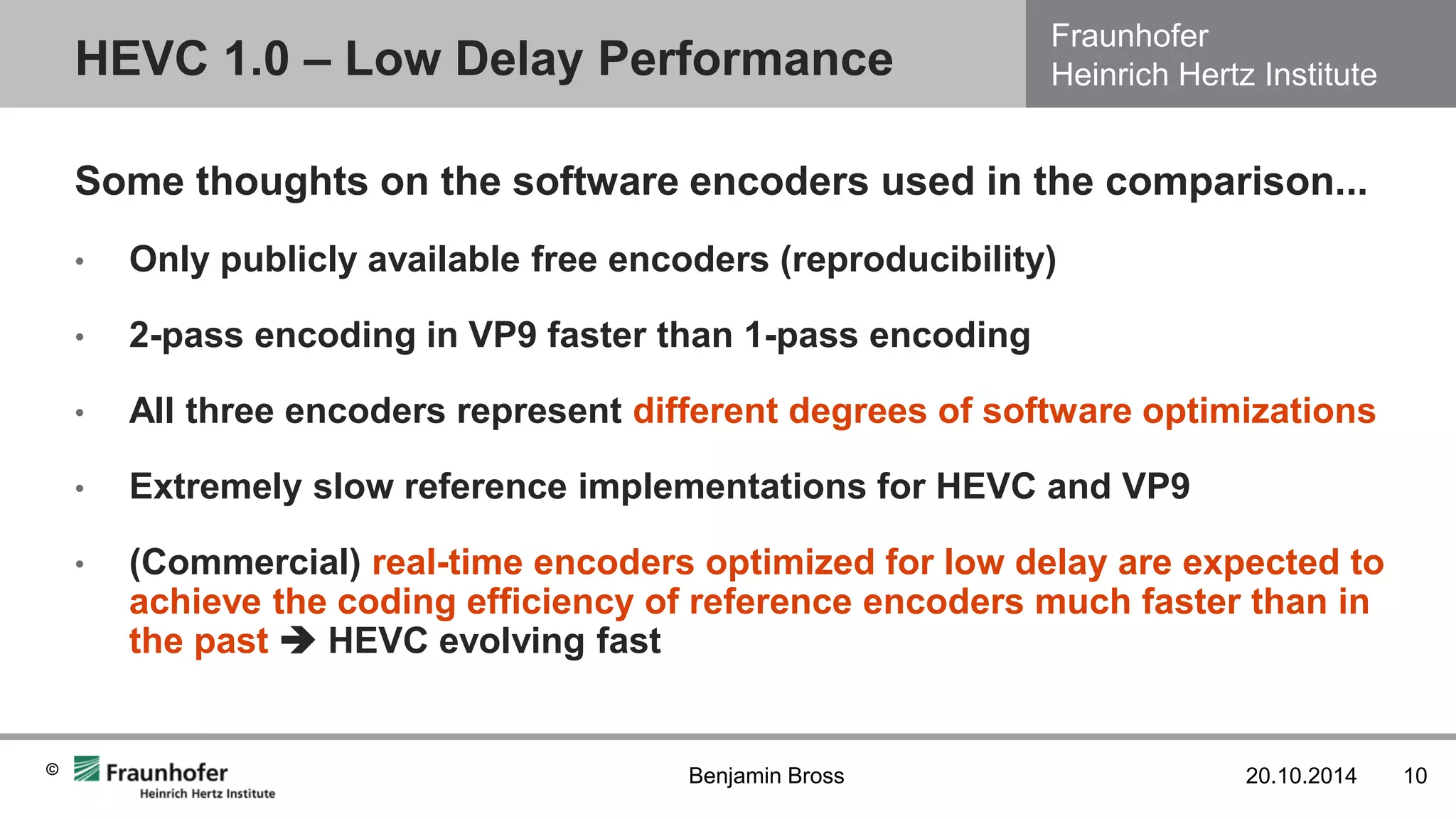
Some thoughts on the software encoders used in the comparison... 
•Only publicly available free encoders (reproducibility) 
•2-pass encoding in VP9 faster than 1-pass encoding 
•All three encoders represent different degrees of software optimizations 
•Extremely slow reference implementations for HEVC and VP9 
•(Commercial) real-time encoders optimized for low delay are expected to achieve the coding efficiency of reference encoders much faster than in the past  HEVC evolving fast
Fraunhofer Heinrich Hertz Institute 
© 
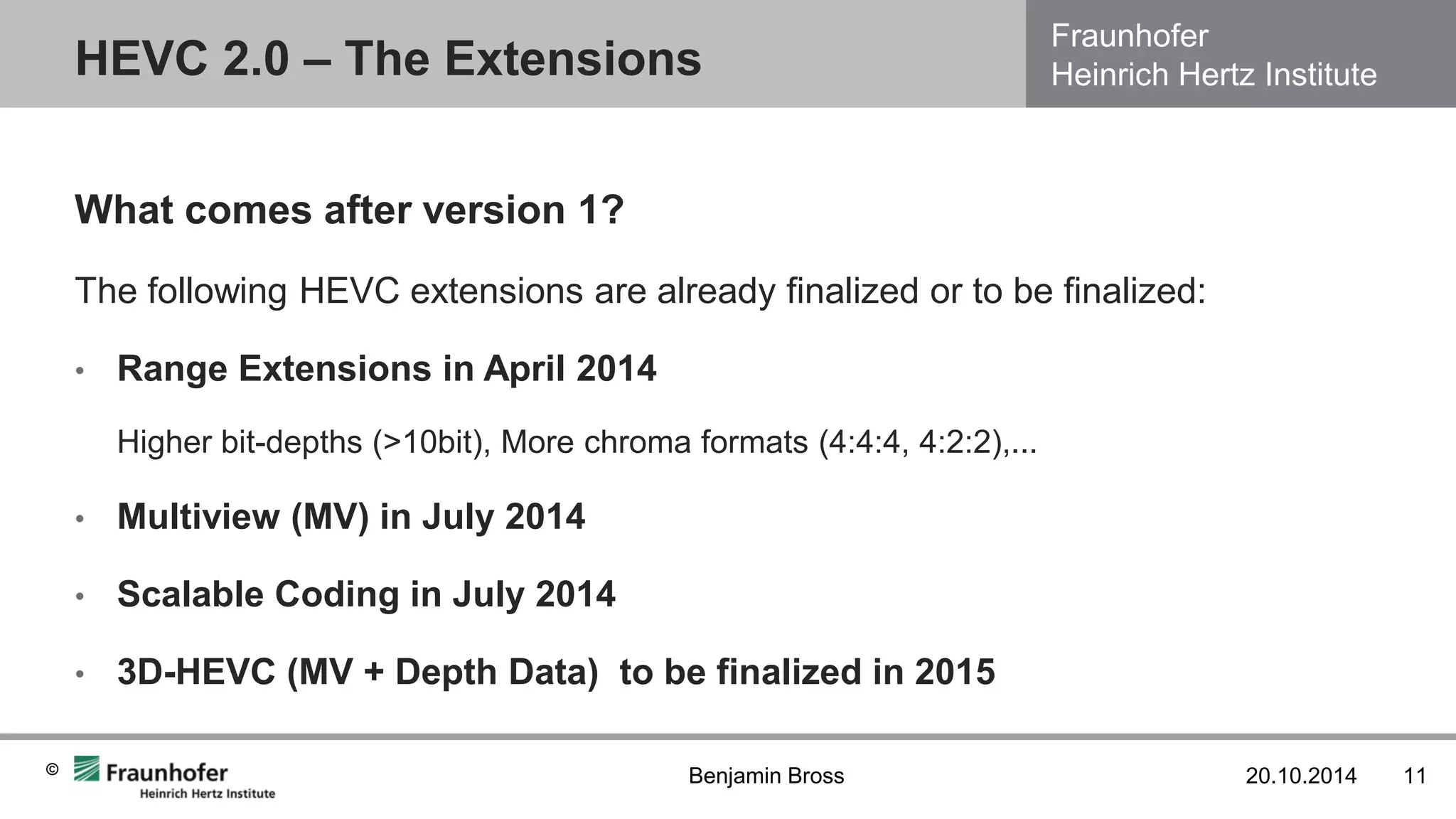
What comes after version 1? 
The following HEVC extensions are already finalized or to be finalized: 
•Range Extensions in April 2014 
Higher bit-depths (>10bit), More chroma formats (4:4:4, 4:2:2),... 
•Multiview (MV) in July 2014 
•Scalable Coding in July 2014 
•3D-HEVC (MV + Depth Data) to be finalized in 2015 
HEVC 2.0 – The Extensions 
20.10.2014 
11 
Benjamin Bross
Fraunhofer Heinrich Hertz Institute 
© 
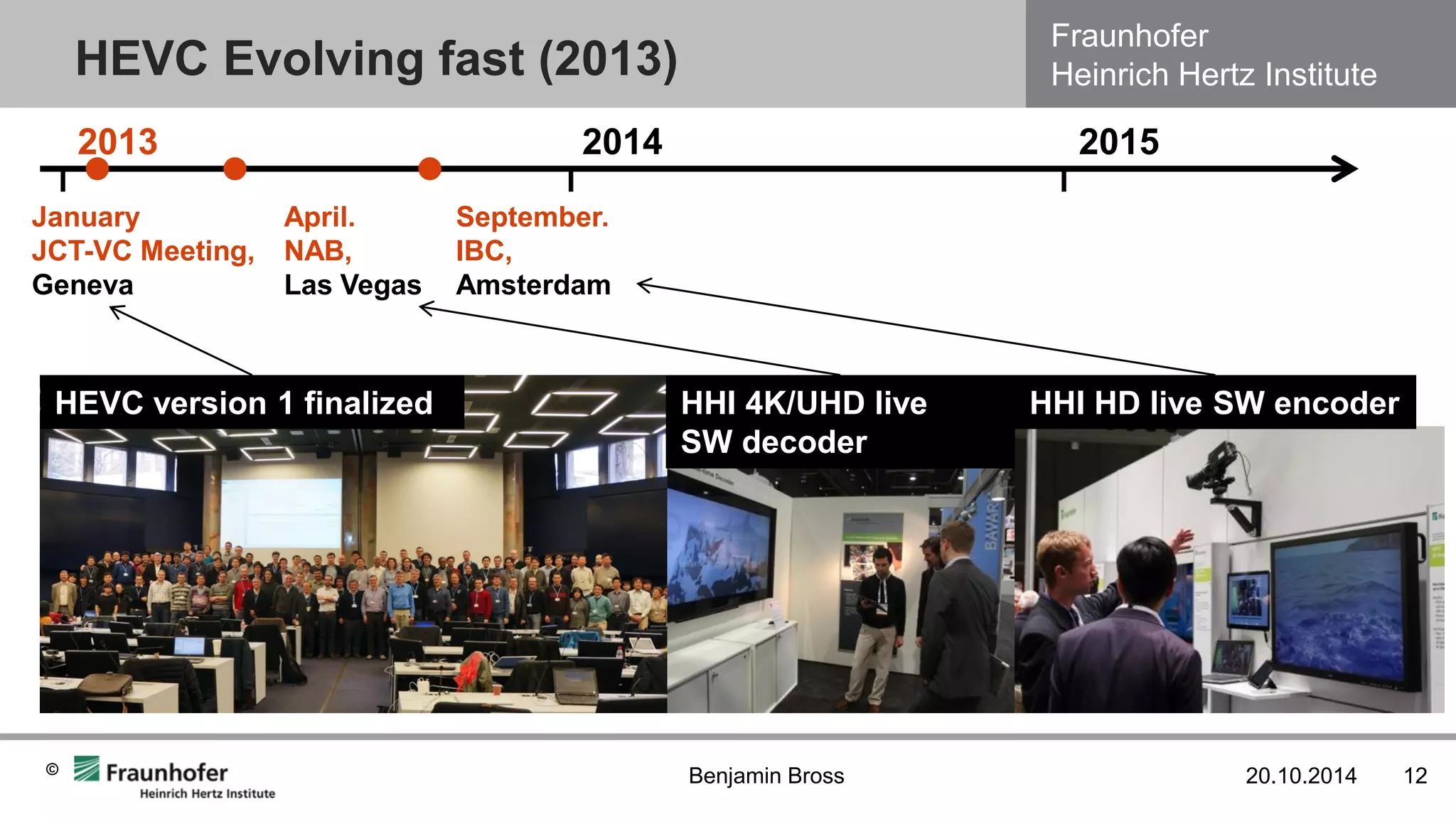
HEVC Evolving fast (2013) 
20.10.2014 
12 
Benjamin Bross 
2015 
January JCT-VC Meeting, Geneva 
HEVC version 1 finalized 
April. 
NAB, 
Las Vegas 
September. IBC, Amsterdam 
HHI 4K/UHD live SW decoder 
HHI HD live SW encoder 
2013 
2014
Fraunhofer Heinrich Hertz Institute 
© 
HEVC Evolving fast (2014) 
20.10.2014 
13 
Benjamin Bross 
2015 
September. IBC, Amsterdam 
2013 
2014 
February, 
MWC, 
Barcelona 
HHI 4K/UHD live SW encoder 
HHI HEVC over LTE 
HHI Encoding in 4K/UHD 50p live soccer broadcast 
April, 
Allianz 
Arena, 
Munich 
WWDC, Cupertino 
iPhone 6 with H.265/HEVC En- /Decoder
Fraunhofer Heinrich Hertz Institute 
© 
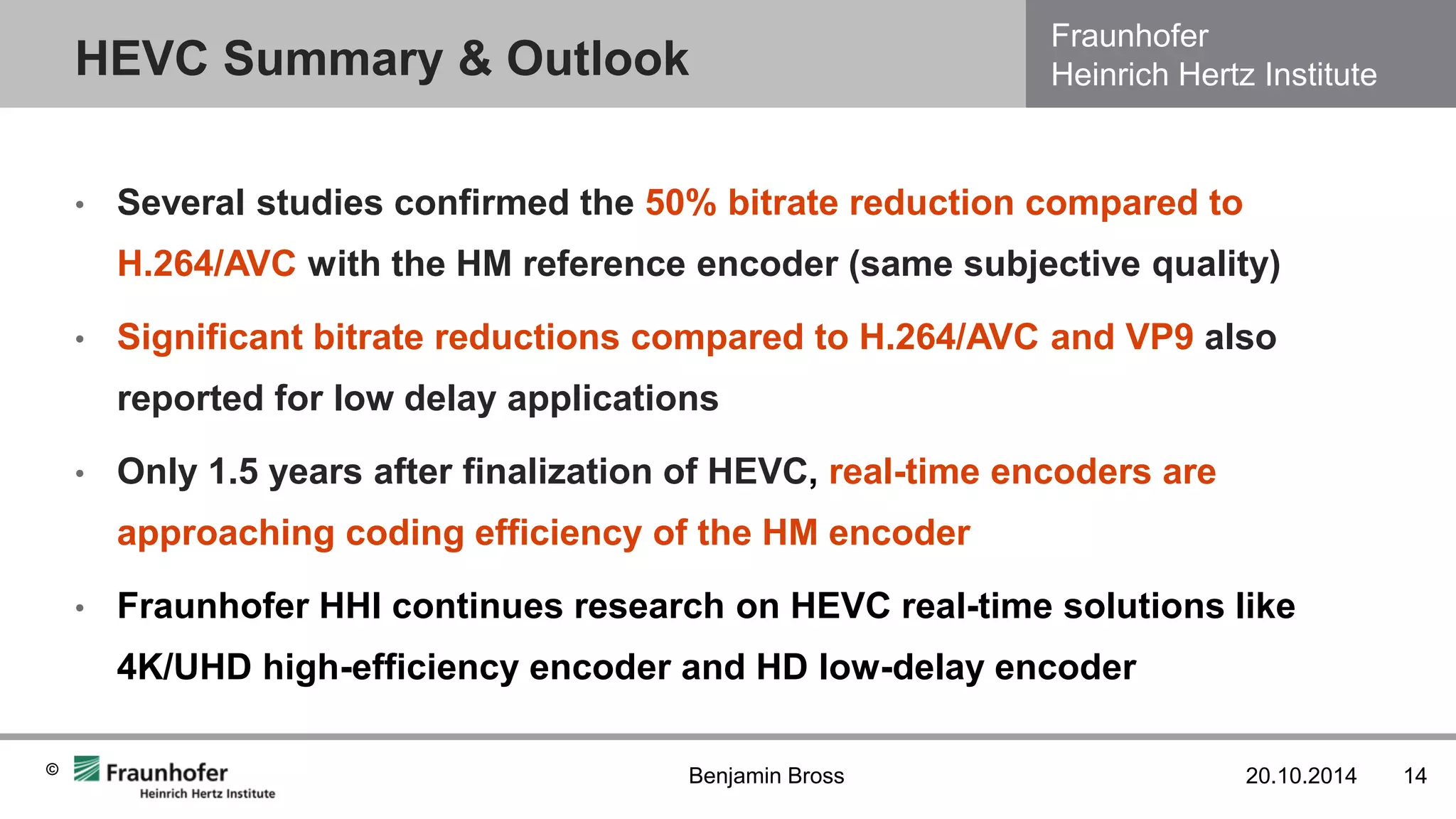
•Several studies confirmed the 50% bitrate reduction compared to H.264/AVC with the HM reference encoder (same subjective quality) 
•Significant bitrate reductions compared to H.264/AVC and VP9 also reported for low delay applications 
•Only 1.5 years after finalization of HEVC, real-time encoders are approaching coding efficiency of the HM encoder 
•Fraunhofer HHI continues research on HEVC real-time solutions like 4K/UHD high-efficiency encoder and HD low-delay encoder 
HEVC Summary & Outlook 
20.10.2014 
14 
Benjamin Bross
Fraunhofer Heinrich Hertz Institute 
© 
[1] Ohm et al, “Comparison of the Coding Efficiency of Video Coding Standards – Including High Efficiency Video Coding (HEVC) ”, IEEE Trans. CSVT, Dec. 2012 
[2] Grois et al, “Performance comparison of H.265/MPEG-HEVC, VP9, and H.264/MPEG-AVC encoders”, PCS 2013 
[3] Rerabek et al, “Comparison of compression efficiency between HEVC/H.265 and VP9 based on subjective assessments”, SPIE Proc. 9217, 2014 
[4] Grois et al, “Comparative Assessment of H.265/MPEG-HEVC, VP9, and H.264/MPEG-AVC Encoders for Low-Delay Video Applications”, SPIE Proc. 9217, 2014 
The H.265/MPEG-HEVC Standard 
20.10.2014 
15 
Benjamin Bross
Fraunhofer Heinrich Hertz Institute 
© 
Thank you very much! 
Further Information: 
benjamin.bross@hhi.fraunhofer.de 
hevc.hhi.fraunhofer.de 
The H.265/MPEG-HEVC Standard 
20.10.2014 
16 
Benjamin Bross

The H.265/MPEG-HEVC Standard

  • 1.
    Fraunhofer Heinrich HertzInstitute Fraunhofer Heinrich Hertz Institute, Einsteinufer 37, 10587 Berlin www.hhi.fraunhofer.de The H.265/MPEG-HEVC Standard IMTC Annual Member Meeting – Redmond, WA, October 16, 2014
  • 2.
    Fraunhofer Heinrich HertzInstitute © 20.10.2014 2 High Efficiency Video Coding (HEVC) HEVC 1.0 – Low Delay Performance HEVC 2.0 – The Extensions HEVC Evolving fast Summary & Outlook Outline Benjamin Bross
  • 3.
    Fraunhofer Heinrich HertzInstitute © 20.10.2014 3 •Most recent joint video coding standard from ITU VCEG and ISO/IEC MPEG: ITU-T Rec. H.265 ISO/IEC 23008-2 MPEG-H Part 2 HEVC •Fraunhofer HHI contributed key techniques (Coding Block and Residual Quadtree, Prediction Block Merging, Transform Coding, CABAC,...) •50% bitrate reduction compared to H.264/AVC High Profile •Version 1 finalized in Jan. 2013 with 3 profiles (all 4:2:0): Main (8bit), Main 10 (10 bit), Main Still Picture High-Efficiency Video Coding (HEVC) Benjamin Bross
  • 4.
    Fraunhofer Heinrich HertzInstitute © HEVC 1.0 – Performance 20.10.2014 4 Benjamin Bross What is the coding efficiency for different coding applications? •Entertainment for TV/Movies (Broadcast, VoD, Storage) Hierarchical B-pictures, structural delay, 1s random access •Interactive for Videoconferencing No picture reordering, low delay
  • 5.
    Fraunhofer Heinrich HertzInstitute © Several studies reporting bitrate savings of H.265/HEVC HM Reference Encoder for the same objective/subjective quality: HEVC 1.0 – Performance 20.10.2014 5 Benjamin Bross AVC HP VP9 AVC HP VP9 Encoder Sequences Objective [PSNR] Subjective [MOS] Objective [PSNR] Subjective [MOS] Objective [PSNR] Objective [PSNR] AVC VP9 [1] Ohm2012 35% 49% 40% JSVM JCT-VC [2] Grois2013 39% 43% x264 WebM JCT-VC (Class A,B,E, F) [3] Rerabek2014 39% 53% 36% 49% JM WebM 4K [4] Grois2014 41% 33% x264 WebM JCT-VC (Class E) Entertainment (Random Access) Interactive (Low Delay)
  • 6.
    Fraunhofer Heinrich HertzInstitute © Several studies reporting bitrate savings of H.265/HEVC HM Reference Encoder for the same objective/subjective quality: HEVC 1.0 – Performance 20.10.2014 6 Benjamin Bross AVC HP VP9 AVC HP VP9 Encoder Sequences Objective [PSNR] Subjective [MOS] Objective [PSNR] Subjective [MOS] Objective [PSNR] Objective [PSNR] AVC VP9 [1] Ohm2012 35% 49% 40% JSVM JCT-VC [2] Grois2013 39% 43% x264 WebM JCT-VC (Class A,B,E, F) [3] Rerabek2014 39% 53% 36% 49% JM WebM 4K [4] Grois2014 41% 33% x264 WebM JCT-VC (Class E) Entertainment (Random Access) Interactive (Low Delay)
  • 7.
    Fraunhofer Heinrich HertzInstitute © HEVC 1.0 – Low Delay Performance 20.10.2014 7 Benjamin Bross Low Delay performance study from Grois et al [4]: •Tested publicly available encoders: •H.265/HEVC  HM reference encoder •H.264/AVC  x264 r2334 •VP9  WebM v1.2.0-3088-ga81bd12 •IPPP coding structure (I-picture followed by P-pictures) •Three JCT-VC 720p60 class E test sequences
  • 8.
    Fraunhofer Heinrich HertzInstitute © HEVC 1.0 – Low Delay Performance 20.10.2014 8 Benjamin Bross •Encoder settings for a fair comparison: •x264 settings for optimized PSNR •VP9 settings recommended by Google •VP9 not optimized for 1-pass  additional 2-pass results provided •Constant quantizer with QP 22, 27, 32, 37  Bitrates from 0.2 to 4 Mbps •Bitrate savings in Bjøntegaard Delta (BD) rate based on PSNR for the 4 rate points Figure 2. 2-pass Encoding Mode: R-D curves and corresponding are representing different video conferencing scenarios.
  • 9.
    Fraunhofer Heinrich HertzInstitute © HEVC 1.0 – Low Delay Performance 20.10.2014 9 Benjamin Bross •For same objective quality (PSNR), VP9 and x264 have significant bitrate overhead: •VP9 48% more than HM •x264 73% more than HM •2nd pass encoding does not gain much for low delay •Runtime differences by factor ~103 between x264 and reference encoders (HM and VP9) 1 10 100 1000 10000 0 20 40 60 80 Encoding Speedup Bitrate overhead to HEVC HM in BD-rate [%] VP9 (1-pass) VP9 (2-pass) x264 (1-pass) x264 (2-pass)
  • 10.
    Fraunhofer Heinrich HertzInstitute © HEVC 1.0 – Low Delay Performance 20.10.2014 10 Benjamin Bross Some thoughts on the software encoders used in the comparison... •Only publicly available free encoders (reproducibility) •2-pass encoding in VP9 faster than 1-pass encoding •All three encoders represent different degrees of software optimizations •Extremely slow reference implementations for HEVC and VP9 •(Commercial) real-time encoders optimized for low delay are expected to achieve the coding efficiency of reference encoders much faster than in the past  HEVC evolving fast
  • 11.
    Fraunhofer Heinrich HertzInstitute © What comes after version 1? The following HEVC extensions are already finalized or to be finalized: •Range Extensions in April 2014 Higher bit-depths (>10bit), More chroma formats (4:4:4, 4:2:2),... •Multiview (MV) in July 2014 •Scalable Coding in July 2014 •3D-HEVC (MV + Depth Data) to be finalized in 2015 HEVC 2.0 – The Extensions 20.10.2014 11 Benjamin Bross
  • 12.
    Fraunhofer Heinrich HertzInstitute © HEVC Evolving fast (2013) 20.10.2014 12 Benjamin Bross 2015 January JCT-VC Meeting, Geneva HEVC version 1 finalized April. NAB, Las Vegas September. IBC, Amsterdam HHI 4K/UHD live SW decoder HHI HD live SW encoder 2013 2014
  • 13.
    Fraunhofer Heinrich HertzInstitute © HEVC Evolving fast (2014) 20.10.2014 13 Benjamin Bross 2015 September. IBC, Amsterdam 2013 2014 February, MWC, Barcelona HHI 4K/UHD live SW encoder HHI HEVC over LTE HHI Encoding in 4K/UHD 50p live soccer broadcast April, Allianz Arena, Munich WWDC, Cupertino iPhone 6 with H.265/HEVC En- /Decoder
  • 14.
    Fraunhofer Heinrich HertzInstitute © •Several studies confirmed the 50% bitrate reduction compared to H.264/AVC with the HM reference encoder (same subjective quality) •Significant bitrate reductions compared to H.264/AVC and VP9 also reported for low delay applications •Only 1.5 years after finalization of HEVC, real-time encoders are approaching coding efficiency of the HM encoder •Fraunhofer HHI continues research on HEVC real-time solutions like 4K/UHD high-efficiency encoder and HD low-delay encoder HEVC Summary & Outlook 20.10.2014 14 Benjamin Bross
  • 15.
    Fraunhofer Heinrich HertzInstitute © [1] Ohm et al, “Comparison of the Coding Efficiency of Video Coding Standards – Including High Efficiency Video Coding (HEVC) ”, IEEE Trans. CSVT, Dec. 2012 [2] Grois et al, “Performance comparison of H.265/MPEG-HEVC, VP9, and H.264/MPEG-AVC encoders”, PCS 2013 [3] Rerabek et al, “Comparison of compression efficiency between HEVC/H.265 and VP9 based on subjective assessments”, SPIE Proc. 9217, 2014 [4] Grois et al, “Comparative Assessment of H.265/MPEG-HEVC, VP9, and H.264/MPEG-AVC Encoders for Low-Delay Video Applications”, SPIE Proc. 9217, 2014 The H.265/MPEG-HEVC Standard 20.10.2014 15 Benjamin Bross
  • 16.
    Fraunhofer Heinrich HertzInstitute © Thank you very much! Further Information: benjamin.bross@hhi.fraunhofer.de hevc.hhi.fraunhofer.de The H.265/MPEG-HEVC Standard 20.10.2014 16 Benjamin Bross