47www.yesmagazine.org :: YES! Fall 2009
How Do You “Know”?
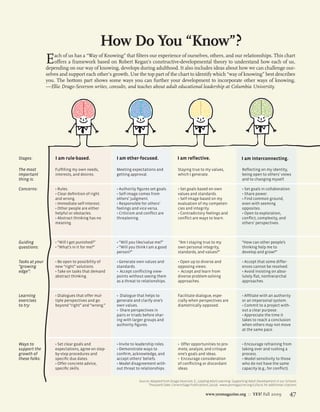
Each of us has a “Way of Knowing” that filters our experience of ourselves, others, and our relationships. This chart
offers a framework based on Robert Kegan’s constructive-developmental theory to understand how each of us,
depending on our way of knowing, develops during adulthood. It also includes ideas about how we can challenge our-
selves and support each other’s growth. Use the top part of the chart to identify which “way of knowing” best describes
you. The bottom part shows some ways you can further your development to incorporate other ways of knowing.
—Ellie Drago-Severson writes, consults, and teaches about adult educational leadership at Columbia University.
Source: Adapted from Drago-Severson, E., Leading Adult Learning: Supporting Adult Development in our Schools.
Thousand Oaks: Corwin/Sage Publications, (2010). www.yesmagazine.org/51facts for additional citations.
I am rule-based. I am 0ther-focused. I am reflective. I am interconnecting.
Staying true to my values,
which I generate.
• Set goals based on own
values and standards.
• Self-image based on my
evaluation of my competen-
cies and integrity.
• Contradictory feelings and
conflict are ways to learn.
“Am I staying true to my
own personal integrity,
standards, and values?”
• Open up to diverse and
opposing views.
• Accept and learn from
diverse problem-solving
approaches.
Facilitate dialogue, espe-
cially when perspectives are
diametrically opposed.
• Offer opportunities to pro-
mote, analyze, and critique
one’s goals and ideas.
• Encourage consideration
of conflicting or discordant
ideas.
Fulfilling my own needs,
interests, and desires.
• Rules.
• Clear definition of right
and wrong.
• Immediate self-interest.
• Other people are either
helpful or obstacles.
• Abstract thinking has no
meaning.
• “Will I get punished?”
• “What’s in it for me?”
• Be open to possibility of
new “right” solutions.
• Take on tasks that demand
abstract thinking.
• Dialogues that offer mul-
tiple perspectives and go
beyond “right” and “wrong.”
• Set clear goals and
expectations, agree on step-
by-step procedures and
specific due dates.
• Offer concrete advice,
specific skills.
Reflecting on my identity,
being open to others’ views
and to changing myself.
• Set goals in collaboration.
• Share power.
• Find common ground,
even with seeming
opposites.
• Open to exploration,
conflict, complexity, and
others’ perspectives.
“How can other people’s
thinking help me to
develop and grow?”
• Accept that some differ-
ences cannot be resolved.
• Avoid insisting on abso-
lutely flat, nonhierarchal
approaches.
• Affiliate with an authority
or an impersonal system.
• Commit to a project with-
out a clear purpose.
• Appreciate the time it
takes to reach a conclusion
when others may not move
at the same pace.
• Encourage refraining from
taking over and rushing a
process.
• Model sensitivity to those
who do not have the same
capacity (e.g., for conflict).
Meeting expectations and
getting approval.
• Authority figures set goals.
• Self-image comes from
others’ judgment.
• Responsible for others’
feelings and vice versa.
• Criticism and conflict are
threatening.
• “Will you like/value me?”
• “Will you think I am a good
person?”
• Generate own values and
standards.
• Accept conflicting view-
points without seeing them
as a threat to relationships.
• Dialogue that helps to
generate and clarify one’s
own values.
• Share perspectives in
pairs or triads before shar-
ing with larger groups and
authority figures.
• Invite to leadership roles.
• Demonstrate ways to
confirm, acknowledge, and
accept others’ beliefs.
• Model disagreement with-
out threat to relationships.
Stages:
The most
important
thing is:
Concerns:
Guiding
questions:
Tasks at your
“growing
edge”:
Learning
exercises
to try:
Ways to
support the
growth of
these folks:
47www.yesmagazine.org :: YES! Fall 2009

Just thefacts

  • 1.
    47www.yesmagazine.org :: YES!Fall 2009 How Do You “Know”? Each of us has a “Way of Knowing” that filters our experience of ourselves, others, and our relationships. This chart offers a framework based on Robert Kegan’s constructive-developmental theory to understand how each of us, depending on our way of knowing, develops during adulthood. It also includes ideas about how we can challenge our- selves and support each other’s growth. Use the top part of the chart to identify which “way of knowing” best describes you. The bottom part shows some ways you can further your development to incorporate other ways of knowing. —Ellie Drago-Severson writes, consults, and teaches about adult educational leadership at Columbia University. Source: Adapted from Drago-Severson, E., Leading Adult Learning: Supporting Adult Development in our Schools. Thousand Oaks: Corwin/Sage Publications, (2010). www.yesmagazine.org/51facts for additional citations. I am rule-based. I am 0ther-focused. I am reflective. I am interconnecting. Staying true to my values, which I generate. • Set goals based on own values and standards. • Self-image based on my evaluation of my competen- cies and integrity. • Contradictory feelings and conflict are ways to learn. “Am I staying true to my own personal integrity, standards, and values?” • Open up to diverse and opposing views. • Accept and learn from diverse problem-solving approaches. Facilitate dialogue, espe- cially when perspectives are diametrically opposed. • Offer opportunities to pro- mote, analyze, and critique one’s goals and ideas. • Encourage consideration of conflicting or discordant ideas. Fulfilling my own needs, interests, and desires. • Rules. • Clear definition of right and wrong. • Immediate self-interest. • Other people are either helpful or obstacles. • Abstract thinking has no meaning. • “Will I get punished?” • “What’s in it for me?” • Be open to possibility of new “right” solutions. • Take on tasks that demand abstract thinking. • Dialogues that offer mul- tiple perspectives and go beyond “right” and “wrong.” • Set clear goals and expectations, agree on step- by-step procedures and specific due dates. • Offer concrete advice, specific skills. Reflecting on my identity, being open to others’ views and to changing myself. • Set goals in collaboration. • Share power. • Find common ground, even with seeming opposites. • Open to exploration, conflict, complexity, and others’ perspectives. “How can other people’s thinking help me to develop and grow?” • Accept that some differ- ences cannot be resolved. • Avoid insisting on abso- lutely flat, nonhierarchal approaches. • Affiliate with an authority or an impersonal system. • Commit to a project with- out a clear purpose. • Appreciate the time it takes to reach a conclusion when others may not move at the same pace. • Encourage refraining from taking over and rushing a process. • Model sensitivity to those who do not have the same capacity (e.g., for conflict). Meeting expectations and getting approval. • Authority figures set goals. • Self-image comes from others’ judgment. • Responsible for others’ feelings and vice versa. • Criticism and conflict are threatening. • “Will you like/value me?” • “Will you think I am a good person?” • Generate own values and standards. • Accept conflicting view- points without seeing them as a threat to relationships. • Dialogue that helps to generate and clarify one’s own values. • Share perspectives in pairs or triads before shar- ing with larger groups and authority figures. • Invite to leadership roles. • Demonstrate ways to confirm, acknowledge, and accept others’ beliefs. • Model disagreement with- out threat to relationships. Stages: The most important thing is: Concerns: Guiding questions: Tasks at your “growing edge”: Learning exercises to try: Ways to support the growth of these folks: 47www.yesmagazine.org :: YES! Fall 2009