© 2019 Copyright ISC Ltd.
We need to stop trying to
change people’s minds!
Some thoughts on behavioural change
Agenda
◼ Some change principles
◼ A model for Human Behaviour Change
◼ A case study
© 2019 Copyright ISC Ltd.
PEOPLE DON’T RESIST
CHANGE, WHAT THEY
RESIST IS BADLY MANAGED
CHANGE
© 2019 Copyright ISC Ltd.
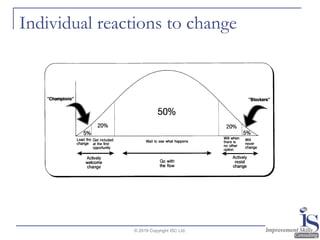
Individual reactions to change
© 2019 Copyright ISC Ltd.
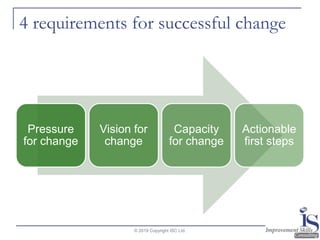
4 requirements for successful change
Pressure
for change
Vision for
change
Capacity
for change
Actionable
first steps
© 2019 Copyright ISC Ltd.
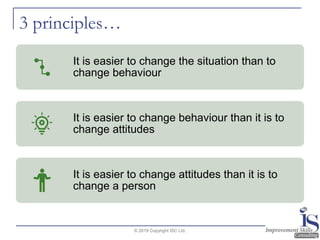
3 principles…
© 2019 Copyright ISC Ltd.
It is easier to change the situation than to
change behaviour
It is easier to change behaviour than it is to
change attitudes
It is easier to change attitudes than it is to
change a person
When it
comes to
behaviour
change, we
need to
answer 2
questions…
“Can people
change?”
“Will people
change?”
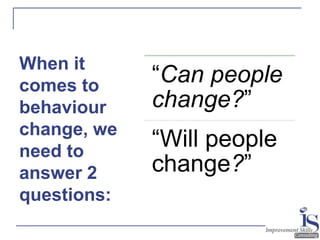
When it
comes to
behaviour
change, we
need to
answer 2
questions:
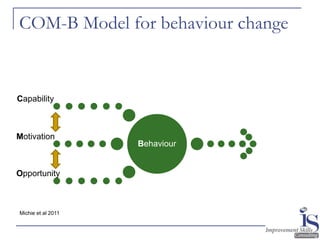
COM-B Model for behaviour change
Behaviour
Capability
Motivation
Opportunity
Michie et al 2011
Michie et al 2011
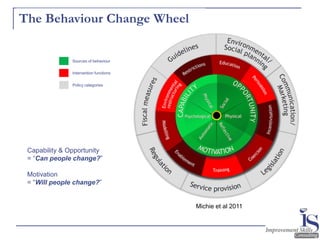
Capability & Opportunity
= “Can people change?”
Motivation
= “Will people change?”
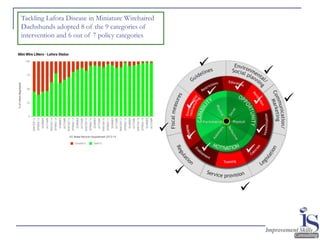
Sources of behaviour
Intervention functions
Policy categories
The Behaviour Change Wheel
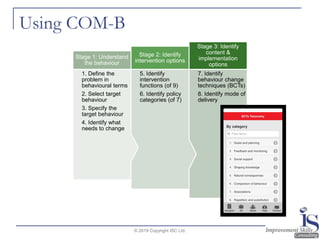
Using COM-B
© 2019 Copyright ISC Ltd.
7. Identify
behaviour change
techniques (BCTs)
8. Identify mode of
delivery
Stage 3: Identify
content &
implementation
options
5. Identify
intervention
functions (of 9)
6. Identify policy
categories (of 7)
Stage 2: Identify
intervention options
1. Define the
problem in
behavioural terms
2. Select target
behaviour
3. Specify the
target behaviour
4. Identify what
needs to change
Stage 1: Understand
the behaviour
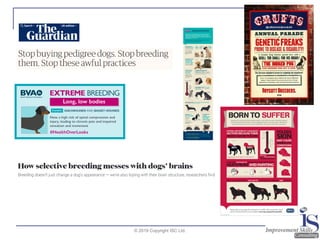
PEDIGREE DOG HEALTH
Case study example…
© 2019 Copyright ISC Ltd.
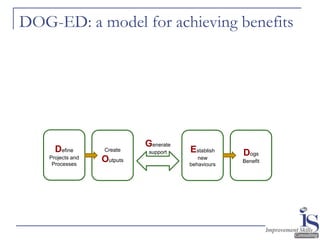
DOG-ED: a model for achieving benefits
Define
Projects and
Processes
Create
Outputs
Establish
new
behaviours
Dogs
Benefit
Generate
support
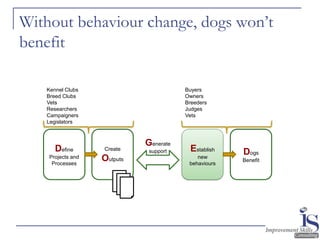
Without behaviour change, dogs won’t
benefit
Define
Projects and
Processes
Create
Outputs
Establish
new
behaviours
Dogs
Benefit
Generate
support
Kennel Clubs
Breed Clubs
Vets
Researchers
Campaigners
Legislators
Buyers
Owners
Breeders
Judges
Vets
Tackling Lafora Disease in Miniature Wirehaired
Dachshunds adopted 8 of the 9 categories of
intervention and 6 out of 7 policy categories
✓
✓
✓
✓✓
✓
✓
✓
✓
✓
✓
✓
✓
✓
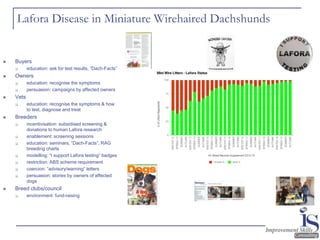
Lafora Disease in Miniature Wirehaired Dachshunds
◼ Buyers
❑ education: ask for test results, “Dach-Facts”
◼ Owners
❑ education: recognise the symptoms
❑ persuasion: campaigns by affected owners
◼ Vets
❑ education: recognise the symptoms & how
to test, diagnose and treat
◼ Breeders
❑ incentivisation: subsidised screening &
donations to human Lafora research
❑ enablement: screening sessions
❑ education: seminars, “Dach-Facts”, RAG
breeding charts
❑ modelling: “I support Lafora testing” badges
❑ restriction: ABS scheme requirement
❑ coercion: “advisory/warning” letters
❑ persuasion: stories by owners of affected
dogs
◼ Breed clubs/council
❑ environment: fund-raising
“The ‘tell, sell, yell’ strategy for Change
Management never works.”
“Culture change happens in units of 1.”
“And that is how change happens. One
gesture. One person. One moment at a
time.”
Some final thoughts…
Ian J Seath
ian.seath@improvement-skills.co.uk
www.improvement-skills.co.uk
@ianjseath
© 2019 Copyright ISC Ltd.

Behavioural change - a few thoughts, a model and a case study

  • 1.
    © 2019 CopyrightISC Ltd. We need to stop trying to change people’s minds! Some thoughts on behavioural change
  • 2.
    Agenda ◼ Some changeprinciples ◼ A model for Human Behaviour Change ◼ A case study © 2019 Copyright ISC Ltd.
  • 3.
    PEOPLE DON’T RESIST CHANGE,WHAT THEY RESIST IS BADLY MANAGED CHANGE © 2019 Copyright ISC Ltd.
  • 4.
    Individual reactions tochange © 2019 Copyright ISC Ltd.
  • 5.
    4 requirements forsuccessful change Pressure for change Vision for change Capacity for change Actionable first steps © 2019 Copyright ISC Ltd.
  • 6.
    3 principles… © 2019Copyright ISC Ltd. It is easier to change the situation than to change behaviour It is easier to change behaviour than it is to change attitudes It is easier to change attitudes than it is to change a person
  • 7.
    When it comes to behaviour change,we need to answer 2 questions… “Can people change?” “Will people change?” When it comes to behaviour change, we need to answer 2 questions:
  • 8.
    COM-B Model forbehaviour change Behaviour Capability Motivation Opportunity Michie et al 2011
  • 9.
    Michie et al2011 Capability & Opportunity = “Can people change?” Motivation = “Will people change?” Sources of behaviour Intervention functions Policy categories The Behaviour Change Wheel
  • 10.
    Using COM-B © 2019Copyright ISC Ltd. 7. Identify behaviour change techniques (BCTs) 8. Identify mode of delivery Stage 3: Identify content & implementation options 5. Identify intervention functions (of 9) 6. Identify policy categories (of 7) Stage 2: Identify intervention options 1. Define the problem in behavioural terms 2. Select target behaviour 3. Specify the target behaviour 4. Identify what needs to change Stage 1: Understand the behaviour
  • 11.
    PEDIGREE DOG HEALTH Casestudy example… © 2019 Copyright ISC Ltd.
  • 12.
  • 13.
    DOG-ED: a modelfor achieving benefits Define Projects and Processes Create Outputs Establish new behaviours Dogs Benefit Generate support
  • 14.
    Without behaviour change,dogs won’t benefit Define Projects and Processes Create Outputs Establish new behaviours Dogs Benefit Generate support Kennel Clubs Breed Clubs Vets Researchers Campaigners Legislators Buyers Owners Breeders Judges Vets
  • 15.
    Tackling Lafora Diseasein Miniature Wirehaired Dachshunds adopted 8 of the 9 categories of intervention and 6 out of 7 policy categories ✓ ✓ ✓ ✓✓ ✓ ✓ ✓ ✓ ✓ ✓ ✓ ✓ ✓
  • 16.
    Lafora Disease inMiniature Wirehaired Dachshunds ◼ Buyers ❑ education: ask for test results, “Dach-Facts” ◼ Owners ❑ education: recognise the symptoms ❑ persuasion: campaigns by affected owners ◼ Vets ❑ education: recognise the symptoms & how to test, diagnose and treat ◼ Breeders ❑ incentivisation: subsidised screening & donations to human Lafora research ❑ enablement: screening sessions ❑ education: seminars, “Dach-Facts”, RAG breeding charts ❑ modelling: “I support Lafora testing” badges ❑ restriction: ABS scheme requirement ❑ coercion: “advisory/warning” letters ❑ persuasion: stories by owners of affected dogs ◼ Breed clubs/council ❑ environment: fund-raising
  • 17.
    “The ‘tell, sell,yell’ strategy for Change Management never works.” “Culture change happens in units of 1.” “And that is how change happens. One gesture. One person. One moment at a time.” Some final thoughts…
  • 18.