Behavior change required
for success of
Antimicrobial Stewardship Program
Prof. Ashok Rattan,
MD, MAMS,
Common Wealth Fellow, INSA DFG Fellow , ex SEARO Temporary Advisor,
ex WHO Lab Director (CAREC/PAHO)
Chairman Medical Committee & Quality, Redcliffe Labs
Online Professor & Mentor, AHRO University, Glasgow, Scotland
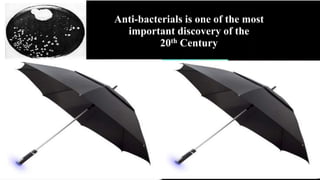
Discovery & Development of
Anti-bacterials is one of the most
important discovery of the
20th Century
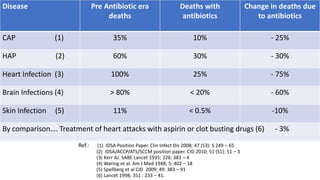
Power of antibiotics
Disease Pre Antibiotic era
deaths
Deaths with
antibiotics
Change in deaths due
to antibiotics
CAP (1) 35% 10% - 25%
HAP (2) 60% 30% - 30%
Heart Infection (3) 100% 25% - 75%
Brain Infections (4) > 80% < 20% - 60%
Skin Infection (5) 11% < 0.5% -10%
By comparison…. Treatment of heart attacks with aspirin or clot busting drugs (6) - 3%
Ref.: (1) IDSA Position Paper. Clin Infect Dis 2008; 47 (S3): S 249 – 65
(2) IDSA/ACCP/ATS/SCCM position paper. CID 2010; 51 (S1): 51 – 3
(3) Kerr AJ. SABE Lancet 1935; 226: 383 – 4
(4) Waring et al. Am J Med 1948; 5: 402 – 18
(5) Spellberg et al CID 2009; 49: 383 – 91
(6) Lancet 1998; 351 : 233 – 41.
Need for Antimicrobial Stewardship
• Antimicrobial stewardship is a coordinated program that
promotes the appropriate use of antimicrobials (including
antibiotics), improves patient outcomes, reduces microbial
resistance, and decreases the spread of infections caused by
multidrug-resistant organisms.
• Objective are: Right drug for the right patients at the right dose
by the right route for the right duration
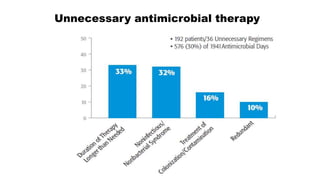
Unnecessary antimicrobial therapy
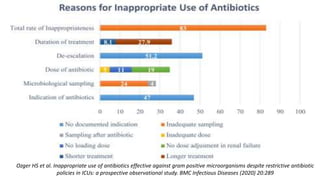
Ozger HS et al. Inappropriate use of antibiotics effective against gram positive microorganisms despite restrictive antibiotic
policies in ICUs: a prospective observational study. BMC Infectious Diseases (2020) 20:289
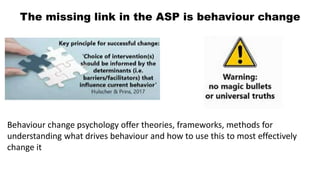
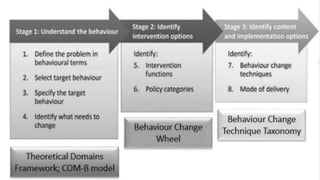
The missing link in the ASP is behaviour change
Behaviour change psychology offer theories, frameworks, methods for
understanding what drives behaviour and how to use this to most effectively
change it
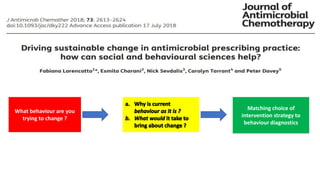
What behaviour are you
trying to change ?
Matching choice of
intervention strategy to
behaviour diagnostics
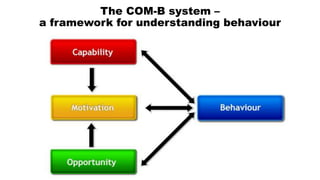
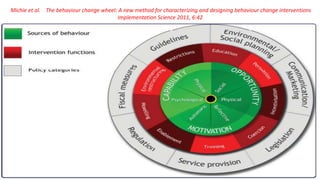
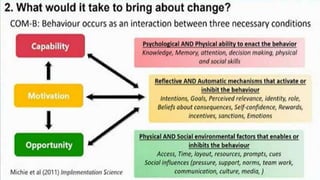
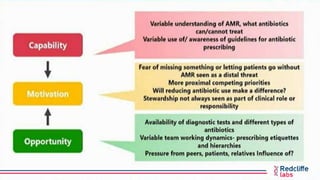
The COM-B system –
a framework for understanding behaviour
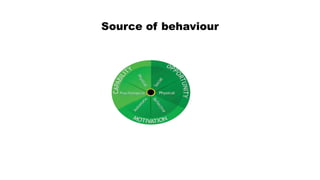
Source of behaviour
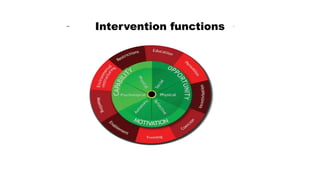
Intervention functions
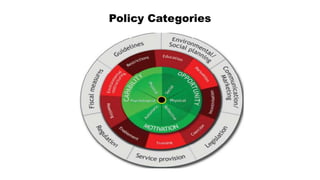
Policy Categories
Michie et al. The behaviour change wheel: A new method for characterizing and designing behaviour change interventions
Implementation Science 2011, 6:42
1. Define your ASP problem in behaviour terms
• 1. Tendency to think in terms of outcomes
• 2. Reducing infection rates or resistance is not a behaviour
• 3. Behaviour is product of numerous discrete experiences
• 4. ASP is not just prescribing
• 5. Multiple actors, actions, different time points & locations
• 6. We are rarely specific about what & whose behaviour we need to change
• 7. Why does it matter ?
• Each driven by different influences
• Choice of intervention approach will depend upon understanding behaviour in
context
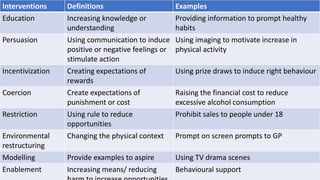
Interventions Definitions Examples
Education Increasing knowledge or
understanding
Providing information to prompt healthy
habits
Persuasion Using communication to induce
positive or negative feelings or
stimulate action
Using imaging to motivate increase in
physical activity
Incentivization Creating expectations of
rewards
Using prize draws to induce right behaviour
Coercion Create expectations of
punishment or cost
Raising the financial cost to reduce
excessive alcohol consumption
Restriction Using rule to reduce
opportunities
Prohibit sales to people under 18
Environmental
restructuring
Changing the physical context Prompt on screen prompts to GP
Modelling Provide examples to aspire Using TV drama scenes
Enablement Increasing means/ reducing Behavioural support
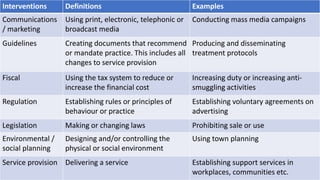
Interventions Definitions Examples
Communications
/ marketing
Using print, electronic, telephonic or
broadcast media
Conducting mass media campaigns
Guidelines Creating documents that recommend
or mandate practice. This includes all
changes to service provision
Producing and disseminating
treatment protocols
Fiscal Using the tax system to reduce or
increase the financial cost
Increasing duty or increasing anti-
smuggling activities
Regulation Establishing rules or principles of
behaviour or practice
Establishing voluntary agreements on
advertising
Legislation Making or changing laws Prohibiting sale or use
Environmental /
social planning
Designing and/or controlling the
physical or social environment
Using town planning
Service provision Delivering a service Establishing support services in
workplaces, communities etc.
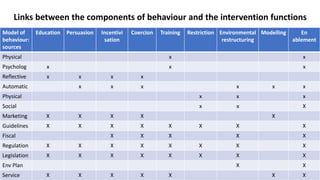
Model of
behaviour:
sources
Education Persuasion Incentivi
sation
Coercion Training Restriction Environmental
restructuring
Modelling En
ablement
Physical x x
Psycholog x x x
Reflective x x x x
Automatic x x x x x x
Physical x x x
Social x x X
Marketing X X X X X
Guidelines X X X X X X X X
Fiscal X X X X X
Regulation X X X X X X X X
Legislation X X X X X X X X
Env Plan X X
Service X X X X X X X
Links between the components of behaviour and the intervention functions
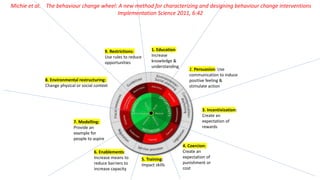
1. Education
Increase
knowledge &
understanding
2. Persuasion: Use
communication to induce
positive feeling &
stimulate action
3. Incentivization:
Create an
expectation of
rewards
4. Coercion:
Create an
expectation of
punishment or
cost
5. Training:
Impact skills
6. Enablements:
Increase means to
reduce barriers to
increase capacity
7. Modelling:
Provide an
example for
people to aspire
8. Environmental restructuring:
Change physical or social context
9. Restrictions:
Use rules to reduce
opportunities
Michie et al. The behaviour change wheel: A new method for characterizing and designing behaviour change interventions
Implementation Science 2011, 6:42
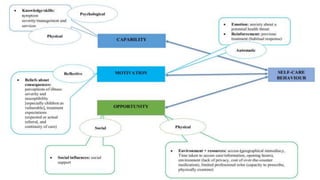
• Capability (psychological and physical)
• Theoretical Domains : knowledge
• Definition : an awareness of the existence of something, e.g. procedural
knowledge
• Reported barrier/ enabler theme
• ‘Poor clinical microbiology knowledge’
• ‘Lack of awareness of clinical guidelines around appropriate antimicrobial prescribing
practices’
• References:
• Chaves et al. tertiary hospitals. Intern Med J 2014; 44: 568–74.
• Fleming et al. long term care facilities BMJ Open 2014; 4: e006442.
• Capability (psychological and physical)
• Theoretical Domains : skills
• Definition : an ability or proficiency acquired through practice, e.g. competence
• Reported barrier/ enabler theme :
• ‘Vancomycin doses are incorrectly adjusted by doctors’
• ‘Lack of training specific to geriatric pharmacotherapy and lack of
communication of clinically relevant information on drugs to avoid for older
patients
• References:
• Chaves et al. tertiary hospitals Intern Med J 2014; 44: 568–74
• Cullinan et al. older hospitalized patients. Implement Sci 2016; 11: 11.
• Capability (psychological and physical)
• Theoretical Domains : memory, attention, decision-making
• Definition : the ability to retain information, focus selectively on aspects of the
environment and choose between two or more alternatives, e.g. decision-making
• Reported barrier/ enabler theme
• ‘Antimicrobial prescribing decisions are contingent on the type of patient’
• ‘Highly pressured prescribing environment limits attention doctors can give
each patient and their medicines’
• References:
• Newlands et al. general dental practice. Br J Clin Pharmacol 2015; 79: 860–9
• Cullinan et al. older hospitalized patients. Implement Sci 2016; 11: 11
• Capability (psychological and physical)
• Theoretical Domains : behavioural regulation
• Definition : anything aimed at managing or changing objectively observed or
measured actions, e.g. selfmonitoring
• Reported barrier/ enabler theme
• ‘Desire for audit and feedback on antibiotic prescribing practice’
• References:
• Newlands et al. general dental practice. Br J Clin Pharmacol 2015; 79: 860–9
• Opportunity (social and physical)
• Theoretical Domains :environmental context and resources
• Definition :any circumstances of a person’s situation or environment that
discourages or encourages the development of skills and abilities, independence,
social competence and adaptive behaviour, e.g. resources
• Reported barrier/ enabler theme
• ‘Lack of diagnostic equipment and interpretation of microbiology results is a
significant challenge for doctors and nurses’
• ‘Lack of time plays a big part in managing bacterial infections’
• ‘Lack of IT infrastructure’
• References:
• Fleming et al. long term care facilities BMJ Open 2014; 4: e006442
• Newlands et al. general dental practice. Br J Clin Pharmacol 2015; 79: 860–9
• Cullinan et al. older hospitalized patients. Implement Sci 2016; 11: 11.
• Opportunity (social and physical)
• Theoretical Domains : social influences
• Definition :those interpersonal processes that can cause individuals to change
their thoughts, feelings or behaviours, e.g. social pressure
• Reported barrier/ enabler theme
• ‘Patient behaviour or demands influence prescribing decisions’
• ‘Nurses acting as a ‘gate keeper’ role, doctors depend on nurses to detect
patients’ signs of infection’
• ‘Patients and/or patients’ families can influence prescribing, with pressure
from patients/families leading doctors to prescribe medications they are not
completely happy with’
• References:
• Newlands et al. general dental practice. Br J Clin Pharmacol 2015; 79: 860–9
• Fleming et al. long term care facilities BMJ Open 2014; 4: e006442
• Cullinan et al. older hospitalized patients. Implement Sci 2016; 11: 11
• Motivation (reflective and automatic)
• Theoretical Domains : social professional role/identity
• Definition :a coherent set of behaviours and displayed personal qualities of an
individual in a social or work setting, e.g. professional confidence
• Reported barrier/ enabler theme
• ‘‘The role of the pharmacist is primarily to screen for drug interactions and
provide medicines information rather than influencing the antibiotic
prescribing process’
• References:
• Fleming et al. long term care facilities BMJ Open 2014; 4: e006442
• Motivation (reflective and automatic)
• Theoretical Domains : beliefs about capabilities
• Definition :acceptance of the truth, reality or validity about an ability, talent or
facility that a person can put to constructive use, e.g. self confidence
• Reported barrier/ enabler theme
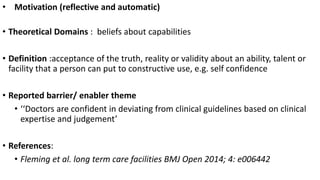
• ‘‘Doctors are confident in deviating from clinical guidelines based on clinical
expertise and judgement’
• References:
• Fleming et al. long term care facilities BMJ Open 2014; 4: e006442
• Motivation (reflective and automatic)
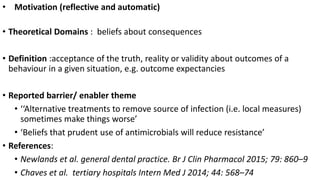
• Theoretical Domains : beliefs about consequences
• Definition :acceptance of the truth, reality or validity about outcomes of a
behaviour in a given situation, e.g. outcome expectancies
• Reported barrier/ enabler theme
• ‘‘Alternative treatments to remove source of infection (i.e. local measures)
sometimes make things worse’
• ‘Beliefs that prudent use of antimicrobials will reduce resistance’
• References:
• Newlands et al. general dental practice. Br J Clin Pharmacol 2015; 79: 860–9
• Chaves et al. tertiary hospitals Intern Med J 2014; 44: 568–74
• Motivation (reflective and automatic)
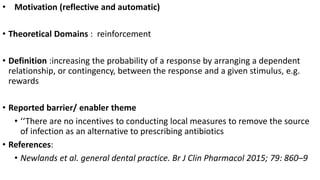
• Theoretical Domains : reinforcement
• Definition :increasing the probability of a response by arranging a dependent
relationship, or contingency, between the response and a given stimulus, e.g.
rewards
• Reported barrier/ enabler theme
• ‘‘There are no incentives to conducting local measures to remove the source
of infection as an alternative to prescribing antibiotics
• References:
• Newlands et al. general dental practice. Br J Clin Pharmacol 2015; 79: 860–9
• Motivation (reflective and automatic)
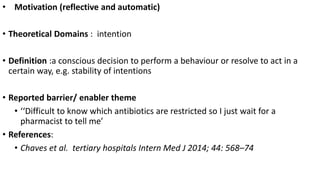
• Theoretical Domains : intention
• Definition :a conscious decision to perform a behaviour or resolve to act in a
certain way, e.g. stability of intentions
• Reported barrier/ enabler theme
• ‘‘Difficult to know which antibiotics are restricted so I just wait for a
pharmacist to tell me’
• References:
• Chaves et al. tertiary hospitals Intern Med J 2014; 44: 568–74
• Motivation (reflective and automatic)
• Theoretical Domains : goals
• Definition :mental representations of outcomes or end states that an individual
wants to achieve, e.g. goal/target setting
• Reported barrier/ enabler theme
• ‘‘Lack of clear targets for antibiotic usage and use of antibiotic care bundles’
• References:
• Fleming et al. long term care facilities BMJ Open 2014; 4: e006442
• Motivation (reflective and automatic)
• Theoretical Domains : optimism
• Definition :the confidence that things will happen for the best or that desired
goals will be attained, e.g. optimism, pessimism
• Reported barrier/ enabler theme
• ‘‘Lack of confidence that local measures as an alternative to prescribing will
solve issues successfully on their own’
• References:
• Newlands et al. general dental practice. Br J Clin Pharmacol 2015; 79: 860–9
• Motivation (reflective and automatic)
• Theoretical Domains : emotion
• Definition :a complex reaction pattern, involving experiential, behavioural and
physiological elements, by which the individual attempts to deal with a personally
significant matter or event, e.g. anxiety
• Reported barrier/ enabler theme
• ‘‘Anxiety about letting somebody go without antibiotics’ ‘Antimicrobials are
often continued because doctors are worried about missing something’
• References:
• Newlands et al. general dental practice. Br J Clin Pharmacol 2015; 79: 860–9
• Study, setting :Newlands et al. 2016, general dental practice
• Key barrier/enabler theme, corresponding Theoretical Domains
Framework domain:
• ‘Although dentists had the knowledge required for evidence-based management of
bacterial infections, most reported difficulties following this day-to-day due to lack
of time during the consultation to implement alternative local measures to remove
the source of infection (e.g. draining dental abscesses)’ (environmental context and
resources)
• Intervention function(s) identified using Theoretical Domains Framework
% BCW mapping matrix:
• restriction, enablement
• BCTs identified using Theoretical Domains Framework % behaviour
change technique mapping matrices:
• -restructuring the social/physical environment
• -instruction on how to perform the behaviour
• -information on health consequences of the behaviour
• Suggested intervention
• ‘Introduction of more emergency slots to booking system.
• Time management course for dentists, practice managers and receptionists who
book appointments and initially deal with patients’
• Study, setting : Fleming et al. 2014, long-term care facilities
• Key barrier/enabler theme, corresponding Theoretical Domains
Framework domain
• ‘Lack of clear targets for antibiotic usage and use of antibiotic care bundles’
(goals/behavioural regulation)
• Intervention function(s) identified using Theoretical Domains Framework
% BCW mapping matrix
• enablement, persuasion
• BCTs identified using Theoretical Domains Framework % behaviour
change technique mapping matrices
• -feedback on outcome of the behaviour
• -discrepancy between current behaviour and goals
• -social comparison
• Suggested intervention
• audit and feedback outlining deviations from guidelines/ evidence-
based practice and benchmarking antibiotic usage against other long
term care facilities
• Study, setting : Cullinan et al. 2014, hospitalized older patients
• Key barrier/enabler theme, corresponding Theoretical Domains
Framework domain
• ‘Prescribers feel ill-equipped to prescribe appropriately due to lack of knowledge
around geriatric pharmacotherapy’ (knowledge/skills)
• Intervention function(s) identified using Theoretical Domains Framework
% BCW mapping matrix
• training
• BCTs identified using Theoretical Domains Framework % behaviour
change technique mapping matrices
• -instruction on how to perform the behaviour
• -information about health consequences of the behaviour
• Suggested intervention
• geriatric pharmacotherapy knowledge and skills-based training for
undergraduate medical trainees; ongoing CPD courses for other clinical staff
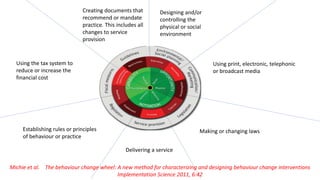
Creating documents that
recommend or mandate
practice. This includes all
changes to service
provision
Using the tax system to
reduce or increase the
financial cost
Establishing rules or principles
of behaviour or practice
Making or changing laws
Designing and/or
controlling the
physical or social
environment
Using print, electronic, telephonic
or broadcast media
Delivering a service
Michie et al. The behaviour change wheel: A new method for characterizing and designing behaviour change interventions
Implementation Science 2011, 6:42
Summary
• The success of ASPs is reliant on the complex challenge of changing human behaviour
• Where possible, avoid ‘rushing’ to intervention.
• Be specific about what you wish to change
• Conduct a ‘behavioural diagnosis’, considering the broader social and environmental
context.
• Consider the full range of intervention strategies and techniques. Match the selection of
intervention to your behavioural diagnosis.
• Look at the evidence in the broader behaviour change literature
• Do not assume your intervention will be implemented as intended or sustained longer-
term
• it is vital to also investigate ‘how’ and ‘why’ interventions are implemented, not just
whether or not they are effective.
Ref: Lorencatto F et al. Driving sustainable change in antimicrobial prescribing practice: how can social and behavioural sciences help?
J Antimicrob Chemother 2018; 73: 2613–2624
I
Thank you
For your attention
&
Action

behaviour changes for success of antimicrobial stewardship program.pptx

  • 1.
    Behavior change required forsuccess of Antimicrobial Stewardship Program Prof. Ashok Rattan, MD, MAMS, Common Wealth Fellow, INSA DFG Fellow , ex SEARO Temporary Advisor, ex WHO Lab Director (CAREC/PAHO) Chairman Medical Committee & Quality, Redcliffe Labs Online Professor & Mentor, AHRO University, Glasgow, Scotland
  • 2.
    Discovery & Developmentof Anti-bacterials is one of the most important discovery of the 20th Century
  • 3.
    Power of antibiotics DiseasePre Antibiotic era deaths Deaths with antibiotics Change in deaths due to antibiotics CAP (1) 35% 10% - 25% HAP (2) 60% 30% - 30% Heart Infection (3) 100% 25% - 75% Brain Infections (4) > 80% < 20% - 60% Skin Infection (5) 11% < 0.5% -10% By comparison…. Treatment of heart attacks with aspirin or clot busting drugs (6) - 3% Ref.: (1) IDSA Position Paper. Clin Infect Dis 2008; 47 (S3): S 249 – 65 (2) IDSA/ACCP/ATS/SCCM position paper. CID 2010; 51 (S1): 51 – 3 (3) Kerr AJ. SABE Lancet 1935; 226: 383 – 4 (4) Waring et al. Am J Med 1948; 5: 402 – 18 (5) Spellberg et al CID 2009; 49: 383 – 91 (6) Lancet 1998; 351 : 233 – 41.
  • 5.
    Need for AntimicrobialStewardship • Antimicrobial stewardship is a coordinated program that promotes the appropriate use of antimicrobials (including antibiotics), improves patient outcomes, reduces microbial resistance, and decreases the spread of infections caused by multidrug-resistant organisms. • Objective are: Right drug for the right patients at the right dose by the right route for the right duration
  • 6.
  • 7.
    Ozger HS etal. Inappropriate use of antibiotics effective against gram positive microorganisms despite restrictive antibiotic policies in ICUs: a prospective observational study. BMC Infectious Diseases (2020) 20:289
  • 11.
    The missing linkin the ASP is behaviour change Behaviour change psychology offer theories, frameworks, methods for understanding what drives behaviour and how to use this to most effectively change it
  • 12.
    What behaviour areyou trying to change ? Matching choice of intervention strategy to behaviour diagnostics
  • 13.
    The COM-B system– a framework for understanding behaviour
  • 14.
  • 15.
  • 16.
  • 17.
    Michie et al.The behaviour change wheel: A new method for characterizing and designing behaviour change interventions Implementation Science 2011, 6:42
  • 19.
    1. Define yourASP problem in behaviour terms • 1. Tendency to think in terms of outcomes • 2. Reducing infection rates or resistance is not a behaviour • 3. Behaviour is product of numerous discrete experiences • 4. ASP is not just prescribing • 5. Multiple actors, actions, different time points & locations • 6. We are rarely specific about what & whose behaviour we need to change • 7. Why does it matter ? • Each driven by different influences • Choice of intervention approach will depend upon understanding behaviour in context
  • 23.
    Interventions Definitions Examples EducationIncreasing knowledge or understanding Providing information to prompt healthy habits Persuasion Using communication to induce positive or negative feelings or stimulate action Using imaging to motivate increase in physical activity Incentivization Creating expectations of rewards Using prize draws to induce right behaviour Coercion Create expectations of punishment or cost Raising the financial cost to reduce excessive alcohol consumption Restriction Using rule to reduce opportunities Prohibit sales to people under 18 Environmental restructuring Changing the physical context Prompt on screen prompts to GP Modelling Provide examples to aspire Using TV drama scenes Enablement Increasing means/ reducing Behavioural support
  • 24.
    Interventions Definitions Examples Communications /marketing Using print, electronic, telephonic or broadcast media Conducting mass media campaigns Guidelines Creating documents that recommend or mandate practice. This includes all changes to service provision Producing and disseminating treatment protocols Fiscal Using the tax system to reduce or increase the financial cost Increasing duty or increasing anti- smuggling activities Regulation Establishing rules or principles of behaviour or practice Establishing voluntary agreements on advertising Legislation Making or changing laws Prohibiting sale or use Environmental / social planning Designing and/or controlling the physical or social environment Using town planning Service provision Delivering a service Establishing support services in workplaces, communities etc.
  • 25.
    Model of behaviour: sources Education PersuasionIncentivi sation Coercion Training Restriction Environmental restructuring Modelling En ablement Physical x x Psycholog x x x Reflective x x x x Automatic x x x x x x Physical x x x Social x x X Marketing X X X X X Guidelines X X X X X X X X Fiscal X X X X X Regulation X X X X X X X X Legislation X X X X X X X X Env Plan X X Service X X X X X X X Links between the components of behaviour and the intervention functions
  • 27.
    1. Education Increase knowledge & understanding 2.Persuasion: Use communication to induce positive feeling & stimulate action 3. Incentivization: Create an expectation of rewards 4. Coercion: Create an expectation of punishment or cost 5. Training: Impact skills 6. Enablements: Increase means to reduce barriers to increase capacity 7. Modelling: Provide an example for people to aspire 8. Environmental restructuring: Change physical or social context 9. Restrictions: Use rules to reduce opportunities Michie et al. The behaviour change wheel: A new method for characterizing and designing behaviour change interventions Implementation Science 2011, 6:42
  • 28.
    • Capability (psychologicaland physical) • Theoretical Domains : knowledge • Definition : an awareness of the existence of something, e.g. procedural knowledge • Reported barrier/ enabler theme • ‘Poor clinical microbiology knowledge’ • ‘Lack of awareness of clinical guidelines around appropriate antimicrobial prescribing practices’ • References: • Chaves et al. tertiary hospitals. Intern Med J 2014; 44: 568–74. • Fleming et al. long term care facilities BMJ Open 2014; 4: e006442.
  • 29.
    • Capability (psychologicaland physical) • Theoretical Domains : skills • Definition : an ability or proficiency acquired through practice, e.g. competence • Reported barrier/ enabler theme : • ‘Vancomycin doses are incorrectly adjusted by doctors’ • ‘Lack of training specific to geriatric pharmacotherapy and lack of communication of clinically relevant information on drugs to avoid for older patients • References: • Chaves et al. tertiary hospitals Intern Med J 2014; 44: 568–74 • Cullinan et al. older hospitalized patients. Implement Sci 2016; 11: 11.
  • 30.
    • Capability (psychologicaland physical) • Theoretical Domains : memory, attention, decision-making • Definition : the ability to retain information, focus selectively on aspects of the environment and choose between two or more alternatives, e.g. decision-making • Reported barrier/ enabler theme • ‘Antimicrobial prescribing decisions are contingent on the type of patient’ • ‘Highly pressured prescribing environment limits attention doctors can give each patient and their medicines’ • References: • Newlands et al. general dental practice. Br J Clin Pharmacol 2015; 79: 860–9 • Cullinan et al. older hospitalized patients. Implement Sci 2016; 11: 11
  • 31.
    • Capability (psychologicaland physical) • Theoretical Domains : behavioural regulation • Definition : anything aimed at managing or changing objectively observed or measured actions, e.g. selfmonitoring • Reported barrier/ enabler theme • ‘Desire for audit and feedback on antibiotic prescribing practice’ • References: • Newlands et al. general dental practice. Br J Clin Pharmacol 2015; 79: 860–9
  • 32.
    • Opportunity (socialand physical) • Theoretical Domains :environmental context and resources • Definition :any circumstances of a person’s situation or environment that discourages or encourages the development of skills and abilities, independence, social competence and adaptive behaviour, e.g. resources • Reported barrier/ enabler theme • ‘Lack of diagnostic equipment and interpretation of microbiology results is a significant challenge for doctors and nurses’ • ‘Lack of time plays a big part in managing bacterial infections’ • ‘Lack of IT infrastructure’ • References: • Fleming et al. long term care facilities BMJ Open 2014; 4: e006442 • Newlands et al. general dental practice. Br J Clin Pharmacol 2015; 79: 860–9 • Cullinan et al. older hospitalized patients. Implement Sci 2016; 11: 11.
  • 33.
    • Opportunity (socialand physical) • Theoretical Domains : social influences • Definition :those interpersonal processes that can cause individuals to change their thoughts, feelings or behaviours, e.g. social pressure • Reported barrier/ enabler theme • ‘Patient behaviour or demands influence prescribing decisions’ • ‘Nurses acting as a ‘gate keeper’ role, doctors depend on nurses to detect patients’ signs of infection’ • ‘Patients and/or patients’ families can influence prescribing, with pressure from patients/families leading doctors to prescribe medications they are not completely happy with’ • References: • Newlands et al. general dental practice. Br J Clin Pharmacol 2015; 79: 860–9 • Fleming et al. long term care facilities BMJ Open 2014; 4: e006442 • Cullinan et al. older hospitalized patients. Implement Sci 2016; 11: 11
  • 34.
    • Motivation (reflectiveand automatic) • Theoretical Domains : social professional role/identity • Definition :a coherent set of behaviours and displayed personal qualities of an individual in a social or work setting, e.g. professional confidence • Reported barrier/ enabler theme • ‘‘The role of the pharmacist is primarily to screen for drug interactions and provide medicines information rather than influencing the antibiotic prescribing process’ • References: • Fleming et al. long term care facilities BMJ Open 2014; 4: e006442
  • 35.
    • Motivation (reflectiveand automatic) • Theoretical Domains : beliefs about capabilities • Definition :acceptance of the truth, reality or validity about an ability, talent or facility that a person can put to constructive use, e.g. self confidence • Reported barrier/ enabler theme • ‘‘Doctors are confident in deviating from clinical guidelines based on clinical expertise and judgement’ • References: • Fleming et al. long term care facilities BMJ Open 2014; 4: e006442
  • 36.
    • Motivation (reflectiveand automatic) • Theoretical Domains : beliefs about consequences • Definition :acceptance of the truth, reality or validity about outcomes of a behaviour in a given situation, e.g. outcome expectancies • Reported barrier/ enabler theme • ‘‘Alternative treatments to remove source of infection (i.e. local measures) sometimes make things worse’ • ‘Beliefs that prudent use of antimicrobials will reduce resistance’ • References: • Newlands et al. general dental practice. Br J Clin Pharmacol 2015; 79: 860–9 • Chaves et al. tertiary hospitals Intern Med J 2014; 44: 568–74
  • 37.
    • Motivation (reflectiveand automatic) • Theoretical Domains : reinforcement • Definition :increasing the probability of a response by arranging a dependent relationship, or contingency, between the response and a given stimulus, e.g. rewards • Reported barrier/ enabler theme • ‘‘There are no incentives to conducting local measures to remove the source of infection as an alternative to prescribing antibiotics • References: • Newlands et al. general dental practice. Br J Clin Pharmacol 2015; 79: 860–9
  • 38.
    • Motivation (reflectiveand automatic) • Theoretical Domains : intention • Definition :a conscious decision to perform a behaviour or resolve to act in a certain way, e.g. stability of intentions • Reported barrier/ enabler theme • ‘‘Difficult to know which antibiotics are restricted so I just wait for a pharmacist to tell me’ • References: • Chaves et al. tertiary hospitals Intern Med J 2014; 44: 568–74
  • 39.
    • Motivation (reflectiveand automatic) • Theoretical Domains : goals • Definition :mental representations of outcomes or end states that an individual wants to achieve, e.g. goal/target setting • Reported barrier/ enabler theme • ‘‘Lack of clear targets for antibiotic usage and use of antibiotic care bundles’ • References: • Fleming et al. long term care facilities BMJ Open 2014; 4: e006442
  • 40.
    • Motivation (reflectiveand automatic) • Theoretical Domains : optimism • Definition :the confidence that things will happen for the best or that desired goals will be attained, e.g. optimism, pessimism • Reported barrier/ enabler theme • ‘‘Lack of confidence that local measures as an alternative to prescribing will solve issues successfully on their own’ • References: • Newlands et al. general dental practice. Br J Clin Pharmacol 2015; 79: 860–9
  • 41.
    • Motivation (reflectiveand automatic) • Theoretical Domains : emotion • Definition :a complex reaction pattern, involving experiential, behavioural and physiological elements, by which the individual attempts to deal with a personally significant matter or event, e.g. anxiety • Reported barrier/ enabler theme • ‘‘Anxiety about letting somebody go without antibiotics’ ‘Antimicrobials are often continued because doctors are worried about missing something’ • References: • Newlands et al. general dental practice. Br J Clin Pharmacol 2015; 79: 860–9
  • 42.
    • Study, setting:Newlands et al. 2016, general dental practice • Key barrier/enabler theme, corresponding Theoretical Domains Framework domain: • ‘Although dentists had the knowledge required for evidence-based management of bacterial infections, most reported difficulties following this day-to-day due to lack of time during the consultation to implement alternative local measures to remove the source of infection (e.g. draining dental abscesses)’ (environmental context and resources) • Intervention function(s) identified using Theoretical Domains Framework % BCW mapping matrix: • restriction, enablement • BCTs identified using Theoretical Domains Framework % behaviour change technique mapping matrices: • -restructuring the social/physical environment • -instruction on how to perform the behaviour • -information on health consequences of the behaviour
  • 43.
    • Suggested intervention •‘Introduction of more emergency slots to booking system. • Time management course for dentists, practice managers and receptionists who book appointments and initially deal with patients’
  • 44.
    • Study, setting: Fleming et al. 2014, long-term care facilities • Key barrier/enabler theme, corresponding Theoretical Domains Framework domain • ‘Lack of clear targets for antibiotic usage and use of antibiotic care bundles’ (goals/behavioural regulation) • Intervention function(s) identified using Theoretical Domains Framework % BCW mapping matrix • enablement, persuasion • BCTs identified using Theoretical Domains Framework % behaviour change technique mapping matrices • -feedback on outcome of the behaviour • -discrepancy between current behaviour and goals • -social comparison
  • 45.
    • Suggested intervention •audit and feedback outlining deviations from guidelines/ evidence- based practice and benchmarking antibiotic usage against other long term care facilities
  • 46.
    • Study, setting: Cullinan et al. 2014, hospitalized older patients • Key barrier/enabler theme, corresponding Theoretical Domains Framework domain • ‘Prescribers feel ill-equipped to prescribe appropriately due to lack of knowledge around geriatric pharmacotherapy’ (knowledge/skills) • Intervention function(s) identified using Theoretical Domains Framework % BCW mapping matrix • training • BCTs identified using Theoretical Domains Framework % behaviour change technique mapping matrices • -instruction on how to perform the behaviour • -information about health consequences of the behaviour • Suggested intervention • geriatric pharmacotherapy knowledge and skills-based training for undergraduate medical trainees; ongoing CPD courses for other clinical staff
  • 47.
    Creating documents that recommendor mandate practice. This includes all changes to service provision Using the tax system to reduce or increase the financial cost Establishing rules or principles of behaviour or practice Making or changing laws Designing and/or controlling the physical or social environment Using print, electronic, telephonic or broadcast media Delivering a service Michie et al. The behaviour change wheel: A new method for characterizing and designing behaviour change interventions Implementation Science 2011, 6:42
  • 48.
    Summary • The successof ASPs is reliant on the complex challenge of changing human behaviour • Where possible, avoid ‘rushing’ to intervention. • Be specific about what you wish to change • Conduct a ‘behavioural diagnosis’, considering the broader social and environmental context. • Consider the full range of intervention strategies and techniques. Match the selection of intervention to your behavioural diagnosis. • Look at the evidence in the broader behaviour change literature • Do not assume your intervention will be implemented as intended or sustained longer- term • it is vital to also investigate ‘how’ and ‘why’ interventions are implemented, not just whether or not they are effective. Ref: Lorencatto F et al. Driving sustainable change in antimicrobial prescribing practice: how can social and behavioural sciences help? J Antimicrob Chemother 2018; 73: 2613–2624
  • 49.
    I Thank you For yourattention & Action