© Cengage Learning 2016 © Cengage Learning 2016
Eric J. Mash
David A. Wolfe
Assessment, Diagnosis, and
Treatment
4
© Cengage Learning 2016
Clinical Issues
• The decision-making process
– Begins with a clinical assessment - uses
systematic problem-solving strategies to
understand children with disturbances and
their family and school environments
– Flexible, ongoing hypothesis testing
assesses:
• A child’s emotional, behavioral, and cognitive
functioning; the role of environmental factors;
nature, causes, and likely outcomes of the problem
© Cengage Learning 2016
Idiographic and Nomothetic Approaches
• Idiographic case formulation
– Assessments focus on obtaining detailed
understanding of the child or family as a
unique entity
• Nomothetic formulation
– Emphasizes general inferences that apply to
large groups of individuals
© Cengage Learning 2016
Developmental Considerations
• Ethnic minority youth are at greater risk of
misdiagnosis
• Cultural information is necessary to:
– Establish relationship with child and family
– Motivate family members to change
– Obtain valid information
– Arrive at accurate diagnosis
– Develop meaningful treatment
recommendations
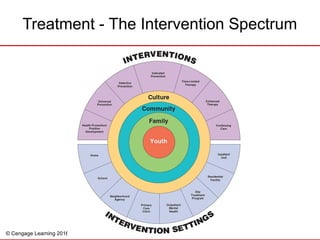
© Cengage Learning 2016
Developmental Considerations - Culture
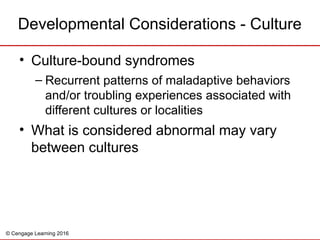
• Culture-bound syndromes
– Recurrent patterns of maladaptive behaviors
and/or troubling experiences associated with
different cultures or localities
• What is considered abnormal may vary
between cultures
© Cengage Learning 2016
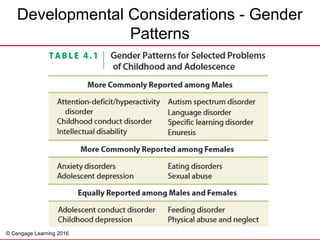
Developmental Considerations - Gender
Patterns
© Cengage Learning 2016
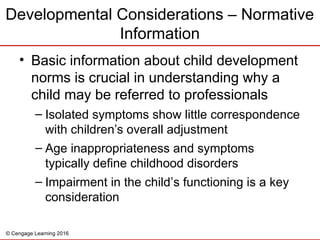
• Basic information about child development
norms is crucial in understanding why a
child may be referred to professionals
– Isolated symptoms show little correspondence
with children’s overall adjustment
– Age inappropriateness and symptoms
typically define childhood disorders
– Impairment in the child’s functioning is a key
consideration
Developmental Considerations – Normative
Information
© Cengage Learning 2016
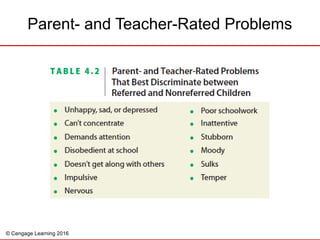
Parent- and Teacher-Rated Problems
© Cengage Learning 2016
Purposes of Assessment
• Description and diagnosis
– First step: clinical description summarizes the
child’s unique behaviors, thoughts, and
feelings that together make up the features of
the child’s psychological disorder
– Diagnosis involves analyzing information and
drawing conclusions about the nature or
cause of the problem
© Cengage Learning 2016
Purposes of Assessment in Treatment
• Prognosis and treatment planning
– Prognosis: the formulation of predictions
about future behavior under specified
conditions
– Treatment planning and evaluation apply
assessment information to generate a
treatment plan and to evaluate its
effectiveness
© Cengage Learning 2016
• Clinical assessment – information is
obtained from different informants, in a
variety of settings, using various methods
– The methods need to be reliable, valid, cost-
effective, and useful for treatment
– Clinical assessment reveals the child’s
thoughts, feelings, and behaviors
– Comprehensive assessment evaluates a
child’s strengths and weaknesses across
many domains
Assessing Disorders
© Cengage Learning 2016
• Provide a large amount of information
during a brief period
• Include a developmental or family history
• Most interviews are unstructured
– May result in low reliability and biased
information
• Semistructured interviews are more
reliable
– Include specific questions
Clinical Interviews
© Cengage Learning 2016
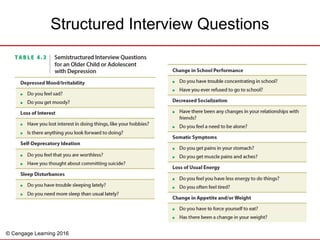
Structured Interview Questions
© Cengage Learning 2016
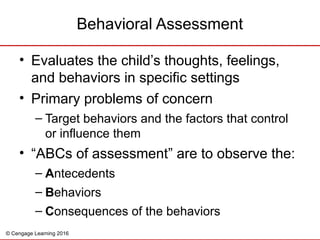
• Evaluates the child’s thoughts, feelings,
and behaviors in specific settings
• Primary problems of concern
– Target behaviors and the factors that control
or influence them
• “ABCs of assessment” are to observe the:
– Antecedents
– Behaviors
– Consequences of the behaviors
Behavioral Assessment
© Cengage Learning 2016
Behavioral Assessment - Behavior Analysis
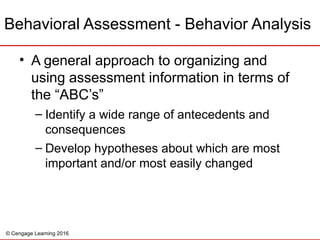
• A general approach to organizing and
using assessment information in terms of
the “ABC’s”
– Identify a wide range of antecedents and
consequences
– Develop hypotheses about which are most
important and/or most easily changed
© Cengage Learning 2016
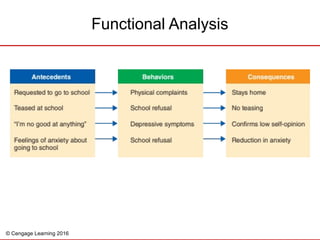
Functional Analysis
© Cengage Learning 2016
Behavioral Assessment - Checklists and
Rating Scales
• Allow for a child’s behavior to be
compared with a known reference group
• Economical to administer and score
• Lack of agreement between informants is
relatively common, and is highly
informative
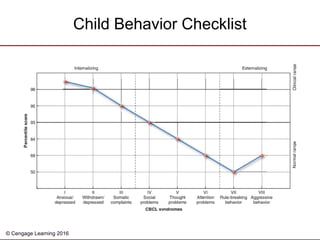
• The Child Behavior Checklist (CBCL)
gives clinicians a useful profile of the
variety and degree of the child’s problems
© Cengage Learning 2016
Child Behavior Checklist
© Cengage Learning 2016
Behavioral Assessment - Behavioral
Observation
• Parents or other observers record baseline
data to provide information about
behaviors in real-life settings
• Recordings may be done by parents or
others
– May be difficult to ensure accuracy
• Clinician may set up role-play simulation to
observe children and their families
© Cengage Learning 2016
• Tests: tasks given under standard
conditions
– The purpose is to assess some aspect of the
child’s knowledge, skill, or personality
• A child’s scores are compared with a norm
group
– The norm group may have limitations in terms
of race, ethnicity, culture, SES, etc.
Psychological Testing
© Cengage Learning 2016
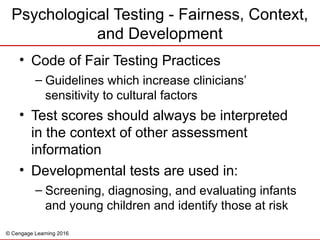
Psychological Testing - Fairness, Context,
and Development
• Code of Fair Testing Practices
– Guidelines which increase clinicians’
sensitivity to cultural factors
• Test scores should always be interpreted
in the context of other assessment
information
• Developmental tests are used in:
– Screening, diagnosing, and evaluating infants
and young children and identify those at risk
© Cengage Learning 2016
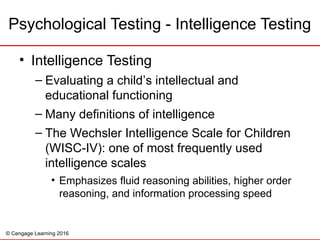
• Intelligence Testing
– Evaluating a child’s intellectual and
educational functioning
– Many definitions of intelligence
– The Wechsler Intelligence Scale for Children
(WISC-IV): one of most frequently used
intelligence scales
• Emphasizes fluid reasoning abilities, higher order
reasoning, and information processing speed
Psychological Testing - Intelligence Testing
© Cengage Learning 2016
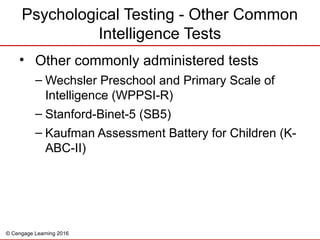
Psychological Testing - Other Common
Intelligence Tests
• Other commonly administered tests
– Wechsler Preschool and Primary Scale of
Intelligence (WPPSI-R)
– Stanford-Binet-5 (SB5)
– Kaufman Assessment Battery for Children (K-
ABC-II)
© Cengage Learning 2016
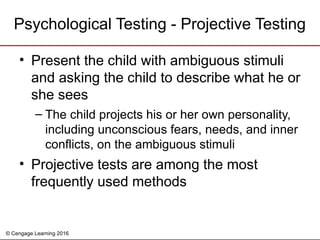
Psychological Testing - Projective Testing
• Present the child with ambiguous stimuli
and asking the child to describe what he or
she sees
– The child projects his or her own personality,
including unconscious fears, needs, and inner
conflicts, on the ambiguous stimuli
• Projective tests are among the most
frequently used methods
© Cengage Learning 2016
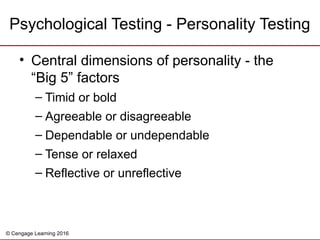
Psychological Testing - Personality Testing
• Central dimensions of personality - the
“Big 5” factors
– Timid or bold
– Agreeable or disagreeable
– Dependable or undependable
– Tense or relaxed
– Reflective or unreflective
© Cengage Learning 2016
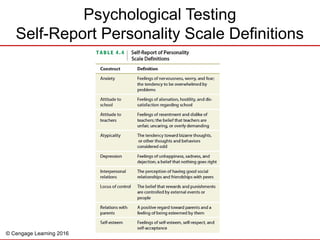
Psychological Testing
Self-Report Personality Scale Definitions
© Cengage Learning 2016
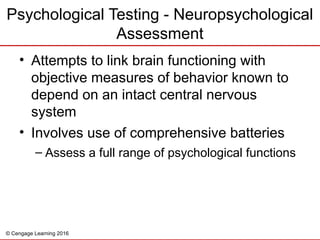
Psychological Testing - Neuropsychological
Assessment
• Attempts to link brain functioning with
objective measures of behavior known to
depend on an intact central nervous
system
• Involves use of comprehensive batteries
– Assess a full range of psychological functions
© Cengage Learning 2016
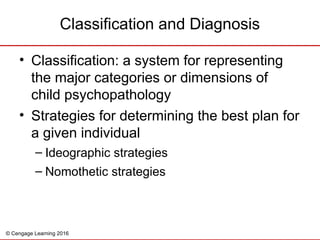
• Classification: a system for representing
the major categories or dimensions of
child psychopathology
• Strategies for determining the best plan for
a given individual
– Ideographic strategies
– Nomothetic strategies
Classification and Diagnosis
© Cengage Learning 2016
• Idiographic strategies highlight a child’s
unique situation
• Nomothetic strategies – employed to:
– Benefit from all the information accumulated
on a given problem or disorder
– Determine the general category to which the
problem belongs
Ideographic and Nomothetic Strategies
© Cengage Learning 2016
Categories and Dimensions
• Categorical classification systems are
based primarily on informed professional
consensus
• A “classical/pure” categorical approach
– Every diagnosis has a clear underlying cause
– Each disorder is fundamentally different from
other disorders
• Dimensional classification
– Many independent dimensions exist
© Cengage Learning 2016
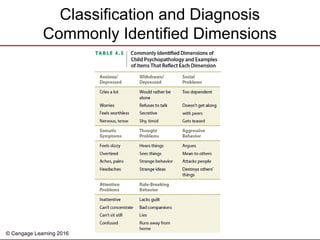
Classification and Diagnosis
Commonly Identified Dimensions
© Cengage Learning 2016
The Diagnostic and Statistical Manual
(DSM)
• The current edition: DSM-5
• A multiaxial system consisting of five axes:
I. Clinical disorders or conditions
II. Personality disorders and intellectual
disability
III. General medical conditions
IV. Psychosocial and environmental problems
V. Global assessment of functioning
© Cengage Learning 2016
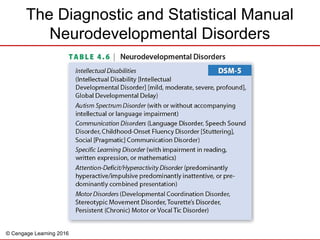
The Diagnostic and Statistical Manual
Neurodevelopmental Disorders
© Cengage Learning 2016
The Diagnostic and Statistical Manual
Criticisms
• Fails to capture the complex adaptations,
transactions, and setting influences crucial
to understanding and treating child
psychopathology
• Gives less attention to disorders of
infancy/childhood
• Fails to capture the interrelationships and
overlap known to exist among many
childhood disorders
© Cengage Learning 2016
The Diagnostic and Statistical Manual -
Pros and Cons
• Pros of diagnostic labels
– Help clinicians summarize and order
observations
– Facilitate communication among
professionals
– Aid parents by providing recognition and
understanding of their child’s problem
© Cengage Learning 2016
The Diagnostic and Statistical Manual -
Pros and Cons (cont’d.)
• Cons of diagnostic labels
– Disagreement about effectiveness of labels to
achieve their purposes
– Negative effects and stigmatization
– Can negatively influence children’s views of
themselves and their behavior
© Cengage Learning 2016
Treatment
• Interventions today are planned by
combining the most effective approaches
to a particular problem
• The most useful treatments are based on
what we know about a particular childhood
disorder
• Data is needed to show that interventions
work
© Cengage Learning 2016
Treatment (cont’d.)
• Multiple problems require multiple
solutions
• Problem-solving strategies are part of a
spectrum of activities for treatment,
maintenance, and prevention
• Interventions are part of an ongoing
decision-making approach
© Cengage Learning 2016
Treatment - The Intervention Spectrum
© Cengage Learning 2016
• Development of evidence-based
interventions has led to a growing
awareness of children’s and families’
cultural contexts
• The cultural compatibility hypothesis
– Treatment is likely to be more effective when
compatible with the cultural patterns of the
child and family
Cultural Considerations
© Cengage Learning 2016
Cultural Considerations (cont’d.)
• Evidenced-based treatments have been
adapted and implemented to meet the
needs of specific cultural groups
• Treatment services for children must:
– Attend to presenting problem
– Consider the specific cultural practices of the
family
• Must be careful not to stereotype
individuals of any cultural group
© Cengage Learning 2016
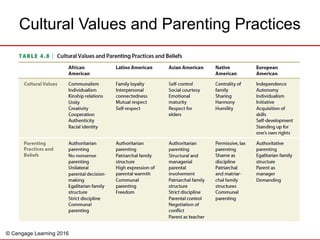
Cultural Values and Parenting Practices
© Cengage Learning 2016
• Outcomes related to child functioning
– Reduce or eliminate symptoms
– Reduce degree of impairment in functioning
– Enhance social competence
– Improve academic performance
Treatment Goals
© Cengage Learning 2016
• Outcomes related to family functioning
– Reduce level of family dysfunction
– Improve marital and sibling relationships
– Reduce stress
– Enhance family support
Treatment Goals (cont’d.)
© Cengage Learning 2016
Treatment Goals (cont’d.)
• Outcomes of societal importance
– Improve child’s participation in school-related
activities
– Decrease involvement in juvenile justice
system
– Reduce need for special services
– Reduce accidental injuries or substance
abuse
– Enhance physical and mental health
© Cengage Learning 2016
Ethical and Legal Considerations
• AACAP and APA ethical code provide
minimum ethical standards
– Select treatment goals and procedures that
are in the best interest of the client
– Ensure participation is active and voluntary
– Keep records to document treatment
effectiveness
– Protect confidentiality
– Ensure therapist’s qualifications and
competencies
© Cengage Learning 2016
Ethical and Legal Considerations (cont’d.)
• Determine when a minor is competent to
make decisions
• Be cautious about ineffective or potentially
harmful treatment
• Comply with federal, state, and local laws
– Education for All Handicapped Children Act
(1975)
– Individuals with Disabilities Education
Improvement Act (2004)
© Cengage Learning 2016
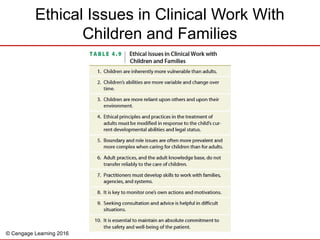
Ethical Issues in Clinical Work With
Children and Families
© Cengage Learning 2016
• More than 70% of clinicians use an
eclectic approach
• Psychodynamic treatments
– View child psychopathology as determined by
underlying unconscious and conscious
conflicts
– Focus is on helping the child develop an
awareness of unconscious factors
contributing to problems
General Approaches to Treatment
© Cengage Learning 2016
• Assume that behaviors are learned
• Focus is on re-educating the child
• Procedures include:
– Positive reinforcement or time-out
– Modeling
– Systematic desensitization
– Changes in the child’s environment
Behavioral Treatments
© Cengage Learning 2016
• View abnormal behavior as the result of
deficits and/or distortions in the child’s
thinking
• Focus is on changing faulty cognitions
Cognitive Treatments
© Cengage Learning 2016
• View psychological disturbances as the
result of:
– Faulty thought patterns
– Faulty learning and environmental
experiences
• Focus on:
– Identifying and changing maladaptive
cognitions; teaching the child to use cognitive
and behavioral coping strategies; and helping
the child learn self-regulation
Cognitive Behavioral Treatments
© Cengage Learning 2016
Client-Centered and Family Treatments
• Client-centered treatments:
– Focus on creating a therapeutic setting which
provides unconditional acceptance of the child
• Family treatments:
– View individual disorders as manifestations of
disturbances in family relations
– Focus on the family issues underlying
children’s problematic behavior
© Cengage Learning 2016
• View child psychopathology as resulting
from psychobiological impairment or
dysfunction
• Rely primarily on pharmacological and
other biological approaches to treatment
Biological Treatments
© Cengage Learning 2016
• The use of two or more interventions, each
of which can stand on its own as a
treatment strategy
• More communities are now implementing
comprehensive mental health programs
for children
– Often delivered through schools
Combined Treatments
© Cengage Learning 2016
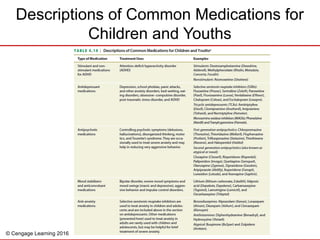
Descriptions of Common Medications for
Children and Youths
© Cengage Learning 2016
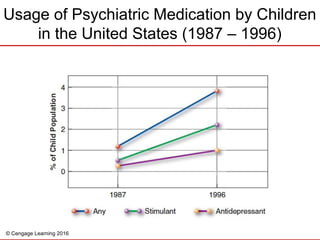
Usage of Psychiatric Medication by Children
in the United States (1987 – 1996)
© Cengage Learning 2016
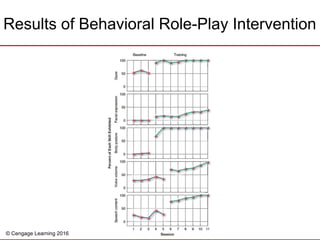
Results of Behavioral Role-Play Intervention
© Cengage Learning 2016
• Best practice guidelines
– Systematically developed statements to assist
practitioners and patients
• Two main approaches in developing best
practice guidelines
– The scientific approach derives guidelines
from a review of current research findings
– The expert-consensus approach uses experts’
opinions to fill gaps in scientific literature
Treatment Effectiveness
© Cengage Learning 2016
Positive Findings
• Children’s changes achieved through
therapy are greater than changes for
children not receiving therapy
• Children receiving therapy are better off
after therapy
• Treatments are equally effective for
internalizing and externalizing disorders
• Treatment effects tend to be long-lasting
© Cengage Learning 2016
Negative Findings
• Fewer than 20% of treatments
demonstrate evidence for reducing
impairment in life functioning
• Community-based clinic therapy is far less
effective than structured research therapy
• Conventional services for children may
have limited effectiveness
© Cengage Learning 2016
New Directions
• As many as 70% to 80% of children and
families with significant mental health
needs do not receive any specialized
assessment or treatment services
• New initiatives:
– Increase recognition of children's mental
health needs
– Develop a wider range of service delivery
models

Abnormal child psychology ppt............

  • 1.
    © Cengage Learning2016 © Cengage Learning 2016 Eric J. Mash David A. Wolfe Assessment, Diagnosis, and Treatment 4
  • 2.
    © Cengage Learning2016 Clinical Issues • The decision-making process – Begins with a clinical assessment - uses systematic problem-solving strategies to understand children with disturbances and their family and school environments – Flexible, ongoing hypothesis testing assesses: • A child’s emotional, behavioral, and cognitive functioning; the role of environmental factors; nature, causes, and likely outcomes of the problem
  • 3.
    © Cengage Learning2016 Idiographic and Nomothetic Approaches • Idiographic case formulation – Assessments focus on obtaining detailed understanding of the child or family as a unique entity • Nomothetic formulation – Emphasizes general inferences that apply to large groups of individuals
  • 4.
    © Cengage Learning2016 Developmental Considerations • Ethnic minority youth are at greater risk of misdiagnosis • Cultural information is necessary to: – Establish relationship with child and family – Motivate family members to change – Obtain valid information – Arrive at accurate diagnosis – Develop meaningful treatment recommendations
  • 5.
    © Cengage Learning2016 Developmental Considerations - Culture • Culture-bound syndromes – Recurrent patterns of maladaptive behaviors and/or troubling experiences associated with different cultures or localities • What is considered abnormal may vary between cultures
  • 6.
    © Cengage Learning2016 Developmental Considerations - Gender Patterns
  • 7.
    © Cengage Learning2016 • Basic information about child development norms is crucial in understanding why a child may be referred to professionals – Isolated symptoms show little correspondence with children’s overall adjustment – Age inappropriateness and symptoms typically define childhood disorders – Impairment in the child’s functioning is a key consideration Developmental Considerations – Normative Information
  • 8.
    © Cengage Learning2016 Parent- and Teacher-Rated Problems
  • 9.
    © Cengage Learning2016 Purposes of Assessment • Description and diagnosis – First step: clinical description summarizes the child’s unique behaviors, thoughts, and feelings that together make up the features of the child’s psychological disorder – Diagnosis involves analyzing information and drawing conclusions about the nature or cause of the problem
  • 10.
    © Cengage Learning2016 Purposes of Assessment in Treatment • Prognosis and treatment planning – Prognosis: the formulation of predictions about future behavior under specified conditions – Treatment planning and evaluation apply assessment information to generate a treatment plan and to evaluate its effectiveness
  • 11.
    © Cengage Learning2016 • Clinical assessment – information is obtained from different informants, in a variety of settings, using various methods – The methods need to be reliable, valid, cost- effective, and useful for treatment – Clinical assessment reveals the child’s thoughts, feelings, and behaviors – Comprehensive assessment evaluates a child’s strengths and weaknesses across many domains Assessing Disorders
  • 12.
    © Cengage Learning2016 • Provide a large amount of information during a brief period • Include a developmental or family history • Most interviews are unstructured – May result in low reliability and biased information • Semistructured interviews are more reliable – Include specific questions Clinical Interviews
  • 13.
    © Cengage Learning2016 Structured Interview Questions
  • 14.
    © Cengage Learning2016 • Evaluates the child’s thoughts, feelings, and behaviors in specific settings • Primary problems of concern – Target behaviors and the factors that control or influence them • “ABCs of assessment” are to observe the: – Antecedents – Behaviors – Consequences of the behaviors Behavioral Assessment
  • 15.
    © Cengage Learning2016 Behavioral Assessment - Behavior Analysis • A general approach to organizing and using assessment information in terms of the “ABC’s” – Identify a wide range of antecedents and consequences – Develop hypotheses about which are most important and/or most easily changed
  • 16.
    © Cengage Learning2016 Functional Analysis
  • 17.
    © Cengage Learning2016 Behavioral Assessment - Checklists and Rating Scales • Allow for a child’s behavior to be compared with a known reference group • Economical to administer and score • Lack of agreement between informants is relatively common, and is highly informative • The Child Behavior Checklist (CBCL) gives clinicians a useful profile of the variety and degree of the child’s problems
  • 18.
    © Cengage Learning2016 Child Behavior Checklist
  • 19.
    © Cengage Learning2016 Behavioral Assessment - Behavioral Observation • Parents or other observers record baseline data to provide information about behaviors in real-life settings • Recordings may be done by parents or others – May be difficult to ensure accuracy • Clinician may set up role-play simulation to observe children and their families
  • 20.
    © Cengage Learning2016 • Tests: tasks given under standard conditions – The purpose is to assess some aspect of the child’s knowledge, skill, or personality • A child’s scores are compared with a norm group – The norm group may have limitations in terms of race, ethnicity, culture, SES, etc. Psychological Testing
  • 21.
    © Cengage Learning2016 Psychological Testing - Fairness, Context, and Development • Code of Fair Testing Practices – Guidelines which increase clinicians’ sensitivity to cultural factors • Test scores should always be interpreted in the context of other assessment information • Developmental tests are used in: – Screening, diagnosing, and evaluating infants and young children and identify those at risk
  • 22.
    © Cengage Learning2016 • Intelligence Testing – Evaluating a child’s intellectual and educational functioning – Many definitions of intelligence – The Wechsler Intelligence Scale for Children (WISC-IV): one of most frequently used intelligence scales • Emphasizes fluid reasoning abilities, higher order reasoning, and information processing speed Psychological Testing - Intelligence Testing
  • 23.
    © Cengage Learning2016 Psychological Testing - Other Common Intelligence Tests • Other commonly administered tests – Wechsler Preschool and Primary Scale of Intelligence (WPPSI-R) – Stanford-Binet-5 (SB5) – Kaufman Assessment Battery for Children (K- ABC-II)
  • 24.
    © Cengage Learning2016 Psychological Testing - Projective Testing • Present the child with ambiguous stimuli and asking the child to describe what he or she sees – The child projects his or her own personality, including unconscious fears, needs, and inner conflicts, on the ambiguous stimuli • Projective tests are among the most frequently used methods
  • 25.
    © Cengage Learning2016 Psychological Testing - Personality Testing • Central dimensions of personality - the “Big 5” factors – Timid or bold – Agreeable or disagreeable – Dependable or undependable – Tense or relaxed – Reflective or unreflective
  • 26.
    © Cengage Learning2016 Psychological Testing Self-Report Personality Scale Definitions
  • 27.
    © Cengage Learning2016 Psychological Testing - Neuropsychological Assessment • Attempts to link brain functioning with objective measures of behavior known to depend on an intact central nervous system • Involves use of comprehensive batteries – Assess a full range of psychological functions
  • 28.
    © Cengage Learning2016 • Classification: a system for representing the major categories or dimensions of child psychopathology • Strategies for determining the best plan for a given individual – Ideographic strategies – Nomothetic strategies Classification and Diagnosis
  • 29.
    © Cengage Learning2016 • Idiographic strategies highlight a child’s unique situation • Nomothetic strategies – employed to: – Benefit from all the information accumulated on a given problem or disorder – Determine the general category to which the problem belongs Ideographic and Nomothetic Strategies
  • 30.
    © Cengage Learning2016 Categories and Dimensions • Categorical classification systems are based primarily on informed professional consensus • A “classical/pure” categorical approach – Every diagnosis has a clear underlying cause – Each disorder is fundamentally different from other disorders • Dimensional classification – Many independent dimensions exist
  • 31.
    © Cengage Learning2016 Classification and Diagnosis Commonly Identified Dimensions
  • 32.
    © Cengage Learning2016 The Diagnostic and Statistical Manual (DSM) • The current edition: DSM-5 • A multiaxial system consisting of five axes: I. Clinical disorders or conditions II. Personality disorders and intellectual disability III. General medical conditions IV. Psychosocial and environmental problems V. Global assessment of functioning
  • 33.
    © Cengage Learning2016 The Diagnostic and Statistical Manual Neurodevelopmental Disorders
  • 34.
    © Cengage Learning2016 The Diagnostic and Statistical Manual Criticisms • Fails to capture the complex adaptations, transactions, and setting influences crucial to understanding and treating child psychopathology • Gives less attention to disorders of infancy/childhood • Fails to capture the interrelationships and overlap known to exist among many childhood disorders
  • 35.
    © Cengage Learning2016 The Diagnostic and Statistical Manual - Pros and Cons • Pros of diagnostic labels – Help clinicians summarize and order observations – Facilitate communication among professionals – Aid parents by providing recognition and understanding of their child’s problem
  • 36.
    © Cengage Learning2016 The Diagnostic and Statistical Manual - Pros and Cons (cont’d.) • Cons of diagnostic labels – Disagreement about effectiveness of labels to achieve their purposes – Negative effects and stigmatization – Can negatively influence children’s views of themselves and their behavior
  • 37.
    © Cengage Learning2016 Treatment • Interventions today are planned by combining the most effective approaches to a particular problem • The most useful treatments are based on what we know about a particular childhood disorder • Data is needed to show that interventions work
  • 38.
    © Cengage Learning2016 Treatment (cont’d.) • Multiple problems require multiple solutions • Problem-solving strategies are part of a spectrum of activities for treatment, maintenance, and prevention • Interventions are part of an ongoing decision-making approach
  • 39.
    © Cengage Learning2016 Treatment - The Intervention Spectrum
  • 40.
    © Cengage Learning2016 • Development of evidence-based interventions has led to a growing awareness of children’s and families’ cultural contexts • The cultural compatibility hypothesis – Treatment is likely to be more effective when compatible with the cultural patterns of the child and family Cultural Considerations
  • 41.
    © Cengage Learning2016 Cultural Considerations (cont’d.) • Evidenced-based treatments have been adapted and implemented to meet the needs of specific cultural groups • Treatment services for children must: – Attend to presenting problem – Consider the specific cultural practices of the family • Must be careful not to stereotype individuals of any cultural group
  • 42.
    © Cengage Learning2016 Cultural Values and Parenting Practices
  • 43.
    © Cengage Learning2016 • Outcomes related to child functioning – Reduce or eliminate symptoms – Reduce degree of impairment in functioning – Enhance social competence – Improve academic performance Treatment Goals
  • 44.
    © Cengage Learning2016 • Outcomes related to family functioning – Reduce level of family dysfunction – Improve marital and sibling relationships – Reduce stress – Enhance family support Treatment Goals (cont’d.)
  • 45.
    © Cengage Learning2016 Treatment Goals (cont’d.) • Outcomes of societal importance – Improve child’s participation in school-related activities – Decrease involvement in juvenile justice system – Reduce need for special services – Reduce accidental injuries or substance abuse – Enhance physical and mental health
  • 46.
    © Cengage Learning2016 Ethical and Legal Considerations • AACAP and APA ethical code provide minimum ethical standards – Select treatment goals and procedures that are in the best interest of the client – Ensure participation is active and voluntary – Keep records to document treatment effectiveness – Protect confidentiality – Ensure therapist’s qualifications and competencies
  • 47.
    © Cengage Learning2016 Ethical and Legal Considerations (cont’d.) • Determine when a minor is competent to make decisions • Be cautious about ineffective or potentially harmful treatment • Comply with federal, state, and local laws – Education for All Handicapped Children Act (1975) – Individuals with Disabilities Education Improvement Act (2004)
  • 48.
    © Cengage Learning2016 Ethical Issues in Clinical Work With Children and Families
  • 49.
    © Cengage Learning2016 • More than 70% of clinicians use an eclectic approach • Psychodynamic treatments – View child psychopathology as determined by underlying unconscious and conscious conflicts – Focus is on helping the child develop an awareness of unconscious factors contributing to problems General Approaches to Treatment
  • 50.
    © Cengage Learning2016 • Assume that behaviors are learned • Focus is on re-educating the child • Procedures include: – Positive reinforcement or time-out – Modeling – Systematic desensitization – Changes in the child’s environment Behavioral Treatments
  • 51.
    © Cengage Learning2016 • View abnormal behavior as the result of deficits and/or distortions in the child’s thinking • Focus is on changing faulty cognitions Cognitive Treatments
  • 52.
    © Cengage Learning2016 • View psychological disturbances as the result of: – Faulty thought patterns – Faulty learning and environmental experiences • Focus on: – Identifying and changing maladaptive cognitions; teaching the child to use cognitive and behavioral coping strategies; and helping the child learn self-regulation Cognitive Behavioral Treatments
  • 53.
    © Cengage Learning2016 Client-Centered and Family Treatments • Client-centered treatments: – Focus on creating a therapeutic setting which provides unconditional acceptance of the child • Family treatments: – View individual disorders as manifestations of disturbances in family relations – Focus on the family issues underlying children’s problematic behavior
  • 54.
    © Cengage Learning2016 • View child psychopathology as resulting from psychobiological impairment or dysfunction • Rely primarily on pharmacological and other biological approaches to treatment Biological Treatments
  • 55.
    © Cengage Learning2016 • The use of two or more interventions, each of which can stand on its own as a treatment strategy • More communities are now implementing comprehensive mental health programs for children – Often delivered through schools Combined Treatments
  • 56.
    © Cengage Learning2016 Descriptions of Common Medications for Children and Youths
  • 57.
    © Cengage Learning2016 Usage of Psychiatric Medication by Children in the United States (1987 – 1996)
  • 58.
    © Cengage Learning2016 Results of Behavioral Role-Play Intervention
  • 59.
    © Cengage Learning2016 • Best practice guidelines – Systematically developed statements to assist practitioners and patients • Two main approaches in developing best practice guidelines – The scientific approach derives guidelines from a review of current research findings – The expert-consensus approach uses experts’ opinions to fill gaps in scientific literature Treatment Effectiveness
  • 60.
    © Cengage Learning2016 Positive Findings • Children’s changes achieved through therapy are greater than changes for children not receiving therapy • Children receiving therapy are better off after therapy • Treatments are equally effective for internalizing and externalizing disorders • Treatment effects tend to be long-lasting
  • 61.
    © Cengage Learning2016 Negative Findings • Fewer than 20% of treatments demonstrate evidence for reducing impairment in life functioning • Community-based clinic therapy is far less effective than structured research therapy • Conventional services for children may have limited effectiveness
  • 62.
    © Cengage Learning2016 New Directions • As many as 70% to 80% of children and families with significant mental health needs do not receive any specialized assessment or treatment services • New initiatives: – Increase recognition of children's mental health needs – Develop a wider range of service delivery models

Editor's Notes

  • #6 Table 4.1 Gender patterns for selected problems of childhood and adolescence Source: Adapted from Gender Differences in the Diagnosis of Mental Disorders. Conclusions and Controversies of DSM-IV by C. M. Hartung and T. A. Widiger, 1998, Psychological Bulletin, 123, 260–278. Copyright © 1998 by the American Psychological Association. Reprinted with permission. APA is not responsible for the accuracy of this translation.
  • #8 Table 4.2 Parent- and teacher-rated problems that best discriminate between referred and nonreferred children Source: From Achenbach, T. M. and Rescorla, L. A. (2001), Manual for the ASEBA School- Age Forms & Profiles, ISBN 978-0-938565-73-4. Burlington, VT: University of Vermont, Research Center for Children, Youth, and Families) p. 144. Reprinted by permission.
  • #13 Table 4.3 Semistructured interview questions for an older child or adolescent with depression Source: Adapted from Clinical and Forensic Interviewing of Children and Families: Guidelines for the Mental Health, Education, Pediatric, and Child Maltreatment Fields by J. M. Sattler, pp. 938-940. Copyright © 1998 by Jerome M. Sattler Publisher, Inc. Adapted by permission.
  • #16 Figure 4.1 Functional analysis: antecedents, behaviors, consequences Source: Cengage Learning 2016
  • #18 Figure 4.2 Child Behavior Checklist (CBCL) profile for Felicia Source: Based on Achenbach & Rescorla, 2001
  • #26 Table 4.4 Self-report of Personality Scale Definitions Source: Behavior Assessment System for Children, Second Edition (BASC-2). Copyright © 2004 NCS Pearson, Inc. Reproduced with permission. All rights reserved. “BASC” is a trademark, in the US and/or other countries, of Pearson Education, Inc. or its affiliates(s).
  • #31 Table 4.5 Commonly identified dimensions of child psychopathology and examples of items that reflect each dimension Source: Achenbach, T. M. & Rescorla, L. A. (2001). Manual for the ASEBA School-Age Forms and Profiles. (Burlington, VT: University of Vermont, Research Center for Children, Youth, and Families, 2001. Reprinted with permission.
  • #33 Table 4.6 Categories that apply to children Source: Reprinted with permission from the Diagnostic and Statistical Manual of Mental Disorders, Fifth Edition
  • #39 FIGURE 4 .4 | The intervention spectrum and settings for childhood disorders. Based on Weisz, J. R., Sandler, I. N., Durlak, J. A., and Anton, B. S. (2005). Promoting and protecting youth mental health through evidence-based prevention and treatment.
  • #42 Table 4.8 Cultural values and parenting practices and beliefs Sources: Adapted from Forehand and Kotchik, 1996; and from Yasui and Dishion, 2007.
  • #48 Table 4.9 Core ethical issues in clinical work with children and families Source: Reprinted from Psychiatric Clinics of North America, 32, Belitz, J. & Bailey, R. A., Clinical ethics for the treatment of children and adolescents: A guide for general psychiatrists, 243–257, Copyright 2009, with permission from Elsevier.
  • #56 Table 4.10 Descriptions of common medications for children and youths Source: Based on Psychiatric medication for children and adolescents. II: Types of medications, American Academy of Child & Adolescent Psychiatry, 2004.
  • #57 Figure 4.4 Usage of psychiatric medication by children in the United States between 1987 and 1996 Source: Adapted from Journal of the American Academy of Child and Adolescent Psychiatry, 41, A Olfson, M., Marcus, S. C., Weissman, M. M., & Jensen, P. S., National trends in the use of psychotropic medications by children, 514–521, Copyright 2002, with permission from Elsevier.
  • #58 Figure 4.6 Results of behavioral role-play intervention Source: Adapted from Depression by D. J. Kolko, 1987. In M. Hersen and V. B. Van Hasselt (Eds.), “Behavior Therapy with Children and Adolescents: A Clinical Approach”, pp. 163–164. Copyright © 1987 by John Wiley & Sons, Inc. Reprinted by permission of John Wiley & Sons, Inc.