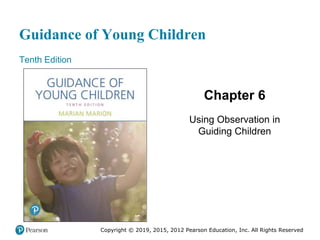
Guidance of Young Children
Tenth Edition
Chapter 6
Using Observation in
Guiding Children
Copyright © 2019, 2015, 2012 Pearson Education, Inc. All Rights Reserved
Learning Objectives
• Explain the reason for assessing children’s development
and the nature of authentic assessment in early
childhood education.
• Recall reasons for observing children’s behavior.
• Identify methods for recording observations objectively
and to avoid bias or subjectivity.
• Explain the major practical and effective methods that
teachers use in observing children’s development and
behavior.
• Defend the utility of portfolios in observation and
assessment.
Copyright © 2019, 2015, 2012 Pearson Education, Inc. All Rights Reserved
Assessment in Early Childhood Education
Drives decision-making in early childhood education
Copyright © 2019, 2015, 2012 Pearson Education, Inc. All Rights Reserved
Assessment: Definition
Gathering and recording information about young children’s
development and learning
Copyright © 2019, 2015, 2012 Pearson Education, Inc. All Rights Reserved
Overall Goal of Assessment
• Identify a child’s strengths
• Build on a child’s strengths
Copyright © 2019, 2015, 2012 Pearson Education, Inc. All Rights Reserved
Purposes of Assessment
• Supports a teacher’s planning so that they can meet
needs of each and every child
• Identify individual children who might need focused
programs or intervention
• Evaluate effectiveness of programs and services
Copyright © 2019, 2015, 2012 Pearson Education, Inc. All Rights Reserved
Different Forms of Assessment
• Summative assessment: Summarizes what children have
learned over a long period
• Progress-monitoring assessment: monitors progress at
preassigned times during the school year
• Formative or Authentic Assessment: Performance based,
observation-based and appropriate for all children
Copyright © 2019, 2015, 2012 Pearson Education, Inc. All Rights Reserved
Who Benefits from Assessment?
• Children: learn in an environment and with curriculum
matched to their strengths and needs
• Teachers: function in their professional role better
because they can get good information about a child’s
strengths and needs
• Parent(s): get a better picture of their child’s development
and learning
Copyright © 2019, 2015, 2012 Pearson Education, Inc. All Rights Reserved
Appropriate Assessment in Early
Childhood Education
• Uses many sources of information
• Appropriate for all children, no exceptions
• Assesses all developmental domains (state learning
standards focus on all domains; therefore, teachers need
information about all developmental domains)
• Always carried out ethically
Copyright © 2019, 2015, 2012 Pearson Education, Inc. All Rights Reserved
Assessment Should Be Performance-Based
Children apply skills and knowledge in a real-world setting
Examples:
• work samples
• interviews with children
• teacher observation
Copyright © 2019, 2015, 2012 Pearson Education, Inc. All Rights Reserved
Reasons for Observing Children’s
Behavior
Copyright © 2019, 2015, 2012 Pearson Education, Inc. All Rights Reserved
Children Communicate with Behavior
• Behavior has meaning
• Words and behavior give clues about
– what has happened
– who was involved
– when things happen
– where things take place
Copyright © 2019, 2015, 2012 Pearson Education, Inc. All Rights Reserved
Discover and Build on Children’s Strengths
Observe behavior to discover children’s:
• preferences
• strengths
• needs
Copyright © 2019, 2015, 2012 Pearson Education, Inc. All Rights Reserved
Observe Individual Needs for Possible
Further Screening
• Observations contribute to teams assessing individual
and special needs
• Teachers do not diagnose but assist in a diagnosis
Copyright © 2019, 2015, 2012 Pearson Education, Inc. All Rights Reserved
The Five ‘w’ Questions about Children’s
Behavior
Copyright © 2019, 2015, 2012 Pearson Education, Inc. All Rights Reserved
Who was Involved?
• Child alone? Other children? How many others?
• Adults? Who? Teacher(s), volunteers, parent(s)?
• Animals?
Copyright © 2019, 2015, 2012 Pearson Education, Inc. All Rights Reserved
What Happened?
• Note the precise nature of the behavior
• Record what happened before and after the behavior
• Note how long the behavior went on
Copyright © 2019, 2015, 2012 Pearson Education, Inc. All Rights Reserved
When the Behavior Take Place?
(Be specific)
Does it occur:
• at the same time(s) each day?
• at different times of the day?
• on the same days?
• on different days?
Copyright © 2019, 2015, 2012 Pearson Education, Inc. All Rights Reserved
Where Did the Behavior Take Place?
Does it occur
• in the same place?
• in different places?
• almost anywhere?
Copyright © 2019, 2015, 2012 Pearson Education, Inc. All Rights Reserved
Why Might the Child Have Behaved This
Way?
• Requires careful reflection
• Reflect on answers to the other four questions
• Decide if you have enough information
• Do you even need to interpret the behavior?
• Do you need more information before you can make an
accurate conclusion?
Copyright © 2019, 2015, 2012 Pearson Education, Inc. All Rights Reserved
Practical and Effective Methods for
Observing Children’s Behavior
Narrative method: tell or narrate a story
Non-narrative method: no story needed
Copyright © 2019, 2015, 2012 Pearson Education, Inc. All Rights Reserved
Narrative Methods
• Anecdotal records
• Running Records
Copyright © 2019, 2015, 2012 Pearson Education, Inc. All Rights Reserved
Anecdotal Records
• ‘Snapshot’ of an incident
• Brief story told with written notes
• Useful for:
– many behaviors
– many aspects of child development
– different parts of children’s learning
• Can be spontaneous or planned
• Advantages: Easy to learn, take little time to use
• Disadvantages: Very little information given, making it difficult
to draw reasoned conclusions
Copyright © 2019, 2015, 2012 Pearson Education, Inc. All Rights Reserved
Running Records
• More detailed retelling of incident
• Needs a clear focus
• Take only about 5 to 10 minutes
• Information on:
– Context, background, and time
– Details of the incident: objective and detailed
– Child’s speech and actions are recorded
– Only observable data recorded
– Comments or interpretation if and only if warranted
Copyright © 2019, 2015, 2012 Pearson Education, Inc. All Rights Reserved
Non-Narrative Methods
• Checklists
• Rating Scales
• Event Sampling
• Time Sampling
Copyright © 2019, 2015, 2012 Pearson Education, Inc. All Rights Reserved
Checklists (1 of 2)
• A list of characteristics or behaviors
• A check is recorded if a child shows the behavior
• A blank space is left if the behavior does not occur
• A short-cut method, takes little time
• Doesn’t need to tell a story
• Should be used several times to get an accurate idea
Copyright © 2019, 2015, 2012 Pearson Education, Inc. All Rights Reserved
Checklists (2 of 2)
• Benefits
– Easy and quick to use
– Flexible
• Drawbacks
– Lack of information about the quality of the behavior
– Do not say anything about the frequency of behavior
• More powerful when combined with anecdotal or running
records
Copyright © 2019, 2015, 2012 Pearson Education, Inc. All Rights Reserved
Rating Scales
• Used after a previous observation to summarize
observations and make judgments about a child’s
behavior
• Shortcut method
– Does not present original data
– Organizes information in a quick, easy-to-read format
• Advantages include: ease of use, does not require
training
• Disadvantages include: great possibility of personal bias
Copyright © 2019, 2015, 2012 Pearson Education, Inc. All Rights Reserved
Event Sampling
• Used to observe one particular aspect of a child’s
development or learning
• Identifies a specific, precise target behavior
• Involves teacher observation followed by recorded
instances of only the defined behavior
• Focuses on something so specific that a bit of detail is
encouraged
• May include potential drawbacks such as ill defined
behavior
Copyright © 2019, 2015, 2012 Pearson Education, Inc. All Rights Reserved
Time Sampling
• Allows teachers to observe small samples of a child’s
behavior
• Used for recording interactions
• Does not record every instance of behavior
• Observations are divided into time intervals
• Requires less writing
• Target behaviors may occur outside of the interval
designed for monitoring
Copyright © 2019, 2015, 2012 Pearson Education, Inc. All Rights Reserved
Copyright

Marion 10 Chapter 6

  • 1.
    Guidance of YoungChildren Tenth Edition Chapter 6 Using Observation in Guiding Children Copyright © 2019, 2015, 2012 Pearson Education, Inc. All Rights Reserved
  • 2.
    Copyright © 2019,2015, 2012 Pearson Education, Inc. All Rights Reserved Learning Objectives • Explain the reason for assessing children’s development and the nature of authentic assessment in early childhood education. • Recall reasons for observing children’s behavior. • Identify methods for recording observations objectively and to avoid bias or subjectivity. • Explain the major practical and effective methods that teachers use in observing children’s development and behavior. • Defend the utility of portfolios in observation and assessment.
  • 3.
    Copyright © 2019,2015, 2012 Pearson Education, Inc. All Rights Reserved Assessment in Early Childhood Education Drives decision-making in early childhood education
  • 4.
    Copyright © 2019,2015, 2012 Pearson Education, Inc. All Rights Reserved Assessment: Definition Gathering and recording information about young children’s development and learning
  • 5.
    Copyright © 2019,2015, 2012 Pearson Education, Inc. All Rights Reserved Overall Goal of Assessment • Identify a child’s strengths • Build on a child’s strengths
  • 6.
    Copyright © 2019,2015, 2012 Pearson Education, Inc. All Rights Reserved Purposes of Assessment • Supports a teacher’s planning so that they can meet needs of each and every child • Identify individual children who might need focused programs or intervention • Evaluate effectiveness of programs and services
  • 7.
    Copyright © 2019,2015, 2012 Pearson Education, Inc. All Rights Reserved Different Forms of Assessment • Summative assessment: Summarizes what children have learned over a long period • Progress-monitoring assessment: monitors progress at preassigned times during the school year • Formative or Authentic Assessment: Performance based, observation-based and appropriate for all children
  • 8.
    Copyright © 2019,2015, 2012 Pearson Education, Inc. All Rights Reserved Who Benefits from Assessment? • Children: learn in an environment and with curriculum matched to their strengths and needs • Teachers: function in their professional role better because they can get good information about a child’s strengths and needs • Parent(s): get a better picture of their child’s development and learning
  • 9.
    Copyright © 2019,2015, 2012 Pearson Education, Inc. All Rights Reserved Appropriate Assessment in Early Childhood Education • Uses many sources of information • Appropriate for all children, no exceptions • Assesses all developmental domains (state learning standards focus on all domains; therefore, teachers need information about all developmental domains) • Always carried out ethically
  • 10.
    Copyright © 2019,2015, 2012 Pearson Education, Inc. All Rights Reserved Assessment Should Be Performance-Based Children apply skills and knowledge in a real-world setting Examples: • work samples • interviews with children • teacher observation
  • 11.
    Copyright © 2019,2015, 2012 Pearson Education, Inc. All Rights Reserved Reasons for Observing Children’s Behavior
  • 12.
    Copyright © 2019,2015, 2012 Pearson Education, Inc. All Rights Reserved Children Communicate with Behavior • Behavior has meaning • Words and behavior give clues about – what has happened – who was involved – when things happen – where things take place
  • 13.
    Copyright © 2019,2015, 2012 Pearson Education, Inc. All Rights Reserved Discover and Build on Children’s Strengths Observe behavior to discover children’s: • preferences • strengths • needs
  • 14.
    Copyright © 2019,2015, 2012 Pearson Education, Inc. All Rights Reserved Observe Individual Needs for Possible Further Screening • Observations contribute to teams assessing individual and special needs • Teachers do not diagnose but assist in a diagnosis
  • 15.
    Copyright © 2019,2015, 2012 Pearson Education, Inc. All Rights Reserved The Five ‘w’ Questions about Children’s Behavior
  • 16.
    Copyright © 2019,2015, 2012 Pearson Education, Inc. All Rights Reserved Who was Involved? • Child alone? Other children? How many others? • Adults? Who? Teacher(s), volunteers, parent(s)? • Animals?
  • 17.
    Copyright © 2019,2015, 2012 Pearson Education, Inc. All Rights Reserved What Happened? • Note the precise nature of the behavior • Record what happened before and after the behavior • Note how long the behavior went on
  • 18.
    Copyright © 2019,2015, 2012 Pearson Education, Inc. All Rights Reserved When the Behavior Take Place? (Be specific) Does it occur: • at the same time(s) each day? • at different times of the day? • on the same days? • on different days?
  • 19.
    Copyright © 2019,2015, 2012 Pearson Education, Inc. All Rights Reserved Where Did the Behavior Take Place? Does it occur • in the same place? • in different places? • almost anywhere?
  • 20.
    Copyright © 2019,2015, 2012 Pearson Education, Inc. All Rights Reserved Why Might the Child Have Behaved This Way? • Requires careful reflection • Reflect on answers to the other four questions • Decide if you have enough information • Do you even need to interpret the behavior? • Do you need more information before you can make an accurate conclusion?
  • 21.
    Copyright © 2019,2015, 2012 Pearson Education, Inc. All Rights Reserved Practical and Effective Methods for Observing Children’s Behavior Narrative method: tell or narrate a story Non-narrative method: no story needed
  • 22.
    Copyright © 2019,2015, 2012 Pearson Education, Inc. All Rights Reserved Narrative Methods • Anecdotal records • Running Records
  • 23.
    Copyright © 2019,2015, 2012 Pearson Education, Inc. All Rights Reserved Anecdotal Records • ‘Snapshot’ of an incident • Brief story told with written notes • Useful for: – many behaviors – many aspects of child development – different parts of children’s learning • Can be spontaneous or planned • Advantages: Easy to learn, take little time to use • Disadvantages: Very little information given, making it difficult to draw reasoned conclusions
  • 24.
    Copyright © 2019,2015, 2012 Pearson Education, Inc. All Rights Reserved Running Records • More detailed retelling of incident • Needs a clear focus • Take only about 5 to 10 minutes • Information on: – Context, background, and time – Details of the incident: objective and detailed – Child’s speech and actions are recorded – Only observable data recorded – Comments or interpretation if and only if warranted
  • 25.
    Copyright © 2019,2015, 2012 Pearson Education, Inc. All Rights Reserved Non-Narrative Methods • Checklists • Rating Scales • Event Sampling • Time Sampling
  • 26.
    Copyright © 2019,2015, 2012 Pearson Education, Inc. All Rights Reserved Checklists (1 of 2) • A list of characteristics or behaviors • A check is recorded if a child shows the behavior • A blank space is left if the behavior does not occur • A short-cut method, takes little time • Doesn’t need to tell a story • Should be used several times to get an accurate idea
  • 27.
    Copyright © 2019,2015, 2012 Pearson Education, Inc. All Rights Reserved Checklists (2 of 2) • Benefits – Easy and quick to use – Flexible • Drawbacks – Lack of information about the quality of the behavior – Do not say anything about the frequency of behavior • More powerful when combined with anecdotal or running records
  • 28.
    Copyright © 2019,2015, 2012 Pearson Education, Inc. All Rights Reserved Rating Scales • Used after a previous observation to summarize observations and make judgments about a child’s behavior • Shortcut method – Does not present original data – Organizes information in a quick, easy-to-read format • Advantages include: ease of use, does not require training • Disadvantages include: great possibility of personal bias
  • 29.
    Copyright © 2019,2015, 2012 Pearson Education, Inc. All Rights Reserved Event Sampling • Used to observe one particular aspect of a child’s development or learning • Identifies a specific, precise target behavior • Involves teacher observation followed by recorded instances of only the defined behavior • Focuses on something so specific that a bit of detail is encouraged • May include potential drawbacks such as ill defined behavior
  • 30.
    Copyright © 2019,2015, 2012 Pearson Education, Inc. All Rights Reserved Time Sampling • Allows teachers to observe small samples of a child’s behavior • Used for recording interactions • Does not record every instance of behavior • Observations are divided into time intervals • Requires less writing • Target behaviors may occur outside of the interval designed for monitoring
  • 31.
    Copyright © 2019,2015, 2012 Pearson Education, Inc. All Rights Reserved Copyright

Editor's Notes

  • #2 If this PowerPoint presentation contains mathematical equations, you may need to check that your computer has the following installed: 1) MathType Plugin 2) Math Player (free versions available) 3) NVDA Reader (free versions available)