point of view

Behavior Changes That Stick:
End the “Spray and Pray” Approach to
Training; Go for “Sustain to Attain” Results


                                                                                                                              Authored by
                                                                                                         Vivien Price and David Robertson
 Definitions:
 Sustain (verb): to supply with sustenance                                terms of learning, this means that participants won’t retain
 Attain (verb): to reach a goal with effort                               the knowledge learned, will fail to act in new ways, and
 Sustain to attain: to supply nourishment and support over time to        ultimately will not master and apply new behaviors.
 strengthen new skills and behaviors                              Forum has partnered with many clients to implement
                                                                  targeted sustainment plans designed to help improve the
Traditionally, organizational learning and development            uptake of new behaviors and processes in the workplace.
interventions have focused on the visible, concrete, “main        Our experience shows that for these plans to be
event” components of learning: virtual or face-to-face            successful, they need to fit with the learning environment,
programs or workshops that introduce new concepts,                with the nature of the work, and with the work styles and
skills, tools, and behaviors. However, a significant              capabilities of the target audience. This document outlines
component of the learning intervention—the ongoing                our sustainment approach: how we’ve worked with clients
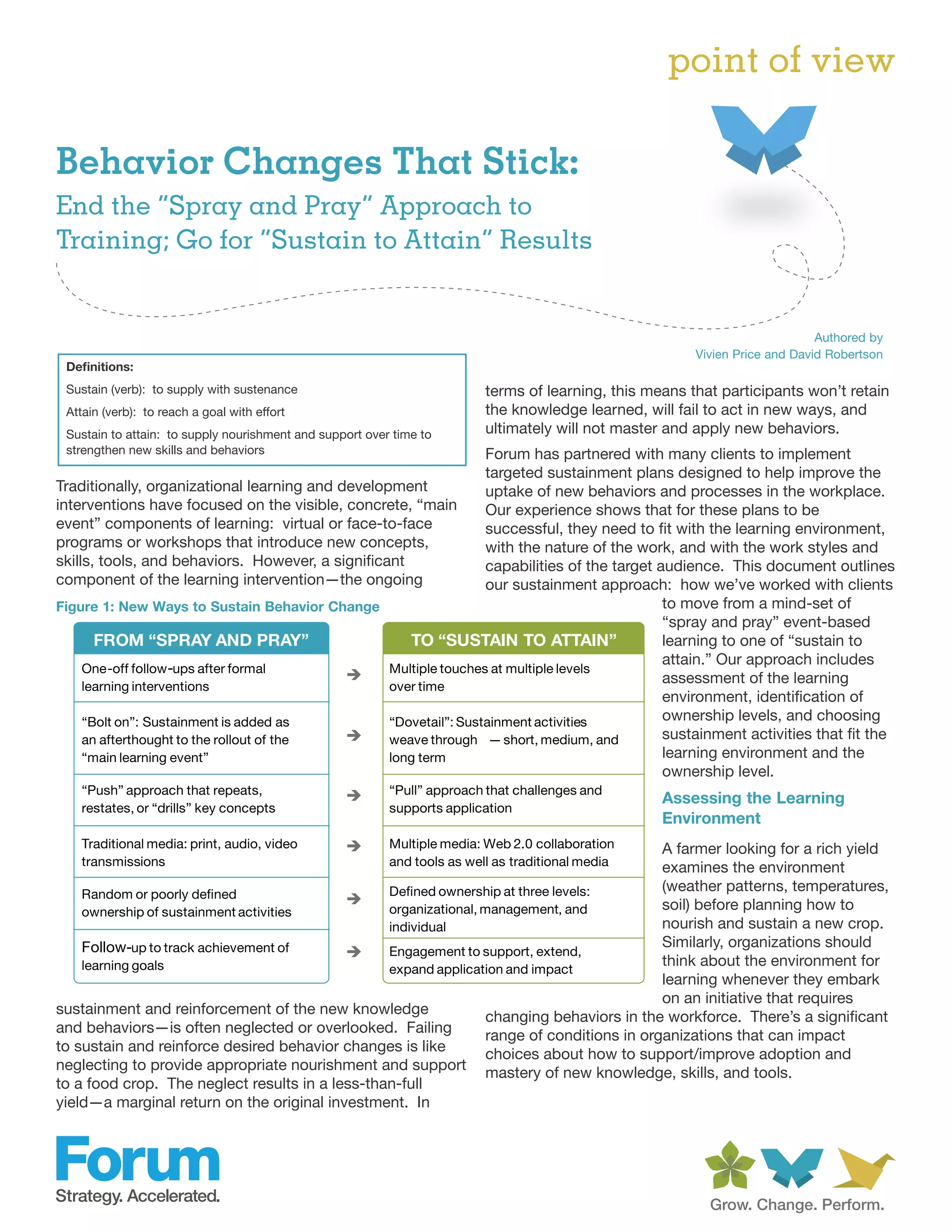
Figure 1: New Ways to Sustain Behavior Change                                                 to move from a mind-set of
                                                                                              “spray and pray” event-based
       FROM “SPRAY AND PRAY”                         TO “SUSTAIN TO ATTAIN”                   learning to one of “sustain to
                                                                                              attain.” Our approach includes
     One-off follow -ups after formal             Multiple touches at multiple levels
     learning interventions                       over time
                                                                                              assessment of the learning
                                                                                              environment, identification of
     “Bolt on”: Sustainment is added as           “Dovetail”: Sustainment activities          ownership levels, and choosing
     an afterthought to the rollout of the        weave through — short, medium, and          sustainment activities that fit the
     “main learning event”                        long term                                   learning environment and the
                                                                                              ownership level.
   “Push” approach that repeats,                          “Pull” approach that challenges and
                                                                                                    Assessing the Learning
   restates, or “drills” key concepts                     supports application
                                                                                                    Environment
   Traditional media: print, audio, video                 Multiple media: Web 2.0 collaboration
                                                                                           A farmer looking for a rich yield
   transmissions                                          and tools as well as traditional media
                                                                                           examines the environment
    Random or poorly de ned                      De ned ownership at three levels:         (weather patterns, temperatures,
    ownership of sustainment activities          organizational, management, and           soil) before planning how to
                                                 individual                                nourish and sustain a new crop.
    Follow-up to track achievement of                                                      Similarly, organizations should
                                                 Engagement to support, extend,
    learning goals                                                                         think about the environment for
                                                 expand application and impact
                                                                                           learning whenever they embark
                                                                                           on an initiative that requires
sustainment and reinforcement of the new knowledge
                                                                 changing behaviors in the workforce. There’s a significant
and behaviors—is often neglected or overlooked. Failing
                                                                 range of conditions in organizations that can impact
to sustain and reinforce desired behavior changes is like
                                                                 choices about how to support/improve adoption and
neglecting to provide appropriate nourishment and support
                                                                 mastery of new knowledge, skills, and tools.
to a food crop. The neglect results in a less-than-full
yield—a marginal return on the original investment. In
point of view
    Case in Point: Transforming Sales Behaviors                                                n Organization drives: The learning and development
                                                                                                 organization invests in centrally driven reinforcement
    One year into a significant change program to improve its sales force
    effectiveness, a leading U.S. beverages company took stock of its                            activities and events.
    situation. The initial phases of the initiative had included alignment                     n Leaders lead: The ownership and responsibility for
    work, rollout of skills development workshops to all salespeople, and                        sustainment and reinforcement work lies primarily in the
    the restructuring/revising of sales processes. The company was
    committed to helping salespeople change their behaviors and deliver a
                                                                                                 hands of managers of participants.
    more consultative approach to working with customers. Sales leaders                        n Learners seek: Sustainment efforts are in the hands
    knew they were facing a possible stall in the initiative, specifically the                   of the individual learners. They select what they will do
    danger of “flavor of the day,” in which people pay attention to the
    initiative in the early stages of rollout but then slip back to old habits
                                                                                                 and how to sustain what they are learning.
    and ways of working. To address this, the company executed a                               Once the primary and secondary owners have been
    sustainment plan to support people in applying the new behaviors and
    skill sets. The plan consisted of a variety of simple, hands-on activities                 identified, the appropriate sustainment activities can be
    to reinforce and support salespeople as they applied new skills and                        chosen to fit with the ownership.
    tools back on the job.
                                                                                               Choosing Sustainment Activities to Fit the
    Six months into the sustainment phase, one tenured manager
    described the impact and uplift as follows: “These sustainment                             Learning Environment and the Ownership
    activities have helped us to move from obligation and ‘We have to                          Approach
    do this’ to commitment and ‘I get it! This stuff does work!’” Change
    happens over time, and people need support and sustainment activities                      Our experience and work with clients who take the
    to help them change behaviors. A “sustain to attain” approach                              “sustain to attain” approach to performance improvement
    improves the application of new knowledge and skills back on the job.                      reveal four categories for sustainment activities
                                                                                               (see Figure 3):
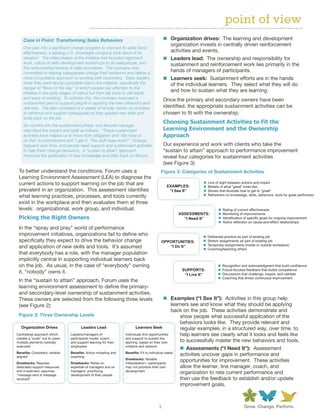
 To better understand the conditions, Forum uses a                                         Figure 3: Categories of Sustainment Activities
 Learning Environment Assessment (LEA) to diagnose the
 current actions to support learning on the job that are                                         EXAMPLES:
                                                                                                                       Line of sight between actions and impact
                                                                                                                       Models of what “great” looks like
 prevalent in an organization. This assessment identifies                                         “I See It”           Stories that illustrate how to get to “great”
 what learning practices, processes, and tools currently                                                               Refreshers on knowledge, skills, behaviors, tools for great performers

 exist in the workplace and then evaluates them at three
 levels: organizational, work group, and individual.                                                                            Rating of current effectiveness
                                                                                                      ASSESSMENTS:              Monitoring of improvements
 Picking the Right Owners                                                                               “I Need It”             Identification of specific goals for ongoing improvement
                                                                                                                                Active reflection on cause-and-effect relationships
 In the “spray and pray” world of performance
 improvement initiatives, organizations fail to define who                                                             Deliberate practice as part of existing job
 specifically they expect to drive the behavior change                                     OPPORTUNITIES:              Stretch assignments as part of existing job
                                                                                                                       Temporary assignments (inside or outside workplace)
 and application of new skills and tools. It’s assumed                                        “I Do It”
                                                                                                                       Coaching/teaching others
 that everybody has a role, with the manager population
 implicitly central in supporting individual learners back
 on the job. As usual, in the case of “everybody” owning                                                                        Recognition and acknowledgment that build confidence
                                                                                                        SUPPORTS:               Future-focused feedback that builds competence
 it, “nobody” owns it.                                                                                   “I Live It”            Discussions that challenge, inspire, and validate
                                                                                                                                Coaching that drives continuous improvement
 In the “sustain to attain” approach, Forum uses the
 learning environment assessment to define the primary-
 and secondary-level ownership of sustainment activities.
 These owners are selected from the following three levels                                  n Examples (“I See It”): Activities in this group help
 (see Figure 2):                                                                               learners see and know what they should be applying
                                                                                               back on the job. These activities demonstrate and
 Figure 2: Three Ownership Levels                                                                  show people what successful application of the
                                                                                                   behaviors looks like. They provide relevant and
   Organization Drives                  Leaders Lead                     Learners Seek             regular examples, in a structured way, over time, to
Centralized approach which       Leaders/managers of              Individuals nd opportunities     help learners see clearly what it looks and feels like
creates a “push” out to users:   participants model, coach,       and support to sustain the
multiple elements centrally      and support learning for their   learning, based on their own     to successfully master the new behaviors and tools.
executed                         employees                        initiative and network
                                                                                                       n Assessments (“I Need It”): Assessment
Bene ts: Consistent, reliable,   Bene ts: Active modeling and     Bene ts: Fit to individual needs
aligned                          coaching
                                                                                                       activities uncover gaps in performance and
                                                                  Drawbacks: Variable
Drawbacks: Requires              Drawbacks: Relies on             interpretation—participants
                                                                                                       opportunities for improvement. These activities
dedicated support resources      expertise of managers and on     may not prioritize their own         allow the learner, line manager, coach, and
and investment; assumes          managers’ prioritizing           development
“message sent is message         development of their people
                                                                                                       organization to rate current performance and
received”                                                                                              then use the feedback to establish and/or update
                                                                                                       improvement goals.


                                                                                           2
point of view
                                  n Opportunities (“I Do It”): Deliberate practice is at the                        The communication plan should define what the targeted
                                    heart of behavior change. Opportunities for application                         message will be over time and identify the optimal method
                                    of new skills and tools don’t have to amount to “10,000                         or technology to drive communication (for example,
                                    hours” but they do need to be more significant than a                           communities of practice, learning groups, coaching the
                                    couple of notes in an action plan at the end of a formal                        coaches, e-mail communication, or the use of an internal
                                    workshop or e-learning event. The nature of the work                            portal or intranet). The communication plan ensures that
                                    determines to what extent deliberate practice needs                             there are deliberate “touches” to people a number of
                                    to be in a safe or simulated environment or whether                             times so that the messages stick. It also creates clarity so
                                    practice drills can be done on the job.                                         everyone understands his or her role and what resources
                                  n Supports (“I Live It”): Activities in this group include                        are available to support and reinforce learning.
                                    significant catalysts for change. Affirmation and                               Where appropriate and realistic, Forum has assisted
                                    encouragement are often underrated but have been                                clients in connecting learning initiatives to broader
                                    shown to be highly significant in helping people to make                        Human Resources systems. These include performance
                                    a change in behavior and move through any short-term                            management, talent assessment, reward and recognition,
                                    performance dip on the way to lasting performance                               and talent development processes related to job
                                    improvement.                                                                    assignments and job rotations.
                                  The four categories of sustainment activities can be                              Seeking Expert Help
                                  defined more specifically by mapping them against the
                                                                                                                    On the surface, the idea of transforming learning events
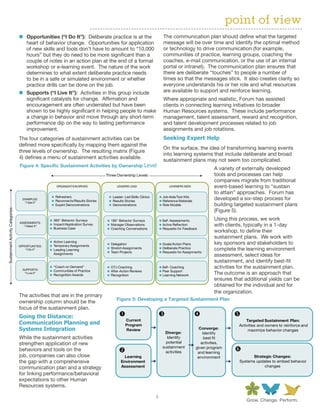
                                  three levels of ownership. The resulting matrix (Figure
                                                                                                                    into learning systems that include deliberate and broad
                                  4) defines a menu of sustainment activities available.
                                                                                                                    sustainment plans may not seem too complicated.
                                  Figure 4: Specific Sustainment Activities by Ownership Level
                                                                                                                                                   A variety of externally developed
                                                                                 Three Ownership Levels                                            tools and processes can help
                                                                                                                                                   companies migrate from traditional
                                                    ORGANIZATION DRIVES               LEADERS LEAD                      LEARNERS SEEK              event-based learning to “sustain
                                                                                                                                                   to attain” approaches. Forum has
                                                    Refreshers                      Leader-Led Skills Clinics       Job Aids/Tool Kits
                                    EXAMPLES:
                                                    Reconnects/Results Stories      Results Stories                 Reference Materials
                                                                                                                                                   developed a six-step process for
                                     “I See It”
                                                    Expert Demonstrations           Demonstrations                  Role Models                    building targeted sustainment plans
                                                                                                                                                   (Figure 5).
Sustainment Activity Categories


                                                   360° Behavior Surveys           180° Behavior Surveys            Self-Assessments               Using this process, we work
                                  ASSESSMENTS:
                                    “I Need It”
                                                   Impact/Application Survey       Manager Observations             Active Re ection               with clients, typically in a 1-day
                                                   Business Case                   Coaching Conversations           Requests for Feedback
                                                                                                                                                   workshop, to define their
                                                                                                                                                   sustainment plans. We work with
                                                   Action Learning
                                                   Temporary Assignments
                                                                                   Delegation                       Goals/Action Plans             key sponsors and stakeholders to
                                  OPPORTUNITIES:
                                      “I Do It”    Leading Learning
                                                                                   Stretch Assignments              Deliberate Practice            complete the learning environment
                                                                                   Team Projects                    Requests for Assignments
                                                   Assignments                                                                                     assessment, select ideas for
                                                                                                                                                   sustainment, and identify best-fit
                                    SUPPORTS:
                                                   “Coach on Demand”               OTJ Coaching                     Self- Coaching                 activities for the sustainment plan.
                                                   Communities of Practice         After-Action Reviews             Peer Support
                                     “I Live It”
                                                   Recognition Awards              Recognition                      Learning Network               The outcome is an approach that
                                                                                                                                                   ensures that additional yields can be
                                                                                                                                                   obtained for the individual and for
                                                                                                                                                   the organization.
                                  The activities that are in the primary
                                                                                      Figure 5: Developing a Targeted Sustainment Plan
                                  ownership column should be the
                                  focus of the sustainment plan.
                                  Going the Distance:
                                                                                            Current                                                              Targeted Sustainment Plan:
                                  Communication Planning and                                Program                                                          Activities and owners to reinforce and
                                  Systems Integration                                       Review                                          Converge:             maximize behavior changes
                                                                                                                     Diverge:                 Identify
                                  While the sustainment activities                                                    Identify                 best t
                                  strengthen application of new                                                       potential              activities,
                                                                                                                    sustainment           given program
                                  behaviors and tools on the                                                         activities            and learning
                                  job, companies can also close                            Learning                                        environment              Strategic Changes:
                                  the gap with a comprehensive                           Environment                                                          Systems updates to embed behavior
                                  communication plan and a strategy                      Assessment                                                                       changes
                                  for linking performance/behavioral
                                  expectations to other Human
                                  Resources systems.

                                                                                                                3
point of view

The Execution Edge
While many L&D departments consider sustainment an
optional investment, it is important to understand that for
the individual learners, sustainment activities back on the
job are the real activators for change. They can close the
“knowing/doing” gap that exists between knowing the
value of skills and behaviors and doing something real to
apply these on the job.
Sustainment is the phase in which the learning translates
into new, improved behaviors and performance. Without
nurturing, kernels of knowledge and rough skills
won’t translate into insight and mastered behaviors.
Organizations need to put the focus on reinforcement
and sustainment activities that get behaviors to stick,
drive performance improvements, and yield individual and
organizational returns on learning investments.


 Forum is a global professional services firm that mobilizes
 people to embrace the critical strategies of their organization
 and accelerate results. We help senior leaders with urgent
 strategic agendas equip their organizations to perform, change,
 and grow. Our expertise is built on decades of original
 research; our business insight keeps companies out ahead of
 their markets, competitors, and customers. Harvard Business
 Press published Forum’s latest book Strategic Speed in 2010.

 For more information, visit www.forum.com.

 © 2010 IIR Holdings, Ltd. All Rights Reserved.


                                                                   4

Behavior changes that stick

  • 1.
    point of view BehaviorChanges That Stick: End the “Spray and Pray” Approach to Training; Go for “Sustain to Attain” Results Authored by Vivien Price and David Robertson Definitions: Sustain (verb): to supply with sustenance terms of learning, this means that participants won’t retain Attain (verb): to reach a goal with effort the knowledge learned, will fail to act in new ways, and Sustain to attain: to supply nourishment and support over time to ultimately will not master and apply new behaviors. strengthen new skills and behaviors Forum has partnered with many clients to implement targeted sustainment plans designed to help improve the Traditionally, organizational learning and development uptake of new behaviors and processes in the workplace. interventions have focused on the visible, concrete, “main Our experience shows that for these plans to be event” components of learning: virtual or face-to-face successful, they need to fit with the learning environment, programs or workshops that introduce new concepts, with the nature of the work, and with the work styles and skills, tools, and behaviors. However, a significant capabilities of the target audience. This document outlines component of the learning intervention—the ongoing our sustainment approach: how we’ve worked with clients Figure 1: New Ways to Sustain Behavior Change to move from a mind-set of “spray and pray” event-based FROM “SPRAY AND PRAY” TO “SUSTAIN TO ATTAIN” learning to one of “sustain to attain.” Our approach includes One-off follow -ups after formal Multiple touches at multiple levels learning interventions over time assessment of the learning environment, identification of “Bolt on”: Sustainment is added as “Dovetail”: Sustainment activities ownership levels, and choosing an afterthought to the rollout of the weave through — short, medium, and sustainment activities that fit the “main learning event” long term learning environment and the ownership level. “Push” approach that repeats, “Pull” approach that challenges and Assessing the Learning restates, or “drills” key concepts supports application Environment Traditional media: print, audio, video Multiple media: Web 2.0 collaboration A farmer looking for a rich yield transmissions and tools as well as traditional media examines the environment Random or poorly de ned De ned ownership at three levels: (weather patterns, temperatures, ownership of sustainment activities organizational, management, and soil) before planning how to individual nourish and sustain a new crop. Follow-up to track achievement of Similarly, organizations should Engagement to support, extend, learning goals think about the environment for expand application and impact learning whenever they embark on an initiative that requires sustainment and reinforcement of the new knowledge changing behaviors in the workforce. There’s a significant and behaviors—is often neglected or overlooked. Failing range of conditions in organizations that can impact to sustain and reinforce desired behavior changes is like choices about how to support/improve adoption and neglecting to provide appropriate nourishment and support mastery of new knowledge, skills, and tools. to a food crop. The neglect results in a less-than-full yield—a marginal return on the original investment. In
  • 2.
    point of view Case in Point: Transforming Sales Behaviors n Organization drives: The learning and development organization invests in centrally driven reinforcement One year into a significant change program to improve its sales force effectiveness, a leading U.S. beverages company took stock of its activities and events. situation. The initial phases of the initiative had included alignment n Leaders lead: The ownership and responsibility for work, rollout of skills development workshops to all salespeople, and sustainment and reinforcement work lies primarily in the the restructuring/revising of sales processes. The company was committed to helping salespeople change their behaviors and deliver a hands of managers of participants. more consultative approach to working with customers. Sales leaders n Learners seek: Sustainment efforts are in the hands knew they were facing a possible stall in the initiative, specifically the of the individual learners. They select what they will do danger of “flavor of the day,” in which people pay attention to the initiative in the early stages of rollout but then slip back to old habits and how to sustain what they are learning. and ways of working. To address this, the company executed a Once the primary and secondary owners have been sustainment plan to support people in applying the new behaviors and skill sets. The plan consisted of a variety of simple, hands-on activities identified, the appropriate sustainment activities can be to reinforce and support salespeople as they applied new skills and chosen to fit with the ownership. tools back on the job. Choosing Sustainment Activities to Fit the Six months into the sustainment phase, one tenured manager described the impact and uplift as follows: “These sustainment Learning Environment and the Ownership activities have helped us to move from obligation and ‘We have to Approach do this’ to commitment and ‘I get it! This stuff does work!’” Change happens over time, and people need support and sustainment activities Our experience and work with clients who take the to help them change behaviors. A “sustain to attain” approach “sustain to attain” approach to performance improvement improves the application of new knowledge and skills back on the job. reveal four categories for sustainment activities (see Figure 3): To better understand the conditions, Forum uses a Figure 3: Categories of Sustainment Activities Learning Environment Assessment (LEA) to diagnose the current actions to support learning on the job that are EXAMPLES: Line of sight between actions and impact Models of what “great” looks like prevalent in an organization. This assessment identifies “I See It” Stories that illustrate how to get to “great” what learning practices, processes, and tools currently Refreshers on knowledge, skills, behaviors, tools for great performers exist in the workplace and then evaluates them at three levels: organizational, work group, and individual. Rating of current effectiveness ASSESSMENTS: Monitoring of improvements Picking the Right Owners “I Need It” Identification of specific goals for ongoing improvement Active reflection on cause-and-effect relationships In the “spray and pray” world of performance improvement initiatives, organizations fail to define who Deliberate practice as part of existing job specifically they expect to drive the behavior change OPPORTUNITIES: Stretch assignments as part of existing job Temporary assignments (inside or outside workplace) and application of new skills and tools. It’s assumed “I Do It” Coaching/teaching others that everybody has a role, with the manager population implicitly central in supporting individual learners back on the job. As usual, in the case of “everybody” owning Recognition and acknowledgment that build confidence SUPPORTS: Future-focused feedback that builds competence it, “nobody” owns it. “I Live It” Discussions that challenge, inspire, and validate Coaching that drives continuous improvement In the “sustain to attain” approach, Forum uses the learning environment assessment to define the primary- and secondary-level ownership of sustainment activities. These owners are selected from the following three levels n Examples (“I See It”): Activities in this group help (see Figure 2): learners see and know what they should be applying back on the job. These activities demonstrate and Figure 2: Three Ownership Levels show people what successful application of the behaviors looks like. They provide relevant and Organization Drives Leaders Lead Learners Seek regular examples, in a structured way, over time, to Centralized approach which Leaders/managers of Individuals nd opportunities help learners see clearly what it looks and feels like creates a “push” out to users: participants model, coach, and support to sustain the multiple elements centrally and support learning for their learning, based on their own to successfully master the new behaviors and tools. executed employees initiative and network n Assessments (“I Need It”): Assessment Bene ts: Consistent, reliable, Bene ts: Active modeling and Bene ts: Fit to individual needs aligned coaching activities uncover gaps in performance and Drawbacks: Variable Drawbacks: Requires Drawbacks: Relies on interpretation—participants opportunities for improvement. These activities dedicated support resources expertise of managers and on may not prioritize their own allow the learner, line manager, coach, and and investment; assumes managers’ prioritizing development “message sent is message development of their people organization to rate current performance and received” then use the feedback to establish and/or update improvement goals. 2
  • 3.
    point of view n Opportunities (“I Do It”): Deliberate practice is at the The communication plan should define what the targeted heart of behavior change. Opportunities for application message will be over time and identify the optimal method of new skills and tools don’t have to amount to “10,000 or technology to drive communication (for example, hours” but they do need to be more significant than a communities of practice, learning groups, coaching the couple of notes in an action plan at the end of a formal coaches, e-mail communication, or the use of an internal workshop or e-learning event. The nature of the work portal or intranet). The communication plan ensures that determines to what extent deliberate practice needs there are deliberate “touches” to people a number of to be in a safe or simulated environment or whether times so that the messages stick. It also creates clarity so practice drills can be done on the job. everyone understands his or her role and what resources n Supports (“I Live It”): Activities in this group include are available to support and reinforce learning. significant catalysts for change. Affirmation and Where appropriate and realistic, Forum has assisted encouragement are often underrated but have been clients in connecting learning initiatives to broader shown to be highly significant in helping people to make Human Resources systems. These include performance a change in behavior and move through any short-term management, talent assessment, reward and recognition, performance dip on the way to lasting performance and talent development processes related to job improvement. assignments and job rotations. The four categories of sustainment activities can be Seeking Expert Help defined more specifically by mapping them against the On the surface, the idea of transforming learning events three levels of ownership. The resulting matrix (Figure into learning systems that include deliberate and broad 4) defines a menu of sustainment activities available. sustainment plans may not seem too complicated. Figure 4: Specific Sustainment Activities by Ownership Level A variety of externally developed Three Ownership Levels tools and processes can help companies migrate from traditional ORGANIZATION DRIVES LEADERS LEAD LEARNERS SEEK event-based learning to “sustain to attain” approaches. Forum has Refreshers Leader-Led Skills Clinics Job Aids/Tool Kits EXAMPLES: Reconnects/Results Stories Results Stories Reference Materials developed a six-step process for “I See It” Expert Demonstrations Demonstrations Role Models building targeted sustainment plans (Figure 5). Sustainment Activity Categories 360° Behavior Surveys 180° Behavior Surveys Self-Assessments Using this process, we work ASSESSMENTS: “I Need It” Impact/Application Survey Manager Observations Active Re ection with clients, typically in a 1-day Business Case Coaching Conversations Requests for Feedback workshop, to define their sustainment plans. We work with Action Learning Temporary Assignments Delegation Goals/Action Plans key sponsors and stakeholders to OPPORTUNITIES: “I Do It” Leading Learning Stretch Assignments Deliberate Practice complete the learning environment Team Projects Requests for Assignments Assignments assessment, select ideas for sustainment, and identify best-fit SUPPORTS: “Coach on Demand” OTJ Coaching Self- Coaching activities for the sustainment plan. Communities of Practice After-Action Reviews Peer Support “I Live It” Recognition Awards Recognition Learning Network The outcome is an approach that ensures that additional yields can be obtained for the individual and for the organization. The activities that are in the primary Figure 5: Developing a Targeted Sustainment Plan ownership column should be the focus of the sustainment plan. Going the Distance: Current Targeted Sustainment Plan: Communication Planning and Program Activities and owners to reinforce and Systems Integration Review Converge: maximize behavior changes Diverge: Identify While the sustainment activities Identify best t strengthen application of new potential activities, sustainment given program behaviors and tools on the activities and learning job, companies can also close Learning environment Strategic Changes: the gap with a comprehensive Environment Systems updates to embed behavior communication plan and a strategy Assessment changes for linking performance/behavioral expectations to other Human Resources systems. 3
  • 4.
    point of view TheExecution Edge While many L&D departments consider sustainment an optional investment, it is important to understand that for the individual learners, sustainment activities back on the job are the real activators for change. They can close the “knowing/doing” gap that exists between knowing the value of skills and behaviors and doing something real to apply these on the job. Sustainment is the phase in which the learning translates into new, improved behaviors and performance. Without nurturing, kernels of knowledge and rough skills won’t translate into insight and mastered behaviors. Organizations need to put the focus on reinforcement and sustainment activities that get behaviors to stick, drive performance improvements, and yield individual and organizational returns on learning investments. Forum is a global professional services firm that mobilizes people to embrace the critical strategies of their organization and accelerate results. We help senior leaders with urgent strategic agendas equip their organizations to perform, change, and grow. Our expertise is built on decades of original research; our business insight keeps companies out ahead of their markets, competitors, and customers. Harvard Business Press published Forum’s latest book Strategic Speed in 2010. For more information, visit www.forum.com. © 2010 IIR Holdings, Ltd. All Rights Reserved. 4