A Beginner’s Guide to ICU
Research in Edinburgh
Dave Hope, Research Manager, Dept. of Anaesthetics, Theatres
& Critical Care, Royal Infirmary of Edinburgh
All images from Department of Anaesthesia, Pain and Critical Care Medicine, University of Edinburgh
CC BY-NC-SA 4.0
Learning
Outcomes
Will be able to anticipate some of the
challenges to conducting a clinical
research project within critical care
Will be able to utilise strategies to
design realistic ICU research projects
and work effectively with the clinical
team
Will be able to appropriately seek
informed consent for research from
proxy representatives according to
Scottish Law
What sort of research happens in the ICU?
• Sedation
• Blood transfusion
• Lung Imaging Diagnostics
• Sepsis biomarker technologies
• Traumatic Brain Injury
• Genomics of Critical Illness
• Recovery from Critical Illness
• Patient and family experience of Critical Illness
Why does this research happen in the ICU?
• Sometimes the only way to conduct effective research is to study the ICU
patient population while they are critically unwell
Who are the patients?
• Patients in ICU often receiving Advanced Respiratory Support
• OR require a minimum of 2 organ support
• they’re the sickest patients in the hospital
• they’re usually lacking capacity to consent
Adults With
Incapacity
(Scotland)
Act 2000
Part 5 Code
of Practice
Research on adults incapable of consenting is
authorised under the Act 2000 provided that:
It will further knowledge
It is of benefit to the adult or others in a
similar condition
It entails little or no risk or discomfort
The adult is not objecting
Consent has been obtained from a person with
relevant powers
The research has been approved by the Ethics
Committee
Don’t let
enthusiasm
outweigh realism -
remember
Lasagna’s Law:
"In clinical
research the
prevalence of any
disease falls to
about 10% of what
you thought it was
the day you start
to look for cases
for your study”
Pilot/audit/dummy
screening/early
discussion with more
experienced researchers
and involving patients
and public who have
experience of critical
illness can help with
planning
(see NIHR Involve website)
Just because you
want there to be
eligible
participants, it
doesn’t mean there
will be!
ICU Study design considerations
YOU NEED TO IDENTIFY A
REAL STUDY
POPULATION
INCLUSION & EXCLUSION
CRITERIA NEED CAREFUL
THOUGHT
TIMING OF
RECRUITMENT/STUDY
PROCEDURES IS CRUCIAL
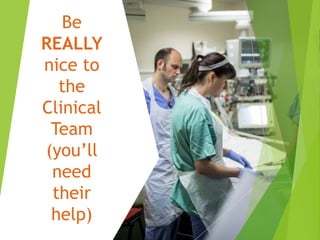
Be
REALLY
nice to
the
Clinical
Team
(you’ll
need
their
help)
“Normally only a member of the patient’s existing clinical care
team should have access to patient records without explicit
consent in order to identify potential participants, check
whether they meet the inclusion criteria or make the initial
approach to patients.”
HRA CTIMP Protocol Development Tool
You need the cooperation of the
clinical team who act as ‘Gatekeepers’
….but the clinical team
• are busy
• have their own routines
• have varying attitudes towards research
• have different priorities – i.e. their professional/duty of care
Clinical team will have valuable
knowledge of patient/family/situation
and can help with data collection
Be REALLY
sensitive
when
speaking
with Family
Members
too!
 ….Relatives have their own
priorities
 Their time with patients is
precious
 Having a critically ill relative is
extremely stressful and tiring
 Considering research represents
a burden
 Family dynamics can be strained
 Not everyone has as their 1st
language (& translation is
expensive)
 It’s not always easy knowing
who to approach and when to
approach
Family Members
Most patients in the
ICU lack capacity to
consent to research,
so unless there’s a
Guardian or Welfare
Attorney you need to
consult the nearest
relative – BUT….
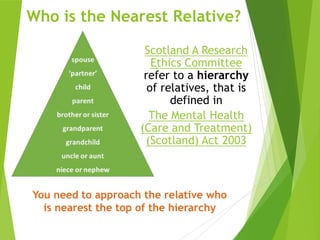
Scotland A Research
Ethics Committee
refer to a hierarchy
of relatives, that is
defined in
The Mental Health
(Care and Treatment)
(Scotland) Act 2003
You need to approach the relative who
is nearest the top of the hierarchy
Who is the Nearest Relative?
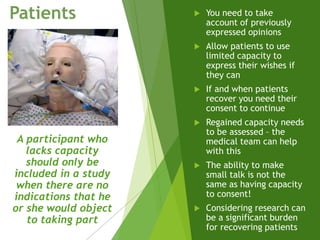
 You need to take
account of previously
expressed opinions
 Allow patients to use
limited capacity to
express their wishes if
they can
 If and when patients
recover you need their
consent to continue
 Regained capacity needs
to be assessed – the
medical team can help
with this
 The ability to make
small talk is not the
same as having capacity
to consent!
 Considering research can
be a significant burden
for recovering patients
Patients
A participant who
lacks capacity
should only be
included in a study
when there are no
indications that he
or she would object
to taking part
Seeking
Informed
Consent
should be
done very
carefully
and at the
right
time…..
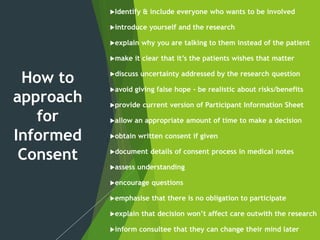
How to
approach
for
Informed
Consent
Identify & include everyone who wants to be involved
introduce yourself and the research
explain why you are talking to them instead of the patient
make it clear that it’s the patients wishes that matter
discuss uncertainty addressed by the research question
avoid giving false hope - be realistic about risks/benefits
provide current version of Participant Information Sheet
allow an appropriate amount of time to make a decision
obtain written consent if given
document details of consent process in medical notes
assess understanding
encourage questions
emphasise that there is no obligation to participate
explain that decision won’t affect care outwith the research
inform consultee that they can change their mind later
Further reading
Flory J Wendler D Emanuel E (2007) Informed consent for research Principles of Health Care
Ethics 703 – 710
http://doi.org/10.1002/9780470510544.ch95
General Medical Council (2013) Consent to research General Medical Council
https://www.gmc-uk.org/-/media/documents/good-practice-in-research-and-consent-to-
research_pdf-58834843.pdf
Mehta S Pelletier FQ Brown M Ethier C Wells D Burry L MacDonald R (2012) Why substitute
decision makers provide or decline consent for ICU research studies: a questionnaire study
Intensive Care Medicine 38 47 – 54
https://link.springer.com/article/10.1007%2Fs00134-011-2411-1
Pattison N Arulkumaran N Humphreys S Walsh T (2017) Exploring obstacles to critical care
trials in the UK: A qualitative investigation Journal of the Intensive Care Society 18 (1) 36 – 46
https://www.ncbi.nlm.nih.gov/pmc/articles/PMC5606357/
RCN Research Society (2011) Informed consent in health and social care research RCN
Guidance for nurses 2nd Ed The Royal college of Nursing (January) 1 – 17
https://www.rcn.org.uk/professional-development/publications/pub-002267
Shepherd V Griffith R Sheehan M Wood F Hood K (2012) Healthcare professionals’
understanding of the legislation governing research involving adults lacking mental capacity in
England and Wales: a national survey Journal of Medical Ethics 44(9) 632 – 637
https://jme.bmj.com/content/44/9/632

Beginners Guide to ICU Research in Edinburgh

  • 1.
    A Beginner’s Guideto ICU Research in Edinburgh Dave Hope, Research Manager, Dept. of Anaesthetics, Theatres & Critical Care, Royal Infirmary of Edinburgh All images from Department of Anaesthesia, Pain and Critical Care Medicine, University of Edinburgh CC BY-NC-SA 4.0
  • 2.
    Learning Outcomes Will be ableto anticipate some of the challenges to conducting a clinical research project within critical care Will be able to utilise strategies to design realistic ICU research projects and work effectively with the clinical team Will be able to appropriately seek informed consent for research from proxy representatives according to Scottish Law
  • 3.
    What sort ofresearch happens in the ICU? • Sedation • Blood transfusion • Lung Imaging Diagnostics • Sepsis biomarker technologies • Traumatic Brain Injury • Genomics of Critical Illness • Recovery from Critical Illness • Patient and family experience of Critical Illness Why does this research happen in the ICU? • Sometimes the only way to conduct effective research is to study the ICU patient population while they are critically unwell Who are the patients? • Patients in ICU often receiving Advanced Respiratory Support • OR require a minimum of 2 organ support • they’re the sickest patients in the hospital • they’re usually lacking capacity to consent
  • 4.
    Adults With Incapacity (Scotland) Act 2000 Part5 Code of Practice Research on adults incapable of consenting is authorised under the Act 2000 provided that: It will further knowledge It is of benefit to the adult or others in a similar condition It entails little or no risk or discomfort The adult is not objecting Consent has been obtained from a person with relevant powers The research has been approved by the Ethics Committee
  • 5.
    Don’t let enthusiasm outweigh realism- remember Lasagna’s Law: "In clinical research the prevalence of any disease falls to about 10% of what you thought it was the day you start to look for cases for your study” Pilot/audit/dummy screening/early discussion with more experienced researchers and involving patients and public who have experience of critical illness can help with planning (see NIHR Involve website) Just because you want there to be eligible participants, it doesn’t mean there will be! ICU Study design considerations YOU NEED TO IDENTIFY A REAL STUDY POPULATION INCLUSION & EXCLUSION CRITERIA NEED CAREFUL THOUGHT TIMING OF RECRUITMENT/STUDY PROCEDURES IS CRUCIAL
  • 6.
  • 7.
    “Normally only amember of the patient’s existing clinical care team should have access to patient records without explicit consent in order to identify potential participants, check whether they meet the inclusion criteria or make the initial approach to patients.” HRA CTIMP Protocol Development Tool You need the cooperation of the clinical team who act as ‘Gatekeepers’ ….but the clinical team • are busy • have their own routines • have varying attitudes towards research • have different priorities – i.e. their professional/duty of care Clinical team will have valuable knowledge of patient/family/situation and can help with data collection
  • 8.
  • 9.
     ….Relatives havetheir own priorities  Their time with patients is precious  Having a critically ill relative is extremely stressful and tiring  Considering research represents a burden  Family dynamics can be strained  Not everyone has as their 1st language (& translation is expensive)  It’s not always easy knowing who to approach and when to approach Family Members Most patients in the ICU lack capacity to consent to research, so unless there’s a Guardian or Welfare Attorney you need to consult the nearest relative – BUT….
  • 10.
    Scotland A Research EthicsCommittee refer to a hierarchy of relatives, that is defined in The Mental Health (Care and Treatment) (Scotland) Act 2003 You need to approach the relative who is nearest the top of the hierarchy Who is the Nearest Relative?
  • 11.
     You needto take account of previously expressed opinions  Allow patients to use limited capacity to express their wishes if they can  If and when patients recover you need their consent to continue  Regained capacity needs to be assessed – the medical team can help with this  The ability to make small talk is not the same as having capacity to consent!  Considering research can be a significant burden for recovering patients Patients A participant who lacks capacity should only be included in a study when there are no indications that he or she would object to taking part
  • 12.
  • 13.
    How to approach for Informed Consent Identify &include everyone who wants to be involved introduce yourself and the research explain why you are talking to them instead of the patient make it clear that it’s the patients wishes that matter discuss uncertainty addressed by the research question avoid giving false hope - be realistic about risks/benefits provide current version of Participant Information Sheet allow an appropriate amount of time to make a decision obtain written consent if given document details of consent process in medical notes assess understanding encourage questions emphasise that there is no obligation to participate explain that decision won’t affect care outwith the research inform consultee that they can change their mind later
  • 14.
    Further reading Flory JWendler D Emanuel E (2007) Informed consent for research Principles of Health Care Ethics 703 – 710 http://doi.org/10.1002/9780470510544.ch95 General Medical Council (2013) Consent to research General Medical Council https://www.gmc-uk.org/-/media/documents/good-practice-in-research-and-consent-to- research_pdf-58834843.pdf Mehta S Pelletier FQ Brown M Ethier C Wells D Burry L MacDonald R (2012) Why substitute decision makers provide or decline consent for ICU research studies: a questionnaire study Intensive Care Medicine 38 47 – 54 https://link.springer.com/article/10.1007%2Fs00134-011-2411-1 Pattison N Arulkumaran N Humphreys S Walsh T (2017) Exploring obstacles to critical care trials in the UK: A qualitative investigation Journal of the Intensive Care Society 18 (1) 36 – 46 https://www.ncbi.nlm.nih.gov/pmc/articles/PMC5606357/ RCN Research Society (2011) Informed consent in health and social care research RCN Guidance for nurses 2nd Ed The Royal college of Nursing (January) 1 – 17 https://www.rcn.org.uk/professional-development/publications/pub-002267 Shepherd V Griffith R Sheehan M Wood F Hood K (2012) Healthcare professionals’ understanding of the legislation governing research involving adults lacking mental capacity in England and Wales: a national survey Journal of Medical Ethics 44(9) 632 – 637 https://jme.bmj.com/content/44/9/632

Editor's Notes

  • #4 DH
  • #6 DH
  • #7 CM MDT – including research team
  • #8 CM Not an open environment – negotiate environment and gatekeepers before reaching potential research participant. Ethics committee review – request member of clinical team to make first approach ICU – visiting teams, researchers Clinical team key – know what is going on with patient and family
  • #9 DH
  • #10 DH
  • #11 DH
  • #12 CM/ DH Important to take into account patients’ wishes – have they previously taken part in research, expressed any views about research? Capacity – can fluctuate Most ICU research will require consent from the patient once they have regained capacity Think about what else the patient has going on at that time – too tired to take part, other things on their mind.
  • #14 DH/CM