ABSTRACT
Animal agriculture continues to look for new, non-an-
tibiotic feed solutions that can be used in conventional
and natural feedlot systems to help improve cattle health
and performance. Therefore, crossbred heifers (n = 1,495;
359 ± 10.75 kg; 20 pens total) were used in a random-
ized complete block design study at a commercial feedlot
to determine the effects of a proprietary Saccharomyces
cerevisiae fermentation prototype on performance, carcass
characteristics, and liver abscess prevalence when monen-
sin, tylosin, and direct-fed microbials were not included
in the diet. Heifers were fed a diet containing (1) mo-
nensin, tylosin, and a direct-fed microbials (PC) or (2)
a Saccharomyces cerevisiae fermentation prototype (PRT;
NaturSafe, Diamond V, Cedar Rapids, IA) at 18 g/head
daily without PC. Diets were fed twice daily with heifers
receiving half of the daily dose of treatment in the TMR
at each feeding. Pen BW were collected on d 0 and before
slaughter. Daily measurements recorded while cattle were
in the feedlot included feed intake, morbidity, and mortal-
ity. Cattle were shipped to slaughter on d 125 and 146
(5 pens per treatment per day). Carcass data collected
included HCW, DP, QG, YG, KPH, rib fat thickness, LM
area, marbling score, and liver abscess scores. Data were
analyzed with the MIXED procedure (continuous) and
GLIMMIX procedure (categorical) of SAS. Treatments
were similar (P ≥ 0.16) for final BW (580 vs. 580 kg),
ADG (1.64 vs. 1.63 kg/d), G:F (0.159 vs. 0.156 kg/kg),
HCW (366 vs. 367 kg), other carcass characteristics, mor-
bidity (0.3 vs. 0.0%), and mortality (0.77 vs. 0.70%). Heif-
ers fed PRT had a numerically lower (P = 0.27) prevalence
of liver abscesses with fewer livers having less severe (i.e.,
A−) abscesses. Replacing monensin, tylosin, and direct-
fed microbials in conventional feedlot diets with NaturSafe
resulted in similar growth performance, carcass character-
istics, and liver abscess prevalence in feedlot cattle.
Key words: beef heifer, large pen, performance, Saccha-
romyces cerevisiae fermentation prototype
INTRODUCTION
The Veterinary Feed Directive was implemented by the
Food and Drug Administration to minimize the use of
antibiotics in animal feed that are similar to those that
have application in human medicine. Beginning in Janu-
ary 2017, feed grade antibiotics, such as tylosin, cannot
be used unless a veterinarian prescription is provided (US
Food and Drug Administration, 2015). Tylosin is used in
the beef industry to help minimize abscesses in the liver
and has been shown to decrease the growth of Fusobac-
terium necrophorum and Trueperella (Arcanobacterium)
pyogenes (the main cause of liver abscesses) in the rumen
(Nagaraja and Chengappa, 1998).
Other conventional feed technologies commonly used in
beef feedlot diets are monensin and bacterial (Lactobacil-
lus and Propionibacterium) direct-fed microbials (DFM).
Monensin has been shown to improve feed efficiency, re-
duce the likelihood of feedlot bloat, and play a role in con-
trolling coccidiosis (Long and Jeffers, 1982; Stock et al.,
1995; Cheng et al., 1998; Duffield et al., 2012). Direct-fed
microbials have had variable results on rumen health and
cattle performance when used in feedlot diets (Brashears
et al., 2003; Elam et al., 2003; Peterson et al., 2007). Un-
like tylosin, the Veterinary Feed Directive does not affect
ionophores or DFM.
Universities and companies within animal agriculture
continue to research and develop new, non-antibiotic feed
solutions that can be used in conventional and natural
feedlot systems to help improve cattle health and perfor-
mance. Therefore, this study was designed to evaluate the
effects of a proprietary Saccharomyces cerevisiae fermenta-
tion prototype on the performance, health, carcass charac-
The Professional Animal Scientist 33:320–326
https://doi.org/10.15232/pas.2016-01580
Effects of feeding a Saccharomyces cerevisiae
fermentation prototype on performance,
carcass characteristics, and liver abscess
prevalence of beef heifers at a commercial
feedlot
M. F. Scott,*1
PAS, K. L. Dorton,* D. L. Henry,* C. R. Belknap,* PAS, D. L. Hanson,* and B. E. Depenbusch†
*Diamond V, Cedar Rapids, IA 52404; and †Innovative Livestock Services Inc., Great Bend, KS 67530
© 2017 THE AUTHORS. Published by Elsevier Inc. on behalf of the American Registry of
Professional Animal Scientists. This is an open access article under the CC BY-NC-ND license
(http://creativecommons.org/licenses/by-nc-nd/3.0/).
1	
Corresponding author: markfscott@msn.com
Performance and carcass characteristics of beef heifers 321
teristics, and prevalence of liver abscesses in feedlot cattle
when monensin, tylosin, and DFM were not included in
the diet.
MATERIALS AND METHODS
Experimental Design
Animals were handled in compliance with applicable lo-
cal regulations and in accordance with the Guide for Care
and Use of Agricultural Animals in Research and Teaching
(FASS, 2010).
Crossbred heifers (n = 1,495; 359 ± 3.4 kg) were received
at a Central Kansas feedyard in May 2015. Heifers were
purchased from 2 sale barns (Salina, KS, n = 255 head;
and Pratt, KS, n = 183 head) and one backgrounding fa-
cility (Central Kansas, n = 1,057 head), where the heifers
grazed wheat pasture. On arrival, heifers were allowed ad
libitum access to fresh water and long-stemmed hay.
On the day after arrival, heifers were individually
weighed, processed, and randomly sorted by source into
pens (5 animals per pen until the desired head count was
achieved in each pen; 67 or 80 head per pen). Pens per
replicate (2 adjacent pens of similar size and head count;
10 replicates total) were assigned to 1 of 2 treatments. A
2-tailed statistical power analysis for ADG [power (1 − β)
= 0.8, α = 0.05, SD = 0.136] showed 10 replicates per
treatment were necessary to detect an expected difference
in ADG of 0.181 kg. Treatments were added to the diet
using a micro-ingredient weigh system (mg/head basis;
Micro Beef Technologies, Amarillo, TX) and consisted of
a diet containing a combination of standard industry tech-
nologies (PC), including monensin (300 mg/head daily;
Rumensin, Elanco Animal Health, Greenfield, IN), tylo-
sin (90 mg/head daily; Tylovet, Huvepharma, Peach Tree,
GA), and a DFM (50 mg/head daily; Bovamine Defend,
Nutrition Physiology Company, Overland Park, KS) or a
diet containing 18 g/head daily of a Saccharomyces cerevi-
siae fermentation prototype (PRT; NaturSafe, Diamond
V, Cedar Rapids, IA) without monensin, tylosin, or the
DFM. Saccharomyces cerevisiae fermentation prototype is
a fermentation prototype containing proprietary levels of
functional metabolites such as peptides, organic acids, and
antioxidants. All pens received 0.5 mg of melengestrol ac-
etate (MGA, Zoetis Animal Health, Exton, PA) in the diet
Table 1. Ingredient and calculated nutrient composition of corn-based diets fed to yearling
heifers
Item
Basal diet
Starter Step 2 Step 3 Finisher
Ingredient, % DM basis        
  Steam-flaked corn 30.2 45.8 58.6 66.1
  Wet distillers grain with solubles 22.2 19.5 18.0 18.0
  Alfalfa hay 38.0 25.0 13.0 0.0
  Mixed hay 0.0 0.0 0.0 4.0
  Corn silage 7.0 7.0 5.0 4.0
 Tallow 0.0 0.0 1.5 2.9
  Liquid supplement1
2.6 2.7 3.9 5.0
Nutrient composition        
  DM, % 55.8 57.0 59.1 60.3
  CP, % 17.9 16.4 15.7 15.1
  Ether extract, % 4.50 4.57 6.12 7.60
  Calcium, % 0.94 0.78 0.80 0.83
  Phosphorus, % 0.37 0.37 0.37 0.37
  Potassium, % 0.98 0.82 0.66 0.56
  Sulfur, % 0.30 0.27 0.24 0.22
 NEm
, Mcal/kg 1.83 2.01 2.21 2.36
 NEg
, Mcal/kg 1.17 1.32 1.50 1.63
1
Positive control diet contained monensin (Rumensin, Elanco Animal Health, Greenfield,
IN), tylosin (Tylovet, Huvepharma, Peach Tree, GA), and a direct-fed microbial (Bovamine
Defend, Nutrition Physiology Company, Overland Park, KS) at 300, 90, and 50 mg/animal
daily, respectively. Prototype (PRT) diets were formulated to provide 18 g of a prototype
Saccharomyces cerevisiae fermentation prototype (NaturSafe, Diamond V, Cedar Rapids, IA)
per heifer daily throughout the trial. Both treatment groups also received 0.5 mg of melengestrol
acetate (Zoetis Animal Health) per heifer daily throughout the trial and 250 mg of ractopamine
hydrochloride (Zoetis Animal Health) per heifer daily during the last 28 d on feed.
Scott et al.
322
daily and 250 mg ractopamine hydrochloride (Actogain,
Zoetis Animal Health) in the diet daily during the last 28
d on feed.
During processing, heifers were uniquely identified with
numbered tags in both ears. The right ear tag contained
the lot number and was color coded to treatment (white
or red for PC and PRT, respectively). All feedlot person-
nel were blinded to treatment. The left ear tag contained
the lot number and animal ID number. Heifers were vac-
cinated for infectious bovine rhinotracheitis and para-
influenza-3 using Pyramid 4 cattle vaccine (Boehringer
Ingelheim Vetmedica Inc., Ridgefield, CT). In addition,
heifers received an injection for internal parasites (Dec-
tomax, Zoetis Animal Health), an oral dose of dewormer
(Safeguard, Merck Animal Health, De Soto, KS), and a
growth implant (Revalor-IH containing 80 mg of trenbo-
lone acetate + 8 mg of estradiol, Merck Animal Health)
under the skin in the posterior aspect of the ear. Approxi-
mately 63 d after the initial growth implant and 74 d
before slaughter, heifers were revaccinated for infectious
bovine rhinotracheitis and parainfluenza-3 (Bovi Shield
Gold IBR-BVD, Zoetis Animal Health), vaccinated with
an autogenous Foot Rot vaccine (Newport Laboratories
Inc., Worthington, MN), and reimplanted (Revalor 200
containing 200 mg of trenbolone acetate + 20 mg of estra-
diol, Merck Animal Health).
Heifers were housed in 20 soil-surfaced pens providing
36.6 cm of bunk space and 21.5 m2
of pen space per heifer.
Each pen contained an earthen mound and water fountain
that supplied fresh well water. Feed was delivered using
horizontal mixing auger trucks, and mixing uniformity
was assessed before and during the study (11 assessments
total). Heifers received 3 step-up diets (~8 d/diet) before
their final finishing diet (Table 1). Pens within a block
were treated the same as it pertains to transitioning onto
the finishing diet. Diets were fed twice daily at approxi-
mately 0830 and 1350 h (±20 min). Feed bunks were man-
aged so that only a trace amount of feed was left in the
bunk at each feeding. All treatment feed additives were
stored under manufacturer-recommended conditions, and
the amount fed was adjusted monthly, or sooner if neces-
sary, to account for variation in ingredient DM and cattle
intakes. Actual formulated intakes were achieved for each
feed additive.
Trained animal caretakers individually observed heif-
ers within each pen daily. Heifers were observed for lame-
ness, anorexia, dull eyes, labored breathing, droopy ears,
coughing, diarrhea, nasal discharge, and general overall
well-being. Heifers experiencing any clinical signs were re-
moved and further evaluated in the hospital pen. Once
restrained in the hospital observation chute, BW, rectal
body temperature, and lung score were determined. Heif-
Table 2. Effects of a Saccharomyces cerevisiae fermentation prototype (PRT) on growth
performance of yearling beef heifers
Item PC1
PRT2
SEM P-value
Heifers (pens), no. 748 (10) 747 (10) N/A3
N/A
Days on feed 136 136 N/A N/A
Bunk space, cm/head 36.6 36.6 N/A N/A
Pen space, m2
/head 21.5 21.5 N/A N/A
Live performance4
       
  Initial BW, kg 358.3 359.7 3.40 0.33
  Final BW,5
kg 579.7 580.6 3.20 0.80
  DMI, kg/d 10.3 10.4 0.15 0.09
  ADG, kg/d 1.64 1.63 0.020 0.73
  G:F, kg/kg 0.159 0.156 0.0018 0.16
Yield-adjusted performance6
       
  BW, kg 574.3 575.6 9.30 0.64
  ADG, kg/d 1.59 1.59 0.019 0.94
 G:F 0.155 0.153 0.0028 0.20
1
Positive control (PC) diet contained monensin (Rumensin, Elanco Animal Health, Greenfield,
IN), tylosin (Tylovet, Huvepharma, Peach Tree, GA), and a direct-fed microbial (Bovamine
Defend, Nutrition Physiology Company, Overland Park, KS) at 300, 90, and 50 mg/animal
daily, respectively.
2
Prototype (PRT) diet contained S. cerevisiae fermentation prototype (NaturSafe, Diamond V,
Cedar Rapids, IA) at 18 g/animal daily and no monensin, tylosin, or direct-fed microbial.
3
N/A = not applicable.
4
Live performance included dead and removed animals.
5
Final BW pencil shrunk 4%.
6
Yield-adjusted BW calculated by dividing HCW by a common dressing yield of 63.75%.
Performance and carcass characteristics of beef heifers 323
ers were then treated based on the clinical signs observed
in the pen and the results from the chute side diagnostics
according to the treatment protocols established by the
consulting veterinarian. In general, heifers were treated
and returned to their home pen on the same day. However,
in some cases, the heifer was kept in the hospital recovery
pen until it was well enough to be returned to its home
pen. Heifers that did not respond to therapy were pulled
from the trial, labeled as a chronic (i.e., railer), held until
drug withdrawal requirements were met, and shipped to
a rendering facility. The feedlot veterinarian performed
necropsies on all heifers that died to determine cause of
death.
Heifers were on trial for 125 to 146 d before slaughter.
The amount of feed offered was recorded daily. Heifers were
weighed by pen on a large platform scale (approximately
3.5 m × 27.5 m) on d 0 and the morning before ship-
ment. On the day of slaughter, heifers were transported
approximately 233 km to a commercial abattoir located in
Holcomb, Kansas. Heifers were slaughtered on 2 separate
shipping dates approximately 3 wk apart (d 125 and 146
for group 1 and 2, respectively). Five pens per treatment
were shipped on each shipping date. Heifers were main-
tained within their pen during shipping and at the abat-
toir. Heifers were processed by pen, and trained personnel
at the abattoir collected carcass measurements using a
video image analysis system. Average carcass weight, DP,
USDA QG, USDA YG, KPH, 12th rib fat thickness, LM
area, and marbling score were collected on each carcass at
the abattoir. A calculated YG was determined using the
following equation (Boggs and Merkel, 1993):
	 Yield grade = 2.50 + (6.35 × fat thickness, cm) 	
− (2.06 × LM area, cm2
) + (0.2 × KPH, %)
+ (0.0017 × HCW, kg).
Fecal swab samples and subiliac lymph nodes were also
collected during slaughter to be analyzed for food-borne
pathogens. However, this is reported elsewhere (Feye et
al., 2016). Liver scores were also collected on each carcass
using trained personnel from Garden City Community
College (Garden City, KS). The liver was evaluated after
evisceration using the liver abscess classification method
developed by Elanco Animal Health (Brown et al., 1975).
Livers were scored as follows:
	 (1)	 O – a normal healthy liver with no abscesses;
	 (2)	A−
– 1 or 2 small abscesses or inactive scars, which
are generally under 2.54 cm in diameter, with the
remaining liver appearing healthy;
	 (3)	 A – 1 or 2 large abscesses, or several small abscess-
es, with the remaining liver appearing healthy; or
	 (4)	A+
– multiple large abscesses present, along with
inflammation of liver tissue surrounding the ab-
scess. Often, portions of the diaphragm are adhered
to the surface of the liver and have to be trimmed
to separate the liver from the carcass.
Statistical Analysis
Growth performance and carcass characteristics (con-
tinuous data) were analyzed using the MIXED procedure
of SAS (9.3, SAS Institute Inc., Cary, NC). Pen was con-
sidered the experimental unit. The model included treat-
ment as the fixed effect, block as the random effect to ex-
plicitly account for the lack of independence among pens
within block, and treatment × block as the error term.
The LSMEANS and corresponding SEM were calculated
from model outputs. Categorical data, including binary
health and carcass QG, YG, and liver abscess outcomes,
were modeled using the GLIMMIX procedure of SAS us-
ing a binomial and ordinal distribution, respectively. The
Link = Logit option was used in the model statement,
and LSMEANS and corresponding SEM were calculated
from model outputs following back transformation from
Table 3. Effects of a Saccharomyces cerevisiae
fermentation prototype (PRT) on animal health
characteristics of yearling heifers
Item PC1
PRT2
SEM P-value
Morbidity, %        
 Respiratory 2.9 2.0 0.74 0.26
 Digestive 0.0 0.0 N/A3
N/A
  Foot rot and lameness 17.5 21.8 3.15 0.06
 Other 0.3 0.0 0.19 0.98
  Pull rate, %        
  1st pull 19.0 22.1 3.09 0.14
  2nd pull 1.7 1.6 0.51 0.85
  3rd pull 0.3 0.13 0.19 0.67
Mortality, %        
 Respiratory 0.40 0.13 0.23 0.52
 Digestive 0.00 0.27 0.19 0.98
 Other 0.40 0.27 0.23 0.73
 Total 0.80 0.67 0.33 0.81
Chronic (railer),4
% 0.26 0.77 0.35 0.19
1
Positive control (PC) diet contained monensin
(Rumensin, Elanco Animal Health, Greenfield, IN), tylosin
(Tylovet, Huvepharma, Peach Tree, GA), and a direct-
fed microbial (Bovamine Defend, Nutrition Physiology
Company, Overland Park, KS) at 300, 90, and 50 mg/
animal daily, respectively.
2
Prototype (PRT) diet contained S. cerevisiae fermentation
prototype (NaturSafe, Diamond V, Cedar Rapids, IA) at
18 g/animal daily and no monensin, tylosin, or direct-fed
microbial.
3
N/A = not applicable.
4
Chronic (railer) = heifers that were removed from the
study because they did not respond to therapy.
Scott et al.
324
the logit scale. Data were considered significant at P ≤
0.05 and a trend at 0.05 > P ≤ 0.10.
RESULTS AND DISCUSSION
Performance
Growth performance data are in Table 2. Heifers fed
PRT tended (P = 0.09) to consume 0.1 kg more feed per
day. However, ADG, G:F, and final BW were not different
(P ≥ 0.16) between treatments. Morbidity and mortality
results are in Table 3. No significant (P ≥ 0.16) differences
were observed between treatments.
Heifers were fed a finishing diet that contained 66%
steam-flaked corn, 18% wet distillers grains plus solubles,
4.0% mixed hay, 4.0% corn silage, and 2.9% tallow. Heif-
ers receiving PC consumed an average of 10.3 kg of DM
daily, which corresponds to an average consumption of 29
mg/kg monensin, 8.7 mg/kg tylosin, and 4.9 mg/kg DFM.
The positive DMI response for heifers supplemented with
PRT compared with PC may be the result of heifers not
receiving monensin and tylosin in the diet, a change in
ruminal kinetics due to supplemental fat and monensin
in heifers fed the PC diet (Clary et al., 1993), or a more
stable rumen environment due to PRT (Brainard et al.,
2014). Previous research with the combination of monen-
sin and tylosin in similar finishing diets to those in this
study did not improve DMI in heifers or steers compared
with a diet without these additives, but the combination
did show a 4.1% improvement in G:F in steers (Depen-
busch et al., 2008; Meyer et al., 2013). Research reported
by Elanco Animal Health (2012) showed that the combi-
nation of monensin and tylosin reduced DMI by 5%. In
addition, Duffield et al. (2012) summarized 64 trials that
were conducted over the last 40 yr and found that monen-
sin decreased DMI by 3%. Duffield et al. (2012) noted that
the effect of monensin on feed conversion has decreased
in recent years. In fact, they estimated that the improve-
ment in DM conversion has decreased from 6% observed
in the 1970s and 1980s to about 3% in the last 2 decades.
However, unlike the Elanco data and the summary data
reported by Duffield et al. (2012), feed conversions were
not significantly different in the current study when mo-
nensin and tylosin were fed.
Table 4. Effects of a Saccharomyces cerevisiae fermentation prototype (PRT) on carcass
characteristics of yearling beef heifers
Item PC1
PRT2
SEM P-value
Carcasses (pens), no. 740 (10) 735 (10) N/A3
N/A
HCW, kg 366 367 2.68 0.58
DP, % 63.13 63.20 0.23 0.57
USDA QG, %     N/A 0.51
 Prime 1.0 0.4    
 Choice 63.9 61.8    
 Select 33.5 36.9    
  No roll 1.6 1.0    
USDA YG, %     N/A 0.48
  YG 1 7.7 7.8    
  YG 2 34.1 38.0    
  YG 3 45.8 43.7    
  YG 4 11.9 9.8    
  YG 5 0.5 0.8    
Calculated YG4
3.12 3.05 0.060 0.21
KPH, % 2.11 2.11 0.017 0.65
12th rib fat thickness, cm 1.24 1.22 0.03 0.73
LM area, cm2
89.55 90.52 0.60 0.28
Marbling score5
420 412 4.09 0.18
1
Positive control (PC) diet contained monensin (Rumensin, Elanco Animal Health, Greenfield,
IN), tylosin (Tylovet, Huvepharma, Peach Tree, GA), and a direct-fed microbial (Bovamine
Defend, Nutrition Physiology Company, Overland Park, KS) at 300, 90, and 50 mg/animal
daily, respectively.
2
Prototype (PRT) diet contained S. cerevisiae fermentation prototype (NaturSafe, Diamond V,
Cedar Rapids, IA) at 18 g/animal daily and no monensin, tylosin, or direct-fed microbial.
3
N/A = not applicable.
4
Calculated YG = 2.5 + (6.35 × adjusted fat thickness, cm) + (0.20 × KPH %) − (2.06 × LM area,
cm2
) + (0.0017 × HCW, kg).
5
400 = Small 00; 500 = Modest 00; 600 = Moderate 00.
Performance and carcass characteristics of beef heifers 325
Carcass Characteristics
No differences were observed between treatments for
any of the carcass characteristics measured (P ≥ 0.18;
Table 4). Although there are no other studies examining
the effects of PRT on carcass characteristics in beef cattle,
studies with other Saccharomyces cerevisiae fermenta-
tion products (SCFP) have shown beneficial effects. In
a recent meta-analysis, supplementation of SCFP (Origi-
nal YC, XP, and XPC, Diamond V) to beef cattle fed
conventional diets resulted in an improvement in carcass
quality (more low choice and less select carcasses; Wagner
et al., 2016). One study included in this meta-analysis
was a study by Swyers et al. (2014). In this study, they
looked at the interactive effects of monensin and SCFP
(Original XP). Although not statistically different, cattle
fed a diet supplemented with SCFP that did not contain
monensin had numerically more choice carcasses (30 and
55%, respectively) and fewer select carcasses (53 and 33%,
respectively) when compared with cattle fed a diet with
monensin and no SCFP. Cattle fed a diet containing both
monensin and SCFP had similar choice (58%) and select
(38%) carcasses to those fed SCFP alone. The results from
the current study suggest that removing monensin and ty-
losin from finishing diets fed to heifers and replacing with
PRT would yield similar carcass characteristics.
Liver Abscesses
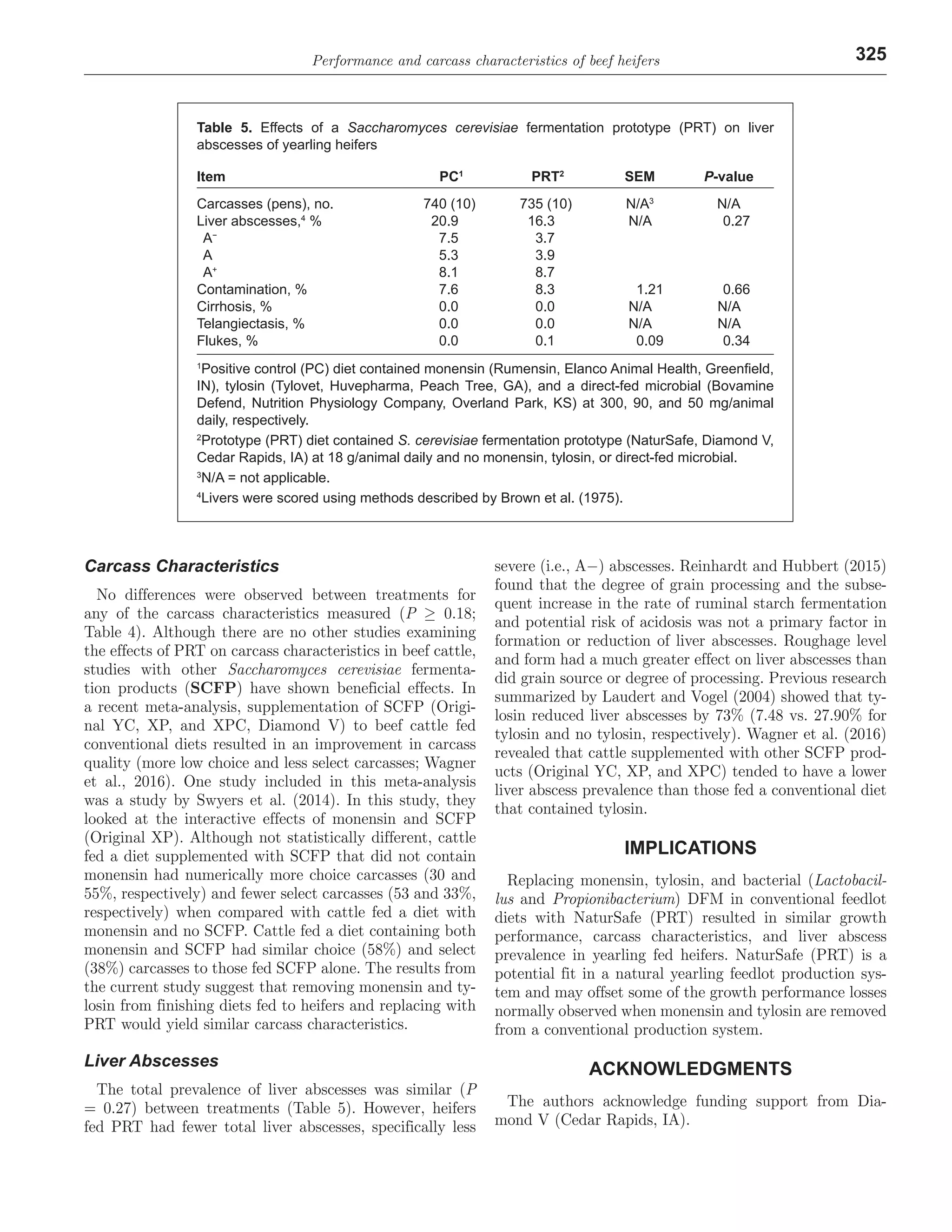
The total prevalence of liver abscesses was similar (P
= 0.27) between treatments (Table 5). However, heifers
fed PRT had fewer total liver abscesses, specifically less
severe (i.e., A−) abscesses. Reinhardt and Hubbert (2015)
found that the degree of grain processing and the subse-
quent increase in the rate of ruminal starch fermentation
and potential risk of acidosis was not a primary factor in
formation or reduction of liver abscesses. Roughage level
and form had a much greater effect on liver abscesses than
did grain source or degree of processing. Previous research
summarized by Laudert and Vogel (2004) showed that ty-
losin reduced liver abscesses by 73% (7.48 vs. 27.90% for
tylosin and no tylosin, respectively). Wagner et al. (2016)
revealed that cattle supplemented with other SCFP prod-
ucts (Original YC, XP, and XPC) tended to have a lower
liver abscess prevalence than those fed a conventional diet
that contained tylosin.
IMPLICATIONS
Replacing monensin, tylosin, and bacterial (Lactobacil-
lus and Propionibacterium) DFM in conventional feedlot
diets with NaturSafe (PRT) resulted in similar growth
performance, carcass characteristics, and liver abscess
prevalence in yearling fed heifers. NaturSafe (PRT) is a
potential fit in a natural yearling feedlot production sys-
tem and may offset some of the growth performance losses
normally observed when monensin and tylosin are removed
from a conventional production system.
ACKNOWLEDGMENTS
The authors acknowledge funding support from Dia-
mond V (Cedar Rapids, IA).
Table 5. Effects of a Saccharomyces cerevisiae fermentation prototype (PRT) on liver
abscesses of yearling heifers
Item PC1
PRT2
SEM P-value
Carcasses (pens), no. 740 (10) 735 (10) N/A3
N/A
Liver abscesses,4
% 20.9 16.3 N/A 0.27
 A−
7.5 3.7    
 A 5.3 3.9    
 A+
8.1 8.7    
Contamination, % 7.6 8.3 1.21 0.66
Cirrhosis, % 0.0 0.0 N/A N/A
Telangiectasis, % 0.0 0.0 N/A N/A
Flukes, % 0.0 0.1 0.09 0.34
1
Positive control (PC) diet contained monensin (Rumensin, Elanco Animal Health, Greenfield,
IN), tylosin (Tylovet, Huvepharma, Peach Tree, GA), and a direct-fed microbial (Bovamine
Defend, Nutrition Physiology Company, Overland Park, KS) at 300, 90, and 50 mg/animal
daily, respectively.
2
Prototype (PRT) diet contained S. cerevisiae fermentation prototype (NaturSafe, Diamond V,
Cedar Rapids, IA) at 18 g/animal daily and no monensin, tylosin, or direct-fed microbial.
3
N/A = not applicable.
4
Livers were scored using methods described by Brown et al. (1975).
Scott et al.
326
LITERATURE CITED
Boggs, D. L., and R. A. Merkel. 1993. Beef carcass evaluation, grad-
ing, and pricing. Page 105 in Live Animal Carcass Evaluation and
Selection Manual. D. L. Boggs and R. A. Merkel, ed. Kendall Hunt
Publ. Co., Dubuque, IA.
Brainard, A., V. Nsereko, I. Yoon, J. Butler, and M. Scott. 2014.
Effects of Saccharomyces cerevisiae fermentation products on fiber di-
gesting and lactate utilizing rumen bacteria at neutral and low pH in
vitro. Page 30 (P115 Abstr.) in Proc. Symp. Gut Health Prod. Food
Anim., St. Louis, MO. FASS Inc., Champaign, IL.
Brashears, M. M., M. L. Galyean, G. H. Loneragan, J. E. Mann, and
K. Killinger-Man. 2003. Prevalence of Escherichia coli O157:H7 and
performance by beef feedlot cattle given Lactobacillus direct-fed mi-
crobials. J. Food Prot. 66:748–754.
Brown, H., R. F. Bing, H. P. Grueter, J. W. McAskill, C. O. Cooley,
and R. P. Rathmacher. 1975. Tylosin and chlortetracycline for the
prevention of liver abscesses, improved weight gains and feed effi-
ciency in feedlot cattle. J. Anim. Sci. 40:207–213.
Cheng, K. J., T. A. McAllister, J. D. Popp, A. N. Hristov, Z. Mir,
and H. T. Shin. 1998. A review of bloat in feedlot cattle. J. Anim.
Sci. 76:299–308.
Clary, E. M., R. T. Brandt Jr., D. L. Harmon, and T. G. Naga-
raja. 1993. Supplemental fat and ionophores in finishing diets: Feed-
lot performance and ruminal digesta kinetics in steers. J. Anim. Sci.
71:3115–3123.
Depenbusch, B. E., E. R. Loe, M. J. Quinn, M. E. Corrigan, M.
L. Gibson, K. K. Karges, and J. S. Drouillard. 2008. Corn distillers
grains with solubles derived from a traditional or partial fractionation
process: Growth performance and carcass characteristics of finishing
feedlot heifers. J. Anim. Sci. 86:2338–2343.
Duffield, T. F., J. K. Merrill, and R. N. Bagg. 2012. Meta-analysis of
the effects of monensin in beef cattle on feed efficiency, body weight
gain, and dry matter intake. J. Anim. Sci. 90:4583–4592.
Elam, N. A., J. F. Gleghorn, J. D. Riveria, M. L. Galyean, P. J. De-
foor, M. M. Brashears, and M. Younts-Dahl. 2003. Effects of live cul-
tures on Lactobacillus acidophilus (strains NP45 and NP51) and Pro-
pionibacterium freudenreichii on performance, carcass, and intestinal
characteristics, and Escherichia coli strain O157 shedding of finishing
beef steers. J. Anim. Sci. 81:2686–2698.
Elanco Animal Health. 2012. Effect of Rumensin and Tylan fed
separately or in combination on feed efficiency and liver abscesses
and the resulting effects on carcass characteristics of feedlot steers.
Rumensin and Tylan Research Brief 1. Elanco Study No. CR-0509.
Accessed Aug. 26, 2016. http://www.elanco.us/pdfs/rumensin-and-
tylan-research-brief-1.pdf.
FASS. 2010. Guide for the Care and Use of Agricultural Animals in
Agricultural Research and Teaching. 3rd ed. FASS Inc., Champaign,
IL.
Feye, K. M., K. L. Anderson, M. F. Scott, D. L. Henry, K. L. Dorton,
B. E. Depenbusch, and S. A. Carlson. 2016. Abrogation of Salmonella
and E. coli O157:H7 in feedlot cattle fed a proprietary Saccharomyces
cerevisiae fermentation prototype. J. Vet. Sci. Technol. 7:350 http://
dx.doi.org/https://doi.org/10.4172/2157-7579.1000350.
Laudert, S. B., and G. Vogel. 2004. Tech Talk. Tylan Efficacy—A
40-trial summary. Accessed Nov. 6, 2015. http://www.elanco.us/pdfs/
tylan-efficacy_40-trial-tech-talk-ai11115_ruty19332.pdf.
Long, P. L., and T. K. Jeffers. 1982. Studies on the stage of action of
ionophorus antibiotics against Eimeria. J. Parasitol. 68:363–371.
Meyer, N. F., G. E. Erickson, T. J. Klopfenstein, J. R. Benton, M. K.
Luebbe, and S. B. Laudert. 2013. Effects of monensin and tylosin in
finishing diets containing corn wet distillers grains with solubles with
differing corn processing methods. J. Anim. Sci. 91:2219–2228.
Nagaraja, T. G., and M. M. Chengappa. 1998. Liver abscesses in
feedlot cattle: A review. J. Anim. Sci. 76:287–298.
Peterson, R. E., T. J. Klopfenstein, G. E. Erickson, J. Folmer, S. Hin-
kley, R. A. Moxley, and D. R. Smith. 2007. Effect of Lactobacillus aci-
dophilus strain NP51 on Escherichia coli O157:H7 fecal shedding and
finishing performance in beef feedlot cattle. J. Food Prot. 70:287–291.
Reinhardt, C. D., and M. E. Hubbert. 2015. Control of liver abscesses
in feedlot cattle: A review. Prof. Anim. Sci. 31:101–108.
Stock, R. A., S. B. Laudert, W. W. Stroup, E. M. Larson, J. C. Par-
rott, and R. A. Britton. 1995. Effect of monensin and monensin and
tylosin combination on feed intake variation of feedlot steers. J. Anim.
Sci. 73:39–44.
Swyers, K. L., J. J. Wagner, K. L. Dorton, and S. L. Archibeque.
2014. Evaluation of Saccharomyces cerevisiae fermentation product as
an alternative to monensin on growth performance, cost of gain, and
carcass characteristics of heavy-weight yearling beef steers. J. Anim.
Sci. 92:2538–2545.
US Food and Drug Administration. 2015. FACT SHEET:
Veterinary Feed Directive Final Rule and Next Steps. Accessed
Aug. 26, 2016. http://www.fda.gov/AnimalVeterinary/
DevelopmentApprovalProcess/ucm449019.htm.
Wagner, J. J., T. E. Engle, C. R. Belknap, and K. L. Dorton. 2016.
Meta-analysis examining the effects of Saccharomyces cerevisiae fer-
mentation products on feedlot performance and carcass traits. Prof.
Anim. Sci. 32:172–182.

Effects of feeding a saccharomyces cerevisiae

  • 1.
    ABSTRACT Animal agriculture continuesto look for new, non-an- tibiotic feed solutions that can be used in conventional and natural feedlot systems to help improve cattle health and performance. Therefore, crossbred heifers (n = 1,495; 359 ± 10.75 kg; 20 pens total) were used in a random- ized complete block design study at a commercial feedlot to determine the effects of a proprietary Saccharomyces cerevisiae fermentation prototype on performance, carcass characteristics, and liver abscess prevalence when monen- sin, tylosin, and direct-fed microbials were not included in the diet. Heifers were fed a diet containing (1) mo- nensin, tylosin, and a direct-fed microbials (PC) or (2) a Saccharomyces cerevisiae fermentation prototype (PRT; NaturSafe, Diamond V, Cedar Rapids, IA) at 18 g/head daily without PC. Diets were fed twice daily with heifers receiving half of the daily dose of treatment in the TMR at each feeding. Pen BW were collected on d 0 and before slaughter. Daily measurements recorded while cattle were in the feedlot included feed intake, morbidity, and mortal- ity. Cattle were shipped to slaughter on d 125 and 146 (5 pens per treatment per day). Carcass data collected included HCW, DP, QG, YG, KPH, rib fat thickness, LM area, marbling score, and liver abscess scores. Data were analyzed with the MIXED procedure (continuous) and GLIMMIX procedure (categorical) of SAS. Treatments were similar (P ≥ 0.16) for final BW (580 vs. 580 kg), ADG (1.64 vs. 1.63 kg/d), G:F (0.159 vs. 0.156 kg/kg), HCW (366 vs. 367 kg), other carcass characteristics, mor- bidity (0.3 vs. 0.0%), and mortality (0.77 vs. 0.70%). Heif- ers fed PRT had a numerically lower (P = 0.27) prevalence of liver abscesses with fewer livers having less severe (i.e., A−) abscesses. Replacing monensin, tylosin, and direct- fed microbials in conventional feedlot diets with NaturSafe resulted in similar growth performance, carcass character- istics, and liver abscess prevalence in feedlot cattle. Key words: beef heifer, large pen, performance, Saccha- romyces cerevisiae fermentation prototype INTRODUCTION The Veterinary Feed Directive was implemented by the Food and Drug Administration to minimize the use of antibiotics in animal feed that are similar to those that have application in human medicine. Beginning in Janu- ary 2017, feed grade antibiotics, such as tylosin, cannot be used unless a veterinarian prescription is provided (US Food and Drug Administration, 2015). Tylosin is used in the beef industry to help minimize abscesses in the liver and has been shown to decrease the growth of Fusobac- terium necrophorum and Trueperella (Arcanobacterium) pyogenes (the main cause of liver abscesses) in the rumen (Nagaraja and Chengappa, 1998). Other conventional feed technologies commonly used in beef feedlot diets are monensin and bacterial (Lactobacil- lus and Propionibacterium) direct-fed microbials (DFM). Monensin has been shown to improve feed efficiency, re- duce the likelihood of feedlot bloat, and play a role in con- trolling coccidiosis (Long and Jeffers, 1982; Stock et al., 1995; Cheng et al., 1998; Duffield et al., 2012). Direct-fed microbials have had variable results on rumen health and cattle performance when used in feedlot diets (Brashears et al., 2003; Elam et al., 2003; Peterson et al., 2007). Un- like tylosin, the Veterinary Feed Directive does not affect ionophores or DFM. Universities and companies within animal agriculture continue to research and develop new, non-antibiotic feed solutions that can be used in conventional and natural feedlot systems to help improve cattle health and perfor- mance. Therefore, this study was designed to evaluate the effects of a proprietary Saccharomyces cerevisiae fermenta- tion prototype on the performance, health, carcass charac- The Professional Animal Scientist 33:320–326 https://doi.org/10.15232/pas.2016-01580 Effects of feeding a Saccharomyces cerevisiae fermentation prototype on performance, carcass characteristics, and liver abscess prevalence of beef heifers at a commercial feedlot M. F. Scott,*1 PAS, K. L. Dorton,* D. L. Henry,* C. R. Belknap,* PAS, D. L. Hanson,* and B. E. Depenbusch† *Diamond V, Cedar Rapids, IA 52404; and †Innovative Livestock Services Inc., Great Bend, KS 67530 © 2017 THE AUTHORS. Published by Elsevier Inc. on behalf of the American Registry of Professional Animal Scientists. This is an open access article under the CC BY-NC-ND license (http://creativecommons.org/licenses/by-nc-nd/3.0/). 1 Corresponding author: markfscott@msn.com
  • 2.
    Performance and carcasscharacteristics of beef heifers 321 teristics, and prevalence of liver abscesses in feedlot cattle when monensin, tylosin, and DFM were not included in the diet. MATERIALS AND METHODS Experimental Design Animals were handled in compliance with applicable lo- cal regulations and in accordance with the Guide for Care and Use of Agricultural Animals in Research and Teaching (FASS, 2010). Crossbred heifers (n = 1,495; 359 ± 3.4 kg) were received at a Central Kansas feedyard in May 2015. Heifers were purchased from 2 sale barns (Salina, KS, n = 255 head; and Pratt, KS, n = 183 head) and one backgrounding fa- cility (Central Kansas, n = 1,057 head), where the heifers grazed wheat pasture. On arrival, heifers were allowed ad libitum access to fresh water and long-stemmed hay. On the day after arrival, heifers were individually weighed, processed, and randomly sorted by source into pens (5 animals per pen until the desired head count was achieved in each pen; 67 or 80 head per pen). Pens per replicate (2 adjacent pens of similar size and head count; 10 replicates total) were assigned to 1 of 2 treatments. A 2-tailed statistical power analysis for ADG [power (1 − β) = 0.8, α = 0.05, SD = 0.136] showed 10 replicates per treatment were necessary to detect an expected difference in ADG of 0.181 kg. Treatments were added to the diet using a micro-ingredient weigh system (mg/head basis; Micro Beef Technologies, Amarillo, TX) and consisted of a diet containing a combination of standard industry tech- nologies (PC), including monensin (300 mg/head daily; Rumensin, Elanco Animal Health, Greenfield, IN), tylo- sin (90 mg/head daily; Tylovet, Huvepharma, Peach Tree, GA), and a DFM (50 mg/head daily; Bovamine Defend, Nutrition Physiology Company, Overland Park, KS) or a diet containing 18 g/head daily of a Saccharomyces cerevi- siae fermentation prototype (PRT; NaturSafe, Diamond V, Cedar Rapids, IA) without monensin, tylosin, or the DFM. Saccharomyces cerevisiae fermentation prototype is a fermentation prototype containing proprietary levels of functional metabolites such as peptides, organic acids, and antioxidants. All pens received 0.5 mg of melengestrol ac- etate (MGA, Zoetis Animal Health, Exton, PA) in the diet Table 1. Ingredient and calculated nutrient composition of corn-based diets fed to yearling heifers Item Basal diet Starter Step 2 Step 3 Finisher Ingredient, % DM basis           Steam-flaked corn 30.2 45.8 58.6 66.1   Wet distillers grain with solubles 22.2 19.5 18.0 18.0   Alfalfa hay 38.0 25.0 13.0 0.0   Mixed hay 0.0 0.0 0.0 4.0   Corn silage 7.0 7.0 5.0 4.0  Tallow 0.0 0.0 1.5 2.9   Liquid supplement1 2.6 2.7 3.9 5.0 Nutrient composition           DM, % 55.8 57.0 59.1 60.3   CP, % 17.9 16.4 15.7 15.1   Ether extract, % 4.50 4.57 6.12 7.60   Calcium, % 0.94 0.78 0.80 0.83   Phosphorus, % 0.37 0.37 0.37 0.37   Potassium, % 0.98 0.82 0.66 0.56   Sulfur, % 0.30 0.27 0.24 0.22  NEm , Mcal/kg 1.83 2.01 2.21 2.36  NEg , Mcal/kg 1.17 1.32 1.50 1.63 1 Positive control diet contained monensin (Rumensin, Elanco Animal Health, Greenfield, IN), tylosin (Tylovet, Huvepharma, Peach Tree, GA), and a direct-fed microbial (Bovamine Defend, Nutrition Physiology Company, Overland Park, KS) at 300, 90, and 50 mg/animal daily, respectively. Prototype (PRT) diets were formulated to provide 18 g of a prototype Saccharomyces cerevisiae fermentation prototype (NaturSafe, Diamond V, Cedar Rapids, IA) per heifer daily throughout the trial. Both treatment groups also received 0.5 mg of melengestrol acetate (Zoetis Animal Health) per heifer daily throughout the trial and 250 mg of ractopamine hydrochloride (Zoetis Animal Health) per heifer daily during the last 28 d on feed.
  • 3.
    Scott et al. 322 dailyand 250 mg ractopamine hydrochloride (Actogain, Zoetis Animal Health) in the diet daily during the last 28 d on feed. During processing, heifers were uniquely identified with numbered tags in both ears. The right ear tag contained the lot number and was color coded to treatment (white or red for PC and PRT, respectively). All feedlot person- nel were blinded to treatment. The left ear tag contained the lot number and animal ID number. Heifers were vac- cinated for infectious bovine rhinotracheitis and para- influenza-3 using Pyramid 4 cattle vaccine (Boehringer Ingelheim Vetmedica Inc., Ridgefield, CT). In addition, heifers received an injection for internal parasites (Dec- tomax, Zoetis Animal Health), an oral dose of dewormer (Safeguard, Merck Animal Health, De Soto, KS), and a growth implant (Revalor-IH containing 80 mg of trenbo- lone acetate + 8 mg of estradiol, Merck Animal Health) under the skin in the posterior aspect of the ear. Approxi- mately 63 d after the initial growth implant and 74 d before slaughter, heifers were revaccinated for infectious bovine rhinotracheitis and parainfluenza-3 (Bovi Shield Gold IBR-BVD, Zoetis Animal Health), vaccinated with an autogenous Foot Rot vaccine (Newport Laboratories Inc., Worthington, MN), and reimplanted (Revalor 200 containing 200 mg of trenbolone acetate + 20 mg of estra- diol, Merck Animal Health). Heifers were housed in 20 soil-surfaced pens providing 36.6 cm of bunk space and 21.5 m2 of pen space per heifer. Each pen contained an earthen mound and water fountain that supplied fresh well water. Feed was delivered using horizontal mixing auger trucks, and mixing uniformity was assessed before and during the study (11 assessments total). Heifers received 3 step-up diets (~8 d/diet) before their final finishing diet (Table 1). Pens within a block were treated the same as it pertains to transitioning onto the finishing diet. Diets were fed twice daily at approxi- mately 0830 and 1350 h (±20 min). Feed bunks were man- aged so that only a trace amount of feed was left in the bunk at each feeding. All treatment feed additives were stored under manufacturer-recommended conditions, and the amount fed was adjusted monthly, or sooner if neces- sary, to account for variation in ingredient DM and cattle intakes. Actual formulated intakes were achieved for each feed additive. Trained animal caretakers individually observed heif- ers within each pen daily. Heifers were observed for lame- ness, anorexia, dull eyes, labored breathing, droopy ears, coughing, diarrhea, nasal discharge, and general overall well-being. Heifers experiencing any clinical signs were re- moved and further evaluated in the hospital pen. Once restrained in the hospital observation chute, BW, rectal body temperature, and lung score were determined. Heif- Table 2. Effects of a Saccharomyces cerevisiae fermentation prototype (PRT) on growth performance of yearling beef heifers Item PC1 PRT2 SEM P-value Heifers (pens), no. 748 (10) 747 (10) N/A3 N/A Days on feed 136 136 N/A N/A Bunk space, cm/head 36.6 36.6 N/A N/A Pen space, m2 /head 21.5 21.5 N/A N/A Live performance4           Initial BW, kg 358.3 359.7 3.40 0.33   Final BW,5 kg 579.7 580.6 3.20 0.80   DMI, kg/d 10.3 10.4 0.15 0.09   ADG, kg/d 1.64 1.63 0.020 0.73   G:F, kg/kg 0.159 0.156 0.0018 0.16 Yield-adjusted performance6           BW, kg 574.3 575.6 9.30 0.64   ADG, kg/d 1.59 1.59 0.019 0.94  G:F 0.155 0.153 0.0028 0.20 1 Positive control (PC) diet contained monensin (Rumensin, Elanco Animal Health, Greenfield, IN), tylosin (Tylovet, Huvepharma, Peach Tree, GA), and a direct-fed microbial (Bovamine Defend, Nutrition Physiology Company, Overland Park, KS) at 300, 90, and 50 mg/animal daily, respectively. 2 Prototype (PRT) diet contained S. cerevisiae fermentation prototype (NaturSafe, Diamond V, Cedar Rapids, IA) at 18 g/animal daily and no monensin, tylosin, or direct-fed microbial. 3 N/A = not applicable. 4 Live performance included dead and removed animals. 5 Final BW pencil shrunk 4%. 6 Yield-adjusted BW calculated by dividing HCW by a common dressing yield of 63.75%.
  • 4.
    Performance and carcasscharacteristics of beef heifers 323 ers were then treated based on the clinical signs observed in the pen and the results from the chute side diagnostics according to the treatment protocols established by the consulting veterinarian. In general, heifers were treated and returned to their home pen on the same day. However, in some cases, the heifer was kept in the hospital recovery pen until it was well enough to be returned to its home pen. Heifers that did not respond to therapy were pulled from the trial, labeled as a chronic (i.e., railer), held until drug withdrawal requirements were met, and shipped to a rendering facility. The feedlot veterinarian performed necropsies on all heifers that died to determine cause of death. Heifers were on trial for 125 to 146 d before slaughter. The amount of feed offered was recorded daily. Heifers were weighed by pen on a large platform scale (approximately 3.5 m × 27.5 m) on d 0 and the morning before ship- ment. On the day of slaughter, heifers were transported approximately 233 km to a commercial abattoir located in Holcomb, Kansas. Heifers were slaughtered on 2 separate shipping dates approximately 3 wk apart (d 125 and 146 for group 1 and 2, respectively). Five pens per treatment were shipped on each shipping date. Heifers were main- tained within their pen during shipping and at the abat- toir. Heifers were processed by pen, and trained personnel at the abattoir collected carcass measurements using a video image analysis system. Average carcass weight, DP, USDA QG, USDA YG, KPH, 12th rib fat thickness, LM area, and marbling score were collected on each carcass at the abattoir. A calculated YG was determined using the following equation (Boggs and Merkel, 1993): Yield grade = 2.50 + (6.35 × fat thickness, cm) − (2.06 × LM area, cm2 ) + (0.2 × KPH, %) + (0.0017 × HCW, kg). Fecal swab samples and subiliac lymph nodes were also collected during slaughter to be analyzed for food-borne pathogens. However, this is reported elsewhere (Feye et al., 2016). Liver scores were also collected on each carcass using trained personnel from Garden City Community College (Garden City, KS). The liver was evaluated after evisceration using the liver abscess classification method developed by Elanco Animal Health (Brown et al., 1975). Livers were scored as follows: (1) O – a normal healthy liver with no abscesses; (2) A− – 1 or 2 small abscesses or inactive scars, which are generally under 2.54 cm in diameter, with the remaining liver appearing healthy; (3) A – 1 or 2 large abscesses, or several small abscess- es, with the remaining liver appearing healthy; or (4) A+ – multiple large abscesses present, along with inflammation of liver tissue surrounding the ab- scess. Often, portions of the diaphragm are adhered to the surface of the liver and have to be trimmed to separate the liver from the carcass. Statistical Analysis Growth performance and carcass characteristics (con- tinuous data) were analyzed using the MIXED procedure of SAS (9.3, SAS Institute Inc., Cary, NC). Pen was con- sidered the experimental unit. The model included treat- ment as the fixed effect, block as the random effect to ex- plicitly account for the lack of independence among pens within block, and treatment × block as the error term. The LSMEANS and corresponding SEM were calculated from model outputs. Categorical data, including binary health and carcass QG, YG, and liver abscess outcomes, were modeled using the GLIMMIX procedure of SAS us- ing a binomial and ordinal distribution, respectively. The Link = Logit option was used in the model statement, and LSMEANS and corresponding SEM were calculated from model outputs following back transformation from Table 3. Effects of a Saccharomyces cerevisiae fermentation prototype (PRT) on animal health characteristics of yearling heifers Item PC1 PRT2 SEM P-value Morbidity, %          Respiratory 2.9 2.0 0.74 0.26  Digestive 0.0 0.0 N/A3 N/A   Foot rot and lameness 17.5 21.8 3.15 0.06  Other 0.3 0.0 0.19 0.98   Pull rate, %           1st pull 19.0 22.1 3.09 0.14   2nd pull 1.7 1.6 0.51 0.85   3rd pull 0.3 0.13 0.19 0.67 Mortality, %          Respiratory 0.40 0.13 0.23 0.52  Digestive 0.00 0.27 0.19 0.98  Other 0.40 0.27 0.23 0.73  Total 0.80 0.67 0.33 0.81 Chronic (railer),4 % 0.26 0.77 0.35 0.19 1 Positive control (PC) diet contained monensin (Rumensin, Elanco Animal Health, Greenfield, IN), tylosin (Tylovet, Huvepharma, Peach Tree, GA), and a direct- fed microbial (Bovamine Defend, Nutrition Physiology Company, Overland Park, KS) at 300, 90, and 50 mg/ animal daily, respectively. 2 Prototype (PRT) diet contained S. cerevisiae fermentation prototype (NaturSafe, Diamond V, Cedar Rapids, IA) at 18 g/animal daily and no monensin, tylosin, or direct-fed microbial. 3 N/A = not applicable. 4 Chronic (railer) = heifers that were removed from the study because they did not respond to therapy.
  • 5.
    Scott et al. 324 thelogit scale. Data were considered significant at P ≤ 0.05 and a trend at 0.05 > P ≤ 0.10. RESULTS AND DISCUSSION Performance Growth performance data are in Table 2. Heifers fed PRT tended (P = 0.09) to consume 0.1 kg more feed per day. However, ADG, G:F, and final BW were not different (P ≥ 0.16) between treatments. Morbidity and mortality results are in Table 3. No significant (P ≥ 0.16) differences were observed between treatments. Heifers were fed a finishing diet that contained 66% steam-flaked corn, 18% wet distillers grains plus solubles, 4.0% mixed hay, 4.0% corn silage, and 2.9% tallow. Heif- ers receiving PC consumed an average of 10.3 kg of DM daily, which corresponds to an average consumption of 29 mg/kg monensin, 8.7 mg/kg tylosin, and 4.9 mg/kg DFM. The positive DMI response for heifers supplemented with PRT compared with PC may be the result of heifers not receiving monensin and tylosin in the diet, a change in ruminal kinetics due to supplemental fat and monensin in heifers fed the PC diet (Clary et al., 1993), or a more stable rumen environment due to PRT (Brainard et al., 2014). Previous research with the combination of monen- sin and tylosin in similar finishing diets to those in this study did not improve DMI in heifers or steers compared with a diet without these additives, but the combination did show a 4.1% improvement in G:F in steers (Depen- busch et al., 2008; Meyer et al., 2013). Research reported by Elanco Animal Health (2012) showed that the combi- nation of monensin and tylosin reduced DMI by 5%. In addition, Duffield et al. (2012) summarized 64 trials that were conducted over the last 40 yr and found that monen- sin decreased DMI by 3%. Duffield et al. (2012) noted that the effect of monensin on feed conversion has decreased in recent years. In fact, they estimated that the improve- ment in DM conversion has decreased from 6% observed in the 1970s and 1980s to about 3% in the last 2 decades. However, unlike the Elanco data and the summary data reported by Duffield et al. (2012), feed conversions were not significantly different in the current study when mo- nensin and tylosin were fed. Table 4. Effects of a Saccharomyces cerevisiae fermentation prototype (PRT) on carcass characteristics of yearling beef heifers Item PC1 PRT2 SEM P-value Carcasses (pens), no. 740 (10) 735 (10) N/A3 N/A HCW, kg 366 367 2.68 0.58 DP, % 63.13 63.20 0.23 0.57 USDA QG, %     N/A 0.51  Prime 1.0 0.4      Choice 63.9 61.8      Select 33.5 36.9       No roll 1.6 1.0     USDA YG, %     N/A 0.48   YG 1 7.7 7.8       YG 2 34.1 38.0       YG 3 45.8 43.7       YG 4 11.9 9.8       YG 5 0.5 0.8     Calculated YG4 3.12 3.05 0.060 0.21 KPH, % 2.11 2.11 0.017 0.65 12th rib fat thickness, cm 1.24 1.22 0.03 0.73 LM area, cm2 89.55 90.52 0.60 0.28 Marbling score5 420 412 4.09 0.18 1 Positive control (PC) diet contained monensin (Rumensin, Elanco Animal Health, Greenfield, IN), tylosin (Tylovet, Huvepharma, Peach Tree, GA), and a direct-fed microbial (Bovamine Defend, Nutrition Physiology Company, Overland Park, KS) at 300, 90, and 50 mg/animal daily, respectively. 2 Prototype (PRT) diet contained S. cerevisiae fermentation prototype (NaturSafe, Diamond V, Cedar Rapids, IA) at 18 g/animal daily and no monensin, tylosin, or direct-fed microbial. 3 N/A = not applicable. 4 Calculated YG = 2.5 + (6.35 × adjusted fat thickness, cm) + (0.20 × KPH %) − (2.06 × LM area, cm2 ) + (0.0017 × HCW, kg). 5 400 = Small 00; 500 = Modest 00; 600 = Moderate 00.
  • 6.
    Performance and carcasscharacteristics of beef heifers 325 Carcass Characteristics No differences were observed between treatments for any of the carcass characteristics measured (P ≥ 0.18; Table 4). Although there are no other studies examining the effects of PRT on carcass characteristics in beef cattle, studies with other Saccharomyces cerevisiae fermenta- tion products (SCFP) have shown beneficial effects. In a recent meta-analysis, supplementation of SCFP (Origi- nal YC, XP, and XPC, Diamond V) to beef cattle fed conventional diets resulted in an improvement in carcass quality (more low choice and less select carcasses; Wagner et al., 2016). One study included in this meta-analysis was a study by Swyers et al. (2014). In this study, they looked at the interactive effects of monensin and SCFP (Original XP). Although not statistically different, cattle fed a diet supplemented with SCFP that did not contain monensin had numerically more choice carcasses (30 and 55%, respectively) and fewer select carcasses (53 and 33%, respectively) when compared with cattle fed a diet with monensin and no SCFP. Cattle fed a diet containing both monensin and SCFP had similar choice (58%) and select (38%) carcasses to those fed SCFP alone. The results from the current study suggest that removing monensin and ty- losin from finishing diets fed to heifers and replacing with PRT would yield similar carcass characteristics. Liver Abscesses The total prevalence of liver abscesses was similar (P = 0.27) between treatments (Table 5). However, heifers fed PRT had fewer total liver abscesses, specifically less severe (i.e., A−) abscesses. Reinhardt and Hubbert (2015) found that the degree of grain processing and the subse- quent increase in the rate of ruminal starch fermentation and potential risk of acidosis was not a primary factor in formation or reduction of liver abscesses. Roughage level and form had a much greater effect on liver abscesses than did grain source or degree of processing. Previous research summarized by Laudert and Vogel (2004) showed that ty- losin reduced liver abscesses by 73% (7.48 vs. 27.90% for tylosin and no tylosin, respectively). Wagner et al. (2016) revealed that cattle supplemented with other SCFP prod- ucts (Original YC, XP, and XPC) tended to have a lower liver abscess prevalence than those fed a conventional diet that contained tylosin. IMPLICATIONS Replacing monensin, tylosin, and bacterial (Lactobacil- lus and Propionibacterium) DFM in conventional feedlot diets with NaturSafe (PRT) resulted in similar growth performance, carcass characteristics, and liver abscess prevalence in yearling fed heifers. NaturSafe (PRT) is a potential fit in a natural yearling feedlot production sys- tem and may offset some of the growth performance losses normally observed when monensin and tylosin are removed from a conventional production system. ACKNOWLEDGMENTS The authors acknowledge funding support from Dia- mond V (Cedar Rapids, IA). Table 5. Effects of a Saccharomyces cerevisiae fermentation prototype (PRT) on liver abscesses of yearling heifers Item PC1 PRT2 SEM P-value Carcasses (pens), no. 740 (10) 735 (10) N/A3 N/A Liver abscesses,4 % 20.9 16.3 N/A 0.27  A− 7.5 3.7      A 5.3 3.9      A+ 8.1 8.7     Contamination, % 7.6 8.3 1.21 0.66 Cirrhosis, % 0.0 0.0 N/A N/A Telangiectasis, % 0.0 0.0 N/A N/A Flukes, % 0.0 0.1 0.09 0.34 1 Positive control (PC) diet contained monensin (Rumensin, Elanco Animal Health, Greenfield, IN), tylosin (Tylovet, Huvepharma, Peach Tree, GA), and a direct-fed microbial (Bovamine Defend, Nutrition Physiology Company, Overland Park, KS) at 300, 90, and 50 mg/animal daily, respectively. 2 Prototype (PRT) diet contained S. cerevisiae fermentation prototype (NaturSafe, Diamond V, Cedar Rapids, IA) at 18 g/animal daily and no monensin, tylosin, or direct-fed microbial. 3 N/A = not applicable. 4 Livers were scored using methods described by Brown et al. (1975).
  • 7.
    Scott et al. 326 LITERATURECITED Boggs, D. L., and R. A. Merkel. 1993. Beef carcass evaluation, grad- ing, and pricing. Page 105 in Live Animal Carcass Evaluation and Selection Manual. D. L. Boggs and R. A. Merkel, ed. Kendall Hunt Publ. Co., Dubuque, IA. Brainard, A., V. Nsereko, I. Yoon, J. Butler, and M. Scott. 2014. Effects of Saccharomyces cerevisiae fermentation products on fiber di- gesting and lactate utilizing rumen bacteria at neutral and low pH in vitro. Page 30 (P115 Abstr.) in Proc. Symp. Gut Health Prod. Food Anim., St. Louis, MO. FASS Inc., Champaign, IL. Brashears, M. M., M. L. Galyean, G. H. Loneragan, J. E. Mann, and K. Killinger-Man. 2003. Prevalence of Escherichia coli O157:H7 and performance by beef feedlot cattle given Lactobacillus direct-fed mi- crobials. J. Food Prot. 66:748–754. Brown, H., R. F. Bing, H. P. Grueter, J. W. McAskill, C. O. Cooley, and R. P. Rathmacher. 1975. Tylosin and chlortetracycline for the prevention of liver abscesses, improved weight gains and feed effi- ciency in feedlot cattle. J. Anim. Sci. 40:207–213. Cheng, K. J., T. A. McAllister, J. D. Popp, A. N. Hristov, Z. Mir, and H. T. Shin. 1998. A review of bloat in feedlot cattle. J. Anim. Sci. 76:299–308. Clary, E. M., R. T. Brandt Jr., D. L. Harmon, and T. G. Naga- raja. 1993. Supplemental fat and ionophores in finishing diets: Feed- lot performance and ruminal digesta kinetics in steers. J. Anim. Sci. 71:3115–3123. Depenbusch, B. E., E. R. Loe, M. J. Quinn, M. E. Corrigan, M. L. Gibson, K. K. Karges, and J. S. Drouillard. 2008. Corn distillers grains with solubles derived from a traditional or partial fractionation process: Growth performance and carcass characteristics of finishing feedlot heifers. J. Anim. Sci. 86:2338–2343. Duffield, T. F., J. K. Merrill, and R. N. Bagg. 2012. Meta-analysis of the effects of monensin in beef cattle on feed efficiency, body weight gain, and dry matter intake. J. Anim. Sci. 90:4583–4592. Elam, N. A., J. F. Gleghorn, J. D. Riveria, M. L. Galyean, P. J. De- foor, M. M. Brashears, and M. Younts-Dahl. 2003. Effects of live cul- tures on Lactobacillus acidophilus (strains NP45 and NP51) and Pro- pionibacterium freudenreichii on performance, carcass, and intestinal characteristics, and Escherichia coli strain O157 shedding of finishing beef steers. J. Anim. Sci. 81:2686–2698. Elanco Animal Health. 2012. Effect of Rumensin and Tylan fed separately or in combination on feed efficiency and liver abscesses and the resulting effects on carcass characteristics of feedlot steers. Rumensin and Tylan Research Brief 1. Elanco Study No. CR-0509. Accessed Aug. 26, 2016. http://www.elanco.us/pdfs/rumensin-and- tylan-research-brief-1.pdf. FASS. 2010. Guide for the Care and Use of Agricultural Animals in Agricultural Research and Teaching. 3rd ed. FASS Inc., Champaign, IL. Feye, K. M., K. L. Anderson, M. F. Scott, D. L. Henry, K. L. Dorton, B. E. Depenbusch, and S. A. Carlson. 2016. Abrogation of Salmonella and E. coli O157:H7 in feedlot cattle fed a proprietary Saccharomyces cerevisiae fermentation prototype. J. Vet. Sci. Technol. 7:350 http:// dx.doi.org/https://doi.org/10.4172/2157-7579.1000350. Laudert, S. B., and G. Vogel. 2004. Tech Talk. Tylan Efficacy—A 40-trial summary. Accessed Nov. 6, 2015. http://www.elanco.us/pdfs/ tylan-efficacy_40-trial-tech-talk-ai11115_ruty19332.pdf. Long, P. L., and T. K. Jeffers. 1982. Studies on the stage of action of ionophorus antibiotics against Eimeria. J. Parasitol. 68:363–371. Meyer, N. F., G. E. Erickson, T. J. Klopfenstein, J. R. Benton, M. K. Luebbe, and S. B. Laudert. 2013. Effects of monensin and tylosin in finishing diets containing corn wet distillers grains with solubles with differing corn processing methods. J. Anim. Sci. 91:2219–2228. Nagaraja, T. G., and M. M. Chengappa. 1998. Liver abscesses in feedlot cattle: A review. J. Anim. Sci. 76:287–298. Peterson, R. E., T. J. Klopfenstein, G. E. Erickson, J. Folmer, S. Hin- kley, R. A. Moxley, and D. R. Smith. 2007. Effect of Lactobacillus aci- dophilus strain NP51 on Escherichia coli O157:H7 fecal shedding and finishing performance in beef feedlot cattle. J. Food Prot. 70:287–291. Reinhardt, C. D., and M. E. Hubbert. 2015. Control of liver abscesses in feedlot cattle: A review. Prof. Anim. Sci. 31:101–108. Stock, R. A., S. B. Laudert, W. W. Stroup, E. M. Larson, J. C. Par- rott, and R. A. Britton. 1995. Effect of monensin and monensin and tylosin combination on feed intake variation of feedlot steers. J. Anim. Sci. 73:39–44. Swyers, K. L., J. J. Wagner, K. L. Dorton, and S. L. Archibeque. 2014. Evaluation of Saccharomyces cerevisiae fermentation product as an alternative to monensin on growth performance, cost of gain, and carcass characteristics of heavy-weight yearling beef steers. J. Anim. Sci. 92:2538–2545. US Food and Drug Administration. 2015. FACT SHEET: Veterinary Feed Directive Final Rule and Next Steps. Accessed Aug. 26, 2016. http://www.fda.gov/AnimalVeterinary/ DevelopmentApprovalProcess/ucm449019.htm. Wagner, J. J., T. E. Engle, C. R. Belknap, and K. L. Dorton. 2016. Meta-analysis examining the effects of Saccharomyces cerevisiae fer- mentation products on feedlot performance and carcass traits. Prof. Anim. Sci. 32:172–182.