Creating a Literate
   Environment
    Analysis Presentation


        Created & Presented by:
            Donna Franklin
           Walden University
Getting to know Literacy Learners
• Each student in a classroom
  possesses different reading skills
  and strategies. It is not only
  beneficial but critical that we
  understand the skills and effort our
  students put into reading. One way
  we can do this is through
  assessment. Assessment “helps us
  understand and appreciate the
  diverse growth that students
  experience and the reading
  challenges they face” (Afflerbach, 2012, p.
  27).
Getting to know Literacy Learners
                  Research Based Practices Implemented
•   Getting to know my students allows me to see what kind
    of world they live in (Laureate Education Inc., 2010a)

•   Determining my students reading strengths and
    weaknesses along with their likes and dislikes, cultural
    and family background allows me to choose or suggest
    appropriate text.

•   In my own classroom I create a literate environment by
    assessing my readers using a variety of methods. A
    few examples are:
     – The Elementary Reading Attitude Survey- “The Garfield
       Test” (McKenna & Kear, 1990)
     – Self- made Reading Interest Surveys
     – Running Records
     – Concept About Print (Tompkins, 2010, p. 113)
     – Literacy Skills Assessments found at
       http://mockingbirdimagery.com/ (most appropriate for
       Preschool/ Kindergarten age children) (Edmunds, 2012)
Selecting Texts
    • Selecting the correct text for
      students requires being in tune with
      student needs, abilities, and
      interests while creating just enough
      “success and failure, soaring and
      stumbling, clarity and confusion” to
      challenge the student to grow
      (Stenner, 1999, p. 5). The classroom
      library, small and whole group
      instruction, guided reading, centers,
      and read aloud book sharing are all
      wonderful times to share the
      various types of text available.
Selecting Texts
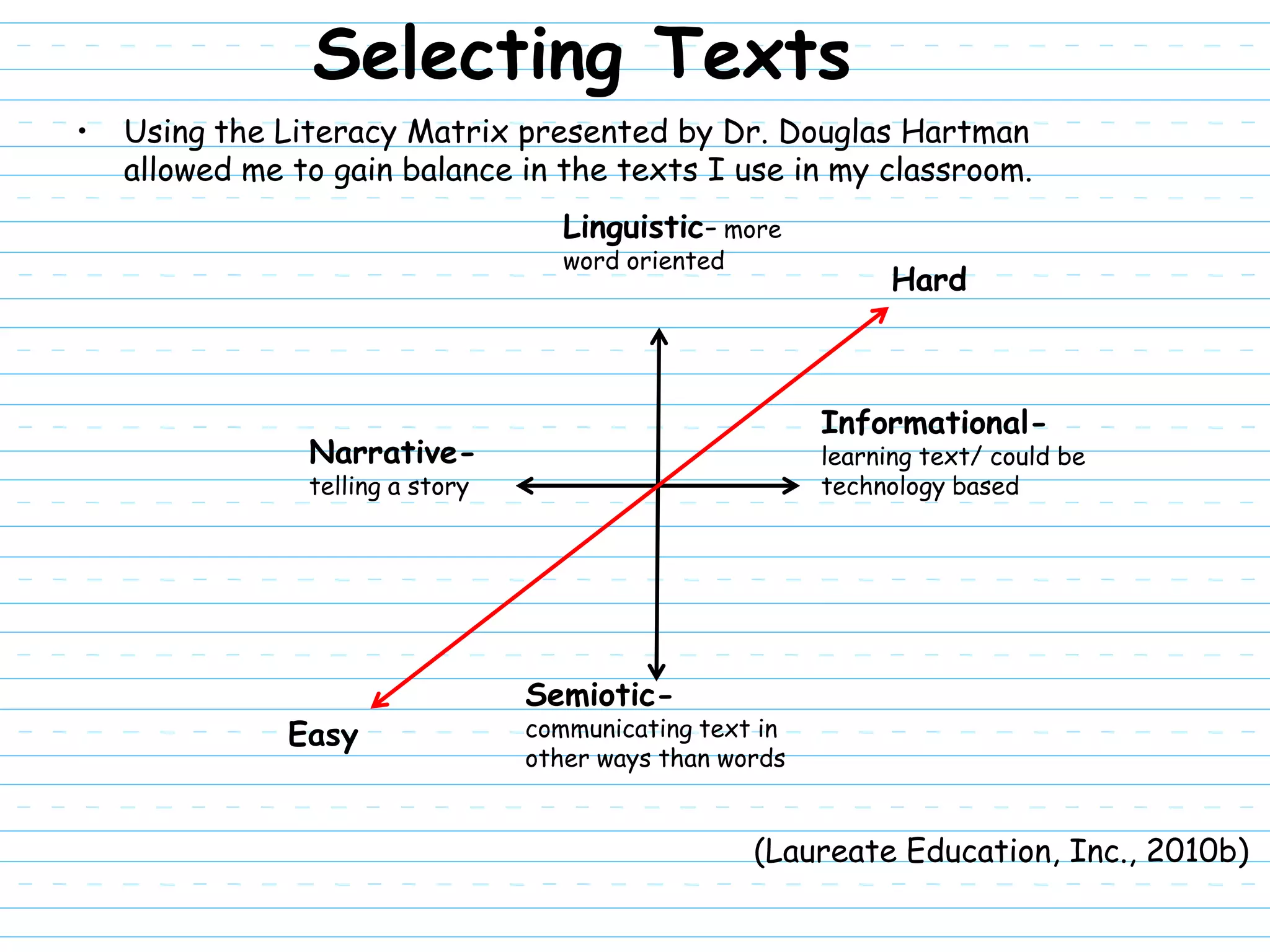
•   Using the Literacy Matrix presented by Dr. Douglas Hartman
    allowed me to gain balance in the texts I use in my classroom.
                                     Linguistic- more
                                     word oriented
                                                                Hard


                                                          Informational-
                Narrative-                                learning text/ could be
                telling a story                           technology based


                                  Semiotic-
               Easy               communicating text in
                                  other ways than words


                                                     (Laureate Education, Inc., 2010b)
Selecting Texts
             Research Based Practices Implemented

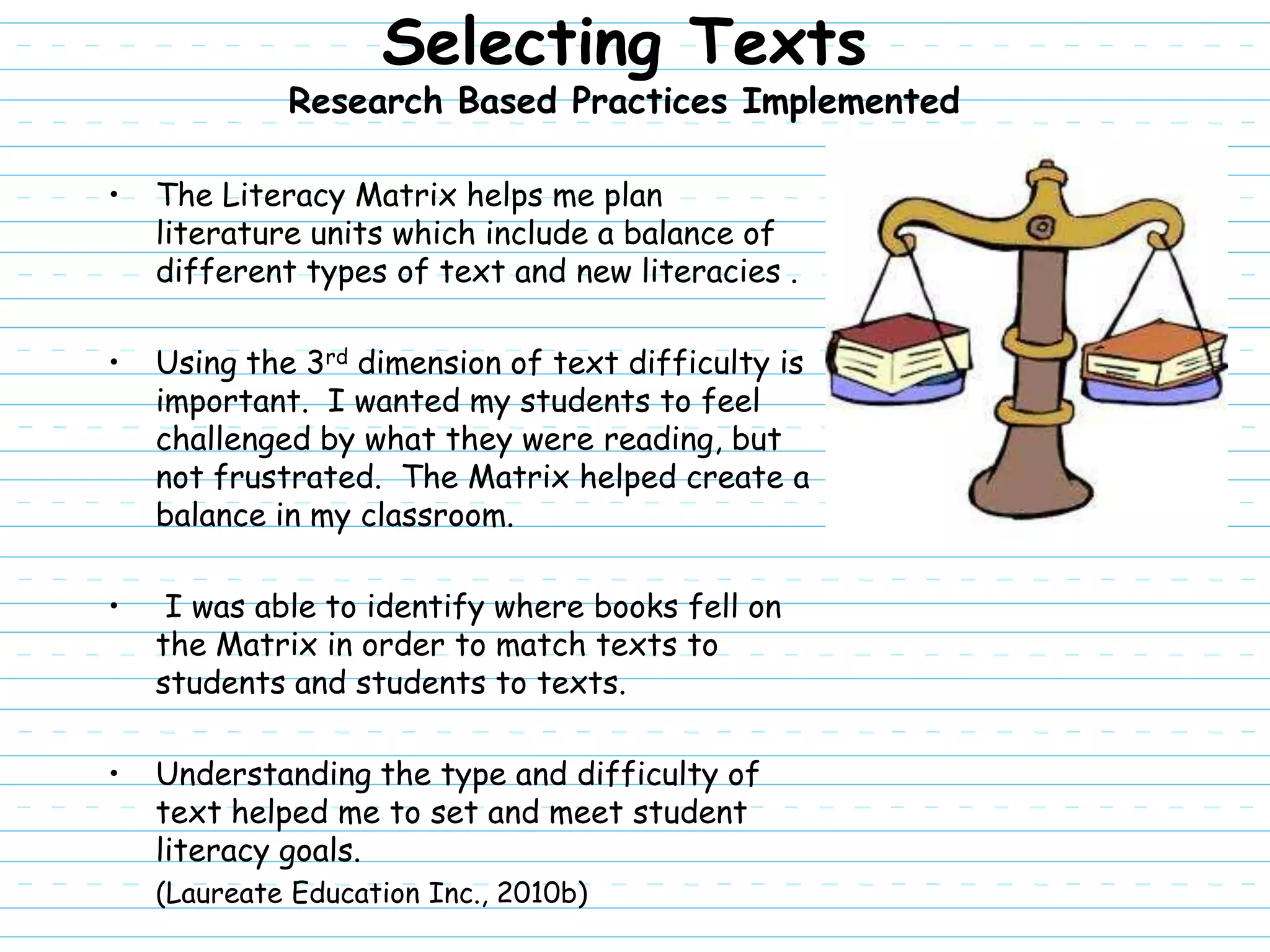
•   The Literacy Matrix helps me plan
    literature units which include a balance of
    different types of text and new literacies .

•   Using the 3rd dimension of text difficulty is
    important. I wanted my students to feel
    challenged by what they were reading, but
    not frustrated. The Matrix helped create a
    balance in my classroom.

•    I was able to identify where books fell on
    the Matrix in order to match texts to
    students and students to texts.

•   Understanding the type and difficulty of
    text helped me to set and meet student
    literacy goals.
    (Laureate Education Inc., 2010b)
• Interactive Perspective-
 reading/writing accurately, fluently, and with
 comprehension

  – Use a variety of assessments to determine
    student strengths/needs

  – Identify appropriate level text, that meets
    student goals

  – Select instructional methods that promote
    independent practice of reading skills and
    strategies (Laureate Education, Inc., 2010c)
Literacy Lesson Using Interactive Perspective
•   I chose to work with “Tyler” a second grade
    student, with a unit focus on the holiday of
    Thanksgiving. This unit of study fit perfect since
    it fell during the month of November and also
    aligned with the South Carolina literacy standards.

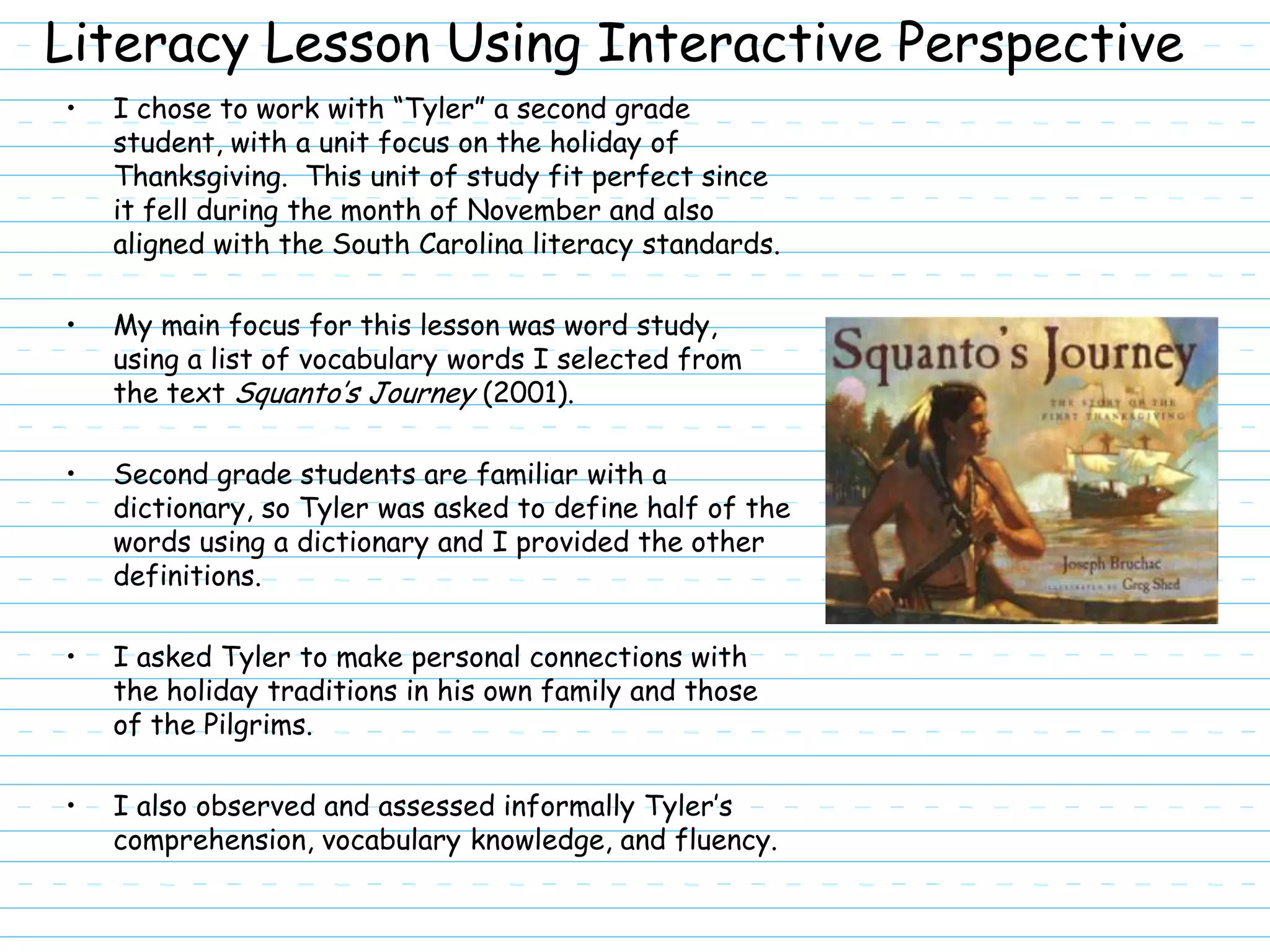
•   My main focus for this lesson was word study,
    using a list of vocabulary words I selected from
    the text Squanto’s Journey (2001).

•   Second grade students are familiar with a
    dictionary, so Tyler was asked to define half of the
    words using a dictionary and I provided the other
    definitions.

•   I asked Tyler to make personal connections with
    the holiday traditions in his own family and those
    of the Pilgrims.

•   I also observed and assessed informally Tyler’s
    comprehension, vocabulary knowledge, and fluency.
• Critical Perspective-thinking critically
 about text (Laureate Education, Inc., 2010c)

  – Identify problems, issues, or interests that
    are important to students

  – Select texts that allow students to think
    critically

  – Provide opportunities for students to
    challenge text (model, question, lead)
• Response Perspective-reacting
 and responding to text in a variety of ways
 (Laureate Education, Inc., 2010c)


  – Discover students’ interests (what
    matters to my students)

  – Select texts that connect with students,
    and evokes a personal/emotional response

  – Provide an opportunity for students to
    THINK about the text (formulate a
    personal response
Literacy Lesson Using Critical & Response
              Perspectives
           •   This lesson was designed for third grade students,
               with a focus on acceptance and tolerance.

           •   I chose to focus on appreciating differences, since
               most if not all of my students live very culturally
               sheltered lives, meaning that most have little to no
               experience with other cultures, languages, or food.

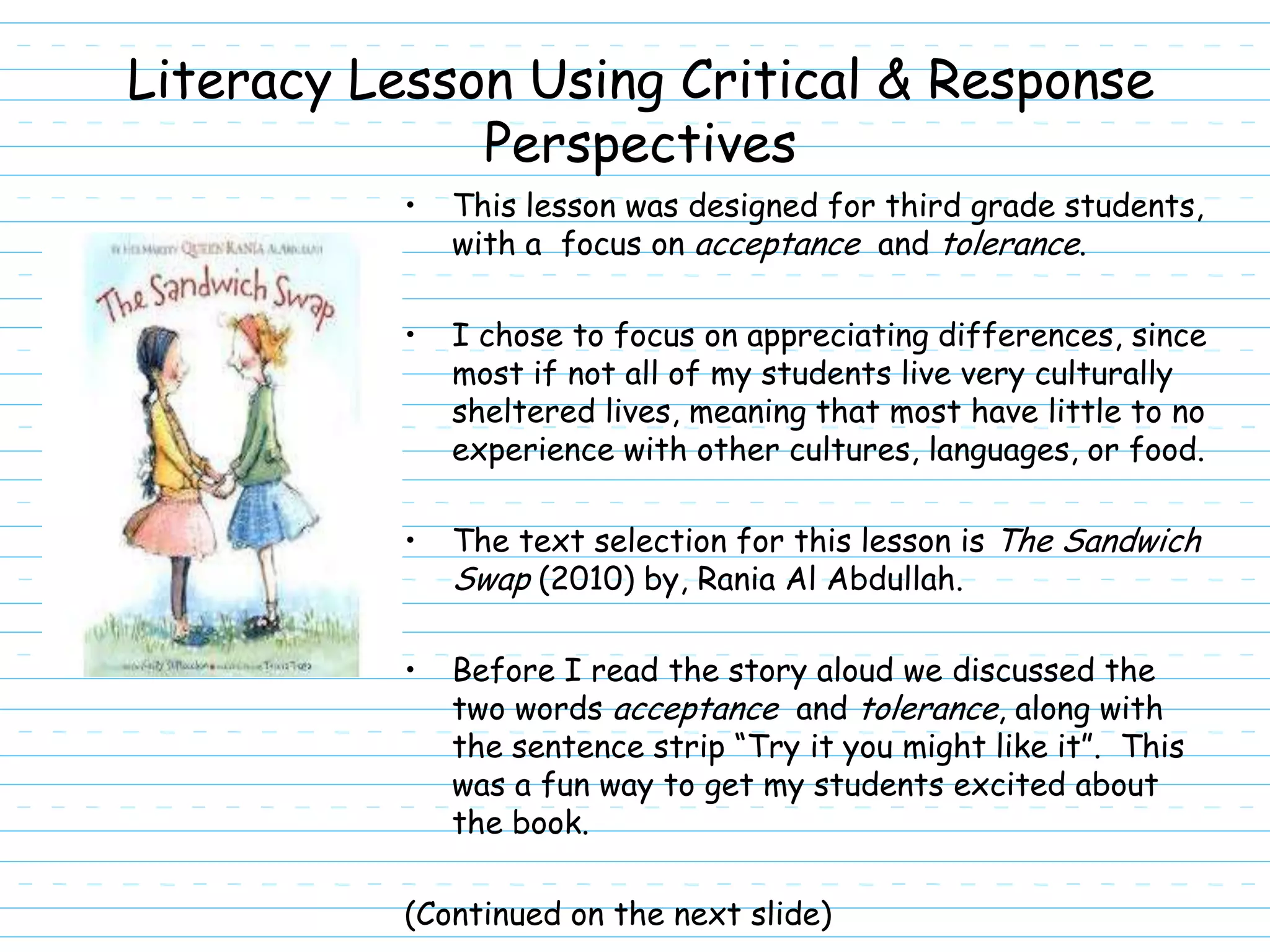
           •   The text selection for this lesson is The Sandwich
               Swap (2010) by, Rania Al Abdullah.

           •   Before I read the story aloud we discussed the
               two words acceptance and tolerance, along with
               the sentence strip “Try it you might like it”. This
               was a fun way to get my students excited about
               the book.

           (Continued on the next slide)
Literacy Lesson Using Critical & Response
                Perspectives (cont.)
                                                       Response Starters:
•   During the read aloud, I stopped to ask my      *I could see, taste, feel,
    students “thinking questions”. I encouraged     hear, smell...
    them to write their feelings and thoughts on    *I felt _______when
    sticky notes.                                   _________ because
                                                    ________.
                                                    *I understand how
•   After the story, students wrote in their        ______ felt because I
    response journals.                              __________.
                                                    *I was surprised when
                                                    __________ because
•   I used response starters, compiled from a       ___________.
    list created by Danille Mahoney (2010).         *I'm guessing that . . .
    Students used their sticky notes as reminders
    of their feelings during the book.

•   Journal entries were NOT for a grade, but I
    did take the time to respond to each journal
    entry.
How did these areas help me create a
            literate environment?
• Getting to know my learners: I honored their individuality,
  strengths, weaknesses, prior knowledge and personal likes
  and dislikes. I saw students more engaged in small group
  instruction, since the texts I chose, fit them specifically
  rather than being a one size fits all story.

• Selecting text in the classroom: Understanding the
  difference and importance of including a variety of text in
  the classroom, I was able to expose my students to more
  informational text. Most of my students enjoyed reading
  informational text and even requested that we read more. I
  still have a few students who prefer reading semiotic text.
  One solution I found that worked in my classroom was to
  print smaller excerpts from the book and paste pictures or
  clipart with each selection, making my own “picture” book.
  (Continue on the next slide)
How did these areas help me create a
        literate environment? (cont.)

• Interactive Perspective: Modeling correct use of a skill or
  strategy was new to me. In the past, I would explain the
  skill and expect students to use it properly. Through
  modeling for my students, I discovered fewer questions
  were being asked and more of my students were ready to
  work independently.

• Critical and Response Perspectives: Most of my students
  enjoyed stepping into the feelings and emotions of either
  the author or the characters in the story. I found my
  students became more thoughtful not only when reading and
  responding but also in their own writing.
References:
•   Al Abdullah, R. (2010). The sandwich swap. New York: Scholastic Inc.

•   Afflerbach, P., Pearson, P. D., & Paris, S. G. (2008). Clarifying differences between reading skills and
    reading strategies. Reading Teacher, 61(5), 364–373

•   Afflerbach, P. (2012). Understanding and using reading assessment k-12. (2nd ed.). Newark, DE:
    International Reading Association.

•   Bruchac, J., & Shed, G. (2001). Squanto's journey, the story of the first thanksgiving. Harcourt Children's
    Books.

•   Laureate Education, Inc. (Executive Producer). (2010b). Analyzing and selecting text [DVD]. Foundations of
    Reading and Literacy. The Beginning Reader, PreK-3.

•   Laureate Education, Inc. (Executive Producer). (2010a). Getting to know your students [DVD]. Foundations
    of Reading and Literacy. The Beginning Reader, PreK-3.

•   Laureate Education, Inc. (Producer). (2010c). Perspectives on literacy learning. [Video webcast]. The
    Beginning Reader, PreK-3.

•   Mahoney, D. (2010, September 14). [Web log message]. Retrieved from
    http://www.scholastic.com/teachers/top-teaching/2010/09/reading-and-critical-thinking-stop-and-think-then-
    jot

•   McKenna, M. C., & Kear, D. J. (1990, May). www.professorgarfield.org. Retrieved from
    http://www.professorgarfield.org/parents_teachers/printables/pdfs/reading/readingsurvey.pdf

•   Stenner, J. (1999). Matching students to text: The targeted reader. New York: Scholastic Center of Literacy
    and Learning.

•   Tompkins, G. E. (2010). Literacy for the 21st centaury a balanced approach. Boston: Allyn and Bacon.

Creating a literate environment

  • 1.
    Creating a Literate Environment Analysis Presentation Created & Presented by: Donna Franklin Walden University
  • 2.
    Getting to knowLiteracy Learners • Each student in a classroom possesses different reading skills and strategies. It is not only beneficial but critical that we understand the skills and effort our students put into reading. One way we can do this is through assessment. Assessment “helps us understand and appreciate the diverse growth that students experience and the reading challenges they face” (Afflerbach, 2012, p. 27).
  • 3.
    Getting to knowLiteracy Learners Research Based Practices Implemented • Getting to know my students allows me to see what kind of world they live in (Laureate Education Inc., 2010a) • Determining my students reading strengths and weaknesses along with their likes and dislikes, cultural and family background allows me to choose or suggest appropriate text. • In my own classroom I create a literate environment by assessing my readers using a variety of methods. A few examples are: – The Elementary Reading Attitude Survey- “The Garfield Test” (McKenna & Kear, 1990) – Self- made Reading Interest Surveys – Running Records – Concept About Print (Tompkins, 2010, p. 113) – Literacy Skills Assessments found at http://mockingbirdimagery.com/ (most appropriate for Preschool/ Kindergarten age children) (Edmunds, 2012)
  • 4.
    Selecting Texts • Selecting the correct text for students requires being in tune with student needs, abilities, and interests while creating just enough “success and failure, soaring and stumbling, clarity and confusion” to challenge the student to grow (Stenner, 1999, p. 5). The classroom library, small and whole group instruction, guided reading, centers, and read aloud book sharing are all wonderful times to share the various types of text available.
  • 5.
    Selecting Texts • Using the Literacy Matrix presented by Dr. Douglas Hartman allowed me to gain balance in the texts I use in my classroom. Linguistic- more word oriented Hard Informational- Narrative- learning text/ could be telling a story technology based Semiotic- Easy communicating text in other ways than words (Laureate Education, Inc., 2010b)
  • 6.
    Selecting Texts Research Based Practices Implemented • The Literacy Matrix helps me plan literature units which include a balance of different types of text and new literacies . • Using the 3rd dimension of text difficulty is important. I wanted my students to feel challenged by what they were reading, but not frustrated. The Matrix helped create a balance in my classroom. • I was able to identify where books fell on the Matrix in order to match texts to students and students to texts. • Understanding the type and difficulty of text helped me to set and meet student literacy goals. (Laureate Education Inc., 2010b)
  • 7.
    • Interactive Perspective- reading/writing accurately, fluently, and with comprehension – Use a variety of assessments to determine student strengths/needs – Identify appropriate level text, that meets student goals – Select instructional methods that promote independent practice of reading skills and strategies (Laureate Education, Inc., 2010c)
  • 8.
    Literacy Lesson UsingInteractive Perspective • I chose to work with “Tyler” a second grade student, with a unit focus on the holiday of Thanksgiving. This unit of study fit perfect since it fell during the month of November and also aligned with the South Carolina literacy standards. • My main focus for this lesson was word study, using a list of vocabulary words I selected from the text Squanto’s Journey (2001). • Second grade students are familiar with a dictionary, so Tyler was asked to define half of the words using a dictionary and I provided the other definitions. • I asked Tyler to make personal connections with the holiday traditions in his own family and those of the Pilgrims. • I also observed and assessed informally Tyler’s comprehension, vocabulary knowledge, and fluency.
  • 9.
    • Critical Perspective-thinkingcritically about text (Laureate Education, Inc., 2010c) – Identify problems, issues, or interests that are important to students – Select texts that allow students to think critically – Provide opportunities for students to challenge text (model, question, lead)
  • 10.
    • Response Perspective-reacting and responding to text in a variety of ways (Laureate Education, Inc., 2010c) – Discover students’ interests (what matters to my students) – Select texts that connect with students, and evokes a personal/emotional response – Provide an opportunity for students to THINK about the text (formulate a personal response
  • 11.
    Literacy Lesson UsingCritical & Response Perspectives • This lesson was designed for third grade students, with a focus on acceptance and tolerance. • I chose to focus on appreciating differences, since most if not all of my students live very culturally sheltered lives, meaning that most have little to no experience with other cultures, languages, or food. • The text selection for this lesson is The Sandwich Swap (2010) by, Rania Al Abdullah. • Before I read the story aloud we discussed the two words acceptance and tolerance, along with the sentence strip “Try it you might like it”. This was a fun way to get my students excited about the book. (Continued on the next slide)
  • 12.
    Literacy Lesson UsingCritical & Response Perspectives (cont.) Response Starters: • During the read aloud, I stopped to ask my *I could see, taste, feel, students “thinking questions”. I encouraged hear, smell... them to write their feelings and thoughts on *I felt _______when sticky notes. _________ because ________. *I understand how • After the story, students wrote in their ______ felt because I response journals. __________. *I was surprised when __________ because • I used response starters, compiled from a ___________. list created by Danille Mahoney (2010). *I'm guessing that . . . Students used their sticky notes as reminders of their feelings during the book. • Journal entries were NOT for a grade, but I did take the time to respond to each journal entry.
  • 13.
    How did theseareas help me create a literate environment? • Getting to know my learners: I honored their individuality, strengths, weaknesses, prior knowledge and personal likes and dislikes. I saw students more engaged in small group instruction, since the texts I chose, fit them specifically rather than being a one size fits all story. • Selecting text in the classroom: Understanding the difference and importance of including a variety of text in the classroom, I was able to expose my students to more informational text. Most of my students enjoyed reading informational text and even requested that we read more. I still have a few students who prefer reading semiotic text. One solution I found that worked in my classroom was to print smaller excerpts from the book and paste pictures or clipart with each selection, making my own “picture” book. (Continue on the next slide)
  • 14.
    How did theseareas help me create a literate environment? (cont.) • Interactive Perspective: Modeling correct use of a skill or strategy was new to me. In the past, I would explain the skill and expect students to use it properly. Through modeling for my students, I discovered fewer questions were being asked and more of my students were ready to work independently. • Critical and Response Perspectives: Most of my students enjoyed stepping into the feelings and emotions of either the author or the characters in the story. I found my students became more thoughtful not only when reading and responding but also in their own writing.
  • 15.
    References: • Al Abdullah, R. (2010). The sandwich swap. New York: Scholastic Inc. • Afflerbach, P., Pearson, P. D., & Paris, S. G. (2008). Clarifying differences between reading skills and reading strategies. Reading Teacher, 61(5), 364–373 • Afflerbach, P. (2012). Understanding and using reading assessment k-12. (2nd ed.). Newark, DE: International Reading Association. • Bruchac, J., & Shed, G. (2001). Squanto's journey, the story of the first thanksgiving. Harcourt Children's Books. • Laureate Education, Inc. (Executive Producer). (2010b). Analyzing and selecting text [DVD]. Foundations of Reading and Literacy. The Beginning Reader, PreK-3. • Laureate Education, Inc. (Executive Producer). (2010a). Getting to know your students [DVD]. Foundations of Reading and Literacy. The Beginning Reader, PreK-3. • Laureate Education, Inc. (Producer). (2010c). Perspectives on literacy learning. [Video webcast]. The Beginning Reader, PreK-3. • Mahoney, D. (2010, September 14). [Web log message]. Retrieved from http://www.scholastic.com/teachers/top-teaching/2010/09/reading-and-critical-thinking-stop-and-think-then- jot • McKenna, M. C., & Kear, D. J. (1990, May). www.professorgarfield.org. Retrieved from http://www.professorgarfield.org/parents_teachers/printables/pdfs/reading/readingsurvey.pdf • Stenner, J. (1999). Matching students to text: The targeted reader. New York: Scholastic Center of Literacy and Learning. • Tompkins, G. E. (2010). Literacy for the 21st centaury a balanced approach. Boston: Allyn and Bacon.