Working on Wellbeing
Table of Contents
                                                                                                Page
Foreword                                                                                          1

Background                                                                                        2

Key Steps    One    Establishing a whole-school Social and Emotional Learning (SEL) Framework     5
             Two    Reviewing the current position                                                7
                    Strand 1: The Learning Needs Analysis                                         8
                    Strand 2: Provision Mapping for Social and Emotional Learning                14
                    Strand 3: Online assessments – My School, My Class, My Feelings              16
             Three Planning interventions                                                        22
                    Strand 1: Planning whole-school interventions                                23
                    Strand 2: Planning class interventions                                       25
                    Strand 3: Planning small group or individual interventions                   30
             Four   Implementation of actions planned                                            37
Appendices   1      Findings from the NBAR project in Bridgend and the Vale of Glamorgan         38
             2      Preparatory activity for developing SEL Framework                            46
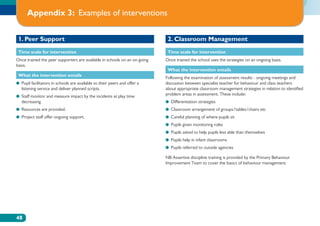
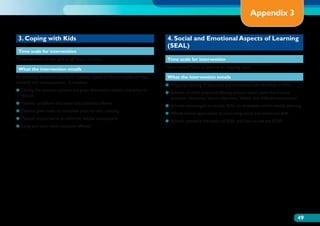
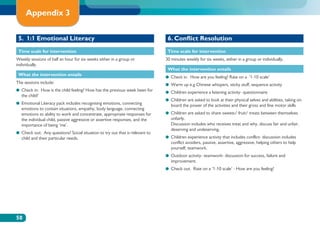
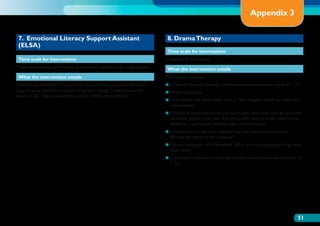
             3      Examples of interventions                                                    48
Foreword                                             These are underpinned by the Welsh
                                                     Government’s Personal and Social Education
                                                     framework, and include the translation of the
                                                                                                          The Working on Wellbeing project is based on a
                                                                                                          recognition that emotional and social difficulties
                                                                                                          that children and young people experience have
The Working on Wellbeing project                     Social and Emotional Aspects of Learning (SEAL)      adverse effects on their ability to learn, because
originated from a commitment by                      resources into Welsh. The curriculum focus           they reduce their capacity to concentrate on
                                                     for personal, social and emotional wellbeing         academic progress and learning new skills. This is
the Minister for Education, Lifelong
                                                     within the Foundation Phase is also an important     especially the case for those pupils with complex
Learning and Skills in March 2006                    component of the work being carried out              needs. Early identification and intervention are
to undertake a National Review of                    by schools. The contributions of the Welsh           crucial for ensuring that specialist approaches can
Behaviour and Attendance (NBAR).                     Network of Healthy School Schemes and the            be accessed in a timely and effective way. This
An independent steering group, led                   Primary Mental Health Teams are also important       not only involves robust work within the school
by Professor Ken Reid, considered the                for supporting the promotion of emotional            setting, but also a commitment from the families
existing good practice in Wales and                  health and wellbeing in schools.                     of the children and young people and the wider
produced clear recommendations.                      Research shows that a properly trained               community. This project therefore provides
                                                     school workforce, able to apply whole school         an important bridge between the Personal and
The Working on Wellbeing project was                 approaches for preventing and intervening in high    Social Education framework in schools and the
subsequently commissioned by the Welsh               risk behaviour, can make a difference not only to    Families First programme designed to support
Assembly Government to develop a strategy for        the children and young people themselves but         families and tackle child poverty.
identifying and assessing the social and emotional   to the school community as a whole. However,         The Working on Wellbeing project has been
needs of children and young people, and to           a number of challenges identified by the NBAR        developed through a successful collaboration
put in place early and effective intervention        steering group need to be addressed, including:      between Bridgend and Vale of Glamorgan local
approaches to meet those needs.                      the provision of professional training and           authorities (including the Educational Psychology
In Wales, a number of whole school approaches        development for school staff; the importance of      Services, the Inclusion Services, and the
are seen as strong components in supporting          utilising the opinion of children and young people   Behaviour Support Services) and the University
pupils’ social and emotional needs, and ultimately   in helping to understand the issues around           of Sussex. We are especially grateful for the
improving their behaviour and learning.              behaviour and attendance; the need for better        contributions made by the staff and pupils in the
                                                     multi-agency working; and concerns around            two clusters of schools in Porthcawl and Barry.
                                                     the histories of poor behaviour and attendance
                                                     before Key Stage 3.


                                                                                                                                                           1
Background                                                            The Working on Wellbeing (WoW) project was
                                                                      designed to help Local Authorities and schools
                                                                      develop a comprehensive approach to social
Efforts to support the wellbeing                                      and emotional learning that includes identifying
of children and young people have                                     and meeting the social and emotional needs of
                                                                      all pupils. It recognizes that the behaviour of
become a national priority, especially
                                                                      children is a result of their social and emotional
in light of international comparisons                                 development, and that this in turn is influenced
of developed countries which have                                     by the social and emotional environment or
indicated relatively low levels of child                              climate that they experience inside and outside
wellbeing in the UK.                                                  school. Therefore, it helps schools to create
                                                                      a positive climate that promotes wellbeing
In one report, the UK was placed 17th or                              and supports the development of social and
lower out of 21 countries on dimensions such                          emotional skills.
as educational well-being, family and peer
relationships, behaviours and risks, and subjective                   The social and emotional development of children
well-being.1                                                          and young people is known to be complex.
                                                                      A large and rapidly growing body of research
Although wellbeing encompasses material/                              evidence has traced a multitude of factors
economic and physical health dimensions, it is                                                                                              For example, we know that children become
                                                                      involved, covering a wide range of topics including
widely understood that social relationships and                                                                                             increasingly mature in their ability to manage
                                                                      early infant-caregiver attachments, interactions
emotional experiences are a crucial bedrock for                                                                                             their emotions, both in terms of how they
                                                                      and relationships with parents and siblings, moral
wellbeing in children and young people, just as                                                                                             express them in public and in terms of how they
                                                                      reasoning, emotional control, self-perceptions,
they are for all human beings. Given that schools                                                                                           deal privately with distressing or uncomfortable
                                                                      gender development, and peer relations.3
are recognised to be one of the key settings for                                                                                            emotions.
the psychological development of children and                         This body of research shows a number of basic
                                                                                                                                            But we also know that, at any given age, children
young people2, this raises the question of what                       developmental patterns and sequences that
                                                                                                                                            and young people vary enormously in their social
schools can do to better understand and support                       children typically show as they move from early
                                                                                                                                            and emotional competence.
the social and emotional foundations of wellbeing.                    childhood to middle childhood to adolescence.


1	 UNICEF (2007). Innocenti Research Centre Report Card 7: An overview of child well-being in rich countries. Florence, Italy: UNICEF.
2	Banerjee, R., Tolmie, A.,  Boyle, J. (2011). Educational psychology: History and overview. In G. Davey (Ed.), Introduction to applied psychology. Chichester, West Sussex: Wiley.
3	 Siegler, R., Deloache, J.,  Eisenberg, N. (2010). How children develop. London: Worth.
4	Saarni, C., Campos, J., Camras, L.,  Witherington, D. (2006). Emotional development Action, communication, and understanding. In W. Damon, L. Lerner,  N. Eisenberg (Eds.), Handbook of child
   psychology. New York: Wiley.


2
This is most obvious in the case of pupils                                  Some pupils generally feel positive about                    Work in the area of social and emotional learning
recognised as having special educational needs.                             themselves and their experiences, whereas others             is nationally recognised as crucial. According
For example, staff in schools will be aware of                              feel anxious or angry and are unable to find                 to the ESTYN Inspection Framework (2010),
pupils who have been diagnosed with an ‘autism                              anything positive about themselves.                          school inspectors are governed by the Education
spectrum condition’ (ASC) or attention deficit                              Moreover, these kinds of variations are present              Act of 2005 regulations which instruct them to
difficulties, often involving significant impairments                       not just at the level of individuals, but also at the        report on ‘The spiritual, moral, social and cultural
in social relationships and interactions. Other                             levels of groups (e.g., a particularly disruptive            development of pupils at the school’ and ‘The
pupils might be identified as having ‘behavioural,                          group of children), classes (e.g., a class with              contribution of the school to the well being of pupils’.
emotional, and social difficulties’ (BESD)                                  generally high levels of anxiety), and even whole
that could include a wide range of difficulties                             schools (e.g., a school where both pupils and staff
in managing social life, from disruptive and                                                                                                The key aim of WoW is to develop a whole-
                                                                            report feeling unsafe).
aggressive behaviour through to social                                                                                                      school framework for social and emotional
withdrawal and deep-rooted insecurities.                                    Working on Wellbeing is based on a strong                       health and wellbeing, with an emphasis
                                                                            evidence base of research that highlights how                   on early identification of needs and
Although recognising and meeting the special                                school-based strategies to support Social and                   intervention. This includes:
educational needs of particular pupils is important,                        Emotional Learning (SEL) can promote a wide
research also shows us that even within the                                                                                                 ●● nvolvement of the whole school community
                                                                                                                                               I
                                                                            range of positive outcomes. According to the
‘mainstream’ population of pupils at school, there                                                                                             in developing a Social and Emotional Learning
                                                                            most recent meta-analysis of research studies6,
are dramatic variations in social and emotional                                                                                                (SEL) framework
                                                                            significant overall effects include:
functioning – variations which are fundamentally                                                                                            ●●  rovision map outlining the range of provision
                                                                                                                                               P
connected to wellbeing.5 For example, some                                  ●● Improved social and emotional skills                            in schools
pupils are well-liked within their peer groups,                             ●●  ore positive attitudes towards self, school,
                                                                               M                                                            ●●  valuation of workforce skills and professional
                                                                                                                                               E
whereas others are actively rejected and                                        and social topics                                              development programme to ensure workforce
ostracised. Some pupils show bullying behaviour,                                                                                               adequately skilled
                                                                            ●● Higher levels of positive social behaviour
some are victimised, and some experience both
– and some pupils egg on the bullies, whereas                               ●● Reduced conduct problems                                     ●● ndividual and whole-school assessments to
                                                                                                                                               I
others come to the aid of victims, and others just                                                                                             identify social and emotional needs
                                                                            ●● Reduced emotional distress
walk away.                                                                                                                                  ●●  roactive whole-school developments that
                                                                                                                                               P
                                                                            ●● Increased academic performance.                                 build upon the current position
                                                                                                                                            ●●  argeted interventions based on the
                                                                                                                                               T
5	
  Smith, P.,  Elliott, J. G. (2011). Social problems in school. In A. M. Slater  J. G. Bremner (Eds.), Introduction to developmental         assessments and the knowledge within the
  psychology. Oxford: Wiley-Blackwell.                                                                                                         school community
6	
  Durlak, J. A., Weissberg, R. P., Dymnicki, A. B., Taylor, R. D.,  Schellinger, K. B. (2011). The impact of enhancing students’
  social and emotional learning: A meta-analysis of school-based universal interventions. Child Development, 82, 405-432.
                                                                                                                                            ●●  onitoring and review of progress and outcomes.
                                                                                                                                               M


                                                                                                                                                                                               3
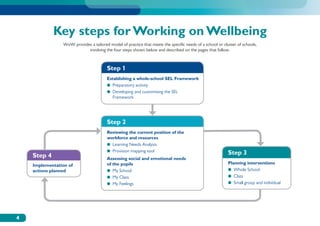
Key steps for Working on Wellbeing
                 WoW provides a tailored model of practice that meets the specific needs of a school or cluster of schools,
                            involving the four steps shown below and described on the pages that follow.


                                        Step 1
                                        Establishing a whole-school SEL Framework
                                        ●  Preparatory activity
                                         D
                                        ●   eveloping and customising the SEL
                                           Framework


                                        Step 2
                                        Reviewing the current position of the
                                        workforce and resources
                                        ●  Learning Needs Analysis
                                        ●  Provision mapping tool
    Step 4                                                                                                 Step 3
                                        Assessing social and emotional needs
                                        of the pupils                                                      Planning interventions
    I
     mplementation of
    actions planned                     ●  My School                                                       ●  Whole School
                                        ●  My Class                                                        ●  Class
                                        ●  My Feelings                                                     ●  Small group and individual


4
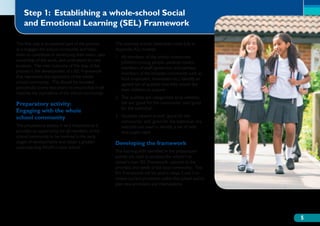
Step 1: Establishing a whole-school Social
    and Emotional Learning (SEL) Framework

This first step is an essential part of the process      This essential activity (described more fully in
as it engages the school community and helps             Appendix A2) involves:
them to contribute to developing their vision, take      1.	 members of the school community
                                                            All
ownership of the work, and understand its core              (children/young people, parents/carers,
purpose. The main outcome of this step of the               members of staff/governors and perhaps
process is the development of a SEL Framework               members of the broader community such as
that represents the aspirations of the whole                local employers, businesses etc.) identify an
school community. This should be revisited                  agreed set of qualities that they would like
periodically (every few years) to ensure that it still      their children to acquire.
matches the aspirations of the school community.
                                                         2.	
                                                            The qualities are categorised as to whether
Preparatory activity:                                       the are ‘good for the community’ and ‘good
                                                            for the individual’.
Engaging with the whole
school community                                         3.	
                                                            Qualities viewed as both ‘good for the
                                                            community’ and ‘good for the individual’ are
The preparatory activity is very important as it            selected and used to identify a set of skills
provides an opportunity for all members of the              that pupils need.
school community to be involved in the early
stages of developments and obtain a greater              Developing the framework
understanding WoW in their school.
                                                         The learning skills identified in the preparatory
                                                         activity are used to produce the school’s or
                                                         cluster’s own SEL Framework, tailored to the
                                                         priorities and needs of the local community. This
                                                         SEL Framework will be used in Steps 2 and 3 to
                                                         review current provisions within the school and to
                                                         plan new provisions and interventions.


                                                                                                              5
Step 1

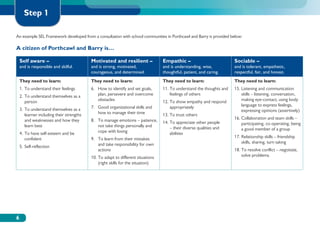
An example SEL Framework developed from a consultation with school communities in Porthcawl and Barry is provided below:

A citizen of Porthcawl and Barry is…

    Self aware –                           Motivated and resilient –               Empathic –                            Sociable –
    and is responsible and skilful.        and is strong, motivated,               and is understanding, wise,           and is tolerant, empathetic,
                                           courageous, and determined.             thoughtful, patient, and caring.      respectful, fair, and honest.
    They need to learn:                    They need to learn:                     They need to learn:                   They need to learn:
    1.	To understand their feelings        6.	How to identify and set goals,      11.	 o understand the thoughts and
                                                                                       T                                 15.	 istening and communication
                                                                                                                             L
    2.	 o understand themselves as a
       T                                       plan, persevere and overcome            feelings of others                    skills – listening, conversation,
       person                                  obstacles                           12.	 o show empathy and respond
                                                                                       T                                     making eye-contact, using body
                                           7.	Good organizational skills and          appropriately                         language to express feelings,
    3.	 o understand themselves as a
       T                                                                                                                     expressing opinions (assertively)
       learner including their strengths       how to manage their time            13.	To trust others
       and weaknesses and how they         8.	 manage emotions – patience,
                                               To                                                                        16.	 ollaboration and team skills –
                                                                                                                             C
                                                                                   14.	 o appreciate other people
                                                                                       T                                     participating, co-operating, being
       learn best                              not take things personally and          – their diverse qualities and
                                               cope with losing                                                              a good member of a group
    4.	 o have self-esteem and be
       T                                                                               abilities
       confident                           9.	 learn from their mistakes
                                               To                                                                        17.	 elationship skills – friendship
                                                                                                                             R
                                               and take responsibility for own                                               skills, sharing, turn taking
    5.	Self-reflection
                                               actions                                                                   18.	 o resolve conflict – negotiate,
                                                                                                                             T
                                           10.	 o adapt to different situations
                                               T                                                                             solve problems.
                                               (right skills for the situation)


6
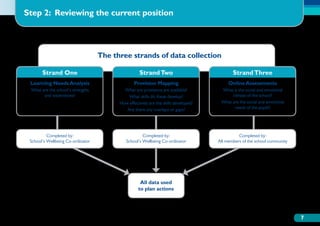
Step 2: Reviewing the current position


                                   The three strands of data collection

       Strand One                                   Strand Two                              Strand Three
 Learning Needs Analysis                         Provision Mapping                        Online Assessments
 What are the school’s strengths           What are provisions are available?         What is the social and emotional
       and weaknesses?                       What skills do these develop?                 climate of the school?
                                         How effectively are the skills developed?    What are the social and emotional
                                            Are there any overlaps or gaps?                 needs of the pupils?


          Completed by:                              Completed by:                             Completed by:
 School’s Wellbeing Co-ordinator            School’s Wellbeing Co-ordinator          All members of the school community


                                                   All data used
                                                  to plan actions
                                                   All data used
                                                   to plan actions


                                                                                                                           7
Step 2                   Strand 1: The Learning Needs Analysis

Background
A key feature of WoW is to establish that the
workforce is ‘fit for purpose’ and able to address
the social and emotional needs of children and
young people.
To do this, the development of an effective and responsive staff
professional development framework for the school community
is crucial. The School Effectiveness Framework states the
need for schools to build strong learning communities where
practitioners can develop and share their professional knowledge
about learning and teaching and build on good practice. It also
highlights the need for a planned training strategy which will meet
a wider range of children including those with Additional Learning
Needs.
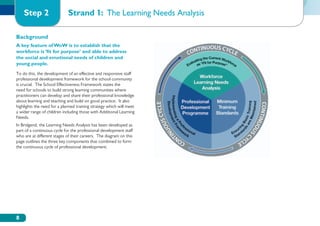
In Bridgend, the Learning Needs Analysis has been developed as
part of a continuous cycle for the professional development staff
who are at different stages of their careers. The diagram on this
page outlines the three key components that combined to form
the continuous cycle of professional development:


8
Step 2                  Strand 1

The Learning Needs Analysis                        As part of a continuous professional development cycle, the LNA helps to measure progress of the school
                                                   workforce over a consolidated period of time. The LNA provides a baseline (starting point) for measuring
The Learning Needs Analysis (LNA) helps to
                                                   how skilled the workforce are to deliver the identified ALN needs of the school’s population and supports
identify good practice taking place in schools,
                                                   the process of reporting on the impact that the CPD activities have had in relation to learner outcomes.
recognizing the knowledge and expertise of
school staff in providing for children and young   The LNA process involves five stages of activity:
people’s social and emotional learning. The LNA
also identifies the strengths and weaknesses of     Stage One           The first stage is to identify the personnel who will be involved in carrying out
the school workforce. This information helps                            the LNA and set up the meeting to carry out the LNA. This might include the
to determine how well equipped the school                               Headteacher, PSE Coordinator, Specialist Outreach Teacher, ALNCo.
workforce are in:
                                                    Stage Two           Together the team should consider each statement on the LNA grid, providing
●● dentifying the progress children and young
   i
                                                                        the necessary evidence as to whether the school meets the criteria for either
  people are making with their social and
                                                                        improving, refining or celebrating success. (See LNA template overleaf)
  emotional aspects of learning
●●  ow pupils are assessed and monitored
   h                                                Stage Three         From each of the areas listed in the LNA the next step is to write up a summary
  where there are concerns                                              of what the school has achieved to date together with a RAG (red, amber, green)
●● what resources the school has in place
                                                                        score. (See LNA template overleaf)

●● what interventions the school has in place       Stage Four          The next step is to use the analysis to set CPD targets as part of the annual cycle
●● what training staff have undergone                                   of professional development for school staff and then to implement the training
                                                                        and development programme.
●● partnership working
●● transition arrangements.                         Stage Five          The final stage of the process is to review the CPD activity at the end of the year
                                                                        in order to evaluate what outcomes have been achieved and the impact this has
                                                                        had on learners.


                                                                                                                                                              9
Step 2                Strand 1

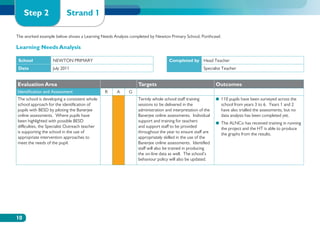
The worked example below shows a Learning Needs Analysis completed by Newton Primary School, Porthcawl.

Learning Needs Analysis

 School            NEWTON PRIMARY                                             Completed by Head Teacher
 Date              July 2011                                                                     Specialist Teacher


Evaluation Area                                              Targets                                    Outcomes
Identification and Assessment                   R   A   G
The school is developing a consistent whole                  Termly whole school staff training         ●●  10 pupils have been surveyed across the
                                                                                                           1
school approach for the identification of                    sessions to be delivered in the              school from years 3 to 6. Years 1 and 2
pupils with BESD by piloting the Banerjee                    administration and interpretation of the     have also trialled the assessments, but no
online assessments. Where pupils have                        Banerjee online assessments. Individual      data analysis has been completed yet.
been highlighted with possible BESD                          support and training for teachers          ●●  he ALNCo has received training in running
                                                                                                           T
difficulties, the Specialist Outreach teacher                and support staff to be provided             the project and the HT is able to produce
is supporting the school in the use of                       throughout the year to ensure staff are      the graphs from the results.
appropriate intervention approaches to                       appropriately skilled in the use of the
meet the needs of the pupil.                                 Banerjee online assessments. Identified
                                                             staff will also be trained in producing
                                                             the on-line data as well. The school’s
                                                             behaviour policy will also be updated.


10
Step 2                  Strand 1

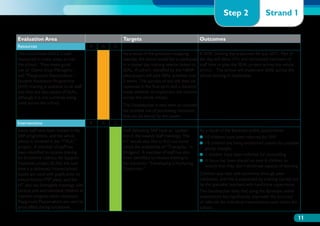
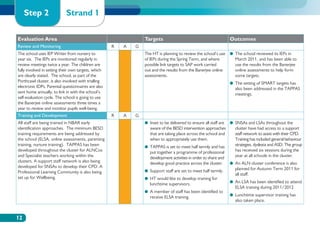
Evaluation Area                                        Targets                                          Outcomes
Resources                                  R   A   G
The school feels that it is well                       As a result of the provision mapping             A SEAL training day is planned for July 2011. Part of
resourced in many areas across                         exercise, the school would like to participate   the day will allow HTs and nominated members of
the school. They make good                             in a cluster day training session linked to      staff time to plan the SEAL project across the whole
use of “Game Shop Managers,”                           SEAL. A cohort, identified by the NBAR           school. The school will implement SEAL across the
and “Playground Peacemakers.”                          pilot project will pilot SEAL activities over    school starting in September.
Student Assistance Programme                           2 terms. The success of this will then be
(SAP) training is available to all staff               reviewed in the final term and a decision
and they are also aware of SEAL,                       made whether to implement the scheme
although it is not currently being                     across the whole school.
used across the school.                                The Headteacher is very keen to consider
                                                       the possible use of purchasing resources
                                                       that can be shared by the cluster.
Interventions                              R   A   G
Some staff have been trained in the                    Staff delivering SAP have an ‘update’            As a result of the Banerjee online assessments:
SAP programme, and the whole                           slot in the weekly staff meetings. The           ●● 10 children have been referred for SAP
school is involved in the “TALK,”                      HT would also like to find out more              ●●  8 children are being monitored closely for possible
                                                                                                           1
project. A member of staff has                         about the availability of “Therapies,” in           group changes.
been identified to receive training                    Bridgend. A member of staff has also             ●● 2 children have been referred for counselling
for Emotional Literacy for Support                     been identified to receive training in
                                                                                                        ●●  focus has been placed on year 6 children to
                                                                                                           A
Assistants project (ELSA) the next                     the future for “Developing a Nurturing
                                                                                                           ensure that they don’t dominate aspects of learning.
time it is delivered. Home/school                      Classroom.”
books are used with pupils prior to                                                                     Children also deal with problems through peer
school Action/PSP plans, and the                                                                        mediation, and this is supported by training carried out
HT also has fortnightly meetings with                                                                   by the specialist teachers with lunchtime supervisors.
parents and and individual children to                                                                  The headteacher feels that using the Banerjee online
monitor progress when necessary.                                                                        assessments has significantly improved the accuracy
Playground Peacemakers are used to                                                                      of referrals for individual interventions used within the
good effect during lunchtimes.                                                                          school.

                                                                                                                                                                11
Step 2                 Strand 1

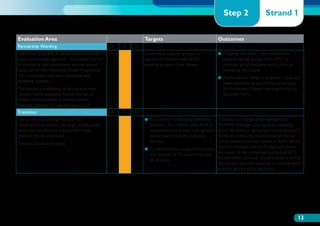
Evaluation Area                                                  Targets                                            Outcomes
Review and Monitoring                                R   A   G
The school uses IEP Writer from nursery to                       The HT is planning to review the school’s use ●●  he school reviewed its IEPs in
                                                                                                                  T
year six. The IEPs are monitored regularly in                    of IEPs during the Spring Term, and where        March 2011, and has been able to
review meetings twice a year. The children are                   possible link targets to SAP work carried        use the results from the Banerjee
fully involved in setting their own targets, which               out and the results from the Banerjee online     online assessments to help form
are clearly stated. The school, as part of the                   assessments.                                     some targets.
Porthcawl cluster, is also involved with trialling                                                                  ●●  he setting of SMART targets has
                                                                                                                       T
electronic IDPs. Parental questionnaires are also                                                                      also been addressed in the TAPPAS
sent home annually, to link in with the school’s                                                                       meetings.
self-evaluation cycle. The school is going to use
the Banerjee online assessments three times a
year to review and monitor pupils well-being.
Training and Development                             R   A   G
All staff are being trained in NBAR early                        ●● nset to be delivered to ensure all staff are
                                                                    I                                               ●●  NSAs and LSAs throughout the
                                                                                                                       S
identification approaches. The minimum BESD                         aware of the BESD intervention approaches          cluster have had access to a support
training requirements are being addressed by                        that are taking place across the school and        staff network to assist with their CPD.
the school (ELSA, online assessments, parenting                     when to appropriately use them.                    Training has included general behaviour
training, nurture training). TAPPAS has been                     ●●  APPAS is set to meet half termly and has
                                                                    T                                                  strategies, dyslexia and ASD. The group
developed throughout the cluster for ALNCos                         put together a programme of professional           has received six sessions during the
and Specialist teachers working within the                          development activities in order to share and       year at all schools in the cluster.
clusters. A support staff network is also being                     develop good practice across the cluster.       ●●  n ALN cluster conference is also
                                                                                                                       A
developed for SNSAs to develop their CPD. A                                                                            planned for Autumn Term 2011 for
Professional Learning Community is also being                    ●●  upport staff are set to meet half termly.
                                                                    S
                                                                                                                       all staff.
set up for Wellbeing.                                            ●●  T would like to develop training for
                                                                    H
                                                                                                                    ●●  n LSA has been identified to attend
                                                                                                                       A
                                                                    lunchtime supervisors.
                                                                                                                       ELSA training during 2011/2012
                                                                 ●●  member of staff has been identified to
                                                                    A
                                                                                                                    ●●  unchtime supervisor training has
                                                                                                                       L
                                                                    receive ELSA training.
                                                                                                                       also taken place.


12
Step 2                  Strand 1

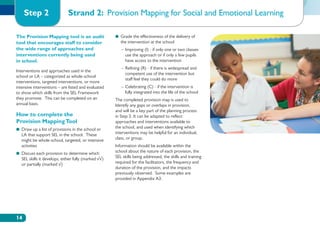
Evaluation Area                                                  Targets                                  Outcomes
Partnership Working                                  R   A   G
The school feels that it has strong links with its               To develop support groups for            ●●  Coping with Kids,” was trialled with
                                                                                                             “
pupils and outside agencies. The school Council                  parents of children with BESD,              parents during Spring Term 2011. It
is involved in staff recruitment and the school                  possibly as part of the cluster.            received good feedback with a view to
takes part in the Meaningful Work Programme.                                                                 repeating the course.
The school also uses peer mediation and                                                                   ●●  arent liaison “drop in surgeries” have also
                                                                                                             P
buddying systems.                                                                                            been identified as part of the action plan
The school is developing its strong links with                                                               for Porthcawl Cluster, starting during the
parents. Some examples include the use of                                                                    Summer Term.
home/ school contracts, termly parents’
evenings with the HT and the use of LAP.
Transition                                           R   A   G
The school has strong links with the                             ●●  o continue to develop smoother
                                                                    T                                    Transition is a target area highlighted in
comprehensive school, although it feels some                        transition for children with ALN to TAPPAS meetings. During these meetings
areas such as SEN and support for these                             comprehensive school with greater there has been an agreement made between
children can be improved.                                           involvement from the Inclusion       ALNCos of the information needed by the
There is a transition policy.                                       Service.                             comprehensive school, linked to ALN. Extra
                                                                 ●●  o provide extra support for pupils
                                                                    T                                    visits for children with ALN have also been
                                                                    and parents of Y6 pupils who may discussed. A day is planned during July 2011
                                                                    be anxious.                          for identified “anxious” pupils in year 6 across
                                                                                                         the cluster, and their parents, to receive extra
                                                                                                         support and a visit to the comp.


                                                                                                                                                          13
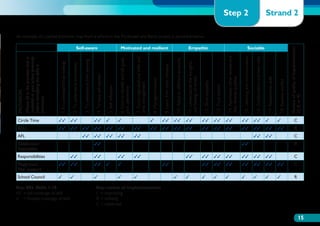
Step 2                   Strand 2: Provision Mapping for Social and Emotional Learning

The Provision Mapping tool is an audit                ●●  rade the effectiveness of the delivery of
                                                         G
tool that encourages staff to consider                   the intervention at the school 	
the wide range of approaches and                      	 Improving (I) - if only one or two classes
                                                        –	
interventions currently being used                        use the approach or if only a few pupils
in school.                                                have access to the intervention
                                                      	 Refining (R) - if there is widespread and
                                                        –	
Interventions and approaches used in the
                                                          competent use of the intervention but
school or LA – categorized as whole-school
                                                          staff feel they could do more
interventions, targeted interventions, or more
intensive interventions – are listed and evaluated    	 Celebrating (C) - if the intervention is
                                                        –	
to show which skills from the SEL Framework               fully integrated into the life of the school
they promote. This can be completed on an             The completed provision map is used to
annual basis.                                         Identify any gaps or overlaps in provision,
                                                      and will be a key part of the planning process
How to complete the                                   in Step 3. It can be adapted to reflect
Provision Mapping Tool                                approaches and interventions available to
●●  raw up a list of provisions in the school or
   D                                                  the school, and used when identifying which
   LA that support SEL in the school. These           interventions may be helpful for an individual,
   might be whole-school, targeted, or intensive      class, or group.
   activities                                         Information should be available within the
●●  iscuss each provision to determine which
   D                                                  school about the nature of each provision, the
   SEL skills it develops, either fully (marked √√)   SEL skills being addressed, the skills and training
   or partially (marked √)                            required for the facilitators, the frequency and
                                                      duration of the provision, and the impacts
                                                      previously observed. Some examples are
                                                      provided in Appendix A3.


14
PROVISION


                                                                                                        AFL
                                                                                                              SEAL
                                                                                                                                   (Please fill in the provision that is
                                                                                                                                   available at your school presently


                                                        Playground
                                                                                          Assemblies
                                                                                          Celebration
                                                                                                                     Circle Time
                                                                                                                                   before identifying the skills it


                                                        Peer Support
                                       School Council
                                                                                                                                   promotes)


                                                                       Responsibilities


     Key: SEL Skills 1-18	
                                        ✓


     √√	 = full coverage of skill	
                                                              ✓✓
                                                                                                              ✓✓
                                                                                                                     ✓✓
                                                                                                                                   1.To understand their feelings


     √	 = limited coverage of skill	
                                        ✓
                                                              ✓✓
                                                                        ✓✓
                                                                                                              ✓✓
                                                                                                                     ✓✓
                                                                                                                                   2. To understand themselves


                                                                                                        ✓✓
                                                                                                              ✓✓
                                                                                                                                   3. To understand their learning
                                                                                                                                                                           Self-aware


                                        ✓
                                                              ✓✓
                                                                        ✓✓
                                                                                               ✓✓
                                                                                                        ✓✓
                                                                                                              ✓✓
                                                                                                                     ✓✓
                                                                                                                                   4. To have self-esteem


                                                              ✓
                                                                                                                     ✓


                                                                                                        ✓✓
                                                                                                              ✓✓
                                                                                                                                   5. Self-reflection


     R	= refining
                                        ✓
                                                              ✓
                                                                                                                     ✓


     C	= celebrate
     I	 = improving
                                                                        ✓✓
                                                                                                        ✓✓
                                                                                                              ✓✓
                                                                                                                                   6. How to identify and set goals,
                                                                                                                                   plan, persevere


                                        ✓
                                                                        ✓✓
                                                                                                        ✓✓
                                                                                                              ✓✓

                                                                                                                                   7. Good organizational skills and
                                                                                                                                   time management
                                                                                                                     ✓
                                                                                                              ✓✓


                                                                                                                                   8. Manage emotions


     Key: review of implementation
                                                                                                                                                                           Motivated and resilient


                                                              ✓✓
                                                                                                              ✓✓
                                                                                                                     ✓✓


                                                                                                                                   9. Learn from their mistakes

                                        ✓
                                                                                                              ✓✓
                                                                                                                     ✓✓


                                        ✓                                                                                          10. Adapt to different situations
                                                                        ✓✓
                                                                                                              ✓✓
                                                                                                                     ✓✓


                                                                                                                                   11. Understands the thoughts
                                                                                                                                   and feelings of others
                                                                                                                                                                                                     An example of a partial provision map from a school in the Porthcawl and Barry project is provided below.


                                        ✓
                                                                                                                                                                           Empathic


                                                              ✓✓
                                                                        ✓✓
                                                                                                              ✓✓
                                                                                                                     ✓✓


                                                                                                                                   12. Show empathy
                                        ✓
                                                              ✓✓
                                                                        ✓✓
                                                                                                              ✓✓
                                                                                                                     ✓✓


                                                                                                                                   13. Trust others
                                        ✓
                                                              ✓✓
                                                                        ✓✓
                                                                                                              ✓✓
                                                                                                                     ✓✓


                                                                                                                                   14. Appreciate other people and
                                                                                                                                   their diverse qualities
                                        ✓
                                                                                                                                                                                                                                                                                                                 Step 2


                                                              ✓✓
                                                                        ✓✓
                                                                                               ✓✓
                                                                                                              ✓✓
                                                                                                                     ✓✓


                                                                                                                                   15. Listening and communication
                                        ✓
                                                              ✓✓
                                                                        ✓✓
                                                                                                        ✓✓
                                                                                                              ✓✓
                                                                                                                     ✓✓


                                                                                                                                   16. Collaboration and team skills
                                                                                                                                                                           Sociable


                                        ✓
                                                                                                                     ✓


                                                              ✓✓
                                                                        ✓✓
                                                                                                        ✓✓
                                                                                                              ✓✓


                                                                                                                                   17. Relationship skills
                                        ✓
                                                                                                                     ✓


                                                              ✓✓
                                                                                                              ✓✓


                                                                                                                                   18. Resolve conflict

                                                                                                                                   Review of quality of implementation
                                       R
                                                                                               R
                                                                                                              R


                                                             C
                                                                       C
                                                                                                        C
                                                                                                                     C
                                                                                                                                                                                                                                                                                                                 Strand 2


                                                                                                                                   (C,R or P)
15
Step 2                  Strand 3: The Online Assessments

Three online surveys were devised to                 From the results, staff can identify                 The results from the ‘My Class’ assessments are
provide additional information about                 ●●  spects of school ethos in which the school is
                                                        a                                                 only meaningful if they are used with a group
the emotional health and wellbeing of                   strong and secure                                 who spend time together on a regular basis. For
the school and the pupils.                                                                                example, a secondary school pupil may not appear
                                                     ●●  reas that need further development
                                                        a                                                 to be fitting in well with their tutor group, but may
The surveys, with instructions for registration      ●●  ifferences in the perceptions between staff
                                                        d                                                 have good friendships with pupils across the year
and administration, are available at:                   and pupils.                                       group. However, research has shown that rejected
http://www.sussex.ac.uk/Users/robinb/                                                                     pupils are very often rejected by their peers
                                                     It should be noted that although staff and pupils
nbar-sepq-info.html                                                                                       independent of whichever group they are in.
                                                     may have different perceptions, there is usually a
Groups of pupils can complete them in the            good convergence between them when it comes          My Feelings. This assessment is completed
school’s ICT suite, with each survey taking          to relative scores across different schools. In      by children, by rating how often various social
approximately 15-20 minutes. The assessments         other words, schools with relatively high ratings    and emotional experiences are true for them. It
are ideally completed at the beginning of the year   from staff tend to have relatively high ratings      provides information about:
(allowing a half-term for pupils to settle) and      from pupils, and schools with relatively low
                                                                                                          ●●  ositive social experiences at school (e.g,
                                                                                                             P
again at the end of the year to monitor progress     ratings from staff tend to have relatively low
and plan actions for the following year.             ratings from pupils.                                    social inclusion)
                                                                                                          ●●  egative social experiences at school (e.g,
                                                                                                             N
My School. This is a survey that is completed        My Class. This ‘sociometric’ assessment is              victimisation)
anonymously by all members of the school             completed by children, by nominating pupils
                                                                                                          ●● Feelings of anger
community, including staff (both teachers and        in their class who fit different descriptions. It
support staff) as well as pupils. The assessment     provides information about:                          ●●  eelings of sadness and depressive symptoms
                                                                                                             F
provides insights into the social and emotional      ●● Pupil relationships within a class/tutor group    ●● Feelings of worry and anxiety
climate of the school. The feedback includes
percentage scores from pupils and staff in           ●●  evels of peer acceptance and rejection
                                                        L                                                 ●● Self-perceptions
response to set questions about their attitudes         experienced by pupils                             Please note that the results produced from
regarding the children’s and adults’ social          ●●  ach pupil’s behavioural reputation within
                                                        E                                                 the ‘My Feelings’ data are about feeling worried,
relationships, enjoyment of school, and social          the peer group: cooperative, disruptive, shy,     sad and angry and about the pupils’ general
and emotional skills.                                   aggressive, leader                                social experiences at school. They cannot be
                                                                                                          used on their own to diagnose clinical mental
                                                                                                          health problems.


16
Step 2                Strand 3

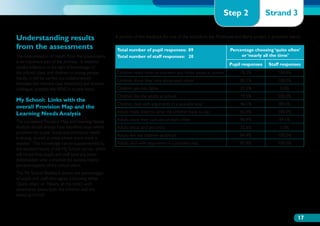
Understanding results                                 A portion of the feedback for one of the schools in the Porthcawl and Barry project is provided below:

from the assessments                                  Total number of pupil responses: 89                             Percentage choosing ‘quite often’
The interpretation of results from the assessments    Total number of staff responses: 20                                  or ‘nearly all the time’
is an important part of the process. It requires
                                                                                                                      Pupil responses     Staff responses
careful reflection in the light of knowledge of
the school, class, and children or young people.      Children really listen to teachers and other adults at school       78.2%                100.0%
Ideally, it will be carried out collaboratively
                                                      Children show they care about each other                            85.1%                100.0%
between the relevant class teacher(s) and another
colleague, possibly the SENCo or year head.           Children get into fights                                            23.2%                 0.0%
                                                      Children like the adults at school                                  79.5%                100.0%
My School: Links with the
                                                      Children deal with arguments in a peaceful way                      46.1%                89.5%
overall Provision Map and the
Learning Needs Analysis                               Adults really listen to what the children have to say               83.9%                100.0%

The completed Provision Map and Learning Needs        Adults show they care about each other                              90.9%                89.5%
Analysis should already have identified areas where   Adults shout and get cross                                          32.6%                 5.0%
provision for pupils’ social and emotional needs
                                                      Adults like the children at school                                  84.9%                100.0%
is strong, as well as areas where more work is
needed. This knowledge can be supplemented by         Adults deal with arguments in a peaceful way                        83.9%                100.0%
the detailed results of the My School survey, which
will reveal how pupils and staff (and any other
stakeholders who complete the questionnaire)
perceive aspects of the school ethos.
The My School feedback shows the percentages
of pupils and staff who agree (choosing either
‘Quite often’ or ‘Nearly all the time’) with
statements about both the children and the
adults at school.


                                                                                                                                                          17
Step 2                  Strand 3

My Class: Sociogram and peer reputation
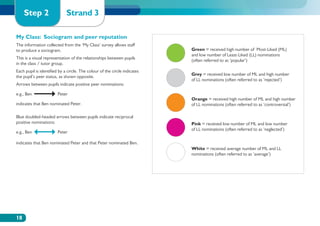
The information collected from the ‘My Class’ survey allows staff
to produce a sociogram.                                                    Green = received high number of Most-Liked (ML)
                                                                           and low number of Least-Liked (LL) nominations
This is a visual representation of the relationships between pupils
                                                                           (often referred to as ‘popular’)
in the class / tutor group.
Each pupil is identified by a circle. The colour of the circle indicates
                                                                           Grey = received low number of ML and high number
the pupil’s peer status, as shown opposite.
                                                                           of LL nominations (often referred to as ‘rejected’)
Arrows between pupils indicate positive peer nominations:

e.g., Ben               Peter
                                                                           Orange = received high number of ML and high number
indicates that Ben nominated Peter.                                        of LL nominations (often referred to as ‘controversial’)

Blue doubled-headed arrows between pupils indicate reciprocal
positive nominations:                                                      Pink = received low number of ML and low number
                                                                           of LL nominations (often referred to as ‘neglected’)
e.g., Ben               Peter

indicates that Ben nominated Peter and that Peter nominated Ben.
                                                                           White = received average number of ML and LL
                                                                           nominations (often referred to as ‘average’)


18
Step 2                 Strand 3

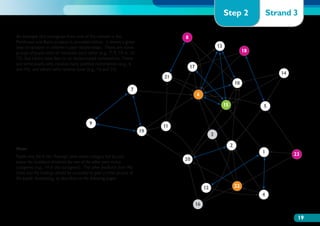
An example of a sociogram from one of the schools in the                          8
Porthcawl and Barry projects is provided below. It shows a great
deal of variation in children’s peer relationships. There are some                                       13
groups of pupils who all nominate each other (e.g., 7, 9, 19, 6, 10,                                                        18
13), but others have few or no reciprocated nominations. There
are some pupils who receive many positive nominations (e.g., 6
and 15), and others who receive none (e.g., 16 and 23).
                                                                                      17
                                                                                                                                        14
                                                                             21
                                                                                                                       10
                                                                   7
                                                                                           6

                                                                                                              15                 5


                                           9
                                                                             11
                                                                        19
                                                                                                     3

                                                                                                                   2
Note:
                                                                                                                                 1           23
Pupils may fall in the ‘Average’ peer status category but be just
below the statistical threshold for one of the other peer status
                                                                                  20
categories (e.g., 14 in this sociogram). The other feedback from My
Class and My Feelings should be consulted to gain a richer picture of
the pupils’ functioning, as described on the following pages.

                                                                                                12                     22
                                                                                                                                 4
                                                                                           16

                                                                                                                                              19
Step 2                  Strand 3

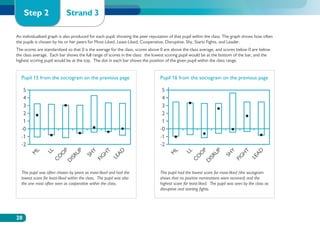
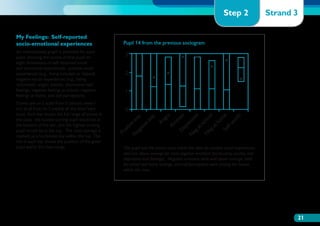
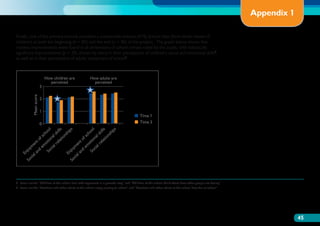
An individualised graph is also produced for each pupil, showing the peer reputation of that pupil within the class. The graph shows how often
the pupils is chosen by his or her peers for Most-Liked, Least-Liked, Cooperative, Disruptive, Shy, Starts Fights, and Leader.
The scores are standardised so that 0 is the average for the class, scores above 0 are above the class average, and scores below 0 are below
the class average. Each bar shows the full range of scores in the class: the lowest scoring pupil would be at the bottom of the bar, and the
highest scoring pupil would be at the top. The dot in each bar shows the position of the given pupil within the class range.


  Pupil 15 from the sociogram on the previous page                             Pupil 16 from the sociogram on the previous page

   5                                                                            5
   4                                                                            4
   3                                                                            3
   2                                                                            2
   1                                                                            1
  -0                                                                           -0
  -1                                                                           -1
  -2                                                                           -2
         L

                LL

                           P

                         UP


                                          Y

                                                  T

                                                          AD


                                                                                      L

                                                                                             LL

                                                                                                        P

                                                                                                      UP


                                                                                                                      Y

                                                                                                                               T

                                                                                                                                      AD
       M


                                                                                    M
                         O


                                                                                                      O
                                                 H


                                                                                                                              H
                                        SH


                                                                                                                    SH
                      ISR


                                                                                                   ISR
                                              FIG


                                                                                                                           FIG
                     CO


                                                                                                  CO
                                                       LE


                                                                                                                                    LE
                    D


                                                                                                 D
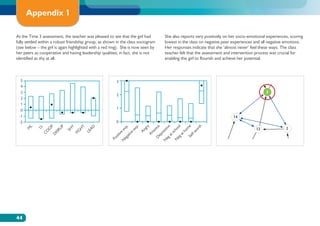
  This pupil was often chosen by peers as most-liked and had the               This pupil had the lowest score for most-liked (the sociogram
  lowest score for least-liked within the class. The pupil was also            shows that no positive nominations were received) and the
  the one most often seen as cooperative within the class.                     highest score for least-liked. The pupil was seen by the class as
                                                                               disruptive and starting fights.


20
Step 2                 Strand 3

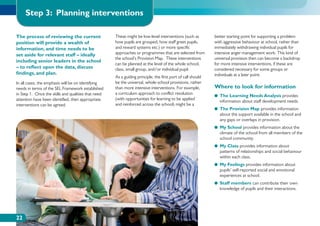
My Feelings: Self-reported
socio-emotional experiences                          Pupil 14 from the previous sociogram	
An individualised graph is provided for each
pupil, showing the scores of that pupil on            3
eight dimensions of self-reported social
and emotional experiences: positive social
experiences (e.g., being included or helped),         2
negative social experiences (e.g., being
victimised), anger, anxiety, depressive/sad
feelings, negative feelings at school, negative       1
feelings at home, and self-perceptions.
Scores are on a scale from 0 (almost never/
not at all true) to 3 (nearly all the time/very       0
true). Each bar shows the full range of scores in


                                                                        .

                                                                      p.

                                                                       y

                                                                      us

                                                                     ive

                                                                      ol

                                                                       e

                                                                      th
                                                        eg exp


                                                                    gr
the class: the lowest scoring pupil would be at


                                                                    m
                                                                   ho
                                                                   ex


                                                                   or
                                                                 xio

                                                                  ss
                                                                 An


                                                                 ho

                                                                 w
                                                                sc
                                                               re
the bottom of the bar, and the highest scoring
                                                              ive

                                                              ive


                                                             An


                                                             lf-
                                                             at
                                                           ep

                                                            at
                                                     sit

                                                           at


                                                          Se
pupil would be at the top. The class average is


                                                         eg
                                                         D

                                                       eg
                                                    Po


                                                      N
marked as a horizontal line within the bar. The
                                                      N


                                                      N
dot in each bar shows the position of the given
pupil within the class range.                        This pupil had the lowest score within the class for positive social experiences,
                                                     and was above average for most negative emotions (particularly anxiety and
                                                     depressive/sad feelings). Negative emotions were well above average, both
                                                     for school and home settings, and self-perceptions were among the lowest
                                                     within the class.


                                                                                                                                                21
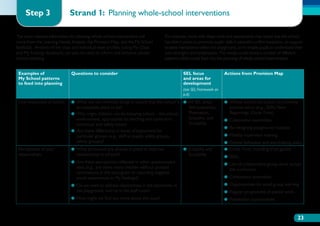
Step 3: Planning interventions

The process of reviewing the current                 These might be low-level interventions (such as         better starting point for supporting a problem
position will provide a wealth of                    how pupils are grouped, how staff greet pupils,         with aggressive behaviour at school, rather than
information, and time needs to be                    and reward systems etc.) or more specific               immediately withdrawing individual pupils for
set aside for relevant staff – ideally               approaches or programmes that are selected from         intensive anger management work. This kind of
                                                     the school’s Provision Map. These interventions         universal provision then can become a backdrop
including senior leaders in the school
                                                     can be planned at the level of the whole school,        for more intensive interventions, if these are
– to reflect upon the data, discuss                  class, small group, and/or individual pupil.            considered necessary for some groups or
findings, and plan.                                                                                          individuals at a later point.
                                                     As a guiding principle, the first port of call should
In all cases, the emphasis will be on identifying    be the universal, whole-school provisions, rather
needs in terms of the SEL Framework established      than more intensive interventions. For example,         Where to look for information
in Step 1. Once the skills and qualities that need   a curriculum approach to conflict resolution
                                                                                                                The Learning Needs Analysis provides
                                                                                                             ●● 
attention have been identified, then appropriate     (with opportunities for learning to be applied
                                                                                                                information about staff development needs.
interventions can be agreed.                         and reinforced across the school) might be a
                                                                                                             ●●  he Provision Map provides information
                                                                                                                T
                                                                                                                about the support available in the school and
                                                                                                                any gaps or overlaps in provision.
                                                                                                             ●●  y School provides information about the
                                                                                                                M
                                                                                                                climate of the school from all members of the
                                                                                                                school community.
                                                                                                             ●●  y Class provides information about
                                                                                                                M
                                                                                                                patterns of relationships and social behaviour
                                                                                                                within each class.
                                                                                                             ●●  y Feelings provides information about
                                                                                                                M
                                                                                                                pupils’ self-reported social and emotional
                                                                                                                experiences at school.
                                                                                                             ●●  taff members can contribute their own
                                                                                                                S
                                                                                                                knowledge of pupils and their interactions.


22
Step 3                   Strand 1: Planning whole-school interventions

The most relevant information for planning whole-school interventions will          For example, work with these tools and assessments may reveal that the school
come from the Learning Needs Analysis, the Provision Map, and the My School         has little in place to promote pupils’ skills in peaceful conflict resolution, to support
feedback. Analysis of the class and individual level profiles (using My Class       positive interactions within the playground, or to enable pupils to understand their
and My Feelings feedback) can also be used to inform and enhance whole-             own strengths and weaknesses. The results could reveal a number of different
school planning.                                                                    patterns which could feed into the planning of whole-school interventions.


 Examples of                  Questions to consider                                            SEL focus                  Actions from Provision Map
 My School patterns                                                                            and areas for
 to feed into planning                                                                         development
                                                                                               (see SEL Framework on
                                                                                               p.6)
 Low enjoyment of school      ●●  hat are we currently doing to ensure that the school is ●●  ll SEL areas –
                                 W                                                            A                           ●●  hole-school curriculum to promote
                                                                                                                             W
                                 an enjoyable place to be?                                         Self-awareness,           positive ethos (e.g., SEAL New
                              ●●  hy might children not be enjoying school – the school
                                 W                                                                 Motivation,               Beginnings, Circle Time)
                                 environment, approaches to teaching and curriculum,               Empathy, and           ●● Celebration assemblies
                                 behaviour and safety issues?                                      Sociability
                                                                                                                          ●● Re-designing playground routines
                              ●●  re there differences in levels of enjoyment for
                                 A
                                 particular groups (e.g., staff or pupils, ability groups,                                ●● Midday supervisor training
                                 ethnic groups)?                                                                          ●●  eview behaviour and anti-bullying policy
                                                                                                                             R
 Perceptions of poor          ●●  hat provisions are already in place to improve
                                 W                                                             ●●  mpathy and
                                                                                                  E                       ●● Circle Time, including trust games
 relationships                    relationships in schools?                                        Sociability            ●● SEAL
                              ●●  re these perceptions reflected in other questionnaire
                                 A                                                                                        ●●  se of collaborative group work across
                                                                                                                             U
                                  data (e.g., are there many children without positive                                       the curriculum
                                  nominations in the sociogram or reporting negative
                                  social experiences in My Feelings)?                                                     ●● Celebration assemblies

                              ●●  o we need to address relationships in the classroom, in
                                 D                                                                                        ●● Opportunities for small group learning
                                  the playground, and/or in the staff room?                                               ●● Regular programme of paired work
                              ●● How might we find out more about this issue?                                             ●● Residential opportunities


                                                                                                                                                                         23
Step 3                Strand 1

Examples of           Questions to consider                                                     SEL focus               Actions from Provision Map
My School patterns                                                                              and areas for
to feed into planning                                                                           development
                                                                                                (see SEL Framework on
                                                                                                p.6)
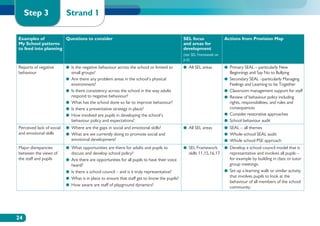
Reports of negative        ●● s the negative behaviour across the school or limited to
                              I                                                                 ●● All SEL areas        ●●  rimary SEAL – particularly New
                                                                                                                           P
behaviour                     small groups?                                                                                Beginnings and Say No to Bullying
                           ●●  re there any problem areas in the school’s physical
                              A                                                                                         ●●  econdary SEAL –particularly Managing
                                                                                                                           S
                              environment?                                                                                 Feelings and Learning to be Together
                           ●● s there consistency across the school in the way adults
                              I                                                                                         ●●  lassroom management support for staff
                                                                                                                           C
                              respond to negative behaviour?                                                            ●●  eview of behaviour policy including
                                                                                                                           R
                           ●●  hat has the school done so far to improve behaviour?
                              W                                                                                            rights, responsibilities, and rules and
                           ●● Is there a preventative strategy in place?                                                   consequences
                           ●●  ow involved are pupils in developing the school’s
                              H                                                                                         ●● Consider restorative approaches
                              behaviour policy and expectations?                                                        ●● School behaviour audit
Perceived lack of social   ●● Where are the gaps in social and emotional skills?                ●●  ll SEL areas
                                                                                                   A                    ●● SEAL – all themes
and emotional skills       ●●  hat are we currently doing to promote social and
                              W                                                                                         ●● Whole-school SEAL audit
                              emotional development?                                                                    ●● Whole school PSE approach
Major disrepancies         ●●  hat opportunities are there for adults and pupils to
                              W                                                                 ●●  EL Framework
                                                                                                   S                    ●●  evelop a school council model that is
                                                                                                                           D
between the views of          discuss and develop school policy?                                   skills 11,15,16,17      representative and involves all pupils –
the staff and pupils       ●●  re there are opportunities for all pupils to have their voice
                              A                                                                                            for example by building in class or tutor
                              heard?                                                                                       group meetings.
                           ●● s there a school council – and is it truly representative?
                              I                                                                                         ●●  et up a learning walk or similar activity
                                                                                                                           S
                           ●●  hat is in place to ensure that staff get to know the pupils?
                              W                                                                                            that involves pupils to look at the
                                                                                                                           behaviour of all members of the school
                           ●● How aware are staff of playground dynamics?
                                                                                                                           community.


24
Step 3                  Strand 2: Planning class interventions

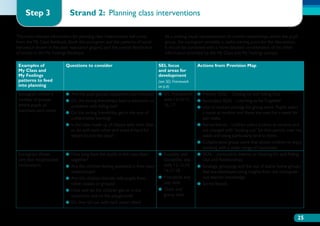
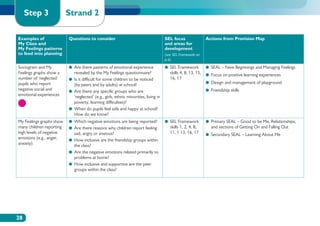
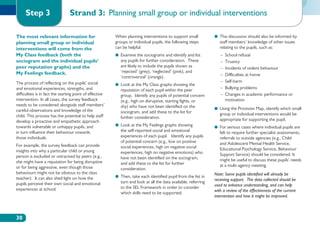
The most relevant information for planning class interventions will come            As a striking visual representation of current relationships within the pupil
from the My Class feedback (both the sociogram and the patterns of social           group, the sociogram provides a useful starting point for the discussions.
behaviour shown in the peer reputation graphs) and the overall distribution         It should be combined with a more detailed consideration of the other
of scores in the My Feelings feedback.                                              information provided by the My Class and My Feelings surveys.

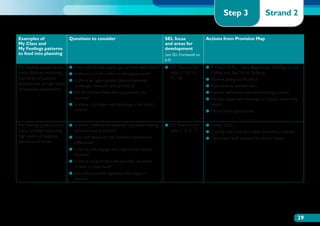
 Examples of               Questions to consider                                SEL focus              Actions from Provision Map
 My Class and                                                                   and areas for
 My Feelings                                                                    development
 patterns to feed                                                               (see SEL Framework
 into planning                                                                  on p.6)
 S
  ociogram shows a        ●●  re the pupil groups supportive and inclusive? ●●  EL Framework
                              A                                                  S                     ●●  rimary SEAL – Getting on and Falling Out
                                                                                                          P
 number of groups          ●●  o the strong friendships lead to exclusion or
                              D                                                     skills 13,14,15,   ●●  econdary SEAL – Learning to be Together
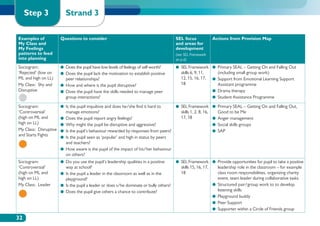
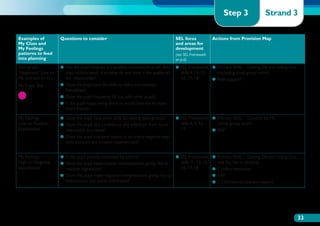
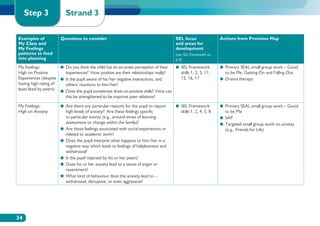
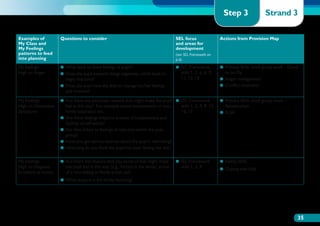
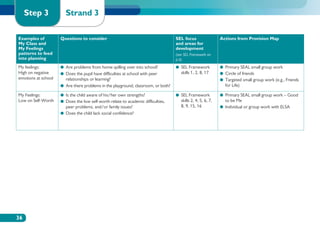
                                                                                                          S
 where pupils all             problems with falling out?                            16, 17             ●●  se of random pairings for group work. Pupils select
                                                                                                          U
 nominate each other       ●●  o the strong friendships get in the way of
                              D                                                                           a name at random and these are used for a week for
                              collaborative learning?                                                     pair tasks.
                           ●● s the class made up of cliques who have little
                              I                                                                        ●●  ecret friends - children select a name at random and
                                                                                                          S
                              to do with each other and make it hard for                                  are charged with ‘looking out’ for that person over the
                              others to join the class?                                                   week and being particularly kind to them.
                                                                                                       ●●  ollaborative group work that allows children to enjoy
                                                                                                          C
                                                                                                          working with a wider range of classmates
 Sociogram shows           ●●  ow long have the pupils in this class been
                              H                                                 ●●  mpathy and
                                                                                   E                   ●●  EAL – particularly themes on Getting On and Falling
                                                                                                          S
 very few reciprocated        together?                                            Sociability, esp.      Out and Relationships
 nominations               ●●  re the children feeling unsettled in their peer
                              A                                                    skills 12,13,14,    ●●  trategic groupings and the use of stable home groups
                                                                                                          S
                              relationships?                                       16,17,18               that are developed using insights from the sociogram
                           ●●  re the children friendly with pupils from
                              A                                                 ●●  riendship and
                                                                                   F                      and teacher knowledge.
                              other classes or groups?                             play skills         ●● Secret friends
                           ●●  ow well do the children get on in the
                              H                                                 ●●  eam and
                                                                                   T
                              classroom and on the playground?                     group skills
                           ●●  o they fall out with each other often?
                              D


                                                                                                                                                                25
Step 3              Strand 2

Examples of              Questions to consider                              SEL focus             Actions from Provision Map
My Class and                                                                and areas for
My Feelings                                                                 development
patterns to feed                                                            (see SEL Framework
into planning                                                               on p.6)
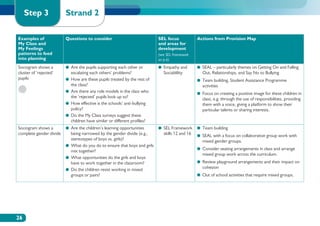
Sociogram shows a        ●●  re the pupils supporting each other or
                            A                                               ●●  mpathy and
                                                                               E                  ●●  EAL – particularly themes on Getting On and Falling
                                                                                                     S
cluster of ‘rejected’       escalating each others’ problems?                  Sociablility          Out, Relationships, and Say No to Bullying
pupils                   ●●  ow are these pupils treated by the rest of
                            H                                                                     ●●  eam building, Student Assistance Programme
                                                                                                     T
                            the class?                                                               activities
                         ●●  re there any role models in the class who
                            A                                                                     ●●  ocus on creating a positive image for these children in
                                                                                                     F
                            the ‘rejected’ pupils look up to?                                        class, e.g. through the use of responsibilities, providing
                         ●●  ow effective is the schools’ anti-bullying
                            H                                                                        them with a voice, giving a platform to show their
                            policy?                                                                  particular talents or sharing interests.
                         ●●  o the My Class surveys suggest these
                            D
                            children have similar or different profiles?
Sociogram shows a        ●●  re the children’s learning opportunities
                            A                                               ●●  EL Framework
                                                                               S                  ●● Team building
complete gender divide      being narrowed by the gender divide (e.g.,         skills 12 and 16   ●●  EAL with a focus on collaborative group work with
                                                                                                     S
                            stereotypes of boys vs. girls)?                                          mixed gender groups.
                         ●●  hat do you do to ensure that boys and girls
                            W
                                                                                                  ●●  onsider seating arrangements in class and arrange
                                                                                                     C
                            mix together?
                                                                                                     mixed group work across the curriculum.
                         ●●  hat opportunities do the girls and boys
                            W
                            have to work together in the classroom?                               ●●  eview playground arrangements and their impact on
                                                                                                     R
                         ●●  o the children resist working in mixed
                            D                                                                        cohesion
                            groups or pairs?                                                      ●●  ut of school activities that require mixed groups.
                                                                                                     O


26
Step 3                  Strand 2

Examples of                Questions to consider                                SEL focus and areas for           Actions from Provision Map
My Class and                                                                    development
My Feelings                                                                     (see SEL Framework on p.6)
patterns to feed
into planning
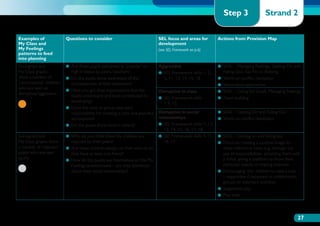
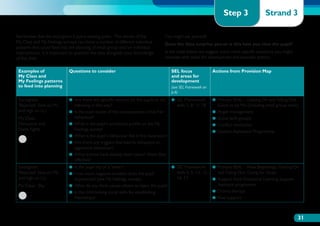
Sociogram and              ●●  re these pupils perceived as ‘popular’ or
                              A                                                 Aggressive                        ●●  EAL – Managing Feelings, Getting On and
                                                                                                                     S
My Class graphs               high in status by peers/teachers?                 ●●  EL Framework skills 1, 2,
                                                                                   S                                 Falling Out, Say No to Bullying
show a number of           ●●  o the pupils show awareness of the
                              D                                                    3, 11, 12, 14, 16, 18          ●●  ork on conflict resolution
                                                                                                                     W
‘controversial’ children      consequences of their behaviour?                                                    ●● Restorative approaches
who are seen as            ●●  ave you got clear expectations that the
                              H
disruptive/aggressive                                                           Disruptive in class               ●● SEAL – Going for Goals, Managing Feelings
                              pupils understand and have contributed to         ●●  EL Framework skills
                                                                                   S                              ●● Team building
                              developing?                                          1-9, 15
                           ●●  oes the class or group take joint
                              D
                              responsibility for creating a calm and peaceful   Disruptive in social              ●● SEAL – Getting On and Falling Out
                              atmosphere?                                       relationships                     ●● Work on conflict resolution
                           ●●  o the pupils show trust in others?
                              D                                                 ●●  EL Framework skills 1, 12,
                                                                                   S
                                                                                   13, 14, 15, 16, 17, 18
Sociogram and              ●●  hy do you think these shy children are
                              W                                                 ●●  EL Framework skills 4, 15,
                                                                                   S                              ●● SEAL – Getting on and falling out
My Class graphs show          rejected by their peers?                             16, 17                         ●●  ocus on creating a positive image for
                                                                                                                     F
a number of ‘rejected’     ●●  re these children always on their own or do
                              A                                                                                      these children in class, e.g. through the
pupils who are seen           they have at least one friend?                                                         use of responsibilities, providing them with
as shy                     ●●  ow do the pupils see themselves on the My
                              H                                                                                      a voice, giving a platform to show their
                              Feelings questionnaire – are they distressed                                           particular talents or sharing interests
                              about their social relationships?                                                   ●●  ncouraging ‘shy’ children to take a role
                                                                                                                     E
                                                                                                                     – supportive if necessary in collaborative
                                                                                                                     groups or voluntary activities
                                                                                                                  ●●  upported play
                                                                                                                     S
                                                                                                                  ●●  lay skills
                                                                                                                     P


                                                                                                                                                               27
Step 3               Strand 2

Examples of               Questions to consider                                       SEL focus                 Actions from Provision Map
My Class and                                                                          and areas for
My Feelings patterns                                                                  development
to feed into planning                                                                 (see SEL Framework on
                                                                                      p.6)
Sociogram and My          ●●  re there patterns of emotional experience
                             A                                                        ●●  EL Framework
                                                                                         S                      ●● SEAL – New Beginnings and Managing Feelings
Feelings graphs show a       revealed by the My Feelings questionnaire?                  skills 4, 8, 13, 15,   ●● Focus on positive learning experiences
number of ‘neglected’     ●● s it difficult for some children to be noticed
                             I                                                           16, 17
pupils who report                                                                                               ●● Design and management of playground
                             (by peers and by adults) at school?
negative social and       ●●  re there any specific groups who are
                             A                                                                                  ●● Friendship skills
emotional experiences        ‘neglected’ (e.g., girls, ethnic minorities, living in
                             poverty, learning difficulties)?
                          ●●  hen do pupils feel safe and happy at school?
                             W
                             How do we know?
My Feelings graphs show   ●●  hich negative emotions are being reported?
                             W                                                        ●●  EL Framework
                                                                                         S                      ●●  rimary SEAL – Good to be Me, Relationships,
                                                                                                                   P
many children reporting   ●●  re there reasons why children report feeling
                             A                                                           skills 1, 2, 4, 8,        and sections of Getting On and Falling Out
high levels of negative      sad, angry or anxious?                                      11, 1 13, 16, 17       ●●  econdary SEAL – Learning About Me
                                                                                                                   S
emotions (e.g., anger,    ●●  ow inclusive are the friendship groups within
                             H
anxiety)                     the class?
                          ●●  re the negative emotions related primarily to
                             A
                             problems at home?
                          ●●  ow inclusive and supportive are the peer
                             H
                             groups within the class?


28
Step 3                  Strand 2

Examples of                Questions to consider                                SEL focus               Actions from Provision Map
My Class and                                                                    and areas for
My Feelings patterns                                                            development
to feed into planning                                                           (see SEL Framework on
                                                                                p.6)
My Feelings graphs show ●●  ow well do the pupils get on with each other?
                              H                                                 ●●  EL Framework
                                                                                   S                    ●●  rimary SEAL – New Beginnings, Getting on and
                                                                                                           P
many children reporting    ●● s there a lot of conflict in the playground?
                              I                                                    skills 4, 10, 16,       Falling out, Say No to Bullying
low levels of positive     ●● s there an appropriate balance between
                              I                                                    17, 18               ●●  eview playground policy
                                                                                                           R
experiences or high levels    challenge, rewards and sanctions?                                         ●●  lay leaders, buddies etc.
                                                                                                           P
of negative experiences
                           ●●  o all children have the opportunity for
                              D                                                                         ●●  eview behaviour and anti-bullying policies
                                                                                                           R
                              success?                                                                  ●●  idday supervisor training to include rewarding
                                                                                                           M
                           ●● s there a problem with bullying in the class/
                              I                                                                            pupils
                              school?                                                                   ●●  estorative approaches
                                                                                                           R


My Feelings graphs show    ●● s there a difference between reported feelings
                              I                                                 ●●  EL Framework
                                                                                   S                    ●●  amily SEAL
                                                                                                           F
many children reporting       at home and at school?                               skills 1, 2, 8, 17   ●●  oping with Kids and other parenting courses
                                                                                                           C
high levels of negative    ●●  re staff aware of the children’s emotional
                              A                                                                         ●●  edicated staff support for family liaison
                                                                                                           D
emotions at home              difficulties?
                           ●●  ow do we engage and support our pupils’
                              H
                              families?
                           ●● s there support that we can offer at whole
                              I
                              school or class level?
                           ●●  re there outside agencies that support
                              A
                              families?


                                                                                                                                                              29
Step 3                      Strand 3: Planning small group or individual interventions

The most relevant information for                         When planning interventions to support small            ●●  his discussion should also be informed by
                                                                                                                     T
planning small group or individual                        groups or individual pupils, the following steps           staff members’ knowledge of other issues
interventions will come from the                          can be helpful:                                            relating to the pupils, such as:
My Class feedback (both the                               ●●  xamine the sociograms and identify and list
                                                             E                                                    	 School refusal
                                                                                                                    –	
sociogram and the individual pupils’                         any pupils for further consideration. These          	 Truancy
                                                                                                                    –	
peer reputation graphs) and the                              are likely to include the pupils shown as            	 Incidents of violent behaviour
                                                                                                                    –	
My Feelings feedback.                                        ‘rejected’ (grey), ‘neglected’ (pink), and
                                                             ‘controversial’ (orange).                            	 Difficulties at home
                                                                                                                    –	
The process of reflecting on the pupils’ social                                                                   	 Self-harm
                                                                                                                    –	
                                                          ●●  ook at the My Class graphs showing the
                                                             L
and emotional experiences, strengths, and                    reputation of each pupil within the peer             	 Bullying problems
                                                                                                                    –	
difficulties is in fact the starting point of effective      group. Identify any pupils of potential concern      	 Changes in academic performance or
                                                                                                                    –	
intervention. In all cases, the survey feedback              (e.g., high on disruptive, starting fights, or            motivation
needs to be considered alongside staff members’              shy) who have not been identified on the
careful observations and knowledge of the                                                                         ●●  sing the Provision Map, identify which small-
                                                                                                                     U
                                                             sociogram, and add these to the list for                group or individual interventions would be
child. This process has the potential to help staff          further consideration.
develop a proactive and empathetic approach                                                                          appropriate for supporting the pupil.
towards vulnerable or unhappy pupils, and                 ●●  ook at the My Feelings graphs showing
                                                             L                                                    ●●  or serious cases where individual pupils are
                                                                                                                     F
in turn influence their behaviour towards                    the self-reported social and emotional                  felt to require further specialist assessments,
those individuals.                                           experiences of each pupil. Identify any pupils          referrals to outside agencies (e.g., Child
                                                             of potential concern (e.g., low on positive             and Adolescent Mental Health Service,
For example, the survey feedback can provide                 social experiences, high on negative social
insights into why a particular child or young                                                                        Educational Psychology Service, Behaviour
                                                             experiences, high on negative emotions) who             Support Service) should be considered. It
person is excluded or ostracised by peers (e.g.,             have not been identified on the sociogram,
she might have a reputation for being disruptive                                                                     might be useful to discuss these pupils’ needs
                                                             and add these to the list for further                   at a multi-agency meeting.
or for being aggressive, even though those                   consideration.
behaviours might not be obvious to the class                                                                      Note: Some pupils identified will already be
teacher). It can also shed light on how the               ●●  hen, take each identified pupil from the list in
                                                             T
                                                                                                                  receiving support. The data collected should be
pupils perceive their own social and emotional               turn and look at all the data available, referring
                                                                                                                  used to enhance understanding, and can help
experiences at school.                                       to the SEL Framework in order to consider
                                                                                                                  with a review of the effectiveness of the current
                                                             which skills need to be supported.
                                                                                                                  intervention and how it might be improved.


30
Step 3                Strand 3

Remember that the sociogram is just a starting point. The results of the               You might ask yourself:
My Class and My Feelings surveys can show a number of different individual             Does the data surprise you or is this how you view the pupil?
patterns that could feed into the planning of small-group and/or individual
interventions. It is important to question the data alongside your knowledge           In the table below we suggest some more specific questions you might
of the child.                                                                          consider with areas for development and example actions.


 Examples of                 Questions to consider                                        SEL focus                 Actions from Provision Map
 My Class and                                                                             and areas for
 My Feelings patterns                                                                     development
 to feed into planning                                                                    (see SEL Framework on
                                                                                          p.6)
 Sociogram:                  ●●  re there any specific reasons for the pupils to be
                                A                                                         ●●  EL Framework
                                                                                             S                      ●●  rimary SEAL – Getting On and Falling Out,
                                                                                                                       P
 ‘Rejected’ (low on ML          behaving in this way?                                        skills 1, 8, 11-18        Good to be Me (including small group work)
 and high on LL)             ●● s the pupil aware of the consequences of his/her
                                I                                                                                   ●● Anger management
 My Class:                      behaviour?                                                                          ●●  ocial skills groups
                                                                                                                       S
 Disruptive and              ●●  hat is the pupil’s emotional profile on the My
                                W                                                                                   ●●  onflict resolution
                                                                                                                       C
 Starts Fights                  Feelings survey?                                                                    ●●  tudent Assistance Programme
                                                                                                                       S
                             ●●  hat is the pupil’s behaviour like in the classroom?
                                W
                             ●●  re there any triggers that lead to disruptive or
                                A
                                aggressive behaviour?
                             ●●  hat actions have already been taken? Were they
                                W
                                effective?
 Sociogram:                  ●● s the pupil shy or a ‘loner’?
                                I                                                         ●●  EL Framework
                                                                                             S                      ●●  rimary SEAL – New Beginnings, Getting On
                                                                                                                       P
 ‘Rejected’ (low on ML       ●●  ow much negative emotion does the pupil
                                H                                                            skills 4, 5, 13, 15,      and Falling Out, Going for Goals
 and high on LL)                experience? (see My Feelings survey)                         16, 17                 ●●  upport from Emotional Learning Support
                                                                                                                       S
 My Class: Shy               ●●  hat do you think causes others to reject this pupil?
                                W                                                                                      Assistant programme
                             ●● s the child lacking social skills for establishing
                                I                                                                                   ●●  rama therapy
                                                                                                                       D
                                friendships?                                                                        ●●  eer support
                                                                                                                       P


                                                                                                                                                                     31
Step 3               Strand 3

Examples of            Questions to consider                                             SEL focus               Actions from Provision Map
My Class and                                                                             and areas for
My Feelings                                                                              development
patterns to feed                                                                         (see SEL Framework
into planning                                                                            on p.6)
Sociogram:             ●●  oes the pupil have low levels of feelings of self-worth?
                          D                                                              ●●  EL Framework ●●  rimary SEAL – Getting On and Falling Out
                                                                                            S                 P
‘Rejected’ (low on     ●●  oes the pupil lack the motivation to establish positive
                          D                                                                 skills 6, 9, 11,        (including small group work)
ML and high on LL)        peer relationships?                                               12, 15, 16, 17,      ●●  upport from Emotional Learning Support
                                                                                                                    S
My Class: Shy and      ●●  ow and where is the pupil disruptive?
                          H                                                                 18                      Assistant programme
Disruptive             ●●  oes the pupil have the skills needed to manage peer
                          D                                                                                      ●●  rama therapy
                                                                                                                    D
                          group interactions?                                                                    ●● Student Assistance Programme

Sociogram:             ●● s the pupil impulsive and does he/she find it hard to
                          I                                                              ●●  EL Framework ●●  rimary SEAL – Getting On and Falling Out,
                                                                                            S                 P
‘Controversial’           manage emotions?                                                  skills 1, 2, 8, 16,    Good to be Me
(high on ML and        ●●  oes the pupil report angry feelings?
                          D                                                                 17, 18              ●●  nger management
                                                                                                                   A
high on LL)            ●●  hy might the pupil be disruptive and aggressive?
                          W                                                                                     ●●  ocial skills groups
                                                                                                                   S
My Class: Disruptive   ●● s the pupil’s behaviour rewarded by responses from peers?
                          I                                                                                     ●● SAP
and Starts Fights
                       ●● s the pupil seen as ‘popular’ and high in status by peers
                          I
                          and teachers?
                       ●●  ow aware is the pupil of the impact of his/her behaviour
                          H
                          on others?
Sociogram:             ●●  o you use the pupil’s leadership qualities in a positive
                          D                                                              ●●  EL Framework ●●  rovide opportunities for pupil to take a positive
                                                                                            S                 P
‘Controversial’           way at school?                                                    skills 15, 16, 17,      leadership role in the classroom – for example
(high on ML and        ●● s the pupil a leader in the classroom as well as in the
                          I                                                                 18                      class room responsibilities, organizing charity
high on LL)               playground?                                                                               event, team leader during collaborative tasks
My Class: Leader       ●● s the pupil a leader or does s/he dominate or bully others?
                          I                                                                                      ●●  tructured pair/group work to to develop
                                                                                                                    S
                       ●●  oes the pupil give others a chance to contribute?
                          D                                                                                         listening skills
                                                                                                                 ●● Playground buddy
                                                                                                                 ●● Peer Support
                                                                                                                 ●●  upporter within a Circle of Friends group
                                                                                                                    S

32
Step 3                Strand 3

Examples of           Questions to consider                                             SEL focus              Actions from Provision Map
My Class and                                                                            and areas for
My Feelings                                                                             development
patterns to feed                                                                        (see SEL Framework
into planning                                                                           on p.6)
Sociogram:            ●●  as the pupil received any positive nominations at all? Are
                         H                                                              ●●  EL Framework ●●  rimary SEAL – Getting On and Falling Out
                                                                                           S                 P
‘Neglected’ (low on      they reciprocated? If so what do you think is the quality of      skills 4, 13, 15,      (including small group work)
ML and low on LL)        the relationships?                                                16, 17, 18          ●● Peer support
My Class: Shy         ●●  oes the pupil have the skills to make and maintain
                         D
                         friendships?
                      ●●  oes the pupil frequently fall out with other pupils?
                         D
                      ●● s the pupil happy being alone or would they like to make
                         I
                         more friends?

My Feelings:          ●● Does the pupil have poor skills for joining peer groups?       ●●  EL Framework ●●  rimary SEAL – Good to be Me
                                                                                           S                 P
Low on Positive       ●●  oes the pupil lack confidence and withdraw from social
                         D                                                                 skills 4, 5, 16,       (small group work)
Experiences              interaction as a result?                                          17                  ●● SAP
                      ●●  oes the pupil interpret events in an overly negative way
                         D
                         (and discount any positive experiences)?


My Feelings:          ●● Is the pupil actively victimised by others?                    ●●  EL Framework ●●  rimary SEAL – Getting On and Falling Out,
                                                                                           S                 P
High on Negative      ●●  oes the pupil make hostile interpretations giving rise to
                         D                                                                 skills 11, 12, 13,    and Say No to Bullying
experiences              reactive aggression?                                              16, 17, 18         ●●  onflict resolution
                                                                                                                 C
                      ●●  oes the pupil make negative interpretations giving rise to
                         D                                                                                    ●●  AP
                                                                                                                 S
                         helplessness and social withdrawal?                                                  ●● 1:1 Emotional Literacy support


                                                                                                                                                           33
Step 3               Strand 3

Examples of            Questions to consider                                           SEL focus                 Actions from Provision Map
My Class and                                                                           and areas for
My Feelings                                                                            development
patterns to feed                                                                       (see SEL Framework on
into planning                                                                          p.6)
My Feelings:          ●●  o you think the child has an accurate perception of their
                         D                                                           ●●  EL Framework
                                                                                        S                        ●●  rimary SEAL small group work – Good
                                                                                                                    P
High on Positive         experiences? How positive are their relationships really?      skills 1, 2, 5, 11,         to be Me, Getting On and Falling Out
Experiences (despite ●● s the pupil aware of his/her negative interactions, and
                         I                                                              12, 16, 17               ●●  rama therapy
                                                                                                                    D
having high rating of    others’ reactions to him/her?
least liked by peers) ●●  oes the pupil sometimes draw on positive skills? How can
                         D
                         this be strengthened to be improve peer relations?

My Feelings:           ●●  re there any particular reasons for the pupil to report
                          A                                                            ●●  EL Framework
                                                                                          S                      ●●  rimary SEAL small group work – Good
                                                                                                                    P
High on Anxiety           high levels of anxiety? Are these feelings specific             skills 1, 2, 4, 5, 8      to be Me
                          to particular events (e.g., around times of learning                                   ●●  AP
                                                                                                                    S
                          assessment or change within the family)?                                               ●●  argeted small group work on anxiety
                                                                                                                    T
                       ●●  re these feelings associated with social experiences or
                          A                                                                                         (e.g., Friends for Life)
                          related to academic work?
                       ●●  oes the pupil interpret what happens to him/her in a
                          D
                          negative way which leads to feelings of helplessness and
                          withdrawal?
                       ●● s the pupil rejected by his or her peers?
                          I
                       ●●  oes his or her anxiety lead to a sense of anger or
                          D
                          resentment?
                       ●●  hat kind of behaviour does the anxiety lead to –
                          W
                          withdrawal, disruptive, or even aggressive?


34
Step 3                  Strand 3

Examples of          Questions to consider                                                  SEL focus                   Actions from Provision Map
My Class and                                                                                and areas for
My Feelings                                                                                 development
patterns to feed                                                                            (see SEL Framework on
into planning                                                                               p.6)
My feelings:         ●● What leads to these feelings of anger?                              ●●  EL Framework
                                                                                               S                        ●●  rimary SEAL small group work – Good
                                                                                                                           P
High on Anger        ●●  oes the pupil interpret things negatively, which leads to
                        D                                                                      skills 1, 2, 6, 8, 9,       to be Me
                        angry reactions?                                                       11, 12, 18               ●●  nger management
                                                                                                                           A
                     ●●  oes the pupil have the skills to manage his/her feelings
                        D                                                                                               ●●  onflict resolution
                                                                                                                           C
                        and impulses?

My Feelings:         ●●  re there any particular reasons that might make the pupil ●●  EL Framework
                        A                                                              S                                ●●  rimary SEAL small group work –
                                                                                                                           P
High on Depressive      feel in this way? For example recent bereavement or loss,              skills 1, 2, 4, 8, 15,      Relationships
Symptoms                family separation etc.                                                 16, 17                   ●●  LSA
                                                                                                                           E
                     ●●  re these feelings linked to a sense of hopelessness and
                        A
                        feelings of self-worth?
                     ●●  re they linked to feelings of rejection within the peer
                        A
                        group?
                     ●●  ave you got serious worries about the pupil’s well-being?
                        H
                     ●●  ow long do you think the pupil has been feeling like this?
                        H

My Feelings:         ●●  re there any reasons that you know of that might make
                        A                                                                   ●●  EL Framework
                                                                                               S                        ●● Family SEAL
High on Negative        the pupil feel in this way (e.g., friction in the family, arrival      skills 1, 2, 8           ●● Coping with Kids
Emotions at Home        of a new sibling or family break up)?
                     ●●  hat support is the family receiving?
                        W


                                                                                                                                                               35
Step 3             Strand 3

Examples of          Questions to consider                                           SEL focus                  Actions from Provision Map
My Class and                                                                         and areas for
My Feelings                                                                          development
patterns to feed                                                                     (see SEL Framework on
into planning                                                                        p.6)
My feelings:         ●●  re problems from home spilling over into school?
                        A                                                            ●●  EL Framework
                                                                                        S                       ●● Primary SEAL small group work
High on negative     ●●  oes the pupil have difficulties at school with peer
                        D                                                               skills 1, 2, 8, 17      ●● Circle of friends
emotions at school      relationships or learning?                                                              ●●  argeted small group work (e.g., Friends
                                                                                                                   T
                     ●●  re there problems in the playground, classroom, or both?
                        A                                                                                          for Life)

My Feelings:         ●● Is the child aware of his/her own strengths?                 ●●  EL Framework
                                                                                        S                       ●●  rimary SEAL small group work – Good
                                                                                                                   P
Low on Self-Worth    ●●  oes the low self-worth relate to academic difficulties,
                        D                                                               skills 2, 4, 5, 6, 7,      to be Me
                        peer problems, and/or family issues?                            8, 9, 15, 16            ●● ndividual or group work with ELSA
                                                                                                                   I
                     ●●  oes the child lack social confidence?
                        D


36
Step 4: Implementation of actions planned

The next step of the process is to implement the
interventions that have been planned. Records should
be kept of which staff and pupils are involved, what they
are doing, how often and for how long they are engaged
in the activities, and why they are taking part in this
work. Any problems that arise should be recorded, as
should any clear indicators of positive change during the
intervention.
Follow-up assessments at the end of the year should
be used to monitor progress and plan actions for the
following year – these may include continuing with
the current interventions, adapting or modifying the
interventions, or putting in place new provisions. The
Learning Needs Analysis and Provision Map should also
be revisited on an annual basis, as part of the school
review process, to ensure that the most appropriate
resources are in place and being deployed to best meet
the needs of the children and young people.


                                                            37
Appendix 1:
     Findings from the NBAR project in Bridgend and the Vale of Glamorgan

Sample                                                 ●●  he effectiveness of different interventions at
                                                          T                                                  A final timepoint of data collection took place for
                                                          whole school, class, small group and individual    the primary school pupils (with data for 318 of
The NBAR project was carried out in two
                                                          levels, for children and young people              the original 368 pupils) approximately 7 months
clusters of schools, including nine primary
                                                          presenting with a variety of different needs.      after the second timepoint.
schools and one secondary school.
                                                          This was achieved by considering changes in        In addition, anonymous My School survey data
●●  he Barry Cluster – volunteer schools were
   T                                                      pupils’ social and emotional functioning over      from the staff (n = 180) and pupils (n = 870)
   requested and all those who wished to be               the course of the project.                         from the primary schools were collected at the
   involved and were willing to attend an initial
                                                       The three assessment tools used within the            first timepoint to inform the planning of cross-
   development day were included in the pilot.
                                                       Bridgend and Vale of Glamorgan project (My            cluster, whole-school strategies.
●●  he Portcawl Cluster – all schools in the
   T                                                   School, My Class, and My Feelings) were selected
   cluster including the local comprehensive           because they matched the aims of the project,         Intervention
   were involved in the pilot.                         and were designed to identify key issues (e.g.,
                                                                                                             The interventions took place between the
Each school nominated one or more classes to           social relationships, behavioural reputation,
                                                                                                             timepoints, at several levels:
be involved in the process of assessment and           self-perceptions, emotional experiences, and
tracking of specific interventions. All children and   school climate) that link with the SEL Framework      Staff development:
young people in these classes were involved in         developed by the participating schools. The pupil
                                                       survey tools currently being used are unique in       ●●  luster development days to enable schools to
                                                                                                                c
the pilot project at some level. However, it was
                                                       that they provide at least two perspectives on the       share experiences and, with external support
also recognised from the outset that the project
                                                       strengths and difficulties of children and young         and facilitation, develop a strategic framework
could and should relate to whole-school issues.
                                                       people – self-report and peer-report – to add to         for social and emotional learning;
Design                                                 school staff’s existing knowledge.                    ●●  range of cluster training delivered to support
                                                                                                                a
                                                       Individual pupil data from the My Class and My           staff identified through the Learning Needs
The project was designed to evaluate:
                                                       Feelings online surveys were carried out with 556        Analysis;
●●  he impact of the whole project on the social
   T                                                   pupils (368 primary pupils aged 8-10 years and        ●● ormal sessions such as the introduction of
                                                                                                                f
   and emotional experience of children and            188 secondary pupils aged 11-12 years). Follow-          SEAL to the class teachers of target classes in
   young people, with attention to the social and      up data was collected at a second timepoint for          the Porthcawl cluster;
   emotional climate of the school.                    525 of those pupils, approximately 6 months
                                                       later for the primary school pupils, and 9 months
                                                       later for the secondary comprehensive pupils.


38
Appendix 1


●●  he process of feedback around the
   t                                              ●●  trategies for grouping pupils and for general
                                                     S
  assessments, which provides valuable insights      classroom management were informed by
  into the pupils’ social and emotional profile      the results of the assessments, and were
  and encourages reflective discussion about         supported by the NBAR project team
  the social and emotional dynamics at school     ●●  dditional whole-class interventions included
                                                     A
                                                     team-building activities and structured Circle
W
 hole school and whole class                        Time opportunities
interventions, based around the
implementation of SEAL:                           S
                                                   mall group and individual interventions
●● nformation from the surveys and provision
   I                                              have also been targeted in the schools
  mapping tool identified three key areas for     in the light of the data from the
  development in the clusters:	                   assessments. These included a variety of
	  eveloping a sense of belonging
  – D                                             targeted strategies, including:
	  onflict resolution
  – C                                             ●● Circle of Friends
	  anaging feelings
  – M                                             ●●  onflict resolution
                                                     C
●●  orthcawl: Implementation of three themes
   P                                              ●●  rama therapy
                                                     D
  from SEAL that related to these issues over     ●●  motional literacy
                                                     E
  the project period, to include assemblies,
                                                  ●●  riends for Life
                                                     F
  whole-class learning opportunities, cross-
  curriculum reinforcement, and family            ●●  tudent Assistance Programme (SAP)
                                                     S
  activities.
●●  arry: Development of a new scheme
   B
  of work to enhance existing SEAL
  implementation


                                                                                                  39
Appendix 1

Summary of key findings7                                                                                                                The graph below shows the change in the average My Feelings scores over
                                                                                                                                        the three timepoints (n = 226 primary pupils with complete data). The stars
The graph below shows the change in the average My Feelings scores
                                                                                                                                        indicate statistically significant linear trends (p  . 005, except for negative
over the first two timepoints (n = 380 primary and secondary pupils with
                                                                                                                                        emotions at school, p  .06) in all of the experiences and emotions, with the
complete data).
                                                                                                                                        exception of self-perceptions. Thus, the improvements in socio-emotional
The stars indicate statistically significant reductions (p  . 01) in all of the                                                        experiences identified between the first two timepoints were maintained
negative experiences and emotions.                                                                                                      through to the final timepoint.


                 3                                                                                                                                      3
   Mean score


                                                                                                                                          Mean score
                 2                                                                                                                                      2

                 1                                                                                                                                      1                                                                                                            Time 1
                                                                                                                               Time 1                                                                                                                                Time 2
                 0                                                                                                             Time 2                   0                                                                                                            Time 3
                              p.           p.       er         t     y
                                                                              io
                                                                                   n           o  l)            e)        ns                                         p.           p.       er         t     y
                                                                                                                                                                                                                     io
                                                                                                                                                                                                                          n           o  l)           e)        ns
                          Ex             Ex      ng        xie             ss               ho             om          tio                                       Ex             Ex      ng        xie             ss               ho            om          tio
                     ve            ive          A        An              re              c             (H            ep                                     ve            ive          A        An              re              c             (H           ep
                sit
                    i          t                                     ep                (S                          c                                   sit
                                                                                                                                                           i          t                                     ep                (S                         c
                            ga                                                   n               on             er                                                 ga                                                   n               on            er
      Po                  e                                    D
                                                                          ot
                                                                              io            ot
                                                                                              i             -P                               Po                  e                                    D
                                                                                                                                                                                                                 ot
                                                                                                                                                                                                                     io            ot
                                                                                                                                                                                                                                     i             -P
                        N                                                                               elf                                                    N
                                                                                                                                                                                                                                              Se
                                                                                                                                                                                                                                                 lf
                                                                 .   Em           .   Em               S
                                                                                                                                                                                                        .   Em           .   Em
                                                              eg               eg                                                                                                                    eg               eg
                                                          N               N                                                                                                                      N               N


7	 Statistical significance is indicated using p values. Conventionally, p values smaller than 0.05 are considered to indicate statistical significance.


40
Appendix 1

Based on the assessments and the teachers’ knowledge of the pupils,          ●●  nger Management staff and School Counsellors worked with different
                                                                                A
tailored individual and/or small-group activities were recorded for 106 of       children, but a very similar positive trend in children’s self-reported anger
the primary school pupils. These ranged from Circle of Friends to small          was found:
group sessions on anger management to individual support with emotional
literacy, depending on the needs of the pupils.
This group was extremely heterogeneous, but statistically significant
                                                                                           3
overall changes from the first to the second timepoint were found in two
aspects of My Feelings: mean scores for perceptions of negative social


                                                                              Mean Anger
experiences (e.g., peer victimisation) declined from 1.01 to .82,                          2
and mean scores for anger declined from 1.14 to .98 (p  .05). These
changes were broadly maintained at the final follow-up (the two mean
scores were .90 and 1.02, respectively).                                                   1                                                      Time 1
The numbers of children experiencing each specific type of intervention
                                                                                                                                                  Time 2
were too small to assess the statistical significance of changes in                        0                                                      Time 3
assessment scores, but several examples are provided below of                                  Anger management      School Counsellor
changes in average scores on the key measures relating to particular                              (6 children)          (8 children)
intervention strategies.


                                                                                                                                                           41
Appendix 1

●●  ircle of Friends was used to support the friendships of a number of
   C                                                                         ●●  small group of 5 children who received targeted work on Emotional
                                                                                A
     selected children. From Time 1 to Time 2 a movement from below             Literacy showed a general improvement in all aspects of My Feelings
     average to average levels of peer acceptance (based on the number of       (which was stronger than the overall improvement seen in the whole
     Most-Like peer nominations received) was found, and the average level      sample), with the exception of self-perception scores, where the
     of peer acceptance was maintained at Time 3:                               improvement from Time 1 to Time 2 was not maintained at Time 3:


                                                                                            3
 Mean Peer Acceptance


                        1


                                                                               Mean score
     (0 = average)


                                                                                            2
                                                                  Time 1
                        0                                         Time 2                                                                                                                               Time 1
                                                                                            1
                                                                  Time 3                                                                                                                               Time 2
                                                                                            0                                                                                                          Time 3
                        -1                                                                            p.           p.       er         t     y              n              l)           e)        ns
                             Circle of friends (8 children)                                       Ex             Ex        g       xie                io                o
                                                                                                                                                                                               tio
                                                                                                                        An                         ss                ho            om
                                                                                            ive            ive                   An              re             (S
                                                                                                                                                                  c             (H         c ep
                                                                                        it          ga
                                                                                                       t                                     ep                           on            er
                                                                                     os           e                                    D              io
                                                                                                                                                        n              i             -P
                                                                                  P             N                                                 ot                 ot            lf
                                                                                                                                             Em                Em               Se
                                                                                                                                         .                 .
                                                                                                                                      eg               eg
                                                                                                                                  N               N


42
Appendix 1

Provided below is an example of the assessment, intervention, and progress          This was backed up by the girl’s own self-reported response to the My
monitoring process, with one girl who was in Year 4 at Time 1 and Year 5 at         Feelings survey, which showed that she scored much higher than the class
Time 3.                                                                             average for perceptions of negative social experiences (e.g., she gave the
At the Time 1 assessment, this girl was recognised by both the peer group           highest possible score to the item in the survey about feeling left out).
and her teacher as very shy and quiet, and was often seen to be ‘on her             The sociogram (part of which is shown below, with the girl highlighted in
own’. Although her behaviour was not a major cause for concern, the                 the red ring) revealed that although she did have one reciprocated positive
teacher perceived that she could benefit from support to help her feel more         nomination, she was clearly not embedded within a social group.
settled in her social experiences at school.


  5                                                     3
  4
  3                                                                                                                   25                                  15
  2                                                     2
  1
  0                                                     1                                                                          6            8
 -1
 -2
                                                                                                                        22
 -3                                                     0
                                                                            p.

                                                                            p.

                                                                             y

                                                                            us

                                                                           ive

                                                                            ol

                                                                             e

                                                                            th
      L

           LL

                   P

                        UP


                              Y

                                    T

                                        AD


                                                                          gr


                                                                          m
      M


                O


                                   H
                             SH


                                                                         ho
                                                                         ex

                                                                         ex


                                                                         or
                                                                       xio
                                                                                                                                                        23


                                                                        ss
                                                                       An


                                                                       ho
                       ISR


                                  FIG
              CO


                                        LE


                                                                       w
                                                                      sc
                                                                     re
                                                          ve

                                                                    ive


                                                                   An                                                            24


                                                                   lf-
                                                                                                                        13


                                                                   at
                    D


                                                                 ep

                                                                  at
                                                         i
                                                      sit

                                                                 at


                                                                Se
                                                               eg
                                                               D
                                                             eg


                                                              eg
                                                     Po


                                                            N
                                                            N


                                                            N

In the course of the project, the friendship difficulties that were perceived to be holding this girl back were addressed by the class
teacher in a variety of ways – she carefully considered a strategy for grouping the girl with other children during normal classroom
activities. In addition, small-group work on team-building and emotional literacy was carried out to support her social relationships.


                                                                                                                                                               43
Appendix 1

At the Time 3 assessment, the teacher was pleased to see that the girl had                She also reports very positively on her socio-emotional experiences, scoring
fully settled within a robust friendship group, as shown in the class sociogram           lowest in the class on negative peer experiences and all negative emotions.
(see below – the girl is again highlighted with a red ring). She is now seen by           Her responses indicate that she ‘almost never’ feel these ways. The class
her peers as cooperative and having leadership qualities; in fact, she is not             teacher felt that the assessment and intervention process was crucial for
identified as shy at all.                                                                 enabling this girl to flourish and achieve her potential.


  5                                                      3
  4
  3                                                                                                                                              3
                                                         2
  2
  1
  0                                                      1
 -1                                                                                                                            14
 -2                                                      0
                                                              p.

                                                                        p.

                                                                             y

                                                                                                    us

                                                                                                   ive

                                                                                                     ol

                                                                                                      e

                                                                                                     th
                                                                                                                                                            2
      L

           LL

                   P

                        UP


                              Y

                                    T

                                        AD


                                                                                                                                            13


                                                                             gr


                                                                                                   m
      M


                O


                                   H
                             SH


                                                                                                  ho
                                                             ex

                                                                      ex


                                                                                                  or
                                                                                  xio

                                                                                                 ss
                                                                           An


                                                                                                ho
                       ISR


                                  FIG
              CO


                                        LE


                                                                                               w
                                                                                               sc
                                                                                              re
                                                        ive

                                                                  ive


                                                                                An


                                                                                            lf-
                                                                                           at
                    D


                                                                                     ep

                                                                                          at
                                                       sit

                                                                 at


                                                                                         Se
                                                                                        eg
                                                                                     D
                                                             eg


                                                                                       eg
                                                     Po


                                                                                     N
                                                             N


                                                                                     N


44
Appendix 1

Finally, one of the primary schools provided a comparable volume of My School data (from three classes of
children) at both the beginning (n = 83) and the end (n = 96) of the project. The graph below shows that
modest improvements were found in all dimensions of school climate rated by the pupils, with statistically
significant improvements (p  .05, shown by stars) in their perceptions of children’s social and emotional skills8,
as well as in their perceptions of adults’ enjoyment of school9.


                                 How children are                                            How adults are
                                   perceived                                                   perceived
                            3
               Mean score


                            2

                            1
                                                                                                                             Time 1
                            0                                                                                                Time 3

                                   o ol             ills           ips
                                                                                           o  ol            ills       ips
                                               k                sh                                      k             h
                                ch          ls               n                          ch           ls            ns
                       o    fs            na         t     io                       ofs            na          tio
                                     io          ela                                         io              la
                    nt            ot                                             nt       ot              re
             m
                 e
                                em        ia   lr                          m
                                                                             e
                                                                                        em          ial
       nj oy            nd             oc                               oy        nd         So
                                                                                                c
      E         l     a              S                           E nj          la
            cia                                                          oc
                                                                            ia
          So                                                            S


8	 Items include “Children at this school deal with arguments in a peaceful way” and “Children at this school think about how other people are feeling”
9	 Items include “Teachers and other adults at this school enjoy coming to school” and “Teachers and other adults at this school have fun at school”


                                                                                                                                                                       45
Appendix 2: Preparatory activity for developing SEL Framework

Aim                                                                                                        This can be done in several ways, two of which
                                                                                                           are described below.
To find out what skills, qualities and attributes
people need to be successful and happy in
Porthcawl or Barry.
                                                                                                            Activity 1
Background
                                                                                                            EITHER: Ask the participants to:
The project is designed to explore the skills, values,
                                                                                                            ‘Think of a person you admire. It
attitudes and dispositions that children and young
                                                                                                            might be someone you know, someone
people need to learn if they are to be fulfilled
                                                                                                            who lives in your neighbourhood,
and active adults in Porthcawl or Barry. This
                                                                                                            someone famous or even someone
preliminary activity provides an opportunity for
                                                                                                            from history or literature.’
everyone to be involved in the identification of
these skills.                                                                                               List some words to describe them and
                                                                                                            why you admire them.
These activities might be completed with any
group of children and young people from KS1 to                                                              Write these words on sticky notes so
KS4 or any adults.                                                                                          there is one word on each of the sticky
                                                                                                            notes.
Involvement of children in KS1 and Foundation
Stage might require additional support and some
simplification of the tasks. You know your children
                                                         Core activities                                    OR: Draw an outline body.
and should adapt and modify them as you see fit.         Following a warm up activity the next task is      Explain:
                                                         to identify the qualities and attributes of our    ‘Just imagine this is an ideal Porthcawl
The activity might follow a stimulus discussion
                                                         ‘ideal’ person of the future – the person that     or Barry citizen of the future. Write
around a suitable story. This might be followed by
                                                         the children and young people of today might       down some of the words you would use
a community of enquiry, if you use this approach.
                                                         become.                                            to describe this person. Write one word
                                                                                                            or phrase on each sticky note. The idea
                                                                                                            is to generate a fairly long list.’


46
Appendix 2

                                                                                          Ask participants to write a particular
Activity 2                                                                                attribute or quality on a post-it note and
                                                                                          stick it on the diagram in the right place.
Draw the diagram below in large on a flip chart or on the white board.                    If the quality is good for the individual
                                                                                          themselves they should place it towards
                                                                                          the right hand side of the diagram. If it
                                             + Positive                                   is good for the community it should be
                                          for Community                                   placed towards the top of the diagram.
                                                                                          This means that qualities that are both
                                                                                          good for the individual and the community
                                                                                          are placed in the top right quadrant
                                                                                          towards the top right corner.
                                                                                          Take all the words from the top right
                                                                                          quadrant and discard the others. Our
                                                                                          aim in the project is to encourage
                                                                                          the development of qualities that are
          – Negative                                                     + Positive       ‘good’ for individuals and ‘good’ for the
       for Individual                                                    for Individual   community.
                                                                                          Participants should work in groups or as
                                                                                          a whole group. For each of the qualities
                                                                                          from the top right hand quadrant they
                                                                                          should identify what they would need to
                                                                                          learn (dispositions, understanding, skills
                                                                                          and knowledge) to acquire this quality.
                                                                                          These dispositions, understandings, skills
                                                                                          and knowledge should be collated so that
                                                                                          any overlaps are discarded. These are
                                             – Negative                                   used to develop the school’s own SEL
                                          for Community                                   Framework.


                                                                                                                                      47
Appendix 3: Examples of interventions


 1. Peer Support                                                              2. Classroom Management
 Time scale for intervention                                                  Time scale for intervention
Once trained the peer supporters are available in schools on an on-going     Once trained the school uses the strategies on an ongoing basis.
basis.
                                                                              What the intervention entails
 What the intervention entails
                                                                             Following the examination of assessment results - ongoing meetings and
●●  upil facilitators in schools are available to their peers and offer a
   P                                                                         discussion between specialist teacher for behaviour and class teachers
   listening service and deliver planned scripts.                            about appropriate classroom management strategies in relation to identified
●●  taff monitor and measure impact by the incidents at play time
   S                                                                         problem areas in assessment. These include:
   decreasing.                                                               ●● Differentiation strategies
●● Resources are provided.                                                   ●●  lassroom arrangement of groups/tables/chairs etc
                                                                                C
●● Project staff offer ongoing support.                                      ●● Careful planning of where pupils sit
                                                                             ●● Pupils given monitoring roles
                                                                             ●●  upils asked to help pupils less able than themselves
                                                                                P
                                                                             ●● Pupils help in infant classrooms
                                                                             ●● Pupils referred to outside agencies

                                                                             NB Assertive discipline training is provided by the Primary Behaviour
                                                                             Improvement Team to cover the basics of behaviour management.


48
Appendix 3

 3. Coping with Kids                                                            4. Social and Emotional Aspects of Learning
                                                                                (Seal)
 Time scale for intervention
Three sessions of two and a half hours duration.                                Time scale for intervention

 What the intervention entails                                                 Once trained SEAL is used on an ongoing basis.

An assertive discipline course for parents based on the principles of rules,    What the intervention entails
rewards and consequences. It involves:
                                                                               ●● Ongoing teaching of the social and emotional skills identified in SEAL
●●  uring the sessions parents are given alternative realistic scenarios to
   D
                                                                               ●●  cheme of work prepared offering schools lesson plans that include
                                                                                  S
   discuss
                                                                                  activities, resources, lesson objectives, Welsh, key skills and assessment
●● Parents’ problems discussed and solutions offered
                                                                               ●● Schools encouraged to include SEAL on timetables and in weekly planning
●● Parents given tasks to complete prior to next meeting
                                                                               ●● Whole school approaches to promoting social and emotional skills
●● Parents supported in an informal, helpful atmosphere
                                                                               ●● Schools trained in the basics of SEAL and how to use the SOW
●● Long and short term solutions offered


                                                                                                                                                               49
Appendix 3

 5. 1:1 Emotional Literacy                                                       6. Conflict Resolution
 Time scale for intervention                                                     Time scale for intervention
Weekly sessions of half an hour for six weeks either in a group or              30 minutes weekly for six weeks, either in a group or individually.
individually.
                                                                                 What the intervention entails
 What the intervention entails
                                                                                ●● Check in. How are you feeling? Rate on a ‘1-10 scale’
The sessions include:                                                           ●● Warm up e.g Chinese whispers, sticky stuff, sequence activity
●●  heck in: How is the child feeling? How has the previous week been for
   C                                                                            ●● Children experience a listening activity- questionnaire
   the child?
                                                                                ●●  hildren are asked to look at their physical selves and abilities, taking on
                                                                                   C
●●  motional Literacy pack includes recognising emotions, connecting
   E                                                                               board the power of the activities and their gross and fine motor skills
   emotions to contain situations, empathy, body language, connecting
   emotions to ability to work and concentrate, appropriate responses for       ●●  hildren are asked to share sweets/ fruit/ treats between themselves
                                                                                   C
   the individual child, passive aggressive or assertive responses, and the        unfairly.
   importance of being ‘me’.                                                       Discussion includes who receives treat and why, discuss fair and unfair,
                                                                                   deserving and undeserving.
●●  heck out: Any questions? Social situation to try out that is relevant to
   C
   child and their particular needs.                                            ●●  hildren experience activity that includes conflict- discussion includes
                                                                                   C
                                                                                   conflict avoiders, passive, assertive, aggressive, helping others to help
                                                                                   yourself, teamwork.
                                                                                ●●  utdoor activity- teamwork- discussion for success, failure and
                                                                                   O
                                                                                   improvement.
                                                                                ●● Check out. Rate on a ‘1-10 scale’ - How are you feeling?


50
Appendix 3

 7. Emotional Literacy Support Assistant                                     8. Drama Therapy
 (Elsa)
                                                                             Time scale for intervention
 Time scale for intervention                                                6 sessions of 30 minutes.
These interventions will be used as and when needed on an ongoing basis.     What the intervention entails
 What the intervention entails                                              Each session includes:
Children are identified for support by the ELSA who provides individual     ●● Check in: How you feeling? Children score themselves on a scale of 1-10
support using the skills acquired during the training. These include: the   ●● Warm up activity
basics of SEL, anger management, social stories, bereavement.
                                                                            ●●  he children are read a story, such as ‘The maligned Wolf’ (or other fairy
                                                                               T
                                                                               tale reversed)
                                                                            ●●  hildren put themselves into character parts, discussion includes why they
                                                                               C
                                                                               would be good for the part- their group behaviour is closely observed by
                                                                               facilitator – particularly whether they compromise etc.
                                                                            ●●  hildren act out the story, experiencing the story line and emotion
                                                                               C
                                                                               through the safety of ‘the character’
                                                                            ●●  lenary discussion: Who felt what?, Why?, and how else could things have
                                                                               P
                                                                               been done?
                                                                            ●●  heck out-: How are you feeling? Children score themselves on a scale of
                                                                               C
                                                                               1-10.


                                                                                                                                                        51
Appendix 3

 9. Circle of Friends                                                           10. Anger Management
 Time scale for intervention                                                    Time scale for intervention
Five weekly small group sessions of approximately 15 minutes duration.         Six weekly small group sessions of approximately 1 hour duration.

 What the intervention entails                                                  What the intervention entails
●● nitial whole class meeting without the target child - problems discussed
   I                                                                           The small group sessions cover:
   and support volunteers are chosen to join the Circle of Friends group.      ●● Understanding of physical aspects of anger
●●  he Circle of Friends for the target child meets for 5 weekly sessions
   T                                                                           ●● Understanding of what makes each individual become angry
   with a facilitator and the target child. They discuss and commit to
   offering appropriate support to the target child.                           ●● Learning ways of avoiding anger
                                                                               ●● Learning how to cope with anger
                                                                               ●● Drawing up peace plan


52
Acknowledgements
With special thanks to all specialists involved in this resource


                                                                          Designed at Design Stage www.designstage.co.uk
Dr Robin Banerjee, School of Psychology, University of Sussex
Deborah Michel, Centre for Wise Education
Julie Hough, Julie Hough Associates
Nichola Jones, Group Manager Inclusion, Bridgend County Borough Council

Bcbc wellbeing booklet (6) final

  • 1.
  • 2.
    Table of Contents Page Foreword 1 Background 2 Key Steps One Establishing a whole-school Social and Emotional Learning (SEL) Framework 5 Two Reviewing the current position 7 Strand 1: The Learning Needs Analysis 8 Strand 2: Provision Mapping for Social and Emotional Learning 14 Strand 3: Online assessments – My School, My Class, My Feelings 16 Three Planning interventions 22 Strand 1: Planning whole-school interventions 23 Strand 2: Planning class interventions 25 Strand 3: Planning small group or individual interventions 30 Four Implementation of actions planned 37 Appendices 1 Findings from the NBAR project in Bridgend and the Vale of Glamorgan 38 2 Preparatory activity for developing SEL Framework 46 3 Examples of interventions 48
  • 3.
    Foreword These are underpinned by the Welsh Government’s Personal and Social Education framework, and include the translation of the The Working on Wellbeing project is based on a recognition that emotional and social difficulties that children and young people experience have The Working on Wellbeing project Social and Emotional Aspects of Learning (SEAL) adverse effects on their ability to learn, because originated from a commitment by resources into Welsh. The curriculum focus they reduce their capacity to concentrate on for personal, social and emotional wellbeing academic progress and learning new skills. This is the Minister for Education, Lifelong within the Foundation Phase is also an important especially the case for those pupils with complex Learning and Skills in March 2006 component of the work being carried out needs. Early identification and intervention are to undertake a National Review of by schools. The contributions of the Welsh crucial for ensuring that specialist approaches can Behaviour and Attendance (NBAR). Network of Healthy School Schemes and the be accessed in a timely and effective way. This An independent steering group, led Primary Mental Health Teams are also important not only involves robust work within the school by Professor Ken Reid, considered the for supporting the promotion of emotional setting, but also a commitment from the families existing good practice in Wales and health and wellbeing in schools. of the children and young people and the wider produced clear recommendations. Research shows that a properly trained community. This project therefore provides school workforce, able to apply whole school an important bridge between the Personal and The Working on Wellbeing project was approaches for preventing and intervening in high Social Education framework in schools and the subsequently commissioned by the Welsh risk behaviour, can make a difference not only to Families First programme designed to support Assembly Government to develop a strategy for the children and young people themselves but families and tackle child poverty. identifying and assessing the social and emotional to the school community as a whole. However, The Working on Wellbeing project has been needs of children and young people, and to a number of challenges identified by the NBAR developed through a successful collaboration put in place early and effective intervention steering group need to be addressed, including: between Bridgend and Vale of Glamorgan local approaches to meet those needs. the provision of professional training and authorities (including the Educational Psychology In Wales, a number of whole school approaches development for school staff; the importance of Services, the Inclusion Services, and the are seen as strong components in supporting utilising the opinion of children and young people Behaviour Support Services) and the University pupils’ social and emotional needs, and ultimately in helping to understand the issues around of Sussex. We are especially grateful for the improving their behaviour and learning. behaviour and attendance; the need for better contributions made by the staff and pupils in the multi-agency working; and concerns around two clusters of schools in Porthcawl and Barry. the histories of poor behaviour and attendance before Key Stage 3. 1
  • 4.
    Background The Working on Wellbeing (WoW) project was designed to help Local Authorities and schools develop a comprehensive approach to social Efforts to support the wellbeing and emotional learning that includes identifying of children and young people have and meeting the social and emotional needs of all pupils. It recognizes that the behaviour of become a national priority, especially children is a result of their social and emotional in light of international comparisons development, and that this in turn is influenced of developed countries which have by the social and emotional environment or indicated relatively low levels of child climate that they experience inside and outside wellbeing in the UK. school. Therefore, it helps schools to create a positive climate that promotes wellbeing In one report, the UK was placed 17th or and supports the development of social and lower out of 21 countries on dimensions such emotional skills. as educational well-being, family and peer relationships, behaviours and risks, and subjective The social and emotional development of children well-being.1 and young people is known to be complex. A large and rapidly growing body of research Although wellbeing encompasses material/ evidence has traced a multitude of factors economic and physical health dimensions, it is For example, we know that children become involved, covering a wide range of topics including widely understood that social relationships and increasingly mature in their ability to manage early infant-caregiver attachments, interactions emotional experiences are a crucial bedrock for their emotions, both in terms of how they and relationships with parents and siblings, moral wellbeing in children and young people, just as express them in public and in terms of how they reasoning, emotional control, self-perceptions, they are for all human beings. Given that schools deal privately with distressing or uncomfortable gender development, and peer relations.3 are recognised to be one of the key settings for emotions. the psychological development of children and This body of research shows a number of basic But we also know that, at any given age, children young people2, this raises the question of what developmental patterns and sequences that and young people vary enormously in their social schools can do to better understand and support children typically show as they move from early and emotional competence. the social and emotional foundations of wellbeing. childhood to middle childhood to adolescence. 1 UNICEF (2007). Innocenti Research Centre Report Card 7: An overview of child well-being in rich countries. Florence, Italy: UNICEF. 2 Banerjee, R., Tolmie, A., Boyle, J. (2011). Educational psychology: History and overview. In G. Davey (Ed.), Introduction to applied psychology. Chichester, West Sussex: Wiley. 3 Siegler, R., Deloache, J., Eisenberg, N. (2010). How children develop. London: Worth. 4 Saarni, C., Campos, J., Camras, L., Witherington, D. (2006). Emotional development Action, communication, and understanding. In W. Damon, L. Lerner, N. Eisenberg (Eds.), Handbook of child psychology. New York: Wiley. 2
  • 5.
    This is mostobvious in the case of pupils Some pupils generally feel positive about Work in the area of social and emotional learning recognised as having special educational needs. themselves and their experiences, whereas others is nationally recognised as crucial. According For example, staff in schools will be aware of feel anxious or angry and are unable to find to the ESTYN Inspection Framework (2010), pupils who have been diagnosed with an ‘autism anything positive about themselves. school inspectors are governed by the Education spectrum condition’ (ASC) or attention deficit Moreover, these kinds of variations are present Act of 2005 regulations which instruct them to difficulties, often involving significant impairments not just at the level of individuals, but also at the report on ‘The spiritual, moral, social and cultural in social relationships and interactions. Other levels of groups (e.g., a particularly disruptive development of pupils at the school’ and ‘The pupils might be identified as having ‘behavioural, group of children), classes (e.g., a class with contribution of the school to the well being of pupils’. emotional, and social difficulties’ (BESD) generally high levels of anxiety), and even whole that could include a wide range of difficulties schools (e.g., a school where both pupils and staff in managing social life, from disruptive and The key aim of WoW is to develop a whole- report feeling unsafe). aggressive behaviour through to social school framework for social and emotional withdrawal and deep-rooted insecurities. Working on Wellbeing is based on a strong health and wellbeing, with an emphasis evidence base of research that highlights how on early identification of needs and Although recognising and meeting the special school-based strategies to support Social and intervention. This includes: educational needs of particular pupils is important, Emotional Learning (SEL) can promote a wide research also shows us that even within the ●● nvolvement of the whole school community I range of positive outcomes. According to the ‘mainstream’ population of pupils at school, there in developing a Social and Emotional Learning most recent meta-analysis of research studies6, are dramatic variations in social and emotional (SEL) framework significant overall effects include: functioning – variations which are fundamentally ●● rovision map outlining the range of provision P connected to wellbeing.5 For example, some ●● Improved social and emotional skills in schools pupils are well-liked within their peer groups, ●● ore positive attitudes towards self, school, M ●● valuation of workforce skills and professional E whereas others are actively rejected and and social topics development programme to ensure workforce ostracised. Some pupils show bullying behaviour, adequately skilled ●● Higher levels of positive social behaviour some are victimised, and some experience both – and some pupils egg on the bullies, whereas ●● Reduced conduct problems ●● ndividual and whole-school assessments to I others come to the aid of victims, and others just identify social and emotional needs ●● Reduced emotional distress walk away. ●● roactive whole-school developments that P ●● Increased academic performance. build upon the current position ●● argeted interventions based on the T 5 Smith, P., Elliott, J. G. (2011). Social problems in school. In A. M. Slater J. G. Bremner (Eds.), Introduction to developmental assessments and the knowledge within the psychology. Oxford: Wiley-Blackwell. school community 6 Durlak, J. A., Weissberg, R. P., Dymnicki, A. B., Taylor, R. D., Schellinger, K. B. (2011). The impact of enhancing students’ social and emotional learning: A meta-analysis of school-based universal interventions. Child Development, 82, 405-432. ●● onitoring and review of progress and outcomes. M 3
  • 6.
    Key steps forWorking on Wellbeing WoW provides a tailored model of practice that meets the specific needs of a school or cluster of schools, involving the four steps shown below and described on the pages that follow. Step 1 Establishing a whole-school SEL Framework ● Preparatory activity D ● eveloping and customising the SEL Framework Step 2 Reviewing the current position of the workforce and resources ● Learning Needs Analysis ● Provision mapping tool Step 4 Step 3 Assessing social and emotional needs of the pupils Planning interventions I mplementation of actions planned ● My School ● Whole School ● My Class ● Class ● My Feelings ● Small group and individual 4
  • 7.
    Step 1: Establishinga whole-school Social and Emotional Learning (SEL) Framework This first step is an essential part of the process This essential activity (described more fully in as it engages the school community and helps Appendix A2) involves: them to contribute to developing their vision, take 1. members of the school community All ownership of the work, and understand its core (children/young people, parents/carers, purpose. The main outcome of this step of the members of staff/governors and perhaps process is the development of a SEL Framework members of the broader community such as that represents the aspirations of the whole local employers, businesses etc.) identify an school community. This should be revisited agreed set of qualities that they would like periodically (every few years) to ensure that it still their children to acquire. matches the aspirations of the school community. 2. The qualities are categorised as to whether Preparatory activity: the are ‘good for the community’ and ‘good for the individual’. Engaging with the whole school community 3. Qualities viewed as both ‘good for the community’ and ‘good for the individual’ are The preparatory activity is very important as it selected and used to identify a set of skills provides an opportunity for all members of the that pupils need. school community to be involved in the early stages of developments and obtain a greater Developing the framework understanding WoW in their school. The learning skills identified in the preparatory activity are used to produce the school’s or cluster’s own SEL Framework, tailored to the priorities and needs of the local community. This SEL Framework will be used in Steps 2 and 3 to review current provisions within the school and to plan new provisions and interventions. 5
  • 8.
    Step 1 An exampleSEL Framework developed from a consultation with school communities in Porthcawl and Barry is provided below: A citizen of Porthcawl and Barry is… Self aware – Motivated and resilient – Empathic – Sociable – and is responsible and skilful. and is strong, motivated, and is understanding, wise, and is tolerant, empathetic, courageous, and determined. thoughtful, patient, and caring. respectful, fair, and honest. They need to learn: They need to learn: They need to learn: They need to learn: 1. To understand their feelings 6. How to identify and set goals, 11. o understand the thoughts and T 15. istening and communication L 2. o understand themselves as a T plan, persevere and overcome feelings of others skills – listening, conversation, person obstacles 12. o show empathy and respond T making eye-contact, using body 7. Good organizational skills and appropriately language to express feelings, 3. o understand themselves as a T expressing opinions (assertively) learner including their strengths how to manage their time 13. To trust others and weaknesses and how they 8. manage emotions – patience, To 16. ollaboration and team skills – C 14. o appreciate other people T participating, co-operating, being learn best not take things personally and – their diverse qualities and cope with losing a good member of a group 4. o have self-esteem and be T abilities confident 9. learn from their mistakes To 17. elationship skills – friendship R and take responsibility for own skills, sharing, turn taking 5. Self-reflection actions 18. o resolve conflict – negotiate, T 10. o adapt to different situations T solve problems. (right skills for the situation) 6
  • 9.
    Step 2: Reviewingthe current position The three strands of data collection Strand One Strand Two Strand Three Learning Needs Analysis Provision Mapping Online Assessments What are the school’s strengths What are provisions are available? What is the social and emotional and weaknesses? What skills do these develop? climate of the school? How effectively are the skills developed? What are the social and emotional Are there any overlaps or gaps? needs of the pupils? Completed by: Completed by: Completed by: School’s Wellbeing Co-ordinator School’s Wellbeing Co-ordinator All members of the school community All data used to plan actions All data used to plan actions 7
  • 10.
    Step 2 Strand 1: The Learning Needs Analysis Background A key feature of WoW is to establish that the workforce is ‘fit for purpose’ and able to address the social and emotional needs of children and young people. To do this, the development of an effective and responsive staff professional development framework for the school community is crucial. The School Effectiveness Framework states the need for schools to build strong learning communities where practitioners can develop and share their professional knowledge about learning and teaching and build on good practice. It also highlights the need for a planned training strategy which will meet a wider range of children including those with Additional Learning Needs. In Bridgend, the Learning Needs Analysis has been developed as part of a continuous cycle for the professional development staff who are at different stages of their careers. The diagram on this page outlines the three key components that combined to form the continuous cycle of professional development: 8
  • 11.
    Step 2 Strand 1 The Learning Needs Analysis As part of a continuous professional development cycle, the LNA helps to measure progress of the school workforce over a consolidated period of time. The LNA provides a baseline (starting point) for measuring The Learning Needs Analysis (LNA) helps to how skilled the workforce are to deliver the identified ALN needs of the school’s population and supports identify good practice taking place in schools, the process of reporting on the impact that the CPD activities have had in relation to learner outcomes. recognizing the knowledge and expertise of school staff in providing for children and young The LNA process involves five stages of activity: people’s social and emotional learning. The LNA also identifies the strengths and weaknesses of Stage One The first stage is to identify the personnel who will be involved in carrying out the school workforce. This information helps the LNA and set up the meeting to carry out the LNA. This might include the to determine how well equipped the school Headteacher, PSE Coordinator, Specialist Outreach Teacher, ALNCo. workforce are in: Stage Two Together the team should consider each statement on the LNA grid, providing ●● dentifying the progress children and young i the necessary evidence as to whether the school meets the criteria for either people are making with their social and improving, refining or celebrating success. (See LNA template overleaf) emotional aspects of learning ●● ow pupils are assessed and monitored h Stage Three From each of the areas listed in the LNA the next step is to write up a summary where there are concerns of what the school has achieved to date together with a RAG (red, amber, green) ●● what resources the school has in place score. (See LNA template overleaf) ●● what interventions the school has in place Stage Four The next step is to use the analysis to set CPD targets as part of the annual cycle ●● what training staff have undergone of professional development for school staff and then to implement the training and development programme. ●● partnership working ●● transition arrangements. Stage Five The final stage of the process is to review the CPD activity at the end of the year in order to evaluate what outcomes have been achieved and the impact this has had on learners. 9
  • 12.
    Step 2 Strand 1 The worked example below shows a Learning Needs Analysis completed by Newton Primary School, Porthcawl. Learning Needs Analysis School NEWTON PRIMARY Completed by Head Teacher Date July 2011 Specialist Teacher Evaluation Area Targets Outcomes Identification and Assessment R A G The school is developing a consistent whole Termly whole school staff training ●● 10 pupils have been surveyed across the 1 school approach for the identification of sessions to be delivered in the school from years 3 to 6. Years 1 and 2 pupils with BESD by piloting the Banerjee administration and interpretation of the have also trialled the assessments, but no online assessments. Where pupils have Banerjee online assessments. Individual data analysis has been completed yet. been highlighted with possible BESD support and training for teachers ●● he ALNCo has received training in running T difficulties, the Specialist Outreach teacher and support staff to be provided the project and the HT is able to produce is supporting the school in the use of throughout the year to ensure staff are the graphs from the results. appropriate intervention approaches to appropriately skilled in the use of the meet the needs of the pupil. Banerjee online assessments. Identified staff will also be trained in producing the on-line data as well. The school’s behaviour policy will also be updated. 10
  • 13.
    Step 2 Strand 1 Evaluation Area Targets Outcomes Resources R A G The school feels that it is well As a result of the provision mapping A SEAL training day is planned for July 2011. Part of resourced in many areas across exercise, the school would like to participate the day will allow HTs and nominated members of the school. They make good in a cluster day training session linked to staff time to plan the SEAL project across the whole use of “Game Shop Managers,” SEAL. A cohort, identified by the NBAR school. The school will implement SEAL across the and “Playground Peacemakers.” pilot project will pilot SEAL activities over school starting in September. Student Assistance Programme 2 terms. The success of this will then be (SAP) training is available to all staff reviewed in the final term and a decision and they are also aware of SEAL, made whether to implement the scheme although it is not currently being across the whole school. used across the school. The Headteacher is very keen to consider the possible use of purchasing resources that can be shared by the cluster. Interventions R A G Some staff have been trained in the Staff delivering SAP have an ‘update’ As a result of the Banerjee online assessments: SAP programme, and the whole slot in the weekly staff meetings. The ●● 10 children have been referred for SAP school is involved in the “TALK,” HT would also like to find out more ●● 8 children are being monitored closely for possible 1 project. A member of staff has about the availability of “Therapies,” in group changes. been identified to receive training Bridgend. A member of staff has also ●● 2 children have been referred for counselling for Emotional Literacy for Support been identified to receive training in ●● focus has been placed on year 6 children to A Assistants project (ELSA) the next the future for “Developing a Nurturing ensure that they don’t dominate aspects of learning. time it is delivered. Home/school Classroom.” books are used with pupils prior to Children also deal with problems through peer school Action/PSP plans, and the mediation, and this is supported by training carried out HT also has fortnightly meetings with by the specialist teachers with lunchtime supervisors. parents and and individual children to The headteacher feels that using the Banerjee online monitor progress when necessary. assessments has significantly improved the accuracy Playground Peacemakers are used to of referrals for individual interventions used within the good effect during lunchtimes. school. 11
  • 14.
    Step 2 Strand 1 Evaluation Area Targets Outcomes Review and Monitoring R A G The school uses IEP Writer from nursery to The HT is planning to review the school’s use ●● he school reviewed its IEPs in T year six. The IEPs are monitored regularly in of IEPs during the Spring Term, and where March 2011, and has been able to review meetings twice a year. The children are possible link targets to SAP work carried use the results from the Banerjee fully involved in setting their own targets, which out and the results from the Banerjee online online assessments to help form are clearly stated. The school, as part of the assessments. some targets. Porthcawl cluster, is also involved with trialling ●● he setting of SMART targets has T electronic IDPs. Parental questionnaires are also also been addressed in the TAPPAS sent home annually, to link in with the school’s meetings. self-evaluation cycle. The school is going to use the Banerjee online assessments three times a year to review and monitor pupils well-being. Training and Development R A G All staff are being trained in NBAR early ●● nset to be delivered to ensure all staff are I ●● NSAs and LSAs throughout the S identification approaches. The minimum BESD aware of the BESD intervention approaches cluster have had access to a support training requirements are being addressed by that are taking place across the school and staff network to assist with their CPD. the school (ELSA, online assessments, parenting when to appropriately use them. Training has included general behaviour training, nurture training). TAPPAS has been ●● APPAS is set to meet half termly and has T strategies, dyslexia and ASD. The group developed throughout the cluster for ALNCos put together a programme of professional has received six sessions during the and Specialist teachers working within the development activities in order to share and year at all schools in the cluster. clusters. A support staff network is also being develop good practice across the cluster. ●● n ALN cluster conference is also A developed for SNSAs to develop their CPD. A planned for Autumn Term 2011 for Professional Learning Community is also being ●● upport staff are set to meet half termly. S all staff. set up for Wellbeing. ●● T would like to develop training for H ●● n LSA has been identified to attend A lunchtime supervisors. ELSA training during 2011/2012 ●● member of staff has been identified to A ●● unchtime supervisor training has L receive ELSA training. also taken place. 12
  • 15.
    Step 2 Strand 1 Evaluation Area Targets Outcomes Partnership Working R A G The school feels that it has strong links with its To develop support groups for ●● Coping with Kids,” was trialled with “ pupils and outside agencies. The school Council parents of children with BESD, parents during Spring Term 2011. It is involved in staff recruitment and the school possibly as part of the cluster. received good feedback with a view to takes part in the Meaningful Work Programme. repeating the course. The school also uses peer mediation and ●● arent liaison “drop in surgeries” have also P buddying systems. been identified as part of the action plan The school is developing its strong links with for Porthcawl Cluster, starting during the parents. Some examples include the use of Summer Term. home/ school contracts, termly parents’ evenings with the HT and the use of LAP. Transition R A G The school has strong links with the ●● o continue to develop smoother T Transition is a target area highlighted in comprehensive school, although it feels some transition for children with ALN to TAPPAS meetings. During these meetings areas such as SEN and support for these comprehensive school with greater there has been an agreement made between children can be improved. involvement from the Inclusion ALNCos of the information needed by the There is a transition policy. Service. comprehensive school, linked to ALN. Extra ●● o provide extra support for pupils T visits for children with ALN have also been and parents of Y6 pupils who may discussed. A day is planned during July 2011 be anxious. for identified “anxious” pupils in year 6 across the cluster, and their parents, to receive extra support and a visit to the comp. 13
  • 16.
    Step 2 Strand 2: Provision Mapping for Social and Emotional Learning The Provision Mapping tool is an audit ●● rade the effectiveness of the delivery of G tool that encourages staff to consider the intervention at the school the wide range of approaches and Improving (I) - if only one or two classes – interventions currently being used use the approach or if only a few pupils in school. have access to the intervention Refining (R) - if there is widespread and – Interventions and approaches used in the competent use of the intervention but school or LA – categorized as whole-school staff feel they could do more interventions, targeted interventions, or more intensive interventions – are listed and evaluated Celebrating (C) - if the intervention is – to show which skills from the SEL Framework fully integrated into the life of the school they promote. This can be completed on an The completed provision map is used to annual basis. Identify any gaps or overlaps in provision, and will be a key part of the planning process How to complete the in Step 3. It can be adapted to reflect Provision Mapping Tool approaches and interventions available to ●● raw up a list of provisions in the school or D the school, and used when identifying which LA that support SEL in the school. These interventions may be helpful for an individual, might be whole-school, targeted, or intensive class, or group. activities Information should be available within the ●● iscuss each provision to determine which D school about the nature of each provision, the SEL skills it develops, either fully (marked √√) SEL skills being addressed, the skills and training or partially (marked √) required for the facilitators, the frequency and duration of the provision, and the impacts previously observed. Some examples are provided in Appendix A3. 14
  • 17.
    PROVISION AFL SEAL (Please fill in the provision that is available at your school presently Playground Assemblies Celebration Circle Time before identifying the skills it Peer Support School Council promotes) Responsibilities Key: SEL Skills 1-18 ✓ √√ = full coverage of skill ✓✓ ✓✓ ✓✓ 1.To understand their feelings √ = limited coverage of skill ✓ ✓✓ ✓✓ ✓✓ ✓✓ 2. To understand themselves ✓✓ ✓✓ 3. To understand their learning Self-aware ✓ ✓✓ ✓✓ ✓✓ ✓✓ ✓✓ ✓✓ 4. To have self-esteem ✓ ✓ ✓✓ ✓✓ 5. Self-reflection R = refining ✓ ✓ ✓ C = celebrate I = improving ✓✓ ✓✓ ✓✓ 6. How to identify and set goals, plan, persevere ✓ ✓✓ ✓✓ ✓✓ 7. Good organizational skills and time management ✓ ✓✓ 8. Manage emotions Key: review of implementation Motivated and resilient ✓✓ ✓✓ ✓✓ 9. Learn from their mistakes ✓ ✓✓ ✓✓ ✓ 10. Adapt to different situations ✓✓ ✓✓ ✓✓ 11. Understands the thoughts and feelings of others An example of a partial provision map from a school in the Porthcawl and Barry project is provided below. ✓ Empathic ✓✓ ✓✓ ✓✓ ✓✓ 12. Show empathy ✓ ✓✓ ✓✓ ✓✓ ✓✓ 13. Trust others ✓ ✓✓ ✓✓ ✓✓ ✓✓ 14. Appreciate other people and their diverse qualities ✓ Step 2 ✓✓ ✓✓ ✓✓ ✓✓ ✓✓ 15. Listening and communication ✓ ✓✓ ✓✓ ✓✓ ✓✓ ✓✓ 16. Collaboration and team skills Sociable ✓ ✓ ✓✓ ✓✓ ✓✓ ✓✓ 17. Relationship skills ✓ ✓ ✓✓ ✓✓ 18. Resolve conflict Review of quality of implementation R R R C C C C Strand 2 (C,R or P) 15
  • 18.
    Step 2 Strand 3: The Online Assessments Three online surveys were devised to From the results, staff can identify The results from the ‘My Class’ assessments are provide additional information about ●● spects of school ethos in which the school is a only meaningful if they are used with a group the emotional health and wellbeing of strong and secure who spend time together on a regular basis. For the school and the pupils. example, a secondary school pupil may not appear ●● reas that need further development a to be fitting in well with their tutor group, but may The surveys, with instructions for registration ●● ifferences in the perceptions between staff d have good friendships with pupils across the year and administration, are available at: and pupils. group. However, research has shown that rejected http://www.sussex.ac.uk/Users/robinb/ pupils are very often rejected by their peers It should be noted that although staff and pupils nbar-sepq-info.html independent of whichever group they are in. may have different perceptions, there is usually a Groups of pupils can complete them in the good convergence between them when it comes My Feelings. This assessment is completed school’s ICT suite, with each survey taking to relative scores across different schools. In by children, by rating how often various social approximately 15-20 minutes. The assessments other words, schools with relatively high ratings and emotional experiences are true for them. It are ideally completed at the beginning of the year from staff tend to have relatively high ratings provides information about: (allowing a half-term for pupils to settle) and from pupils, and schools with relatively low ●● ositive social experiences at school (e.g, P again at the end of the year to monitor progress ratings from staff tend to have relatively low and plan actions for the following year. ratings from pupils. social inclusion) ●● egative social experiences at school (e.g, N My School. This is a survey that is completed My Class. This ‘sociometric’ assessment is victimisation) anonymously by all members of the school completed by children, by nominating pupils ●● Feelings of anger community, including staff (both teachers and in their class who fit different descriptions. It support staff) as well as pupils. The assessment provides information about: ●● eelings of sadness and depressive symptoms F provides insights into the social and emotional ●● Pupil relationships within a class/tutor group ●● Feelings of worry and anxiety climate of the school. The feedback includes percentage scores from pupils and staff in ●● evels of peer acceptance and rejection L ●● Self-perceptions response to set questions about their attitudes experienced by pupils Please note that the results produced from regarding the children’s and adults’ social ●● ach pupil’s behavioural reputation within E the ‘My Feelings’ data are about feeling worried, relationships, enjoyment of school, and social the peer group: cooperative, disruptive, shy, sad and angry and about the pupils’ general and emotional skills. aggressive, leader social experiences at school. They cannot be used on their own to diagnose clinical mental health problems. 16
  • 19.
    Step 2 Strand 3 Understanding results A portion of the feedback for one of the schools in the Porthcawl and Barry project is provided below: from the assessments Total number of pupil responses: 89 Percentage choosing ‘quite often’ The interpretation of results from the assessments Total number of staff responses: 20 or ‘nearly all the time’ is an important part of the process. It requires Pupil responses Staff responses careful reflection in the light of knowledge of the school, class, and children or young people. Children really listen to teachers and other adults at school 78.2% 100.0% Ideally, it will be carried out collaboratively Children show they care about each other 85.1% 100.0% between the relevant class teacher(s) and another colleague, possibly the SENCo or year head. Children get into fights 23.2% 0.0% Children like the adults at school 79.5% 100.0% My School: Links with the Children deal with arguments in a peaceful way 46.1% 89.5% overall Provision Map and the Learning Needs Analysis Adults really listen to what the children have to say 83.9% 100.0% The completed Provision Map and Learning Needs Adults show they care about each other 90.9% 89.5% Analysis should already have identified areas where Adults shout and get cross 32.6% 5.0% provision for pupils’ social and emotional needs Adults like the children at school 84.9% 100.0% is strong, as well as areas where more work is needed. This knowledge can be supplemented by Adults deal with arguments in a peaceful way 83.9% 100.0% the detailed results of the My School survey, which will reveal how pupils and staff (and any other stakeholders who complete the questionnaire) perceive aspects of the school ethos. The My School feedback shows the percentages of pupils and staff who agree (choosing either ‘Quite often’ or ‘Nearly all the time’) with statements about both the children and the adults at school. 17
  • 20.
    Step 2 Strand 3 My Class: Sociogram and peer reputation The information collected from the ‘My Class’ survey allows staff to produce a sociogram. Green = received high number of Most-Liked (ML) and low number of Least-Liked (LL) nominations This is a visual representation of the relationships between pupils (often referred to as ‘popular’) in the class / tutor group. Each pupil is identified by a circle. The colour of the circle indicates Grey = received low number of ML and high number the pupil’s peer status, as shown opposite. of LL nominations (often referred to as ‘rejected’) Arrows between pupils indicate positive peer nominations: e.g., Ben Peter Orange = received high number of ML and high number indicates that Ben nominated Peter. of LL nominations (often referred to as ‘controversial’) Blue doubled-headed arrows between pupils indicate reciprocal positive nominations: Pink = received low number of ML and low number of LL nominations (often referred to as ‘neglected’) e.g., Ben Peter indicates that Ben nominated Peter and that Peter nominated Ben. White = received average number of ML and LL nominations (often referred to as ‘average’) 18
  • 21.
    Step 2 Strand 3 An example of a sociogram from one of the schools in the 8 Porthcawl and Barry projects is provided below. It shows a great deal of variation in children’s peer relationships. There are some 13 groups of pupils who all nominate each other (e.g., 7, 9, 19, 6, 10, 18 13), but others have few or no reciprocated nominations. There are some pupils who receive many positive nominations (e.g., 6 and 15), and others who receive none (e.g., 16 and 23). 17 14 21 10 7 6 15 5 9 11 19 3 2 Note: 1 23 Pupils may fall in the ‘Average’ peer status category but be just below the statistical threshold for one of the other peer status 20 categories (e.g., 14 in this sociogram). The other feedback from My Class and My Feelings should be consulted to gain a richer picture of the pupils’ functioning, as described on the following pages. 12 22 4 16 19
  • 22.
    Step 2 Strand 3 An individualised graph is also produced for each pupil, showing the peer reputation of that pupil within the class. The graph shows how often the pupils is chosen by his or her peers for Most-Liked, Least-Liked, Cooperative, Disruptive, Shy, Starts Fights, and Leader. The scores are standardised so that 0 is the average for the class, scores above 0 are above the class average, and scores below 0 are below the class average. Each bar shows the full range of scores in the class: the lowest scoring pupil would be at the bottom of the bar, and the highest scoring pupil would be at the top. The dot in each bar shows the position of the given pupil within the class range. Pupil 15 from the sociogram on the previous page Pupil 16 from the sociogram on the previous page 5 5 4 4 3 3 2 2 1 1 -0 -0 -1 -1 -2 -2 L LL P UP Y T AD L LL P UP Y T AD M M O O H H SH SH ISR ISR FIG FIG CO CO LE LE D D This pupil was often chosen by peers as most-liked and had the This pupil had the lowest score for most-liked (the sociogram lowest score for least-liked within the class. The pupil was also shows that no positive nominations were received) and the the one most often seen as cooperative within the class. highest score for least-liked. The pupil was seen by the class as disruptive and starting fights. 20
  • 23.
    Step 2 Strand 3 My Feelings: Self-reported socio-emotional experiences Pupil 14 from the previous sociogram An individualised graph is provided for each pupil, showing the scores of that pupil on 3 eight dimensions of self-reported social and emotional experiences: positive social experiences (e.g., being included or helped), 2 negative social experiences (e.g., being victimised), anger, anxiety, depressive/sad feelings, negative feelings at school, negative 1 feelings at home, and self-perceptions. Scores are on a scale from 0 (almost never/ not at all true) to 3 (nearly all the time/very 0 true). Each bar shows the full range of scores in . p. y us ive ol e th eg exp gr the class: the lowest scoring pupil would be at m ho ex or xio ss An ho w sc re the bottom of the bar, and the highest scoring ive ive An lf- at ep at sit at Se pupil would be at the top. The class average is eg D eg Po N marked as a horizontal line within the bar. The N N dot in each bar shows the position of the given pupil within the class range. This pupil had the lowest score within the class for positive social experiences, and was above average for most negative emotions (particularly anxiety and depressive/sad feelings). Negative emotions were well above average, both for school and home settings, and self-perceptions were among the lowest within the class. 21
  • 24.
    Step 3: Planninginterventions The process of reviewing the current These might be low-level interventions (such as better starting point for supporting a problem position will provide a wealth of how pupils are grouped, how staff greet pupils, with aggressive behaviour at school, rather than information, and time needs to be and reward systems etc.) or more specific immediately withdrawing individual pupils for set aside for relevant staff – ideally approaches or programmes that are selected from intensive anger management work. This kind of the school’s Provision Map. These interventions universal provision then can become a backdrop including senior leaders in the school can be planned at the level of the whole school, for more intensive interventions, if these are – to reflect upon the data, discuss class, small group, and/or individual pupil. considered necessary for some groups or findings, and plan. individuals at a later point. As a guiding principle, the first port of call should In all cases, the emphasis will be on identifying be the universal, whole-school provisions, rather needs in terms of the SEL Framework established than more intensive interventions. For example, Where to look for information in Step 1. Once the skills and qualities that need a curriculum approach to conflict resolution The Learning Needs Analysis provides ●● attention have been identified, then appropriate (with opportunities for learning to be applied information about staff development needs. interventions can be agreed. and reinforced across the school) might be a ●● he Provision Map provides information T about the support available in the school and any gaps or overlaps in provision. ●● y School provides information about the M climate of the school from all members of the school community. ●● y Class provides information about M patterns of relationships and social behaviour within each class. ●● y Feelings provides information about M pupils’ self-reported social and emotional experiences at school. ●● taff members can contribute their own S knowledge of pupils and their interactions. 22
  • 25.
    Step 3 Strand 1: Planning whole-school interventions The most relevant information for planning whole-school interventions will For example, work with these tools and assessments may reveal that the school come from the Learning Needs Analysis, the Provision Map, and the My School has little in place to promote pupils’ skills in peaceful conflict resolution, to support feedback. Analysis of the class and individual level profiles (using My Class positive interactions within the playground, or to enable pupils to understand their and My Feelings feedback) can also be used to inform and enhance whole- own strengths and weaknesses. The results could reveal a number of different school planning. patterns which could feed into the planning of whole-school interventions. Examples of Questions to consider SEL focus Actions from Provision Map My School patterns and areas for to feed into planning development (see SEL Framework on p.6) Low enjoyment of school ●● hat are we currently doing to ensure that the school is ●● ll SEL areas – W A ●● hole-school curriculum to promote W an enjoyable place to be? Self-awareness, positive ethos (e.g., SEAL New ●● hy might children not be enjoying school – the school W Motivation, Beginnings, Circle Time) environment, approaches to teaching and curriculum, Empathy, and ●● Celebration assemblies behaviour and safety issues? Sociability ●● Re-designing playground routines ●● re there differences in levels of enjoyment for A particular groups (e.g., staff or pupils, ability groups, ●● Midday supervisor training ethnic groups)? ●● eview behaviour and anti-bullying policy R Perceptions of poor ●● hat provisions are already in place to improve W ●● mpathy and E ●● Circle Time, including trust games relationships relationships in schools? Sociability ●● SEAL ●● re these perceptions reflected in other questionnaire A ●● se of collaborative group work across U data (e.g., are there many children without positive the curriculum nominations in the sociogram or reporting negative social experiences in My Feelings)? ●● Celebration assemblies ●● o we need to address relationships in the classroom, in D ●● Opportunities for small group learning the playground, and/or in the staff room? ●● Regular programme of paired work ●● How might we find out more about this issue? ●● Residential opportunities 23
  • 26.
    Step 3 Strand 1 Examples of Questions to consider SEL focus Actions from Provision Map My School patterns and areas for to feed into planning development (see SEL Framework on p.6) Reports of negative ●● s the negative behaviour across the school or limited to I ●● All SEL areas ●● rimary SEAL – particularly New P behaviour small groups? Beginnings and Say No to Bullying ●● re there any problem areas in the school’s physical A ●● econdary SEAL –particularly Managing S environment? Feelings and Learning to be Together ●● s there consistency across the school in the way adults I ●● lassroom management support for staff C respond to negative behaviour? ●● eview of behaviour policy including R ●● hat has the school done so far to improve behaviour? W rights, responsibilities, and rules and ●● Is there a preventative strategy in place? consequences ●● ow involved are pupils in developing the school’s H ●● Consider restorative approaches behaviour policy and expectations? ●● School behaviour audit Perceived lack of social ●● Where are the gaps in social and emotional skills? ●● ll SEL areas A ●● SEAL – all themes and emotional skills ●● hat are we currently doing to promote social and W ●● Whole-school SEAL audit emotional development? ●● Whole school PSE approach Major disrepancies ●● hat opportunities are there for adults and pupils to W ●● EL Framework S ●● evelop a school council model that is D between the views of discuss and develop school policy? skills 11,15,16,17 representative and involves all pupils – the staff and pupils ●● re there are opportunities for all pupils to have their voice A for example by building in class or tutor heard? group meetings. ●● s there a school council – and is it truly representative? I ●● et up a learning walk or similar activity S ●● hat is in place to ensure that staff get to know the pupils? W that involves pupils to look at the behaviour of all members of the school ●● How aware are staff of playground dynamics? community. 24
  • 27.
    Step 3 Strand 2: Planning class interventions The most relevant information for planning class interventions will come As a striking visual representation of current relationships within the pupil from the My Class feedback (both the sociogram and the patterns of social group, the sociogram provides a useful starting point for the discussions. behaviour shown in the peer reputation graphs) and the overall distribution It should be combined with a more detailed consideration of the other of scores in the My Feelings feedback. information provided by the My Class and My Feelings surveys. Examples of Questions to consider SEL focus Actions from Provision Map My Class and and areas for My Feelings development patterns to feed (see SEL Framework into planning on p.6) S ociogram shows a ●● re the pupil groups supportive and inclusive? ●● EL Framework A S ●● rimary SEAL – Getting on and Falling Out P number of groups ●● o the strong friendships lead to exclusion or D skills 13,14,15, ●● econdary SEAL – Learning to be Together S where pupils all problems with falling out? 16, 17 ●● se of random pairings for group work. Pupils select U nominate each other ●● o the strong friendships get in the way of D a name at random and these are used for a week for collaborative learning? pair tasks. ●● s the class made up of cliques who have little I ●● ecret friends - children select a name at random and S to do with each other and make it hard for are charged with ‘looking out’ for that person over the others to join the class? week and being particularly kind to them. ●● ollaborative group work that allows children to enjoy C working with a wider range of classmates Sociogram shows ●● ow long have the pupils in this class been H ●● mpathy and E ●● EAL – particularly themes on Getting On and Falling S very few reciprocated together? Sociability, esp. Out and Relationships nominations ●● re the children feeling unsettled in their peer A skills 12,13,14, ●● trategic groupings and the use of stable home groups S relationships? 16,17,18 that are developed using insights from the sociogram ●● re the children friendly with pupils from A ●● riendship and F and teacher knowledge. other classes or groups? play skills ●● Secret friends ●● ow well do the children get on in the H ●● eam and T classroom and on the playground? group skills ●● o they fall out with each other often? D 25
  • 28.
    Step 3 Strand 2 Examples of Questions to consider SEL focus Actions from Provision Map My Class and and areas for My Feelings development patterns to feed (see SEL Framework into planning on p.6) Sociogram shows a ●● re the pupils supporting each other or A ●● mpathy and E ●● EAL – particularly themes on Getting On and Falling S cluster of ‘rejected’ escalating each others’ problems? Sociablility Out, Relationships, and Say No to Bullying pupils ●● ow are these pupils treated by the rest of H ●● eam building, Student Assistance Programme T the class? activities ●● re there any role models in the class who A ●● ocus on creating a positive image for these children in F the ‘rejected’ pupils look up to? class, e.g. through the use of responsibilities, providing ●● ow effective is the schools’ anti-bullying H them with a voice, giving a platform to show their policy? particular talents or sharing interests. ●● o the My Class surveys suggest these D children have similar or different profiles? Sociogram shows a ●● re the children’s learning opportunities A ●● EL Framework S ●● Team building complete gender divide being narrowed by the gender divide (e.g., skills 12 and 16 ●● EAL with a focus on collaborative group work with S stereotypes of boys vs. girls)? mixed gender groups. ●● hat do you do to ensure that boys and girls W ●● onsider seating arrangements in class and arrange C mix together? mixed group work across the curriculum. ●● hat opportunities do the girls and boys W have to work together in the classroom? ●● eview playground arrangements and their impact on R ●● o the children resist working in mixed D cohesion groups or pairs? ●● ut of school activities that require mixed groups. O 26
  • 29.
    Step 3 Strand 2 Examples of Questions to consider SEL focus and areas for Actions from Provision Map My Class and development My Feelings (see SEL Framework on p.6) patterns to feed into planning Sociogram and ●● re these pupils perceived as ‘popular’ or A Aggressive ●● EAL – Managing Feelings, Getting On and S My Class graphs high in status by peers/teachers? ●● EL Framework skills 1, 2, S Falling Out, Say No to Bullying show a number of ●● o the pupils show awareness of the D 3, 11, 12, 14, 16, 18 ●● ork on conflict resolution W ‘controversial’ children consequences of their behaviour? ●● Restorative approaches who are seen as ●● ave you got clear expectations that the H disruptive/aggressive Disruptive in class ●● SEAL – Going for Goals, Managing Feelings pupils understand and have contributed to ●● EL Framework skills S ●● Team building developing? 1-9, 15 ●● oes the class or group take joint D responsibility for creating a calm and peaceful Disruptive in social ●● SEAL – Getting On and Falling Out atmosphere? relationships ●● Work on conflict resolution ●● o the pupils show trust in others? D ●● EL Framework skills 1, 12, S 13, 14, 15, 16, 17, 18 Sociogram and ●● hy do you think these shy children are W ●● EL Framework skills 4, 15, S ●● SEAL – Getting on and falling out My Class graphs show rejected by their peers? 16, 17 ●● ocus on creating a positive image for F a number of ‘rejected’ ●● re these children always on their own or do A these children in class, e.g. through the pupils who are seen they have at least one friend? use of responsibilities, providing them with as shy ●● ow do the pupils see themselves on the My H a voice, giving a platform to show their Feelings questionnaire – are they distressed particular talents or sharing interests about their social relationships? ●● ncouraging ‘shy’ children to take a role E – supportive if necessary in collaborative groups or voluntary activities ●● upported play S ●● lay skills P 27
  • 30.
    Step 3 Strand 2 Examples of Questions to consider SEL focus Actions from Provision Map My Class and and areas for My Feelings patterns development to feed into planning (see SEL Framework on p.6) Sociogram and My ●● re there patterns of emotional experience A ●● EL Framework S ●● SEAL – New Beginnings and Managing Feelings Feelings graphs show a revealed by the My Feelings questionnaire? skills 4, 8, 13, 15, ●● Focus on positive learning experiences number of ‘neglected’ ●● s it difficult for some children to be noticed I 16, 17 pupils who report ●● Design and management of playground (by peers and by adults) at school? negative social and ●● re there any specific groups who are A ●● Friendship skills emotional experiences ‘neglected’ (e.g., girls, ethnic minorities, living in poverty, learning difficulties)? ●● hen do pupils feel safe and happy at school? W How do we know? My Feelings graphs show ●● hich negative emotions are being reported? W ●● EL Framework S ●● rimary SEAL – Good to be Me, Relationships, P many children reporting ●● re there reasons why children report feeling A skills 1, 2, 4, 8, and sections of Getting On and Falling Out high levels of negative sad, angry or anxious? 11, 1 13, 16, 17 ●● econdary SEAL – Learning About Me S emotions (e.g., anger, ●● ow inclusive are the friendship groups within H anxiety) the class? ●● re the negative emotions related primarily to A problems at home? ●● ow inclusive and supportive are the peer H groups within the class? 28
  • 31.
    Step 3 Strand 2 Examples of Questions to consider SEL focus Actions from Provision Map My Class and and areas for My Feelings patterns development to feed into planning (see SEL Framework on p.6) My Feelings graphs show ●● ow well do the pupils get on with each other? H ●● EL Framework S ●● rimary SEAL – New Beginnings, Getting on and P many children reporting ●● s there a lot of conflict in the playground? I skills 4, 10, 16, Falling out, Say No to Bullying low levels of positive ●● s there an appropriate balance between I 17, 18 ●● eview playground policy R experiences or high levels challenge, rewards and sanctions? ●● lay leaders, buddies etc. P of negative experiences ●● o all children have the opportunity for D ●● eview behaviour and anti-bullying policies R success? ●● idday supervisor training to include rewarding M ●● s there a problem with bullying in the class/ I pupils school? ●● estorative approaches R My Feelings graphs show ●● s there a difference between reported feelings I ●● EL Framework S ●● amily SEAL F many children reporting at home and at school? skills 1, 2, 8, 17 ●● oping with Kids and other parenting courses C high levels of negative ●● re staff aware of the children’s emotional A ●● edicated staff support for family liaison D emotions at home difficulties? ●● ow do we engage and support our pupils’ H families? ●● s there support that we can offer at whole I school or class level? ●● re there outside agencies that support A families? 29
  • 32.
    Step 3 Strand 3: Planning small group or individual interventions The most relevant information for When planning interventions to support small ●● his discussion should also be informed by T planning small group or individual groups or individual pupils, the following steps staff members’ knowledge of other issues interventions will come from the can be helpful: relating to the pupils, such as: My Class feedback (both the ●● xamine the sociograms and identify and list E School refusal – sociogram and the individual pupils’ any pupils for further consideration. These Truancy – peer reputation graphs) and the are likely to include the pupils shown as Incidents of violent behaviour – My Feelings feedback. ‘rejected’ (grey), ‘neglected’ (pink), and ‘controversial’ (orange). Difficulties at home – The process of reflecting on the pupils’ social Self-harm – ●● ook at the My Class graphs showing the L and emotional experiences, strengths, and reputation of each pupil within the peer Bullying problems – difficulties is in fact the starting point of effective group. Identify any pupils of potential concern Changes in academic performance or – intervention. In all cases, the survey feedback (e.g., high on disruptive, starting fights, or motivation needs to be considered alongside staff members’ shy) who have not been identified on the careful observations and knowledge of the ●● sing the Provision Map, identify which small- U sociogram, and add these to the list for group or individual interventions would be child. This process has the potential to help staff further consideration. develop a proactive and empathetic approach appropriate for supporting the pupil. towards vulnerable or unhappy pupils, and ●● ook at the My Feelings graphs showing L ●● or serious cases where individual pupils are F in turn influence their behaviour towards the self-reported social and emotional felt to require further specialist assessments, those individuals. experiences of each pupil. Identify any pupils referrals to outside agencies (e.g., Child of potential concern (e.g., low on positive and Adolescent Mental Health Service, For example, the survey feedback can provide social experiences, high on negative social insights into why a particular child or young Educational Psychology Service, Behaviour experiences, high on negative emotions) who Support Service) should be considered. It person is excluded or ostracised by peers (e.g., have not been identified on the sociogram, she might have a reputation for being disruptive might be useful to discuss these pupils’ needs and add these to the list for further at a multi-agency meeting. or for being aggressive, even though those consideration. behaviours might not be obvious to the class Note: Some pupils identified will already be teacher). It can also shed light on how the ●● hen, take each identified pupil from the list in T receiving support. The data collected should be pupils perceive their own social and emotional turn and look at all the data available, referring used to enhance understanding, and can help experiences at school. to the SEL Framework in order to consider with a review of the effectiveness of the current which skills need to be supported. intervention and how it might be improved. 30
  • 33.
    Step 3 Strand 3 Remember that the sociogram is just a starting point. The results of the You might ask yourself: My Class and My Feelings surveys can show a number of different individual Does the data surprise you or is this how you view the pupil? patterns that could feed into the planning of small-group and/or individual interventions. It is important to question the data alongside your knowledge In the table below we suggest some more specific questions you might of the child. consider with areas for development and example actions. Examples of Questions to consider SEL focus Actions from Provision Map My Class and and areas for My Feelings patterns development to feed into planning (see SEL Framework on p.6) Sociogram: ●● re there any specific reasons for the pupils to be A ●● EL Framework S ●● rimary SEAL – Getting On and Falling Out, P ‘Rejected’ (low on ML behaving in this way? skills 1, 8, 11-18 Good to be Me (including small group work) and high on LL) ●● s the pupil aware of the consequences of his/her I ●● Anger management My Class: behaviour? ●● ocial skills groups S Disruptive and ●● hat is the pupil’s emotional profile on the My W ●● onflict resolution C Starts Fights Feelings survey? ●● tudent Assistance Programme S ●● hat is the pupil’s behaviour like in the classroom? W ●● re there any triggers that lead to disruptive or A aggressive behaviour? ●● hat actions have already been taken? Were they W effective? Sociogram: ●● s the pupil shy or a ‘loner’? I ●● EL Framework S ●● rimary SEAL – New Beginnings, Getting On P ‘Rejected’ (low on ML ●● ow much negative emotion does the pupil H skills 4, 5, 13, 15, and Falling Out, Going for Goals and high on LL) experience? (see My Feelings survey) 16, 17 ●● upport from Emotional Learning Support S My Class: Shy ●● hat do you think causes others to reject this pupil? W Assistant programme ●● s the child lacking social skills for establishing I ●● rama therapy D friendships? ●● eer support P 31
  • 34.
    Step 3 Strand 3 Examples of Questions to consider SEL focus Actions from Provision Map My Class and and areas for My Feelings development patterns to feed (see SEL Framework into planning on p.6) Sociogram: ●● oes the pupil have low levels of feelings of self-worth? D ●● EL Framework ●● rimary SEAL – Getting On and Falling Out S P ‘Rejected’ (low on ●● oes the pupil lack the motivation to establish positive D skills 6, 9, 11, (including small group work) ML and high on LL) peer relationships? 12, 15, 16, 17, ●● upport from Emotional Learning Support S My Class: Shy and ●● ow and where is the pupil disruptive? H 18 Assistant programme Disruptive ●● oes the pupil have the skills needed to manage peer D ●● rama therapy D group interactions? ●● Student Assistance Programme Sociogram: ●● s the pupil impulsive and does he/she find it hard to I ●● EL Framework ●● rimary SEAL – Getting On and Falling Out, S P ‘Controversial’ manage emotions? skills 1, 2, 8, 16, Good to be Me (high on ML and ●● oes the pupil report angry feelings? D 17, 18 ●● nger management A high on LL) ●● hy might the pupil be disruptive and aggressive? W ●● ocial skills groups S My Class: Disruptive ●● s the pupil’s behaviour rewarded by responses from peers? I ●● SAP and Starts Fights ●● s the pupil seen as ‘popular’ and high in status by peers I and teachers? ●● ow aware is the pupil of the impact of his/her behaviour H on others? Sociogram: ●● o you use the pupil’s leadership qualities in a positive D ●● EL Framework ●● rovide opportunities for pupil to take a positive S P ‘Controversial’ way at school? skills 15, 16, 17, leadership role in the classroom – for example (high on ML and ●● s the pupil a leader in the classroom as well as in the I 18 class room responsibilities, organizing charity high on LL) playground? event, team leader during collaborative tasks My Class: Leader ●● s the pupil a leader or does s/he dominate or bully others? I ●● tructured pair/group work to to develop S ●● oes the pupil give others a chance to contribute? D listening skills ●● Playground buddy ●● Peer Support ●● upporter within a Circle of Friends group S 32
  • 35.
    Step 3 Strand 3 Examples of Questions to consider SEL focus Actions from Provision Map My Class and and areas for My Feelings development patterns to feed (see SEL Framework into planning on p.6) Sociogram: ●● as the pupil received any positive nominations at all? Are H ●● EL Framework ●● rimary SEAL – Getting On and Falling Out S P ‘Neglected’ (low on they reciprocated? If so what do you think is the quality of skills 4, 13, 15, (including small group work) ML and low on LL) the relationships? 16, 17, 18 ●● Peer support My Class: Shy ●● oes the pupil have the skills to make and maintain D friendships? ●● oes the pupil frequently fall out with other pupils? D ●● s the pupil happy being alone or would they like to make I more friends? My Feelings: ●● Does the pupil have poor skills for joining peer groups? ●● EL Framework ●● rimary SEAL – Good to be Me S P Low on Positive ●● oes the pupil lack confidence and withdraw from social D skills 4, 5, 16, (small group work) Experiences interaction as a result? 17 ●● SAP ●● oes the pupil interpret events in an overly negative way D (and discount any positive experiences)? My Feelings: ●● Is the pupil actively victimised by others? ●● EL Framework ●● rimary SEAL – Getting On and Falling Out, S P High on Negative ●● oes the pupil make hostile interpretations giving rise to D skills 11, 12, 13, and Say No to Bullying experiences reactive aggression? 16, 17, 18 ●● onflict resolution C ●● oes the pupil make negative interpretations giving rise to D ●● AP S helplessness and social withdrawal? ●● 1:1 Emotional Literacy support 33
  • 36.
    Step 3 Strand 3 Examples of Questions to consider SEL focus Actions from Provision Map My Class and and areas for My Feelings development patterns to feed (see SEL Framework on into planning p.6) My Feelings: ●● o you think the child has an accurate perception of their D ●● EL Framework S ●● rimary SEAL small group work – Good P High on Positive experiences? How positive are their relationships really? skills 1, 2, 5, 11, to be Me, Getting On and Falling Out Experiences (despite ●● s the pupil aware of his/her negative interactions, and I 12, 16, 17 ●● rama therapy D having high rating of others’ reactions to him/her? least liked by peers) ●● oes the pupil sometimes draw on positive skills? How can D this be strengthened to be improve peer relations? My Feelings: ●● re there any particular reasons for the pupil to report A ●● EL Framework S ●● rimary SEAL small group work – Good P High on Anxiety high levels of anxiety? Are these feelings specific skills 1, 2, 4, 5, 8 to be Me to particular events (e.g., around times of learning ●● AP S assessment or change within the family)? ●● argeted small group work on anxiety T ●● re these feelings associated with social experiences or A (e.g., Friends for Life) related to academic work? ●● oes the pupil interpret what happens to him/her in a D negative way which leads to feelings of helplessness and withdrawal? ●● s the pupil rejected by his or her peers? I ●● oes his or her anxiety lead to a sense of anger or D resentment? ●● hat kind of behaviour does the anxiety lead to – W withdrawal, disruptive, or even aggressive? 34
  • 37.
    Step 3 Strand 3 Examples of Questions to consider SEL focus Actions from Provision Map My Class and and areas for My Feelings development patterns to feed (see SEL Framework on into planning p.6) My feelings: ●● What leads to these feelings of anger? ●● EL Framework S ●● rimary SEAL small group work – Good P High on Anger ●● oes the pupil interpret things negatively, which leads to D skills 1, 2, 6, 8, 9, to be Me angry reactions? 11, 12, 18 ●● nger management A ●● oes the pupil have the skills to manage his/her feelings D ●● onflict resolution C and impulses? My Feelings: ●● re there any particular reasons that might make the pupil ●● EL Framework A S ●● rimary SEAL small group work – P High on Depressive feel in this way? For example recent bereavement or loss, skills 1, 2, 4, 8, 15, Relationships Symptoms family separation etc. 16, 17 ●● LSA E ●● re these feelings linked to a sense of hopelessness and A feelings of self-worth? ●● re they linked to feelings of rejection within the peer A group? ●● ave you got serious worries about the pupil’s well-being? H ●● ow long do you think the pupil has been feeling like this? H My Feelings: ●● re there any reasons that you know of that might make A ●● EL Framework S ●● Family SEAL High on Negative the pupil feel in this way (e.g., friction in the family, arrival skills 1, 2, 8 ●● Coping with Kids Emotions at Home of a new sibling or family break up)? ●● hat support is the family receiving? W 35
  • 38.
    Step 3 Strand 3 Examples of Questions to consider SEL focus Actions from Provision Map My Class and and areas for My Feelings development patterns to feed (see SEL Framework on into planning p.6) My feelings: ●● re problems from home spilling over into school? A ●● EL Framework S ●● Primary SEAL small group work High on negative ●● oes the pupil have difficulties at school with peer D skills 1, 2, 8, 17 ●● Circle of friends emotions at school relationships or learning? ●● argeted small group work (e.g., Friends T ●● re there problems in the playground, classroom, or both? A for Life) My Feelings: ●● Is the child aware of his/her own strengths? ●● EL Framework S ●● rimary SEAL small group work – Good P Low on Self-Worth ●● oes the low self-worth relate to academic difficulties, D skills 2, 4, 5, 6, 7, to be Me peer problems, and/or family issues? 8, 9, 15, 16 ●● ndividual or group work with ELSA I ●● oes the child lack social confidence? D 36
  • 39.
    Step 4: Implementationof actions planned The next step of the process is to implement the interventions that have been planned. Records should be kept of which staff and pupils are involved, what they are doing, how often and for how long they are engaged in the activities, and why they are taking part in this work. Any problems that arise should be recorded, as should any clear indicators of positive change during the intervention. Follow-up assessments at the end of the year should be used to monitor progress and plan actions for the following year – these may include continuing with the current interventions, adapting or modifying the interventions, or putting in place new provisions. The Learning Needs Analysis and Provision Map should also be revisited on an annual basis, as part of the school review process, to ensure that the most appropriate resources are in place and being deployed to best meet the needs of the children and young people. 37
  • 40.
    Appendix 1: Findings from the NBAR project in Bridgend and the Vale of Glamorgan Sample ●● he effectiveness of different interventions at T A final timepoint of data collection took place for whole school, class, small group and individual the primary school pupils (with data for 318 of The NBAR project was carried out in two levels, for children and young people the original 368 pupils) approximately 7 months clusters of schools, including nine primary presenting with a variety of different needs. after the second timepoint. schools and one secondary school. This was achieved by considering changes in In addition, anonymous My School survey data ●● he Barry Cluster – volunteer schools were T pupils’ social and emotional functioning over from the staff (n = 180) and pupils (n = 870) requested and all those who wished to be the course of the project. from the primary schools were collected at the involved and were willing to attend an initial The three assessment tools used within the first timepoint to inform the planning of cross- development day were included in the pilot. Bridgend and Vale of Glamorgan project (My cluster, whole-school strategies. ●● he Portcawl Cluster – all schools in the T School, My Class, and My Feelings) were selected cluster including the local comprehensive because they matched the aims of the project, Intervention were involved in the pilot. and were designed to identify key issues (e.g., The interventions took place between the Each school nominated one or more classes to social relationships, behavioural reputation, timepoints, at several levels: be involved in the process of assessment and self-perceptions, emotional experiences, and tracking of specific interventions. All children and school climate) that link with the SEL Framework Staff development: young people in these classes were involved in developed by the participating schools. The pupil survey tools currently being used are unique in ●● luster development days to enable schools to c the pilot project at some level. However, it was that they provide at least two perspectives on the share experiences and, with external support also recognised from the outset that the project strengths and difficulties of children and young and facilitation, develop a strategic framework could and should relate to whole-school issues. people – self-report and peer-report – to add to for social and emotional learning; Design school staff’s existing knowledge. ●● range of cluster training delivered to support a Individual pupil data from the My Class and My staff identified through the Learning Needs The project was designed to evaluate: Feelings online surveys were carried out with 556 Analysis; ●● he impact of the whole project on the social T pupils (368 primary pupils aged 8-10 years and ●● ormal sessions such as the introduction of f and emotional experience of children and 188 secondary pupils aged 11-12 years). Follow- SEAL to the class teachers of target classes in young people, with attention to the social and up data was collected at a second timepoint for the Porthcawl cluster; emotional climate of the school. 525 of those pupils, approximately 6 months later for the primary school pupils, and 9 months later for the secondary comprehensive pupils. 38
  • 41.
    Appendix 1 ●● he process of feedback around the t ●● trategies for grouping pupils and for general S assessments, which provides valuable insights classroom management were informed by into the pupils’ social and emotional profile the results of the assessments, and were and encourages reflective discussion about supported by the NBAR project team the social and emotional dynamics at school ●● dditional whole-class interventions included A team-building activities and structured Circle W hole school and whole class Time opportunities interventions, based around the implementation of SEAL: S mall group and individual interventions ●● nformation from the surveys and provision I have also been targeted in the schools mapping tool identified three key areas for in the light of the data from the development in the clusters: assessments. These included a variety of eveloping a sense of belonging – D targeted strategies, including: onflict resolution – C ●● Circle of Friends anaging feelings – M ●● onflict resolution C ●● orthcawl: Implementation of three themes P ●● rama therapy D from SEAL that related to these issues over ●● motional literacy E the project period, to include assemblies, ●● riends for Life F whole-class learning opportunities, cross- curriculum reinforcement, and family ●● tudent Assistance Programme (SAP) S activities. ●● arry: Development of a new scheme B of work to enhance existing SEAL implementation 39
  • 42.
    Appendix 1 Summary ofkey findings7 The graph below shows the change in the average My Feelings scores over the three timepoints (n = 226 primary pupils with complete data). The stars The graph below shows the change in the average My Feelings scores indicate statistically significant linear trends (p . 005, except for negative over the first two timepoints (n = 380 primary and secondary pupils with emotions at school, p .06) in all of the experiences and emotions, with the complete data). exception of self-perceptions. Thus, the improvements in socio-emotional The stars indicate statistically significant reductions (p . 01) in all of the experiences identified between the first two timepoints were maintained negative experiences and emotions. through to the final timepoint. 3 3 Mean score Mean score 2 2 1 1 Time 1 Time 1 Time 2 0 Time 2 0 Time 3 p. p. er t y io n o l) e) ns p. p. er t y io n o l) e) ns Ex Ex ng xie ss ho om tio Ex Ex ng xie ss ho om tio ve ive A An re c (H ep ve ive A An re c (H ep sit i t ep (S c sit i t ep (S c ga n on er ga n on er Po e D ot io ot i -P Po e D ot io ot i -P N elf N Se lf . Em . Em S . Em . Em eg eg eg eg N N N N 7 Statistical significance is indicated using p values. Conventionally, p values smaller than 0.05 are considered to indicate statistical significance. 40
  • 43.
    Appendix 1 Based onthe assessments and the teachers’ knowledge of the pupils, ●● nger Management staff and School Counsellors worked with different A tailored individual and/or small-group activities were recorded for 106 of children, but a very similar positive trend in children’s self-reported anger the primary school pupils. These ranged from Circle of Friends to small was found: group sessions on anger management to individual support with emotional literacy, depending on the needs of the pupils. This group was extremely heterogeneous, but statistically significant 3 overall changes from the first to the second timepoint were found in two aspects of My Feelings: mean scores for perceptions of negative social Mean Anger experiences (e.g., peer victimisation) declined from 1.01 to .82, 2 and mean scores for anger declined from 1.14 to .98 (p .05). These changes were broadly maintained at the final follow-up (the two mean scores were .90 and 1.02, respectively). 1 Time 1 The numbers of children experiencing each specific type of intervention Time 2 were too small to assess the statistical significance of changes in 0 Time 3 assessment scores, but several examples are provided below of Anger management School Counsellor changes in average scores on the key measures relating to particular (6 children) (8 children) intervention strategies. 41
  • 44.
    Appendix 1 ●● ircle of Friends was used to support the friendships of a number of C ●● small group of 5 children who received targeted work on Emotional A selected children. From Time 1 to Time 2 a movement from below Literacy showed a general improvement in all aspects of My Feelings average to average levels of peer acceptance (based on the number of (which was stronger than the overall improvement seen in the whole Most-Like peer nominations received) was found, and the average level sample), with the exception of self-perception scores, where the of peer acceptance was maintained at Time 3: improvement from Time 1 to Time 2 was not maintained at Time 3: 3 Mean Peer Acceptance 1 Mean score (0 = average) 2 Time 1 0 Time 2 Time 1 1 Time 3 Time 2 0 Time 3 -1 p. p. er t y n l) e) ns Circle of friends (8 children) Ex Ex g xie io o tio An ss ho om ive ive An re (S c (H c ep it ga t ep on er os e D io n i -P P N ot ot lf Em Em Se . . eg eg N N 42
  • 45.
    Appendix 1 Provided belowis an example of the assessment, intervention, and progress This was backed up by the girl’s own self-reported response to the My monitoring process, with one girl who was in Year 4 at Time 1 and Year 5 at Feelings survey, which showed that she scored much higher than the class Time 3. average for perceptions of negative social experiences (e.g., she gave the At the Time 1 assessment, this girl was recognised by both the peer group highest possible score to the item in the survey about feeling left out). and her teacher as very shy and quiet, and was often seen to be ‘on her The sociogram (part of which is shown below, with the girl highlighted in own’. Although her behaviour was not a major cause for concern, the the red ring) revealed that although she did have one reciprocated positive teacher perceived that she could benefit from support to help her feel more nomination, she was clearly not embedded within a social group. settled in her social experiences at school. 5 3 4 3 25 15 2 2 1 0 1 6 8 -1 -2 22 -3 0 p. p. y us ive ol e th L LL P UP Y T AD gr m M O H SH ho ex ex or xio 23 ss An ho ISR FIG CO LE w sc re ve ive An 24 lf- 13 at D ep at i sit at Se eg D eg eg Po N N N In the course of the project, the friendship difficulties that were perceived to be holding this girl back were addressed by the class teacher in a variety of ways – she carefully considered a strategy for grouping the girl with other children during normal classroom activities. In addition, small-group work on team-building and emotional literacy was carried out to support her social relationships. 43
  • 46.
    Appendix 1 At theTime 3 assessment, the teacher was pleased to see that the girl had She also reports very positively on her socio-emotional experiences, scoring fully settled within a robust friendship group, as shown in the class sociogram lowest in the class on negative peer experiences and all negative emotions. (see below – the girl is again highlighted with a red ring). She is now seen by Her responses indicate that she ‘almost never’ feel these ways. The class her peers as cooperative and having leadership qualities; in fact, she is not teacher felt that the assessment and intervention process was crucial for identified as shy at all. enabling this girl to flourish and achieve her potential. 5 3 4 3 3 2 2 1 0 1 -1 14 -2 0 p. p. y us ive ol e th 2 L LL P UP Y T AD 13 gr m M O H SH ho ex ex or xio ss An ho ISR FIG CO LE w sc re ive ive An lf- at D ep at sit at Se eg D eg eg Po N N N 44
  • 47.
    Appendix 1 Finally, oneof the primary schools provided a comparable volume of My School data (from three classes of children) at both the beginning (n = 83) and the end (n = 96) of the project. The graph below shows that modest improvements were found in all dimensions of school climate rated by the pupils, with statistically significant improvements (p .05, shown by stars) in their perceptions of children’s social and emotional skills8, as well as in their perceptions of adults’ enjoyment of school9. How children are How adults are perceived perceived 3 Mean score 2 1 Time 1 0 Time 3 o ol ills ips o ol ills ips k sh k h ch ls n ch ls ns o fs na t io ofs na tio io ela io la nt ot nt ot re m e em ia lr m e em ial nj oy nd oc oy nd So c E l a S E nj la cia oc ia So S 8 Items include “Children at this school deal with arguments in a peaceful way” and “Children at this school think about how other people are feeling” 9 Items include “Teachers and other adults at this school enjoy coming to school” and “Teachers and other adults at this school have fun at school” 45
  • 48.
    Appendix 2: Preparatoryactivity for developing SEL Framework Aim This can be done in several ways, two of which are described below. To find out what skills, qualities and attributes people need to be successful and happy in Porthcawl or Barry. Activity 1 Background EITHER: Ask the participants to: The project is designed to explore the skills, values, ‘Think of a person you admire. It attitudes and dispositions that children and young might be someone you know, someone people need to learn if they are to be fulfilled who lives in your neighbourhood, and active adults in Porthcawl or Barry. This someone famous or even someone preliminary activity provides an opportunity for from history or literature.’ everyone to be involved in the identification of these skills. List some words to describe them and why you admire them. These activities might be completed with any group of children and young people from KS1 to Write these words on sticky notes so KS4 or any adults. there is one word on each of the sticky notes. Involvement of children in KS1 and Foundation Stage might require additional support and some simplification of the tasks. You know your children Core activities OR: Draw an outline body. and should adapt and modify them as you see fit. Following a warm up activity the next task is Explain: to identify the qualities and attributes of our ‘Just imagine this is an ideal Porthcawl The activity might follow a stimulus discussion ‘ideal’ person of the future – the person that or Barry citizen of the future. Write around a suitable story. This might be followed by the children and young people of today might down some of the words you would use a community of enquiry, if you use this approach. become. to describe this person. Write one word or phrase on each sticky note. The idea is to generate a fairly long list.’ 46
  • 49.
    Appendix 2 Ask participants to write a particular Activity 2 attribute or quality on a post-it note and stick it on the diagram in the right place. Draw the diagram below in large on a flip chart or on the white board. If the quality is good for the individual themselves they should place it towards the right hand side of the diagram. If it + Positive is good for the community it should be for Community placed towards the top of the diagram. This means that qualities that are both good for the individual and the community are placed in the top right quadrant towards the top right corner. Take all the words from the top right quadrant and discard the others. Our aim in the project is to encourage the development of qualities that are – Negative + Positive ‘good’ for individuals and ‘good’ for the for Individual for Individual community. Participants should work in groups or as a whole group. For each of the qualities from the top right hand quadrant they should identify what they would need to learn (dispositions, understanding, skills and knowledge) to acquire this quality. These dispositions, understandings, skills and knowledge should be collated so that any overlaps are discarded. These are – Negative used to develop the school’s own SEL for Community Framework. 47
  • 50.
    Appendix 3: Examplesof interventions 1. Peer Support 2. Classroom Management Time scale for intervention Time scale for intervention Once trained the peer supporters are available in schools on an on-going Once trained the school uses the strategies on an ongoing basis. basis. What the intervention entails What the intervention entails Following the examination of assessment results - ongoing meetings and ●● upil facilitators in schools are available to their peers and offer a P discussion between specialist teacher for behaviour and class teachers listening service and deliver planned scripts. about appropriate classroom management strategies in relation to identified ●● taff monitor and measure impact by the incidents at play time S problem areas in assessment. These include: decreasing. ●● Differentiation strategies ●● Resources are provided. ●● lassroom arrangement of groups/tables/chairs etc C ●● Project staff offer ongoing support. ●● Careful planning of where pupils sit ●● Pupils given monitoring roles ●● upils asked to help pupils less able than themselves P ●● Pupils help in infant classrooms ●● Pupils referred to outside agencies NB Assertive discipline training is provided by the Primary Behaviour Improvement Team to cover the basics of behaviour management. 48
  • 51.
    Appendix 3 3.Coping with Kids 4. Social and Emotional Aspects of Learning (Seal) Time scale for intervention Three sessions of two and a half hours duration. Time scale for intervention What the intervention entails Once trained SEAL is used on an ongoing basis. An assertive discipline course for parents based on the principles of rules, What the intervention entails rewards and consequences. It involves: ●● Ongoing teaching of the social and emotional skills identified in SEAL ●● uring the sessions parents are given alternative realistic scenarios to D ●● cheme of work prepared offering schools lesson plans that include S discuss activities, resources, lesson objectives, Welsh, key skills and assessment ●● Parents’ problems discussed and solutions offered ●● Schools encouraged to include SEAL on timetables and in weekly planning ●● Parents given tasks to complete prior to next meeting ●● Whole school approaches to promoting social and emotional skills ●● Parents supported in an informal, helpful atmosphere ●● Schools trained in the basics of SEAL and how to use the SOW ●● Long and short term solutions offered 49
  • 52.
    Appendix 3 5.1:1 Emotional Literacy 6. Conflict Resolution Time scale for intervention Time scale for intervention Weekly sessions of half an hour for six weeks either in a group or 30 minutes weekly for six weeks, either in a group or individually. individually. What the intervention entails What the intervention entails ●● Check in. How are you feeling? Rate on a ‘1-10 scale’ The sessions include: ●● Warm up e.g Chinese whispers, sticky stuff, sequence activity ●● heck in: How is the child feeling? How has the previous week been for C ●● Children experience a listening activity- questionnaire the child? ●● hildren are asked to look at their physical selves and abilities, taking on C ●● motional Literacy pack includes recognising emotions, connecting E board the power of the activities and their gross and fine motor skills emotions to contain situations, empathy, body language, connecting emotions to ability to work and concentrate, appropriate responses for ●● hildren are asked to share sweets/ fruit/ treats between themselves C the individual child, passive aggressive or assertive responses, and the unfairly. importance of being ‘me’. Discussion includes who receives treat and why, discuss fair and unfair, deserving and undeserving. ●● heck out: Any questions? Social situation to try out that is relevant to C child and their particular needs. ●● hildren experience activity that includes conflict- discussion includes C conflict avoiders, passive, assertive, aggressive, helping others to help yourself, teamwork. ●● utdoor activity- teamwork- discussion for success, failure and O improvement. ●● Check out. Rate on a ‘1-10 scale’ - How are you feeling? 50
  • 53.
    Appendix 3 7.Emotional Literacy Support Assistant 8. Drama Therapy (Elsa) Time scale for intervention Time scale for intervention 6 sessions of 30 minutes. These interventions will be used as and when needed on an ongoing basis. What the intervention entails What the intervention entails Each session includes: Children are identified for support by the ELSA who provides individual ●● Check in: How you feeling? Children score themselves on a scale of 1-10 support using the skills acquired during the training. These include: the ●● Warm up activity basics of SEL, anger management, social stories, bereavement. ●● he children are read a story, such as ‘The maligned Wolf’ (or other fairy T tale reversed) ●● hildren put themselves into character parts, discussion includes why they C would be good for the part- their group behaviour is closely observed by facilitator – particularly whether they compromise etc. ●● hildren act out the story, experiencing the story line and emotion C through the safety of ‘the character’ ●● lenary discussion: Who felt what?, Why?, and how else could things have P been done? ●● heck out-: How are you feeling? Children score themselves on a scale of C 1-10. 51
  • 54.
    Appendix 3 9.Circle of Friends 10. Anger Management Time scale for intervention Time scale for intervention Five weekly small group sessions of approximately 15 minutes duration. Six weekly small group sessions of approximately 1 hour duration. What the intervention entails What the intervention entails ●● nitial whole class meeting without the target child - problems discussed I The small group sessions cover: and support volunteers are chosen to join the Circle of Friends group. ●● Understanding of physical aspects of anger ●● he Circle of Friends for the target child meets for 5 weekly sessions T ●● Understanding of what makes each individual become angry with a facilitator and the target child. They discuss and commit to offering appropriate support to the target child. ●● Learning ways of avoiding anger ●● Learning how to cope with anger ●● Drawing up peace plan 52
  • 56.
    Acknowledgements With special thanksto all specialists involved in this resource Designed at Design Stage www.designstage.co.uk Dr Robin Banerjee, School of Psychology, University of Sussex Deborah Michel, Centre for Wise Education Julie Hough, Julie Hough Associates Nichola Jones, Group Manager Inclusion, Bridgend County Borough Council