Environmental Education
Strategies for sustainability
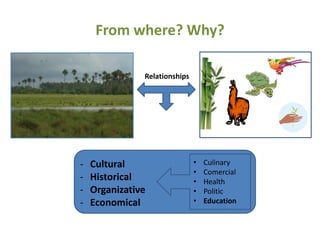
From where? Why?

               Relationships


-   Cultural                   •   Culinary
                               •   Comercial
-   Historical                 •   Health
-   Organizative               •   Politic
-   Economical                 •   Education
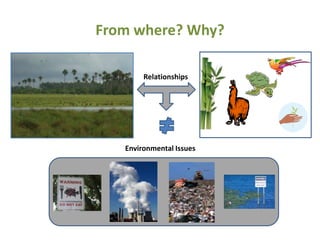
From where? Why?

        Relationships


   Environmental Issues
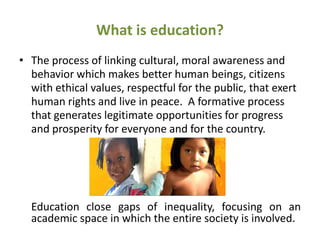
What is education?
• The process of linking cultural, moral awareness and
  behavior which makes better human beings, citizens
  with ethical values, respectful for the public, that exert
  human rights and live in peace. A formative process
  that generates legitimate opportunities for progress
  and prosperity for everyone and for the country.


  Education close gaps of inequality, focusing on an
  academic space in which the entire society is involved.
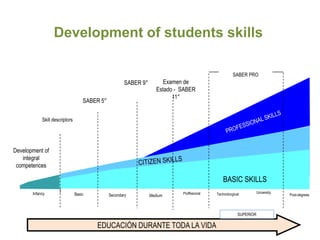
Development of students skills

                                                                                                      SABER PRO
                                                      SABER 9°         Examen de
                                                                    Estado - SABER
                                                                          11°
                                    SABER 5°

            Skill descriptors


Development of
   integral
 competences

                                                                                       BASIC SKILLS
                                                                               COMPETENCIAS BÁSICAS
       Infancy                  Basic                                        Proffesional   Technolocgical          University
                                               Secondary         Medium                                                          Post-degrees


                                                                                                         SUPERIOR

                                        EDUCACIÓN DURANTE TODA LA VIDA
VIDEO
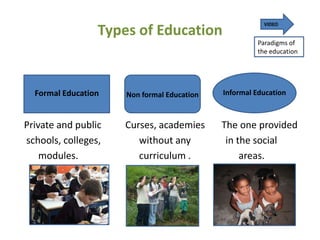
                 Types of Education
                                                     Paradigms of
                                                     the education


  Formal Education   Non formal Education   Informal Education


Private and public   Curses, academies      The one provided
schools, colleges,      without any          in the social
    modules.            curriculum .             areas.
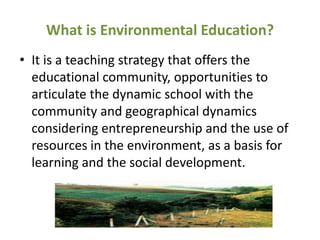
What is Environmental Education?
• It is a teaching strategy that offers the
  educational community, opportunities to
  articulate the dynamic school with the
  community and geographical dynamics
  considering entrepreneurship and the use of
  resources in the environment, as a basis for
  learning and the social development.
What for?
• Generate pedagogical spaces that allow the development of
  practical and experiential educational processes.

• Build positive learning environments that allow the
  integration of basic and elective areas of the curriculum and
  its practical application

• Create spaces and articulation of the technical, the teaching
  and the productive resources.
• Promote the implementation of environmentally sustainable
  practices.
• Develop strategies for projection of the educational institution
  to the community. (Exchange of knowledge).
Environmental education also makes it
               possible to:
• The identification, prioritization and analysis
  of environmental impacts on natural capital.
• The decision-making for sustainable
  environmental intervention.
• Training for environmental responsibility.
• Prioritization of the well-being of life;
  personal, occupational, professional, and
  community projects.
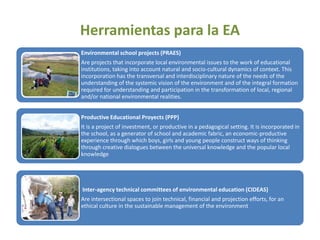
Herramientas para la EA
Environmental school projects (PRAES)
Are projects that incorporate local environmental issues to the work of educational
institutions, taking into account natural and socio-cultural dynamics of context. This
incorporation has the transversal and interdisciplinary nature of the needs of the
understanding of the systemic vision of the environment and of the integral formation
required for understanding and participation in the transformation of local, regional
and/or national environmental realities.


Productive Educational Proyects (PPP)
It is a project of investment, or productive in a pedagogical setting. It is incorporated in
the school, as a generator of school and academic fabric, an economic-productive
experience through which boys, girls and young people construct ways of thinking
through creative dialogues between the universal knowledge and the popular local
knowledge


Inter-agency technical committees of environmental education (CIDEAS)
Are intersectional spaces to join technical, financial and projection efforts, for an
ethical culture in the sustainable management of the environment
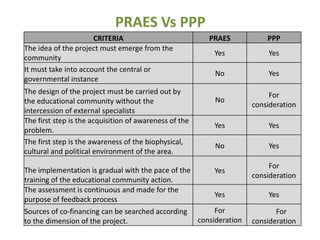
PRAES Vs PPP
                      CRITERIA                             PRAES            PPP
The idea of the project must emerge from the
                                                            Yes             Yes
community
It must take into account the central or
                                                             No             Yes
governmental instance
The design of the project must be carried out by                             For
the educational community without the                        No
                                                                        consideration
intercession of external specialists
The first step is the acquisition of awareness of the
                                                            Yes             Yes
problem.
The first step is the awareness of the biophysical,
                                                             No             Yes
cultural and political environment of the area.
                                                                             For
The implementation is gradual with the pace of the          Yes
                                                                        consideration
training of the educational community action.
The assessment is continuous and made for the
                                                            Yes             Yes
purpose of feedback process
Sources of co-financing can be searched according            For               For
to the dimension of the project.                        consideration   consideration
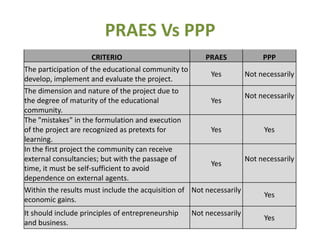
PRAES Vs PPP
                    CRITERIO                           PRAES            PPP
The participation of the educational community to
                                                        Yes        Not necessarily
develop, implement and evaluate the project.
The dimension and nature of the project due to
                                                                   Not necessarily
the degree of maturity of the educational               Yes
community.
The "mistakes" in the formulation and execution
of the project are recognized as pretexts for           Yes             Yes
learning.
In the first project the community can receive
external consultancies; but with the passage of                    Not necessarily
                                                        Yes
time, it must be self-sufficient to avoid
dependence on external agents.
Within the results must include the acquisition of Not necessarily
                                                                        Yes
economic gains.
It should include principles of entrepreneurship   Not necessarily
                                                                        Yes
and business.
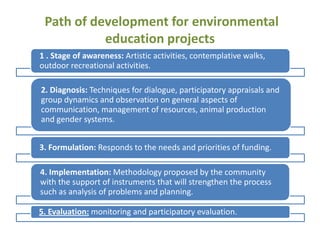
Path of development for environmental
           education projects
1 . Stage of awareness: Artistic activities, contemplative walks,
outdoor recreational activities.

2. Diagnosis: Techniques for dialogue, participatory appraisals and
group dynamics and observation on general aspects of
communication, management of resources, animal production
and gender systems.


3. Formulation: Responds to the needs and priorities of funding.

4. Implementation: Methodology proposed by the community
with the support of instruments that will strengthen the process
such as analysis of problems and planning.

5. Evaluation: monitoring and participatory evaluation.

Environmental Education

  • 1.
  • 2.
    From where? Why? Relationships - Cultural • Culinary • Comercial - Historical • Health - Organizative • Politic - Economical • Education
  • 3.
    From where? Why? Relationships Environmental Issues
  • 4.
    What is education? •The process of linking cultural, moral awareness and behavior which makes better human beings, citizens with ethical values, respectful for the public, that exert human rights and live in peace. A formative process that generates legitimate opportunities for progress and prosperity for everyone and for the country. Education close gaps of inequality, focusing on an academic space in which the entire society is involved.
  • 5.
    Development of studentsskills SABER PRO SABER 9° Examen de Estado - SABER 11° SABER 5° Skill descriptors Development of integral competences BASIC SKILLS COMPETENCIAS BÁSICAS Infancy Basic Proffesional Technolocgical University Secondary Medium Post-degrees SUPERIOR EDUCACIÓN DURANTE TODA LA VIDA
  • 6.
    VIDEO Types of Education Paradigms of the education Formal Education Non formal Education Informal Education Private and public Curses, academies The one provided schools, colleges, without any in the social modules. curriculum . areas.
  • 7.
    What is EnvironmentalEducation? • It is a teaching strategy that offers the educational community, opportunities to articulate the dynamic school with the community and geographical dynamics considering entrepreneurship and the use of resources in the environment, as a basis for learning and the social development.
  • 8.
    What for? • Generatepedagogical spaces that allow the development of practical and experiential educational processes. • Build positive learning environments that allow the integration of basic and elective areas of the curriculum and its practical application • Create spaces and articulation of the technical, the teaching and the productive resources. • Promote the implementation of environmentally sustainable practices. • Develop strategies for projection of the educational institution to the community. (Exchange of knowledge).
  • 9.
    Environmental education alsomakes it possible to: • The identification, prioritization and analysis of environmental impacts on natural capital. • The decision-making for sustainable environmental intervention. • Training for environmental responsibility. • Prioritization of the well-being of life; personal, occupational, professional, and community projects.
  • 10.
    Herramientas para laEA Environmental school projects (PRAES) Are projects that incorporate local environmental issues to the work of educational institutions, taking into account natural and socio-cultural dynamics of context. This incorporation has the transversal and interdisciplinary nature of the needs of the understanding of the systemic vision of the environment and of the integral formation required for understanding and participation in the transformation of local, regional and/or national environmental realities. Productive Educational Proyects (PPP) It is a project of investment, or productive in a pedagogical setting. It is incorporated in the school, as a generator of school and academic fabric, an economic-productive experience through which boys, girls and young people construct ways of thinking through creative dialogues between the universal knowledge and the popular local knowledge Inter-agency technical committees of environmental education (CIDEAS) Are intersectional spaces to join technical, financial and projection efforts, for an ethical culture in the sustainable management of the environment
  • 11.
    PRAES Vs PPP CRITERIA PRAES PPP The idea of the project must emerge from the Yes Yes community It must take into account the central or No Yes governmental instance The design of the project must be carried out by For the educational community without the No consideration intercession of external specialists The first step is the acquisition of awareness of the Yes Yes problem. The first step is the awareness of the biophysical, No Yes cultural and political environment of the area. For The implementation is gradual with the pace of the Yes consideration training of the educational community action. The assessment is continuous and made for the Yes Yes purpose of feedback process Sources of co-financing can be searched according For For to the dimension of the project. consideration consideration
  • 12.
    PRAES Vs PPP CRITERIO PRAES PPP The participation of the educational community to Yes Not necessarily develop, implement and evaluate the project. The dimension and nature of the project due to Not necessarily the degree of maturity of the educational Yes community. The "mistakes" in the formulation and execution of the project are recognized as pretexts for Yes Yes learning. In the first project the community can receive external consultancies; but with the passage of Not necessarily Yes time, it must be self-sufficient to avoid dependence on external agents. Within the results must include the acquisition of Not necessarily Yes economic gains. It should include principles of entrepreneurship Not necessarily Yes and business.
  • 13.
    Path of developmentfor environmental education projects 1 . Stage of awareness: Artistic activities, contemplative walks, outdoor recreational activities. 2. Diagnosis: Techniques for dialogue, participatory appraisals and group dynamics and observation on general aspects of communication, management of resources, animal production and gender systems. 3. Formulation: Responds to the needs and priorities of funding. 4. Implementation: Methodology proposed by the community with the support of instruments that will strengthen the process such as analysis of problems and planning. 5. Evaluation: monitoring and participatory evaluation.