SINGLE NATIONAL CURRICULUM
EARLY CHILDHOOD
CARE AND EDUCATION
GRADE PRE I 2020
ONE NATION, ONE CURRICULUM
NATIONAL CURRICULUM COUNCIL,
MINISTRY OF FEDERAL EDUCATION AND PROFESSIONAL TRAINING, ISLAMABAD
GOVERNMENT OF PAKISTAN
EARLY CHILDHOOD
CARE AND EDUCATION
CURRICULUM
GRADE PRE I
2020
NATIONAL CURRICULUM COUNCIL
MINISTRY OF FEDERAL EDUCATION AND
PROFESSIONAL TRAINING, ISLAMABAD
GOVERNMENT OF PAKISTAN
PREFACE
Chapter 01: Introduction
1.1 The Significance of Early Childhood Care and Education (ECCE)
1.2 Philosophy and Values in ECCE
1.3 National Commitments to ensure steps to be taken to
improve statistics and quality of education in the country:
1.3.1 EFA- Education for All
1.3.2 COMMITMENT TO ACHIEVE EFA GOALS AT E-9 FORUM
1.3.3 SUSTAINABLE DEVELOPMENT GOAL FOR EDUCATION
(SDG-4)
1.4 Principles Underlying Quality ECCE Programmes
1.4.1 Holistic Development through Early Childhood Care and
Education
1.5 The Aims of Education
1.5.1 A Statement of Beliefs
1.5.2 A Statement of Objectives
Chapter 02: Key Learning Areas, Competencies and Expected
Learning Outcomes for ECCE
2.1 Introduction to the Key Learning Areas and competencies
2.1.1 Personal Social and emotional Development
2.1.2 Language and literacy
2.1.3 Basic mathematical concepts
2.1.4 The World Around us
2.1.5 Physical Development
2.1.6 Health, Hygiene and Safety
2.1.7 Creative Arts
2.2 Competencies and Expected Learning Outcomes
2.3 Examples and ideas for Implementation
2.4 Personal and Social and emotional Development:
2.5 Language and literacy
2.5.1 Listening and Speaking skills
2.5.2 Reading Skills
2.5.3 Writing Skills
2.6 Basic Mathematical Concepts
2.7 World Around Us
2.8 Physical Development
2.10 Creative Arts
2.10.1 Visual Arts
2.10.2 Sound, Rhythm and Action
2.10.3 Dramatic Play
2.11 Summary of key learning areas and competencies
06
08
09
09
09
09
10
10
12
12
14
14
14
18
18
18
18
18
19
19
19
19
19
19
20
25
26
29
31
32
38
45
47
49
54
55
56
Chapter 03: Creating A Positive and Conducive Environment for
ECCE Classroom
3.1 Guidelines for establishing A conducive Learning Environment for
ECCE
3.1.1 Creating Learning Corners (Goshay)
3.1.2 The Daily Routine of an ECCE Classroom
3.2 Guidelines for Developing Criterion of Assessment
3.2.1 Child Assessment and Record Keeping
3.3 Guidelines for Effective Implementation of Quality ECCE
3.3.1 Essentials for Developing a Teacher’ Guide
3.4 Guidelines for IMPLEMENTATION of the Teachers’ Guide
3.5 Guidelines for Developing a Teacher Educators’/school
administrator’s Guide:
3.5.1 Format and Suggested Content
3.5.2 Key Competencies for Teacher Educators/school
administrators
3.6 Guidelines for planning Continuous Professional Development
Programme (CPD) for ECCE Teachers
3.7 Guidelines for Developing Content of an ECCE Continuous
Professional Development Programme
3.7.1 Designing a Teacher Education Programme
3.8 Guidelines for developing Assessment of ecce teachers’ training,
learning and cpd Programmes
3.9 Guidelines for ECCE Learning Material Developers
3.9.1 Key Considerations for Material Development
3.10 A Suggested List of Materials for the ECCE Classroom
Chapter 04: Theoretical Perspectives on Early Childhood Care and
Education (ECCE)
4.1 Developmental Theories
4.1.1 Brain Development in the Early Years
4.1.2 Piaget’s Theory of Cognitive Development
4.1.3 Vygotsky’s Theory of Sociocultural Development
4.1.4 Bronfenbrenner’s Ecological Systems Theory of Child
Development
4.1.5 Erik Erikson’s Theory Of Social Emotional Development
4.2 Learning Theories
4.2.1 Howard Gardner’s Theory of Multiple Intelligences-An
Innovative Approach Towards Understanding Child’s Potential
4.2.2 Learning Styles
Glossary
Acronyms
References
Curriculum Review Committee
60
60
60
61
63
64
64
69
69
70
70
71
72
72
73
74
75
75
76
80
80
80
82
84
86
88
91
91
94
96
100
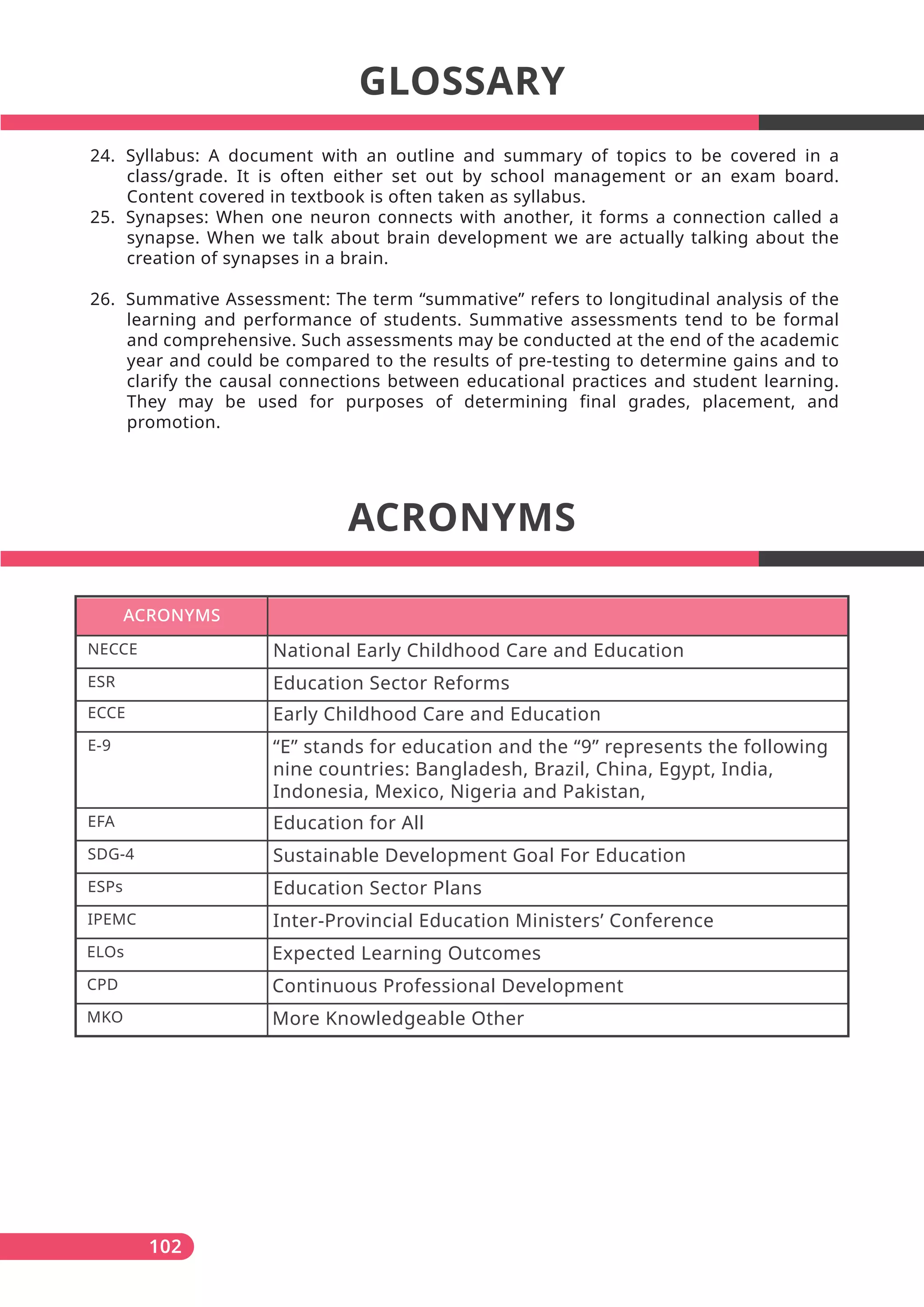
102
103
105
PREFACE
The current review and revision of the National Early Childhood Care and Education
curriculum comes after a decade and a half of its development under the Education Sector
Reform (ESR 2001-2004). Guided by the Prime Minister’s vision of a single national
curriculum for all streams of education in the country, with a view to the imperatives of
fairness and justice, the present revision also took into perspective emerging trends in
education development and research. The Single National Curriculum (SNC) 2020 aspires
to aid in preparing future generations that are conscious of their expected role as globally
competent, responsible citizens and vigilant custodians of human heritage and resources.
The Single National Curriculum of Early Childhood Care and Education 2020 sets the
parameters and provides a road map and guidelines for designing activities and a scheme
of studies for pre-schoolers (age 04-05) with a keen eye on the inclusion of
developmentally appropriate practices for this tender age. This curriculum is aimed to
foster children’s overall well-being and to ensure the best possible conditions for growth
and development in a conducive, child friendly and all-inclusive environment where they
can experience choice and freedom of actions in a safe, guided and healthy environment.
This provision is aimed to help them develop into individuals who are able to learn
through play, discovery, experimentation and collaboration. An enlarged focus on
inclusion of values education and 21st
century skills has added value to this curriculum.
A primary focus during this curriculum revision remained on the development of
indicators for ECCE that would help track the development of pro-social behaviour
through introduction to collaborative processes, cooperation, sharing and caring for
others. At the same time, the curriculum calls for encouraging and stoking the children’s
sense of wonder to help them develop confidence and not feel threatened by the
debilitating effects of a competitive environment. It also outlines an environment that
enables the development of the child’s personality through assimilation of skills and
values such as research/probing, decision-making, inquisitive learning, leadership,
patience, tolerance, empathy and civic education.
Another vital underlying theme is personality development with local, national and global
perspectives where the aim is to help the child become a responsible, law-abiding citizen,
fully aware of his/her role as custodian of national heritage and natural resources aiming
to conserve and replenish.
The revised ECCE SNC 2020 is articulated under the renewed national commitments at
international forums like United Nations and E-9 as well as latest researches and
established theories of child development encompassing all aspects of physical, cognitive,
social, emotional and ecological developmental domains.
This curriculum is a reference document for all ECCE stakeholders–particularly policy
makers, researchers, teacher educators, teachers, parents, ECCE administrators/
managers, school administrators and textbook/ material designers. It has been developed
to provide a national tool for guiding the implementation of Early Childhood Care and
Education catering to the needs of all predefined parameters mentioned here. At all levels
of planning for and implementation of ECCE curriculum the key consideration remains
that education and development is linked to culture and constant change in local, national
and global society. This factor should always be sensitively taken into account in the
continuous assessment of implementation mechanism of ECCE, goal setting, setting
expectations of learning outcomes and future revisions of Curriculum.
06
06
CHAPTER
CHAPTER
INTRODUCTION
1
Pregnancy: 9*30=270 days. 2 years: 365*2=730 days.
08
1.1 The Significance of Early Childhood Care and Education (ECCE)
It is now widely acknowledged that the effects of what happens during the pre-natal
period and in the initial thousand days (three years) of a child's life can have lifelong
consequences. The kind of early care a child receives from parents, pre-school teachers
and caregivers determines how a child learns and relates to school and life in general. The
most important factors contributing to the holistic development of a child lay in the
domains of social, emotional, moral, cognitive and physical development, which together
define the overall personality of a child in later years. It is during early years that a child
develops all the key elements of emotional intelligence, namely confidence, curiosity,
purposefulness, self-control, connectedness and the capacity to communicate and
co¬operate. Emotional Intelligence is now considered crucial for educational success and
lifelong learning.
The early years are also critical for the acquisition of the concepts, skills and attitudes that
lay the foundation of lifelong learning. These include the acquisition of life skills such as
self-awareness, critical thinking and conflict management, language, perception-motor
skills required for learning to read and write and basic numeracy concepts and skills.
Interventions in the earliest years in social awareness and wellbeing are in fact essential
for reducing the social and economic disparities, race and gender inequalities that divide
our society. It is especially the children of our poor rural and poor urban communities who
are most likely to benefit from and who most urgently need investment in early childhood
development. It is through initiatives in ECCE such as this, that we can begin to put an end
to inter-generational cycles of poverty, disease, violence and discrimination.
By the time children reach the age of two (first 1000 days)1
their brains contain as many
synapses and use up as much energy as the brain of an average adult. The complexity of
this development is described by scientists as a magical "dance" which lies at the very
heart of every human being and his or her learning process, beginning at birth, and even
before. This relatively new understanding of brain development has critical implications
for society, and particularly for educators and the way children are taught.
It is evident that it is within the crucial early years, when experience is moulding the brain,
that the foundations of learning are also set. A person's ability to learn and his or her
attitude towards learning, stem from their experiences in early years. A stimulating and
receptive context can set a young child on the path of discovery, openness to the outside
world and the capacity to integrate information. The brain is never as elastic again as it is
in childhood, in terms of receptivity and vulnerability. Adults are capable of assimilating
new knowledge, but can never rival the child's brain in its mastering of new skills and its
discovery of learning. Early childhood experiences are the building blocks of this
development and the child is the architect of his/ her own brain, piecing together the
puzzle and reacting to the outside world.
1.2 Philosophy and Values in ECCE:
Every child should have the opportunity to grow up in a setting that values children, that
provides safe and secure environment, and that respects diversity. Because children are
both the present and the future of every nation, they have needs, rights, and intrinsic
worth that must be recognised and supported.
Children must receive appropriate nurturing and education within and outside their
families before birth and onwards, if they are to develop optimally. Attention to health,
nutrition, early stimulation, education, and psychosocial development of children during
their early years is essential for the future wellbeing of nations and the global community.
Knowledge about human development is now more substantial than at any given point in
history. The new century offers opportunities to consolidate recent gains and respond to
new challenges that lie ahead. It is important to bear in mind that children, just like adults,
need to be respected as capable, thinking and feeling individuals with unique
personalities.
Central to the key considerations of the curriculum, to which the Government of Pakistan
is signatory, is the Convention on the Rights of the Child (CRC). A core value of the CRC is
human dignity of the child. Related to this basic value, the Convention consists of the
following four principles:
1. Non-discrimination
2. The child’s best interest
3. The child’s right to life and full development
4. Giving due weight to the views of the child
Learning through Play
All young children need periods of uninterrupted time in which they can engage in
active learning, explore their environment, make their own discoveries and set their
own challenges. They need opportunities to work with other children, and they need
adults who are able to understand and extend their natural interests. Above all, they
need opportunities for learning through play.
“Play acts as an integrating mechanism which enables children to draw on past
experiences, represent them in different ways, make connections, explore
possibilities, and create a sense of meaning. It integrates cognitive processes and
skills which assist in learning. Some of these develop spontaneously, others have
to be learnt consciously in order to make learning more efficient. We would all like
children to become successful learners.”
Bennet et al (1997)
1.3 National Commitments to ensure steps to be taken to improve statistics
and quality of education in the country:
1.3.1 EFA- Education for All
Advancement in research on education and human development, highlight the crucial
nature of the early years and its implication for a healthy and peaceful life at later stages.
The world recognises the importance and need for ECCE (Early Childhood Care and
Education) by endorsing expansion and improvement of comprehensive early childhood
care and education, especially for the most vulnerable and disadvantaged children as a
key means for creating a better world.
09
The Education for all declaration and subsequent reiteration at World Education
Conferences has brought ECCE into the main policy discourse of more than 180 countries.
As a signatory to the framework, Pakistan has also made a commitment to support ECCE
programmes in the country.
1.3.2 COMMITMENT TO ACHIEVE EFA GOALS AT E-9 FORUM:
Recognising that the ‘Education for All’ goals remains unachieved in the nine most
populous countries of the world, E-9 member countries gathered to sign a commitment to
strengthen collaboration with each other to improve education standards in their
countries. The E-9 Initiative, a consortium of the nine most populous countries of the
South was put in place in 1993, following the World Conference on EFA in Jomtien,
Thailand in 1990. “E” stands for education and “9” for those nine countries which are home
to over half of the world's population as well as to almost half of the world’s out of school
children and two thirds of the world’s illiterates: Bangladesh, Brazil, China, Egypt, India,
Indonesia, Mexico, Nigeria and Pakistan. The nine countries committed to pursue “with
determination” the Jomtien goals and have become over the years a driving force within
the Education for All partnership.
“Inclusive, relevant quality Education for All” has been identified as the thematic focus
for cooperation among the E-9 countries. With contribution from high-profile academia
from all the E-9 signatory countries, following four sub-themes have been identified:
1. Qualifications framework and competency standards for inclusive quality education
2. Management of teacher education and the issue of quality inclusive education
3. Teacher education and training for inclusive quality education
4. Financing teacher education for inclusive quality education
(UNESCO, 2012)
1.3.3 SUSTAINABLE DEVELOPMENT GOAL FOR EDUCATION (SDG-4):
Pakistan is also a signatory to Education 2030 vision which was adopted in the Incheon
Declaration on May 21, 2015 at the World Education Forum (WEF 2015) held in South
Korea. The Incheon Declaration constitutes the commitment of the education community
to Education 2030 and the 2030 Agenda for Sustainable Development, recognizing the
important role of the education as a primary driver of development.
Education 2030 proposes ways of implementing, coordinating, financing, and monitoring
efforts to achieve equal education opportunities for all, outlining how the commitments
made in Incheon Declaration may be translated into practice at the national and global
levels. It also includes indicative strategies which countries may contextualize in the light
of their national realities, capacities and their own policies and priorities. It thus presents
a serious attempt at providing guidelines for overcoming deficits in implementation when
global reform agendas are agreed upon.
In the post-devolution scenario of education in Pakistan, all provinces and areas have
developed their respective Education Sector Plans (ESPs) and are also working on
implementation plans for SDG-4 with specific focus on ECCE. In addition, the active forum
of Inter-Provincial Education Ministers’ Conference (IPEMC) discusses key issues, makes
recommendations and develops collaboration among all provinces and areas. IPEMC
provides an excellent forum to the provinces and areas for experience sharing in
implementation of two years pre-primary grades and to develop a way forward.
10
SUSTAINABLE DEVELOPMENT GOAL FOR EDUCATION (SDG-4):
Obtaining quality education is the foundation to improving people’s lives and
sustainable development. Major progress has been made towards increasing access
to education at all levels and increasing enrolment rates in schools particularly for
women and girls. Basic literacy skills have improved tremendously, yet bolder efforts
are needed to make even greater strides for achieving universal education goals. For
example, the world has achieved equality in primary education between girls and
boys, but few countries have achieved that target at all levels of education (2015, EFA
Global Monitoring Report); hence the need is to renew world’s commitment to achieve
education related targets by 2030. A summary of SDG-4 targets is:
4.1: By 2030, ensure that all girls and boys complete free, equitable and quality
primary and secondary education leading to relevant and Goal-4 effective
learning outcomes
4.2: By 2030, ensure that all girls and boys have access to quality early childhood
development, care and pre-primary education so that they are ready for primary
education
4.3: By 2030, ensure equal access for all women and men to affordable and quality
technical, vocational and tertiary education, including university
4.4: By 2030, substantially increase the number of youth and adults who have relevant
skills, including technical and vocational skills for employment, decent jobs and
entrepreneurship
4.5: By 2030, eliminate gender disparities in education and ensure equal access to all
levels of education and vocational training for the vulnerable, including persons
with disabilities, indigenous peoples and children in vulnerable situations
4.6: By 2030, ensure that all youth and a substantial proportion of adults, both men
and women, achieve literacy and numeracy
4.7: By 2030, ensure that all learners acquire the knowledge and skills needed to
promote sustainable development, including, among others, through education
for sustainable development and sustainable lifestyles, human rights, gender
equality, promotion of a culture of peace and non-violence, global citizenship and
appreciation of cultural diversity and of culture’s contribution to sustainable
development
4.8: Build and upgrade education facilities that are child, disability and gender
sensitive and provide safe, nonviolent, inclusive and effective learning
environments for all
4.9: By 2020, substantially expand globally the number of scholarships available to
developing countries, in particular least developed countries, small island
developing States and African countries, for enrolment in higher education,
including vocational training and information and communications technology,
technical, engineering and scientific programmes, in developed countries and
other developing countries
4.10: By 2030, substantially increase the supply of qualified teachers, including
through international cooperation for teacher training in developing countries,
especially least developed countries and small island developing states (United
Nations, 2015)
11
SDG target 4.2 is directly linked with the provision of access to quality Early Childhood
Care and Education or pre-primary education regardless of gender or area. Though little
has been done under the slogan of EFA and efforts to introduce and implement at least
one-year pre-primary education across the country, a lot remains to be done for ensuring
quality ECCE across Pakistan.
1.4 Principles Underlying Quality ECCE Programmes:
Schools should be ready to accommodate and cater to the needs of young learners by
providing adequate resources including sufficient space.
Children learn best when:
• The environment provided is secure and enabling, where teachers appreciate their
previous experiences, and take them forward from where they are.
• A partnership between home and school is valued.
• Adults are interested in them and the interaction between them is positive.
• They are respected; a positive self-image and high self-esteem are fostered.
• They are motivated to be independent active learners through first hand experiences
• They are given opportunities to make choices and decisions which develop their
confidence, helping them to take responsibility of their own learning and growth.
• Activities are planned to match their own pace, and are varied, with periods of activity
and quiet reflection.
• The experiences offered are relevant to their immediate interests and match their
individual needs.
• The programme is holistic and not compartmentalized with an established daily
routine.
1.4.1 Holistic Development through Early Childhood Care and Education:
One of the guiding principles of holistic childhood development is the unfolding process
of learning which is more important than the product. It is the approach to stimulate
willingness to learn rather than mere memorisation of facts and figures. Pushing children
to absorb facts and knowledge will not increase their desire to learn. It will, in fact, be to
the detriment of the child's development later on and his/her ability to learn effectively.
Learning by doing and the very basic need to know are the main motors in stimulating
children.
All educators, implementers and policy makers have a huge responsibility to ensure that
children, who enter schools at age four, are given a sound learning environment. The age
for pre-primary grade (04-05) specified directly connotes the existing structure of ECCE
grade as Prep/Nursery/Katchi/Undakhil as prevalent across the country. This aspect is the
SDG’s (SDG-4.2) indication of the need for implementation of 02 years ECCE Programme.
In this regard, it may well be noted that this curriculum for ECCE has the scope to expand
and a pre-primary grade for age 03-04 years can easily be derived, should the need arise.
This document will provide for the baseline of such introduction of extended pre-primary
grades in the Education System of Pakistan. It is important to have a fair level of
understanding about the different domains of development, so that developmentally
appropriate provisions can be made in response to children’s collective and individual
needs.
Development is not a linear process; it is simultaneous and integrated. However, for the
purposes of explanation and understanding, the domains have been compartmentalized
into the following major areas.
12
• Physical Development: Involves the way children use their muscles, both large and
small. The large muscles are used for activities such as walking, jumping and lifting
large objects. The small muscles are used for fine motor activities such as threading
beads, writing, and drawing, cleaning rice and working with small objects. Exposures to
activities that help in muscle development help children in doing small tasks on a daily
basis. They start feeling capable of helping elders and gain confidence.
• Social and Moral Development: Refers to those processes where children develop
relationships with their culture, with people around them and the environment in
general. The social setting and value system form the core of a person’s identity –
children at a very young age try to figure out what is good, what is appreciated or
beneficial, based on what they observe in their surroundings. Quality ECCE
environment provides opportunities for children to form positive relationships with
other children and with elders, and to engage in conversations about social norms and
ethical issues.
• Emotional Development: Refers to the development of a child’s capacity to
experience, manage and express a full range of positive and negative emotions. The
development of self-esteem is critical throughout the early years. It is essential for
children to have positive experiences at this stage. Feeling important, actively taking
responsibility, being listened to and cared for, are essentials for creating a positive
self-concept in children.
• Language Development: Refers to the process by which children make sense of the
words, symbols and information around them. Children are born with the ability to
learn language but again, conducive learning environment is essential to help them
develop optimally. Learning to read and write the alphabets and make small sentences
is just one component of language development. Over emphasis on this component
especially through rote memorization, without giving children a chance to process the
information and relate it to their lives, cripples not only their language development,
but also their cognitive capacities.
• Cognitive Development: Refers to the development of mental processes and
capabilities; it focuses on how children learn and process information. It is the
development of the thinking and organizing systems of the mind. It involves language,
imagining, thinking, creating, exploring, reasoning, problem solving, developing and
rejecting ideas and concepts, memory, expression through multiple media and
experimenting and applying what they learn. When they come to school, children are
already equipped with the basic thinking and processing skills - they have learnt it all as
part of growing up. Sound cognitive development enhances critical thinking and
creativity in human beings. A conducive ECCE environment provides learning
opportunities where children are given the freedom to explore, think, imagine,
question, and experiment, as they develop the ability to create novel ideas and
solutions.
• The World Around Us: the focus of this is on development of children’s knowledge and
understanding of their environment, other people, features of the natural and ‘human
world’. They provide a foundation for historical, geographical, scientific and
technological learning
• Health, Hygiene and Safety: It focuses on children developing physical control,
mobility, awareness of space and manipulative skills in indoor and outdoor
environments. They include establishing positive attitudes and understanding of
healthy and active way of life. It encompasses children’s conception and understanding
of safety measures to be taken in various situations in the surrounding.
13
• Creative Arts: It focuses on the development of children’s imagination and their ability
to communicate and to express ideas, feelings, observations and experiences in
creative ways. This includes encouraging children to think of new and innovative ideas
which can be expressed through varied media.
1.5 THE AIMS OF EDUCATION
“To educate Pakistanis to be:
• Seekers of truth and knowledge who can apply both for the progress of society;
• Creative, constructive, communicative, and reflective individuals;
• Disciplined, productive, moderate and enlightened citizens;
• Capable of effectively participating in the highly competitive global, knowledge-based
economy and the information age; citizens committed to creating just civil society that
respects diversity of views, beliefs and faiths.”
(Ministry of Education, Government of Pakistan, 2006)
Recent deliberations and group discussions also yielded the recommendation of adding
the following aims to augment the above-mentioned National level aims of education.
• Empathetic & patient participants in the world around them;
• Contributors towards building harmonious and tolerant society;
1.5.1 A STATEMENT OF BELIEFS:
The principles given below carry important implications for practice:
• Holistic development of a child is important - social, emotional, physical, cognitive and
moral developments are interrelated.
• Learning is holistic and for the young child it is not compartmentalised under subject
headings.
• Intrinsic motivation is valuable because it results in child-initiated learning.
• The child’s sense of dignity, autonomy and self-discipline are of critical importance.
• In the early years, children learn best through active learning (using all five senses)
learning by doing.
• What children can do, not what they cannot do, is the starting point in children's
education.
• There is potential (multiple intelligences, p.88) in all children which emerges powerfully
under favourable conditions.
• The adults and children to whom the child relates are of central importance.
• The child's education is seen as an interaction between the child and the environment,
which includes people as well as materials and knowledge.
• The teacher understands the importance of inclusive education and also practices it in
the classrooms.
1.5.2 A STATEMENT OF OBJECTIVES
The National ECCE Curriculum aims to:
• Provide for the holistic development of the child, which includes physical, social,
emotional, cognitive and moral development.
• Develop critical thinking skills.
• Nurture tolerance and respect for diversity.
• Nurture in children a sense of identity and pride in being Pakistani.
• Provide knowledge and understanding of Islam and Islamic society.
• Develop an understanding and respect for the beliefs and practices of all other
religions.
14
• Create in children a sense of citizenship in community, country and the world.
• Foster a sense of independence, self-reliance and a positive self-image.
• Equip the child with life-long learning skills.
• Provide opportunities for active learning.
• Provide opportunities for self-initiated play and decision making.
• Developing values, morals, ethics and civic sense.
• Sharpen aesthetic sense of children.
• Develop intrinsic motivation.
• Develop teamwork and sharing attitude.
This curriculum is divided into four chapters to ease the understanding of concepts and
their implications.
Chapter 1 introduces the significance of ECCE while providing the underlying theoretical
frameworks of developmental domains catered for in this document. Chapter 2 enlists the
key learning areas, competencies and expected learning outcomes for each
developmental domain while identifying implementable ideas for teachers, practitioners
and textbook/classroom material developers. Chapter 3 provides detailed guiding
principles for establishing the learning environment in an ECCE classroom, assessment
and evaluation, teachers’ selection, training and continuous professional development
programmes, devising roles of school administrators, parents, developing text
book/materials for ECCE, and suggested timelines for future curriculum revisions and its
practical implications are also included in this chapter. Chapter 4 provides the theoretical
perspectives of age appropriate brain development, cognitive development, psychosocial
and emotional development as well as ecological system development theories to help
understand the holistic development of a child.
15
CHAPTER
KEY LEARNING AREAS,
COMPETENCIES AND EXPECTED
LEARNING OUTCOMES FOR ECCE
18
CHAPTER
KEY LEARNING AREAS, COMPETENCIES
AND EXPECTED LEARNING OUTCOMES
FOR ECCE
2.1 INTRODUCTION TO THE KEY LEARNING AREAS AND
COMPETENCIES:
The key learning areas outlined in this curriculum contains competencies, or goals which
have been outlined for children at the pre-primary stages of education. These six areas of
learning provide a foundation for later learning and achievement. It is important to
remember that children progress at different rates, that individual achievement will vary
and that ECCE teachers must appreciate and recognise the language and culture of the
children.
Children whose achievements exceed the expected outcomes should be provided with
opportunities which extend their knowledge and skills. There may be others who will
require continuous support to achieve all or some of outcomes at entering Grade I. Care
must be taken to ensure that they get the opportunities of revision and reinforcement.
Children with special educational needs may also need varied kinds of support
throughout schooling.
This curriculum for the early years has been divided into the following key learning areas.
Each key learning area has been assigned between three to ten competences of learning
goals.
2.1.1 PERSONAL SOCIAL AND EMOTIONAL DEVELOPMENT
These outcomes focus on children’ learning how to work, play, co-operate with others and
function in groups beyond the family. They cover important aspects of personal, social,
moral and spiritual development and of personal values agreed upon by the adults in the
community, including the parents.
2.1.2 LANGUAGE AND LITERACY
These outcomes cover important aspects of language development and provide the
foundation for literacy. At the start, the language used in the programmes for all six areas
of development, could be in mother tongue, based on local culture and it can then
gradually and progressively be further developed to acquire competence in English.
Children should be helped gradually to acquire competence in Urdu, making use where
appropriate, for developing understanding and skills in languages. The outcomes focus
on children’s developing competence in talking and listening and becoming readers and
writers. It is important to note that the other areas of learning make a vital contribution
to the successful development of communication and literacy.
2.1.3 BASIC MATHEMATICAL CONCEPTS
These outcomes cover important aspects of understanding mathematics and provide the
foundation for numeracy. They focus on achievement and application through practical
activities and on using and understanding mathematical language.
19
2.1.4 THE WORLD AROUND US
These outcomes focus on development of children’s knowledge and understanding of
their environment, other people and features of the natural and “human” world. They
provide a foundation for historical, geographical, scientific and technological learning.
2.1.5 PHYSICAL DEVELOPMENT
These outcomes focus on children’s development, physical control, mobility, awareness of
space and manipulation skills in indoor and outdoor environment. The Child will
demonstrate balance and coordination, will learn and practice motor skills.
2.1.6 HEALTH, HYGIENE AND SAFETY
These outcomes focus on developing understanding of personal care, environmental
safety and security in children. These include establishing positive attitudes towards a
healthy and active way of life.
2.1.7 CREATIVE ARTS
These outcomes focus on the development of children’s imagination and their ability to
communicate and to express ideas, feelings, and observations and experiences in creative
ways. They include encouraging children to think about new and innovative ideas which
can be expressed through varied media.
2.2 COMPETENCIES AND EXPECTED LEARNING OUTCOMES
Children learn at their own individual pace according to their interest and learning styles.
At the young age of 4-5 years children should not be forced to learn beyond their capacity
because this will impede their learning and cognitive development.
The ECCE Curriculum charts out learning outcomes that young children are expected to
attain. However, given the diverse learning styles and paces, many children may not
achieve all the outcomes in one year of the pre- primary grade. Therefore, the outcomes
for the subject pre-primary grade are termed “Expected” and educators and supervisors
should not be overly concerned about children completing activities or meeting each and
every outcome. It is the process and not the production of the learning that is more
important at this stage!
For all the key Learning Areas, and Competencies there is a list of Expected Learning
Outcomes, which start with, “By the end of the year, children will begin to …”It is important
to reiterate that in the early years, children learn and achieve the expected outcomes by
the end of the year. This is why the outcomes in the National ECCE Curriculum are called
expected learning outcomes and not student learning outcomes, as are in the curricula
for Grade 1-12. As long as the teacher is providing continuous and varied opportunities
for hands-on learning and children are engaged enthusiastically, teacher supervisor and
parents should not be overly concerned.
2.3 EXAMPLES AND IDEAS FOR IMPLEMENTATION
An additional column containing examples and ideas for implementation has been added,
to this curriculum to provide some implementation suggestions, for teacher writers of
Teachers’ Guide and for those who will develop teaching-learning resources for this age
group.
20
As the term suggests, these are examples and ideas only, and are not intended as a
prescriptive or exhaustive list of activities for teachers to follow.
It is hoped that teachers will use these suggestions as a starting point, and localize the
ideas to meet the needs of the children’s context and make cross-curricular links for
enhanced learning.
2.4 PERSONAL AND SOCIAL AND EMOTIONAL DEVELOPMENT:
Competency 1: Children will develop an understanding of their likes, dislikes, strengths,
emotions and self-grooming, decision making and problem solving skills. Children will
further enhance their positive sense of self-identity and see themselves as capable
learners.
By the end of the year children will begin
to:
a. Share what they like about themselves
and what they like about a friend and
others.
b. Identify different occasions when they
feel happy, sad, scared, loved, angry,
excited and bored.
c. Choose and talk about an activity/work
that they enjoy doing the most in class
d. Express their likes and dislikes and talk
about their strengths and areas of
improvement.
e. Develop and understand that as
individuals, they have their unique
needs,
interests and abilities and that they are
separate from each other.
f. Develop and understand how to dress
up,
know about eating habits, proper
posture
while walking, talking and sitting.
g. Take care of his/her and others’
belongings
h. Perceive himself/herself in a positive
way
i. Ask for help when needed
j. Develop problem solving skills by
identifying the problems and finding the
best solutions through participating in
different activities
Expected Learning Outcomes Examples and ideas for implementation
This competency focuses on developing
children’s self-confidence and
understanding of their lifestyles and
preferences.
Teachers can facilitate learning in the
following ways:
• Ask open ended questions, Why & how
questions so that children can think
about their responses. For examples, if a
child says I want to be a pilot, teachers
should also ask her why she/he wants to
become a pilot-what does she/he likes
about pilots?
• Be patient with children so that they
have
adequate thinking time and then
respond. They should never be rushed
into answering.
• Encourage children to keep learning
areas tidy.
• Encourage children to seek permission
before taking others’ belongings. They
should keep only those things in their
bag which belong to them.
• Putting lunch-boxes and water-bottles
at
the assigned place and remembering to
take them back home.
• Respond to significant experiences,
showing a range of feelings (happy, sad,
worried, scared and angry) appropriate
to situations; for example, birthday
celebration and “dua” (prayer) for
deceased family members of peers etc.
• Appreciate and talk about the
characteristics that make each person
special and unique (name, gender, eye
colour).
21
Competency 2: Children will be willing to share and work in collaboration with their
peers, teachers, family members and neighbours, regardless of any differences, such as,
in gender, ability, culture, language and ethnicity.
By the end of the year children will begin
to:
a. Show an understanding and respect for
the feelings of their peers and others.
b. Cooperate with peers, teachers, family
and community members.
c. Work cooperatively and share materials
and ideas amicably in groups.
d. Form friendly and interactive relations
with peers and adult around them.
e. Learn to respect others’ opinion while
communicating.
f. Learn to take turns.
g. Cooperate with and be sensitive to
peers,
elders, and neighbours who may
be differently abled.
h. Work in collaboration, in groups/project
work to promote leadership skills.
Expected Learning Outcomes Examples and ideas for implementation
This competency focuses on developing
children’s relationship with the people they
interact with on a daily bases.
Teachers can facilitate learning in the
following ways:
• Encourage children to help each other
carrying out small tasks, like handling
and using class materials such as,
books,
blocks and beads.
• Help children to work and play amicably
by assigning roles in groups and being
respectful towards each other.
• Help children make queues when going
out of the class for outdoor activities,
during break, for washing hands and
coming back to the classroom.
• Help children take turns during
classroom discussion, be attentive and
respectful when peers or teacher are
sharing their views and experiences.
• Be available to support children resolve
conflicts, using a problem-solving
approach.
Competency 3: Children will learn about and appreciate their heritage and culture and
develop acceptance, respect and appreciation for the diversity of cultures and languages.
By the end of the year children will begin
to:
a. Talk about the cultural aspects of their l
ives, such as, language, clothing,
lifestyle, food, traditions and customs.
b. Talk about the key cultural practices to
resolve conflicts and issues and
celebrate
festivals
c. Recognize historical and cultural places.
d. Narrate stories heard from elders.
e. Play local games (hide and seek,
jumping,
gudda-guddi ki shaadi, ghar ghar khail,
tug of war, clay modelling, cat’s cradle
etc.)
f. Develop basic knowledge about
Pakistani
culture. (i.e. know about the national
game, flag, flower, food, folk dances,
languages etc.)
Expected Learning Outcomes Examples and ideas for implementation
This competency focuses on developing
children’s understanding of life, cultures
and history. This competency aims to
develop children’s appreciation of culture
that is part of their daily lives.
Teachers can facilitate learning in the
following ways:
• Initiate discussions about cultural
events which the children experience
directly.
• Talk about their cultural practices such
as autaq, kacheri, Jirga, majlis, chopaal
etc.
• Talk about and celebrate religious and
cultural festivals, i.e., Eid-ul-Fitr,
Eid-ul-Azha, national events such as
Independence Day and
Jashan-e-Baharaan, depending on the
local culture.
• Help them observe and identify the
beautiful and unique patterns in old
buildings and cultural places.
22
Competency 3: Children will learn about and appreciate their heritage and culture and
develop acceptance, respect and appreciation for the diversity of cultures and languages.
g. Respect the feelings and views of others
irrespective of their religion, caste,
colour, creed and people with special
need.
Expected Learning Outcomes Examples and ideas for implementation
• Invite parents and grandparents to tell
stories.
• Encourage them to talk about and play
their favourite local games by ensuring
equal opportunities for all and taking
care of their individual needs
• Talk about places for family gatherings
in their local context
Competency 4: Children will develop an understanding of their own religious values and
practices as well as respect for others’ religious values and practices, with acceptance
and appreciation for the differences that exist.
By the end of the year children will begin
to:
a. Recognise, appreciate and respect
similarities and differences among
people
b. Associate and mingle with children
having diverse abilities and
backgrounds
c. Know and understand that the religion
of
most of the people in Pakistan is Islam
d. Recognize that other religions exist in
Pakistan as well
e. Name their religion.
f. Appreciate “peace” (love, care,
friendship,
tolerance, kindness and respect for
others) as a common value across
religions.
g. Muslim children will:
• Believe that Allah is the Sole
Creator and Prophet Muhammad
‫ﷺ‬ is His last and most beloved
Prophet.
• Believe that Islam stands for peace
and harmony.
• Recite the first Kalma.
• Recite small dua’as and know why
they should be recited
h. Non-Muslim children will learn and
practice about their own religion
Respect other religions and have
tolerance for other religions.
Expected Learning Outcomes Examples and ideas for implementation
%
This competency focuses on developing
children’s concept of religion and respect for
all religious.
Teachers can facilitate learning in the
following ways:
• Celebrate culture and harmony days
(cultural games, food, dresses etc.)
• Assign tasks to mix-ability groups with
pre-defined rules (displayed in the
classroom as classroom norms)
• Promote the values of tolerance and
respect for everyone. Young children
should be made confident that Allah
loves them. He has created them with
love and wants them to love their
fellow-beings. Notions of ‘fear; or
‘punishment’ should not be inculcated at
this young age.
• Recite small dua’as so that Muslim
children are introduced to the ethics of
Islamic living. Help children understand
the significance of dua’as. For example
why we should recite dua’as before
eating or sleeping – what do they mean
and how they communicate our
gratefulness to Allah?
• Encourage children who belong to other
religions to recite their own prayers and
share their beliefs.
23
Competency 5: Children will demonstrate a sense of responsibility for self and others in
class, school, home and neighbourhood.
Expected Learning Outcomes Examples and ideas for implementation
By the end of the year children will begin to:
a. Manage small tasks leading to
self-reliance.
b. Take care of their own belongings and
put classroom materials back in the
right
place after use.
c. Identify and implement small tasks l
eading to a sense of responsibility for
school, community and public property.
d. Recognise that water, food, electricity
and paper are very important resources
and need to be used responsibly.
e. Recognise and practice their
responsibility in keeping the
environment, home, classroom and
neighbourhood clean.
f. Take care of peers in class, school and
neighbourhood.
This competency focuses on developing
children’s confidence and self-reliance, and on
developing an understanding and appreciation
for the responsible use of scarce resources.
Teachers can facilitate learning in the
following ways:
• Encourage a sense of care and
responsibility in children. For example,
turning pages of books with care;
helping in setting the snacks carefully;
returning materials to the designated
place after use in school and at home.
• Stand back and let them resolve little
problems independently, until they ask
for help. Encourage them to help other
children and adults in the classroom and
neighbourhood.
• Discuss respect for others’ property and
give them responsibility for:
• Performing tasks assigned individually
and in groups
• Cleaning up after snack time.
• Using materials with care, keeping
tables, shelves and walls clean.
• Using waste bin for throwing litter and
wrappers, after checking for ‘junk’ that
can be recycled.
• Taking pride in clean, environment.
• Returning things that do not belong to
them, to an adult, switching off fans and
lights when leaving room.
• Group leader will bring materials for
group work from the learning corners
• Group leader helps others within the
group to complete the task
• Talk about the importance of water,
food, electricity and paper. Discuss in
simple terms where they come from;
how we need these in our daily lives and
how these can be depleted and ‘hurt’ the
earth if we don’t use them carefully.
24
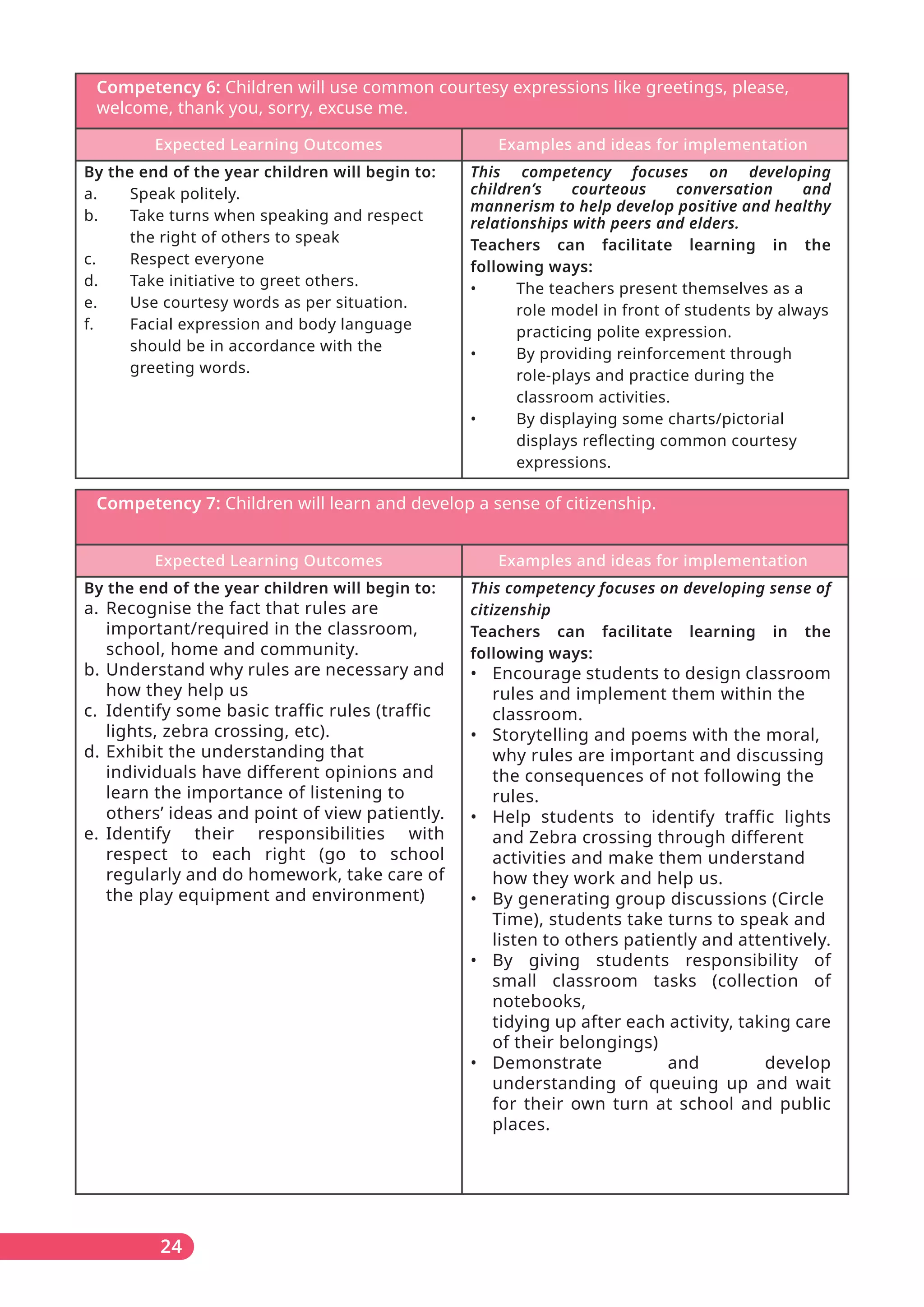
Competency 6: Children will use common courtesy expressions like greetings, please,
welcome, thank you, sorry, excuse me.
Expected Learning Outcomes Examples and ideas for implementation
By the end of the year children will begin to:
a. Speak politely.
b. Take turns when speaking and respect
the right of others to speak
c. Respect everyone
d. Take initiative to greet others.
e. Use courtesy words as per situation.
f. Facial expression and body language
should be in accordance with the
greeting words.
This competency focuses on developing
children’s courteous conversation and
mannerism to help develop positive and healthy
relationships with peers and elders.
Teachers can facilitate learning in the
following ways:
• The teachers present themselves as a
role model in front of students by always
practicing polite expression.
• By providing reinforcement through
role-plays and practice during the
classroom activities.
• By displaying some charts/pictorial
displays reflecting common courtesy
expressions.
Competency 7: Children will learn and develop a sense of citizenship.
Expected Learning Outcomes Examples and ideas for implementation
By the end of the year children will begin to:
a. Recognise the fact that rules are
important/required in the classroom,
school, home and community.
b. Understand why rules are necessary and
how they help us
c. Identify some basic traffic rules (traffic
lights, zebra crossing, etc).
d. Exhibit the understanding that
individuals have different opinions and
learn the importance of listening to
others’ ideas and point of view patiently.
e. Identify their responsibilities with
respect to each right (go to school
regularly and do homework, take care of
the play equipment and environment)
This competency focuses on developing sense of
citizenship
Teachers can facilitate learning in the
following ways:
• Encourage students to design classroom
rules and implement them within the
classroom.
• Storytelling and poems with the moral,
why rules are important and discussing
the consequences of not following the
rules.
• Help students to identify traffic lights
and Zebra crossing through different
activities and make them understand
how they work and help us.
• By generating group discussions (Circle
Time), students take turns to speak and
listen to others patiently and attentively.
• By giving students responsibility of
small classroom tasks (collection of
notebooks,
tidying up after each activity, taking care
of their belongings)
• Demonstrate and develop
understanding of queuing up and wait
for their own turn at school and public
places.
Competency 8: Children will develop and demonstrate ethical and moral values such as
honesty, inner accountability, social justice, empathy, compassion and respect.
Expected Learning Outcomes Examples and ideas for implementation
By the end of the year children will begin to:
a. Develop an understanding of the term
kindness and the importance of being
kind to others
b. Understand the importance of sharing
and list the things they can share with
others (toys/lunch).
c. Understand that mistakes are a part of
learning and nothing to be ashamed of
or to make fun of.
d. Develop the ability to think about and
take personal accountability for actions.
e. Develop and understanding of
truthfulness, honesty, fairness and
trustworthiness in their actions.
This competency focuses demonstrate ethical
and moral values.
Teachers can facilitate learning in the
following ways:
• Encourage children to share their
real-life experiences on kindness.
• Provide opportunities that encourage
sharing within and beyond the
classroom
• Encourage children to share if anything
goes wrong and make them comfortable
that it’s okay to make mistakes.
• Identify ways in which we can reduce the
hurt caused to others (admit mistake,
ask for forgiveness, do something
special for them, appreciation)
• Share moral stories, role plays and
children’s own life experiences with the
whole class
• Develop the habit of self-reflection in
students.
Competency 1: Children will engage confidently with others using language in a
variety of ways for a variety of purposes and contexts.
2.5.1 LISTENING AND SPEAKING SKILLS
By the end of the year children will begin to:
a. Listen attentively in small and large
groups and share their views about
every event and special occasions.
b. Respond to others in a variety of verbal
and non-verbal ways for a variety of
purposes, for example exchanging
ideas, expressing feelings, and a variety
of contexts, plan-work-clean-up-review,
group work time’.
c. Talk about their experiences and
feelings with peers and adults by using
complete sentences.
d. Respond to and verbally express a range
of feelings, such as, joy and sorrow,
wonder and anger.
The primary function of Competency 1 is to
enhance children’s confidence and ability to
communicate with fluency.
Teachers can facilitate learning in the
following ways:
• Engage children in conversation by
talking about special cultural and
national events which are meaningful
for them, encourage them at school as
well as at home. Initiate the
conversation by sharing own news,
experience and feelings, taking care that
these are appropriate for the children.
Following the weekend, ask learning
questions or comments such as, “I
wonder if anyone went to the park
yesterday ….; or “I can see that Ayesha
has mehndi/henna on her hands;
All the following competencies require that teachers start the language and Literacy
program in children’s Mother Tongue, based on local culture and gradually add Urdu and
English (wherever applicable), and also reference from the wider culture. Children need
the confidence that their mother tongue is valued.
2.5 LANGUAGE AND LITERACY:
25
Competency 1: Children will engage confidently with others using language in a
variety of ways for a variety of purposes and contexts.
2.5.1 LISTENING AND SPEAKING SKILLS
e. Show respect for a variety of ideas and
beliefs by listening and responding
appropriately.
f. Wait for their turn to speak and not
interrupt when others are talking.
g. Initiate conversations with peers and
adults.
h. Recognition of letters with their initial
sounds
i. Recognise and differentiate between
sounds in the environment.
j. Understand and follow instructions.
k. Use correct pronunciation.
l. Draw on words from enhanced
vocabulary, and making new words
through blending sounds.
m.Make appropriate use of body language
(eye contact, hands movements, facial
expressions etc.) while speaking to the
audience.
Do you think someone in her family is
getting married?;It looks like Ali has had
a haircut.” Encourage children to give
answers in complete sentences.
• Introduce sounds using different mode
of technology and techniques (smart
phone, cassette player, multi media
player)
• (tapping, drumming, local no cost
resources,)
• Encourage children to listen to different
sounds in their environment for
example, paper tearing, dropping and
tapping things, animal voices, wind
blowing, audio players and musical
instruments.
• Establish an environment where
children feel free to talk, by placing self
at children’s height level. Be available to
converse with all the children
throughout the day. Refer one child’s
questions and problems to another
• Listen actively to children and wait for
them to complete what they are saying.
Be patient with their hesitation and at
the same time help other children to
listen and wait, by holding up a hand,
and nodding, assuring them that they
will get a turn. Display appropriate facial
expressions and body language to
communicate respect, joy, sorrow or
wonder.
• Play games where they have to
understand and follow simple
instructions. For example, “Ayesha,
touch your head and then your nose and
then clap your hands.”
• Teacher will use phonic rhymes and
sounds in audio/video form. Children
will learn the rhyme and will identify
letters with their initial sounds.
• Repeat the correct pronunciation of
words that children may have
mispronounced, without telling them
that they were wrong.
• Help them enhance their vocabulary, by
encouraging them to guess new words
by playing games like ‘I spy with my little
eye something that begins with the
letter A, or B’. Action poems and songs
are a goodway to learn words and
sentences.
26
Competency 2: Children will describe objects, events and their plans for the day.
Expected Learning Outcomes Examples and ideas for implementation
By the end of the year children will begin to:
a. Name things in their environment.
b. Describe and talk about pictures, drama,
animated video etc
c. Share their plans for the day and
describe the previous or upcoming
events and days
d. Express their ideas with clarity.
e. Extend their ideas or accounts by
providing some detail about their topic
and daily routine
f. Describe a picture by using appropriate
words or simple sentences
This competency is designed to help children to
process and comprehend spoken language and
to communicate their thoughts, needs, interests
and feelings to others.
Teachers can facilitate learning in the
following ways:
• Take children for a walk around the
school and play a game of naming
objects that they see in the
environment. Back in the classroom,
encourage children to try and recall
what they had seen in the environment.
• Talk about and discuss pictures from
children’s story books, or pictures
(age/culturally appropriate) that have
been cut out from old magazines or
newspapers.
• Facilitate discussion about their daily
routine
• Sing songs and recite poems in a similar
manner with action and encourage
children to do role play.
• Play games where children have shut
their eyes and ask them to listen to
different sounds in the environment and
guess who or what is making those
sounds. For example, the sound of a
bird, a cat or dog, a rickshaw or a bus. At
other times, make sound such as
clapping, tapping or stomping your foot
and ask them to identify the sound.
• Listen to the children as they work and
play, and make up chants and rhythms
along with them. Recite rhyming words,
even if all of them don’t make sense and
laugh at these together. Develop a
playful interest in respective sounds and
words, aspects of language such as
rhythm, rhyme, alliteration, and an
enjoyment of nonsense stories and
rhymes.
27
Competency 3: Children will enjoy listening to stories and poems/rhymes and make
up their own stories and rhymes.
Expected Learning Outcomes Examples and ideas for implementation
By the end of the year children will begin to:
a. Retell and respond to stories, songs and
rhymes by joining verbally or with
actions as appropriate
b. Recognise and differentiate between
sounds in the environment
c. Appreciate the concept of words,
rhymes and syllables.
d. Make up their own stories and rhymes
This competency focuses on enjoying stories,
poems and songs and on children making up
their own stories and taking part in role play
with confidence.
Teachers can facilitate learning in the
following ways:
• Tell children traditional stories and tales
which have cultural relevance for them.
Occasionally, use simple props such as
puppets, masks and toys available in
local context.
• Help children explore using language
through enjoyable ways like playing with
words, rhymes, poems, stories and role
play.
• Sit with children on the floor, on a
mat/darri so that you are closer and at
the same physical level as them.
• Tell stories without props too, so that
children can rely on and build their
imagination.
• Maintain their interest in stories and
poems by being animated and telling or
reading a story with expression. Pause
for children’s comments or questions
and enjoy their responses. Make story
telling a fun activity.
• Sing songs and recite poems with
actions and encourage children to role
play.
• Listen to the children as they work and
play, and make up chants and rhymes
along with them. Recite rhyming words,
even if all of them do not make sense
and laugh at these together. Develop a
playful interest in repetitive sounds and
words, aspects of language such as
rhythm, rhymes, and alliteration and an
enjoyment of nonsensical stories and
rhymes.
• Practice syllable activities, for example,
‘clap and say’, ‘hip-po-pot-a-mus’
28
Competency 4: Children will enjoy age appropriate books and handle them carefully.
2.5.2 READING SKILLS
By the end of the year children will begin to:
a. Hold, open and turn pages of a book
with care.
b. Enjoy skimming/scanning through age
appropriate big books.
c. Predict the story by looking at the cover
page and flipping through pages.
d. Predict what comes next in stories.
e. Ask open ended questions about the
story to support critical and logical
thinking.
f. Repeat simple repetitive sequences in
traditional and popular children’s
stories.
g. Tell a simple story by looking at pictures.
h. Retell a favourite story in the correct
sequence.
This competency focuses on pre-reading skills.
Children will enjoy books and handle them
carefully.
Teachers can facilitate learning in the
following ways:
• Hold up books for children when reading
a story and show them the pictures.
Show enjoyment and respect of books
through actions and facial expressions.
Share own feelings about books during
circle time. Encourage the children to
tell a story by looking at the pictures. If
they make up their own stories, just
accept them. However, if they are
re-telling a favourite story, and they
miss important steps in the sequence,
help them to remember by questioning
gently and appealing to their sense of
reasoning.
• Establish a reading corner in the
classroom. Encourage children to bring
books (used books) from home
(wherever possible) to keep them in the
reading corner for a few days.
• Show children how to hold and open a
book without spoiling or tearing it. Show
them also how to turn the pages with
care. Learning to respect other people’s
property is an important part of learning
about right and wrong.
• Build up a sense of anticipation and give
children the opportunity to guess what
will happen next in a story. Also wait for
and encourage them to join in when a
sentence is repeated in a familiar story.
29
Competency 5: Children will understand how books are organized.
Expected Learning Outcomes Examples and ideas for implementation
By the end of the year children will begin to:
a. Differentiate between the parts of a
book (the cover, the title and the end).
b. Understand and demonstrate the usage
and significance of different parts of a
book.
c. Know that some books tell stories and
others give information.
d. Know that Urdu is read from right to left
and top to bottom.
e. Know that English is read from left to
right and top to bottom.
f. Know that regional languages (where
applicable) are read from right to left
and top to bottom).
This competency will help children understand
the different parts/sections of a book, the
different kinds of books and the orientation of
different languages.
Teachers can facilitate learning in the
following ways:
• Tell them in a conversational tone, what
the different parts of a book are, such as
the cover, the end, the spine through
demonstrating the significance and
usage of these parts
• When reading out a story, show them
where a sentence begins and which
direction we read in and how we read
from top to bottom.
• Talk to children about different kinds of
books explaining that some tell us story
and others tell us about so many
different things, such as animals, plants,
buildings, and history.
Competency 6: Children will recognise letters and familiar words in simple texts.
Expected Learning Outcomes Examples and ideas for implementation
By the end of the year children will begin to:
a. Understand that words and pictures
carry meaning.
b. Identify and name the characters in a
story.
c. Recognise their names in print (Urdu &
English).
d. Begin to recognise letters of the
Alphabet.
e. Identify sight words that are meaningful
for them.
f. Identify letter sounds through words
that have personal meaning for them.
g. Associate initial letter sounds with
names of objects in their classroom
environment.
h. Think of a variety of objects beginning
with a single letter of the alphabet.
This competency will help children recognise
familiar words in simple texts. They will begin to
associate sounds with letters of the alphabet
and also to recognise letters of the alphabet by
shape and sound. They will begin to recognise
their own names and other familiar, often
repeated words.
Teachers can facilitate learning in the
following ways:
• Provide a print rich environment.
Children learn to read by trying to make
sense of the print they come
across.Support their efforts by labelling
objects and areas in the classroom.
Place plenty of books in the learning
environment for them to look through,
and to tell each other their stories.
• Create symbols for their names and
draw these along with the written name
on a label which can be pinned (safely)
on their clothes. Let them find their own
name tags each day when they arrive.
When they are confident and can
identify their names easily, remove the
symbol and leave only their name on the
name tag.
30
Competency 6: Children will recognise letters and familiar words in simple texts.
Expected Learning Outcomes Examples and ideas for implementation
• Prepare flash cards with letters of the
Alphabet (remember to move from
mother tongue to Urdu to English) and
play matching games. Match the cards
to objects and pictures which begin with
a particular alphabet. Say the initial
alphabetical sounds of objects and
match these to sounds of the alphabets
present. Begin with words that are
personally meaningful for the children
like their own name, names of family
members, pets, favourite food and
places. Keep an ear open for children’s
interests and use words that are
important for them to help them “read”
the respective alphabet and sight words.
Competency 7: Children will use pictures, symbols and familiar letters and words to
communicate meaning, show awareness of some (symbols, letters and words), for the
different purposes of writing.
2.5.3 WRITING SKILLS
By the end of the year children will begin to:
a. Make marks and scribble to
communicate meaning
b. Use some clearly identifiable letters in
their writing to communicate meaning,
representing some sounds correctly and
in sequence.
c. Draw pictures to communicate meaning.
d. Hold writing tools properly to develop a
comfortable and efficient pencil grip.
e. Colour a simple picture keeping within
designated space.
f. Trace, copy, draw and colour different
shapes, such as circles, squares,
triangles and rectangles.
g. Trace and draw vertical, horizontal and
wavy lines and simple patterns made up
of lines, circles, semi circles and other
simple shapes.
h. Trace, copy and write the letter of Urdu
alphabet.
i. Trace, copy and write the letters of the
English alphabet.
This competency will help children use pictures
symbols and familiar letters and words to
communicate meaning, showing awareness of
some of the different purposes of writing. It will
also focus on learning the skills they will need in
writing legibly.
Teachers can facilitate learning in the
following ways:
• Provide a variety of writing and drawing
materials (pencils, crayons, chalk etc.) to
scribble and make marks on
paper/Slate/takhti and sand-paper.
Accept children’s scribbling/drawing as
their first attempts at writing. Look
carefully to find letters and images
emerging from their scribbling. Gently,
help them to hold their writing tools
correctly; use computers with children’s
software where possible.
• Talk to them about their drawing and
write a word or sentence, exactly as they
say it, and then let them trace over it if
they want to. They may return to it the
next or another day and “read” what was
written. This will help them see that
pictures communicate meaning.
31
Competency 7: Children will use pictures, symbols and familiar letters and words to
communicate meaning, show awareness of some (symbols, letters and words), for the
different purposes of writing.
2.5.3. WRITING SKILLS
j. Trace, copy and write the letters of
reginal languages (where applicable).
k. Know that print carries meaning and in
English, it is written from left to right,
begins at the top left corner of the page
and moves across and down, and words
are separated by space.
l. Know that print carries meaning and in
Urdu, it is written from right to left,
begins at the top right corner of the
page and moves across and down, and
words are separated by space.
m.Write their own names in English & Urdu
and their native language with
appropriate use of upper and lower case
letters.
n. Write a word or a sentence while
describing a picture.
• Provide a tray with sand in it. Encourage
children to draw lines and patterns in
the sand and then later on paper. They
can trace or copy lines and patterns that
have been made for them.
• Provide practise by writing letters in the
air, moving hand in the correct direction
asking the children to follow.
• Give them plenty of opportunities to
trace, draw and colour pictures prepared
for them and simple shapes which have
been introduced earlier. Let them trace
and copy letters of the alphabet (mother
tongue, Urdu, English) and their own
names.
2.6 BASIC MATHEMATICAL CONCEPTS:
Competency 1: Children will develop basic logical, critical, creative and problem solving
skills by demonstrating an understanding of the different attributes of objects (such as
colour, size, weight and texture) and match, sequence, sort and classify objects based on
one/two attributes.
By the end of the year children will begin to:
a. Recognise, name and differentiate
between colours.
b. Differentiate between the objects on the
basis of size, weight, length, width and
textures (smooth & rough).
c. Arrange objects and later pictures,
according to their size/length, going
from smallest to biggest, biggest to
smallest, shortest to longest and longest
to shortest and vice versa.
d. Arrange objects and then pictures,
according to their weight and width,
going from highest to lowest, heaviest
to lightest and narrowest to widest and
vice versa.
Expected Learning Outcomes Examples and ideas for implementation
This competency requires that children use
mathematical language as they explore the
similarities and difference between the attributes
of objects. It focuses on enhancing children’s
thinking skills through pattern identification and
through building relationships.
Teachers can facilitate learning in the
following ways:
• Give the children freedom to explore
patterns and relationship. Give them the
opportunity to come up with different
answers or solutions and accept what
they come up with.
32
Competency 1: Children will develop basic logical, critical, creative and problem solving
skills by demonstrating an understanding of the different attributes of objects (such as
colour, size, weight and texture) and match, sequence, sort and classify objects based on
one/two attributes.
e. Match and compare one object with
another on the basis of similar
attributes.
f. Sort and group objects (classify) based
on a single attribute (for e.g.; colour or
size etc) and based on two attributes
(e.g. colour, weight, size, number of
sides).
g. Observe, identify and extend patterns
developed with various concrete
materials.
h. Observe, identify and extend the given
picture/symbol patterns.
i. Group objects together according to
their shapes and colours.
j. Sequence objects according to their size,
shapes and colours
k. Identify and differentiate between
broad and narrow
l. Identify that 'some' is less than 'all'
m.Differentiate between 'more', 'less' and
'equal.
n. Differentiate between half and full.
o. Create own patterns using concrete
materials and pictures and then explain
them.
p. Observe and identify the “odd one out”
from the given set of concrete material
or pictures and explain the answer.
Expected Learning Outcomes Examples and ideas for implementation
• Design various interesting activities
using simple everyday material to help
children build their skills. A few ideas are
given below:
• Use concrete materials such as,
beads, blocks, and buttons. Help
them recognise and describe the
attributes of these objects.
• Ask children to compare the given
objects and identity similarities and
differences between them.
Encourage them to group various
objects and explain the reasons for
doing so.
• Use a variety of materials to help
children build their classification
skills. For example, give children
red and blue beads of the same
size and ask them to sort these in
two groups. Later, give them red
and blue beads in small and large
sizes and ask them to sort these. In
the second case, children may
come up with different ideas. They
can make four groups (small red
beads, big red beads, small blue
beads and large blue beads). They
may make only two groups (red
beads and blue beads or small
beads and big beads. (Encourage
children to consider various
attributes while sorting.
• Use the concept of sorting and
sequencing in daily class activities,
such as making a queue of children
in the order of height, dividing the
children for various group
activities, organizing class
materials in boxes and arranging
books in various piles.
• Use low cost materials, such as,
beads, nut shells, ice cream sticks and
pebbles for pattern seeking
exercises. Start by showing a few
patterns to children, and then engage
them in extending the given patterns
and developing their own patterns
using concrete materials and
pictures.
33
Competency 1: Children will develop basic logical, critical, creative and problem solving
skills by demonstrating an understanding of the different attributes of objects (such as
colour, size, weight and texture) and match, sequence, sort and classify objects based on
one/two attributes.
Expected Learning Outcomes Examples and ideas for implementation
• Engage children in observing the
environment and identifying various
patterns. For example, pattern on floor
tiles (one red tile and one blue tile)
pattern of lines and flowers on various
clothes and patterns of day and night
and daily routine of the child.
Competency 2: Children will develop a basic understanding of quantity, counting up to
50 and simple number operations of 0-9.
By the end of the year children will begin to:
a. Differentiate between some and all from
a given set of objects, and understand
that some is less than all.
b. Understand one to one correspondence.
c. Count up to 100 orally.
d. Use numbers to represent quantities in
daily life interaction.
e. Compare quantities of objects in
different sets and describe which sets
are equal, which have more objects, and
which have lesser objects than another.
f. Begin to develop an understanding of
the concept of zero (meaning nothing).
g. Identify and write correct numerals to
represent numbers from 0-50.
h. Sequence numerals correctly from 0-50.
i. Identify which numeral represents a
bigger quantity or lesser quantity.
j. Identify ordinal numbers up to ten.
k. Tell number stories to build the concept
of “more” and “less” using concreate
objects.
l. Use concrete objects to develop the
concept of addition and subtraction
m.Substitute numerals for concrete objects
during the process of addition.
n. Use the concept of addition in their daily
lives with oral examples.
o. Remove the identified number of objects
from a given set, and tell how many
objects are left in the set.
p. Substitute numerals for concrete object
during the process of subtraction.
q. Use the concept of subtraction in their
Expected Learning Outcomes Examples and ideas for implementation
This competency focuses on nurturing children’s
emerging number concepts, through concrete
experiences. It aims to develop an understanding
of basic numbers and simple mathematical
operations.
Teachers can facilitate learning in the
following ways:
• Encourage children to sing number
songs and poems, count different
objects in the environment, count while
bouncing a ball /clap / jump.
• Engage children in hands-on activities to
help them build an understanding of
numbers and their numeral
representation.
• Provide manipulative material, such as
counting bars, small blocks, balls,
spoons, ice-cream sticks and engage
children in sorting the given objects in
groups; counting the number of objects
in each group; comparing the quantities
in the various groups; and identifying
which one has more objects than the
other, which has less and which two
groups have equal numbers.
• Provide daily opportunities to the
children to count and recount objects in
the environment.
• Encourage children to compare
relationships between quantities in their
daily life. Ask question to stimulate
thinking. For example:
34
Competency 2: Children will develop a basic understanding of quantity, counting up to
50 and simple number operations of 0-9.
Expected Learning Outcomes Examples and ideas for implementation
- Are there more brown objects or black
objects in our class?
- Are there more girls or more boys in our
class?
- Do more children in our class like
bananas or do more like apples?
• Give two sets of materials (such as, cups
and spoons) to children, and ask them to
arrange them in one to one
correspondence.
• Introduce numeral representation once
children have developed a good sense of
numbers and their values. For example,
count objects and show its numerals to
children on a card or on the board; give
number cards (cards on which different
numerals form 1-9 are written) and
various objects to children and engage
them in: sorting the objects in groups;
counting the objects in each group; and
placing the right number card alongside
each group.
• Give children picture cards and number
cards and engage them in counting the
number of pictures in each card, and
matching the picture cards with their
corresponding number cards.
• Engage children in various activities
using concrete materials to build the
concept of addition and subtraction.
• Provide opportunities to use addition
andsubtraction in daily life. For example,
Ali has two books. Asma has three
books.How many books does that make?
Saima had four biscuits. She ate two
now, how many biscuits does she have?
• Use mathematical language to describe
number operations and encourage
children to do the same.
daily lives with oral examples.
r. Identify the signs of addition and equals
to.
s. Introduce and apply the addition and
subtraction signs to add or subtract
from 0 till 9 with a single digit answer.
Use concreate objects and other ways to
support the process.
t. Use mathematical language while
talking to children, such as, add/subtract
and makes/left to describe the process
of addition and subtraction.
35
Competency 3: Children will recognise basic geometrical shapes and the position of
objects in relation to each other and surroundings
By the end of the year children will begin to:
a. Recognise, name and draw two
dimensional shapes, such as circle, oval,
square, rectangle or triangle, using
features such as number of sides,
curved
or straight.
b. Recognize and name 3-D shapes such as
sphere, cube, cuboid cylinder and cone
using features such as number of faces,
flat or curved faces
c. Identify the shapes in their
environment.
d. Draw object of their own choice using
various shapes.
e. Develop understanding and describe the
position and order of objects using
position words such as, in front of,
behind, up, down, under, inside, outside,
between and next to.
Expected Learning Outcomes Examples and ideas for implementation
This competency will help children to develop a
sense of shape and space. It emphasizes the
provision of hands-on experience to understand
the position of objects in space.
Teachers can facilitate learning in the
following ways:
• Provide several sets of shape cards in
the same colour, and ask children to sort
the cards using their own criteria;
describe the sorting process hey
adopted and talk about the criteria they
used; and name each shape. Children
may use and name each shape. Children
may use various names, and at this
stage their methods and answers need
to be accepted regardless of their
accuracy.
• Introduce 2-D and 3-D shapes and their
proper names. Involve children in
identifying and talking about similarities
and differences of the shapes.
• Provide easily available material to build
models.
• Take children on a ‘shape walk’ looking
for geometric shapes in the
environment.
• Provide experiences in making shapes
with natural and recycled materials,
such as, clay, string and ice-cream sticks.
• Introduce and use various position
words to describe the position of objects
in daily activities. For example, Akram is
putting the ball on the table; Salma has
put the pencil next to her book; Zehra is
standing between Ali and Asma.
• Engage children in various games in
which they give instructions to each
other using position words.
• Involve children in describing pictures
using positional words.
36
Competency 4: Children will develop an understanding of measurement.
Expected Learning Outcomes Examples and ideas for implementation
By the end of the year children will begin to:
a. Describe and compare objects using
length; weight, height and temperature
(hot & cold) as measurement attributes.
b. Observe various objects and estimate
their weight and length.
c. Verify their estimations using simple
tools.
d. Understand informal time units and
know that clocks and calendars mark the
passage of time.
e. Sequence events in time and anticipate
events.
This competency emphasizes developing basic
ideas about measurement and measuring
attributes through hands-on experiences.
Teachers can facilitate learning in the
following ways:
• Provide concrete materials to children
such as long and short pencil, strips of
paper or strings, heavy and light blocks,
toys and pebbles and engage them in
comparing and describing the
relationship between these objects,
using words such as, longer or shorter
than, heavier or lighter than. Height
chart may be used to give the concept of
height.
• To lead children towards estimating the
measurements, show them a few objects
and ask questions, such as, which one
seems to be the heaviest/lightest,
longest/shortest? To verify their
estimations, use simple tools such as,
their own hand span, a simple balance,
rope or scale.
• Using a calendar indicates special days,
months, birthdays and use terms such
as yesterday, today or tomorrow. Use a
clock in the daily routine to anticipate
what will happen next. Anticipate how
many months before Ramadan and Eid,
summer holidays, going to the next
class, vand other events that are of
relevance to the children.
• Create a simple analogue clock by using
card-paper with moveable hands and
use it to teach the concept of time such
as time for coming to school, time for
break and pack-up time etc.
• Give them opportunity to adjust the
hands of clock according to the
above-mentioned directions, on their
own.
37
Competency 1: Children will develop an understanding of how families are important
and talk about their family history.
Expected Learning Outcomes Examples and ideas for implementation
By the end of the year children will begin to:
a. Talk about their family members and
each one’s role and importance to the
well-being of the family.
b. Know information about their family
members (name, job, contact number).
c. Talk about their family history, like their
grandparents, such as where they
belong to and what they used to do,
their food, language etc.
d. Identify various ways of showing love
and respect for family members.
This competency is designed to help children
recognise the importance of family
relationships and to learn more about their own
families and those of their peers.
The key processes children can be engaged in,
are the collection and sharing of information
about their family.
Teachers can facilitate learning in the
following ways:
• A form will be developed by the school
to collect the basic information about
the child and family for the record.
• Talk to children about their family
members and about their roles and
responsibilities. This can be initiated by
choosing stories based on family
relationships.
• Help children think of a few questions
they could ask their family members, in
order to learn more about them, such
as, their likes and dislikes, hobbies and
favourite food etc. Children can talk to
their family members at home, to their
family members away from home by
telephone or e-mail, and then share the
collected information with their peers in
small groups in class. Children can also
bring photographs of their family
members to show to their friends and
make a family tree.
• Help children think of ways in which they
can show their family that they love and
respect them.
• Help children by involving parents to
enable them to share their parent’s
name, job, address and contact number.
• Parents, siblings and grandparents
should be encouraged to come to the
class to be part of class activities.
2.7 WORLD AROUND US:
38
Competency 2: Children will develop an understanding of the people and places around
them.
Expected Learning Outcomes Examples and ideas for implementation
By the end of the year children will begin to:
a. Talk about various community members
and explore their roles.
b. Recognise places in the community and
talk about their purpose and
importance.
c. Talk about food, water and clothes.
Discuss where they come from, who
brings them to markets and homes and
how they get there.
d. Identify and explore various means of
communication and transportation.
This competency focuses on exploration and
enhanced understanding of the environment. It
also focuses on helping children realize the
importance of community structures and their
services to the community.
Teachers can facilitate learning in the
following ways:
• Help children identify and learn more
about community members, who are
most relevant to their context. These
may be the people who provide services
to others such as, lady health visitors,
carpenters, cobblers, milkmen,
sweepers, doctors, drivers, tailors.
• Help children identify and learn more
about community places (school, library,
clinic/hospitals/dispensary, shopping
malls/markets, post office, cinema,
banks, parks, museum, zoo, mosque,
airport, railway station, bus stop), which
are significant in their local community.
• Take children on field trips where they
can observe the places and talk to the
people there.
• Invite various community members to
class to talk about their work. Encourage
children to have discussions with them.
• Pick a few necessities of daily life and
engage children in reflecting and talking
about their sources. For examples,
teachers can choose ‘Bread’ as a topic
and ask questions to help children trace
the path to its source:
• Where do you think we get bread
from?
• I wonder where bakers get bread
from?
• What do you think bread is made
from?
• Where does flour come from?
• Organize interesting exploration
activities to help children learn about
communication and transport. Engage
them in observing various modes of
transportation. Ask them to compare
these, and sort them in groups using
their own criteria. Discuss with them
their reasons for why they sorted as they
did.
39
Competency 2: Children will develop an understanding of the people and places around
them.
Expected Learning Outcomes Examples and ideas for implementation
• Give children a choice of drawing or
making clay models of imaginary forms
of transport. Encourage children to
come up with their own ideas. Talk to
them about their experiences of
travelling and mode of commutation
such as Letter, post card, telephone,
e-mail, text message. Involve children in
collecting pictures of different places
mentioned above (like museum,
hospital, post office, railway station etc)
from newspapers, sticker charts or other
means and share with their friends in
the classroom. This activity can also be
designed as group presentations.
Competency 3: Children will recognise the differences between living and non-living
things
By the end of the year children will begin to:
a. Understand the concept of living things
and name a few of them.
b. Understand the concept of non-living
things and name a few of them
c. Identify and differentiate between living
and non-living things
Expected Learning Outcomes Examples and ideas for implementation
This competency is designed to give the concept of
living and non-living things.
Teachers can facilitate learning in the
following ways:
• Use concrete examples to demonstrate
living and non-living things. For
example, pet animals, small rocks,
insects, blocks and things in the
environment
• Help children to differentiate between
all living and non-living things using
flash cards
• Organise an outdoor activity within the
school premises to identify and name
living and non-living things.
40
Competency 4: Children will recognise the plants and animals in their environment and
explore their basic features and habitat.
Expected Learning Outcomes Examples and ideas for implementation
By the end of the year children will begin to:
a. Recognise animals and explore their
basic features.
b. Compare a variety of animals to identify
similarities and differences and to sort
them into groups, using their own
criteria.
c. Recognise plants and explore their basic
parts. Know that there are different
types of plants. Some are indoor while
some are outdoor. Some can be grown
in pots while others grow as big trees.
Plants produce flowers and fruits.
d. Talk about the significance of animals
and plants for human beings and their
relationships with each other.
e. Practice how to take care of animals,
plants and birds.
f. Know that all living things have different
types of homes. Some live on land, some
live in water and some live in nests.
g. Know that some animals are friendly
(pet animals), some are useful (farm
animals), some are dangerous (wild
animal)
This competency is designed to engage children
in the careful observation and comparison of
various animals and plants in their
surroundings. It also aims to develop a caring
and loving attitude towards animals and plants.
Teachers can facilitate learning in the
following ways:
• Read or tell animal and plant stories,
and talk to children about their
observations and experiences with
animals and plants.
• Ask children to observe local animals
and their basic features, such as, body
parts, sounds, habits, food and homes.
• Organise a trip to a nearby park to
observe different types and sizes of
plants/trees and insects.
• Organise field trips to the zoo to see
animals that are not locally observable.
In the classroom, they can depict various
animal movements.
• Help children recognise the main parts
of plants, such as, root, stem, leaves,
flowers and seeds and compare the
parts of various plants. Give them the
opportunity to touch, smell and feel the
different textures of leaves, and talk
about similarities and differences. Help
them to grow seeds even in small
pots/jars
• Learn about different types of habitats
of animals).
• Encourage children to reflect on and
share ideas about actions which are
harmful for animals and plants, for
example, beating animals and plucking
flowers and leaves from their stems.
Discuss ways of showing respect and
care for animals and plants. Talk to
children about organisations (WWF etc)
and people who love and protect plants
and animals.
• Involve children in a role play to show
how to take care of all living things
(animals and plants).
41
Competency 5: Children will observe the weather and develop understanding of the
seasons and their significance to people.
Expected Learning Outcomes Examples and ideas for implementation
By the end of the year children will begin to:
a. Observe and describe daily weather
conditions.
b. Record daily weather condition on a
weather chart using symbols.
c. Describe key features of different
seasons, based on observations and
experiences.
d. Explore and discuss how the changing
seasons affect our food, clothes and
lifestyles.
e. Explore and discuss how climate change
affects our environment (Global
warming and pollution).
This competency focuses on helping children
understand their environment by becoming
good environmental observers and explorers.
Teachers can facilitate learning in the
following ways:
• Spend a few minutes each day, talking
about the daily weather conditions,
using simple indicators such as sunny,
cloudy, warm, cold, rainy, windy, dry, or
humid day.
• Use simple symbols/pictures to help
children record the weather. For
example, put up a big chart in the class
with boxes for each day and ask children
to draw and place appropriate symbols
in the relevant box to record their
observations.
• Engage children in discussions, during
winter, about food, clothes and lifestyle
related to winter. In summer, design
activities to facilitate children to explore
summer and help them notice how
various aspects of our life changes with
the change in seasons.
• Show them pictorial display and/or video
to know the harmful effects of cutting
trees and pollution caused by plastic
bags, smoke, putting fire on rubbish.
• Engage children in discussion to
understand the harmful effects of
above-mentioned actions.
• Engage the children in activity of
planting, adopting a tree and know the
importance of plantation.
42
Competency 6: Children will develop a caring attitude towards the environment.
Expected Learning Outcomes Examples and ideas for implementation
By the end of the year children will begin to:
a. Understand the need for clean air and
how to prevent air pollution.
b. Understand the importance of water, its
uses and the need to conserve it.
c. Identify pleasant and unpleasant
sounds leading to an awareness of noise
pollution.
d. Discuss and implement the careful use
of resources/materials in everyday life.
e. Explore alternate uses of waste material.
f. Identify practices that are useful and
harmful to the environment and suggest
alternatives to harmful practices.
This competency focuses on nurturing children’s
abilities to think critically about sustainable
development. Identifying problems, thinking of
alternatives, generating diverse solutions and
asking and responding to open-ended
questions, as the key processes in which
children need to be engaged.
Teachers can facilitate learning in the
following ways:
• Work with children on environmental
print puzzles, jigsaw puzzle and riddles f
or general problem-solving activities.
Select tasks which can be solved in a
variety of ways, which have optional
solutions, instead of just one correct
answer.
• Indulge children in activities which
encourage them to think of alternatives
for recycling and safe disposal. For
examples, ask children to think of
various possible uses for an empty
plastic bottle, an old calendar, an empty
carton or biscuit box.
• Discuss and share ideas for replacing
environmentally harmful practices with
better alternatives. For example, use of
cloth/paper bag instead of plastic bags.
• Engage children in answering
open-ended questions which are
imaginary and from daily life, such as
1. If you could choose, would you
rather be a flower or a bird? Why?
2. What would happen if all the toys
disappeared from the world?
3. What would you do if you saw two
of your friends fighting in the
playground?
4. What would you do if your teacher
was not in the class and your friend
got hurt?
43
Competency 7: Children will recognise and identify natural resources and physical
features of Earth.
Expected Learning Outcomes Examples and ideas for implementation
By the end of the year children will begin to:
a. Introduce and explain with example
from real life;
• Different physical features like
mountains, desert, forests, sea, etc.
• Natural resources such as water,
wind, forests and minerals
b. Name at least three natural resources
and three physical features of earth.
This competency focuses on developing abilities
to observe and differentiate amongst land
features around them. It also sensitises them
towards the importance of land diversity and
importance of its conservation.
Teachers can facilitate learning in the
following ways:
• Use stories and poems about
mountains, jungles, sea, rivers, deserts
etc.
• Encourage children to share their
experiences if they have seen any of
these resources and features.
• Use flash cards to make children familiar
with the names and pictures (of natural
resources/physical features)
• Encourage children to talk with their
family about these natural
resources/physical features.
• Involve children in the discussion to
know the safe and responsible use of
resources like water, electricity and gas.
For example, switch off the light, fan and
other electric appliances, before leaving
the space and turn off the tap after use.
Competency 8: Children will be able to explore and use basic types of technology
Expected Learning Outcomes Examples and ideas for implementation
By the end of the year children will begin to:
a. Name and Explore different types of
technology like television, computer,
mobile phone, i-pad, iron, blender,
washing machine etc.
b. Learn basic use of different types of
technology devices
c. Understand the advantages and
disadvantages of using technology
This competency focuses on the safe use of
technology for learning purposes.
Teachers can facilitate learning in the
following ways:
• Provide children with the exposure to a
variety of technology devices.
• Let children explore these devices under
adult supervision.
• Teacher will ensure the learning of
different concepts through the use of
technology.
• Teachers should use technology to
motivate students and allow them to
learn and share their understanding in
fun and unique ways.
• Teacher will ensure to highlight the
advantages and disadvantages of using
technology devices.
44
Competency 1: Children will develop a sense of balance, agility and coordination.
Expected Learning Outcomes Examples and ideas for implementation
By the end of the year children will begin to:
a. Move in a number of ways, such as
running, jumping, skipping, sliding and
hopping.
b. Learn balancing, walk on a straight and
curved line, zig zag and asked directions
by using bean bags and other articles.
c. Move around, under, over, along and
through balancing and climbing
equipment.
d. Refine and improve their movements as
they repeat actions.
e. Develop gross motor skills and flexibility
through physical exercise, such as
stretching, bending and other drills.
Learn and understand how different
body parts can move.
f. Move through spaces with consideration
of other children/people and objects in
the environment.
g. Show respect for other children’s
personal space while playing.
h. Development of spatial intelligence.
i. Demonstrate the control necessary to
hold objects or hold themselves in fixed
positions for a couple of minutes.
j. Explore a variety of ways to represent
ideas through actions and movements.
k. Explore the use of personal space and
set
the rules for using the general space in
the room/play ground
l. Ensure health and safety activities
throughout the day, in different
segments of daily routine.
This competency focuses on children’s
developing physical control, mobility and
awareness of space in indoor and outdoor
environments. It includes establishing a positive
attitude towards a healthy, active way of life.
Teachers can facilitate learning in the
following ways:
• Monitor children’s height and weight on
a monthly basis and keep the record.
Identify the children who are falling
behind in physical growth according to
the National Health Standards and make
parents aware of it.
• Help children learn to balance by
engaging them to walk with a book,
bean bag on his/her head and a spoon
having different small objects holding in
his/her mouth.
• Object chosen for different activities are
not sharp or pointed and they are clean.
• Model healthy and safe practices and
promote healthy lifestyles for children.
• Provide safe spaces and opportunities
for children to walk, run and climb every
day.
• Provide opportunities to throw a ball at a
certain distance, walk backwards, climb
on a ladder and stairs, and jump over
small objects with balance and control.
• Support children in using outdoor gross
motor equipment such as swings and
climbing frames, safely and
appropriately.
• Encourage both girls and boys to
participate in active play.
• Participate in gross motor activities
during transition time, from the
segment of the daily routine to another.
For example, “hop to the table” or “jump
five times while you wait to wash your
hands.”
• Encourage and promote children to play
local games for example: Pithu garam,
chuppan chuppaiee, staphu, laal pari,
kho kho etc.
2.8 PHYSICAL DEVELOPMENT:
45
Competency 2: Children will have increased hand-eye coordination and the ability to
handle tools and materials effectively.
Expected Learning Outcomes Examples and ideas for implementation
By the end of the year children will begin to:
a. Use a range of child-appropriate tools
with increasing control and confidence.
b. Handle flexible/mouldable materials
safely with increasing control.
c. Show increasing control over their daily
chores.
d. Able to manipulate small objects with
ease (string beads, fit small objects into
holes), pick up small objects with
fingers.
This competency focuses on developing
children’s skills to accomplish tasks and
activities that require balance and safe
handling of tools and objects.
Teachers can facilitate learning in the
following ways:
• Provide opportunities to use simple
tools such as, scissors, thread, paper
knives, hammers and screw drivers with
extreme care.
• Provide sensory experiences to children
such as water and sand play where
children can pour, fill and empty.
• Organise activities which involve d
ressing-up using varied fasteners, such
as, buttons, hooks, laces and zips.
Involve children in opening and closing
bottle caps, boxes and bags of various
designs and sizes.
• Check the environment every day to
ensure that healthy and safe practices
are followed. Review safety rules before
involving children in activities, such as
cutting, so that children are conscious of
themselves while working.
Competency 3: Children will develop sensory motor skills
Expected Learning Outcomes Examples and ideas for implementation
By the end of the year children will begin to:
a. Differentiate between smells bad, good,
strong, light, fruity, flowery, pungent
b. Differentiate between different tastes;
sweet, bitter, salty, sour, and spicy.
c. Differentiate between textures; smooth,
rough, hard, soft, silky, fluffy, bumpy,
slimy
d. Enhance observation skills by looking at
the environment around them
e. Differentiate between different sounds;
loud, soft, shrilly.
f. Differentiate between different
temperatures hot, cold, warm.
The main focus of this competency is to help
children through a variety of activities to
develop their sensory skills:
Teachers can facilitate learning in the
following ways:
• Take a bag full of different objects with
different textures (mystery bag) to be
given to children and they will identify by
just putting their hand inside the bag
and will identify the objects without
looking into the bag.
• Introduce different smells through
opaque jars containing different
smelling objects such as onion, garlic,
swab of perfume, vinegar, talcum
powder, soap etc. Children will smell
each jar and identify the smell like bad,
good, strong, light, fruity, flowery,
pungent etc.
46
Competency 3: Children will develop sensory motor skills
Expected Learning Outcomes Examples and ideas for implementation
• Teacher will place an object on the table
and will ask the children to describe it in
2 to 3 sentences verbally. Teacher will
show different pictures to the children
and will ask them to describe those
pictures. Children will be asked to name
objects in the class.
• Teacher may involve children in different
activities and games to identify different
sounds; for example, tapping table,
bouncing ball, clapping, musical
instruments, dropping things, sounds in
the environment etc.
Competency 1: Children will develop an understanding of the importance of healthy,
safe and hygienic practices.
Expected Learning Outcomes Examples and ideas for implementation
2.9 HEALTH HYGIENE AND SAFETY
By the end of the year children will begin to:
a. Demonstrate an awareness of healthy
lifestyle practices.
b. Take care of their personal hygiene
(cutting nails, keeping hair clean and
tidy, keeping teeth clean, taking bath,
proper use of toilet, wiping runny nose
and keeping belongings clean.)
c. Wash hands before and after meals,
after using the toilet and as and when
required.
d. Identify healthy and unhealthy food.
e. Identify people in the community who
care for health needs.
f. Understand the importance of nutrition
g. Understand the importance of clean
water.
h. Learn healthy eating habits.
The main focus of this competency is on health,
hygiene, safety, security and wellbeing.
Teachers can facilitate learning in the
following ways:
• Model hygienic and safe practices and
read stories about healthy lifestyle.
• Discuss how germs are spread. Talk
about not buying snacks from vendors
who do not use covers, and allow flies to
sit on the food which in turn spread
diseases. Discuss the hazards of spitting
in the surroundings and the risks of
smoking and air pollution.
• Talk about the importance of washing
hands (seven steps of washing hands),
keeping their bodies clean, brushing
teeth regularly and wearing clean
clothes. Demonstrate these practices
through action rhymes, role plays,
stories and songs.
• Engage children in a discussion on food
types. Over a period of time, children
can talk about benefits of healthy food
and harmful effects of junk food for
example the hazards of eating
meethi-chalia, chewing gum, excessive
intake of oily foods, sweets/toffees and
fizzy drinks. Motivate children to bring
healthy lunch.
47
Competency 1: Children will develop an understanding of the importance of healthy,
safe and hygienic practices.
Expected Learning Outcomes Examples and ideas for implementation
• Encourage children to drink milk and
plenty of clean drinking water. Talk
about clinics, hospitals, doctors, dentists
and other health professional and their
role in society.
• Involve parents in different school
activities to promote healthy eating
habits
• Prepare and maintain a personal
hygiene checklist through which
children are marked daily.
• Establish a physically and emotionally
safe environment where children know
they can talk about how they are feeling.
• Discuss safety rules on a regular basis,
before starting an activity or going
outdoors to play. Discuss hitting,
touching others, being touched (and not
liking it) pushing, being considerate and
walking slowly in a queue, so as not to
bump into others.
• Discuss and put up pictorial
messages/signs in the classroom about
broken wires, loose switch, sharp edges
and tools, door and windows handling
and broken glass, climbing fence in
parks and schools.
• Display safety rules/ signs on a
prominent place in the classroom.
Competency 2: Children will develop an understanding of personal safety and
security.
Expected Learning Outcomes Examples and ideas for implementation
By the end of the year children will begin to:
a. Know and express in situations where
they need to report or ask for help, such
as bullying/violence.
b. Demonstrate an understanding on
private body parts (good touch and bad
touch)
c. Understand that except their parents
and doctor no one else can touch those
body parts
d. Understand that they must report to
parents and teacher immediately if
someone touches them inappropriately
This competency focuses of promoting
self-awareness of personal safety and security
to help them safeguard themselves from
unseen/unpleasant happenings in their
environment.
Teachers can facilitate learning in the
following ways:
• Telling short stories from daily life and
fiction.
• Show videos related to know the
importance of being careful from the
unpleasant and uncomfortable
happenings.
48
Competency 2: Children will develop an understanding of personal safety and
security.
Expected Learning Outcomes Examples and ideas for implementation
e. Encourage children to shout and say
“NO” when someone tries to touch
inappropriately.
f. Understand that they should not
• talk to strangers
• go with strangers
• take anything from strangers
• go out alone
g. Recognise that some manmade and
natural disasters are dangerous Express
needs and feelings (hungry, thirsty,
need to go to toilet etc.)
h. Explore ways of dealing with issues
through role play
i. Learn to cross a road carefully
j. Aware of harmful effects of taking
medicines without adults’ supervision
k. Seek (trusted) adults’ help whenever
required
l. Recognise and follow basic safety rules.
m.Identify and seek adult help if feeling
unwell, hurt, unhappy or uncomfortable.
n. Keep themselves safe and to know what
to do in an emergency.
• Discussion with children on how to
respond in situations where they are
being bullied/hit or any other type of
violence by peers or older children or
adults.
• Discussion with children about private
body parts and how good touch is
different from bad touch.
• Role plays to emphasize the importance
of being careful of strangers.
• Help children practice various safety
drills such as lock down, evacuation and
fire rescue drills etc.
• Help children how to use appliances
safely
Competency 1: Children will express themselves through the use of drawings and
colours.
Expected Learning Outcomes Examples and ideas for implementation
2.10 CREATIVE ARTS:
By the end of the year children will begin to:
a. Hold crayons, colour, pencils, paint
brush correctly.
b. Recognise and use a variety of mediums
and colours to express their imagination
and observations.
c. Use a variety of lines, colours, shapes
and textures to express ideas and
feelings in their drawings, paintings,
construction and craft works.
d. Recognise colours and use them to
express their thoughts and feelings.
e. Identify a variety of art tools, materials,
techniques and demonstrate
understanding of their suitable and safe
use (brushes, fingers, sponges for
painting, markers, pencils, crayons for
This competency focuses on helping children to
initiate the process of building their skills and
understanding of drawing and colours. It does
not require proficiency in drawing specific
objects or to use colours with great skill.
Emphasis should be placed on the enhancement
of children’s confidence to use colours and
various drawing tools for self-expression.
Teachers can facilitate learning in the
following ways:
• Introduce a variety of drawing mediums
such as, crayons, charcoal, paint, chalk,
and drawing tools on children’s
computer software (where possible) and
provide children with opportunities to
experiment with all of them.
49
Competency 1: Children will develop an understanding of the importance of healthy,
safe and hygienic practices.
Expected Learning Outcomes Examples and ideas for implementation
drawing, modelling clay for making
sculptures)
f. Talk about their own art work and those
of their peers
g. Practice art work by using technology
Give children the assurance that they
can draw anything they like, and can use
colours of their own choice.
• Introduce a variety of colours, including
black, and provide opportunities for
children to explore these colours by
mixing them in water and applying them
on large sheets of paper and newspaper.
Give children the freedom to express
their thoughts and feelings through the
use of these colours.
• Provide sufficient time for children to
work on their painting. Encourage them
to talk about the process of creating
their
art pieces and their finished product.
• Display children’s paintings in the class,
and place samples in each child’s
portfolio.
• Talk about their own art work and those
of their peers for example:
1. What the art work is about?
2. What they think the lines, shapes
and colours represent etc.?
Use available resource i.e. tablets,
computers etc to practice art work.
Competency 2: Children will work with a variety of low cost and no cost/ waste
material to create craft project of their choice.
Expected Learning Outcomes Examples and ideas for implementation
By the end of the year children will begin to:
a. Share ideas for creating various objects
from low/no cost material.
b. Create objects of their own choice using
a variety of waste and indigenous
materials collected from their
immediate surroundings.
c. Use various art techniques, such as,
drawing, colouring, collage or printing
to create their craft work.
d. Talk about the process of constructing
their craft project, giving reasons for
choice of materials.
This competency focuses on nurturing children’s
creativity, decision making skills, and
confidence in their choice of materials.
Teachers can facilitate learning in the
following ways:
• Ask children to collect waste material
such as, pieces of cloth, empty tissue
boxes, new straws, pencil shavings and
nut shells, from their home, school and
neighbourhood.
• Involve children in sorting the collected
materials and organizing them in boxes
and jars. It is important to place all the
material within easy access of children.
Materials for colouring, sticking and
cutting should also be made available.
50
Competency 2: Children will work with a variety of low cost and no cost/ waste
material to create craft project of their choice.
Expected Learning Outcomes Examples and ideas for implementation
• Invite children to share ideas for
creating new projects.
• Encourage them to decide what they
want to make and to work in pairs or
groups, if they choose to.
• Provide sufficient time for children to
work on their projects, and to discuss
the process and the product. Display
children’s final products in the class.
When possible place samples of work in
each child’s portfolio.
• Encourage them to make unique stuff
using their imaginations.
• Organize an exhibition/gallery walk
where students can display and present
their work.
Competency 3: Children will experiment with a variety of materials to represent their
observations and imagination, in the form of models/sculptures.
Expected Learning Outcomes Examples and ideas for implementation
By the end of the year children will begin to:
a. Feel comfortable and enjoy engaging
with clay, papier Mache and other
available modelling materials like play
dough and slime.
b. Create various sculptures/models.
c. Colour or decorate their models if they
choose to do so.
This competency focuses on nurturing children’s
creative abilities by engaging them in designing
and developing models/sculpture) using clay,
papier-mâché, and other available modelling
materials.
Teachers can facilitate learning in the
following ways:
• Engage children in thinking about their
ideas and providing them the material,
freedom, and encouragement to create
sculptures of their own choice.
• Provide freedom of selection of
modelling material and be able to give
their reason of selection.
• Provide sufficient time for children to
work on their projects, and to discuss
the process and the product. Display
children’s final products in the class and
encourage them to present their work as
well as appreciate/comment on others’
projects.
51
Competency 4: Children will learn the skills of collage work and printing and use these in
a variety of ways to create their own art pieces and patterns developing their fine motor
skills.
By the end of the year children will begin to:
a. Identify a variety of material for collage
making.
b. Make personal choices from the
available material for creating their own
collage.
c. Create their collage by pasting materials
of their own choice.
d. Identify a variety of material for
printing.
e. Make personal choices from the
available material for creating their own
art work.
f. Create own patterns and designs using
different techniques for printing.
Expected Learning Outcomes Examples and ideas for implementation
This competency focuses on nurturing children’s
creative abilities and thinking, through collage
work and printing. Like other competencies, it
emphasizes on children’s choice and decision
making for creating designs and use of material.
The competency also focuses on the development
of fine motor skills.
Teachers can facilitate learning in the
following ways:
• Involve children in the collection of
materials for collage work, such as,
pieces of paper and cloth, old
photographs magazine cut-outs, cotton
wool, used buttons and pencil shavings.
For printing, collect materials, such as,
thread, sponges and tops of vegetables
that are usually thrown away.
• Place all the collected materials and
other necessary items such as glue,
scissors, paper and colours, in a place
which can be easily accessed by children.
• Show the children some samples of
collage work prior to the activity day/
during story time. Engage them in
thinking about their ideas for collage
work.
• Encourage children to develop their own
collage by selecting materials of their
own choice.
• Demonstrate a variety of printing
techniques such as: sponge printing,
stamping (with wooden stamps, rubber
stamps) thread printing, bubble
printing, hand/foot printing, flower/
leaf/vegetables printing and block
printing.
• Engage children in the process of
developing their own prints, using their
own choice of techniques.
• Provide sufficient time for children to
work on their projects, discuss the
process and the product. Display
children’s final products in the class.
When possible, place samples of work in
each child’s portfolio.
52
Competency 5: Children will observe, practice and explore various techniques of folding,
cutting, pasting, tearing and weaving paper to make objects and patterns.
Expected Learning Outcomes Examples and ideas for implementation
By the end of the year children will begin to:
a. Fold paper in a variety of ways.
b. Observe adults and practice using
various techniques of paper cutting and
paper folding to make simple objects
and designs.
c. Explore various ways to make different
objects by folding and cutting paper.
d. Cut and paste various materials
This competency focuses on paper art for the
expression of children’s creativity and
imagination. Like other competencies the
elements of imagination, choice and decision
making are critical ones.
Teachers can facilitate learning in the
following ways:
• Demonstrate the art of paper folding
step by step, for example, how to fold
paper in halves, quarters, diagonals, etc.
with increasing precision.
• Organise activities where children can
practice paper folding and making a few
simple objects such as, a fan or a boat
with the help of demonstrations. Later,
encourage them to explore their own
techniques to make objects. Encourage
them to manipulate the paper in various
ways.
• Demonstrate and engage children in
paper weaving to develop patterns by
varying the width and colour of strips or
to make objects, such as, mats.
• Help children to cut and paste various
materials such as chart paper, glace
paper etc to make designs
• Provide sufficient time for children to
work on their projects, discuss the
process and the product. Display
children’s final products in the class.
When possible place samples of work in
each child’s portfolio.
• Let the children clean up the place and
put the materials on its respective places
at the end of all activities
53
Competency 6: Children will listen to, identify and appreciate a variety of sound
patterns, rhythms and rhymes as a form of expression.
2.10.2 SOUND, RHYTHM AND ACTION
By the end of the year children will begin to:
a. Listen to and identify sounds and
rhythms in their surroundings.
b. Experiment with different sound
producing objects and observe the
differences in the sounds produced by
them.
c. Produce sound patterns/rhythms by
counting out beats.
d. Explore the sounds made by various
musical instruments.
e. Recite poems, folk songs, national songs
in chorus and solo.
f. Children will perform poems with
actions
This competency focuses on developing
children’s sense of sound in terms of rhythm and
rhyme, using a variety of objects from their
environment.
Teachers can facilitate learning in the
following ways:
• Collect several sound producing objects
such as, wooden and metallic spoons,
wooden sticks, hard plastic tubes,
metallic and plastic bowls.
• Engage children in exploring sounds
produced by various objects when they
are struck with another object, (such as
a spoon or stick) or tapped with the
fingers. Provide opportunities to explore
the difference in sound when a
bottle/container is filled with different
levels of water and when it is empty.
• Engage children in producing repetitive
sounds using various objects, leading to
musical patterns. For examples, gently
tapping a metallic bowl and plastic cup
with a metallic spoon in sequence and
listening to the sound and then
changing the sequence and observing
the difference.
• Demonstrate beats and rhythms by
clapping out number patterns, for
example, 1-2-3 stop 1-2-3 stop. These
beats can then be played out by tapping
or shaking various sound producing
objects.
• Engage children in reciting poems, folk
songs and national songs in chorus and
in solo with rhythm and appropriate
actions and expressions by depicting
kindness, help, love and friendliness
• Sound boxes/shakers can be made with
empty boxes, grains and pebbles.
• Teacher will recite poems with actions
and children will follow.
54
Competency 7: Children will participate with increasing confidence in a variety of
dramatic play activities to express themselves.
2.10.3 DRAMATIC PLAY
By the end of the year children will begin to:
a. Explore and enact a variety of roles.
b. Imitate the movements they observe in
nature, and of various modes of
transport.
c. Perform/depict a variety of roles and
situations in front of the class with
increasing confidence.
d. Dramatize role plays/ stories, poems
and folk tales individually, and in
groups.
e. Enact daily experiences and fantasy
while working /playing cooperatively
with other children.
This competency focuses on building children’s
confidence, enhancing their imagination and
nurturing creative expression by encouraging
them to participate in dramatic play activities.
Teachers can facilitate learning in the
following ways:
• Help children to develop the confidence
to participate in dramatic play activities
by engaging them in various activities l
ike mimicking and enacting games such
as:
• ‘Let’s pretend to be…’ In this game,
children identify an object and try
to mimic it. For example, ‘let’s
pretend to be a train’: children can
make a line and enact the
movement and sound of a train. In
the same way, encourage children
to depict animal movement and
sounds, plants swing in the wind,
the different waves/movements of
water, aeroplane and whatever else
they can think of. Children can
enact the roles of various family
members and the occupations of
community members, such as,
parents and grandparents, a
doctor, a carpenter, a
laundryman/dhobi, a tailor or a
policeman.
• ‘Guessing games,’ in these games,
children think of a situation, a
person or an object. The chosen
subject is depicted in front of the
other children and they try to guess
what is being enacted.
• Engage children in acting out
poems and stories by selecting
roles for themselves.
• Children can be invited to
represent their own imaginations
through role play. For examples,
children can develop a role play to
depict ‘If I were a magician, I
would…’
55
2.11 SUMMARY OF KEY LEARNING AREAS AND COMPETENCIES
Key Learning Areas Competencies
Personal
and
Social
Development
Competency 1: Children will develop an understanding of their likes,
dislikes, strengths, emotions and self-grooming, decision making and
problem-solving skills.
Competency 2: Children will be willing to share and work in
collaboration with their peers, teachers, family and neighbours
regardless of differently able children and gender.
Competency 3: Children will learn about and appreciate heritage and
culture of their own family, their peers, neighbours and develop an
appreciation, respect and acceptance for the diversity of different
cultures and minorities
Competency 4: Children will develop an understanding of their own
religious values and practices as well as the appreciation, respect and
acceptance for others’ religious values and practices
Competency 5: Children will demonstrate a sense of responsibility for
self and others in class, school, home and neighbourhood.
Competency 6: Children will use common courtesy expressions like
greetings, please, thank you, sorry, excuse me.
Competency 7: Children will learn and develop a sense of citizenship.
Language
and
Literacy
Competency 1: Children will engage in conversation with others and
talk confidently about matters of immediate and personal interest.
Competency 2: Children will describe objects, events and their plans
for the day.
Competency 3: Children will enjoy listening to stories and
poems/rhymes and make up their own stories and rhymes.
Competency 4: Children will enjoy age appropriate books and handle
them carefully.
Competency 5: Children will understand how books are organized.
Competency 6: Children will recognise letters and familiar words in
simple texts.
Competency 7: Children will use pictures, symbols and familiar letters
and words to communicate meaning, show awareness of some
(symbols, letters and words), for the different purposes of writing.
Basic
Mathematical
Concepts
Competency 1: Children will develop basic logical, critical, creative and
problem-solving skills by demonstrating an understanding of the
different attributes of objects, such as colour, size, weight and texture,
and match, sequence, sorting and classifying objects based on
one/two attributes.
Competency 2: Children will develop a basic understanding of
quantity, counting up to 100 and simple number operations of 0-9.
Competency 3: Children will recognise basic geometrical shapes and
the position of objects in relation to each other and surroundings
Competency 4: Children will develop an understanding of
measurement.
56
Key Learning Areas Competencies
World
Around
Us
Competency 1: Children will develop an understanding of how families
are important and talk about their family history.
Competency 2: Children will develop an understanding of the people
and places around them.
Competency 3: Children will recognise the plants and animals in their
environment and explore their basic features and habitat.
Competency 4: Children will observe the weather and develop an
understanding of the seasons and their significance to people.
Competency 5: Children will develop a caring attitude towards the
environment and natural resources
Competency 6: Children will recognise and identify natural resources
and physical features of Earth.
Competency 7: Children will be able to explore and use basic types of
technology
Physical
Development
Competency 1: Children will develop a sense of balance, agility and
coordination.
Competency 2: Children will have increased hand-eye coordination
and the ability to handle tools and materials effectively.
Competency 3: Children will develop sensory motor skills
Creative
Arts
Competency 1: Children will express themselves through the use of
drawing and colours.
Competency 2: Children will work with a variety of low cost and waste
material to create craft project of their choice.
Competency 3: Children will experiment with a variety of materials to
represent their observations and imagination, in the form of
models/sculptures.
Competency 4: Children will learn the skills of collage work and
printing and use these in a variety of ways to create their own art
pieces and patterns developing their fine motor skills.
Competency 5: Children will observe, practice and explore various
techniques of folding, cutting, tearing and weaving paper to make
objects and patterns.
Competency 6: Children will listen to, identify and appreciate a variety
of sound patterns, rhythms and rhymes as a form of expression.
Competency 7: Children will listen to, identify and appreciate a variety
of sound patterns, rhythms and rhymes as a form of expression.
Health,
Hygiene
and
Safety
Competency 1: Children will develop an understanding of the
importance of safe, hygienic practices.
Competency 2: Children will develop an understanding of personal
safety and security.
57
CHAPTER
60
CHAPTER
CREATING A POSITIVE AND CONDUCIVE
ENVIRONMENT FOR ECCE CLASSROOM
3.1 GUIDELINES FOR ESTABLISHING A CONDUCIVE LEARNING
ENVIRONMENT FOR ECCE
Young children learn by interacting with their environment, with other children, and with
adults. Learning is an active and creative process in which children are working on making
sense of the world around them. We need to give them the opportunity to engage in this
process purposefully and actively, by using all five senses and their imagination. A wide
range of experiences and activities provide children with the opportunity to develop their
knowledge, skills and attitudes in a meaningful way.
An ECCE environment is a whole formed by physical, psychological and social elements. It
includes the built facilities, the immediate neighbourhood, and psychological and social
setting and also the materials and equipment. A ‘rich’ and flexible environment is
conducive to learning, and attracts interest and curiosity in children and encourages them
to experiment, act and therefore, extremely important for teachers to provide a
stimulating, pleasant environment for the children.
Conventional furniture, such as desks, is inappropriate for young children. If resources
allow, then small, child-sized furniture items can be purchased or else a darri (rug) will
suffice. A central place will be required, where the children can come together for
Greeting Circle, Group Work, Planning/Review Time and Story Time.
3.1.1 CREATING LEARNING CORNERS (GOSHAY):
Young children look for causal links in their experiences. For example; what happens
when they pile up 20 blocks on top of each other, or what happens when they drop a
pencil into a tub of water or what happens when they move a pencil or crayon on a flat
surface, such as a wall, slate or paper? They need opportunities to explore these situations
and come to their own conclusions. Their conclusions, however, may differ from an adult’s
as they are based on limited experience. Having designated areas or learning corners for
specific activities and storage of classroom equipment is an efficient and effective way of
organizing, and optimizing children’s learning experiences. Learning corners encourage
children to learn in ways that are natural to them; they allow children to work
independently, in small groups or one-on-one with the teacher. Learning Corners provide
for a wide range of abilities and interests where children can progress at their own rate
and repeat an activity for pleasure or reinforcement. Learning corners encourage children
to be independent, make decisions and solve problems. They foster experimentation,
curiosity and creativity.
These corners are ideal work spaces for children where they can learn in simulated
real-life situations. Working in different corners helps develop children’s ability to:
• Take initiative; make choices and decisions about what they are going to do (i.e. plan)
and how they are going to do it.
• Complete self-chosen tasks and review their plans.
• Question, experiment, discover and make sense of the world around them.
• Work, share and cooperate with other children, thereby developing their social skills.
61
• Work independently towards mastery of different skills.
• Conform and adhere to classroom rules.
• Reason and express themselves in a wide range of naturally occurring situations,
thereby building their self-confidence.
Learning corners need to be separate from each other. They also need space, such as low
shelves or boxes/cartons to store the materials, books and toys for the various corners.
Three or more of the following learning corners can be set up at any given time:
• Language Corner: This corner should be equipped with material related to increasing
vocabulary and learning reading skills.
• Library Corner: This corner should be set up with age appropriate big and small
colourful books to promote the reading habit and to learn how to care for and value
books.
• Art Corner: This corner provides children with opportunities for creative expression.
• Math Corner: Appropriate material for the Math corner includes objects that will help
children grasp basic math concepts of size, shape, width, classification and number
through direct experimentation.
• Science Corner: This corner should provide children with opportunities for observation
and experimentation in order to understand the world around them.
• Home Corner: The home corner should reflect the cultural background of the children
where various kitchen utensils, clothes, small furniture and dolls can be provided. From
a kitchen it can be later transformed into a shop, office or a doctor’s clinic.
The Learning Corners should be organized in the context of the Key Learning Areas and
Expected Learning Outcomes, so that children have the opportunity to experiment with
concepts and skills that have been introduced by the teacher.
3.1.2 THE DAILY ROUTINE OF AN ECCE CLASSROOM:
Young children need the comfort and security of a daily routine. They need to know what
to expect during the school day. A daily routine provides a consistent, predictable
sequence of events that gives them a sense of control over what they will be doing during
the day. To make optimal use of the valuable time young children spend in school, a
schedule needs to be made. The teacher’s tasks become more focused and relatively
easier to follow if a consistent routine is established, and children also get used to
working in an organized and methodical way. A daily routine is important because it:
• Makes children feel secure when they know what to expect.
• Creates an organized environment that is conducive to the learning process.
• Helps children learn about sequencing.
• Helps children understand the concept of the passage of time.
• Helps teachers organize themselves.
• Helps children realise that an activity has to be completed within a set time-frame.
A sample daily routine and explanation is given below. It can be varied depending on the
school’s hours and needs. The daily routine should be displayed using symbols/pictures
for each activity, so that children, who are not yet reading can understand it.
62
S no. Activity Suggested Duration
01 Dua/National Anthem 15 minutes
02 Greeting Circle 15 minutes
03 Group Work Time 40 minutes
04 Outside Time 30 minutes
05 Snack Time 30 minutes
07 Story and Rhyme Time 20 minutes
06 Plan-Work-Clean up Review
• Planning Time
• Work/Gosha Time
• Clean-Up Time
• Review Time
90 minutes
15 minutes
45 minutes
10 minutes
20 minutes
1. Dua/National Anthem: All the children get together to say a small
prayer and sing the National Anthem. This can be done along with the rest of the school
or a separate assembly can be held for the 4-5 year olds. It is essential to consider
alternatives or inclusive prayers for children of minority religions.
2. Greeting Circle: This is the time of day when the teacher gathers all the children
together and greets them with a warm welcome by saying ‘Assalam-u-Alaikum’, ‘Good
morning’, how are you? I am glad to see you here. Then the teacher will initiate general
discussion that will include date, day, weather of the day, sharing what they did at
home the previous day. The teacher can utilise this time to inculcate moral values
among children for example being truthful, respectful, patient, tolerant, fair, just and
polite. The teacher can also help children develop democratic and problem-solving
skills by putting issues in front of the kids and seeking their suggestions to resolve it.
3. Group Work Time: During this segment of the daily routine, the teacher discusses
concepts from the different Key Learning Areas, with all the children. Once the concept
has been discussed, the teacher forms small groups and gives children activities to
work on. The activities done at this time are planned and initiated and facilitated by the
teacher.
4. Outside Time: This is the time for physical education exercises. The teacher can plan a
series of bending, stretching, jumping and balancing activities for children’s physical
development. Equipment, such as large balls for catching and throwing, old tyres for
walking in and out of, and medium-sized boxes for jumping over can also be used.
Children will play on swings and slides, merry-go-round, and games like see-saw under
the supervision of the teacher. This is also a time to discuss safety rules, such as making
queues, avoiding pushing and taking turns.
5. Snack Time: A lot of valuable learning can take place if children have their snacks
indoors in an organised way, under the teacher’s guidance. Children will be asked to
wash their hands before snack time. They can learn to spread the
darri/dastarkhawn/mat and sit around it, giving each other space without pushing.
They can say “Bismillah” together and share their snack if someone has not brought
their own. This is a good time to reinforce the importance of clean, boiled water and
healthy food brought from home. The children can talk about the different kinds of
food, healthy eating, learn to pour water without spilling, and clean up when everyone
has finished.
63
6. Plan – Work – Clean up – Review Time
I. Planning Time: Planning should be done in the central space on the darri/mat. This
is the time of day when children have the opportunity to initiate the activity and take
responsibility for their own learning. During planning time, children plan which
Learning Corners they would like to work in, and what they hope to accomplish there.
It is important to allow children to choose the learning corner/gosha themselves, and
to encourage them to make their own decisions about what they will do there.
II. Work/Gosha Time: During this time, children carry out their plans in the learning
corners. In consultation and through discussion with the children, teachers should set
some ground rules at the beginning of the year and discuss these frequently with them.
For example: sharing and taking turns with the material; sharing materials and being
considerate; talking very softly in all the corners, especially in the reading corner;
listening and responding to the set signal when the time for learning corner /gosha
work is finished; and tidying up and returning material to the designated place at the
sound of the signal.
III. Clean-up Time: When the pre-determined clean-up signal is given by the teacher,
children must tidy up and return the material they were using to their designated
places.
IV.Review Time: Children come back to the central space on the mat/darri and talk
about their learning corner/goshas work and whether they accomplished their plans
for the day. Reviewing is a very important part of children’s planning and working.
There will be some children who may not have implemented their plans. They should be
supported to identify reasons for this, by asking open-ended questions and letting
them arrive at the answers. Where there are too many children in a class, this will
undoubtedly be difficult; the teacher should ensure that each child gets the
opportunity to review her/his work at least twice a week.
V. Story and Rhyme Time: This time is set aside for storytelling and for songs and
poems with actions. The children or the teacher can choose a book from the reading
corner for story time. Children should be encouraged to tell stories that they have
heard at home or in school or make their own stories.
3.2 GUIDELINES FOR DEVELOPING CRITERION OF ASSESSMENT:
Research indicates that formal tests and examinations are not at all accurate when
measuring young children’s abilities. Many children do not perform well in situations
where they have to answer specific questions or complete specific tasks because they may
not be familiar with the testing language, they may be shy or frightened in a new
situation, or they may be tired, bored, upset or unwell on the day of the test. When a child
does not do well on a test for any of these reasons, a teacher may attach a negative,
inaccurate label (she/he is weak, lazy, dull) to that child which is then difficult to replace
and can be harmful for the child’s development.
Tests usually suggest that we compare one child’s score with another’s, which is
inappropriate for children – particularly, young children. This comparison is meaningless
because children develop at their own individual and unique pace. This scoring and
comparison may be harmful to children whose score is low, because they may be made to
feel like ‘failures’ when, in fact, their development is normal and will soon catch up with
the others.
Children’s progress should be measured by the teacher’s on-going observations during
the entire year. Their progress should be compared to their own previous level of
development and not to that of other children. The results of evaluating a child’s progress
should be used to plan the future learning programme for the ECCE classroom.
“The teacher of little children is not merely giving lessons. She is helping to make a
brain and nervous system, and this work which is going to determine all that comes
after, requires a finer perception and a wider training and outlook than is needed by
any other kind of teacher.”
Margaret McMillan ( 1930)
64
3.2.1 CHILD ASSESSMENT AND RECORD KEEPING
Throughout the day, ECCE teachers will have to observe children as they participate in
different activities. Sometimes they can stand back to observe, but more often they will be
involved in the activities with the children.
This is a skill that teachers have to develop, to be actively involved, picking up cues from
the children and at the same time observing each individual child. What is the teacher
supposed to look for? The teacher observes and assesses the different areas of learning
and development.
The following methods of assessment and record keeping are strongly recommended:
A) CHECKLIST OF CHILDREN’S PROGRESS
For each child, teachers should maintain a checklist of the Expected Learning Outcomes
which are given in the section on Key Learning Areas. Any special comments and
anecdotes the teacher may have about a child must be recorded there.
B) PORTFOLIO OF CHILDREN’S WORK
Teachers should also maintain each child’s art work, literacy and numeracy related
worksheets in their individual folders. Each sheet will have the child’s name, and date the
work was done, written clearly on it. The portfolio will aid the teacher in assessing the
progress children have made in their art work, writing, and understanding of numeracy
related concepts.
C) PROGRESS REPORT FOR PARENTS
The teacher should meet parents in school to discuss the child’s progress in class or send
the progress report home. This report will be based on the Expected Learning Outcomes.
The teacher should fill in the progress report, twice a year, using the portfolio and
monthly checklist as a base, to support her/his evaluations. From their observations,
monthly checklists and portfolios, teachers can assess each child’s progress. When
progress is recorded regularly and efficiently, the teacher builds up a comprehensive
picture of each child. The process of recording helps the teacher to be aware of all areas
of the child’s learning and development.
3.3 GUIDELINES FOR EFFECTIVE IMPLEMENTATION OF QUALITY ECCE
3.3.1 ESSENTIALS FOR DEVELOPING A TEACHER’ GUIDE
ECCE teachers need to have certain essential attributes such as gentleness,
thoughtfulness, effective interpersonal skills (patience, tolerance, and effective
communication) and a generally positive and caring attitude. They need to possess or
develop specialized skills to engage with very young children effectively. A teacher’s guide
can help teachers to understand their task and accomplish it professionally.
65
A) FORMAT AND SUGGESTED CONTENT
It is crucial that the developers of the Teachers’ Guide are familiar with the Single National
Curriculum for ECCE and that this document is attached as an appendix to the Teachers’
Guide. All ECCE teachers must be well versed in the contents of the NCECCE.
It would be most effective to have the Teacher’s Guide in Urdu. This is necessary as these
concepts will be new to most teachers, so it is important that the ECCE teachers
understand the content and the concepts contained in the Teacher’s Guide.
SECTION I: KEY COMPETENCIES FOR ECCE TEACHERS:
This section will describe the key competencies that are essential for ECCE teachers. ECCE
teachers need to have specific knowledge, skills and attitudes for the effective
implementation of the SNC ECCE. It is important for them to know what these basic
competencies are, also that they can reflect and assess themselves and then work on their
own professional growth. Some basic competencies are given below; these should be
further elaborated on, in the ECCE Teachers Guide. (In line with Minimum Learning
Standards for Quality Education in Pakistan, 2009)
Knowledge: Teachers need to possess comprehensive knowledge and understanding
about the following:
• Knowledge and understanding of child development from zero to eight.
• Theories of learning and methods of teaching.
• Family Structures and the role of parents, families and communities in shaping
children’s development.
• Knowledge and understanding of active learning and the value of play.
• Services available within the community to get support for the development of children.
• Knowledge and understanding of pro-social behaviour.
• The Single National Curriculum for ECCE.
• Knowledge of catering differently-abled children.
Skills: Teachers need to have the following skills to function effectively as early childhood
teachers:
• Pedagogical skills to facilitate the learning process of young children such as, engaging
them in group work, organizing discussions, and a variety of play activities, asking
meaningful questions, handling children’s responses, and facilitating them during
outdoor play.
• Skills for developing and organizing learning resources including displays,
manipulative material, worksheets, charts, and posters.
• Skills for observing children and documenting the observations, maintaining children’s
progress record and developing progress reports.
• Communication and presentation skills to effectively engage with children, parents,
families, communities and other services related to early childhood development.
• Counselling skills to work with parents and children regarding their learning.
• Independent learning skills for engaging self in an on-going process of learning.
• Develop Conflict management skills among children and colleagues and handle
behavioural issues.
• Possess skills to dealing with differently able children.
Attitudes: Teachers must realise the importance of relationships for holistic development
in early childhood, and the attitudes required for developing a warm, caring and trusting
relationship with children and their families. Teachers need to ensure that their
66
interaction with children and their families demonstrates the following aspects:
• Respect for children’s abilities and the wealth of knowledge, skills and individual
potential they possess.
• Care and consideration for all children.
• Patience while interacting with children/parents/families and responding to their
questions, requests and concerns.
• Unbiased and non-judgmental dealing with all children and their parents.
• Appreciation and acknowledgment of diversity.
• Pro-activity in identifying, exploring and accessing services available in the community
for children.
• Willingness to reach out to parents and families to build relationships with them for the
effective learning and development of children.
• Willingness to engage self in a continuous process of learning in a variety of ways.
• Acceptance for children with different abilities.
SECTION II: EARLY CHILDHOOD DEVELOPMENT
This section will help teachers to understand the basic concepts of early childhood
development under two key themes;
1) Holistic Child Development, and
2) Early Childhood Development and Relationship Building.
Holistic Child Development:
This theme will help teachers to understand the key aspects of early childhood
development. The following points need to be incorporated and elaborated on, in the text:
• Developmental milestones of children aged 0-8. All the developmental domains, such
as, physical, cognitive/intellectual, emotional, social and moral development must be
included.
• Brain development in the early years and its importance and implications for designing
early learning experiences.
• The role of schools, parents and communities in children’s development
Early Childhood Development and Relationship Building:
This theme will elaborate on the importance of relationship building and ways of building
positive relationships in the early years. It is recommended that the text of this theme
should incorporate some basic and simple research findings. Key points around which this
theme will be developed are:
• The importance of bonding and healthy relationships for optimal development in early
childhood.
• Building healthy, positive relationships with children.
• The importance of nurturing pro-social behaviour among siblings and peers.
• Understanding the underlying causes of problem behaviour.
• Understanding the reasons for social conflict in the classroom and learning conflict
resolution strategies.
67
SECTION III: KNOWLEDGE AND UNDERSTANDING
OF THE NATIONAL CURRICULUM FOR ECCE
This section will help teachers to understand the key features of the National Curriculum
for ECCE
Key features of the ECCE National Curriculum
• The philosophy and objectives.
• The importance of play in children’s learning.
• Key Learning Areas and their importance.
• Expected Learning Outcomes (ELOs) and their importance.
• Using the ELOs as guideposts for designing classroom activities.
• Teaching and learning approaches.
• Organization of the learning environment and the daily routine.
• The assessment framework.
SECTION IV: UNDERSTANDING LEARNING AND THE LEARNING ENVIRONMENT
This section will help teachers to build their understanding about the overall teaching and
learning approach, and the learning environment proposed for ECCE classes. This section
will be organized under three themes:
1) Learning and teaching for the early years
2) Learning activities
3) The learning environment. Ideas will be presented in detail using text, graphics and
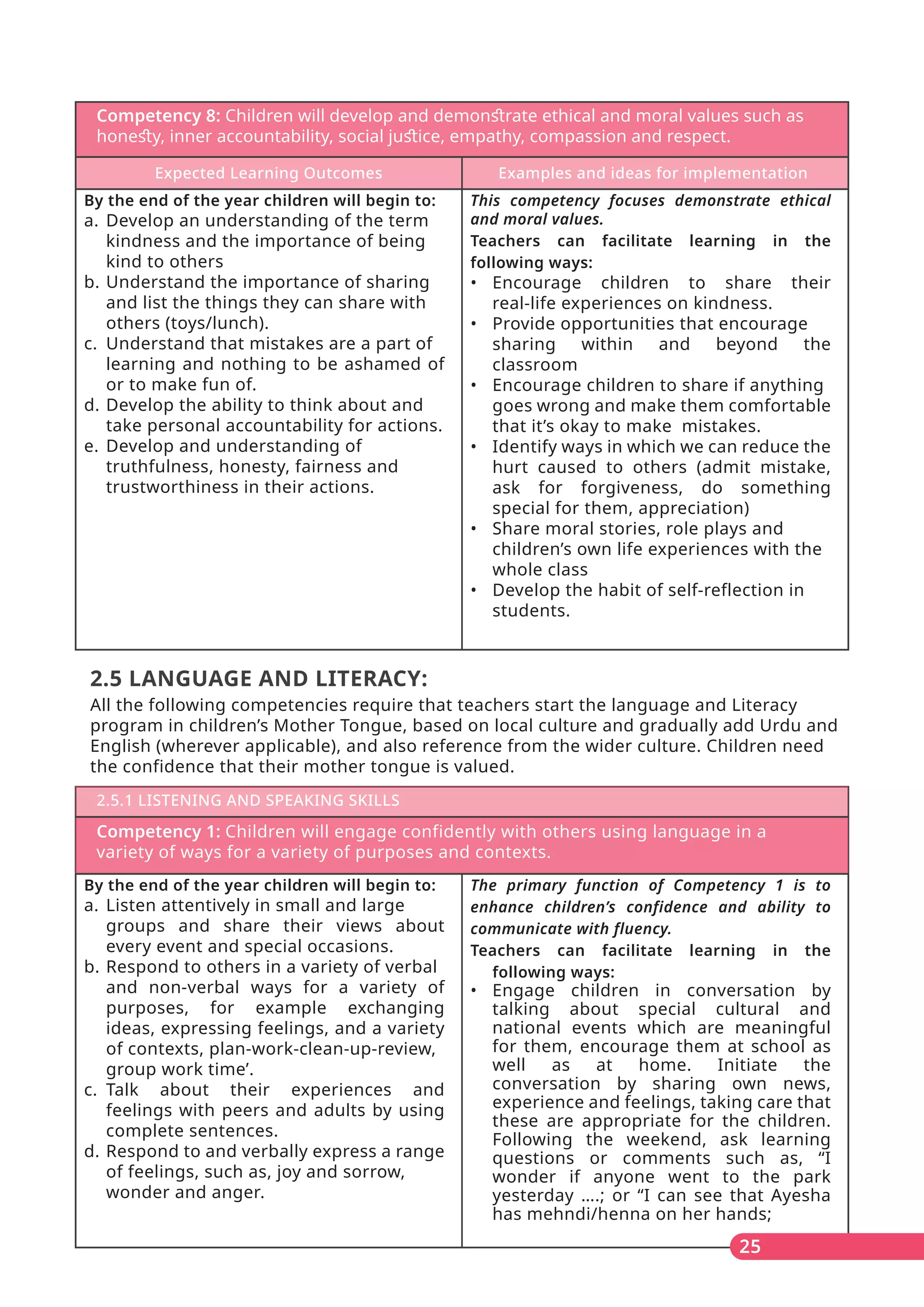
pictures to aid understating.
Learning and Teaching for the Early Years:
This theme will highlight the following important points:
• Learning in the early years; explaining the key points about natural learning processes.
• An Active Learning Approach: Understanding active learning, its importance and how it
is different from traditional approaches to learning in schools. Ways of involving
children in an active learning process, with examples. Understanding the ‘plan – work -
clean – review’ cycle, its importance and implementation. Involving children in free play
and exploration activities and organizing hands-on experiences for children in all
learning areas. Involving children in discussion, role-play, creative thinking,
questioning and problem solving.
• Dealing with diversity in the class; concepts of learning styles learning differences and
multiple intelligences. Explaining that each child is unique in terms of his/her social and
cultural background, developmental milestones, experiences and learning potential.
• Ways of creating an inclusive ECCE class. The attitude and skills required by an ECCE
teacher to engage with individual children as per their needs.
Learning Activities:
It is suggested that under this theme various learning activities may be added for
classroom use:
• Examples of learning activities should be arranged according to the learning areas, so
that teachers can use them easily to link with various Expected Learning Outcomes. The
ideas presented here will be useful for planning their lessons and to design their own
activities.
• Besides suggesting activities under various learning areas, teachers should be given an
understanding of how to design integrated lessons. Examples need to clearly
68
demonstrate how one learning activity can contribute towards the achievement of
number of different ELOs.
Learning Environment:
This theme will provide detailed guidelines to teachers for setting up their classroom in
terms of space and time according to the principles of quality ECCE practice. It is
recommended that this section should be supported with many good quality photographs
of a variety of creative classroom arrangements in different contexts with different
resource constraints. These visuals will help teachers to understand the possibilities of
different types of classroom floor plans and will offer them options to choose for their
own classrooms. The theme will explain the following essential aspects of the learning
environment.
• The term ‘Learning Environment’ and what constitutes the learning environment in an
ECCE classroom, including the physical, social and emotional environments.
• Key features of an ECCE classroom and its physical features, such as, cleanliness, light,
ventilation, seating (age appropriate and child friendly furniture), kinds of material
needed, placement of materials, accessibility of materials by children and safety
aspects in the classroom. This part will also present different ideas for arranging the
classroom.
• Creating Learning Corners (Goshay): This theme will help teachers understand the
basic ideas about learning corners, the objectives behind setting up learning corners,
their importance and the materials required for each corner and how to use them
effectively.
• Classroom display: This part will help teachers understand the importance of classroom
displays in ECCE classes, and give them ideas on how to involve children in classroom
displays. Some creative and attractive displays regarding different concepts such as
photographs, children’s art work, key messages, letter of the day are recommended for
different learning areas
• Classroom Management Techniques: Classroom norms and responsibility chart should
be developed with children’s consent and reviewed regularly and displayed in the room.
Message of the day or a week should be practiced regularly and to be displayed in the
classroom.
• Daily Routine: To make optimal use of the valuable time young children spend in school,
teachers will be familiarized with the importance of a consistent daily routine and
shown some examples of daily routine scheduling. An explanation of routines and the
importance of flexibility to meet children’s spontaneous needs will be stressed.
• Classroom Management Checklist: This part will provide a handy sample checklist to
teachers to assess their own classroom environment and its appropriateness for
quality ECCE practice.
SECTION V: ASSESSMENT AND EVALUATION
In order to change classroom practice, it is essential to bring about changes in
understanding of assessment as part of the teaching process. This section is
recommended to help the teachers to understand the following:
• Focus of assessment: This part will explain the purpose of assessment in an early years’
classroom.
• Observation as a tool for assessment: This part will highlight the importance of
observation as an effective tool for assessment and provide teachers with guidance
about when, how and what to record during observations.
• Use of checklist for assessment: This section will help teachers to understand checklist,
and how to create, administer and analyse checklists.
69
• Portfolio of children’s work: This section will
introduce the concept of portfolios to teachers and will explain its importance for
assessment in the early years. It will also guide teachers on how to maintain a portfolio.
• Progress report for parents:
This part will help teachers to know the importance of progress reports, creative and
appropriate formats, ideas and important points for writing comments and effective
ways to share the reports with parents.
SECTION VI: THE IMPORTANCE OF PLANNING
This section will explain the following points:
• The importance of planning before a lesson:
• Planning schedules: yearly, quarterly, monthly, weekly, daily
• Characteristics of a good planning process and planning document
• Planning a day for young learners
• Elements of flexibility and adaptation in the plan to cater to the needs, interest and
moods of children
3.4 GUIDELINES FOR IMPLEMENTATION OF THE TEACHERS’ GUIDE
A) PLANNING
1. Forming a team by identifying people with good writing skills. The team of writers must
include people with the relevant experience (practitioners) of working at the
ECCE/Primary level. They should also have a deep understanding of teacher education
and adult learning.
2. Reading and understanding the National ECCE Curriculum and this section on the
development of the Teachers’ Guide.
3. Meeting with the curriculum development team to understand the philosophy and
principles on which the National ECCE curriculum is based, and to clarify the aspects of
the curriculum which are unclear to the writers.
4. Understanding and reviewing the suggested format for the guidebook, and finalizing
the format and procedures for writing.
5. Deciding the roles and responsibilities of each team member, dividing the work and
setting deadlines.
6. Forming a review team.
B) DEVELOPING
1. Producing initial, individual drafts as per decisions taken at the planning level.
2. Reviewing the drafts and existing relevant documents.
3. Soliciting feedback from the review team.
4. Incorporating the feedback and revising the initial drafts.
C) PILOTING
1. Sharing the complete draft with teachers in public and private schools and in teacher
training colleges.
2. Sharing key areas with them in which feedback is required, such as language of the
guidebook, format of the book, missing content and clarity of ideas presented in the
guidebook.
3. Meeting with the people piloting the guidebook, and collecting data on their
experiences.
70
4. Asking them to share the areas which they found
difficult or ambiguous or needing greater emphasis.
5. Reviewing and revising the guidebook in light of feedback from piloting, to develop the
final version of the guidebook.
D) EDITING
1. Getting the services of editors to ensure the accuracy of language and formatting.
2. Revising the draft further to incorporate the editors’ recommendations.
E) PUBLISHING
1. Finalizing the details of the layout and graphics.
2. Composing the book.
3. Proofreading the composed draft.
4. Printing of required number of books.
F) DISSEMINATION:
1. Ensure the timely distribution of the documents to the teachers, head teachers,
principals and education officers.
3.5 GUIDELINES FOR DEVELOPING A TEACHER EDUCATORS’/SCHOOL
ADMINISTRATOR’S GUIDE:
Young children need very skilful and caring facilitation from adults in order to explore
their environment and build understanding of it. An adult, who understands children’s
potential and possesses an ability to develop trustful relationships with them, can create
an environment conducive to nurturing children’s innate potential. At schools, teachers
need to have an understanding of the ECCE curriculum besides having a loving and caring
attitude. In order to ensure that teachers have the required understanding, skills and
attitude to work with young children, they need to be engaged in an on-going process of
learning and professional development. The role of teacher educators is to design and
implement programmes to facilitate teachers to learn about the basic concepts of Early
Childhood Education and Development and build the required skills to work effectively
with children. Furthermore, they are responsible for providing adequate support and
learning material for ECCE.
3.5.1 FORMAT AND SUGGESTED CONTENT
It is crucial that the developers of the Teacher Educators’ Guide carefully read and
understand:
1. The National Curriculum for Early Childhood Care and Education
2. The Teachers’ Guide Book
3. Sections II-VI of the chapter titled, Essentials for Developing a Teachers’ Guide, in this
document
The Teacher Educators’ Guide will be divided into sections which will elaborate aspects
that are essential for ECCE teachers to know and understand. These sections will help
teacher educators to understand the need, content and design aspects of a professional
development programme for ECCE teachers. The following sections are recommended as
components of the Teacher Educators’ Guide.
71
3.5.2 KEY COMPETENCIES FOR TEACHER EDUCATORS/SCHOOL ADMINISTRATORS:
This section will describe the key competencies essential for teacher educators. It is
essential for all teacher educators to understand the competencies given below, so that
they can assess themselves, as well as design professional development programme, in
line with the competencies required by the teachers.
Teacher Educators assume the important and sensitive responsibility of facilitating
teachers to learn and improve their understanding and skills. In order to accomplish their
task effectively, they also need to possess a certain level of competence in terms of
knowledge, attitudes and skills. These are the key competencies essential for a teacher
educator:
KNOWLEDGE:
Teacher educators need to possess comprehensive knowledge and understanding about
the following:
• Theories of Child Development from zero – eight.
• Brain development research.
• Theories and methods of child learning and development.
• Theories and methods of adult learning, support and development.
• The National curriculum for Early Childhood Care and Education, and ECCE Teachers’
Guides.
• The Role of parents, care-givers, families and communities in nurturing children.
• Services and support mechanism available within the community for the development
of children.
ASSESSMENT OF TEACHER LEARNING. SKILLS:
• Andragogic skills to facilitate the learning process of adults.
• Providing positive reinforcement.
• Skills for designing, conducting and assessing workshops/seminar/courses for ECCE
teachers.
• Skills for developing resources to support teachers’ learning.
• Observation skills to assess teachers during workshops/courses and in the classroom.
• Documentation skills to record observations and maintain records of teachers’
participation and performance.
• Communication and presentation skills to effectively communicate with teachers.
• Communication skills to provide constructive feedback to teachers about their
performance.
• Counselling skills to work with teachers and head teachers on a one to one basis for
school development.
• Independent learning skills for engaging self in an ongoing process of learning.
ATTITUDES:
Teacher educators must realise the importance of building rapport, i.e; a close and
harmonious relationship with teachers and groups of teachers, and show concern and
understanding of their background and current needs. They need to ensure that their
interaction with teachers demonstrates:
• Respect for the knowledge, skills, experience and individual potential possessed by
each teacher.
72
• Consideration, respect and empathy towards all
teachers.
• Patience while interacting with teachers and responding to their questions, requests,
concerns, ideas, and feedback.
• Unbiased and non-judgmental behaviour in dealing with teachers.
• Pro-active approach in identifying, exploring and accessing the services available for
the support of teachers in the community.
• Willingness to engage self in a continuous process of learning.
EXPERIENCE:
It is important for ECCE teacher educators to have the following experiences:
• Teaching experience at ECCE or primary level classes.
• Mentoring experience with ECCE or primary level teachers to support their learning.
3.6 GUIDELINES FOR PLANNING CONTINUOUS PROFESSIONAL DEVELOPMENT
PROGRAMME (CPD) FOR ECCE TEACHERS:
This section will facilitate teacher educators, school administrators, training departments
in understanding the important steps they need to undertake in order to design a
professional development programme for ECCE teachers:
• Analysing the needs: Assessing the needs of teachers and understanding their current
competencies.
• Reading the Teachers’ Guide thoroughly: Before designing a professional development
programme for ECCE, it is essential that teacher and educator read the Teachers’
Guides thoroughly, to understand the scope, nature of work and expectations of an
ECCE teacher.
• Forming a team: Relevant Education Department needs to form a team of teacher
educators to design and conduct the programme. The team may include other teacher
educators or competent ECCE teachers/head teachers.
• Developing a detailed plan: The training team should design a detailed plan for
implementation by identifying content, strategies and activities; resources required;
and assessment techniques. The Guidebook should contain some sample templates for
planning.
• Collecting/developing resources: before the programme commences, the team
needs to develop and collect all the required resources for the implementation of the
programme.
• Setting-up the room: The space where the programme will be run needs to be
properly organized. The implementing team needs to ensure that the space is:
o Neat and clean.
o Well-lit and ventilated.
o Organised with appropriate and comfortable seating arrangements, drinking water
and with clean washroom facilities nearby.
o Provision of internet connection, multimedia and relevant material that include
reference books.
o Attractive with relevant displays and all other teaching-learning resources at hand.
3.7 GUIDELINES FOR DEVELOPING CONTENT OF AN ECCE CONTINUOUS
PROFESSIONAL DEVELOPMENT PROGRAMME
Most of the content for a professional development programme will be derived from the
key competencies described above and will facilitate the teachers to enhance their overall
competence level.
This section will elaborate on the concepts that
have been given in Sections II – VI of the chapter titled Essentials for Developing a
Teachers’ Guide in this document:
• Section II Early Childhood development: Child Development and Early Childhood
Development and Relationship Building.
• Section III knowledge and Understanding of the National Curriculum for ECCE
• Section IV Understanding Learning and the Learning Environment: Learning and
Teaching for the Early Year, Learning Activities and Learning Environment.
• Section V Assessment and Evaluation.
• Section VI Importance of Planning and Reflection.
3.7.1 DESIGNING A TEACHER EDUCATION PROGRAMME
This section will provide guidelines to teacher educators for the actual design of the
programme. A few ideas are presented here which can be further elaborated on, and
more ideas added to the guide. Teacher educators can design pre-service or in-service
courses/workshops/seminars for teachers, depending on the findings of the need
analysis, available time and other context-specific circumstances. Below are the three key
approaches which can be used to design a professional development programme. A mix
of all three approaches would be greatly beneficial for teachers.
A) ORGANIZING LEARNING SESSIONS
Learning sessions are a key component of any professional development programme.
These sessions can be in the form of workshops, seminars, and discussion forums. The
main purpose of these sessions is to provide an opportunity to teachers to get together,
share ideas and experience and learn about various aspects of their work under the
guidance and facilitation of an experienced facilitator. It is recommended to hold cluster
wise meeting and assign responsibility to a district education officer to ensure these
meetings.
There could be a series of learning sessions at the beginning of any programme related to
the basic ideas and then the remainder of the sessions could be spread over a period of
time. Weekly sessions and fortnightly seminars can also be organized. In these sessions,
teacher educators can engage teachers in a variety of activities related to the components
of the programme. Teacher educators need to ensure that their learning sessions
demonstrate the following key features:
• Use of an active learning approach in which teachers are engaged in a variety of
activities to explore and understand the various aspects of teaching and learning and
an ECCE curriculum. Teachers should not be merely lectured on various topics but they
need to be involved in reading, discussions, presentations, simulations, role-play, and
debates. They need to be practically engaged in most of the learning approaches or
techniques which they are supposed to use in the classroom. This will help them to
experience such processes and their impact on learning.
• Provision of practical, hands-on experiences to teachers during learning sessions in
order to help them to develop the skills they will need, such as developing material of
ECCE classes, developing plans, demonstrating lessons.
• A collegial and respectful environment in the sessions so that teachers of varied
experiences, qualification and personalities feel comfortable, and can concentrate on
their own learning, and can also support others to learn.
73
B) FIELD BASED SUPPORT
This approach is used to ensure that the newly trained ECCE teachers get enough support
and guidance for the implementation of new ideas in the classroom. The new ECCE
teachers are mentored/coached by the teacher educators or by experienced and skilled
teachers already present in the school. Such support may include providing the new ECCE
teachers help in planning lessons, observing ECCE class and helping teacher to reflect on
the lesson, help teachers in the class to demonstrate and practice specific skills. It may
also be used to assist new ECCE teachers in accessing or developing resources. This
support is essential as it actually helps the new ECCE teachers to reflect on the issues,
identify solutions and move ahead with new ideas. It also makes such teachers
enthusiastic and accountable for the implementation of new ideas.
Teacher educators can visit and work with the new teachers in the school on particular
days. They can also introduce the following strategies to initiate an on-going process of
learning and support within the school:
• Identifying senior and competent teachers in the school and getting their support for
helping new teachers in the field. These teachers can help the new teachers by
planning together, observing each other’s classes, reviewing the work of new teachers
and organizing small learning sessions within the school for new teachers.
• Peer Coaching or encouraging teachers of the same level to work together and to
support each other in learning. They can observe each other’s classes, review each
other’s material, and do joint planning.
• Taking help from supervisors in public schools, and guiding them to provide
needs-based support to teachers when they visit the schools.
C) ARRANGING & PARTICIPATING IN ON-GOING REVIEWS AND REFLECTION SESSIONS
These sessions provide a platform to the teacher to get together and share their
successes and challenges with each other. They can learn from each other’s experiences
and provide necessary support to each other. These sessions provide teacher educators
with a valuable opportunity to understand the common issues of all teachers enabling
them to improve the design of further learning sessions. These sessions can be facilitated
by teacher educators, or the head of a school, or supervisors in public schools.
D) ARRANGING ORIENTATION SESSIONS FOR HEAD TEACHERS AND PRINCIPALS
• The orientation sessions should cover all the key areas of the training attended by the
teachers.
• Head teachers and principals should know what the trainee teacher is expected to do in
the school.
• Head teachers and principals should facilitate and provide support to the trainee
teachers.
3.8 GUIDELINES FOR DEVELOPING ASSESSMENT OF ECCE TEACHERS’ TRAINING,
LEARNING AND CPD PROGRAMMES
It is important for teacher educators to use specific methods to assess the relevance and
delivery of their programme, as well as its impact on teachers’ learning and classroom
practice. Given below are guidelines to teacher educators to develop tools and processes
for the assessment of teacher learning sessions. It is recommended that detailed
74
guidelines for the following key areas be provided in the guidebook:
• Purpose of assessing learning session and fields-based support.
• Purpose of assessing teachers’ competence levels.
• Methods of assessing learning sessions and field-based support.
• Taking participants’ feedback at the end of the programme through questionnaire,
checklist or rating scale. Some sample tools can be included in the appendices.
• Asking participants to talk about the session/field-based support provided, in terms of
what value was added to their learning, what did not work and what needs to improve.
• Inviting experienced individuals to provide feedback to teacher educators to improve
the sessions.
• Reflecting daily on the sessions/field-based work by teacher educators themselves, in
order to identity the strengths and weaknesses of their programmes and then taking
action to improve.
• Techniques to assess teachers’ competence and professional growth.
• Observing teachers in action in the school and classroom and assessing their
competence in all areas.
• Discussing their work with teachers and asking for a self-analysis on their learning.
• Studying and analysing teachers’ work such as, plans developed by them for their
classes, learning material produced by them.
• Discussing teachers’ performance with the head of the school.
3.9 GUIDELINES FOR ECCE LEARNING MATERIAL DEVELOPERS:
3.9.1 KEY CONSIDERATIONS FOR MATERIAL DEVELOPMENT
• Goals and Objectives: The first step towards developing learning material is to account
for its utility and impact on children’s learning. It is critical to identify specific learning
areas and key competencies for which the learning materials will be used, and this
information should be included in the packaging/literature. Consequently, focused
materials development and effectiveness of pre-testing will be ensured. If this
information is provided to teachers, parents and educators, it will facilitate the effective
utilization of the learning materials.
• Interactivity of Materials: Children at the ECCE stage of development need hands-on,
concrete activities to make sense of the world around them.
• Quality and Relevance of Content: A key aspect is to look at the content for its quality.
Depth, range, comprehensiveness and accuracy of information shared, defines the
quality of the materials. For example, depicting a whale as fish is inaccurate. Checking
the learning content for relevance with respect to the age, context and key
competencies is essential for producing quality learning material. It is also entirely
possible that correct information can be irrelevant. For example, describing the
internal parts of a computer at the ECCE level is irrelevant and unnecessary, even
though the information may be accurate. Material must be assessed for both quality
and relevance.
• Language and Text: Developers should ensure that words used in the material are
appropriate to the learner’s as well as the teacher’s literacy level. Complex sentence
structures and archaic words should be avoided. For ECCE materials, language must be
simple and creative. Care should be taken to ensure that language and text used for
materials do not violate the principles of inclusiveness and diversity mentioned below.
All learning materials should be free from stereotyping and should respect the social
diversity of the context. Stereotypes may be understood as ideas about
75
people that are widely held and accepted, though
they may not necessarily be true, such as, only men as breadwinners, and women as
housewives only. The title of the material, especially in the case of booklets, guides and
displays should be engaging and meaningful.
• Visuals: Visuals and illustrations at the ECCE level play a key role in stimulating
children’s thinking and developing their meta-cognitive skills. The illustrations and
graphics used in the material should be accurate, attractive, bright, colourful, and
engaging. However, they should not be too busy or cluttered, thereby making it difficult
for children to focus on the main points. Visual content should be free from all types of
stereotyping whilst retaining relevance and respect for social contexts. For instance,
check the illustrations and see if the dominant characters are mainly from one cultural
group or are all men. Who is doing what? Are children with disabilities passive
onlookers, or are they actively involved? Do they look enthusiastic? Is the imagery in
any way promoting violence? Responding to such questions will ensure that
illustrations are not perpetuating the taboos and misconstrued notions widely held in
society.
• Incisiveness of Teaching Materials: It is of utmost importance that the teaching and
learning materials are incisive in nature. As charted out by UNESCO, learning materials
become incisive when they:
- Include all children, including those with diverse backgrounds and abilities.
- Are relevant to the children’s learning needs and abilities, as well as their way of life.
- Are appropriate to the culture and value social diversity, for example, socio-economic
diversity: poor families can be very good families for children; they can come up with
creative solutions for problems, and they could be depicted as inventive.
- Are useful for their future life.
- Include males and females in a variety of roles.
- Use appropriate language that includes all of these aspects of equity.
Checking the story line is also critical for making the material incisive and respectful.
Consider how problems are presented, conceived, and resolved in the story. Does the
story line encourage passive acceptance or active resistance by “minority” characters,
such as persons with different abilities? Are the successes of girls and women based on
their own initiative and intelligence, or are they due to their good looks? Could the same
story be told if the action or roles given to men and women in the story were reversed? It
often goes without any realization but most commonly told tales like Cinderella, present
gender biased and stereotypical roles.
• Safety of Materials: Learning resources related to the Key Learning Area should be
produced as far as possible with natural materials. The concept of safety is broader
than ensuring that materials do not have sharp edges. For instance, many toys and
learning materials are made of poor quality plastic which is detrimental to health and
is carcinogenic. Where possible, environment friendly materials should be used.
3.10 A SUGGESTED LIST OF MATERIALS FOR THE ECCE CLASSROOM
Given below is a list of learning materials which teachers can place in the Learning
Corners/Goshay and use during Group Work Time as well. It is highly recommended that
the materials are from the local context to begin with. Not all materials have to be
purchased; families and community members will certainly be willing to share old/used
(but clean) objects and “junk” which can be very useful to build up a conducive and
equipped ECCE learning environment. However, there is no limit to quality and if
resources permit an ECCE classroom must be the best equipped classroom in any school.
Materials which can be recycled and reused are strongly recommended.
76
Teachers must check for breakage, safety and
cleanliness on a daily basis.
For Creative Art Work
• Materials for mixing and painting
• Paint/powder paint
• Crayon shavings, Pencil shavings, Wood shaving
• Plastic bottles
• Plastic jars
• Paint brushes of different sizes
• Saucers, dishes for paint
• Sponges
• Aprons, T- shirts
• Toothbrushes
• Clothes pegs,
• Small pieces of cloths
• Materials for representation
• Pencils, crayons, markers, chalk
• Magazines, newspapers, catalogues
• Paper of different sizes and textures
• Wax paper, tissue paper
• Scraps of paper, paper plates
• Invitation/greeting cards
• small/large empty boxes
• Clay, slime, plasticine
• Large Buttons, straws, small empty cartons
• Empty thread spools/reels
• Cardboard tubes, paper bags
• Cloth, felt, vinyl scraps, fallen leaves
• Recyclable/indigenous materials
• Materials for holding things together and for taking them apart
• White glue,
• Masking tape,
• Yarn
• Staplers (for teachers’ use only)
• String
• paper clips (for teachers’ use only)
• Rubber bands
• Round tip scissors
• Cellophane tape
• paper knives
• For Music and Movement
• Tape recorders/CD players and tapes/CDs of a variety of music,
• Musical instruments (homemade or purchased)
• Bottles of different sizes and textures, metal spoons, wooden sticks
• For Pretend Play/Role Play (all toys)
• Old telephones, old clocks, (toy) tool box, soft chair, dust brush and dustpan
• Small tables and chairs
• Props for pretending – clothes, hats, shoes, mirror
• Dolls, stuffed animals, doll beds, baby rattles,
77
bibs, bottles
• Cushions, small blankets, matters
• Toy utensil sets
• Teapots, kettles (toy)
• Cutlery, doi, (ladle)
• Mixing bowls, measuring spoons/cups, sifter
• Potholders, aprons, towels, sponges, napkins, place mats
• Empty dry food boxes, cartons, jars, bags
• Doctors’ sets
• Gardening tools set
• Construction tools set
• Carpenter tools set
• For Building and Pretend Play
• A variety of blocks: hollow, unit small stacking,
• Blocks made from boxes
• Large and small boxes, small pieces of wood with round edges
• Small cars and trucks, small animals, insects, birds
• For Experimentation and Discovery
• Seeds, fallen leaves and twigs
• Magnifying glass
• Puzzles, boxes and bottle with lids in different sizes
• Large nuts and bolts (toy)
• Cloth Pegs
• Stacking rings
• Magnets, scales and balances
• Beads, stringing materials
• Large Buttons, small stones, sea shells
• Sets of matching picture cards
• Sand and water, sifters and strainers
• Materials that will float/sink
• Measuring cups, funnels
• Material for bubbles making
• maps of Pakistan and World
• For Reading and Writing
• Pencils, crayons, markers
• Old Computer keyboards, typewriters
• Rubber stamps, paper clips, tape, rulers
• Different types of paper: with and without lines
• Envelopes
• Assorted books (big books, small books, picture books with and without text)
• Child-made books
• Photograph books from field trips
• Cosy chair or pillows
• Puppets
• Slate & chalks
• Takhti, qalam & dawat
• Rubbers
• Foot rulers
• Sharpeners
78
CHAPTER
80
CHAPTER
THEORETICAL PERSPECTIVES ON EARLY
CHILDHOOD CARE AND EDUCATION
(ECCE)
4.1 DEVELOPMENTAL THEORIES:
4.1.1 BRAIN DEVELOPMENT IN THE EARLY YEARS
At birth, the brain of a baby is only 25 percent of the weight of an adult’s brain, which is
1.5 kg. By the age of 3, it is 90 per cent of the adult weight and by the age of six, it is almost
as large as it will ever be. However, some parts of the brain continue to grow even in
adulthood. The fast growth of the brain in the first few years of a child’s life is a critical
indicator of how important the early years are.
The brain is made of tiny building blocks known as cells which are also present in rest of
the body. These cells are so tiny that they cannot be seen without the help of a strong
microscope. When a baby is born, it has all the brain cells it will ever need. There are a
hundred billion brain cells present at birth. Brain cells are also called neurons. Neurons
are able to send and receive messages from other neurons. In fact, they are only useful
when they connect with each other.
To better understand this, think of your brain as an office where the neurons are the office
workers. Now imagine that none of the workers are allowed to talk or work with one
another. How do you think that office will functions? Obviously, an office can only operate
when the workers are allowed to talk and work with each other. Similarly, our brain can
only work usefully when the neurons connect with each other.
When one neuron connects with another it forms a connection called a synapse. When we
talk about brain development we are actually talking about the creation of synapses in a
brain. One neuron can form synapses with many other neurons and so the number of
synapses grows very rapidly. There are trillions of such connections in our brain making a
kind of complicated web.
As shown in the figure, a young child of 02 years has twice as many synapses as that of an
adult brain. As the neuron web grows, child’s abilities such as, memory, language skills,
problem solving and intellectual capacity also grow. However, the neurons and synapses
which are not being used eventually stop working and die. For example, vision (or eye
81
sight) develops slowly during the first six months of life. If the ‘web’ of synapses that is
responsible for vision is not stimulated correctly during these months, eye sight may not
develop properly. As a result, if the baby’s eyes never see any light in the first six months,
no synaptic connections would form and the baby would not have any vision.
The ability and rate, at which synaptic connections are formed, reduce significantly by the
time adulthood is reached and only those connections stay put that have been
strengthened during the early years. The simple mechanics of brain functioning portrayed
in the figure, not only highlight the criticality of the early years, but also the significance
of an enabling and nurturing environment for the holistic development of children.
Although learning is a continuous, life long process, the extent to which we can realize our
potential and what we become as adults, is largely determined by what we experience in
our childhood. Scientific findings about brain development confirm what most of us
already know....warm and loving attachments between infants and mothers/caregivers,
and positive stimulation right from birth make a significant difference in children’s
development. In the early years’ classroom, a warm, trusting, comfortable relationship is
crucial for positive, holistic development.
So now the question therefore is “how do we best help children achieve the full potential
of development of the brain?” There are several ways to achieve as theorised by ECCE
philosophies and practices. Most of them define an enriched environment as one that
includes a steady source of environmental support, nutritious diet, stimulates all senses,
atmosphere free from stress, enjoyable, challenging, allows social interaction, promotes
development, and gives the child a chance to assess the results of their actions, all in all
allows the child to be an active participant rather than a passive observer (Diamond and
Hopson, 1998).
This idea is reflected in what an ECCE classroom is perceived to be as a prepared
environment. The prepared environment allows the link for a child to reach into his world.
ECCE related educational philosophies define a prepared environment to consider the
specific needs of the children with concerns to their age of development, it provides the
children what they need in order to live such as, physical and emotional security. It should
be aesthetically pleasing and inviting, this includes hygiene and appropriate furniture,
and it has to have order. These are few of the main ideas but it is vital to mentions that the
environment has to allow freedom of choice, it allows the children to act independently,
and allow them to learn to take responsibility for their actions.
It is good to know about 5 Stages of Human Brain Development
Throughout the lifetime of the human brain it continues to undergo changes.
Stage 1: 0 to 10 months
• Neurons and connections grow.
• A pregnant woman should stay as stress-free as possible, take folic acid, B6 &B12,
stimulate this young developing brain with sounds and sensations. Mother should
avoid toxins, cigarettes, heavy metals, alcohol, drugs.
82
Stage 2: birth to 6 years
• Development of voluntary movement, reasoning, perception, frontal lobes active in
development of emotions, attachments, planning, working memory, and
perception. A sense of self is developing and life experiences shape the emotional
well-being.
• By age six, the brain is 95% its adult weight and at the peak of energy consumption.
• Caregivers need to provide nurturing environment and daily individualized
communication. Negative or harsh treatment may come with emotional
consequences in the future.
Stage 3: 7 to 22 years
• The neural connections or ‘grey’ matter is still pruning, wiring of brain still in
progress, the fatty tissues surrounding neurons or ‘white’ matter increase and
assist with speeding up electrical impulses and stabilize connections. The
prefrontal cortex is the last to mature and it involves the control of impulses and
decision-making.
• Therefore, teenagers need to learn to control reckless, irrational and irritable
behaviour. Avoiding drugs, alcohol, smoking, unprotected sex and substance
abuse.
Stage 4: 23 to 65 years
• Finally, the brain reaches its peak power around age 22 and lasts for 5 more years.
Afterwards, it’s a downhill pattern begins. The last to mature and the first to go are
the brain functionality of executive control, occurring in the prefrontal and
temporal cortices. Memory for recalling episodes start to decline, processing speed
slows and working memory is storing less information.
• Brain cells are lost in the critical areas such as the hippocampus responsible for
processing memories.
• Learn new skills, practice mediation to promote neutral emotions, exercise to
improve abstract reasoning and concentration.
• Avoid stress or incorporate stress reducing medication and exercises.
• Eat a healthy diet with foods to nourish one’s level of dopamine.
Stage 5: older than 65 years
Source: http://nancyguberti.com/5-stages-of-human-brain-development/
4.1.2 PIAGET’S THEORY OF COGNITIVE DEVELOPMENT:
Jean Piaget (1896-1980) a Swiss psychologist, who studied the intellectual and logical
abilities of children, theorized that cognitive development proceeds in four stages that
follow the same sequential order. His Cognitive Development Theory is hugely influential
in the fields of education and psychology. He proposed that the thinking process develops
through each of the stages, until a child can think logically. Understanding cognitive
development helps us organize appropriate learning environments and plan
developmentally appropriate learning activities. The following are Piaget’s four
developmental stages:
83
A) THE SENSORIMOTOR STAGE (BIRTH – MONTHS/2 YEARS)
Even though Piaget was opposed to applying age norms to the stages, most researchers
consider approximately the first two years of life to be the Sensorimotor Stage. Infants
mainly make use of senses and motor capabilities to experience the environment. For
instance, if infants cannot see or touch an object, they stop trying to find it. Once infants
develop the capability to recognise that a hidden object still continues to exist, they start
searching for it. The characteristic limitation of this stage is ‘thinking only by doing’. The
sensorimotor infant’s main concern is developing motor control, and coordination with
information from the senses.
B) PREOPERATIONAL STAGE (2 – 7 YEARS)
The second stage in Piaget’s theory of development coincides with the preschool years. At
this stage, children develop the ability to think symbolically and use language to express
their thoughts, needs, feelings and observations. However, the preoperational child still
learns from concrete material, while adults can learn in an abstract way. The
preoperational child is also unaware of another person’s perspective. They exhibit
egocentric thought and language.
Here are some limitations of preoperational thought. To begin with, the preoperational
child lacks the concept of conservation. For example, a child is presented with two rows of
apples that contain the same number of apples. When one row is lengthened without any
change in the number of apples, the preoperational child states that the rows are not
equal. The appearance of the objects gives the wrong impression about them. Children’s
decisions are dominated by their perceptions.
Conservation does not happen simultaneously in all subject areas. Children can
understand conservation of numbers around age 5-6, and understand conservation of
substance, or mass at around age 7-8. Additionally, the preoperational child is likely to
centre on only one dimension of an event and ignore other important details. Also,
84
children concentrate more on the static features of an event, than on the
transformations from one state to another. Children in the preoperational period, at times
will see some relationships between particular cases while in actuality there is none. For
instance, a child might say, “If an apple is red, then a green fruit is not an apple.”
C) CONCRETE OPERATIONAL STAGE (7 – 11 YEARS)
The next stage generally represents the elementary grade years. The concrete operational
child begins to think logically. Operations are associated with personal experience.
Concrete operations allow children to classify several classes into a bigger group or to
combine a number of classes in any order. Although objects are moved or reordered, no
change takes place in their perception of the objects; they are able to conserve. Concrete
operations also allow children to order objects in terms of more than one dimension and
they can solve conservation tasks. The operational thought is reversible; the concrete
operation child can operate an action, and then go back to the original condition. For
instance, 3+2=5 and 5-2=3.
D) FORMAL OPERATIONAL STAGE (11 YEARS AND BEYOND)
After roughly 11 years, students have the ability to consider many possibilities for a given
condition. They are able to deal with propositions that explain concrete facts. They have
the ability to use planning to think ahead. Most importantly, students at Piaget’s final
stage of cognitive development increase their ability to think abstractly. They can solve
complex and hypothetical problems involving abstract operations.
Formal operational thinkers can recognise and identify a problem. They can state several
alternative hypotheses, execute procedure to collect information about the problems to
be studied, and test the hypotheses.
4.1.3 VYGOTSKY’S THEORY OF SOCIOCULTURAL DEVELOPMENT:
Lev Semyonovich Vygotsky, a Russian psychologist who lived during the Russian
Revolution, developed a theory of development known as the Sociocultural Theory of
Development during the first quarter of the twentieth century.
As a proponent of the sociocultural perspective to development, Vygotsky’s outlook
gained worldwide recognition and began to exert influence when his work was finally
translated into English in 1962 and the importance of both sociocultural contexts of
development and cross-cultural research was recognised.
Vygotsky’s main assertion was that children are entrenched in different sociocultural
contexts through which their cognitive development is advanced through social
interaction with more skilled individuals. His theory is mainly concerned with the more
complex cognitive activities of children which are governed and influenced by several
principles. Believing that children construct knowledge actively, Vygotsky’s theory is also
one of those responsible for laying the groundwork for constructivism.
85
A) ZONE OF PROXIMAL DEVELOPMENT
Vygotsky is most recognised for his concept of Zone of Proximal Development or ZPD
pertaining to the learning of children. Children who are in the zone of proximal
development for a specific task are almost able to perform the task independently, but not
quite. With an appropriate amount and level of assistance, however, children are able to
successfully accomplish the task.
The lower limit of a child’s zone of proximal development is the level of analysis and
problem-solving reached by a child without any help. The upper limit, on the other hand,
is the level of additional responsibility that a child can receive with the support of a skilled
instructor.
As children are verbally given instructions or shown how to perform certain tasks, they
organize the new information received in their existing mental schemas in order to assist
them in the ultimate goal of performing the task independently. This emphasis on the
concept of Zone of Proximal Development made by Vygotsky underscores his conviction
that social influences, particularly instruction, are of immense importance on the
cognitive development of children.
B) MORE KNOWLEDGEABLE OTHER
The child is entrenched in a sociocultural backdrop, usually the home, in which social
interaction with significant adults, i.e. the parents, is the crucial factor that affects the
child’s learning. Adults need to direct and organize the learning experiences of a child to
ensure that a child can master and internalize the learning.
Any person who possesses a higher skill level than the learner with regard to a particular
task or concept is called a More Knowledgeable Other or MKO. This person may be a
teacher, parent, an older adult, a coach or even a peer.
86
C) SCAFFOLDING
The concept of scaffolding is closely related to the concept of the zone of proximal
development. Scaffolding refers to the temporary support given to the child by More
Knowledgeable Others, usually parents or teachers that enable the child to perform the
task until such time that the child can already perform the task independently.
Scaffolding entails changing the quality and quantity of support provided to a child in the
course of a teaching session. The more-skilled instructor adjusts the level of guidance
needed in order to fit the student’s current level of performance. For novel tasks, the
instructor may utilize direct instruction. As the child gains more familiarity with the task
and becomes more skilled at it, the instructor may then provide less guidance.
Children who experience more difficulty in task performance are in need of greater
assistance and guidance from an adult. When the child has learned to complete the task
independently, the scaffolds are removed by the adult, as they are no longer needed.
A major contribution of Vygotsky’s theory is the acknowledgement of the social
component in both cognitive and psychosocial development. Due to his proffered ideas,
research attention has been shifted from the individual onto larger interactional units
such as parent and child, teacher and child, or brother and sister.
Vygotsky likewise called attention to the variability of cultural realities, stating that the
development of children who are in one culture or subculture, such as middleclass Asian
Americans, may be totally different from children who hail from other societies or
subcultures. It would not be fitting, therefore, to utilize the developmental experiences of
children from one culture as a norm for children from other cultures.
The theory has significant ramifications in education and cognitive testing. Vygotsky was
a strong advocate of non-standard assessment procedures for the assessment of what
and how much a child has learned and in the formulation of approaches that could
enhance the child’s learning. His ideas have effected changes in educational systems
through the increased importance given to the active role of students in their own
learning process and the encouragement of teacher-student collaboration in a reciprocal
learning experience.
4.1.4 BRONFENBRENNER’S ECOLOGICAL SYSTEMS THEORY OF CHILD DEVELOPMENT:
American psychologist, Urie Bronfenbrenner, formulated the Ecological Systems Theory
to explain how the inherent qualities of a child and the characteristics of the external
environment which the child finds himself in interact to influence how the child will grow
and develop. Through his theory, Bronfenbrenner stressed the importance of studying a
child in the context of his/her multiple environments, also known as ecological systems in
the attempt to understand his/her individual development.
A child finds himself simultaneously enmeshed in different ecosystems, from the most
intimate home ecological system moving outward to the larger school system and the
most expansive system which is society and culture. Each of these systems inevitably
interacts with and influences each other and every aspect of the child’s life.
The Ecological Systems Approach organizes contexts of development into five levels of
external influence which interlock. The levels are categorized from the most intimate level
to the broadest, with the most intimate being the microsystem.
A) MICROSYSTEM:
The microsystem is the smallest and most immediate environment in which the child lives.
As such, the microsystem comprises the daily home, school or day-care, peer group or
community environment of the child. Interactions within the microsystem typically involve
personal relationships with family members, classmates, teachers and caregivers, in
which influences go back and forth. How these groups or individuals interact with the
child will affect how the child grows. Similarly, how the child reacts to people in his
microsystem will also influence how they treat the child in return. More nurturing and
more supportive interactions and relationships will understandably foster the child’s
improved development.
Given two siblings experiencing the same microsystem, however, it is not impossible for
the development of the two siblings to progress in different manners. Each child’s
particular personality traits, such as temperament, which is influenced by unique genetic
and biological factors, ultimately have a hand in how he is treated by others. One of the
most significant findings that Bronfenbrenner unearthed in his study of ecological
systems is that it is possible for siblings who find themselves within the same ecological
system to still experience very different environments.
87
88
B) MESOSYSTEM:
The mesosystem encompasses the interaction of the different microsystems which the
developing child finds himself/herself in. It is, in essence, a system of microsystems and
as such, involves linkages between home and school, between peer group and family, or
between family and church. If a child’s parents are actively involved in the friendships of
their child, invite friends over to their house and spend time with them, then the child’s
development is affected positively through harmony and like-mindedness. However, if the
child’s parents dislike their child’s peers and openly criticize them, then the child
experiences disequilibrium and conflicting emotions, probably affecting his development
negatively.
C) EXOSYSTEM:
The exosystem, on the other hand, pertains to the linkages that may exist between two or
more settings, one of which may not contain the developing child but affects him/her
indirectly, nonetheless. Other people and places which the child may not directly interact
with but may still have an effect on the child, comprise the exosystem. Such places and
people may include the parents’ workplaces, the larger neighbourhood, and extended
family members. For example, a father who is continually passed up for promotion by an
indifferent boss at the workplace may take it out on his children and mistreat them at
home.
D) MACROSYSTEM:
The macrosystem is the largest and most distant collection of people and places to the
child that still exercises significant influence on the child. It is composed of the child’s
cultural patterns and values, specifically the child’s dominant beliefs and ideas, as well as
political and economic systems. Children in war-torn areas, for example, will experience a
different kind of development than children in communities where peace reigns.
E) CHRONOSYSTEM:
The chronosystem adds the useful dimension of time, which demonstrates the influence
of both change and constancy in the child’s environment. The chronosystem may thus
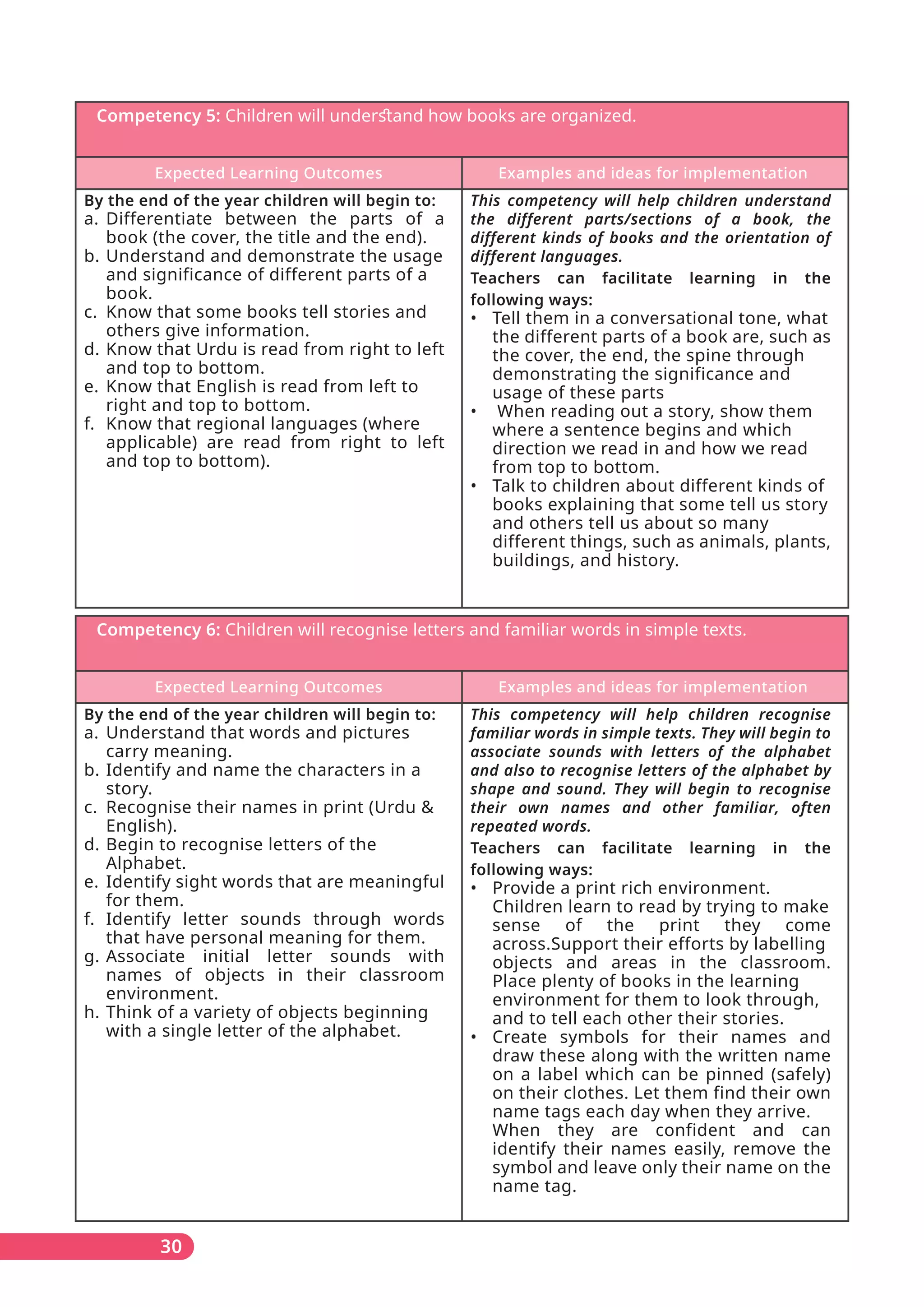
include a change in family structure, address, parent’s employment status, in addition to
immense society changes such as economic cycles and wars.
By studying the different systems that simultaneously influence a child, the ecological
systems theory is able to demonstrate the diversity of interrelated influences on the
child’s development. Awareness of contexts can sensitize us to variations in the way a
child may act in different settings. For example, a child who frequently bullies smaller
children at school may portray the role of a terrified victim at home. Due to these
variations, adults concerned with the care of a particular child should pay close attention
to behaviour in different settings or contexts and to the quality and type of connections
that exist between these contexts.
4.1.5 ERIK ERIKSON’S THEORY OF SOCIAL EMOTIONAL DEVELOPMENT:
Every person has his or her own unique identity. This identity is composed of the different
personality traits that can be considered positive or negative. These personality traits can
also be innate or acquired, and they vary from one person to another based on the degree
of influence the environment has on the individual.
The bottom line is that as human beings, we possess many characteristics that are honed
in many different aspects that eventually define who we are.
89
Erik Erikson’s Theory of Psychosocial Development emphasizes the sociocultural
determinants of development and presents them as eight stages of psychosocial conflicts
(often known as Erikson’s psychosocial stages) that all individuals must overcome or
resolve successfully in order to adjust well to the environment.
Erik Erikson’s Theory of Psychosocial Development
KEY CONCEPTS:
Erikson’s psychosocial theory of development considers the impact of external factors,
parents and society on personality development from childhood to adulthood. According
to Erikson’s theory, every person must pass through a series of eight interrelated stages
over the entire life cycle.
1. INFANCY: BIRTH-18 MONTHS OLD
Basic Trust vs. Mistrust – Hope
During the first or second year of life, the major emphasis is on the mother and father’s
nurturing ability and care for a child, especially in terms of visual contact and touch. The
child will develop optimism, trust, confidence, and security if properly cared for and
handled. If a child does not experience trust, he or she may develop insecurity,
worthlessness, and general mistrust to the world.
2. TODDLER / EARLY CHILDHOOD YEARS: 18 MONTHS TO 3 YEARS
Autonomy vs. Shame – Will
The second stage occurs between 18 months and 3 years. At this point, the child has an
opportunity to build self-esteem and autonomy as he or she learns new skills and right
from wrong. The well-cared for child is sure of himself, carrying himself or herself with
pride rather than shame. During this time of the “terrible twos”, defiance, temper
90
tantrums, and stubbornness can also appear. Children tend to be vulnerable during this
stage, sometimes feeling ashamed and low self-esteem during an inability to learn certain
skills.
3. PRESCHOOLER: 3 TO 5 YEARS
Initiative vs. Guilt – Purpose
During this period, we experience a desire to copy the adults around us and take initiative
in creating play situations. We make up stories with Barbie’s and Ken’s, toy phones and
miniature cars, playing out roles in a trial universe, experimenting with the blueprint for
what we believe it means to be an adult. We also begin to use that wonderful word for
exploring the world—”WHY?”
While Erikson was influenced by Freud, he downplays biological sexuality in favor of the
psychosocial features of conflict between child and parents. Nevertheless, he said that at
this stage we usually become involved in the classic “Oedipal struggle” and resolve this
struggle through “social role identification.” If we’re frustrated over natural desires and
goals, we may easily experience guilt. The most significant relationship is with the basic
family.
4. SCHOOL AGE CHILD: 6 TO 12 YEARS
Industry vs. Inferiority – Competence
During this stage, often called the Latency, we are capable of learning, creating and
accomplishing numerous new skills and knowledge, thus developing a sense of industry.
This is also a very social stage of development and if we experience unresolved feelings of
inadequacy and inferiority among our peers, we can have serious problems in terms of
competence and self-esteem.
As the world expands a bit, our most significant relationship is with the school and
neighbourhood. Parents are no longer the complete authorities they once were, although
they are still important.
5. ADOLESCENT: 12 TO 18 YEARS
Identity vs. Role Confusion – Fidelity
Up until this fifth stage, development depends on what is done to a person. At this point,
development now depends primarily upon what a person does. An adolescent must
struggle to discover and find his or her own identity, while negotiating and struggling
with social interactions and “fitting in”, and developing a sense of morality and right from
wrong.
Some attempt to delay entrance to adulthood and withdraw from responsibilities
(moratorium). Those unsuccessful with this stage tend to experience role confusion and
upheaval. Adolescents begin to develop a strong affiliation and devotion to ideals, causes,
and friends.
6. YOUNG ADULT: 18 TO 35 YEARS
Intimacy and Solidarity vs. Isolation – Love
At the young adult stage, people tend to seek companionship and love. Some also begin
to “settle down” and start families, although seems to have been pushed back farther in
recent years.
91
Young adults seek deep intimacy and satisfying relationships,
but if unsuccessful, isolation may occur. Significant relationships at this stage are with
marital partners and friends.
7. MIDDLE-AGED ADULT: 35 TO 55 OR 65 YEARS
Generativity vs. Self-Absorption or Stagnation – Care
Career and work are the most important things at this stage, along with family. Middle
adulthood is also the time when people can take on greater responsibilities and control.
For this stage, working to establish stability and Erikson’s idea of generativity –
attempting to produce something that makes a difference to society. Inactivity and
meaninglessness are common fears during this stage.
Major life shifts can occur during this stage. For example, children leave the household;
careers can change, and so on. Some may struggle with finding purpose. Significant
relationships are those within the family, workplace, local church and other communities.
8. LATE ADULT: 55 OR 65 TO DEATH
Integrity vs. Despair – Wisdom
Erikson believed that much of life is preparing for the middle adulthood stage and the last
stage involves much reflection. As older adults, some can look back with a feeling of
integrity — that is, contentment and fulfilment, having led a meaningful life and valuable
contribution to society. Others may have a sense of despair during this stage, reflecting
upon their experiences and failures. They may fear death as they struggle to find a
purpose to their lives, wondering “What was the point of life? Was it worth it?”
4.2 LEARNING THEORIES:
Learning theories provide the theoretical framework to understand and analyse how
knowledge is absorbed, processed, and retained as a part of learning. Cognitive,
emotional, and environmental influences, as well as prior experience, all play a part in
how understanding, or a world view, is acquired or changed and knowledge and skills are
retained. For ECCE teachers/stakeholders knowledge of established learning theories is
vital to enable them in their role of helping children develop in a positive and healthy
environment. For reference purposes the following two learning theories are included
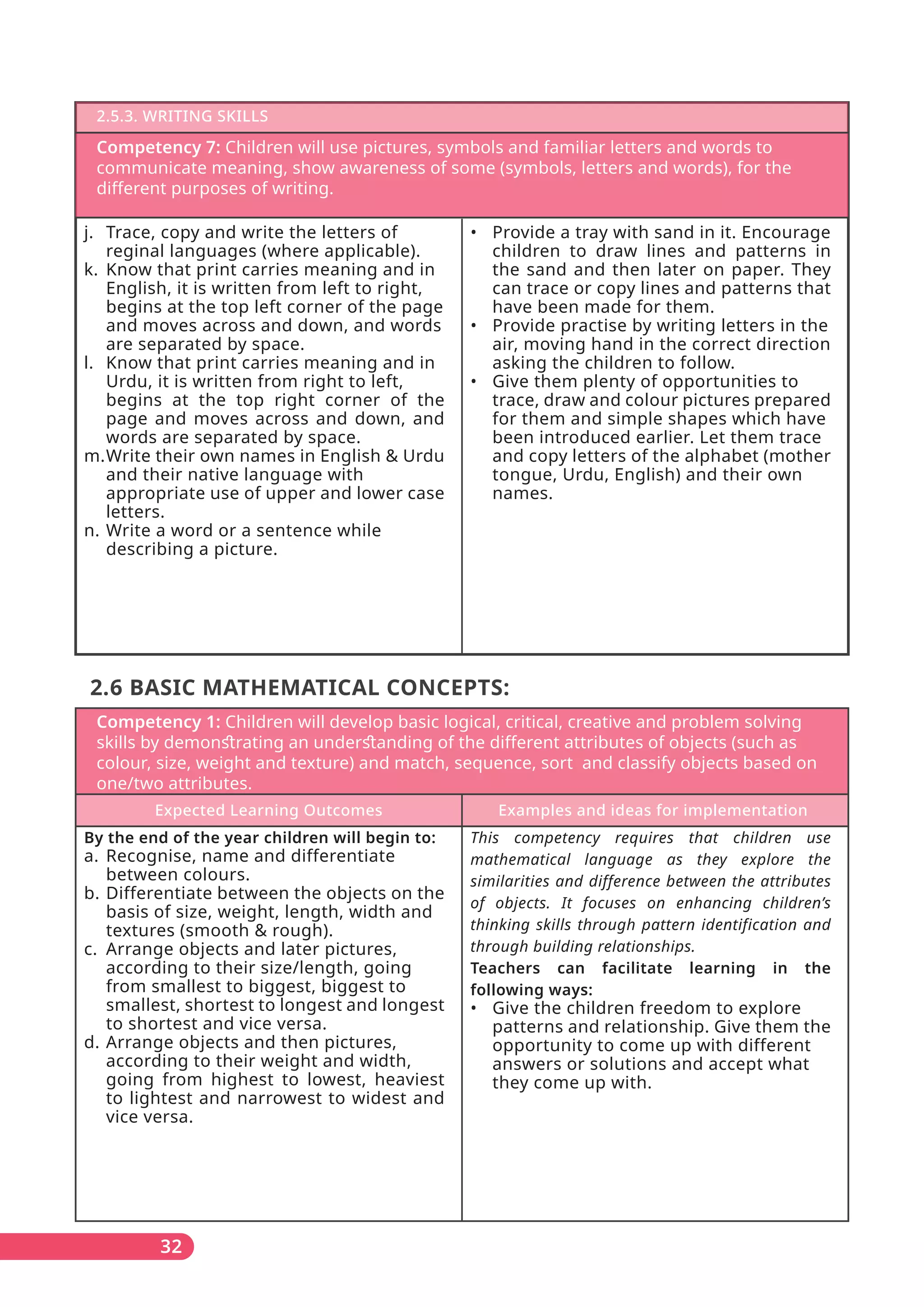
here to provide a baseline for teachers to probe further.
4.2.1 HOWARD GARDNER’S THEORY OF MULTIPLE INTELLIGENCES-AN INNOVATIVE
APPROACH TOWARDS UNDERSTANDING CHILD’S POTENTIAL
Many educators have had the experience of not being able to reach some students until
presenting the information in a completely different way or providing new options for
student expression. Perhaps it was a student who struggled with writing until the teacher
provided the option to create a graphic story, which blossomed into a beautiful and
complex narrative. Or maybe it was a student who just couldn't seem to grasp fractions,
until he created them by separating oranges into slices.
Because of these kinds of experiences, the theory of multiple intelligences resonates with
many educators. It supports what we all know to be true: A one-size-fits-all approach to
education will invariably leave some students behind. However, the theory is also often
misunderstood, which can lead to it being used interchangeably with learning styles or
applying it in ways that can limit student potential. While the theory of multiple
intelligences is a powerful way to think about learning, it’s also important to understand
92
the research that supports it.
Howard Gardner's Nine Intelligences
The theory of multiple intelligences challenges the idea of a single IQ, where human
beings have one central "computer" where intelligence is housed. Howard Gardner, the
Harvard professor who originally proposed the theory, says that there are multiple types
of human intelligence, each representing different ways of processing information:
1. NATURALIST INTELLIGENCE (“NATURE SMART”)
This intelligence designates the human ability to discriminate among living things (plants,
animals) as well as sensitivity to other features of the natural world (clouds, rock
configurations). This ability was clearly of value in our evolutionary past as hunters,
gatherers, and farmers; it continues to be central in such roles as botanist or chef. It is
also speculated that much of our consumer society exploits the naturalist intelligences,
which can be mobilized in the discrimination among cars, sneakers, kinds of makeup, and
the like.
2. MUSICAL INTELLIGENCE (“MUSICAL SMART”)
Musical intelligence is the capacity to discern pitch, rhythm, timbre, and tone. This
intelligence enables us to recognise, create, reproduce, and reflect on music, as
demonstrated by composers, conductors, musicians, vocalist, and sensitive listeners.
Interestingly, there is often an affective connection between music and the emotions; and
mathematical and musical intelligences may share common thinking processes. Young
adults with this kind of intelligence are usually singing or drumming to themselves. They
are usually quite aware of sounds others may miss.
93
3. LOGICAL-MATHEMATICAL INTELLIGENCE (”NUMBER/REASONING SMART”)
Logical-mathematical intelligence is the ability to calculate, quantify, consider
propositions and hypotheses, and carry out complete mathematical operations. It
enables us to perceive relationships and connections and to use abstract, symbolic
thought; sequential reasoning skills; and inductive and deductive thinking patterns.
Logical intelligence is usually well developed in mathematicians, scientists, and
detectives. Young adults with lots of logical intelligence are interested in patterns,
categories, and relationships. They are drawn to arithmetic problems, strategy games
and experiments.
4. EXISTENTIAL INTELLIGENCE
Sensitivity and capacity to tackle deep questions about human existence, such as the
meaning of life, why do we die, and how did we get here.
5. INTERPERSONAL INTELLIGENCE (”PEOPLE SMART”)
Interpersonal intelligence is the ability to understand and interact effectively with others.
It involves effective verbal and nonverbal communication, the ability to note distinctions
among others, sensitivity to the moods and temperaments of others, and the ability to
entertain multiple perspectives. Teachers, social workers, actors/public figures and
politicians exhibit interpersonal intelligence. Young adults with this kind of intelligence
are leaders amongst their peers, are good at communicating, and seem to understand
others’ feelings and motives.
6. BODILY-KINAESTHETIC INTELLIGENCE (“BODY SMART”)
Bodily kinaesthetic intelligence is the capacity to manipulate objects and use a variety of
physical skills. This intelligence also involves a sense of timing and the perfection of skills
through mind–body union. Athletes, dancers, surgeons, and craftspeople exhibit
well-developed bodily kinaesthetic intelligence.
7. LINGUISTIC INTELLIGENCE (”WORD SMART”)
Linguistic intelligence is the ability to think in words and to use language to express and
appreciate complex meanings. Linguistic intelligence allows us to understand the order
and meaning of words and to apply meta-linguistic skills to reflect on our use of language.
Linguistic intelligence is the most widely shared human competence and is evident in
poets, novelists, journalists, and effective public speakers. Young adults with this kind of
intelligence enjoy writing, reading, telling stories or doing crossword puzzles.
8. INTRA-PERSONAL INTELLIGENCE (”SELF SMART”)
Intra-personal intelligence is the capacity to understand oneself and one’s thoughts and
feelings, and to use such knowledge in planning and giving direction to one’s life.
Intra-personal intelligence involves not only an appreciation of the self, but also of the
human condition. It is evident in psychologist, spiritual leaders, and philosophers. These
young adults may be shy. They are very aware of their own feelings and are
self-motivated.
9. SPATIAL INTELLIGENCE (“PICTURE SMART”)
Spatial intelligence is the ability to think in three dimensions. Core capacities include
mental imagery, spatial reasoning, image manipulation, graphic and artistic skills, and an
active imagination. Sailors, pilots, sculptors, painters, and architects all exhibit spatial
intelligence. Young adults with this kind of intelligence may be fascinated with mazes or
jigsaw puzzles, or spend free time drawing or daydreaming.
HOW CAN THE MULTIPLE INTELLIGENCES THEORY GUIDE ECCE TEACHERS?
While additional research is still needed to determine the best measures for assessing and
supporting a range of intelligences in schools, the theory has provided opportunities to
94
broaden definitions of intelligence. As an ECCE educator, it is useful to think about the
different ways that information can be presented. However, it is critical to not classify
students as being specific types of learners nor as having an innate or fixed type of
intelligence.
For example, teachers can develop small quizzes with the help of online Multiple
Intelligences Quiz maps aligned to Howard Gardner's multiple intelligences. This is a fun
way to learn about how some of our tastes and interests can influence how we take in
information. However, its results are not intended as a way to label people as naturalistic
learners, musical learners, etc. Labelling creates limits, and when it comes to learning, we
want to avoid restricting how we define student potential. People have much different
intelligence and strength in one area does not predict weakness in another.
4.2.2 LEARNING STYLES:
Among the recently renowned learning theories and themes one of the most talked about
and relevant is “learning styles”. The term “learning styles” speaks to the understanding
that every student learns differently. Technically, an individual’s learning style refers to
the preferential way in which the student absorbs processes, comprehends and retains
information. For example, when learning how to build a clock, some students understand
the process by following verbal instructions, while others have to physically manipulate
the clock themselves. This notion of individualized learning styles has gained widespread
recognition in education theory and classroom management strategy. Individual learning
styles depend on cognitive, emotional and environmental factors, as well as one’s prior
experience. In other words: everyone’s different. It is important for educators and vital for
ECCE teachers to understand the differences in their students’ learning styles, so that they
can implement the best practices strategies into their daily activities, curriculum and
assessments.
NEIL FLEMING'S VARK MODEL:
The most relevant and appropriate learning styles model is by Neil Fleming who has
proposed VARK model expanded upon notions of sensory modalities of Visual, Auditory,
Reading/Writing and Kinaesthetic.
The VARK model acknowledges that students have different approaches to how they
process information, referred to as “preferred learning modes.”
• Students’ preferred learning modes have significant influence on their behaviour and
learning
• Students’ preferred learning modes should be matched with appropriate learning
strategies.
• Information that is accessed through students’ use of their modality preferences shows
an increase in their levels of comprehension, motivation, and metacognition.
Identifying students as visual, auditory, reading/writing or kinaesthetic learners, and
aligning the overall curriculum with these learning styles, will prove to be beneficial for
overall classroom management, allowing students to access information in ways they are
comfortable with will increase their academic confidence.
Visual: Information presented as maps, spider
diagrams, charts, graphs, flow charts, labeled
diagrams, and all the symbolic arrows, circles,
hierarchies, and other devices that people use to
represent what could have been presented in words.
Auditory/Aural: A preference for information that is
heard or spoken such as lectures, group discussion,
radio, email, mobile phones, speaking, web-chat, and
talking things through.
Reading/Writing: Information displayed as words,
text-based input and output. This includes all forms
but especially manuals, reports, essays, and
assignments.
Kinesthetic: A preference for gathering information
through experience and practice, simulated or real,
either through concrete personal experiences,
examples, practice or simulation. It also includes
demonstrations, simulations, videos, and movies, as
well as case studies, practice, and applications.
95
4.2.3 HIGH SCOPE APPROACH
The High Scope Educational Research Foundation studies methods of early childhood
education based on the methodology of the 1962 Perry Preschool study. It was founded in
1970 by psychologist David Weikart.
The Perry Preschool study has been noted for its "large effects on educational attainment,
income, criminal activity, and other important life outcomes, sustained well into
adulthood".
The philosophy behind High Scope is based on child development theory and research,
originally drawing on the work of Jean Piaget and John Dewey. The curriculum was further
developed to incorporate Lev Vygotsky's zone of proximal development and Jerome
Bruner's related strategy of adult scaffolding. This method emphasizes the role of adults
to support each child at their current developmental level and help them build upon it,
under a model of "shared control" where activities are both child-initiated and
adult-guided. The adults working with the children see themselves more as facilitators or
partners than as managers or supervisors.
How to Teach
In a High Scope preschool program, teachers ignite children’s interest in learning by
creating an environment that encourages them to explore learning materials and interact
with adults and peers. The focus is on supporting early learners as they make decisions,
build academic skills, develop socially and emotionally, and become part of a classroom
community.
Active learning is at the centre of the High Scope Curriculum. It’s the foundation of young
children gaining knowledge through their natural play and interactions with the
environment, events, and other people.
Adult-Child Interaction
Teachers act as partners, working alongside children and communicating with them both
verbally and nonverbally to encourage learning. Key strategies for adult-child interactions
are sharing control with children, communicating as a partner with children, scaffolding
children’s play, using encouragement instead of praise, and taking a problem-solving
approach to supporting children in resolving conflicts.
Learning Environment
To create a predictable and active learning environment, teachers arrange and equip the
classroom with diverse, open-ended materials that reflect children’s home, culture, and
language. The room is organized and labelled to promote independence and encourage
children to carry out their intentions.
Daily Routine
A consistent framework for the day provides a balanced variety of experiences and
learning opportunities. Children engage in both individual and social play, participate in
small and large-group activities, assist with clean up, socialize during meals, develop
self-care skills, and exercise their small and large muscles. The most important segment
of the daily routine is the plan-do-review sequence, in which children make decisions
about what they will do, carry out their ideas, and reflect upon their activities with adults
and other children. These higher-level thinking skills are linked to the development of
executive functions, which are needed to be successful in school and life.
96
Assessment
Ongoing child assessment is also an underlying component of the High Scope Curriculum.
Objective anecdotal observations of children collected throughout children’s natural play
allow teachers to assess child progress and plan meaningful learning experiences.
4.2.4 BLOOMS TAXONOMY
Bloom's taxonomy is a set of three hierarchical models used to classify educational
learning objectives into levels of complexity and specificity. The three lists cover the
learning objectives in cognitive, affective and psychomotor domains. The cognitive
domain list has been the primary focus of most traditional education and is frequently
used to structure curriculum learning objectives, assessments and activities.
The models were named after Benjamin Bloom, who chaired the committee of educators
that devised the taxonomy.
a) The Cognitive Domain (knowledge-based)
In the original version of the taxonomy, the cognitive domain is broken into the following
six levels of objectives. In the 2001 revised edition of Bloom's taxonomy, the levels are
slightly different: Remember, Understand, Apply, Analyze, Evaluate, Create (rather than
Synthesize).
Knowledge
Knowledge involves recognizing or remembering facts, terms, basic concepts, or answers
without necessarily understanding what they mean. Its characteristics may include:
• Knowledge of specifics—terminology, specific facts
• Knowledge of ways and means of dealing with specifics—conventions, trends and
sequences, classifications and categories, criteria, methodology
• Knowledge of the universals and abstractions in a field—principles and generalizations,
theories and structures
Example: Name three common varieties of apple.
Comprehension
Comprehension involves demonstrating an understanding of facts and ideas by
organizing, comparing, translating, interpreting, giving descriptions, and stating the main
ideas.
Example: Compare the identifying characteristics of a Golden Delicious apple with a
Granny Smith apple.
Application
Application involves using acquired knowledge—solving problems in new situations by
applying acquired knowledge, facts, techniques and rules. Learners should be able to use
prior knowledge to solve problems, identify connections and relationships and how they
apply in new situations.
Example: Would apples prevent scurvy, a disease caused by a deficiency in vitamin C?
Analysis
Analysis involves examining and breaking information into component parts, determining
how the parts relate to one another, identifying motives or causes, making inferences,
and finding evidence to support generalizations. Its characteristics include:
• Analysis of elements
• Analysis of relationships
• Analysis of organization
Example: List four ways of serving foods made with apples and explain which ones have
the highest health benefits. Provide references to support your statements.
Synthesis
Synthesis involves building a structure or pattern from diverse elements; it also refers to
the act of putting parts together to form a whole. Its characteristics include:
• Production of a unique communication
• Production of a plan, or proposed set of operations
• Derivation of a set of abstract relations
Example: Convert an "unhealthy" recipe for apple pie to a "healthy" recipe by replacing
your choice of ingredients. Explain the health benefits of using the ingredients you chose
vs. the original ones.
Evaluation
Evaluation involves presenting and defending opinions by making judgments about
information, the validity of ideas, or quality of work based on a set of criteria. Its
characteristics include:
• Judgments in terms of internal evidence
• Judgments in terms of external criteria
Example: Which kinds of apples are best for baking a pie, and why?
b) The Affective Domain (emotional-based)
Skills in the affective domain describe the way people react emotionally and their ability
to feel other living things' pain or joy. Affective objectives typically target the awareness
and growth in attitudes, emotions and feelings.
There are five levels in the affective domain moving through the lowest-order processes
to the highest.
Receiving
The lowest level; the student passively pays attention. Without this level, no learning can
occur. Receiving is about the student's memory and recognition as well.
Responding
The student actively participates in the learning process, not only attends to a stimulus;
the student also reacts in some way.
Valuing
The student attaches a value to an object, phenomenon, or piece of information. The
student associates a value or some values to the knowledge they acquired.
97
98
Organizing
The student can put together different values, information, and ideas, and can
accommodate them within his/her own schema; the student is comparing, relating and
elaborating on what has been learned.
Characterizing
The student at this level tries to build abstract knowledge.
c) The Psychomotor Domain (action-based)
Skills in the psychomotor domain describe the ability to physically manipulate a tool or
instrument like a hand or a hammer. Psychomotor objectives usually focus on change
and/or development in behavior and/or skills.
Bloom and his colleagues never created subcategories for skills in the psychomotor
domain, but since then other educators have created their own psychomotor taxonomies.
Simpson (1972) proposed the following levels:
Perception
The ability to use sensory cues to guide motor activity: This ranges from sensory
stimulation, through cue selection, to translation.
Examples: Detects non-verbal communication cues. Estimate where a ball will land after it
is thrown and then moving to the correct location to catch the ball. Adjusts heat of the
stove to correct temperature by smell and taste of food. Adjusts the height of the forks on
a forklift by comparing where the forks are in relation to the pallet.
Key words: chooses, describes, detects, differentiates, distinguishes, identifies, isolates,
relates, selects.
Set
Readiness to act: It includes mental, physical, and emotional sets. These three sets are
dispositions that predetermine a person's response to different situations (sometimes
called mindsets). This subdivision of psychomotor is closely related with the "responding
to phenomena" subdivision of the affective domain.
Examples: Knows and acts upon a sequence of steps in a manufacturing process.
Recognizes his or her abilities and limitations. Shows desire to learn a new process
(motivation).
Keywords: begins, displays, explains, moves, proceeds, reacts, shows, states, volunteers.
Guided response
The early stages of learning a complex skill that includes imitation and trial and error:
Adequacy of performance is achieved by practicing.
Examples: Performs a mathematical equation as demonstrated. Follows instructions to
build a model. Responds to hand-signals of the instructor while learning to operate a
forklift.
Keywords: copies, traces, follows, reacts, reproduces, responds.
Mechanism
The intermediate stage in learning a complex skill: Learned responses have become
habitual and the movements can be performed with some confidence and proficiency.
Examples: Use a personal computer. Repair a leaking tap. Drive a car.
Key words: assembles, calibrates, constructs, dismantles, displays, fastens, fixes, grinds,
heats, manipulates, measures, mends, mixes, organizes, sketches.
99
Complex overt response
The skilful performance of motor acts that involve complex movement patterns:
Proficiency is indicated by a quick, accurate, and highly coordinated performance,
requiring a minimum of energy. This category includes performing without hesitation and
automatic performance. For example, players will often utter sounds of satisfaction or
expletives as soon as they hit a tennis ball or throw a football because they can tell by the
feel of the act what the result will produce.
Examples: Manoeuvres a car into a tight parallel parking spot. Operates a computer
quickly and accurately. Displays competence while playing the piano.
Key words: assembles, builds, calibrates, constructs, dismantles, displays, fastens, fixes,
grinds, heats, manipulates, measures, mends, mixes, organizes, sketches. (Note: The key
words are the same as in mechanism, but will have adverbs or adjectives that indicate that
the performance is quicker, better, more accurate, etc.)
Adaptation
Skills are well developed and the individual can modify movement patterns to fit special
requirements.
Examples: Responds effectively to unexpected experiences. Modifies instruction to meet
the needs of the learners. Performs a task with a machine that was not originally intended
for that purpose (the machine is not damaged and there is no danger in performing the
new task).
Key words: adapts, alters, changes, rearranges, reorganizes, revises, varies.
Origination
Creating new movement patterns to fit a particular situation or specific problem: Learning
outcomes emphasize creativity based upon highly developed skills.
Examples: Constructs a new set or pattern of movements organized around a novel
concept or theory. Develops a new and comprehensive training program. Creates a new
gymnastic routine.
Key words: arranges, builds, combines, composes, constructs, creates, designs, initiates,
makes, originates.
100
GLOSSARY
1. Andragogy: Theory of adult learning.
2. Assessment: The term “assessment” refers to any process of obtaining information
that is used to make educational decisions about students, to give feedback to the
student about his or her progress, strengths and weakness, to judge teaching
effectiveness and curriculum adequacy and to inform policy.
3. Curriculum: A plan of instruction that details what students are to know, how they are
to learn it, what the teacher’s role is, and the context in which learning and teaching
will take place.
4. Diversity: The state of being diverse, having variety. Individual are differences of
people, including, but not limited to differences in: intelligence, learning styles,
academic and/or social ability, culture, ethnicity, socio-economic status, gender,
religion, sexual orientation, value systems.
5. Facilitator: A role for classroom teachers that allows students to take a more active
role in learning. Teachers assist students in making connections between classroom
instruction and students’ own knowledge and experiences by encouraging students
to create new solutions, by challenging their assumptions, and by asking probing
questions.
6. Fine Motor skills: Fine motor skills can be defined as small muscle movements, those
that occur in the finger, in coordination with the eyes. Teaching fine motor skills is
similar is similar to teaching other skills because the instructor must always try to be
patient and understanding. Fine motor skills do not develop over night, but with time
and practice.
7. Formative Assessment: The term “formative assessment” refers to frequent or
on-going evaluation during courses, programmes, or learning experiences that gives
an early indication of what students are learning, as well as their strengths and
weaknesses. Formative assessment is often used as a diagnostic tool for students and
faculty, providing information with which to make real-time improvements in
instructional methods, materials, activities, techniques, and approaches. Approaches
to formative assessment might include daily, weekly, or midterm projects; portfolios;
journals; observations of the learning process and learning outcomes; discussion
groups; performances; self-assessments; or examinations that occur during courses,
when students and faculty can benefit from the information and improve.
8. Gross Motor skills: Gross Motor skills involve the larger muscles in the arms, legs and
torso. Gross motor activities include walking, running, throwing, lifting, kicking, etc.
These skills also relate to body awareness, reaction speed, balance and strength.
Group’s motor development gives a child the ability to move in a variety of ways, the
ability to control his/her body and helps promote self-esteem.
9. Imagination: Thoughts or fantasies.
10. Kindergarten: Friedrich Froebel (1782-1852) known as the ‘father of the
Kindergarten,” –coined the term, which literarily means a “garden of children,” He
believed that children learn about themselves and their environment primarily
through play. Now commonly used to mean a school or class that prepares children
for first grade.
101
GLOSSARY
11. Learning Styles: Learning styles are students’ approaches to learning, problem
solving, and processing information.
12. Lifestyle: A way of living, conduct, behaviour, customs, culture, habits.
13. Manipulative Material: Any physical object (for example, clay, blocks, string, coins)
that can be handled and used to represent or model a problem situation or develop a
logical concept.
14. Metacognition: Awareness and understanding of one’s own thought processes. A
child’s ability to consciously and intentionally control own behaviour.
15. Multiple Intelligences: Traditional measurements of ‘intelligence’ were limited to a
single quotient on the basis of performance in a broad range of test elements. On the
basis of developments in cognitive psychology and neurological science, Howard
Gardner (1983) re-defined intelligence as the ability to create something which is
valued by any culture, in nine intellectual areas which are independent and
interdependent. For examples, a person can be good with language use and thinking
through this mode; similarly, another person can be musically more intelligent. The
implication for learning and teaching is that learning activities should cater for the
whole range of intelligences or be tailored to the intelligences of specific learners.
16. Mystery Bag: A bag full of many small objects with different textures for students to
feel the objects without looking at them, identify and name them. It acts as a great
resource for sensory development and memory build up.
17. Open-ended, questions: Questions that have more than one right answer, or ones
that can be answered in more than one way. This way of asking questions stimulates
more language use, acknowledges that there can be many solutions to one problem,
affirms children’s ideas and encourages creative thinking.
18. Paper Mache: A malleable mixture of paper and glue, or paper, flour, and water that
becomes hard when dry.
19. Pedagogy: The art or science of being a teacher of children. Generally refers to
strategies or style of instruction.
20. Portfolio: A collection of various samples of a student’s work throughout the school
year that can include writing samples, examples of math problems, and results of
science experiments.
21. Portfolio Assessment: An assessment process that is based on the collection of
student’s work, such as written assignments, drafts, artwork, and presentations, that
represent competencies, exemplary work, or the student’s developmental progress.
22. Pro-action: Creating or controlling a situation by causing something to happen rather
than responding to it after it has happened.
23. Special Education: Special instruction provided for students with educational or
physical disabilities, tailored to each student’s needs and learning style.
102
GLOSSARY
ACRONYMS
24. Syllabus: A document with an outline and summary of topics to be covered in a
class/grade. It is often either set out by school management or an exam board.
Content covered in textbook is often taken as syllabus.
25. Synapses: When one neuron connects with another, it forms a connection called a
synapse. When we talk about brain development we are actually talking about the
creation of synapses in a brain.
26. Summative Assessment: The term “summative” refers to longitudinal analysis of the
learning and performance of students. Summative assessments tend to be formal
and comprehensive. Such assessments may be conducted at the end of the academic
year and could be compared to the results of pre-testing to determine gains and to
clarify the causal connections between educational practices and student learning.
They may be used for purposes of determining final grades, placement, and
promotion.
ACRONYMS
NECCE National Early Childhood Care and Education
ESR Education Sector Reforms
ECCE Early Childhood Care and Education
EFA Education for All
SDG-4 Sustainable Development Goal For Education
ESPs Education Sector Plans
IPEMC Inter-Provincial Education Ministers’ Conference
ELOs Expected Learning Outcomes
CPD Continuous Professional Development
MKO More Knowledgeable Other
E-9 “E” stands for education and the “9” represents the following
nine countries: Bangladesh, Brazil, China, Egypt, India,
Indonesia, Mexico, Nigeria and Pakistan,
103
REFERENCES
• Aly, J. H. (2007). Education in Pakistan. A white paper revised. Document to debate and
finalize the National Education Policy.
• Bennett, J. O. H. N. (2008). Early childhood education and care systems in the OECD
countries: the issue of tradition and governance. Encyclopaedia on Early Childhood
Development, 1-5.
• Bennett, J., &Tayler, C. P. (2006). Starting strong II: Early childhood education and care.
OECD.
• Bennett, N. (1997). Teaching through play: Teachers' thinking and classroom practice.
McGraw-Hill Education (UK).
• Daries, J., Engdahl, I., Otieno, L., Pramling-Samuelson, I., Siraj-Blatchford, J., &Vallabh,
P. (2009). Early childhood education for sustainability: Recommendations for
development. International Journal of Early Childhood, 41(2), 113-117.
• Department of Education (DoE). (2001). Education White Paper 5: Meeting the
Challenge of Early Childhood Development in South Africa. Pretoria: Department of
Education.
• Government of Pakistan. (2009). National Education Policy, Ministry of Education,
Islamabad.
• Henderson, K. (2004). Illinois Early Learning Standards. vol. SU-29, August. Hohmann,
M., &Weikart, D. P. (2002). Educating Young Children: Active Learning Practices for
Preschool and Child Care Programs [and] A Study Guide to Educating Young Children:
Exercises for Adult Learners.
• Heinämäki, L. (2008). Early childhood education in Finland.
• Mahmud, M. (2002). Strong Foundation-A Guide for ECE Teachers. Teachers Resource
Centre, Karachi.
• Miller, D. F. (2006). Positive Child Guidance. New York: Delmar Learning.
• Morrison, G. S. (2013). Fundamentals of early childhood education. Pearson Higher Ed.
• Morrison, G. S. (1988). Early childhood education today. Columbus, Ohio: Merrill
Publishing Company.
• Nuttall, J. G. (Ed.). (2003). Weaving TeWhāriki: Aotearoa New Zealand's early childhood
curriculum document in theory and practice. Wellington, NZ: New Zealand Council for
Educational Research.
• Shami, P. A. (2009). Early Childhood Education in Pakistan--Progress and ChBennett, N.
(1997). Teaching through play: Teachers' thinking and classroom practice. McGraw-Hill
Education (UK).allenges. Journal on Educational Psychology, 2(4), 98-104.
• https://www.psychologynoteshq.com/erikerikson/
• https://www.psychologynoteshq.com/vygotsky-theory/
• https://www.psychologynoteshq.com/bronfenbrenner-ecological-theory/
• https://en.wikipedia.org/wiki/Learning_styles#Neil_Fleming.27s_VAK.2FVARK_model
• https://www.edutopia.org/multiple-intelligences-research
• https://www.google.com.pk/search?q=brain+development+stages&rlz=1C1CHWA_
104
REFERENCES
enAU573AU573&source=lnms&tbm=isch&sa=X&sqi=2&ved=0ahUKEwjhjLP1_
bLUAhUIQI8KHVxoAVoQ_AUIBigB&biw=1366&bih=589#imgrc=s0ldcyU9U52ZmM:
• https://www.google.com.pk/search?q=brain+development+stages&rlz=1C1CHWA_en
AU573AU573&source=lnms&tbm=isch&sa=X&sqi=2&ved=0ahUKEwjhjLP1_bLUAhUIQ
I8KHVxoAVoQ_AUIBigB&biw=1366&bih=589#tbm=isch&q=multiple+intelligences&i
mgrc=uHQCHnLeIDnpjM
• https://www.google.com.pk/search?q=learning+styles&rlz=1C1CHWA_enAU573AU57
3&source=lnms&tbm=isch&sa=X&ved=0ahUKEwjevKGngbPUAhXELo8KHSV9BU8Q_A
UICigB&biw=1366&bih=589#imgrc=YTlpd0rqM9FwdM
• http://www.un.org/sustainabledevelopment/education/
• https://en.wikipedia.org/wiki/HighScope
• https://highscope.org/our-practice/preschool-curriculum/
• https://www.google.com/search?q=bloom%27s+taxonomy&sxsrf=ALeKk00IEjS0CR
QwzBW9fEvlE2WxPaF-1Q:1582449216808&tbm=isch&source=iu&ictx=1&fir=93s6n
toD_4PpZM%253A%252ChT_VGsTcKmS_nM%252C_&vet=1&usg=AI4_-kSzIVZiHIMuu
WbBvzse0AKEuTyCJQ&sa=X&ved=2ahUKEwj-nsXbqufnAhXJ3YUKHcsFCIUQ_h0wAX
oECAoQBg#imgrc=lBele2w4gw7fWM
• https://en.wikipedia.org/wiki/Bloom%27s_taxonomy
08
NATIONAL CURRICULUM COUNCIL
MINISTRY OF FEDERAL EDUCATION AND
PROFESSIONAL TRAINING, ISLAMABAD
GOVERNMENT OF PAKISTAN

SNC_ECCE Pre-I.pdf

  • 1.
    SINGLE NATIONAL CURRICULUM EARLYCHILDHOOD CARE AND EDUCATION GRADE PRE I 2020 ONE NATION, ONE CURRICULUM NATIONAL CURRICULUM COUNCIL, MINISTRY OF FEDERAL EDUCATION AND PROFESSIONAL TRAINING, ISLAMABAD GOVERNMENT OF PAKISTAN
  • 3.
    EARLY CHILDHOOD CARE ANDEDUCATION CURRICULUM GRADE PRE I 2020 NATIONAL CURRICULUM COUNCIL MINISTRY OF FEDERAL EDUCATION AND PROFESSIONAL TRAINING, ISLAMABAD GOVERNMENT OF PAKISTAN
  • 4.
    PREFACE Chapter 01: Introduction 1.1The Significance of Early Childhood Care and Education (ECCE) 1.2 Philosophy and Values in ECCE 1.3 National Commitments to ensure steps to be taken to improve statistics and quality of education in the country: 1.3.1 EFA- Education for All 1.3.2 COMMITMENT TO ACHIEVE EFA GOALS AT E-9 FORUM 1.3.3 SUSTAINABLE DEVELOPMENT GOAL FOR EDUCATION (SDG-4) 1.4 Principles Underlying Quality ECCE Programmes 1.4.1 Holistic Development through Early Childhood Care and Education 1.5 The Aims of Education 1.5.1 A Statement of Beliefs 1.5.2 A Statement of Objectives Chapter 02: Key Learning Areas, Competencies and Expected Learning Outcomes for ECCE 2.1 Introduction to the Key Learning Areas and competencies 2.1.1 Personal Social and emotional Development 2.1.2 Language and literacy 2.1.3 Basic mathematical concepts 2.1.4 The World Around us 2.1.5 Physical Development 2.1.6 Health, Hygiene and Safety 2.1.7 Creative Arts 2.2 Competencies and Expected Learning Outcomes 2.3 Examples and ideas for Implementation 2.4 Personal and Social and emotional Development: 2.5 Language and literacy 2.5.1 Listening and Speaking skills 2.5.2 Reading Skills 2.5.3 Writing Skills 2.6 Basic Mathematical Concepts 2.7 World Around Us 2.8 Physical Development 2.10 Creative Arts 2.10.1 Visual Arts 2.10.2 Sound, Rhythm and Action 2.10.3 Dramatic Play 2.11 Summary of key learning areas and competencies 06 08 09 09 09 09 10 10 12 12 14 14 14 18 18 18 18 18 19 19 19 19 19 19 20 25 26 29 31 32 38 45 47 49 54 55 56
  • 5.
    Chapter 03: CreatingA Positive and Conducive Environment for ECCE Classroom 3.1 Guidelines for establishing A conducive Learning Environment for ECCE 3.1.1 Creating Learning Corners (Goshay) 3.1.2 The Daily Routine of an ECCE Classroom 3.2 Guidelines for Developing Criterion of Assessment 3.2.1 Child Assessment and Record Keeping 3.3 Guidelines for Effective Implementation of Quality ECCE 3.3.1 Essentials for Developing a Teacher’ Guide 3.4 Guidelines for IMPLEMENTATION of the Teachers’ Guide 3.5 Guidelines for Developing a Teacher Educators’/school administrator’s Guide: 3.5.1 Format and Suggested Content 3.5.2 Key Competencies for Teacher Educators/school administrators 3.6 Guidelines for planning Continuous Professional Development Programme (CPD) for ECCE Teachers 3.7 Guidelines for Developing Content of an ECCE Continuous Professional Development Programme 3.7.1 Designing a Teacher Education Programme 3.8 Guidelines for developing Assessment of ecce teachers’ training, learning and cpd Programmes 3.9 Guidelines for ECCE Learning Material Developers 3.9.1 Key Considerations for Material Development 3.10 A Suggested List of Materials for the ECCE Classroom Chapter 04: Theoretical Perspectives on Early Childhood Care and Education (ECCE) 4.1 Developmental Theories 4.1.1 Brain Development in the Early Years 4.1.2 Piaget’s Theory of Cognitive Development 4.1.3 Vygotsky’s Theory of Sociocultural Development 4.1.4 Bronfenbrenner’s Ecological Systems Theory of Child Development 4.1.5 Erik Erikson’s Theory Of Social Emotional Development 4.2 Learning Theories 4.2.1 Howard Gardner’s Theory of Multiple Intelligences-An Innovative Approach Towards Understanding Child’s Potential 4.2.2 Learning Styles Glossary Acronyms References Curriculum Review Committee 60 60 60 61 63 64 64 69 69 70 70 71 72 72 73 74 75 75 76 80 80 80 82 84 86 88 91 91 94 96 100 102 103 105
  • 6.
    PREFACE The current reviewand revision of the National Early Childhood Care and Education curriculum comes after a decade and a half of its development under the Education Sector Reform (ESR 2001-2004). Guided by the Prime Minister’s vision of a single national curriculum for all streams of education in the country, with a view to the imperatives of fairness and justice, the present revision also took into perspective emerging trends in education development and research. The Single National Curriculum (SNC) 2020 aspires to aid in preparing future generations that are conscious of their expected role as globally competent, responsible citizens and vigilant custodians of human heritage and resources. The Single National Curriculum of Early Childhood Care and Education 2020 sets the parameters and provides a road map and guidelines for designing activities and a scheme of studies for pre-schoolers (age 04-05) with a keen eye on the inclusion of developmentally appropriate practices for this tender age. This curriculum is aimed to foster children’s overall well-being and to ensure the best possible conditions for growth and development in a conducive, child friendly and all-inclusive environment where they can experience choice and freedom of actions in a safe, guided and healthy environment. This provision is aimed to help them develop into individuals who are able to learn through play, discovery, experimentation and collaboration. An enlarged focus on inclusion of values education and 21st century skills has added value to this curriculum. A primary focus during this curriculum revision remained on the development of indicators for ECCE that would help track the development of pro-social behaviour through introduction to collaborative processes, cooperation, sharing and caring for others. At the same time, the curriculum calls for encouraging and stoking the children’s sense of wonder to help them develop confidence and not feel threatened by the debilitating effects of a competitive environment. It also outlines an environment that enables the development of the child’s personality through assimilation of skills and values such as research/probing, decision-making, inquisitive learning, leadership, patience, tolerance, empathy and civic education. Another vital underlying theme is personality development with local, national and global perspectives where the aim is to help the child become a responsible, law-abiding citizen, fully aware of his/her role as custodian of national heritage and natural resources aiming to conserve and replenish. The revised ECCE SNC 2020 is articulated under the renewed national commitments at international forums like United Nations and E-9 as well as latest researches and established theories of child development encompassing all aspects of physical, cognitive, social, emotional and ecological developmental domains. This curriculum is a reference document for all ECCE stakeholders–particularly policy makers, researchers, teacher educators, teachers, parents, ECCE administrators/ managers, school administrators and textbook/ material designers. It has been developed to provide a national tool for guiding the implementation of Early Childhood Care and Education catering to the needs of all predefined parameters mentioned here. At all levels of planning for and implementation of ECCE curriculum the key consideration remains that education and development is linked to culture and constant change in local, national and global society. This factor should always be sensitively taken into account in the continuous assessment of implementation mechanism of ECCE, goal setting, setting expectations of learning outcomes and future revisions of Curriculum. 06 06
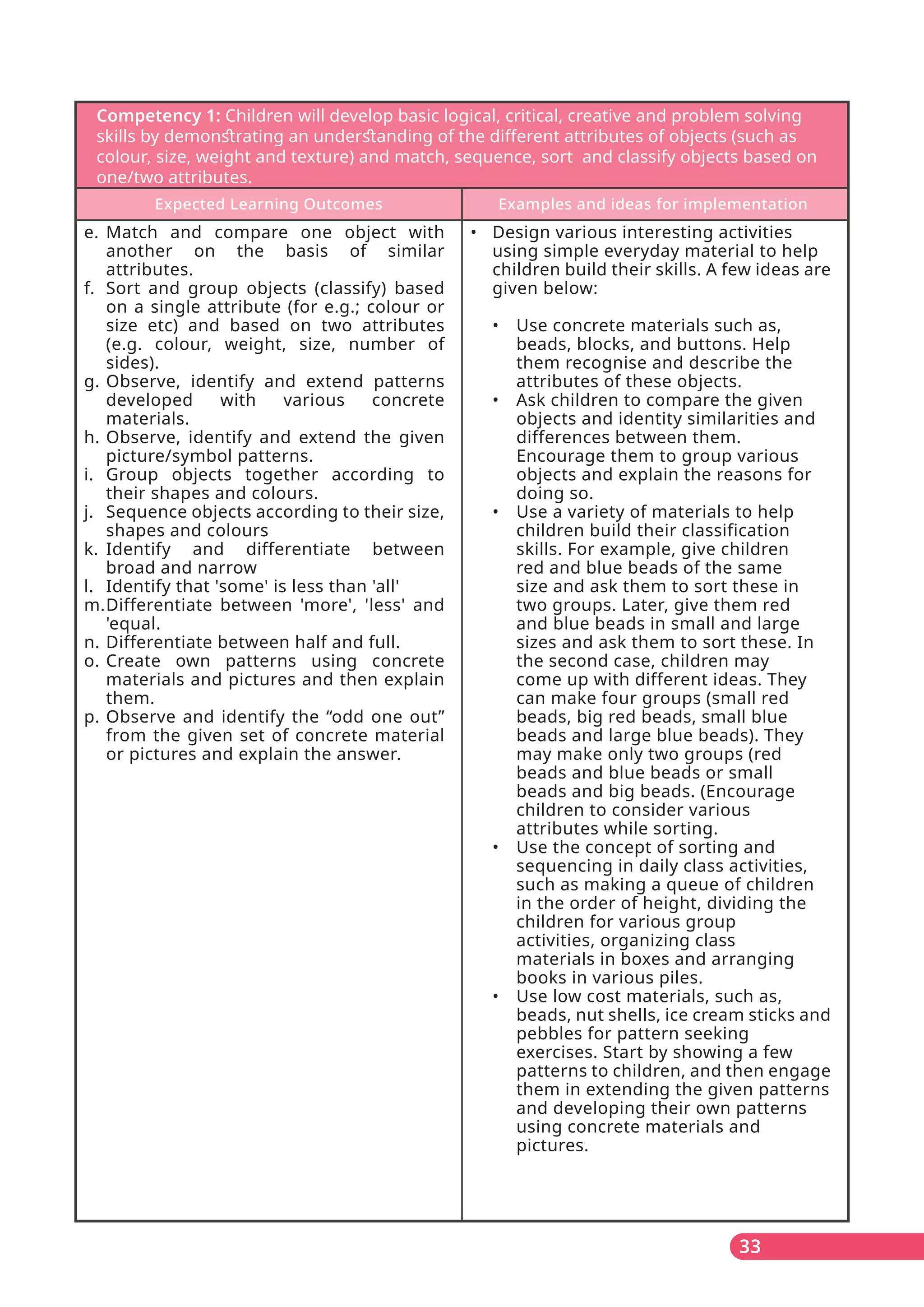
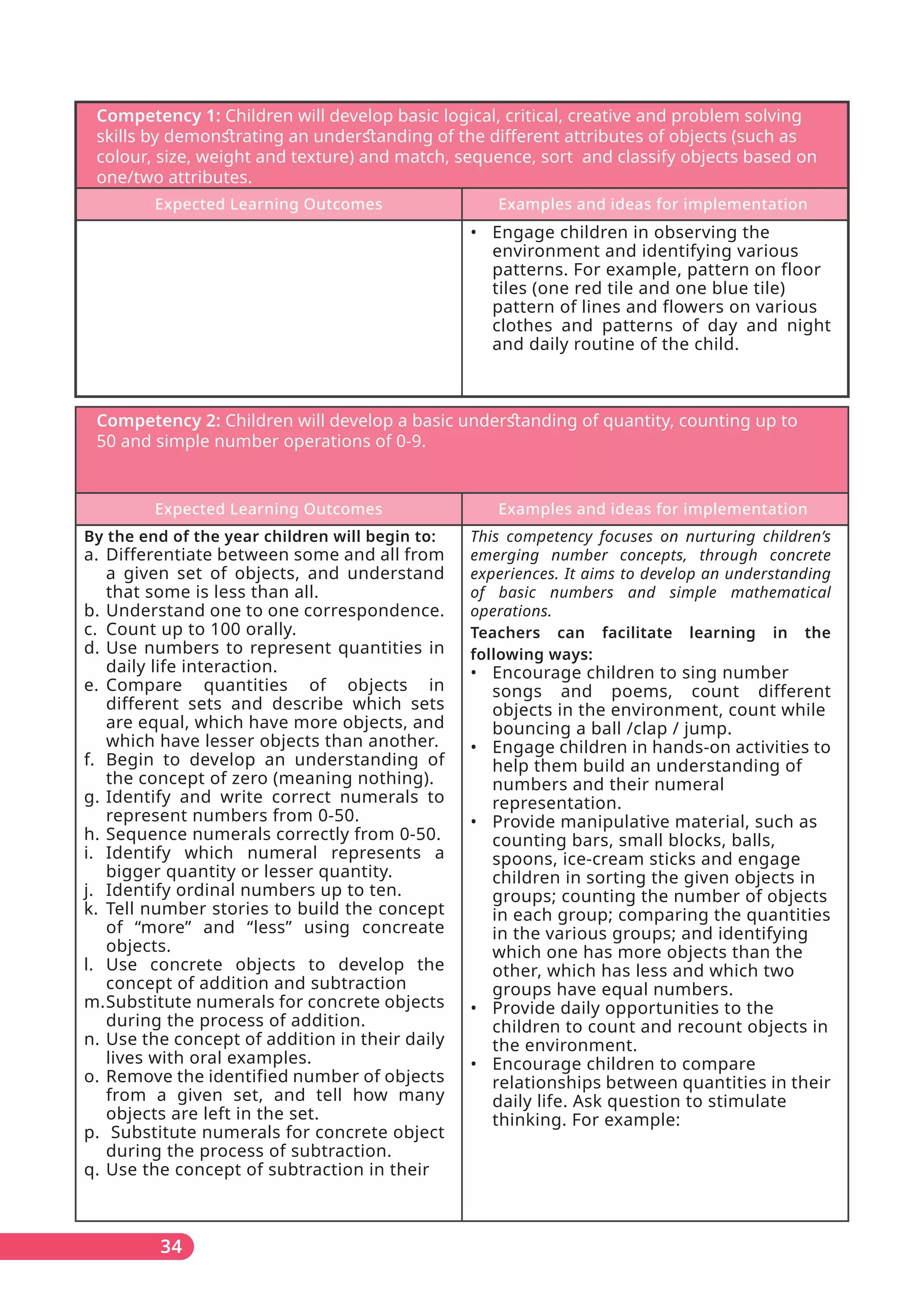
  • 7.
  • 8.
    CHAPTER INTRODUCTION 1 Pregnancy: 9*30=270 days.2 years: 365*2=730 days. 08 1.1 The Significance of Early Childhood Care and Education (ECCE) It is now widely acknowledged that the effects of what happens during the pre-natal period and in the initial thousand days (three years) of a child's life can have lifelong consequences. The kind of early care a child receives from parents, pre-school teachers and caregivers determines how a child learns and relates to school and life in general. The most important factors contributing to the holistic development of a child lay in the domains of social, emotional, moral, cognitive and physical development, which together define the overall personality of a child in later years. It is during early years that a child develops all the key elements of emotional intelligence, namely confidence, curiosity, purposefulness, self-control, connectedness and the capacity to communicate and co¬operate. Emotional Intelligence is now considered crucial for educational success and lifelong learning. The early years are also critical for the acquisition of the concepts, skills and attitudes that lay the foundation of lifelong learning. These include the acquisition of life skills such as self-awareness, critical thinking and conflict management, language, perception-motor skills required for learning to read and write and basic numeracy concepts and skills. Interventions in the earliest years in social awareness and wellbeing are in fact essential for reducing the social and economic disparities, race and gender inequalities that divide our society. It is especially the children of our poor rural and poor urban communities who are most likely to benefit from and who most urgently need investment in early childhood development. It is through initiatives in ECCE such as this, that we can begin to put an end to inter-generational cycles of poverty, disease, violence and discrimination. By the time children reach the age of two (first 1000 days)1 their brains contain as many synapses and use up as much energy as the brain of an average adult. The complexity of this development is described by scientists as a magical "dance" which lies at the very heart of every human being and his or her learning process, beginning at birth, and even before. This relatively new understanding of brain development has critical implications for society, and particularly for educators and the way children are taught. It is evident that it is within the crucial early years, when experience is moulding the brain, that the foundations of learning are also set. A person's ability to learn and his or her attitude towards learning, stem from their experiences in early years. A stimulating and receptive context can set a young child on the path of discovery, openness to the outside world and the capacity to integrate information. The brain is never as elastic again as it is in childhood, in terms of receptivity and vulnerability. Adults are capable of assimilating new knowledge, but can never rival the child's brain in its mastering of new skills and its discovery of learning. Early childhood experiences are the building blocks of this development and the child is the architect of his/ her own brain, piecing together the puzzle and reacting to the outside world.
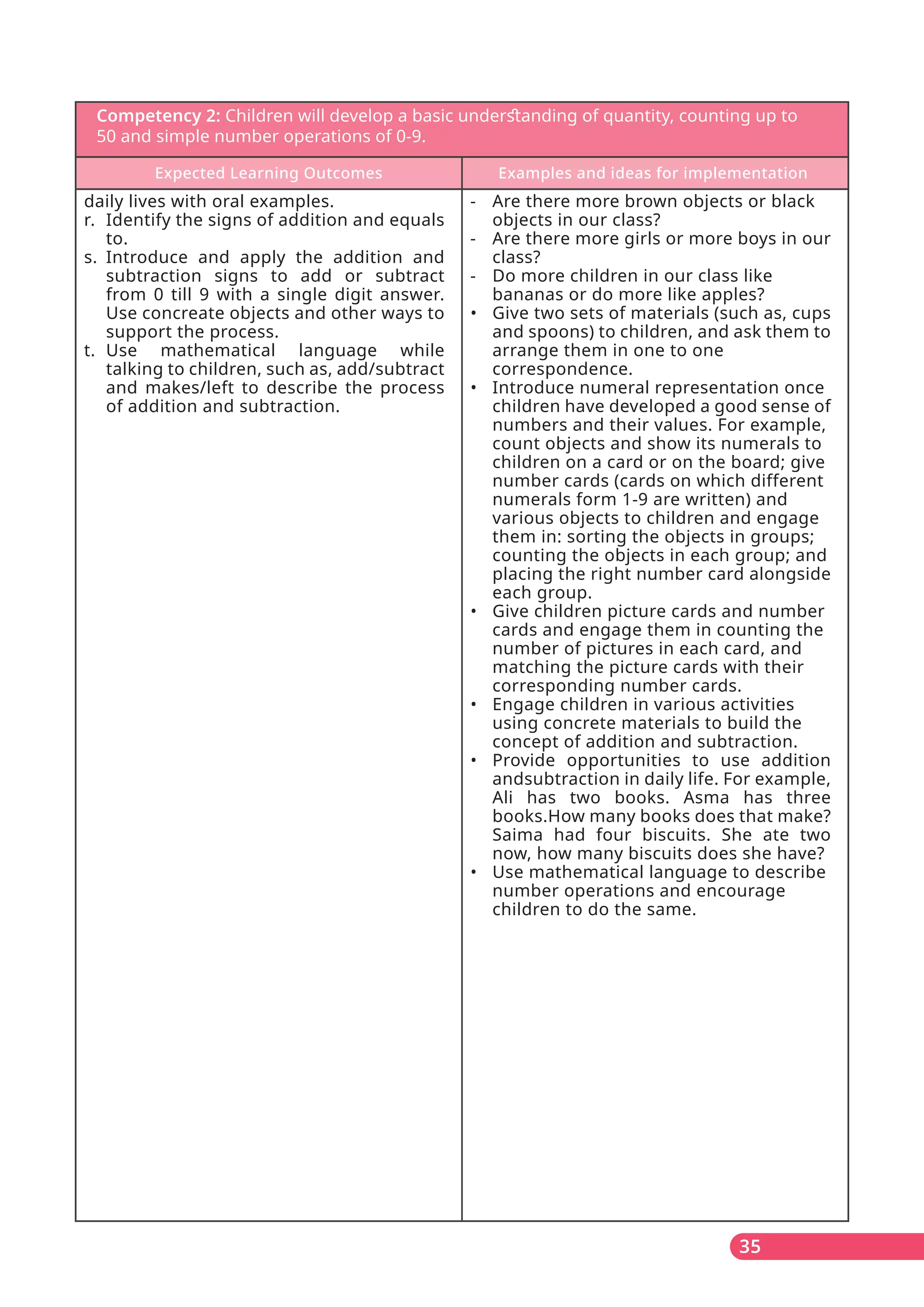
  • 9.
    1.2 Philosophy andValues in ECCE: Every child should have the opportunity to grow up in a setting that values children, that provides safe and secure environment, and that respects diversity. Because children are both the present and the future of every nation, they have needs, rights, and intrinsic worth that must be recognised and supported. Children must receive appropriate nurturing and education within and outside their families before birth and onwards, if they are to develop optimally. Attention to health, nutrition, early stimulation, education, and psychosocial development of children during their early years is essential for the future wellbeing of nations and the global community. Knowledge about human development is now more substantial than at any given point in history. The new century offers opportunities to consolidate recent gains and respond to new challenges that lie ahead. It is important to bear in mind that children, just like adults, need to be respected as capable, thinking and feeling individuals with unique personalities. Central to the key considerations of the curriculum, to which the Government of Pakistan is signatory, is the Convention on the Rights of the Child (CRC). A core value of the CRC is human dignity of the child. Related to this basic value, the Convention consists of the following four principles: 1. Non-discrimination 2. The child’s best interest 3. The child’s right to life and full development 4. Giving due weight to the views of the child Learning through Play All young children need periods of uninterrupted time in which they can engage in active learning, explore their environment, make their own discoveries and set their own challenges. They need opportunities to work with other children, and they need adults who are able to understand and extend their natural interests. Above all, they need opportunities for learning through play. “Play acts as an integrating mechanism which enables children to draw on past experiences, represent them in different ways, make connections, explore possibilities, and create a sense of meaning. It integrates cognitive processes and skills which assist in learning. Some of these develop spontaneously, others have to be learnt consciously in order to make learning more efficient. We would all like children to become successful learners.” Bennet et al (1997) 1.3 National Commitments to ensure steps to be taken to improve statistics and quality of education in the country: 1.3.1 EFA- Education for All Advancement in research on education and human development, highlight the crucial nature of the early years and its implication for a healthy and peaceful life at later stages. The world recognises the importance and need for ECCE (Early Childhood Care and Education) by endorsing expansion and improvement of comprehensive early childhood care and education, especially for the most vulnerable and disadvantaged children as a key means for creating a better world. 09
  • 10.
    The Education forall declaration and subsequent reiteration at World Education Conferences has brought ECCE into the main policy discourse of more than 180 countries. As a signatory to the framework, Pakistan has also made a commitment to support ECCE programmes in the country. 1.3.2 COMMITMENT TO ACHIEVE EFA GOALS AT E-9 FORUM: Recognising that the ‘Education for All’ goals remains unachieved in the nine most populous countries of the world, E-9 member countries gathered to sign a commitment to strengthen collaboration with each other to improve education standards in their countries. The E-9 Initiative, a consortium of the nine most populous countries of the South was put in place in 1993, following the World Conference on EFA in Jomtien, Thailand in 1990. “E” stands for education and “9” for those nine countries which are home to over half of the world's population as well as to almost half of the world’s out of school children and two thirds of the world’s illiterates: Bangladesh, Brazil, China, Egypt, India, Indonesia, Mexico, Nigeria and Pakistan. The nine countries committed to pursue “with determination” the Jomtien goals and have become over the years a driving force within the Education for All partnership. “Inclusive, relevant quality Education for All” has been identified as the thematic focus for cooperation among the E-9 countries. With contribution from high-profile academia from all the E-9 signatory countries, following four sub-themes have been identified: 1. Qualifications framework and competency standards for inclusive quality education 2. Management of teacher education and the issue of quality inclusive education 3. Teacher education and training for inclusive quality education 4. Financing teacher education for inclusive quality education (UNESCO, 2012) 1.3.3 SUSTAINABLE DEVELOPMENT GOAL FOR EDUCATION (SDG-4): Pakistan is also a signatory to Education 2030 vision which was adopted in the Incheon Declaration on May 21, 2015 at the World Education Forum (WEF 2015) held in South Korea. The Incheon Declaration constitutes the commitment of the education community to Education 2030 and the 2030 Agenda for Sustainable Development, recognizing the important role of the education as a primary driver of development. Education 2030 proposes ways of implementing, coordinating, financing, and monitoring efforts to achieve equal education opportunities for all, outlining how the commitments made in Incheon Declaration may be translated into practice at the national and global levels. It also includes indicative strategies which countries may contextualize in the light of their national realities, capacities and their own policies and priorities. It thus presents a serious attempt at providing guidelines for overcoming deficits in implementation when global reform agendas are agreed upon. In the post-devolution scenario of education in Pakistan, all provinces and areas have developed their respective Education Sector Plans (ESPs) and are also working on implementation plans for SDG-4 with specific focus on ECCE. In addition, the active forum of Inter-Provincial Education Ministers’ Conference (IPEMC) discusses key issues, makes recommendations and develops collaboration among all provinces and areas. IPEMC provides an excellent forum to the provinces and areas for experience sharing in implementation of two years pre-primary grades and to develop a way forward. 10
  • 11.
    SUSTAINABLE DEVELOPMENT GOALFOR EDUCATION (SDG-4): Obtaining quality education is the foundation to improving people’s lives and sustainable development. Major progress has been made towards increasing access to education at all levels and increasing enrolment rates in schools particularly for women and girls. Basic literacy skills have improved tremendously, yet bolder efforts are needed to make even greater strides for achieving universal education goals. For example, the world has achieved equality in primary education between girls and boys, but few countries have achieved that target at all levels of education (2015, EFA Global Monitoring Report); hence the need is to renew world’s commitment to achieve education related targets by 2030. A summary of SDG-4 targets is: 4.1: By 2030, ensure that all girls and boys complete free, equitable and quality primary and secondary education leading to relevant and Goal-4 effective learning outcomes 4.2: By 2030, ensure that all girls and boys have access to quality early childhood development, care and pre-primary education so that they are ready for primary education 4.3: By 2030, ensure equal access for all women and men to affordable and quality technical, vocational and tertiary education, including university 4.4: By 2030, substantially increase the number of youth and adults who have relevant skills, including technical and vocational skills for employment, decent jobs and entrepreneurship 4.5: By 2030, eliminate gender disparities in education and ensure equal access to all levels of education and vocational training for the vulnerable, including persons with disabilities, indigenous peoples and children in vulnerable situations 4.6: By 2030, ensure that all youth and a substantial proportion of adults, both men and women, achieve literacy and numeracy 4.7: By 2030, ensure that all learners acquire the knowledge and skills needed to promote sustainable development, including, among others, through education for sustainable development and sustainable lifestyles, human rights, gender equality, promotion of a culture of peace and non-violence, global citizenship and appreciation of cultural diversity and of culture’s contribution to sustainable development 4.8: Build and upgrade education facilities that are child, disability and gender sensitive and provide safe, nonviolent, inclusive and effective learning environments for all 4.9: By 2020, substantially expand globally the number of scholarships available to developing countries, in particular least developed countries, small island developing States and African countries, for enrolment in higher education, including vocational training and information and communications technology, technical, engineering and scientific programmes, in developed countries and other developing countries 4.10: By 2030, substantially increase the supply of qualified teachers, including through international cooperation for teacher training in developing countries, especially least developed countries and small island developing states (United Nations, 2015) 11
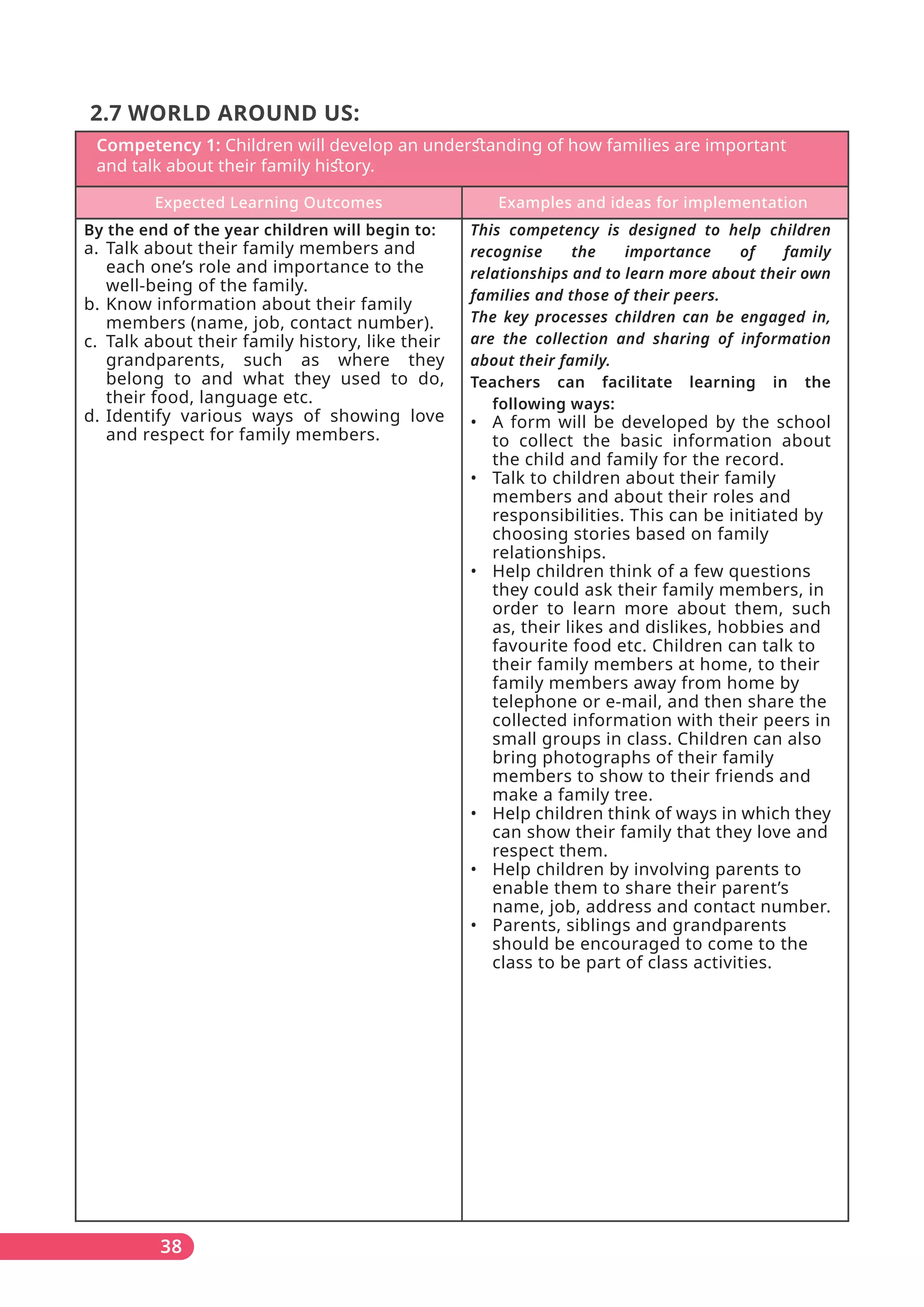
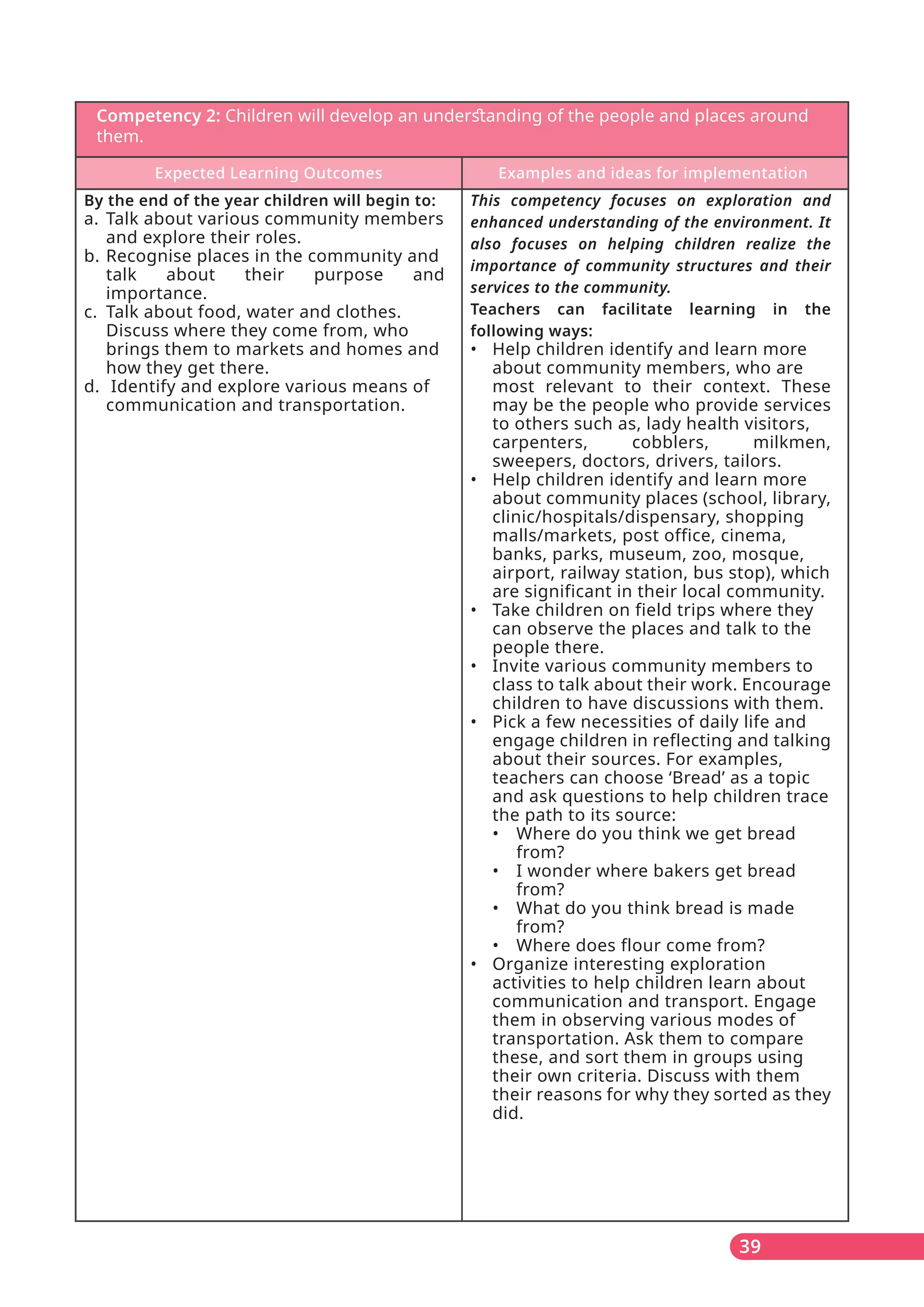
  • 12.
    SDG target 4.2is directly linked with the provision of access to quality Early Childhood Care and Education or pre-primary education regardless of gender or area. Though little has been done under the slogan of EFA and efforts to introduce and implement at least one-year pre-primary education across the country, a lot remains to be done for ensuring quality ECCE across Pakistan. 1.4 Principles Underlying Quality ECCE Programmes: Schools should be ready to accommodate and cater to the needs of young learners by providing adequate resources including sufficient space. Children learn best when: • The environment provided is secure and enabling, where teachers appreciate their previous experiences, and take them forward from where they are. • A partnership between home and school is valued. • Adults are interested in them and the interaction between them is positive. • They are respected; a positive self-image and high self-esteem are fostered. • They are motivated to be independent active learners through first hand experiences • They are given opportunities to make choices and decisions which develop their confidence, helping them to take responsibility of their own learning and growth. • Activities are planned to match their own pace, and are varied, with periods of activity and quiet reflection. • The experiences offered are relevant to their immediate interests and match their individual needs. • The programme is holistic and not compartmentalized with an established daily routine. 1.4.1 Holistic Development through Early Childhood Care and Education: One of the guiding principles of holistic childhood development is the unfolding process of learning which is more important than the product. It is the approach to stimulate willingness to learn rather than mere memorisation of facts and figures. Pushing children to absorb facts and knowledge will not increase their desire to learn. It will, in fact, be to the detriment of the child's development later on and his/her ability to learn effectively. Learning by doing and the very basic need to know are the main motors in stimulating children. All educators, implementers and policy makers have a huge responsibility to ensure that children, who enter schools at age four, are given a sound learning environment. The age for pre-primary grade (04-05) specified directly connotes the existing structure of ECCE grade as Prep/Nursery/Katchi/Undakhil as prevalent across the country. This aspect is the SDG’s (SDG-4.2) indication of the need for implementation of 02 years ECCE Programme. In this regard, it may well be noted that this curriculum for ECCE has the scope to expand and a pre-primary grade for age 03-04 years can easily be derived, should the need arise. This document will provide for the baseline of such introduction of extended pre-primary grades in the Education System of Pakistan. It is important to have a fair level of understanding about the different domains of development, so that developmentally appropriate provisions can be made in response to children’s collective and individual needs. Development is not a linear process; it is simultaneous and integrated. However, for the purposes of explanation and understanding, the domains have been compartmentalized into the following major areas. 12
  • 13.
    • Physical Development:Involves the way children use their muscles, both large and small. The large muscles are used for activities such as walking, jumping and lifting large objects. The small muscles are used for fine motor activities such as threading beads, writing, and drawing, cleaning rice and working with small objects. Exposures to activities that help in muscle development help children in doing small tasks on a daily basis. They start feeling capable of helping elders and gain confidence. • Social and Moral Development: Refers to those processes where children develop relationships with their culture, with people around them and the environment in general. The social setting and value system form the core of a person’s identity – children at a very young age try to figure out what is good, what is appreciated or beneficial, based on what they observe in their surroundings. Quality ECCE environment provides opportunities for children to form positive relationships with other children and with elders, and to engage in conversations about social norms and ethical issues. • Emotional Development: Refers to the development of a child’s capacity to experience, manage and express a full range of positive and negative emotions. The development of self-esteem is critical throughout the early years. It is essential for children to have positive experiences at this stage. Feeling important, actively taking responsibility, being listened to and cared for, are essentials for creating a positive self-concept in children. • Language Development: Refers to the process by which children make sense of the words, symbols and information around them. Children are born with the ability to learn language but again, conducive learning environment is essential to help them develop optimally. Learning to read and write the alphabets and make small sentences is just one component of language development. Over emphasis on this component especially through rote memorization, without giving children a chance to process the information and relate it to their lives, cripples not only their language development, but also their cognitive capacities. • Cognitive Development: Refers to the development of mental processes and capabilities; it focuses on how children learn and process information. It is the development of the thinking and organizing systems of the mind. It involves language, imagining, thinking, creating, exploring, reasoning, problem solving, developing and rejecting ideas and concepts, memory, expression through multiple media and experimenting and applying what they learn. When they come to school, children are already equipped with the basic thinking and processing skills - they have learnt it all as part of growing up. Sound cognitive development enhances critical thinking and creativity in human beings. A conducive ECCE environment provides learning opportunities where children are given the freedom to explore, think, imagine, question, and experiment, as they develop the ability to create novel ideas and solutions. • The World Around Us: the focus of this is on development of children’s knowledge and understanding of their environment, other people, features of the natural and ‘human world’. They provide a foundation for historical, geographical, scientific and technological learning • Health, Hygiene and Safety: It focuses on children developing physical control, mobility, awareness of space and manipulative skills in indoor and outdoor environments. They include establishing positive attitudes and understanding of healthy and active way of life. It encompasses children’s conception and understanding of safety measures to be taken in various situations in the surrounding. 13
  • 14.
    • Creative Arts:It focuses on the development of children’s imagination and their ability to communicate and to express ideas, feelings, observations and experiences in creative ways. This includes encouraging children to think of new and innovative ideas which can be expressed through varied media. 1.5 THE AIMS OF EDUCATION “To educate Pakistanis to be: • Seekers of truth and knowledge who can apply both for the progress of society; • Creative, constructive, communicative, and reflective individuals; • Disciplined, productive, moderate and enlightened citizens; • Capable of effectively participating in the highly competitive global, knowledge-based economy and the information age; citizens committed to creating just civil society that respects diversity of views, beliefs and faiths.” (Ministry of Education, Government of Pakistan, 2006) Recent deliberations and group discussions also yielded the recommendation of adding the following aims to augment the above-mentioned National level aims of education. • Empathetic & patient participants in the world around them; • Contributors towards building harmonious and tolerant society; 1.5.1 A STATEMENT OF BELIEFS: The principles given below carry important implications for practice: • Holistic development of a child is important - social, emotional, physical, cognitive and moral developments are interrelated. • Learning is holistic and for the young child it is not compartmentalised under subject headings. • Intrinsic motivation is valuable because it results in child-initiated learning. • The child’s sense of dignity, autonomy and self-discipline are of critical importance. • In the early years, children learn best through active learning (using all five senses) learning by doing. • What children can do, not what they cannot do, is the starting point in children's education. • There is potential (multiple intelligences, p.88) in all children which emerges powerfully under favourable conditions. • The adults and children to whom the child relates are of central importance. • The child's education is seen as an interaction between the child and the environment, which includes people as well as materials and knowledge. • The teacher understands the importance of inclusive education and also practices it in the classrooms. 1.5.2 A STATEMENT OF OBJECTIVES The National ECCE Curriculum aims to: • Provide for the holistic development of the child, which includes physical, social, emotional, cognitive and moral development. • Develop critical thinking skills. • Nurture tolerance and respect for diversity. • Nurture in children a sense of identity and pride in being Pakistani. • Provide knowledge and understanding of Islam and Islamic society. • Develop an understanding and respect for the beliefs and practices of all other religions. 14
  • 15.
    • Create inchildren a sense of citizenship in community, country and the world. • Foster a sense of independence, self-reliance and a positive self-image. • Equip the child with life-long learning skills. • Provide opportunities for active learning. • Provide opportunities for self-initiated play and decision making. • Developing values, morals, ethics and civic sense. • Sharpen aesthetic sense of children. • Develop intrinsic motivation. • Develop teamwork and sharing attitude. This curriculum is divided into four chapters to ease the understanding of concepts and their implications. Chapter 1 introduces the significance of ECCE while providing the underlying theoretical frameworks of developmental domains catered for in this document. Chapter 2 enlists the key learning areas, competencies and expected learning outcomes for each developmental domain while identifying implementable ideas for teachers, practitioners and textbook/classroom material developers. Chapter 3 provides detailed guiding principles for establishing the learning environment in an ECCE classroom, assessment and evaluation, teachers’ selection, training and continuous professional development programmes, devising roles of school administrators, parents, developing text book/materials for ECCE, and suggested timelines for future curriculum revisions and its practical implications are also included in this chapter. Chapter 4 provides the theoretical perspectives of age appropriate brain development, cognitive development, psychosocial and emotional development as well as ecological system development theories to help understand the holistic development of a child. 15
  • 17.
    CHAPTER KEY LEARNING AREAS, COMPETENCIESAND EXPECTED LEARNING OUTCOMES FOR ECCE
  • 18.
    18 CHAPTER KEY LEARNING AREAS,COMPETENCIES AND EXPECTED LEARNING OUTCOMES FOR ECCE 2.1 INTRODUCTION TO THE KEY LEARNING AREAS AND COMPETENCIES: The key learning areas outlined in this curriculum contains competencies, or goals which have been outlined for children at the pre-primary stages of education. These six areas of learning provide a foundation for later learning and achievement. It is important to remember that children progress at different rates, that individual achievement will vary and that ECCE teachers must appreciate and recognise the language and culture of the children. Children whose achievements exceed the expected outcomes should be provided with opportunities which extend their knowledge and skills. There may be others who will require continuous support to achieve all or some of outcomes at entering Grade I. Care must be taken to ensure that they get the opportunities of revision and reinforcement. Children with special educational needs may also need varied kinds of support throughout schooling. This curriculum for the early years has been divided into the following key learning areas. Each key learning area has been assigned between three to ten competences of learning goals. 2.1.1 PERSONAL SOCIAL AND EMOTIONAL DEVELOPMENT These outcomes focus on children’ learning how to work, play, co-operate with others and function in groups beyond the family. They cover important aspects of personal, social, moral and spiritual development and of personal values agreed upon by the adults in the community, including the parents. 2.1.2 LANGUAGE AND LITERACY These outcomes cover important aspects of language development and provide the foundation for literacy. At the start, the language used in the programmes for all six areas of development, could be in mother tongue, based on local culture and it can then gradually and progressively be further developed to acquire competence in English. Children should be helped gradually to acquire competence in Urdu, making use where appropriate, for developing understanding and skills in languages. The outcomes focus on children’s developing competence in talking and listening and becoming readers and writers. It is important to note that the other areas of learning make a vital contribution to the successful development of communication and literacy. 2.1.3 BASIC MATHEMATICAL CONCEPTS These outcomes cover important aspects of understanding mathematics and provide the foundation for numeracy. They focus on achievement and application through practical activities and on using and understanding mathematical language.
  • 19.
    19 2.1.4 THE WORLDAROUND US These outcomes focus on development of children’s knowledge and understanding of their environment, other people and features of the natural and “human” world. They provide a foundation for historical, geographical, scientific and technological learning. 2.1.5 PHYSICAL DEVELOPMENT These outcomes focus on children’s development, physical control, mobility, awareness of space and manipulation skills in indoor and outdoor environment. The Child will demonstrate balance and coordination, will learn and practice motor skills. 2.1.6 HEALTH, HYGIENE AND SAFETY These outcomes focus on developing understanding of personal care, environmental safety and security in children. These include establishing positive attitudes towards a healthy and active way of life. 2.1.7 CREATIVE ARTS These outcomes focus on the development of children’s imagination and their ability to communicate and to express ideas, feelings, and observations and experiences in creative ways. They include encouraging children to think about new and innovative ideas which can be expressed through varied media. 2.2 COMPETENCIES AND EXPECTED LEARNING OUTCOMES Children learn at their own individual pace according to their interest and learning styles. At the young age of 4-5 years children should not be forced to learn beyond their capacity because this will impede their learning and cognitive development. The ECCE Curriculum charts out learning outcomes that young children are expected to attain. However, given the diverse learning styles and paces, many children may not achieve all the outcomes in one year of the pre- primary grade. Therefore, the outcomes for the subject pre-primary grade are termed “Expected” and educators and supervisors should not be overly concerned about children completing activities or meeting each and every outcome. It is the process and not the production of the learning that is more important at this stage! For all the key Learning Areas, and Competencies there is a list of Expected Learning Outcomes, which start with, “By the end of the year, children will begin to …”It is important to reiterate that in the early years, children learn and achieve the expected outcomes by the end of the year. This is why the outcomes in the National ECCE Curriculum are called expected learning outcomes and not student learning outcomes, as are in the curricula for Grade 1-12. As long as the teacher is providing continuous and varied opportunities for hands-on learning and children are engaged enthusiastically, teacher supervisor and parents should not be overly concerned. 2.3 EXAMPLES AND IDEAS FOR IMPLEMENTATION An additional column containing examples and ideas for implementation has been added, to this curriculum to provide some implementation suggestions, for teacher writers of Teachers’ Guide and for those who will develop teaching-learning resources for this age group.
  • 20.
    20 As the termsuggests, these are examples and ideas only, and are not intended as a prescriptive or exhaustive list of activities for teachers to follow. It is hoped that teachers will use these suggestions as a starting point, and localize the ideas to meet the needs of the children’s context and make cross-curricular links for enhanced learning. 2.4 PERSONAL AND SOCIAL AND EMOTIONAL DEVELOPMENT: Competency 1: Children will develop an understanding of their likes, dislikes, strengths, emotions and self-grooming, decision making and problem solving skills. Children will further enhance their positive sense of self-identity and see themselves as capable learners. By the end of the year children will begin to: a. Share what they like about themselves and what they like about a friend and others. b. Identify different occasions when they feel happy, sad, scared, loved, angry, excited and bored. c. Choose and talk about an activity/work that they enjoy doing the most in class d. Express their likes and dislikes and talk about their strengths and areas of improvement. e. Develop and understand that as individuals, they have their unique needs, interests and abilities and that they are separate from each other. f. Develop and understand how to dress up, know about eating habits, proper posture while walking, talking and sitting. g. Take care of his/her and others’ belongings h. Perceive himself/herself in a positive way i. Ask for help when needed j. Develop problem solving skills by identifying the problems and finding the best solutions through participating in different activities Expected Learning Outcomes Examples and ideas for implementation This competency focuses on developing children’s self-confidence and understanding of their lifestyles and preferences. Teachers can facilitate learning in the following ways: • Ask open ended questions, Why & how questions so that children can think about their responses. For examples, if a child says I want to be a pilot, teachers should also ask her why she/he wants to become a pilot-what does she/he likes about pilots? • Be patient with children so that they have adequate thinking time and then respond. They should never be rushed into answering. • Encourage children to keep learning areas tidy. • Encourage children to seek permission before taking others’ belongings. They should keep only those things in their bag which belong to them. • Putting lunch-boxes and water-bottles at the assigned place and remembering to take them back home. • Respond to significant experiences, showing a range of feelings (happy, sad, worried, scared and angry) appropriate to situations; for example, birthday celebration and “dua” (prayer) for deceased family members of peers etc. • Appreciate and talk about the characteristics that make each person special and unique (name, gender, eye colour).
  • 21.
    21 Competency 2: Childrenwill be willing to share and work in collaboration with their peers, teachers, family members and neighbours, regardless of any differences, such as, in gender, ability, culture, language and ethnicity. By the end of the year children will begin to: a. Show an understanding and respect for the feelings of their peers and others. b. Cooperate with peers, teachers, family and community members. c. Work cooperatively and share materials and ideas amicably in groups. d. Form friendly and interactive relations with peers and adult around them. e. Learn to respect others’ opinion while communicating. f. Learn to take turns. g. Cooperate with and be sensitive to peers, elders, and neighbours who may be differently abled. h. Work in collaboration, in groups/project work to promote leadership skills. Expected Learning Outcomes Examples and ideas for implementation This competency focuses on developing children’s relationship with the people they interact with on a daily bases. Teachers can facilitate learning in the following ways: • Encourage children to help each other carrying out small tasks, like handling and using class materials such as, books, blocks and beads. • Help children to work and play amicably by assigning roles in groups and being respectful towards each other. • Help children make queues when going out of the class for outdoor activities, during break, for washing hands and coming back to the classroom. • Help children take turns during classroom discussion, be attentive and respectful when peers or teacher are sharing their views and experiences. • Be available to support children resolve conflicts, using a problem-solving approach. Competency 3: Children will learn about and appreciate their heritage and culture and develop acceptance, respect and appreciation for the diversity of cultures and languages. By the end of the year children will begin to: a. Talk about the cultural aspects of their l ives, such as, language, clothing, lifestyle, food, traditions and customs. b. Talk about the key cultural practices to resolve conflicts and issues and celebrate festivals c. Recognize historical and cultural places. d. Narrate stories heard from elders. e. Play local games (hide and seek, jumping, gudda-guddi ki shaadi, ghar ghar khail, tug of war, clay modelling, cat’s cradle etc.) f. Develop basic knowledge about Pakistani culture. (i.e. know about the national game, flag, flower, food, folk dances, languages etc.) Expected Learning Outcomes Examples and ideas for implementation This competency focuses on developing children’s understanding of life, cultures and history. This competency aims to develop children’s appreciation of culture that is part of their daily lives. Teachers can facilitate learning in the following ways: • Initiate discussions about cultural events which the children experience directly. • Talk about their cultural practices such as autaq, kacheri, Jirga, majlis, chopaal etc. • Talk about and celebrate religious and cultural festivals, i.e., Eid-ul-Fitr, Eid-ul-Azha, national events such as Independence Day and Jashan-e-Baharaan, depending on the local culture. • Help them observe and identify the beautiful and unique patterns in old buildings and cultural places.
  • 22.
    22 Competency 3: Childrenwill learn about and appreciate their heritage and culture and develop acceptance, respect and appreciation for the diversity of cultures and languages. g. Respect the feelings and views of others irrespective of their religion, caste, colour, creed and people with special need. Expected Learning Outcomes Examples and ideas for implementation • Invite parents and grandparents to tell stories. • Encourage them to talk about and play their favourite local games by ensuring equal opportunities for all and taking care of their individual needs • Talk about places for family gatherings in their local context Competency 4: Children will develop an understanding of their own religious values and practices as well as respect for others’ religious values and practices, with acceptance and appreciation for the differences that exist. By the end of the year children will begin to: a. Recognise, appreciate and respect similarities and differences among people b. Associate and mingle with children having diverse abilities and backgrounds c. Know and understand that the religion of most of the people in Pakistan is Islam d. Recognize that other religions exist in Pakistan as well e. Name their religion. f. Appreciate “peace” (love, care, friendship, tolerance, kindness and respect for others) as a common value across religions. g. Muslim children will: • Believe that Allah is the Sole Creator and Prophet Muhammad ‫ﷺ‬ is His last and most beloved Prophet. • Believe that Islam stands for peace and harmony. • Recite the first Kalma. • Recite small dua’as and know why they should be recited h. Non-Muslim children will learn and practice about their own religion Respect other religions and have tolerance for other religions. Expected Learning Outcomes Examples and ideas for implementation % This competency focuses on developing children’s concept of religion and respect for all religious. Teachers can facilitate learning in the following ways: • Celebrate culture and harmony days (cultural games, food, dresses etc.) • Assign tasks to mix-ability groups with pre-defined rules (displayed in the classroom as classroom norms) • Promote the values of tolerance and respect for everyone. Young children should be made confident that Allah loves them. He has created them with love and wants them to love their fellow-beings. Notions of ‘fear; or ‘punishment’ should not be inculcated at this young age. • Recite small dua’as so that Muslim children are introduced to the ethics of Islamic living. Help children understand the significance of dua’as. For example why we should recite dua’as before eating or sleeping – what do they mean and how they communicate our gratefulness to Allah? • Encourage children who belong to other religions to recite their own prayers and share their beliefs.
  • 23.
    23 Competency 5: Childrenwill demonstrate a sense of responsibility for self and others in class, school, home and neighbourhood. Expected Learning Outcomes Examples and ideas for implementation By the end of the year children will begin to: a. Manage small tasks leading to self-reliance. b. Take care of their own belongings and put classroom materials back in the right place after use. c. Identify and implement small tasks l eading to a sense of responsibility for school, community and public property. d. Recognise that water, food, electricity and paper are very important resources and need to be used responsibly. e. Recognise and practice their responsibility in keeping the environment, home, classroom and neighbourhood clean. f. Take care of peers in class, school and neighbourhood. This competency focuses on developing children’s confidence and self-reliance, and on developing an understanding and appreciation for the responsible use of scarce resources. Teachers can facilitate learning in the following ways: • Encourage a sense of care and responsibility in children. For example, turning pages of books with care; helping in setting the snacks carefully; returning materials to the designated place after use in school and at home. • Stand back and let them resolve little problems independently, until they ask for help. Encourage them to help other children and adults in the classroom and neighbourhood. • Discuss respect for others’ property and give them responsibility for: • Performing tasks assigned individually and in groups • Cleaning up after snack time. • Using materials with care, keeping tables, shelves and walls clean. • Using waste bin for throwing litter and wrappers, after checking for ‘junk’ that can be recycled. • Taking pride in clean, environment. • Returning things that do not belong to them, to an adult, switching off fans and lights when leaving room. • Group leader will bring materials for group work from the learning corners • Group leader helps others within the group to complete the task • Talk about the importance of water, food, electricity and paper. Discuss in simple terms where they come from; how we need these in our daily lives and how these can be depleted and ‘hurt’ the earth if we don’t use them carefully.
  • 24.
    24 Competency 6: Childrenwill use common courtesy expressions like greetings, please, welcome, thank you, sorry, excuse me. Expected Learning Outcomes Examples and ideas for implementation By the end of the year children will begin to: a. Speak politely. b. Take turns when speaking and respect the right of others to speak c. Respect everyone d. Take initiative to greet others. e. Use courtesy words as per situation. f. Facial expression and body language should be in accordance with the greeting words. This competency focuses on developing children’s courteous conversation and mannerism to help develop positive and healthy relationships with peers and elders. Teachers can facilitate learning in the following ways: • The teachers present themselves as a role model in front of students by always practicing polite expression. • By providing reinforcement through role-plays and practice during the classroom activities. • By displaying some charts/pictorial displays reflecting common courtesy expressions. Competency 7: Children will learn and develop a sense of citizenship. Expected Learning Outcomes Examples and ideas for implementation By the end of the year children will begin to: a. Recognise the fact that rules are important/required in the classroom, school, home and community. b. Understand why rules are necessary and how they help us c. Identify some basic traffic rules (traffic lights, zebra crossing, etc). d. Exhibit the understanding that individuals have different opinions and learn the importance of listening to others’ ideas and point of view patiently. e. Identify their responsibilities with respect to each right (go to school regularly and do homework, take care of the play equipment and environment) This competency focuses on developing sense of citizenship Teachers can facilitate learning in the following ways: • Encourage students to design classroom rules and implement them within the classroom. • Storytelling and poems with the moral, why rules are important and discussing the consequences of not following the rules. • Help students to identify traffic lights and Zebra crossing through different activities and make them understand how they work and help us. • By generating group discussions (Circle Time), students take turns to speak and listen to others patiently and attentively. • By giving students responsibility of small classroom tasks (collection of notebooks, tidying up after each activity, taking care of their belongings) • Demonstrate and develop understanding of queuing up and wait for their own turn at school and public places.
  • 25.
    Competency 8: Childrenwill develop and demonstrate ethical and moral values such as honesty, inner accountability, social justice, empathy, compassion and respect. Expected Learning Outcomes Examples and ideas for implementation By the end of the year children will begin to: a. Develop an understanding of the term kindness and the importance of being kind to others b. Understand the importance of sharing and list the things they can share with others (toys/lunch). c. Understand that mistakes are a part of learning and nothing to be ashamed of or to make fun of. d. Develop the ability to think about and take personal accountability for actions. e. Develop and understanding of truthfulness, honesty, fairness and trustworthiness in their actions. This competency focuses demonstrate ethical and moral values. Teachers can facilitate learning in the following ways: • Encourage children to share their real-life experiences on kindness. • Provide opportunities that encourage sharing within and beyond the classroom • Encourage children to share if anything goes wrong and make them comfortable that it’s okay to make mistakes. • Identify ways in which we can reduce the hurt caused to others (admit mistake, ask for forgiveness, do something special for them, appreciation) • Share moral stories, role plays and children’s own life experiences with the whole class • Develop the habit of self-reflection in students. Competency 1: Children will engage confidently with others using language in a variety of ways for a variety of purposes and contexts. 2.5.1 LISTENING AND SPEAKING SKILLS By the end of the year children will begin to: a. Listen attentively in small and large groups and share their views about every event and special occasions. b. Respond to others in a variety of verbal and non-verbal ways for a variety of purposes, for example exchanging ideas, expressing feelings, and a variety of contexts, plan-work-clean-up-review, group work time’. c. Talk about their experiences and feelings with peers and adults by using complete sentences. d. Respond to and verbally express a range of feelings, such as, joy and sorrow, wonder and anger. The primary function of Competency 1 is to enhance children’s confidence and ability to communicate with fluency. Teachers can facilitate learning in the following ways: • Engage children in conversation by talking about special cultural and national events which are meaningful for them, encourage them at school as well as at home. Initiate the conversation by sharing own news, experience and feelings, taking care that these are appropriate for the children. Following the weekend, ask learning questions or comments such as, “I wonder if anyone went to the park yesterday ….; or “I can see that Ayesha has mehndi/henna on her hands; All the following competencies require that teachers start the language and Literacy program in children’s Mother Tongue, based on local culture and gradually add Urdu and English (wherever applicable), and also reference from the wider culture. Children need the confidence that their mother tongue is valued. 2.5 LANGUAGE AND LITERACY: 25
  • 26.
    Competency 1: Childrenwill engage confidently with others using language in a variety of ways for a variety of purposes and contexts. 2.5.1 LISTENING AND SPEAKING SKILLS e. Show respect for a variety of ideas and beliefs by listening and responding appropriately. f. Wait for their turn to speak and not interrupt when others are talking. g. Initiate conversations with peers and adults. h. Recognition of letters with their initial sounds i. Recognise and differentiate between sounds in the environment. j. Understand and follow instructions. k. Use correct pronunciation. l. Draw on words from enhanced vocabulary, and making new words through blending sounds. m.Make appropriate use of body language (eye contact, hands movements, facial expressions etc.) while speaking to the audience. Do you think someone in her family is getting married?;It looks like Ali has had a haircut.” Encourage children to give answers in complete sentences. • Introduce sounds using different mode of technology and techniques (smart phone, cassette player, multi media player) • (tapping, drumming, local no cost resources,) • Encourage children to listen to different sounds in their environment for example, paper tearing, dropping and tapping things, animal voices, wind blowing, audio players and musical instruments. • Establish an environment where children feel free to talk, by placing self at children’s height level. Be available to converse with all the children throughout the day. Refer one child’s questions and problems to another • Listen actively to children and wait for them to complete what they are saying. Be patient with their hesitation and at the same time help other children to listen and wait, by holding up a hand, and nodding, assuring them that they will get a turn. Display appropriate facial expressions and body language to communicate respect, joy, sorrow or wonder. • Play games where they have to understand and follow simple instructions. For example, “Ayesha, touch your head and then your nose and then clap your hands.” • Teacher will use phonic rhymes and sounds in audio/video form. Children will learn the rhyme and will identify letters with their initial sounds. • Repeat the correct pronunciation of words that children may have mispronounced, without telling them that they were wrong. • Help them enhance their vocabulary, by encouraging them to guess new words by playing games like ‘I spy with my little eye something that begins with the letter A, or B’. Action poems and songs are a goodway to learn words and sentences. 26
  • 27.
    Competency 2: Childrenwill describe objects, events and their plans for the day. Expected Learning Outcomes Examples and ideas for implementation By the end of the year children will begin to: a. Name things in their environment. b. Describe and talk about pictures, drama, animated video etc c. Share their plans for the day and describe the previous or upcoming events and days d. Express their ideas with clarity. e. Extend their ideas or accounts by providing some detail about their topic and daily routine f. Describe a picture by using appropriate words or simple sentences This competency is designed to help children to process and comprehend spoken language and to communicate their thoughts, needs, interests and feelings to others. Teachers can facilitate learning in the following ways: • Take children for a walk around the school and play a game of naming objects that they see in the environment. Back in the classroom, encourage children to try and recall what they had seen in the environment. • Talk about and discuss pictures from children’s story books, or pictures (age/culturally appropriate) that have been cut out from old magazines or newspapers. • Facilitate discussion about their daily routine • Sing songs and recite poems in a similar manner with action and encourage children to do role play. • Play games where children have shut their eyes and ask them to listen to different sounds in the environment and guess who or what is making those sounds. For example, the sound of a bird, a cat or dog, a rickshaw or a bus. At other times, make sound such as clapping, tapping or stomping your foot and ask them to identify the sound. • Listen to the children as they work and play, and make up chants and rhythms along with them. Recite rhyming words, even if all of them don’t make sense and laugh at these together. Develop a playful interest in respective sounds and words, aspects of language such as rhythm, rhyme, alliteration, and an enjoyment of nonsense stories and rhymes. 27
  • 28.
    Competency 3: Childrenwill enjoy listening to stories and poems/rhymes and make up their own stories and rhymes. Expected Learning Outcomes Examples and ideas for implementation By the end of the year children will begin to: a. Retell and respond to stories, songs and rhymes by joining verbally or with actions as appropriate b. Recognise and differentiate between sounds in the environment c. Appreciate the concept of words, rhymes and syllables. d. Make up their own stories and rhymes This competency focuses on enjoying stories, poems and songs and on children making up their own stories and taking part in role play with confidence. Teachers can facilitate learning in the following ways: • Tell children traditional stories and tales which have cultural relevance for them. Occasionally, use simple props such as puppets, masks and toys available in local context. • Help children explore using language through enjoyable ways like playing with words, rhymes, poems, stories and role play. • Sit with children on the floor, on a mat/darri so that you are closer and at the same physical level as them. • Tell stories without props too, so that children can rely on and build their imagination. • Maintain their interest in stories and poems by being animated and telling or reading a story with expression. Pause for children’s comments or questions and enjoy their responses. Make story telling a fun activity. • Sing songs and recite poems with actions and encourage children to role play. • Listen to the children as they work and play, and make up chants and rhymes along with them. Recite rhyming words, even if all of them do not make sense and laugh at these together. Develop a playful interest in repetitive sounds and words, aspects of language such as rhythm, rhymes, and alliteration and an enjoyment of nonsensical stories and rhymes. • Practice syllable activities, for example, ‘clap and say’, ‘hip-po-pot-a-mus’ 28
  • 29.
    Competency 4: Childrenwill enjoy age appropriate books and handle them carefully. 2.5.2 READING SKILLS By the end of the year children will begin to: a. Hold, open and turn pages of a book with care. b. Enjoy skimming/scanning through age appropriate big books. c. Predict the story by looking at the cover page and flipping through pages. d. Predict what comes next in stories. e. Ask open ended questions about the story to support critical and logical thinking. f. Repeat simple repetitive sequences in traditional and popular children’s stories. g. Tell a simple story by looking at pictures. h. Retell a favourite story in the correct sequence. This competency focuses on pre-reading skills. Children will enjoy books and handle them carefully. Teachers can facilitate learning in the following ways: • Hold up books for children when reading a story and show them the pictures. Show enjoyment and respect of books through actions and facial expressions. Share own feelings about books during circle time. Encourage the children to tell a story by looking at the pictures. If they make up their own stories, just accept them. However, if they are re-telling a favourite story, and they miss important steps in the sequence, help them to remember by questioning gently and appealing to their sense of reasoning. • Establish a reading corner in the classroom. Encourage children to bring books (used books) from home (wherever possible) to keep them in the reading corner for a few days. • Show children how to hold and open a book without spoiling or tearing it. Show them also how to turn the pages with care. Learning to respect other people’s property is an important part of learning about right and wrong. • Build up a sense of anticipation and give children the opportunity to guess what will happen next in a story. Also wait for and encourage them to join in when a sentence is repeated in a familiar story. 29
  • 30.
    Competency 5: Childrenwill understand how books are organized. Expected Learning Outcomes Examples and ideas for implementation By the end of the year children will begin to: a. Differentiate between the parts of a book (the cover, the title and the end). b. Understand and demonstrate the usage and significance of different parts of a book. c. Know that some books tell stories and others give information. d. Know that Urdu is read from right to left and top to bottom. e. Know that English is read from left to right and top to bottom. f. Know that regional languages (where applicable) are read from right to left and top to bottom). This competency will help children understand the different parts/sections of a book, the different kinds of books and the orientation of different languages. Teachers can facilitate learning in the following ways: • Tell them in a conversational tone, what the different parts of a book are, such as the cover, the end, the spine through demonstrating the significance and usage of these parts • When reading out a story, show them where a sentence begins and which direction we read in and how we read from top to bottom. • Talk to children about different kinds of books explaining that some tell us story and others tell us about so many different things, such as animals, plants, buildings, and history. Competency 6: Children will recognise letters and familiar words in simple texts. Expected Learning Outcomes Examples and ideas for implementation By the end of the year children will begin to: a. Understand that words and pictures carry meaning. b. Identify and name the characters in a story. c. Recognise their names in print (Urdu & English). d. Begin to recognise letters of the Alphabet. e. Identify sight words that are meaningful for them. f. Identify letter sounds through words that have personal meaning for them. g. Associate initial letter sounds with names of objects in their classroom environment. h. Think of a variety of objects beginning with a single letter of the alphabet. This competency will help children recognise familiar words in simple texts. They will begin to associate sounds with letters of the alphabet and also to recognise letters of the alphabet by shape and sound. They will begin to recognise their own names and other familiar, often repeated words. Teachers can facilitate learning in the following ways: • Provide a print rich environment. Children learn to read by trying to make sense of the print they come across.Support their efforts by labelling objects and areas in the classroom. Place plenty of books in the learning environment for them to look through, and to tell each other their stories. • Create symbols for their names and draw these along with the written name on a label which can be pinned (safely) on their clothes. Let them find their own name tags each day when they arrive. When they are confident and can identify their names easily, remove the symbol and leave only their name on the name tag. 30
  • 31.
    Competency 6: Childrenwill recognise letters and familiar words in simple texts. Expected Learning Outcomes Examples and ideas for implementation • Prepare flash cards with letters of the Alphabet (remember to move from mother tongue to Urdu to English) and play matching games. Match the cards to objects and pictures which begin with a particular alphabet. Say the initial alphabetical sounds of objects and match these to sounds of the alphabets present. Begin with words that are personally meaningful for the children like their own name, names of family members, pets, favourite food and places. Keep an ear open for children’s interests and use words that are important for them to help them “read” the respective alphabet and sight words. Competency 7: Children will use pictures, symbols and familiar letters and words to communicate meaning, show awareness of some (symbols, letters and words), for the different purposes of writing. 2.5.3 WRITING SKILLS By the end of the year children will begin to: a. Make marks and scribble to communicate meaning b. Use some clearly identifiable letters in their writing to communicate meaning, representing some sounds correctly and in sequence. c. Draw pictures to communicate meaning. d. Hold writing tools properly to develop a comfortable and efficient pencil grip. e. Colour a simple picture keeping within designated space. f. Trace, copy, draw and colour different shapes, such as circles, squares, triangles and rectangles. g. Trace and draw vertical, horizontal and wavy lines and simple patterns made up of lines, circles, semi circles and other simple shapes. h. Trace, copy and write the letter of Urdu alphabet. i. Trace, copy and write the letters of the English alphabet. This competency will help children use pictures symbols and familiar letters and words to communicate meaning, showing awareness of some of the different purposes of writing. It will also focus on learning the skills they will need in writing legibly. Teachers can facilitate learning in the following ways: • Provide a variety of writing and drawing materials (pencils, crayons, chalk etc.) to scribble and make marks on paper/Slate/takhti and sand-paper. Accept children’s scribbling/drawing as their first attempts at writing. Look carefully to find letters and images emerging from their scribbling. Gently, help them to hold their writing tools correctly; use computers with children’s software where possible. • Talk to them about their drawing and write a word or sentence, exactly as they say it, and then let them trace over it if they want to. They may return to it the next or another day and “read” what was written. This will help them see that pictures communicate meaning. 31
  • 32.
    Competency 7: Childrenwill use pictures, symbols and familiar letters and words to communicate meaning, show awareness of some (symbols, letters and words), for the different purposes of writing. 2.5.3. WRITING SKILLS j. Trace, copy and write the letters of reginal languages (where applicable). k. Know that print carries meaning and in English, it is written from left to right, begins at the top left corner of the page and moves across and down, and words are separated by space. l. Know that print carries meaning and in Urdu, it is written from right to left, begins at the top right corner of the page and moves across and down, and words are separated by space. m.Write their own names in English & Urdu and their native language with appropriate use of upper and lower case letters. n. Write a word or a sentence while describing a picture. • Provide a tray with sand in it. Encourage children to draw lines and patterns in the sand and then later on paper. They can trace or copy lines and patterns that have been made for them. • Provide practise by writing letters in the air, moving hand in the correct direction asking the children to follow. • Give them plenty of opportunities to trace, draw and colour pictures prepared for them and simple shapes which have been introduced earlier. Let them trace and copy letters of the alphabet (mother tongue, Urdu, English) and their own names. 2.6 BASIC MATHEMATICAL CONCEPTS: Competency 1: Children will develop basic logical, critical, creative and problem solving skills by demonstrating an understanding of the different attributes of objects (such as colour, size, weight and texture) and match, sequence, sort and classify objects based on one/two attributes. By the end of the year children will begin to: a. Recognise, name and differentiate between colours. b. Differentiate between the objects on the basis of size, weight, length, width and textures (smooth & rough). c. Arrange objects and later pictures, according to their size/length, going from smallest to biggest, biggest to smallest, shortest to longest and longest to shortest and vice versa. d. Arrange objects and then pictures, according to their weight and width, going from highest to lowest, heaviest to lightest and narrowest to widest and vice versa. Expected Learning Outcomes Examples and ideas for implementation This competency requires that children use mathematical language as they explore the similarities and difference between the attributes of objects. It focuses on enhancing children’s thinking skills through pattern identification and through building relationships. Teachers can facilitate learning in the following ways: • Give the children freedom to explore patterns and relationship. Give them the opportunity to come up with different answers or solutions and accept what they come up with. 32
  • 33.
    Competency 1: Childrenwill develop basic logical, critical, creative and problem solving skills by demonstrating an understanding of the different attributes of objects (such as colour, size, weight and texture) and match, sequence, sort and classify objects based on one/two attributes. e. Match and compare one object with another on the basis of similar attributes. f. Sort and group objects (classify) based on a single attribute (for e.g.; colour or size etc) and based on two attributes (e.g. colour, weight, size, number of sides). g. Observe, identify and extend patterns developed with various concrete materials. h. Observe, identify and extend the given picture/symbol patterns. i. Group objects together according to their shapes and colours. j. Sequence objects according to their size, shapes and colours k. Identify and differentiate between broad and narrow l. Identify that 'some' is less than 'all' m.Differentiate between 'more', 'less' and 'equal. n. Differentiate between half and full. o. Create own patterns using concrete materials and pictures and then explain them. p. Observe and identify the “odd one out” from the given set of concrete material or pictures and explain the answer. Expected Learning Outcomes Examples and ideas for implementation • Design various interesting activities using simple everyday material to help children build their skills. A few ideas are given below: • Use concrete materials such as, beads, blocks, and buttons. Help them recognise and describe the attributes of these objects. • Ask children to compare the given objects and identity similarities and differences between them. Encourage them to group various objects and explain the reasons for doing so. • Use a variety of materials to help children build their classification skills. For example, give children red and blue beads of the same size and ask them to sort these in two groups. Later, give them red and blue beads in small and large sizes and ask them to sort these. In the second case, children may come up with different ideas. They can make four groups (small red beads, big red beads, small blue beads and large blue beads). They may make only two groups (red beads and blue beads or small beads and big beads. (Encourage children to consider various attributes while sorting. • Use the concept of sorting and sequencing in daily class activities, such as making a queue of children in the order of height, dividing the children for various group activities, organizing class materials in boxes and arranging books in various piles. • Use low cost materials, such as, beads, nut shells, ice cream sticks and pebbles for pattern seeking exercises. Start by showing a few patterns to children, and then engage them in extending the given patterns and developing their own patterns using concrete materials and pictures. 33
  • 34.
    Competency 1: Childrenwill develop basic logical, critical, creative and problem solving skills by demonstrating an understanding of the different attributes of objects (such as colour, size, weight and texture) and match, sequence, sort and classify objects based on one/two attributes. Expected Learning Outcomes Examples and ideas for implementation • Engage children in observing the environment and identifying various patterns. For example, pattern on floor tiles (one red tile and one blue tile) pattern of lines and flowers on various clothes and patterns of day and night and daily routine of the child. Competency 2: Children will develop a basic understanding of quantity, counting up to 50 and simple number operations of 0-9. By the end of the year children will begin to: a. Differentiate between some and all from a given set of objects, and understand that some is less than all. b. Understand one to one correspondence. c. Count up to 100 orally. d. Use numbers to represent quantities in daily life interaction. e. Compare quantities of objects in different sets and describe which sets are equal, which have more objects, and which have lesser objects than another. f. Begin to develop an understanding of the concept of zero (meaning nothing). g. Identify and write correct numerals to represent numbers from 0-50. h. Sequence numerals correctly from 0-50. i. Identify which numeral represents a bigger quantity or lesser quantity. j. Identify ordinal numbers up to ten. k. Tell number stories to build the concept of “more” and “less” using concreate objects. l. Use concrete objects to develop the concept of addition and subtraction m.Substitute numerals for concrete objects during the process of addition. n. Use the concept of addition in their daily lives with oral examples. o. Remove the identified number of objects from a given set, and tell how many objects are left in the set. p. Substitute numerals for concrete object during the process of subtraction. q. Use the concept of subtraction in their Expected Learning Outcomes Examples and ideas for implementation This competency focuses on nurturing children’s emerging number concepts, through concrete experiences. It aims to develop an understanding of basic numbers and simple mathematical operations. Teachers can facilitate learning in the following ways: • Encourage children to sing number songs and poems, count different objects in the environment, count while bouncing a ball /clap / jump. • Engage children in hands-on activities to help them build an understanding of numbers and their numeral representation. • Provide manipulative material, such as counting bars, small blocks, balls, spoons, ice-cream sticks and engage children in sorting the given objects in groups; counting the number of objects in each group; comparing the quantities in the various groups; and identifying which one has more objects than the other, which has less and which two groups have equal numbers. • Provide daily opportunities to the children to count and recount objects in the environment. • Encourage children to compare relationships between quantities in their daily life. Ask question to stimulate thinking. For example: 34
  • 35.
    Competency 2: Childrenwill develop a basic understanding of quantity, counting up to 50 and simple number operations of 0-9. Expected Learning Outcomes Examples and ideas for implementation - Are there more brown objects or black objects in our class? - Are there more girls or more boys in our class? - Do more children in our class like bananas or do more like apples? • Give two sets of materials (such as, cups and spoons) to children, and ask them to arrange them in one to one correspondence. • Introduce numeral representation once children have developed a good sense of numbers and their values. For example, count objects and show its numerals to children on a card or on the board; give number cards (cards on which different numerals form 1-9 are written) and various objects to children and engage them in: sorting the objects in groups; counting the objects in each group; and placing the right number card alongside each group. • Give children picture cards and number cards and engage them in counting the number of pictures in each card, and matching the picture cards with their corresponding number cards. • Engage children in various activities using concrete materials to build the concept of addition and subtraction. • Provide opportunities to use addition andsubtraction in daily life. For example, Ali has two books. Asma has three books.How many books does that make? Saima had four biscuits. She ate two now, how many biscuits does she have? • Use mathematical language to describe number operations and encourage children to do the same. daily lives with oral examples. r. Identify the signs of addition and equals to. s. Introduce and apply the addition and subtraction signs to add or subtract from 0 till 9 with a single digit answer. Use concreate objects and other ways to support the process. t. Use mathematical language while talking to children, such as, add/subtract and makes/left to describe the process of addition and subtraction. 35
  • 36.
    Competency 3: Childrenwill recognise basic geometrical shapes and the position of objects in relation to each other and surroundings By the end of the year children will begin to: a. Recognise, name and draw two dimensional shapes, such as circle, oval, square, rectangle or triangle, using features such as number of sides, curved or straight. b. Recognize and name 3-D shapes such as sphere, cube, cuboid cylinder and cone using features such as number of faces, flat or curved faces c. Identify the shapes in their environment. d. Draw object of their own choice using various shapes. e. Develop understanding and describe the position and order of objects using position words such as, in front of, behind, up, down, under, inside, outside, between and next to. Expected Learning Outcomes Examples and ideas for implementation This competency will help children to develop a sense of shape and space. It emphasizes the provision of hands-on experience to understand the position of objects in space. Teachers can facilitate learning in the following ways: • Provide several sets of shape cards in the same colour, and ask children to sort the cards using their own criteria; describe the sorting process hey adopted and talk about the criteria they used; and name each shape. Children may use and name each shape. Children may use various names, and at this stage their methods and answers need to be accepted regardless of their accuracy. • Introduce 2-D and 3-D shapes and their proper names. Involve children in identifying and talking about similarities and differences of the shapes. • Provide easily available material to build models. • Take children on a ‘shape walk’ looking for geometric shapes in the environment. • Provide experiences in making shapes with natural and recycled materials, such as, clay, string and ice-cream sticks. • Introduce and use various position words to describe the position of objects in daily activities. For example, Akram is putting the ball on the table; Salma has put the pencil next to her book; Zehra is standing between Ali and Asma. • Engage children in various games in which they give instructions to each other using position words. • Involve children in describing pictures using positional words. 36
  • 37.
    Competency 4: Childrenwill develop an understanding of measurement. Expected Learning Outcomes Examples and ideas for implementation By the end of the year children will begin to: a. Describe and compare objects using length; weight, height and temperature (hot & cold) as measurement attributes. b. Observe various objects and estimate their weight and length. c. Verify their estimations using simple tools. d. Understand informal time units and know that clocks and calendars mark the passage of time. e. Sequence events in time and anticipate events. This competency emphasizes developing basic ideas about measurement and measuring attributes through hands-on experiences. Teachers can facilitate learning in the following ways: • Provide concrete materials to children such as long and short pencil, strips of paper or strings, heavy and light blocks, toys and pebbles and engage them in comparing and describing the relationship between these objects, using words such as, longer or shorter than, heavier or lighter than. Height chart may be used to give the concept of height. • To lead children towards estimating the measurements, show them a few objects and ask questions, such as, which one seems to be the heaviest/lightest, longest/shortest? To verify their estimations, use simple tools such as, their own hand span, a simple balance, rope or scale. • Using a calendar indicates special days, months, birthdays and use terms such as yesterday, today or tomorrow. Use a clock in the daily routine to anticipate what will happen next. Anticipate how many months before Ramadan and Eid, summer holidays, going to the next class, vand other events that are of relevance to the children. • Create a simple analogue clock by using card-paper with moveable hands and use it to teach the concept of time such as time for coming to school, time for break and pack-up time etc. • Give them opportunity to adjust the hands of clock according to the above-mentioned directions, on their own. 37
  • 38.
    Competency 1: Childrenwill develop an understanding of how families are important and talk about their family history. Expected Learning Outcomes Examples and ideas for implementation By the end of the year children will begin to: a. Talk about their family members and each one’s role and importance to the well-being of the family. b. Know information about their family members (name, job, contact number). c. Talk about their family history, like their grandparents, such as where they belong to and what they used to do, their food, language etc. d. Identify various ways of showing love and respect for family members. This competency is designed to help children recognise the importance of family relationships and to learn more about their own families and those of their peers. The key processes children can be engaged in, are the collection and sharing of information about their family. Teachers can facilitate learning in the following ways: • A form will be developed by the school to collect the basic information about the child and family for the record. • Talk to children about their family members and about their roles and responsibilities. This can be initiated by choosing stories based on family relationships. • Help children think of a few questions they could ask their family members, in order to learn more about them, such as, their likes and dislikes, hobbies and favourite food etc. Children can talk to their family members at home, to their family members away from home by telephone or e-mail, and then share the collected information with their peers in small groups in class. Children can also bring photographs of their family members to show to their friends and make a family tree. • Help children think of ways in which they can show their family that they love and respect them. • Help children by involving parents to enable them to share their parent’s name, job, address and contact number. • Parents, siblings and grandparents should be encouraged to come to the class to be part of class activities. 2.7 WORLD AROUND US: 38
  • 39.
    Competency 2: Childrenwill develop an understanding of the people and places around them. Expected Learning Outcomes Examples and ideas for implementation By the end of the year children will begin to: a. Talk about various community members and explore their roles. b. Recognise places in the community and talk about their purpose and importance. c. Talk about food, water and clothes. Discuss where they come from, who brings them to markets and homes and how they get there. d. Identify and explore various means of communication and transportation. This competency focuses on exploration and enhanced understanding of the environment. It also focuses on helping children realize the importance of community structures and their services to the community. Teachers can facilitate learning in the following ways: • Help children identify and learn more about community members, who are most relevant to their context. These may be the people who provide services to others such as, lady health visitors, carpenters, cobblers, milkmen, sweepers, doctors, drivers, tailors. • Help children identify and learn more about community places (school, library, clinic/hospitals/dispensary, shopping malls/markets, post office, cinema, banks, parks, museum, zoo, mosque, airport, railway station, bus stop), which are significant in their local community. • Take children on field trips where they can observe the places and talk to the people there. • Invite various community members to class to talk about their work. Encourage children to have discussions with them. • Pick a few necessities of daily life and engage children in reflecting and talking about their sources. For examples, teachers can choose ‘Bread’ as a topic and ask questions to help children trace the path to its source: • Where do you think we get bread from? • I wonder where bakers get bread from? • What do you think bread is made from? • Where does flour come from? • Organize interesting exploration activities to help children learn about communication and transport. Engage them in observing various modes of transportation. Ask them to compare these, and sort them in groups using their own criteria. Discuss with them their reasons for why they sorted as they did. 39
  • 40.
    Competency 2: Childrenwill develop an understanding of the people and places around them. Expected Learning Outcomes Examples and ideas for implementation • Give children a choice of drawing or making clay models of imaginary forms of transport. Encourage children to come up with their own ideas. Talk to them about their experiences of travelling and mode of commutation such as Letter, post card, telephone, e-mail, text message. Involve children in collecting pictures of different places mentioned above (like museum, hospital, post office, railway station etc) from newspapers, sticker charts or other means and share with their friends in the classroom. This activity can also be designed as group presentations. Competency 3: Children will recognise the differences between living and non-living things By the end of the year children will begin to: a. Understand the concept of living things and name a few of them. b. Understand the concept of non-living things and name a few of them c. Identify and differentiate between living and non-living things Expected Learning Outcomes Examples and ideas for implementation This competency is designed to give the concept of living and non-living things. Teachers can facilitate learning in the following ways: • Use concrete examples to demonstrate living and non-living things. For example, pet animals, small rocks, insects, blocks and things in the environment • Help children to differentiate between all living and non-living things using flash cards • Organise an outdoor activity within the school premises to identify and name living and non-living things. 40
  • 41.
    Competency 4: Childrenwill recognise the plants and animals in their environment and explore their basic features and habitat. Expected Learning Outcomes Examples and ideas for implementation By the end of the year children will begin to: a. Recognise animals and explore their basic features. b. Compare a variety of animals to identify similarities and differences and to sort them into groups, using their own criteria. c. Recognise plants and explore their basic parts. Know that there are different types of plants. Some are indoor while some are outdoor. Some can be grown in pots while others grow as big trees. Plants produce flowers and fruits. d. Talk about the significance of animals and plants for human beings and their relationships with each other. e. Practice how to take care of animals, plants and birds. f. Know that all living things have different types of homes. Some live on land, some live in water and some live in nests. g. Know that some animals are friendly (pet animals), some are useful (farm animals), some are dangerous (wild animal) This competency is designed to engage children in the careful observation and comparison of various animals and plants in their surroundings. It also aims to develop a caring and loving attitude towards animals and plants. Teachers can facilitate learning in the following ways: • Read or tell animal and plant stories, and talk to children about their observations and experiences with animals and plants. • Ask children to observe local animals and their basic features, such as, body parts, sounds, habits, food and homes. • Organise a trip to a nearby park to observe different types and sizes of plants/trees and insects. • Organise field trips to the zoo to see animals that are not locally observable. In the classroom, they can depict various animal movements. • Help children recognise the main parts of plants, such as, root, stem, leaves, flowers and seeds and compare the parts of various plants. Give them the opportunity to touch, smell and feel the different textures of leaves, and talk about similarities and differences. Help them to grow seeds even in small pots/jars • Learn about different types of habitats of animals). • Encourage children to reflect on and share ideas about actions which are harmful for animals and plants, for example, beating animals and plucking flowers and leaves from their stems. Discuss ways of showing respect and care for animals and plants. Talk to children about organisations (WWF etc) and people who love and protect plants and animals. • Involve children in a role play to show how to take care of all living things (animals and plants). 41
  • 42.
    Competency 5: Childrenwill observe the weather and develop understanding of the seasons and their significance to people. Expected Learning Outcomes Examples and ideas for implementation By the end of the year children will begin to: a. Observe and describe daily weather conditions. b. Record daily weather condition on a weather chart using symbols. c. Describe key features of different seasons, based on observations and experiences. d. Explore and discuss how the changing seasons affect our food, clothes and lifestyles. e. Explore and discuss how climate change affects our environment (Global warming and pollution). This competency focuses on helping children understand their environment by becoming good environmental observers and explorers. Teachers can facilitate learning in the following ways: • Spend a few minutes each day, talking about the daily weather conditions, using simple indicators such as sunny, cloudy, warm, cold, rainy, windy, dry, or humid day. • Use simple symbols/pictures to help children record the weather. For example, put up a big chart in the class with boxes for each day and ask children to draw and place appropriate symbols in the relevant box to record their observations. • Engage children in discussions, during winter, about food, clothes and lifestyle related to winter. In summer, design activities to facilitate children to explore summer and help them notice how various aspects of our life changes with the change in seasons. • Show them pictorial display and/or video to know the harmful effects of cutting trees and pollution caused by plastic bags, smoke, putting fire on rubbish. • Engage children in discussion to understand the harmful effects of above-mentioned actions. • Engage the children in activity of planting, adopting a tree and know the importance of plantation. 42
  • 43.
    Competency 6: Childrenwill develop a caring attitude towards the environment. Expected Learning Outcomes Examples and ideas for implementation By the end of the year children will begin to: a. Understand the need for clean air and how to prevent air pollution. b. Understand the importance of water, its uses and the need to conserve it. c. Identify pleasant and unpleasant sounds leading to an awareness of noise pollution. d. Discuss and implement the careful use of resources/materials in everyday life. e. Explore alternate uses of waste material. f. Identify practices that are useful and harmful to the environment and suggest alternatives to harmful practices. This competency focuses on nurturing children’s abilities to think critically about sustainable development. Identifying problems, thinking of alternatives, generating diverse solutions and asking and responding to open-ended questions, as the key processes in which children need to be engaged. Teachers can facilitate learning in the following ways: • Work with children on environmental print puzzles, jigsaw puzzle and riddles f or general problem-solving activities. Select tasks which can be solved in a variety of ways, which have optional solutions, instead of just one correct answer. • Indulge children in activities which encourage them to think of alternatives for recycling and safe disposal. For examples, ask children to think of various possible uses for an empty plastic bottle, an old calendar, an empty carton or biscuit box. • Discuss and share ideas for replacing environmentally harmful practices with better alternatives. For example, use of cloth/paper bag instead of plastic bags. • Engage children in answering open-ended questions which are imaginary and from daily life, such as 1. If you could choose, would you rather be a flower or a bird? Why? 2. What would happen if all the toys disappeared from the world? 3. What would you do if you saw two of your friends fighting in the playground? 4. What would you do if your teacher was not in the class and your friend got hurt? 43
  • 44.
    Competency 7: Childrenwill recognise and identify natural resources and physical features of Earth. Expected Learning Outcomes Examples and ideas for implementation By the end of the year children will begin to: a. Introduce and explain with example from real life; • Different physical features like mountains, desert, forests, sea, etc. • Natural resources such as water, wind, forests and minerals b. Name at least three natural resources and three physical features of earth. This competency focuses on developing abilities to observe and differentiate amongst land features around them. It also sensitises them towards the importance of land diversity and importance of its conservation. Teachers can facilitate learning in the following ways: • Use stories and poems about mountains, jungles, sea, rivers, deserts etc. • Encourage children to share their experiences if they have seen any of these resources and features. • Use flash cards to make children familiar with the names and pictures (of natural resources/physical features) • Encourage children to talk with their family about these natural resources/physical features. • Involve children in the discussion to know the safe and responsible use of resources like water, electricity and gas. For example, switch off the light, fan and other electric appliances, before leaving the space and turn off the tap after use. Competency 8: Children will be able to explore and use basic types of technology Expected Learning Outcomes Examples and ideas for implementation By the end of the year children will begin to: a. Name and Explore different types of technology like television, computer, mobile phone, i-pad, iron, blender, washing machine etc. b. Learn basic use of different types of technology devices c. Understand the advantages and disadvantages of using technology This competency focuses on the safe use of technology for learning purposes. Teachers can facilitate learning in the following ways: • Provide children with the exposure to a variety of technology devices. • Let children explore these devices under adult supervision. • Teacher will ensure the learning of different concepts through the use of technology. • Teachers should use technology to motivate students and allow them to learn and share their understanding in fun and unique ways. • Teacher will ensure to highlight the advantages and disadvantages of using technology devices. 44
  • 45.
    Competency 1: Childrenwill develop a sense of balance, agility and coordination. Expected Learning Outcomes Examples and ideas for implementation By the end of the year children will begin to: a. Move in a number of ways, such as running, jumping, skipping, sliding and hopping. b. Learn balancing, walk on a straight and curved line, zig zag and asked directions by using bean bags and other articles. c. Move around, under, over, along and through balancing and climbing equipment. d. Refine and improve their movements as they repeat actions. e. Develop gross motor skills and flexibility through physical exercise, such as stretching, bending and other drills. Learn and understand how different body parts can move. f. Move through spaces with consideration of other children/people and objects in the environment. g. Show respect for other children’s personal space while playing. h. Development of spatial intelligence. i. Demonstrate the control necessary to hold objects or hold themselves in fixed positions for a couple of minutes. j. Explore a variety of ways to represent ideas through actions and movements. k. Explore the use of personal space and set the rules for using the general space in the room/play ground l. Ensure health and safety activities throughout the day, in different segments of daily routine. This competency focuses on children’s developing physical control, mobility and awareness of space in indoor and outdoor environments. It includes establishing a positive attitude towards a healthy, active way of life. Teachers can facilitate learning in the following ways: • Monitor children’s height and weight on a monthly basis and keep the record. Identify the children who are falling behind in physical growth according to the National Health Standards and make parents aware of it. • Help children learn to balance by engaging them to walk with a book, bean bag on his/her head and a spoon having different small objects holding in his/her mouth. • Object chosen for different activities are not sharp or pointed and they are clean. • Model healthy and safe practices and promote healthy lifestyles for children. • Provide safe spaces and opportunities for children to walk, run and climb every day. • Provide opportunities to throw a ball at a certain distance, walk backwards, climb on a ladder and stairs, and jump over small objects with balance and control. • Support children in using outdoor gross motor equipment such as swings and climbing frames, safely and appropriately. • Encourage both girls and boys to participate in active play. • Participate in gross motor activities during transition time, from the segment of the daily routine to another. For example, “hop to the table” or “jump five times while you wait to wash your hands.” • Encourage and promote children to play local games for example: Pithu garam, chuppan chuppaiee, staphu, laal pari, kho kho etc. 2.8 PHYSICAL DEVELOPMENT: 45
  • 46.
    Competency 2: Childrenwill have increased hand-eye coordination and the ability to handle tools and materials effectively. Expected Learning Outcomes Examples and ideas for implementation By the end of the year children will begin to: a. Use a range of child-appropriate tools with increasing control and confidence. b. Handle flexible/mouldable materials safely with increasing control. c. Show increasing control over their daily chores. d. Able to manipulate small objects with ease (string beads, fit small objects into holes), pick up small objects with fingers. This competency focuses on developing children’s skills to accomplish tasks and activities that require balance and safe handling of tools and objects. Teachers can facilitate learning in the following ways: • Provide opportunities to use simple tools such as, scissors, thread, paper knives, hammers and screw drivers with extreme care. • Provide sensory experiences to children such as water and sand play where children can pour, fill and empty. • Organise activities which involve d ressing-up using varied fasteners, such as, buttons, hooks, laces and zips. Involve children in opening and closing bottle caps, boxes and bags of various designs and sizes. • Check the environment every day to ensure that healthy and safe practices are followed. Review safety rules before involving children in activities, such as cutting, so that children are conscious of themselves while working. Competency 3: Children will develop sensory motor skills Expected Learning Outcomes Examples and ideas for implementation By the end of the year children will begin to: a. Differentiate between smells bad, good, strong, light, fruity, flowery, pungent b. Differentiate between different tastes; sweet, bitter, salty, sour, and spicy. c. Differentiate between textures; smooth, rough, hard, soft, silky, fluffy, bumpy, slimy d. Enhance observation skills by looking at the environment around them e. Differentiate between different sounds; loud, soft, shrilly. f. Differentiate between different temperatures hot, cold, warm. The main focus of this competency is to help children through a variety of activities to develop their sensory skills: Teachers can facilitate learning in the following ways: • Take a bag full of different objects with different textures (mystery bag) to be given to children and they will identify by just putting their hand inside the bag and will identify the objects without looking into the bag. • Introduce different smells through opaque jars containing different smelling objects such as onion, garlic, swab of perfume, vinegar, talcum powder, soap etc. Children will smell each jar and identify the smell like bad, good, strong, light, fruity, flowery, pungent etc. 46
  • 47.
    Competency 3: Childrenwill develop sensory motor skills Expected Learning Outcomes Examples and ideas for implementation • Teacher will place an object on the table and will ask the children to describe it in 2 to 3 sentences verbally. Teacher will show different pictures to the children and will ask them to describe those pictures. Children will be asked to name objects in the class. • Teacher may involve children in different activities and games to identify different sounds; for example, tapping table, bouncing ball, clapping, musical instruments, dropping things, sounds in the environment etc. Competency 1: Children will develop an understanding of the importance of healthy, safe and hygienic practices. Expected Learning Outcomes Examples and ideas for implementation 2.9 HEALTH HYGIENE AND SAFETY By the end of the year children will begin to: a. Demonstrate an awareness of healthy lifestyle practices. b. Take care of their personal hygiene (cutting nails, keeping hair clean and tidy, keeping teeth clean, taking bath, proper use of toilet, wiping runny nose and keeping belongings clean.) c. Wash hands before and after meals, after using the toilet and as and when required. d. Identify healthy and unhealthy food. e. Identify people in the community who care for health needs. f. Understand the importance of nutrition g. Understand the importance of clean water. h. Learn healthy eating habits. The main focus of this competency is on health, hygiene, safety, security and wellbeing. Teachers can facilitate learning in the following ways: • Model hygienic and safe practices and read stories about healthy lifestyle. • Discuss how germs are spread. Talk about not buying snacks from vendors who do not use covers, and allow flies to sit on the food which in turn spread diseases. Discuss the hazards of spitting in the surroundings and the risks of smoking and air pollution. • Talk about the importance of washing hands (seven steps of washing hands), keeping their bodies clean, brushing teeth regularly and wearing clean clothes. Demonstrate these practices through action rhymes, role plays, stories and songs. • Engage children in a discussion on food types. Over a period of time, children can talk about benefits of healthy food and harmful effects of junk food for example the hazards of eating meethi-chalia, chewing gum, excessive intake of oily foods, sweets/toffees and fizzy drinks. Motivate children to bring healthy lunch. 47
  • 48.
    Competency 1: Childrenwill develop an understanding of the importance of healthy, safe and hygienic practices. Expected Learning Outcomes Examples and ideas for implementation • Encourage children to drink milk and plenty of clean drinking water. Talk about clinics, hospitals, doctors, dentists and other health professional and their role in society. • Involve parents in different school activities to promote healthy eating habits • Prepare and maintain a personal hygiene checklist through which children are marked daily. • Establish a physically and emotionally safe environment where children know they can talk about how they are feeling. • Discuss safety rules on a regular basis, before starting an activity or going outdoors to play. Discuss hitting, touching others, being touched (and not liking it) pushing, being considerate and walking slowly in a queue, so as not to bump into others. • Discuss and put up pictorial messages/signs in the classroom about broken wires, loose switch, sharp edges and tools, door and windows handling and broken glass, climbing fence in parks and schools. • Display safety rules/ signs on a prominent place in the classroom. Competency 2: Children will develop an understanding of personal safety and security. Expected Learning Outcomes Examples and ideas for implementation By the end of the year children will begin to: a. Know and express in situations where they need to report or ask for help, such as bullying/violence. b. Demonstrate an understanding on private body parts (good touch and bad touch) c. Understand that except their parents and doctor no one else can touch those body parts d. Understand that they must report to parents and teacher immediately if someone touches them inappropriately This competency focuses of promoting self-awareness of personal safety and security to help them safeguard themselves from unseen/unpleasant happenings in their environment. Teachers can facilitate learning in the following ways: • Telling short stories from daily life and fiction. • Show videos related to know the importance of being careful from the unpleasant and uncomfortable happenings. 48
  • 49.
    Competency 2: Childrenwill develop an understanding of personal safety and security. Expected Learning Outcomes Examples and ideas for implementation e. Encourage children to shout and say “NO” when someone tries to touch inappropriately. f. Understand that they should not • talk to strangers • go with strangers • take anything from strangers • go out alone g. Recognise that some manmade and natural disasters are dangerous Express needs and feelings (hungry, thirsty, need to go to toilet etc.) h. Explore ways of dealing with issues through role play i. Learn to cross a road carefully j. Aware of harmful effects of taking medicines without adults’ supervision k. Seek (trusted) adults’ help whenever required l. Recognise and follow basic safety rules. m.Identify and seek adult help if feeling unwell, hurt, unhappy or uncomfortable. n. Keep themselves safe and to know what to do in an emergency. • Discussion with children on how to respond in situations where they are being bullied/hit or any other type of violence by peers or older children or adults. • Discussion with children about private body parts and how good touch is different from bad touch. • Role plays to emphasize the importance of being careful of strangers. • Help children practice various safety drills such as lock down, evacuation and fire rescue drills etc. • Help children how to use appliances safely Competency 1: Children will express themselves through the use of drawings and colours. Expected Learning Outcomes Examples and ideas for implementation 2.10 CREATIVE ARTS: By the end of the year children will begin to: a. Hold crayons, colour, pencils, paint brush correctly. b. Recognise and use a variety of mediums and colours to express their imagination and observations. c. Use a variety of lines, colours, shapes and textures to express ideas and feelings in their drawings, paintings, construction and craft works. d. Recognise colours and use them to express their thoughts and feelings. e. Identify a variety of art tools, materials, techniques and demonstrate understanding of their suitable and safe use (brushes, fingers, sponges for painting, markers, pencils, crayons for This competency focuses on helping children to initiate the process of building their skills and understanding of drawing and colours. It does not require proficiency in drawing specific objects or to use colours with great skill. Emphasis should be placed on the enhancement of children’s confidence to use colours and various drawing tools for self-expression. Teachers can facilitate learning in the following ways: • Introduce a variety of drawing mediums such as, crayons, charcoal, paint, chalk, and drawing tools on children’s computer software (where possible) and provide children with opportunities to experiment with all of them. 49
  • 50.
    Competency 1: Childrenwill develop an understanding of the importance of healthy, safe and hygienic practices. Expected Learning Outcomes Examples and ideas for implementation drawing, modelling clay for making sculptures) f. Talk about their own art work and those of their peers g. Practice art work by using technology Give children the assurance that they can draw anything they like, and can use colours of their own choice. • Introduce a variety of colours, including black, and provide opportunities for children to explore these colours by mixing them in water and applying them on large sheets of paper and newspaper. Give children the freedom to express their thoughts and feelings through the use of these colours. • Provide sufficient time for children to work on their painting. Encourage them to talk about the process of creating their art pieces and their finished product. • Display children’s paintings in the class, and place samples in each child’s portfolio. • Talk about their own art work and those of their peers for example: 1. What the art work is about? 2. What they think the lines, shapes and colours represent etc.? Use available resource i.e. tablets, computers etc to practice art work. Competency 2: Children will work with a variety of low cost and no cost/ waste material to create craft project of their choice. Expected Learning Outcomes Examples and ideas for implementation By the end of the year children will begin to: a. Share ideas for creating various objects from low/no cost material. b. Create objects of their own choice using a variety of waste and indigenous materials collected from their immediate surroundings. c. Use various art techniques, such as, drawing, colouring, collage or printing to create their craft work. d. Talk about the process of constructing their craft project, giving reasons for choice of materials. This competency focuses on nurturing children’s creativity, decision making skills, and confidence in their choice of materials. Teachers can facilitate learning in the following ways: • Ask children to collect waste material such as, pieces of cloth, empty tissue boxes, new straws, pencil shavings and nut shells, from their home, school and neighbourhood. • Involve children in sorting the collected materials and organizing them in boxes and jars. It is important to place all the material within easy access of children. Materials for colouring, sticking and cutting should also be made available. 50
  • 51.
    Competency 2: Childrenwill work with a variety of low cost and no cost/ waste material to create craft project of their choice. Expected Learning Outcomes Examples and ideas for implementation • Invite children to share ideas for creating new projects. • Encourage them to decide what they want to make and to work in pairs or groups, if they choose to. • Provide sufficient time for children to work on their projects, and to discuss the process and the product. Display children’s final products in the class. When possible place samples of work in each child’s portfolio. • Encourage them to make unique stuff using their imaginations. • Organize an exhibition/gallery walk where students can display and present their work. Competency 3: Children will experiment with a variety of materials to represent their observations and imagination, in the form of models/sculptures. Expected Learning Outcomes Examples and ideas for implementation By the end of the year children will begin to: a. Feel comfortable and enjoy engaging with clay, papier Mache and other available modelling materials like play dough and slime. b. Create various sculptures/models. c. Colour or decorate their models if they choose to do so. This competency focuses on nurturing children’s creative abilities by engaging them in designing and developing models/sculpture) using clay, papier-mâché, and other available modelling materials. Teachers can facilitate learning in the following ways: • Engage children in thinking about their ideas and providing them the material, freedom, and encouragement to create sculptures of their own choice. • Provide freedom of selection of modelling material and be able to give their reason of selection. • Provide sufficient time for children to work on their projects, and to discuss the process and the product. Display children’s final products in the class and encourage them to present their work as well as appreciate/comment on others’ projects. 51
  • 52.
    Competency 4: Childrenwill learn the skills of collage work and printing and use these in a variety of ways to create their own art pieces and patterns developing their fine motor skills. By the end of the year children will begin to: a. Identify a variety of material for collage making. b. Make personal choices from the available material for creating their own collage. c. Create their collage by pasting materials of their own choice. d. Identify a variety of material for printing. e. Make personal choices from the available material for creating their own art work. f. Create own patterns and designs using different techniques for printing. Expected Learning Outcomes Examples and ideas for implementation This competency focuses on nurturing children’s creative abilities and thinking, through collage work and printing. Like other competencies, it emphasizes on children’s choice and decision making for creating designs and use of material. The competency also focuses on the development of fine motor skills. Teachers can facilitate learning in the following ways: • Involve children in the collection of materials for collage work, such as, pieces of paper and cloth, old photographs magazine cut-outs, cotton wool, used buttons and pencil shavings. For printing, collect materials, such as, thread, sponges and tops of vegetables that are usually thrown away. • Place all the collected materials and other necessary items such as glue, scissors, paper and colours, in a place which can be easily accessed by children. • Show the children some samples of collage work prior to the activity day/ during story time. Engage them in thinking about their ideas for collage work. • Encourage children to develop their own collage by selecting materials of their own choice. • Demonstrate a variety of printing techniques such as: sponge printing, stamping (with wooden stamps, rubber stamps) thread printing, bubble printing, hand/foot printing, flower/ leaf/vegetables printing and block printing. • Engage children in the process of developing their own prints, using their own choice of techniques. • Provide sufficient time for children to work on their projects, discuss the process and the product. Display children’s final products in the class. When possible, place samples of work in each child’s portfolio. 52
  • 53.
    Competency 5: Childrenwill observe, practice and explore various techniques of folding, cutting, pasting, tearing and weaving paper to make objects and patterns. Expected Learning Outcomes Examples and ideas for implementation By the end of the year children will begin to: a. Fold paper in a variety of ways. b. Observe adults and practice using various techniques of paper cutting and paper folding to make simple objects and designs. c. Explore various ways to make different objects by folding and cutting paper. d. Cut and paste various materials This competency focuses on paper art for the expression of children’s creativity and imagination. Like other competencies the elements of imagination, choice and decision making are critical ones. Teachers can facilitate learning in the following ways: • Demonstrate the art of paper folding step by step, for example, how to fold paper in halves, quarters, diagonals, etc. with increasing precision. • Organise activities where children can practice paper folding and making a few simple objects such as, a fan or a boat with the help of demonstrations. Later, encourage them to explore their own techniques to make objects. Encourage them to manipulate the paper in various ways. • Demonstrate and engage children in paper weaving to develop patterns by varying the width and colour of strips or to make objects, such as, mats. • Help children to cut and paste various materials such as chart paper, glace paper etc to make designs • Provide sufficient time for children to work on their projects, discuss the process and the product. Display children’s final products in the class. When possible place samples of work in each child’s portfolio. • Let the children clean up the place and put the materials on its respective places at the end of all activities 53
  • 54.
    Competency 6: Childrenwill listen to, identify and appreciate a variety of sound patterns, rhythms and rhymes as a form of expression. 2.10.2 SOUND, RHYTHM AND ACTION By the end of the year children will begin to: a. Listen to and identify sounds and rhythms in their surroundings. b. Experiment with different sound producing objects and observe the differences in the sounds produced by them. c. Produce sound patterns/rhythms by counting out beats. d. Explore the sounds made by various musical instruments. e. Recite poems, folk songs, national songs in chorus and solo. f. Children will perform poems with actions This competency focuses on developing children’s sense of sound in terms of rhythm and rhyme, using a variety of objects from their environment. Teachers can facilitate learning in the following ways: • Collect several sound producing objects such as, wooden and metallic spoons, wooden sticks, hard plastic tubes, metallic and plastic bowls. • Engage children in exploring sounds produced by various objects when they are struck with another object, (such as a spoon or stick) or tapped with the fingers. Provide opportunities to explore the difference in sound when a bottle/container is filled with different levels of water and when it is empty. • Engage children in producing repetitive sounds using various objects, leading to musical patterns. For examples, gently tapping a metallic bowl and plastic cup with a metallic spoon in sequence and listening to the sound and then changing the sequence and observing the difference. • Demonstrate beats and rhythms by clapping out number patterns, for example, 1-2-3 stop 1-2-3 stop. These beats can then be played out by tapping or shaking various sound producing objects. • Engage children in reciting poems, folk songs and national songs in chorus and in solo with rhythm and appropriate actions and expressions by depicting kindness, help, love and friendliness • Sound boxes/shakers can be made with empty boxes, grains and pebbles. • Teacher will recite poems with actions and children will follow. 54
  • 55.
    Competency 7: Childrenwill participate with increasing confidence in a variety of dramatic play activities to express themselves. 2.10.3 DRAMATIC PLAY By the end of the year children will begin to: a. Explore and enact a variety of roles. b. Imitate the movements they observe in nature, and of various modes of transport. c. Perform/depict a variety of roles and situations in front of the class with increasing confidence. d. Dramatize role plays/ stories, poems and folk tales individually, and in groups. e. Enact daily experiences and fantasy while working /playing cooperatively with other children. This competency focuses on building children’s confidence, enhancing their imagination and nurturing creative expression by encouraging them to participate in dramatic play activities. Teachers can facilitate learning in the following ways: • Help children to develop the confidence to participate in dramatic play activities by engaging them in various activities l ike mimicking and enacting games such as: • ‘Let’s pretend to be…’ In this game, children identify an object and try to mimic it. For example, ‘let’s pretend to be a train’: children can make a line and enact the movement and sound of a train. In the same way, encourage children to depict animal movement and sounds, plants swing in the wind, the different waves/movements of water, aeroplane and whatever else they can think of. Children can enact the roles of various family members and the occupations of community members, such as, parents and grandparents, a doctor, a carpenter, a laundryman/dhobi, a tailor or a policeman. • ‘Guessing games,’ in these games, children think of a situation, a person or an object. The chosen subject is depicted in front of the other children and they try to guess what is being enacted. • Engage children in acting out poems and stories by selecting roles for themselves. • Children can be invited to represent their own imaginations through role play. For examples, children can develop a role play to depict ‘If I were a magician, I would…’ 55
  • 56.
    2.11 SUMMARY OFKEY LEARNING AREAS AND COMPETENCIES Key Learning Areas Competencies Personal and Social Development Competency 1: Children will develop an understanding of their likes, dislikes, strengths, emotions and self-grooming, decision making and problem-solving skills. Competency 2: Children will be willing to share and work in collaboration with their peers, teachers, family and neighbours regardless of differently able children and gender. Competency 3: Children will learn about and appreciate heritage and culture of their own family, their peers, neighbours and develop an appreciation, respect and acceptance for the diversity of different cultures and minorities Competency 4: Children will develop an understanding of their own religious values and practices as well as the appreciation, respect and acceptance for others’ religious values and practices Competency 5: Children will demonstrate a sense of responsibility for self and others in class, school, home and neighbourhood. Competency 6: Children will use common courtesy expressions like greetings, please, thank you, sorry, excuse me. Competency 7: Children will learn and develop a sense of citizenship. Language and Literacy Competency 1: Children will engage in conversation with others and talk confidently about matters of immediate and personal interest. Competency 2: Children will describe objects, events and their plans for the day. Competency 3: Children will enjoy listening to stories and poems/rhymes and make up their own stories and rhymes. Competency 4: Children will enjoy age appropriate books and handle them carefully. Competency 5: Children will understand how books are organized. Competency 6: Children will recognise letters and familiar words in simple texts. Competency 7: Children will use pictures, symbols and familiar letters and words to communicate meaning, show awareness of some (symbols, letters and words), for the different purposes of writing. Basic Mathematical Concepts Competency 1: Children will develop basic logical, critical, creative and problem-solving skills by demonstrating an understanding of the different attributes of objects, such as colour, size, weight and texture, and match, sequence, sorting and classifying objects based on one/two attributes. Competency 2: Children will develop a basic understanding of quantity, counting up to 100 and simple number operations of 0-9. Competency 3: Children will recognise basic geometrical shapes and the position of objects in relation to each other and surroundings Competency 4: Children will develop an understanding of measurement. 56
  • 57.
    Key Learning AreasCompetencies World Around Us Competency 1: Children will develop an understanding of how families are important and talk about their family history. Competency 2: Children will develop an understanding of the people and places around them. Competency 3: Children will recognise the plants and animals in their environment and explore their basic features and habitat. Competency 4: Children will observe the weather and develop an understanding of the seasons and their significance to people. Competency 5: Children will develop a caring attitude towards the environment and natural resources Competency 6: Children will recognise and identify natural resources and physical features of Earth. Competency 7: Children will be able to explore and use basic types of technology Physical Development Competency 1: Children will develop a sense of balance, agility and coordination. Competency 2: Children will have increased hand-eye coordination and the ability to handle tools and materials effectively. Competency 3: Children will develop sensory motor skills Creative Arts Competency 1: Children will express themselves through the use of drawing and colours. Competency 2: Children will work with a variety of low cost and waste material to create craft project of their choice. Competency 3: Children will experiment with a variety of materials to represent their observations and imagination, in the form of models/sculptures. Competency 4: Children will learn the skills of collage work and printing and use these in a variety of ways to create their own art pieces and patterns developing their fine motor skills. Competency 5: Children will observe, practice and explore various techniques of folding, cutting, tearing and weaving paper to make objects and patterns. Competency 6: Children will listen to, identify and appreciate a variety of sound patterns, rhythms and rhymes as a form of expression. Competency 7: Children will listen to, identify and appreciate a variety of sound patterns, rhythms and rhymes as a form of expression. Health, Hygiene and Safety Competency 1: Children will develop an understanding of the importance of safe, hygienic practices. Competency 2: Children will develop an understanding of personal safety and security. 57
  • 59.
  • 60.
    60 CHAPTER CREATING A POSITIVEAND CONDUCIVE ENVIRONMENT FOR ECCE CLASSROOM 3.1 GUIDELINES FOR ESTABLISHING A CONDUCIVE LEARNING ENVIRONMENT FOR ECCE Young children learn by interacting with their environment, with other children, and with adults. Learning is an active and creative process in which children are working on making sense of the world around them. We need to give them the opportunity to engage in this process purposefully and actively, by using all five senses and their imagination. A wide range of experiences and activities provide children with the opportunity to develop their knowledge, skills and attitudes in a meaningful way. An ECCE environment is a whole formed by physical, psychological and social elements. It includes the built facilities, the immediate neighbourhood, and psychological and social setting and also the materials and equipment. A ‘rich’ and flexible environment is conducive to learning, and attracts interest and curiosity in children and encourages them to experiment, act and therefore, extremely important for teachers to provide a stimulating, pleasant environment for the children. Conventional furniture, such as desks, is inappropriate for young children. If resources allow, then small, child-sized furniture items can be purchased or else a darri (rug) will suffice. A central place will be required, where the children can come together for Greeting Circle, Group Work, Planning/Review Time and Story Time. 3.1.1 CREATING LEARNING CORNERS (GOSHAY): Young children look for causal links in their experiences. For example; what happens when they pile up 20 blocks on top of each other, or what happens when they drop a pencil into a tub of water or what happens when they move a pencil or crayon on a flat surface, such as a wall, slate or paper? They need opportunities to explore these situations and come to their own conclusions. Their conclusions, however, may differ from an adult’s as they are based on limited experience. Having designated areas or learning corners for specific activities and storage of classroom equipment is an efficient and effective way of organizing, and optimizing children’s learning experiences. Learning corners encourage children to learn in ways that are natural to them; they allow children to work independently, in small groups or one-on-one with the teacher. Learning Corners provide for a wide range of abilities and interests where children can progress at their own rate and repeat an activity for pleasure or reinforcement. Learning corners encourage children to be independent, make decisions and solve problems. They foster experimentation, curiosity and creativity. These corners are ideal work spaces for children where they can learn in simulated real-life situations. Working in different corners helps develop children’s ability to: • Take initiative; make choices and decisions about what they are going to do (i.e. plan) and how they are going to do it. • Complete self-chosen tasks and review their plans. • Question, experiment, discover and make sense of the world around them. • Work, share and cooperate with other children, thereby developing their social skills.
  • 61.
    61 • Work independentlytowards mastery of different skills. • Conform and adhere to classroom rules. • Reason and express themselves in a wide range of naturally occurring situations, thereby building their self-confidence. Learning corners need to be separate from each other. They also need space, such as low shelves or boxes/cartons to store the materials, books and toys for the various corners. Three or more of the following learning corners can be set up at any given time: • Language Corner: This corner should be equipped with material related to increasing vocabulary and learning reading skills. • Library Corner: This corner should be set up with age appropriate big and small colourful books to promote the reading habit and to learn how to care for and value books. • Art Corner: This corner provides children with opportunities for creative expression. • Math Corner: Appropriate material for the Math corner includes objects that will help children grasp basic math concepts of size, shape, width, classification and number through direct experimentation. • Science Corner: This corner should provide children with opportunities for observation and experimentation in order to understand the world around them. • Home Corner: The home corner should reflect the cultural background of the children where various kitchen utensils, clothes, small furniture and dolls can be provided. From a kitchen it can be later transformed into a shop, office or a doctor’s clinic. The Learning Corners should be organized in the context of the Key Learning Areas and Expected Learning Outcomes, so that children have the opportunity to experiment with concepts and skills that have been introduced by the teacher. 3.1.2 THE DAILY ROUTINE OF AN ECCE CLASSROOM: Young children need the comfort and security of a daily routine. They need to know what to expect during the school day. A daily routine provides a consistent, predictable sequence of events that gives them a sense of control over what they will be doing during the day. To make optimal use of the valuable time young children spend in school, a schedule needs to be made. The teacher’s tasks become more focused and relatively easier to follow if a consistent routine is established, and children also get used to working in an organized and methodical way. A daily routine is important because it: • Makes children feel secure when they know what to expect. • Creates an organized environment that is conducive to the learning process. • Helps children learn about sequencing. • Helps children understand the concept of the passage of time. • Helps teachers organize themselves. • Helps children realise that an activity has to be completed within a set time-frame. A sample daily routine and explanation is given below. It can be varied depending on the school’s hours and needs. The daily routine should be displayed using symbols/pictures for each activity, so that children, who are not yet reading can understand it.
  • 62.
    62 S no. ActivitySuggested Duration 01 Dua/National Anthem 15 minutes 02 Greeting Circle 15 minutes 03 Group Work Time 40 minutes 04 Outside Time 30 minutes 05 Snack Time 30 minutes 07 Story and Rhyme Time 20 minutes 06 Plan-Work-Clean up Review • Planning Time • Work/Gosha Time • Clean-Up Time • Review Time 90 minutes 15 minutes 45 minutes 10 minutes 20 minutes 1. Dua/National Anthem: All the children get together to say a small prayer and sing the National Anthem. This can be done along with the rest of the school or a separate assembly can be held for the 4-5 year olds. It is essential to consider alternatives or inclusive prayers for children of minority religions. 2. Greeting Circle: This is the time of day when the teacher gathers all the children together and greets them with a warm welcome by saying ‘Assalam-u-Alaikum’, ‘Good morning’, how are you? I am glad to see you here. Then the teacher will initiate general discussion that will include date, day, weather of the day, sharing what they did at home the previous day. The teacher can utilise this time to inculcate moral values among children for example being truthful, respectful, patient, tolerant, fair, just and polite. The teacher can also help children develop democratic and problem-solving skills by putting issues in front of the kids and seeking their suggestions to resolve it. 3. Group Work Time: During this segment of the daily routine, the teacher discusses concepts from the different Key Learning Areas, with all the children. Once the concept has been discussed, the teacher forms small groups and gives children activities to work on. The activities done at this time are planned and initiated and facilitated by the teacher. 4. Outside Time: This is the time for physical education exercises. The teacher can plan a series of bending, stretching, jumping and balancing activities for children’s physical development. Equipment, such as large balls for catching and throwing, old tyres for walking in and out of, and medium-sized boxes for jumping over can also be used. Children will play on swings and slides, merry-go-round, and games like see-saw under the supervision of the teacher. This is also a time to discuss safety rules, such as making queues, avoiding pushing and taking turns. 5. Snack Time: A lot of valuable learning can take place if children have their snacks indoors in an organised way, under the teacher’s guidance. Children will be asked to wash their hands before snack time. They can learn to spread the darri/dastarkhawn/mat and sit around it, giving each other space without pushing. They can say “Bismillah” together and share their snack if someone has not brought their own. This is a good time to reinforce the importance of clean, boiled water and healthy food brought from home. The children can talk about the different kinds of food, healthy eating, learn to pour water without spilling, and clean up when everyone has finished.
  • 63.
    63 6. Plan –Work – Clean up – Review Time I. Planning Time: Planning should be done in the central space on the darri/mat. This is the time of day when children have the opportunity to initiate the activity and take responsibility for their own learning. During planning time, children plan which Learning Corners they would like to work in, and what they hope to accomplish there. It is important to allow children to choose the learning corner/gosha themselves, and to encourage them to make their own decisions about what they will do there. II. Work/Gosha Time: During this time, children carry out their plans in the learning corners. In consultation and through discussion with the children, teachers should set some ground rules at the beginning of the year and discuss these frequently with them. For example: sharing and taking turns with the material; sharing materials and being considerate; talking very softly in all the corners, especially in the reading corner; listening and responding to the set signal when the time for learning corner /gosha work is finished; and tidying up and returning material to the designated place at the sound of the signal. III. Clean-up Time: When the pre-determined clean-up signal is given by the teacher, children must tidy up and return the material they were using to their designated places. IV.Review Time: Children come back to the central space on the mat/darri and talk about their learning corner/goshas work and whether they accomplished their plans for the day. Reviewing is a very important part of children’s planning and working. There will be some children who may not have implemented their plans. They should be supported to identify reasons for this, by asking open-ended questions and letting them arrive at the answers. Where there are too many children in a class, this will undoubtedly be difficult; the teacher should ensure that each child gets the opportunity to review her/his work at least twice a week. V. Story and Rhyme Time: This time is set aside for storytelling and for songs and poems with actions. The children or the teacher can choose a book from the reading corner for story time. Children should be encouraged to tell stories that they have heard at home or in school or make their own stories. 3.2 GUIDELINES FOR DEVELOPING CRITERION OF ASSESSMENT: Research indicates that formal tests and examinations are not at all accurate when measuring young children’s abilities. Many children do not perform well in situations where they have to answer specific questions or complete specific tasks because they may not be familiar with the testing language, they may be shy or frightened in a new situation, or they may be tired, bored, upset or unwell on the day of the test. When a child does not do well on a test for any of these reasons, a teacher may attach a negative, inaccurate label (she/he is weak, lazy, dull) to that child which is then difficult to replace and can be harmful for the child’s development. Tests usually suggest that we compare one child’s score with another’s, which is inappropriate for children – particularly, young children. This comparison is meaningless because children develop at their own individual and unique pace. This scoring and comparison may be harmful to children whose score is low, because they may be made to feel like ‘failures’ when, in fact, their development is normal and will soon catch up with the others. Children’s progress should be measured by the teacher’s on-going observations during the entire year. Their progress should be compared to their own previous level of development and not to that of other children. The results of evaluating a child’s progress should be used to plan the future learning programme for the ECCE classroom.
  • 64.
    “The teacher oflittle children is not merely giving lessons. She is helping to make a brain and nervous system, and this work which is going to determine all that comes after, requires a finer perception and a wider training and outlook than is needed by any other kind of teacher.” Margaret McMillan ( 1930) 64 3.2.1 CHILD ASSESSMENT AND RECORD KEEPING Throughout the day, ECCE teachers will have to observe children as they participate in different activities. Sometimes they can stand back to observe, but more often they will be involved in the activities with the children. This is a skill that teachers have to develop, to be actively involved, picking up cues from the children and at the same time observing each individual child. What is the teacher supposed to look for? The teacher observes and assesses the different areas of learning and development. The following methods of assessment and record keeping are strongly recommended: A) CHECKLIST OF CHILDREN’S PROGRESS For each child, teachers should maintain a checklist of the Expected Learning Outcomes which are given in the section on Key Learning Areas. Any special comments and anecdotes the teacher may have about a child must be recorded there. B) PORTFOLIO OF CHILDREN’S WORK Teachers should also maintain each child’s art work, literacy and numeracy related worksheets in their individual folders. Each sheet will have the child’s name, and date the work was done, written clearly on it. The portfolio will aid the teacher in assessing the progress children have made in their art work, writing, and understanding of numeracy related concepts. C) PROGRESS REPORT FOR PARENTS The teacher should meet parents in school to discuss the child’s progress in class or send the progress report home. This report will be based on the Expected Learning Outcomes. The teacher should fill in the progress report, twice a year, using the portfolio and monthly checklist as a base, to support her/his evaluations. From their observations, monthly checklists and portfolios, teachers can assess each child’s progress. When progress is recorded regularly and efficiently, the teacher builds up a comprehensive picture of each child. The process of recording helps the teacher to be aware of all areas of the child’s learning and development. 3.3 GUIDELINES FOR EFFECTIVE IMPLEMENTATION OF QUALITY ECCE 3.3.1 ESSENTIALS FOR DEVELOPING A TEACHER’ GUIDE ECCE teachers need to have certain essential attributes such as gentleness, thoughtfulness, effective interpersonal skills (patience, tolerance, and effective communication) and a generally positive and caring attitude. They need to possess or develop specialized skills to engage with very young children effectively. A teacher’s guide can help teachers to understand their task and accomplish it professionally.
  • 65.
    65 A) FORMAT ANDSUGGESTED CONTENT It is crucial that the developers of the Teachers’ Guide are familiar with the Single National Curriculum for ECCE and that this document is attached as an appendix to the Teachers’ Guide. All ECCE teachers must be well versed in the contents of the NCECCE. It would be most effective to have the Teacher’s Guide in Urdu. This is necessary as these concepts will be new to most teachers, so it is important that the ECCE teachers understand the content and the concepts contained in the Teacher’s Guide. SECTION I: KEY COMPETENCIES FOR ECCE TEACHERS: This section will describe the key competencies that are essential for ECCE teachers. ECCE teachers need to have specific knowledge, skills and attitudes for the effective implementation of the SNC ECCE. It is important for them to know what these basic competencies are, also that they can reflect and assess themselves and then work on their own professional growth. Some basic competencies are given below; these should be further elaborated on, in the ECCE Teachers Guide. (In line with Minimum Learning Standards for Quality Education in Pakistan, 2009) Knowledge: Teachers need to possess comprehensive knowledge and understanding about the following: • Knowledge and understanding of child development from zero to eight. • Theories of learning and methods of teaching. • Family Structures and the role of parents, families and communities in shaping children’s development. • Knowledge and understanding of active learning and the value of play. • Services available within the community to get support for the development of children. • Knowledge and understanding of pro-social behaviour. • The Single National Curriculum for ECCE. • Knowledge of catering differently-abled children. Skills: Teachers need to have the following skills to function effectively as early childhood teachers: • Pedagogical skills to facilitate the learning process of young children such as, engaging them in group work, organizing discussions, and a variety of play activities, asking meaningful questions, handling children’s responses, and facilitating them during outdoor play. • Skills for developing and organizing learning resources including displays, manipulative material, worksheets, charts, and posters. • Skills for observing children and documenting the observations, maintaining children’s progress record and developing progress reports. • Communication and presentation skills to effectively engage with children, parents, families, communities and other services related to early childhood development. • Counselling skills to work with parents and children regarding their learning. • Independent learning skills for engaging self in an on-going process of learning. • Develop Conflict management skills among children and colleagues and handle behavioural issues. • Possess skills to dealing with differently able children. Attitudes: Teachers must realise the importance of relationships for holistic development in early childhood, and the attitudes required for developing a warm, caring and trusting relationship with children and their families. Teachers need to ensure that their
  • 66.
    66 interaction with childrenand their families demonstrates the following aspects: • Respect for children’s abilities and the wealth of knowledge, skills and individual potential they possess. • Care and consideration for all children. • Patience while interacting with children/parents/families and responding to their questions, requests and concerns. • Unbiased and non-judgmental dealing with all children and their parents. • Appreciation and acknowledgment of diversity. • Pro-activity in identifying, exploring and accessing services available in the community for children. • Willingness to reach out to parents and families to build relationships with them for the effective learning and development of children. • Willingness to engage self in a continuous process of learning in a variety of ways. • Acceptance for children with different abilities. SECTION II: EARLY CHILDHOOD DEVELOPMENT This section will help teachers to understand the basic concepts of early childhood development under two key themes; 1) Holistic Child Development, and 2) Early Childhood Development and Relationship Building. Holistic Child Development: This theme will help teachers to understand the key aspects of early childhood development. The following points need to be incorporated and elaborated on, in the text: • Developmental milestones of children aged 0-8. All the developmental domains, such as, physical, cognitive/intellectual, emotional, social and moral development must be included. • Brain development in the early years and its importance and implications for designing early learning experiences. • The role of schools, parents and communities in children’s development Early Childhood Development and Relationship Building: This theme will elaborate on the importance of relationship building and ways of building positive relationships in the early years. It is recommended that the text of this theme should incorporate some basic and simple research findings. Key points around which this theme will be developed are: • The importance of bonding and healthy relationships for optimal development in early childhood. • Building healthy, positive relationships with children. • The importance of nurturing pro-social behaviour among siblings and peers. • Understanding the underlying causes of problem behaviour. • Understanding the reasons for social conflict in the classroom and learning conflict resolution strategies.
  • 67.
    67 SECTION III: KNOWLEDGEAND UNDERSTANDING OF THE NATIONAL CURRICULUM FOR ECCE This section will help teachers to understand the key features of the National Curriculum for ECCE Key features of the ECCE National Curriculum • The philosophy and objectives. • The importance of play in children’s learning. • Key Learning Areas and their importance. • Expected Learning Outcomes (ELOs) and their importance. • Using the ELOs as guideposts for designing classroom activities. • Teaching and learning approaches. • Organization of the learning environment and the daily routine. • The assessment framework. SECTION IV: UNDERSTANDING LEARNING AND THE LEARNING ENVIRONMENT This section will help teachers to build their understanding about the overall teaching and learning approach, and the learning environment proposed for ECCE classes. This section will be organized under three themes: 1) Learning and teaching for the early years 2) Learning activities 3) The learning environment. Ideas will be presented in detail using text, graphics and pictures to aid understating. Learning and Teaching for the Early Years: This theme will highlight the following important points: • Learning in the early years; explaining the key points about natural learning processes. • An Active Learning Approach: Understanding active learning, its importance and how it is different from traditional approaches to learning in schools. Ways of involving children in an active learning process, with examples. Understanding the ‘plan – work - clean – review’ cycle, its importance and implementation. Involving children in free play and exploration activities and organizing hands-on experiences for children in all learning areas. Involving children in discussion, role-play, creative thinking, questioning and problem solving. • Dealing with diversity in the class; concepts of learning styles learning differences and multiple intelligences. Explaining that each child is unique in terms of his/her social and cultural background, developmental milestones, experiences and learning potential. • Ways of creating an inclusive ECCE class. The attitude and skills required by an ECCE teacher to engage with individual children as per their needs. Learning Activities: It is suggested that under this theme various learning activities may be added for classroom use: • Examples of learning activities should be arranged according to the learning areas, so that teachers can use them easily to link with various Expected Learning Outcomes. The ideas presented here will be useful for planning their lessons and to design their own activities. • Besides suggesting activities under various learning areas, teachers should be given an understanding of how to design integrated lessons. Examples need to clearly
  • 68.
    68 demonstrate how onelearning activity can contribute towards the achievement of number of different ELOs. Learning Environment: This theme will provide detailed guidelines to teachers for setting up their classroom in terms of space and time according to the principles of quality ECCE practice. It is recommended that this section should be supported with many good quality photographs of a variety of creative classroom arrangements in different contexts with different resource constraints. These visuals will help teachers to understand the possibilities of different types of classroom floor plans and will offer them options to choose for their own classrooms. The theme will explain the following essential aspects of the learning environment. • The term ‘Learning Environment’ and what constitutes the learning environment in an ECCE classroom, including the physical, social and emotional environments. • Key features of an ECCE classroom and its physical features, such as, cleanliness, light, ventilation, seating (age appropriate and child friendly furniture), kinds of material needed, placement of materials, accessibility of materials by children and safety aspects in the classroom. This part will also present different ideas for arranging the classroom. • Creating Learning Corners (Goshay): This theme will help teachers understand the basic ideas about learning corners, the objectives behind setting up learning corners, their importance and the materials required for each corner and how to use them effectively. • Classroom display: This part will help teachers understand the importance of classroom displays in ECCE classes, and give them ideas on how to involve children in classroom displays. Some creative and attractive displays regarding different concepts such as photographs, children’s art work, key messages, letter of the day are recommended for different learning areas • Classroom Management Techniques: Classroom norms and responsibility chart should be developed with children’s consent and reviewed regularly and displayed in the room. Message of the day or a week should be practiced regularly and to be displayed in the classroom. • Daily Routine: To make optimal use of the valuable time young children spend in school, teachers will be familiarized with the importance of a consistent daily routine and shown some examples of daily routine scheduling. An explanation of routines and the importance of flexibility to meet children’s spontaneous needs will be stressed. • Classroom Management Checklist: This part will provide a handy sample checklist to teachers to assess their own classroom environment and its appropriateness for quality ECCE practice. SECTION V: ASSESSMENT AND EVALUATION In order to change classroom practice, it is essential to bring about changes in understanding of assessment as part of the teaching process. This section is recommended to help the teachers to understand the following: • Focus of assessment: This part will explain the purpose of assessment in an early years’ classroom. • Observation as a tool for assessment: This part will highlight the importance of observation as an effective tool for assessment and provide teachers with guidance about when, how and what to record during observations. • Use of checklist for assessment: This section will help teachers to understand checklist, and how to create, administer and analyse checklists.
  • 69.
    69 • Portfolio ofchildren’s work: This section will introduce the concept of portfolios to teachers and will explain its importance for assessment in the early years. It will also guide teachers on how to maintain a portfolio. • Progress report for parents: This part will help teachers to know the importance of progress reports, creative and appropriate formats, ideas and important points for writing comments and effective ways to share the reports with parents. SECTION VI: THE IMPORTANCE OF PLANNING This section will explain the following points: • The importance of planning before a lesson: • Planning schedules: yearly, quarterly, monthly, weekly, daily • Characteristics of a good planning process and planning document • Planning a day for young learners • Elements of flexibility and adaptation in the plan to cater to the needs, interest and moods of children 3.4 GUIDELINES FOR IMPLEMENTATION OF THE TEACHERS’ GUIDE A) PLANNING 1. Forming a team by identifying people with good writing skills. The team of writers must include people with the relevant experience (practitioners) of working at the ECCE/Primary level. They should also have a deep understanding of teacher education and adult learning. 2. Reading and understanding the National ECCE Curriculum and this section on the development of the Teachers’ Guide. 3. Meeting with the curriculum development team to understand the philosophy and principles on which the National ECCE curriculum is based, and to clarify the aspects of the curriculum which are unclear to the writers. 4. Understanding and reviewing the suggested format for the guidebook, and finalizing the format and procedures for writing. 5. Deciding the roles and responsibilities of each team member, dividing the work and setting deadlines. 6. Forming a review team. B) DEVELOPING 1. Producing initial, individual drafts as per decisions taken at the planning level. 2. Reviewing the drafts and existing relevant documents. 3. Soliciting feedback from the review team. 4. Incorporating the feedback and revising the initial drafts. C) PILOTING 1. Sharing the complete draft with teachers in public and private schools and in teacher training colleges. 2. Sharing key areas with them in which feedback is required, such as language of the guidebook, format of the book, missing content and clarity of ideas presented in the guidebook. 3. Meeting with the people piloting the guidebook, and collecting data on their experiences.
  • 70.
    70 4. Asking themto share the areas which they found difficult or ambiguous or needing greater emphasis. 5. Reviewing and revising the guidebook in light of feedback from piloting, to develop the final version of the guidebook. D) EDITING 1. Getting the services of editors to ensure the accuracy of language and formatting. 2. Revising the draft further to incorporate the editors’ recommendations. E) PUBLISHING 1. Finalizing the details of the layout and graphics. 2. Composing the book. 3. Proofreading the composed draft. 4. Printing of required number of books. F) DISSEMINATION: 1. Ensure the timely distribution of the documents to the teachers, head teachers, principals and education officers. 3.5 GUIDELINES FOR DEVELOPING A TEACHER EDUCATORS’/SCHOOL ADMINISTRATOR’S GUIDE: Young children need very skilful and caring facilitation from adults in order to explore their environment and build understanding of it. An adult, who understands children’s potential and possesses an ability to develop trustful relationships with them, can create an environment conducive to nurturing children’s innate potential. At schools, teachers need to have an understanding of the ECCE curriculum besides having a loving and caring attitude. In order to ensure that teachers have the required understanding, skills and attitude to work with young children, they need to be engaged in an on-going process of learning and professional development. The role of teacher educators is to design and implement programmes to facilitate teachers to learn about the basic concepts of Early Childhood Education and Development and build the required skills to work effectively with children. Furthermore, they are responsible for providing adequate support and learning material for ECCE. 3.5.1 FORMAT AND SUGGESTED CONTENT It is crucial that the developers of the Teacher Educators’ Guide carefully read and understand: 1. The National Curriculum for Early Childhood Care and Education 2. The Teachers’ Guide Book 3. Sections II-VI of the chapter titled, Essentials for Developing a Teachers’ Guide, in this document The Teacher Educators’ Guide will be divided into sections which will elaborate aspects that are essential for ECCE teachers to know and understand. These sections will help teacher educators to understand the need, content and design aspects of a professional development programme for ECCE teachers. The following sections are recommended as components of the Teacher Educators’ Guide.
  • 71.
    71 3.5.2 KEY COMPETENCIESFOR TEACHER EDUCATORS/SCHOOL ADMINISTRATORS: This section will describe the key competencies essential for teacher educators. It is essential for all teacher educators to understand the competencies given below, so that they can assess themselves, as well as design professional development programme, in line with the competencies required by the teachers. Teacher Educators assume the important and sensitive responsibility of facilitating teachers to learn and improve their understanding and skills. In order to accomplish their task effectively, they also need to possess a certain level of competence in terms of knowledge, attitudes and skills. These are the key competencies essential for a teacher educator: KNOWLEDGE: Teacher educators need to possess comprehensive knowledge and understanding about the following: • Theories of Child Development from zero – eight. • Brain development research. • Theories and methods of child learning and development. • Theories and methods of adult learning, support and development. • The National curriculum for Early Childhood Care and Education, and ECCE Teachers’ Guides. • The Role of parents, care-givers, families and communities in nurturing children. • Services and support mechanism available within the community for the development of children. ASSESSMENT OF TEACHER LEARNING. SKILLS: • Andragogic skills to facilitate the learning process of adults. • Providing positive reinforcement. • Skills for designing, conducting and assessing workshops/seminar/courses for ECCE teachers. • Skills for developing resources to support teachers’ learning. • Observation skills to assess teachers during workshops/courses and in the classroom. • Documentation skills to record observations and maintain records of teachers’ participation and performance. • Communication and presentation skills to effectively communicate with teachers. • Communication skills to provide constructive feedback to teachers about their performance. • Counselling skills to work with teachers and head teachers on a one to one basis for school development. • Independent learning skills for engaging self in an ongoing process of learning. ATTITUDES: Teacher educators must realise the importance of building rapport, i.e; a close and harmonious relationship with teachers and groups of teachers, and show concern and understanding of their background and current needs. They need to ensure that their interaction with teachers demonstrates: • Respect for the knowledge, skills, experience and individual potential possessed by each teacher.
  • 72.
    72 • Consideration, respectand empathy towards all teachers. • Patience while interacting with teachers and responding to their questions, requests, concerns, ideas, and feedback. • Unbiased and non-judgmental behaviour in dealing with teachers. • Pro-active approach in identifying, exploring and accessing the services available for the support of teachers in the community. • Willingness to engage self in a continuous process of learning. EXPERIENCE: It is important for ECCE teacher educators to have the following experiences: • Teaching experience at ECCE or primary level classes. • Mentoring experience with ECCE or primary level teachers to support their learning. 3.6 GUIDELINES FOR PLANNING CONTINUOUS PROFESSIONAL DEVELOPMENT PROGRAMME (CPD) FOR ECCE TEACHERS: This section will facilitate teacher educators, school administrators, training departments in understanding the important steps they need to undertake in order to design a professional development programme for ECCE teachers: • Analysing the needs: Assessing the needs of teachers and understanding their current competencies. • Reading the Teachers’ Guide thoroughly: Before designing a professional development programme for ECCE, it is essential that teacher and educator read the Teachers’ Guides thoroughly, to understand the scope, nature of work and expectations of an ECCE teacher. • Forming a team: Relevant Education Department needs to form a team of teacher educators to design and conduct the programme. The team may include other teacher educators or competent ECCE teachers/head teachers. • Developing a detailed plan: The training team should design a detailed plan for implementation by identifying content, strategies and activities; resources required; and assessment techniques. The Guidebook should contain some sample templates for planning. • Collecting/developing resources: before the programme commences, the team needs to develop and collect all the required resources for the implementation of the programme. • Setting-up the room: The space where the programme will be run needs to be properly organized. The implementing team needs to ensure that the space is: o Neat and clean. o Well-lit and ventilated. o Organised with appropriate and comfortable seating arrangements, drinking water and with clean washroom facilities nearby. o Provision of internet connection, multimedia and relevant material that include reference books. o Attractive with relevant displays and all other teaching-learning resources at hand. 3.7 GUIDELINES FOR DEVELOPING CONTENT OF AN ECCE CONTINUOUS PROFESSIONAL DEVELOPMENT PROGRAMME Most of the content for a professional development programme will be derived from the key competencies described above and will facilitate the teachers to enhance their overall competence level.
  • 73.
    This section willelaborate on the concepts that have been given in Sections II – VI of the chapter titled Essentials for Developing a Teachers’ Guide in this document: • Section II Early Childhood development: Child Development and Early Childhood Development and Relationship Building. • Section III knowledge and Understanding of the National Curriculum for ECCE • Section IV Understanding Learning and the Learning Environment: Learning and Teaching for the Early Year, Learning Activities and Learning Environment. • Section V Assessment and Evaluation. • Section VI Importance of Planning and Reflection. 3.7.1 DESIGNING A TEACHER EDUCATION PROGRAMME This section will provide guidelines to teacher educators for the actual design of the programme. A few ideas are presented here which can be further elaborated on, and more ideas added to the guide. Teacher educators can design pre-service or in-service courses/workshops/seminars for teachers, depending on the findings of the need analysis, available time and other context-specific circumstances. Below are the three key approaches which can be used to design a professional development programme. A mix of all three approaches would be greatly beneficial for teachers. A) ORGANIZING LEARNING SESSIONS Learning sessions are a key component of any professional development programme. These sessions can be in the form of workshops, seminars, and discussion forums. The main purpose of these sessions is to provide an opportunity to teachers to get together, share ideas and experience and learn about various aspects of their work under the guidance and facilitation of an experienced facilitator. It is recommended to hold cluster wise meeting and assign responsibility to a district education officer to ensure these meetings. There could be a series of learning sessions at the beginning of any programme related to the basic ideas and then the remainder of the sessions could be spread over a period of time. Weekly sessions and fortnightly seminars can also be organized. In these sessions, teacher educators can engage teachers in a variety of activities related to the components of the programme. Teacher educators need to ensure that their learning sessions demonstrate the following key features: • Use of an active learning approach in which teachers are engaged in a variety of activities to explore and understand the various aspects of teaching and learning and an ECCE curriculum. Teachers should not be merely lectured on various topics but they need to be involved in reading, discussions, presentations, simulations, role-play, and debates. They need to be practically engaged in most of the learning approaches or techniques which they are supposed to use in the classroom. This will help them to experience such processes and their impact on learning. • Provision of practical, hands-on experiences to teachers during learning sessions in order to help them to develop the skills they will need, such as developing material of ECCE classes, developing plans, demonstrating lessons. • A collegial and respectful environment in the sessions so that teachers of varied experiences, qualification and personalities feel comfortable, and can concentrate on their own learning, and can also support others to learn. 73
  • 74.
    B) FIELD BASEDSUPPORT This approach is used to ensure that the newly trained ECCE teachers get enough support and guidance for the implementation of new ideas in the classroom. The new ECCE teachers are mentored/coached by the teacher educators or by experienced and skilled teachers already present in the school. Such support may include providing the new ECCE teachers help in planning lessons, observing ECCE class and helping teacher to reflect on the lesson, help teachers in the class to demonstrate and practice specific skills. It may also be used to assist new ECCE teachers in accessing or developing resources. This support is essential as it actually helps the new ECCE teachers to reflect on the issues, identify solutions and move ahead with new ideas. It also makes such teachers enthusiastic and accountable for the implementation of new ideas. Teacher educators can visit and work with the new teachers in the school on particular days. They can also introduce the following strategies to initiate an on-going process of learning and support within the school: • Identifying senior and competent teachers in the school and getting their support for helping new teachers in the field. These teachers can help the new teachers by planning together, observing each other’s classes, reviewing the work of new teachers and organizing small learning sessions within the school for new teachers. • Peer Coaching or encouraging teachers of the same level to work together and to support each other in learning. They can observe each other’s classes, review each other’s material, and do joint planning. • Taking help from supervisors in public schools, and guiding them to provide needs-based support to teachers when they visit the schools. C) ARRANGING & PARTICIPATING IN ON-GOING REVIEWS AND REFLECTION SESSIONS These sessions provide a platform to the teacher to get together and share their successes and challenges with each other. They can learn from each other’s experiences and provide necessary support to each other. These sessions provide teacher educators with a valuable opportunity to understand the common issues of all teachers enabling them to improve the design of further learning sessions. These sessions can be facilitated by teacher educators, or the head of a school, or supervisors in public schools. D) ARRANGING ORIENTATION SESSIONS FOR HEAD TEACHERS AND PRINCIPALS • The orientation sessions should cover all the key areas of the training attended by the teachers. • Head teachers and principals should know what the trainee teacher is expected to do in the school. • Head teachers and principals should facilitate and provide support to the trainee teachers. 3.8 GUIDELINES FOR DEVELOPING ASSESSMENT OF ECCE TEACHERS’ TRAINING, LEARNING AND CPD PROGRAMMES It is important for teacher educators to use specific methods to assess the relevance and delivery of their programme, as well as its impact on teachers’ learning and classroom practice. Given below are guidelines to teacher educators to develop tools and processes for the assessment of teacher learning sessions. It is recommended that detailed 74
  • 75.
    guidelines for thefollowing key areas be provided in the guidebook: • Purpose of assessing learning session and fields-based support. • Purpose of assessing teachers’ competence levels. • Methods of assessing learning sessions and field-based support. • Taking participants’ feedback at the end of the programme through questionnaire, checklist or rating scale. Some sample tools can be included in the appendices. • Asking participants to talk about the session/field-based support provided, in terms of what value was added to their learning, what did not work and what needs to improve. • Inviting experienced individuals to provide feedback to teacher educators to improve the sessions. • Reflecting daily on the sessions/field-based work by teacher educators themselves, in order to identity the strengths and weaknesses of their programmes and then taking action to improve. • Techniques to assess teachers’ competence and professional growth. • Observing teachers in action in the school and classroom and assessing their competence in all areas. • Discussing their work with teachers and asking for a self-analysis on their learning. • Studying and analysing teachers’ work such as, plans developed by them for their classes, learning material produced by them. • Discussing teachers’ performance with the head of the school. 3.9 GUIDELINES FOR ECCE LEARNING MATERIAL DEVELOPERS: 3.9.1 KEY CONSIDERATIONS FOR MATERIAL DEVELOPMENT • Goals and Objectives: The first step towards developing learning material is to account for its utility and impact on children’s learning. It is critical to identify specific learning areas and key competencies for which the learning materials will be used, and this information should be included in the packaging/literature. Consequently, focused materials development and effectiveness of pre-testing will be ensured. If this information is provided to teachers, parents and educators, it will facilitate the effective utilization of the learning materials. • Interactivity of Materials: Children at the ECCE stage of development need hands-on, concrete activities to make sense of the world around them. • Quality and Relevance of Content: A key aspect is to look at the content for its quality. Depth, range, comprehensiveness and accuracy of information shared, defines the quality of the materials. For example, depicting a whale as fish is inaccurate. Checking the learning content for relevance with respect to the age, context and key competencies is essential for producing quality learning material. It is also entirely possible that correct information can be irrelevant. For example, describing the internal parts of a computer at the ECCE level is irrelevant and unnecessary, even though the information may be accurate. Material must be assessed for both quality and relevance. • Language and Text: Developers should ensure that words used in the material are appropriate to the learner’s as well as the teacher’s literacy level. Complex sentence structures and archaic words should be avoided. For ECCE materials, language must be simple and creative. Care should be taken to ensure that language and text used for materials do not violate the principles of inclusiveness and diversity mentioned below. All learning materials should be free from stereotyping and should respect the social diversity of the context. Stereotypes may be understood as ideas about 75
  • 76.
    people that arewidely held and accepted, though they may not necessarily be true, such as, only men as breadwinners, and women as housewives only. The title of the material, especially in the case of booklets, guides and displays should be engaging and meaningful. • Visuals: Visuals and illustrations at the ECCE level play a key role in stimulating children’s thinking and developing their meta-cognitive skills. The illustrations and graphics used in the material should be accurate, attractive, bright, colourful, and engaging. However, they should not be too busy or cluttered, thereby making it difficult for children to focus on the main points. Visual content should be free from all types of stereotyping whilst retaining relevance and respect for social contexts. For instance, check the illustrations and see if the dominant characters are mainly from one cultural group or are all men. Who is doing what? Are children with disabilities passive onlookers, or are they actively involved? Do they look enthusiastic? Is the imagery in any way promoting violence? Responding to such questions will ensure that illustrations are not perpetuating the taboos and misconstrued notions widely held in society. • Incisiveness of Teaching Materials: It is of utmost importance that the teaching and learning materials are incisive in nature. As charted out by UNESCO, learning materials become incisive when they: - Include all children, including those with diverse backgrounds and abilities. - Are relevant to the children’s learning needs and abilities, as well as their way of life. - Are appropriate to the culture and value social diversity, for example, socio-economic diversity: poor families can be very good families for children; they can come up with creative solutions for problems, and they could be depicted as inventive. - Are useful for their future life. - Include males and females in a variety of roles. - Use appropriate language that includes all of these aspects of equity. Checking the story line is also critical for making the material incisive and respectful. Consider how problems are presented, conceived, and resolved in the story. Does the story line encourage passive acceptance or active resistance by “minority” characters, such as persons with different abilities? Are the successes of girls and women based on their own initiative and intelligence, or are they due to their good looks? Could the same story be told if the action or roles given to men and women in the story were reversed? It often goes without any realization but most commonly told tales like Cinderella, present gender biased and stereotypical roles. • Safety of Materials: Learning resources related to the Key Learning Area should be produced as far as possible with natural materials. The concept of safety is broader than ensuring that materials do not have sharp edges. For instance, many toys and learning materials are made of poor quality plastic which is detrimental to health and is carcinogenic. Where possible, environment friendly materials should be used. 3.10 A SUGGESTED LIST OF MATERIALS FOR THE ECCE CLASSROOM Given below is a list of learning materials which teachers can place in the Learning Corners/Goshay and use during Group Work Time as well. It is highly recommended that the materials are from the local context to begin with. Not all materials have to be purchased; families and community members will certainly be willing to share old/used (but clean) objects and “junk” which can be very useful to build up a conducive and equipped ECCE learning environment. However, there is no limit to quality and if resources permit an ECCE classroom must be the best equipped classroom in any school. Materials which can be recycled and reused are strongly recommended. 76
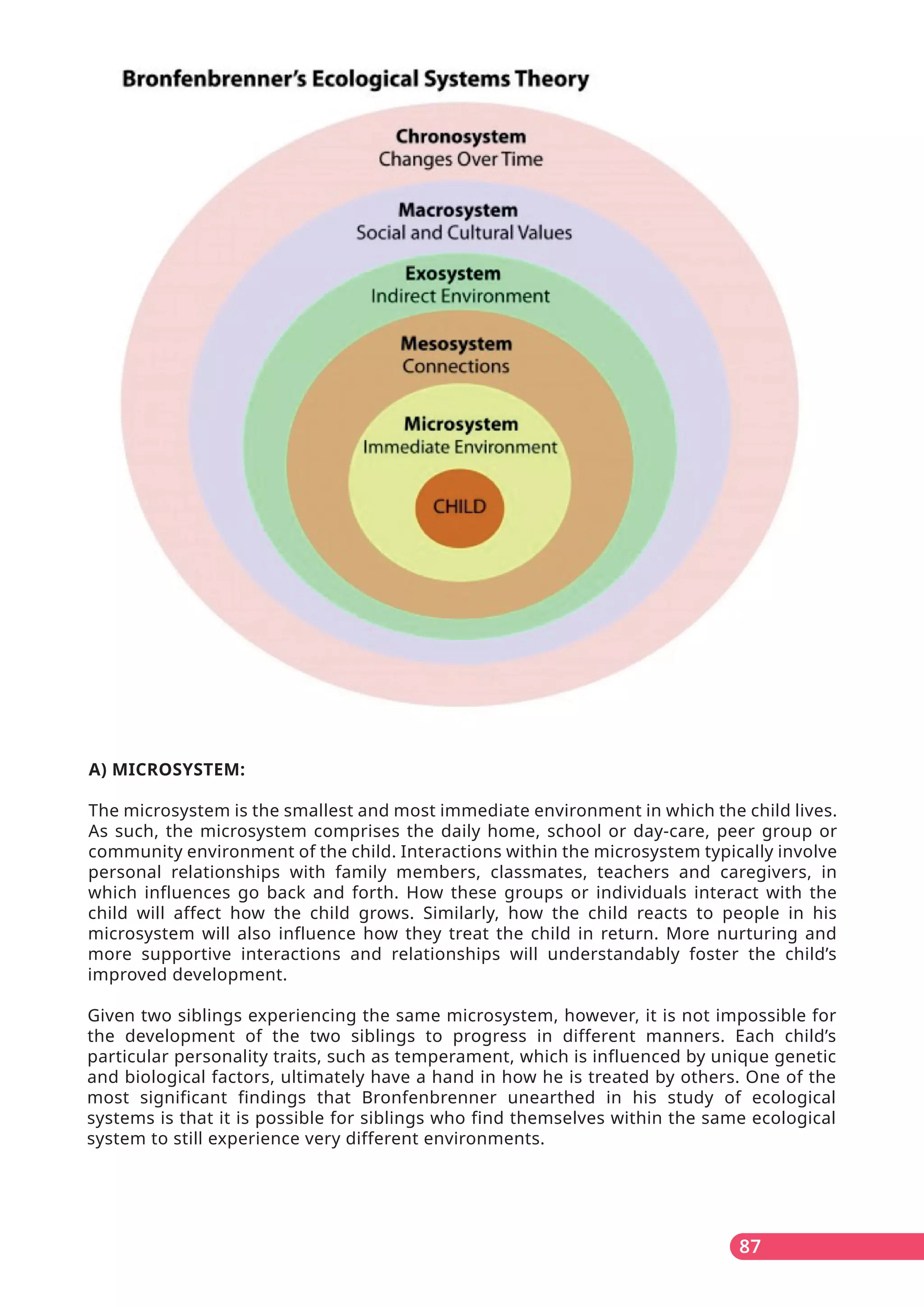
  • 77.
    Teachers must checkfor breakage, safety and cleanliness on a daily basis. For Creative Art Work • Materials for mixing and painting • Paint/powder paint • Crayon shavings, Pencil shavings, Wood shaving • Plastic bottles • Plastic jars • Paint brushes of different sizes • Saucers, dishes for paint • Sponges • Aprons, T- shirts • Toothbrushes • Clothes pegs, • Small pieces of cloths • Materials for representation • Pencils, crayons, markers, chalk • Magazines, newspapers, catalogues • Paper of different sizes and textures • Wax paper, tissue paper • Scraps of paper, paper plates • Invitation/greeting cards • small/large empty boxes • Clay, slime, plasticine • Large Buttons, straws, small empty cartons • Empty thread spools/reels • Cardboard tubes, paper bags • Cloth, felt, vinyl scraps, fallen leaves • Recyclable/indigenous materials • Materials for holding things together and for taking them apart • White glue, • Masking tape, • Yarn • Staplers (for teachers’ use only) • String • paper clips (for teachers’ use only) • Rubber bands • Round tip scissors • Cellophane tape • paper knives • For Music and Movement • Tape recorders/CD players and tapes/CDs of a variety of music, • Musical instruments (homemade or purchased) • Bottles of different sizes and textures, metal spoons, wooden sticks • For Pretend Play/Role Play (all toys) • Old telephones, old clocks, (toy) tool box, soft chair, dust brush and dustpan • Small tables and chairs • Props for pretending – clothes, hats, shoes, mirror • Dolls, stuffed animals, doll beds, baby rattles, 77
  • 78.
    bibs, bottles • Cushions,small blankets, matters • Toy utensil sets • Teapots, kettles (toy) • Cutlery, doi, (ladle) • Mixing bowls, measuring spoons/cups, sifter • Potholders, aprons, towels, sponges, napkins, place mats • Empty dry food boxes, cartons, jars, bags • Doctors’ sets • Gardening tools set • Construction tools set • Carpenter tools set • For Building and Pretend Play • A variety of blocks: hollow, unit small stacking, • Blocks made from boxes • Large and small boxes, small pieces of wood with round edges • Small cars and trucks, small animals, insects, birds • For Experimentation and Discovery • Seeds, fallen leaves and twigs • Magnifying glass • Puzzles, boxes and bottle with lids in different sizes • Large nuts and bolts (toy) • Cloth Pegs • Stacking rings • Magnets, scales and balances • Beads, stringing materials • Large Buttons, small stones, sea shells • Sets of matching picture cards • Sand and water, sifters and strainers • Materials that will float/sink • Measuring cups, funnels • Material for bubbles making • maps of Pakistan and World • For Reading and Writing • Pencils, crayons, markers • Old Computer keyboards, typewriters • Rubber stamps, paper clips, tape, rulers • Different types of paper: with and without lines • Envelopes • Assorted books (big books, small books, picture books with and without text) • Child-made books • Photograph books from field trips • Cosy chair or pillows • Puppets • Slate & chalks • Takhti, qalam & dawat • Rubbers • Foot rulers • Sharpeners 78
  • 79.
  • 80.
    80 CHAPTER THEORETICAL PERSPECTIVES ONEARLY CHILDHOOD CARE AND EDUCATION (ECCE) 4.1 DEVELOPMENTAL THEORIES: 4.1.1 BRAIN DEVELOPMENT IN THE EARLY YEARS At birth, the brain of a baby is only 25 percent of the weight of an adult’s brain, which is 1.5 kg. By the age of 3, it is 90 per cent of the adult weight and by the age of six, it is almost as large as it will ever be. However, some parts of the brain continue to grow even in adulthood. The fast growth of the brain in the first few years of a child’s life is a critical indicator of how important the early years are. The brain is made of tiny building blocks known as cells which are also present in rest of the body. These cells are so tiny that they cannot be seen without the help of a strong microscope. When a baby is born, it has all the brain cells it will ever need. There are a hundred billion brain cells present at birth. Brain cells are also called neurons. Neurons are able to send and receive messages from other neurons. In fact, they are only useful when they connect with each other. To better understand this, think of your brain as an office where the neurons are the office workers. Now imagine that none of the workers are allowed to talk or work with one another. How do you think that office will functions? Obviously, an office can only operate when the workers are allowed to talk and work with each other. Similarly, our brain can only work usefully when the neurons connect with each other. When one neuron connects with another it forms a connection called a synapse. When we talk about brain development we are actually talking about the creation of synapses in a brain. One neuron can form synapses with many other neurons and so the number of synapses grows very rapidly. There are trillions of such connections in our brain making a kind of complicated web. As shown in the figure, a young child of 02 years has twice as many synapses as that of an adult brain. As the neuron web grows, child’s abilities such as, memory, language skills, problem solving and intellectual capacity also grow. However, the neurons and synapses which are not being used eventually stop working and die. For example, vision (or eye
  • 81.
    81 sight) develops slowlyduring the first six months of life. If the ‘web’ of synapses that is responsible for vision is not stimulated correctly during these months, eye sight may not develop properly. As a result, if the baby’s eyes never see any light in the first six months, no synaptic connections would form and the baby would not have any vision. The ability and rate, at which synaptic connections are formed, reduce significantly by the time adulthood is reached and only those connections stay put that have been strengthened during the early years. The simple mechanics of brain functioning portrayed in the figure, not only highlight the criticality of the early years, but also the significance of an enabling and nurturing environment for the holistic development of children. Although learning is a continuous, life long process, the extent to which we can realize our potential and what we become as adults, is largely determined by what we experience in our childhood. Scientific findings about brain development confirm what most of us already know....warm and loving attachments between infants and mothers/caregivers, and positive stimulation right from birth make a significant difference in children’s development. In the early years’ classroom, a warm, trusting, comfortable relationship is crucial for positive, holistic development. So now the question therefore is “how do we best help children achieve the full potential of development of the brain?” There are several ways to achieve as theorised by ECCE philosophies and practices. Most of them define an enriched environment as one that includes a steady source of environmental support, nutritious diet, stimulates all senses, atmosphere free from stress, enjoyable, challenging, allows social interaction, promotes development, and gives the child a chance to assess the results of their actions, all in all allows the child to be an active participant rather than a passive observer (Diamond and Hopson, 1998). This idea is reflected in what an ECCE classroom is perceived to be as a prepared environment. The prepared environment allows the link for a child to reach into his world. ECCE related educational philosophies define a prepared environment to consider the specific needs of the children with concerns to their age of development, it provides the children what they need in order to live such as, physical and emotional security. It should be aesthetically pleasing and inviting, this includes hygiene and appropriate furniture, and it has to have order. These are few of the main ideas but it is vital to mentions that the environment has to allow freedom of choice, it allows the children to act independently, and allow them to learn to take responsibility for their actions. It is good to know about 5 Stages of Human Brain Development Throughout the lifetime of the human brain it continues to undergo changes. Stage 1: 0 to 10 months • Neurons and connections grow. • A pregnant woman should stay as stress-free as possible, take folic acid, B6 &B12, stimulate this young developing brain with sounds and sensations. Mother should avoid toxins, cigarettes, heavy metals, alcohol, drugs.
  • 82.
    82 Stage 2: birthto 6 years • Development of voluntary movement, reasoning, perception, frontal lobes active in development of emotions, attachments, planning, working memory, and perception. A sense of self is developing and life experiences shape the emotional well-being. • By age six, the brain is 95% its adult weight and at the peak of energy consumption. • Caregivers need to provide nurturing environment and daily individualized communication. Negative or harsh treatment may come with emotional consequences in the future. Stage 3: 7 to 22 years • The neural connections or ‘grey’ matter is still pruning, wiring of brain still in progress, the fatty tissues surrounding neurons or ‘white’ matter increase and assist with speeding up electrical impulses and stabilize connections. The prefrontal cortex is the last to mature and it involves the control of impulses and decision-making. • Therefore, teenagers need to learn to control reckless, irrational and irritable behaviour. Avoiding drugs, alcohol, smoking, unprotected sex and substance abuse. Stage 4: 23 to 65 years • Finally, the brain reaches its peak power around age 22 and lasts for 5 more years. Afterwards, it’s a downhill pattern begins. The last to mature and the first to go are the brain functionality of executive control, occurring in the prefrontal and temporal cortices. Memory for recalling episodes start to decline, processing speed slows and working memory is storing less information. • Brain cells are lost in the critical areas such as the hippocampus responsible for processing memories. • Learn new skills, practice mediation to promote neutral emotions, exercise to improve abstract reasoning and concentration. • Avoid stress or incorporate stress reducing medication and exercises. • Eat a healthy diet with foods to nourish one’s level of dopamine. Stage 5: older than 65 years Source: http://nancyguberti.com/5-stages-of-human-brain-development/ 4.1.2 PIAGET’S THEORY OF COGNITIVE DEVELOPMENT: Jean Piaget (1896-1980) a Swiss psychologist, who studied the intellectual and logical abilities of children, theorized that cognitive development proceeds in four stages that follow the same sequential order. His Cognitive Development Theory is hugely influential in the fields of education and psychology. He proposed that the thinking process develops through each of the stages, until a child can think logically. Understanding cognitive development helps us organize appropriate learning environments and plan developmentally appropriate learning activities. The following are Piaget’s four developmental stages:
  • 83.
    83 A) THE SENSORIMOTORSTAGE (BIRTH – MONTHS/2 YEARS) Even though Piaget was opposed to applying age norms to the stages, most researchers consider approximately the first two years of life to be the Sensorimotor Stage. Infants mainly make use of senses and motor capabilities to experience the environment. For instance, if infants cannot see or touch an object, they stop trying to find it. Once infants develop the capability to recognise that a hidden object still continues to exist, they start searching for it. The characteristic limitation of this stage is ‘thinking only by doing’. The sensorimotor infant’s main concern is developing motor control, and coordination with information from the senses. B) PREOPERATIONAL STAGE (2 – 7 YEARS) The second stage in Piaget’s theory of development coincides with the preschool years. At this stage, children develop the ability to think symbolically and use language to express their thoughts, needs, feelings and observations. However, the preoperational child still learns from concrete material, while adults can learn in an abstract way. The preoperational child is also unaware of another person’s perspective. They exhibit egocentric thought and language. Here are some limitations of preoperational thought. To begin with, the preoperational child lacks the concept of conservation. For example, a child is presented with two rows of apples that contain the same number of apples. When one row is lengthened without any change in the number of apples, the preoperational child states that the rows are not equal. The appearance of the objects gives the wrong impression about them. Children’s decisions are dominated by their perceptions. Conservation does not happen simultaneously in all subject areas. Children can understand conservation of numbers around age 5-6, and understand conservation of substance, or mass at around age 7-8. Additionally, the preoperational child is likely to centre on only one dimension of an event and ignore other important details. Also,
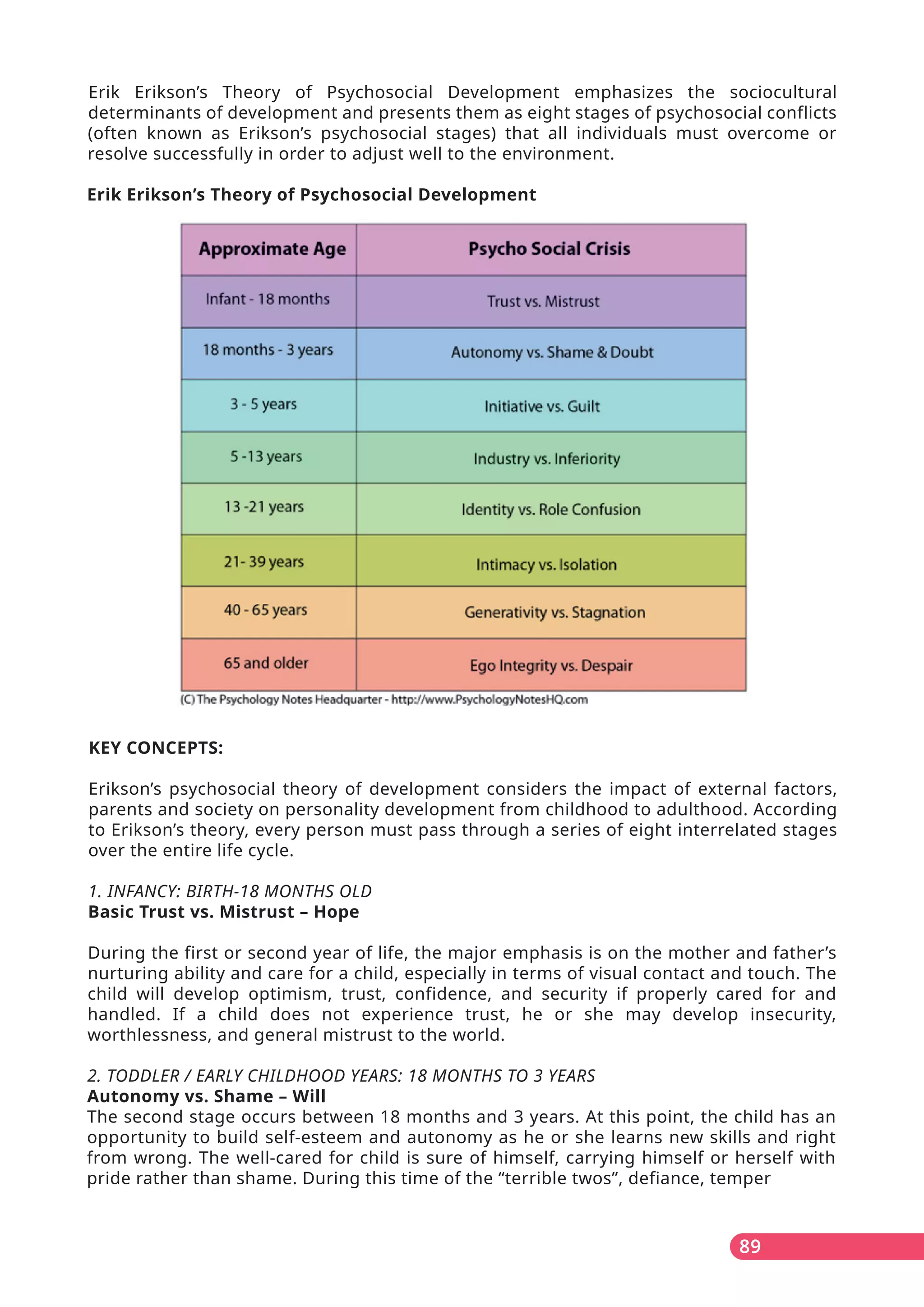
  • 84.
    84 children concentrate moreon the static features of an event, than on the transformations from one state to another. Children in the preoperational period, at times will see some relationships between particular cases while in actuality there is none. For instance, a child might say, “If an apple is red, then a green fruit is not an apple.” C) CONCRETE OPERATIONAL STAGE (7 – 11 YEARS) The next stage generally represents the elementary grade years. The concrete operational child begins to think logically. Operations are associated with personal experience. Concrete operations allow children to classify several classes into a bigger group or to combine a number of classes in any order. Although objects are moved or reordered, no change takes place in their perception of the objects; they are able to conserve. Concrete operations also allow children to order objects in terms of more than one dimension and they can solve conservation tasks. The operational thought is reversible; the concrete operation child can operate an action, and then go back to the original condition. For instance, 3+2=5 and 5-2=3. D) FORMAL OPERATIONAL STAGE (11 YEARS AND BEYOND) After roughly 11 years, students have the ability to consider many possibilities for a given condition. They are able to deal with propositions that explain concrete facts. They have the ability to use planning to think ahead. Most importantly, students at Piaget’s final stage of cognitive development increase their ability to think abstractly. They can solve complex and hypothetical problems involving abstract operations. Formal operational thinkers can recognise and identify a problem. They can state several alternative hypotheses, execute procedure to collect information about the problems to be studied, and test the hypotheses. 4.1.3 VYGOTSKY’S THEORY OF SOCIOCULTURAL DEVELOPMENT: Lev Semyonovich Vygotsky, a Russian psychologist who lived during the Russian Revolution, developed a theory of development known as the Sociocultural Theory of Development during the first quarter of the twentieth century. As a proponent of the sociocultural perspective to development, Vygotsky’s outlook gained worldwide recognition and began to exert influence when his work was finally translated into English in 1962 and the importance of both sociocultural contexts of development and cross-cultural research was recognised. Vygotsky’s main assertion was that children are entrenched in different sociocultural contexts through which their cognitive development is advanced through social interaction with more skilled individuals. His theory is mainly concerned with the more complex cognitive activities of children which are governed and influenced by several principles. Believing that children construct knowledge actively, Vygotsky’s theory is also one of those responsible for laying the groundwork for constructivism.
  • 85.
    85 A) ZONE OFPROXIMAL DEVELOPMENT Vygotsky is most recognised for his concept of Zone of Proximal Development or ZPD pertaining to the learning of children. Children who are in the zone of proximal development for a specific task are almost able to perform the task independently, but not quite. With an appropriate amount and level of assistance, however, children are able to successfully accomplish the task. The lower limit of a child’s zone of proximal development is the level of analysis and problem-solving reached by a child without any help. The upper limit, on the other hand, is the level of additional responsibility that a child can receive with the support of a skilled instructor. As children are verbally given instructions or shown how to perform certain tasks, they organize the new information received in their existing mental schemas in order to assist them in the ultimate goal of performing the task independently. This emphasis on the concept of Zone of Proximal Development made by Vygotsky underscores his conviction that social influences, particularly instruction, are of immense importance on the cognitive development of children. B) MORE KNOWLEDGEABLE OTHER The child is entrenched in a sociocultural backdrop, usually the home, in which social interaction with significant adults, i.e. the parents, is the crucial factor that affects the child’s learning. Adults need to direct and organize the learning experiences of a child to ensure that a child can master and internalize the learning. Any person who possesses a higher skill level than the learner with regard to a particular task or concept is called a More Knowledgeable Other or MKO. This person may be a teacher, parent, an older adult, a coach or even a peer.
  • 86.
    86 C) SCAFFOLDING The conceptof scaffolding is closely related to the concept of the zone of proximal development. Scaffolding refers to the temporary support given to the child by More Knowledgeable Others, usually parents or teachers that enable the child to perform the task until such time that the child can already perform the task independently. Scaffolding entails changing the quality and quantity of support provided to a child in the course of a teaching session. The more-skilled instructor adjusts the level of guidance needed in order to fit the student’s current level of performance. For novel tasks, the instructor may utilize direct instruction. As the child gains more familiarity with the task and becomes more skilled at it, the instructor may then provide less guidance. Children who experience more difficulty in task performance are in need of greater assistance and guidance from an adult. When the child has learned to complete the task independently, the scaffolds are removed by the adult, as they are no longer needed. A major contribution of Vygotsky’s theory is the acknowledgement of the social component in both cognitive and psychosocial development. Due to his proffered ideas, research attention has been shifted from the individual onto larger interactional units such as parent and child, teacher and child, or brother and sister. Vygotsky likewise called attention to the variability of cultural realities, stating that the development of children who are in one culture or subculture, such as middleclass Asian Americans, may be totally different from children who hail from other societies or subcultures. It would not be fitting, therefore, to utilize the developmental experiences of children from one culture as a norm for children from other cultures. The theory has significant ramifications in education and cognitive testing. Vygotsky was a strong advocate of non-standard assessment procedures for the assessment of what and how much a child has learned and in the formulation of approaches that could enhance the child’s learning. His ideas have effected changes in educational systems through the increased importance given to the active role of students in their own learning process and the encouragement of teacher-student collaboration in a reciprocal learning experience. 4.1.4 BRONFENBRENNER’S ECOLOGICAL SYSTEMS THEORY OF CHILD DEVELOPMENT: American psychologist, Urie Bronfenbrenner, formulated the Ecological Systems Theory to explain how the inherent qualities of a child and the characteristics of the external environment which the child finds himself in interact to influence how the child will grow and develop. Through his theory, Bronfenbrenner stressed the importance of studying a child in the context of his/her multiple environments, also known as ecological systems in the attempt to understand his/her individual development. A child finds himself simultaneously enmeshed in different ecosystems, from the most intimate home ecological system moving outward to the larger school system and the most expansive system which is society and culture. Each of these systems inevitably interacts with and influences each other and every aspect of the child’s life. The Ecological Systems Approach organizes contexts of development into five levels of external influence which interlock. The levels are categorized from the most intimate level to the broadest, with the most intimate being the microsystem.
  • 87.
    A) MICROSYSTEM: The microsystemis the smallest and most immediate environment in which the child lives. As such, the microsystem comprises the daily home, school or day-care, peer group or community environment of the child. Interactions within the microsystem typically involve personal relationships with family members, classmates, teachers and caregivers, in which influences go back and forth. How these groups or individuals interact with the child will affect how the child grows. Similarly, how the child reacts to people in his microsystem will also influence how they treat the child in return. More nurturing and more supportive interactions and relationships will understandably foster the child’s improved development. Given two siblings experiencing the same microsystem, however, it is not impossible for the development of the two siblings to progress in different manners. Each child’s particular personality traits, such as temperament, which is influenced by unique genetic and biological factors, ultimately have a hand in how he is treated by others. One of the most significant findings that Bronfenbrenner unearthed in his study of ecological systems is that it is possible for siblings who find themselves within the same ecological system to still experience very different environments. 87
  • 88.
    88 B) MESOSYSTEM: The mesosystemencompasses the interaction of the different microsystems which the developing child finds himself/herself in. It is, in essence, a system of microsystems and as such, involves linkages between home and school, between peer group and family, or between family and church. If a child’s parents are actively involved in the friendships of their child, invite friends over to their house and spend time with them, then the child’s development is affected positively through harmony and like-mindedness. However, if the child’s parents dislike their child’s peers and openly criticize them, then the child experiences disequilibrium and conflicting emotions, probably affecting his development negatively. C) EXOSYSTEM: The exosystem, on the other hand, pertains to the linkages that may exist between two or more settings, one of which may not contain the developing child but affects him/her indirectly, nonetheless. Other people and places which the child may not directly interact with but may still have an effect on the child, comprise the exosystem. Such places and people may include the parents’ workplaces, the larger neighbourhood, and extended family members. For example, a father who is continually passed up for promotion by an indifferent boss at the workplace may take it out on his children and mistreat them at home. D) MACROSYSTEM: The macrosystem is the largest and most distant collection of people and places to the child that still exercises significant influence on the child. It is composed of the child’s cultural patterns and values, specifically the child’s dominant beliefs and ideas, as well as political and economic systems. Children in war-torn areas, for example, will experience a different kind of development than children in communities where peace reigns. E) CHRONOSYSTEM: The chronosystem adds the useful dimension of time, which demonstrates the influence of both change and constancy in the child’s environment. The chronosystem may thus include a change in family structure, address, parent’s employment status, in addition to immense society changes such as economic cycles and wars. By studying the different systems that simultaneously influence a child, the ecological systems theory is able to demonstrate the diversity of interrelated influences on the child’s development. Awareness of contexts can sensitize us to variations in the way a child may act in different settings. For example, a child who frequently bullies smaller children at school may portray the role of a terrified victim at home. Due to these variations, adults concerned with the care of a particular child should pay close attention to behaviour in different settings or contexts and to the quality and type of connections that exist between these contexts. 4.1.5 ERIK ERIKSON’S THEORY OF SOCIAL EMOTIONAL DEVELOPMENT: Every person has his or her own unique identity. This identity is composed of the different personality traits that can be considered positive or negative. These personality traits can also be innate or acquired, and they vary from one person to another based on the degree of influence the environment has on the individual. The bottom line is that as human beings, we possess many characteristics that are honed in many different aspects that eventually define who we are.
  • 89.
    89 Erik Erikson’s Theoryof Psychosocial Development emphasizes the sociocultural determinants of development and presents them as eight stages of psychosocial conflicts (often known as Erikson’s psychosocial stages) that all individuals must overcome or resolve successfully in order to adjust well to the environment. Erik Erikson’s Theory of Psychosocial Development KEY CONCEPTS: Erikson’s psychosocial theory of development considers the impact of external factors, parents and society on personality development from childhood to adulthood. According to Erikson’s theory, every person must pass through a series of eight interrelated stages over the entire life cycle. 1. INFANCY: BIRTH-18 MONTHS OLD Basic Trust vs. Mistrust – Hope During the first or second year of life, the major emphasis is on the mother and father’s nurturing ability and care for a child, especially in terms of visual contact and touch. The child will develop optimism, trust, confidence, and security if properly cared for and handled. If a child does not experience trust, he or she may develop insecurity, worthlessness, and general mistrust to the world. 2. TODDLER / EARLY CHILDHOOD YEARS: 18 MONTHS TO 3 YEARS Autonomy vs. Shame – Will The second stage occurs between 18 months and 3 years. At this point, the child has an opportunity to build self-esteem and autonomy as he or she learns new skills and right from wrong. The well-cared for child is sure of himself, carrying himself or herself with pride rather than shame. During this time of the “terrible twos”, defiance, temper
  • 90.
    90 tantrums, and stubbornnesscan also appear. Children tend to be vulnerable during this stage, sometimes feeling ashamed and low self-esteem during an inability to learn certain skills. 3. PRESCHOOLER: 3 TO 5 YEARS Initiative vs. Guilt – Purpose During this period, we experience a desire to copy the adults around us and take initiative in creating play situations. We make up stories with Barbie’s and Ken’s, toy phones and miniature cars, playing out roles in a trial universe, experimenting with the blueprint for what we believe it means to be an adult. We also begin to use that wonderful word for exploring the world—”WHY?” While Erikson was influenced by Freud, he downplays biological sexuality in favor of the psychosocial features of conflict between child and parents. Nevertheless, he said that at this stage we usually become involved in the classic “Oedipal struggle” and resolve this struggle through “social role identification.” If we’re frustrated over natural desires and goals, we may easily experience guilt. The most significant relationship is with the basic family. 4. SCHOOL AGE CHILD: 6 TO 12 YEARS Industry vs. Inferiority – Competence During this stage, often called the Latency, we are capable of learning, creating and accomplishing numerous new skills and knowledge, thus developing a sense of industry. This is also a very social stage of development and if we experience unresolved feelings of inadequacy and inferiority among our peers, we can have serious problems in terms of competence and self-esteem. As the world expands a bit, our most significant relationship is with the school and neighbourhood. Parents are no longer the complete authorities they once were, although they are still important. 5. ADOLESCENT: 12 TO 18 YEARS Identity vs. Role Confusion – Fidelity Up until this fifth stage, development depends on what is done to a person. At this point, development now depends primarily upon what a person does. An adolescent must struggle to discover and find his or her own identity, while negotiating and struggling with social interactions and “fitting in”, and developing a sense of morality and right from wrong. Some attempt to delay entrance to adulthood and withdraw from responsibilities (moratorium). Those unsuccessful with this stage tend to experience role confusion and upheaval. Adolescents begin to develop a strong affiliation and devotion to ideals, causes, and friends. 6. YOUNG ADULT: 18 TO 35 YEARS Intimacy and Solidarity vs. Isolation – Love At the young adult stage, people tend to seek companionship and love. Some also begin to “settle down” and start families, although seems to have been pushed back farther in recent years.
  • 91.
    91 Young adults seekdeep intimacy and satisfying relationships, but if unsuccessful, isolation may occur. Significant relationships at this stage are with marital partners and friends. 7. MIDDLE-AGED ADULT: 35 TO 55 OR 65 YEARS Generativity vs. Self-Absorption or Stagnation – Care Career and work are the most important things at this stage, along with family. Middle adulthood is also the time when people can take on greater responsibilities and control. For this stage, working to establish stability and Erikson’s idea of generativity – attempting to produce something that makes a difference to society. Inactivity and meaninglessness are common fears during this stage. Major life shifts can occur during this stage. For example, children leave the household; careers can change, and so on. Some may struggle with finding purpose. Significant relationships are those within the family, workplace, local church and other communities. 8. LATE ADULT: 55 OR 65 TO DEATH Integrity vs. Despair – Wisdom Erikson believed that much of life is preparing for the middle adulthood stage and the last stage involves much reflection. As older adults, some can look back with a feeling of integrity — that is, contentment and fulfilment, having led a meaningful life and valuable contribution to society. Others may have a sense of despair during this stage, reflecting upon their experiences and failures. They may fear death as they struggle to find a purpose to their lives, wondering “What was the point of life? Was it worth it?” 4.2 LEARNING THEORIES: Learning theories provide the theoretical framework to understand and analyse how knowledge is absorbed, processed, and retained as a part of learning. Cognitive, emotional, and environmental influences, as well as prior experience, all play a part in how understanding, or a world view, is acquired or changed and knowledge and skills are retained. For ECCE teachers/stakeholders knowledge of established learning theories is vital to enable them in their role of helping children develop in a positive and healthy environment. For reference purposes the following two learning theories are included here to provide a baseline for teachers to probe further. 4.2.1 HOWARD GARDNER’S THEORY OF MULTIPLE INTELLIGENCES-AN INNOVATIVE APPROACH TOWARDS UNDERSTANDING CHILD’S POTENTIAL Many educators have had the experience of not being able to reach some students until presenting the information in a completely different way or providing new options for student expression. Perhaps it was a student who struggled with writing until the teacher provided the option to create a graphic story, which blossomed into a beautiful and complex narrative. Or maybe it was a student who just couldn't seem to grasp fractions, until he created them by separating oranges into slices. Because of these kinds of experiences, the theory of multiple intelligences resonates with many educators. It supports what we all know to be true: A one-size-fits-all approach to education will invariably leave some students behind. However, the theory is also often misunderstood, which can lead to it being used interchangeably with learning styles or applying it in ways that can limit student potential. While the theory of multiple intelligences is a powerful way to think about learning, it’s also important to understand
  • 92.
    92 the research thatsupports it. Howard Gardner's Nine Intelligences The theory of multiple intelligences challenges the idea of a single IQ, where human beings have one central "computer" where intelligence is housed. Howard Gardner, the Harvard professor who originally proposed the theory, says that there are multiple types of human intelligence, each representing different ways of processing information: 1. NATURALIST INTELLIGENCE (“NATURE SMART”) This intelligence designates the human ability to discriminate among living things (plants, animals) as well as sensitivity to other features of the natural world (clouds, rock configurations). This ability was clearly of value in our evolutionary past as hunters, gatherers, and farmers; it continues to be central in such roles as botanist or chef. It is also speculated that much of our consumer society exploits the naturalist intelligences, which can be mobilized in the discrimination among cars, sneakers, kinds of makeup, and the like. 2. MUSICAL INTELLIGENCE (“MUSICAL SMART”) Musical intelligence is the capacity to discern pitch, rhythm, timbre, and tone. This intelligence enables us to recognise, create, reproduce, and reflect on music, as demonstrated by composers, conductors, musicians, vocalist, and sensitive listeners. Interestingly, there is often an affective connection between music and the emotions; and mathematical and musical intelligences may share common thinking processes. Young adults with this kind of intelligence are usually singing or drumming to themselves. They are usually quite aware of sounds others may miss.
  • 93.
    93 3. LOGICAL-MATHEMATICAL INTELLIGENCE(”NUMBER/REASONING SMART”) Logical-mathematical intelligence is the ability to calculate, quantify, consider propositions and hypotheses, and carry out complete mathematical operations. It enables us to perceive relationships and connections and to use abstract, symbolic thought; sequential reasoning skills; and inductive and deductive thinking patterns. Logical intelligence is usually well developed in mathematicians, scientists, and detectives. Young adults with lots of logical intelligence are interested in patterns, categories, and relationships. They are drawn to arithmetic problems, strategy games and experiments. 4. EXISTENTIAL INTELLIGENCE Sensitivity and capacity to tackle deep questions about human existence, such as the meaning of life, why do we die, and how did we get here. 5. INTERPERSONAL INTELLIGENCE (”PEOPLE SMART”) Interpersonal intelligence is the ability to understand and interact effectively with others. It involves effective verbal and nonverbal communication, the ability to note distinctions among others, sensitivity to the moods and temperaments of others, and the ability to entertain multiple perspectives. Teachers, social workers, actors/public figures and politicians exhibit interpersonal intelligence. Young adults with this kind of intelligence are leaders amongst their peers, are good at communicating, and seem to understand others’ feelings and motives. 6. BODILY-KINAESTHETIC INTELLIGENCE (“BODY SMART”) Bodily kinaesthetic intelligence is the capacity to manipulate objects and use a variety of physical skills. This intelligence also involves a sense of timing and the perfection of skills through mind–body union. Athletes, dancers, surgeons, and craftspeople exhibit well-developed bodily kinaesthetic intelligence. 7. LINGUISTIC INTELLIGENCE (”WORD SMART”) Linguistic intelligence is the ability to think in words and to use language to express and appreciate complex meanings. Linguistic intelligence allows us to understand the order and meaning of words and to apply meta-linguistic skills to reflect on our use of language. Linguistic intelligence is the most widely shared human competence and is evident in poets, novelists, journalists, and effective public speakers. Young adults with this kind of intelligence enjoy writing, reading, telling stories or doing crossword puzzles. 8. INTRA-PERSONAL INTELLIGENCE (”SELF SMART”) Intra-personal intelligence is the capacity to understand oneself and one’s thoughts and feelings, and to use such knowledge in planning and giving direction to one’s life. Intra-personal intelligence involves not only an appreciation of the self, but also of the human condition. It is evident in psychologist, spiritual leaders, and philosophers. These young adults may be shy. They are very aware of their own feelings and are self-motivated. 9. SPATIAL INTELLIGENCE (“PICTURE SMART”) Spatial intelligence is the ability to think in three dimensions. Core capacities include mental imagery, spatial reasoning, image manipulation, graphic and artistic skills, and an active imagination. Sailors, pilots, sculptors, painters, and architects all exhibit spatial intelligence. Young adults with this kind of intelligence may be fascinated with mazes or jigsaw puzzles, or spend free time drawing or daydreaming. HOW CAN THE MULTIPLE INTELLIGENCES THEORY GUIDE ECCE TEACHERS? While additional research is still needed to determine the best measures for assessing and supporting a range of intelligences in schools, the theory has provided opportunities to
  • 94.
    94 broaden definitions ofintelligence. As an ECCE educator, it is useful to think about the different ways that information can be presented. However, it is critical to not classify students as being specific types of learners nor as having an innate or fixed type of intelligence. For example, teachers can develop small quizzes with the help of online Multiple Intelligences Quiz maps aligned to Howard Gardner's multiple intelligences. This is a fun way to learn about how some of our tastes and interests can influence how we take in information. However, its results are not intended as a way to label people as naturalistic learners, musical learners, etc. Labelling creates limits, and when it comes to learning, we want to avoid restricting how we define student potential. People have much different intelligence and strength in one area does not predict weakness in another. 4.2.2 LEARNING STYLES: Among the recently renowned learning theories and themes one of the most talked about and relevant is “learning styles”. The term “learning styles” speaks to the understanding that every student learns differently. Technically, an individual’s learning style refers to the preferential way in which the student absorbs processes, comprehends and retains information. For example, when learning how to build a clock, some students understand the process by following verbal instructions, while others have to physically manipulate the clock themselves. This notion of individualized learning styles has gained widespread recognition in education theory and classroom management strategy. Individual learning styles depend on cognitive, emotional and environmental factors, as well as one’s prior experience. In other words: everyone’s different. It is important for educators and vital for ECCE teachers to understand the differences in their students’ learning styles, so that they can implement the best practices strategies into their daily activities, curriculum and assessments. NEIL FLEMING'S VARK MODEL: The most relevant and appropriate learning styles model is by Neil Fleming who has proposed VARK model expanded upon notions of sensory modalities of Visual, Auditory, Reading/Writing and Kinaesthetic. The VARK model acknowledges that students have different approaches to how they process information, referred to as “preferred learning modes.” • Students’ preferred learning modes have significant influence on their behaviour and learning • Students’ preferred learning modes should be matched with appropriate learning strategies. • Information that is accessed through students’ use of their modality preferences shows an increase in their levels of comprehension, motivation, and metacognition. Identifying students as visual, auditory, reading/writing or kinaesthetic learners, and aligning the overall curriculum with these learning styles, will prove to be beneficial for overall classroom management, allowing students to access information in ways they are comfortable with will increase their academic confidence. Visual: Information presented as maps, spider diagrams, charts, graphs, flow charts, labeled diagrams, and all the symbolic arrows, circles, hierarchies, and other devices that people use to represent what could have been presented in words. Auditory/Aural: A preference for information that is heard or spoken such as lectures, group discussion, radio, email, mobile phones, speaking, web-chat, and talking things through. Reading/Writing: Information displayed as words, text-based input and output. This includes all forms but especially manuals, reports, essays, and assignments. Kinesthetic: A preference for gathering information through experience and practice, simulated or real, either through concrete personal experiences, examples, practice or simulation. It also includes demonstrations, simulations, videos, and movies, as well as case studies, practice, and applications.
  • 95.
    95 4.2.3 HIGH SCOPEAPPROACH The High Scope Educational Research Foundation studies methods of early childhood education based on the methodology of the 1962 Perry Preschool study. It was founded in 1970 by psychologist David Weikart. The Perry Preschool study has been noted for its "large effects on educational attainment, income, criminal activity, and other important life outcomes, sustained well into adulthood". The philosophy behind High Scope is based on child development theory and research, originally drawing on the work of Jean Piaget and John Dewey. The curriculum was further developed to incorporate Lev Vygotsky's zone of proximal development and Jerome Bruner's related strategy of adult scaffolding. This method emphasizes the role of adults to support each child at their current developmental level and help them build upon it, under a model of "shared control" where activities are both child-initiated and adult-guided. The adults working with the children see themselves more as facilitators or partners than as managers or supervisors. How to Teach In a High Scope preschool program, teachers ignite children’s interest in learning by creating an environment that encourages them to explore learning materials and interact with adults and peers. The focus is on supporting early learners as they make decisions, build academic skills, develop socially and emotionally, and become part of a classroom community. Active learning is at the centre of the High Scope Curriculum. It’s the foundation of young children gaining knowledge through their natural play and interactions with the environment, events, and other people. Adult-Child Interaction Teachers act as partners, working alongside children and communicating with them both verbally and nonverbally to encourage learning. Key strategies for adult-child interactions are sharing control with children, communicating as a partner with children, scaffolding children’s play, using encouragement instead of praise, and taking a problem-solving approach to supporting children in resolving conflicts. Learning Environment To create a predictable and active learning environment, teachers arrange and equip the classroom with diverse, open-ended materials that reflect children’s home, culture, and language. The room is organized and labelled to promote independence and encourage children to carry out their intentions. Daily Routine A consistent framework for the day provides a balanced variety of experiences and learning opportunities. Children engage in both individual and social play, participate in small and large-group activities, assist with clean up, socialize during meals, develop self-care skills, and exercise their small and large muscles. The most important segment of the daily routine is the plan-do-review sequence, in which children make decisions about what they will do, carry out their ideas, and reflect upon their activities with adults and other children. These higher-level thinking skills are linked to the development of executive functions, which are needed to be successful in school and life.
  • 96.
    96 Assessment Ongoing child assessmentis also an underlying component of the High Scope Curriculum. Objective anecdotal observations of children collected throughout children’s natural play allow teachers to assess child progress and plan meaningful learning experiences. 4.2.4 BLOOMS TAXONOMY Bloom's taxonomy is a set of three hierarchical models used to classify educational learning objectives into levels of complexity and specificity. The three lists cover the learning objectives in cognitive, affective and psychomotor domains. The cognitive domain list has been the primary focus of most traditional education and is frequently used to structure curriculum learning objectives, assessments and activities. The models were named after Benjamin Bloom, who chaired the committee of educators that devised the taxonomy. a) The Cognitive Domain (knowledge-based) In the original version of the taxonomy, the cognitive domain is broken into the following six levels of objectives. In the 2001 revised edition of Bloom's taxonomy, the levels are slightly different: Remember, Understand, Apply, Analyze, Evaluate, Create (rather than Synthesize). Knowledge Knowledge involves recognizing or remembering facts, terms, basic concepts, or answers without necessarily understanding what they mean. Its characteristics may include: • Knowledge of specifics—terminology, specific facts • Knowledge of ways and means of dealing with specifics—conventions, trends and sequences, classifications and categories, criteria, methodology • Knowledge of the universals and abstractions in a field—principles and generalizations, theories and structures Example: Name three common varieties of apple. Comprehension Comprehension involves demonstrating an understanding of facts and ideas by organizing, comparing, translating, interpreting, giving descriptions, and stating the main ideas. Example: Compare the identifying characteristics of a Golden Delicious apple with a Granny Smith apple.
  • 97.
    Application Application involves usingacquired knowledge—solving problems in new situations by applying acquired knowledge, facts, techniques and rules. Learners should be able to use prior knowledge to solve problems, identify connections and relationships and how they apply in new situations. Example: Would apples prevent scurvy, a disease caused by a deficiency in vitamin C? Analysis Analysis involves examining and breaking information into component parts, determining how the parts relate to one another, identifying motives or causes, making inferences, and finding evidence to support generalizations. Its characteristics include: • Analysis of elements • Analysis of relationships • Analysis of organization Example: List four ways of serving foods made with apples and explain which ones have the highest health benefits. Provide references to support your statements. Synthesis Synthesis involves building a structure or pattern from diverse elements; it also refers to the act of putting parts together to form a whole. Its characteristics include: • Production of a unique communication • Production of a plan, or proposed set of operations • Derivation of a set of abstract relations Example: Convert an "unhealthy" recipe for apple pie to a "healthy" recipe by replacing your choice of ingredients. Explain the health benefits of using the ingredients you chose vs. the original ones. Evaluation Evaluation involves presenting and defending opinions by making judgments about information, the validity of ideas, or quality of work based on a set of criteria. Its characteristics include: • Judgments in terms of internal evidence • Judgments in terms of external criteria Example: Which kinds of apples are best for baking a pie, and why? b) The Affective Domain (emotional-based) Skills in the affective domain describe the way people react emotionally and their ability to feel other living things' pain or joy. Affective objectives typically target the awareness and growth in attitudes, emotions and feelings. There are five levels in the affective domain moving through the lowest-order processes to the highest. Receiving The lowest level; the student passively pays attention. Without this level, no learning can occur. Receiving is about the student's memory and recognition as well. Responding The student actively participates in the learning process, not only attends to a stimulus; the student also reacts in some way. Valuing The student attaches a value to an object, phenomenon, or piece of information. The student associates a value or some values to the knowledge they acquired. 97
  • 98.
    98 Organizing The student canput together different values, information, and ideas, and can accommodate them within his/her own schema; the student is comparing, relating and elaborating on what has been learned. Characterizing The student at this level tries to build abstract knowledge. c) The Psychomotor Domain (action-based) Skills in the psychomotor domain describe the ability to physically manipulate a tool or instrument like a hand or a hammer. Psychomotor objectives usually focus on change and/or development in behavior and/or skills. Bloom and his colleagues never created subcategories for skills in the psychomotor domain, but since then other educators have created their own psychomotor taxonomies. Simpson (1972) proposed the following levels: Perception The ability to use sensory cues to guide motor activity: This ranges from sensory stimulation, through cue selection, to translation. Examples: Detects non-verbal communication cues. Estimate where a ball will land after it is thrown and then moving to the correct location to catch the ball. Adjusts heat of the stove to correct temperature by smell and taste of food. Adjusts the height of the forks on a forklift by comparing where the forks are in relation to the pallet. Key words: chooses, describes, detects, differentiates, distinguishes, identifies, isolates, relates, selects. Set Readiness to act: It includes mental, physical, and emotional sets. These three sets are dispositions that predetermine a person's response to different situations (sometimes called mindsets). This subdivision of psychomotor is closely related with the "responding to phenomena" subdivision of the affective domain. Examples: Knows and acts upon a sequence of steps in a manufacturing process. Recognizes his or her abilities and limitations. Shows desire to learn a new process (motivation). Keywords: begins, displays, explains, moves, proceeds, reacts, shows, states, volunteers. Guided response The early stages of learning a complex skill that includes imitation and trial and error: Adequacy of performance is achieved by practicing. Examples: Performs a mathematical equation as demonstrated. Follows instructions to build a model. Responds to hand-signals of the instructor while learning to operate a forklift. Keywords: copies, traces, follows, reacts, reproduces, responds. Mechanism The intermediate stage in learning a complex skill: Learned responses have become habitual and the movements can be performed with some confidence and proficiency. Examples: Use a personal computer. Repair a leaking tap. Drive a car. Key words: assembles, calibrates, constructs, dismantles, displays, fastens, fixes, grinds, heats, manipulates, measures, mends, mixes, organizes, sketches.
  • 99.
    99 Complex overt response Theskilful performance of motor acts that involve complex movement patterns: Proficiency is indicated by a quick, accurate, and highly coordinated performance, requiring a minimum of energy. This category includes performing without hesitation and automatic performance. For example, players will often utter sounds of satisfaction or expletives as soon as they hit a tennis ball or throw a football because they can tell by the feel of the act what the result will produce. Examples: Manoeuvres a car into a tight parallel parking spot. Operates a computer quickly and accurately. Displays competence while playing the piano. Key words: assembles, builds, calibrates, constructs, dismantles, displays, fastens, fixes, grinds, heats, manipulates, measures, mends, mixes, organizes, sketches. (Note: The key words are the same as in mechanism, but will have adverbs or adjectives that indicate that the performance is quicker, better, more accurate, etc.) Adaptation Skills are well developed and the individual can modify movement patterns to fit special requirements. Examples: Responds effectively to unexpected experiences. Modifies instruction to meet the needs of the learners. Performs a task with a machine that was not originally intended for that purpose (the machine is not damaged and there is no danger in performing the new task). Key words: adapts, alters, changes, rearranges, reorganizes, revises, varies. Origination Creating new movement patterns to fit a particular situation or specific problem: Learning outcomes emphasize creativity based upon highly developed skills. Examples: Constructs a new set or pattern of movements organized around a novel concept or theory. Develops a new and comprehensive training program. Creates a new gymnastic routine. Key words: arranges, builds, combines, composes, constructs, creates, designs, initiates, makes, originates.
  • 100.
    100 GLOSSARY 1. Andragogy: Theoryof adult learning. 2. Assessment: The term “assessment” refers to any process of obtaining information that is used to make educational decisions about students, to give feedback to the student about his or her progress, strengths and weakness, to judge teaching effectiveness and curriculum adequacy and to inform policy. 3. Curriculum: A plan of instruction that details what students are to know, how they are to learn it, what the teacher’s role is, and the context in which learning and teaching will take place. 4. Diversity: The state of being diverse, having variety. Individual are differences of people, including, but not limited to differences in: intelligence, learning styles, academic and/or social ability, culture, ethnicity, socio-economic status, gender, religion, sexual orientation, value systems. 5. Facilitator: A role for classroom teachers that allows students to take a more active role in learning. Teachers assist students in making connections between classroom instruction and students’ own knowledge and experiences by encouraging students to create new solutions, by challenging their assumptions, and by asking probing questions. 6. Fine Motor skills: Fine motor skills can be defined as small muscle movements, those that occur in the finger, in coordination with the eyes. Teaching fine motor skills is similar is similar to teaching other skills because the instructor must always try to be patient and understanding. Fine motor skills do not develop over night, but with time and practice. 7. Formative Assessment: The term “formative assessment” refers to frequent or on-going evaluation during courses, programmes, or learning experiences that gives an early indication of what students are learning, as well as their strengths and weaknesses. Formative assessment is often used as a diagnostic tool for students and faculty, providing information with which to make real-time improvements in instructional methods, materials, activities, techniques, and approaches. Approaches to formative assessment might include daily, weekly, or midterm projects; portfolios; journals; observations of the learning process and learning outcomes; discussion groups; performances; self-assessments; or examinations that occur during courses, when students and faculty can benefit from the information and improve. 8. Gross Motor skills: Gross Motor skills involve the larger muscles in the arms, legs and torso. Gross motor activities include walking, running, throwing, lifting, kicking, etc. These skills also relate to body awareness, reaction speed, balance and strength. Group’s motor development gives a child the ability to move in a variety of ways, the ability to control his/her body and helps promote self-esteem. 9. Imagination: Thoughts or fantasies. 10. Kindergarten: Friedrich Froebel (1782-1852) known as the ‘father of the Kindergarten,” –coined the term, which literarily means a “garden of children,” He believed that children learn about themselves and their environment primarily through play. Now commonly used to mean a school or class that prepares children for first grade.
  • 101.
    101 GLOSSARY 11. Learning Styles:Learning styles are students’ approaches to learning, problem solving, and processing information. 12. Lifestyle: A way of living, conduct, behaviour, customs, culture, habits. 13. Manipulative Material: Any physical object (for example, clay, blocks, string, coins) that can be handled and used to represent or model a problem situation or develop a logical concept. 14. Metacognition: Awareness and understanding of one’s own thought processes. A child’s ability to consciously and intentionally control own behaviour. 15. Multiple Intelligences: Traditional measurements of ‘intelligence’ were limited to a single quotient on the basis of performance in a broad range of test elements. On the basis of developments in cognitive psychology and neurological science, Howard Gardner (1983) re-defined intelligence as the ability to create something which is valued by any culture, in nine intellectual areas which are independent and interdependent. For examples, a person can be good with language use and thinking through this mode; similarly, another person can be musically more intelligent. The implication for learning and teaching is that learning activities should cater for the whole range of intelligences or be tailored to the intelligences of specific learners. 16. Mystery Bag: A bag full of many small objects with different textures for students to feel the objects without looking at them, identify and name them. It acts as a great resource for sensory development and memory build up. 17. Open-ended, questions: Questions that have more than one right answer, or ones that can be answered in more than one way. This way of asking questions stimulates more language use, acknowledges that there can be many solutions to one problem, affirms children’s ideas and encourages creative thinking. 18. Paper Mache: A malleable mixture of paper and glue, or paper, flour, and water that becomes hard when dry. 19. Pedagogy: The art or science of being a teacher of children. Generally refers to strategies or style of instruction. 20. Portfolio: A collection of various samples of a student’s work throughout the school year that can include writing samples, examples of math problems, and results of science experiments. 21. Portfolio Assessment: An assessment process that is based on the collection of student’s work, such as written assignments, drafts, artwork, and presentations, that represent competencies, exemplary work, or the student’s developmental progress. 22. Pro-action: Creating or controlling a situation by causing something to happen rather than responding to it after it has happened. 23. Special Education: Special instruction provided for students with educational or physical disabilities, tailored to each student’s needs and learning style.
  • 102.
    102 GLOSSARY ACRONYMS 24. Syllabus: Adocument with an outline and summary of topics to be covered in a class/grade. It is often either set out by school management or an exam board. Content covered in textbook is often taken as syllabus. 25. Synapses: When one neuron connects with another, it forms a connection called a synapse. When we talk about brain development we are actually talking about the creation of synapses in a brain. 26. Summative Assessment: The term “summative” refers to longitudinal analysis of the learning and performance of students. Summative assessments tend to be formal and comprehensive. Such assessments may be conducted at the end of the academic year and could be compared to the results of pre-testing to determine gains and to clarify the causal connections between educational practices and student learning. They may be used for purposes of determining final grades, placement, and promotion. ACRONYMS NECCE National Early Childhood Care and Education ESR Education Sector Reforms ECCE Early Childhood Care and Education EFA Education for All SDG-4 Sustainable Development Goal For Education ESPs Education Sector Plans IPEMC Inter-Provincial Education Ministers’ Conference ELOs Expected Learning Outcomes CPD Continuous Professional Development MKO More Knowledgeable Other E-9 “E” stands for education and the “9” represents the following nine countries: Bangladesh, Brazil, China, Egypt, India, Indonesia, Mexico, Nigeria and Pakistan,
  • 103.
    103 REFERENCES • Aly, J.H. (2007). Education in Pakistan. A white paper revised. Document to debate and finalize the National Education Policy. • Bennett, J. O. H. N. (2008). Early childhood education and care systems in the OECD countries: the issue of tradition and governance. Encyclopaedia on Early Childhood Development, 1-5. • Bennett, J., &Tayler, C. P. (2006). Starting strong II: Early childhood education and care. OECD. • Bennett, N. (1997). Teaching through play: Teachers' thinking and classroom practice. McGraw-Hill Education (UK). • Daries, J., Engdahl, I., Otieno, L., Pramling-Samuelson, I., Siraj-Blatchford, J., &Vallabh, P. (2009). Early childhood education for sustainability: Recommendations for development. International Journal of Early Childhood, 41(2), 113-117. • Department of Education (DoE). (2001). Education White Paper 5: Meeting the Challenge of Early Childhood Development in South Africa. Pretoria: Department of Education. • Government of Pakistan. (2009). National Education Policy, Ministry of Education, Islamabad. • Henderson, K. (2004). Illinois Early Learning Standards. vol. SU-29, August. Hohmann, M., &Weikart, D. P. (2002). Educating Young Children: Active Learning Practices for Preschool and Child Care Programs [and] A Study Guide to Educating Young Children: Exercises for Adult Learners. • Heinämäki, L. (2008). Early childhood education in Finland. • Mahmud, M. (2002). Strong Foundation-A Guide for ECE Teachers. Teachers Resource Centre, Karachi. • Miller, D. F. (2006). Positive Child Guidance. New York: Delmar Learning. • Morrison, G. S. (2013). Fundamentals of early childhood education. Pearson Higher Ed. • Morrison, G. S. (1988). Early childhood education today. Columbus, Ohio: Merrill Publishing Company. • Nuttall, J. G. (Ed.). (2003). Weaving TeWhāriki: Aotearoa New Zealand's early childhood curriculum document in theory and practice. Wellington, NZ: New Zealand Council for Educational Research. • Shami, P. A. (2009). Early Childhood Education in Pakistan--Progress and ChBennett, N. (1997). Teaching through play: Teachers' thinking and classroom practice. McGraw-Hill Education (UK).allenges. Journal on Educational Psychology, 2(4), 98-104. • https://www.psychologynoteshq.com/erikerikson/ • https://www.psychologynoteshq.com/vygotsky-theory/ • https://www.psychologynoteshq.com/bronfenbrenner-ecological-theory/ • https://en.wikipedia.org/wiki/Learning_styles#Neil_Fleming.27s_VAK.2FVARK_model • https://www.edutopia.org/multiple-intelligences-research • https://www.google.com.pk/search?q=brain+development+stages&rlz=1C1CHWA_
  • 104.
    104 REFERENCES enAU573AU573&source=lnms&tbm=isch&sa=X&sqi=2&ved=0ahUKEwjhjLP1_ bLUAhUIQI8KHVxoAVoQ_AUIBigB&biw=1366&bih=589#imgrc=s0ldcyU9U52ZmM: • https://www.google.com.pk/search?q=brain+development+stages&rlz=1C1CHWA_en AU573AU573&source=lnms&tbm=isch&sa=X&sqi=2&ved=0ahUKEwjhjLP1_bLUAhUIQ I8KHVxoAVoQ_AUIBigB&biw=1366&bih=589#tbm=isch&q=multiple+intelligences&i mgrc=uHQCHnLeIDnpjM • https://www.google.com.pk/search?q=learning+styles&rlz=1C1CHWA_enAU573AU57 3&source=lnms&tbm=isch&sa=X&ved=0ahUKEwjevKGngbPUAhXELo8KHSV9BU8Q_A UICigB&biw=1366&bih=589#imgrc=YTlpd0rqM9FwdM •http://www.un.org/sustainabledevelopment/education/ • https://en.wikipedia.org/wiki/HighScope • https://highscope.org/our-practice/preschool-curriculum/ • https://www.google.com/search?q=bloom%27s+taxonomy&sxsrf=ALeKk00IEjS0CR QwzBW9fEvlE2WxPaF-1Q:1582449216808&tbm=isch&source=iu&ictx=1&fir=93s6n toD_4PpZM%253A%252ChT_VGsTcKmS_nM%252C_&vet=1&usg=AI4_-kSzIVZiHIMuu WbBvzse0AKEuTyCJQ&sa=X&ved=2ahUKEwj-nsXbqufnAhXJ3YUKHcsFCIUQ_h0wAX oECAoQBg#imgrc=lBele2w4gw7fWM • https://en.wikipedia.org/wiki/Bloom%27s_taxonomy
  • 108.
    08 NATIONAL CURRICULUM COUNCIL MINISTRYOF FEDERAL EDUCATION AND PROFESSIONAL TRAINING, ISLAMABAD GOVERNMENT OF PAKISTAN