POVERTY
 Done by: SGT Lester Ye Ge
CPL Sean Lee
CPL Toh Chin Howe
LCP Jorim Jireh
INTRODUCTION TO POVERTY
• Definition: Poverty is the state of one who lacks a
  certain amount of material possessions or money.
• In developing countries, it is known as destitution.
• Destitution: the deprivation of basic human
  needs, which commonly includes
  food, water, sanitation, clothing, shelter, health care
  and education
• 98% of the world’s undernourished people live in
  developing countries where poverty occurs.
PROBLEMS FACED BY THE POOR
•   Health issues
•   Hunger issues
•   Education issues
•   Housing and utilities issues
•   Violence issues
HEALTH
• One third of deaths – some 18 million people a year or
  50,000 per day – are due to poverty-related causes.
• According to the World Health Organization, hunger and
  malnutrition are the single gravest threats to the world's
  public health.
• Malnutrition is by far the biggest contributor to child
  mortality.
• Infectious diseases such as malaria and tuberculosis can
  perpetuate poverty by diverting health and economic
  resources from investment and productivity.
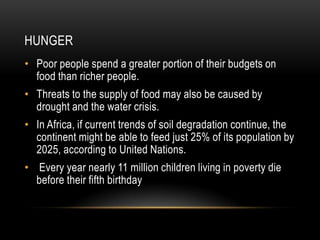
HUNGER
• Poor people spend a greater portion of their budgets on
  food than richer people.
• Threats to the supply of food may also be caused by
  drought and the water crisis.
• In Africa, if current trends of soil degradation continue, the
  continent might be able to feed just 25% of its population by
  2025, according to United Nations.
• Every year nearly 11 million children living in poverty die
  before their fifth birthday
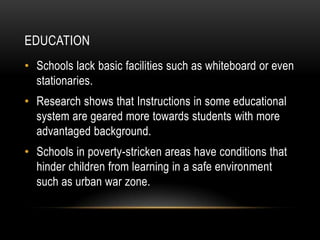
EDUCATION
• Schools lack basic facilities such as whiteboard or even
  stationaries.
• Research shows that Instructions in some educational
  system are geared more towards students with more
  advantaged background.
• Schools in poverty-stricken areas have conditions that
  hinder children from learning in a safe environment
  such as urban war zone.
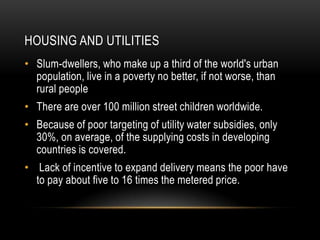
HOUSING AND UTILITIES
• Slum-dwellers, who make up a third of the world's urban
  population, live in a poverty no better, if not worse, than
  rural people
• There are over 100 million street children worldwide.
• Because of poor targeting of utility water subsidies, only
  30%, on average, of the supplying costs in developing
  countries is covered.
• Lack of incentive to expand delivery means the poor have
  to pay about five to 16 times the metered price.
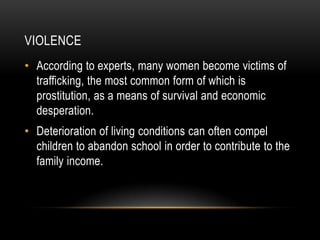
VIOLENCE
• According to experts, many women become victims of
  trafficking, the most common form of which is
  prostitution, as a means of survival and economic
  desperation.
• Deterioration of living conditions can often compel
  children to abandon school in order to contribute to the
  family income.
HOW CAN WE HELP?
•   Everyone should put in an effort and make donations to charity or organisations.
•   We can spread the message to everyone through different aspects of mass media.
•   Join one of the organisations and understand poverty more through it.

STOP poverty!

  • 1.
    POVERTY Done by:SGT Lester Ye Ge CPL Sean Lee CPL Toh Chin Howe LCP Jorim Jireh
  • 2.
    INTRODUCTION TO POVERTY •Definition: Poverty is the state of one who lacks a certain amount of material possessions or money. • In developing countries, it is known as destitution. • Destitution: the deprivation of basic human needs, which commonly includes food, water, sanitation, clothing, shelter, health care and education • 98% of the world’s undernourished people live in developing countries where poverty occurs.
  • 3.
    PROBLEMS FACED BYTHE POOR • Health issues • Hunger issues • Education issues • Housing and utilities issues • Violence issues
  • 4.
    HEALTH • One thirdof deaths – some 18 million people a year or 50,000 per day – are due to poverty-related causes. • According to the World Health Organization, hunger and malnutrition are the single gravest threats to the world's public health. • Malnutrition is by far the biggest contributor to child mortality. • Infectious diseases such as malaria and tuberculosis can perpetuate poverty by diverting health and economic resources from investment and productivity.
  • 5.
    HUNGER • Poor peoplespend a greater portion of their budgets on food than richer people. • Threats to the supply of food may also be caused by drought and the water crisis. • In Africa, if current trends of soil degradation continue, the continent might be able to feed just 25% of its population by 2025, according to United Nations. • Every year nearly 11 million children living in poverty die before their fifth birthday
  • 6.
    EDUCATION • Schools lackbasic facilities such as whiteboard or even stationaries. • Research shows that Instructions in some educational system are geared more towards students with more advantaged background. • Schools in poverty-stricken areas have conditions that hinder children from learning in a safe environment such as urban war zone.
  • 7.
    HOUSING AND UTILITIES •Slum-dwellers, who make up a third of the world's urban population, live in a poverty no better, if not worse, than rural people • There are over 100 million street children worldwide. • Because of poor targeting of utility water subsidies, only 30%, on average, of the supplying costs in developing countries is covered. • Lack of incentive to expand delivery means the poor have to pay about five to 16 times the metered price.
  • 8.
    VIOLENCE • According toexperts, many women become victims of trafficking, the most common form of which is prostitution, as a means of survival and economic desperation. • Deterioration of living conditions can often compel children to abandon school in order to contribute to the family income.
  • 9.
    HOW CAN WEHELP? • Everyone should put in an effort and make donations to charity or organisations. • We can spread the message to everyone through different aspects of mass media. • Join one of the organisations and understand poverty more through it.