BASKETBALL

         LEE CHOON WEE
         A125497
         F.PENDIDIKAN
         SUKAN DAN REKREASI
~HISTORY OF BASKETBALL~
 Basketball was invented in December 1891 by the
  Canadian-American clergyman, educator, and
  physician James Naismith, then an instructor at the
  Young Men’s Christian Association Training School
  (now Springfield College) in Springfield, Mass.
 At first, James Naismith wrote the basic rules and
  nailed a peach basket onto a 10-foot (3.05 m)
  elevated track. The ball that used in early stage
  was football. A team would gain a point when the
  person got the ball in the basket.
Continue~~

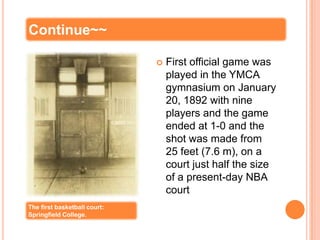
                                 First official game was
                                  played in the YMCA
                                  gymnasium on January
                                  20, 1892 with nine
                                  players and the game
                                  ended at 1-0 and the
                                  shot was made from
                                  25 feet (7.6 m), on a
                                  court just half the size
                                  of a present-day NBA
                                  court
The first basketball court:
Springfield College.
CONTINUE~~
 Women's basketball began in 1892 at Smith
  College when Senda Berenson, a physical
  education teacher, modified Naismith's rules for
  women.
 In 1959, a basketball Hall of Fame was founded in
  Springfield, Massachusetts. Its rosters include the
  names of great players, coaches, referees and
  people who have contributed significantly to the
  development of the game.
 first balls made specifically for basketball were
  brown, and it was only in the late 1950s that Tony
  Hinkle, then modified to orange ball.
BASKETBALL TODAY~~
      (PLAYING REGULATIONS)
   Games are played in four quarters of 10 (international) or 12
    minutes (NBA).
   Five players from each team (out of a twelve player roster)
    may be on the court at one time. Substitutions are unlimited
    but can only be done when play is stopped and coach are
    required.
   A standard uniform consists of a pair of shorts and a jersey
    with a clearly visible number, printed on both the front and
    back.
   A limited number of time-outs, clock stoppages requested by a
    coach for a short meeting with the players, are allowed.
   The game is controlled by the officials consisting of the
    referee, one or two umpires and the table officials.
BASKETBALL TODAY~~
(EQUIPMENT)
 The only essential equipment in basketball is the
  basketball and the court: a flat, rectangular surface
  with baskets at opposite ends.
 Clocks, score sheets, scoreboard(s), alternating
  possession arrows, and whistle-operated stop-clock
  systems are required.
 A regulation basketball court in international games
  is 28 by 15 meters (approx. 92 by 49 ft) and in the
  NBA is 94 by 50 feet (29 by 15 m). Most courts are
  made of wood. A steel basket with net and
  backboard hang over each end of the court. At
  almost all levels of competition, the top of the rim is
  exactly 10 feet (3.05 m) above the court and 4 feet
  (1.2 m) inside the baseline.
BASKETBALL TODAY~~
(FOULS)
   An attempt to unfairly disadvantage an opponent
    through physical contact is illegal and is called a foul.
   A player or coach who shows poor sportsmanship, for
    instance, by arguing with a referee or by fighting with
    another player, can be charged with a more serious foul
    called a technical foul.
   If a team exceeds a certain limit of team fouls in a given
    period (quarter or half) – four for NBA and international
    games – the opposing team is awarded one or two free
    throws on all subsequent fouls for that period.
   Commits five fouls (including technical fouls), or in an
    NBA game, commits six fouls (excluding technical fouls)
    is not allowed to participate for the rest of the game, and
    is said to have "fouled out".
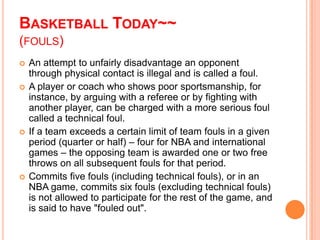
The referee signals that a foul has
been committed.


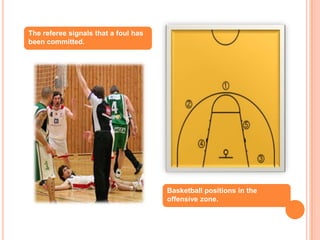
                                      Basketball positions in the
                                      offensive zone.
BASKETBALL TODAY~~
(POSITIONS AND STRUCTURES)
o   During the first five decades of basketball's
    evolution, one guard, two forwards, and two centers
    or two guards, two forwards, and one center were
    used. Since the 1980s, more specific positions
    have evolved, namely:
o   Point guard
o   Shooting guard
o   Small forward
o   Power forward
o   Center
BASKETBALL TODAY~~
(COMMON AND BASIC TECHNIQUES)
    1) SHOOTING
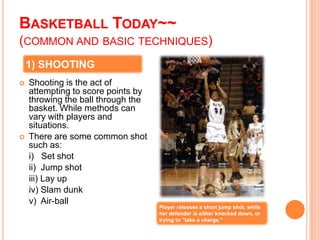
   Shooting is the act of
    attempting to score points by
    throwing the ball through the
    basket. While methods can
    vary with players and
    situations.
   There are some common shot
    such as:
    i) Set shot
    ii) Jump shot
    iii) Lay up
    iv) Slam dunk
    v) Air-ball
                                    Player releases a short jump shot, while
                                    her defender is either knocked down, or
                                    trying to "take a charge."
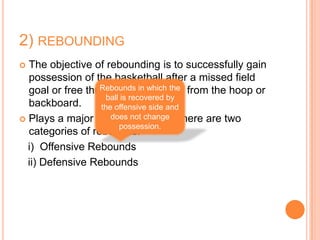
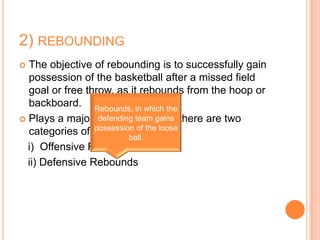
2) REBOUNDING
 The objective of rebounding is to successfully gain
  possession of the basketball after a missed field
  goal or free throw, as it rebounds from the hoop or
  backboard.
 Plays a major role in the game, there are two
  categories of rebounds:
  i) Offensive Rebounds
  ii) Defensive Rebounds
3) PASSING
 A pass is a method of moving the ball between
  players.
 A staple pass is the chest pass. Another type of
  pass is the bounce pass.
 The overhead pass is used to pass the ball over a
  defender.
 The outlet pass occurs after a team gets a
  defensive rebound. The next pass after the rebound
  is the outlet pass.
 Another advanced style of passing is the behind-
  the-back pass, throwing the ball behind the
  passer's back to a teammate.
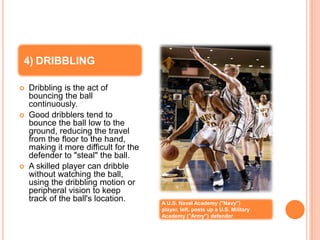
4) DRIBBLING

   Dribbling is the act of
    bouncing the ball
    continuously.
   Good dribblers tend to
    bounce the ball low to the
    ground, reducing the travel
    from the floor to the hand,
    making it more difficult for the
    defender to "steal" the ball.
   A skilled player can dribble
    without watching the ball,
    using the dribbling motion or
    peripheral vision to keep
    track of the ball's location.      A U.S. Naval Academy ("Navy")
                                       player, left, posts up a U.S. Military
                                       Academy ("Army") defender
5) BLOCKING
 A block is performed when, after a shot is
  attempted, a defender attempts to alter the shot by
  touching the ball.
 In almost all variants of play, it is illegal to touch the
  ball after it is in the downward part of its arc; this is
  known as goaltending.
 With good timing and sufficient vertical leap, even
  shorter players can be effective at blocking shots.
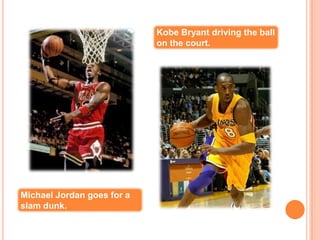
Kobe Bryant driving the ball
                            on the court.


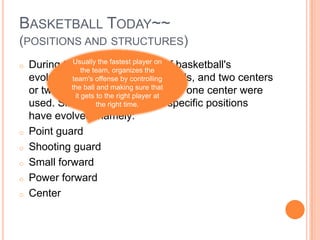
Michael Jordan goes for a
slam dunk.
THE END
BASKETBALL TODAY~~
(POSITIONS AND STRUCTURES)
o   During the the team,fastest player on of basketball's
              Usually the
                  first five decades
                             organizes the
    evolution,team's offense by controlling
                one guard, two forwards, and two centers
    or two guards,to the right playerthat and one center were
             the ball and making sure
               it gets
                        two forwards,     at
    used. Since the 1980s, more specific positions
                       the right time.
    have evolved, namely:
o   Point guard
o   Shooting guard
o   Small forward
o   Power forward
o   Center
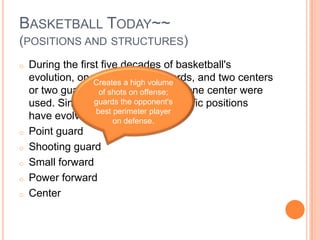
BASKETBALL TODAY~~
(POSITIONS AND STRUCTURES)
o   During the first five decades of basketball's
    evolution, oneCreates a high volume
                    guard, two forwards, and two centers
    or two guards, of shots on offense;
                    two forwards, and one center were
                   guards the opponent's
    used. Since the 1980s, more specific positions
    have evolved, best on defense.
                    namely: player
                        perimeter

o   Point guard
o   Shooting guard
o   Small forward
o   Power forward
o   Center
BASKETBALL TODAY~~
(POSITIONS AND STRUCTURES)
o   During the first five decades of basketball's
    evolution, one guard, two forwards, and two centers
    or two guards, two forwards, and one center were
    used. Since the 1980s, more specific positions
    have evolved, namely:
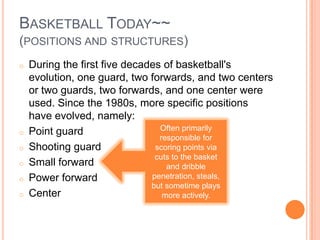
o   Point guard                  Often primarily
                                 responsible for
o   Shooting guard              scoring points via
                                cuts to the basket
o   Small forward                  and dribble
o   Power forward              penetration, steals,
                               but sometime plays
o   Center                        more actively.
BASKETBALL TODAY~~
(POSITIONS AND STRUCTURES)
o   During the first five decades of basketball's
    evolution, one guard, two forwards, and two centers
    or two guards, two forwards, and one center were
    used. Since the 1980s, more specific positions
    have evolved, namely:
o   Point guard
o   Shooting guard
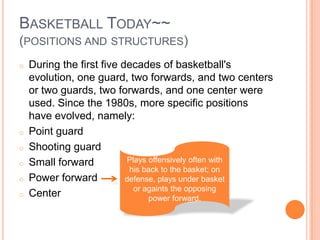
o   Small forward          Plays offensively often with
                            his back to the basket; on
o   Power forward          defense, plays under basket
                             or againts the opposing
o   Center                       power forward.
BASKETBALL TODAY~~
(POSITIONS AND STRUCTURES)
o   During the first five decades of basketball's
    evolution, one guard, two forwards, and two centers
    or two guards, two forwards, and one center were
    used. Since the 1980s, more specific positions
    have evolved, namely:
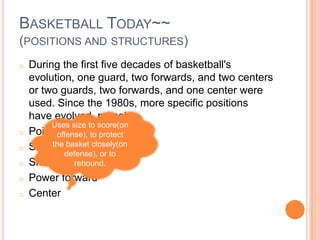
         Uses size to score(on
o   Point guard to protect
          offense),
o        the basket closely(on
    Shooting guard
            defense), or to
o   Small forward
               rebound.
o   Power forward
o   Center
2) REBOUNDING
 The objective of rebounding is to successfully gain
  possession of the basketball after a missed field
  goal or free throw, as it in which the from the hoop or
                  Rebounds rebounds
                    ball is recovered by
  backboard.       the offensive side and
 Plays a major role in thechange there are two
                      does not game,
                        possession.
  categories of rebounds:
  i) Offensive Rebounds
  ii) Defensive Rebounds
2) REBOUNDING
 The objective of rebounding is to successfully gain
  possession of the basketball after a missed field
  goal or free throw, as it rebounds from the hoop or
  backboard. Rebounds, in which the
 Plays a major role in the game, there are two
                  defending team gains
  categories of rebounds: the loose
                 possession of
                          ball.
  i) Offensive Rebounds
  ii) Defensive Rebounds

Basketball(Editted)

  • 1.
    BASKETBALL LEE CHOON WEE A125497 F.PENDIDIKAN SUKAN DAN REKREASI
  • 2.
    ~HISTORY OF BASKETBALL~ Basketball was invented in December 1891 by the Canadian-American clergyman, educator, and physician James Naismith, then an instructor at the Young Men’s Christian Association Training School (now Springfield College) in Springfield, Mass.  At first, James Naismith wrote the basic rules and nailed a peach basket onto a 10-foot (3.05 m) elevated track. The ball that used in early stage was football. A team would gain a point when the person got the ball in the basket.
  • 3.
    Continue~~  First official game was played in the YMCA gymnasium on January 20, 1892 with nine players and the game ended at 1-0 and the shot was made from 25 feet (7.6 m), on a court just half the size of a present-day NBA court The first basketball court: Springfield College.
  • 4.
    CONTINUE~~  Women's basketballbegan in 1892 at Smith College when Senda Berenson, a physical education teacher, modified Naismith's rules for women.  In 1959, a basketball Hall of Fame was founded in Springfield, Massachusetts. Its rosters include the names of great players, coaches, referees and people who have contributed significantly to the development of the game.  first balls made specifically for basketball were brown, and it was only in the late 1950s that Tony Hinkle, then modified to orange ball.
  • 5.
    BASKETBALL TODAY~~ (PLAYING REGULATIONS)  Games are played in four quarters of 10 (international) or 12 minutes (NBA).  Five players from each team (out of a twelve player roster) may be on the court at one time. Substitutions are unlimited but can only be done when play is stopped and coach are required.  A standard uniform consists of a pair of shorts and a jersey with a clearly visible number, printed on both the front and back.  A limited number of time-outs, clock stoppages requested by a coach for a short meeting with the players, are allowed.  The game is controlled by the officials consisting of the referee, one or two umpires and the table officials.
  • 6.
    BASKETBALL TODAY~~ (EQUIPMENT)  Theonly essential equipment in basketball is the basketball and the court: a flat, rectangular surface with baskets at opposite ends.  Clocks, score sheets, scoreboard(s), alternating possession arrows, and whistle-operated stop-clock systems are required.  A regulation basketball court in international games is 28 by 15 meters (approx. 92 by 49 ft) and in the NBA is 94 by 50 feet (29 by 15 m). Most courts are made of wood. A steel basket with net and backboard hang over each end of the court. At almost all levels of competition, the top of the rim is exactly 10 feet (3.05 m) above the court and 4 feet (1.2 m) inside the baseline.
  • 7.
    BASKETBALL TODAY~~ (FOULS)  An attempt to unfairly disadvantage an opponent through physical contact is illegal and is called a foul.  A player or coach who shows poor sportsmanship, for instance, by arguing with a referee or by fighting with another player, can be charged with a more serious foul called a technical foul.  If a team exceeds a certain limit of team fouls in a given period (quarter or half) – four for NBA and international games – the opposing team is awarded one or two free throws on all subsequent fouls for that period.  Commits five fouls (including technical fouls), or in an NBA game, commits six fouls (excluding technical fouls) is not allowed to participate for the rest of the game, and is said to have "fouled out".
  • 8.
    The referee signalsthat a foul has been committed. Basketball positions in the offensive zone.
  • 9.
    BASKETBALL TODAY~~ (POSITIONS ANDSTRUCTURES) o During the first five decades of basketball's evolution, one guard, two forwards, and two centers or two guards, two forwards, and one center were used. Since the 1980s, more specific positions have evolved, namely: o Point guard o Shooting guard o Small forward o Power forward o Center
  • 10.
    BASKETBALL TODAY~~ (COMMON ANDBASIC TECHNIQUES) 1) SHOOTING  Shooting is the act of attempting to score points by throwing the ball through the basket. While methods can vary with players and situations.  There are some common shot such as: i) Set shot ii) Jump shot iii) Lay up iv) Slam dunk v) Air-ball Player releases a short jump shot, while her defender is either knocked down, or trying to "take a charge."
  • 11.
    2) REBOUNDING  Theobjective of rebounding is to successfully gain possession of the basketball after a missed field goal or free throw, as it rebounds from the hoop or backboard.  Plays a major role in the game, there are two categories of rebounds: i) Offensive Rebounds ii) Defensive Rebounds
  • 12.
    3) PASSING  Apass is a method of moving the ball between players.  A staple pass is the chest pass. Another type of pass is the bounce pass.  The overhead pass is used to pass the ball over a defender.  The outlet pass occurs after a team gets a defensive rebound. The next pass after the rebound is the outlet pass.  Another advanced style of passing is the behind- the-back pass, throwing the ball behind the passer's back to a teammate.
  • 13.
    4) DRIBBLING  Dribbling is the act of bouncing the ball continuously.  Good dribblers tend to bounce the ball low to the ground, reducing the travel from the floor to the hand, making it more difficult for the defender to "steal" the ball.  A skilled player can dribble without watching the ball, using the dribbling motion or peripheral vision to keep track of the ball's location. A U.S. Naval Academy ("Navy") player, left, posts up a U.S. Military Academy ("Army") defender
  • 14.
    5) BLOCKING  Ablock is performed when, after a shot is attempted, a defender attempts to alter the shot by touching the ball.  In almost all variants of play, it is illegal to touch the ball after it is in the downward part of its arc; this is known as goaltending.  With good timing and sufficient vertical leap, even shorter players can be effective at blocking shots.
  • 15.
    Kobe Bryant drivingthe ball on the court. Michael Jordan goes for a slam dunk.
  • 16.
  • 17.
    BASKETBALL TODAY~~ (POSITIONS ANDSTRUCTURES) o During the the team,fastest player on of basketball's Usually the first five decades organizes the evolution,team's offense by controlling one guard, two forwards, and two centers or two guards,to the right playerthat and one center were the ball and making sure it gets two forwards, at used. Since the 1980s, more specific positions the right time. have evolved, namely: o Point guard o Shooting guard o Small forward o Power forward o Center
  • 18.
    BASKETBALL TODAY~~ (POSITIONS ANDSTRUCTURES) o During the first five decades of basketball's evolution, oneCreates a high volume guard, two forwards, and two centers or two guards, of shots on offense; two forwards, and one center were guards the opponent's used. Since the 1980s, more specific positions have evolved, best on defense. namely: player perimeter o Point guard o Shooting guard o Small forward o Power forward o Center
  • 19.
    BASKETBALL TODAY~~ (POSITIONS ANDSTRUCTURES) o During the first five decades of basketball's evolution, one guard, two forwards, and two centers or two guards, two forwards, and one center were used. Since the 1980s, more specific positions have evolved, namely: o Point guard Often primarily responsible for o Shooting guard scoring points via cuts to the basket o Small forward and dribble o Power forward penetration, steals, but sometime plays o Center more actively.
  • 20.
    BASKETBALL TODAY~~ (POSITIONS ANDSTRUCTURES) o During the first five decades of basketball's evolution, one guard, two forwards, and two centers or two guards, two forwards, and one center were used. Since the 1980s, more specific positions have evolved, namely: o Point guard o Shooting guard o Small forward Plays offensively often with his back to the basket; on o Power forward defense, plays under basket or againts the opposing o Center power forward.
  • 21.
    BASKETBALL TODAY~~ (POSITIONS ANDSTRUCTURES) o During the first five decades of basketball's evolution, one guard, two forwards, and two centers or two guards, two forwards, and one center were used. Since the 1980s, more specific positions have evolved, namely: Uses size to score(on o Point guard to protect offense), o the basket closely(on Shooting guard defense), or to o Small forward rebound. o Power forward o Center
  • 22.
    2) REBOUNDING  Theobjective of rebounding is to successfully gain possession of the basketball after a missed field goal or free throw, as it in which the from the hoop or Rebounds rebounds ball is recovered by backboard. the offensive side and  Plays a major role in thechange there are two does not game, possession. categories of rebounds: i) Offensive Rebounds ii) Defensive Rebounds
  • 23.
    2) REBOUNDING  Theobjective of rebounding is to successfully gain possession of the basketball after a missed field goal or free throw, as it rebounds from the hoop or backboard. Rebounds, in which the  Plays a major role in the game, there are two defending team gains categories of rebounds: the loose possession of ball. i) Offensive Rebounds ii) Defensive Rebounds